Article

Seed Germination Traits and High-Temperature Tolerance of Three Species from Xishuangbanna, SW China


CAS Key Laboratory of Tropical Plant Resources and Sustainable Use, Xishuangbanna Tropical Botanical Garden, Chinese Academy of Sciences, Mengla 666303, China
*
Authors to whom correspondence should be addressed.
Seeds 2026, 5(4), 45; https://doi.org/10.3390/seeds5040045
Submission received: 21 May 2026 / Revised: 29 July 2026 / Accepted: 31 July 2026 / Published: 4 August 2026

Abstract

Germination traits and high-temperature tolerance are critical seed traits for species to respond to habitat changes through seed germination and population dynamics in tropical areas. This study investigated germination under temperature, water and NaCl stress and the seed high-temperature tolerance of three species growing in Xishuangbanna, i.e., one native vine species, Clematis subumbellata, and two introduced tree species, Handroanthus chrysanthus and Melaleuca viminalis. The results were compared with our previous studies in this region to assess the threatened status of C. subumbellata and invasion risk of H. chrysanthus and M. viminalis, in combination with their other traits. These three species are all characterized by the production of numerous small seeds with high viability every year, having the ability to increase their population rapidly under favorable conditions, though they all suffered viability loss and germination inhibition under high temperature and water stresses. The two introduced species, both H. chrysanthus and M. viminalis, produced seeds with wider germination temperature ranges and better high-temperature tolerance than the native C. subumbellata, but their seed heat tolerance was markedly lower than that of typical invasive weeds in this region. On the contrary, C. subumbellata seeds exhibited rather poor high-temperature tolerance, comparable to some rare and endangered species reported previously in the region; however, this species primarily grows on forest margins, slopes, and scrub and produces plumose achenes with good wind dispersal capacity. Thus, it was concluded that H. chrysanthus and M. viminalis may possess only low-to-moderate invasion risks, and their most probable invasive habitats are mainly forest edges. C. subumbellata can be regarded as not threatened currently, without urgent conservation demand. This information is useful for biodiversity conservation in Xishuangbanna.

1. Introduction

The seed is the propagation organ of seed plants and usually also the dispersal unit or its main component. For the vast majority of seed plants, the seed is the only mobile stage in their life cycle [1]. A mature seed generally consists of three parts, the embryo (a miniature plant), nutrient reserves (present as endosperm and/or stored in cotyledons), and protective tissues, with appendages in some species, which are usually dispersal devices, such as wings, plumes, hooks, arils, and buoyant structures [2]. The development of the seed habit makes water unnecessary for fertilization and enables seed plants to colonize dry terrestrial habitats where spore plants are unable to establish themselves. Compared with spores, most seeds not only possess a rudimentary plant structure but also contain abundant nutrient reserves obtained from the mother plant, providing energy and materials for germination and early seedling growth. Additionally, the seed coat offers more comprehensive protection and dispersal ability; in some species, the fruit coat, and even the endosperm, supports or provides a substitute for this role. These characteristics greatly preserve seed viability, facilitate dispersal, and promote seedling establishment. Thus, the emergence of seeds is one of the most significant advances in plant evolution, conferring unparalleled advantages upon seed plants. This led to their unprecedented prosperity, allowing them to replace spore plants as the most dominant taxa of plants on Earth [2,3].
A seed is produced to germinate and regenerate into a new plant. Successful germination results from the interaction between the seed and its habitat [4,5,6]. On the one hand, it depends on intrinsic properties, namely the seed’s own nature, such as seed quality (including viability and vigor) and traits (including tolerance, longevity, dormancy, and germination requirements). On the other hand, it relies on extrinsic factors or environmental conditions, such as temperature, water, light, and pH [2,3]. After maturation, seeds generally do not germinate immediately. They usually undergo primary dispersal and sometimes secondary dispersal; even after reaching their destination, they do not germinate until environmental conditions become suitable for seedling growth [4,6,7]. During the period between detachment from the mother plants and germination, seeds may be exposed to various stresses, such as extreme temperatures and desiccation.
Seed traits and germination requirements result from the long-term adaptation of species to their native habitats and represent an important aspect of plant survival strategies [3]. Terrestrial habitats exhibit high environmental variability, and plants inhabit diverse environments according to their habituation; in turn, plants modify their surroundings, further increasing habitat diversity. Seeds of different plant species have distinct germination requirements and vary widely in stress tolerance, often to a considerable degree [3]. Therefore, studies on seed tolerance and germination traits have emerged as an important tool for the conservation of plant diversity [8], which help us to understand plant adaptation to their natural habitat, accumulate basic data, and provide guidance for plant propagation and seedling production. At the same time, since seed germination is the basis of plant population dynamics, it can help us to predict trends in plant population dynamics under global change, which is of particularly important ecological significance [9].
Native plant endangerment and alien plant invasions are two major challenges to the conservation of plant diversity, both of which are particularly pronounced in tropical regions [10]. Xishuangbanna, located on the edge of the tropics, is included in the Indo-Burma biodiversity hotspots [11]. It has a typical tropical monsoon climate with distinct rainy and dry seasons, as well as abundant plant species, diverse vegetation types, and significant botanical diversity, where high temperatures, low temperatures, and droughts can all impose stress or even damage on plants. It is estimated that over the past 60 years, the rainforest area in Xishuangbanna has decreased by nearly half, and forest coverage has declined from 55% in the early 1950s to less than 30% nowadays because of changes in land use, with more than 15% of the regional flora being threatened species [12,13]. Meanwhile, Xishuangbanna is also a region severely suffering from biological invasions [14]. Identifying which plant species are under threat and which plant species are potential invaders is crucial for the conservation of plant diversity in Xishuangbanna. Taking seeds of three tropical plant species growing in Xishuangbanna, i.e., Clematis subumbellata (native), Handroanthus chrysanthus, and Melaleuca viminalis (both introduced), as experimental materials, this study investigated their seed germination traits and high-temperature tolerance and compared the results with our previous reports. On the one hand, this can provide guidance for the propagation and seedling production of these three species. On the other hand, this can help us to predict the responses of these species to global change and offer a reference for biodiversity conservation in Xishuangbanna.

2. Materials and Methods

2.1. Plant Species and Seed Sources

Clematis subumbellata Kurz (Ranunculaceae) is a medicinal plant native to Xishuangbanna growing on forest margins, slopes, and scrub and also planted as ornamental garden plants in Xishuangbanna. Handroanthus chrysanthus (Jacq.) S.O. Grose (Bignoniaceae) is native to America, and Melaleuca viminalis (Sol. ex Gaertn.) Byrnes (Myrtaceae) is native to Australia; these two species have been introduced into Xishuangbanna and cultivated as ornamental plants there.
The seeds of these three species used in this study were collected from plants growing in Xishuangbana Tropical Botanical Garden, in Menglun, Mengla, South Yunnan, SW China. These plants produce numerous small seeds with high viability every year according to our observation. After natural shedding began, fruits were harvested from as many plants as possible. The seeds were removed manually from fruits and air-dried under ambient conditions. For convenience, C. subumbellata achenes are referred to as seeds in this paper. The thousand-seed weight (10 replicates of 100 seeds), initial moisture content (eight replicates used, dried at 103 °C for ≥17 h, expressed on a fresh basis), and viability (germination test used) were determined. The remaining seeds were stored in a dry room set at 15 °C and 50% relative humidity for no more than half a year before use.

2.2. Germination Test and Seed Viability Assessment

Unless otherwise specified, seed viability was assessed using the following germination method: seeds were sown on 1% agar medium (agar:water, w/v) (ChembaseBio, Beijing, China), with 50 seeds (for C. subumbellata and M. viminalis) or 20 seeds (for H. chrysanthus only) per Petri dish × six replicates per treatment used. The dishes with seeds were placed in an incubator set at 30 °C with light provided by white fluorescent lamps. Germination was scored once a week. A seed was considered germinated (in germination experiments) or survived (in stress experiments) when the radicle emerged to approximately 0.2 cm long, and the formation of morphologically normal seedlings was observed. The germination experiments lasted about six weeks. At the end of the experiment, non-germinated seeds were checked for decay.

2.3. Effects of Incubation Temperature on Seed Germination

To investigate the effects of incubation temperatures on seed germination, seeds were first sown in Petri dishes containing 1% agar. These dishes were then randomly assigned to incubators set at 10 °C, 15 °C, 20 °C, 25 °C, 30 °C, 35 °C, and 40 °C, plus an alternating temperature regime of 30 °C/20 °C (12 h/12 h) for incubation, with germination scored regularly.

2.4. Effects of Daily Periodic High Temperature on Seed Germination

This experiment was conducted following the method reported previously [15]. Briefly, seeds were sown in Petri dishes containing 1% agar first, and then seeds in these dishes were alternately incubated between two incubators set at 40 °C and 30 °C with light daily. Different treatments were established based on the daily duration of exposure to 40 °C, e.g., 3 h heating means 3 h at 40 °C followed by 21 h at 30 °C. Nine high-temperature durations were set in this study, i.e., 0, 3, 6, 9, 12, 15, 18, 21, and 24 h.

2.5. Effects of Continuous High Temperature on Seed Viability

A constant temperature of 40 °C was used as the treatment temperature. Seeds were sown in Petri dishes containing 1% agar first and then placed in an incubator at 40 °C with light for a set continuous period. After heating for the target period of time, the seeds were transferred to an incubator at 30 °C with light to assess changes in seed viability. Twelve treatment durations were used, i.e., 0, 1, 2, 3, 4, 5, 6, 7, 8, 10, 12, and 15 d.

2.6. Tolerance of Quiescent Seeds to Extreme High Temperature

Seeds in two hydration statuses were employed in this experiment, i.e., air-dry and imbibed. A water bath was used to provide high-temperature regimes ranging from 30 to 95 °C. Specifically, two large triangular flasks were used, each containing 300 seeds (for C. subumbellata and M. viminalis) or 120 seeds (for H. chrysanthus only) spread in a monolayer on the bottom to ensure uniform heating. Prior to heating, a small amount of pure water was added to one flask to make the seeds imbibed, while seeds in the other flask were kept dry. These flasks were capped during heating and removed after being treated at the set temperature for 30 min, with seeds sown immediately to test viability.

2.7. Effects of Water Stress on Seed Germination

To investigate the effects of water stress on seed germination, test solutions with water potentials ranging from −0.1 to −1.5 MPa were prepared using PEG 8000 (neoFroxx, Einhausen, Germany) according to the method of Michel [16], with deionized water (0 MPa) as the control. Seeds were placed in dishes lined with two layers of filter paper, which were moistened with the test solution, and incubated at 25 °C. To minimize changes in water potential during the experiment, Petri dishes for the same treatment were sealed in a resealable double-clear plastic bag. Filter paper and test solutions were refreshed twice a week, with germination scored simultaneously. After incubation for four weeks at least, the ungerminated seeds were removed from stress and subjected to another two weeks’ incubation on filter paper moistened with deionized water.

2.8. Effects of NaCl Stress on Seed Germination

According to the method of Lang [17], test solutions with water potentials ranging from −0.1 to −1.5 MPa were prepared using NaCl, with other details following those described above for the water stress experiment.

2.9. Data Statistics and Analysis

Germination percentage (for germination experiments), survival percentage (for stress experiments), and seedling percentage were calculated, which were subjected to an analysis of variance (ANOVA) using a generalized linear model (GLM) as dependent variables separately after arcsine-square-root transformation, with all environmental factors treated as fixed effects, and interactions between factors were also evaluated. A post hoc comparison was performed when necessary. Untransformed data were presented as means ± SE based on six replicates of 50 seeds (for C. subumbellata and M. viminalis) or 20 (for H. chrysanthus) seeds. All analyses were carried out using SPSS 17.0 for Windows (SPSS Inc, Chicago, IL, USA).

3. Results

3.1. Initial Seed Traits

Generally speaking, the three species studied produce small seeds, with a 100-seed weight ranging from 0.017 to 1.692 g. The air-dried seeds had moisture contents of ca. 15% and high initial viability > 75% for H. chrysanthus and >90% for both C. subumbellata and M. viminalis (Table 1).

3.2. Effect of Incubation Temperature on Seed Germination

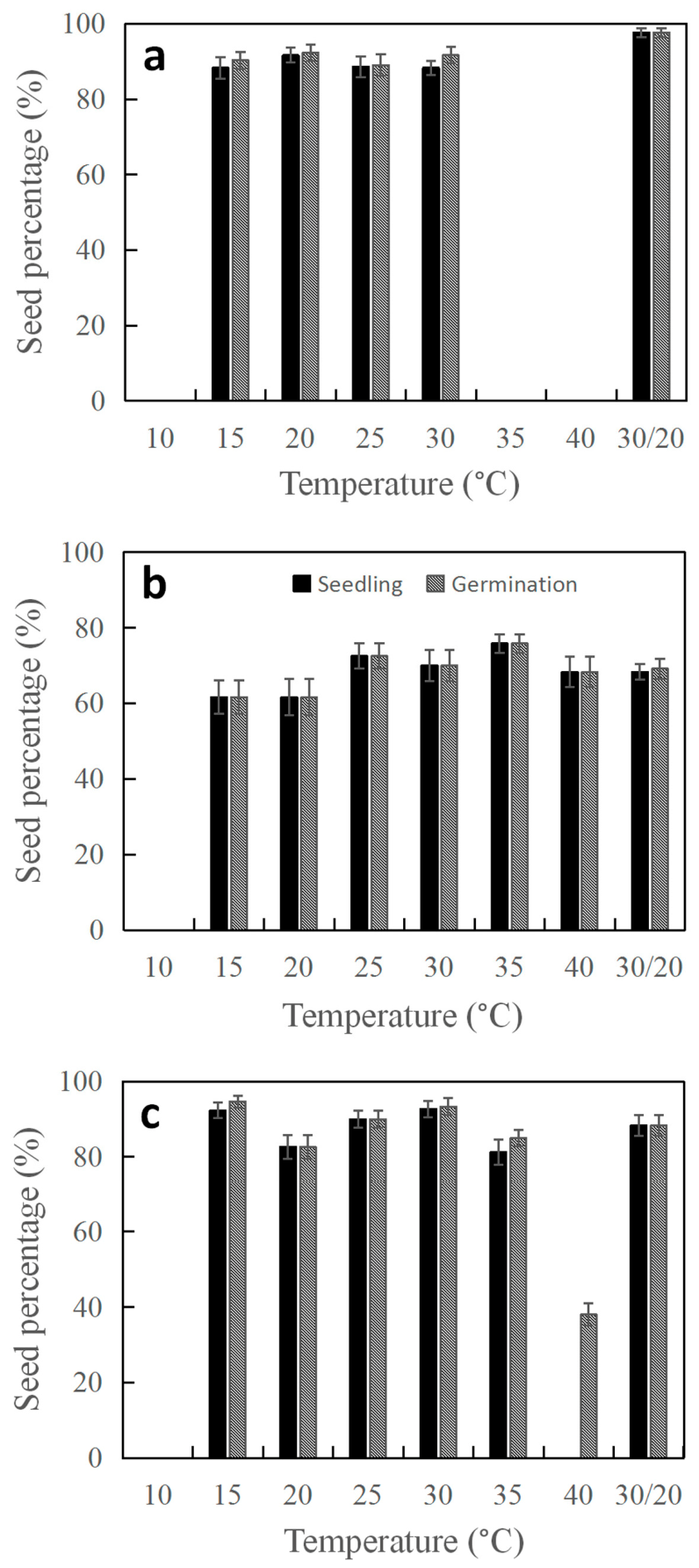
Both species and incubation temperature had significant effects on seed germination (p < 0.001 for all, Table S1). In the range of 15–30 °C, these three species all had a high degree of germination, but none of them germinated at 10 °C. Among them, H. chrysanthus had the widest germination temperature range, which germinated at 40 °C, with a seedling percentage of around 70%. About 40% M. viminalis seeds germinated, but no seedlings formed at 40 °C. At 35 °C, M. viminalis had more than 80% seedling percentage, while no C. subumbellata seeds germinated (Figure 1).
Meanwhile, seeds incubated under the alternative temperature regime had good germination also, comparable to that at 25 °C and 30 °C, with only a little more or less observed. At 25 °C, these seeds germinated quickly without any pre-treatment required, with a mean germination time of 27.3, 7, and 10.8 d for C. subumbellata, H. chrysanthus, and M. viminalis, respectively.

3.3. Effects of Periodic High Temperature on Seed Germination

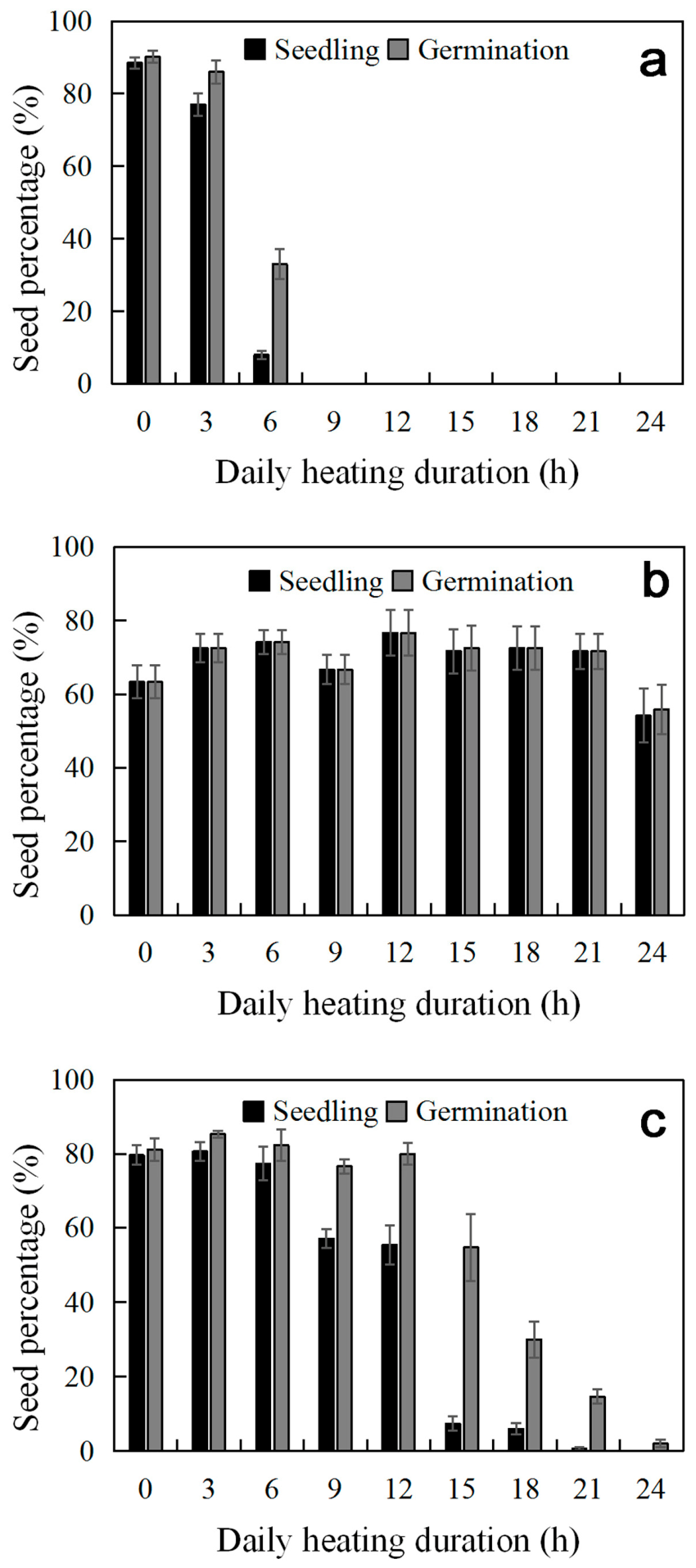
The three species studied exhibited significant differences in tolerance to daily periodic heating (p < 0.001 for all, Table S1). In this experiment, H. chrysanthus seeds had the strongest high-temperature tolerance, for about 55% of them germinated and grew into seedlings in the daily 24 h regime at 40 °C. The second was M. viminalis. With an increase in heating duration at 40 °C per day, M. viminalis seeds showed decreased germination and seedling percentage gradually, until 21 h per day; only a small part (20%) of the seeds germinated; and nearly no seedlings formed. C. subumbellata seeds had the worst high-temperature tolerance, for there was no germination when daily heating duration exceeded 6 h (Figure 2).

3.4. Effects of Continuous High-Temperature Treatment on Seed Viability

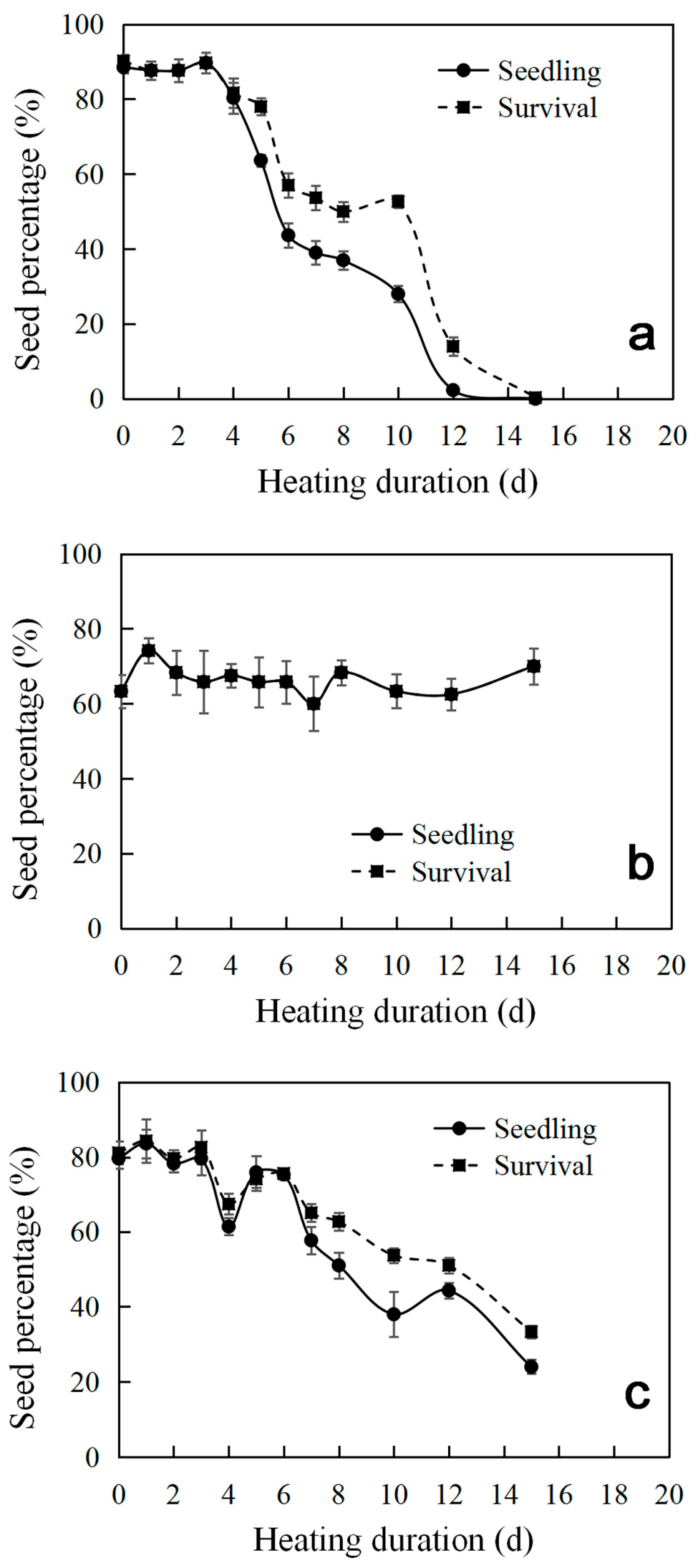
Assessed on the changes in seed viability after continuous heating, the three species studied had significant differences in seed high-temperature tolerance (p < 0.001 for all, Table S1). After 5 days of heating, C. subumbellata seeds showed evidently decreased seedling percentage. After 12 days, only about 20% of them survived, and nearly no seedlings formed. With an increase in heating time, M. viminalis seeds lost viability linearly, with only ca. 30% survival percentage and 20% seedling percentage on the 15th day. H. chrysanthus seeds had the strongest high-temperature tolerance, without viability loss detected during this experiment (Figure 3).

3.5. Tolerance of Quiescent Seeds to Extreme High Temperature

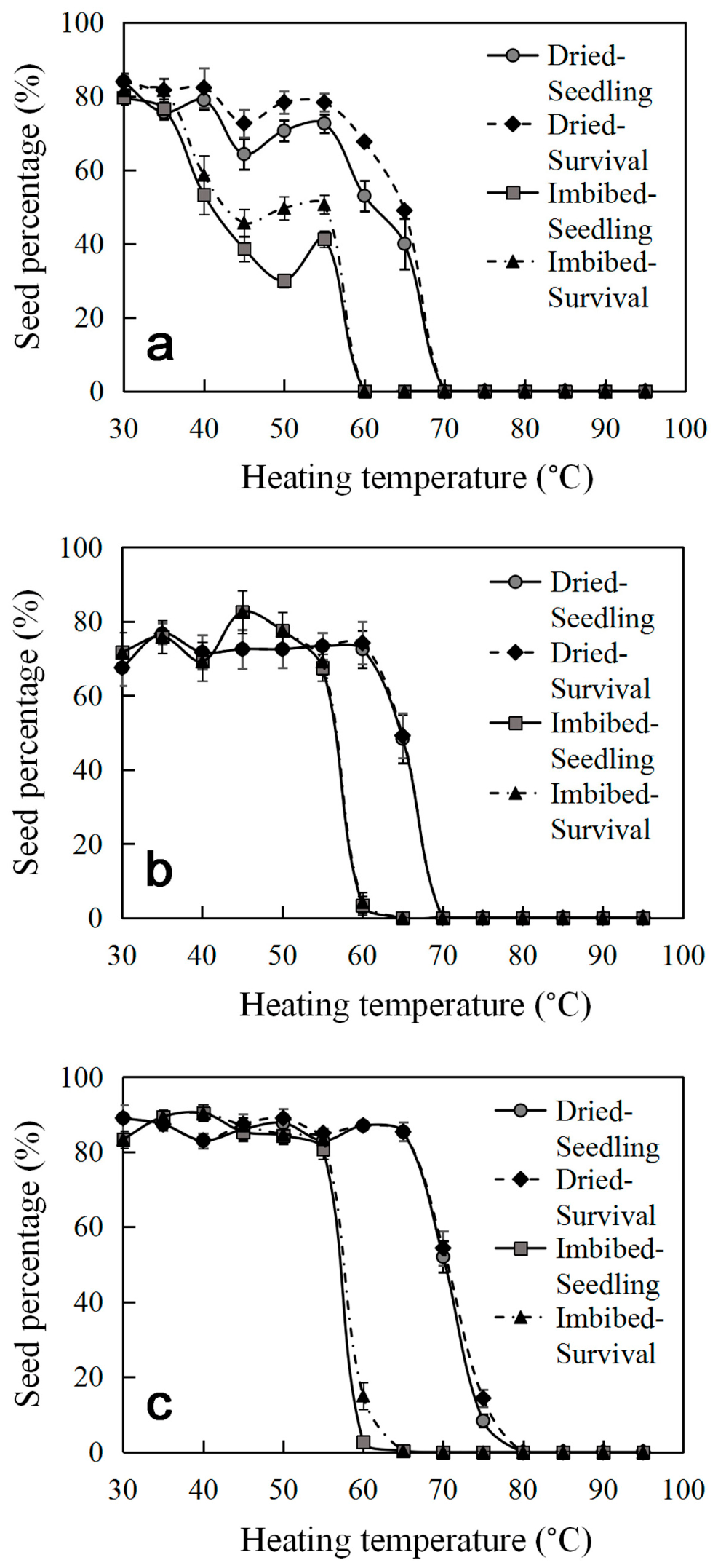
Species, treatment temperature and hydration status of seeds had significant effects on seed viability (p < 0.001 for all, Table S1). In this experiment, no seeds survived 80 °C and above; for the same species, dry seeds were more tolerant to high-temperature treatment than their imbibed counterparts, for the maximum temperature that the air-dried seeds tolerated was 65 °C (for C. subumbellata and H. chrysanthus) and 75 °C (for M. viminalis), while imbibed seeds only tolerated 55 °C at most. Among these three species, C. subumbellata seeds exhibited the lowest high-temperature tolerance, and its imbibed seeds suffered a significant viability loss from heating at 40 °C, while the other two species survived heating at 55 °C. M. viminalis seeds had the strongest high-temperature tolerance, for its air-dried seeds had a seedling percentage of 50%, while the other two species had no germination after heating at 70 °C for 30 min (Figure 4).

3.6. Effects of Water Stress on Seed Germination

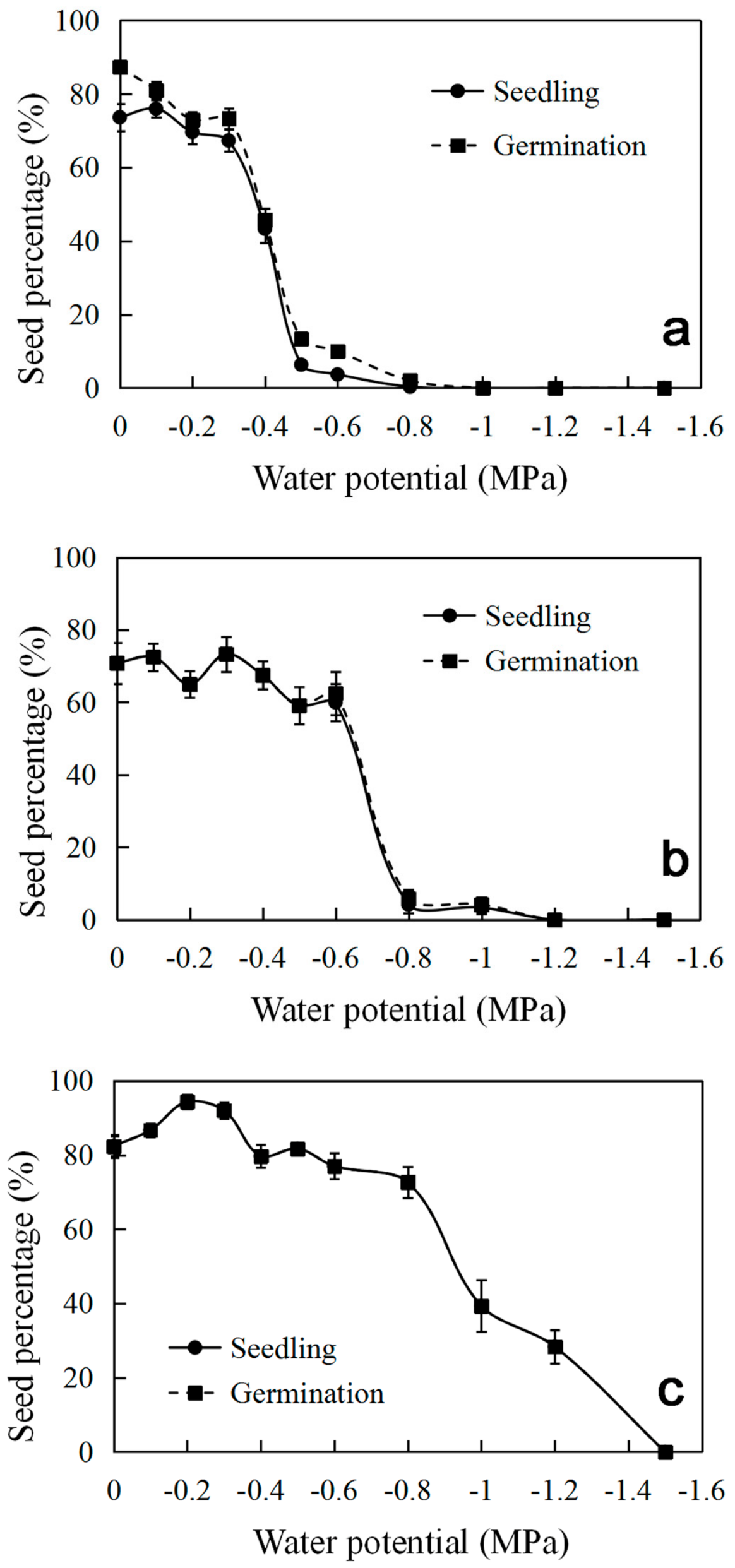
With a decrease in water potential, the seed germination of these three species was gradually inhibited but showed significant interspecific differences (p < 0.001 for all, Table S1). Among them, C. subumbellata seeds were the most sensitive, with only about a 15% germination percentage and 7% seedling percentage under −0.5 MPa. The second was H. chrysanthus seeds, which had a 60% seedling percentage at −0.6 MPa but hardly any germination at −0.8 MPa; M. viminalis seeds were the most tolerant, having a nearly 30% germination and seedling percentage at −1.2 MPa (Figure 5). After being released from stress, additional germination was observed for all three species, especially for seeds incubated under −0.8 to −1.5 MPa previously.

3.7. Effects of NaCl Stress on Seed Germination

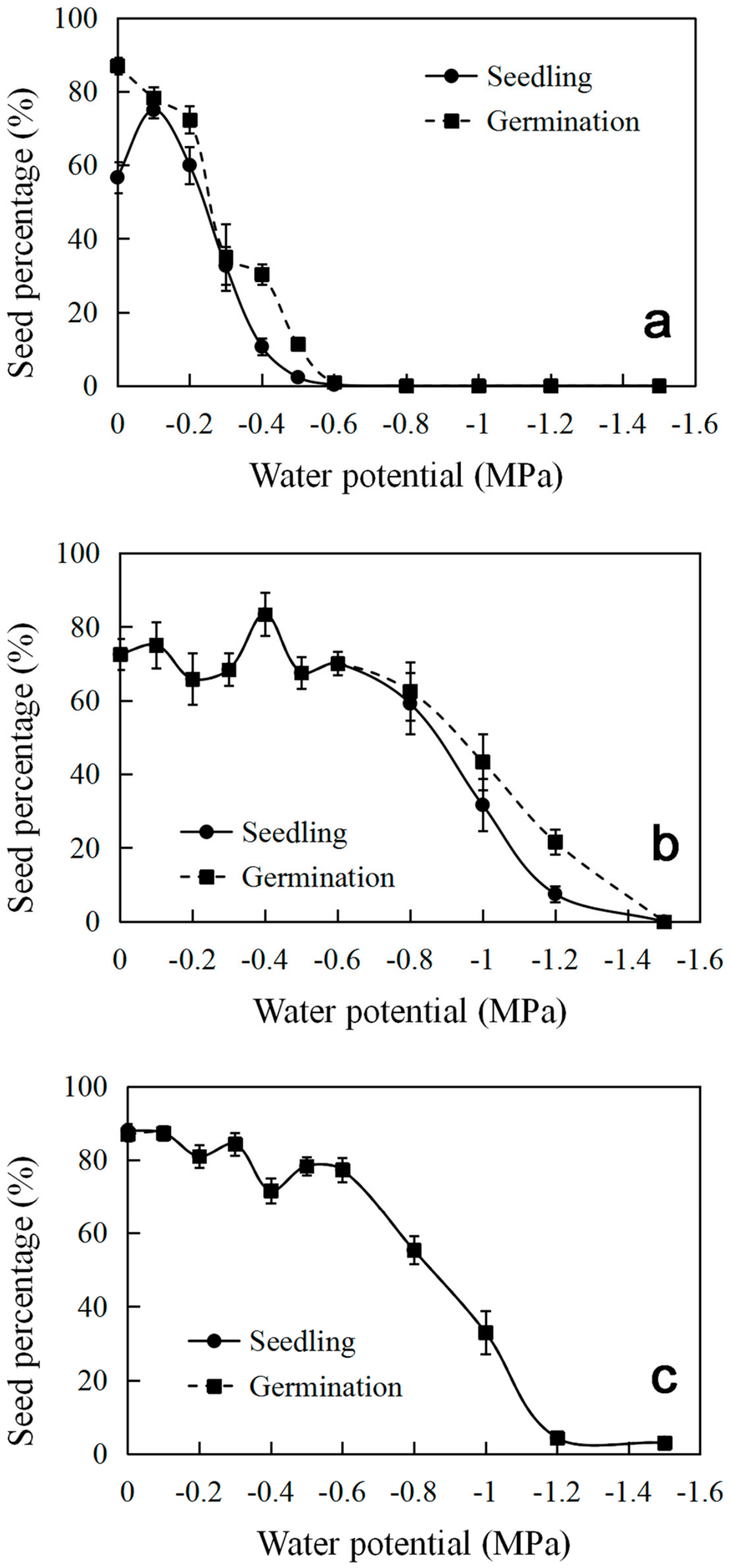
Similarly, the seed germination of these three species showed significant interspecific differences in tolerance to NaCl stress (p < 0.001 for all, Table S1). C. subumbellata seeds were also the most sensitive among them, with only about a 10% germination percentage at −0.5 MPa; M. viminalis seeds were intermediate; and H. chrysanthus seeds were the least sensitive. At −1.2 MPa, H. chrysanthus seeds had about a 20% germination percentage and 7.5% seedling percentage; under the same stress, M. viminalis seeds had little germination (Figure 6). Additional germination was also found after stress was removed.

4. Discussion

This study investigated germination traits and seed high-temperature tolerance in three species growing in Xishuangbanna and found that the two introduced species, both H. chrysanthus and M. viminalis, produced seeds with wider germination temperature ranges and better tolerance to high-temperature, water and NaCl stresses than the native species C. subumbellata, though they all suffered viability loss and germination inhibition under high temperature, water and NaCl stresses. Impressively, C. subumbellata seeds exhibited rather poor tolerance to these stresses, for those incubated at a constant temperature ≥ 35 °C (Figure 1) or ≥9 h daily high-temperature period at 40 °C (Figure 2), under water potentials ≤ 0.6 MPa (Figure 5) or NaCl stress ≤ 0.8 MPa (Figure 6), had no germination; meanwhile, heating at 60 °C for 30 min killed all imbibed seeds while significantly reducing the seedling percentage of air-dried seeds (Figure 4), and continuous heating at 40 °C for 15 days led to complete viability loss (Figure 3).
According to our observation on plants growing in our garden, these three species all produce a large number of small seeds every year, a trait in accordance with r-strategies [18], which confers them the ability to increase plant populations rapidly when environmental conditions are favorable. Previous studies found that both plant invasiveness and endangerment were closely related to seed traits; for example, invasive species were usually characterized by the mass production of small seeds, as well as rapid and good germination under a wide set of environmental conditions [5], while rare and endangered species often had difficulties in seed production and/or germination [19,20,21].
As mentioned above, native plant endangerment and alien plant invasion are two major challenges to the conservation of plant diversity. Thus, plant diversity conservationists need to take measures to prevent the disappearance of native species from the community while stopping the entry of potential invaders. To accomplish this, the ecological processes underlying these species shifts must be elucidated, which, in turn, would allow for the design of simple and efficient approaches able to find threatened species and identify potential invaders [12]. While these two issues appear to be contrary, they often occur simultaneously in the same area, e.g., plant species shift in rainforest fragments [22,23,24,25,26]. Meanwhile, they are both closely related to human activities, such as habitat loss and fragmentation caused by deforestation and land-use change, as well as inappropriate species introduction. Every year, large areas of forests are cut down, and numerous species are intentionally or unintentionally transported outside their natural distribution ranges [27,28]. Taking Xishuangbanna as an example, there are 3856 native seed plant species [29] and 4347 common seed plant species [30] in this region. This means that there are approximately 500 alien plant species widely growing in this area, among which 75 have become invasive species [14]. In addition, there are more than 14,000 species collected as living plants in Xishuangbanna Tropical Botanical Garden currently, of which over 10,000 are introduced species. Among these more than 3800 native plant species, which are under threat and may become rare or endangered in the future? Among the more than 10,000 introduced species, especially among the around 500 widely occurring introduced species, which will become invasive? A feasible prediction method is needed to identify and monitor them.
Plant invasion [31,32,33] and species endangerment [20,34,35] are both complex processes of interaction between plants and their habitats, typically involving several stages influenced by multiple factors. They require consideration from both plant and habitat aspects, involving the physiological and ecological traits of the plant species, as well as biotic and abiotic traits and changes in surroundings. Currently, there is no widely accepted approach to predicting invasive species or to identifying endangered species [36,37]. However, in any case, the essence of both plant invasion and species endangerment lies in changes in plant populations, often achieved through seed germination. They both may involve the responses of plant species to changed habitats, which were mainly initiated by seed germination but under different population dynamics. Therefore, studying plant seed traits—including seed yield, quality, tolerance, and dormancy and germination traits—combined with habitat traits and changes, may help us analyze population dynamic trends in specific species and provide insights for predicting potential threatened or invasive plants.
High temperature is a critical environmental factor that can impose stress and damage on plants. In tropical deserts, high temperatures are universal, and desert species mostly have evolved seed tolerance to extreme temperatures as a mechanism allowing the seed bank to persist on hot soil surfaces [38,39], while in tropical rainforest regions, the surroundings have been modified to form diverse microhabitats, so plants exhibit great interspecific differences in tolerance to high temperatures [5]. Previous studies have revealed that high-temperature tolerance is a vital seed trait with profound ecological significance. It is not only closely associated with the invasiveness of alien plant species but also strongly correlated with their threatened status and endangerment risk of native plant species. Tropical plants exhibit substantial interspecific differences in seed high-temperature tolerance. Alien invasive plants and pioneer species typically colonize open habitats, and their seeds are characterized by high heat tolerance and the capacity to germinate under high-temperature conditions, such as Tithonia diversifolia [40] and Amaranthus spinosus [41]. Plant species producing recalcitrant seeds are mostly woody species native to tropical rainforests [42]. Having long adapted to the cool and moist microenvironments inside rainforests, they generally lack high-temperature tolerance, such as Baccaurea ramiflora [13,43] and Alexandra palm [44]. Rare and endangered plants are also predominantly native tropical rainforest species and tend to exhibit poor seed tolerance to high temperatures, such as Camptotheca acuminata [21].
The plant species shift in fragmented rainforests, i.e., the disappearance of native species and invasion of alien species, may be driven by changes in germination profile there. This is based on two realities: plant species differing in seed high-temperature tolerance is the intrinsic factor, on the one hand; on the other hand, as the extrinsic factor, human disturbance and damage to natural habitats, such as deforestation and habitat fragmentation, cause changes in germination conditions. Deforestation and fragmentation not only decrease habitat areas suitable for native plants but also create those suitable for alien plants. In fragmented rainforests, microclimates have become drier and hotter; in particular, temperatures have risen within forest understories [12,45]. Previous research in Xishuangbanna demonstrated that some native species suffered from germination inhibition and regeneration difficulties in fragmented rainforests because their seeds are sensitive to increased temperature. This not only led to the endangerment of these native plants but also provided an opportunity for the invasion of alien species producing seeds with high tolerance to high temperature [13,21,43].
Therefore, we suggested that seed high-temperature tolerance can be used as a key trait, combined with other seed traits such as seed size, seed yield, seed viability, dispersal ability, dormancy, and germination traits, in order to predict population dynamic trends in certain species under land-use change in tropical areas. The three plant species investigated in this study have a common trait, i.e., the mass production of small nondormant seeds with high initial viability, which endows them with the potential for rapid population expansion through seed germination under favorable external conditions. Among them, C. subumbellata exhibited poor high-temperature tolerance; no seeds germinated under a constant temperature of 35 °C or under daily ≥9 h high-temperature exposure at 40 °C. Its thermal sensitivity is comparable to that of rare and endangered native species previously studied in this region, such as Camptotheca acuminate [21], Pellacalyx yunnanensis and Tacca chantrieri (authors’ unpublished data), implying that this species may face endangerment risks. However, C. subumbellata is a vine species, with a short life cycle, which primarily grows on forest margins, slopes, and scrub and produces plumose achenes, i.e., its seeds possess good wind dispersal capacity. Habitats suitable for its regeneration did not decrease in the past and will not, at least in the near future. Taking all of this into consideration, we do not think that this species is threatened currently, with no urgent conservation demand. In reality, this species is classified as “Less Concern (LC)” according to the standards of International Union for Conservation of Nature (IUCN).
On the contrary, the other two species, H. chrysanthus and M. viminalis, are both tree species with long life cycles. They have been artificially introduced into Xishuangbanna and successfully established cultivated populations with human assistance. It remains unclear whether these two species can escape cultivation and form self-sustaining wild populations, and nowadays the key management measure involves preventing their seeds from reaching microhabitats suitable for seed persistence and germination. The results from this study indicated that both species possess relatively high heat tolerance and can germinate under high temperatures. However, their seed heat tolerance is markedly lower than that of typical invasive weeds previously reported in this region, such as Tithonia diversifolia [40], Amaranthus spinosus [41], and Ageratum conyzoides [46], and is merely comparable to that of Piper aduncum [15] and Crassocephalum crepidioides [46]. To date, no animal seed dispersers have been observed for either species in Xishuangbanna based on our field observations. H. chrysanthus is wind-dispersed, indicated by seed wings, and has a high seedling percentage under high temperatures and strong tolerance to continuous heat, which may increase its invasion risk. In contrast, M. viminalis lacks specialized dispersal structures, but its seeds exhibit greater tolerance to extreme high temperatures and can persist longer in soil, which also raises its invasive potential. Overall, we think that these two species may possess low-to-moderate invasion risks. Their most probable invasive habitats resemble those of Piper aduncum, mainly forest edges. For management purposes, soil containing seeds of M. viminalis should not be transported toward forest edges; H. chrysanthus should not be planted near forest edges; and artificial seed transportation to edge habitats should be strictly prohibited.
Accordingly, for a given native plant species, we can analyze its potential endangerment drivers by integrating species traits with local environmental conditions in specific regions. Similarly, for a given alien plant species, we can identify favorable and restrictive factors underlying its invasiveness, predict its potential invasive habitats, and propose targeted precautionary measures. Such detailed and targeted guidance holds great significance for biodiversity conservation in Xishuangbanna.
At the same time, we must acknowledge the limitations of this study, for the environmental factors, i.e., temperature, water stress, and salinity stress, were evaluated and analyzed separately in the laboratory, while these factors often act simultaneously and interdependently under natural conditions. It should be kept in mind that the responses observed under controlled laboratory conditions do not always fully reflect the behavior of the species in the field, though they provided a reference for plant conservation.
In conclusion, studies on germination traits and seed high-temperature tolerance are a critical approach, which can be used to predict population dynamic trends in certain species under land-use change in tropical areas, in combination with other seed traits, such as seed size, seed yield, dispersal ability, seed viability and longevity. This can benefit the conservation of plant diversity through assessing the invasiveness of alien plant species and threatened status of native plant species.

Supplementary Materials

The following supporting information can be downloaded at https://www.mdpi.com/article/10.3390/seeds5040045/s1, Table S1: Analysis of variance for seedling and germination or survival percentage.

Author Contributions

B.W. and L.C. outlined this research; Y.Z. and X.Y. collected the data; B.W. analyzed the data and wrote this paper. All authors have read and agreed to the published version of the manuscript.

Funding

We are grateful to National Key R&D Program of China (2024YFF1307400) for providing financial support for this research.

Institutional Review Board Statement

Not applicable.

Informed Consent Statement

Not applicable.

Data Availability Statement

The original contributions presented in this study are included in the article/Supplementary Material. Further inquiries can be directed to the corresponding authors.

Acknowledgments

We are grateful to National Key R&D Program of China (2024YFF1307400) for providing financial support for this research. We thank the Seedbank of Xishuangbanna Tropical Botanical Garden for providing the laboratory for the experiments that we performed there.

Conflicts of Interest

The authors declare no conflicts of interest.

Abbreviations

The following abbreviations are used in this manuscript:
ANOVAAnalysis of variance
GLMGeneralized linear model
CASChinese Academy of Sciences

References

  1. Kuparinen, A.; Markkanen, T.; Riikonen, H.; Vesala, T. Modeling air-mediated dispersal of spores, pollen and seeds in forested areas. Ecol. Model. 2007, 208, 177–188. [Google Scholar] [CrossRef] [Scilit]
  2. Bewley, J.D.; Bradford, K.J.; Hilhorst, H.W.M.; Nonogaki, H. Seeds: Physiology of Development, Germination and Dormancy, 3rd ed.; Springer: New York, NY, USA; Berlin/Heidelberg, Germany; Dordrecht, The Netherlands; London, UK, 2013. [Google Scholar]
  3. Baskin, C.C.; Baskin, J.M. Seeds. Ecology, Biogeography, and Evolution of Dormancy and Germination, 2nd ed.; Elsevier Inc.: Amsterdam, The Netherlands, 2014. [Google Scholar]
  4. Chambers, J.C.; MacMahon, J.A. A day in the life of a seed: Movements and fates of seeds and their implications for natural and managed systems. Annu. Rev. Ecol. Syst. 1994, 25, 263–292. [Google Scholar] [CrossRef]
  5. Wen, B.; Zhao, Z.F.; Wang, S.Q.; Yin, X.J.; He, L.P.; Chen, L.G. Seed–habitat thermal interactions contribute to the mosaic distribution patterns of invasive Chromolaena odorata and Ageratina adenophora in South Yunnan, China. Integr. Conserv. 2025, 4, 85–94. [Google Scholar] [CrossRef] [Scilit]
  6. Donohue, K.; de Casas, R.R.; Burghardt, L.; Kovach, K.; Willis, C.G. Germination, postgermination adaptation, and species ecological ranges. Annu. Rev. Ecol. Evol. Syst. 2010, 41, 293–319. [Google Scholar] [CrossRef] [Scilit]
  7. Howe, H.F.; Smallwood, J. Ecology of seed dispersal. Annu. Rev. Ecol. Syst. 1982, 13, 201–228. [Google Scholar] [CrossRef] [Scilit]
  8. Iralu, V.; Upadhaya, K. Seed dormancy, germination and seedling characteristics of Elaeocarpus prunifolius Wall. Ex Müll. Berol.: A threatened tree species of Northeast India. N. Z. J. For. Sci. 2018, 48, 16. [Google Scholar] [CrossRef] [Scilit]
  9. Baskin, C.C.; Baskin, J.M. Plant Regeneration from Seeds: A Global Warming Perspective; Academic Press: San Diego, CA, USA, 2022. [Google Scholar]
  10. Tilman, D.; Clark, M.; Williams, D.R.; Kimmel, K.; Polasky, S.; Packer, C. Future threats to biodiversity and pathways to their prevention. Nature 2017, 546, 73–81. [Google Scholar] [CrossRef] [Scilit] [PubMed]
  11. Raven, P.H.; Gereau, R.E.; Phillipson, P.B.; Chatelain, C.; Jenkins, C.N.; Ulloa, C.U. The distribution of biodiversity richness in the tropics. Sci. Adv. 2020, 6, eabc6228. [Google Scholar] [CrossRef] [Scilit] [PubMed]
  12. An, X.J.; Yang, L.; Wen, B.; Chen, L.G. Seed high-temperature sensitivity and germination ecology in intermediate seeds of three species from Xishuangbanna, tropical China. Plant Ecol. 2023, 224, 647–658. [Google Scholar] [CrossRef] [Scilit]
  13. Wen, B.; Cai, Y.F. Seed viability as a function of moisture and temperature in the recalcitrant rainforest species Baccaurea ramiflora (Euphorbiaceae). Ann. For. Sci. 2014, 71, 853–861. [Google Scholar] [CrossRef] [Scilit][Green Version]
  14. Guan, Z.B.; Deng, W.H.; Huang, Z.L.; Huang, N.Y.; Ai, L.; Li, C.Y. A Preliminary investigation on the alien invasive plants in Xishuangbanna. Trop. Agric. Sci. Technol. 2007, 29, 35–38, (In Chinese with English abstract). [Google Scholar]
  15. Wen, B.; Xue, P.; Zhang, N.; Yan, Q.; Ji, M.Y. Seed germination of invasive species Piper aduncum as affected by high temperature and water stress. Weed Res. 2015, 55, 155–162. [Google Scholar] [CrossRef] [Scilit]
  16. Michel, B.E. Evaluation of water potentials of solutions of polyethylene glycol 8000 both in the absence and presence of other solutes. Plant Physiol. 1983, 72, 66–70. [Google Scholar] [CrossRef] [Scilit] [PubMed]
  17. Lang, A.R.G. Osmotic coefficients and water potentials of sodium chloride solutions from 0 to 40 °C. Aust. J. Chem. 1967, 20, 2017–2023. [Google Scholar] [CrossRef] [Scilit]
  18. Chapman, J.L.; Reiss, M.J. Ecology: Principles and Applications, 2nd ed.; Tsinghua University Press: Beijing, China, 2001. [Google Scholar]
  19. Baskin, C.C.; Baskin, J.M. Seed germination and propagation of Xyristennesseensis, a federal endangered wetland species. Wetlands 2003, 23, 116–124. [Google Scholar] [CrossRef] [Scilit]
  20. Ramírez-Padilla, C.A.; Valverde, T. Germination responses of three congeneric cactus species (Neobuxbaumia) with differing degrees of rarity. J. Arid. Environ. 2005, 61, 333–343. [Google Scholar] [CrossRef] [Scilit]
  21. Wen, B.; Yang, P.R. Implications of seed germination ecology for conservation of Camptotheca acuminata, a rare, endemic, and endangered species in China. Plant Ecol. 2021, 222, 209–219. [Google Scholar] [CrossRef] [Scilit]
  22. Laurance, W.F.; Ferreira, L.V.; Merona, J.M.R.; Laurance, S.G.; Hutchings, R.W.; Lovejoy, T.E. Effects of forest fragmentation on recruitment pattern in Amazonian tree communities. Conser. Biol. 1998, 12, 460–465. [Google Scholar] [CrossRef] [Scilit]
  23. Laurance, W.F.; Ferreira, L.V.; Merona, J.M.R.; Laurance, S.G. Rain forest fragmentation and the dynamics of Amazonian tree communities. Ecology 1998, 79, 2032–2040. [Google Scholar] [CrossRef]
  24. Laurance, W.F.; Nascimento, H.E.M.; Laurance, S.G.; Andrade, A.; Ribeiro, J.E.L.S.; Giraldo, J.P.; Lovejoy, T.E.; Condi, R.; Chave, J.; Harms, K.E. Rapid decay of tree-community composition in Amazonian forest fragments. Proc. Natl. Acad. Sci. USA 2006, 103, 19010–19014. [Google Scholar] [CrossRef] [Scilit] [PubMed]
  25. Zhu, H.; Wang, H.; Zhou, S.S. Species diversity, floristic composition and physiogenmy changes in a rainforest remnant in Southern Yunnan, China after 48 years. J. Trop. For. Sci. 2010, 22, 49–66. [Google Scholar]
  26. Zhu, H.; Xu, Z.F.; Wang, H.; Li, B.G. Tropical rainforest fragmentation and its ecological and species diversity changes in southern Yunnan. Biodivers. Conserv. 2004, 13, 1355–1372. [Google Scholar] [CrossRef] [Scilit]
  27. Maillet; Lopez-Garcia. What criteria are relevant for predicting the invasive capacity of a new agricultural weed? The case of invasive American species in France. Weed Res. 2010, 40, 11–26. [Google Scholar] [CrossRef] [Scilit]
  28. Huebner, C.D. Effects of global climate change on regeneration of invasive plant species from seeds. In Plant Regeneration from Seeds. A Global Warming Perspective; Baskin, C.C., Baskin, J., Eds.; Academic Press: San Diego, CA, USA, 2022; pp. 243–257. [Google Scholar]
  29. Zhu, H.; Yan, L.C. Native Seed Plants in Xishuangbanna of Yunnan; Science Press: Beijing, China, 2012. (In Chinese) [Google Scholar]
  30. Li, Y.H. List of Plants in Xishuangbanna; Yunnan Minzu Press: Kunming, China, 1996. (In Chinese) [Google Scholar]
  31. Heger, T.; Trepl, L. Predicting biological invasions. Biol. Invasions 2003, 5, 313–321. [Google Scholar] [CrossRef] [Scilit]
  32. Kolar, C.S.; Lodge, D.M. Progress in invasion biology: Predicting invaders. Trends Ecol. Evol. 2001, 16, 199–204. [Google Scholar] [CrossRef] [Scilit] [PubMed]
  33. Rai, P.K. What makes the plant invasion possible? Paradigm of invasion mechanisms, theories and attributes. Environ. Skept. Crit. 2015, 4, 36–66. [Google Scholar]
  34. Fiedler, P.L. Concepts of rarity in vascular plant species, with special reference to the genus Calochortus pursh (Liliaceae). Taxon 1986, 35, 502–518. [Google Scholar] [CrossRef] [Scilit] [PubMed]
  35. Rabinowitz, D.; Cairns, S.; Dillon, T. Seven forms of rarity and their frequency in the flora of the British Isles. In Conservation Biology: The Science of Scarcity and Diversity; Soule, M.E., Ed.; Sinauer Associates: Sunderland, MA, USA, 1986. [Google Scholar]
  36. Beckmann, M.; Bruelheide, H.; Erfmeier, A. Germination responses of three grassland species differ between native and invasive origins. Ecol. Res. 2011, 26, 763–771. [Google Scholar] [CrossRef] [Scilit]
  37. Guo, W.Y.; van Kleunen, M.; Winter, M.; Weigelt, P.; Stein, A.; Pierce, S.; Pergl, J.; Moser, D.; Maurel, N.; Lenzner, B.; et al. The role of adaptive strategies in plant naturalization. Ecol. Lett. 2018, 21, 1380–1389. [Google Scholar] [CrossRef] [Scilit] [PubMed]
  38. Daws, M.I.; Kabadajic, A.; Manger, K.; Kranner, I. Extreme thermotolerance in seeds of desert succulents is related to maximum annual temperature. S. Afr. J. Bot. 2007, 73, 262–265. [Google Scholar] [CrossRef] [Scilit]
  39. Barrios, D.; Sánchez, J.A.; Flores, J.; Jurado, E. Seed traits and germination in the Cactaceae family: A review across Americas. Bot. Sci. 2020, 98, 417–440. [Google Scholar] [CrossRef] [Scilit]
  40. Wen, B. Effects of high temperature and water stress on seed germination of the invasive species Mexican Sunflower. PLoS ONE 2015, 10, e0141567. [Google Scholar] [CrossRef] [Scilit] [PubMed]
  41. Ye, J.; Wen, B. Seed germination in relation to the invasiveness in spiny amaranth and edible amaranth in Xishuangbanna, SW China. PLoS ONE 2017, 12, e0175948. [Google Scholar] [CrossRef] [Scilit] [PubMed]
  42. Farnsworth, E.A. The ecology and physiology of viviparous and recalcitrant seeds. Annu. Rev. Ecol. Syst. 2000, 31, 107–138. [Google Scholar] [CrossRef] [Scilit]
  43. Wen, B.; Liu, M.H.; Tan, Y.H.; Liu, Q. Sensitivity to high temperature and water stress in recalcitrant Baccaurea ramiflora seeds. J. Plant Res. 2016, 129, 637–645. [Google Scholar] [CrossRef] [Scilit] [PubMed]
  44. Wen, B. Seed germination ecology of Alexandra palm (Archontophoenix alexandrae) and its implication on invasiveness. Sci. Rep. 2019, 9, 4057. [Google Scholar] [CrossRef] [Scilit] [PubMed]
  45. Ma, Y.X.; Liu, Y.H.; Zhang, K.Y. On microclimate edge effects of tropical rainforest fragments in Xishuangbanna. Acta Phytoecol. Sin. 1998, 22, 250–255, (In Chinese with English abstract). [Google Scholar]
  46. Yuan, X.; Wen, B. Seed germination response to high temperature and water stress in three invasive Asteraceae weeds from Xishuangbanna, SW China. PLoS ONE 2018, 13, e0191710. [Google Scholar] [CrossRef] [Scilit] [PubMed]
Figure 1. Germination of seeds incubated in light at 10–40 °C constant temperatures and alternating day/night temperatures of 30/20 °C. Germination values are means ± SEs of 6 replicates of 50 seeds (for C. subumbellata and M. viminalis) or 20 seeds (for H. chrysanthus). (a): C. subumbellata; (b): H. chrysanthus; (c): M. viminalis. Note: The legend in subfigure (b) is shared by subfigures (a) and (c), as there is not enough space for separate legends.
Seeds 05 00045 g001
Figure 2. Germination of seeds under daily periodic high-temperature stress at 40 °C. Heating of given thermoperiod at 40 °C was imposed on seeds every day. Germination values are means ± SEs of 6 replicates of 50 seeds (for C. subumbellata and M. viminalis) or 20 seeds (for H. chrysanthus). (a): C. subumbellata; (b): H. chrysanthus; (c): M. viminalis.
Seeds 05 00045 g002
Figure 3. Effects of continuous heating at 40 °C on seed viability. Seeds were heat-shocked for given period of time at 40 °C and then incubated at 30 °C after release from stress. Seed viability values are means ± SEs of 6 replicates of 50 seeds (for C. subumbellata and M. viminalis) or 20 seeds (for H. chrysanthus). (a): C. subumbellata; (b): H. chrysanthus; (c): M. viminalis. Note: Seedling percentages did not differ from survival percentage for H. chrysanthus seeds in this experiment.
Seeds 05 00045 g003
Figure 4. Effects of 30 min heat shocks at temperatures from 30 °C to 95 °C on seed viability. Seeds, air-dried or imbibed, were heated at given temperature for 30 min and then incubated at 30 °C. Viability values are means ± SEs of 6 replicates of 50 seeds (for C. subumbellata and M. viminalis) or 20 seeds (for H. chrysanthus). (a): C. subumbellata; (b): H. chrysanthus; (c): M. viminalis.
Seeds 05 00045 g004
Figure 5. Effects of water stress on seed germination. Seed germination was scored for at least 4 weeks under water stress. Germination values are means ± SEs of 6 replicates of 50 seeds (for C. subumbellata and M. viminalis) or 20 seeds (for H. chrysanthus). (a): C. subumbellata; (b): H. chrysanthus; (c): M. viminalis. Note: Seedling percentages did not differ from germination percentage for M. viminalis seeds in this experiment.
Seeds 05 00045 g005
Figure 6. Effects of NaCl stress on seed germination. Seed germination was scored for at least 4 weeks under NaCl stress. Germination values are means ± SEs of 6 replicates of 50 seeds (for C. subumbellata and M. viminalis) or 20 seeds (for H. chrysanthus). (a): C. subumbellata; (b): H. chrysanthus; (c): M. viminalis. Note: Seedling percentages did not differ from germination percentage for M. viminalis seeds in this experiment.
Seeds 05 00045 g006
Table 1. The initial seed traits of the three species used in this study.
Species100-Seed Weight (g)Moisture Content (%)Initial Viability (%)
C. subumbellata0.1460 ± 0.001414.91 ± 0.2491.67 ± 0.96
Handroanthus chrysanthus1.6916 ± 0.007915.51 ± 1.3675.83 ± 2.39
Melaleuca viminalis0.0171 ± 0.000413.56 ± 0.7292.67 ± 2.11
Disclaimer/Publisher’s Note: The statements, opinions and data contained in all publications are solely those of the individual author(s) and contributor(s) and not of MDPI and/or the editor(s). MDPI and/or the editor(s) disclaim responsibility for any injury to people or property resulting from any ideas, methods, instructions or products referred to in the content.