Article

Application of Morphometric and Chemometric Techniques to Analyze the Influence of Climate and Soil Type on the Morphological, Proximate, and Fatty Acid Fingerprints of Moringa (Moringa oleifera Lam.) Seeds Cultivated in Different States of Mexico


by
Rafael Ruiz-Hernández
1,
Arturo Pérez-Vázquez
1,*,
Fredy Morales-Trejo
1,
Gustavo López-Romero
1,
José Roberto Bautista-Aguilar
2,
Mario Alejandro Hernández-Chontal
2,
Emmanuel de Jesús Ramírez-Rivera
3,
Oliver Salas-Valdez
3 and
Adán Cabal-Prieto
4
1
Colegio de Postgraduados, Campus Veracruz, Predio Tepetates, Manlio F. Altamirano, Veracruz C.P. 91700, Veracruz, Mexico
2
Facultad de Ciencias Agrícolas, Universidad Veracruzana, Circuito Gonzalo Aguirre Beltrán s/n, Zona Universitaria, Xalapa C.P. 91000, Veracruz, Mexico
3
Tecnológico Nacional de México, Instituto Tecnológico Superior de Zongolica, Zongolica C.P. 95005, Veracruz, Mexico
4
Tecnológico Nacional de México, Instituto Tecnológico Superior de Huatusco, Av. 25 Poniente No. 100, Colonia Reserva Territorial, Huatusco C.P. 94106, Veracruz, Mexico
*
Author to whom correspondence should be addressed.
Seeds 2026, 5(2), 18; https://doi.org/10.3390/seeds5020018
Submission received: 21 December 2025 / Revised: 3 March 2026 / Accepted: 4 March 2026 / Published: 14 March 2026
(This article belongs to the Special Issue Technological Advances in Seed Quality)

Abstract

The objective of this research was to apply morphometric and chemometric techniques to analyze the influence of climate and soil type on the morphological, proximate, and fatty acid fingerprints of moringa (Moringa oleifera Lam.) seeds cultivated in different regions of Mexico. Seeds were collected from the states of Chiapas, Michoacán, Nuevo León, Oaxaca, Veracruz, and Yucatán. The morphological traits of the seeds were evaluated, while the proximate composition and fatty acid profiles of the seed flours were analyzed using gas chromatography–mass spectrometry (GC–MS). Data were assessed through analysis of variance (ANOVA) and linear discriminant analysis to develop their fingerprint profiles. The results showed that the morphological variables that constituted the climate-based morphological fingerprint were seed length, width, seed weight, and kernel weight, whereas for the soil type-based fingerprint, only seed length was significant. Regarding the proximate chemical composition, all variables (fat, ash, moisture, and protein), except fiber content, were influenced by both climate and soil type, forming the proximate chemical fingerprint. The fatty acid fingerprint consisted of 21 compounds, with oleic, behenic, stearic, palmitic, and arachidic acids present in the highest concentrations. The fingerprints obtained from the different determinations were confirmed through cross-validation values exceeding 50%, according to the linear discriminant analysis validation technique. The fatty acid and proximate composition determinations showed the highest classification values (83–100%) and contributed most significantly to ensuring the fingerprinting of moringa seeds cultivated in Mexico.

1. Introduction

Moringa oleifera Lam is a plant species cultivated in tropical, subtropical, and arid to semi-arid regions [1]. Moringa trees can reach up to 12 m in height, with a stem diameter of 40 cm and a lifespan of up to 20 years [2]. Their ability to thrive under diverse agroecological conditions makes them a key resource for ensuring the food supply in regions adversely affected by climate change [3]. Flowering in some moringa varieties begins as early as six months after planting [4]. By the fifth year, moringa trees can produce up to 630 fruits, known as capsules, which are divided into three parts, can reach a length of 120 cm, and mature three months after flowering [5]. A single tree can yield between 15,000 and 25,000 seeds per year [6], with a yield per hectare ranging from 1.18 to 2.5 t [7]. In Mexico, 46.25 ha of moringa were cultivated in 2024, with the highest production reported in the states of Michoacán and Puebla, with 36 and 16.25 ha, respectively [8]. Although moringa cultivation has been primarily focused on leaf production [9] for the preparation of various by products, such as flours, capsules, and teas, in recent years, moringa seeds have become the subject of multiple studies owing to their potential applications as flocculants and bioadsorbents [10], as well as their applications in food and medicine [11], with research addressing their morphological and nutritional characteristics. In this regard, refs. [12,13] reported that moringa seeds are round or triangular in shape, brown to dark brown in color, and may exhibit three whitish wings, with approximate measurements of 1.05 cm in length, 0.86 cm in diameter, and 0.22 g in weight. Refs. [4,13] stated that moringa seeds contain 32.19% protein, 3.39% ash, 38.72% fat, 13.31% fiber, and 7.00% moisture. Likewise, ref. [14] reported mineral contents of 6.82 mg 100 g−1 Na, 763.49 mg 100 g−1 K, 139.64 mg 100 g−1 Ca, 302.51 mg 100 g−1 Mg, 771.19 mg 100 g−1 P, 1994.06 mg 100 g−1 S, 9.97 mg 100 g−1 Fe, 0.86 mg 100 g−1 Cu, 5.20 mg 100 g−1 Zn, 1.25 mg 100 g−1 Mn, and 0.58 mg 100 g−1 B. Ref. [15] indicated that the oil content of moringa seeds ranges between 30% and 45%, consisting mainly of oleic, linoleic, palmitic, stearic, and behenic fatty acids [4]. Additionally, other studies have focused on developing the morphological and nutritional profiles of moringa seeds [13,16,17].
It is noteworthy that the quality of moringa seeds can enhance the nutritional content of foods in which they are incorporated [18]. The aforementioned studies do not report the influence of external factors such as agronomic management, soil type, or climatic conditions, which may affect the nutritional quality of moringa seeds.
In Mexico, both climatic conditions and soil types are highly diverse, and for moringa, suitable environmental conditions are required for optimal development [19]. Therefore, it is necessary to perform studies that incorporate techniques capable of analyzing the impact of climatic and edaphic factors on widely consumed and representative food products. In this context, research has been conducted on priority crops, such as habanero chili [20,21], maize [22], coffee [23], and beans [24], involving the use of various chemical techniques (e.g., proximate composition analysis and chromatography) coupled with multivariate statistical methods (e.g., linear discriminant analysis and multiple factor analysis) to identify the most relevant variables for developing food profiles [25]. Similar research has previously been conducted on other species. The present study integrates climatic and edaphic variables with the proximate composition and fatty acid profile to provide a more comprehensive understanding of the characteristics of moringa seeds. Elucidating the relationships between edaphic and climatic factors and the nutritional composition and fatty acid profile of moringa seeds will enable more precise recommendations and facilitate the identification of new and targeted uses for moringa seeds in climates similar to those evaluated in this study. Based on the above, the objective of this research was to apply morphometric and chemometric techniques to analyze the influence of climate and soil type on the morphological, proximate, and fatty acid fingerprints of Moringa oleifera Lam. seeds cultivated in different states of Mexico.

2. Materials and Methods

2.1. Study Area

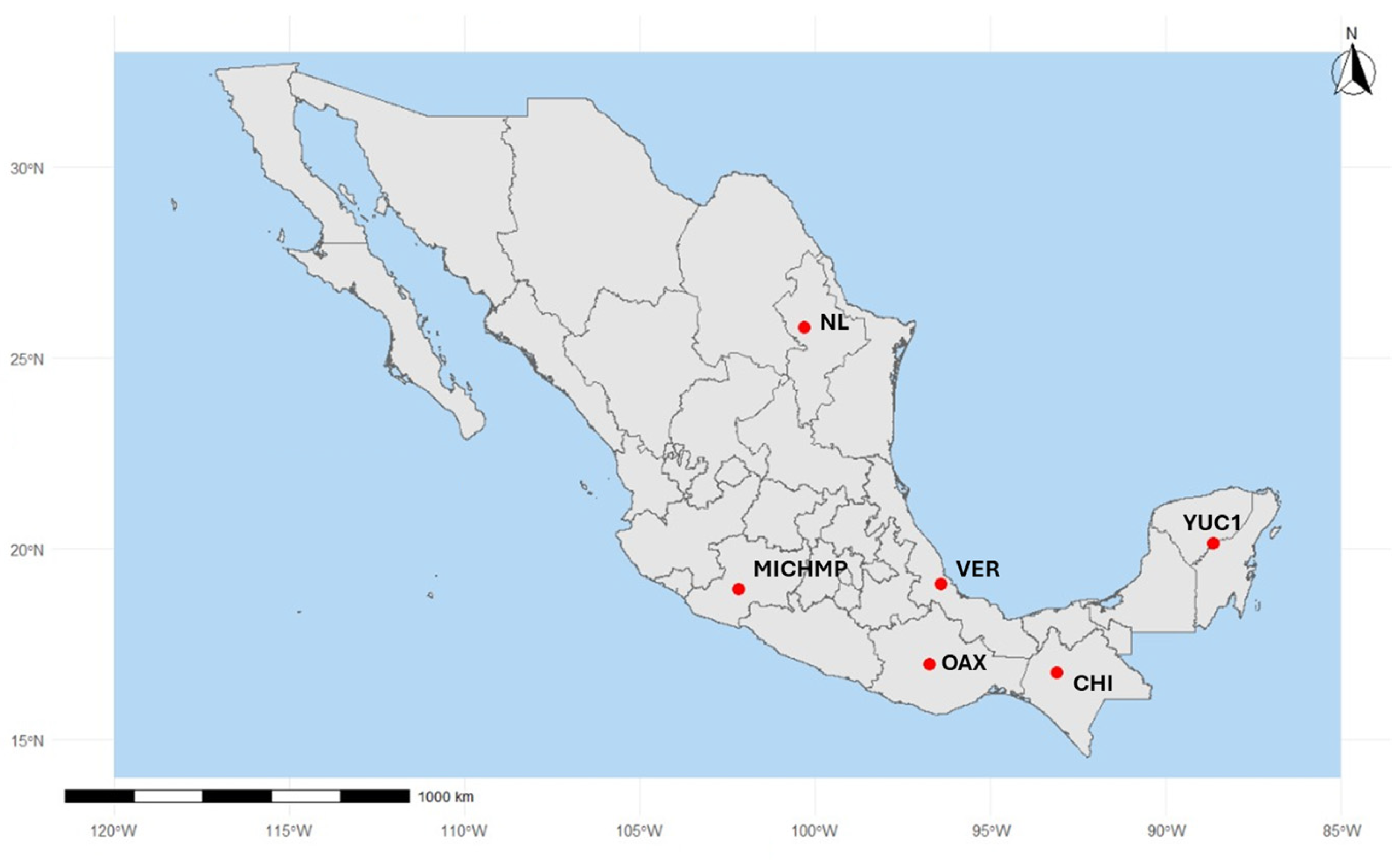
The seeds were collected in the fall of 2022. Moringa producers with commercial purposes were identified. A batch was obtained from each sampling point, from which 500 g (approximately 2000 seeds) was collected. In total, 500 g of moringa seeds was collected from each M. oleifera population in the states of Chiapas, Michoacán, Nuevo León, Oaxaca, Veracruz, and Yucatán, Mexico (Figure 1). The aforementioned states were selected based on their high moringa productivity in recent years [8]. The collected seeds were used for commercial sale, oil extraction, and plant propagation.
The edaphoclimatic conditions of the different M. oleifera producing states are shown in Table 1.

2.2. Morphological Characterization of M. oleifera

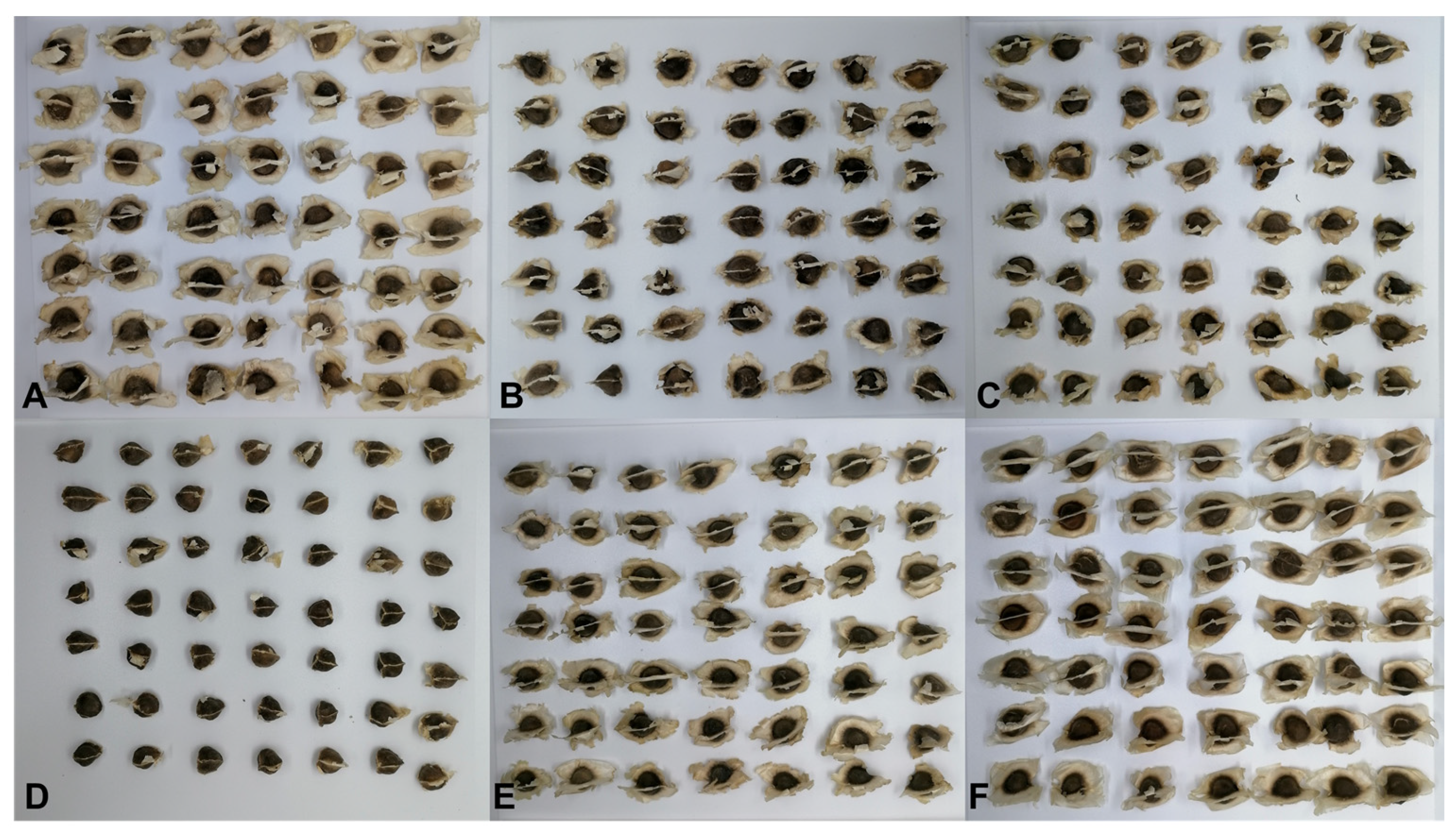
A total of 100 seeds were randomly selected from each sampled population. The selected seeds met the following criteria: clean, complete, mature, healthy, and low moisture content (Figure 2).
The morphological traits evaluated included seed length and width, measured with a digital caliper. Subsequently, seed and kernel weights were determined using an OHAUS Pioneer analytical balance. The kernel-to-seed weight ratio (%) was calculated using Equation (1):
%   of   almond   in   the   seed % = almond   weight × 100 seed   weight

2.3. Preparation of M. oleifera Seed Flour

To obtain the proximate and fatty acid profile, moringa seed flour was prepared as follows: (1) the seed kernels were manually extracted and dried in a forced-air oven at 45 °C for 48 h; (2) the dried kernels were ground using a plant tissue grinder (Internacional Brand, Model LI-3ª, Xalapa, Mexico); (3) and the resulting flour was stored in airtight bags at a temperature of 22 ± 5 °C until analysis.

2.4. Proximate Analysis of M. oleifera Seed Flour

The proximate composition was determined according to the methods of the Association of Official Analytical Chemists (A.O.A.C.) [26]: moisture (method 925.04), ash (method 940.05), fat (method 960.39), and protein (method 978.02). All determinations were performed in triplicate. The analyses were carried out at the Food Laboratory of the Colegio de Postgraduados, Campus Veracruz.

2.5. Fatty Acid Profile of M. oleifera Seeds

For the esterification of fatty acids, the method established in Commission Regulation (EEC) No. 2568/91 (1991) was used, with modifications. First, 25 mg of oil was weighed into an Eppendorf tube, and 200 µL of n-hexane and 50 µL of a 2 N potassium hydroxide solution in methanol were added. The mixture was vortexed for 1 min and allowed to stand in an ice bath to prevent the loss of volatile fatty acids. Next, 0.13 g of sodium hydrogen sulfonate was added, and the mixture was resuspended through vortexing and centrifuged at 14,000 rpm for 5 min. Subsequently, 100 µL of the supernatant was transferred to a 2 mL amber vial. To this, 400 µL of n-hexane was added while vortexing.
The esterified sample was injected into a gas chromatograph (78900B GC System; Agilent Technologies, Santa Clara, CA, USA) coupled to a mass spectrometer (MSD5977B; Agilent Technologies) as a detector. The sample (1 µL) was injected using an autosampler (ALS7693; Agilent Technologies) at 250 °C. For fatty acid separation, an HP-88 column (Agilent J&W, Santa Clara, CA, USA) was used, measuring 100 m × 0.250 mm × 0.20 μm film thickness. The following conditions were used: temperatures of 250 °C, 230 °C, and 150 °C for the GC-MS interface, the power source, and the quadrupole, respectively. The ionization energy was 70 EV.
The temperature ramp applied to the oven was as follows: an initial temperature of 50 °C for 1 min, an increase to 160 °C at 20 °C/min, an increase to 198 °C at 1 °C/min, and finally an increase to 230 °C at 5 °C/min, which was held for 15 min. Helium was used as the carrier gas at a flow rate of 1 mL/min, and the injection was performed in split mode (1:25 ratio). The recording and integration of chromatographic peaks were performed using Qualitative Analysis B.07.00 software (MassHunter Workstation Software, Agilent Technologies, https://www.selectscience.net/product/masshunter-workstation-software, (accessed on 3 March 2026)). Fatty acid methyl esters were identified through comparison with the retention times of a standard fatty acid mixture (Supelco 37 component FAME Mix, Inc., Bellefonte, PA, USA) and using the NIST Mass Spectral Search library (for the NIST/EPA/NIH Mass Spectral Library, Version 2.2). Each fatty acid was reported as a percentage of the total fatty acids identified in each analyzed sample. The results were expressed as the relative percentage of fatty acids (%) using Equation (2):
Fat % = Peak   area   of   the   compound Total   area   of   all   peaks × 100

2.6. Statistical Analysis

The statistical analysis strategy of the data consisted of the following steps: (1) A general analysis was performed using descriptive statistics, analysis of variance (ANOVA), and Tukey’s test at α = 5% to determine significant differences between length, width, weight, almond weight, % of almond with respect to the total weight of the seed, moisture, lipids, ash, protein and fatty acid content according to the factors of state, climate type and soil type. (2) The representation of morphological, proximate, and fatty acid content results for each factor (state, climate type, and soil type) was performed using the heatmap technique. (3) Morphological, proximate, and fatty acid profiles were developed and validated using the stepwise procedure of the Linear Discriminant Analysis (LDA) method according to each factor considered (state, climate type, and soil type) [25]. LDA assesses new synthetic variables called “discriminant functions,” which are linear combinations of the selected principal components, allowing a better separation of the centers of gravity of the considered groups [25]. Finally, correlations between morphology, proximate, and lipid profile data were determined using the vector correlation coefficient (Rv) [27]. This technique enables determining the proximity between matrices of quantitative variables or configurations resulting from multivariate analysis based on the following interpretation: an Rv value closer to 1 indicates greater similarity between two matrices.
Statistical analyses were performed using InfoStat software, version 2020 (Argentina) [28], and XLSTAT software, version 2020 (Addinsoft, New York, NY, USA) [29].

3. Results

3.1. General Analysis: Morphology and Proximate Chemistry

Table 2 shows the probability values for the determinations of morphology and proximate composition by factor. It was observed that all morphological variables were significant (p < 0.05) for the state factor. For the climate type factor, only the variable % of almond in the seed was significant, while for the soil type factor, only the seed length variable was significant (p < 0.01). In the case of the proximate determinations, it was found that all variables were significant (p < 0.01).
Table 3 shows the mean values for the morphological variables by analyzed factor. It was observed that the state of Veracruz produced the seeds with the greatest (p < 0.05) length (1.309 cm). However, in the states of Chiapas and Veracruz, the seeds had greater (p < 0.05) length, while the highest seed weight and kernel weight were found in the seeds from Chiapas. For the % of almond in the seed, it was found that the states of Michoacán, Nuevo León, and Oaxaca (71.780, 72.533, and 73.029, respectively) produced seeds with these characteristics. Regarding the climate type factor, it was observed that 163 seeds with the highest values for length (1.209 cm), width (1.114 cm), weight (0.425 g), and kernel weight (0.298 g) were found in the Awo climate, while the BS1(h’)w and BS1hw climate types favored the growth of seeds with a higher % of kernel (72.675 and 72.711%, respectively). In the case of the soil type factor, it was found that seeds with the greatest (p < 0.05) length, width, seed weight, and kernel weight were obtained in Leptosol and Vertisol soils (1.130 cm, 1.033 cm, 0.347 g, and 0.247 g, respectively), while in Regosol soil, moringa seeds with a high % of almond in the seed (71.768%) were produced.
Table 4 shows the mean results of the proximate composition variables by analyzed factor. For the state factor, it was found that moringa seeds with the highest (p < 0.05) fat (45.483, 42.983, and 42.117%, respectively) and ash (3.440, 3.261, and 3.028%, respectively) contents were obtained in the states of Veracruz, NL, and Yucatán. In the case of moisture content, the highest values of this variable were observed in the states of Chiapas and Michoacán (5.316 and 5.250%, respectively). However, the highest (p < 0.05) protein and fiber contents were obtained in seeds produced in the state of Nuevo León, with values of 37.429 and 22.927%, respectively. Regarding the climate type factor, the highest fat content (p < 0.05) was found in the Aw1(x’) climate, with a percentage of 45.489%. For ash content, the highest (p < 0.05) values were found in the Aw1(x’), Awo, and BS1hw climates (3.038, 3.144, and 2.965%, respectively). Regarding moisture content, the seeds produced in the BS1 (h’)w climate showed a significantly higher value (5.543%) compared to those produced in the other climates. However, the highest protein and fiber contents were found in seeds produced in the BS1hw climate, with contents of 41.801 and 24.220%, respectively. Regarding the soil type factor, it was observed that seeds produced in Vertisol and Regosol soils had the highest (p < 0.05) fat (43.250%) and ash (3.413%) contents, respectively. Conversely, moringa seeds produced in Leptosol soil had higher (p < 0.05) moisture (5.029%), protein (37.686%), and fiber (20.936%) contents. The high protein content of moringa seed meal makes it suitable for use as animal feed and also for reducing water turbidity in areas where water availability for agriculture is limited. Seeds produced in the Aw1(x′) climate type exhibited higher fat content. Geographic regions with this climate type can achieve high oil yields and promote oil processing for biofuel production.

3.2. General Analysis: Fatty Acids

Table 5 shows the probability values for fatty acids analyzed by factor. It was observed that for the factors state and climate, all fatty acids were significant (p < 0.05), except heneicosanoic acid. For the soil type factor, it was found that the contents of cis-7-hexadecenoic acid, heneicosanoic acid, docosanoic acid (behenic acid), and cis-11-hexadecenoic acid were similar (p > 0.05).
Table 6 shows the mean values of fatty acids for the state factor. It was found that the fatty acids with higher concentrations were oleic, behenic, stearic, and palmitic acids, while the concentrations of the remaining fatty acids were close to 0%. It was observed that the fatty acid with the highest concentration in all moringa flours was oleic acid, which was found in greater proportion in the CHI sample (70.11%) and in the lowest amount in the OAX sample (67.80%). The second most abundant fatty acid was behenic acid, with 7.11% and 8.03% for the CHI and OAX samples, respectively. Stearic acid was found in the highest amount in the OAX sample (7.26%) and in the lowest amount in the CHI sample (6.03%). Palmitic acid was the fourth most important fatty acid, with the MICHMP and VER samples showing the lowest (5.51%) and highest (6.35%) contents, respectively.
Table 7 shows the mean values of fatty acids for the climate type factor. It was observed that the fatty acids with the highest concentrations were oleic, behenic, stearic, and palmitic acids, while the concentrations of the other fatty acids were close to 0%. It was found that oleic acid had the lowest (67.16%) and highest (69.42%) values in the Aw1(x’) and BS1hw climates, respectively. Behenic acid reached its highest production (8.05%) in the Aw1(x’) climate and the lowest (7.25%) in the Awo climate. Stearic acid was the third most abundant fatty acid, being predominant (7.77%) in the Aw1(x’) climate and lowest in the BS1hw climate. The palmitic acid content ranged from 5.71% to 6.55% in the BS1 (h’) w and Awo climates, respectively. This fatty acid was the fourth most abundant in the moringa seed flour samples.
Table 8 shows the mean values of fatty acids for the soil type factor. It was observed that the fatty acids with the highest concentrations were oleic, behenic, stearic, palmitic, and arachidic acids, while the concentrations of the other fatty acids were close to 0%. Oleic acid was found in greater concentration in Leptosol soil (70.10%), whereas in Regosol soil it showed a lower content (67.18%). Behenic acid presented its highest concentration (7.81%) in Regosol soil and the lowest (7.48%) in Leptosol soil. The stearic acid content ranged from 6.11% to 7.07% in Leptosol and Vertisol soils, respectively. Palmitic acid had the lowest concentration (5.87%) in Leptosol soil and the highest (6.79%) in Regosol soil. In the case of arachidic acid, its concentration was lower (4.05%) in Leptosol soil compared to that obtained (4.50%) in Regosol soil.

3.3. Morphological, Proximate, and Fatty Acid Profiles Through Linear Discriminant Analysis

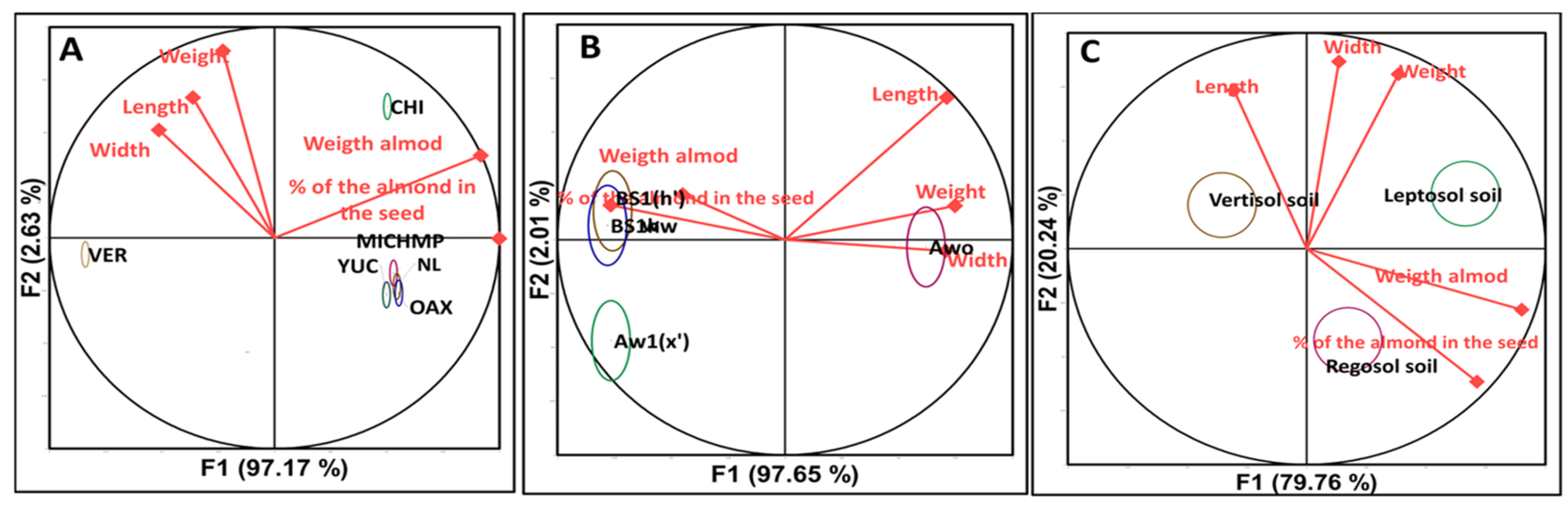
Figure 3 shows the morphological profile as a function of the analyzed factors. It was observed that in the state of Veracruz, seeds with greater weight, length, and width were produced, unlike those from the states of Michoacán, Nuevo León, Oaxaca, and Yucatán, where seeds tended to have a higher percentage of kernel per seed, while in Chiapas, the kernels had a greater weight (Figure 3A).
In the case of climate type, it can be observed that seeds with greater weight, length, and width were produced in the Awo climate, while seeds with a higher percentage of kernel and greater kernel weight are found in the BS1 (h’) w and BS1hw climates (Figure 3B).
According to soil type, seeds with greater width, weight, and length were produced in Vertisol and Leptosol soils, unlike those cultivated in Regosol soil, which were characterized by having higher percentages of kernel both in proportion and weight (Figure 3C).
The information presented in Figure 3 shows important aspects of the factor loadings: for the state factor, the materials collected in the states of Michoacán, Yucatán, Nuevo León, and Oaxaca showed a higher percentage of kernel weight relative to seed weight, unlike the sample collected in Veracruz. The sample from the state of Chiapas showed the greatest kernel weight. For the seed length variable, the Veracruz population stood out for its size, while those from Yucatán and Oaxaca had the shortest lengths.
The climate factor significantly influenced seed morphology. The Awo climate was associated with greater seed width and weight, while the BS1 (h’)w climate was associated with greater kernel weight (Figure 3B). Soil is a potential factor in seed morphology: Regosol soil influenced a higher percentage of kernel weight relative to seed weight.
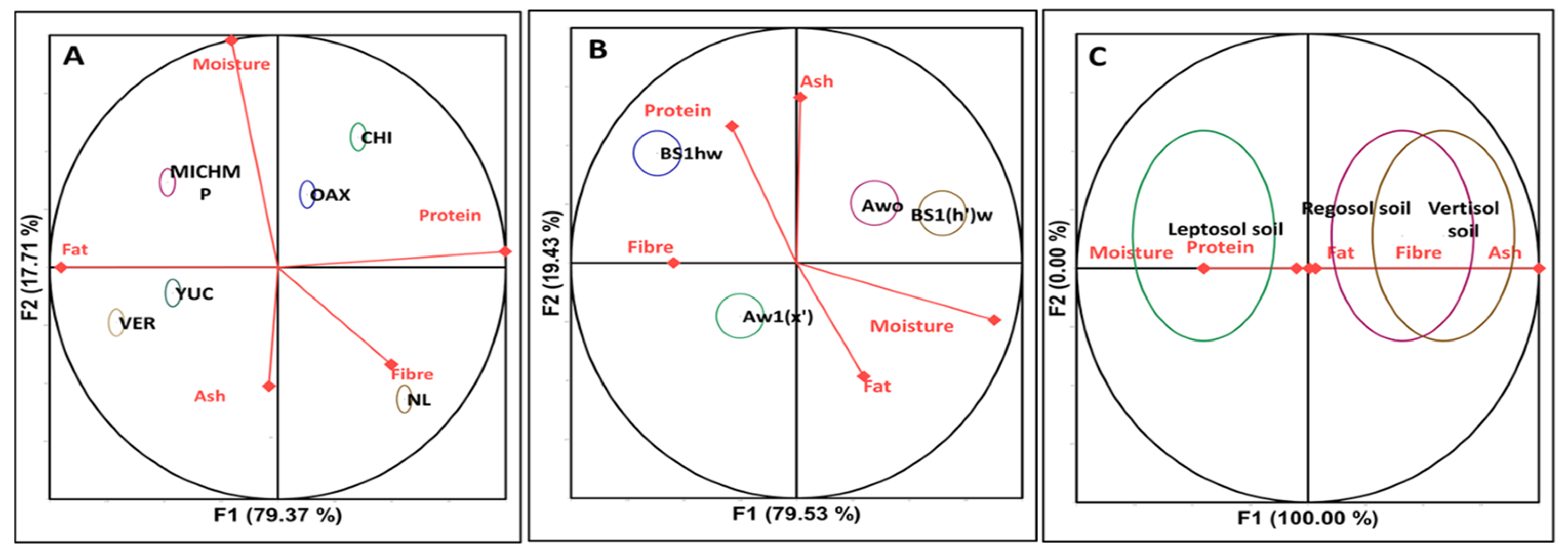
The factor loadings of soil condition and climate influenced the proximate chemical composition of moringa seeds (Figure 4). Samples OAX and CHI showed higher protein content (F2 discrimination) and lower fat content. Samples VER and YUC had a higher percentage of fat and a lower percentage of protein. Moisture content was higher in samples MICHMP and CHI and lower in sample NL (Figure 4B). Regarding climate, the BS1hw climate was identified as having a greater association with moisture and fat content, while the Aw1(x’) climate was associated with higher moisture and fat content (F1 discrimination) (Figure 4B). Leptosol soil influenced higher protein and moisture contents. Ash content was higher in Vertisol soil (Figure 4C).
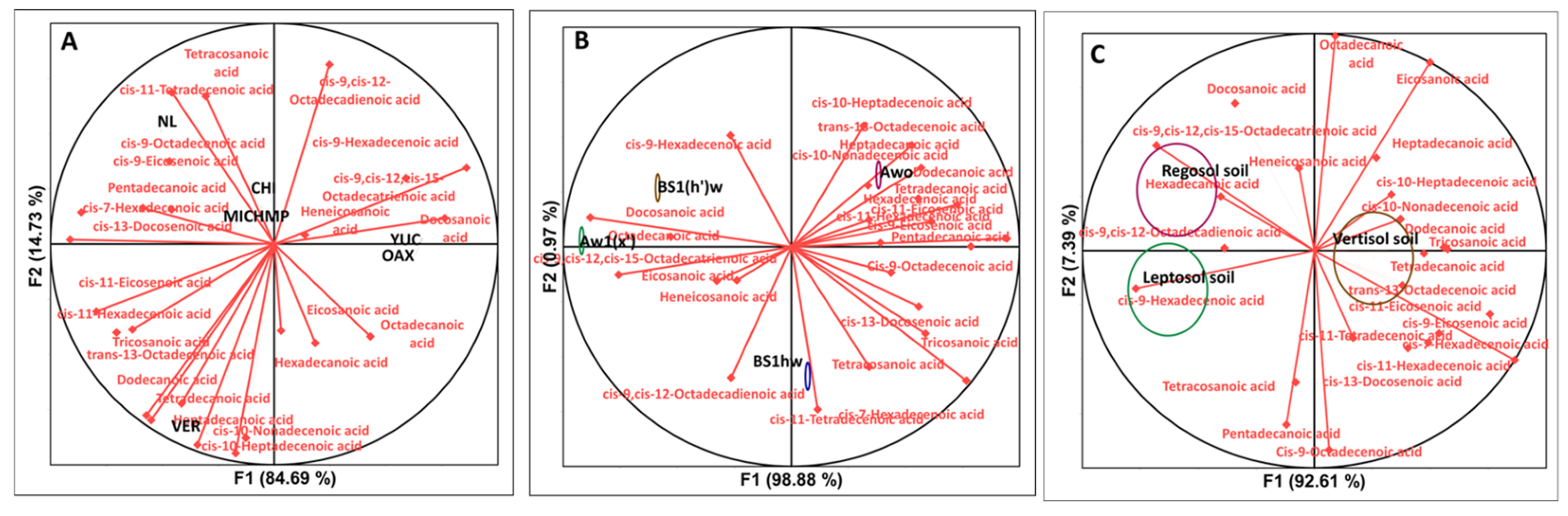
Figure 5 shows the fatty acid profile as a function of the analyzed factors. For the state factor, the predominant fatty acids in moringa seeds from Yucatán and Oaxaca were mainly α-linolenic acid, behenic acid, heneicosanoic acid, palmitoleic acid, and linoleic acid. For the states of Chiapas and Michoacán, the predominant fatty acids were cis-9-eicosenoic acid, cis-7-hexadecenoic acid, cis-13-docosenoic acid (erucic acid), and oleic acid, while in Nuevo León, the predominant fatty acids were cis-11-tetradecenoic acid and lignoceric acid. In the case of Veracruz, the seeds were characterized by a greater diversity of fatty acids such as cis-11-eicosenoic acid, cis-11-hexadecenoic acid, tricosanoic acid, trans-13-octadecenoic acid, dodecanoic acid (lauric acid), tetradecanoic acid (myristic acid), heptadecanoic acid (margaric acid), cis-10-nonadecenoic acid, and cis-10-heptadecenoic acid (Figure 5A). For the climate type factor (Figure 5B), it was observed that in the Awo climate, moringa seeds contained the following fatty acids: cis-10-heptadecenoic acid, trans-13-octadecenoic acid, cis-10-nonadecenoic acid, heptadecanoic acid (margaric acid), tetradecanoic acid (myristic acid), dodecanoic acid (lauric acid), cis-11-eicosenoic acid, cis-9-eicosenoic acid, and pentadecanoic acid. In the BS1 (h’) w and Aw1(x’) climates, the predominant fatty acids were cis-9-hexadecenoic acid (palmitoleic acid), docosanoic acid (behenic acid), octadecanoic acid (stearic acid), cis-9,cis-12,cis-15-octadecatrienoic acid (α-linolenic acid), eicosanoic acid (arachidic acid), and heneicosanoic acid. In the BS1hw climate, seeds predominantly contained the fatty acids cis-9,cis-12-octadecadienoic acid (linoleic acid), cis-11-tetradecenoic acid, cis-7-hexadecenoic acid, tetracosanoic acid (lignoceric acid), tricosanoic acid, and cis-13-docosenoic acid (erucic acid).
For the soil type factor, it was found that the fatty acid profile of moringa seeds grown in Vertisol soil was mainly associated with cis-10-nonadecenoic acid, dodecanoic acid (lauric acid), tricosanoic acid, cis-10-heptadecenoic acid, trans-13-octadecenoic acid, cis-11-eicosenoic acid, cis-9-eicosenoic acid, cis-7-hexadecenoic acid, and cis-11-hexadecenoic acid. In Regosol soil, the fatty acids present in the seeds were docosanoic acid (behenic acid), cis-9,cis-12,cis-15-octadecatrienoic acid (α-linolenic acid), heneicosanoic acid, and hexadecanoic acid (palmitic acid), while in Leptosol soil, the predominant fatty acids were cis-9,cis-12-octadecadienoic acid (linoleic acid), cis-9-hexadecenoic acid (palmitoleic acid), tetracosanoic acid (lignoceric acid), and pentadecanoic acid.
Table 9 shows the cross-validation percentages for each determination by analyzed factor. It was observed that the determinations correctly classified more than 50% of the samples evaluated through morphology, proximate composition, and chromatography. The fatty acid and proximate composition determinations exhibited the highest classification values (83–100%) and contributed most substantially to ensuring the fingerprinting of moringa seeds cultivated in Mexico.

3.4. Correlation Analysis

Table 10 shows the correlation coefficient (Rv) values. Moderate to strong correlations were found between the following sets of variables: precipitation–climate type (Rv = 0.6), morphology–climate type (Rv = 0.6), proximate–soil moisture range (Rv = 0.7), volatile–soil moisture range (Rv = 0.6), climate type–soil moisture range (Rv = 0.6), and temperature–altitude (Rv = 0.6). These results demonstrated that the factors with the greatest influence on chemical and morphological aspects were climate type and soil moisture level. It was also found that proximal content was related to lipid profile content (Rv = 0.6).

4. Discussion

4.1. Effect of State: Morphology

The seed length recorded in this study ranged from 1.05 to 1.32 cm, which was similar to the 1.05 cm reported by ref. [13]. This variable is highly informative in selection, breeding, and conservation schemes. Regarding seed width, the values were similar to the 1.09 cm reported by ref. [30] and higher than the 0.86 cm reported by ref. [13]. Seed length and width are yield components that allow the selection of larger materials for the development of new cultivars. Seed weight is a key variable for selecting populations with higher values, ensuring a greater content of nutrients of interest. In this study, the CHI population reached a weight of 0.430 g, which was higher than the 0.220 g reported by ref. [13] and 0.280 g by ref. [30]. Moringa materials present in Mexico showed higher seed weights compared to previous studies. This yield component can be increased through selection and appropriate agronomic management such as fertilization and irrigation. The identification of materials with higher seed weights ensures a greater oil content, allowing the establishment of crops with higher productivity. The percentage of kernel weight relative to total seed weight was similar to the 71.78% reported by ref. [4]. Both seed and kernel weight are influenced by genetic composition and their interaction with environmental factors [13]. Samples with larger kernel size could contain higher amounts of nutrients, which would enhance their survival during the first days after germination. The seeds evaluated were collected over a two-month period without previous data on optimal storage conditions or harvest dates. These factors could have influenced seed weight due to temperature variations at the sampling sites.

4.2. Effect of State: Proximate Chemistry

The moisture content of the flour evaluated was higher than the 1.26% reported by ref. [31] and 2.03% by ref. [32], but lower than the 10.5% reported by ref. [33] and 9.56% by ref. [34]. A low moisture percentage in samples is associated with good flour quality, which increases its storage period. The moisture content of moringa seeds may have been influenced by genetic variety, age, and previous environmental and storage conditions. The moisture content of moringa seed flour is an important indicator for estimating shelf life, as samples with lower moisture tend to have a longer shelf life [35].
The ash content of a sample represents the total mineral content. Variation was observed when comparing the ash content among seed flours from different moringa populations. The seeds from the VER population had the highest total mineral content. These values were similar to the 3.38% reported by ref. [36], 3.82% by ref. [37], 3.39% by ref. [13], and 3.48% by ref. [38], but lower than the 4.48% reported by ref. [17] and 8.24% by ref. [34].
The protein content of the flours ranged from 28.11% to 37.43%, similar to the 32.19% reported by ref. [13]. Protein is the second most abundant compound in moringa seed flour. This flour is an important source of essential amino acids and can complement various types of food for both humans and animals [39]. The digestibility of moringa seed flour protein is 89.17% [40], making it a good nutritional alternative.

4.3. Effect of State: Fatty Acid Profile

The oleic acid content of the samples ranged from 67.80% to 70.12%, which was similar to the 65.78% reported by ref. [41] and 68.84% by ref. [42], but lower than the 75.32% reported by ref. [43]. Comparison of this fatty acid content with that reported in previous studies allows identifying its response to low yields and developing strategies to increase its content. This is the most abundant fatty acid in the species, and differences have been observed among varieties. Oleic acid can be utilized in various industrial processes [1]. Ref. [44] reported the stability of moringa oil between 50 and 90 °C for 8 h; however, they also identified autooxidation due to a rapid increase in peroxide value. Regarding medicinal properties, oleic acid intake promotes neurogenesis by activating nuclear receptors in stem cells, promotes cell division, and prevents nervous system diseases [45]. Frequent consumption of oleic acid also contributes to obesity prevention, reduces inflammation, and decreases lipogenesis [46].
The highest behenic acid content was identified in seeds from the OAX population, higher than the 0.50% reported by ref. [43] and 6.04% by ref. [4]. This value was much higher than those reported previously, although the extraction and preservation methods could have influenced its content. Molecular dynamics simulation identified the potential of behenic acid for type II diabetes control [47].
The palmitoleic acid values in seeds cultivated in Mexico were similar to the 1.41% reported by ref. [4], 1.42% by ref. [41], and 1.75% by ref. [42], but higher than the 0.32% reported by ref. [43]. Palmitoleic acid has multiple benefits, such as cholesterol regulation, inflammation reduction, modulation of lipogenesis, and promotion of beta-cell proliferation, which are responsible for insulin secretion and blood glucose control [48]. It also benefits skin health by strengthening its barrier function [49].
The stearic acid content ranged from 6.04% to 7.27%, higher than the 2.85% reported by ref. [43] and similar to the 7.51% reported by ref. [42]. Stearic acid reduces low-density cholesterol, promotes fatty acid β-oxidation, enhances mitochondrial fusion in neutrophils, and reduces cancer risk [50].
Arachidic acid production did not differ significantly among populations but was similar to the 4.62% reported by ref. [43] and above the 3.00% reported by ref. [42]. This fatty acid content could be improved through studies focused on irrigation management in moringa [51].
The linoleic acid content was similar to the 0.62% reported by ref. [40] and 0.73% by ref. [41]. This fatty acid is associated with skin permeability and the formation of bioactive metabolites [51]. Moringa seeds represent a low-cost source of this therapeutically important fatty acid.
The diversity in fatty acid content may have been associated with the origin of the samples. Ref. [52] identified differences among sunflower seed varieties. In this study, comparison among samples from different origins revealed that genetic variation within each material is of primary importance.

4.4. Effect of Climate: Morphology

Seed morphology in this study was influenced by the climate of each sampling site. Kernel size was the most important attribute, as it ensures a higher oil content. Ref. [53] reported values of 1.13 cm in length, 1.02 cm in width, and 0.346 g under dry tropical conditions. The Chiapas sample location presented a climate and precipitation (985 mm) suitable for optimal moringa growth. Additional irrigation practices by producers may have influenced seed morphology. Ref. [9] mentioned that annual rainfall levels of around 970 mm favor moringa development. Rain distribution promotes flowering and seed production.
Seed length, width, weight, and kernel weight were higher in the Awo climate than in the other climates. The Awo climate is warm subhumid, with mean temperatures above 22 °C and the coldest month is above 18 °C. The driest month receives between 0 and 60 mm of rainfall, with 5–10.2% of the annual rain occurring in winter. These conditions favor flowering and seed development, as temperatures below 14 °C inhibit moringa flowering. Materials from the Aw1(x’) climate showed the lowest values in seed dimensions and weights. In the linear discriminant analysis, no morphological variable was associated with this climate, suggesting that Aw1(x’) is not suitable for moringa cultivation aimed at seed production. The BS1hw climate is warm semi-arid, with annual mean temperatures above 22 °C and colder months below 18 °C, limiting moringa flowering in some periods.

4.5. Effect of Climate: Proximate Analysis

Moringa seeds produced under drought conditions exhibit lower moisture content in proximate analyses [54]. Protein content was similar to the 35.34% reported by ref. [55], but lower than the 38.57% reported by ref. [17]. In this study, 45.48% fat was identified in the VER population, which was higher than the 32.86% reported by ref. [1] and similar to the 42.27% reported by ref. [17], 35.58% by ref. [32], and 37.76% by ref. [56]. The VER population could therefore be used for oil production, ensuring positive yields. The fat contained in the seeds is an underutilized product due to limited information available in Mexico. Although the seeds are a secondary product of the tree, they could become an important source for edible oil and biodiesel production. The physicochemical characteristics of moringa oil allow it to serve as a substitute for olive oil owing to its high thermal stability [4]. Refinement processes such as alkaline neutralization can improve oil quality [44]. The populations evaluated came from different climatic conditions. Ref. [15] identified that climate influences the oil content of moringa seeds. In this study, the two samples with the highest oil content corresponded to locations with higher rainfall (Table 2). Unlike other vegetable oil sources, M. oleifera can thrive under drought conditions while maintaining oil production [51].

4.6. Effect of Climate: Fatty Acid Profile

Differences in fatty acid content were observed due to climate effects. Analysis of the fatty acid profiles of moringa materials under the same environmental, agronomic, and postharvest conditions would allow more precise identification of variation. Such studies could clarify the quantitative differences in morphology and nutrient content among moringa populations. Materials with higher fatty acid content and greater drought tolerance could be used to develop cultivars focused on sustainable oil production.
The oleic acid content ranged from 67.16% to 69.42%, with BS1hw being the most suitable climate for its production. These values were lower than the 75.52% reported by ref. [1] under different climatic conditions. Oleic acid in moringa seeds could be used in the food and pharmaceutical industries [54]. Ref. [55] noted that a high oleic acid content contributes to oil stability during cooking.
The behenic acid content ranged from 7.250% to 8.055% in the Awo and Aw1(x’) climates, respectively. These values were higher than the 5.90% reported by ref. [1], 3.62% by ref. [54], and 5.67% by ref. [53]. The palmitoleic acid content ranged from 1.331% in Aw1(x’) to 1.618% in BS1 (h’) w, lower than the 1.80% reported by ref. [55]. The stearic acid content ranged from 6.472% to 7.771% in the BS1hw and Aw1(x’) climates, respectively, higher than the 3.95% reported by ref. [1] but lower than the 7.98% reported by ref. [54].
The eicosanoic acid content ranged from 4.293% to 4.744%, higher than the 1.69% reported by ref. [54] and close to the 5.10% reported by ref. [55]. The linoleic acid content was lower than the 0.83% reported by ref. [4], 0.96% by ref. [54], and 10.24% by ref. [43].

4.7. Effect of Soil: Morphology

Seed length was influenced by soil type, while width, seed weight, and kernel weight were also affected by soil conditions. In the linear discriminant analysis, Vertisol soil had no effect on the morphological variables, likely because this soil type is not suitable for moringa due to its compaction during drought and high moisture content during rainy seasons, which affect root development [57]. However, with proper agronomic practices, it can still be functional. Studies on species such as Salvia officinalis have shown soil-type effects on morphology [58].

4.8. Effect of Soil: Proximate Composition

Soil conditions differed among sampling sites (Table 2). Soil groups had an effect on the proximate composition of moringa seeds. This variation may have been associated with mineral content, pH, and cation exchange capacity of the soil. Ref. [17] reported a relationship between soil type and mineral content of moringa organs. Additionally, crop age, genetic variety, agronomic management, seed storage conditions, and extraction methods can influence oil yield [55]. To better explain the variation in moringa seed flour fat content, evaluating materials under homogeneous soil conditions with standardized agronomic and postharvest management is recommended. This approach would minimize environmental effects on genetic materials. Studies on other plant species have also found soil effects on chemical composition. Ref. [52] identified higher oil content of Helianthus annuus grown in Vertisol soil, while ref. [58] reported that oil concentration in Salvia officinalis was significantly influenced by Chernozem and Fluvisol soils.

4.9. Effect of Soil: Fatty Acid Profile

Soil type affected the fatty acid content of moringa seeds, particularly cis-9, cis-12-octadecadienoic acid and cis-9-octadecenoic acid. Soil organic matter influences yield, oil content, and oleic acid concentration in canola seeds [59]. In this study, no fertilization was applied during seed production. Ref. [60] reported that soil nutrient content affected palmitic and oleic acid levels in Camellia oleifera. Therefore, soil should be considered when analyzing fatty acid content in agro-food species.
The fat content of seeds produced in Leptosol soil was lower than that produced in Vertisol and Regosol soils. Leptosol soil covers 28.3% (54.3 ha) of Mexico’s surface and limits the growth of some species due to low water retention [61], yet in this study it favored the protein and moisture contents of the seeds. This may be attributed to moringa’s taproot system, which allows it to utilize limited soil moisture, supporting flowering and fruiting during dry periods. Leptosol soil typically has subhumid moisture with xeric regimes (90–180 days of moisture). Regosol soil, on the other hand, ranges from humid to subhumid with udic (270–330 days) or ustic (180–270 days) regimes. Ref. [52] identified fatty acid content variations in materials grown in different soils. Ref. [58] reported fatty acid differences in Salvia officinalis leaves grown in Chernozem and Fluvisol soils. Ref. [62] suggested that fatty acids could serve as markers through linear discriminant analyses to associate materials with specific soil types. Although ref. [62] found no soil effect on total oil content of Panax ginseng roots, saturated and monounsaturated fatty acids differed among soil types. Predictive power refers to the ability to classify observations into defined groups based on the results obtained. The results obtained indicate the high discriminatory capacity of the model used, based on the determinations and factors (state, soil, and climate) considered in this research [63].

Research Limitations

This study explored the effects of climate and soil type on morphological, proximate, and fatty acid profile traits of moringa seeds grown under different edaphoclimatic conditions in Mexico, demonstrating that several values were higher than those reported in previous studies. This confirms that climatic, genetic, seasonal, and agronomic factors influence both yield and oil composition [64]. These factors modulate the genetic expression of each material, and yield can be enhanced or limited depending on the intensity of each factor. Therefore, identifying and minimizing environmental effects will allow the production of high-quality oil, while efficient extraction processes can further increase yields. However, additional studies are needed to evaluate materials under uniform edaphoclimatic conditions, flowering phenology, postharvest performance, yield–nutrition associations, antioxidant potential, secondary metabolite profiles, and formulation and evaluation of seed-based products for their impact on human and animal health across the identified diversity.
Similarly, it is necessary to apply analytical techniques such as inductively coupled plasma mass spectrometry (ICP-MS) to analyze soil mineral composition and to evaluate its relationship with the potential mineral content of moringa seeds.

5. Conclusions

Based on the findings, edaphoclimatic factors significantly influenced the morphological, proximate, and fatty acid characteristics of Mexican moringa seeds and flour. Morphological variables that constituted the morphological fingerprint based on climate were seed length, width, seed weight, and kernel weight, while under soil type, only seed length was important. For proximate composition, it was concluded that all variables (fat, ash, moisture, and protein), except fiber content, were influenced by climate and soil, forming the proximate chemical fingerprint. In the fatty acid profile, only cis-7-hexadecenoic acid, heneicosanoic acid, and docosanoic (behenic) acid were not influenced by edaphoclimatic factors. However, the fatty acid fingerprint consisted of 21 compounds, with oleic, behenic, stearic, palmitic, and arachidic acids showing the highest concentrations compared to the others. Verification of these fingerprints through linear discriminant analysis confirmed a classification accuracy above 50% according to the cross-validation technique. Therefore, the findings highlight the nutritional importance and value of moringa seeds and flours produced in Mexico, which may be of interest to the food industry and moringa producers for developing alternative products for human and animal nutrition, among other applications. The nutritional value of moringa seeds can be beneficial for human and animal consumption. The high oil content identified could be the basis for new uses of the seed.

Author Contributions

R.R.-H.: Conceptualization, methodology, writing—original draft preparation. A.P.-V.: Conceptualization, methodology, investigation, validation. F.M.-T.: Methodology, investigation. G.L.-R.: Conceptualization, methodology. J.R.B.-A.: Methodology, validation. M.A.H.-C.: Methodology, validation. E.d.J.R.-R.: Conceptualization, methodology, software, validation, formal analysis, writing—original draft preparation. O.S.-V.: Conceptualization, writing—review and editing. A.C.-P.: Conceptualization, writing—original draft preparation, writing—review and editing, supervision. All authors have read and agreed to the published version of the manuscript.

Funding

This research received no external funding.

Informed Consent Statement

Not applicable.

Data Availability Statement

No new data were created or analyzed in this study. Data sharing is not applicable to this article.

Acknowledgments

The authors would like to thank the Colegio de Postgraduados, Campus Veracruz, for the facilities provided during the development of this research.

Conflicts of Interest

The authors declare no conflicts of interest.

References

  1. Ayerza, R. Seed Characteristics, Oil Content and Fatty Acid Composition of Moringa (Moringa oleifera Lam.) Seeds from Three Arid Land Locations in Ecuador. Ind. Crops Prod. 2019, 140, 111575. [Google Scholar] [CrossRef]
  2. Das, B.; Khaled, K.L. Drumstick (Moringa oleifera)—A Natural Gift (an Extensive Review). Int. J. Pharm. Biol. Sci. 2018, 8, 1093–1103. [Google Scholar]
  3. Bancessi, A.; Bancessi, Q.; Baldé, A.; Catarino, L. Present and Potential Uses of Moringa oleifera as a Multipurpose Plant in Guinea-Bissau. S. Afr. J. Bot. 2020, 129, 206–208. [Google Scholar] [CrossRef]
  4. Leone, A.; Spada, A.; Battezzati, A.; Schiraldi, A.; Aristil, J.; Bertoli, S. Moringa oleifera Seeds and Oil: Characteristics and Uses for Human Health. Int. J. Mol. Sci. 2016, 17, 2141. [Google Scholar] [CrossRef] [PubMed]
  5. Zhigila, D.A.; Mohammed, S.; Oladele, F.A.; Sawa, F.B.J. Numerical analyses of leaf and fruit external morphology in Moringa oleifera Lam. J. Teknol. 2015, 77, 123–131. [Google Scholar] [CrossRef]
  6. Paikra, B.K.; Dhongade, H.; Kumar, J.; Gidwani, B. Phytochemistry and Pharmacology of Moringa oleifera Lam. J. Pharmacopunct. 2017, 20, 194–200. [Google Scholar] [CrossRef]
  7. Rodríguez, J.L.L.; Alonso, G.R.; Jiménez, D.G.B.; Pérez, R.C.R.; Ramírez, J.V.R.; Pérez, J.J.R. Producción de semillas de variedades de Moringa oleifera Lam. en el Valle del Cauto. Agron. Mesoam. 2018, 29, 415–423. [Google Scholar] [CrossRef]
  8. DGSIAP. Anuario Estadístico de la Producción Agrícola: Moringa oleifera; SIAP: Chiba, Japan, 2024. [Google Scholar]
  9. Olson, M.; Alvarado-Cárdenas, L.O. ¿Dónde cultivar el árbol milagro, Moringa oleifera, en México? Un análisis de su distribución potencial. Rev. Mex. Biodivers. 2016, 87, 1089–1102. [Google Scholar] [CrossRef]
  10. Ueda Yamaguchi, N.; Cusioli, L.F.; Quesada, H.B.; Camargo Ferreira, M.E.; Fagundes-Klen, M.R.; Salcedo Vieira, A.M.; Gomes, R.G.; Vieira, M.F.; Bergamasco, R. A Review of Moringa oleifera Seeds in Water Treatment: Trends and Future Challenges. Process Saf. Environ. Prot. 2021, 147, 405–420. [Google Scholar] [CrossRef]
  11. Al-Jadabi, N.; Laaouan, M.; El Hajjaji, S.; Mabrouki, J.; Benbouzid, M.; Dhiba, D. The Dual Performance of Moringa oleifera Seeds as Eco-Friendly Natural Coagulant and as an Antimicrobial for Wastewater Treatment: A Review. Sustainability 2023, 15, 4280. [Google Scholar] [CrossRef]
  12. Gupta, N.; Chinnappa, M.; Singh, P.M.; Kumar, R.; Sagar, V. Determination of the Physio-Biochemical Changes Occurring during Seed Development, Maturation, and Desiccation Tolerance in Moringa oleifera Lam. S. Afr. J. Bot. 2022, 144, 430–436. [Google Scholar] [CrossRef]
  13. León-López, L.; Escobar-Zúñiga, Y.; Milán-Carrillo, J.; Domínguez-Arispuro, D.M.; Gutiérrez-Dorado, R.; Cuevas-Rodríguez, E.O. Chemical Proximate Composition, Antinutritional Factors Content, and Antioxidant Capacity of Anatomical Seed Fractions of Moringa oleifera. Acta Univ. 2020, 30, e2892. [Google Scholar] [CrossRef]
  14. Gautier, A.; Duarte, C.M.; Sousa, I. Moringa oleifera Seeds Characterization and Potential Uses as Food. Foods 2022, 11, 1629. [Google Scholar] [CrossRef] [PubMed]
  15. Díaz-Domínguez, Y.; Tabio-García, D.; Rondón-Macias, M.; Fernández-Santana, E.; Muñoz-Rodríguez, S.; Ameneiros-Martínez, J.M.; Piloto-Rodríguez, R. Extraction and Characterization of Moringa oleifera Lam Var. Supergenius Seed Oil from Cuba. Revista CENIC. Cienc. Quim. 2017, 48, 17–26. [Google Scholar]
  16. Ruiz Hernández, R.; Pérez-Vázquez, A.; García Pérez, E.; Morales Trejo, F.; Soto Hernández, R.M. Caracterización Morfológica de Accesiones de Moringa oleifera Provenientes Del Sur-Sureste de México. Rev. Mex. Cienc. Agric. 2021, 12, 1210–2022. [Google Scholar] [CrossRef]
  17. Guzmán-Maldonado, S.H.; López-Manzano, M.J.; Madera-Santana, T.J.; Núñez-Colín, C.A.; Grijalva-Verdugo, C.P.; Villa-Lerma, A.G.; Rodríguez-Núñez, J.R. Nutritional Characterization of Moringa oleifera Leaves, Seeds, Husks and Flowers from Two Regions of Mexico. Agron. Colomb. 2020, 38, 287–297. [Google Scholar] [CrossRef]
  18. Saa, R.W.; Fombang, E.N.; Ndjantou, E.B.; Njintang, N.Y. Treatments and Uses of Moringa oleifera Seeds in Human Nutrition: A Review. Food Sci. Nutr. 2019, 7, 1911–1919. [Google Scholar] [CrossRef]
  19. Trigo, C.; Castelló, M.L.; Ortolá, M.D.; García-Mares, F.J.; Desamparados Soriano, M. Moringa oleifera: An Unknown Crop in Developed Countries with Great Potential for Industry and Adapted to Climate Change. Foods 2021, 10, 31. [Google Scholar] [CrossRef]
  20. Oney-Montalvo, J.; Uc-Varguez, A.; Ramírez-Rivera, E.; Ramírez-Sucre, M.; Rodríguez-Buenfil, I. Influence of Soil Composition on the Profile and Content of Polyphenols in Habanero Peppers (Capsicum Chinense Jacq.). Agronomy 2020, 10, 1234. [Google Scholar] [CrossRef]
  21. Oney Montalvo, J.E.; Morozova, K.; Ferrentino, G.; Ramirez Sucre, M.O.; Rodríguez Buenfil, I.M.; Scampicchio, M. Effects of Local Environmental Factors on the Spiciness of Habanero Chili Peppers (Capsicum Chinense Jacq.) by Coulometric Electronic Tongue. Eur. Food Res. Technol. 2021, 247, 101–110. [Google Scholar] [CrossRef]
  22. Mann, L.; Tolbert, V.; Cushman, J. Potential Environmental Effects of Corn (Zea mays L.) Stover Removal with Emphasis on Soil Organic Matter and Erosion. Agric. Ecosyst. Environ. 2002, 89, 149–166. [Google Scholar] [CrossRef]
  23. Getachew, M.; Tolassa, K.; De Frenne, P.; Verheyen, K.; Tack, A.J.M.; Hylander, K.; Ayalew, B.; Boeckx, P. The Relationship between Elevation, Soil Temperatures, Soil Chemical Characteristics, and Green Coffee Bean Quality and Biochemistry in Southwest Ethiopia. Agron. Sustain. Dev. 2022, 42, 61. [Google Scholar] [CrossRef]
  24. Li, S.; You, S.; Song, Z.; Zhang, L.; Liu, Y. Impacts of Climate and Environmental Change on Bean Cultivation in China. Atmosphere 2021, 12, 1591. [Google Scholar] [CrossRef]
  25. Osorio, M.; Koidis, T.; Papademas, P. Major and Trace Elements in Milk and Halloumi Cheese as Markers for Authentication of Goat Feeding Regimes and Geographical Origin. Int. J. Dairy Technol. 2015, 68, 573–581. [Google Scholar] [CrossRef]
  26. AOAC. Official Methods of Analysis; AOAC: Rockville, MD, USA, 1990. [Google Scholar]
  27. Josse, J.; Pagès, J.; Husson, F. Testing the Significance of the RV Coefficient. Comput. Stat. Data Anal. 2008, 53, 82–91. [Google Scholar] [CrossRef]
  28. Di Rienzo, J.; Balzarini, M.; Gonzalez, L.; Casanoves, F.; Tablada, M.; Walter Robledo, C. Infostat: Software Para Análisis Estadístico, version 2020; Infostat Systems, Inc.: Sacramento, CA, USA, 2010.
  29. XLSTAT, V2020; Addinsoft: Paris, France, 2024.
  30. López, S.E.; Pazos, A.; Gil, A.; Crespo, J.; Vargas, C. Morfometría de fruto y semilla de Moringa oleifera Lam. “moringa”. SCIÉNDO 2018, 21, 201–204. [Google Scholar] [CrossRef]
  31. Bonomi, Z.M.; Al–Amin, A.S.; Gadanya, M.A.; Babandi, A. Characterisation and Proximate Analysis of Moringa oleifera Seed Oil Cultivated in Kano, Nigeria. Niger. J. Nutr. Sci. 2018, 39, 175–178. [Google Scholar]
  32. Jumare, F.; Muhammad, M.; Maiturare, H.; Abubakar, H.; Binji, Z.; Inuwa, F. Antibacterial Activity, Phytochemical and Proximate Analysis of Moringa oleifera Seeds Against Clinical Isolates. Caliphate J. Sci. Technol. 2022, 4, 27–32. [Google Scholar] [CrossRef]
  33. Adegbe, A.; Rotimi, L.; Omojuwa, J.; Omojuwa, T. Proximate Analysis, Physicochemical Properties and Chemical Constituents Characterization of Moringa oleifera (Moringaceae) Seed Oil Using GC-MS Analysis. Am. J. Chem. 2016, 6, 23–28. [Google Scholar] [CrossRef]
  34. Mgbemena, N.M.; Obodo, G.A. Comparative Analysis of the Proximate and Mineral Composition of Moringa oleifera Roots, Leaves and Seeds Obtained in Okigwe Imo State Nigeria. J. Sci. Technol. Env. Inf. 2016, 3, 207–212. [Google Scholar] [CrossRef]
  35. Forsido, S.F.; Welelaw, E.; Belachew, T.; Hensel, O. Effects of Storage Temperature and Packaging Material on Physico-Chemical, Microbial and Sensory Properties and Shelf Life of Extruded Composite Baby Food Flour. Heliyon 2021, 7, e06821. [Google Scholar] [CrossRef] [PubMed]
  36. Sodamade, A.; Owonikoko, A.; Owoyemi, D. Nutrient Contents and Mineral Composition of Moringa oleifera Seed. Int. J. Commun. Syst. 2017, 5, 205–207. [Google Scholar]
  37. Guzmán-Albores, J.M.; Bojórquez-Velázquez, E.; De León-Rodríguez, A.; de Calva-Cruz, O.J.; Barba de la Rosa, A.P.; Ruíz-Valdiviezo, V.M. Comparison of Moringa oleifera Oils Extracted with Supercritical Fluids and Hexane and Characterization of Seed Storage Proteins in Defatted Flour. Food Biosci. 2021, 40, 100830. [Google Scholar] [CrossRef]
  38. Iliyasu, D.; Rwuaan, J.; Sani, D.; Agnes, N.; Njuko, C.; Mustapha, A.-R.; Peter, I. Evaluation of Safety, Proximate and Efficacy of Graded Dose of Moringa oleifera Aqueous Seed Extract as Supplement That Improve Live-Body Weight and Scrotal Circumference in Yankasa Ram. Int. J. Livest. Res. 2020, 10, 33–46. [Google Scholar] [CrossRef]
  39. Kumar, M.; Selvasekaran, P.; Kapoor, S.; Barbhai, M.D.; Lorenzo, J.M.; Saurabh, V.; Potkule, J.; Changan, S.; ElKelish, A.; Selim, S.; et al. Moringa Oleifera Lam. Seed Proteins: Extraction, Preparation of Protein Hydrolysates, Bioactivities, Functional Food Properties, and Industrial Application. Food Hydrocoll. 2022, 131, 107791. [Google Scholar] [CrossRef]
  40. Aderinola, T.A.; Alashi, A.M.; Nwachukwu, I.D.; Fagbemi, T.N.; Enujiugha, V.N.; Aluko, R.E. In Vitro Digestibility, Structural and Functional Properties of Moringa oleifera Seed Proteins. Food Hydrocoll. 2020, 101, 105574. [Google Scholar] [CrossRef]
  41. Salama, M.A.E.-B.; Owon, M.; Osman, M.; Ibrahim, A.; Matthäus, B. Effect of Germination and Roasting on Oil Profile of Moringa oleifera and Moringa Peregrina Seeds. Food Meas. 2020, 14, 2220–2229. [Google Scholar] [CrossRef]
  42. Pérez-Pérez, V.; Alamilla-Beltrán, L.; Jiménez-Martínez, C.; del Pereyra-Castro, S.C.; Ortiz-Moreno, A.; Plazola-Jacinto, C.P.; Camacho-Díaz, B.H.; Ortega, M.H. Evaluación de la toxicidad aguda y composición química de aceite refinado de Moringa oleifera cultivada en México. TIP Rev. Espec. Cienc. Quim. Biol. 2020, 23, 1–9. [Google Scholar] [CrossRef]
  43. Aly, A.A.; Maraei, R.W.; Ali, H.G.M. Fatty Acids Profile and Chemical Composition of Egyptian Moringa oleifera Seed Oils. J. Am. Oil Chem. Soc. 2016, 93, 397–404. [Google Scholar] [CrossRef]
  44. Maliki, M.; Olofinsawe, P.O.; Ikhuo, E.U.; Ifijen, I.H. Thermal Stability Studies of Moringa oleifera Seed Oil. Malays. J. Chem. 2023, 25, 55–63. [Google Scholar]
  45. Shi, Y.; Evans, R.M.; Gage, F.H. Oleic Acid Regulates Hippocampal Neurogenesis as a TLX Ligand. Proc. Natl. Acad. Sci. USA 2022, 119, e2203038119. [Google Scholar] [CrossRef]
  46. Tutunchi, H.; Ostadrahimi, A.; Saghafi-Asl, M. The Effects of Diets Enriched in Monounsaturated Oleic Acid on the Management and Prevention of Obesity: A Systematic Review of Human Intervention Studies. Adv. Nutr. 2020, 11, 864–877. [Google Scholar] [CrossRef] [PubMed]
  47. Nath, V.; Paul, R.K.; Kumar, N.; Kumar, V. Identification of Behenic Acid as Medicinal Food for the Diabetes Mellitus: Structure-Based Computational Approach and Molecular Dynamics Simulation Studies. J. Mol. Model. 2022, 28, 73. [Google Scholar] [CrossRef] [PubMed]
  48. Hu, W.; Fitzgerald, M.; Topp, B.; Alam, M.; O’Hare, T.J. A Review of Biological Functions, Health Benefits, and Possible de Novo Biosynthetic Pathway of Palmitoleic Acid in Macadamia Nuts. J. Funct. Foods 2019, 62, 103520. [Google Scholar] [CrossRef]
  49. Koh, Y.G.; Seok, J.; Park, J.W.; Kim, K.R.; Yoo, K.H.; Kim, Y.J.; Kim, B.J. Efficacy and Safety of Oral Palmitoleic Acid Supplementation for Skin Barrier Improvement: A 12-Week, Randomized, Double-Blinded, Placebo-Controlled Study. Heliyon 2023, 9, e16711. [Google Scholar] [CrossRef] [PubMed]
  50. Senyilmaz-Tiebe, D.; Pfaff, D.H.; Virtue, S.; Schwarz, K.V.; Fleming, T.; Altamura, S.; Muckenthaler, M.U.; Okun, J.G.; Vidal-Puig, A.; Nawroth, P.; et al. Dietary Stearic Acid Regulates Mitochondria in Vivo in Humans. Nat. Commun. 2018, 9, 3129. [Google Scholar] [CrossRef]
  51. Mashamaite, C.V.; Ngcobo, B.L.; Manyevere, A.; Bertling, I.; Fawole, O.A. Assessing the Usefulness of Moringa oleifera Leaf Extract as a Biostimulant to Supplement Synthetic Fertilizers: A Review. Plants 2022, 11, 2214. [Google Scholar] [CrossRef]
  52. Yilmaz, F.F.; Boyraz, E.D. Effects of Different Soil Types and Varieties on Oil Quality of Sunflower in the Thrace Region. Riv. Ital. Sostanze Grasse 2020, 97, 51–59. [Google Scholar]
  53. Reyes Sánchez, N.; Jiménez Campos, M.; Mendieta Araica, B.; Rocha, L.; Noguera Talavera, Á. Rasgos morfológicos de Moringa oleifera cv Honghe en condiciones de trópico seco. Calera 2022, 22, 1–8. [Google Scholar] [CrossRef]
  54. Wiltshire, F.M.S.; de França Santos, A.; Silva, L.K.B.; Carvalho de Almeida, L.; dos Santos Freitas, L.; Lima, A.S.; Fricks, A.T.; Dariva, C.; Soares, C.M.F. Influence of Seasonality on the Physicochemical Properties of Moringa oleifera Lam. Seed Oil and Their Oleochemical Potential. Food Chem. Mol. Sci. 2022, 4, 100068. [Google Scholar] [CrossRef]
  55. Barakat, H.; Ghazal, G.A. Physicochemical Properties of Moringa oleifera Seeds and Their Edible Oil Cultivated at Different Regions in Egypt. Food Nutr. Sci. 2016, 7, 472–484. [Google Scholar] [CrossRef]
  56. Ibiene, A.A.; Ekwuribe, N.C.; Osadebe, A.U.; Okerentugba, P.O. Nutritional, Functional and Microbiological Analysis of Powdered Seed of Moringa oleifera. Int. J. Biochem. Biophys. 2021, 9, 1–7. [Google Scholar] [CrossRef]
  57. Carrión, J.M.; Rodríguez, O.A.V. Potencial agroecológico de Moringa oleifera Lam. para el estado de Veracruz. Rev. Mex. Cienc. For. 2022, 13, 42–63. [Google Scholar] [CrossRef]
  58. Valkovszki, N.J.; Szalóki, T.; Székely, Á.; Kun, Á.; Kolozsvári, I.; Szalókiné Zima, I.; Tavaszi-Sárosi, S.; Jancsó, M. Influence of Soil Types on the Morphology, Yield, and Essential Oil Composition of Common Sage (Salvia officinalis L.). Horticulturae 2023, 9, 1037. [Google Scholar] [CrossRef]
  59. Onemli, F. Fatty Acid Content of Seed at Different Development Stages in Canola on Different Soil Types with Low Organic Matter. Plant Prod. Sci. 2014, 17, 253–259. [Google Scholar] [CrossRef]
  60. Xu, Y.; Deng, S.; Ma, L.; Li, M.; Xie, B.; Gao, J.; Shao, M.; Chen, Y. Effects of Soil Properties and Nutrients on the Fruit Economic Parameters and Oil Nutrient Contents of Camellia oleifera. Forests 2023, 14, 1786. [Google Scholar] [CrossRef]
  61. SEMARNAT. Informe de la Situación del Medio Ambiente en México; SEMARNAT: Mexico City, Mexico, 2013; Volume 12. [Google Scholar]
  62. Chung, I.-M.; Kim, J.-K.; Yang, J.-H.; Lee, J.-H.; Park, S.-K.; Son, N.-Y.; Kim, S.-H. Effects of Soil Type and Organic Fertilizers on Fatty Acids and Vitamin E in Korean Ginseng (Panax Ginseng Meyer). Food Res. Int. 2017, 102, 265–273. [Google Scholar] [CrossRef]
  63. Moreno-Rojas, R.; Sánchez-Segarra, P.J.; Cámara-Martos, F.; Amaro-López, M.A. Multivariate Analysis Techniques as Tools for Categorization of Southern Spanish Cheeses: Nutritional Composition and Mineral Content. Eur. Food Res. Technol. 2010, 231, 841–851. [Google Scholar] [CrossRef]
  64. Raposo, J.D.A.; Figueiredo, P.L.B.; Santana, R.L.; da Silva Junior, A.Q.; Suemitsu, C.; da Silva, R.; Mourão, R.H.V.; Maia, J.G.S. Seasonal and Circadian Study of the Essential Oil of Myrcia sylvatica (G. Mey) DC., a Valuable Aromatic Species Occurring in the Lower Amazon River Region. Biochem. Syst. Ecol. 2018, 79, 21–29. [Google Scholar] [CrossRef]
Figure 1. Geographic location of the evaluated M. oleifera populations that were cultivated in Mexico. CHI: Chiapas; MICHMP: Michoacán; NL: Nuevo León; OAX: Oaxaca; VER: Veracruz; YUC1: Yucatán. The crops were planted at the following densities: CHI (1250 plants ha−1), MICHMP (1111 plants ha−1), NL (10,000 plants ha−1), OAX (10,000 plants ha−1), VER (1111 plants ha−1), and YUC1 (400 plants ha−1). The crops were not fertilized or irrigated.
Seeds 05 00018 g001
Figure 2. Moringa oleifera seeds collected in different states of Mexico. (A): CHI (Chiapas); (B): MICHMP (Michoacán); (C): NL (Nuevo León); (D): OAX (Oaxaca); (E): VER (Veracruz); and (F): YUC1 (Yucatán).
Seeds 05 00018 g002
Figure 3. Morphological profile via linear discriminant analysis: (A) state factor; (B) climate type factor; and (C) soil type factor. Overlapping ellipses indicate that the values are similar. CHI: Chiapas; MICHMP: Michoacán; NL: Nuevo León; OAX: Oaxaca; VER: Veracruz; YUC: Yucatán.
Seeds 05 00018 g003
Figure 4. Proximate chemical profile via linear discriminant analysis: (A) state factor; (B) climate type factor; and (C) soil type factor. CHI: Chiapas; MICHMP: Michoacán; NL: Nuevo León; OAX: Oaxaca; VER: Veracruz; YUC: Yucatán.
Seeds 05 00018 g004
Figure 5. Fatty acid profiles via linear discriminant analysis: (A) state factor; (B) climate type factor; and (C) soil type factor. CHI: Chiapas; MICHMP: Michoacán; NL: Nuevo León; OAX: Oaxaca; VER: Veracruz; YUC: Yucatán.
Seeds 05 00018 g005
Table 1. Edaphoclimatic conditions of M. oleifera populations cultivated in Mexico. Summer 2022.
StateClimate TypeAverage Temp (°C)Minimal Temp (°C)Maximum Temp (°C)Altitude (msnm)Prec * (mm)Dominant
Soil
Humidity Range
CHIAwo25.3218.8431.80529985LeptosolSubhumid (w0)
MICHMPBS1(h’)w27.2919.7734.80265717VertisolArid (BS0)
NLBS1hw21.8315.1828.48478521VertisolSemiarid (BS1)
OAXBS1(h’)w20.2611.9928.531518688RegosolSubhumid (w0)
VERAwo25.2319.5330.93681143VertisolSubhumid (w1)
YUC1Aw1(x’)25.3418.4632.22291178LeptosolSubhumid (w1)
CHI: Chiapas; MICHMP: Michoacán; NL: Nuevo León; OAX: Oaxaca; VER: Veracruz; YUC1: Yucatán. Temp: temperature; Prec *: precipitation; Awo: warm subhumid climate with lower humidity; BS1(h’)w: warm semiarid (steppe) climate; BS1hw: temperate semiarid or semidry climate with summer rains; Aw1(x’): subtype of warm subhumid (tropical) climate with summer rains.
Table 2. Probability values for the factors state, climate type, and soil type for morphological and proximate composition data.
Morphological Analysis
StateClimate TypeSoil Type
Variablep-Valuep-Valuep-Value
Length (cm)<0.0001<0.0001<0.0001
Width (cm)<0.0001<0.00010.069
Seed weight (g)<0.0001<0.00010.203
Weight of almonds (g)<0.0001<0.00010.341
% of almond in the seed<0.00010.9050.320
Proximate Analysis
StateClimate TypeSoil Type
Variablep-Valuep-Valuep-Value
Fat<0.0001<0.0001<0.0001
Ash<0.0001<0.0001<0.0001
Moisture<0.0001<0.0001<0.0001
Protein<0.0001<0.0001<0.0001
Fiber0.0030.0010.015
Table 3. Mean values of morphological variables for the factors state, climate type, and soil type.
Factor: State
StateSeed Length (cm)Width (cm)Seed Weight (g)Weight of Almonds (g)% of Almond in the Seed
CHI1.230 ± 0.01 d1.121 ± 0.007 b0.427 ± 0.005 c0.300 ± 0.003 d69.381 ± 0.45 a
VER1.309 ± 0.01 e1.109 ± 0.007 b0.377 ± 0.005 b0.290 ± 0.003 d70.400 ± 0.45 c
MICHMP1.136 ± 0.01 c1.003 ± 0.007 a0.326 ± 0.005 a0.235 ± 0.003 c71.780 ± 0.45 cd
NL1.105 ± 0.01 bc1.008 ± 0.007 a0.318 ± 0.005 a0.231 ± 0.003 bc72.533 ± 0.45 d
OAX1.076 ± 0.01 ab0.985 ± 0.007 a0.319 ± 0.005 a0.232 ± 0.003 bc73.029 ± 0.45 d
YUC11.049 ± 0.01 a1.000 ± 0.007 a0.315 ± 0.005 a0.220 ± 0.003 a69.840 ± 0.45 bc
Factor: Climate Type
CategorySeed Length (cm)Width (cm)Seed Weight(g)Weight of Almonds (g)% of Almond in the Seed
Awo1.209 ± 0.01 c1.114 ± 0.007 b0.425 ± 0.005 b0.298 ± 0.004 c70.252 ± 0.417 a
BS1(h’)w1.115 ± 0.07 b0.996 ± 0.005 a0.324 ± 0.003 a0.235 ± 0.003 b72.675 ± 0.281 b
BS1hw1.085 ± 0.01 b1.002 ± 0.007 a0.315 ± 0.005 a0.229 ± 0.004 ab72.711 ± 0.417 b
Aw1(x’)1.029 ± 0.01 a0.994 ± 0.007 a0.312 ± 0.005 a0.219 ± 0.004 a70.017 ± 0.417 a
Factor: Soil type
CategorySeed Length (cm)Width(cm)Seed Weight(g)Weight of Almonds (g)% of Almond in the Seed
Leptosol1.130 ± 0.005 b1.033 ± 0.003 a0.347 ± 0.002 a0.247 ± 0.002 a71.236 ± 0.189 a
Vertisol1.130 ± 0.005 b1.033 ± 0.003 a0.347 ± 0.002 a0.247 ± 0.002 a71.236 ± 0.189 a
Regosol1.071 ± 0.013 a1.016 ± 0.009 a0.339 ± 0.006 a0.242 ± 0.004 a71.768 ± 0.499 a
CHI: Chiapas; MICHMP: Michoacán; NL: Nuevo León; OAX: Oaxaca; VER: Veracruz y YUC1: Yucatán. Different letters in the column indicate statistically significant differences (Tukey p < 0.05).
Table 4. Mean values of proximate composition variables for the factors state, climate type, and soil type.
Factor: State
StateFatAshMoistureProteinFiber
CHI36.450 ± 0.727 a2.356 ± 0.072 a5.316 ± 0.061 d36.540 ± 0.132 d19.338 ± 0.688 ab
VER45.483 ± 0.727 b3.4400.072 d4.136 ± 0.061 b28.112 ± 0.132 a18.829 ± 0.688 a
MICHMP42.983 ± 0.727 b2.8320.072 b5.250 ± 0.061 d30.136 ± 0.132 b18.798 ± 0.688 a
NL33.383 ± 0.727 a3.2610.072 cd2.999 ± 0.061 a37.429 ± 0.132 e22.927 ± 0.688 c
OAX35.033 ± 0.727 a3.0280.072 bc4.950 ± 0.061 c34.823 ± 0.132 c22.165 ± 0.688 bc
YUC142.117 ± 0.727 b2.2500.072 a4.192 ± 0.061 b29.782 ± 0.132 b21.659 ± 0.688 abc
Factor: Climate Type
WertherFatAshMoistureProteinFiber
Awo39.822 ± 0.641 b3.144 ± 0.064 b4.429 ± 0.054 b32.484 ± 0.117 b20.121 ± 0.607 a
BS1(h’)w37.322 ± 0.641 b2.536 ± 0.064 a5.543 ± 0.054 c34.508 ± 0.117 c20.090 ± 0.607 a
BS1hw27.722 ± 0.873 a2.965 ± 0.087 b3.292 ± 0.073 a41.801 ± 0.159 d24.220 ± 0.827 b
Aw1(x’)45.489 ± 1.056 c3.038 ± 0.105 b3.305 ± 0.089 a25.726 ± 0.192 a22.442 ± 0.999 ab
Factor: Soil Type
SoilFatAshMoistureProteinFiber
Leptosol34.217 ± 0.727 a2.133 ± 0.072 a5.029 ± 0.061 c37.686 ± 0.132 c20.936 ± 0.688 ab
Vertisol43.250 ± 0.514 b3.217 ± 0.051 b3.849 ± 0.043 b29.258 ± 0.094 a20.426 ± 0.486 a
Regosol35.300 ± 1.027 a3.413 ± 0.103 b3.549 ± 0.086 a33.945 ± 0.187 b23.793 ± 0.973 b
CHI: Chiapas; MICHMP: Michoacán; NL: Nuevo León; OAX: Oaxaca; VER: Veracruz; YUC1: Yucatán. Different letters in the column indicate statistically significant differences (Tukey p < 0.05).
Table 5. Probability values for the factors state, climate type, and soil type for fatty acid data.
StateClimate TypeSoil Type StateClimate TypeSoil Type
Fatty Acidp-Valuep-Valuep-ValueFatty Acidp-Valuep-Valuep-Value
Dodecanoic acid<0.0001<0.0001<0.0001trans-13-Octadecenoic acid<0.0001<0.00010.002
Tetradecanoic acid<0.0001<0.0001<0.0001cis-9,cis-12-Octadecadienoic acid<0.0001<0.0001<0.0001
cis-11-Tetradecenoic acid0.0010.0010.022cis-10-Nonadecenoic acid<0.0001<0.0001<0.0001
Pentadecanoic acid<0.0001<0.00010.001Eicosanoic acid<0.0001<0.0001<0.0001
Hexadecanoic acid<0.0001<0.0001<0.0001cis-9,cis-12,cis-15-Octadecatrienoic acid<0.0001<0.0001<0.0001
cis-7-Hexadecenoic acid<0.0001<0.00010.300cis-11-Eicosenoic acid<0.00010.002<0.0001
cis-9-Hexadecenoic acid<0.0001<0.0001<0.0001cis-9-Eicosenoic acid0.0300.0490.030
cis-11-Hexadecenoic acid<0.0001<0.00010.122Heneicosanoic acid0.8330.7890.718
Heptadecanoic acid<0.0001<0.0001<0.0001Docosanoic acid<0.0001<0.00010.233
cis-10-Heptadecenoic acid<0.0001<0.0001<0.0001cis-13-Docosenoic acid<0.00010.021<0.0001
Octadecanoic acid<0.0001<0.0001<0.0001Tricosanoic acid<0.0001<0.0001<0.0001
cis-9-Octadecenoic0.0060.0270.003Tetracosanoic acid<0.0001<0.0001<0.0001
Table 6. Mean and standard deviation values of fatty acids for the state factor.
Fatty AcidVERNLCHIOAXMICHMPYUC1
Dodecanoic acid 0.020 ± 0.01 c0.012 ± 0.01 ab0.011 ± 0.01 ab0.010 ± 0.01 a0.013 ± 0.01 b0.010 ± 0.01 a
Tetradecanoic acid0.158 ± 0.01 c0.103 ± 0.01 b0.104 ± 0.01 b0.090 ± 0.01 a0.090 ± 0.01 a0.087 ± 0.01 a
cis-11-Tetradecenoic acid0.008 ± 0.01 a0.014 ± 0.01 b0.010 ± 0.01 ab0.008 ± 0.01 a0.010 ± 0.01 ab0.010 ± 0.01 a
Pentadecanoic acid0.012 ± 0.00 ab0.012 ± 0.00 b0.014 ± 0.00 c0.011 ± 0.00 ab0.011 ± 0.00 a0.010 ± 0.00 a
Hexadecanoic acid6.355 ± 0.090 b5.992 ± 0.090 b6.194 ± 0.090 b6.280 ± 0.090 b5.517 ± 0.090 a6.112 ± 0.090 b
cis-7-Hexadecenoic acid0.089 ± 0.01 b0.100 ± 0.01 c0.087 ± 0.01 b0.075 ± 0.01 a0.077 ± 0.01 a0.074 ± 0.01 a
cis-9-Hexadecenoic acid1.346 ± 0.022 a1.341 ± 0.022 a1.623 ± 0.022 c1.556 ± 0.022 bc1.510 ± 0.022 b1.501 ± 0.022 b
cis-11-Hexadecenoic acid0.044 ± 0.01 c0.039 ± 0.01 b0.041 ± 0.01 bc0.034 ± 0.01 a0.034 ± 0.01 a0.033 ± 0.01 a
Heptadecanoic acid0.092 ± 0.002 c0.072 ± 0.002 ab0.070 ± 0.002 ab0.078 ± 0.002 b0.070 ± 0.002 a0.073 ± 0.002 ab
cis-10-Heptadecenoic acid0.043 ± 0.001 c0.021 ± 0.001 a0.025 ± 0.001 ab0.027 ± 0.001 b0.029 ± 0.001 b0.026 ± 0.001 ab
Octadecanoic acid7.002 ± 0.086 bc6.624 ± 0.086 b6.036 ± 0.086 a7.269 ± 0.086 c6.758 ± 0.086 b6.957 ± 0.086 bc
cis-9-Octadecenoic68.569 ± 0.329 ab69.362 ± 0.329 ab70.119 ± 0.329 b67.800 ± 0.329 a69.164 ± 0.329 ab68.655 ± 0.329 ab
trans-13-Octadecenoic acid 0.092 ± 0.002 b0.073 ± 0.002 a0.080 ± 0.002 a0.071 ± 0.002 a0.080 ± 0.002 a0.075 ± 0.002 a
cis-9,cis-12-Octadecadienoic acid0.601 ± 0.007 a0.717 ± 0.007 d0.681 ± 0.007 c0.699 ± 0.007 cd0.644 ± 0.007 b0.684 ± 0.007 cd
cis-10-Nonadecenoic acid0.067 ± 0.001 b0.026 ± 0.001 a0.030 ± 0.001 a0.030 ± 0.001 a0.025 ± 0.001 a0.024 ± 0.001 a
Eicosanoic acid4.534 ± 0.033 b4.428 ± 0.033 b4.019 ± 0.033 a4.515 ± 0.033 b4.439 ± 0.033 b4.376 ± 0.033 b
cis-9,cis-12,cis-15-Octadecatrienoic acid0.115 ± 0.002 a0.153 ± 0.002 c0.145 ± 0.002 bc0.203 ± 0.002 d0.138 ± 0.002 b0.206 ± 0.002 d
cis-11-Eicosenoic acid2.497 ± 0.049 c2.302 ± 0.049 c2.274 ± 0.049 bc2.057 ± 0.049 ab2.437 ± 0.049 c1.962 ± 0.049 a
cis-9-Eicosenoic acid0.097 ± 0.003 ab0.100 ± 0.003 ab0.101 ± 0.003 ab0.091 ± 0.003 ab0.105 ± 0.003 b0.088 ± 0.003 a
Heneicosanoic acid0.050 ± 0.003 a0.052 ± 0.003 a0.047 ± 0.003 a0.053 ± 0.003 a0.050 ± 0.003 a0.051 ± 0.003 a
Docosanoic acid7.181 ± 0.108 a7.266 ± 0.108 ab7.118 ± 0.108 a8.030 ± 0.108 c7.761 ± 0.108 bc7.923 ± 0.108 c
cis-13-Docosenoic acid0.099 ± 0.002 b0.103 ± 0.002 b0.092 ± 0.002 b0.075 ± 0.002 a0.101 ± 0.002 b0.079 ± 0.002 a
Tricosanoic acid0.063 ± 0.002 b0.060 ± 0.002 b0.048 ± 0.002 a0.045 ± 0.002 a0.044 ± 0.002 a0.049 ± 0.002 a
Tetracosanoic acid0.868 ± 0.018 a1.030 ± 0.018 b1.028 ± 0.018 b0.893 ± 0.018 a0.893 ± 0.018 a0.935 ± 0.018 a
CHI: Chiapas; MICHMP: Michoacán; NL: Nuevo León; OAX: Oaxaca; VER: Veracruz; YUC1: Yucatán. Different letters in the same row indicate statistically significant differences (Tukey p < 0.05).
Table 7. Mean and standard deviation values of fatty acids for the climate type factor.
Fatty AcidAwoBS1hwAw1(x’)BS1(h’)w
Dodecanoic acid0.016 ± 0.00 b0.008 ± 0.001 a0.015 ± 0.001 b0.009 ± 0.00 a
Tetradecanoic acid0.140 ± 0.001 d0.085 ± 0.001 b0.123 ± 0.02 c0.072 ± 0.001 a
cis-11-Tetradecenoic acid0.008 ± 0.001 a0.014 ± 0.001 b0.007 ± 0.001 a0.010 ± 0.001 a
Pentadecanoic acid0.013 ± 0.00 bc0.013 ± 0.00 c0.009 ± 0.00 a0.011 ± 0.00 b
Hexadecanoic acid6.556 ± 0.079 b6.193 ± 0.108 b6.473 ± 0.130 b5.718 ± 0.079 a
cis-7-Hexadecenoic acid0.087 ± 0.001 b0.098 ± 0.001 c0.074 ± 0.002 a0.076 ± 0.001 a
cis-9-Hexadecenoic acid1.454 ± 0.020 b1.449 ± 0.027 ab1.331 ± 0.032 a1.618 ± 0.020 c
cis-11-Hexadecenoic acid0.043 ± 0.001 c0.038 ± 0.001 b0.035 ± 0.001 ab0.034 ± 0.001 a
Heptadecanoic acid0.087 ± 0.001 b0.068 ± 0.002 a0.090 ± 0.002 b0.065 ± 0.001 a
cis-10-Heptadecenoic acid0.036 ± 0.001 c0.015 ± 0.001 a0.037 ± 0.002 c0.022 ± 0.001 b
Octadecanoic acid6.850 ± 0.075 b6.472 ± 0.103 a7.771 ± 0.124 c6.606 ± 0.075 ab
cis-9-Octadecenoic68.631 ± 0.290 b69.424 ± 0.395 b67.167 ± 0.478 a69.226 ± 0.290 b
trans-13-Octadecenoic acid0.085 ± 0.002 c0.066 ± 0.003 a0.080 ± 0.003 bc0.073 ± 0.002 ab
cis-9,cis-12-Octadecadienoic acid0.646 ± 0.006 a0.762 ± 0.009 c0.649 ± 0.011 ab0.689 ± 0.006 b
cis-10-Nonadecenoic acid0.057 ± 0.001 b0.015 ± 0.002 a0.051 ± 0.002 b0.014 ± 0.001 a
Eicosanoic acid4.388 ± 0.029 a4.281 ± 0.040 a4.744 ± 0.049 b4.293 ± 0.029 a
cis-9,cis-12,cis-15-Octadecatrienoic acid0.147 ± 0.002 a0.185 ± 0.002 c0.207 ± 0.003 d0.169 ± 0.002 b
cis-11-Eicosenoic acid2.296 ± 0.043 b2.101 ± 0.058 ab1.984 ± 0.071 a2.236 ± 0.043 ab
cis-9-Eicosenoic acid0.094 ± 0.003 ab0.096 ± 0.004 ab0.080 ± 0.005 a0.102 ± 0.003 b
Heneicosanoic acid0.050 ± 0.003 a0.052 ± 0.004 a0.054 ± 0.005 a0.050 ± 0.003 a
Docosanoic acid7.250 ± 0.095 a7.334 ± 0.129 a8.055 ± 0.156 b7.830 ± 0.095 b
cis-13-Docosenoic acid0.088 ± 0.002 b0.092 ± 0.003 b0.075 ± 0.004 a0.090 ± 0.002 b
Tricosanoic acid0.058 ± 0.002 b0.055 ± 0.002 b0.060 ± 0.003 b0.040 ± 0.002 a
Tetracosanoic acid0.921 ± 0.016 b1.084 ± 0.022 c0.829 ± 0.026 a0.946 ± 0.016 b
Different letters in the same row indicate statistically significant differences (Tukey p < 0.05).
Table 8. Mean and standard deviation values of fatty acids for the soil type factor.
Fatty AcidRegosolVertisolLeptosol
Dodecanoic acid0.012 ± 0.001 b0.016 ± 0.00 c0.008 ± 0.001 a
Tetradecanoic acid0.123 ± 0.002 b0.123 ± 0.001 b0.069 ± 0.001 a
cis-11-Tetradecenoic acid0.007 ± 0.001 a0.010 ± 0.001 ab0.012 ± 0.001 b
Pentadecanoic acid0.011 ± 0.00 a0.011 ± 0.00 a0.013 ± 0.00 b
Hexadecanoic acid6.797 ± 0.127 b6.034 ± 0.090 a5.874 ± 0.090 a
cis-7-Hexadecenoic acid0.083 ± 0.002 a0.085 ± 0.001 a0.083 ± 0.001 a
cis-9-Hexadecenoic acid1.401 ± 0.032 a1.355 ± 0.016 a1.633 ± 0.022 b
cis-11-Hexadecenoic acid0.038 ± 0.001 a0.038 ± 0.001 a0.036 ± 0.001 a
Heptadecanoic acid0.090 ± 0.002 c0.082 ± 0.001 b0.061 ± 0.002 a
cis-10-Heptadecenoic acid0.032 ± 0.002 b0.034 ± 0.001 b0.017 ± 0.001 a
Octadecanoic acid7.587 ± 0.121 c7.077 ± 0.060 b6.111 ± 0.086 a
cis-9-Octadecenoic67.186 ± 0.465 a68.550 ± 0.233 b70.100 ± 0.329 c
trans-13-Octadecenoic acid0.074 ± 0.003 a0.083 ± 0.002 b0.071 ± 0.002 a
cis-9,cis-12-Octadecadienoic acid0.696 ± 0.010 b0.641 ± 0.005 a0.721 ± 0.007 b
cis-10-Nonadecenoic acid0.050 ± 0.002 c0.045 ± 0.001 b0.007 ± 0.001 a
Eicosanoic acid4.648 ± 0.047 b4.573 ± 0.024 b4.058 ± 0.033 a
cis-9,cis-12,cis-15-Octadecatrienoic acid0.210 ± 0.003 c0.146 ± 0.001 a0.175 ± 0.002 b
cis-11-Eicosenoic acid1.976 ± 0.0692.355 ± 0.034 b2.132 ± 0.049 a
cis-9-Eicosenoic acid0.082 ± 0.005 a0.096 ± 0.002 b0.100 ± 0.003 b
Heneicosanoic acid0.054 ± 0.005 a0.051 ± 0.002 a0.049 ± 0.003 a
Docosanoic acid7.818 ± 0.152 a7.549 ± 0.076 a7.485 ± 0.108 a
cis-13-Docosenoic acid0.072 ± 0.004 a0.097 ± 0.002 b0.090 ± 0.002 b
Tricosanoic acid0.059 ± 0.003 b0.058 ± 0.001 b0.043 ± 0.002 a
Tetracosanoic acid0.892 ± 0.026 a0.891 ± 0.013 a1.052 ± 0.018 b
Different letters in the same row indicate statistically significant differences (Tukey p < 0.05).
Table 9. Cross-validation percentage values for each analysis by factor considered.
FactorMorphological (%)Proximate (%)Fatty Acids (%)
State52.41100100
Climate type55.5788.89100
Soil type54.7483.3388.89
Table 10. Correlation Matrix.
PrecipitationMorphologyProximate VolatileSoilClimate TypeSoil Moisture RangeTemperatureAltitude
Precipitation1.0
Morphology0.31.0
Proximate0.40.11.0
Volatile0.20.50.61.0
Soil0.30.20.40.51.0
Climate type0.60.60.50.60.41.0
Soil moisture range0.50.10.70.50.30.61.0
Temperature0.30.20.50.30.40.20.41.0
Altitude0.30.10.30.20.60.20.40.61.0
0–0.39 weak correlation; 0.40–0.69 moderate correlation; 0.70–1.0 strong correlation. Values in bold are considered important.
Disclaimer/Publisher’s Note: The statements, opinions and data contained in all publications are solely those of the individual author(s) and contributor(s) and not of MDPI and/or the editor(s). MDPI and/or the editor(s) disclaim responsibility for any injury to people or property resulting from any ideas, methods, instructions or products referred to in the content.