
Security Threats and AI-Based Detection Techniques in IoT Chips

Abstract
1. Introduction
- 1.
- Hardware-level attacks, including Hardware Trojans and side-channel vulnerabilities;
- 2.
- AI-based detection techniques, appropriate for On-Chip and edge implementation;
- 3.
- Emerging secure-by-design architectures that embed security in the hardware foundation of IoT systems.
2. The Hardware Threat Landscape in IoT
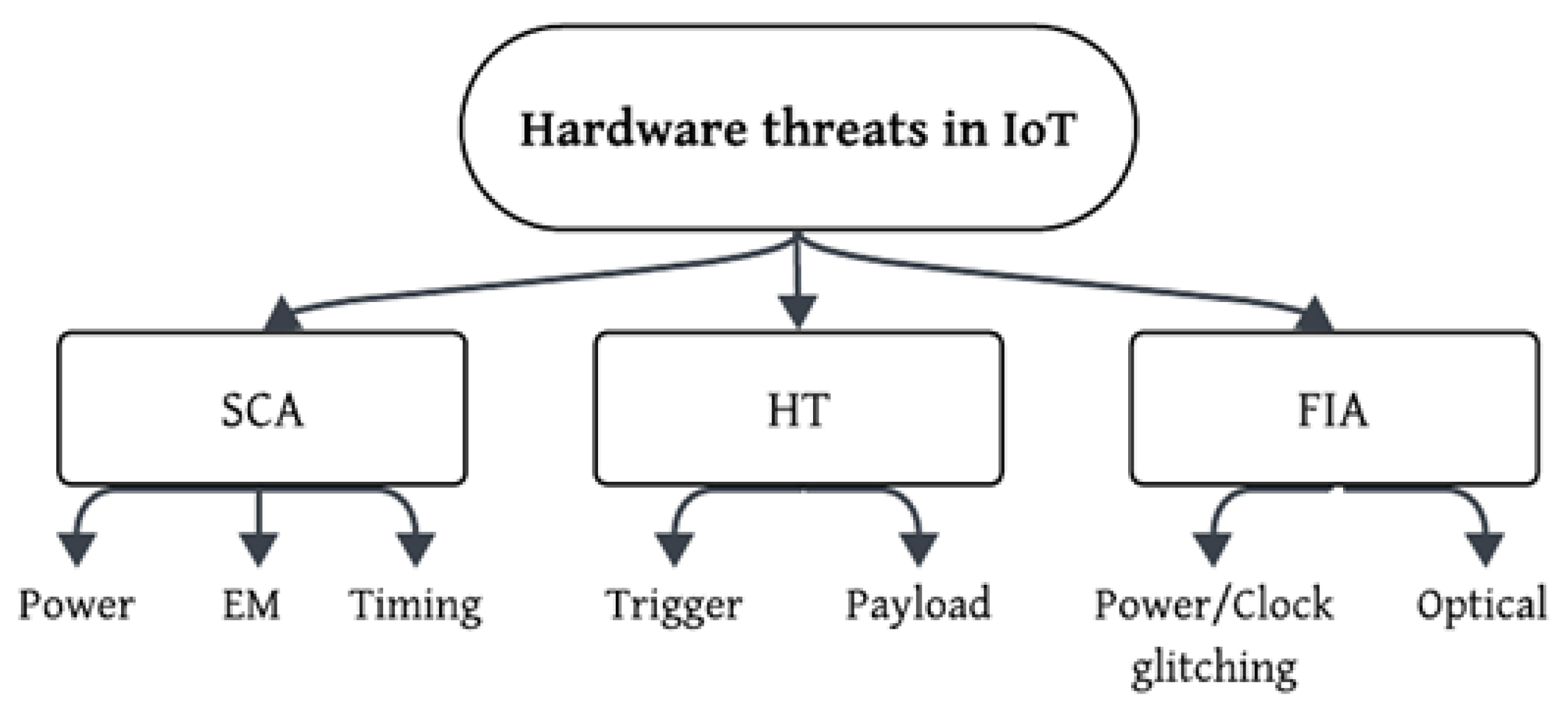
2.1. Side-Channel Attacks
2.1.1. Power Analysis Attacks
- Simple Power Analysis (SPA): SPA involves the visual analysis of the power consumption trace to deduce the flow of the program executed by the processor. For example, in an implemented version of RSA (Rivest-Shamir-Adleman), a square function will consume completely different amounts of energy compared to a multiplication function; therefore, it is feasible to make an extraction of a private exponent from an implementation when it is not performed with constant time.
- Differential and Correlation Power Analysis (DPA/CPA): DPA and CPA are statistical attacks that enable one to extract secret keys even from noisy measurements, where SPA may fail. CPA is the more robust metric that applies the Pearson Correlation Coefficient in mapping the hypothetical power consumption, a hypothesis developed from a leakage model like Hamming Weight or Hamming Distance, to the actual recorded traces. The correlation is computed for key guesses in a set of N traces, thereby revealing the correct sub-key at the point where the correlation is maximized [12].
2.1.2. Electromagnetic (EM) Analysis
2.1.3. Micro-Architectural Timing Attacks
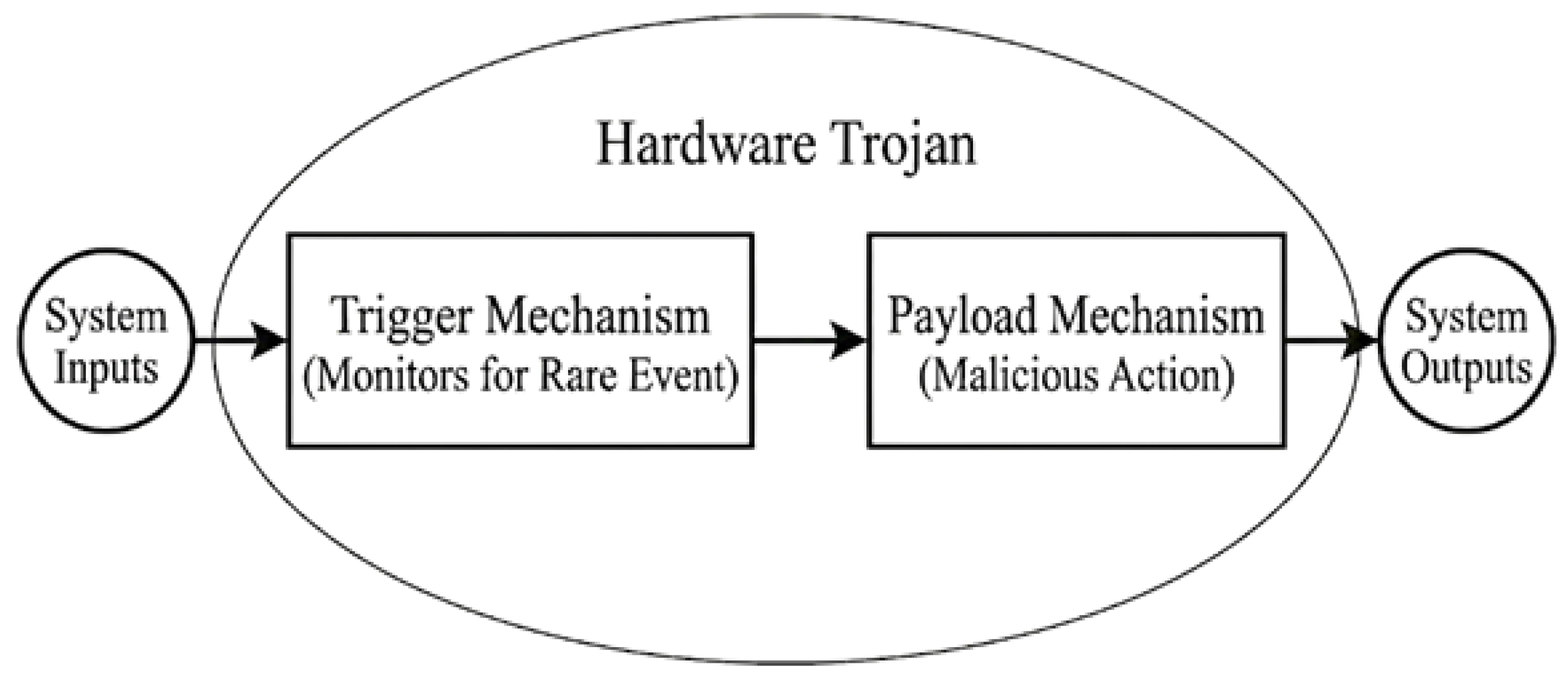
2.2. Hardware Trojans (HTs)
- Combinational Triggers: The triggering occurs when there is a combination of certain logic values on internal nodes; for example, when a certain 128-bit value appears on the data bus. The likelihood of the trigger being true is very low; Ptrigger < 10–20, and hence it is less likely to occur during the verification or random test vectors [17].
- Sequential Triggers: "Time-bombs" or state machines that trigger after a series of events, like reaching a set threshold (for example, after thousands of hours of operation) [18]. Sequential triggers are very dangerous in an IoT context because they make it simple for an attacker to coordinate multiple device failures.
- Denial of Service (DoS): The payload could turn off an essential clock tree, reset the processor, or blow a non-volatile fuse, effectively destroying the chip (“Kill Switch”) [19].
- Information Leakage: The Trojan leaks critical resources such as AES keys using covert channels. These may be physical, such as using power or emanations to escape software firewalls, or logical, such as bits embedded in unused packet headers [20].
- Functional Modification: The Trojan makes a slight change to the results of the computational processes, like reversing a bit within the Random Number Generator (RNG) that reduces entropy, resulting in predictable cryptographic keys.
2.3. Physical and Fault Injection Attacks
- Power Glitching: It involves briefly reducing or rising the voltage of the power supply. It results in a processor skipping or incorrectly executing instructions, commonly used to evade security checks or sabotage key-dependent operations [22].
- Clock Glitching: Adding a brief, unexpected pulse to the clock signal. Like power glitching, it can upset the sequential activity and timing of the IC [23].
- Optical Fault Injection: This method involves the use of focused light (such as a laser) to introduce charge carriers into the silicon substrate to disturb the state of the transistor. It involves decapsulation but allows for high control over the fault.
3. Edge AI and TinyML for On-Chip Security
3.1. Deep Learning Architectures for On-Chip Security
Critical Analysis and Comparative Insights
3.2. TinyML Implementation Strategies for On-Chip Security
3.2.1. Model Compression and Optimization
- Quantization: This involves reducing the precision of the model’s weights and activations from standard 32-bit floating-point to lower bit-widths, such as 8-bit integers or even binary. Quantization significantly reduces memory footprint and allows for faster, more energy-efficient inference using integer arithmetic units, which are common in low-power microcontrollers [38].
- Pruning: This technique removes redundant weights or connections from the neural network, effectively reducing the number of operations required for inference. Structured pruning, which consists in removing entire channels or layers, is preferred for hardware implementation as it results in a more regular, hardware-friendly architecture [39].
- Knowledge Distillation: A smaller, “student” model is trained to mimic the output of a larger, more complex “teacher” model. This allows the deployment of a highly compact model that retains much of the accuracy of the original, resource-intensive model [40].
3.2.2. Hardware-Aware Deployment Architectures
- Software-Based Execution (In-Core): In this architecture, the TinyML model runs as a background task on the main application processor, using ARM’s CMSIS-NN library, for example. One of its main advantages is Zero hardware overhead, as existing devices can be patched with AI security via firmware updates. However, the security task competes with the user application for CPU cycles, potentially introducing latency. Furthermore, if the OS is compromised by a logical attack, the security monitor itself may be disabled.
- Co-Processor/Accelerator (NPU): Modern IoT SoCs increasingly integrate dedicated Neural Processing Units (NPUs) or DSPs. Offloading the intrusion detection model to an NPU decouples security from the main application logic. An NPU can monitor the power rail continuously without waking the main CPU. Studies have shown that dedicated RISC-V-based accelerators with custom vector extensions can execute SCA detection models faster than software implementations, enabling cycle-accurate detection of anomalies [41].
- Embedded FPGA (eFPGA) Overlay: For critical infrastructure, heterogeneous SoCs containing eFPGA fabrics offer the highest performance. The neural network is synthesized directly into logic gates. This is particularly effective for identifying Hardware Trojans at runtime, where the detection logic must operate at the same clock speed as the malicious trigger to prevent the payload from executing [42].
4. Secure-by-Design Architectures and Future Directions
5. Conclusions
Author Contributions
Funding
Data Availability Statement
Conflicts of Interest
References
- El Balbali, H.; Abou El Kalam, A. Towards Robust IoT Security: The Impact of Data Quality and Imbalanced Data on AI-Based IDS. Int. J. Adv. Comput. Sci. Appl. 2025, 16, 851–865. [Google Scholar] [CrossRef]
- El Balbali, H.; Abou El Kalam, A. AI-Driven Big Data Quality Improvement for Efficient Threat Detection in Agricultural IoT Systems. In Proceedings of the International Conference on Advanced Intelligent Systems for Sustainable Development; Springer: Berlin/Heidelberg, Germany, 2023. [Google Scholar] [CrossRef]
- Lu, S.; Shi, W. Vehicle Computing: Vision and challenges. J. Inf. Intell. 2023, 1, 23–35. [Google Scholar] [CrossRef]
- Yuan, J.; Zhang, J.; Qiu, P.; Wei, X.; Liu, D. A Survey of of Side-Channel Attacks and Mitigation for Processor Interconnects. Appl. Sci. 2024, 14, 6699. [Google Scholar] [CrossRef]
- Kuang, S.; Quan, Z.; Xie, G.; Cai, X.; Chen, X.; Li, K. NtNDet: Hardware Trojan detection based on pre-trained language models. Expert Syst. Appl. 2025, 271, 126666. [Google Scholar] [CrossRef]
- Biryukov, A.; Perrin, L. State of the Art in Lightweight Symmetric Cryptography; IACR: Beijing, China, 2017. [Google Scholar]
- Ray, P.P. A review on TinyML: State-of-the-art and prospects. J. King Saud Univ.-Comput. Inf. Sci. 2022, 34, 1595–1623. [Google Scholar] [CrossRef]
- Capogrosso, L.; Cunico, F.; Cheng, O.S.; Fummi, F.; Cristani, M. A Machine Learning-Oriented Survey on Tiny Machine Learning. IEEE Access 2024, 12, 23406–23426. [Google Scholar] [CrossRef]
- Liptak, C.; Mal-Sarkar, S.; Kumar, S.A.P. Power Analysis Side Channel Attacks and Countermeasures for the Internet of Things. In 2022 IEEE Physical Assurance and Inspection of Electronics (PAINE); IEEE: Piscataway, NJ, USA, 2022. [Google Scholar] [CrossRef]
- Crowe, J.; Hayes-Gill, B. Choosing a means of implementation. In Introduction to Digital Electronics; Elsevier: Amsterdam, The Netherlands, 1998. [Google Scholar] [CrossRef]
- Ali, A.; Becher, A.; Ziener, D. Backing the Wrong Horse: How Bit-Level Netlist Augmentation can Counter Power Side Channel Attacks. arXiv 2025, arXiv:2510.04640. [Google Scholar] [CrossRef]
- Differential Power Analysis. In Power Analysis Attacks; Springer: Berlin/Heidelberg, Germany, 2007. [CrossRef]
- Chen, Y.; Yu, J.; Kong, L.; Zhu, Y. A Comprehensive Survey of Side-Channel Sound-Sensing Methods. IEEE Internet Things J. 2025, 12, 1554–1578. [Google Scholar] [CrossRef]
- Rezaeezade, A.; Basurto-Becerra, A.; Weissbart, L.; Perin, G. One for All, All for Ascon: Ensemble-based Deep Learning Side-channel Analysis. In Proceedings of the International Conference on Applied Cryptography and Network Security; Springer: Berlin/Heidelberg, Germany, 2024. [Google Scholar] [CrossRef]
- Zhang, J.; Chen, C.; Cui, J.; Li, K. Timing Side-channel Attacks and Countermeasures in CPU Microarchitectures. ACM Comput. Surv. 2024, 56, 1–40. [Google Scholar] [CrossRef]
- Zulberti, L.; Nannipieri, P.; Fanucci, L. A Script-Based Cycle-True Verification Framework to Speed-Up Hardware and Software Co-Design of System-on-Chip exploiting RISC-V Architecture. In Proceedings of the 2021 16th International Conference on Design & Technology of Integrated Systems in Nanoscale Era (DTIS); IEEE: Piscataway, NJ, USA, 2021. [Google Scholar] [CrossRef]
- Lee, D.; Lee, J.; Jung, Y.; Kauh, J.; Song, T. Robust Hardware Trojan Detection Method by Unsupervised Learning of Electromagnetic Signals. IEEE Trans. Very Large Scale Integr. (Vlsi) Syst. 2024, 32, 2327–2340. [Google Scholar] [CrossRef]
- Wang, J.; Hassan, G.M.; Akhtar, N. A Survey of Neural Trojan Attacks and Defenses in Deep Learning. arXiv 2022, arXiv:2202.07183. [Google Scholar] [CrossRef]
- Dhavlle, A.; Hassan, R.; Mittapalli, M.; Dinakarrao, S.M.P. Design of Hardware Trojans and its Impact on CPS Systems: A Comprehensive Survey. In Proceedings of the 2021 IEEE International Symposium on Circuits and Systems; IEEE: Piscataway, NJ, USA, 2022. [Google Scholar] [CrossRef]
- Gohil, V.; Guo, H.; Patnaik, S.; Rajendran, J. ATTRITION: Attacking Static Hardware Trojan Detection Techniques Using Reinforcement Learning. In Proceedings of the 2022 ACM SIGSAC Conference on Computer and Communications Security; ACM: New York, NY, USA, 2022. [Google Scholar]
- Ghosal, A.K.; Sardar, A.; Chowdhury, D.R. Differential fault analysis attack-tolerant hardware implementation of AES. J. Supercomput. 2024, 80, 4648–4681. [Google Scholar] [CrossRef]
- Shuvo, A.M.; Zhang, T.; Farahmandi, F.; Tehranipoor, M. A Comprehensive Survey on Non-Invasive Fault Injection Attacks. 2023. Available online: https://ia.cr/2023/1769 (accessed on 26 February 2026).
- Breier, J.; Hou, X. How Practical Are Fault Injection Attacks, Really? IEEE Access 2022, 10, 113122–113130. [Google Scholar] [CrossRef]
- Alabdulwahab, S.; Cheong, M.; Seo, A.; Kim, Y.-T.; Son, Y. Enhancing deep learning-based side-channel analysis using feature engineering in a fully simulated IoT system. Expert Syst. Appl. 2025, 266, 126079. [Google Scholar] [CrossRef]
- Abdollahi, M.; Chegini, M.; Hasanzadeh, M.; Hesar, S.; Patooghy, J.A.; Baniasadi, A. NoCSNet: Network-on-Chip Security Assessment Under Thermal Attacks Using Deep Neural Network. In Proceedings of the 2024 17th IEEE/ACM International Workshop on Network on Chip Architectures (NoCArc); IEEE: Piscataway, NJ, USA, 2024. [Google Scholar] [CrossRef]
- Gourousis, T.; Zhang, Z.; Yan, M.; Zhang, M.; Mittal, A.; Shrivastava, A. Identification of Stealthy Hardware Trojans through On-Chip Temperature Sensing and an Autoencoder-Based Machine Learning Algorithm. In Proceedings IEEE International Midwest Symposium on Circuits and Systems (MWSCAS); IEEE: Piscataway, NJ, USA, 2023. [Google Scholar] [CrossRef]
- Ahmed, A.A.; Islam, S.; Aman, A.H.M.; Safie, N. Design of Convolutional Neural Networks Architecture for Non-Profiled Side-Channel Attack Detection. Telecommun. Eng. 2023, 29, 76–81. [Google Scholar] [CrossRef]
- ScienceDirect Convolution Formula. 2006. Available online: https://www.sciencedirect.com/topics/computer-science/convolution-formula (accessed on 26 February 2026).
- Dofe, J.; Danesh, W.; More, V.; Chaudhari, A. Natural Language Processing for Hardware Security: Case of Hardware Trojan Detection in FPGAs. Cryptography 2024, 8, 36. [Google Scholar] [CrossRef]
- Berahmand, K.; Daneshfar, F.; Salehi, E.S.; Li, Y.; Xu, Y. Autoencoders and their applications in machine learning: A survey. Artif. Intell. Rev. 2024, 57, 28. [Google Scholar] [CrossRef]
- Apxml Reconstruction Loss Functions. Available online: https://apxml.com/courses/autoencoders-representation-learning/chapter-2-classic-autoencoder-architecture/reconstruction-loss-functions (accessed on 26 February 2026).
- Michelucci, U. An Introduction to Autoencoders. arXiv 2022, arXiv:2201.03898. [Google Scholar] [CrossRef]
- Li, Z.; Du, C.; Duan, X. Efficient AES Side-Channel Attacks Based on Residual Mamba Enhanced CNN. Entropy 2025, 27, 853. [Google Scholar] [CrossRef]
- Pu, K.; Dang, H.; Kong, F.; Zhang, J.; Wang, W. A Quantitative Analysis of Non-Profiled Side-Channel Attacks Based on Attention Mechanism. Electronics 2023, 12, 3279. [Google Scholar] [CrossRef]
- Chinbat, M.; Wu, L.; Zhang, X.; Yang, Y.; Wei, M. Comparative Deep Learning-Based Side-Channel Analysis of an FPGA-Based CRYSTALS-Kyber NTT Accelerator. Cryptography 2025, 9, 64. [Google Scholar] [CrossRef]
- Wang, J.; Zhai, G.; Gao, H.; Xu, L.; Li, X.; Li, Z.; Huang, Z.; Xie, C. A Hardware Trojan Detection and Diagnosis Method for Gate-Level Netlists Based on Machine Learning and Graph Theory. Electronics 2024, 13, 59. [Google Scholar] [CrossRef]
- Diavastos, B.A.A.; Peh, L.-S.; Carlson, T.E. Secure Run-Time Hardware Trojan Detection Using Lightweight Analytical Models. IEEE Trans. Comput. Des. Integr. Circuits Syst. 2024, 43, 431–441. [Google Scholar] [CrossRef]
- Li, Z.; Li, H.; Meng, L. Model Compression for Deep Neural Networks: A Survey. Computers 2023, 12, 60. [Google Scholar] [CrossRef]
- Wang, M.; Zhao, Y.; Liu, J.J.; Chen, C.Z.; Gu, R.J.; Guo, X.Z. Large Multimodal Model Compression via Iterative Efficient Pruning and Distillation. In Companion Proceedings of the ACM Web Conference 2024; ACM: New York, NY, USA, 2024. [Google Scholar] [CrossRef]
- Hong, Y.-W.; Leu, J.-S.; Faisal, M.; Prakaso, S.W. Analysis of Model Compression Using Knowledge Distillation. IEEE Access 2022, 10, 85095–85105. [Google Scholar] [CrossRef]
- Kieu, D.-N.-B. Research on RISC-V-Based Multicore Processor for Multi-Threading. Ph.D. Thesis, The University of Electro-Communications, Tokyo, Japan, 2025. [Google Scholar]
- Dharavathu, A. Towards Reconfigurable Hardware for In-Field Hardware Bug Patches. Master’s Thesis, University of Calgary, Calgary, AB, Canada, 2024. [Google Scholar]



| Threat | Attack Vector | Physical Mechanism/Vulnerability | Primary Target | Attacker Requirements | Security Impact |
|---|---|---|---|---|---|
| SCA | Power Analysis (SPA) | Visual inspection of power traces () to identify instruction sequences | Crypto Co-processors (RSA, ECC) | Low: Oscilloscope, Shunt Resistor | Confidentiality: Recovery of coarse-grained secrets (e.g., RSA exponent). |
| Power Analysis (DPA/CPA) | Statistical correlation (Pearson) between hypothetical leakage models (Hamming Weight) and actual power consumption. | AES/Symmetric Engines | Medium: Oscilloscope, statistical post-processing (e.g., Pearson correlation) | Confidentiality: Full key extraction from noisy traces. | |
| Electromagnetic Analysis (EMA) | Detection of magnetic near-fields generated by current loops in metal interconnects (Maxwell’s Laws). | Localized Logic Blocks (Specific Co-processor) | Medium: EM Probes, SDR, XYZ Table | Confidentiality: Spatial localization of leakage, bypassing global noise. | |
| Micro-architectural Timing | Exploitation of data-dependent execution times caused by shared resources. | Cache Memory, Branch Predictor, Pipeline | Low: Remote code execution or shared OS | Privacy: Inference of memory access patterns or key-dependent lookups | |
| Hardware Trojans | Combinational Trigger | Activation via rare logic states on internal nets (). | System Bus, Internal Data Paths | High: Foundry access or Design House infiltration | Integrity/Availability: Silent dormancy until specific input pattern occurs. |
| Sequential Trigger | “Time-bomb” activation based on state machines or counters (e.g., clock cycles). | Counter Registers, RTC (Real-Time Clock) | High: Supply Chain manipulation | Availability: Synchronized fleet failure after deployment duration. | |
| Payload: Denial of Service | Modification of critical control signals to freeze or destroy the chip. | Clock Tree, Reset Logic, Fuses | Inherited from trigger mechanism | Availability: Permanent (“Kill Switch”) or temporary device failure. | |
| Payload: Info Leakage | Modulation of side-channels (Thermal, Power, Delay) to transmit secrets covertly. | Power Management Unit (PMU), GPIO | Inherited from trigger mechanism | Confidentiality: Exfiltration of keys via covert channels. | |
| Payload: Parametric | Altering transistor sizing or doping to degrade performance or entropy. | Analog Front-End, RNG (TRNG) | High: Foundry manipulation | Integrity: Weakened cryptography due to predictable RNG. | |
| FIA | Voltage Glitching | Undervolting/ Overvolting to violate setup/hold time constraints of flip-flops. | Power Regulation (LDO), Control Logic | Low: FPGA, Voltage Glitcher | Integrity: Instruction skipping (bypassing authentication). |
| Clock Glitching | Injecting transient pulses into the clock signal to corrupt instruction fetch/decode. | Clock Distribution Network | Low: FPGA, Direct Pin Access | Integrity: Altering control flow or loop parameters. | |
| Optical/Laser Faults | Photoelectric effect induces localized charge carriers, causing bit-flips in memory | SRAM, Register File, Flash Memory | High: Laser Station, Decapsulation equipment | Confidentiality: Differential Fault Analysis (DFA) to recover keys. |
| Model | Security Application | Input Data | Implementation Cost | Key Strength for IoT |
|---|---|---|---|---|
| 1D-CNN | SCA Detection: Identifying DPA/CPA patterns amidst noise. | Raw Power Traces, EM Emanations. | High: Requires hardware accelerator or heavy DSP. | Robust against trace misalignment and jitter. |
| MLP | Fault Injection: Classifying glitch shapes (e.g., voltage droop). | Glitch Detector outputs, On-chip Voltmeter. | Medium: Heavy memory usage for weights if FC. | Simple architecture, easy to parallelize on SIMD. |
| LSTM/GRU | Hardware Trojans: Detecting sequential triggers or complex payloads. | Sequence of Power, Op-codes, or PC values. | High: Complex memory management (gating). | Able to learn long-term dependencies (cycles). |
| AE/VAE | Zero-Day Anomaly: Detecting unknown attacks without labels. | Performance Counters (HPC), Thermal Maps. | Medium/High: Inference is light, training is heavy. | Does not require a database of known attacks. |
| Random Forest | Logic Locking: Modeling PUF responses or verifying stability. | Challenge–Response Pairs (CRPs). | Low: Can be implemented as IF-ELSE statements. | Extremely fast inference and interpretable logic. |
| SVM | Malware Detection: Identifying micro-architectural anomalies. | Cache hits/misses, Branch stats. | Low: Efficient if using linear kernels. | Effective in high-dimensional spaces with small data. |
| SNN | Always-On Monitoring: Wake-up trigger for coarse anomalies. | Event-based sensor spikes (asynchronous). | Ultra-Low: Event-driven (power only on spikes). | Extreme energy efficiency, mimics biology. |
| Ref. | Target Threat | AI Model/Architecture | Hardware Platform | Accuracy/Success Rate | Overhead/Efficiency |
|---|---|---|---|---|---|
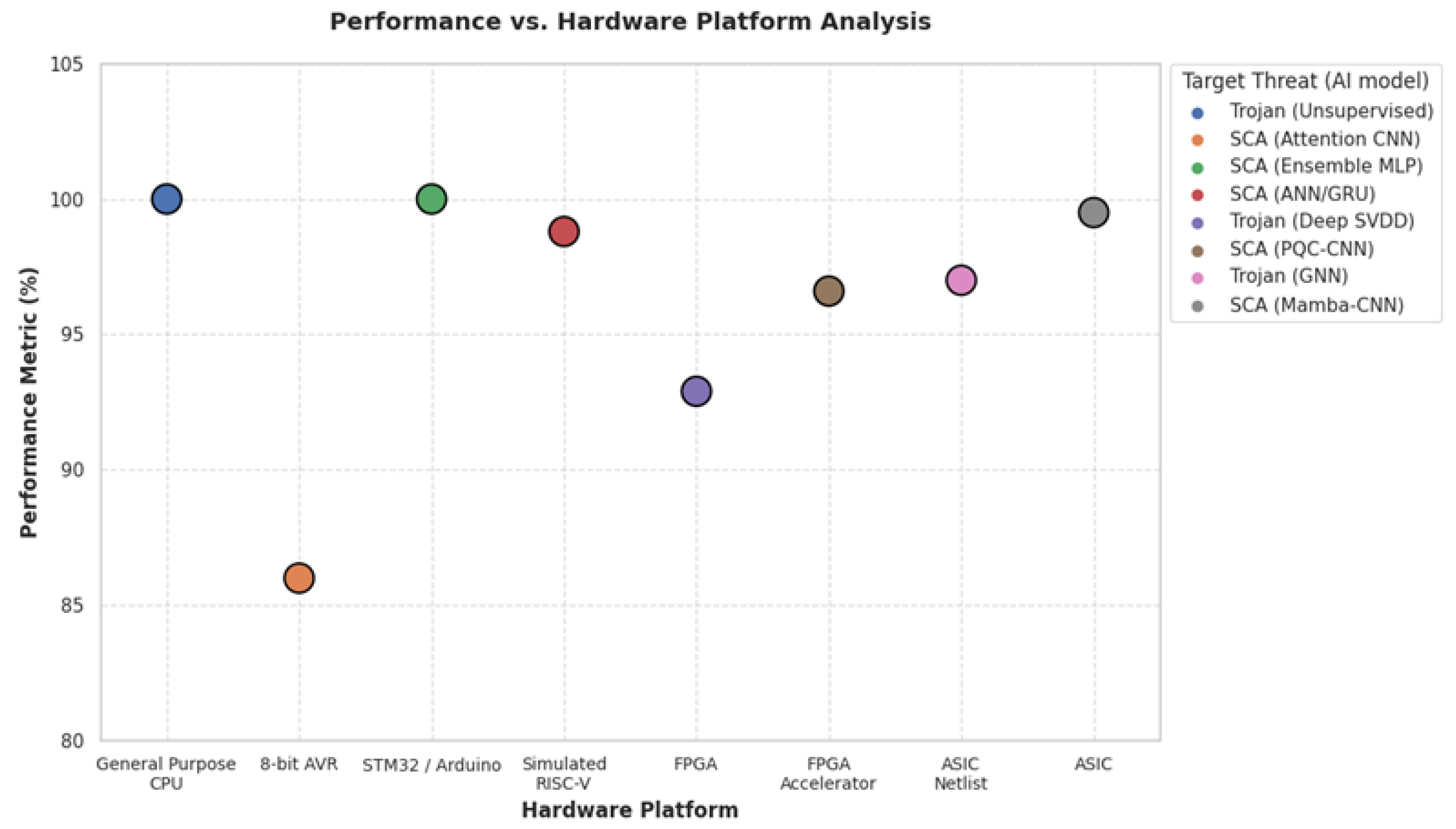
| [24] | SCA (Hiding Countermeasures) | ANN/GRU (Gated Recurrent Unit) | Simulated IoT System (RISC-V/ARM) | 98.8% (Detection Accuracy) | High energy efficiency via feature engineering |
| [17] | Hardware Trojan (HT) | Deep SVDD (Unsupervised EM Analysis) | FPGA Implementation | 92.87% (Average Accuracy) | Superior generalization vs. benchmarks |
| [33] | SCA (AES/Masking) | Mamba-Enhanced CNN (Hybrid Attention) | ASIC/ASCAD Benchmark | > (Trace Classification) | Robust against trace jitter/misalignment |
| [14] | SCA (Lightweight Ascon) | Ensemble MLP/CNN | Microcontroller (STM32/Arduino) | 100% Key Recovery (<3k traces) | Efficient on 32-bit Cortex-M4 devices |
| [34] | Non-Profiled SCA | Attention-Based CNN | 8-bit AVR Microcontroller | 86% (Success Rate) | Effective on long, noisy power traces |
| [35] | SCA on PQC (Kyber) | Optimized CNN/MLP | FPGA Accelerator | 96.6% (Key Classif.) | 10.3× faster training than standard DL |
| [36] | Gate-Level Trojans | Graph Neural Network (GNN) | Netlist | >97% (F1-Score) | +25% True Negative Rate improvement |
| [37] | Runtime Trojans | Lightweight Analytical Model | CPU | 100% TPR/0 False Pos. | Negligible power overhead (0.005%) |
Disclaimer/Publisher’s Note: The statements, opinions and data contained in all publications are solely those of the individual author(s) and contributor(s) and not of MDPI and/or the editor(s). MDPI and/or the editor(s) disclaim responsibility for any injury to people or property resulting from any ideas, methods, instructions or products referred to in the content. |
© 2026 by the authors. Licensee MDPI, Basel, Switzerland. This article is an open access article distributed under the terms and conditions of the Creative Commons Attribution (CC BY) license.
Share and Cite
El Balbali, H.; Abou El Kalam, A. Security Threats and AI-Based Detection Techniques in IoT Chips. Chips 2026, 5, 9. https://doi.org/10.3390/chips5010009
El Balbali H, Abou El Kalam A. Security Threats and AI-Based Detection Techniques in IoT Chips. Chips. 2026; 5(1):9. https://doi.org/10.3390/chips5010009
Chicago/Turabian StyleEl Balbali, Hiba, and Anas Abou El Kalam. 2026. "Security Threats and AI-Based Detection Techniques in IoT Chips" Chips 5, no. 1: 9. https://doi.org/10.3390/chips5010009
APA StyleEl Balbali, H., & Abou El Kalam, A. (2026). Security Threats and AI-Based Detection Techniques in IoT Chips. Chips, 5(1), 9. https://doi.org/10.3390/chips5010009