Review

Methane Emissions from Livestock Operations: Sources, Sinks, and Mitigation Strategies

by
Bonface O. Manono
Colorado State University Extension, Fort Collins, CO 80523, USA
Submission received: 6 January 2026 / Revised: 26 January 2026 / Accepted: 28 January 2026 / Published: 1 February 2026

Abstract

Livestock operations significantly contribute to global methane (CH4) emissions, a potent greenhouse gas. This occurs primarily through enteric fermentation (a digestive process in ruminant animals that produce methane) and manure management. This review synthesizes the current understanding of the sources of methane within livestock farming systems. It focuses on the primary drivers of these emissions, namely methane production during ruminant digestion and emissions from manure handling. The review also explores the concept of methane sinks, highlighting the processes that remove methane from the atmosphere and their role in the global methane cycle. While natural methane sinks exist, their capacity to offset methane emissions from livestock operations is limited. This review therefore discusses a range of mitigation approaches, categorized into animal and feed management, diet manipulation, rumen manipulation, and advanced technologies. Synthesizing these elements provides a clear understanding of the challenges and opportunities in addressing livestock-related methane emissions. Effective strategies should aim to reduce methane production without negatively impacting animal productivity and health. This emphasizes that addressing sustainable livestock production requires integrated approaches that simultaneously tackle climate change mitigation.

1. Introduction

Methane (CH4) is a potent greenhouse gas (GHG), with a much higher global warming potential (GWP) than carbon dioxide over a 100-year period [1]. Atmospheric methane levels have more than doubled since the start of the Industrial Revolution, and this increase is a major anthropogenic driver of global warming [2]. The livestock sector plays a substantial role in these emissions [3,4]. Enteric fermentation, which is a natural digestive process occurring in ruminant animals like cattle, buffalo, sheep, and goats, is its largest single source within the livestock sector [5]. The other contribution is from manure management practices in livestock operations [3,6]. These emissions not only pose an environmental concern but also represent a loss of dietary energy for the animals, thereby reducing productivity [6,7].
The increasing global demand for animal-based food products suggests the livestock sector will continue to expand [8,9]. Furthermore, the atmospheric lifespan of methane is comparatively brief [10]. This means its emissions reduction can have a more immediate impact on mitigating global warming compared to CO2. This makes effective methane mitigation strategies more critical [11]. Therefore, understanding the complex interplay of methane sources from livestock production, natural sinks, and effective mitigation strategies is critical. This knowledge is essential for developing sustainable livestock production systems, which in turn support the achievement of global climate targets. This review synthesizes existing data on methane emissions and sequestration in livestock farming and examines current and emerging mitigation techniques. It will also provide policy recommendations and future research directions.

2. Review Methodology

To identify relevant studies for this review, a structured and systematic literature search was conducted using multiple scholarly databases. The search process was designed to capture a wide range of high-quality publications related to methane emissions from livestock systems. Major academic databases, including Web of Science, Scopus, and Google Scholar, were consulted, along with selected peer-reviewed journals specializing in environmental and agricultural sciences. Search queries were developed using combinations of carefully chosen terms reflecting the core focus of the review, such as “methane emissions from livestock”, “enteric fermentation”, “manure management”, “greenhouse gases”, “ruminant production systems”, and “mitigation approaches”. Logical operators were applied strategically to refine the searches and improve the relevance of retrieved records.
The resulting publications were screened using predefined eligibility criteria to ensure relevance and scientific reliability. Only articles published in peer-reviewed journals and written in English were considered. Eligible studies were required to address methane emissions originating from livestock production, including emission sources, measurement methods, and mitigation options. Both primary research studies (experimental, observational, and modeling) and secondary studies (reviews and meta-analyses) were included to provide a comprehensive overview of the topic. While recent literature was emphasized to reflect current advances, earlier foundational studies were also examined to contextualize developments in the field. Studies focused on methane emissions unrelated to livestock systems, as well as editorials, opinion articles, conference abstracts lacking full manuscripts, and unpublished materials, were excluded. Publications reporting redundant or substantially overlapping data were removed during the screening process.
To ensure the robustness of the synthesized evidence, the methodological quality of the selected studies was critically evaluated. For original research articles, assessment criteria included study design, sample size adequacy, methodological rigor, and the appropriateness of statistical analyses. For review-based studies, attention was given to the transparency of their search strategies, the clarity of inclusion criteria, and the rigor of their evidence synthesis methods.

3. Sources of Methane Emissions in Livestock Operations

Methane emissions from livestock primarily originate from two major biological and management-related pathways: enteric generation in the ruminant rumen and from anaerobic manure management systems [3,12]. Factors such as animal physiology, diet composition, and specific management practices influence these sources [13].

3.1. Enteric Fermentation

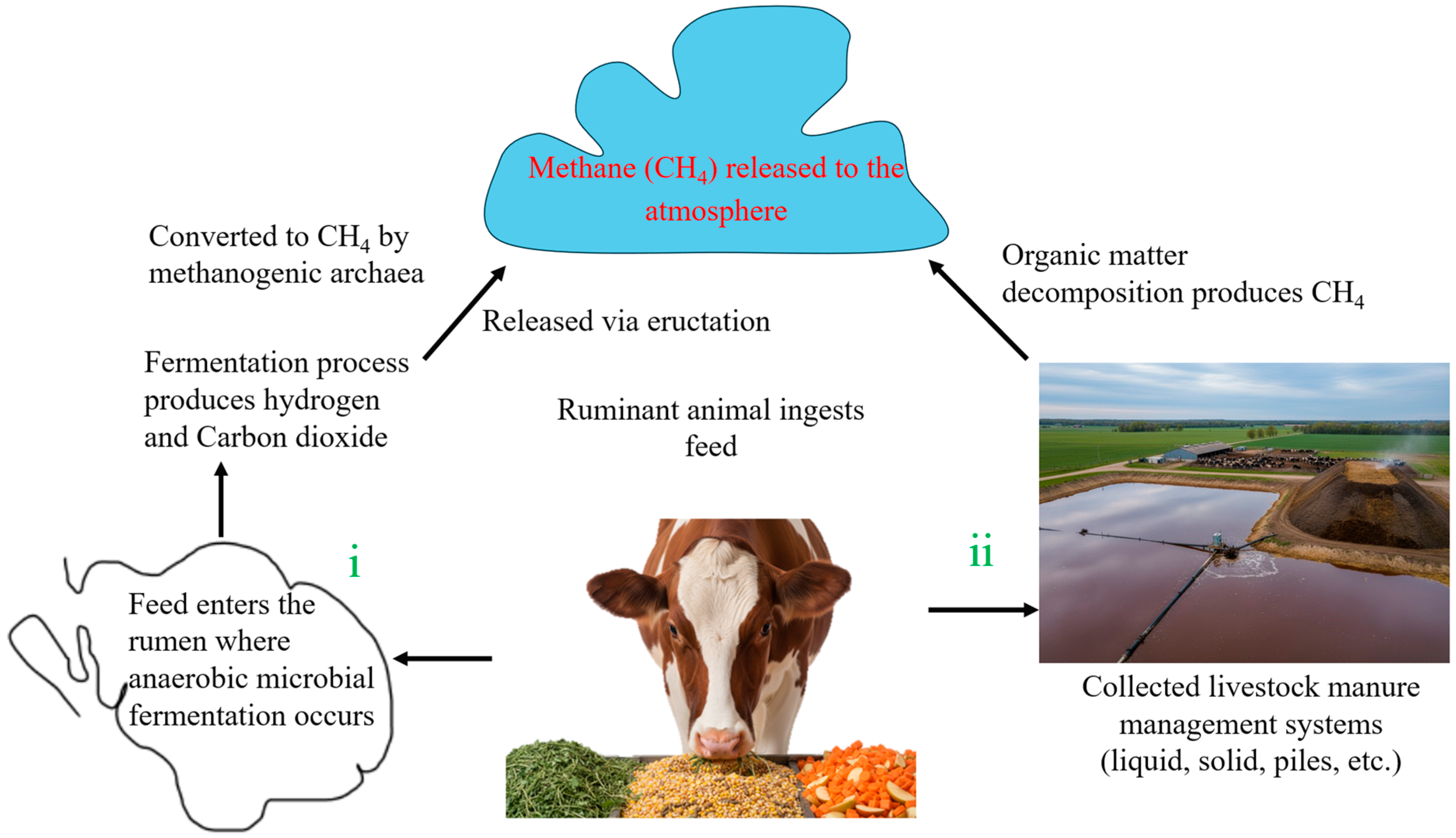
Enteric fermentation is a digestive process occurring in the specialized stomach compartments of ruminant animals, such as cattle, sheep, and goats [14]. In the anaerobic rumen environment, a variety of microorganisms break down consumed feed, especially complex carbohydrates such as cellulose, hemicellulose, pectin, and starch [15,16]. This fermentation process produces volatile fatty acids, which serve as the primary energy source for the host animal. It also generates hydrogen (H2) and carbon dioxide (CO2) as byproducts [17]. Methanogenic archaea, a specialized group of microorganisms, utilizes these H2 and CO2 to produce methane through a process called methanogenesis [17,18,19]. The methane generated is predominantly released into the atmosphere via eructation (belching) [20,21].
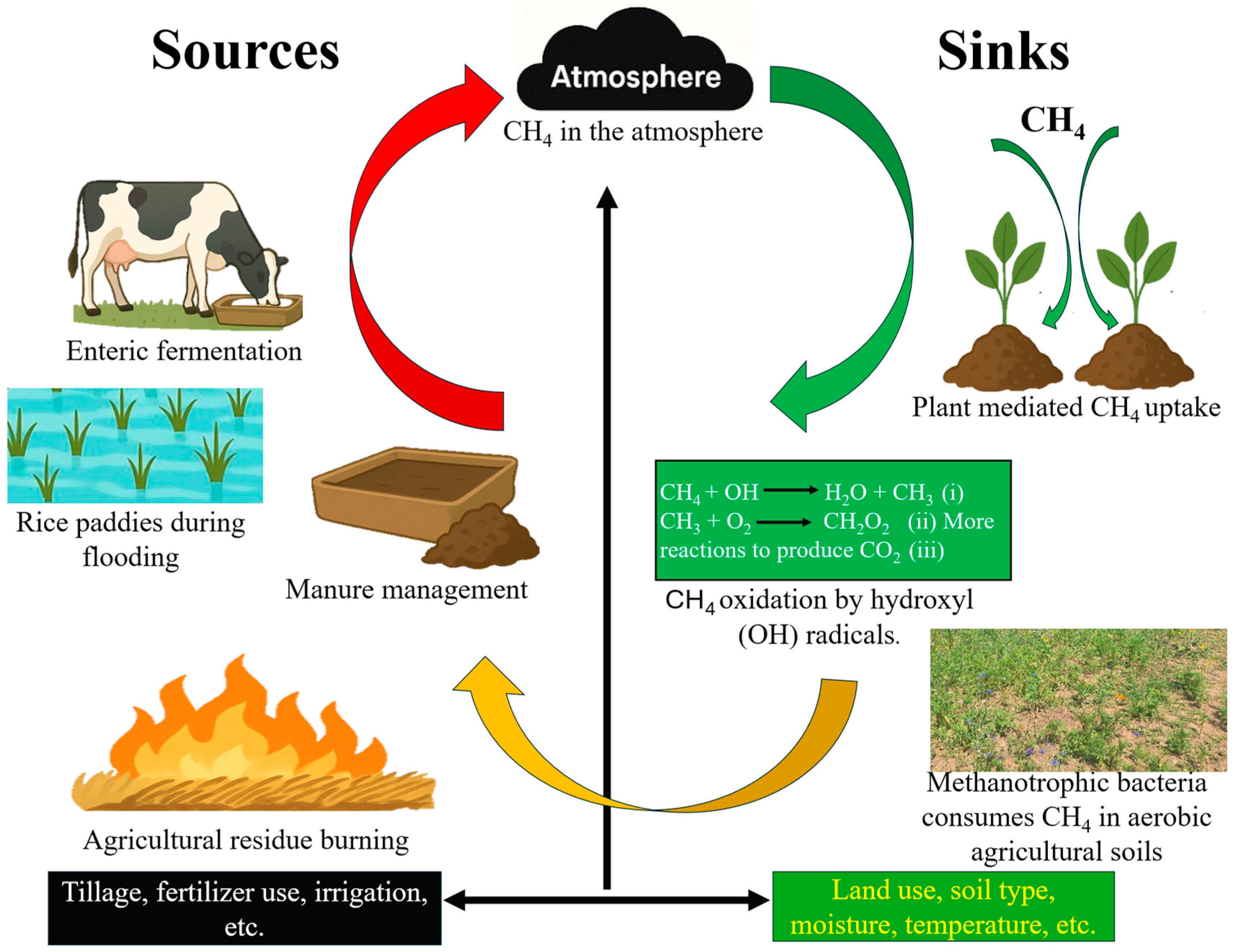
Enteric methane emissions vary widely, influenced by several key factors [13,16]. Animal species and breed significantly affect methane emissions; cattle generally release more methane than sheep or goats [22]. Diet composition is also an influencing determinant. Diets rich in high-quality concentrates and readily fermentable carbohydrates tend to reduce methane production compared to low-quality, high-fiber forages, which promote greater methanogenesis [23,24]. Feed intake levels, feed processing, and the physiological status of the animal (e.g., lactation stage) also influence methane output [13,16,24]. Moreover, individual genetic differences among animals lead to variations in methane emission profiles, offering potential avenues for mitigation through selective breeding [12,17,23]. Enteric fermentation is a natural digestive process occurring inside the animal that releases methane as a direct byproduct (Figure 1). On the other hand, manure management is an environmental outcome of how the animal’s waste is handled and stored after it leaves the animal (Figure 1).

3.2. Manure Management

Methane is also generated during the anaerobic decomposition of organic matter in livestock manure, particularly when stored or managed under limited oxygen conditions [3,25] (Figure 1). Common manure management systems, such as liquid slurry tanks, anaerobic lagoons, and deep pit storage, create environments conducive to methanogenesis [23,25].
The amount of methane produced from manure depends on several factors, including the type of storage system, temperature, and moisture content [26]. Other factors that play a role include the manure characteristics, such as volatile solids content, and the duration of storage [26,27]. For instance, warmer climates typically result in greater methane emissions from manure because higher temperatures boost microbial activity.
Manure management is responsible for around 10% to 12% of worldwide agricultural methane emissions; however, this share fluctuates depending on the specific region [28]. In certain systems, particularly intensive swine and dairy operations, manure related emissions can be substantial [28,29]. Effective manure management practices are therefore crucial for reducing methane emissions and contributing to overall GHG mitigation from the livestock sector [30].
Methane production from enteric fermentation and manure management differs primarily in their source within the livestock system and the point of release (Table 1). The main differences between the two are summarized in Table 1.
Environmental factors like climate and housing, and management factors such as diet composition, manure handling, and animal genetics influence methane emissions from livestock in both enteric fermentation and manure management (Table 2).

4. The Methane Cycle in Agricultural Landscapes: Sinks and Atmospheric Interactions

While livestock operations are significant sources of methane, agricultural landscapes also play a crucial role in the global methane cycle through various natural sinks and atmospheric interactions [45]. To effectively mitigate methane, a holistic understanding of these processes is essential.

4.1. Soil Methanotrophy

Agricultural soils are important natural sinks for atmospheric methane through the process of methanotrophy [18,46]. Methanotrophic bacteria, found in aerobic soil environments, oxidize methane, using it as a source of carbon and energy [47]. This biological process effectively removes methane from the atmosphere. However, the sink’s efficiency is significantly influenced by how the land is used and managed [46]. For instance, the conversion of natural grasslands or forests to agricultural land can significantly reduce soil methane uptake capacity due to alterations in soil structure and microbial communities [48,49]. Intensive agricultural practices, such as conventional tillage and the use of ammonium-based fertilizers, can inhibit the activity of methanotrophs, which diminishes the soil’s natural ability to consume methane [48]. Conversely, practices such as no-till farming, leaving crop residue on the field, and adding organic materials can maintain or enhance the soil’s ability to absorb methane [50,51]. Subterranean environments, such as cave rocks and other porous spaces connected to the atmosphere, have also been identified as substantial methane sinks, where methanotrophic bacteria actively consume methane at high rates [52].

4.2. Plant-Mediated Uptake

The role of plants in methane uptake is less direct and insignificant compared to soil methanotrophy. However, it contributes to the overall methane balance in agroecosystems. Some plant species, particularly those with methanotrophic endophytes in their roots or tissues, can facilitate methane oxidation [53]. Plant-soil interactions also play a role, influencing the net methane flux in different ecosystems [48,54]. Plant-associated microbes, while not major consumers of methane overall, engage in activities that play a role in the complex methane cycle.

4.3. Atmospheric Oxidation

The primary natural sink for methane once it enters the atmosphere is chemical oxidation by hydroxyl radicals (OH) [45]. Methane’s atmospheric lifetime of approximately 12 years is determined by this reaction [24]. Other atmospheric oxidants, such as chlorine radicals, also contribute to methane removal, but to a lesser extent. This atmospheric removal process is critical in regulating global methane concentrations and is a constant interaction point for methane emitted from agricultural landscapes [45].
Agricultural landscapes are typically considered major sources of atmospheric methane emissions; they also possess an inherent capacity to act as a crucial methane sink. As illustrated in Table 3, the efficacy of this natural sink function varies considerably across different land management practices. Table 3 illustrates the variability in the soil’s role by presenting the methane sink capacities observed in various agricultural landscape types and under specific management scenarios. It also highlights the potential for mitigation through management interventions.
Figure 2 illustrates the movement and exchange of methane gas between different environmental components within the agricultural landscapes. It highlights the key sources, such as methane belched by cattle, produced in manure storage systems, burning of agricultural residues and flooded rice paddies. Figure 2 also includes natural sinks as well. They include breakdown of methane by hydroxyl radicals in the atmosphere and consumption by methanotrophic bacteria in dry soils. This helps regulate its atmospheric concentration. Understanding this cycle is crucial for developing strategies to mitigate methane emissions from agricultural practices.

5. Current and Emerging Methane Mitigation Strategies

Reducing methane emissions from livestock operations is crucial for addressing climate change and improving the sustainability of the agricultural sector [55,56]. A variety of existing and new strategies are being researched and put into practice to reduce methane emissions associated with both enteric fermentation and manure management [44,57]. However, no single technology can eliminate methane, emphasizing the need for integrated, multi-pronged approaches [58].

5.1. Current Methane Mitigation Strategies

Current methane mitigation strategies often focus on nutritional and management aspects that have been researched and applied for some time [12].

5.1.1. Dietary Manipulation

Evidence suggests that feeding cattle diets high in grain concentrates and easily digestible carbohydrates reduce the amount of methane produced [7]. This effect is especially notable when concentrates make up more than 40% of their total dry matter intake [59]. This response arises from coordinated changes within the rumen ecosystem, including lower ruminal pH, altered microbial populations, and a metabolic shift favoring propionate synthesis over acetate production [60]. Practical examples include the replacement of grass silage with corn silage, which has repeatedly been associated with reduced methane emissions alongside increased dry matter intake and enhanced milk yield [61]. As a result, methane emissions expressed per unit of fat- and protein-corrected milk are often lower under high-concentrate feeding systems. However, the magnitude and consistency of this mitigation effect depend on carbohydrate type and rumen conditions. For instance, sucrose does not consistently reduce methane emissions relative to structural carbohydrates and, under conditions of elevated ruminal pH, may even stimulate methanogenesis when compared with starch-based diets [62]. These findings underscore that methane mitigation through dietary carbohydrate manipulation depends not only on fermentability but also on its interaction with the broader rumen environment [7].
In contrast, feeding systems dominated by low-quality fiber-rich forages generally result in higher methane emissions per unit of animal products [63]. These diets are characterized by reduced digestibility, lower protein availability, and limited voluntary intake, all of which favor methane production relative to output. High fiber concentrations slow digesta passage and restrict intake, thereby increasing methane yield per unit of dry matter consumed [64]. Nevertheless, evidence suggests that targeted nutritional interventions can partially offset these disadvantages [65]. Supplementation with energy- or lipid-rich feeds, such as dried distillers’ grains with solubles or whole cottonseed, has been shown to reduce both daily methane emissions and methane yield by 22% and 29%, respectively in animals consuming low-quality roughages [66]. Similarly, substituting highly fibrous forages with more digestible alternatives, including corn silage, improves fermentation efficiency and lowers methane emissions [67]. Although some dairy studies report reduced methane yield at higher forage inclusion levels [68], comparisons across production systems consistently indicate greater methane emissions in cows fed in high-forage diets than those receiving commercial partial mixed rations [69]. These observations highlight forage quality, rather than forage proportion alone, as a key determinant of methane outcomes

5.1.2. Feed Intake, Feed Processing, and Physiological Status

Feed intake significantly impacts total methane emissions. Higher intake provides more fermentable substrate to the rumen, leading to increased methane production [21,70]. At the same time, higher intake levels are often associated with lower methane yield per unit of dry matter intake due to accelerated passage rates and improved feed-use efficiency [71]. Studies in grazing dairy cows demonstrate this dual effect, whereby concentrate supplementation increases total methane output but reduces methane yield and emission intensity relative to milk production [72]. These results indicate that improving intake and nutrient utilization efficiency can reduce emission intensity without constraining animal performance [35].
Processing methods that enhance digestibility and modify fermentation kinetics represent a complementary mitigation strategy. Techniques such as ensiling, grinding, and steam-rolling increase carbohydrate availability and promote rumen fermentation pathways associated with lower methane production. For example, ensiled corn stalks produce 30–37 percent less methane than unprocessed corn stalks [73]. Consequently, feed processing is increasingly recognized as a practical tool for optimizing rumen function and reducing emissions when integrated with dietary formulation [74]. However, data on several livestock species specifically sheep, goats, and buffalo, remain limited; therefore, a broader evaluation is needed across diverse production systems [74].
Physiological status, particularly lactation, exerts a strong influence on methane emissions due to differences in intake, metabolic rate, and energy demand [75]. Lactating cows consistently emit more methane than non-lactating animals, with emissions typically exceeding those of dry cows by 31–47% [76,77]. Contrary to general trends, some studies suggest that lactating cows may produce less methane. An example is a study by Odai et al. [78] that recorded 22.7 L/kg methane production per dry matter intake (DMI) of lactating cows against 25.7 L/kg DMI for dry cows. Conversely, other studies indicate there is no significant difference in enteric methane production between lactating and dry cows [79]. Comparable patterns have been reported in small ruminants, where lactating ewes show the highest daily methane output [80]. Although dietary interventions can alter total methane production, diurnal emission patterns are generally stable unless feeding frequency or allocation is modified [69]. Accordingly, contemporary predictive models increasingly incorporate milk yield and composition to improve the accuracy of methane emission estimates [62].

5.1.3. Plant Extracts and Chemical Interventions

Secondary plant metabolites, including tannins, saponins, and essential oils, have received considerable attention for their ability to suppress methanogenesis through direct or indirect effects on rumen microorganisms [81,82]. Experimental studies indicate that tannin-rich extracts can reduce methane production without disrupting overall fermentation [83]. Similarly, adding phytogenic additives or agro-industrial by products has been effective in significantly lowering methane output while simultaneously making feed more efficient and increasing milk production [84]. These findings suggest that well formulated plant-based additives can align methane mitigation with productive performance.
While both tannins and saponins are effective at mitigating enteric methane, their use requires a careful balance to avoid “anti-nutritional” effects. High doses typically inhibit the very microorganisms responsible for breaking down plant material, leading to reduced fiber digestibility and potentially lower animal productivity [85]. The challenge lies in finding the optimal dosage that reduces methane production without compromising nutrient digestibility and animal performance. Research indicates that this balance can be achieved through precise dosage, specific plant sources, and the use of strategic combinations of these compounds [86].
Chemical mitigation strategies including nitrate supplementation, lipid inclusion, and direct methanogenesis inhibitors use different biological pathways to achieve a common goal: redirecting how hydrogen is used within the rumen [35,81]. Lipid supplementation consistently reduces methane emissions; however, including excessive amounts can negatively affect feed intake, fiber digestion, and milk composition [35]. Direct inhibitors, including 3-nitrooxypropanol (3-NOP) and halogenated compounds derived from macroalgae, have produced some of the largest reported reductions in methane yield, particularly when combined with dietary lipids [87]. Despite their demonstrated efficacy, uncertainties remain regarding their long-term effectiveness, animal health implications, and system level sustainability [20,87].

5.1.4. Animal Management Practices

Effective animal management contributes to reducing methane emissions per unit product through enhancing the productivity and efficiency of livestock systems [5,36]. Breeding and genetic development of low emission livestock are considered the most effective tools to reduce emission intensity, especially in developing countries characterized by low production per animal and high emission intensity [3]. Genetic approaches offer smaller but more permanent benefits, focusing on methane per unit of product rather than per head [88]. Animal breeding technologies are advancing with the goal of reducing the methane emissions produced by livestock. These evolving techniques focus on selective breeding and genetic modifications to develop animals that naturally produce less methane, contributing to efforts to combat climate change [36,89].
Proper management of animal manure is crucial for mitigating both methane and nitrous oxide emissions from livestock operations [5,32,44]. Therefore, several technologies can effectively reduce these emissions [44]. By capturing methane from decomposing manure, anaerobic digestion produces clean, renewable biogas energy and prevents the release of methane gas into the atmosphere [44,90]. Thus, anaerobic digesters offer dual benefits: they mitigate harmful emissions while simultaneously providing economic advantages through the generation of clean energy and more effective nutrient management. Promoting aerobic conditions, such as through well-managed aerobic composting and biofiltration, significantly reduces methane production during manure storage. This is because the presence of oxygen inhibits the activity of methanogens, the methane-producing microorganisms [44]. Slurry acidification and the use of covers are effective strategies for reducing methane emissions from liquid manure. Studies have shown that acidifying liquid manure slurry can significantly decrease these emissions, in some cases by up to 87% [37,44,91]. Covering manure storage pits with artificial films or straw reduces emissions by limiting gas exchange with the atmosphere. While straw covers are effective, they may result in an increase in N2O emissions [37]. Finally, solid–liquid separation technologies can reduce methane emissions by partitioning manure into more manageable fractions [92].

5.2. Emerging Methane Mitigation Technologies

New and emerging technologies present promising opportunities to significantly lower methane emissions from livestock; however, most require substantial further research and validation before widespread adoption [38,93].

5.2.1. Novel Feed Additives and Dietary Interventions

The rapid development of new feed additives and specific dietary changes provides effective, practical tools for significantly reducing methane emissions [9,57,89,94]. 3-Nitrooxypropanol (3-NOP) is a synthetic methane inhibitor that reduces emissions in livestock by an average of 30%. Depending on the specific animal, diet, and dosage, its effectiveness can reach as high as 82% [95]. 3-NOP works by specifically targeting methyl-coenzyme M reductase, inhibiting the final catalytic step in methanogenesis in rumen archaea [95]. 3-NOP is a proven, safe, and effective tool poised for widespread commercial use to lower methane emissions [96,97]. It has received regulatory approval in several regions, notably in Brazil and Chile, and the European Food Safety Authority has issued a favorable opinion on it [95]. Certain species of macroalgae, particularly Asparagopsis taxiformis, have shown remarkable methane reduction potential, exceeding 50% in meta-analyses and up to 99% in some studies [98,99]. This reduction is due to secondary metabolites, particularly bromoform, which inhibit methanogens [98]. It should however be noted that challenges remain in scaling sustainable production and assessing long-term animal health impacts [98].

5.2.2. Biotechnological Interventions

These strategies offer long term and potentially more sustainable solutions for methane reduction [39,93]. Immunization vaccines are being developed to target methanogens, while the potential of phages for mitigating enteric methanogenesis is under investigation [93,100]. Vaccination targeting rumen methanogens has been identified as an effective method for reducing methane emissions in beef cattle and sheep with studies showing a 10% decrease [101]. Chemogenomics, the study of how small molecules affect biological systems, is advancing the field of methane reduction [102]. Driven by increasing understanding of the diversity among methanogens, advancements in DNA sequencing technologies, and the application of bioinformatics, researchers are now better equipped to employ targeted chemogenomic strategies [103]. The goal of these strategies is to screen both natural and chemical compounds that act as inhibitors of methane production [93,103]. Methods for inhibiting methanogens include using antibiotics, encouraging the proliferation of viruses and bacteriophages, and incorporating specific feed additives that directly target and suppress these microorganisms [88]. To enhance the population of alternative hydrogen users in the rumen, two methods are employed: first, inoculating the rumen with acetogenic species, and second, providing highly digestible feed to optimize conditions that favor propionate fermentation [88].

5.2.3. Rumen Microflora Manipulation

Manipulating the rumen microbiome is a key area of research. By playing a critical role in methane production, it offers an opportunity for methane mitigation [43]. According to Su et al. [104] and Liu et al. [105], strategies for this mitigation involve three primary approaches. Altering the microbial community to directly reduce the amount of hydrogen produced, rerouting hydrogen toward the creation of non-methane byproducts, and encouraging the growth of methanotrophic microbes capable of oxidizing, or consuming, existing methane. Furthermore, research is exploring ways to manipulate the rumen microbiome through various dietary supplementations and improved animal production efficiency to effectively reduce enteric methane emissions [43,106]. This includes promoting acetogenic species and modifying rumen conditions [88].

5.2.4. Emerging Biological Strategies

Ionophores, such as monensin, modify rumen fermentation processes. They function by selectively inhibiting Gram-positive bacteria, which in turn favors the production of propionate and decreases the availability of hydrogen necessary for methanogenesis [81,107]. Studies have shown that supplementing animal feed with ionophores can reduce enteric methane emissions by 27–30% [108]. However, this effect is often temporary [35]. Probiotics offer an alternative biological approach, with some strains improving fermentation efficiency and reducing methane output, although responses remain highly dependent on formulation and production context [106,109]. While acetogenic bacteria are a promising theoretical option for utilizing hydrogen in the rumen, efforts to establish this process in living animals have produced unreliable results [110]. More recent strategies targeting methanogens directly, including archaeal viruses and bacteriocins, show promise but require further validation regarding efficacy, persistence, and biosafety before practical application can be considered [35,111,112].

5.2.5. Genetic Selection and Breeding

Genetic selection for animals with inherently lower methane emissions is a sustainable, long-term mitigation strategy [12,113]. The approach involves selectively breeding animals that produce less methane per unit products (such as milk, meat, or wool) they yield. This aims to improve the efficiency of animal agriculture by minimizing greenhouse gas emissions per unit of output. Variability in methane production among individuals within a species has a genetic basis, making selective breeding a viable approach [17,39]. Breeding programs can focus on traits like low residual feed intake or reduced methane production per unit of product [23,41]. While genetic selection may yield smaller per-animal reductions (around 10%) compared to some feed additives, the benefits are cumulative and permanent across generations [114]. Advances in genomic selection and microbiome profiling are facilitating the identification of desirable traits and animals that naturally harbor low methane producing rumen microbial communities [16].
Heritability estimates indicate that reducing methane emissions in livestock is a practical goal for selective breeding programs; this genetic selection can be implemented without compromising the animals’ productivity [36,115,116]. Evidence that host genetics influence rumen microbial composition further supports the potential for indirect mitigation through breeding strategies [117]. In addition, selection for improved feed efficiency, reproductive performance, and longevity may deliver cumulative reductions in methane emissions by increasing overall system efficiency [118].

5.2.6. Precision Livestock Farming (PLF)

Precision Livestock Farming (PLF) employs sensor technologies, real time monitoring, and data analytics to optimize individual animal management, resource utilization, and environmental impact [119,120]. PLF gathers accurate data on animal health, feed intake, and methane emissions, allowing for highly targeted and individualized intervention [120,121]. By improving feed efficiency, detecting diseases early, and optimizing nutrient delivery, it is possible to indirectly reduce methane emissions [119,122]. While PLF requires significant capital investment and faces adoption barriers, it offers a holistic approach to methane mitigation by integrating management practices with advanced technology [119,123].
The mitigation strategies, their mechanisms of action, effectiveness, considerations, and status are summarized in Table 4 below.

5.3. The Effect of EU Ban on Antibiotic Growth Promoters as Feed Additives on the Development of Feed Methane Mitigation Feed Additives

In 2006, the EU banned the use of antibiotic growth promoters (AGPs) in livestock [124,125,126]. This landmark regulation addressed concerns that agricultural antibiotic use contributes to antimicrobial resistance (AMR), specifically through the transfer of resistant bacteria and genes from farm animals to humans [127]. By separating therapeutic from non-therapeutic uses, this new law applies the precautionary principle more broadly, revealing a conflict between short-term farm output and long-term public welfare goals [124,126]. These EU additive regulations have shifted from a permissive approach to a preventive one, now prioritizing environmental and public health protections [124,125,128].
The EU’s position sparked global regulatory changes, extending its influence far beyond Europe [124]. In 2011, South Korea implemented a nationwide ban on AGPs in livestock feed to combat antibiotic resistance [129]. In 2017, the United States implemented partial restrictions on AGPs by prohibiting the use of medically important antibiotics for livestock growth enhancement [130]. In 2017, China banned colistin as a feed additive and expanded this to a broader prohibition on AGPs by 2020, a significant step for the world’s largest livestock market to combat antibiotic resistance [131]. Subsequently, many countries have adopted comparable restrictions, though enforcement mechanisms and compliance vary [132]. Global efforts in antimicrobial stewardship are mixed: while countries agree on the dangers of AMR, they fail to create consistent regulations, showing both unified goals and conflicting approaches [133]. While the ban restricts antibiotics for growth promotion, it still allows therapeutic use, leading to concerns that off-label misuse could undermine efforts to reduce AMR. As such, the legislation’s duality highlights a complex interplay between science-based risk assessments and economic pressures in agri-food policy design.
From a methane mitigation standpoint, this disparity presents both a challenge and an opportunity. Although unintended, the removal of AGPs from animal feed has sparked efforts to find alternative additives that enhance animal health while also helping to address climate change [134,135,136,137]. Natural phytochemicals particularly tannins, essential oils, saponins, and organic acids are now being explored for their dual functionality: promoting gut health and inhibiting methanogenesis [135,138]. However, the alternatives’ performance is inconsistent across species, diets, and environmental conditions. Moreover, while tannins exhibit antimicrobial and immunomodulatory effects, their efficacy in methane reduction varies depending on dosage, plant source, and interaction with rumen microbiota [135]. This exposes a critical tension between their intended ecological benefits and their variable effects on production efficiency [139]. This underscores the ongoing challenge of identifying scalable, low-residue, and cost-effective solutions that match the broad-spectrum utility once provided by AGPs. To maximize the potential of antibiotic alternatives for reducing drug resistance and methane emissions, coordinated international action and harmonized standards are essential.
Table 4. Methane mitigation strategies and their effectiveness.
Strategy/TechnologyMechanism of ActionAverage CH4 ReductionNotes/ConsiderationsCurrent StatusReferences
Dietary ManipulationHigh-Quality Forages/Grains
Improves digestion efficiency
Alters ruminal fermentation pathways
≈5–11%
Effective in regions with poor quality forage
Established
[7,12]
Lipids in Diet
Effect on ruminal fermentation
≈15%
Environmentally safe and beneficial for animal health
Established
[44,106,140]
Tannins and Saponins
Dietary supplements that reduce methane emissions
≈11%
Potential toxicity or adverse effects on productivity
Established
[44,141]
Ionophores
Manipulates ruminal fermentation
Inhibits methanogens
Varies
Well researched and applied
Established
[12,142]
Animal ManagementImproved Grazing Management
Better feed utilization and animal health
≈11%
Well researched and applied
Established
[106]
Increased Animal Productivity/Selection
Focus on genetic selection for lower methane output
Varies
Most effective in in developing countries
Offer smaller but more permanent benefits
Established
Emerging
[3,88]
Precision Livestock Farming
Enables targeted mitigation actions
Varies
Adoption barriers
Technological acceptance
Data quality and analysis complexity
Emerging
[120,122,143]
Manure Management
Reduces emissions from stored and treated manure
Varies
Direct effect on emissions from major non-CO2 GHGs
Established
[5,32]
Emerging Technologies3-Nitrooxypropanol (3-NOP)
Chemically synthesized inhibitor targeting methyl-coenzyme M reductase
Inhibits the final step of methanogenesis in rumen archaea
≈30% (up to 82%)
Highly effective
Regulatory approvals in Brazil, Chile
Favorable opinion from European Food Safety Authority
Efficacy dependent on animal type, diet, and dose
Emerging
Commercializing
[17,95,97,144]
Macroalgae (Asparagopsis taxiformis)
Contains secondary metabolites (e.g., bromoform) that inhibit methanogens
Reduce methane production in the rumen
Up to 99%
Highly promising
Requires further research on sustainable large-scale production and long-term effects on animal health
Emerging
[98,99]
Immunization Vaccines
Targets rumen methanogens to reduce their population and activity.
≈10%
Still under investigation for widespread deployment
Research
Emerging
[93,100,101]
Probiotics, Acetogens, etc.
Manipulates rumen microflora to divert hydrogen away from methanogens
Enhance alternative hydrogen using species
Varies
Requires more research to validate effectiveness
Understanding interactions within the rumen microbiome is crucial
Research
[12,90,142]
Plant Extracts (e.g., essential oils)
Manipulates gastrointestinal microflora
Improves production efficiency to reduce methanogenesis
Varies
More research is needed to assess effectiveness and long-term impacts
Research
[93,106]
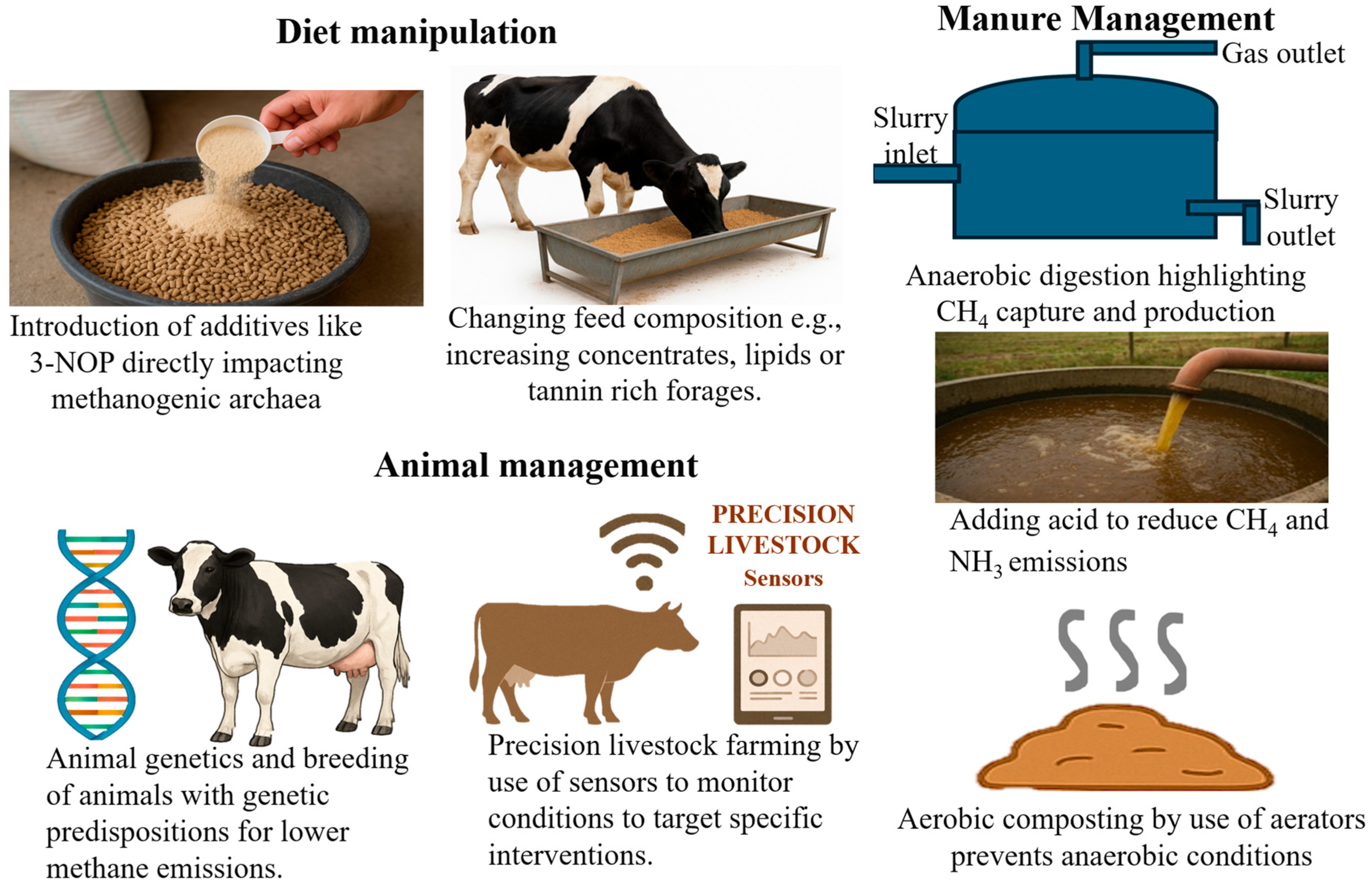
Methane emissions from livestock operations stem from enteric fermentation in ruminant animals and the decomposition of their manure. Addressing this requires a multi-pronged approach, encompassing both available practices and innovative, emerging technologies. Figure 3 illustrates a range of current and emerging strategies. They include dietary manipulation by changing feed composition and genetic selection for lower methane producing animals. Additionally, manure management techniques such as anaerobic digestion to capture biogas and acidification to reduce emissions during storage are highlighted. Other pathways highlighted to mitigate emissions include use of data sensors.

6. Global Trends and Quantification Methods for Livestock Methane Emissions

6.1. Global Trends and Future Scenarios

Global methane emissions from the livestock sector have shown a substantial and concerning increase over the past century. From 1890 to 2019, global livestock methane emissions quadrupled, rising from approximately 31.8 Tg CH4 per year to about 131.7 Tg CH4 per year [145]. This rapid growth, which became particularly noticeable after 1950, has been driven primarily by the expansion of cattle populations and a rising global demand for livestock products [146]. Key drivers of these trends include global population growth, shifts in dietary patterns towards higher consumption of animal protein, and economic development, especially in emerging economies [147,148]. Emission hotspots are concentrated in regions like South Asia, Brazil, North Africa, China, the United States, Western Europe, and Equatorial Africa, driven by intensive livestock farming and differences in management efficiency [3,145]. For example, South Asia, tropical Africa, and Brazil have dominated the growth in global livestock methane emissions over the last three decades [145].
Future scenarios project that under current policies; livestock methane emissions are expected to increase by another 30% by 2050 [149]. However, these projections also highlight the significant potential for reduction through various mitigation pathways [150]. Efforts focusing on enhancing production efficiency, i.e., reducing methane emissions per unit of animal product (e.g., meat or milk), have demonstrated considerable effectiveness [40,151]. Improved feed quality, genetic selection, and better animal health and herd management contribute to these efficiency gains, which often have greater mitigating effects than demand-side interventions alone [40,152,153].
Demand side efforts, such as promoting balanced, healthy, and environmentally sustainable diets, also play a role, but their impact on total emissions may not be sufficient without parallel improvements in production efficiency [40]. Integrated mitigation strategies that combine dietary interventions, animal feed additives, genetic improvements, and advanced manure management technologies offer the most promising path to substantial and sustainable emission reductions. These varied strategies are crucial for ensuring the livestock industry helps meet worldwide goals for reducing climate change. This is especially important because agricultural methane is projected to constitute an increasing proportion of total anthropogenic methane emissions under future climate scenarios.

6.2. Methods for Quantifying Methane Emissions from Livestock Systems

Livestock farming is a significant source of methane within the agricultural sector, leading to the development of various methods for measuring these emissions [154]. These techniques vary considerably, as they cover a wide range of spatial scales, temporal resolutions, and experimental constraints. They span assessments from measurements of individual animals to evaluations made at the level of entire facilities and landscapes [155]. Thus, method choice prioritizes study goals, logistics, and a balance of control versus real world applicability over inherent precision [154]. Existing approaches are commonly grouped into bottom-up methods, which combine measurements taken at the individual source level, and top-down methods, which use broader atmospheric emissions to calculate overall emissions across a large area [156].

6.2.1. Measurement of Enteric Methane Emissions

Enteric fermentation in ruminants is the primary source of methane emissions from livestock, making its quantification a central focus of mitigation research [157]. This has led to the creation of techniques that are adaptable to both controlled experimental studies and commercial production measurements. Respiration chambers are typically considered the reference method for accurately measuring an individual animal’s enteric methane emissions, making them widely used in mechanistic studies and mitigation trials [157,158]. Methane output is quantified by continuously monitoring the airflow and gas concentrations within an isolated, enclosed space surrounding the animal [155]. This high degree of control facilitates the precise evaluation of dietary makeup, feed supplements, or management strategies within a controlled environment [159]. Despite these advantages, chamber-based measurements have significant limitations. Confining animals can affect their natural behavior, how they eat, and their rumen function, which in turn influences the accuracy of the measured emission rates [160]. In addition, the substantial capital investment, labor intensity, and limited measurement capacity restrict their use in large populations or routine on-farm applications [161].
The sulfur hexafluoride (SF6) tracer technique was developed to facilitate enteric methane measurements under conditions that more closely reflect commercial livestock management [161]. In this approach, methane emissions are inferred from the ratio of methane to SF6 collected in breath samples, with SF6 released at a known rate from a permeation tube placed in the rumen [162]. This configuration allows animals to remain in grazing systems or loose housing, thereby improving behavioral realism and enabling measurements across larger groups. Initial applications of the SF6 technique showed significant variation; however, refinements in sampling protocols, tracer calibration, and background correction have improved agreement with respiration chamber estimates [157]. SF6 misses emissions originating from the hindgut, and methodological rigor is required to minimize uncertainty associated with tracer release rates, sampling duration, and ambient methane concentrations [163].
Automated head chamber systems, including the GreenFeed platform, occupy an intermediate position between tightly controlled chamber measurements and open-path atmospheric techniques [164]. These systems intermittently sample exhaled and eructated gases when animals voluntarily approach the unit, typically motivated by small feed incentives [165]. When visit frequency and temporal distribution are adequate, GreenFeed-derived measurements can yield reliable estimates of daily methane production under practical farm conditions [156]. However, data quality is highly dependent on animal behavior and consistency of unit use. As with the SF6 technique, methane emitted via the hindgut is not measured, which may result in systematic underestimation of total emissions [166]. These limitations underscore the importance of careful experimental design and data screening when applying automated systems in heterogeneous production settings.

6.2.2. Methane Emissions from Manure Management

Methane associated with manure management originates from multiple sources, including housing environments, liquid manure storage, and exposed manure surfaces [167]. Measurement strategies vary according to whether emissions can be physically enclosed and the nature of ventilation within the system. In mechanically ventilated housing, emissions are typically estimated using mass balance calculations that combine airflow measurements with differences in methane concentration between inlet and exhaust air [168]. For naturally ventilated facilities, ventilation rates are often derived using tracer gas approaches or carbon dioxide balance methods [169]. Emissions from area sources, such as manure lagoons, may also be quantified using external tracer release techniques by relating downwind methane concentrations to those of a co-released inert tracer [170].
At larger spatial scales, methane emissions are increasingly assessed using perimeter monitoring, inverse dispersion modeling, and airborne mass balance methods [171]. Open-path spectroscopic instruments deployed around livestock facilities enable whole-site emission estimates by integrating concentration gradients with dispersion or ventilation parameters [172]. Aircraft-based approaches extend this framework to regional scales, although their interpretation is constrained by temporal coverage and challenges in separating overlapping emission sources [172]. The eddy covariance technique has become an important method for measuring methane fluxes in areas such as grazing systems and mixed agricultural landscapes [173]. This method provides continuous, spatially integrated estimates of methane flux by combining frequent measurements of vertical wind velocity and methane concentration [174]. Its accuracy relies on supporting data from appropriate footprint analysis and information regarding animal distribution [175].

6.2.3. Selection of Measurement Approaches

Choosing a method for measuring methane depends on the study’s specific goals, how large an area is being covered, and what practical limitations exist; there is not one best technique for all situations [154]. Highly controlled systems, particularly respiration chambers, remain indispensable for elucidating mechanistic processes and rigorously evaluating mitigation strategies [157,158,161]. However, their limited throughput restricts application in population-level studies. Tracer techniques and automated head chambers are pragmatic alternatives because they enable precise individual animal measurements in larger cohorts [157]. At the scale of commercial farms and production landscapes, micrometeorological and atmospheric approaches offer the most representative emission estimates, as they capture methane fluxes under real-world management and environmental variability [176].

7. Policy Frameworks, Knowledge Gaps and Future Research Directions

Robust policy frameworks, regulatory approaches, and tailored incentive programs are essential for effectively managing methane emissions from the livestock sector, considering the diverse regional and socio-economic factors involved [177,178]. Effective livestock policies require a three-pronged approach, integrating environmental stewardship, economic sustainability, and public acceptance.

7.1. Policy Frameworks

7.1.1. Sectoral Policies and Market Based Instruments

Many regions employ sectoral policies, such as carbon taxes or emissions trading schemes, to incentivize methane reductions. These instruments are usually applied nationally or regionally. They measure average emissions for each unit of a product to lessen the administrative work for individual producers [177]. For example, a global sectoral emissions trading scheme could allow non-Annex 1 (developing) countries to earn revenue from selling methane emission permits, incentivizing widespread mitigation efforts [177]. However, policies that are implemented exclusively in Annex 1 (developed) countries may lead to ‘emission leakage.’ This occurs when the emission reductions achieved in those countries are counteracted by increased emissions in regions that are not subject to the same policies [179,180].

7.1.2. Regulatory Frameworks

Direct regulatory approaches are also being adopted. California, for instance, has implemented state-level regulations on short-lived climate pollutants, including methane from livestock operations, requiring monitoring and setting reduction targets [181]. The European Union’s Methane Strategy acknowledges the need to curb agricultural methane emissions. However, it faces challenges in accurately measuring and verifying emissions across diverse farming systems [182]. Currently, only about 13% of methane emissions are regulated under direct methane mitigation policies in Europe, highlighting a significant gap [182].
Regulation (EU) 2019/6 establishes binding rules governing the approval, distribution, and application of veterinary medicinal products across the European Union, thereby shaping how microbial interventions may be implemented in food-producing animals [183]. This regulatory framework is especially pertinent to addressing the global challenge of antimicrobial resistance (AMR), which continues to compromise treatment outcomes and impose substantial health and economic costs worldwide [184]. The declining efficacy of antimicrobial compounds against both pathogenic and commensal microorganisms highlight the necessity for careful governance of practices that intentionally alter microbial ecosystems in animals and humans [185]. Animal agriculture represents a major driver of antimicrobial exposure at the global scale; a trend strongly associated with intensified production systems and rising demand for animal derived foods [186]. Sustained antimicrobial use in these settings has contributed to increased prevalence of resistant bacteria, especially in highly managed sectors such as poultry and swine, with inappropriate dosing practices and insufficient waste management further amplifying selective pressures [184]. These considerations are increasingly pertinent as novel strategies targeting the rumen microbiome such as bacterial consortia aimed at mitigating enteric methane emissions gain scientific and commercial attention.
Policy evaluations have raised concerns regarding the effectiveness of existing AMR mitigation efforts. A 2019 assessment by the European Court of Auditors found limited evidence that EU-level initiatives had substantially reduced the public health burden of resistance, underscoring the importance of robust surveillance systems [187]. National monitoring programs, such as those implemented in the Netherlands, demonstrate that coordinated oversight can lead to sustained reductions in resistance among livestock populations [188]. Within this context, Regulation (EU) 2019/6 characterizes antimicrobials by their intended use against infectious diseases, a distinction that is critical when developing rumen-targeted microbial products that must be clearly differentiated from antimicrobial agents [189]. Although many jurisdictions, including India, have adopted multisectoral AMR action plans aligned with One Health principles, uneven implementation persists [184,190]. Consequently, methane mitigation strategies based on microbial manipulation must be evaluated not only for efficacy, but also for their regulatory classification and potential to influence resistance dynamics, to ensure sustainable deployment within livestock systems.

7.1.3. Incentive Programs and Economic Instruments

To promote the adoption of methane-reducing technologies, various incentive programs have been established. These include carbon offset payments, subsidies for installing anaerobic digesters, or payments linked to verifiable emission reductions [177,191]. Economic models suggest that moderate increases in carbon prices can significantly boost the uptake of mitigation technologies, particularly in larger operations. For example, a price of USD 30/t CO2-eq for methane could result in non-Annex 1 countries collectively earning USD 2.4 billion annually from permit sales [177].

7.1.4. Co-Benefits and Trade-Offs

Methane mitigation strategies offer several co-benefits. Economically, improved feed efficiency and animal productivity can lead to reduced costs and increased profitability [192]. Environmentally, reducing methane contributes to climate change abatement and can improve air quality [193]. Socially, sustainable livestock practices can enhance livelihoods and support rural development [194]. However, trade-offs exist: some interventions have high upfront costs, may affect animal welfare if not properly managed, or could lead to shifts in other GHG emissions like nitrous oxide [37,44]. A “multiple gas perspective” is critical to assess overall environmental impact, as reducing one GHG might unintentionally increase another [37,44].
Government policy and regulation are critical to addressing methane emissions from livestock operations. While numerous technological solutions for reducing emissions have been identified, their widespread adoption faces significant economic and practical barriers that policy frameworks can help overcome. To illustrate the varied global response to this challenge, Table 5 provides an overview of the specific policy instruments and regulatory frameworks for methane mitigation in the livestock sectors across different regions. They highlight key differences in their approaches and targets.

7.2. Challenges in Implementing Livestock Sector Methane Mitigation Strategies

Designing and implementing effective methane mitigation for livestock is hindered by weak measurement and MRV systems, insufficient policy coverage and regulatory stringency, economic and distributional barriers for farmers, technical and scalability limits of mitigation options, governance and leakage risks across jurisdictions, and socio-cultural and behavioral constraints that limit uptake [196].
Accurately quantifying methane emissions from livestock at policy-relevant resolution remains difficult, which limits both effective policymaking and credible progress tracking [197]. Estimates can vary substantially across measurement approaches, and national inventories are often too aggregated to support the design of targeted interventions [40]. With monitoring, reporting, and verification (MRV) still insufficient, a meaningful share of methane emissions is not captured by enforceable frameworks, making it harder for policymakers to focus on the highest-impact opportunities [196]. Policy coverage is also limited: only a small portion of methane emissions is governed by explicit measures, leaving most agricultural methane effectively unregulated worldwide [196]. This narrow coverage combined with wide differences in policy scope and ambition reduces overall mitigation potential and makes international coordination more difficult.
Many mitigation options impose sizable upfront investments or ongoing operating costs, which can be prohibitive for farmers, particularly smallholders [194]. Even when solutions work technically, adoption often lags because producers are uncertain whether costs will be recovered through prices, subsidies, payments, or credit mechanisms, weakening uptake [198]. Deployment is further constrained by the absence of any single technology that can eliminate methane emissions across all systems; available approaches (such as feed additives, genetic selection, and manure management technologies) face limits in effectiveness, suitability across contexts, or scalability [58]. Scaling prominent options including feed additives (e.g., 3-NOP or macroalgae) and anaerobic digesters also depend on supply chains, distribution capacity, and supporting infrastructure that are not yet in place in many regions [95,199].
Unilateral or inconsistently applied policies may push production to areas with weaker regulations, lowering global benefits and increasing domestic opposition [200]. As a result, designing market-based instruments across countries requires harmonizing measurement approaches, incentives, and trade-related rules to avoid unintended losses for producers. Because livestock production systems differ dramatically from extensive pastoralism to intensive feedlots uniform policy packages tend to underperform and may be inequitable [200]. More effective approaches are typically tailored to local feed systems, breeds, climatic conditions, and institutional capacity, but this customization raises design complexity and administrative costs [201]. In addition, some interventions reduce methane but increase other emissions (such as nitrous oxide) or generate broader environmental trade-offs. This makes multi-gas evaluation and integrated policy design important for avoiding unintended outcomes [4,202]. If co-benefits and trade-offs are not accounted for, policies can create perverse incentives and trigger political pushback when measures conflict with other sustainability objectives.
Implementation capacity is another binding constraint. Many nations, particularly those still developing, do not have the necessary institutions, technical skills, or funding mechanisms to implement and track large-scale mitigation efforts. International support and tailored finance (including grants, concessional lending, and carbon finance) are often necessary, yet mobilizing these resources remains difficult [199]. Methane’s short atmospheric lifetime means rapid reductions can produce relatively near-term climate benefits, but many policy frameworks and common GHG metrics (e.g., CO2-centered approaches and 100-year GWP) can obscure the value of fast CH4 cuts, complicating prioritization and slowing political momentum to address methane in national strategies. Finally, demand- and practice-oriented measures face social and political friction. Dietary preferences, the cultural role of livestock, and farmers’ risk aversion can make it difficult to implement interventions that either curb demand or require changes to established supply-side practices. Progress typically depends on sustained engagement, extension services, and locally appropriate incentives yet these social investments are frequently underfunded [194,195].
Weak MRV and low policy coverage prevent credible targets, measurement of progress, and the use of market mechanisms [196,197]. Cost, infrastructure and scalability constraints block deployment of technically promising options, especially in developing countries [95,199]. Moreover, heterogeneous systems and leakage risk require international coordination and context-specific instruments rather than blanket rules [200]. Without attention to co-pollutant trade-offs, social acceptance, and finance, policies will be ineffective or inequitable despite sound science [195,202].
To address these challenges, it is necessary to invest in standardized, scalable MRV systems and capacity building to make emissions measurable and policies verifiable [196,197]. The policy coverage should be expanded to include integrated approaches that combine regulatory measures, financial incentives, and market-based instruments. This holistic strategy is designed to effectively prevent carbon leakage or other unintended spillover effects.
To stimulate the widespread deployment of established agricultural technologies (such as digesters and 3-NOP), strategies that mix financial instruments such as blended finance, subsidies and demonstration programs that mitigate initial cost barriers for farmers are recommended. It is critical to prioritize the comprehensive assessment of all greenhouse gas policies to prevent unintended negative consequences and maximize shared benefits across key areas like economic productivity, public health, and community well-being [202]. Policies should be customized to fit local agricultural methods and involve all relevant parties in the decision-making process. This ensures they align with the needs of the community and encourages farmers to adopt them willingly. Near term focused methane mitigation measures should be deployed to capture rapid climate benefits, while concurrently implementing long-term structural changes, such as in animal breeding and feed systems to build sustainable transformations [203].

7.3. Knowledge Gaps and Future Research Directions

Despite significant advancements in understanding and mitigating methane emissions from livestock, several key knowledge gaps, research needs, and methodological challenges persist [204]. To develop more effective and scalable mitigation strategies, it is essential to adequately address these issues
Reliable quantification of methane emissions is still constrained by limitations in measurement that affect repeatability and scalability [143,205]. Methods such as respiration chambers, the SF6 tracer approach, and micrometeorological techniques differ in accuracy, cost, and practicality, which can produce non-trivial differences across studies [56,205]. Establishing harmonized protocols and shared validation criteria would improve comparability, strengthen national inventory estimates, and support cross-country benchmarking [56,143].
Progress in mitigation initiatives depends on a comprehensive understanding of the temporal dynamics of rumen communities, with particular emphasis on methanogenic archaea responsible for methanogenesis [16]. Although shifts in archaeal composition are associated with differences in methane output, the mechanisms and contributions of many taxa, especially poorly characterized bacteria linked to low-emission animals, are not yet well defined [16]. Priorities include isolating and identifying key methanogens and generating genome sequences to clarify pathways and reveal new mitigation targets [206].
Many default emission factors are too coarse to represent local conditions, and they understate variability driven by breed type, diet composition, management system, and climate [145,207]. This limitation is especially consequential in low- and middle-income settings where production contexts are highly heterogeneous [145,207]. Improving emission factors with locally observed information on resource use, feed quality, and productivity would yield more defensible inventories and more actionable mitigation priorities [195,207].
Additional work is needed to quantify how gains in production efficiency translate into changes in methane emissions and emissions intensity [40]. Strategies that improve output per animal while reducing methane per unit of product should be developed and tested together, rather than in isolation, to achieve concurrent productivity and mitigation benefits [152,153]. This also requires evaluating interactions among interventions so that emissions reductions are not offset by unintended effects on performance or other system outcomes [44,208].
Evidence is also needed on whether mitigation options are affordable, practical to implement, and acceptable to farmers in both smallholder and commercial contexts [3,98]. Research should examine support mechanisms such as extension services, financing, and incentives that reduce barriers to adoption, particularly where capital and technical capacity are constrained [3,98]. Integrated assessments that quantify trade-offs across mitigation choices and wider environmental and socio-economic outcomes are essential for designing interventions that work in practice [209].

8. Conclusions

Methane emissions from livestock operations represent a substantial portion of anthropogenic greenhouse gas emissions, primarily originating from enteric fermentation in ruminants and manure management. Meeting the increasing global demand for animal products threatens climate goals due to associated emissions, underscoring the need for immediate and effective reduction strategies. A diverse array of mitigation strategies has been developed and evaluated, encompassing animal and feed management, diet formulation, and rumen manipulation. Dietary interventions such as using methane inhibitors, oils and fats, oilseeds, electron sinks, and tanniferous forages have shown promising results in reducing methane emissions without negatively affecting animal productivity. Other effective feeding strategies involve decreasing the dietary forage to concentrate ratio. These strategies that exclude methane inhibitors are ready for immediate implementation.
Manure management also offers significant potential for methane reduction through practices such as covering outdoor slurry storage, shortening indoor storage times, and lowering storage temperatures. Improving animal productivity through genetic selection and enhanced feeding practices is considered the most effective tool for reducing emission intensity. Other approaches such as specific feed additives (e.g., 3-nitrooxypropanol and Asparagopsis seaweed) have shown promising results in significantly reducing methane emissions. However, widespread adoption and validation of these strategies, particularly in developing countries with limited resources, remain critical areas for further research and implementation.
Despite progress in understanding and mitigating these emissions, accurate and reliable estimation of methane remains a critical limiting step for widespread adoption of mitigation strategies. Continued research and development in advanced measurement technologies are crucial for improving the detection and segmentation of methane plumes from livestock operations. Ultimately, a combination of improved animal management, targeted dietary interventions, efficient manure handling, and advanced monitoring technologies will be essential to achieve sustainable livestock production and effectively reduce methane’s environmental impact.

Funding

This research received no external funding.

Data Availability Statement

All data and materials used in this study are available within this article.

Acknowledgments

The author acknowledges the use of Adobe Firefly Image Generator free version on 20 November 2025 to generate some of the used images. Specific prompts included [cow feeding] and [mixing animal feed]. The generated images were reviewed, edited, and then integrated into the final manuscript figures by the author who takes full responsibility for the content.

Conflicts of Interest

The author declares no conflicts of interest.

Abbreviations

The following abbreviations are used in this manuscript:
3-NOP3-Nitrooxypropanol
AGPAntibiotic Growth Promoters
AMRAntimicrobial Resistance
GHGGreenhouse Gas
GWPGlobal Warming Potential
LDARLeak Detection and Repair
MRVMeasurement, Reporting and Verification
PLFPrecision Livestock Farming

References

  1. Finn, D.; Dalal, R.; Klieve, A. Methane in Australian agriculture: Current emissions, sources and sinks, and potential mitigation strategies. Crop Pasture Sci. 2015, 66, 1–22. [Google Scholar] [CrossRef]
  2. Collins, W.; Orbach, R.; Bailey, M.; Biraud, S.; Coddington, I.; DiCarlo, D.; Peischl, J.; Radhakrishnan, A.; Schimel, D. Monitoring methane emissions from oil and gas operations. Opt. Express 2022, 30, 24326–24351. [Google Scholar] [CrossRef] [PubMed]
  3. Forabosco, F.; Chitchyan, Z.; Mantovani, R. Methane, nitrous oxide emissions and mitigation strategies for livestock in developing countries: A review. S. Afr. J. Anim. Sci. 2017, 47, 268–280. [Google Scholar] [CrossRef]
  4. Manono, B.O. Carbon dioxide, nitrous oxide and methane emissions from the Waimate District (New Zealand) pasture soils as influenced by irrigation, effluent dispersal and earthworms. Cogent Environ. Sci. 2016, 2, 1256564. [Google Scholar] [CrossRef]
  5. Vijayalakshmy, K.; Biswal, J.; Rahman, H. Amelioration of methane production from livestock production systems through effective management strategies. J. Entomol. Zool. Stud. 2020, 8, 148–152. Available online: https://hdl.handle.net/10568/120605 (accessed on 25 November 2025).
  6. Sejian, V.; Bhatta, R.; Malik, P.K.; Madiajagan, B.; Al-Hosni, Y.A.; Sullivan, M.; Gaughan, J.B. Livestock as sources of greenhouse gases and its significance to climate change. In Greenhouse Gases; IntechOpen: London, UK, 2016. [Google Scholar]
  7. Haque, M.N. Dietary manipulation: A sustainable way to mitigate methane emissions from ruminants. J. Anim. Sci. Technol. 2018, 60, 15. [Google Scholar] [CrossRef]
  8. Thornton, P.K. Livestock production: Recent trends, future prospects. Philos. Trans. R. Soc. B Biol. Sci. 2010, 365, 2853–2867. [Google Scholar] [CrossRef]
  9. Prathap, P.; Chauhan, S.S.; Leury, B.J.; Cottrell, J.J.; Dunshea, F.R. Towards sustainable livestock production: Estimation of methane emissions and dietary interventions for mitigation. Sustainability 2021, 13, 6081. [Google Scholar] [CrossRef]
  10. Voulgarakisc, A.; Naik, V.; Lamarque, J.F.; Shindell, D.T.; Young, P.J.; Prather, M.J.; Wild, O.; Field, R.D.; Bergmann, D.; Cameron-Smith, P.; et al. Analysis of present day and future OH and methane lifetime in the ACCMIP simulations. Atmos. Chem. Phys. 2013, 13, 2563–2587. [Google Scholar] [CrossRef]
  11. Ghassemi Nejad, J.; Ju, M.S.; Jo, J.H.; Oh, K.H.; Lee, Y.S.; Lee, S.D.; Kim, E.J.; Roh, S.; Lee, H.G. Advances in methane emission estimation in livestock: A review of data collection methods, model development and the role of AI technologies. Animals 2024, 14, 435. [Google Scholar] [CrossRef]
  12. Boadi, D.; Benchaar, C.; Chiquette, J.; Massé, D. Mitigation strategies to reduce enteric methane emissions from dairy cows: Update review. Can. J. Anim. Sci. 2004, 84, 319–335. [Google Scholar] [CrossRef]
  13. Shrestha, S.; Bindari, Y.R.; Shrestha, N.; Gaire, T.N. Methane gas emission in relation to livestock: A review. J. Anim. Prod. Adv. 2013, 3, 187–191. [Google Scholar] [CrossRef]
  14. Vargas, J.; Ungerfeld, E.; Muñoz, C.; DiLorenzo, N. Feeding strategies to mitigate enteric methane emission from ruminants in grassland systems. Animals 2022, 12, 1132. [Google Scholar] [CrossRef]
  15. Weimer, P.J. Degradation of Cellulose and Hemicellulose by Ruminal Microorganisms. Microorganisms 2022, 10, 2345. [Google Scholar] [CrossRef]
  16. Shinkai, T.; Takizawa, S.; Fujimori, M.; Mitsumori, M. The role of rumen microbiota in enteric methane mitigation for sustainable ruminant production. Anim. Biosci. 2023, 37, 360–369. [Google Scholar] [CrossRef]
  17. Pinares-Patiño, C.S.; Kjestrup, H.; MacLean, S.; Sandoval, E.; Molano, G.; Harland, R.; Hickey, S.; Young, E.; Dodds, K.; Knowler, K.; et al. Methane emission from sheep is related to concentrations of rumen volatile fatty acids. In Energy and Protein Metabolism and Nutrition in Sustainable Animal Production; Wageningen Academic: Wageningen, The Netherlands, 2013; pp. 495–496. [Google Scholar]
  18. Manono, B.O. Effects of Irrigation, Effluent Dispersal and Organic Farming on Earthworms and Soil Microbes in New Zealand Dairy Farms. Ph.D. Thesis, University of Otago, Dunedin, New Zealand, 2014. Available online: https://hdl.handle.net/10523/5097 (accessed on 25 October 2025).
  19. Greening, C.; Geier, R.; Wang, C.; Woods, L.C.; Morales, S.E.; McDonald, M.J.; Rushton-Green, R.; Morgan, X.C.; Koike, S.; Leahy, S.C.; et al. Diverse hydrogen production and consumption pathways influence methane production in ruminants. ISME J. 2019, 13, 2617–2632. [Google Scholar] [CrossRef]
  20. Króliczewska, B.; Pecka-Kiełb, E.; Bujok, J. Strategies used to reduce methane emissions from ruminants: Controversies and issues. Agriculture 2023, 13, 602. [Google Scholar] [CrossRef]
  21. Johnson, K.A.; Johnson, D.E. Methane emissions from cattle. J. Anim. Sci. 1995, 73, 2483–2492. [Google Scholar] [CrossRef] [PubMed]
  22. Dangal, S.R.; Tian, H.; Zhang, B.; Pan, S.; Lu, C.; Yang, J. Methane emission from global livestock sector during 1890–2014: Magnitude, trends and spatiotemporal patterns. Glob. Change Biol. 2017, 23, 4147–4161. [Google Scholar] [CrossRef]
  23. Broucek, J. Methane abatement strategies based on genetics and dietary manipulation of ruminants: A review. Arch. Zootec. 2018, 67, 448–458. [Google Scholar] [CrossRef]
  24. Benchaar, C.; Pomar, C.; Chiquette, J. Evaluation of dietary strategies to reduce methane production in ruminants: A modelling approach. Can. J. Anim. Sci. 2001, 81, 563–574. [Google Scholar] [CrossRef]
  25. Dalby, F.R.; Hafner, S.D.; Petersen, S.O.; VanderZaag, A.C.; Habtewold, J.; Dunfield, K.; Chantigny, M.H.; Sommer, S.G. Understanding methane emission from stored animal manure: A review to guide model development. J. Environ. Qual. 2021, 50, 817–835. [Google Scholar] [CrossRef]
  26. Im, S.; Petersen, S.O.; Lee, D.; Kim, D.H. Effects of storage temperature on CH4 emissions from cattle manure and subsequent biogas production potential. Waste Manag. 2020, 101, 35–43. [Google Scholar] [CrossRef]
  27. Qu, Q.; Zhang, K. Effects of pH, total solids, temperature and storage duration on gas emissions from slurry storage: A systematic review. Atmosphere 2021, 12, 1156. [Google Scholar] [CrossRef]
  28. Dumortier, J.; Hayes, D.J. Towards an integrated global agricultural greenhouse gas model: Greenhouse Gases from Agriculture Simulation Model (GreenAgSiM). AgEcon Search 2009. [Google Scholar] [CrossRef]
  29. Gallo, M.; Borghi, A.D.; Strazza, C. Analysis of potential GHG emissions reductions from methane recovery in livestock farming. Int. J. Glob. Warm. 2015, 8, 516–533. [Google Scholar] [CrossRef]
  30. Monteny, G.J.; Groenestein, C.M.; Hilhorst, M.A. Interactions and coupling between emissions of methane and nitrous oxide from animal husbandry. Nutr. Cycl. Agroecosyst. 2001, 60, 123–132. [Google Scholar] [CrossRef]
  31. Holly, M.A.; Larson, R.A.; Powellc, J.M.; Ruark, M.D.; Barford, C. Carbon Dioxide, Methane, Nitrous Oxide, and Ammonia Emissions from Digested and Separated Dairy Manure During Storage and Land Application. 2016. Available online: https://www.sidalc.net/search/Record/dat-usda-us-article24852060 (accessed on 30 October 2025).
  32. Montes, F.; Meinen, R.; Dell, C.; Rotz, A.; Hristov, A.N.; Oh, J.; Waghorn, G.; Gerber, P.J.; Henderson, B.; Makkar, H.P.; et al. SPECIAL TOPICS—Mitigation of methane and nitrous oxide emissions from animal operations: II. A review of manure management mitigation options. J. Anim. Sci. 2013, 91, 5070–5094. [Google Scholar] [CrossRef]
  33. Beauchemin, K.A.; McAllister, T.A.; McGinn, S.M. Dietary mitigation of enteric methane from cattle. CABI Rev. 2009, 4, 1–8. [Google Scholar] [CrossRef]
  34. Samal, A.; Sahu, S.K.; Mishra, A.; Mangaraj, P.; Pani, S.K.; Beig, G. Assessment and Quantification of Methane Emission from Indian Livestock and Manure Management. Aerosol Air Qual. Res. 2024, 24, 230204. [Google Scholar] [CrossRef]
  35. Hristov, A.N.; Oh, J.; Firkins, J.L.; Dijkstra, J.; Kebreab, E.; Waghorn, G.; Makkar, H.P.; Adesogan, A.T.; Yang, W.; Lee, C.; et al. Special topics—Mitigation of methane and nitrous oxide emissions from animal operations: I. A review of enteric methane mitigation options. J. Anim. Sci. 2013, 91, 5045–5069. [Google Scholar] [CrossRef] [PubMed]
  36. Hristov, A.N.; Ott, T.; Tricarico, J.; Rotz, A.; Waghorn, G.; Adesogan, A.; Dijkstra, J.; Montes, F.; Oh, J.; Kebreab, E.; et al. Special topics—Mitigation of methane and nitrous oxide emissions from animal operations: III. A review of animal management mitigation options. J. Anim. Sci. 2013, 91, 5095–5113. [Google Scholar] [CrossRef]
  37. Hou, Y.; Velthof, G.L.; Oenema, O. Mitigation of ammonia, nitrous oxide and methane emissions from manure management chains: A meta-analysis and integrated assessment. Glob. Change Biol. 2015, 21, 1293–1312. [Google Scholar] [CrossRef] [PubMed]
  38. Hegarty, R.S.; Passetti, R.A.; Dittmer, K.M.; Wang, Y.; Shelton, S.W.; Emmet-Booth, J.; Wollenberg, E.K.; McAllister, T.; Leahy, S.; Beauchemin, K.; et al. An Evaluation of Emerging Feed Additives to Reduce Methane Emissions from Livestock. 2021. Available online: https://hdl.handle.net/10568/116489 (accessed on 30 October 2025).
  39. Hegarty, R.S.; McEwan, J.C. Genetic opportunities to reduce enteric methane emissions from ruminant livestock. In Proceedings of the 9th World Congress on Genetics Applied to Livestock Production, Leipzig, Germany, 1–6 August 2010; pp. 1–6. [Google Scholar]
  40. Chang, J.; Peng, S.; Yin, Y.; Ciais, P.; Havlik, P.; Herrero, M. The key role of production efficiency changes in livestock methane emission mitigation. AGU Adv. 2021, 2, e2021AV000391. [Google Scholar] [CrossRef]
  41. Pickering, N.K.; Oddy, V.H.; Basarab, J.; Cammack, K.; Hayes, B.; Hegarty, R.S.; Lassen, J.; McEwan, J.C.; Miller, S.; Pinares-Patiño, C.S.; et al. Animal board invited review: Genetic possibilities to reduce enteric methane emissions from ruminants. Animal 2015, 9, 1431–1440. [Google Scholar] [CrossRef]
  42. Prusty, S.; Sontakke, U.B.; Kundu, S.S. Methane and nitrous oxide emission from livestock manure. Afr. J. Biotechnol. 2014, 13, 4200–4207. [Google Scholar] [CrossRef]
  43. Lozano, M.G.; Garcia, Y.P.; Arellano, K.A.; Ortiz, C.L.; Balagurusamy, N. Livestock methane emission: Microbial ecology and mitigation strategies. In Livestock Science; Sekkin, S., Ed.; IntechOpen: London, UK, 2017; Volume 11, pp. 51–69. [Google Scholar] [CrossRef]
  44. Gerber, P.J.; Hristov, A.N.; Henderson, B.; Makkar, H.; Oh, J.; Lee, C.; Meinen, R.; Montes, F.; Ott, T.; Firkins, J.; et al. Technical options for the mitigation of direct methane and nitrous oxide emissions from livestock: A review. Animal 2013, 7, 220–234. [Google Scholar] [CrossRef]
  45. Khalil, M.A.; Rasmussen, R.A. Sources, sinks, and seasonal cycles of atmospheric methane. J. Geophys. Res. Ocean. 1983, 88, 5131–5144. [Google Scholar] [CrossRef]
  46. Saggar, S.; Tate, K.R.; Giltrap, D.L.; Singh, J. Soil-atmosphere exchange of nitrous oxide and methane in New Zealand terrestrial ecosystems and their mitigation options: A review. Plant Soil 2008, 309, 25–42. [Google Scholar] [CrossRef]
  47. Wang, C.; Huang, G.; Liang, Z.; Wu, J.; Xu, G.; Yue, J.; Shi, Y. Advances in the research on sources and sinks of CH4 and CH4 oxidation (uptake) in soil. Ying Yong Sheng Tai Xue Bao J. Appl. Ecol. 2002, 13, 1707–1712. Available online: https://pubmed.ncbi.nlm.nih.gov/12682988/ (accessed on 25 October 2025).
  48. Mosier, A.; Wassmann, R.; Verchot, L.; King, J.; Palm, C. Methane and nitrogen oxide fluxes in tropical agricultural soils: Sources, sinks and mechanisms. Environ. Dev. Sustain. 2004, 6, 11–49. [Google Scholar] [CrossRef]
  49. Smith, P.; Reay, D.; Smith, J. Agricultural methane emissions and the potential formitigation. Philos. Trans. R. Soc. A 2021, 379, 20200451. [Google Scholar] [CrossRef]
  50. Das, S.R.; Nayak, B.K.; Dey, S.; Sarkar, S.; Chatterjee, D.; Saha, S.; Sarkar, D.; Pradhan, A.; Saha, S.; Nayak, A.K. Potential soil organic carbon sequestration vis-a-vis methane emission in lowland rice agroecosystem. Environ. Monit. Assess. 2023, 195, 1099. [Google Scholar] [CrossRef]
  51. Anyebe, O.; Sadiq, F.K.; Manono, B.O.; Matsika, T.A. Biochar characteristics and application: Effects on soil ecosystem services and nutrient dynamics for enhanced crop yields. Nitrogen 2025, 6, 31. [Google Scholar] [CrossRef]
  52. Lennon, J.T.; Nguyễn-Thùy, D.; Phạm, T.M.; Drobniak, A.; Tạ, P.H.; Phạm, N.Ð.; Streil, T.; Webster, K.D.; Schimmelmann, A. Microbial contributions to subterranean methane sinks. Geobiology 2017, 15, 254–258. [Google Scholar] [CrossRef] [PubMed]
  53. Stępniewska, Z.; Pytlak, A.; Kuźniar, A. Methanotrophic activity in Carboniferous coalbed rocks. Int. J. Coal Geol. 2013, 106, 1–10. [Google Scholar] [CrossRef]
  54. Webb, J.R.; Leavitt, P.R.; Simpson, G.L.; Baulch, H.M.; Haig, H.A.; Hodder, K.R.; Finlay, K. Regulation of carbon dioxide and methane in small agricultural reservoirs: Optimizing potential for greenhouse gas uptake. Biogeosciences 2019, 16, 4211–4227. [Google Scholar] [CrossRef]
  55. Manono, B.O. New Zealand dairy farm effluent, irrigation and soil biota management for sustainability: Farmer priorities and monitoring. Cogent Food Agric. 2016, 2, 1221636. [Google Scholar] [CrossRef]
  56. Kebreab, E.; Clark, K.; Wagner-Riddle, C.; France, J. Methane and nitrous oxide emissions from Canadian animal agriculture: A review. Can. J. Anim. Sci. 2006, 86, 135–157. [Google Scholar] [CrossRef]
  57. Lascano, C.E.; Cárdenas, E. Alternatives for methane emission mitigation in livestock systems. Rev. Bras. De Zootec. 2010, 39, 175–182. [Google Scholar] [CrossRef]
  58. Aziiba, E.A. Methane Mitigation in the Livestock Industry-Using Integrated Approach: A Review. J. Smart Agric. Environ. Technol. 2025, 3, 44–56. [Google Scholar] [CrossRef]
  59. Sun, X.; Cheng, L.; Jonker, A.; Munidasa, S.; Pacheco, D. A review: Plant carbohydrate types—The potential impact on ruminant methane emissions. Front. Vet. Sci. 2022, 9, 880115. [Google Scholar] [CrossRef]
  60. Leng, R.A. Interactions between microbial consortia in biofilms: A paradigm shift in rumen microbial ecology and enteric methane mitigation. Anim. Prod. Sci. 2014, 54, 519–543. [Google Scholar] [CrossRef]
  61. Bannink, A.; Smits, M.C.; Kebreab, E.; Mills, J.A.; Ellis, J.L.; Klop, A.; France, J.; Dijkstra, J. Simulating the effects of grassland management and grass ensiling on methane emission from lactating cows. J. Agric. Sci. 2010, 148, 55–72. [Google Scholar] [CrossRef]
  62. Hindrichsen, I.K.; Wettstein, H.R.; Machmüller, A.; Kreuzer, M. Effects of concentrates characterized by different carbohydrates on methane emission by dairy cows and corresponding effects on methane production in the slurries. In Animal Nu-trition; Swiss Federal Institute of Technology (ETH) Zurich ETH Center/LFW: Zürich, Switzerland, 2005. [Google Scholar]
  63. Moorby, J.M.; Fraser, M.D. New feeds and new feeding systems in intensive and semi-intensive forage-fed ruminant livestock systems. Animal 2021, 15, 100297. [Google Scholar] [CrossRef]
  64. Galyean, M.L.; Hales, K.E. Prediction of methane per unit of dry matter intake in growing and finishing cattle from the ratio of dietary concentrations of starch to neutral detergent fiber alone or in combination with dietary concentration of ether extract. J. Anim. Sci. 2022, 100, skac243. [Google Scholar] [CrossRef] [PubMed]
  65. Gere, J.I.; Feksa Frasson, M.; Wawrzkiewicz, M.; Fernández Pepi, M.G.; Ramos, M.L.; Bualó, R.; Cerón-Cucchi, M.E.; Jaurena, G. Enteric methane emission from Sheep fed with rhodes grass hay (Chloris gayana) alone or supplemented with dried distillers’ grains with solubles. Methane 2022, 1, 210–217. [Google Scholar] [CrossRef]
  66. Hernández, O.; López, A.; Ceron-Cucchi, M.E.; AdégbéÏga Alabi, C.D.; Loza, C.; Juárez Sequeira, A.V.; Fissolo, H.M.; García, E.M.; Gere, J.I. Whole Cottonseed as an Effective Strategy to Mitigate Enteric Methane Emissions in Cattle Fed Low-Quality Forages. Animals 2025, 15, 819. [Google Scholar] [CrossRef]
  67. Eslamizad, M.; Schmicke, M.; Sauerwein, H.; Kuhla, B. Partial replacement of high-fiber forages with corn silage across the lactation cycle: Effects on methane emission, rumen fermentation and efficiency in dairy cows. Animal 2025, 19, 101494. [Google Scholar] [CrossRef]
  68. Benaouda, M.; González-Ronquillo, M.; Avilés-Nova, F.; Zaragoza-Guerrero, R.; Ku-Vera, J.C.; Castelán-Ortega, O.A. Use of Increasing Levels of Low-Quality Forage in Dairy Cows’ Diets to Regulate Enteric Methane Production in Subtropical Regions. Methane 2024, 3, 149–159. [Google Scholar] [CrossRef]
  69. Bell, M.J.; Craigon, J.; Saunders, N.; Goodman, J.R.; Garnsworthy, P.C. Does the diurnal pattern of enteric methane emissions from dairy cows change over time? Animal 2018, 12, 2065–2070. [Google Scholar] [CrossRef]
  70. Mc Geough, E.J.; O’kiely, P.; Hart, K.J.; Moloney, A.P.; Boland, T.M.; Kenny, D.A. Methane emissions, feed intake, performance, digestibility, and rumen fermentation of finishing beef cattle offered whole-crop wheat silages differing in grain content. J. Anim. Sci. 2010, 88, 2703–2716. [Google Scholar] [CrossRef]
  71. Shibata, M.; Terada, F.; Kurihara, M.; Nishida, T.; Iwasaki, K. Estimation of methane production in ruminants. Anim. Sci. Technol. 1993, 64, 790–796. Available online: https://www.cabidigitallibrary.org/doi/full/10.5555/19941412599 (accessed on 29 October 2025). [CrossRef]
  72. van Wyngaard, J.D.; Meeske, R.; Erasmus, L.J. Effect of concentrate level on enteric methane emissions, production performance, and rumen fermentation of Jersey cows grazing kikuyu-dominant pasture during summer. J. Dairy Sci. 2018, 101, 9954–9966. [Google Scholar] [CrossRef] [PubMed]
  73. Na, R.; Dong, H.; Tao, X.; Ma, R.; Xi, J. Effects of diet composition on in vitro digestibility and methane emissions of cows. J. Agro-Environ. Sci. 2010, 29, 1576–1581. [Google Scholar]
  74. Nedelkov, K.; Angelova, T.; Krastanov, J.; Mihaylova, M. Feeding strategies to reduce methane emissions: A review. Bulg. J. Agric. Sci. 2024, 30, 28–36. [Google Scholar]
  75. Gao, Z.; Yuan, H.; Ma, W.; Li, J.; Liu, X.; Desjardins, R.L. Diurnal and seasonal patterns of methane emissions from a dairy operation in North China Plain. Adv. Meteorol. 2011, 2011, 190234. [Google Scholar] [CrossRef]
  76. Broucek, J. Production of methane emissions from ruminant husbandry: A review. J. Environ. Prot. 2014, 5, 1482. [Google Scholar] [CrossRef]
  77. Sun, H.; Trabue, S.L.; Scoggin, K.; Jackson, W.A.; Pan, Y.; Zhao, Y.; Malkina, I.L.; Koziel, J.A.; Mitloehner, F.M. Alcohol, volatile fatty acid, phenol, and methane emissions from dairy cows and fresh manure. J. Environ. Qual. 2008, 37, 615–622. [Google Scholar] [CrossRef] [PubMed]
  78. Odai, M.; Nonaka, I.; Sumamal, W.; Narmsilee, R.; Pholsen, P.; Chuenprecha, T.; Phromloungsri, A.; Khotprom, N.; Phaowphaisal, I.; Indramanee, S.; et al. Estimation of methane production by lactating and dry crossbred holstein cows in thailand. Jpn. Agric. Res. Q. JARQ 2010, 44, 429–434. [Google Scholar] [CrossRef][Green Version]
  79. Salas-Riega, C.Y.; Osorio, S.; del Pilar Gamarra, J.; Alvarado-Bolovich, V.; Osorio, C.; Gomez, C. Enteric methane emission by Lactating and Dry cows in rye grass-clover pasture in the high Andean zone of Peru. Res. Sq. 2021. [Google Scholar] [CrossRef]
  80. Oddy, V.H.; Donaldson, A.J.; Cameron, M.; Bond, J.; Dominik, S.; Robinson, D.L. Variation in methane production over time and physiological state in sheep. Anim. Prod. Sci. 2019, 59, 441–448. [Google Scholar] [CrossRef]
  81. Jian, S.U.; Zhao, G.; Li, M.M. Using nutritional strategies to mitigate ruminal methane emissions from ruminants. Front. Agric. Sci. Eng. 2023, 10, 390–402. [Google Scholar] [CrossRef]
  82. Sun, K.; Liu, H.; Fan, H.; Liu, T.; Zheng, C. Research progress on the application of feed additives in ruminal methane emission reduction: A review. PeerJ 2021, 9, e11151. [Google Scholar] [CrossRef]
  83. Chen, L.; Bao, X.; Guo, G.; Huo, W.; Xu, Q.; Wang, C.; Li, Q.; Liu, Q. Effects of hydrolysable tannin with or without condensed tannin on alfalfa silage fermentation characteristics and in vitro ruminal methane production, fermentation patterns, and microbiota. Animals 2021, 11, 1967. [Google Scholar] [CrossRef] [PubMed]
  84. Cuervo, W.; Gomez, C.; Tarnonsky, F.; Fernandez-Marenchino, I.; Podversich, F.; Maderal, A.; Schulmeister, T.M.; Vargas, J.D.; DiLorenzo, N. Effects of cashew nutshell extract inclusion into a high-grain finishing diet on methane emissions, nutrient digestibility, and ruminal fermentation in beef steers. J. Anim. Sci. 2025, 103, skae359. [Google Scholar] [CrossRef]
  85. da Silva Aguiar, F.; Bezerra, L.R.; Cordão, M.A.; Cavalcante, I.T.; de Oliveira, J.P.; do Nascimento, R.R.; de Souza, B.B.; Oliveira, R.L.; Pereira, E.S.; Filho, J.M. Effects of increasing levels of total tannins on intake, digestibility, and balance of nitrogen, water, and energy in hair lambs. Animals 2023, 13, 2497. [Google Scholar] [CrossRef]
  86. Aboagye, I.A.; Beauchemin, K.A. Potential of molecular weight and structure of tannins to reduce methane emissions from ruminants: A review. Animals 2019, 9, 856. [Google Scholar] [CrossRef]
  87. Hristov, A.N. Perspective: Could dairy cow nutrition meaningfully reduce the carbon footprint of milk production? J. Dairy Sci. 2023, 106, 7336–7340. [Google Scholar] [CrossRef]
  88. Cottle, D.J.; Nolan, J.V.; Wiedemann, S.G. Ruminant enteric methane mitigation: A review. Anim. Prod. Sci. 2011, 51, 491–514. [Google Scholar] [CrossRef]
  89. Caprarulo, V.; Ventura, V.; Amatucci, A.; Ferronatoc, G.; Gilioli, G. Innovations for reducing methane emissions in livestock toward a sustainable system: Analysis of feed additive patents in ruminants. Animals 2022, 12, 2760. [Google Scholar] [CrossRef] [PubMed]
  90. Takahashi, J. Prophylactic modulation of methane and nitrous oxide emitted from ruminants livestock for sustainable animal agriculture. Media Peternak. 2014, 37, 206–214. [Google Scholar] [CrossRef]
  91. Ma, G.; Jin, W.; Zhang, Y.; Gai, Y.; Tang, W.; Guo, L.; Azzaz, H.H.; Ghaffari, M.H.; Gu, Z.; Mao, S.; et al. A Meta-Analysis of Dietary Inhibitors for Reducing Methane Emissions via Modulating Rumen Microbiota in Ruminants. J. Nutr. 2025, 155, 402–412. [Google Scholar] [CrossRef] [PubMed]
  92. Zhang, Y.; Bai, W.; Xu, J.; Wang, W.; Wu, G.; Zhan, X.; Hu, Z.H. Evaluation of solid-liquid separation of dairy manure with different separator screen sizes on the resource recovery and greenhouse gas emissions reduction. J. Clean. Prod. 2024, 448, 141680. [Google Scholar] [CrossRef]
  93. Kumar, S.; Choudhury, P.K.; Carro, M.D.; Griffith, G.W.; Dagar, S.S.; Puniya, M.; Calabro, S.; Ravella, S.R.; Dhewa, T.; Upadhyay, R.C.; et al. New aspects and strategies for methane mitigation from ruminants. Appl. Microbiol. Biotechnol. 2014, 98, 31–44. [Google Scholar] [CrossRef]
  94. Place, S.E. 433 Leveraging Feed Technologies to Reduce Methane Emissions from Livestock. J. Anim. Sci. 2023, 101, 210–211. [Google Scholar] [CrossRef]
  95. Yu, G.; Beauchemin, K.A.; Dong, R. A review of 3-nitrooxypropanol for enteric methane mitigation from ruminant livestock. Animals 2021, 11, 3540. [Google Scholar] [CrossRef]
  96. Kreuzer, M. Feed additives for methane mitigation: Introduction—Special issue on technical guidelines to develop feed additives to reduce enteric methane. J. Dairy Sci. 2025, 108, 298–301. [Google Scholar] [CrossRef]
  97. Hristov, A.N. Invited review: Advances in nutrition and feed additives to mitigate enteric methane emissions. J. Dairy Sci. 2024, 107, 4129–4146. [Google Scholar] [CrossRef]
  98. Silwer, H. Macroalgae as Feed Supplement for Reduction of Methane Emission in Livestock. 2018. Available online: http://urn.kb.se/resolve?urn=urn:nbn:se:slu:epsilon-s-9652 (accessed on 2 November 2025).
  99. Black, J.L.; Davison, T.M.; Box, I. Methane emissions from ruminants in Australia: Mitigation potential and applicability of mitigation strategies. Animals 2021, 11, 951. [Google Scholar] [CrossRef]
  100. Easter, M. Mitigating Ruminant Methane: Exploring the Commercialisation of Technologies for Reducing Livestock Methane Emissions. Ph.D. Thesis, Te Herenga Waka-Victoria University of Wellington, Wellington, New Zealand, 2019. [Google Scholar]
  101. Dragosits, U.; Chadwick, D.R.; Del Prado, A.; Scholefield, D.; Mills, J.A.; Crompton, L.A.; Newbold, C.J. Implications of Farm-scale Methane Mitigation Measures for National Methane Emissions. 2008, pp. 168–174. Available online: https://nora.nerc.ac.uk/id/eprint/2643 (accessed on 2 November 2025).
  102. Asselstine, V.; Lam, S.; Miglior, F.; Brito, L.F.; Sweett, H.; Guan, L.; Waters, S.M.; Plastow, G.; Cánovas, A. The potential for mitigation of methane emissions in ruminants through the application of metagenomics, metabolomics, and other-OMICS technologies. J. Anim. Sci. 2021, 99, skab193. [Google Scholar] [CrossRef] [PubMed]
  103. Wallace, R.J.; Snelling, T.J.; McCartney, C.A.; Tapio, I.; Strozzi, F. Application of meta-omics techniques to understand greenhouse gas emissions originating from ruminal metabolism. Genet. Sel. Evol. 2017, 49, 9. [Google Scholar] [CrossRef]
  104. Su, C.; Shinkai, T.; Miyazawa, N.; Mitsumori, M.; Enishi, O.; Nagashima, K.; Koike, S.; Kobayashi, Y. Microbial community structure of the bovine rumen as affected by feeding cashew nut shell liquid, a methane-inhibiting and propionate-enhancing agent. Anim. Sci. J. 2021, 92, e13503. [Google Scholar] [CrossRef]
  105. Liu, X.; Zhu, X.; Yellezuome, D.; Liu, R.; Liu, X.; Sun, C.; Abd-Alla, M.H.; Rasmey, A.H. Effects of Bacillus subtilis Bioaugmentation on Hydrogen-Methane Production and Microbial Community in a Two-Stage Anaerobic Digestion System. Waste Biomass Valorization 2025, 16, 3789–3804. [Google Scholar] [CrossRef]
  106. Temesgen, T.; Ayeneshet, B.; Aman, Y.I. Nutritional mitigation of enteric methane gas emission from livestock sector: A Review. Forage Res. 2021, 47, 139–146. Available online: http://forageresearch.in/category/vol-47-2/ (accessed on 2 November 2025).
  107. McGinn, S.M.; Beauchemin, K.A.; Coates, T.; Colombatto, D. Methane emissions from beef cattle: Effects of monensin, sunflower oil, enzymes, yeast, and fumaric acid. J. Anim. Sci. 2004, 82, 3346–3356. [Google Scholar] [CrossRef]
  108. Guan, H.; Wittenberg, K.M.; Ominski, K.H.; Krause, D.O. Efficacy of ionophores in cattle diets for mitigation of enteric methane. J. Anim. Sci. 2006, 84, 1896–1906. [Google Scholar] [CrossRef] [PubMed]
  109. Saleem, A.S.; Al-Marakby, K.M.; Elaref, M.Y.; Bassiony, S.M.; Helal, A.A.; Abdel-Monem, U.M.; Abdelnour, S.A. Effects of quadric probiotic blends on rumen fermentation, nutrient degradability, and methane emission in sheep: An in vitro study. AMB Express 2025, 15, 1–3. [Google Scholar] [CrossRef] [PubMed]
  110. Lopez, S.; McIntosh, F.M.; Wallace, R.J.; Newbold, C.J. Effect of adding acetogenic bacteria on methane production by mixed rumen microorganisms. Anim. Feed. Sci. Technol. 1999, 78, 1–9. [Google Scholar] [CrossRef]
  111. Khan, F.A.; Ali, A.; Wu, D.; Huang, C.; Zulfiqar, H.; Ali, M.; Ahmed, B.; Yousaf, M.R.; Putri, E.M.; Negara, W.; et al. Editing microbes to mitigate enteric methane emissions in livestock. World J. Microbiol. Biotechnol. 2024, 40, 300. [Google Scholar] [CrossRef] [PubMed]
  112. Shen, J.; Liu, Z.; Yu, Z.; Zhu, W. Monensin and nisin affect rumen fermentation and microbiota differently in vitro. Front. Microbiol. 2017, 8, 1111. [Google Scholar] [CrossRef]
  113. Henry, B.; Eckard, R. Greenhouse gas emissions in livestock production systems. TG Trop. Grassl. 2009, 43, 232. [Google Scholar]
  114. Jenkins, B.; Herold, L.; de Mendonça, M.; Loughnan, H.; Willcocks, J.; David, T.; Ginns, B.; Rock, L.; Wilshire, J.; Avis, K. Breeding for reduced methane emissions in livestock. ClimateXChange 2024. [Google Scholar] [CrossRef]
  115. De Haas, Y.; Windig, J.J.; Calus, M.P.; Dijkstra, J.; De Haan, M.; Bannink, A.; Veerkamp, R.F. Genetic parameters for predicted methane production and potential for reducing enteric emissions through genomic selection. J. Dairy Sci. 2011, 94, 6122–6134. [Google Scholar] [CrossRef]
  116. Lassen, J.; Løvendahl, P. Heritability estimates for enteric methane emissions from Holstein cattle measured using noninvasive methods. J. Dairy Sci. 2016, 99, 1959–1967. [Google Scholar] [CrossRef]
  117. Roehe, R.; Dewhurst, R.J.; Duthie, C.A.; Rooke, J.A.; McKain, N.; Ross, D.W.; Hyslop, J.J.; Waterhouse, A.; Freemanc, T.C.; Watson, M.; et al. Bovine host genetic variation influences rumen microbial methane production with best selection criterion for low methane emitting and efficiently feed converting hosts based on metagenomic gene abundance. PLoS Genet. 2016, 12, e1005846. [Google Scholar] [CrossRef] [PubMed]
  118. Richardson, C.M.; Sunduimijid, B.; Amer, P.; Van Den Berg, I.; Pryce, J.E. A method for implementing methane breeding values in Australian dairy cattle. Anim. Prod. Sci. 2021, 61, 1781–1787. [Google Scholar] [CrossRef]
  119. Tullo, E.; Finzi, A.; Guarino, M. Environmental impact of livestock farming and Precision Livestock Farming as a mitigation strategy. Sci. Total Environ. 2019, 650, 2751–2760. [Google Scholar] [CrossRef]
  120. Manono, B.O.; Mwami, B.; Mutavi, S.; Nzilu, F. Precision Farming with Smart Sensors: Current State, Challenges and Future Outlook. Sensors 2026, 26, 882. [Google Scholar] [CrossRef]
  121. Niloofar, P.; Francis, D.P.; Lazarova-Molnar, S.; Vulpe, A.; Vochin, M.C.; Suciu, G.; Balanescu, M.; Anestis, V.; Bartzanas, T. Data-driven decision support in livestock farming for improved animal health, welfare and greenhouse gas emissions: Overview and challenges. Comput. Electron. Agric. 2021, 190, 106406. [Google Scholar] [CrossRef]
  122. Lovarelli, D.; Bovo, M.; Giannone, C.; Santolini, E.; Tassinari, P.; Guarino, M. Reducing life cycle environmental impacts of milk production through precision livestock farming. Sustain. Prod. Consum. 2024, 51, 303–314. [Google Scholar] [CrossRef]
  123. Pardo, G.; del Prado, A.; Fernandez-Alvarez, J.; Yanez-Ruiz, D.R.; Belanche, A. Influence of precision livestock farming on the environmental performance of intensive dairy goat farms. J. Clean. Prod. 2022, 351, 131518. [Google Scholar] [CrossRef]
  124. Castanon, J.I. History of the use of antibiotic as growth promoters in European poultry feeds. Poult. Sci. 2007, 86, 2466–2471. [Google Scholar] [CrossRef]
  125. Biernasiak, J.; Śliżewska, K.; Libudzisz, Z. Feeds with Probiotics in Animals’ Nutrition; INTECH Open Access Publisher: London, UK, 2011. [Google Scholar] [CrossRef]
  126. Koluman, A.; Dikici, A. Antimicrobial resistance of emerging foodborne pathogens: Status quo and global trends. Crit. Rev. Microbiol. 2013, 39, 57–69. [Google Scholar] [CrossRef]
  127. Ibeagha-Awemu, E.M.; Omonijo, F.A.; Piché, L.; Vincent, A.T. Alternatives to antibiotics for sustainable livestock production in the context of the One-Health-Approach: Tackling a common foe. Front. Vet. Sci. 2025, 12, 1605215. [Google Scholar] [CrossRef]
  128. Barlow, S.M. Safety of Food Additives in Europe in Essential Guide to Food Additives, 4th ed.; Saltmarsh, M., Ed.; The Royal Society of Chemistry: London, UK, 2013; pp. 14–30. [Google Scholar] [CrossRef]
  129. Kyung-Hyo, D.; Jae-Won, B.; Wan-Kyu, L. Antimicrobial resistance profiles of Escherichia coli from diarrheic weaned piglets after the ban on antibiotic growth promoters in feed. Antibiotics 2020, 9, 755. [Google Scholar] [CrossRef]
  130. Sneeringer, S.; Bowman, M.; Clancy, M. The US and EU Animal pharmaceutical industries in the age of antibiotic resistance. In USDA Economic Research Service Report; USDA: Washington, DC, USA, 2019. [Google Scholar] [CrossRef]
  131. Wang, Y.; Xu, C.; Zhang, R.; Chen, Y.; Shen, Y.; Hu, F.; Liu, D.; Lu, J.; Guo, Y.; Xia, X.; et al. Changes in colistin resistance and mcr-1 abundance in Escherichia coli of animal and human origins following the ban of colistin-positive additives in China: An epidemiological comparative study. Lancet Infect. Dis. 2020, 20, 1161–1171. [Google Scholar] [CrossRef] [PubMed]
  132. Etienne, F.; Lurier, T.; Yugueros-Marcos, J.; Mateus, A.L. Is use of antimicrobial growth promoters linked to antimicrobial resistance in food-producing animals? A systematic review. Int. J. Antimicrob. Agents 2025, 66, 107505. [Google Scholar] [CrossRef]
  133. Langford, B.J.; Wrona, F.J.; Hardcastle, L.; Wojcik, K.M. Beyond the echo chamber: Reframing AMR awareness efforts to reach the other 99.9%. Antimicrob. Steward. Healthc. Epidemiol. 2025, 5, e301. [Google Scholar] [CrossRef]
  134. Morris, V.; Jacquet, J. The animal agriculture industry, US universities, and the obstruction of climate understanding and policy. Clim. Change 2024, 177, 41. [Google Scholar] [CrossRef]
  135. Nawab, A.; Li, G.; An, L.; Nawab, Y.; Zhao, Y.; Xiao, M.; Tang, S.; Sun, C. The potential effect of dietary tannins on enteric methane emission and ruminant production, as an alternative to antibiotic feed additives—A review. Ann. Anim. Sci. 2020, 20, 355–388. [Google Scholar] [CrossRef]
  136. Rafiq, K.; Tofazzal Hossain, M.; Ahmed, R.; Hasan, M.M.; Islam, R.; Hossen, M.I.; Shaha, S.N.; Islam, M.R. Role of different growth enhancers as alternative to in-feed antibiotics in poultry industry. Front. Vet. Sci. 2022, 8, 794588. [Google Scholar] [CrossRef]
  137. Sepulveda, B.J.; González-Recio, O.; Chamberlain, A.J.; Khansefid, M.; Cocks, B.G.; Wang, J.; Prowse-Wilkins, C.P.; Marett, L.C.; Williams, S.R.; Jacobs, J.L.; et al. Rumen metagenome as a genomic selection target to reduce enteric methane emissions. J. Dairy Sci. 2025, 108, 8619–8636. [Google Scholar] [CrossRef] [PubMed]
  138. Beilig, S.; Voskuhl, L.; Geydirici, I.; Tintrop, L.K.; Schmidt, T.C.; Meckenstock, R.U. Coexistence of methanogenesis and sulfate reduction in a sulfate-adapted enrichment culture from an oil reservoir. Appl. Environ. Microbiol. 2025, 91, e00141-25. Available online: https://pmc.ncbi.nlm.nih.gov/articles/PMC12724199/ (accessed on 2 November 2025). [CrossRef]
  139. Vázquez-Carrillo, M.F.; Zaragoza-Guerrero, R.; Corona-Gochi, L.; González-Ronquillo, M.; Castillo-Gallegos, E.; Castelán-Ortega, O.A. Effect of Cymbopogon citratus on enteric methane emission, nutrients digestibility, and energy partition in growing beef cattle. Agriculture 2023, 13, 745. [Google Scholar] [CrossRef]
  140. Beauchemin, K.A.; McGinn, S.M.; Petit, H.V. Methane abatement strategies for cattle: Lipid supplementation of diets. Can. J. Anim. Sci. 2007, 87, 431–440. [Google Scholar] [CrossRef]
  141. Jayanegara, A.; Yogianto, Y.; Wina, E.; Sudarman, A.; Kondo, M.; Obitsu, T.; Kreuzer, M. Combination effects of plant extracts rich in tannins and saponins as feed additives for mitigating in vitro ruminal methane and ammonia formation. Animals 2020, 10, 1531. [Google Scholar] [CrossRef]
  142. Nibedita, S.; Swati, P.; Pattnaik, M.; Mohapatra, S. Environmental and Agricultural Microbiology: Applications for Sustainability; Wiley: Hoboken, NJ, USA, 2021; Chapter 12; pp. 257–274. [Google Scholar]
  143. Larios, A.D.; Kaur Brar, S.; Avalos Ramírez, A.; Godbout, S.; Sandoval-Salas, F.; Palacios, J.H. Challenges in the measurement of emissions of nitrous oxide and methane from livestock sector. Rev. Environ. Sci. Bio/Technol. 2016, 15, 285–297. [Google Scholar] [CrossRef]
  144. Tricarico, J.M.; Garcia, F.; Bannink, A.; Lee, S.S.; Miguel, M.A.; Newbold, J.R.; Rosenstein, P.K.; Van der Saag, M.R.; Yáñez-Ruiz, D.R. Feed additives for methane mitigation: Regulatory frameworks and scientific evidence requirements for the authorization of feed additives to mitigate ruminant methane emissions. J. Dairy Sci. 2025, 108, 395–410. [Google Scholar] [CrossRef] [PubMed]
  145. Zhang, L.; Tian, H.; Shi, H.; Pan, S.; Chang, J.; Dangal, S.R.; Qin, X.; Wang, S.; Tubiello, F.N.; Canadellz, J.G.; et al. A 130-year global inventory of methane emissions from livestock: Trends, patterns, and drivers. Glob. Change Biol. 2022, 28, 5142–5158. [Google Scholar] [CrossRef]
  146. Liu, S.; Proudman, J.; Mitloehner, F.M. Rethinking methane from animal agriculture. CABI Agric. Biosci. 2021, 2, 1–13. [Google Scholar] [CrossRef]
  147. Manono, B.O.; Moller, H.; Benge, J.; Carey, P.; Lucock, D.; Manhire, J. Assessment of soil properties and earthworms in organic and conventional farming systems after seven years of dairy farm conversions in New Zealand. Agroecol. Sustain. Food Syst. 2019, 43, 678–704. [Google Scholar] [CrossRef]
  148. Henchion, M.; Moloney, A.P.; Hyland, J.; Zimmermann, J.; McCarthy, S. Trends for meat, milk and egg consumption for the next decades and the role played by livestock systems in the global production of proteins. Animal 2021, 15, 100287. [Google Scholar] [CrossRef]
  149. Reisinger, A.; Clark, H.; Cowie, A.L.; Emmet-Booth, J.; Gonzalez Fischer, C.; Herrero, M.; Howden, M.; Leahy, S. How necessary and feasible are reductions of methane emissions from livestock to support stringent temperature goals? Philos. Trans. R. Soc. A 2021, 379, 20200452. [Google Scholar] [CrossRef]
  150. Herrero, M.; Henderson, B.; Havlík, P.; Thornton, P.K.; Conant, R.T.; Smith, P.; Wirsenius, S.; Hristov, A.N.; Gerber, P.; Gill, M.; et al. Greenhouse gas mitigation potentials in the livestock sector. Nat. Clim. Change 2016, 6, 452–461. [Google Scholar] [CrossRef]
  151. Grossi, G.; Goglio, P.; Vitali, A.; Williams, A.G. Livestock and climate change: Impact of livestock on climate and mitigation strategies. Anim. Front. 2019, 9, 69–76. [Google Scholar] [CrossRef]
  152. Mottet, A.; Henderson, B.; Opio, C.; Falcucci, A.; Tempio, G.; Silvestri, S.; Chesterman, S.; Gerber, P.J. Climate change mitigation and productivity gains in livestock supply chains: Insights from regional case studies. Reg. Environ. Change 2017, 17, 129–141. [Google Scholar] [CrossRef]
  153. Rigolot, C. Narratives behind livestock methane mitigation studies matter. AGU Adv. 2021, 2, e2021AV000526. [Google Scholar] [CrossRef]
  154. Storm, I.M.; Hellwing, A.L.; Nielsen, N.I.; Madsen, J. Methods for measuring and estimating methane emission from ruminants. Animals 2012, 2, 160–183. [Google Scholar] [CrossRef] [PubMed]
  155. Bekele, W.; Guinguina, A.; Zegeye, A.; Simachew, A.; Ramin, M. Contemporary methods of measuring and estimating methane emission from ruminants. Methane 2022, 1, 82–95. [Google Scholar] [CrossRef]
  156. Maasakkers, J.D. Improved Understanding of Methane Emissions by Combination of Bottom-Up and Top-Down Methods. Ph.D. Thesis, Harvard University, Cambridge, MA, USA, 2018. Available online: http://nrs.harvard.edu/urn-3:HUL.InstRepos:41121226 (accessed on 2 November 2025).
  157. Patra, A.K. Recent advances in measurement and dietary mitigation of enteric methane emissions in ruminants. Front. Vet. Sci. 2016, 3, 39. [Google Scholar] [CrossRef]
  158. Arceo-Castillo, J.I.; Jiménez-Ocampo, R.; Flores-Santiago, E.D.; Escobar-Restrepo, C.S.; Aguilar-Pérez, C.F.; Solorio-Sánchez, F.J.; Quintana-Owen, P.; Ku-Vera, J.C. Assessment of the accuracy of open-circuit respiration chambers for measuring enteric methane emissions in cattle. Atmósfera 2021, 34, 133–141. [Google Scholar] [CrossRef]
  159. Tremblay, F.J.; Massé, D.I. Detailed Design of Respiratory Chamber that Provides Highly Accurate Measurements of Enteric Methane Emissions. Appl. Eng. Agric. 2016, 32, 651–658. [Google Scholar] [CrossRef]
  160. Niu, M.; Arshad, U.; Islam, M.Z.; Barrientos-Blanco, M.A.; Slack, E.; Giannoukos, S.; Zenobi, R. Breathprints of the Barn: The Future of Livestock Research and Monitoring with Exhalomics. Annu. Rev. Anim. Biosci. 2025, 14. [Google Scholar] [CrossRef]
  161. Zhao, Y.; Nan, X.; Yang, L.; Zheng, S.; Jiang, L.; Xiong, B. A review of enteric methane emission measurement techniques in ruminants. Animals 2020, 10, 1004. [Google Scholar] [CrossRef]
  162. Johnson, K.A.; Westberg, H.H.; Michal, J.J.; Cossalman, M.W. The SF6 tracer technique: Methane measurement from ruminants. Meas. Methane Prod. Rumin. 2007, 20, 33–67. [Google Scholar] [CrossRef]
  163. Loza, C.; Cerón-Cucchi, M.E.; Cabezas-Garcia, E.H.; Ortiz-Chura, A.; Gualdrón-Duarte, L.; Gere, J.I. On the use of the SF6 gas tracer technique in Latin America for measuring methane emissions in ruminants: A review and analysis. New Zealand J. Agric. Res. 2025, 68, 839–868. [Google Scholar] [CrossRef]
  164. Perez-Priego, O. Plant chamber measurements. In Springer Handbook of Atmospheric Measurements; Springer International Publishing: Cham, Switzerland, 2021; pp. 1585–1601. [Google Scholar]
  165. Hristov, A.N.; Oh, J.; Giallongo, F.; Frederick, T.; Weeks, H.; Zimmerman, P.R.; Harper, M.T.; Hristova, R.A.; Zimmerman, R.S.; Branco, A.F. The use of an automated system (GreenFeed) to monitor enteric methane and carbon dioxide emissions from ruminant animals. J. Vis. Exp. JoVE 2015, 103, 52904. [Google Scholar] [CrossRef]
  166. Hammond, K.J.; Waghorn, G.C.; Hegarty, R.S. The GreenFeed system for measurement of enteric methane emission from cattle. Anim. Prod. Sci. 2016, 56, 181–189. [Google Scholar] [CrossRef]
  167. Petersen, S.O.; Blanchard, M.; Chadwick, D.; Del Prado, A.; Edouard, N.; Mosquera, J.; Sommer, S.G. Manure management for greenhouse gas mitigation. Animal 2013, 7, 266–282. [Google Scholar] [CrossRef]
  168. Samer, M.; Loebsin, C.; Fiedler, M.; Ammon, C.; Berg, W.; Sanftleben, P.; Brunsch, R. Heat balance and tracer gas technique for airflow rates measurement and gaseous emissions quantification in naturally ventilated livestock buildings. Energy Build. 2011, 43, 3718–3728. [Google Scholar] [CrossRef]
  169. Samer, M.; Ammon, C.; Loebsin, C.; Fiedler, M.; Berg, W.; Sanftleben, P.; Brunsch, R. Moisture balance and tracer gas technique for ventilation rates measurement and greenhouse gases and ammonia emissions quantification in naturally ventilated buildings. Build. Environ. 2012, 50, 10–20. [Google Scholar] [CrossRef]
  170. Ro, K.S.; Li, H.; Hapeman, C.J.; Harper, L.A.; Flesch, T.K.; Downey, P.M.; McConnell, L.L.; Torrents, A.; Yao, Q. Enhanced dispersion and removal of ammonia emitted from a poultry house with a vegetative environmental buffer. Agriculture 2018, 8, 46. [Google Scholar] [CrossRef]
  171. Erland, B.M.; Thorpe, A.K.; Gamon, J.A. Recent advances toward transparent methane emissions monitoring: A review. Environ. Sci. Technol. 2022, 56, 16567–16581. [Google Scholar] [CrossRef]
  172. Nisbet, E.G.; Manning, M.R.; Lowry, D.; Fisher, R.E.; Lan, X.L.; Michel, S.E.; France, J.L.; Nisbet, R.E.; Bakkaloglu, S.; Leitner, S.M.; et al. Practical paths towards quantifying and mitigating agricultural methane emissions. Proc. R. Soc. A Math. Phys. Eng. Sci. 2025, 481, 390. [Google Scholar] [CrossRef]
  173. Coates, T.W.; Benvenutti, M.A.; Flesch, T.K.; Charmley, E.; McGinn, S.M.; Chen, D. Applicability of eddy covariance to estimate methane emissions from grazing cattle. J. Environ. Qual. 2018, 47, 54–61. [Google Scholar] [CrossRef]
  174. Morin, T.H. Advances in the eddy covariance approach to CH4 monitoring over two and a half decades. J. Geophys. Res. Biogeosciences 2019, 124, 453–460. [Google Scholar] [CrossRef]
  175. Felber, R.; Münger, A.; Neftel, A.; Ammann, C. Eddy covariance methane flux measurements over a grazed pasture: Effect of cows as moving point sources. Biogeosciences 2015, 12, 3925–3940. [Google Scholar] [CrossRef]
  176. Weerasekara, C. Field-Scale Quantification of Methane and Nitrous Oxide Agricultural Emissions Using Micrometeorological Approaches. Ph.D. Thesis, Kansas State University, Manhattan, KS, USA, 2025. Available online: https://hdl.handle.net/2097/44762 (accessed on 2 November 2025).
  177. Key, N.; Tallard, G. Mitigating methane emissions from livestock: A global analysis of sectoral policies. Clim. Change 2012, 112, 387–414. [Google Scholar] [CrossRef]
  178. Kipling, R.P.; Taft, H.E.; Chadwick, D.R.; Styles, D.; Moorby, J. Challenges to implementing greenhouse gas mitigation measures in livestock agriculture: A conceptual framework for policymakers. Environ. Sci. Policy 2019, 92, 107–115. [Google Scholar] [CrossRef]
  179. King, L.C.; van den Bergh, J.C. Potential carbon leakage under the Paris Agreement. Clim. Change 2021, 165, 52. [Google Scholar] [CrossRef]
  180. Ahuja, B.R.; Shankar, N. Climate Change and Mitigation Strategies: Stylized Facts of Leading Annex I and Non-Annex I Nations. In Green Futures: Navigating the Path to Environmental Resilience; Springer Nature: Singapore, 2025; pp. 151–172. [Google Scholar] [CrossRef]
  181. Lee, H. State Regulation on Livestock Methane and Challenges Faced by the California Dairy Industry. ARE Update 2016, 20, 1–4. Available online: https://giannini.ucop.edu/filer/file/1480974456/17759/ (accessed on 25 October 2025).
  182. Olczak, M. Methane Emissions in Europe: Advancements in Monitoring Techniques, Mitigation Strategies and Policy Frameworks. Ph.D. Thesis, Queen Mary University of London, London, UK, 2025. Available online: https://qmro.qmul.ac.uk/xmlui/handle/123456789/108591 (accessed on 25 October 2025).
  183. More, S.J. European perspectives on efforts to reduce antimicrobial usage in food animal production. Ir. Vet. J. 2020, 73, 2. [Google Scholar] [CrossRef] [PubMed]
  184. Taneja, N.; Sharma, M. Antimicrobial resistance in the environment: The Indian scenario. Indian J. Med. Res. 2019, 149, 119–128. [Google Scholar] [CrossRef] [PubMed]
  185. Dadgostar, P. Antimicrobial resistance: Implications and costs. Infect. Drug Resist. 2019, 12, 3903–3910. [Google Scholar] [CrossRef]
  186. Van Boeckel, T.P.; Brower, C.; Gilbert, M.; Grenfell, B.T.; Levin, S.A.; Robinson, T.P.; Teillant, A.; Laxminarayan, R. Global trends in antimicrobial use in food animals. Proc. Natl. Acad. Sci. USA 2015, 112, 5649–5654. [Google Scholar] [CrossRef]
  187. Watson, R. EU financial watchdog criticises lack of progress in tackling antimicrobial resistance. BMJ 2019, 367, l6577. [Google Scholar] [CrossRef]
  188. Hesp, A.; Veldman, K.; van der Goot, J.; Mevius, D.; van Schaik, G. Monitoring antimicrobial resistance trends in commensal Escherichia coli from livestock, the Netherlands, 1998 to 2016. Eurosurveillance 2019, 24, 1800438. [Google Scholar] [CrossRef]
  189. Torren Edo, J. Monitoring of Sales of Antimicrobials for Animal Use in the EU/EEA and Switzerland, Years 2010 to 2016; a Regulatory and Statistical Analysis. 2019. Available online: https://hdl.handle.net/10803/669745 (accessed on 25 October 2025).
  190. Menz, J.; Olsson, O.; Kümmerer, K. Antibiotic residues in livestock manure: Does the EU risk assessment sufficiently protect against microbial toxicity and selection of resistant bacteria in the environment? J. Hazard. Mater. 2019, 379, 120807. [Google Scholar] [CrossRef]
  191. Tricarico, J.M.; de Haas, Y.; Hristov, A.N.; Kebreab, E.; Kurt, T.; Mitloehner, F.; Pitta, D. Symposium review: Development of a funding program to support research on enteric methane mitigation from ruminants. J. Dairy Sci. 2022, 105, 8535–8542. [Google Scholar] [CrossRef]
  192. da Costa Freitas, J.; Barbosa, M.J. Effective Strategies in Modern Livestock Management to Increase Productivity and Profitability. J. Acad. Sci. 2025, 2, 1488–1495. [Google Scholar]
  193. Manono, B.O.; Sadiq, F.K.; Sadiq, A.A.; Matsika, T.A.; Tanko, F. Impacts of Air Quality on Global Crop Yields and Food Security: An Integrative Review and Future Outlook. Air 2025, 3, 24. [Google Scholar] [CrossRef]
  194. Manono, B.O. Small-Scale Farming in the United States: Challenges and Pathways to Enhanced Productivity and Profitability. Sustainability 2025, 17, 6752. [Google Scholar] [CrossRef]
  195. Pushpalatha, R.; Roshni, T.; Sruthy, S.; Upadhyay, G. Potential mitigation practices to reduce methane emissions from livestock in rural India and policy recommendations. Environ. Monit. Assess. 2025, 197, 289. [Google Scholar] [CrossRef]
  196. Olczak, M.; Piebalgs, A.; Balcombe, P. A global review of methane policies reveals that only 13% of emissions are covered with unclear effectiveness. One Earth 2023, 6, 519–535. [Google Scholar] [CrossRef]
  197. Dobson, S.; Goodday, V.; Winter, J. If it matters, measure it: A review of methane sources and mitigation policy in Canada. Int. Rev. Environ. Resour. Econ. 2023, 16, 309–429. [Google Scholar] [CrossRef]
  198. Olum, S.; Gellynck, X.; Juvinal, J.; Ongeng, D.; De Steur, H. Farmers’ adoption of agricultural innovations: A systematic review on willingness to pay studies. Outlook Agric. 2020, 49, 187–203. [Google Scholar] [CrossRef]
  199. Ani, O.I.; Aniokete, T.; Agbo, A. Assessing Potential of Biogas: Harnessing Sustainable Energy from Biomass for Renewable Solutions. Al-Rafidain J. Eng. Sci. 2024, 4, 330–449. [Google Scholar] [CrossRef]
  200. Cooper, M.H.; Boston, J.; Bright, J. Policy challenges for livestock emissions abatement: Lessons from New Zealand. Clim. Policy 2013, 13, 110–133. [Google Scholar] [CrossRef]
  201. Wang, S.W.; Lee, W.K.; Son, Y. Low carbon development pathways in Indian agriculture. Change Adapt. Socio-Ecol. Syst. 2017, 3, 18–26. Available online: https://access.portico.org/stable?au=phx34rvtmf7 (accessed on 25 October 2025). [CrossRef]
  202. Beauchemin, K.A.; Ungerfeld, E.M.; Eckard, R.J.; Wang, M. Fifty years of research on rumen methanogenesis: Lessons learned and future challenges for mitigation. Animal 2020, 14, s2–s16. [Google Scholar] [CrossRef]
  203. Cassandro, M. Animal breeding and climate change, mitigation and adaptation. J. Anim. Breed. Genet. 2020, 137, 121–122. [Google Scholar] [CrossRef]
  204. Abdul, S.; Gul, Z.; Xu, M. Tracing the contribution of cattle farms to methane emissions through bibliometric analyses. J. Integr. Agric. 2025, 24, 1220–1233. [Google Scholar] [CrossRef]
  205. Coates, T.; Chen, D.; Bai, M. Measuring methane emissions from livestock. In Reducing Greenhouse Gas Emissions from Livestock Production; Burleigh Dodds Science Publishing: Sawston, UK, 2021; pp. 3–24. [Google Scholar]
  206. Qiao, J.; Tan, Z.; Wang, M. Potential and existing mechanisms of enteric methane production in ruminants. Sci. Agric. 2014, 71, 430–440. [Google Scholar] [CrossRef]
  207. Wolf, J.; Asrar, G.R.; West, T.O. Revised methane emissions factors and spatially distributed annual carbon fluxes for global livestock. Carbon Balance Manag. 2017, 12, 16. [Google Scholar] [CrossRef] [PubMed]
  208. Manono, B.O.; Gichana, Z. Agriculture-Livestock-Forestry Nexus: Pathways to Enhanced Incomes, Soil Health, Food Security and Climate Change Mitigation in Sub-Saharan Africa. Earth 2025, 6, 74. [Google Scholar] [CrossRef]
  209. Herrero, M.; Thornton, P.K.; Havlík, P.; Rufino, M. Livestock and greenhouse gas emissions: Mitigation options and trade-offs. In Climate Change Mitigation and Agriculture; Routledge: New York, NY, USA, 2013; pp. 316–332. Available online: https://hdl.handle.net/10568/2667 (accessed on 25 October 2025).
Figure 1. Methane emission pathways in livestock operations. (i) Begins with a ruminant animal ingesting feed, which then enters the rumen where anaerobic microbial fermentation occurs producing H2 and CO2 that methanogenic archaea convert into CH4. (ii) Manure excreted by livestock collected and stored as liquid (lagoons, slurry pits) or solid (piles) decomposes leading to CH4 production.
Methane 05 00007 g001
Figure 2. The methane cycle in agricultural landscapes. Sources include enteric fermentation from ruminant livestock and manure management systems, rice paddies during flooded periods and agricultural residue burning. Sinks include aerobic agricultural soils (methanotrophic bacteria consumes atmospheric CH4), and plant mediated methane uptake. Further, methane undergoes oxidation by hydroxyl radicals. These feedback loops are influenced by land use, soil type, moisture, temperature, and management practices.
Methane 05 00007 g002
Figure 3. Mechanisms and points of intervention for methane mitigation strategies in livestock systems. Interventions include dietary manipulation by changing feed composition and additives, animal management through genetic selection and use of data sensors and manure management (anaerobic digestion, aerobic composting and slurry acidification).
Methane 05 00007 g003
Table 1. Differences between enteric fermentation and manure management methane emissions in livestock operations.
FactorEnteric FermentationManure ManagementReferences
Source
Within the digestive tract of ruminant animals.
Specifically in the rumen.
Animal waste
Storage and handling systems
[28,31]
Process/Emission Pathway
Anaerobic microbial fermentation in rumen
Ingested food is broken down by microorganisms.
Anaerobic decomposition of organic matter in manure
[31,32]
Primary Gas
Methane (CH4)
Methane (CH4)
[28,31]
Other Gases
H2 and CO2 initially
Then converted to CH4
Nitrous Oxide (N2O) is also produced
[28,33]
Influencing Factors/Influencing Factors
Animal species and breed
Diet composition (fiber vs. concentrate)
Feed quality
Feed intake level/Feeding management
Rumen microbial population
Physiological status
Animal genetics
Manure storage system (liquid slurry, solid pile, composting)
Ambient temperature
Moisture content
Manure characteristics (e.g., volatile solids)
Duration of storage
Manure handling practices
Climate
Duration of storage
[13,16,29,33]
Emission Pathway
Eructation (belching)
Volatilization from manure storage facilities
[32,33]
Livestock production Contribution Estimates
Majority of livestock methane emissions (70–90%)
Typically, 10–12% of livestock methane emissions
Emission factors vary from low (solid manure) to high (liquid/slurry) systems
[21,22,28,34]
Mitigation Strategies
Dietary manipulation (e.g., adding lipids, concentrates, or plant extracts)
Feed additives like 3-NOP, macroalgae, etc.
Genetic selection for low emitters
Improving forage quality
Anaerobic digestion systems
Aerobic composting
Slurry acidification
Covering storage facilities
Utilizing solid liquid separation techniques
[33,35,36,37]
Table 2. Environmental and management factors influencing methane emission variability in livestock.
Factor TypeDescriptionImpact on Methane EmissionMitigation PotentialReferences
Diet Composition
Fiber vs. Concentrate ratio
Feed additives (tannins, lipids, essential oils, nitrates)
High fiber increases emissions
Concentrates and additives reduce emissions.
They alter rumen fermentation and inhibit methanogens
High via feed reformulation and supplementation
[9,23,24,38]
Animal Genetics
Breed
Residual feed intake
Productivity
Digestive physiology
Selective breeding for low methane producers can reduce emissions per unit product
Higher productivity can lower emission intensity
Moderate to high
Long-term approach
[23,39,40,41]
Housing/Manure
Storage type (anaerobic vs. aerobic)
Moisture
Duration
Manure characteristics
Anaerobic storage systems (lagoons, slurry) increase emissions
Aerobic systems (composting) reduce emissions
High via improved manure management, covers, and processing technologies
[42,43,44]
Climate
Ambient temperature and seasonal variations affect feed availability and animal metabolism
Higher temperatures promote faster microbial metabolism and emissions
Regional climate dictates forage quality and animal stress.
Low to moderate
Region specific
Adapting animal breeds and systems to local climate.
[43]
Table 3. Methane sink capacities in agricultural landscapes.
Sink ComponentMethane Sink Capacity (μg CH4 m−2 h−1)/EquivalentDescription and Influencing FactorsReferences
Agricultural Soils (Aerobic)
−2 to −30 (uptake rates variable)
Aerobic methanotrophic bacteria oxidizes atmospheric methane
Influenced by soil moisture, temperature, nitrogen fertilizer type (NH4+ inhibits uptake), organic amendments, soil pH, and tillage practices.
No-till and organic matter additions promote uptake
Ammonium-based fertilizers suppress it
[48,50]
Pasture Soils
−10 to −20
Methane oxidation is influenced by grazing intensity, soil compaction, organic matter content, and soil aeration
[48,55]
Crop Fields (Arable Soils)
Generally low sink or neutral to slight source (<−15 or near 0)
Conventional cultivation reduces methane sink
Fertilizer management critical
Plowing can enhance or reduce sink depending on conditions
[48]
Subterranean Soils (Vadose Zone)
Approximately −50 to −110 (converted from −1200 to −2700 mg CH4 m−2 d−1)
Methane oxidation by methanotrophic bacteria near vapor saturated soil zones
Represents a newly recognized substantial sink
[52]
Vegetation (Plant-Mediated Processes)
Variable; can be sink or source
Net effect minor but spatially variable
Plants may facilitate methane transport with internal oxidation or production
Certain plant–soil interactions influence net methane flux
[48]
Small Farm Reservoirs
Some act as net methane sinks (~−21 mmol m−2 d−1)
But majority are methane sources
Water quality
Eutrophication
Reservoir hydrology influence methane dynamics
[54]
Table 5. Policy instruments and regulatory frameworks for methane mitigation in livestock sectors across different regions.
Country/RegionType of Policy InstrumentDescription and Key FeaturesRegulatory Framework HighlightsIncentive Mechanisms and Economic InstrumentsChallenges and ConsiderationsReferences
European Union
Regulatory and Strategy
Targets agriculture
Improving methane inventories
Promote biogas/biomethane production
Emissions regulated under EU Effort Sharing, Measurement Reporting and Verification (MRV) frameworks and Leak Detection and Repair (LDAR)
Encourage innovation in CH4 measurement technologies
Limited direct economic incentives
Spatial-temporal complexity of CH4 emission measurement
Underestimation issues
Regulatory coverage of only 13% of CH4 emissions
[182]
United States (California)
Direct Regulatory Approach
State-level regulations on short-lived climate pollutants
Monitoring, reporting, and reduction compliance
Apply non-voluntary standards.
Enforcement mechanisms
Support for technological uptake.
Livestock systems complicate enforcement
Need for robust MRV systems.
[181]
Annex 1 Countries (Developed)
Sector-Wide Market-Based Instruments
Carbon taxes and emissions trading schemes
Induce reductions without burdening individual producers
Provide financial incentives for CH4 reduction
Supports uptake of mitigation technologies.
Risks emission leakage if non-participating countries increase production
Challenges in harmonizing policies globally
[177,179,180]
Non-Annex 1 Countries (Developing)
Emerging Sectoral Market Instruments
International Cooperation
Limited administrative capacity
Potential benefits from global emissions trading schemes
Policies extend to developing countries via international mechanisms
Emphasize capacity building.
Possibility of earning from CH4 emission permit sales
Subsidies or support tied to sustainable livestock development
Financial and technical barriers\Need international funding support
Balancing development needs with emission reductions.
[177,179]
India (Rural Communities)
Support community-Level Practices
Encourage adoption of improved feed quality, feed additives, forage varieties
Sustainable integrated livestock farming
Recognizes need to empower rural communities for CH4 quantification and mitigation
Policy supports for scaling low-emission species
Incentives for behavioral change among producers and consumers
Data limitations in rural areas
Need for education and training
Policy frameworks still evolving
[195]
Disclaimer/Publisher’s Note: The statements, opinions and data contained in all publications are solely those of the individual author(s) and contributor(s) and not of MDPI and/or the editor(s). MDPI and/or the editor(s) disclaim responsibility for any injury to people or property resulting from any ideas, methods, instructions or products referred to in the content.