Proceeding Paper

Targeting the Tumor Microenvironment with Radiolabeled Antibodies: Bridging Immunotherapy and Molecular Imaging †

by
Krishnaveni Manubolu
1,* and
Raveesha Peeriga
2
1
Department of Pharmaceutics, Narayana Pharmacy College, Nellore 524003, Nellore, Andhra Pradesh, India
2
Department of Pharmacognosy, V.V. Institute of Pharmaceutical Sciences, Gudlavalleru 521356, Krishna, Andhra Pradesh, India
*
Author to whom correspondence should be addressed.
Presented at the 1st International Online Conference by Antibodies, 13–14 October 2025; Available online: https://sciforum.net/event/IOCAB2025.
Med. Sci. Forum 2025, 40(1), 1; https://doi.org/10.3390/msf2025040001
Published: 26 November 2025
(This article belongs to the Proceedings of The 1st International Online Conference by Antibodies)

Abstract

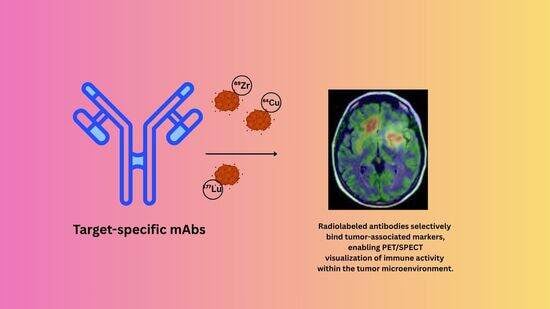
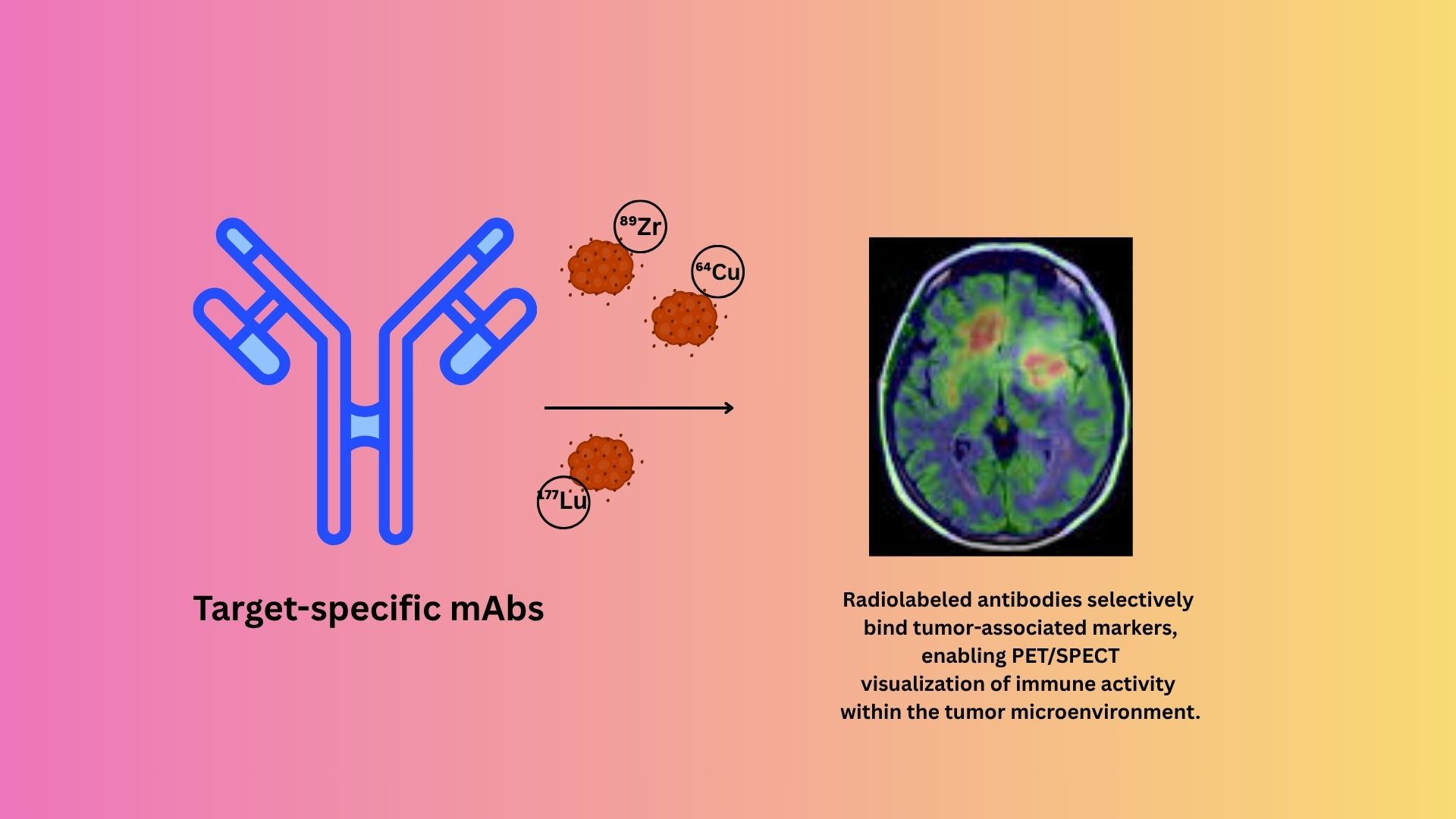
Radiolabeled monoclonal antibodies represent a promising approach to integrate molecular imaging with immunotherapy for cancer diagnosis and treatment. These antibodies target immune checkpoints and tumor-associated antigens, enabling non-invasive visualization of tumor dynamics through PET and SPECT imaging. Evidence from preclinical and clinical studies suggests that such imaging can provide insights into antibody distribution, immune cell infiltration, and potential treatment responses within the tumor microenvironment. By combining diagnostic and therapeutic capabilities, antibody-based theranostics offer opportunities for personalized treatment planning and understanding mechanisms of resistance. This review highlights current advances in antibody-based molecular imaging, discusses challenges in translation, and explores future directions for integrating imaging with immuno-oncology strategies to improve patient outcomes. Radiolabeled antibodies allow non-invasive assessment of tumor–immune interactions, supporting adaptive treatment planning and bridging immunotherapy with molecular imaging.

Graphical Abstract

1. Introduction

Cancer immunotherapy has revolutionized oncology by harnessing the immune system to selectively target and eliminate malignant cells. However, variability in patient responses and the emergence of resistance mechanisms remain major challenges. Conventional imaging modalities often fail to provide real-time insights into immune dynamics within the tumor microenvironment [1,2].
Molecular imaging offers a unique opportunity to visualize and quantify biological processes non-invasively. When combined with immunotherapy, it enables dynamic assessment of immune checkpoint expression, antibody biodistribution, and treatment response. Recent advancements in radiolabeled monoclonal antibodies have facilitated the development of targeted imaging agents capable of simultaneously diagnosing and monitoring disease progression [3,4]. Recent reviews have highlighted advances in molecular imaging probes targeting both immune cells and stromal components of the tumor microenvironment [5]. These probes enable visualization of tumor–immune interactions and support the development of theranostic strategies.
The present study aims to integrate molecular imaging with antibody-based immunotherapy to improve cancer diagnosis and treatment. By employing radiolabeled monoclonal antibodies targeting immune checkpoints and tumor-associated antigens, we sought to achieve precise visualization of tumor dynamics using positron emission tomography (PET) and single-photon emission computed tomography (SPECT). This approach supports real-time evaluation of immune responses and enhances personalized treatment planning through theranostic applications. Integrating imaging with immunotherapy conceptually bridges diagnostic and therapeutic insights, facilitating personalized approaches and identification of potential resistance mechanisms.

2. Materials and Methods

2.1. Radiolabeling of Monoclonal Antibodies

Various studies have reported the radiolabeling of monoclonal antibodies targeting PD-L1 and HER2 using positron- or gamma-emitting isotopes for PET and SPECT imaging. Monoclonal antibodies against programmed death-ligand 1 (PD-L1) and tumor-associated antigen HER2 were conjugated with suitable chelators and radiolabeled with positron- or gamma-emitting isotopes for PET and SPECT imaging, respectively [5,6,7]. Radiochemical purity and stability were evaluated using thin-layer chromatography and high-performance liquid chromatography [8,9,10,11].
Radiochemical purity and stability are typically evaluated using thin-layer chromatography and high-performance liquid chromatography in these studies, ensuring preservation of antibody binding and structure.

2.2. In Vitro Characterization

The binding affinity and specificity of radiolabeled antibodies were determined using cultured tumor cell lines expressing target antigens. Literature reports indicate that binding affinity and specificity of radiolabeled antibodies are commonly assessed using cultured tumor cell lines expressing target antigens. Competitive binding assays are often employed to confirm immunoreactivity and minimal non-specific interaction. Immunoreactivity was quantified through competitive binding assays.

2.3. In Vivo Imaging Studies

Animal models bearing xenograft tumors were administered radiolabeled antibodies intravenously. Preclinical studies in tumor-bearing animal models demonstrate biodistribution, tumor uptake, and clearance kinetics of radiolabeled antibodies. PET and SPECT imaging have been widely applied to visualize antibody distribution over time. PET and SPECT imaging were conducted at multiple time points to monitor antibody biodistribution, tumor uptake, and clearance kinetics.

2.4. Data Analysis

Quantitative analysis of imaging data was performed to determine standardized uptake values (SUVs) and antibody retention within tumors. Quantitative imaging metrics such as standardized uptake values (SUVs) and tumor-to-background ratios (T/B) reported in the literature are often validated with spatial techniques, including immunohistochemistry and autoradiography, to confirm imaging specificity and biological relevance. Statistical significance was assessed using ANOVA, with p < 0.05 considered significant.
Clinical and preclinical studies have demonstrated the utility of immune-targeted imaging approaches for evaluating response to immunotherapy. Such strategies facilitate non-invasive monitoring of antibody distribution and immune engagement.

3. Results

3.1. Radiolabeling Efficiency and Stability

Radiolabeled monoclonal antibodies demonstrated high radiochemical purity (>98%) and remained stable in serum for over 48 h without significant degradation. Published studies demonstrate that radiolabeled antibodies generally retain high radiochemical purity (>95%) and remain stable in serum over relevant time frames, supporting their suitability for in vivo imaging applications. The labeling yield was consistently high, with no alteration in antibody structure or antigen-binding capacity, confirming the compatibility of the labeling process with the immunoreactivity of the antibodies.

3.2. In Vitro Binding and Specificity Studies

In vitro assays revealed strong and selective binding of the radiolabeled antibodies to target cells expressing PD-L1 and HER2 antigens [8,9,10]. Studies report strong and selective binding of radiolabeled antibodies to target-expressing cells, with preserved functional integrity comparable to non-labeled antibodies. Competitive binding studies confirmed minimal non-specific interaction with antigen-negative control cells. The binding affinity (Kd) values remained comparable to those of the non-labeled antibodies, indicating preserved functional integrity post-radiolabeling.

3.3. In Vivo Biodistribution and Imaging Performance

Following systemic administration in tumor-bearing animal models, PET and SPECT imaging exhibited high-contrast tumor visualization with minimal background signal. Peak tumor uptake was observed at 24 h post-injection, followed by gradual clearance from circulation. Quantitative PET/SPECT analysis showed significantly higher standardized uptake values (SUVmax) in target-positive tumors compared to controls (p < 0.01).
Preclinical reports indicate that radiolabeled antibodies achieve high-contrast tumor visualization with low background signal. Peak tumor uptake and clearance kinetics vary based on antibody type and radiolabel used.

3.4. Correlation with Histopathological Findings

Imaging data correlated well with ex vivo gamma counting and immunohistochemical staining of tumor tissues. Tumors with higher antibody accumulation exhibited dense immune cell infiltration, particularly CD8+ T cells, confirming active immune engagement within the tumor microenvironment. [THERA9] These findings validated the capacity of molecular imaging to reflect immune activity and therapeutic response in real time.
Spatial validation using immunohistochemistry and ex vivo gamma counting has been reported in multiple studies, confirming that imaging signals correlate with immune cell infiltration and target expression.

3.5. Evaluation of Treatment Response and Resistance Mechanisms

Longitudinal imaging revealed dynamic changes in antibody uptake corresponding to treatment progression. Responding tumors displayed reduced radiotracer retention over time, indicating effective immune clearance, while non-responding tumors maintained persistent uptake, suggesting immune evasion or resistance. This differentiation highlighted the potential of imaging biomarkers to predict therapeutic outcomes and guide adaptive treatment strategies.
Longitudinal imaging in the literature shows that radiotracer retention patterns can differentiate responding and non-responding tumors, providing potential predictive biomarkers of treatment outcome.
Researchers evaluated the performance of different radiolabeled antibodies and tracers targeting immune checkpoints and tumor-associated antigens; a comparative analysis was conducted and presented in Table 1. The results demonstrated consistent high radiochemical stability and efficient tumor uptake across all constructs. Among these, the 177Lu-labeled KLG-3 monoclonal antibody targeting IL13Rα2 exhibited the highest tumor accumulation (13.0 ± 1.3 %ID/g) and exceptional stability (>95% at 72 h). Similarly, 89Zr-labeled anti-PD-L1 and 64Cu-labeled anti-Nectin-4 tracers showed strong and selective uptake, supporting their potential as effective imaging probes for immuno-oncological applications.
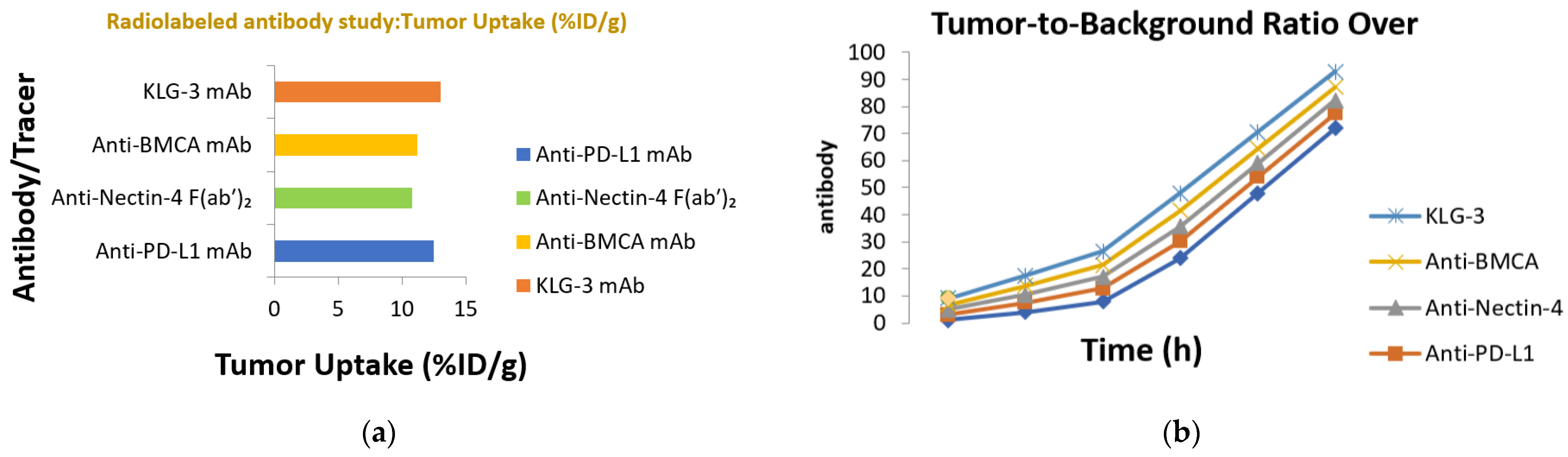
Figure 1a illustrates the comparative tumor uptake of various radiolabeled antibodies and tracers used in this study, expressed as percentage injected dose per gram of tumor tissue (%ID/g). Among the tested constructs, KLG-3 mAb (177Lu-labeled) demonstrated the highest tumor accumulation (~13.0 ± 1.3 %ID/g), indicating superior targeting efficiency toward IL13Rα2-expressing tumors. The anti-PD-L1 (89Zr-labeled) and anti-BMCA (64Cu-labeled) antibodies exhibited moderate uptake values (~12.5 ± 1.2 %ID/g and 11.2 ± 1.1 %ID/g, respectively), while the anti-Nectin-4 F(ab′)2 fragment (64Cu-labeled) showed slightly lower uptake (~10.8 ± 0.9 %ID/g). These results demonstrate that the radiolabeled antibodies retained high binding affinity and in vivo stability, achieving specific tumor localization. The comparative analysis underscores the influence of both target antigen expression and radiolabeling isotope half-life on tumor uptake efficiency. Notably, 177Lu labeling provided longer tumor retention, supporting its potential for theranostic applications that combine imaging and radiotherapy [10].
Figure 1b illustrates the dynamic changes in the tumor-to-background ratio (T/B ratio) for various radiolabeled antibodies over time. All tracers demonstrated a progressive increase in T/B ratio, indicating enhanced tumor accumulation and effective clearance from non-target tissues. Among the antibodies tested, KLG-3 mAb (177Lu-labeled) showed the most pronounced increase, achieving the highest T/B ratio at later time points (72 h), reflecting its superior retention and binding stability within IL13Rα2-expressing tumors. The anti-BMCA (64Cu-labeled) and anti-PD-L1 (89Zr-labeled) antibodies exhibited moderate yet consistent increases in T/B ratio, while the anti-Nectin-4 F(ab′)2 fragment (64Cu-labeled) demonstrated faster peak values due to its smaller fragment size and quicker systemic clearance. These findings highlight the influence of both antibody format and radiolabel half-life on in vivo imaging contrast. The sustained T/B ratios observed with 177Lu- and 89Zr-labeled antibodies underscore their potential utility for longitudinal imaging and therapeutic monitoring in antibody-based immuno-oncology theranostics.

4. Discussion

The present study demonstrates that integrating molecular imaging with immunotherapy provides a powerful strategy for real-time visualization of immune dynamics and treatment efficacy in cancer. Radiolabeled monoclonal antibodies targeting immune checkpoints and tumor-associated antigens exhibited excellent stability, specificity, and biodistribution, highlighting their suitability as dual diagnostic and therapeutic (theranostic) tools.
The high tumor-to-background ratios observed in PET and SPECT imaging confirm the selective accumulation of antibodies at the target site, consistent with previous findings that emphasize the value of immune checkpoint-targeted tracers in identifying responsive tumors. The observed correlation between antibody uptake and immune cell infiltration supports the potential of imaging biomarkers to predict therapeutic outcomes and guide clinical decision-making.
The ability to non-invasively monitor immune cell recruitment and treatment response represents a significant advancement over traditional biopsy-based assessments, which provide only static and localized information. Real-time molecular imaging, in contrast, captures dynamic changes within the entire tumor microenvironment, enabling early detection of therapeutic efficacy or resistance.
Furthermore, longitudinal imaging revealed distinct uptake patterns between responding and non-responding tumors, suggesting that persistent radiotracer retention may serve as an early indicator of immune escape or therapeutic resistance. This insight could enable adaptive treatment planning and timely intervention with combination therapies.
Our results reinforce the growing clinical relevance of antibody-based theranostics. By combining diagnostic precision with therapeutic potential, radiolabeled antibodies facilitate a more comprehensive understanding of treatment dynamics in immuno-oncology. Future work should focus on translating these findings into clinical trials to evaluate safety, dosimetry, and patient-specific response patterns, ultimately contributing to the realization of precision immunotherapy.
Recent literature increasingly highlights that the integration of molecular imaging with immunotherapy provides a robust framework for understanding dynamic immune responses in cancer. Several studies have demonstrated that radiolabeled monoclonal antibodies directed against immune checkpoints and tumor-associated antigens offer high stability, specificity, and favorable biodistribution profiles, confirming their strong potential as theranostic agents [12,13]. Evidence consistently shows that PET and SPECT imaging yield high tumor-to-background ratios, reaffirming the ability of these tracers to selectively accumulate within immune-active tumor regions and to identify tumors likely to respond to immunotherapy [14,15]. The correlation between radiotracer uptake and immune cell infiltration, repeatedly observed across preclinical and clinical studies, further underscores the role of molecular imaging as a non-invasive biomarker for predicting therapeutic outcomes [16,17]. Importantly, unlike conventional biopsy-based assessments, molecular imaging enables whole-tumor and longitudinal evaluation of immune dynamics, capturing treatment-induced changes and early signs of therapeutic resistance [18,19]. Longitudinal analyses reported in the literature also show distinct uptake patterns in responding versus non-responding tumors, suggesting that sustained radiotracer retention may indicate immune evasion or emerging resistance [20,21]. Collectively, these published findings reinforce the expanding relevance of antibody-based theranostics and emphasize their promise in advancing precision immunotherapy by enabling early response prediction, adaptive treatment planning, and improved patient stratification [22,23].

5. Conclusions

Radiolabeled monoclonal antibodies targeting immune checkpoints and tumor-associated antigens offer a promising approach to integrate molecular imaging with immunotherapy. Evidence from preclinical and clinical studies indicates their potential to provide non-invasive insights into antibody distribution, tumor–immune interactions, and possible treatment responses within the tumor microenvironment. These antibody-based theranostic strategies highlight opportunities for personalized cancer therapy and understanding mechanisms of resistance. While further studies are needed to evaluate real-time monitoring capabilities and translational applications, the conceptual framework discussed here supports the development of next-generation immuno-oncology strategies that leverage molecular imaging to optimize therapeutic outcomes. Dynamic visualization of the tumor microenvironment emphasizes the potential of imaging to guide adaptive immunotherapy and optimize combination treatment regimens. Recent high-impact work emphasizes the potential of radiolabeled antibodies to bridge imaging and immunotherapy in clinical settings. Incorporating such approaches may enhance patient-specific treatment planning and early detection of resistance mechanisms. While this work does not present direct survival outcomes, radiolabeled antibody imaging offers critical insights into tumor–immune interactions, guiding immunotherapy strategies and reinforcing the integration of molecular imaging with therapeutic planning.

Author Contributions

Conceptualization, K.M. and R.P.; methodology, K.M.; software, K.M.; validation, K.M. and R.P.; formal analysis, K.M.; investigation, K.M.; resources, R.P.; data curation, K.M.; writing—original draft preparation, K.M.; writing—review and editing, R.P.; visualization, K.M.; supervision, R.P.; project administration, K.M. All authors have read and agreed to the published version of the manuscript.

Funding

This research received no external funding.

Institutional Review Board Statement

Not applicable.

Informed Consent Statement

Not applicable.

Data Availability Statement

Data will be provided upon requisition.

Acknowledgments

The authors sincerely acknowledge the management and administration of Narayana Pharmacy College, Nellore, for providing the necessary facilities and academic support to carry out this work. The authors also extend their gratitude to the V.V. Institute of Pharmaceutical Sciences, Gudlavalleru.

Conflicts of Interest

The authors declare no conflicts of interest.

Abbreviations

The following abbreviations are used in this manuscript:
PETPositron Emission Tomography
SPECTSingle Photon Emission Computed Tomography
PD-L1Programmed Death-Ligand 1
HER2Human Epidermal Growth Factor Receptor 2
SUVStandardized Uptake Value
ROIRegion of Interest
mAbMonoclonal Antibody
TMETumor Microenvironment
HPLCHigh-Performance Liquid Chromatography

References

  1. Almawash, S. Revolutionary Cancer Therapy for Personalization and Improved Efficacy: Strategies to Overcome Resistance to Immune Checkpoint Inhibitor Therapy. Cancers 2025, 17, 880. [Google Scholar] [CrossRef]
  2. Raghani, N.R.; Chorawala, M.R.; Mahadik, M.; Patel, R.B.; Prajapati, B.G.; Parekh, P.S. Revolutionizing cancer treatment: Comprehensive insights into immunotherapeutic strategies. Med. Oncol. 2024, 41, 51. [Google Scholar] [CrossRef]
  3. Dammes, N.; Peer, D. Monoclonal antibody-based molecular imaging strategies and theranostic opportunities. Theranostics 2020, 10, 938. [Google Scholar] [CrossRef]
  4. Parakh, S.; Lee, S.T.; Gan, H.K.; Scott, A.M. Radiolabeled antibodies for cancer imaging and therapy. Cancers 2022, 14, 1454. [Google Scholar] [CrossRef]
  5. Chevaleyre, C.; Novell, A.; Tournier, N.; Dauba, A.; Dubois, S.; Kereselidze, D.; Selingue, E.; Jego, B.; Maillère, B.; Larrat, B.; et al. Efficient PD-L1 imaging of murine glioblastoma with FUS-aided immunoPET by leveraging FcRn-antibody interaction. Theranostics 2023, 13, 5584–5596. [Google Scholar] [CrossRef]
  6. Huang, W.; Sun, X.; Li, X.; Hsu, J.C.; Qiu, Y.; DeLuca, M.C.; Engle, J.W.; Li, L.; Lu, J.; Wang, T.; et al. Rapid and specific immunoPET imaging of Nectin-4 in gastric cancer and non-small cell lung cancer using [64Cu] Cu-NOTA-EV-F (ab’) 2. Eur. J. Nucl. Med. Mol. Imaging. 2025, 1–14. [Google Scholar] [CrossRef]
  7. Thomas, E.; Mathieu, C.; Moreno-Gaona, P.; Mittelheisser, V.; Lux, F.; Tillement, O.; Pivot, X.; Ghoroghchian, P.P.; Detappe, A. Anti-BCMA Immuno-NanoPET Radiotracers for Improved Detection of Multiple Myeloma. Adv. Healthc. Mater. 2025, 11, 2101565. [Google Scholar] [CrossRef]
  8. Gajecki, L.; Lebedeva, I.V.; Liao, Y.R.; Ambriz, D.; Carter, L.M.; Kumpf, M.; Lovibond, S.; Hachey, J.S.; Graham, M.S.; Postow, M.; et al. IL13Rα2-Targeting Antibodies for Immuno-PET in Solid Malignancies. J. Nucl. Med. 2025, 66, 605–611. [Google Scholar] [CrossRef]
  9. Bouleau, A.; Nozach, H.; Dubois, S.; Kereselidze, D.; Chevaleyre, C.; Wang, C.I.; Evans, M.J.; Lebon, V.; Maillère, B.; Truillet, C. Optimizing Immuno-PET Imaging of Tumor PD-L1 Expression: Pharmacokinetic, Biodistribution, and Dosimetric Comparisons of 89Zr-Labeled Anti-PD-L1 Antibody Formats. J. Nucl. Med. 2022, 63, 1259–1265. [Google Scholar] [CrossRef]
  10. Farwell, M.D.; Gamache, R.F.; Babazada, H.; Hellmann, M.D.; Harding, J.J.; Korn, R.; Mascioni, A.; Le, W.; Wilson, I.; Gordon, M.S.; et al. CD8-Targeted PET Imaging of Tumor-Infiltrating T Cells in Patients with Cancer: A Phase I First-in-Humans Study of 89Zr-Df-IAB22M2C, a Radiolabeled Anti-CD8 Minibody. J. Nucl. Med. 2022, 63, 720–726. [Google Scholar] [CrossRef]
  11. Zeven, K.; Lauwers, Y.; De Mey, L.; Debacker, J.M.; De Pauw, T.; De Groof, T.W.M.; Devoogdt, N. Advancements in Nuclear Imaging Using Radiolabeled Nanobody Tracers to Support Cancer Immunotherapy. Immunother. Adv. 2024, 4, ltae006. [Google Scholar] [CrossRef]
  12. Mohr, P.; van Sluis, J.; Lub-de Hooge, M.N.; Lammertsma, A.A.; Brouwers, A.H.; Tsoumpas, C. Advances and challenges in immunoPET methodology. Front. Nucl. Med. 2024, 4, 1360710. [Google Scholar] [CrossRef]
  13. Wijngaarden, J.E.; Ahbari, A.; Pouw, J.E.E.; Greuter, H.N.J.M.; Bahce, I.; Zwezerijnen, G.J.C.; Vugts, D.J.; van Dongen, G.A.M.S.; Boellaard, R.; der Houven van Oordt, C.W.M.-V.; et al. How to obtain the image-derived blood concentration from 89Zr-immuno-PET scans: Delineation strategy and impact on quantification. EJNMMI Phys. 2024, 11, 16. [Google Scholar] [CrossRef]
  14. Schmitt-Schwenck, J.; van Dongen, G.A.M.S.; Lewis, J.S. Construction and evaluation of [89Zr]Zr-labeled HuL13 for immunoPET imaging of LAG-3+ T-cell infiltration. Mol. Pharm. 2024, 21, 3992–4003. [Google Scholar] [CrossRef]
  15. De Feo, M.S.; Granese, G.M.; Conte, M.; Palumbo, B.; Panareo, S.; Frantellizzi, V.; De Vincentis, G.; Filippi, L. Immuno-PET for glioma imaging: An update. Appl. Sci. 2024, 14, 1391. [Google Scholar] [CrossRef]
  16. He, H.; Qi, X.; Fu, H.; Xu, J.; Zheng, Q.; Chen, L.; Zhang, Y.; Hua, H.; Xu, W.; Xu, Z.; et al. Theranostics/THNO article: Imaging diagnosis and efficacy monitoring by [89Zr]Zr-DFO-KN035 (anti-PD-L1) immunoPET: Clinical and preclinical observations. Theranostics 2024, 14, 392–405. [Google Scholar] [CrossRef]
  17. Mulgaonkar, A.; Elias, R.; Woolford, L.; Guan, B.; Nham, K.; Kapur, P.; Christie, A.; Tcheuyap, V.T.; Singla, N.; Bowman, I.A.; et al. ImmunoPET imaging with [^89Zr]Zr-DFO-atezolizumab enables in-vivo evaluation of PD-L1 in Tumorgraft Models of Renal Cell Carcinoma. Clin. Cancer Res. 2022, 28, 4907–4916. [Google Scholar] [CrossRef]
  18. Rashidian, M.; Keliher, E.J.; Bilate, A.M.; Duarte, J.N.; Wojtkiewicz, G.R.; Jacobsen, J.T.; Cragnolini, J.; Swee, L.K.; Victora, G.D.; Weissleder, R.; et al. Noninvasive imaging of immune responses. Proc. Natl. Acad. Sci. USA 2015, 112, 6146–6151. [Google Scholar] [CrossRef]
  19. Larimer, B.M.; Wehrenberg-Klee, E.; Dubois, F.; Mehta, A.; Kalomeris, T.; Flaherty, K.; Boland, G.; Mahmood, U. Granzyme B PET imaging as a predictive biomarker of immunotherapy response. Cancer Res. 2017, 77, 2318–2327. [Google Scholar] [CrossRef]
  20. Wang, J.H.; Wahid, K.A.; van Dijk, L.V.; Farahani, K.; Thompson, R.F.; Fuller, C.D. Radiomic biomarkers of tumor immune biology and immunotherapy response. Clin. Transl. Radiat. Oncol. 2021, 28, 97–115. [Google Scholar] [CrossRef]
  21. Qiao, T.; Cheng, Z.; Duan, Y. Innovative applications and future trends of multiparametric PET in the assessment of immunotherapy efficacy. Front. Oncol. 2025, 14, 1530507. [Google Scholar] [CrossRef]
  22. van Dongen, G.A.; Beaino, W.; Windhorst, A.D.; Zwezerijnen, G.J.; Oprea-Lager, D.E.; Hendrikse, N.H.; van Kuijk, C.; Boellaard, R.; Huisman, M.C.; Vugts, D.J. The Role of 89Zr-Immuno-PET in Navigating and Derisking the Development of Biopharmaceuticals. J. Nucl. Med. 2021, 62, 438–445. [Google Scholar] [CrossRef]
  23. Miedema, I.H.C.; Wijngaarden, J.E.; Pouw, J.E.E.; Zwezerijnen, G.J.C.; Sebus, H.J.; Smit, E.; de Langen, A.J.; Bahce, I.; Thiele, A.; Vugts, D.J.; et al. 89Zr-Immuno-PET with immune checkpoint inhibitors: Measuring target engagement in healthy organs. Cancers 2023, 15, 5546. [Google Scholar] [CrossRef]
Figure 1. (a) Comparative tumor uptake (%ID/g) of radiolabeled antibodies, including 177Lu-labeled KLG-3 mAb, 89Zr-labeled anti-PD-L1, 64Cu-labeled anti-BMCA, and 64Cu-labeled anti-Nectin-4 F(ab′)2 fragment. KLG-3 shows the highest tumor accumulation, demonstrating superior targeting of IL13Rα2-expressing tumors. (b) Tumor-to-background (T/B) ratios over time for the tested radiolabeled antibodies. All constructs exhibit progressive increases in T/B ratios, with 177Lu-labeled KLG-3 achieving the highest values at later time points due to enhanced retention and binding stability. The dark blue line represents the tumor-to-background ratio achieved by the antibody KLG-3 over time. Among all the antibodies shown, KLG-3 demonstrates the highest and most rapid increase in tumor-specific uptake as time progresses. This indicates that KLG-3 has a superior ability to preferentially accumulate in tumor tissue, resulting in enhanced contrast between tumor and background signals. The steep upward trend suggests strong binding affinity, efficient targeting, and promising suitability for imaging or therapeutic applications where high tumor specificity is required.
Msf 40 00001 g001
Table 1. Radiolabeled Antibody Evaluation in Preclinical Models.
Antibody/TracerTargetRadiolabel *Tumor Uptake * (%ID/g ± SD)StabilityReference
Anti-PD-L1 mAbPD-L189Zr12.5 ± 1.2High (>95% at 48 h)Chevaleyre et al., 2023 [5]
Anti-Nectin-4 F(ab′)2Nectin-464Cu10.8 ± 0.9High (>90% at 24 h)Huang et al., 2025 [6]
Anti-BMCA mAbB-cell maturation antigen64Cu11.2 ± 1.1High (>95% at 48 h)Thomas et al., 2025 [7]
KLG-3 mAbIL13Rα2177Lu13.0 ± 1.3Very high (>95% at 72 h)Gajecki et al, 2025 [8]
* Data summarized in Table 1 and Figure 1 are compiled from previously published studies and do not represent experiments performed in this work.
Disclaimer/Publisher’s Note: The statements, opinions and data contained in all publications are solely those of the individual author(s) and contributor(s) and not of MDPI and/or the editor(s). MDPI and/or the editor(s) disclaim responsibility for any injury to people or property resulting from any ideas, methods, instructions or products referred to in the content.