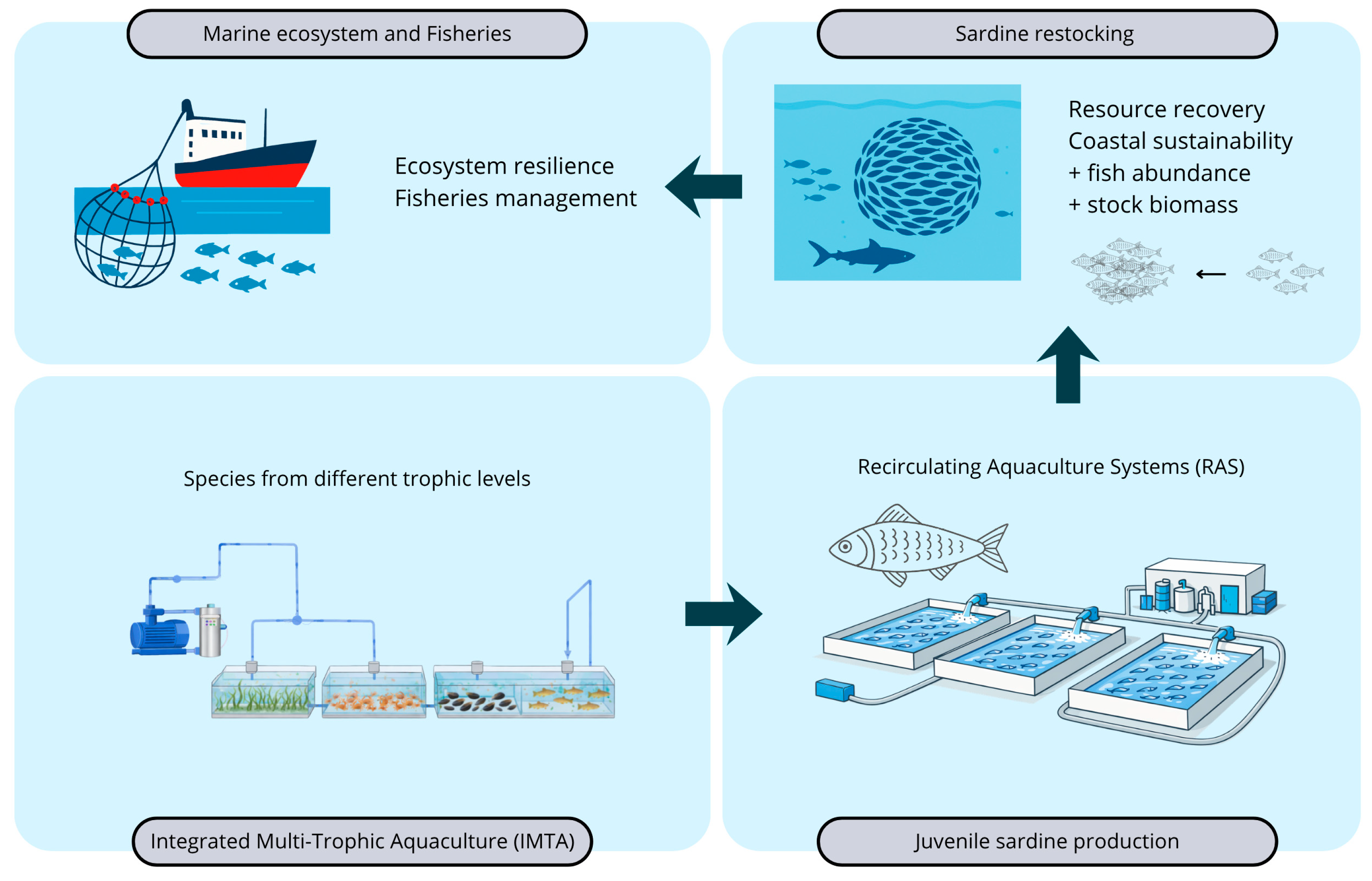

Juvenile Sardine Production in Ecological Culture System: Opportunities for Restocking and Coastal Sustainability

Abstract
1. Introduction
1.1. The Common Sardine (Strangomera bentincki): Biological and Economic Importance
1.2. Life Cycle, Population Dynamics and Coastal Fisheries
1.3. Climate Change and Phenology
1.4. Physiological Ecology and Sustainable Coastal Aquaculture
1.5. Human Nutrition and Food Safety
1.6. RAS and IMTA
1.7. Husbandry Conditions and Production Cycle
1.8. Future Work
2. Conclusions
Author Contributions
Funding
Institutional Review Board Statement
Informed Consent Statement
Data Availability Statement
Acknowledgments
Conflicts of Interest
References
- Food and Agriculture Organization of the United Nations (FAO). The State of World Fisheries and Aquaculture 2024; FAO: Rome, Italy, 2024; 264p. [Google Scholar] [CrossRef]
- Alheit, J.; Peck, M.A. Drivers of dynamics of small pelagic fish resources: Biology, management and human factors. Mar. Ecol. Prog. Ser. 2019, 621, 127–141. [Google Scholar] [CrossRef]
- Peck, M.A.; Catalán, I.A.; Garrido, S.; Rykaczewski, R.R.; Asch, R.G.; McDowell, J.R.; Hazen, E.L.; Kaplan, I.C. Small pelagic fish: New frontiers in ecological research. Mar. Ecol. Prog. Ser. 2024, 741, 1–6. [Google Scholar] [CrossRef]
- Rooper, C.N.; Boldt, J.L.; Uriarte, A.; Hansen, C.; Gaichas, S.; Nash, R.; Ward, T. Small pelagic fish: New frontiers in science for sustainable management. Can. J. Fish. Aquat. Sci. 2024, 81, 984–989. [Google Scholar] [CrossRef]
- Ruzicka, J.; Chiaverano, L.; Coll, M.; Garrido, S.; Tam, J.; Murase, H.; Robinson, K.; Romagnoni, G.; Shannon, L.; Silva, A.; et al. The role of small pelagic fish in diverse ecosystems: Knowledge gleaned from food-web models. Mar. Ecol. Prog. Ser. 2024, 741, 7–27. [Google Scholar] [CrossRef]
- Pousão, P.; Araújo, J.; Barata, M.; Castanho, S.; Soares, F.; Marçalo, A.; Mendes, A. First steps on sardine (Sardina pilchardus) aquaculture production: Adaptation to captivity and spawning. In Proceedings of the World Aquaculture Society Conference, Singapore, 14–18 December 2020; Available online: https://www.was.org/MeetingAbstracts/ShowAbstract/136612 (accessed on 10 September 2025).
- Owatari, M.S.; Cerqueira, V.R.; Baloi, M.F.; Cipriano, F.S.; Manzoni, G.C.; Sterzelecki, F.C.; Magnotti, C. Low-Trophic-Level species Sardinella brasiliensis in aquaculture: Crosstalk between aquaculture and fisheries. Rev. Fish. Sci. Aquac. 2024, 32, 679–697. [Google Scholar] [CrossRef]
- Hossain, A.; Senff, P.; Glaser, M. Lessons for coastal applications of IMTA as a way towards sustainable development: A review. Appl. Sci. 2022, 12, 11920. [Google Scholar] [CrossRef]
- Checa, D.; Macey, B.M.; Bolton, J.J.; Brink-Hull, M.; O’Donohoe, P.; Cardozo, A.; Poersch, L.H.; Sánchez, I. Circularity assessment in aquaculture: The case of integrated multi-trophic aquaculture (IMTA) systems. Fishes 2024, 9, 165. [Google Scholar] [CrossRef]
- Cubillos, L.A.; Arcos, D.F.; Bucarey, D.A.; Canales, M.T. Seasonal growth of small pelagic fish off Talcahuano, Chile (37° S, 73° W): A consequence of their reproductive strategy to seasonal upwelling? Aquat. Living Resour. 2001, 14, 115–124. [Google Scholar] [CrossRef]
- Servicio Nacional de Pesca y Acuicultura (SERNAPESCA). Anuarios Estadísticos de Pesca y Acuicultura—Sernapesca; SERNAPESCA: Valparaíso, Chile, 2024; Available online: https://www.sernapesca.cl/informacion-utilidad/anuarios-estadisticos-de-pesca-y-acuicultura/ (accessed on 10 September 2025).
- Cubillos, L.A.; Bucarey, D.; Canales, M. Monthly abundance estimation for common sardine Strangomera bentincki and anchovy Engraulis ringens in the central-southern area off Chile (34–40° S). Fish. Res. 2002, 57, 117–130. [Google Scholar] [CrossRef]
- Fernández, C.; Oyarzún, C. Trophic variations of the Chilean croaker Cilus gilberti during the summer period 1997–98 (Perciformes, Sciaenidae). J. Appl. Ichthyol. 2001, 17, 227–233. [Google Scholar] [CrossRef]
- Herling, C.; Culik, B.M.; Hennicke, J.C. Diet of the Humboldt penguin (Spheniscus humboldti) in northern and southern Chile. Mar. Biol. 2005, 147, 13–25. [Google Scholar] [CrossRef]
- Ibáñez, C.M.; Arancibia, H.; Cubillos, L.A. Biases in determining the diet of jumbo squid Dosidicus gigas (D’Orbigny, 1835) (Cephalopoda: Ommastrephidae) off southern-central Chile (34° S–40° S). Helgol. Mar. Res. 2008, 62, 331–338. [Google Scholar] [CrossRef]
- Muñoz, L.; Pavez, G.; Quiñones, R.A.; Oliva, D.; Santos, M.; Sepúlveda, M. Diet plasticity of the South American sea lion in Chile: Stable isotope evidence. Rev. Biol. Mar. Oceanogr. 2013, 48, 613–622. [Google Scholar] [CrossRef]
- Herrera, G.; Tarifeño, E.; Orellana, M.C. Description of eggs and early larval stages of common sardine (Strangomera bentincki) and menhaden (Ethmidium maculatum). Biol. Pesq. 1987, 16, 107–113. [Google Scholar]
- Molina-Valdivia, V.; Landaeta, M.F.; Castillo, M.I.; Alarcón, D.; Plaza, G. Short-term variations in the early life history traits of common sardine Strangomera bentincki and anchoveta Engraulis ringens off central Chile. Fish. Res. 2020, 224, 105460. [Google Scholar] [CrossRef]
- Pedraza-Garcia, M.; Cubillos, L.A. Population dynamics of two small pelagic fish in the central-south area off Chile: Delayed density-dependence and biological interaction. Environ. Biol. Fishes 2008, 82, 111–122. [Google Scholar] [CrossRef]
- Claramunt, G.; Cubillos, L.A.; Castro, L.; Hernández, C.; Arteaga, C. Variation in the spawning periods of Engraulis ringens and Strangomera bentincki off the coasts of Chile: A quantitative analysis. Fish. Res. 2014, 160, 96–102. [Google Scholar] [CrossRef]
- Aranis, A.; de la Cruz, R.; Montenegro, C.; Ramírez, M.; Caballero, L.; Gómez, A.; Walker, K. Meta-estimation of Araucanian herring, Strangomera bentincki (Norman, 1936), biological indicators in the central-south zone of Chile (32°–47° S). Front. Mar. Sci. 2022, 9, 886321. [Google Scholar] [CrossRef]
- Cubillos, L.A.; Claramunt, G.; Castro, L. Simulation of fishery-induced changes on the reproductive cycle of common sardine, Strangomera bentincki, off central-southern Chile. Fish. Res. 2014, 160, 103–111. [Google Scholar] [CrossRef]
- Cubillos, L.A.; Arcos, D.F. Recruitment of common sardine (Strangomera bentincki) and anchovy (Engraulis ringens) off central-south Chile in the 1990s and the impact of the 1997–1998 El Niño. Aquat. Living Resour. 2002, 15, 87–94. [Google Scholar] [CrossRef]
- Checkley, D.M.; Asch, R.G.; Rykaczewski, R.R. Climate, anchovy, and sardine. Annu. Rev. Mar. Sci. 2017, 9, 469–493. [Google Scholar] [CrossRef]
- Koenigstein, S.; Mark, F.C.; Gößling-Reisemann, S.; Reuter, H.; Pörtner, H.-O. Modelling climate change impacts on marine fish populations: Process-based integration of ocean warming, acidification and other environmental drivers. Fish Fish. 2016, 17, 972–1004. [Google Scholar] [CrossRef]
- Pietri, A.; Colas, F.; Mogollon, R.; Tam, J.; Gutierrez, D. Marine heatwaves in the Humboldt Current System: From 5-day localized warming to year-long El Niños. Sci. Rep. 2021, 11, 21172. [Google Scholar] [CrossRef]
- Carrasco, D.; Pizarro, O.; Jacques-Coper, M.; Narváez, D.A. Main drivers of marine heat waves in the eastern South Pacific. Front. Mar. Sci. 2023, 10, 1129276. [Google Scholar] [CrossRef]
- Frölicher, T.L.; Fischer, E.M.; Gruber, N. Marine heatwaves under global warming. Nature 2018, 560, 360–364. [Google Scholar] [CrossRef]
- García-Reyes, M.; Sydeman, W.J.; Schoeman, D.S.; Rykaczewski, R.R.; Black, B.A.; Smit, A.J.; Bograd, S.J. Under pressure: Climate change, upwelling, and eastern boundary upwelling ecosystems. Front. Mar. Sci. 2015, 2, 109. [Google Scholar] [CrossRef]
- Kirby, R.R.; Beaugrand, G.; Lindley, J.A. Climate-induced effects on the meroplankton and the benthic–pelagic ecology of the North Sea. Limnol. Oceanogr. 2008, 53, 1805–1815. [Google Scholar] [CrossRef]
- Cushing, D.H. Plankton production and year-class strength in fish populations: An update of the match/mismatch hypothesis. In Advances in Marine Biology; Blaxter, J.H.S., Southward, A.J., Eds.; Academic Press: London, UK, 1990; Volume 26, pp. 249–293. [Google Scholar] [CrossRef]
- Durant, J.; Hjermann, D.O.; Ottersen, G.; Stenseth, N.C. Climate and the match or mismatch between predator requirements and resource availability. Clim. Res. 2007, 33, 271–283. [Google Scholar] [CrossRef]
- Brierley, A.S.; Kingsford, M.J. Impacts of climate change on marine organisms and ecosystems. Curr. Biol. 2009, 19, R602–R614. [Google Scholar] [CrossRef] [PubMed]
- IFOP. Programa de Seguimiento de Las Principales Pesquerías Pelágicas de La Zona Centro Sur de Chile; Subsecretaría de Economía y EMT: Valparaíso, Chile, 2024; Available online: https://www.ifop.cl/wp-content/contenidos/uploads/RepositorioIfop/InformeFinal/2025/P-581206.pdf (accessed on 2 January 2026).
- Custódio, M.; Villasante, S.; Calado, R.; Lillebø, A.I. Valuation of ecosystem services to promote sustainable aquaculture practices. Rev. Aquac. 2019, 12, 392–405. [Google Scholar] [CrossRef]
- Iglesias, J.; Fuentes, L. Culture viability of Sardina pilchardus (Fish, Teleost): Preliminary results of growth in captivity up to 18 months. Sci. Mar. 2014, 78, 371–375. [Google Scholar] [CrossRef]
- Chopin, T. Marine aquaculture in Canada: Well-established monocultures of finfish and shellfish and an emerging integrated multi-trophic aquaculture (IMTA) approach including seaweeds, other invertebrates, and microbial communities. Fisheries 2015, 40, 28–31. [Google Scholar] [CrossRef]
- Liu, T.; Qi, D.; Qi, H.; Wang, Y.; Xu, S.; Zhao, K. Physiological, metabolomic, and transcriptomic reveal metabolic pathway alterations in Gymnocypris przewalskii due to cold exposure. BMC Genom. 2023, 24, 545. [Google Scholar] [CrossRef] [PubMed]
- Colombo, S.M.; Roy, K.; Mraz, J.; Wan, A.H.L.; Davies, S.J.; Tibbetts, S.M.; Øverland, M.; Francis, D.S.; Rocker, M.M.; Gasco, L.; et al. Towards achieving circularity and sustainability in feeds for farmed blue foods. Rev. Aquacult. 2023, 15, 1115–1141. [Google Scholar] [CrossRef]
- Glencross, B.; Bureau, D.; Øverland, M.; Simon, C.; Valente, L.M.P.; Gracey, E.; Zatti, K. Toward Applying a Circu-larity Framework Against the Use of Aquaculture Feed Ingredients. Rev. Fish. Sci. Aquac. 2025, 1–14. [Google Scholar] [CrossRef]
- Tocher, D.R. Metabolism and functions of lipids and fatty acids in teleost fish. Rev. Fish. Sci. 2003, 11, 107–184. [Google Scholar] [CrossRef]
- Sargent, J.R.; Tocher, D.R.; Bell, J.G. The lipids. In Fish Nutrition, 3rd ed.; Halver, J.E., Hardy, R.W., Eds.; Academic Press: San Diego, CA, USA, 2003; pp. 181–257. [Google Scholar] [CrossRef]
- Tocher, D.R.; Glencross, B.D. Lipids and fatty acids. In Dietary Nutrients, Additives, and Fish Health; John Wiley & Sons, Ltd.: Chichester, UK, 2015; pp. 47–94. [Google Scholar] [CrossRef]
- Dalsgaard, J.; St John, M.; Kattner, G.; Müller-Navarra, D.C.; Hagen, W. Fatty acid trophic markers in the pelagic marine environment. Adv. Mar. Biol. 2003, 46, 225–340. [Google Scholar] [CrossRef]
- Brett, M.T.; Müller-Navarra, D.C. The role of highly unsaturated fatty acids in aquatic food web processes. Freshw. Biol. 1997, 38, 483–499. [Google Scholar] [CrossRef]
- Hixson, S.M.; Arts, M.T. Climate warming is predicted to reduce omega-3, long-chain, polyunsaturated fatty acid production in phytoplankton. Glob. Change Biol. 2016, 22, 2744–2755. [Google Scholar] [CrossRef]
- Tan, K.; Zhang, H.; Zheng, H. Climate change and n-3 LC-PUFA availability. Prog. Lipid Res. 2022, 86, 101161. [Google Scholar] [CrossRef]
- Araujo, P.; Truzzi, C.; Belghit, I.; Antonucci, M. The impact of seawater warming on fatty acid composition and nutritional quality indices of Trematomus bernacchii from the Antarctic region. Food Chem. 2021, 365, 130500. [Google Scholar] [CrossRef] [PubMed]
- Alfaro, A.C.; Thomas, F.; Sergent, L.; Duxbury, M. Identification of trophic interactions within an estuarine food web (northern New Zealand) using fatty acid biomarkers and stable isotopes. Estuar. Coast. Shelf Sci. 2006, 70, 271–286. [Google Scholar] [CrossRef]
- Urzúa, Á.; Gebert, M. Polyunsaturated fatty acid biosynthesis in marine ectotherms with different trophic levels under a global warming scenario: Interdisciplinary implications for the marine food chain, sustainable aquaculture, and human nutrition. Reg. Stud. Mar. Sci. 2025, 65, 104048. [Google Scholar] [CrossRef]
- Arts, M.T.; Brett, M.T.; Kainz, M.J. Lipids in Aquatic Ecosystems; Springer: New York, NY, USA, 2009. [Google Scholar] [CrossRef]
- Twining, C.W.; Bernhart, J.R.; Derry, A.M.; Hudson, C.M.; Ishikawa, A.; Kabeya, N.; Kainz, M.J.; Kitano, J.; Kowarik, C.; Ladd, S.N.; et al. The evolutionary ecology of fatty-acid variation: Implications for consumer adaptation and diversification. Ecol. Lett. 2021, 24, 1709–1731. [Google Scholar] [CrossRef]
- Adarme-Vega, T.C.; Thomas-Hall, S.R.; Schenk, P.M. Towards sustainable sources for omega-3 fatty acids production. Curr. Opin. Biotechnol. 2014, 26, 14–18. [Google Scholar] [CrossRef] [PubMed]
- Ahmmed, M.K.; Ahmmed, F.; Tian, H.S.; Carne, A.; Bekhit, A.E. Marine omega-3 (n-3) phospholipids: A comprehen-sive review of their properties, sources, bioavailability, and relation to brain health. Compr. Rev. Food Sci. Food Saf. 2020, 19, 64–123. [Google Scholar] [CrossRef] [PubMed]
- Harvey, B.P.; Al-Janabi, B.; Broszeit, S.; Cioffi, R.; Kumar, A.; Aranguren-Gassis, M.; Bailey, A.; Green, L.; Gsottbauer, C.M.; Hall, E.F.; et al. Evolution of marine organisms under climate change at different levels of biological organisation. Water 2014, 6, 3545–3574. [Google Scholar] [CrossRef]
- Hochachka, P.W.; Somero, G.N. Biochemical Adaptation: Mechanisms and Processes in Physiological Evolution; Oxford University Press: New York, NY, USA, 2002. [Google Scholar]
- Monroig, Ó.; Shu-Chien, A.C.; Kabeya, N.; Tocher, D.R.; Castro, L.F.C. Desaturases and elongases involved in long-chain polyunsaturated fatty acid biosynthesis in aquatic animals: From genes to functions. Prog. Lipid Res. 2022, 86, 101157. [Google Scholar] [CrossRef] [PubMed]
- Steinberg, C.E.W. Aquatic Animal Nutrition: Organic Macro- and Micro-Nutrients; Springer: Cham, Switzerland, 2022. [Google Scholar] [CrossRef]
- Steinberg, C.E.W. Aquatic Animal Nutrition: A Mechanistic Perspective from Individuals to Generations; Springer: Cham, Switzerland, 2018. [Google Scholar] [CrossRef]
- Marrero, M.; Monroig, Ó.; Betancor, M.; Herrera, M.; Pérez, J.A.; Garrido, D.; Galindo, A.; Giráldez, I.; Rodríguez, C. Influence of dietary lipids and environmental salinity on the n-3 long-chain polyunsaturated fatty acids biosynthesis capacity of the marine teleost Solea senegalensis. Mar. Drugs 2021, 19, 254. [Google Scholar] [CrossRef]
- Galindo, A.; Garrido, D.; Monroig, Ó.; Pérez, J.A.; Betancor, M.B.; Acosta, N.G.; Kabeya, N.; Marrero, M.A.; Bolaños, A.; Rodríguez, C. Polyunsaturated fatty acid metabolism in three fish species with different trophic level. Aquaculture 2021, 530, 735761. [Google Scholar] [CrossRef]
- Tocher, D.R.; Betancor, M.B.; Sprague, M.; Olsen, R.E.; Napier, J.A. Omega-3 long-chain polyunsaturated fatty acids, EPA and DHA: Bridging the gap between supply and demand. Nutrients 2019, 11, 89. [Google Scholar] [CrossRef]
- Costello, C.; Cao, L.; Gelcich, S.; Cisneros-Mata, M.Á.; Free, C.M.; Froehlich, H.E.; Golden, C.D.; Ishimura, G.; Maier, J.; Macadam-Somer, I.; et al. The future of food from the sea. Nature 2020, 588, 95–100. [Google Scholar] [CrossRef] [PubMed]
- Béné, C.; Barange, M.; Subasinghe, R.; Pinstrup-Andersen, P.; Merino, G.; Hemre, G.I.; Williams, M. Feeding 9 billion by 2050—Putting fish back on the menu. Food Secur. 2015, 7, 261–274. [Google Scholar] [CrossRef]
- United Nations. The Sustainable Development Goals Report 2022; United Nations: New York, NY, USA, 2022; Available online: https://unstats.un.org/sdgs/report/2022/ (accessed on 10 September 2025).
- FAO. Food Outlook—Biannual Report on Global Food Markets; Food and Agriculture Organisation of the United Nations: Rome, Italy, 2024. [Google Scholar] [CrossRef]
- Pernet, F.; Browman, H.I. The future is now: Marine aquaculture in the anthropocene. ICES J. Mar. Sci. 2021, 78, 315–322. [Google Scholar] [CrossRef]
- Preena, P.G.; Rejish Kumar, V.J.; Singh, I.S.B. Nitrification and denitrification in recirculating aquaculture systems: The processes and players. Rev. Aquac. 2021, 13, 2053–2075. [Google Scholar] [CrossRef]
- Bao, W.; Zhu, S.; Jin, G.; Ye, Z. Generation, characterization, perniciousness, removal and reutilization of solids in aquaculture water: A review from the whole process perspective. Rev. Aquac. 2019, 11, 1342–1366. [Google Scholar] [CrossRef]
- Gendel, Y.; Lahav, O. A novel approach for ammonia removal from fresh water recirculated aquaculture systems, comprising ion exchange and electrochemical regeneration. Aquac. Eng. 2013, 52, 27–38. [Google Scholar] [CrossRef]
- Halim, M.A.; Aziz, D.; Arshad, A.; Wong, N.L.W.S.; Nabi, M.M.; Islam, M.A.; Syukri, F. A systematic analysis of recirculating aquaculture systems (RAS) and biofloc technology (BFT) for white leg shrimp (Litopenaeus vannamei) in the indoor farming system. Aquac. Eng. 2025, 110, 102544. [Google Scholar] [CrossRef]
- Bregnballe, J. A Guide to Recirculation Aquaculture: An Introduction to the New Environmentally Friendly and Highly Productive Closed Fish Farming Systems; FAO and EuroFish International Organization: Rome, Italy, 2022. [Google Scholar]
- Martins, C.I.M.; Eding, E.H.; Verdegem, M.C.; Heinsbroek, L.T.; Schneider, O.; Blancheton, J.P.; d’Orbcastel, E.R.; Verreth, J.A.J. New developments in recirculating aquaculture systems in Europe: A perspective on environmental sustainability. Aquac. Eng. 2010, 43, 83–93. [Google Scholar] [CrossRef]
- Olesen, I.; Bonaldo, A.; Farina, R.; Gonera, A.; Hughes, A.D.; Navrud, S.; Orsini, F.; Parma, L.; Zornoza, R. Moving beyond agriculture and aquaculture to integrated sustainable food systems as part of a circular bioeconomy. Front. Mar. Sci. 2023, 10, 1178014. [Google Scholar] [CrossRef]
- Nissar, S.; Bakhtiyar, Y.; Arafat, M.Y.; Andrabi, S.; Mir, Z.A.; Khan, N.A.; Langer, S. The evolution of integrated multi-trophic aquaculture in context of its design and components paving way to valorization via optimization and diversification. Aquaculture 2023, 565, 739074. [Google Scholar] [CrossRef]
- Cosgrove, W.J.; Loucks, D.P. Water management: Current and future challenges and research directions. Water Resour. Res. 2015, 51, 4823–4839. [Google Scholar] [CrossRef]
- Valenti, W.C.; Ballester, E.L. Integrated Aquaculture and Monoculture of Low-Trophic Species. Fishes 2024, 9, 450. [Google Scholar] [CrossRef]
- Buck, B.H.; Troell, M.F.; Krause, G.; Angel, D.L.; Grote, B.; Chopin, T. State of the art and challenges for offshore integrated multi-trophic aquaculture (IMTA). Front. Mar. Sci. 2018, 5, 165. [Google Scholar] [CrossRef]
- Hala, A.F.; Chougule, K.; Cunha, M.E.; Mendes, M.C.; Oliveira, I.; Bradley, T.; Forbes, J.; Speranza, L.G. Life cycle assessment of integrated multi-trophic aquaculture: A review on methodology and challenges for its sustainability evaluation. Aquaculture 2024, 590, 741035. [Google Scholar] [CrossRef]
- Urzúa, Á.; Gebert, M. Exploring the Potential of European Brown Shrimp (Crangon crangon) in Integrated Multi-Trophic Aquaculture: Towards Achieving Sustainable and Diversified Coastal Systems. Oceans 2025, 6, 47. [Google Scholar] [CrossRef]
- Orellana, M.C.; Balbontín, F. Estudio comparativo de las larvas de Clupeiformes de la costa de Chile. Rev. Biol. Mar. Valparaíso 1983, 19, 1–46. [Google Scholar]
- Soto-Mendoza, S.; Castro, L.R.; Llanos-Rivera, A. Variabilidad espacial y temporal de huevos y larvas de Strangomera bentincki y Engraulis ringens, asociados a la desembocadura del río Itata, Chile. Rev. Biol. Mar. Oceanogr. 2010, 45, 471–487. [Google Scholar] [CrossRef]

Disclaimer/Publisher’s Note: The statements, opinions and data contained in all publications are solely those of the individual author(s) and contributor(s) and not of MDPI and/or the editor(s). MDPI and/or the editor(s) disclaim responsibility for any injury to people or property resulting from any ideas, methods, instructions or products referred to in the content. |
© 2026 by the authors. Licensee MDPI, Basel, Switzerland. This article is an open access article distributed under the terms and conditions of the Creative Commons Attribution (CC BY) license.
Share and Cite
Urzúa, Á.; Guzmán-Rivas, F.; Aguilera-Macías, A. Juvenile Sardine Production in Ecological Culture System: Opportunities for Restocking and Coastal Sustainability. Hydrobiology 2026, 5, 3. https://doi.org/10.3390/hydrobiology5010003
Urzúa Á, Guzmán-Rivas F, Aguilera-Macías A. Juvenile Sardine Production in Ecological Culture System: Opportunities for Restocking and Coastal Sustainability. Hydrobiology. 2026; 5(1):3. https://doi.org/10.3390/hydrobiology5010003
Chicago/Turabian StyleUrzúa, Ángel, Fabián Guzmán-Rivas, and Ana Aguilera-Macías. 2026. "Juvenile Sardine Production in Ecological Culture System: Opportunities for Restocking and Coastal Sustainability" Hydrobiology 5, no. 1: 3. https://doi.org/10.3390/hydrobiology5010003
APA StyleUrzúa, Á., Guzmán-Rivas, F., & Aguilera-Macías, A. (2026). Juvenile Sardine Production in Ecological Culture System: Opportunities for Restocking and Coastal Sustainability. Hydrobiology, 5(1), 3. https://doi.org/10.3390/hydrobiology5010003