Lavender Paper: A Sustainable Alternative for Pulp Production


Abstract
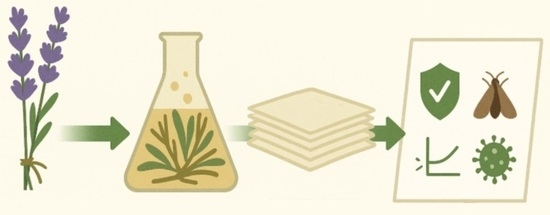
1. Introduction
- i.
- to produce nitrate–alkali pulp from lavender waste and evaluate the chemical and mechanical characteristics of the resulting papers; and
- ii.
- to investigate their potential functional properties, especially insect-repellent activity, and to assess the feasibility of lavender as a sustainable, multifunctional raw material for the paper industry.
2. Materials and Methods
2.1. Raw Material
2.2. Chemical Composition Analysis
- Cellulose content: determined by the Seifert method [20].
- Lignin content: measured as Klason lignin using TAPPI T 222 cm-02 [21].
- Holocellulose content: determined according to Wise et al. [22].
- Hemicelluloses content: calculated as the difference between the holocellulose and cellulose fractions.
- Extractives: determined by extraction with acetone and a mixture of ethanol and toluene according to TAPPI T 204 cm-97 [21].
- Ash content: measured using TAPPI T 211 cm-02 [21].
2.3. Pulping Process
2.4. Mechanical and Physical Testing
2.5. Evaluation of Repellent Properties
3. Results
3.1. Chemical Composition
3.2. Total Pulp Yield and Kappa Number
3.3. Mechanical Properties
3.4. Physical Appearance and Fiber Morphology
3.5. Repellent Properties
4. Discussion
- Active packaging materials with inherent pest resistance;
- Environmentally friendly storage inserts for textiles or books;
- Hybrid composites, where aromatic residues improve interfacial bonds with polymers.
5. Conclusions
Author Contributions
Funding
Institutional Review Board Statement
Informed Consent Statement
Data Availability Statement
Conflicts of Interest
References
- Otieno, J.O.; Okumu, T.N.; Adalla, M.K.; Ogutu, F.O.; Oure, B. Agricultural Residues as an Alternative Source of Fibre for the Production of Paper in Kenya—A Review. Asian J. Chem. Sci. 2021, 10, 22–37. [Google Scholar] [CrossRef]
- Saijonkari-Pakhala, K. Non-Wood Plants as Raw Materials for Pulp and Paper. Agric. Food Sci. 2001, 10, 101. [Google Scholar] [CrossRef]
- Mandeep; Gupta, G.K.; Liu, H.; Shukla, P. Pulp and paper industry-based pollutants, their health hazard and environmental. Curr. Opin. Environ. Sci. Health 2019, 12, 48–56. [Google Scholar] [CrossRef]
- Ding, Z.; Grundmann, P. Understanding system interdependencies in sustainable paper production from residue grass biomass: Insights from fuzzy cognitive mapping. Sci. Rep. 2025, 15, 1398. [Google Scholar] [CrossRef]
- El-Sayed, E.S.A.; El-Sakhawy, M.; El-Sakhawy, M.A.M. Non-wood fibers as raw material for pulp and paper industry. Nord. Pulp Pap. Res. J. 2020, 35, 215–230. [Google Scholar] [CrossRef]
- Lesage-Meessen, L.; Bou, M.; Ginies, C.; Chevret, D.; Navarro, D.; Drula, E.; Bonnin, E.; del Río, J.C.; Odinot, E.; Bisotto, A.; et al. Lavender- and lavandin-distolled straws: An untapped feedstock with great potential for the production of high-added value compounds and fungal enzymes. Biotechnol. Biofuels 2018, 11, 217. [Google Scholar] [CrossRef]
- Vareltzis, P.; Fotiou, D.; Papatheologou, V.; Kyroglou, S.; Tsachouridou, E.; Goula, A.M. Optimized Solid–Liquid Separation of Phenolics from Lavender Waste and Properties of the Dried Extracts. Separations 2024, 11, 67. [Google Scholar] [CrossRef]
- Greff, B.; Szigeti, J.; Varga, Á.; Lakatos, E.; Sáhó, A.; Varga, L. Effect of bacterial inoculation on co-composting of lavender (Lavandula angustifolia Mill.) waste and cattle manure. 3 Biotech 2021, 11, 306. [Google Scholar] [CrossRef] [PubMed]
- Kamperidou, V.; Terzopoulou, P. Co-Pelletization of Lavender Waste and Pine-Wood for Sustainable Fuel Pellet Production. Forests 2025, 16, 1455. [Google Scholar] [CrossRef]
- Angelova, G.; Brazkova, M.; Stefanova, P.; Blazheva, D.; Vladev, V.; Petkova, N.; Slavov, A.; Denev, P.; Karashanova, D.; Zaharieva, R.; et al. Waste Rose Flower and Lavender Straw Biomass—An Innovative Lignocellulose Feedstock for Mycelium Bio-Materials Development Using Newly Isolated Ganoderma resinaceum GA1M. J. Fungi 2021, 7, 866. [Google Scholar] [CrossRef]
- Stamova, S.; Ermenlieva, N.; Tsankova, G.; Georgieva, E. Antimicrobial Activity of Lavender Essential Oil from Lavandula angustifolia Mill.: In Vitro and In Silico Evaluation. Antibiotics 2025, 14, 656. [Google Scholar] [CrossRef]
- Rungwasantisuk, A.; Raibhu, S. Application of encapsulating lavender essential oil in gelatin/gum-arabic complex coacervate and varnish screen-printing in making fragrant gift-wrapping paper. Prog. Org. Coat. 2020, 149, 105924. [Google Scholar] [CrossRef]
- Todorova, D.; Yavorov, N.; Lasheva, V.; Damyanova, S.; Kostova, I. Lavender Essential Oil as Antibacterial Treatment for Packaging Paper. Coatings 2023, 13, 32. [Google Scholar] [CrossRef]
- Marovska, G.; Vasileva, I.; Petkova, N.; Ognyanov, M.; Gandovo, V.; Stoyanova, A.; Merdzhanov, P.; Simitchhiev, A.; Slavov, A. Lavender (Lavandula angustifolia Mill.) industrial by-products as a source of polysaccharides. Ind. Crops Prod. 2022, 188, 115678. [Google Scholar] [CrossRef]
- Eyupoglu, S.; Merdan, N. Physicochemical Properties of New Plant Based Fiber from Lavender Stem. J. Nat. Fibers 2022, 19, 9248–9258. [Google Scholar] [CrossRef]
- Crișan, I.; Ona, A.; Vârban, D.; Muntean, L.; Vârban, R.; Stoie, A.; Mihăiescu, T.; Morea, A. Current Trends for Lavender (Lavandula angustifolia Mill.) Crops and Products with Emphasis on Essential Oil Quality. Plants 2023, 12, 357. [Google Scholar] [CrossRef]
- Hájková, K.; Bouček, J.; Procházka, P.; Kalous, P.; Budský, D. Nitrate-Alkaline Pulp from Non-Wood Plants. Materials 2021, 14, 3673. [Google Scholar] [CrossRef]
- Housseinpour, R.; Latibari, J.; Farnood, R.; Fatehi, P.; Sepiddehdam, J. Fiber Morphology and Chemical Composition of Rapeseed (Brassica Napus) Stems. IAWA J. 2010, 31, 457–464. [Google Scholar] [CrossRef]
- González, I.; Alcalá, M.; Arbat, G.; Vilaseca, F.; Mutje, P. Suitability of rapeseed chemithermomechanical pulp as raw material in papermaking. Bioresources 2013, 8, 1967–1981. [Google Scholar] [CrossRef]
- Seifert, K. Uber ein neues Verfahren zur Schnellbestimmung Der Rein-Cellulose. Das Pap. 1956, 10, 301–306. [Google Scholar]
- Tappi. Standard & Test Methods. In Tappi Test Methods; Tappi Press: Peachtree Corners, GA, USA, 2004. [Google Scholar]
- Wise, L.E.; Murphy, M.; D’Addieco, A.A. Chlorite holocellulose, its fractionation and bearing on summative wood analysis and on studies on the hemicelluloses. Pap. Trade J. 1946, 122, 35–43. [Google Scholar]
- ČSN EN ISO 1924-2. (500340); Paper and Board—Determination of Tensile Properties. Czech Standard Institute: Prague, Czech Republic, 2009.
- ISO 2758:2014; Paper—Determination of Bursting Strength. International Organization for Standardization: Geneve, Switzerland, 2014.
- ISO 5636-5; Paper and Board—Determination of air Permeance (Medium Range)—Part 5: Gurley Method. International Organization for Standardization: Geneve, Switzerland, 2019.
- Bidar, L.; Noohi, N.; Dehkordi, M.H. Comparative Study of Antifungal Activity of Three Herbal Essential Oil of Thymus, Lavender, and Boswellia on Paper. J. Res. Archaeom. 2022, 8, 101–114. [Google Scholar]
- ČSN ISO 302 (50 0258); Pulps—Determination Kappa Number. Czech Standard Institute: Prague, Czech Republic, 1993.
- Potůček, F.; Miklík, J. Chemical composition of wood and annual plant pulps. Acta Fac. Xylologiae Zvolen 2011, 53, 49–58. [Google Scholar]
- Enayati, A.A.; Hazem, Y.; Mirshokraie, S.A.; Molaii, M. Papermaking potential of canola stalks. Bioresources 2009, 4, 245–256. [Google Scholar] [CrossRef]
- Hájková, K.; Jurczyková, T.; Filipi, M.; Bouček, J. Chemical Pulp from Corn Stalks. Biotechnol. Rep. 2023, 37, e00786. [Google Scholar] [CrossRef] [PubMed]
- Ferdous, T.; Ni, Y.; Quaiyyum, M.A.; Uddin, M.N.; Jahan, M.S. Non-Wood Fibers: Relationships of Fiber Properties with Pulp Properties. ACS Omega 2021, 6, 21613–21622. [Google Scholar] [CrossRef]
- Urdaneta, F.; Meza, L.; Márquez, R.; Franco, J.; Vera, R.E.; Urdaneta, I.; Parrish, C.; Saloni, D.; Pawlak, J.J.; Jameel, H.; et al. Comparing the impacts of wood and APMP non-wood fibers on the properties of hygiene tissue paper. Cellulose 2025, 32, 5021–5034. [Google Scholar] [CrossRef]
- Aldroubi, S.; Kasal, B.; Yan, L.; Bachtiar, E.V. Multi-scale investigation of morphological, physical and tensile properties of flax single fiber, yarn and unidirectional fabric. Compos. Part B Eng. 2023, 259, 110732. [Google Scholar] [CrossRef]
- Fidelis, M.E.A.; Pereira, T.V.C.; Gomes, O.d.F.M.; Silva, F.d.A.; Filho, R.D.T. The effect of fiber morphology on the tensile strength of natural fibers. J. Mater. Res. Technol. 2013, 2, 149–157. [Google Scholar] [CrossRef]
- Hindi, J.; Muralishwara, K.; Gurumurthy, B.M. Comparative analysis of physical, morphological, tensile and thermal stability characteristics of raw and alkali treated novel Tinospora cordifolia natural fiber. Sci. Rep. 2025, 15, 18596. [Google Scholar] [CrossRef]
- Liu, Y.; Deng, B.; Liang, J.; Li, J.; Liu, B.; Wang, F.; Qin, C.; Yao, S. Effects of the Preferential Oxidation of Phenolic Lignin Using Chlorine Dioxide on Pulp Bleaching Efficiency. Int. J. Mol. Sci. 2022, 23, 13310. [Google Scholar] [CrossRef]
- Türkoğlu, G.C.; Erkan, G.; Karanava, S.Y.; Sarıışık, A.M.; Bakadur, A.C.; Ütebay, B.; Popescu, A. Spray-Dried Oregano Oil and Lavender Oil Microcapsules for Antibacterial Sports and Leisurewear. AATCC J. Res. 2023, 10, 332–345. [Google Scholar] [CrossRef]
- Kumineck Junior, S.R.; Silveira, V.F.; Silva, D.A.K.; Garcia, M.C.F.; Apati, G.P.; Schneider, A.L.d.S.; Pezzin, A.P.T. Development of bacterial cellulose incorporated with essential oils for wound treatment. Polímeros 2023, 33, e20230041. [Google Scholar] [CrossRef]
- Marshall, T.; Dosoky, N.S.; Satyal, P.; Setzer, W.N. Aroma Compounds of Carrier Oils. AppliedChem 2023, 3, 546–580. [Google Scholar] [CrossRef]
- Lisý, A.; Ház, A.; Nadányi, R.; Jablonský, M.; Šurina, I. About Hydrophobicity of Lignin: A Review of Selected Chemical Methods for Lignin Valorisation in Biopolymer Production. Energies 2022, 15, 6213. [Google Scholar] [CrossRef]
- Hu, J.; Wang, L.; Xiao, M.; Chen, W.; Zhou, M.; Hu, Y.; Zhang, Y.; Lai, M.; He, A.; Zhao, M. Insights into bacterial cellulose for adsorption and sustained-release mechanism of flavors. Food Chem. X 2025, 25, 102110. [Google Scholar] [CrossRef]
- Mishra, P.K.; Ekielski, A. The Self-Assembly of Lignin and Its Application in Nanoparticle Synthesis: A Short Review. Nanomaterials 2019, 9, 243. [Google Scholar] [CrossRef] [PubMed]
- Aladić, K.; Jarni, K.; Barbir, T.; Vidović, S.; Vladić, J.; Bilić, M.; Jokić, S. Supercritical CO2 extraction of hemp (Cannabis sativa L.) seed oil. Ind. Crops Prod. 2015, 76, 472–478. [Google Scholar] [CrossRef]
- Barbash, V.; Poyda, V.; Deykun, I. Peracetic acid pulp from annual plants. Cellul. Chem. Technol. 2011, 45, 613–618. [Google Scholar]
- Srećković, N.; Mišić, D.; Gašić, U.; Matić, S.L.; Stanković, J.S.K.; Mihailović, N.R.; Monti, D.M.; D’Elia, L.; Mihailović, V. Meadow sage (Salvia pratensis L.): A neglected sage species with valuable phenolic compounds and biological potential. Ind. Crops Prod. 2022, 189, 115841. [Google Scholar] [CrossRef]



| Sample | Ash | Extracts (Acetone) | Extracts (Acetone-Toluene) | Lignin | Cellulose | Holocellulose | Hemicelluloses |
|---|---|---|---|---|---|---|---|
| Lavender stalks | 5.25 ± 0.37 | 7.25 ± 0.19 | 9.28 ± 0.08 | 24.10 ± 1.12 | 29.43 ± 1.27 | 77.90 ± 1.92 | 48.47 ± 1.55 |
| Lavender blossoms | 5.50 ± 0.29 | 13.79 ± 0.87 | 12.03 ± 1.03 | 20.52 ± 0.97 | 26.73 ± 1.08 | 60.19 ± 1.75 | 33.46 ± 1.42 |
| Sample | Air Permeability [s] | Breaking Length [km] | Relative Elongation [%] | Tensile Index [N·m·g−1] | Tensile Energy Absorption [J·g−1] | Burst Index [kPa] |
|---|---|---|---|---|---|---|
| Lavender 80 g·m−2 | 1.80 ± 0.20 | 1.71 ± 0.05 | 0.68 ± 0.04 | 16.76 ± 0.47 | 0.08 ± 0.01 | 26.93 ± 0.21 |
| Lavender 100 g·m−2 | 2.33 ± 0.12 | 0.57 ± 0.16 | 0.35 ± 0.16 | 5.58 ± 1.51 | 0.01 ± 0.01 | 30.53 ± 0.59 |
| Lavender 120 g·m−2 | 3.87 ± 0.12 | 0.98 ± 0.05 | 0.59 ± 0.06 | 9.58 ± 0.42 | 0.04 ± 0.01 | 36.17 ± 0.81 |
| Sample | Lavender Pulp | Flax Pulp | ||
|---|---|---|---|---|
| Insects Within 2 cm Zone (%) ± SD | Qualitative Reaction | Insects Within 2 cm Zone (%) ± SD | Qualitative Reaction | |
| Only pulp | 80.95 ± 21.55 | 2 | 92.86 ± 14.20 | 2 |
| Pulp + 1% lavender blossoms | 45.23 ± 16.57 | 1 | 78.57 ± 16.58 | 2 |
| Pulp + 5% lavender blossoms | 7.14 ± 14.19 | 0 | 11.90 ± 16.58 | 0 |
| Pulp + 10% lavender essential oil | 4.76 ± 12.10 | 0 | 11.90 ± 16.58 | 0 |
| Pulp + 1% lavender blossoms + 10% essential oil | 26.19 ± 19.30 | 1 | 30.95 ± 20.52 | 1 |
| Pulp + 5% lavender blossoms + 10% essential oil | 0.00 ± 0.00 | 0 | 7.14 ± 14.19 | 0 |
Disclaimer/Publisher’s Note: The statements, opinions and data contained in all publications are solely those of the individual author(s) and contributor(s) and not of MDPI and/or the editor(s). MDPI and/or the editor(s) disclaim responsibility for any injury to people or property resulting from any ideas, methods, instructions or products referred to in the content. |
© 2026 by the authors. Licensee MDPI, Basel, Switzerland. This article is an open access article distributed under the terms and conditions of the Creative Commons Attribution (CC BY) license.
Share and Cite
Hájková, K.; Bárta, J.; Holeček, T.; Filipi, M.; Synek, J. Lavender Paper: A Sustainable Alternative for Pulp Production. AppliedChem 2026, 6, 11. https://doi.org/10.3390/appliedchem6010011
Hájková K, Bárta J, Holeček T, Filipi M, Synek J. Lavender Paper: A Sustainable Alternative for Pulp Production. AppliedChem. 2026; 6(1):11. https://doi.org/10.3390/appliedchem6010011
Chicago/Turabian StyleHájková, Kateřina, Josef Bárta, Tomáš Holeček, Michaela Filipi, and Jiří Synek. 2026. "Lavender Paper: A Sustainable Alternative for Pulp Production" AppliedChem 6, no. 1: 11. https://doi.org/10.3390/appliedchem6010011
APA StyleHájková, K., Bárta, J., Holeček, T., Filipi, M., & Synek, J. (2026). Lavender Paper: A Sustainable Alternative for Pulp Production. AppliedChem, 6(1), 11. https://doi.org/10.3390/appliedchem6010011