Article

Hydrothermal Synthesis of FAU-Type Zeolite NaX Using Ladle Slag and Waste Aluminum Cans

by
Borislav Barbov
1,*,
Hristina Lazarova
1,2,
Liliya Tsvetanova
1 and
Aleksandar Nikolov
1,*
1
Institute of Mineralogy and Crystallography, Bulgarian Academy of Sciences, Acad. G. Bonchev Str., bl. 107, 1113 Sofia, Bulgaria
2
PERIMED-2, BG16RFPR002-1.014-0007, Central District, Vasil Aprilov Blvd. 15A, 4002 Plovdiv, Bulgaria
*
Authors to whom correspondence should be addressed.
AppliedChem 2026, 6(1), 12; https://doi.org/10.3390/appliedchem6010012
Submission received: 30 October 2025 / Revised: 23 December 2025 / Accepted: 28 January 2026 / Published: 3 February 2026
(This article belongs to the Special Issue Feature Papers in AppliedChem, 2nd Edition)

Abstract

This study explores a sustainable synthesis route for FAU-type zeolite X using acid-treated ladle slag as a silicon source and waste aluminum cans as an alternative aluminum precursor. Conventional zeolite synthesis relies on high-purity reagents, which are costly and environmentally intensive to produce. Previous research has rarely addressed the valorization of ladle slag and metallic aluminum waste for zeolite formation, leaving their potential largely unexplored. The study focuses on the effective utilization of industrial and post-consumer wastes—acid-treated ladle slag and aluminum cans—as precursors for FAU-type NaX zeolite, demonstrating their feasibility as alternative silicon and aluminum sources. Here, zeolite X was synthesized hydrothermally from treated slag combined with either dissolved aluminum cans and commercial sodium aluminate at 90 °C for 6 h. FAU-type zeolite X was successfully synthesized using both aluminum sources, with a SiO2/Al2O3 ratio of approximately 1.4. The results demonstrate that waste-derived precursors can effectively replace conventional chemicals, yielding predominantly NaX zeolite with high crystallinity and minor NaA impurity (as observed by XRD), with experimental yields of 1.47 g for aluminum cans and 1.266 g for sodium aluminate. The obtained zeolite X samples were structurally and texturally characterized by XRD, FTIR, XRF, BET surface area analysis, and thermogravimetric analysis (TG).

1. Introduction

Zeolites are crystalline aluminosilicates characterized by highly ordered microporous structures and exceptional physicochemical stability [1,2]. Their three-dimensional frameworks, composed from SiO4 and AlO4 tetrahedra linked through shared oxygen atoms, form regular channels and cavities that can host cations and molecules of various sizes, giving zeolites their characteristic ion-exchange, adsorption, and molecular sieving properties [3]. The presence of framework aluminum generates negative charges that are compensated by extra-framework cations, endowing zeolites with tunable acidity and enabling their extensive use as solid acid catalysts, adsorbents, and ion exchangers in chemical, petrochemical, and environmental technologies [4,5].
Among the diverse zeolitic topologies, zeolite X—belonging to the faujasite (FAU) structural family—has attracted particular attention due to its large pore openings (~7.4 Å) and high cation exchange capacity. The faujasite framework consists of truncated octahedral supercages linked through 12-membered oxygen rings, providing a highly accessible channel system that allows the diffusion of large molecules and facilitates active-site accessibility [6]. These characteristics make zeolite X a preferred candidate for applications such as gas separation, catalysis, adsorption of heavy metals, water purification [7,8]. Moreover, zeolite X is easily modified with cation exchange procedures to obtain modified zeolite X with optimized functionality [9]. Its structural and catalytic properties can be further optimized by adjusting the Si/Al ratio, synthesis parameters, and the nature of charge-compensating cations, providing broad versatility for performance enhancement across various applications [10].
The conventional synthesis of zeolite X typically relies on mild synthesis parameters and utilizes commercial sodium silicate and sodium aluminate as silicon and aluminum sources [10]. Commercial reagents are costly, and their production is associated with a significant environmental footprint due to high energy consumption and CO2 emissions [11]. To reduce both cost and environmental impact, the chemical reagents could be replaced by industrial by-products and waste materials as alternative Si and Al sources [12,13]. Several studies have demonstrated the feasibility of using fly ash [14,15,16,17], coal gangue [18], rice husk ash [19] and metallurgical slags [20,21] as precursors for zeolite synthesis. Previous studies have shown that metallurgical slags can be successfully converted into zeolites with high crystallinity and desirable structural properties, demonstrating their feasibility as alternative silicon and aluminum sources [22,23]. Nevertheless, ladle slag, a by-product of steel refining, remains underutilized despite its high content of silica and aluminum-bearing phases that can be converted into soluble aluminosilicates after suitable treatment.
Among these alternative precursors, ladle slag (LS)—a by-product of steel refining—represents a promising source of reactive silica. LS typically contains significant amounts of calcium aluminates and silicates [21]. Recent studies have shown that acid treatment of LS effectively removes calcium and other impurities, enriching the residue in amorphous silica and improving its reactivity toward zeolite formation [22,23]. Meanwhile, metallic aluminum waste—especially post-consumer beverage cans—offers a cheap, abundant, and readily available source of aluminum [24]. When dissolved in alkaline media, aluminum forms soluble aluminate species (Al(OH)4), suitable for direct use in zeolite synthesis. The combination of these two raw materials—acid-treated ladle slag and aluminum scrap—enables the synthesis of zeolite X using alternative silicon and aluminum sources. These findings further support the potential of these materials for zeolite synthesis and provide the context for the approach adopted in the present study.
In the present study, zeolite X was synthesized through a sustainable approach that utilized acid-treated ladle slag (T-LS) as the silicon source and two alternative aluminum precursors: (1) an aluminate solution derived from post-consumer aluminum beverage cans dissolved in NaOH and (2) commercial sodium aluminate (NaAlO2). The two synthesis routes were designed under identical hydrothermal conditions to enable a direct comparison between the waste-derived and commercial aluminum sources. This investigation aimed to assess the suitability of T-LS as a reactive precursor for zeolite X formation and to elucidate how the nature of the aluminum source influences the crystallization behavior and phase purity of the final products.
Waste-derived materials such as ladle slag and aluminum beverage cans have been successfully employed as alternative sources of silicon and aluminum in the synthesis of NaX zeolite [13,24,25]. These studies demonstrate the feasibility of using industrial and domestic wastes to produce zeolites with comparable crystallinity and structural properties to those obtained from conventional reagents. These findings further support the potential of waste-derived raw materials for the sustainable synthesis of zeolite X and provide the context for the approach adopted in the present study.

2. Materials and Methods

The ladle slag used in this study was collected from a steelmaking plant from outside stockpile. The slag was oven-dried and milled using a steel ball mill to achieve a particle size below 100 µm. The oven-drying at 100 °C for 12 h was performed to remove any adsorbed moisture from storage and handling, ensuring consistent weighing and reproducible reaction conditions during the subsequent acid treatment and hydrothermal synthesis. The primary crystalline phases identified previously in the slag by X-ray diffraction (XRD) were mayenite (Ca12Al14O33), γ- belite (Ca2SiO4), periclase (MgO), gehlenite (Ca2Al2SiO7), katoite (Ca3Al2(OH)12), strätlingite (Ca2Al2SiO7·8H2O), quartz (SiO2) (Figure 1) [26].

Acid Treatment of Ladle Slag

The ladle slag was treated with 1 M HCl at a solid-to-liquid ratio of 1:10 (g/mL) and stirred for 2 h at room temperature. The suspension was filtered and repeatedly washed with distilled water until neutral pH. The treated slag (T-LS) was dried at 100 °C for 12 h and stored in sealed containers for subsequent synthesis.
Analytical-grade sodium hydroxide pellets (NaOH, ≥ 98%;CAS No.:1310-73-2), hydrochloric acid (HCl, 37%; CAS No.: 7647-01-0), and sodium aluminate (NaAlO2, ≥98%; CAS No.: 11138-49-1) were obtained from Sigma-Aldrich (Darmstadt, Germany). Distilled water was used throughout all experimental procedures. Post-consumer aluminum can tabs (the pull tabs) were cut into small strips (approximately 1 × 2 cm) and directly dissolved in NaOH solution. The dissolution was carried out under magnetic stirring for 4–5 h until complete dissolution of the aluminum strips was achieved. The synthesis procedure and gel composition were adapted from a previously reported protocol for NaX zeolite synthesis using commercial sodium aluminate and SiO2 [27]. In that work, a two-stage gel preparation and aging strategy resulted in a synthesis gel with a molar composition of 9.5Na2O:5SiO2:Al2O3:480H2O and yielded highly crystalline NaX zeolite.
In the present study, commercial SiO2 and sodium aluminate were replaced by acid-treated ladle slag (T-LS) and waste-derived aluminum sources. The quantities of reagents were recalculated based on the XRF-determined composition of the treated ladle slag (T-LS) to maintain SiO2/Al2O3 and Na2O/Al2O3 ratios within the typical ranges for NaX synthesis. This approach ensured a gel composition comparable to previously reported protocols for FAU-type NaX zeolite, yielding highly crystalline products.
Powder X-ray diffraction (PXRD) analyses were carried out using an Empyrean diffractometer (Malvern Panalytical, Almelo, The Netherlands) equipped with Cu Kα radiation, operated at 40 kV and 30 mA. Fourier-transform infrared (FTIR) spectra were collected on a Bruker Tensor 37 spectrometer in the range of 4000–400 cm−1 using the KBr pellet technique. Each spectrum represented the average of 128 scans, ensuring an enhanced signal-to-noise ratio and improved spectral resolution. Chemical composition was determined by wavelength-dispersive X-ray fluorescence (WDXRF) using a Rigaku Supermini 200 spectrometer (Osaka, Japan), operated at 50 kV and 4.0 mA. XRF samples were prepared as pressed pellets. The dried powder was mixed with boric acid (as a backing material) and pressed into 32 mm pellets under a load of 25 tons.
Simultaneous thermogravimetric and differential scanning calorimetry analyses (TGA/DSC) were performed using a BXT-STA-200 analyzer (Shanghai Glomro, Shanghai, China). Twenty mg of each sample was weighed in corundum crucibles and examined in the temperature range of 25–600 °C, heating rate of 10 °C min−1, and with a dynamic air atmosphere.
The specific surface area and porosity of NaX-1 and NaX-2 samples were analyzed using 3Flex surface analyzer (Micromeritics, Norcross, GA, USA). Before analysis, the samples were degassed in situ at 90 °C for 5 h under vacuum (>1.10−6 mmHg). The physisorption experiments were carried out under liquid nitrogen (77 K) using N2 probe molecule. Quantitative information for the specific surface area (S, m2·g–1), micropore volume (Vm, cm3·g–1), pore size distribution, etc., was obtained by analyzing the resulting N2 adsorption/desorption isotherms. Brunauer, Emmett and Teller (BET) specific surface areas were calculated from adsorption data in the relative pressure range from 0.05 to 0.31 P/P0 [28]. The total pore volume was estimated based on the amount adsorbed at a relative pressure of 0.96 [29]. Micropore volumes were determined using the t-plot method [30] and the Horvath–Kawazoe micropore algorithm [31]. Pore size distributions (PSDs) were calculated from nitrogen adsorption data using an algorithm based on the ideas of Barrett, Joyner and Halenda (BJH) [32]. The mesopore diameters were determined as the maxima on the PSD for the given samples.

3. Results

3.1. Acid Treatment of Ladle Slag

The treated ladle slag (T-LS) prepared as described in Section 3.1 was analyzed by XRF and XRD analysis. The chemical composition of the raw and T-LS determined by XRF is presented in Table 1. The acid treatment resulted in a substantial relative increase of SiO2 content (from 12.2 wt% to 83 wt%) and a strong reduction in CaO (from 61.0 wt% to 1.5 wt%), indicating efficient removal of calcium-bearing phases.
The observed relative increase in SO3 and TiO2 after acid treatment does not reflect a real increase in their amounts, but is an artifact of normalization to an anhydrous basis. XRF analysis shows that Fe2O3 and TiO2 are present only in minor amounts (~1.8–2.5 wt%), while CaO is largely removed during acid treatment (from 61 wt% to 1.5 wt%). The removal of soluble Ca- and Fe-phases reduces the total mass used for normalization, leading to an apparent increase in the less reactive oxides. A similar effect has been reported in the literature for acid-treated metallurgical wastes and is typical of partial selective decalcification [33].
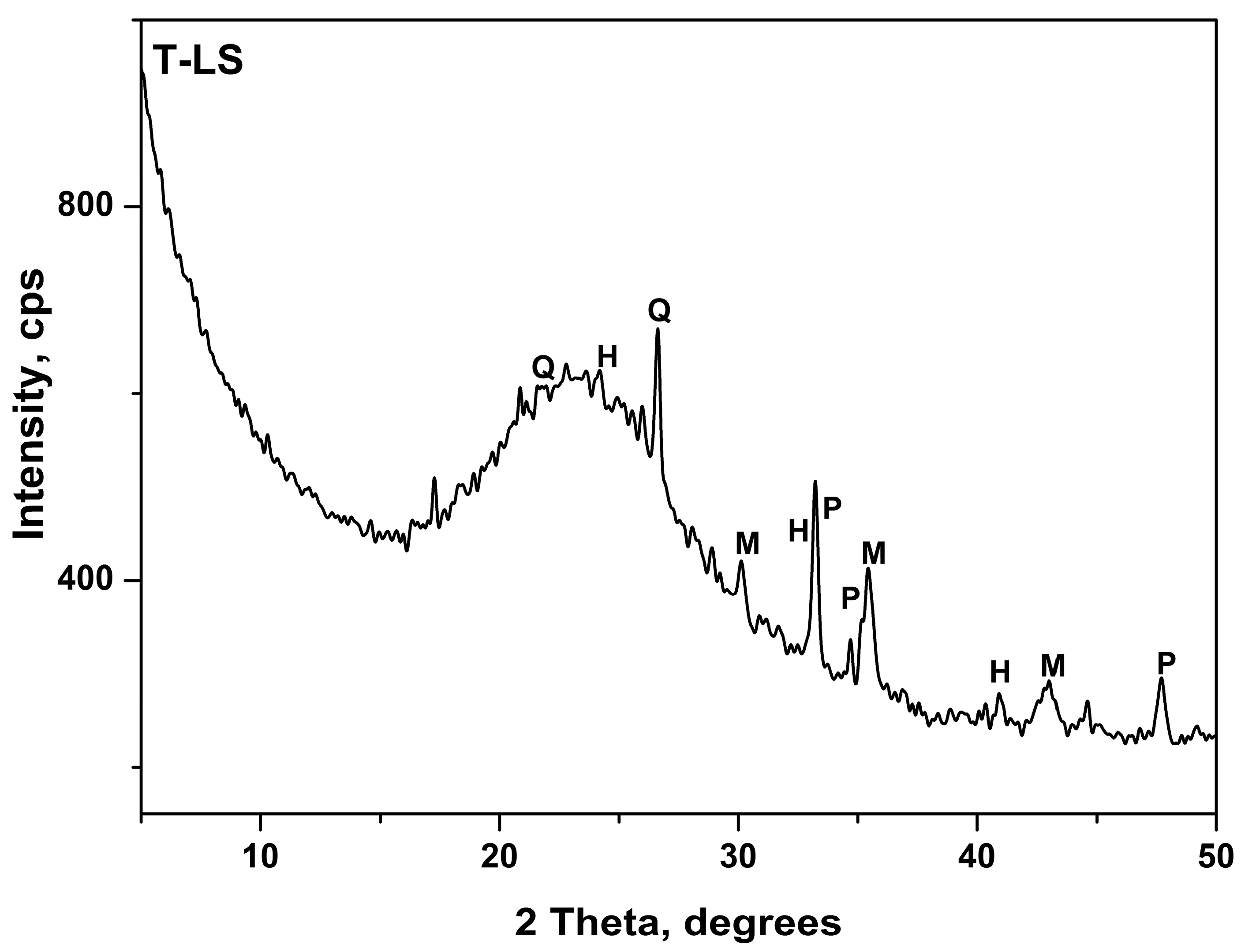
The powder X-ray diffraction (XRD) pattern of the T-LS, shown in Figure 1, reveals the presence of a broad diffuse halo centered around 2θ = 20–35°, characteristic of an amorphous siliceous phase. This feature indicates that the acid-leaching process effectively disrupted the crystalline structure of the original slag, transforming a substantial portion of the silicate phases into amorphous, highly reactive silica. The formation of this disordered phase is advantageous for subsequent zeolite synthesis, as amorphous silica readily dissolves under alkaline conditions to provide soluble silicate species necessary for zeolite nucleation and growth.
After acid treatment, minor crystalline phases such as magnetite, hematite, and perovskite-type calcium titanate are still detectable; however, their peaks are weak, and no firm conclusions regarding their stability can be drawn. The most significant features are the broad diffuse halo (2θ = 20–35°) indicating amorphous siliceous phase formation and the pronounced quartz peak, which are relevant for subsequent zeolite synthesis. (Figure 2). The persistence of these inert crystalline phases, although their diffraction peaks are weak, suggests that while acid treatment efficiently enriches the slag in amorphous silica, complete dissolution of mineral constituents is not achieved. Nonetheless, the resulting T-LS exhibits a favorable combination of amorphous and residual crystalline phases (mainly quartz) that can serve as both reactive and structurally stable components during zeolite formation.

3.2. Synthesis of Zeolite X

Two distinct synthesis routes were employed using acid-treated ladle slag (T-LS) as the silicon source, differing only in the aluminum precursor:
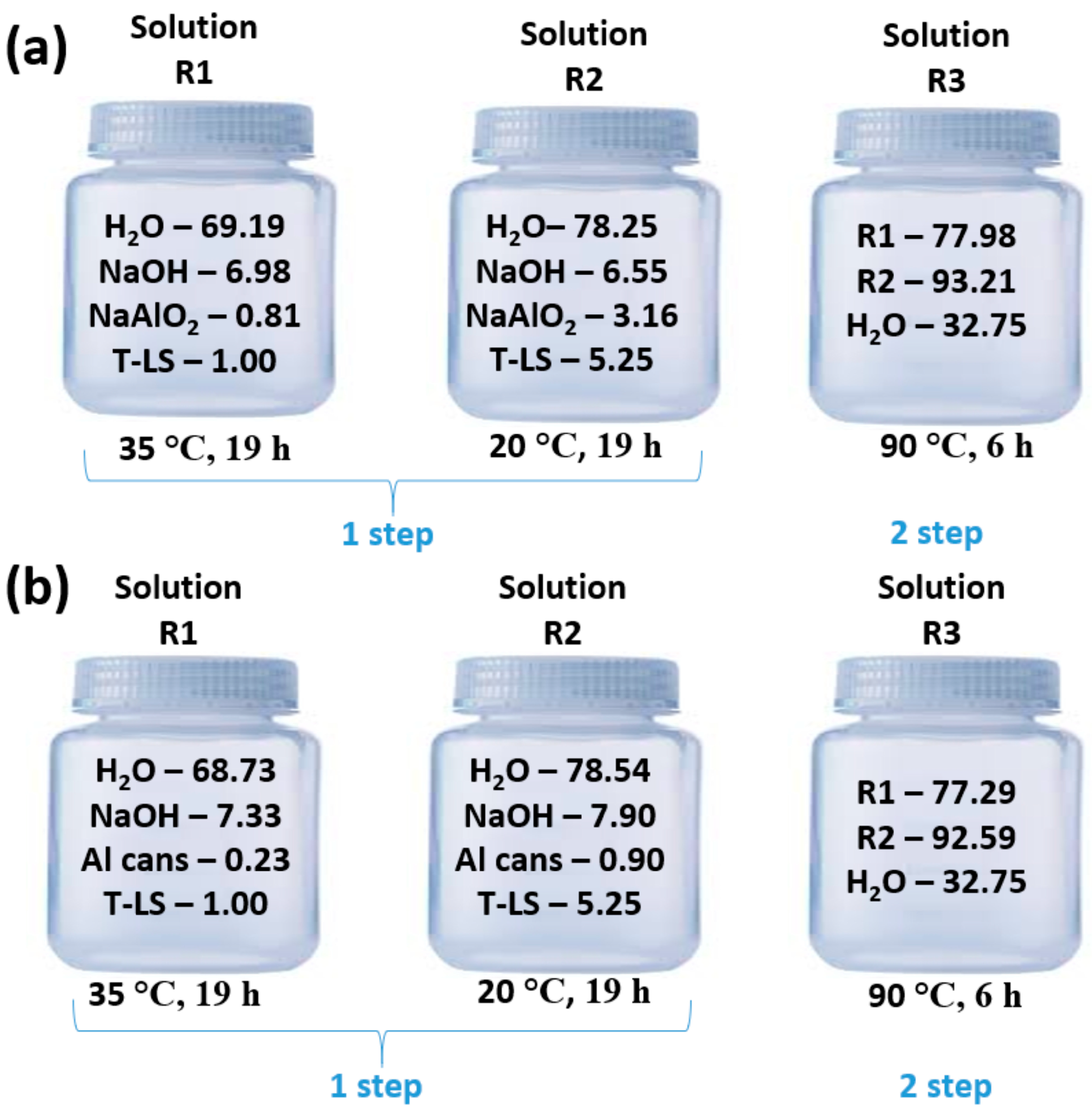
Synthesis Route 1: T-LS + Sodium Aluminate (NaAlO2) (Scheme 1a)
Solution R1 was prepared by dissolving 0.81 g NaAlO2 and 6.98 g NaOH in 69.19 mL distilled water with 1 g treated ladle slag (T-LS), and aged at 35 °C for 19 h. Solution R2 was prepared by combining 3.16 g NaAlO2, 6.55 g NaOH, 78.25 mL distilled water, and 5.15 g T-LS, and aged at room temperature for 19 h. Solutions R1 and R2 were then combined, 32.75 mL distilled water was added to form R3, and the final gel was hydrothermally crystallized at 90 °C for 6 h. Solution R1 was aged at 35 °C to accelerate aluminum dissolution and promote the formation of nuclei, while solution R2 was aged at room temperature to allow slow maturation of the gel. Preliminary experiments showed that simply mixing all reagents and hydrothermally treating them for 6 h at 90 °C resulted in NaX with lower crystallinity and a pronounced amorphous halo, indicating incomplete reaction of aluminosilicate phases. This two-stage aging strategy ensures the formation of well-crystallized NaX zeolite with minimal amorphous content, following a previously reported procedure [9]. Hydrothermal crystallization at 90 °C for 6 h was chosen based on conventional and validated synthesis protocols for FAU-type zeolites [27]. The solid product was cooled, filtered, washed until neutral pH, and dried at 90 °C for 1 h.
Synthesis Route 2: T-LS + Aluminum Cans (Scheme 1b)
Solution R1 was prepared by dissolving 0.231 g aluminum from beverage cans and 7.33 g NaOH in 68.73 mL distilled water with 1 g T-LS, and aged at 35 °C for 19 h. Solution R2 was prepared by mixing 0.9 g aluminum from cans, 7.90 g NaOH, 78.54 mL distilled water, and 5.25 g T-LS, and aged at room temperature for 19 h. Solutions R1 and R2 were combined, and 32.75 mL distilled water was added to form R3. The final gel was hydrothermally crystallized at 90 °C for 6 h. After hydrothermal crystallization, the solid products were recovered by vacuum filtration using a Büchner funnel. The solids were washed repeatedly with distilled water (approximately 10–15 mL per wash, ~10 washes) until the filtrate reached pH 8, and then dried at 90 °C for 1 h. Note: The only distinction between the two synthesis routes is the initial aluminum source; all other conditions, including the molar composition, aging, and hydrothermal treatment, were kept identical. Hydrothermal crystallization was carried out at 90 °C for 6 h, following established protocols for NaX zeolite [27,34,35]. This ensures complete crystallization while minimizing secondary phases.
The experimental yield of NaX was calculated as:
Yield (%) = (mexp/mtheor) × 100,
where mexp is the mass of the dried product, and mtheor is the theoretical mass of NaX calculated from the total Si and Al in the gel.
Aluminum cans: mexp = 1.47 g, mtheor ≈ 1.50; Yield ≈ 98%
Sodium aluminate: mexp = 1.266 g, mtheor ≈ 1.30; Yield ≈ 97%
This approach allowed us to directly compare conventional and waste-derived aluminum sources, revealing their effects on the crystallization process and the yield of NaX zeolite.

3.3. Microstructural Characterization of Zeolite X

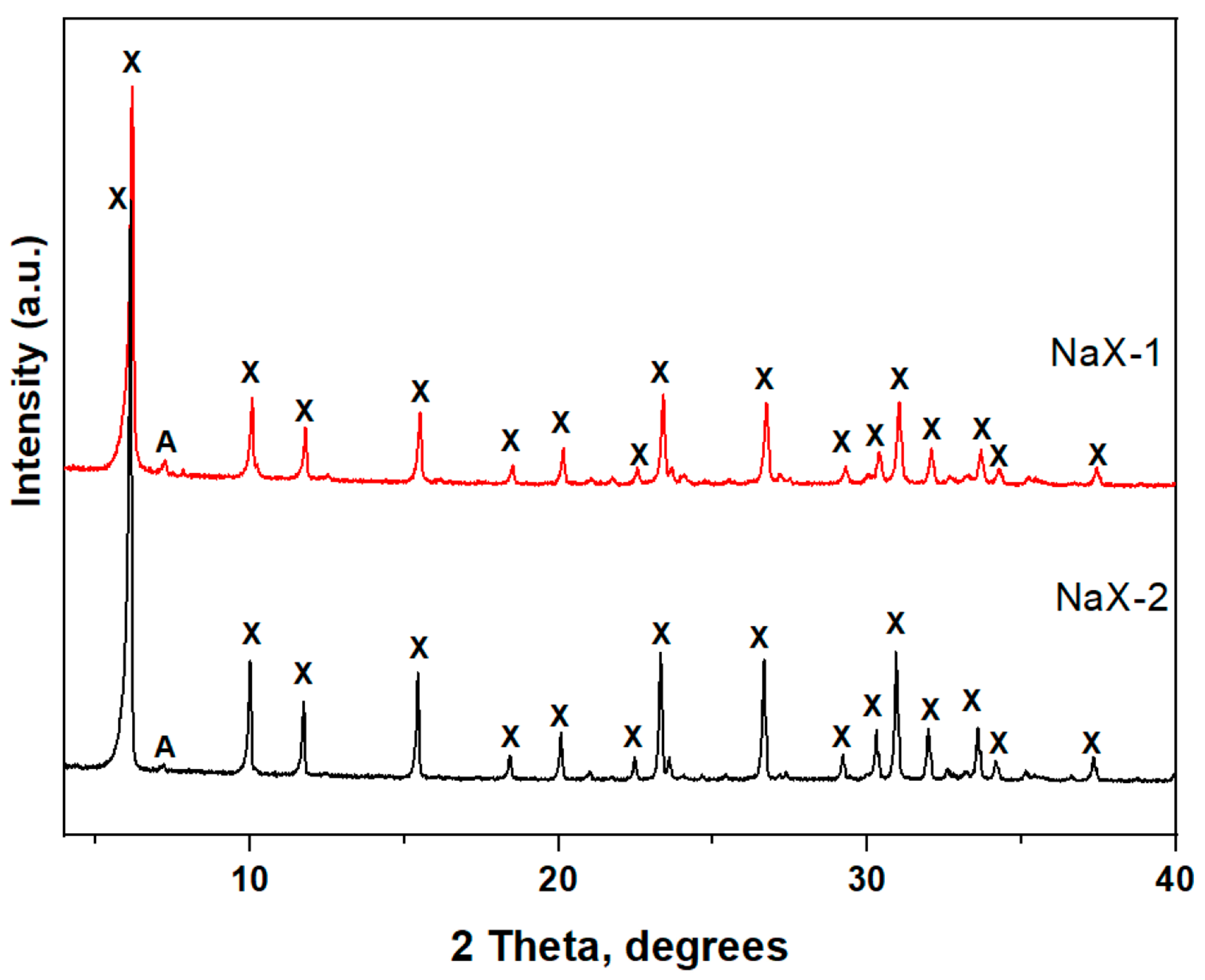
The XRD patterns of the synthesized zeolite samples indicate that both synthesis routes resulted predominantly in the formation of the FAU-type zeolite X phase. The diffraction peaks observed at 2θ ≈ 6.1°, 10.0°, 11.9°, 15.5°, 20.3°, 23.4°, 26.8°, 31.0° and 32.6° are characteristic of the FAU-type zeolite structure, consistent with the standard JCPDS card No. 01-074-1052, while minor reflections attributable to zeolite A were also detected. The relative crystallinity of the samples was semi-quantitatively assessed by comparing the intensity and sharpness of the characteristic NaX reflections at 2θ ≈ 6.1° (111), 15.3° (331), and 27.0° (642), which are typical for FAU-type zeolites.
In addition to the dominant FAU reflections, weak diffraction peaks corresponding to zeolite A (LTA-type) were also detected in both samples. These minor reflections, appearing near 2θ ≈ 7.2°, indicate the presence of a small amount of NaA phase co-crystallized together with NaX (Figure 3). The diffraction peaks observed in Figure 2 are in good agreement with the reference XRD pattern of FAU-type NaX reported in the IZA database [36]. All characteristic reflections of the FAU framework, including those at 2θ ≈ 6.1°, 10.0°, 11.9°, 15.5°, 20.3°, 23.4°, 26.8°, 31.0° and 32.6°, are well reproduced, confirming the successful formation of NaX zeolite. The formation of this secondary phase is common in zeolite synthesis systems with high alkalinity or slightly varying Si/Al ratios and may result from local inhomogeneities in the synthesis gel during hydrothermal crystallization.
The powder XRD and FTIR results indicate that both aluminum sources—recycled aluminum cans and sodium aluminate—produce predominantly FAU-type NaX zeolite, with only trace amounts of LTA-type NaA as a secondary phase. The minor presence of Fe and Ti does not significantly affect crystallinity, phase purity, or textural properties, as confirmed by XRD, FTIR, BET, and TGA analyses. All characteristic reflections and absorption bands of FAU-type zeolite are well reproduced, confirming successful formation of NaX. Apparent differences in peak intensities are observed, but no quantitative conclusions on crystallinity are drawn.
XRF analysis (Table 2) confirms that both zeolites possess similar oxide compositions, with SiO2/Al2O3 ratios of approximately 1.4, typical for FAU-type NaX. The Na2O content is slightly higher in the sample obtained from sodium aluminate (16.9 wt%) compared to that synthesized from aluminum cans (15.6 wt%), which may contribute to the enhanced crystallinity observed in the diffraction patterns. The Fe2O3 and TiO2 levels remain nearly constant in both samples, indicating that these elements originate mainly from the treated ladle slag.
The molar ratios reported in Table 2 were calculated from the XRF-determined oxide mass percentages by converting each oxide content into moles, considering the total mass of the obtained zeolite sample. The number of moles of each oxide (SiO2, Al2O3, Na2O) was calculated according to:
n = (w · mtotal)/M,
where w is the mass fraction of the oxide determined by XRF, mtotal is the total mass of the zeolite sample, and M is the molar mass of the corresponding oxide. The molar ratios were then obtained from the respective mole ratios of SiO2, Al2O3 and Na2O.
Overall, the structural and chemical analyses demonstrate that acid-treated ladle slag serves as an effective and reactive silicon source for NaX zeolite synthesis, while both aluminum cans and sodium aluminate act as efficient aluminum precursors. These results indicate that NaX zeolite synthesized from treated ladle slag maintains typical structural and functional properties despite minor residual impurities. The minor presence of the NaA phase does not significantly affect the overall crystallinity or phase purity of the final zeolite X products.
Based on the XRF oxide composition, the molar ratios of the synthesized NaX zeolites were calculated. The SiO2/Al2O3 molar ratios were 2.39 for NaX-1 and 2.29 for NaX-2, while the corresponding Na2O/Al2O3 ratios were 0.82 and 0.86, respectively (Table 3). These values are characteristic of FAU-type NaX zeolites and confirm that both synthesis routes resulted in Al-rich frameworks typical for zeolite X. Minor differences in Na2O and MgO contents are attributed to the different aluminum sources and the heterogeneous nature of the waste-derived raw materials. The difference in MgO content is related to the varying degrees of extraction of Mg-containing phases during acid treatment, as well as the different suspension stability of these phases during gel formation. Since Mg-silicates have low solubility under alkaline conditions, some remain inert and are incorporated into the final product to different extents. Such variations are typical when using waste-derived raw materials.
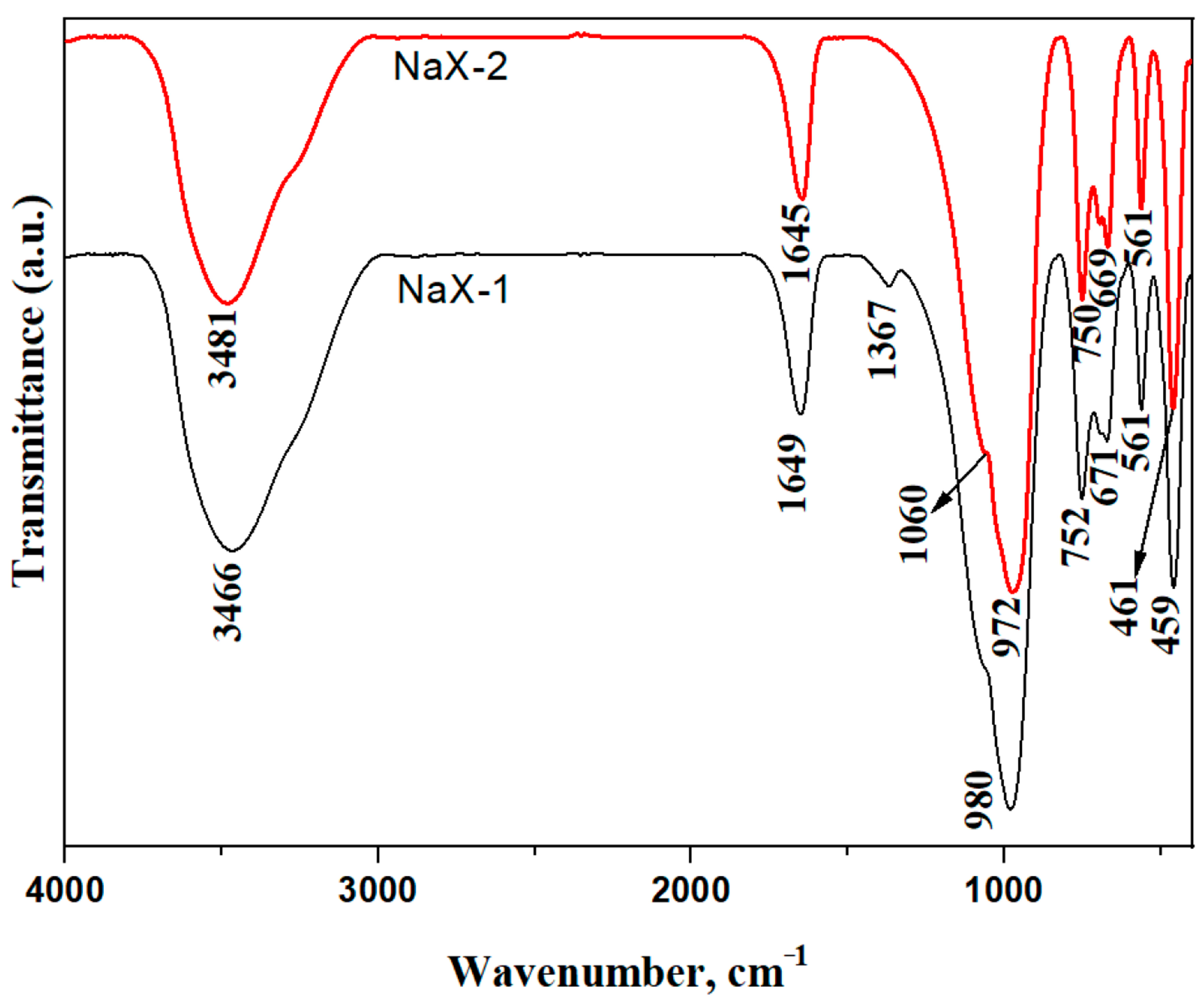
The FTIR spectra of the NaX zeolites synthesized from T-LS using sodium aluminate (NaX-2) and aluminum cans (NaX-1) are shown in Figure 4. Both samples exhibit all characteristic absorption bands of the FAU framework [29,30]. Broad O–H stretching bands at 3481–3466 cm−1 and H–O–H bending modes at 1645–1649 cm−1 confirm water within the zeolitic pores [34]. The asymmetric T–O–T stretching vibrations at 980–972 cm−1, symmetric O–T–O stretching bands at 752–750 cm−1, distorted tetrahedral linkages at 671–669 cm−1, double six-membered rings (D6R) at 561 cm−1, and T–O bending vibrations at 461–459 cm−1 are all consistent with the FAU-type framework [29,35]. These FTIR features correlate with the XRD reflections at 2θ ≈ 6.1°, 15.3°, and 27.0°, confirming that both aluminum sources yield structurally consistent NaX zeolite, while minor differences in band intensities reflect slight variations in crystallinity due to the nature of the aluminum precursor [37]. The assignment of the characteristic FTIR absorption bands and their corresponding vibrational modes and structural features is summarized in Table 4.
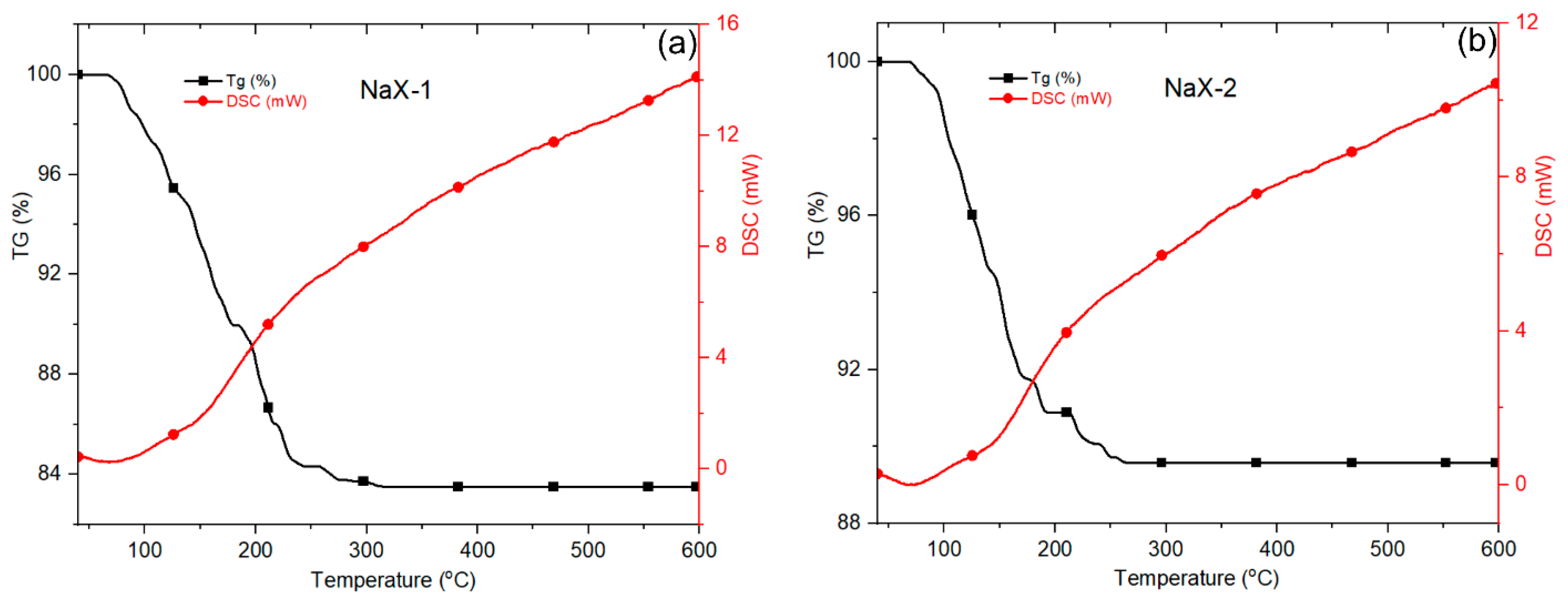
The TGA–DSC profiles of NaX-1 and NaX-2 (Figure 5) exhibit two main mass-loss regions typical for faujasite-type zeolites. The first major weight loss occurring between 25 and 200 °C is accompanied by a weak endothermic signal and corresponds to the removal of physisorbed and weakly bound water within the supercages. A second, more gradual mass-loss step between 200 and 350 °C is attributed to the release of more strongly bound water and partial dehydroxylation of the framework. Above 350 °C, no significant changes are observed, indicating high thermal stability of the zeolite structure up to 600 °C. NaX-1 exhibits a slightly higher total mass loss compared to NaX-2, suggesting a higher initial hydration level, while both samples display similar overall thermal behavior [38].
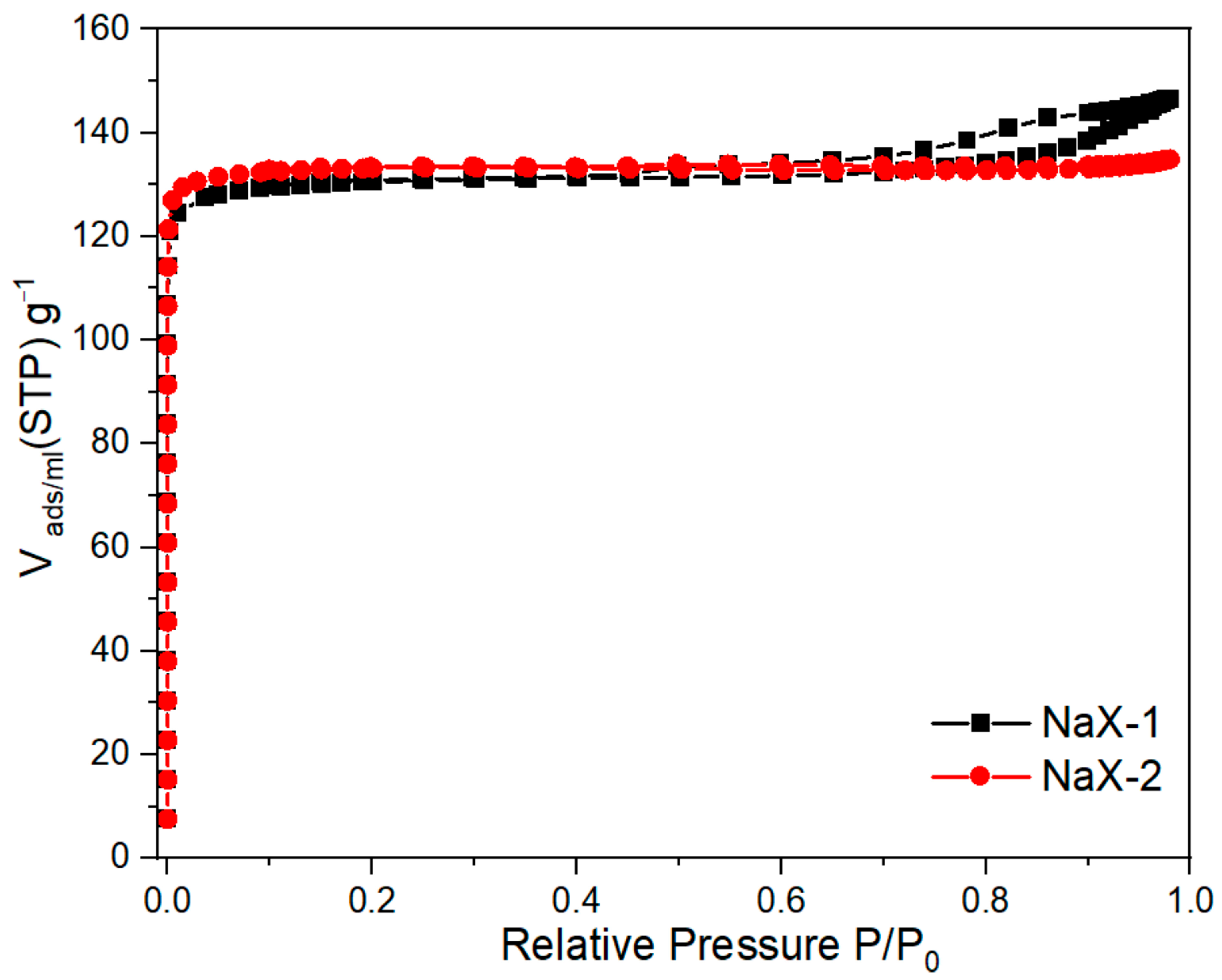
Based on the nitrogen adsorption–desorption isotherms, both NaX-1 and NaX-2 exhibit a Type I(b) isotherm according to the IUPAC [29] classification, which is characteristic of materials containing wider micropores (1–2.5 nm). The adsorption and desorption branches overlap without forming a hysteresis loop, indicating the absence of significant mesoporosity. This behavior is typical for faujasite-type zeolites dominated by microporous structures. The nitrogen physisorption analysis (BET method) revealed that both NaX-1 and NaX-2 samples possess high specific surface areas typical of microporous zeolitic materials. The measured BET surface areas were 410.99 m2·g−1 for NaX-1 and 417.87 m2·g−1 for NaX-2, indicating that the two samples exhibit very similar textural characteristics, with NaX-2 showing only a slightly higher surface area (Table 5). These values suggest that both materials maintain well-developed microporous frameworks. The total pore volumes of the samples were also comparable, measured at 0.22 cm3·g−1 for NaX-1 and 0.21 cm3·g−1 for NaX-2. This minor difference implies that the overall porosity of both samples is preserved, and no significant collapse or blockage of pores occurred during synthesis or treatment. Analysis of the average pore diameters demonstrated that both materials are predominantly microporous, with NaX-1 showing an average pore diameter of 2.1 nm and NaX-2 of 1.9 nm. These values fall within the upper range of micropores and the lower limit of mesopores, which is consistent with typical structural characteristics of faujasite-type zeolites. Overall, the BET results indicate that NaX-1 and NaX-2 exhibit nearly identical textural properties, with only slight variations that may result from minor differences in synthesis or post-synthesis treatment. Both samples maintain high surface areas and pore volumes, confirming their suitability for applications involving adsorption, catalysis, or ion exchange. The BET surface areas obtained for NaX-1 and NaX-2 (≈411–418 m2·g−1) are comparable to those reported in the literature for NaX zeolites synthesized from pure chemical reagents, where values typically range from ~400 to 750 m2·g−1, depending on synthesis conditions and post-treatment procedures.
Similar multi-step synthesis strategies involving separate gel aging stages have been widely reported for FAU-type zeolites, where extended aging times are employed to enhance nucleation control and crystallinity rather than to minimize synthesis duration [27,39]. Such approaches are particularly common when waste-derived or low-reactivity raw materials are used.
Overall, the structural, textural, and thermal properties of NaX-1 and NaX-2 synthesized from waste-derived precursors are fully comparable to those of NaX zeolites reported in the literature and synthesized from pure chemical reagents. Conventional NaX zeolites typically exhibit BET surface areas in the range of 400–750 m2·g−1, Type I microporous nitrogen adsorption isotherms (Figure 6), characteristic FAU-type XRD patterns, and thermal stability up to 600–700 °C [27,39]. The present samples fall well within these reported ranges, confirming that the use of ladle slag and aluminum waste does not compromise the intrinsic properties of FAU-type NaX.

4. Discussion

The present study demonstrates a sustainable hydrothermal route for synthesizing FAU-type zeolite X entirely from industrial and post-consumer wastes—acid-treated ladle slag (T-LS) as a silicon source and waste aluminum cans as an aluminum precursor. The approach aligns with current efforts to implement green and circular chemistry principles by transforming low-value residues into functional, high-value materials. Both synthesis routes, employing either dissolved aluminum cans or commercial sodium aluminate, yielded phase-pure FAU-type zeolite X with only minor LTA-type impurities. Powder XRD results showed characteristic reflections of NaX, and FTIR spectra confirmed the presence of framework-specific T–O–T (T = Si, Al) vibrations and double six-membered ring modes typical for faujasitic topology [40]. The SiO2/Al2O3 ratio of ~1.4, derived from the bulk analysis by XRF, corresponds to stoichiometries characteristic of NaX-type zeolite, consistent with literature data [41,42]. The slightly higher crystallinity observed in the NaAlO2-derived sample suggests that the purity of the aluminate precursor affects nucleation and growth kinetics.
Although the synthesis successfully yielded predominantly crystalline NaX zeolite, as confirmed by XRD analysis (Figure 2) and FTIR spectroscopy (Figure 3), minor reflections attributable to NaA were also detected. Nevertheless, the preparation of the precursor materials requires supplementary treatment stages and operational inputs. In particular, the acid activation of ladle slag using hydrochloric acid is essential for transforming into a reactive silicate source. The removal of calcium-bearing phases and enrichment of amorphous silica were confirmed by the presence of a broad diffuse feature in the XRD pattern within the 2θ range of 20–35°, characteristic of an amorphous siliceous phase [23], superimposed on the crystalline reflections of NaX. This transformation is essential for efficient dissolution under alkaline conditions, enabling the formation of soluble silicate species that participate in the nucleation of aluminosilicate gels. The residual crystalline phases—mainly quartz, magnetite, and calcium titanate—acted as inert fillers during hydrothermal treatment. Importantly, the acid-leaching step also generated a calcium chloride-rich effluent as a by-product. This solution, containing primarily soluble CaCl2 and minor FeCl3, has potential reuse as a de-icing or dust-suppressing agent in winter road maintenance [43], or carbon dioxide capture technologies [44]. Similarly, the dissolution of aluminum cans in NaOH also demonstrates dual benefits. Beyond producing soluble aluminate ions (Al(OH)4) that serve as essential framework-forming species in the zeolite synthesis, this reaction liberates molecular hydrogen as a valuable by-product. This enables renewable hydrogen production, which can be collected and reused as a clean energy carrier or fuel.
FAU-type zeolites produced from waste precursors retain the high cation exchange and adsorption capacities characteristic of NaX, enabling potential applications in environmental remediation, gas adsorption, CO2 sorption and catalysis [45]. For instance, such zeolites could be used: in wastewater purification for removing heavy metals or ammonium ions [46]; as antimicrobial agents [47]; in adsorption-based CO and CO2 capture processes [16,48]; catalysis by obtaining modification forms of various transition metals [9]. The integration of slag valorization, hydrogen generation, and zeolite production thus exemplifies a multi-output, zero-waste chemical process, turning linear waste streams into closed-loop systems.
The obtained results are in good agreement with previously reported studies on the synthesis of FAU-type NaX zeolite from waste-derived raw materials. Similar two-stage gel aging strategies combined with hydrothermal crystallization at moderate temperatures (80–100 °C) and short crystallization times (4–8 h) have been reported to promote controlled nucleation and enhanced crystallinity of NaX, particularly when low-reactivity or heterogeneous waste sources are employed [37,49,50]. Compared to conventional syntheses based on commercial sodium silicate and sodium aluminate, the present approach demonstrates that acid-treated ladle slag and waste aluminum sources can successfully serve as alternative precursors without significantly affecting the structural characteristics of the resulting NaX zeolite [14,51]. The formation of minor secondary phases, such as zeolite A, has also been observed in related waste-based synthesis systems and is commonly attributed to local compositional inhomogeneities or slight deviations in gel chemistry during aging and crystallization [52,53].
The formation of FAU-type NaX zeolite from acid-treated ladle slag and aluminum sources involves a controlled nucleation and crystallization process. Soluble silicate species released from the acid-activated slag and aluminate ions derived either from dissolved aluminum cans or sodium aluminate interact under alkaline conditions to form aluminosilicate gels, which subsequently undergo hydrothermal crystallization into the FAU framework. The minor presence of LTA-type NaA is most likely caused by local variations in the Si/Al ratio during gel mixing and aging, leading to localized deviations in framework topology. Impurities such as Fe2O3, TiO2, and MgO are largely inert under the applied hydrothermal conditions; they may act as fillers or heterogeneous nucleation sites, thereby subtly influencing crystallization kinetics without suppressing FAU-type phase formation. Similar observations have been reported in previous studies on NaX synthesis from waste-derived raw materials. Compared to conventional one-step approaches, the present two-stage aging strategy (R1 at 35 °C and R2 at room temperature) enables improved control over nucleation and gel maturation, resulting in well-crystallized NaX even when heterogeneous waste precursors are used [14,37,51,53,54]. NaX zeolite formation from acid-treated ladle slag and aluminum waste involves the release of soluble silicate and aluminate species, followed by gel formation, nucleation, and crystal growth. The two-stage aging strategy (R1 at 35 °C, R2 at room temperature) promotes controlled nucleation and gel maturation, leading to the successful crystallization of zeolite X. Minor impurities (Fe2O3, TiO2, MgO) are mostly inert and may slightly affect nucleation, while occasional NaA formation arises from local Si/Al ratio variations. This mechanism aligns with previous studies on zeolite synthesis from metallurgical wastes [37,55].
Thermodynamically, the formation of NaX zeolite from soluble silicate and aluminate species is favorable under alkaline hydrothermal conditions, as the nucleation and growth of the FAU framework lead to a decrease in Gibbs free energy [56,57]. The controlled two-stage aging (R1 at 35 °C, R2 at room temperature) moderates the kinetics of nucleation and crystal growth, preventing rapid precipitation and ensuring uniform gel maturation [37]. This balance between thermodynamic driving force and kinetic control facilitates the formation of well-defined FAU-type zeolite X, while minor NaA impurities arise from local deviations in Si/Al ratios [52,53]. Impurities such as Fe2O3, TiO2, and MgO remain largely inert, subtly influencing nucleation sites without hindering crystallization [14,40,51,53].
Given their high microporous surface area, preserved FAU-type framework, appropriate Si/Al ratios, and good thermal stability, the synthesized NaX zeolites are suitable for applications in which conventional NaX is commonly employed, including adsorption, ion exchange, and catalysis [58].

5. Conclusions

This study demonstrates the successful synthesis of FAU-type NaX zeolite entirely from industrial and post-consumer waste. Acid-treated ladle slag was used as a silicon source, while aluminum was supplied either from recycled beverage cans or commercial sodium aluminate. After hydrochloric acid treatment, the slag primarily provides amorphous silica suitable for hydrothermal crystallization.
Both synthesis routes resulted in predominantly FAU-type NaX with only minor LTA-type (NaA) impurities. Structural characterization by XRD and FTIR confirmed the integrity of the FAU framework, and XRF analysis indicated Si/Al ratios consistent with NaX stoichiometry. The use of aluminum from waste cans allowed for the successful synthesis of NaX without loss of phase purity.
These results highlight that FAU-type NaX can be effectively produced from acid-treated ladle slag and aluminum cans, providing a feasible route to obtain functional zeolite materials for potential applications in catalysis, adsorption, and water purification.

Author Contributions

Conceptualization, B.B. and A.N.; methodology B.B., L.T. and A.N.; validation, L.T. and A.N.; formal analysis, B.B. and A.N.; investigation, B.B. and A.N.; data curation, B.B., H.L. and A.N.; writing—original draft preparation, B.B.; writing—review and editing, L.T., H.L. and A.N.; visualization, B.B. and A.N.; project administration, B.B. and A.N.; funding acquisition, A.N. and H.L. All authors have read and agreed to the published version of the manuscript.

Funding

This research received no external funding.

Institutional Review Board Statement

Not applicable.

Informed Consent Statement

Not applicable.

Data Availability Statement

The original contributions presented in this study are included in the article. Further inquiries can be directed to the corresponding authors.

Acknowledgments

We would like to express our gratitude to programme “Research, Innovation and Digitalisation for Smart Transformation” 2021–2027, funded by the European Union, Project BG16RFPR002-1.014-0007 “Center for Competence “PERIMED-2” for supporting this article.

Conflicts of Interest

The authors declare no conflicts of interest.

Abbreviations

The following abbreviations are used in this manuscript:
LSLadle slag
T-LSTreated Ladle Slag

References

  1. Davis, M.E. Ordered porous materials for emerging applications. Nature 2002, 417, 813–821. [Google Scholar] [CrossRef] [PubMed]
  2. Asgar Pour, Z.; Abu Zeitoun, E.; Alassmy, Y.A.; El Hariri El Nokab, M.; Van Steenberge, P.H.M.; Sebakhy, K.O. Impact of Synthesis Parameters on the Crystallinity of Macroscopic Zeolite Y Spheres Shaped Using Resin Hard Templates. Crystals 2024, 14, 1051. [Google Scholar] [CrossRef]
  3. Breck, D.W. Zeolite Molecular Sieves: Structure, Chemistry, and Use; Wiley: Hoboken, NJ, USA, 1974. [Google Scholar]
  4. Kazemian, H.; Gedik, K.; İmamoğlu, İ. Environmental applications of natural zeolites. In Handbook of Natural Zeolites; Bentham Science Publishers: Boston, MA, USA, 2012; pp. 473–508. [Google Scholar][Green Version]
  5. Weitkamp, J. Zeolites and catalysis. Solid State Ion. 2000, 131, 175–188. [Google Scholar] [CrossRef]
  6. Frising, T.; Leflaive, P. Extraframework cation distributions in X and Y faujasite zeolites: A review. Microporous Mesoporous Mater. 2008, 114, 27–63. [Google Scholar] [CrossRef]
  7. Li, Y.; Li, L.; Yu, J. Applications of zeolites in sustainable chemistry. Chem 2017, 3, 928–949. [Google Scholar] [CrossRef]
  8. Boycheva, S.; Zgureva, D.; Barbov, B.; Kalvachev, Y. Synthetic micro-and nanocrystalline zeolites for environmental protection systems. In Nanoscience Advances in CBRN Agents Detection, Information and Energy Security; Springer: Berlin/Heidelberg, Germany, 2014; pp. 443–450. [Google Scholar]
  9. Barbov, B.; Zaharieva, K.; Karakashkova, P.; Penchev, H.; Tsvetanova, L.; Dimova, S. Preparation and Catalytic Study of Mn-NaX, Cu-NaX and Ag-/AgNPs-NaX Zeolites. Eng. Proc. 2023, 37, 20. [Google Scholar]
  10. Li, J.; Gao, M.; Yan, W.; Yu, J. Regulation of the Si/Al ratios and Al distributions of zeolites and their impact on properties. Chem. Sci. 2023, 14, 1935–1959. [Google Scholar] [CrossRef]
  11. Deneyer, A.; Ke, Q.; Devos, J.; Dusselier, M. Zeolite synthesis under nonconventional conditions: Reagents, reactors, and modi operandi. Chem. Mater. 2020, 32, 4884–4919. [Google Scholar] [CrossRef]
  12. Yoldi, M.; Fuentes-Ordoñez, E.; Korili, S.; Gil, A. Zeolite synthesis from industrial wastes. Microporous Mesoporous Mater. 2019, 287, 183–191. [Google Scholar] [CrossRef]
  13. Mallapur, V.P.; Oubagaranadin, J.U.K. A brief review on the synthesis of zeolites from hazardous wastes. Trans. Indian Ceram. Soc. 2017, 76, 1–13. [Google Scholar] [CrossRef]
  14. Murayama, N.; Yamamoto, H.; Shibata, J. Mechanism of zeolite synthesis from coal fly ash by alkali hydrothermal reaction. Int. J. Miner. Process. 2002, 64, 1–17. [Google Scholar] [CrossRef]
  15. Querol, X.; Plana, F.; Alastuey, A.; López-Soler, A. Synthesis of Na-zeolites from fly ash. Fuel 1997, 76, 793–799. [Google Scholar] [CrossRef]
  16. Todorova, S.; Barbov, B.; Todorova, T.; Kolev, H.; Ivanova, I.; Shopska, M.; Kalvachev, Y. CO oxidation over Pt-modified fly ash zeolite X. React. Kinet. Mech. Catal. 2020, 129, 773–786. [Google Scholar] [CrossRef]
  17. Stanimirova, T.; Kirov, G. Modification of zeolite Na-X, sodalite and cancrinite in salt melts. Geol. Balc. 2023, 52, 41–49. [Google Scholar] [CrossRef]
  18. Huo, M.; Wang, Y.; Ding, D.; Guo, Y.; Ma, Z.; Yan, K.; Gao, J.-M. Zeolite functional materials synthesized from coal gangue. J. Mater. Sci. 2025, 60, 20986–21011. [Google Scholar] [CrossRef]
  19. Tran-Nguyen, P.L.; Ly, K.-P.; Thanh, L.H.V.; Angkawijaya, A.E.; Santoso, S.P.; Tran, N.-P.-D.; Tsai, M.-L.; Ju, Y.-H. Facile synthesis of zeolite NaX using rice husk ash without pretreatment. J. Taiwan Inst. Chem. Eng. 2021, 123, 338–345. [Google Scholar] [CrossRef]
  20. Yoldi, M.; Fuentes-Ordoñez, E.; Korili, S.; Gil, A. Zeolite synthesis from aluminum saline slag waste. Powder Technol. 2020, 366, 175–184. [Google Scholar] [CrossRef]
  21. Chen, D.; Hu, X.; Shi, L.; Cui, Q.; Wang, H.; Yao, H. Synthesis and characterization of zeolite X from lithium slag. Appl. Clay Sci. 2012, 59, 148–151. [Google Scholar] [CrossRef]
  22. Li, Y.; Peng, T.; Man, W.; Ju, L.; Zheng, F.; Zhang, M.; Guo, M. Hydrothermal synthesis of mixtures of NaA zeolite and sodalite from Ti-bearing electric arc furnace slag. RSC Adv. 2016, 6, 8358–8366. [Google Scholar] [CrossRef]
  23. Nyembe, N.; Isa, Y.M. Acid leaching of blast furnace slag for enhanced zeolite synthesis. Clean. Waste Syst. 2025, 10, 100207. [Google Scholar] [CrossRef]
  24. Hollman, G.; Steenbruggen, G.; Janssen-Jurkovičová, M. A two-step process for the synthesis of zeolites from coal fly ash. Fuel 1999, 78, 1225–1230. [Google Scholar] [CrossRef]
  25. Grela, A.; Łach, M.; Mierzwiński, D.; Bajda, T.; Mikuła, J. Obtaining zeolites from slags and ashes from a waste combustion plant in an autoclave process. In Proceedings of the E3S Web of Conferences; EDP Sciences: London, UK, 2017; p. 00026. [Google Scholar]
  26. Nikolov, A.; Kostov, V.; Petrova, N.; Tsvetanova, L.; Vassilev, S.V.; Titorenkova, R. Sunflower Shells Biomass Fly Ash as Alternative Alkali Activator for One-Part Cement Based on Ladle Slag. Ceramics 2025, 8, 79. [Google Scholar] [CrossRef]
  27. Mintova, S.; Gilson, J.-P.; Valtchev, V. Advances in nanosized zeolites. Nanoscale 2013, 5, 6693–6703. [Google Scholar] [CrossRef]
  28. Brunauer, S.; Emmett, P.H.; Teller, E. Adsorption of gases in multimolecular layers. J. Am. Chem. Soc. 1938, 60, 309–319. [Google Scholar] [CrossRef]
  29. Sing, K.S. Reporting physisorption data for gas/solid systems with special reference to the determination of surface area and porosity (Recommendations 1984). Pure Appl. Chem. 1985, 57, 603–619. [Google Scholar] [CrossRef]
  30. Lippens, B.C.; De Boer, J. Studies on pore systems in catalysts: V. T method. J. Catal. 1965, 4, 319–323. [Google Scholar] [CrossRef]
  31. Kowalczyk, P.; Terzyk, A.P.; Gauden, P.A.; Solarz, L. Numerical analysis of Horvath–Kawazoe equation. Comput. Chem. 2002, 26, 125–130. [Google Scholar] [CrossRef] [PubMed]
  32. Barrett, E.P.; Joyner, L.G.; Halenda, P.P. The determination of pore volume and area distributions in porous substances. I. Computations from nitrogen isotherms. J. Am. Chem. Soc. 1951, 73, 373–380. [Google Scholar] [CrossRef]
  33. Shi, C.; Qian, J. High performance cementing materials from industrial slags—A review. Resour. Conserv. Recycl. 2000, 29, 195–207. [Google Scholar] [CrossRef]
  34. Shen, S.-h.; Zhang, S.-g.; Wang, D.-w.; Fang, K.-m. Hydrothermal preparation and crystal habit of X-zeolite powder. J. Cent. South Univ. Technol. 2005, 12, 315–319. [Google Scholar] [CrossRef]
  35. Dhainaut, J.; Daou, T.; Chappaz, A.; Bats, N.; Harbuzaru, B.; Lapisardi, G.; Chaumeil, H.; Defoin, A.; Rouleau, L.; Patarin, J. Synthesis of FAU and EMT-type zeolites using structure-directing agents specifically designed by molecular modelling. Microporous Mesoporous Mater. 2013, 174, 117–125. [Google Scholar] [CrossRef]
  36. Mintova, S. Verified Syntheses of Zeolitic Materials; Synthesis Commission of the International Zeolite Association: Caen, France, 2016. [Google Scholar]
  37. Mintova, S.; Olson, N.H.; Valtchev, V.; Bein, T. Mechanism of zeolite A nanocrystal growth from colloids at room temperature. Science 1999, 283, 958–960. [Google Scholar] [CrossRef]
  38. Giroux, M.; Sahadeo, E.; Libera, R.; Maurizi, A.; Giles, I.; Marteel-Parrish, A. An undergraduate research experience: Synthesis, modification, and comparison of hydrophobicity of zeolites A and X. Polyhedron 2016, 114, 42–52. [Google Scholar] [CrossRef]
  39. Cundy, C.S.; Cox, P.A. The hydrothermal synthesis of zeolites: Precursors, intermediates and reaction mechanism. Microporous Mesoporous Mater. 2005, 82, 1–78. [Google Scholar] [CrossRef]
  40. Zhang, W.; Zhang, T.; Lv, Y.; Jing, T.; Gao, X.; Gu, Z.; Li, S.; Ao, H.; Fang, D. Recent progress on the synthesis and applications of zeolites from industrial solid wastes. Catalysts 2024, 14, 734. [Google Scholar] [CrossRef]
  41. Garcia, G.; Cabrera, S.; Hedlund, J.; Mouzon, J. Selective synthesis of FAU-type zeolites. J. Cryst. Growth 2018, 489, 36–41. [Google Scholar] [CrossRef]
  42. Reiprich, B.; Weissenberger, T.; Schwieger, W.; Inayat, A. Layer-like FAU-type zeolites: A comparative view on different preparation routes. Front. Chem. Sci. Eng. 2020, 14, 127–142. [Google Scholar] [CrossRef]
  43. Moogooee, M.T. Chloride Binding and Desorption Mechanism in Blended Cement Containing Supplementary Cementitious Materials Exposed to De-icing Brine Solutions. Doctoral Dissertation, Colorado State University, Fort Collins, CO, USA, 2024. [Google Scholar]
  44. Kunzler, C.; Alves, N.; Pereira, E.; Nienczewski, J.; Ligabue, R.; Einloft, S.; Dullius, J. CO2 storage with indirect carbonation using industrial waste. Energy Procedia 2011, 4, 1010–1017. [Google Scholar] [CrossRef]
  45. Mgbemere, H.; Ekpe, I.; Lawal, G. Zeolite synthesis, characterization and application areas: A review. Int. Res. J. Environ. Sci. 2017, 6, 45–59. [Google Scholar]
  46. Ezzeddine, Z.; Batonneau-Gener, I.; Pouilloux, Y.; Hamad, H.; Saad, Z. Synthetic nax zeolite as a very efficient heavy metals sorbent in batch and dynamic conditions. Colloids Interfaces 2018, 2, 22. [Google Scholar] [CrossRef]
  47. Pavlova, E.L.; Nenova, E.P.; Yocheva, L.D.; Ivanova, I.A.; Georgiev, P.A. Antimicrobial and oxidative activities of different levels of silver-exchanged zeolites X and ZSM-5 and their ecotoxicity. Pharmaceuticals 2024, 17, 1586. [Google Scholar] [CrossRef]
  48. Krachuamram, S.; Chanapattharapol, K.C.; Kamonsutthipaijit, N. Synthesis and characterization of NaX-type zeolites prepared by different silica and alumina sources and their CO2 adsorption properties. Microporous Mesoporous Mater. 2021, 310, 110632. [Google Scholar] [CrossRef]
  49. Cundy, C.S.; Cox, P.A. The Hydrothermal Synthesis of Zeolites:  History and Development from the Earliest Days to the Present Time. Chem. Rev. 2003, 103, 663–702. [Google Scholar] [CrossRef]
  50. Encyclopædia Britannica, Inc. Leaf-nosed bat. In Encyclopædia Britannica; Encyclopædia Britannica, Inc.: Chicago, IL, USA, 2009. [Google Scholar]
  51. Querol, X.; Moreno, N.; Umaña, J.t.; Alastuey, A.; Hernández, E.; Lopez-Soler, A.; Plana, F. Synthesis of zeolites from coal fly ash: An overview. Int. J. Coal Geol. 2002, 50, 413–423. [Google Scholar] [CrossRef]
  52. Barrer, R. Occurrence, classification and some properties of zeolites. In Hydrothermal Chemistry of Zeolites; Academic Press: London, UK, 1982; pp. 1–42. [Google Scholar]
  53. Hui, K.; Chao, C.Y.H.; Kot, S. Removal of mixed heavy metal ions in wastewater by zeolite 4A and residual products from recycled coal fly ash. J. Hazard. Mater. 2005, 127, 89–101. [Google Scholar] [CrossRef]
  54. Hui, K.; Chao, C.Y.H. Effects of step-change of synthesis temperature on synthesis of zeolite 4A from coal fly ash. Microporous Mesoporous Mater. 2006, 88, 145–151. [Google Scholar] [CrossRef]
  55. Kovo, A.S.; Hernandez, O.; Holmes, S. Synthesis and characterization of zeolite Y and ZSM-5 from Nigerian Ahoko Kaolin using a novel, lower temperature, metakaolinization technique. J. Mater. Chem. 2009, 19, 6207–6212. [Google Scholar] [CrossRef]
  56. Chen, X.; Getman, R.B. The significant differences in solvation thermodynamics of C1–C3 oxygenates in hydrophilic versus hydrophobic pores of a hydrophilic Ti-FAU zeolite model. J. Phys. Chem. C 2024, 128, 19367–19379. [Google Scholar] [CrossRef]
  57. Liu, P.; Zhang, J.; Peng, S.; Liu, W.; Mei, D. Understanding the hydrocracking of polycyclic aromatic hydrocarbons within FAU zeolites: Hydrogen splitting catalyzed by the frustrated Lewis pair. J. Phys. Chem. C 2023, 127, 8083–8095. [Google Scholar] [CrossRef]
  58. Cejka, J.; Corma, A.; Zones, S. Zeolites and Catalysis: Synthesis, Reactions and Applications; John Wiley & Sons: Hoboken, NJ, USA, 2010. [Google Scholar]
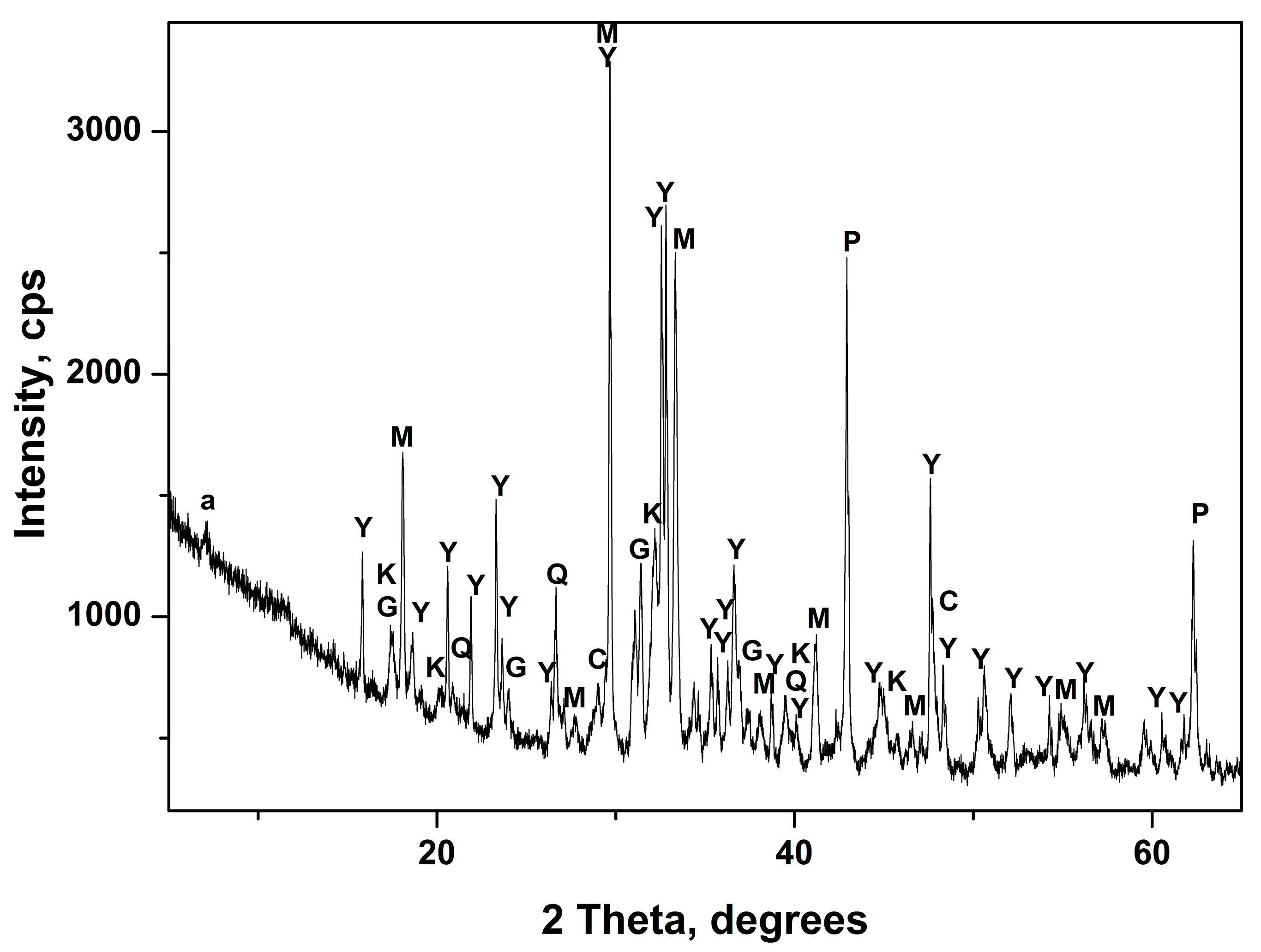
Figure 1. Powder XRD of the ladle slag (LS). Legend: a—strätlingite, C—calcite, G—gehlenite, K—katoite, P—periclase, Q—quartz, M—mayenite, γ—γ-belite (Ca2SiO4).
Appliedchem 06 00012 g001
Figure 2. Powder XRD of the treated ladle slag (T-LS). Legend: Q—quartz, H—hematite, M—magnetite, P—perovskite (CaTiO3).
Appliedchem 06 00012 g002
Scheme 1. Schematic illustration of the synthesis steps for FAU-type zeolite X from treated ladle slag (T-LS) using (a) sodium aluminate and (b) aluminum derived from beverage cans, followed by hydrothermal crystallization at 90 °C for 6 h.
Appliedchem 06 00012 sch001
Figure 3. X-ray diffraction (XRD) patterns of the synthesized zeolite samples obtained from acid-treated ladle slag using (NaX-1) waste aluminum cans and (NaX-2) commercial sodium aluminate as aluminum sources. The characteristic reflections of FAU-type NaX are marked with X, while minor LTA-type NaA reflections are indicated with A. The reference pattern corresponds to FAU-type NaX (ICDD/JCPDS card No. 01-074-1052).
Appliedchem 06 00012 g003
Figure 4. FTIR spectra of NaX zeolites synthesized from treated ladle slag using (NaX-2) sodium aluminate and (NaX-2) aluminum cans as aluminum sources. Characteristic absorption bands of the FAU framework are indicated.
Appliedchem 06 00012 g004
Figure 5. DTA-TGA of (a) NaX-1 and (b) NaX-2.
Appliedchem 06 00012 g005
Figure 6. N2-BET isotherms of the NaX-1 and NaX-2.
Appliedchem 06 00012 g006
Table 1. Chemical composition of ladle slag (LS) and treated ladle slag (T-LS) (wt%).
SiO2Al2O3Fe2O3CaOMgOK2OSO3TiO2Other
LS12.2013.752.7761.015.560.093.120.870.63
T-LS83.003.782.411.540.820.143.413.431.47
Table 2. Chemical composition (wt%) and calculated molar ratios of NaX-1 and NaX-2 zeolites determined from XRF data. Molar ratios were calculated from oxide mass percentages determined by XRF, considering the total mass of the obtained zeolite sample.
SampleSiO2Al2O3Na2OCaOMgOK2OSO3TiO2Fe2O3Other
NaX-144.331.415.61.182.490.110.072.561.830.46
NaX-243.932.516.91.140.5540.0950.0762.441.830.565
Table 3. Oxide composition and calculated molar ratios of synthesized NaX zeolites.
SampleSiO2/Al2O3 (mol)Na2O/Al2O3 (mol)
NaX-1 (Al cans)2.390.82
NaX-2 (NaAlO2)2.290.86
Table 4. Assignment of FTIR absorption bands and corresponding structural features of FAU-type NaX zeolite.
Wave Number (cm −1)Vibration Type/
Assignment
Structural Interpretation
3481/3466O–H stretching vibrations (adsorbed H2O)Broad band associated with hydrogen-bonded water molecules in zeolitic pores
1645/1649H–O–H bending vibrations (adsorbed H2O)Confirms the presence of water molecules within the zeolite channels
980/972Asymmetric T–O–T stretching vibrations (T = Si, Al)Framework vibrations characteristic of FAU-type aluminosilicates
752/750Symmetric T–O stretching vibrationsVibrations associated with tetrahedral units of the aluminosilicate framework
671/669Distorted T–O–T vibrationsIndicative of framework deformation and tetrahedral linkage distortion
561Double six-membered ring (D6R) vibrationsDiagnostic band of FAU-type zeolite, confirming NaX framework formation
461/459T–O bending vibrationsLow-frequency bending modes of the aluminosilicate framework
3481/3466O–H stretching vibrations (adsorbed H2O)Broad band associated with hydrogen-bonded water molecules in zeolitic pores
Table 5. Textural parameters for NaX-1 and NaX-2 as deduced from Nitrogen adsorption isotherms.
SamplesSBET
m2·g−1
Vt
cm3·g−1
Average Pore Diameter
nm
NaX-1410.990.222.1
NaX-2417.870.211.9
Disclaimer/Publisher’s Note: The statements, opinions and data contained in all publications are solely those of the individual author(s) and contributor(s) and not of MDPI and/or the editor(s). MDPI and/or the editor(s) disclaim responsibility for any injury to people or property resulting from any ideas, methods, instructions or products referred to in the content.