Review

Bioenergetic Profiling in Exercise: Methods, Limitations and Practical Applications—A Narrative Review


by
Manoel J. Rios
1,2,*,
David B. Pyne
3 and
Ricardo J. Fernandes
2
1
Piaget Research Center for Ecological Human Development, Higher School of Sport and Education, Jean Piaget Polytechnic Institute of the North, 4405-678 Vila Nova de Gaia, Portugal
2
Centre of Research, Education, Innovation and Intervention in Sport and Porto Biomechanics Laboratory, Faculty of Sport, University of Porto, 4200-450 Porto, Portugal
3
Research Institute for Sport & Exercise, University of Canberra, Canberra 2617, Australia
*
Author to whom correspondence should be addressed.
Physiologia 2026, 6(1), 19; https://doi.org/10.3390/physiologia6010019
Submission received: 10 February 2026 / Revised: 1 March 2026 / Accepted: 6 March 2026 / Published: 6 March 2026
(This article belongs to the Special Issue Exercise Physiology and Biochemistry: 3rd Edition)

Abstract

Quantifying oxidative, glycolytic, and phosphagen energy system contributions during exercise is challenging due to their simultaneous activation and reliance on indirect estimation. This narrative review critically examines the methodological foundations, assumptions, and practical implications of current approaches used to estimate energy system contributions during continuous and intermittent exercise, with the aim of clarifying how these methods shape the interpretation of bioenergetic responses. Oxidative contribution, primarily estimated through oxygen uptake (VO2) integration, typically exceeds (~75–88%) in continuous efforts longer than 6 min and can reach values above ~87% when exercise duration allows full development of VO2 kinetics, particularly in trained young adult cohorts. In contrast, supramaximal efforts shorter than 30–90 s involve markedly lower oxidative contribution, commonly below ~50% and as low as ~8–19%. Glycolytic contribution is inferred from net blood lactate concentration accumulation and increases with exercise intensity, ranging from ~3–5% in longer severe-intensity efforts to values up to ~60% during brief maximal tasks lasting 15–30 s. Phosphagen contribution is estimated using the fast component of post-exercise VO2 recovery or theoretical phosphocreatine breakdown models, and can reach ~39–48% in maximal efforts lasting 10–15 s, while declining to values below ~10% in prolonged exercise. Each method is shaped by exercise duration, intensity, structural format, and physiological assumptions, contributing to methodological heterogeneity and limiting direct comparability between studies. Advances in portable gas analyzers, near-infrared spectroscopy, and biosensing technologies have improved temporal resolution and ecological validity. To enhance the accuracy and practical application of energy system profiling, standardized and integrative frameworks are urgently required.

1. Introduction

Understanding the bioenergetic basis of muscular work is central to exercise physiology, since sustained muscle contractions depend on the continuous resynthesis of adenosine triphosphate (ATP) [1,2,3]. This process is supported by the integrated contribution of three metabolic pathways: phosphagen, glycolytic, and oxidative [1,4]. These pathways operate simultaneously but contribute to ATP turnover to varying degrees, depending on exercise intensity, duration, and mechanical demands [1,5]. Accurately quantifying the relative contribution of each pathway remains a fundamental challenge in both experimental and applied exercise bioenergetics [1,5,6].
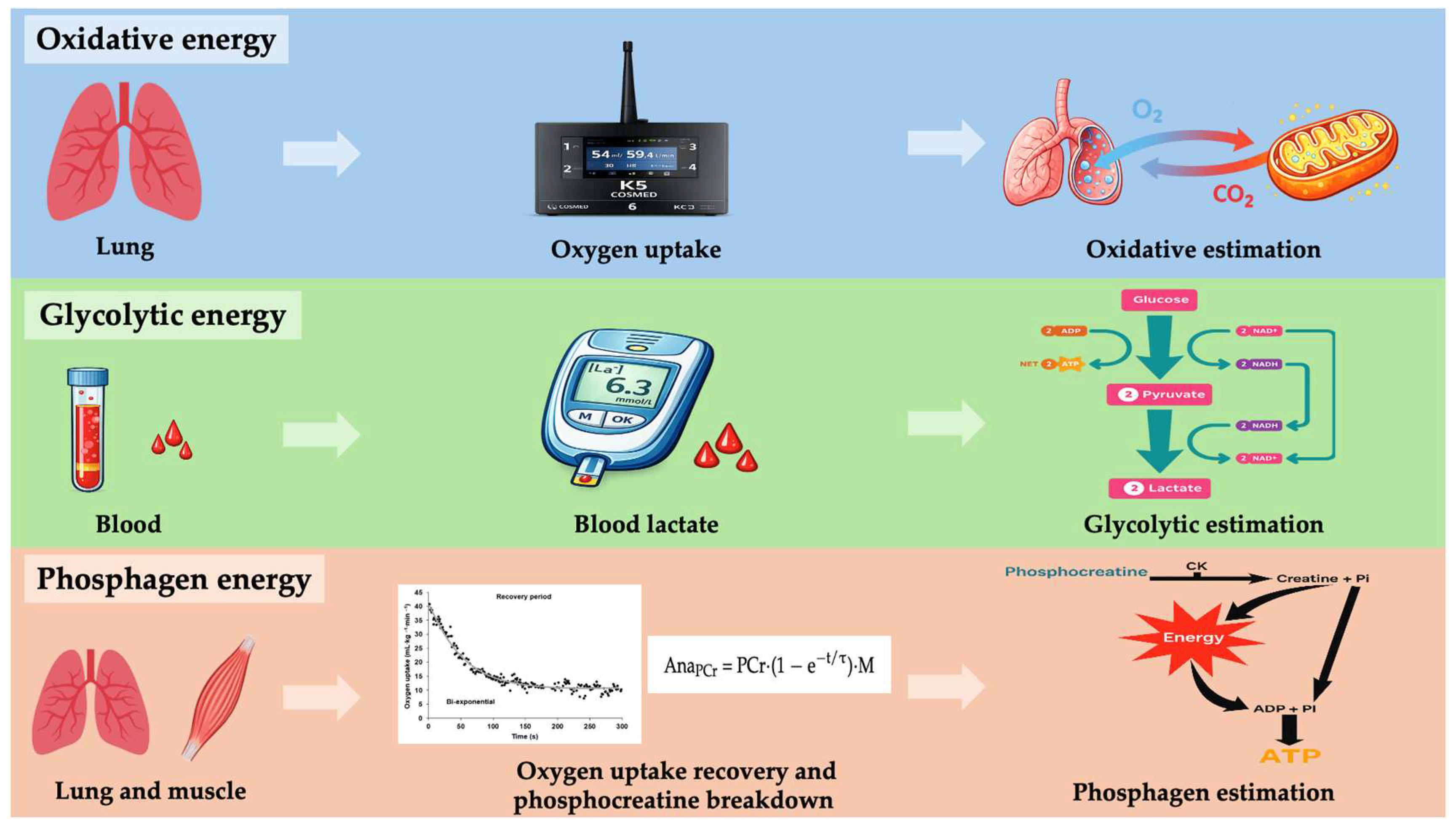
At the whole-body level, oxidative energy contribution is commonly estimated using indirect calorimetry, with pulmonary oxygen uptake (VO2) serving as a surrogate for mitochondrial ATP resynthesis [5,7,8]. Glycolytic contribution is typically inferred from net blood lactate accumulation ([La]) [9,10,11], while phosphagen energy supply is estimated indirectly from the fast component of post-exercise VO2 recovery or from theoretical models of maximal phosphocreatine (PCr) breakdown [12,13,14,15]. The degree of PCr breakdown is based on assumed intramuscular PCr availability and fixed energetic equivalents (see Figure 1) [5,11,16]. These approaches do not quantify ATP turnover directly and depend on indirect proxies shaped by physiological kinetics, methodological assumptions, and specific model constraints [1,12,14].
Alternative frameworks for estimating anaerobic energy contribution include the maximal accumulated oxygen deficit (MAOD), its alternate formulations (MAOD_ALT) and the accumulated oxygen deficit (AOD), provide integrated estimates of oxygen-independent metabolism expressed as a single oxygen-equivalent value [17,18,19]. The MAOD represents the maximal value obtained from this accumulated deficit across repeated supramaximal efforts [17], whereas MAOD_ALT simplifies the procedure by combining VO2 and blood lactate-derived estimates within a single supramaximal bout [18]. The AOD method estimates the difference between the predicted oxygen demand (extrapolated from submaximal exercise) and the measured VO2 during supramaximal exercise [19]. While these approaches can be useful in some contexts, they do not fully differentiate between glycolytic and phosphagen contributions, which limit interpretation of the simultaneous involvement of the three energy systems [1,20]. In contrast, muscle biopsy techniques enable direct assessment of intramuscular substrates and metabolite accumulation, as well as maintaining the reference method for distinguishing glycolytic and phosphagen anaerobic energy release [20,21]. However, their invasive nature and limited ecological validity restrict their widespread use particularly in applied and field-based settings.
The lack of consensus regarding the estimation of energy system contributions has led to proliferation of heterogeneous models, output units, and interpretation frameworks [1,20]. Most existing methodologies either aggregate anaerobic metabolism into a single component or fail to provide comparable estimates across exercise modalities. These shortcomings limit the interpretability of bioenergetic profiles and hinder both cross-study synthesis and real-world application [5,7,22]. In this narrative review, we examine the rationale, application, and methodological limitations of current estimation techniques in order to clarify how these approaches influence the interpretation of energy system contributions during exercise. Particular emphasis is placed on how physiological assumptions, model constraints, and contextual exercise characteristics shape the interpretation of bioenergetic profiles and contribute to heterogeneity across studies. Emphasis is placed on cyclical sports, functional fitness, and combat sports to illustrate the influence of task structure on energy system dynamics, primarily based on studies conducted in young adult participants, most frequently male, as sex-specific analyses of energy system contributions remain limited in the current literature.
Rather than seeking a single gold standard, this review proposes that progress in bioenergetic profiling depends on methodological convergence within an integrative and modality-sensitive framework. By critically examining current approaches, we aim to clarify structured pathways for reducing ambiguity in exercise–metabolism settings.

2. Methods

This narrative review was conducted to synthesize methodological and applied evidence concerning the estimation of oxidative, glycolytic, and phosphagen energy system contributions during exercise. The review was designed to integrate conceptual and experimental perspectives rather than to perform a formal systematic synthesis. A structured literature search was performed using PubMed, Scopus, and Web of Science. Google Scholar was used as a complementary source to identify additional relevant and recently published studies. Titles, abstracts, and full texts were screened when necessary.
No strict temporal restrictions were imposed. However, the search included studies published up to December 2025. Foundational investigations establishing the theoretical and methodological basis of energy system assessment were retained alongside more recent studies reflecting contemporary technological and analytical developments. Search terms were refined iteratively and included combinations of keywords related to energy system contribution, oxygen uptake kinetics, blood lactate accumulation, phosphocreatine modeling, and bioenergetic profiling in sport.
Given the objective of synthesizing studies that provided discrete quantification of energy system contributions under controlled experimental conditions, the scope of the review was restricted primarily to individual sport modalities (e.g., cyclical sports, functional fitness, and combat sports). Team sports were not included due to their stochastic and tactically driven structure, which limits methodological comparability using current metabolic partitioning models. Study inclusion was based on conceptual relevance, methodological transparency, and explicit reporting of energy system estimation procedures, rather than predefined systematic eligibility criteria.
For clarity and consistency, intensity terminology was harmonized throughout the manuscript. The term submaximal refers to workloads performed below maximal VO2 (VO2max); maximal refers to efforts eliciting VO2max; and supramaximal refers to workloads exceeding the velocity or power associated with VO2max (vVO2max). When available, intensity is expressed relative to %vVO2max or task-specific maximal performance. These descriptors are used pragmatically to facilitate comparison and do not imply strict physiological intensity-domain classification.

3. Aerobic Energy Contribution Assessment

Oxidative contribution to total energy demand is typically estimated using pulmonary VO2 as an indirect marker of whole-body aerobic metabolism. This approach integrates VO2 values above resting levels throughout the exercise bout, providing a net measure of aerobic demand [5]. Although it does not quantify ATP production directly, VO2 integration is a practical and widely adopted method under a range of exercise conditions. Table 1 summarizes reported oxidative contributions across different exercise modalities, organized by sport (e.g., cyclical sports, functional fitness and combat sports) and further stratified by effort intensity. For clarity, oxidative contribution is categorized as low (<30%), moderate (30–60%), or high (>60%) [1], using heuristic thresholds to support interpretative comparison across studies, with potential overlap near boundary values.
Across multiple exercise modalities, time-to-exhaustion protocols that elicit VO2max are primarily sustained by oxidative metabolism, typically reflecting a high aerobic contribution, as the duration of these efforts allows for full development of VO2 kinetics, as consistently reported in swimming, cycling, rowing, and running [5]. In swimming, increasing intensity from 95 to 105% of the vVO2max leads to a progressive reduction in aerobic contribution from high to moderate levels, suggesting a compensatory increase in anaerobic energy demand [23]. A similar duration-dependent trend is observed across swimming race distances, with oxidative contribution increasing from low levels in 50 m (~34%) to moderate in 100 m (~54%) and high in 200 m (~71%) efforts [24]. In contrast, all-out 100 m front-crawl swims present a moderate oxidative contribution, which is limited by the short duration and insufficient time for full VO2 kinetics adjustment [25]. Conversely, 400 m front-crawl efforts provide greater opportunity for oxidative engagement, resulting in high aerobic contribution [26]
In rowing, simulated 2000 m on-water efforts are mainly supported by oxidative metabolism, with high aerobic contribution [27]. However, shorter all-out efforts, (e.g., 90 s or 500 m rows) still show moderate oxidative contribution despite their high relative intensity [11,22]. A similar duration-dependent pattern is observed in sprint kayaking (250–2000 m), where oxidative contribution increases as race distance increases [8]. Shorter duration protocols like the Wingate test (30 s) show low oxidative contribution (~19%), reflecting the dominance of anaerobic metabolism [13,28]. The reduction in oxidative contribution becomes even more pronounced in sprints lasting ≤15 s, where aerobic input is minimal [29].
In functional fitness, the oxidative contribution varies according to task structure and pacing. The Fran workout, which consists of thrusters and pull-ups, yields a high aerobic contribution when performed continuously, compared to lower values reported when 30 s rest intervals are introduced between rounds [7,30]. These data suggest that uninterrupted execution allows for more consistent VO2 elevation. The Isabel workout, consisting exclusively of snatch repetitions, elicits a moderate aerobic contribution despite its short duration (~120 s), highlighting that even brief tasks can substantially engage oxidative metabolism when performed at maximal effort with large muscle groups [31].
In combat sports, three consecutive 2 min boxing rounds can yield a high aerobic contribution, reflecting the cumulative demand of repeated high-intensity efforts interspersed with short recovery periods [32]. Similarly, both judo and taekwondo rely predominantly on aerobic metabolism, with oxidative contributions ranging from ~50 to 81% in judo and 62 to 70% in taekwondo, depending on bout structure and intensity [33]. In karate, kumite simulations show a high aerobic contribution (~69%), whereas kata routines display a more moderate demand (~53%), likely due to their shorter duration and lower mechanical complexity [34]. Outside of combat sports, endurance surf paddling (~6 min duration) elicits a high aerobic contribution, reflecting the prolonged, rhythmic nature of upper-body activity [35]. In contrast, indoor climbing efforts lasting between 3 and 7 min typically yield a moderate oxidative contribution, likely due to intermittent muscular loading and high isometric demand [36].
These findings suggest that exercise duration is a major determinant of oxidative metabolism. Prolonged continuous tasks lasting more than 6–10 min are consistently dominated by aerobic energy provision, with contributions typically exceeding 75–85%. In contrast, short maximal or supramaximal efforts tend to present reduced aerobic participation, particularly when the duration is insufficient for the full development of VO2 kinetics. Intermittent formats may enhance aerobic contribution by enabling repeated VO2 reactivation during brief recovery intervals. Furthermore, the amount of active muscle mass appears to influence both the absolute and relative magnitude of oxidative contribution [37,38]. Whole-body modalities generally result in higher aerobic fractions when compared to localized or upper-limb dominant efforts. Therefore, VO2-derived estimates of oxidative contribution should be interpreted as an integrated outcome influenced by temporal, structural, and neuromuscular factors, rather than a direct reflection of exercise modality alone.
Table 1. Oxidative energy contribution across different sports and exercise modalities.
ModalityParticipants
Age/Level
Exercise
Intensity
Oxidative
(%)
Study
Cycling50 trained individuals; 20–25 years;
Wingate test (15 s)
Supramaximal8–11Archacki et al. [29]
Cycling14 active males; 24 years;
Wingate test (30 s)
Supramaximal11Lovell et al. [28]
Cycling11 active males; 22 years;
Wingate test (30 s)
Supramaximal19Beneke et al. [13]
Functional fitness14 trained males; 28 years; workout IsabelMaximal40Rios et al. [31]
Functional fitness20 trained CrossFitters; 26–29 years; workout FranMaximal41Rios et al. [7]
Swimming17 well-trained male swimmers; 17 years;
100 m front crawl
Maximal43–45Ribeiro et al. [25]
Climbing13 active males; 20–24 years;
climbing routes
Submaximal40–46Bertuzzi et al. [36]
Rowing14 trained rowers; 26 years;
500 m on water
Maximal50Cardoso et al. [22]
Rowing20 trained rowers; 23–26 years;
all-out 90 s tethered
Supramaximal56Cardoso et al. [11]
Functional fitness20 trained CrossFitters; 26–29 years; workout FranMaximal62Rios et al. [30]
Karate12 trained karate; 19–30 years;
kata and kumite techniques
Maximal53–69Doria et al. [34]
Taekwondo10 trained males; 21 years;
3 × 2 min rounds
Maximal62–70Campos et al. [39]
Swimming28 well-trained swimmers; 15–18 years;
50, 100, 200 m time trials
Maximal34–71Almeida et al. [24]
Swimming, rowing,
cycling, and running
40 trained males; 17–28 years;
exercise at VO2max
Maximal73–80Sousa et al. [5]
Judo12 trained males; 18 years;
5 judo match simulations
Maximal50–81Julio et al. [33]
Surf16 trained males; 23 years; surfer paddled 6 min at 60% peak velocitySubmaximal82Borgonovo-Santos et al. [35]
Swimming12 trained males; 18 years;
TTE at 95, 100 and 105% vVO2max
Supramaximal59–83Sousa et al. [23]
Boxing10 males novice boxers; 23 years:
3 × 2 min rounds
Maximal86Davis et al. [32]
Rowing8 trained males; 24 years;
2000 m race
Maximal87de Campos Mello et al. [27]
Swimming24 age-group swimmers; 14 years;
400 m test in front crawl
Maximal87–88Zacca et al. [26]
Kayaking8 middle- to high-class athletes;
15–32 years; 250–2000 m time trials
Maximal40–90Zamparo et al. [8]
Key: TTE, time to exhaustion; vVO2 max, velocity at maximal oxygen uptake; values are reported as a mean or range as presented in the original study.

4. Anaerobic Energy Contribution Assessment

4.1. Blood Lactate Accumulation

Glycolytic energy contribution is commonly estimated from net [La] because direct in vivo measurement of glycolytic ATP production is not feasible. This indirect method applies fixed conversion factors (~2.7–3.3 mL O2·kg−1 per 1 mmol·L−1 of [La] and 20.9 kJ per liter of O2) to estimate the associated energy yield [9]. These fixed energetic equivalents do not fully account for interindividual metabolic variability or differences in buffering capacity, which may alter the relationship between lactate accumulation and ATP turnover under different physiological conditions [40]. However, it should be emphasized that lactate-derived estimates represent an indirect and model-dependent approximation of glycolytic ATP turnover rather than a direct quantification [9,41].
The energetic equivalent attributed to lactate accumulatio is typically treated as constant, although it may vary slightly depending on experimental conditions, active muscle mass, and measurement site [9,41]. Furthermore, [La] reflects the net balance between lactate production, distribution, and clearance, and therefore does not necessarily represent instantaneous glycolytic flux [41]. As summarized in Table 2, glycolytic contribution varies with exercise intensity, duration, and structural organization. For classification, glycolytic energy contributions were rated as low (<10%), moderate (10–30%) or high (>30%) [1].
At workloads near VO2max (workload durations of ~180–240 s), glycolytic contribution tends to remain moderate across cyclic modalities (e.g., swimming, cycling, rowing and running), since oxidative metabolism predominates early in efforts of sufficient duration [5]. As intensity approaches and slightly exceeds this threshold, glycolytic involvement increases, ranging from 12% at maximal to 20% at supramaximal intensities [23]. In swimming, shorter maximal efforts elicit higher glycolytic reliance, with contribution decreasing progressively as distance increases from 50–200 m [24]. Similarly, 100 m efforts lasting ~60–65 s show substantial glycolytic activation [25], whereas 400 m efforts result in lower and more consistent values across a training season [26].
In rowing, glycolytic contribution is low during prolonged efforts such as 2000 m trials, whether performed on water or an ergometer [27]. Glycolytic contribution increases substantially during shorter all-out rowing bouts [11,22] and peaks during 30 s Wingate protocols [13,28], a pattern also observed in 15 s sprint efforts [29]. In sprint kayaking, glycolytic contribution decreases progressively as distance increases, ranging from high values in 250 m (~37%) to moderate in 500 m (~27%), as well as low levels in 1000 m (~9%) and 2000 m (~6%) events [8]. These findings highlight that lactate-based estimates of glycolytic contribution are highly sensitive to both exercise duration and mechanical power output. In functional fitness, glycolytic contribution varies with task structure, as the Fran workout shows greater lactate accumulation when interspersed with prescribed rest intervals compared to continuous execution [7,30]. The Isabel workout elicits a particularly high glycolytic response, likely due to its short duration and the combination of elevated power output with high movement density [31].
In combat sports, glycolytic contribution tends to remain low across repeated rounds of amateur boxing, judo, and taekwondo, since the short duration of bouts and intervening recovery intervals limit net [La] accumulation [32,33]. However, accelerated lactate clearance between high-intensity actions may underestimate actual glycolytic flux in these modalities. Simulated karate competitions also show low glycolytic values, with small differences between kata and kumite (~20% and 15%, respectively) [31]. Similarly, endurance surf paddling presents low glycolytic contribution [35], whereas indoor climbing yields moderate values, likely due to greater isometric demand and intermittent loading patterns [36].
Glycolytic contribution increases with exercise intensity, decreases with task duration, peaks during short maximal and supramaximal efforts, and remains low in prolonged or submaximal activities. This pattern reflects the brief temporal window in which high glycolytic flux can be sustained before oxidative metabolism becomes dominant. In longer or intermittent tasks, enhanced oxidative capacity and recovery intervals facilitate lactate clearance, thereby reducing net accumulation. Consequently, lactate-based estimates should be interpreted as context-sensitive indicators of glycolytic involvement, shaped primarily by duration and structure rather than by exercise modality alone.

4.2. Fast Component of Post-Exercise Oxygen Uptake Recovery

Phosphagen (alactic) energy contribution is commonly estimated from the fast component of post-exercise VO2 recovery, derived through exponential modeling of VO2 kinetics to reflect PCr resynthesis [12,15]. As with other indirect approaches, this estimate is influenced by the temporal characteristics of the exercise task. Table 3 summarizes these values across exercise modalities, based on either VO2 recovery kinetics or theoretical PCr breakdown, with contributions classified as low (<10%), moderate (10–25%), or high (>25%) [1].
In swimming, phosphagen contribution declines progressively as exercise duration increases, with higher values observed in short front-crawl efforts and lower contributions in longer distances [24]. A similar duration-dependent reduction is observed in rowing, where the phosphagen contribution becomes minimal during prolonged 2000 m efforts, both on water and on an ergometer [27].
In shorter duration exercise, phosphagen contribution is markedly elevated in efforts such as upper- and lower-body Wingate protocols [13,28] and 15 s all-out sprints, due to the high demand for rapid ATP resynthesis [29]. In intermittent combat sports such as boxing, judo, and taekwondo, phosphagen metabolism accounts for a substantial portion of total energy expenditure. Similar values are observed in simulated kata routines in karate, with contributions around 27%, and in indoor climbing, where repeated maximal contractions and short recovery intervals favor PCr resynthesis [31,32,36].

4.3. Theoretical Modeling of Maximal Phosphocreatine Breakdown

An alternative method to estimate phosphagen energy supply is based on theoretical modeling of maximal PCr breakdown, which does not depend on post-exercise VO2 recovery but instead relies on structural assumptions [9]. This model assumes an intramuscular PCr availability of ~18–20 mmol·kg−1 of active muscle and applies a fixed energy equivalent of 0.468 kJ·mmol−1 for PCr hydrolysis [9], enabling ATP–PCr provision to be estimated independently of recovery kinetics. However, PCr availability may vary with muscle fiber-type composition (e.g., type II fiber proportion) and training status, including strength-training adaptations, which can influence model-derived estimates.
Across exercise modalities, phosphagen contribution estimated via theoretical PCr breakdown is generally modest, with values of swimming (12%), rowing (16%), running (12%), and cycling (15%), indicating a relatively limited role under typical endurance conditions [5]. As exercise demands increase, such as during 100 m front-crawl or tasks involving greater muscle mass, phosphagen contribution tends to rise due to greater reliance on alactic metabolism [23,25]. In contrast, during longer efforts like 400 m swimming, the phosphagen contribution remains consistently low across the training season [26].
In rowing, theoretical estimates show substantial phosphagen contribution during short maximal efforts, which progressively declines as duration increases, as observed in 90 s tethered rowing and 500 m sprints [11,22]. In sprint kayaking (250–2000 m), phosphagen contribution decreases with increasing distance, ranging from moderate values in 250 m (~22%) and 500 m (~13%) to low levels in 1000 m (~8%) and 2000 m (~4%) events [8]. A similar pattern occurs in functional fitness, where intermittent execution of the Fran workout results in higher phosphagen contribution compared to continuous performance [7,30]. In contrast, the Isabel workout [31] and endurance surf paddling [35] exhibit modest alactic involvement, aligned with the metabolic demands of longer-duration efforts.
Phosphagen contribution consistently decreases as exercise duration increases. The highest values are observed during short, high-intensity efforts, while prolonged activities yield minimal involvement. These discrepancies reflect differences in recovery kinetics, model assumptions, and non-metabolic components of post-exercise VO2. Therefore, phosphagen contribution should be interpreted as a context-dependent estimate shaped by both exercise characteristics and the assessment method, rather than as an exact quantitative measure of ATP–PCr turnover.

5. Methodological Limitations

Although multiple approaches have been proposed to estimate the relative contribution of energy systems during exercise, all are constrained by physiological and methodological limitations that prevent precise partitioning of total energy expenditure when metabolic pathways operate simultaneously. Consequently, the percentage values presented in Table 1, Table 2 and Table 3 should be interpreted within the methodological context of each original study, as analytical decisions such as baseline subtraction, treatment of the VO2 slow component, timing of lactate sampling, and recovery curve modeling substantially influence reported energy system contributions. Indirect calorimetry and VO2 integration remain the primary methods for assessing oxidative metabolism, yet their validity depends on steady-state assumptions and accurate modeling of VO2 kinetics [42]. These assumptions are frequently violated during short, supramaximal, or intermittent efforts, as observed in swimming and rowing, where VO2 kinetics are incomplete or delayed. In efforts ≤2 min, incomplete VO2 kinetics can influence the estimation of oxidative contribution due to the temporal lag between metabolic demand and pulmonary VO2 adjustment [43].
Moreover, pulmonary VO2 reflects whole-body VO2 and may not adequately capture local muscle metabolism [1], especially in upper-limb-dominant or modality-specific tasks such as arm-only swimming protocols [25]. Interindividual differences in mechanical efficiency may also influence energy system estimates, as variations in movement economy alter the oxygen cost of a given external workload [5]. In addition, interpreting integrated VO2 as net oxidative contribution does not fully account for the initial O2 deficit, the development of a VO2 slow component during severe-intensity exercise, or potential non-metabolic influences on excess post-exercise oxygen consumption. Factors such as altered ventilatory patterns, transient apnea at exercise cessation, elevated muscle temperature, and autonomic adjustments may modify recovery VO2 kinetics and thereby influence estimates of phosphagen contribution [44,45].
Estimating glycolytic contribution from net [La] also presents significant limitations. Blood lactate concentration reflects the balance between production and clearance, rather than actual intramuscular glycolytic flux [1]. Lactate dynamics are further influenced by intracellular–extracellular transport mechanisms and the lactate shuttle, which are not directly captured by systemic blood measurements [46]. Consequently, lactate-based estimates are highly sensitive to exercise duration, recovery intervals and sampling timing [46]. For example, in intermittent combat sports such as boxing and judo (see Table 2), short rest periods enhance lactate clearance (potentially underestimating glycolytic contribution). During prolonged exercise, increased buffering capacity and clearance further complicate interpretation. Fixed energetic equivalents provide pragmatic conversion factors but may not fully reflect the dynamic regulation of glycolytic ATP turnover under different physiological conditions [9].
Phosphagen contribution is typically estimated using either the fast component of post-exercise VO2 recovery or theoretical modeling of PCr breakdown. Although the rapid VO2 phase is often interpreted as reflecting phosphocreatine resynthesis, this interpretation is not exclusive, as the fast component can also be influenced by non-metabolic factors (e.g., ventilatory adjustments, autonomic responses, and thermoregulatory demands) [1,15]. Acute elevations in muscle temperature may influence mitochondrial oxidative flux and PCr resynthesis kinetics, whereas transient ventilatory alterations following breath-holding or apnea at exercise cessation may transiently augment early recovery VO2 [47,48]. These influences are especially pronounced after supramaximal sprints or intermittent tasks, where altered breathing patterns or transient apnea at the cessation of exercise may elevate VO2 recovery and affect kinetic modeling. Accordingly, the fast component should be interpreted as a composite physiological response rather than a direct and isolated marker of PCr resynthesis [14].
Theoretical approaches based on PCr breakdown introduce further limitations by relying on assumed values for intramuscular phosphocreatine availability, active muscle mass, and fixed energetic equivalents [9,14]. Such models overlook interindividual variability in muscle recruitment, training status, and exercise technique, as well as variation in local muscle VO2 kinetics [9,14]. As discussed in Section 4.3, comparisons between short (100 m) and longer (400 m) swimming efforts illustrate how exercise duration and muscle mass recruitment substantially influence model-derived phosphagen estimates. Accordingly, all current methods should be regarded as context-dependent approximations. While useful for comparing relative contributions across tasks or conditions, no currently available model offers an absolute or direct quantification of energy system activation during exercise. Table 4 summarizes the principal methodological limitations associated with each estimation approach.

6. Integrating Technology and Bioenergetic Profiling

Recent technological advances have enhanced the ability to assess energy system contributions beyond traditional indirect calorimetry and discrete blood-based methods. Portable VO2 analyzers (e.g., COSMED K5) allow continuous, in-field monitoring of breath-by-breath VO2, improving the resolution of both transient and steady-state responses during dynamic exercise [49,50]. Computational modeling platforms, including VO2FITTING [42], allow standardized analysis of VO2 and recovery curves. These tools improve the estimation of oxidative and phosphagen system contributions, as well as promoting reproducibility across studies. More recently, data-driven approaches including machine learning algorithms have been applied to model VO2 and metabolic responses, enabling pattern recognition and improved parameter estimation during complex or non-steady-state exercise conditions [51].
Near-infrared spectroscopy (NIRS) provides localized insights into muscle oxygenation and reoxygenation, addressing the spatial limitations of whole-body VO2 measures [52,53,54]. Portable NIRS systems have been used in research to monitor regional muscle oxygenation dynamics during various types of exercise [55,56,57] (including strength protocols and endurance activities). Combining pulmonary VO2 measurements with NIRS may enhance interpretative robustness, as systemic VO2 and local muscle oxygenation provide complementary information regarding oxidative metabolism. Cross-validation between these approaches may reduce uncertainty associated with whole-body assumptions and improve contextual interpretation of energy system estimates. Automated blood lactate analyzers (e.g., Lactate Pro 2) offer point-of-care assessment of glycolytic activation through enzymatic detection in capillary blood [58,59]. These tools are widely used but remain invasive and dependent on proper sampling timing and technique. Wearable lactate sensors based on sweat or interstitial fluid offer near-continuous monitoring of lactate dynamics during exercise, although validation and practical implementation remain ongoing challenges [59,60,61]. Table 5 presents the main technologies used in bioenergetic assessment, providing clearer insight into energy system contributions.

7. Future Directions

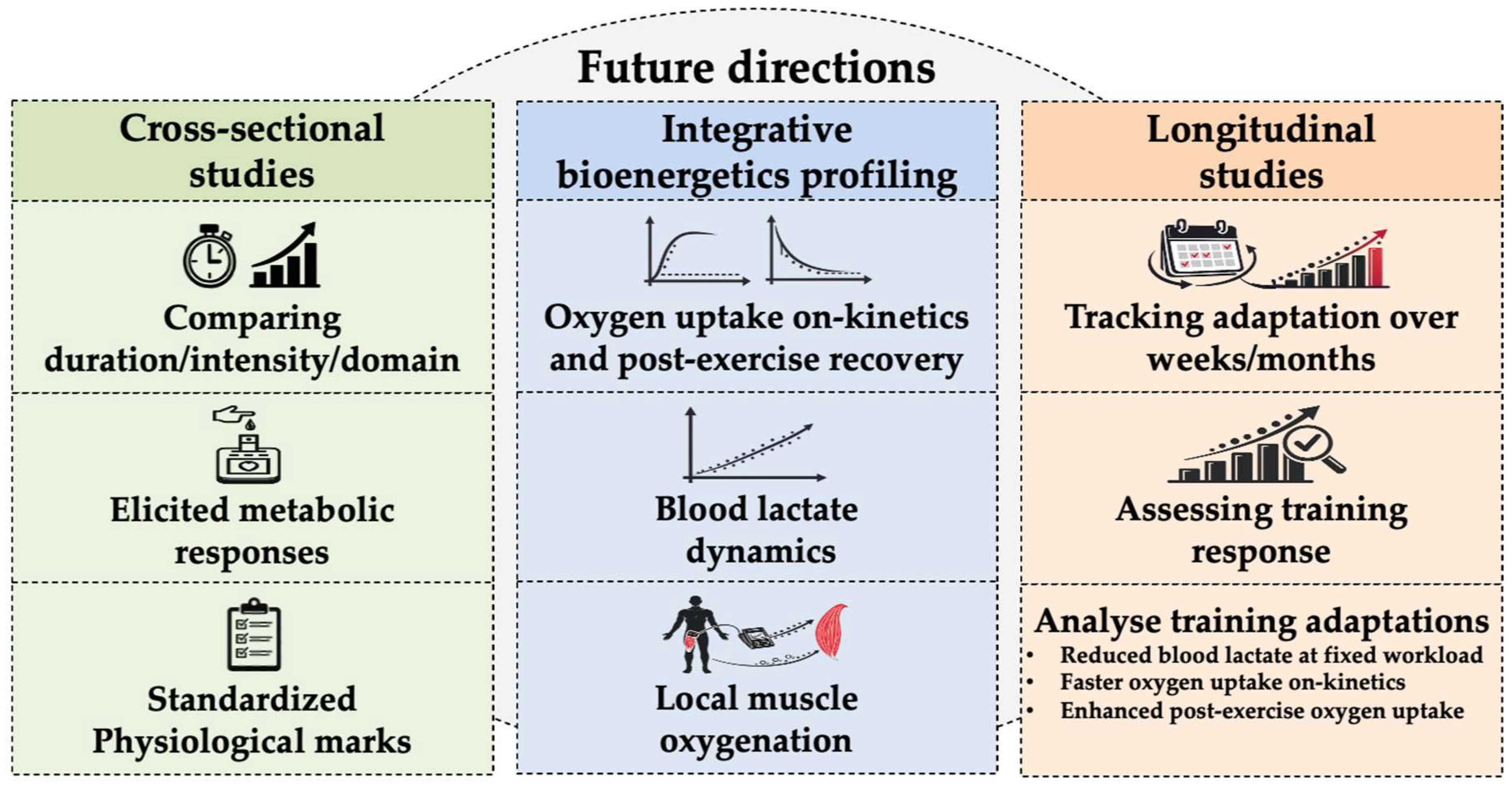
Building on the limitations identified throughout this review, future research should prioritize integrative bioenergetic profiling frameworks that combine methodological harmonization, multimodal physiological assessment, and standardized analytical reporting. Such convergence is essential to improve comparability and reduce interpretative inconsistencies across exercise modalities.
Cross-sectional studies are essential to characterize acute bioenergetic responses across exercise tasks that differ in duration, intensity domain, and structural format. However, future research must move beyond descriptive characterization of metabolic patterns and prioritize the standardization of estimation frameworks used to quantify oxidative, glycolytic, and phosphagen contributions. This approach is needed to establish harmonized protocols for VO2 integration, lactate-derived calculations, and phosphagen modeling, including clearly defined intensity-domain criteria and reporting standards. Carefully designed exercise studies under controlled conditions should help clarify task-specific metabolic demands and enhance the interpretation of VO2 integration, [La], and post-exercise VO2 recovery across exercise modalities. Without methodological harmonization, between-study comparability and translational application will remain limited. A major research priority is the development and validation of integrative bioenergetic models that combine systemic and localized physiological signals. Integration of pulmonary VO2 kinetics with muscle oxygenation techniques (e.g., NIRS), real-time lactate monitoring, and wearable metabolic technologies represents a critical methodological frontier. However, these approaches require rigorous validation across exercise modalities, populations, and environmental conditions before widespread implementation.
Longitudinal studies involving repeated assessments of standardized tasks across different phases of training are equally important. Research conducted over several weeks or a full training cycle (e.g., 6–12 weeks) is needed to examine how bioenergetic profiles evolve over time. Future investigations should establish population-specific bioenergetic profiling frameworks, including normative reference ranges for trained athletes, recreational exercisers, and youth populations. Defining methodological thresholds for detecting meaningful physiological adaptation versus measurement variability is another critical gap that warrants systematic investigation. Ultimately, advancing exercise bioenergetics will depend on the creation of standardized, integrated, and modality-sensitive analytical models that bridge laboratory precision with real-world ecological validity. Figure 2 illustrates key future directions for exploring exercise bioenergetics through cross-sectional designs, integrative profiling, and longitudinal monitoring.

8. Practical Applications

Accurate bioenergetic profiling supports individualized training prescription, recovery planning, and performance monitoring across a variety of exercise modalities. The combined application of VO2 integration, [La], and post-exercise VO2 recovery provides a multidimensional view of energy system contributions. VO2-derived metrics form the foundation of this framework by quantifying oxidative contribution and informing on aerobic engagement and pacing strategies. For example, in endurance athletes, identifying the relative oxidative contribution during submaximal tasks can guide intensity prescription within specific training zones and optimize pacing during competition. These assessments are especially valuable when obtained through portable breath-by-breath systems in ecologically valid environments. Blood lactate analysis, whether via capillary or venous sampling, complements VO2 measures by reflecting the metabolic cost of high-intensity exercise through [La] during and after effort. In practical terms, elevated post-exercise [La] at a given workload across training sessions may indicate increased glycolytic reliance or accumulated fatigue, thereby supporting adjustments in training volume or recovery intervals.
Phosphagen contribution can be inferred from the fast component of VO2 recovery using kinetic modeling, offering insight into the alactic energy demands of short or intermittent activities. This information may be particularly useful in sports requiring repeated sprint efforts, where quantifying phosphagen recovery kinetics can inform rest interval duration and structure of high-intensity interval training. When available, NIRS indicators of muscle oxygenation and reoxygenation provide valuable localized information that deepens interpretation of both oxidative and phosphagen-related responses. For instance, delayed muscle reoxygenation patterns may signal peripheral fatigue or insufficient recovery between high-intensity bouts, guiding conditioning strategies in team and combat sports. Integrating systemic and localized physiological data supports context-specific decisions regarding workload design, fatigue management, and optimization of conditioning strategy. Implementing these approaches should transforms bioenergetic assessment from descriptive profiling into a practical tool for training design and performance optimization. This integrative approach is applicable to both laboratory assessments and selected field-based performance monitoring, provided that methodological consistency is maintained.

9. Conclusions

Estimating energy system contributions during exercise remains inherently complex due to the simultaneous activation of metabolic pathways and the indirect nature of current methodologies. Although VO2 integration, lactate-based estimation, and phosphagen modeling provide useful insights, all approaches are shaped by physiological assumptions and analytical decisions that limit direct comparability across studies. This review advances a structured and integrative perspective for bioenergetic profiling, emphasizing methodological harmonization, standardized reporting, and contextual interpretation. Future progress in the field depends on converging analytical practices and multimodal validation strategies to improve clarity, comparability, and practical application in exercise science.

Author Contributions

M.J.R.: Writing—original draft; M.J.R., D.B.P., and R.J.F.: Writing—review and editing. All authors have read and agreed to the published version of the manuscript.

Funding

The CIFI2D research unit received funding from FCT under the reference UIDB/05913/2020 (DOI: 10.54499/UIDB/05913/2020). The INSIGHT was also funded by FCT through the project reference UID/PRR/06334/2025 (DOI: 10.54499/UID/PRR/06334/2025).

Institutional Review Board Statement

Not applicable.

Informed Consent Statement

Not applicable.

Data Availability Statement

No new data were created or analyzed in this study.

Conflicts of Interest

The authors declare no conflicts of interest.

Abbreviations

The following abbreviations are used in this manuscript:
[La]Blood lactate concentration
AODAccumulated oxygen deficit
ATPAdenosine triphosphate
MAODMaximal accumulated oxygen deficit
MAOD_ALTAlternative maximal accumulated oxygen deficit
NIRSNear-infrared spectroscopy
O2Oxygen
PCrPhosphocreatine
TTETime to exhaustion
VO2Oxygen uptake
VO2maxMaximal oxygen uptake
vVO2maxVelocity at maximal oxygen uptake

References

  1. Gastin, P.B. Energy system interaction and relative contribution during maximal exercise. Sports Med. 2001, 31, 725–741. [Google Scholar] [CrossRef]
  2. Ambaum, C.; Hoppe, M.W. Evaluation of methods to quantify aerobic-anaerobic energy contributions during sports and exercise—A systematic review and best-evidence synthesis. Front. Sports Act. Living 2025, 7, 1650741. [Google Scholar] [CrossRef] [PubMed]
  3. Brochhagen, J.; Hoppe, M.W. Validation of the metabolic power model during three intermittent running-based exercises with emphasis on aerobic and anaerobic energy supply. Front. Sports Act. Living 2025, 7, 1583313. [Google Scholar] [CrossRef] [PubMed]
  4. Zamparo, P.; Ferretti, G. Quantifying metabolic energy contributions in sprint running. Eur. J. Appl. Physiol. 2025, 125, 2641–2642. [Google Scholar] [CrossRef] [PubMed]
  5. Sousa, A.; Figueiredo, P.; Zamparo, P.; Pyne, D.B.; Vilas-Boas, J.P.; Fernandes, R.J. Exercise Modality Effect on Bioenergetical Performance at VO2max Intensity. Med. Sci. Sports Exerc. 2015, 47, 1705–1713. [Google Scholar] [CrossRef]
  6. Franchini, E. Energy System Contributions during Olympic Combat Sports: A Narrative Review. Metabolites 2023, 13, 297. [Google Scholar] [CrossRef]
  7. Rios, M.; Zacca, R.; Azevedo, R.; Fonseca, P.; Pyne, D.B.; Reis, V.M.; Moreira-Gonçalves, D.; Fernandes, R.J. Bioenergetic Analysis and Fatigue Assessment During the Fran Workout in Experienced Crossfitters. Int. J. Sports Physiol. Perform. 2023, 18, 786–792. [Google Scholar] [CrossRef]
  8. Zamparo, P.; Capelli, C.; Guerrini, G. Energetics of kayaking at submaximal and maximal speeds. Eur. J. Appl. Physiol. 1999, 80, 542–548. [Google Scholar] [CrossRef]
  9. di Prampero, P.E. Energetics of muscular exercise. Rev. Physiol. Biochem. Pharmacol. 1981, 89, 143–222. [Google Scholar] [CrossRef]
  10. Zamparo, P.; Cortesi, M.; Gatta, G. The energy cost of swimming and its determinants. Eur. J. Appl. Physiol. 2020, 120, 41–66. [Google Scholar] [CrossRef]
  11. Cardoso, R.; Rios, M.; Carvalho, D.; Monteiro, A.S.; Soares, S.; Abraldes, J.A.; Gomes, B.B.; Vilas-Boas, J.P.; Fernandes, R.J. Mechanics and Energetic Analysis of Rowing with Big Blades with Randall Foils. Int. J. Sports Med. 2023, 44, 1043–1048. [Google Scholar] [CrossRef]
  12. Di Prampero, P.E.; Margaria, R. Relationship between O2 consumption, high energy phosphates and the kinetics of the O2 debt in exercise. Pflügers Arch. 1968, 304, 11–19. [Google Scholar] [CrossRef]
  13. Beneke, R.; Pollmann, C.; Bleif, I.; Leithäuser, R.M.; Hütler, M. How anaerobic is the Wingate Anaerobic Test for humans? Eur. J. Appl. Physiol. 2002, 87, 388–392. [Google Scholar] [CrossRef]
  14. Rios, M.; Reis, V.M.; Soares, S.; Moreira-Gonçalves, D.; Fernandes, R.J. Pros and cons of two methods of anaerobic alactic energy assessment in a high-intensity CrossFit® workout. Oxygen 2022, 2, 621–627. [Google Scholar] [CrossRef]
  15. Margaria, R.; Edwards, H.; Dill, D.B. The possible mechanisms of contracting and paying the oxygen debt and the role of lactic acid in muscular contraction. Am. J. Physiol.-Leg. Content 1933, 106, 689–715. [Google Scholar] [CrossRef]
  16. di Prampero, P.E. The energy cost of human locomotion on land and in water. Int. J. Sports Med. 1986, 7, 55–72. [Google Scholar] [CrossRef]
  17. Medbø, J.I.; Mohn, A.C.; Tabata, I.; Bahr, R.; Vaage, O.; Sejersted, O.M. Anaerobic capacity determined by maximal accumulated O2 deficit. J. Appl. Physiol. (1985) 1988, 64, 50–60. [Google Scholar] [CrossRef]
  18. Bertuzzi, R.C.; Franchini, E.; Ugrinowitsch, C.; Kokubun, E.; Lima-Silva, A.E.; Pires, F.O.; Nakamura, F.Y.; Kiss, M.A. Predicting MAOD using only a supramaximal exhaustive test. Int. J. Sports Med. 2010, 31, 477–481. [Google Scholar] [CrossRef]
  19. Reis, V.M.; Marinho, D.A.; Barbosa, F.P.; Reis, A.M.; Guidetti, L.; Silva, A.J. Examining the accumulated oxygen deficit method in breaststroke swimming. Eur. J. Appl. Physiol. 2010, 109, 1129–1135. [Google Scholar] [CrossRef]
  20. Reis, V.M.; Júnior, R.S.; Zajac, A.; Oliveira, D.R. Energy cost of resistance exercises: An uptade. J. Hum. Kinet. 2011, 29a, 33–39. [Google Scholar] [CrossRef]
  21. Gollnick, P.D.; Armstrong, R.B.; Saubert, C.W., 4th; Piehl, K.; Saltin, B. Enzyme activity and fiber composition in skeletal muscle of untrained and trained men. J. Appl. Physiol. 1972, 33, 312–319. [Google Scholar] [CrossRef] [PubMed]
  22. Cardoso, R.; Rios, M.; Cardoso, F.; Bouicher, S.; Abraldes, J.A.; Gomes, B.B.; Vilas-Boas, J.P.; Fernandes, R.J. Randall Foils Versus Big Blades: Comparative Analysis in On-Water Sprint Rowing. Int. J. Sports Physiol. Perform. 2025, 20, 678–683. [Google Scholar] [CrossRef] [PubMed]
  23. Sousa, A.C.; Vilas-Boas, J.P.; Fernandes, R.J. VO2 kinetics and metabolic contributions whilst swimming at 95, 100, and 105% of the velocity at VO2max. BioMed Res. Int. 2014, 2014, 675363. [Google Scholar] [CrossRef] [PubMed]
  24. Almeida, T.A.F.; Pessôa Filho, D.M.; Espada, M.A.C.; Reis, J.F.; Simionato, A.R.; Siqueira, L.O.C.; Alves, F.B. VO2 kinetics and energy contribution in simulated maximal performance during short and middle distance-trials in swimming. Eur. J. Appl. Physiol. 2020, 120, 1097–1109. [Google Scholar] [CrossRef]
  25. Ribeiro, J.; Figueiredo, P.; Sousa, A.; Monteiro, J.; Pelarigo, J.; Vilas-Boas, J.P.; Toussaint, H.M.; Fernandes, R.F. VO2 kinetics and metabolic contributions during full and upper body extreme swimming intensity. Eur. J. Appl. Physiol. 2015, 115, 1117–1124. [Google Scholar] [CrossRef]
  26. Zacca, R.; Azevedo, R.; Chainok, P.; Vilas-Boas, J.P.; Castro, F.A.S.; Pyne, D.B.; Fernandes, R.J. Monitoring Age-Group Swimmers Over a Training Macrocycle: Energetics, Technique, and Anthropometrics. J. Strength Cond. Res. 2020, 34, 818–827. [Google Scholar] [CrossRef]
  27. de Campos Mello, F.; de Moraes Bertuzzi, R.C.; Grangeiro, P.M.; Franchini, E. Energy systems contributions in 2,000 m race simulation: A comparison among rowing ergometers and water. Eur. J. Appl. Physiol. 2009, 107, 615–619. [Google Scholar] [CrossRef]
  28. Lovell, D.; Kerr, A.; Wiegand, A.; Solomon, C.; Harvey, L.; McLellan, C. The contribution of energy systems during the upper body Wingate anaerobic test. Appl. Physiol. Nutr. Metab. 2013, 38, 216–219. [Google Scholar] [CrossRef]
  29. Archacki, D.; Zieliński, J.; Pospieszna, B.; Włodarczyk, M.; Kusy, K. The contribution of energy systems during 15-second sprint exercise in athletes of different sports specializations. PeerJ 2024, 12, e17863. [Google Scholar] [CrossRef]
  30. Rios, M.; Becker, K.M.; Monteiro, A.S.; Fonseca, P.; Pyne, D.B.; Reis, V.M.; Moreira-Gonçalves, D.; Fernandes, R.J. Effect of the Fran CrossFit Workout on Oxygen Uptake Kinetics, Energetics, and Postexercise Muscle Function in Trained CrossFitters. Int. J. Sports Physiol. Perform. 2024, 19, 299–306. [Google Scholar] [CrossRef]
  31. Rios, M.; Becker, K.M.; Cardoso, F.; Pyne, D.B.; Reis, V.M.; Moreira-Gonçalves, D.; Fernandes, R.J. Assessment of Cardiorespiratory and Metabolic Contributions in an Extreme Intensity CrossFit® Benchmark Workout. Sensors 2024, 24, 513. [Google Scholar] [CrossRef]
  32. Davis, P.; Leithäuser, R.M.; Beneke, R. The energetics of semicontact 3 x 2-min amateur boxing. Int. J. Sports Physiol. Perform. 2014, 9, 233–239. [Google Scholar] [CrossRef] [PubMed]
  33. Julio, U.F.; Panissa, V.L.G.; Esteves, J.V.; Cury, R.L.; Agostinho, M.F.; Franchini, E. Energy-System Contributions to Simulated Judo Matches. Int. J. Sports Physiol. Perform. 2017, 12, 676–683. [Google Scholar] [CrossRef] [PubMed]
  34. Doria, C.; Veicsteinas, A.; Limonta, E.; Maggioni, M.A.; Aschieri, P.; Eusebi, F.; Fanò, G.; Pietrangelo, T. Energetics of karate (kata and kumite techniques) in top-level athletes. Eur. J. Appl. Physiol. 2009, 107, 603–610. [Google Scholar] [CrossRef] [PubMed]
  35. Borgonovo-Santos, M.; Zacca, R.; Fernandes, R.J.; Vilas-Boas, J.P. The impact of a single surfing paddling cycle on fatigue and energy cost. Sci. Rep. 2021, 11, 4566. [Google Scholar] [CrossRef]
  36. Bertuzzi, R.C.; Franchini, E.; Kokubun, E.; Kiss, M.A. Energy system contributions in indoor rock climbing. Eur. J. Appl. Physiol. 2007, 101, 293–300. [Google Scholar] [CrossRef]
  37. Farinatti, P.T.; Castinheiras Neto, A.G. The effect of between-set rest intervals on the oxygen uptake during and after resistance exercise sessions performed with large- and small-muscle mass. J. Strength Cond. Res. 2011, 25, 3181–3190. [Google Scholar] [CrossRef]
  38. Elder, C.P.; Mahoney, E.T.; Black, C.D.; Slade, J.M.; Dudley, G.A. Oxygen cost of dynamic or isometric exercise relative to recruited muscle mass. Dyn. Med. 2006, 5, 9. [Google Scholar] [CrossRef]
  39. Campos, F.A.; Bertuzzi, R.; Dourado, A.C.; Santos, V.G.; Franchini, E. Energy demands in taekwondo athletes during combat simulation. Eur. J. Appl. Physiol. 2012, 112, 1221–1228. [Google Scholar] [CrossRef]
  40. Carr, A.J.; McKay, A.K.A.; Burke, L.M.; Smith, E.S.; Urwin, C.S.; Convit, L.; Jardine, W.T.; Kelly, M.K.; Saunders, B. Use of Buffers in Specific Contexts: Highly Trained Female Athletes, Extreme Environments and Combined Buffering Agents—A Narrative Review. Sports Med. 2023, 53, 25–48. [Google Scholar] [CrossRef]
  41. Ferretti, G.; di Prampero, P.E. A reassessment of the energetic significance of blood lactate accumulation during exercise. Eur. J. Appl. Physiol. 2026. [Google Scholar] [CrossRef]
  42. Zacca, R.; Azevedo, R.; Figueiredo, P.; Vilas-Boas, J.P.; Castro, F.A.S.; Pyne, D.B.; Fernandes, R.J. VO2FITTING: A Free and Open-Source Software for Modelling Oxygen Uptake Kinetics in Swimming and other Exercise Modalities. Sports 2019, 7, 31. [Google Scholar] [CrossRef]
  43. Poole, D.C.; Jones, A.M. Oxygen uptake kinetics. Compr. Physiol. 2012, 2, 933–996. [Google Scholar] [CrossRef] [PubMed]
  44. Jones, A.M.; Grassi, B.; Christensen, P.M.; Krustrup, P.; Bangsbo, J.; Poole, D.C. Slow component of VO2 kinetics: Mechanistic bases and practical applications. Med. Sci. Sports Exerc. 2011, 43, 2046–2062. [Google Scholar] [CrossRef] [PubMed]
  45. Gaesser, G.A.; Brooks, G.A. Metabolic bases of excess post-exercise oxygen consumption: A review. Med. Sci. Sports Exerc. 1984, 16, 29–43. [Google Scholar] [CrossRef] [PubMed]
  46. Benítez-Muñoz, J.A.; Cupeiro, R. Factors Influencing Blood Lactate Concentration During Exercise: A Narrative Review With a Lactate Shuttle Perspective. Acta Physiol. 2025, 241, e70131. [Google Scholar] [CrossRef]
  47. Singh, M.; Jhajharia, A.; Pruthi, R.; Carmichael, O.T. 31P-MRS-Measured Phosphocreatine Recovery Kinetics in Human Muscles in Health and Disease-A Systematic Review and Meta-Analysis. NMR Biomed. 2025, 38, e70023. [Google Scholar] [CrossRef]
  48. Klepochová, R.; Niess, F.; Metz, M.; Ukropcová, B.; Ukropec, J.; Trattnig, S.; Kautzky-Willer, A.; Krššák, M.; Meyerspeer, M. 1H and 31P MRS Interleaved With High Time Resolution Reveals Closely Matching Creatine CH2 and PCr Dynamics During Exercise. NMR Biomed. 2025, 38, e70132. [Google Scholar] [CrossRef]
  49. Winkert, K.; Kirsten, J.; Dreyhaupt, J.; Steinacker, J.M.; Treff, G. The COSMED K5 in Breath-by-Breath and Mixing Chamber Mode at Low to High Intensities. Med. Sci. Sports Exerc. 2020, 52, 1153–1162. [Google Scholar] [CrossRef]
  50. Zacca, R.; Castro, F.A.S.; Monteiro, A.S.M.; Pyne, D.B.; Vilas-Boas, J.P.; Fernandes, R.J.P. Swimming With the COSMED AquaTrainer and K5 Wearable Metabolic System in Breath-by-Breath Mode: Accuracy, Precision, and Repeatability. Int. J. Sports Physiol. Perform. 2023, 18, 1152–1160. [Google Scholar] [CrossRef]
  51. Bustos, D.; Cardoso, F.; Rios, M.; Vaz, M.; Guedes, J.; Torres Costa, J.; Santos Baptista, J.; Fernandes, R.J. Machine Learning Approach to Model Physical Fatigue during Incremental Exercise among Firefighters. Sensors 2022, 23, 194. [Google Scholar] [CrossRef] [PubMed]
  52. Iskra, S.; Paravlić, A. Assessing the feasibility of near-infrared spectroscopy for evaluating physiological exercise thresholds. Sci. Rep. 2025, 15, 33349. [Google Scholar] [CrossRef] [PubMed]
  53. Klusiewicz, A.; Rębiś, K.; Ozimek, M.; Czaplicki, A. The use of muscle near-infrared spectroscopy (NIRS) to assess the aerobic training loads of world-class rowers. Biol. Sport 2021, 38, 713–719. [Google Scholar] [CrossRef] [PubMed]
  54. Nascimento, E.M.F.; Borszcz, F.K.; Ventura, T.P.; Boaventura, B.C.B.; do Nascimento Salvador, P.C.; Guglielmo, L.G.A.; Dantas de Lucas, R. No Combined Effect of Caffeinated Chewing Gum and Priming Exercise on Oxygen Uptake and Muscle Near-Infrared Spectroscopy-Derived Kinetics: A Double-Blind Randomized Crossover Placebo-Controlled Trial in Cyclists. Int. J. Sport Nutr. Exerc. Metab. 2024, 34, 340–348. [Google Scholar] [CrossRef]
  55. Ferrari, M.; Muthalib, M.; Quaresima, V. The use of near-infrared spectroscopy in understanding skeletal muscle physiology: Recent developments. Philos. Trans. R. Soc. A Math. Phys. Eng. Sci. 2011, 369, 4577–4590. [Google Scholar] [CrossRef]
  56. Arnet, J.; Knaier, R.; Schoch, R.; D’Hulst, G.; Bruggisser, F.; Feldmann, A.; Leuenberger, R.; Westerhuis, E.; Infanger, D.; Schmidt-Trucksäss, A.; et al. Determination of Ventilatory Thresholds Using Near-Infrared Spectroscopy in Recreational Endurance and CrossFit Athletes. Int. J. Sports Physiol. Perform. 2025, 20, 345–354. [Google Scholar] [CrossRef]
  57. Kime, R.; Endo, T.; Takagi, S.; Hamaoka, T. Muscle Oxygen Dynamics Measured by NIRS. In Proceedings of the International Society on Oxygen Transport to Tissue; Springer: Berlin/Heidelberg, Germany, 2024; Volume 1463, pp. 347–351. [Google Scholar] [CrossRef]
  58. Pyne, D.B.; Boston, T.; Martin, D.T.; Logan, A. Evaluation of the Lactate Pro blood lactate analyser. Eur. J. Appl. Physiol. 2000, 82, 112–116. [Google Scholar] [CrossRef]
  59. Rios, M.; Pyne, D.B. Integrative Physiological Strategies for Monitoring Demands in Functional Fitness. Sports 2025, 13, 381. [Google Scholar] [CrossRef]
  60. Xuan, X.; Chen, C.; Molinero-Fernandez, A.; Ekelund, E.; Cardinale, D.; Swarén, M.; Wedholm, L.; Cuartero, M.; Crespo, G.A. Fully Integrated Wearable Device for Continuous Sweat Lactate Monitoring in Sports. ACS Sens. 2023, 8, 2401–2409. [Google Scholar] [CrossRef]
  61. Wang, C.; Li, G. Recent Advancement in Non-Enzymatic Electrochemical Detection of Lactate Based on Metal Nanomaterials: A Review. Sensors 2025, 25, 6194. [Google Scholar] [CrossRef]
Figure 1. Overview of indirect methods for estimating energy system contributions.
Physiologia 06 00019 g001
Figure 2. Methodological directions for future research in exercise bioenergetics.
Physiologia 06 00019 g002
Table 2. Glycolytic energy contribution across different sports and exercise modalities.
ModalityParticipants
Age/Level
Exercise
Intensity
Glycolytic (%)Study
Swimming24 age-group swimmers; 14 years;
400 m test in front crawl
Maximal3–5Zacca et al. [26]
Boxing10 males novice boxers; 23 years:
3 × 2 min rounds
Maximal4–6Davis et al. [32]
Rowing8 trained males; 24 years;
2000 m race
Maximal6de Campos Mello et al. [27]
Taekwondo10 trained males; 21 years;
3 × 2 min rounds
Maximal3–7Campos et al. [39]
Surf16 trained males; 23 years; surfer paddled 6 min at 60% peak velocitySubmaximal9Borgonovo-Santos et al. [35]
Judo12 trained males; 18 years;
5 judo match simulations
Maximal6–10Julio et al. [33]
Swimming, rowing,
cycling, and running
40 trained males; 17–28 years;
exercise at VO2max
Maximal12–16Sousa et al. [5]
Karate12 trained karate; 19–30 years;
kata and kumite techniques
Maximal15–20Doria et al. [34]
Rowing20 trained rowers; 23–26 years;
all-out 90 s tethered
Supramaximal18–20Cardoso et al. [11]
Swimming12 trained males; 18 years;
TTE at 95, 100 and 105% vVO2max
Supramaximal20Sousa et al. [23]
Climbing13 active males; 20–24 years;
climbing routes
Submaximal17–22Bertuzzi et al. [36]
Functional fitness20 trained CrossFitters; 26–29 years; workout FranMaximal26Rios et al. [30]
Swimming28 well-trained swimmers; 15–18 years;
50, 100, 200 m time trials
Maximal17–31Almeida et al. [24]
Functional fitness20 trained CrossFitters; 26–29 years; workout FranMaximal33Rios et al. [7]
Swimming17 well-trained male swimmers; 17 years;
100 m front crawl
Maximal33Ribeiro et al. [25]
Rowing14 trained rowers; 26 years;
500 m on water
Supramaximal33–35Cardoso et al. [22]
Kayaking8 middle- to high-class athletes;
15–32 years; 250–2000 m time trials
Maximal6–37Zamparo et al. [8]
Functional fitness14 trained males; 28 years; workout IsabelMaximal45Rios et al. [31]
Cycling11 active males; 22 years;
Wingate test (30 s)
Supramaximal45–50Beneke et al. [13]
Cycling50 trained individuals; 20–25 years;
Wingate test (15 s)
Supramaximal42–53Archacki et al. [29]
Cycling14 active males; 24 years;
Wingate test (30 s)
Supramaximal60Lovell et al. [28]
Key: TTE, time to exhaustion; vVO2 max, velocity at maximal oxygen uptake. Values are reported as a mean or range as presented in the original study.
Table 3. Phosphagen energy contribution across different sports and exercise modalities.
ModalityParticipants
Age/Level
Exercise
Intensity
Phosphagen (%)Study
Swimming 224 age-group swimmers; 14 years;
400 m test in front crawl
Maximal8Zacca et al. [26]
Rowing 18 trained males; 24 years;
2000 m race
Maximal7–9de Campos Mello et al. [27]
Surf 216 trained males; 23 years;
surfer paddled 6 min at 60% peak velocity
Submaximal9Borgonovo-Santos et al. [35]
Functional fitness 220 trained CrossFitters; 26–29 years; workout FranMaximal12Rios et al. [30]
Functional fitness 214 trained males; 28 years; workout IsabelMaximal15Rios et al. [31]
Swimming, rowing,
cycling, and running 2
40 trained males; 17–28 years;
exercise at VO2max
Maximal12–16Sousa et al. [5]
Boxing 110 males boxers; 23 years:
3 × 2 min rounds
Maximal19Davis et al. [32]
Rowing 214 trained rowers; 26 years;
500 m on water
Supramaximal18–20Cardoso et al. [22]
Swimming 212 trained males; 18 years;
TTE at 95, 100 and 105% vVO2max
Supramaximal10–21Sousa et al. [23]
Kayaking 28 middle- to high-class athletes;
15–32 years; 250–2000 m time trials
Maximal4–22Zamparo et al. [8]
Swimming 217 well-trained males; 17 years;
100 m front crawl
Maximal19–23Ribeiro et al. [25]
Rowing 220 trained rowers; 23–26 years;
all-out 90 s tethered
Maximal23–24Cardoso et al. [11]
Functional fitness 220 trained CrossFitters; 26–29 years; workout FranMaximal26Rios et al. [7]
Karate 112 trained karate; 19–30 years;
kata and kumite techniques
Maximal16–27Doria et al. [34]
Cycling 114 active males; 24 years;
Wingate test (30 s)
Supramaximal28Lovell et al. [28]
Cycling 111 active males; 22 years;
Wingate test (30 s)
Supramaximal31Beneke et al. [13]
Taekwondo 110 trained males; 21 years;
3 × 2 min rounds
Maximal26–31Campos et al. [39]
Swimming 128 well-trained swimmers; 15–18 years;
50, 100, 200 m time trials
Maximal14–34Almeida et al. [24]
Judo 112 trained males; 18 years;
5 judo match simulations
Maximal12–40Julio et al. [33]
Climbing 113 active males; 20–24 years;
climbing routes
Submaximal35–42Bertuzzi et al. [36]
Cycling 150 trained individuals; 20–25 years;
Wingate test (15 s)
Supramaximal39–48Archacki et al. [29]
Key: TTE, time to exhaustion; vVO2 max, velocity at maximal oxygen uptake; 1 oxygen uptake recovery; 2 theoretical phosphocreatine. Values are reported as a mean or range as presented in the original study.
Table 4. Comparative methodological limitations of energy system estimation methods.
Estimation
Method
Physiological
Assumption
Main
Limitation
Context
Sensitivity
VO2 integrationPulmonary VO2 reflects mitochondrial ATP resynthesisInfluenced by VO2 kinetics, O2 deficit, slow component, and whole-body measurementHigh during short, supramaximal or intermittent efforts
Net blood lactateNet accumulation reflects
glycolytic ATP turnover
Influenced by production–clearance balance, buffering, distribution, sampling timingHigh in intermittent and prolonged tasks
Fast VO2 recoveryFast component reflects
PCr resynthesis
Influenced by ventilatory adjustments, transient apnea, autonomic responses, muscle temperatureHigh after supramaximal efforts
Theoretical PCr
modeling
Fixed intramuscular
PCr availability (~18–20 mmol·kg−1)
Assumes constant fiber-type composition, training status, active muscle massHigh across populations and training backgrounds
Key: VO2, oxygen uptake; PCr, phosphocreatine; ATP, adenosine triphosphate; O2, oxygen; [La], blood lactate concentration.
Table 5. Features and limitations of technologies used in bioenergetic assessment.
TechnologyMeasurementAdvantagesLimitations
Oxygen uptake
analyzers
Breath-by-breath
oxygen uptake
Real-time, portable, and
field-ready
Expensive and
technical handling
Near-infrared
spectroscopy
Local muscle
oxygenation
Non-invasive and
localized data
Affected by motion and
tissue depth
Lactate
analyzers
Capillary
blood lactate
Fast, accessible, and
validated
Highly dependent on sampling timing and collection technique; inter-sample variability
Wearable
lactate sensors
Sweat or
interstitial lactate
Non-invasive and
continuous potential
Under validation and
sweat-dependent
Modeling
platforms
Oxygen uptake kinetics and
recovery curves
Standardized and
reproducible output
Requires technical skill and protocol standardization
Disclaimer/Publisher’s Note: The statements, opinions and data contained in all publications are solely those of the individual author(s) and contributor(s) and not of MDPI and/or the editor(s). MDPI and/or the editor(s) disclaim responsibility for any injury to people or property resulting from any ideas, methods, instructions or products referred to in the content.