Article

Prenatal Exposure to a Moderate Dose of Δ9-Tetrahydrocannabinol Alters Hippocampal AMPA Receptor Channel Function Without Changing Subunit Expression


by
Kawsar U. Chowdhury
1,2,3,4,
Kylie Tenhouse
2,
Abhinav Yenduri
5,
Subhrajit Bhattacharya
6,
Miranda N. Reed
1,* and
Vishnu Suppiramaniam
1,2,3,4,*
1
Department of Drug Discovery and Development, Auburn University, Auburn, AL 36849, USA
2
Department of Molecular and Cellular Biology, College of Science and Mathematics, Kennesaw State University, Kennesaw, GA 30144, USA
3
Cyber-Physical Realms (CYPHR) Center, Kennesaw State University, Kennesaw, GA 30144, USA
4
Mobility for Everyone Center (MOVE), Kennesaw State University, Kennesaw, GA 30144, USA
5
Center for Advanced Studies in Science, Math, and Technology, Wheeler High School, Marietta, GA 30068, USA
6
School of Pharmacy, Keck Graduate Institute, Claremont, CA 91711, USA
*
Authors to whom correspondence should be addressed.
Physiologia 2026, 6(1), 18; https://doi.org/10.3390/physiologia6010018
Submission received: 4 December 2025 / Revised: 24 February 2026 / Accepted: 25 February 2026 / Published: 28 February 2026

Abstract

Background: Prenatal cannabinoid exposure (PCE) causes neurodevelopmental impairments affecting learning and memory; however, the receptor-level interactions underlying these cognitive deficits remain poorly understood. This study investigated whether a moderate dose of prenatal Δ9-tetrahydrocannabinol (THC) exposure alters the biophysical properties of synaptic α-amino-3-hydroxy-5-methyl-4-isoxazolepropionic acid (AMPA) receptors, which are critical mediators of excitatory neurotransmission and synaptic plasticity. Methods: Pregnant Sprague-Dawley rats received a moderate dose (5 mg/kg) of THC or vehicle control via oral gavage throughout gestation and early postnatal development. Single-channel electrophysiological activity of the AMPA receptors (AMPARs) was recorded using patch-clamp techniques on synaptosomal AMPARs reconstituted into artificial lipid bilayers from adolescent offspring. Western blot analysis of GluA1- and GluA2-containing AMPAR subunits and the postsynaptic scaffold protein postsynaptic density 95 (PSD95) was conducted to assess protein levels. Results: Prenatal THC exposure decreased AMPAR open-channel probability, reduced mean open time, increased mean closed time, and altered burst channel activity significantly, without altering GluA1, GluA2, or PSD95 protein levels. Furthermore, the interactive channel-gating activity observed in control synaptosomes was absent in synaptosomes derived from THC-exposed offspring. Conclusions: Prenatal cannabinoid exposure induces early alterations in glutamatergic synaptic function primarily mediated by changes in AMPAR channel kinetics rather than receptor abundance. By identifying AMPAR single-channel dysfunction as a sensitive marker of PCE-induced synaptic disruption, this work provides a mechanistic framework linking prenatal THC exposure to long-term alterations in learning and memory.

1. Introduction

Cannabis has become one of the most widely consumed psychoactive substances globally, and its use has increased significantly in recent years due to continuous changes in legal frameworks, medical applications, and societal perceptions. In the United States, cannabis use reached approximately 19% of the adult population in 2021 [1], and by early 2024, cannabis was legalized for recreational use in 24 states plus the District of Columbia, while 47 states permitted its medical use [2]. Alongside this expanded access, cannabis use among pregnant women has risen at an alarming rate. Epidemiological surveys show that the use of prenatal cannabis has more than doubled between 2002 and 2017 [3]. In fact, it is increasing further following statewide legalization. For example, Colorado documented a 69% increase in neonatal cannabinoid exposure within two years of legalization [4]. Pregnant individuals mostly take cannabis to alleviate nausea, anxiety, depression, pain, or stress, frequently under the assumption that cannabis is a natural and safe alternative to prescription medications [5,6]. However, the neurodevelopmental effects of prenatal cannabis exposure (PCE), particularly oral tetrahydrocannabinol (THC) use, remain inadequately understood. Mechanistic data explaining how oral THC exposure affects learning and memory in children born to exposed mothers during adolescence are still lacking.
Memory is a cognitive function essential for learning and behavioral adaptation, relying on dynamic neural circuits capable of encoding, storing, and retrieving information [7]. The hippocampus plays a central role in the formation and consolidation of new memories [8], partly due to its high density of glutamatergic synapses and the molecular machinery that supports activity-dependent synaptic plasticity. Long-term potentiation (LTP) and long-term depression (LTD) represent key synaptic processes underlying memory, supported by the regulated trafficking, composition, and kinetic properties of ionotropic glutamate receptors [9]. Glutamate is the principal excitatory neurotransmitter in the brain [10], and fast excitatory transmission is predominantly mediated by α-amino-3-hydroxy-5-methyl-4-isoxazolepropionic acid (AMPA)-type glutamate receptors (AMPARs), which are assembled primarily as GluA1/GluA2 heteromers in hippocampal pyramidal neurons [11,12,13]. AMPAR properties, including conductance, open probability, dwell time distribution, and subunit cooperativity, are tightly regulated to support synaptic plasticity and memory encoding [14,15,16]. Any disturbance in AMPAR function can, therefore, exert profound effects on synaptic transmission and cognitive performance.
Cannabinoid signaling interacts closely with glutamatergic neurotransmission [17]. Δ9-tetrahydrocannabinol (Δ9-THC), the primary psychoactive constituent of cannabis, acts as a partial agonist at cannabinoid type-1 (CB1) receptors, which are abundantly expressed on presynaptic glutamatergic terminals in the hippocampus [18,19,20]. Activation of CB1 receptors suppresses glutamate release [20,21], regulates short-term synaptic plasticity, including depolarization-induced suppression of excitation [22,23], modulates LTP and LTD [21,22], and shapes neural circuit maturation during development [22]. Previous publications have shown that cannabinoid agonists impair hippocampal-based learning, memory, and synaptic plasticity [23,24,25,26]. Additionally, our recent review highlighted that cannabinoids, including THC and synthetic agonists, modulate glutamate-mediated neurotransmission in ways that may disrupt the molecular processes underlying cognitive development [27].
Despite the well-established interactions between cannabinoid signaling and hippocampal plasticity, the effects of prenatal THC exposure on adolescent hippocampal AMPAR expression and single-channel function remain elusive. Understanding single-channel behavior is particularly important because AMPAR gating dynamics, such as open probability, burst structure, and cooperative subunit activity, directly determine the strength and fidelity of excitatory synaptic transmission [28,29,30]. Even subtle disruptions in these channel-level properties can profoundly alter synaptic efficacy without producing detectable changes in protein expression, making single-channel analysis a powerful and highly sensitive approach for detecting developmental perturbations that bulk biochemical methods cannot reveal.
Although numerous studies have documented the effects of prenatal cannabis exposure on learning and memory, no studies to date have examined how prenatal oral THC exposure specifically impacts hippocampus-dependent cognitive function. Prior developmental studies have primarily used the synthetic cannabinoid agonists WIN 55,212-2 or THC, administered via intraperitoneal, subcutaneous, or inhalation routes [31,32,33]. These models, while informative, do not reflect common human patterns of prenatal cannabis consumption, where oral intake (e.g., edibles, oils, tinctures, and capsules) is increasingly favored for perceived safety [34,35] and ease of dosing. However, oral THC undergoes first-pass metabolism, producing a prolonged pharmacokinetic profile and elevated levels of 11-hydroxy-THC, an active metabolite with greater psychoactive potency than THC itself [36,37]. These unique pharmacodynamic properties make oral THC particularly relevant for modeling real-world PCE.
Adolescence represents a critical developmental window during which hippocampal circuits continue to refine [38,39], AMPAR subunit composition stabilizes [39], and memory networks mature [40]. Perturbations that occur during gestation may, therefore, have lasting consequences for synaptic physiology during adolescence. Yet no study has examined whether prenatal oral THC exposure disrupts AMPAR expression, phosphorylation, or channel function during this vulnerable period. Since single-channel-gating dynamics, including open probability, burst behavior [41], and cooperative subunit activity [30], directly determine synaptic efficacy, investigating AMPAR-mediated single-channel properties is essential for revealing subtle but functionally significant changes that may not be apparent at the level of receptor expression.
Given these gaps, the present study investigates whether prenatal exposure to a moderate oral dose of Δ9-THC alters AMPAR expression and single-channel function in the adolescent hippocampus. By integrating quantitative immunoblotting with high-resolution single-channel electrophysiology using synaptosomal AMPARs reconstituted into artificial lipid bilayers, this work addresses a critical and unexplored mechanistic question regarding how prenatal cannabis exposure influences the molecular substrates of learning and memory.

2. Results

2.1. PCE Caused No Changes in the Expression of AMPAR Subunits GluA1 and GluA2, and the Phosphorylation Status of GluA1

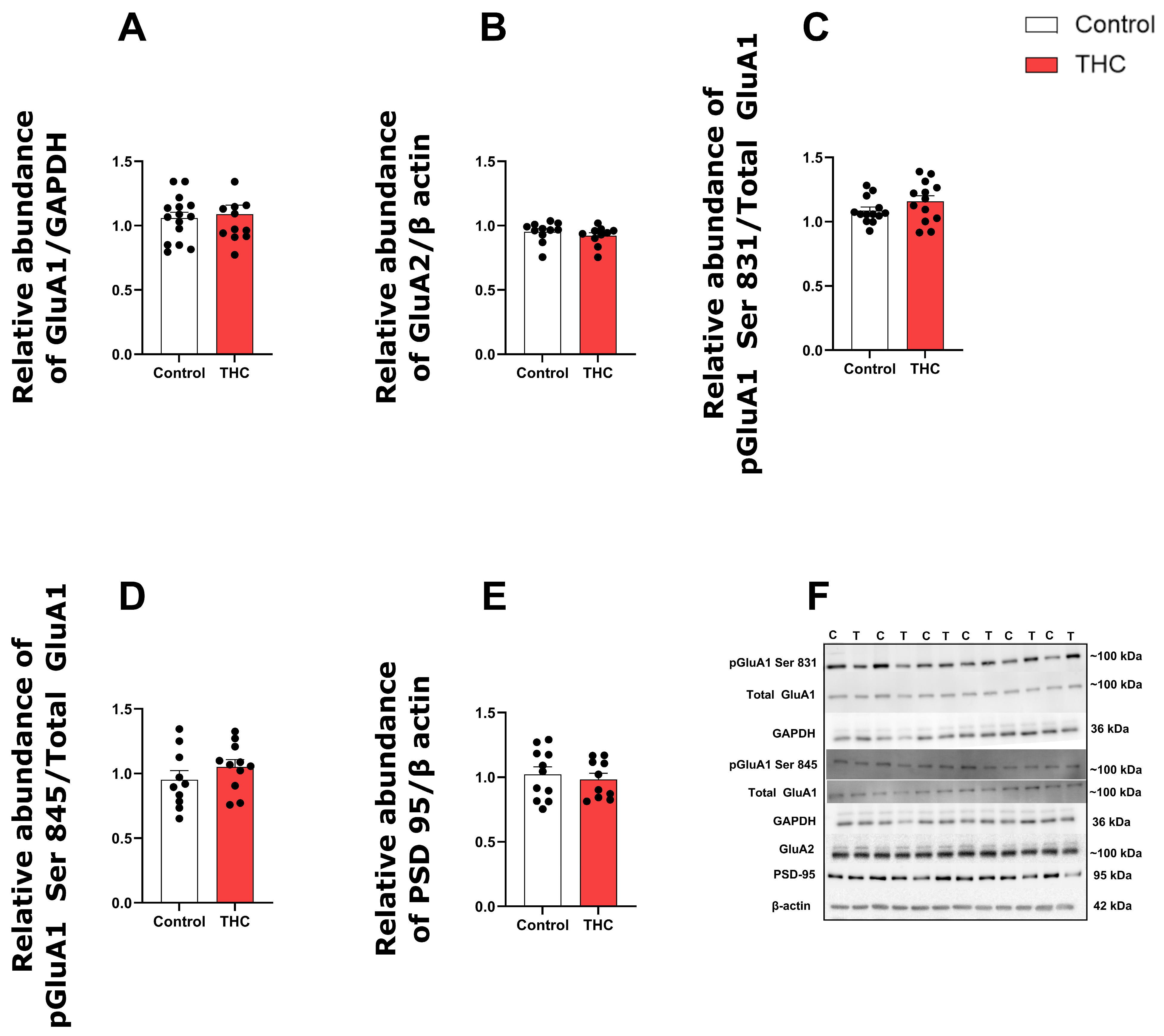
We first examined the effects of prenatal THC exposure on hippocampal AMPAR subunit GluA1 and GluA2 levels. Immunoblot analysis of synaptosomes revealed no significant changes in the expression of GluA1 (p = 0.7369; Figure 1A) or GluA2 (p = 0.3651; Figure 1B) containing AMPARs between control and PCE groups. The functional activity of AMPARs is regulated by phosphorylation of specific residues on the GluA1 subunit [42,43]; we next assessed the phosphorylation state of GluA1 at Ser831 [43] and Ser845 [42,44]. These sites are associated with modulation of channel conductance and trafficking properties [42,43,44], respectively. Immunoblotting results indicated no significant alteration in the expression of phosphorylated GluA1 at Ser831 (p = 0.1872; Figure 1C) or Ser845 (p= 0.2780; Figure 1D) following THC exposure. Given that scaffolding proteins maintain AMPAR anchoring and synaptic stabilization within the postsynaptic density, we also examined the expression of PSD-95 [45]. In alignment with immunoblotting results showing no alteration in receptor levels or function, PSD-95 protein levels were similarly unaffected between the control and THC-treated groups (p = 0.6106; see Figure 1E). This finding corroborates previous studies reporting stable PSD-95 protein expression in the prefrontal cortex after intraperitoneal THC administration [46]. Collectively, these findings indicate that prenatal THC exposure does not affect the total level, phosphorylation status, or synaptic scaffolding of AMPARs, suggesting that prenatal THC does not alter basal AMPAR composition or localization in the hippocampus.

2.2. PCE Decreases the Open Probability of AMPARs and Alters the Dwell Time

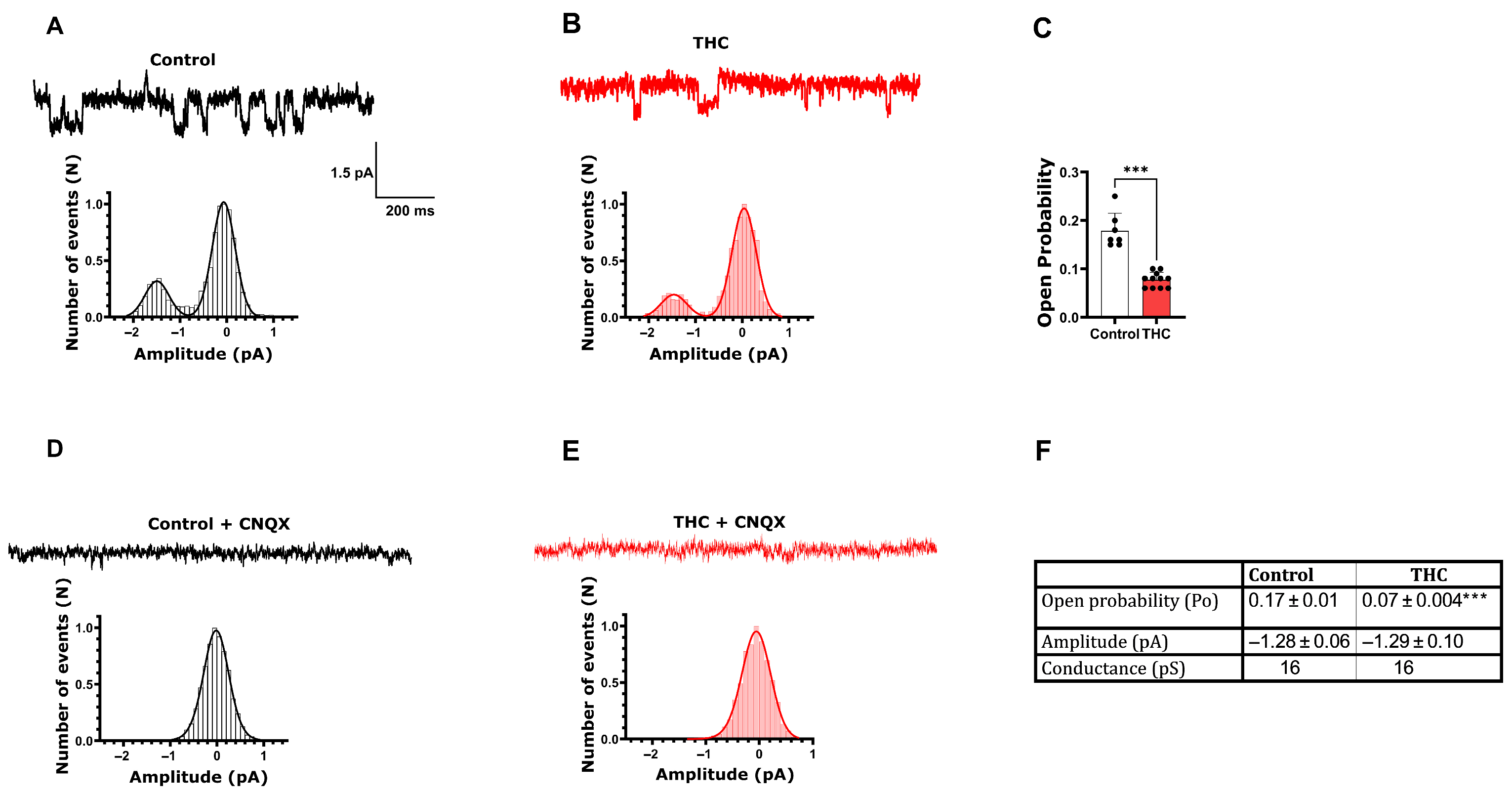
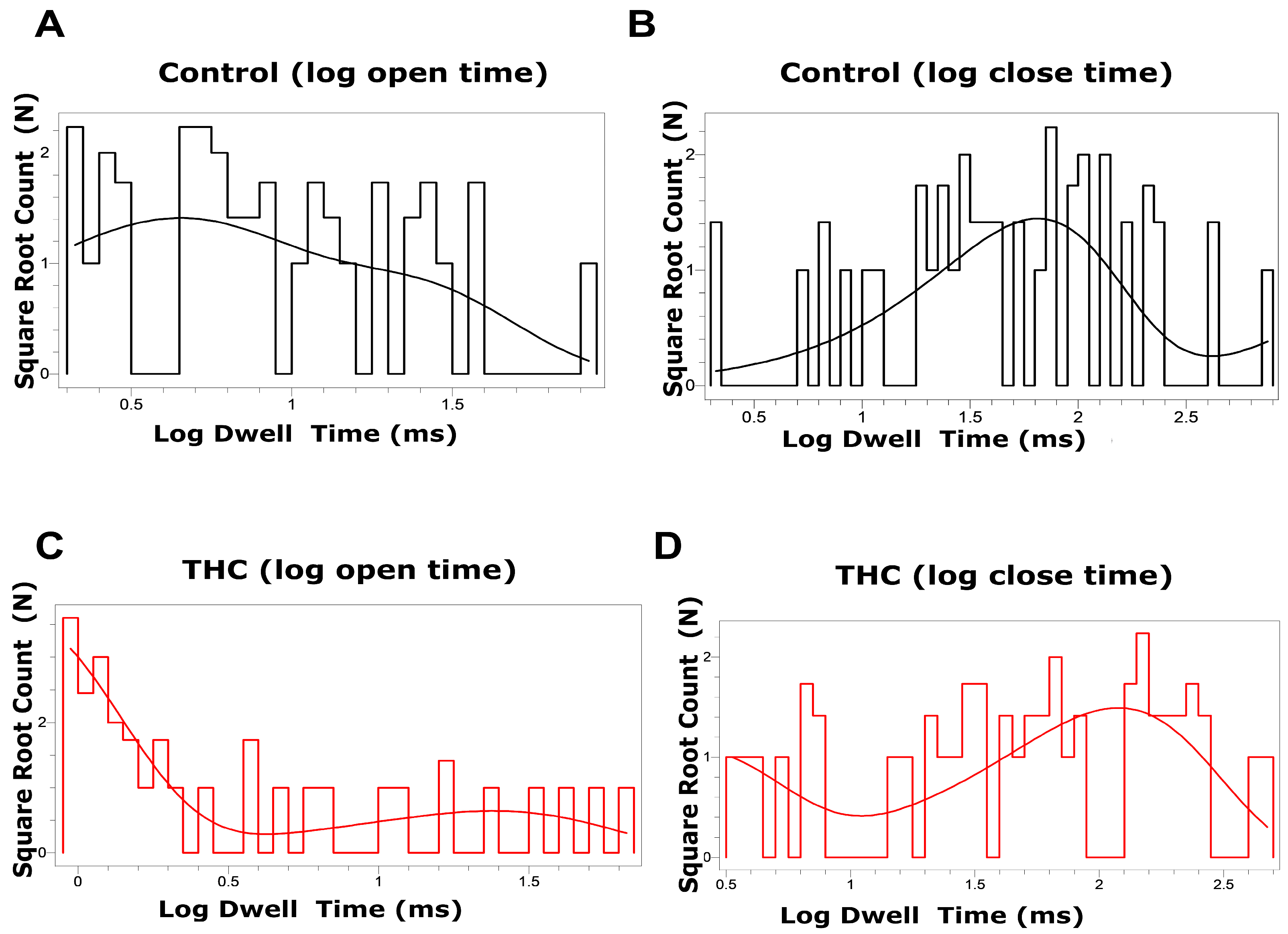
Although total AMPAR expression remained unchanged following prenatal THC exposure, functional alterations in receptor properties could still occur. Given that immunoblotting is a semiquantitative technique with limited sensitivity to subtle functional changes [47,48], we next analyzed synaptosomal AMPAR activity at the single-channel level using single-channel electrophysiology to examine the functional properties of AMPARs, including the probability of opening and conductance. Analysis of single-channel traces obtained from control (probability of opening, Po = 0.25; Figure 2A) and THC (probability of opening, Po = 0.10; Figure 2B) animals revealed a significant reduction in mean probability of opening (Po) in the PCE group (Figure 2C). The reduction in open probability is supported by both the smaller number of channel openings per trace as well as the smaller area under the curve that corresponds to the primary open amplitude of the amplitude histogram from prenatal THC-exposed animals compared to controls. There was no significant change in single-channel conductance in THC animals compared to controls (Figure 2F). This finding is consistent with the absence of changes in GluA1 Ser831 phosphorylation, a modification known to regulate AMPAR single-channel conductance [43]. To confirm that the recorded activity originated from AMPARs, CNQX was applied to the bilayer in both control (Figure 2D) and THC samples (Figure 2E). CNQX abolished channel openings in both groups, thereby verifying that AMPARs mediated the observed channel activity. Furthermore, analyses of dwell time revealed that open times (τo) (Figure 3A,C) were significantly reduced, and dwell closed times (τc) (Figure 3B,D) were significantly increased in THC animals (summarized in Table 1). These findings suggest that prenatal THC-induced alterations in AMPAR single-channel activity may contribute to changes in synaptic plasticity, which could potentially affect learning and memory processes.

2.3. PCE Decreases the Interactive Channel-Gating Activity

To further investigate the functional mechanisms underlying prenatal THC-induced alterations in AMPAR activity, we examined interactive channel gating, which reflects the non-independent, synchronous openings among nearby AMPAR channels. In synaptosomal recordings, the steady-state open probabilities deviate from binomial predictions, indicating cooperative channel gating. This cooperative behavior can underlie larger postsynaptic responses, providing a synaptic gain mechanism. That is, without altering receptor number or unitary conductance, coordinated channel openings can enhance charge transfer and thereby strengthen synaptic efficacy [29,30,49,50].
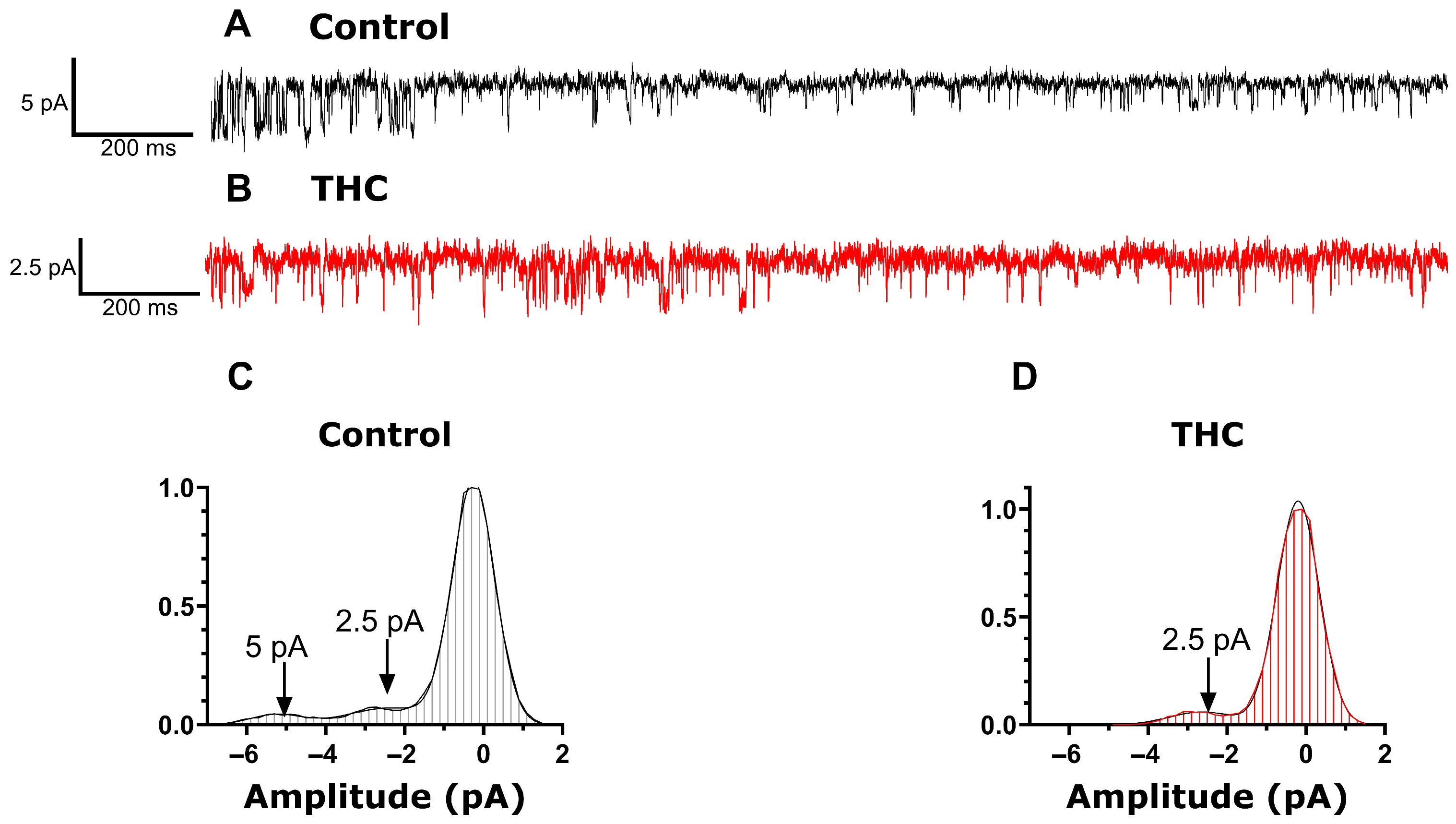
In control animals, AMPARs exhibited robust and frequent gating transitions (Figure 4A,C), as demonstrated by simultaneous channel openings. This is consistent with efficient subunit cooperation. In contrast, synaptosomal AMPARs from prenatally THC-exposed animals displayed no cooperative channel-gating behavior (Figure 4B,D). These findings suggest that prenatal THC exposure interferes with the cooperative activation of AMPAR subunits, leading to impaired receptor kinetics. Such disruption in interactive gating may contribute to alterations in PCE-induced learning and memory that have been previously observed [31,41].

2.4. PCE Modulates Single-Channel Burst Properties of Synaptosomal AMPARs

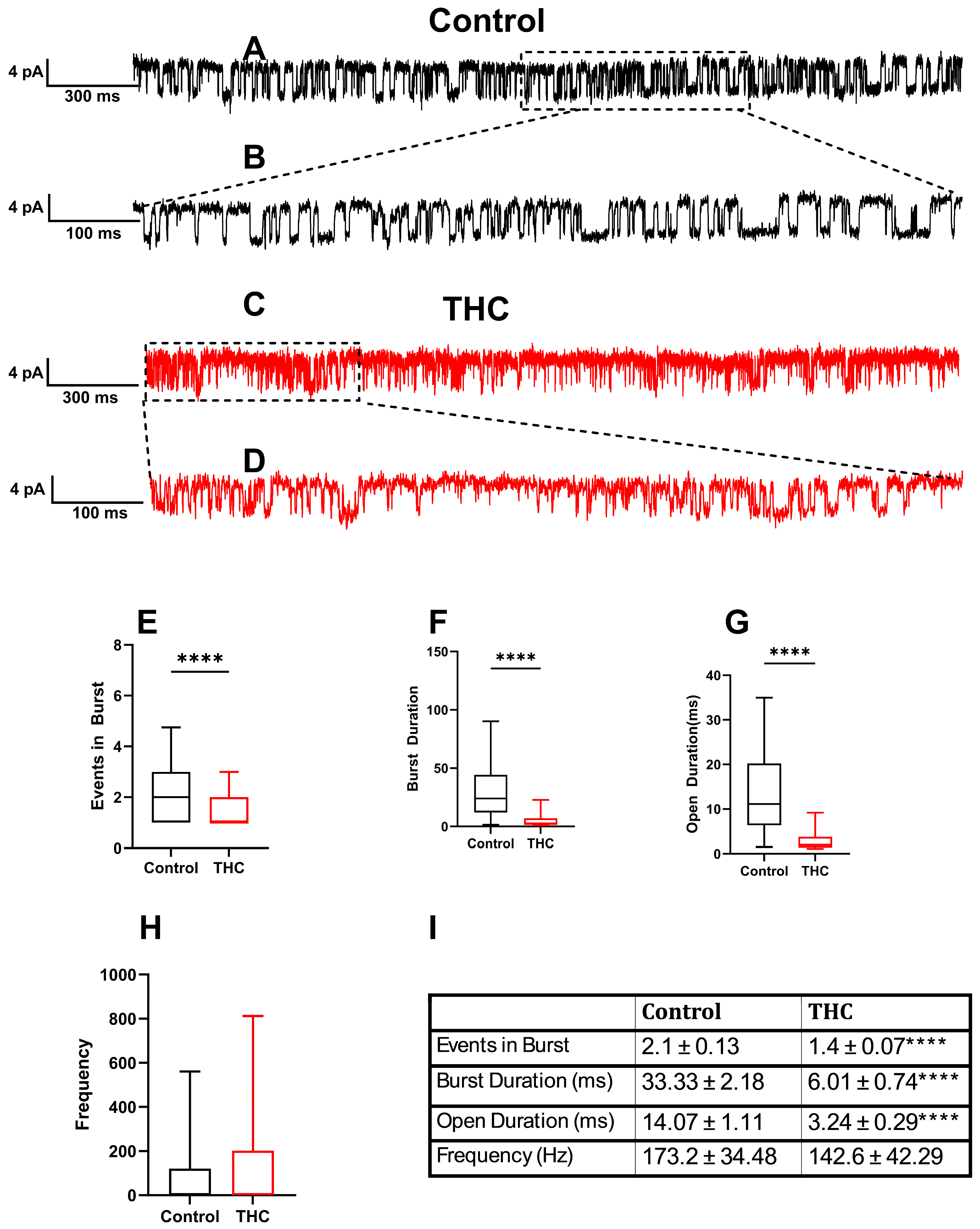
We next evaluated the single-channel burst kinetics of synaptosomal AMPARs (Figure 5A–D). Prenatal THC exposure resulted in fewer opening events per burst (p < 0.0001; Figure 5E) and decreased burst duration (p < 0.0001; Figure 5F). Additionally, the open duration within burst activity also decreased (p < 0.0001; Figure 5G), though the frequency of bursts did not differ (p = 0.1476; Figure 5H) in AMPARs from PCE synaptosomes compared to the control group. Taken together, these results indicate that altered single-channel activity of AMPARs may contribute to altered burst channel properties. In other words, alterations in burst kinetics suggest a disruption of coordinated AMPAR channel gating, which is required to sustain synaptic depolarization and subsequent calcium-dependent signaling. Decreases in burst duration and the number of openings within each burst are expected to reduce the temporal summation of excitatory currents, thereby diminishing postsynaptic activation and the efficiency of activity-dependent plasticity processes, including LTP. Consequently, reduced stability and reliability of AMPAR-mediated burst activity may attenuate synaptic strengthening and contribute to the persistent impairments in excitatory synaptic transmission observed following prenatal THC exposure [27].

3. Discussion

The present study demonstrates that prenatal exposure to a moderate oral dose of Δ9-tetrahydrocannabinol induces profound and persistent impairments in AMPAR channel kinetics in the adolescent hippocampus despite causing no change in receptor levels, phosphorylation status, and synaptic scaffolding molecules. This dissociation reveals that cannabinoid-induced developmental neuroadaptations do not necessarily manifest as changes in receptor abundance but instead emerge through alterations in the biophysical properties of receptor function. Such a mechanism has received limited attention in the cannabinoid literature and underscores the importance of integrating electrophysiological approaches with biochemical analyses when evaluating the long-term consequences of prenatal THC exposure.
In contrast to earlier reports showing that cannabinoid exposure can either upregulate or downregulate AMPAR subunit expression depending on dose, brain region, and route of administration [31,32,33], our findings show unchanged levels of GluA1, GluA2, and PSD95 following oral prenatal THC exposure. Previous studies have similarly reported unchanged GluA2 expression after chronic intraperitoneal THC administration in both the prefrontal cortex [32] and hippocampus [51]. Notably, GluA1 levels in previous studies have exhibited bidirectional changes, either increases or decreases, depending on the cannabinoid compound and exposure parameters used, underscoring the variability across models. The lack of GluA1 alterations in our study may reflect the unique pharmacokinetic profile of orally administered THC, which is characterized by slower absorption [36], prolonged systemic exposure, elevated formation of the potent metabolite 11-hydroxy-THC due to extensive first-pass metabolism [36,37], and potentially more robust compensatory transcriptional regulation during brain development. Homeostatic mechanisms in the developing hippocampus may further maintain AMPAR protein levels to preserve excitatory signaling during critical periods of synaptogenesis [52,53], even as early-life cannabinoid exposure perturbs normal endocannabinoid-mediated maturation of glutamatergic circuitry [54,55]. The unchanged phosphorylation of GluA1-containing AMPARs at Ser831 and Ser845 residues further indicates that canonical kinase and phosphatase pathways regulating AMPAR open probability, conductance, and trafficking remain unaffected by prenatal oral THC exposure, suggesting alternative mechanisms underlying the functional impairment. One limitation of the present study is that the expression of the AMPA receptor subunits GluA3 and GluA4 was not examined. Future studies will address their potential contribution to the observed synaptic plasticity changes.
Despite this biochemical stability, single-channel recordings revealed extensive functional abnormalities, including reduced open probability, shortened open durations, increased closed times, disrupted burst stability, and a complete loss of interactive gating, which is an essential feature of mature AMPAR subunit cooperativity. These alterations represent a fundamental weakening of AMPAR-mediated synaptic transmission that cannot be attributed solely to changes in protein expression. The data instead suggest the involvement of noncanonical regulatory pathways. One possibility is that prenatal THC exposure disrupts the expression or trafficking of AMPAR auxiliary proteins such as Transmembrane AMPAR Regulator Proteins (TARPs), Cornichons (CNIHs), or Germ Cell-Specific Gene 1-Like Protein (GSG1L), which play critical roles in regulating gating kinetics, desensitization, synaptic anchoring, and receptor cooperativity [56,57,58]. Even subtle perturbations in auxiliary protein function could profoundly alter receptor behavior while leaving GluA1/2 levels unchanged. Another plausible mechanism involves THC’s lipophilicity and its integration into neuronal membranes, which could disrupt the composition of lipid rafts, membrane fluidity, and cholesterol distribution [59,60,61]. Given that channel activities are exquisitely sensitive to the biophysical properties of the surrounding membrane [62], such alterations provide a compelling explanation for the disrupted kinetic behavior observed in this study.
Prenatal THC exposure not only exerts membrane-level effects but may also disrupt perinatal synaptogenesis by altering CB1 receptor-mediated signaling pathways essential for glutamatergic axonal development and synapse formation [55,63,64]. Such disruption may lead to the formation of fewer mature AMPAR nanodomains or the incorporation of immature AMPARs. Prenatal THC exposure also induces long-lasting epigenetic modifications in hippocampal circuits [65], which could alter the expression of key signaling molecules regulating AMPAR kinetics, including scaffolding proteins like synapse-associated protein 97 (SAP97), glutamate receptor-interacting protein 1 (GRIP1) [66,67]. These epigenetic changes may endure through adolescence, providing a developmental framework for the persistent functional deficits observed in this study.
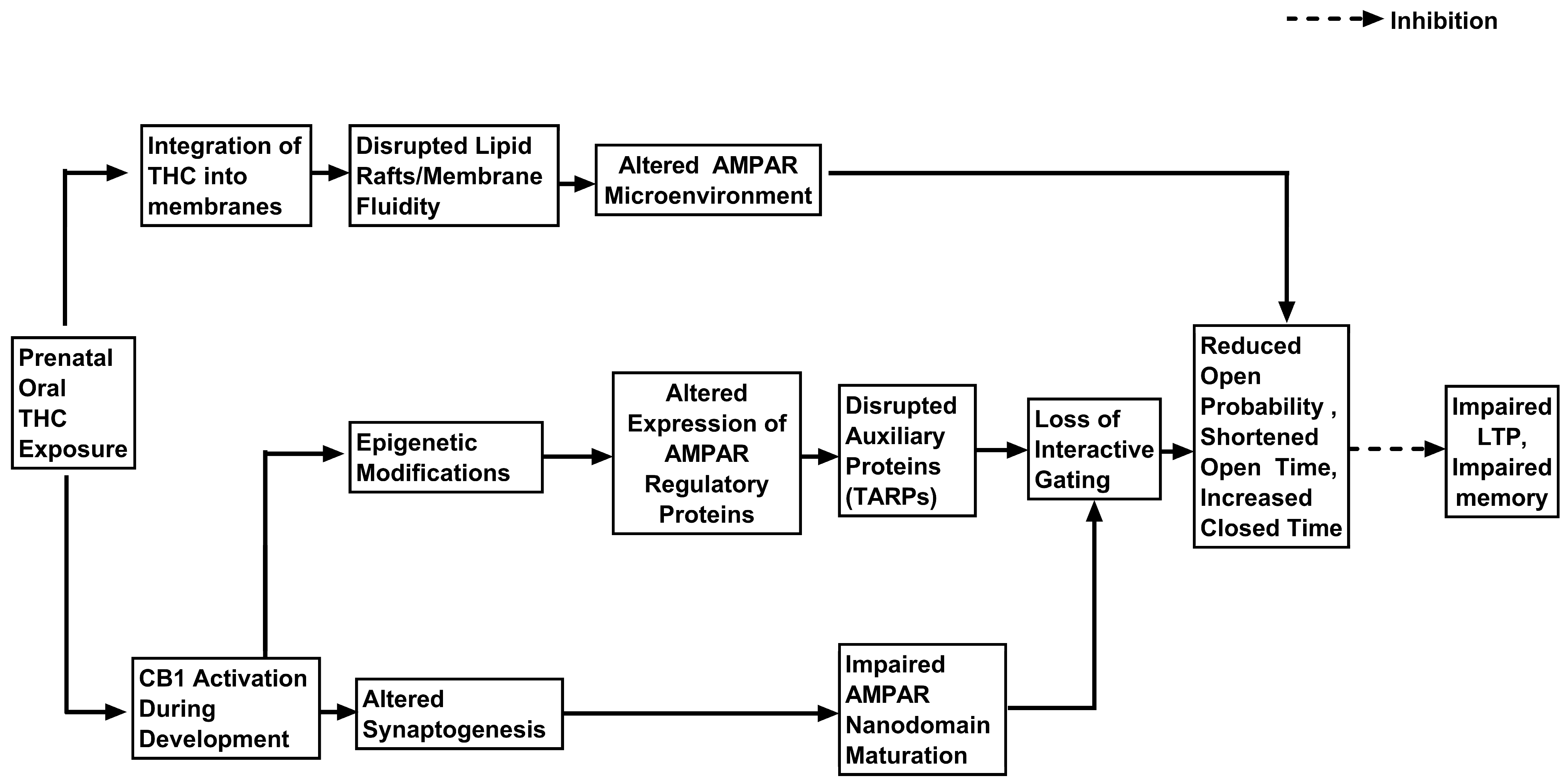
The abnormalities in burst kinetics observed in PCE offspring provide an additional mechanistic link to impaired cognitive function. During high-frequency stimulation, AMPAR burst activity is crucial for generating sufficient postsynaptic depolarization to facilitate LTP induction. The PCE-induced reductions in events per burst indicate that receptors adopt a more unstable or desensitized configuration, reducing sustained charge transfer during plasticity-inducing stimuli. When combined with the loss of interactive gating, these functional deficits would significantly compromise the synaptic efficiency required for learning and memory (Summarized in Figure 6). This aligns with observed deficits in hippocampal-dependent behavior in animal models of PCE [41,68] and provides a mechanistic explanation rooted in fundamental channel dynamics.
Although this study offers novel and compelling insights into how prenatal THC exposure disrupts AMPAR function, several limitations warrant consideration. This study employed only one oral THC dose and exposure window, limiting dose–response interpretation and translational relevance. In addition, although receptor expression was quantified, auxiliary proteins, trafficking regulators, and nanodomain architecture were not assessed directly.

4. Materials and Methods

4.1. Animals

Timed-pregnant Sprague Dawley rats were obtained from Charles River Laboratories (Wilmington, MA, USA). Pregnant dams received a daily dose of THC at 5 mg/kg dissolved in sesame oil (vehicle), orally through a buccopharyngeal cannula from gestational day (GD) 5 to postnatal day (PND) 9. This dose of THC has been found to correspond to a moderate cannabis exposure, and this dosage regimen has not previously been shown to cause maternal or fetal toxicity, with no significant effects on maternal weight gain, fetal growth, litter size, gestational length, or pup survival [69,70,71].
Animals were housed in a controlled vivarium environment with regulated temperature and humidity under a 12 h light/dark cycle and provided food and water ad libitum. All procedures complied with the National Institutes of Health (NIH) guidelines for the Care and Use of Laboratory Animals and received prior approval from the Auburn University Institutional Animal Care and Use Committee (IACUC). Sample size estimation, study design, statistical analyses, and data reporting followed the ARRIVE guidelines. The brain samples from the pups were collected following euthanasia on PND 40–PND 50, which is equivalent to the periadolescent age [72].

4.2. Preparation of Synaptosomes

Synaptosomes were isolated from the hippocampi of male and female pups following previously established procedures [73,74]. Briefly, hippocampal tissues were rapidly dissected and homogenized in modified Krebs buffer (mKRBS) containing (in mM): 118.5 NaCl, 4.7 KCl, 1.18 MgSO4, 2.5 CaCl2, 1.18 KH2PO4, 24.9 NaHCO3, and 10 dextrose, supplemented with 10 mg/mL adenosine deaminase. To minimize proteolytic degradation, the buffer was further enriched with protease-phosphatase inhibitor. The homogenate was filtered and centrifuged, and the resulting pellet containing the synaptosomal fraction was resuspended in fresh mKRBS buffer as described previously [75].

4.3. Immunoblotting

Synaptosomes isolated from both male and female hippocampal tissue were used for immunoblotting. Total protein concentration was determined using the Pierce BCA Protein Assay Kit (Thermo Fisher Scientific, Rockford, IL, USA). Equal amounts of protein (10 µg per sample) were separated by SDS–PAGE and subsequently transferred onto polyvinylidene difluoride (PVDF) membranes.
Membranes were blocked with 5% non-fat dry milk prepared in Tris-buffered saline (TBS) with 0.1% Tween-20 (TBST) for 1 h at room temperature. Following blocking, primary antibodies raised in different host species were then selected and applied simultaneously as a multiplex cocktail, with targets chosen to have distinct apparent molecular weights for overnight incubation at the same time, according to the molecular weights of the target proteins, as determined by Precision Plus Protein™ All Blue Prestained Protein Standards (Bio-Rad, Benicia, CA, USA), allowing multiple proteins to be probed on the same membrane while minimizing antibody use.
Each membrane was incubated overnight at 4 °C with the appropriate primary antibody diluted in 5% bovine serum albumin (BSA) in TBST. After five washes with TBST, membranes were incubated with horseradish peroxidase (HRP)-conjugated secondary antibodies for 1 h at room temperature. Immunoreactive bands were visualized using enhanced chemiluminescence (ECL; Thermo Fisher Scientific) and imaged with an Azure Biosystems 500 imaging system.
Protein expression levels were normalized to β-actin or GAPDH as internal loading controls. Band intensities were quantified using ImageJ software (version 1.53t, NIH). Detailed information regarding the antibodies and their working dilutions is provided in Table 2.

4.4. Single-Channel Electrophysiology

To record single-channel activity, AMPARs were incorporated from synaptosomal preparations into artificial lipid bilayers using the tip-dip method at room temperature. A borosilicate glass pipette (resistance ≈ 100 MΩ) was used to form the phospholipid bilayer at the pipette tip. The pipette was filled with artificial intracellular fluid (aICF) containing (in mM): KCl 110, NaCl 4, NaHCO3 2, MgCl2 1, CaCl2 0.1, and 2 3-(N-morpholino)propanesulfonic acid (MOPS). The solution pH was adjusted to 7.4. All reagents were obtained from Sigma Aldrich, St. Louis, MO, USA. The synthetic phospholipid solution was prepared by dissolving 1,2-diphytanoyl-sn-glycero-3-phosphocholine (Avanti Polar Lipids, Alabaster, AL, USA) in anhydrous hexane (Sigma-Aldrich) at a concentration of 1 mg/mL. Approximately 2–3 µL of this solution was added to 500 µL of artificial extracellular fluid (aECF) containing (in mM): 125 NaCl (Sigma Aldrich), 5 KCl (Sigma Aldrich), 1.25 NaH2PO4 (Sigma Aldrich), and 5 Tris-HCl (Sigma Aldrich), supplemented with 0.001 mM glycine (Sigma Aldrich). Pharmacological blockers were included in the bath to inhibit non-target ion channel activity: 1 µM tetrodotoxin (TTX) (TOCRIS Bioscience), 2 µM tetraethylammonium (TEA) (TOCRIS Bioscience), 50 µM 2-amino-5-phosphonovaleric acid (APV) (Hellobio, Princeton, NJ, USA), 10 µM UBP302 (TOCRIS Bioscience, Minneapolis, MN, USA), and 100 µM bicuculline (Sigma Aldrich), to block sodium, potassium, NMDA, kainate, and GABAA channels, respectively. To confirm the identity of the recorded channels as AMPARs, 10 µM CNQX (6-cyano-7-nitroquinoxaline-2,3-dione), a specific competitive AMPAR antagonist, was applied at the end of each recording to block channel activity completely.
Following the stabilization of the lipid bilayer, 2–3 µL of the synaptosomal suspension was combined with an equal volume of the phospholipid solution and added to the bath. The application of voltage across the bilayer facilitated the incorporation of receptors into the membrane. Single-channel AMPAR-mediated currents were evoked by application of 3 µM glutamate, and recordings were obtained at holding potentials near -80 mV, chosen to optimize event resolution while maintaining bilayer stability.
The synaptosomal single-channel currents, clamped at various voltages, were amplified using an Axopatch 200B (Molecular Devices, Foster City, CA, USA), filtered at 2 kHz, and digitized at 5 kHz via a DigiData 1550B interface (Molecular Devices, San Jose, CA, USA). Data acquisition and analysis were performed with pClamp version 11.2 (Molecular Devices). For the analysis of the single-channel, only recordings exhibiting consistent single-channel current fluctuations with a stable baseline were selected. Single-channel conductance was determined by plotting AMPA-evoked currents against membrane voltage using the equation g = I/(V − Vo), where I represents single-channel current, V the voltage, and Vo the reversal potential. Channel open probability was calculated using the equation Po = Ro/(Rc + Ro), where Rc and Ro represent the areas under the current-amplitude histogram corresponding to the closed and open states, respectively. These values were fitted with the sum of two Gaussians using Clamfit and GraphPad programs. Throughout each experiment, membrane capacitance and resistance were monitored continuously to verify the formation and stability of the membrane.
Another special pattern of single-channel activity, known as burst activity, was also analyzed for the AMPAR. A burst is a continuous sequence of alternating openings and closures of a single ion channel during which the channel reopens repeatedly without remaining closed for a prolonged interval. Burst activity was quantified from long-duration traces exhibiting clear burst patterns, with the burst delimiter defined individually for each receptor type as the minimum interval separating consecutive bursts.

4.5. Statistical Analysis

Statistical analyses were performed using JMP 17 (SAS Institute, Cary, NC, USA), Clampfit 11, and GraphPad Prism 10 software. Synaptosomal samples from male and female offspring were pooled. Unless stated otherwise, comparisons between two experimental groups were analyzed using paired or unpaired Student’s t-tests. Parameters such as open probability and conductance were assessed using Welch’s t-test to correct for unequal variances. Non-normally distributed data obtained from burst analyses were examined using the Kolmogorov–Smirnov test. Data are reported as mean ± SEM, and differences were considered statistically significant at p < 0.05.

5. Conclusions

Prenatal exposure to THC leads to persistent synaptic dysfunction in the developing brain. Notably, moderate-dose prenatal cannabis exposure disrupts the coupling between glutamate receptor abundance and function, diminishing glutamatergic synaptic transmission in the adolescent hippocampus, even in the absence of changes in AMPAR expression or canonical signaling pathways. This newly identified mechanism of neurodevelopmental disruption establishes a direct molecular connection between developmental cannabinoid exposure and enduring cognitive deficits in offspring.

Supplementary Materials

The following supporting information can be downloaded at https://www.mdpi.com/article/10.3390/physiologia6010018/s1, Figure S1: Full-length, uncropped Western blot images of pGluA1 Ser 831, Total GluA1, GAPDH, corresponding to Figure 1, Figure S2: Full-length, uncropped Western blot images of GluA2, β-actin, corresponding to Figure 1, Figure S3: Full-length, uncropped Western blot images of pGluA1 Ser 845, Total GluA1, GAPDH, corresponding to Figure 1. Figure S4: Full-length, uncropped Western blot images of PSD-95, β-actin, corresponding to Figure 1.

Author Contributions

K.U.C., K.T., A.Y., and V.S. performed the experiments and/or analyzed the data. K.U.C. wrote the manuscript with support from S.B., M.N.R., and V.S. All authors provided input in data interpretation and manuscript review. All authors have read and agreed to the published version of the manuscript.

Funding

Research was funded by the National Institutes of Health (NIH), grant number R01 DA046723.

Institutional Review Board Statement

The animal study protocol was approved by the Institutional Review Board of Auburn University (protocol code 2019-3572; Approved on 14 August 2019).

Informed Consent Statement

Not applicable.

Data Availability Statement

The data that is presented here in this study are available on request from the corresponding author.

Conflicts of Interest

The authors declare no conflicts of interest.

Abbreviations

The following abbreviations are used in this manuscript:
AMPAα-amino-3-hydroxy-5-methyl-4-isoxazolepropionic acid
AMPARα-amino-3-hydroxy-5-methyl-4-isoxazolepropionic acid receptors
aECFArtificial Extracellular Fluid
aICFArtificial Intracellular Fluid
APV2-amino-5-phosphonovaleric acid
BSABovine Serum Albumin
CB1Cannabinoid Receptor 1
CNQX6-cyano-7-nitroquinoxaline-2,3-dione
GABAGamma-aminobutyric Acid
GDGestational Day
HRPHorseradish Peroxidase
IACUCInstitutional Animal Care and Use Committee
LTPLong Term Potentiation
LTDLong Term Depression
MOPS2 3-(N-morpholino) Propanesulfonic Acid
mKRBSModified Krebs–Henseleit Buffer
NIHNational Institute of Health
NMDAN methyl D Aspartate
PCEPrenatal Cannabinoid Exposure
PNDPostnatal Day
PSD-95Post Synaptic Density-95
PVDFPolyvinylidene Difluoride
SDS-PAGESodium Dodecyl Sulfate–Polyacrylamide Gel Electrophoresis
TBSTTris-Buffered Saline with 0.1% Tween-20
THCTetrahydrocannabinol
TTXTetrodotoxin
TEATetraethylammonium

References

  1. SAMHSA. Key Substance Use and Mental Health Indicators in the United States: Results from the 2021 National Survey on Drug Use and Health. Available online: https://www.samhsa.gov/data/report/2021-nsduh-annual-national-report (accessed on 13 November 2025).
  2. CDC. State Medical Cannabis Laws. 2024. Available online: https://www.cdc.gov/cannabis/about/state-medical-cannabis-laws.html (accessed on 13 November 2025).
  3. Volkow, N.D.; Han, B.; Compton, W.M.; McCance-Katz, E.F. Self-reported Medical and Nonmedical Cannabis Use Among Pregnant Women in the United States. JAMA 2019, 322, 167. [Google Scholar] [CrossRef] [PubMed]
  4. Joseph, T.; Jones, A.B.; Shu, I. A comparison of meconium screening outcomes as an indicator of the impact of state-level relaxation of marijuana policy. Drug Alcohol Depend. 2015, 156, e104–e105. [Google Scholar] [CrossRef]
  5. Gunn, R.L.; Aston, E.R.; Artis, L.; Nesi, J.; Pedersen, E.R.; Micalizzi, L. Use of cannabis to manage symptoms of mental and physical health conditions during pregnancy: Analysis of a pro-cannabis pregnancy forum. Front. Psychiatry 2024, 15, 1478505. [Google Scholar] [CrossRef]
  6. Vanstone, M.; Panday, J.; Popoola, A.; Taneja, S.; Greyson, D.; McDonald, S.D.; Pack, R.; Black, M.; Murray-Davis, B.; Darling, E. Pregnant People’s Perspectives On Cannabis Use During Pregnancy: A Systematic Review and Integrative Mixed-Methods Research Synthesis. J. Midwifery Womens Health 2022, 67, 354–372. [Google Scholar] [CrossRef] [PubMed]
  7. Kandel, E.R.; Dudai, Y.; Mayford, M.R. The molecular and systems biology of memory. Cell 2014, 157, 163–186. [Google Scholar] [CrossRef]
  8. Kennedy, M.B. Synaptic Signaling in Learning and Memory. Cold Spring Harb. Perspect. Biol. 2013, 8, a016824. [Google Scholar] [CrossRef]
  9. Citri, A.; Malenka, R.C. Synaptic plasticity: Multiple forms, functions, and mechanisms. Neuropsychopharmacology 2008, 33, 18–41. [Google Scholar] [CrossRef]
  10. Fonnum, F. Glutamate: A neurotransmitter in mammalian brain. J. Neurochem. 1984, 42, 1–11. [Google Scholar] [CrossRef]
  11. Sprengel, R.; Seeburg, P.H. The unique properties of glutamate receptor channels. FEBS Lett. 1993, 325, 90–94. [Google Scholar] [CrossRef]
  12. Hansen, K.B.; Wollmuth, L.P.; Bowie, D.; Furukawa, H.; Menniti, F.S.; Sobolevsky, A.I.; Swanson, G.T.; Swanger, S.A.; Greger, I.H.; Nakagawa, T.; et al. Structure, Function, and Pharmacology of Glutamate Receptor Ion Channels. Pharmacol. Rev. 2021, 73, 298–487. [Google Scholar] [CrossRef]
  13. Traynelis, S.F.; Wollmuth, L.P.; McBain, C.J.; Menniti, F.S.; Vance, K.M.; Ogden, K.K.; Hansen, K.B.; Yuan, H.; Myers, S.J.; Dingledine, R. Glutamate receptor ion channels: Structure, regulation, and function. Pharmacol. Rev. 2010, 62, 405–496. [Google Scholar] [CrossRef]
  14. Michaelis, E.K. Molecular biology of glutamate receptors in the central nervous system and their role in excitotoxicity, oxidative stress and aging. Prog. Neurobiol. 1998, 54, 369–415. [Google Scholar] [CrossRef]
  15. Benke, T.A.; Luthi, A.; Isaac, J.T.; Collingridge, G.L. Modulation of AMPA receptor unitary conductance by synaptic activity. Nature 1998, 393, 793–797. [Google Scholar] [CrossRef] [PubMed]
  16. Pereyra, M.; Medina, J.H. AMPA Receptors: A Key Piece in the Puzzle of Memory Retrieval. Front. Hum. Neurosci. 2021, 15, 729051. [Google Scholar] [CrossRef] [PubMed]
  17. Watts, J.J.; Garani, R.; Da Silva, T.; Lalang, N.; Chavez, S.; Mizrahi, R. Evidence That Cannabis Exposure, Abuse, and Dependence Are Related to Glutamate Metabolism and Glial Function in the Anterior Cingulate Cortex: A (1)H-Magnetic Resonance Spectroscopy Study. Front. Psychiatry 2020, 11, 764. [Google Scholar] [CrossRef]
  18. Laaris, N.; Good, C.H.; Lupica, C.R. Delta9-tetrahydrocannabinol is a full agonist at CB1 receptors on GABA neuron axon terminals in the hippocampus. Neuropharmacology 2010, 59, 121–127. [Google Scholar] [CrossRef]
  19. Kendall, D.A.; Yudowski, G.A. Cannabinoid Receptors in the Central Nervous System: Their Signaling and Roles in Disease. Front. Cell Neurosci. 2016, 10, 294. [Google Scholar] [CrossRef] [PubMed]
  20. Katona, I.; Freund, T.F. Multiple functions of endocannabinoid signaling in the brain. Annu. Rev. Neurosci. 2012, 35, 529–558. [Google Scholar] [CrossRef]
  21. Chevaleyre, V.; Takahashi, K.A.; Castillo, P.E. Endocannabinoid-mediated synaptic plasticity in the CNS. Annu. Rev. Neurosci. 2006, 29, 37–76. [Google Scholar] [CrossRef]
  22. Heifets, B.D.; Castillo, P.E. Endocannabinoid signaling and long-term synaptic plasticity. Annu. Rev. Physiol. 2009, 71, 283–306. [Google Scholar] [CrossRef]
  23. Holliday, E.; Chowdhury, K.U.; Chen, K.; Saleem, B.; Yenduri, A.; Suppiramaniam, V. Critical Windows of Vulnerability: Behavioral Dysregulation After Prenatal vs. Adolescent THC Exposure. Psychoactives 2025, 4, 29. [Google Scholar] [CrossRef]
  24. Hoffman, A.F.; Oz, M.; Yang, R.; Lichtman, A.H.; Lupica, C.R. Opposing actions of chronic 9-tetrahydrocannabinol and cannabinoid antagonists on hippocampal long-term potentiation. Learn. Mem. 2007, 14, 63–74. [Google Scholar] [CrossRef]
  25. Hampson, R.E.; Deadwyler, S.A. Cannabinoids, hippocampal function and memory. Life Sci. 1999, 65, 715–723. [Google Scholar] [CrossRef]
  26. Puighermanal, E.; Marsicano, G.; Busquets-Garcia, A.; Lutz, B.; Maldonado, R.; Ozaita, A. Cannabinoid modulation of hippocampal long-term memory is mediated by mTOR signaling. Nat. Neurosci. 2009, 12, 1152–1158. [Google Scholar] [CrossRef]
  27. Chowdhury, K.U.; Holden, M.E.; Wiley, M.T.; Suppiramaniam, V.; Reed, M.N. Effects of Cannabis on Glutamatergic Neurotransmission: The Interplay between Cannabinoids and Glutamate. Cells 2024, 13, 1130. [Google Scholar] [CrossRef]
  28. Coombs, I.D.; Cull-Candy, S.G. Single-channel mechanisms underlying the function, diversity and plasticity of AMPA receptors. Neuropharmacology 2021, 198, 108781. [Google Scholar] [CrossRef]
  29. Twomey, E.C.; Yelshanskaya, M.V.; Grassucci, R.A.; Frank, J.; Sobolevsky, A.I. Channel opening and gating mechanism in AMPA-subtype glutamate receptors. Nature 2017, 549, 60–65. [Google Scholar] [CrossRef]
  30. Vaithianathan, T.; Manivannan, K.; Kleene, R.; Bahr, B.A.; Dey, M.P.; Dityatev, A.; Suppiramaniam, V. Single channel recordings from synaptosomal AMPA receptors. Cell Biochem. Biophys. 2005, 42, 75–85. [Google Scholar] [CrossRef]
  31. Suárez, I.; Bodega, G.; Fernández-Ruiz, J.; Ramos, J.A.; Rubio, M.; Fernández, B. Down-regulation of the AMPA glutamate receptor subunits GluR1 and GluR2/3 in the rat cerebellum following pre- and perinatal Δ9-tetrahydrocannabinol exposure. Cerebellum 2004, 3, 66–74. [Google Scholar] [CrossRef]
  32. Rubino, T.; Prini, P.; Piscitelli, F.; Zamberletti, E.; Trusel, M.; Melis, M.; Sagheddu, C.; Ligresti, A.; Tonini, R.; Di Marzo, V.; et al. Adolescent exposure to THC in female rats disrupts developmental changes in the prefrontal cortex. Neurobiol. Dis. 2015, 73, 60–69. [Google Scholar] [CrossRef]
  33. Zamberletti, E.; Gabaglio, M.; Grilli, M.; Prini, P.; Catanese, A.; Pittaluga, A.; Marchi, M.; Rubino, T.; Parolaro, D. Long-term hippocampal glutamate synapse and astrocyte dysfunctions underlying the altered phenotype induced by adolescent THC treatment in male rats. Pharmacol. Res. 2016, 111, 459–470. [Google Scholar] [CrossRef]
  34. Thompson, R.; DeJong, K.; Lo, J. Marijuana Use in Pregnancy: A Review. Obstet. Gynecol. Surv. 2019, 74, 415–428. [Google Scholar] [CrossRef] [PubMed]
  35. Ko, J.Y.; Farr, S.L.; Tong, V.T.; Creanga, A.A.; Callaghan, W.M. Prevalence and patterns of marijuana use among pregnant and nonpregnant women of reproductive age. Am. J. Obstet. Gynecol. 2015, 213, 201.e1–201.e10. [Google Scholar] [CrossRef]
  36. Huestis, M.A. Human cannabinoid pharmacokinetics. Chem. Biodivers. 2007, 4, 1770–1804. [Google Scholar] [CrossRef] [PubMed]
  37. Grotenhermen, F. Pharmacokinetics and pharmacodynamics of cannabinoids. Clin. Pharmacokinet. 2003, 42, 327–360. [Google Scholar] [CrossRef]
  38. Sturman, D.A.; Moghaddam, B. The neurobiology of adolescence: Changes in brain architecture, functional dynamics, and behavioral tendencies. Neurosci. Biobehav. Rev. 2011, 35, 1704–1712. [Google Scholar] [CrossRef]
  39. Giedd, J.N.; Blumenthal, J.; Jeffries, N.O.; Castellanos, F.X.; Liu, H.; Zijdenbos, A.; Paus, T.; Evans, A.C.; Rapoport, J.L. Brain development during childhood and adolescence: A longitudinal MRI study. Nat. Neurosci. 1999, 2, 861–863. [Google Scholar] [CrossRef]
  40. Casey, B.J.; Giedd, J.N.; Thomas, K.M. Structural and functional brain development and its relation to cognitive development. Biol. Psychol. 2000, 54, 241–257. [Google Scholar] [CrossRef] [PubMed]
  41. Pinky, P.D.; Bloemer, J.; Smith, W.D.; Du, Y.; Heslin, R.T.; Setti, S.E.; Pfitzer, J.C.; Chowdhury, K.; Hong, H.; Bhattacharya, S.; et al. Prenatal Cannabinoid Exposure Elicits Memory Deficits Associated with Reduced PSA-NCAM Expression, Altered Glutamatergic Signaling, and Adaptations in Hippocampal Synaptic Plasticity. Cells 2023, 12, 2525. [Google Scholar] [CrossRef]
  42. Keller, B.U.; Hollmann, M.; Heinemann, S.; Konnerth, A. Calcium influx through subunits GluR1/GluR3 of kainate/AMPA receptor channels is regulated by cAMP dependent protein kinase. EMBO J. 1992, 11, 891–896. [Google Scholar] [CrossRef]
  43. Jenkins, M.A.; Traynelis, S.F. PKC phosphorylates GluA1-Ser831 to enhance AMPA receptor conductance. Channels 2012, 6, 60–64. [Google Scholar] [CrossRef]
  44. Diering, G.H.; Heo, S.; Hussain, N.K.; Liu, B.; Huganir, R.L. Extensive phosphorylation of AMPA receptors in neurons. Proc. Natl. Acad. Sci. USA 2016, 113, E4920–E4927. [Google Scholar] [CrossRef]
  45. Watson, J.F.; Ho, H.; Greger, I.H. Synaptic transmission and plasticity require AMPA receptor anchoring via its N-terminal domain. Elife 2017, 6, e23024. [Google Scholar] [CrossRef]
  46. Rubino, T.; Realini, N.; Braida, D.; Alberio, T.; Capurro, V.; Viganò, D.; Guidali, C.; Sala, M.; Fasano, M.; Parolaro, D. The Depressive Phenotype Induced in Adult Female Rats by Adolescent Exposure to THC is Associated with Cognitive Impairment and Altered Neuroplasticity in the Prefrontal Cortex. Neurotox. Res. 2009, 15, 291–302. [Google Scholar] [CrossRef]
  47. Taylor, S.C.; Posch, A. The design of a quantitative western blot experiment. Biomed. Res. Int. 2014, 2014, 361590. [Google Scholar] [CrossRef] [PubMed]
  48. Aldridge, G.M.; Podrebarac, D.M.; Greenough, W.T.; Weiler, I.J. The use of total protein stains as loading controls: An alternative to high-abundance single-protein controls in semi-quantitative immunoblotting. J. Neurosci. Methods 2008, 172, 250–254. [Google Scholar] [CrossRef] [PubMed]
  49. Shi, E.Y.; Yuan, C.L.; Sipple, M.T.; Srinivasan, J.; Ptak, C.P.; Oswald, R.E.; Nowak, L.M. Noncompetitive antagonists induce cooperative AMPA receptor channel gating. J. Gen. Physiol. 2019, 151, 156–173. [Google Scholar] [CrossRef]
  50. Suppiramaniam, V.; Vaithianathan, T.; Manivannan, K.; Dhanasekaran, M.; Parameshwaran, K.; Bahr, B.A. Modulatory effects of dextran sulfate and fucoidan on binding and channel properties of AMPA receptors isolated from rat brain. Synapse 2006, 60, 456–464. [Google Scholar] [CrossRef] [PubMed]
  51. Fan, N.; Yang, H.; Zhang, J.; Chen, C. Reduced expression of glutamate receptors and phosphorylation of CREB are responsible for in vivo Delta9-THC exposure-impaired hippocampal synaptic plasticity. J. Neurochem. 2010, 112, 691–702. [Google Scholar] [CrossRef]
  52. Turrigiano, G.G.; Nelson, S.B. Homeostatic plasticity in the developing nervous system. Nat. Rev. Neurosci. 2004, 5, 97–107. [Google Scholar] [CrossRef]
  53. Turrigiano, G. Homeostatic synaptic plasticity: Local and global mechanisms for stabilizing neuronal function. Cold Spring Harb. Perspect. Biol. 2012, 4, a005736. [Google Scholar] [CrossRef]
  54. Harkany, T.; Keimpema, E.; Barabas, K.; Mulder, J. Endocannabinoid functions controlling neuronal specification during brain development. Mol. Cell Endocrinol. 2008, 286, S84–S90. [Google Scholar] [CrossRef]
  55. Tortoriello, G.; Morris, C.V.; Alpar, A.; Fuzik, J.; Shirran, S.L.; Calvigioni, D.; Keimpema, E.; Botting, C.H.; Reinecke, K.; Herdegen, T.; et al. Miswiring the brain: Delta9-tetrahydrocannabinol disrupts cortical development by inducing an SCG10/stathmin-2 degradation pathway. EMBO J. 2014, 33, 668–685. [Google Scholar] [CrossRef] [PubMed]
  56. Jackson, A.C.; Nicoll, R.A. The expanding social network of ionotropic glutamate receptors: TARPs and other transmembrane auxiliary subunits. Neuron 2011, 70, 178–199. [Google Scholar] [CrossRef] [PubMed]
  57. Tomita, S.; Adesnik, H.; Sekiguchi, M.; Zhang, W.; Wada, K.; Howe, J.R.; Nicoll, R.A.; Bredt, D.S. Stargazin modulates AMPA receptor gating and trafficking by distinct domains. Nature 2005, 435, 1052–1058. [Google Scholar] [CrossRef] [PubMed]
  58. Chen, L.; Chetkovich, D.M.; Petralia, R.S.; Sweeney, N.T.; Kawasaki, Y.; Wenthold, R.J.; Bredt, D.S.; Nicoll, R.A. Stargazin regulates synaptic targeting of AMPA receptors by two distinct mechanisms. Nature 2000, 408, 936–943. [Google Scholar] [CrossRef]
  59. Beiersdorf, J.; Hevesi, Z.; Calvigioni, D.; Pyszkowski, J.; Romanov, R.; Szodorai, E.; Lubec, G.; Shirran, S.; Botting, C.H.; Kasper, S.; et al. Adverse effects of Delta9-tetrahydrocannabinol on neuronal bioenergetics during postnatal development. JCI Insight 2020, 5, e135418. [Google Scholar] [CrossRef]
  60. Yao, L.; Wells, M.; Wu, X.; Xu, Y.; Zhang, L.; Xiong, W. Membrane cholesterol dependence of cannabinoid modulation of glycine receptor. FASEB J. 2020, 34, 10920–10930. [Google Scholar] [CrossRef]
  61. Rimmerman, N.; Hughes, H.V.; Bradshaw, H.B.; Pazos, M.X.; Mackie, K.; Prieto, A.L.; Walker, J.M. Compartmentalization of endocannabinoids into lipid rafts in a dorsal root ganglion cell line. Br. J. Pharmacol. 2008, 153, 380–389. [Google Scholar] [CrossRef]
  62. Tillman, T.S.; Cascio, M. Effects of membrane lipids on ion channel structure and function. Cell Biochem. Biophys. 2003, 38, 161–190. [Google Scholar] [CrossRef] [PubMed]
  63. Wu, C.S.; Zhu, J.; Wager-Miller, J.; Wang, S.; O’Leary, D.; Monory, K.; Lutz, B.; Mackie, K.; Lu, H.C. Requirement of cannabinoid CB(1) receptors in cortical pyramidal neurons for appropriate development of corticothalamic and thalamocortical projections. Eur. J. Neurosci. 2010, 32, 693–706. [Google Scholar] [CrossRef]
  64. Harkany, T.; Guzman, M.; Galve-Roperh, I.; Berghuis, P.; Devi, L.A.; Mackie, K. The emerging functions of endocannabinoid signaling during CNS development. Trends Pharmacol. Sci. 2007, 28, 83–92. [Google Scholar] [CrossRef]
  65. Szutorisz, H.; Hurd, Y.L. Epigenetic Effects of Cannabis Exposure. Biol. Psychiatry 2016, 79, 586–594. [Google Scholar] [CrossRef]
  66. Dong, H.; O’Brien, R.J.; Fung, E.T.; Lanahan, A.A.; Worley, P.F.; Huganir, R.L. GRIP: A synaptic PDZ domain-containing protein that interacts with AMPA receptors. Nature 1997, 386, 279–284. [Google Scholar] [CrossRef]
  67. Waites, C.L.; Specht, C.G.; Hartel, K.; Leal-Ortiz, S.; Genoux, D.; Li, D.; Drisdel, R.C.; Jeyifous, O.; Cheyne, J.E.; Green, W.N.; et al. Synaptic SAP97 isoforms regulate AMPA receptor dynamics and access to presynaptic glutamate. J. Neurosci. 2009, 29, 4332–4345. [Google Scholar] [CrossRef]
  68. Mereu, G.; Fa, M.; Ferraro, L.; Cagiano, R.; Antonelli, T.; Tattoli, M.; Ghiglieri, V.; Tanganelli, S.; Gessa, G.L.; Cuomo, V. Prenatal exposure to a cannabinoid agonist produces memory deficits linked to dysfunction in hippocampal long-term potentiation and glutamate release. Proc. Natl. Acad. Sci. USA 2003, 100, 4915–4920. [Google Scholar] [CrossRef]
  69. Beggiato, S.; Borelli, A.C.; Tomasini, M.C.; Morgano, L.; Antonelli, T.; Tanganelli, S.; Cuomo, V.; Ferraro, L. Long-lasting alterations of hippocampal GABAergic neurotransmission in adult rats following perinatal Delta(9)-THC exposure. Neurobiol. Learn. Mem. 2017, 139, 135–143. [Google Scholar] [CrossRef]
  70. Trezza, V.; Campolongo, P.; Cassano, T.; Macheda, T.; Dipasquale, P.; Carratu, M.R.; Gaetani, S.; Cuomo, V. Effects of perinatal exposure to delta-9-tetrahydrocannabinol on the emotional reactivity of the offspring: A longitudinal behavioral study in Wistar rats. Psychopharmacology 2008, 198, 529–537. [Google Scholar] [CrossRef]
  71. Campolongo, P.; Trezza, V.; Cassano, T.; Gaetani, S.; Morgese, M.G.; Ubaldi, M.; Soverchia, L.; Antonelli, T.; Ferraro, L.; Massi, M.; et al. Perinatal exposure to delta-9-tetrahydrocannabinol causes enduring cognitive deficits associated with alteration of cortical gene expression and neurotransmission in rats. Addict. Biol. 2007, 12, 485–495. [Google Scholar] [CrossRef]
  72. Sengupta, P. The Laboratory Rat: Relating Its Age With Human’s. Int. J. Prev. Med. 2013, 4, 624–630. [Google Scholar]
  73. Johnson, M.W.; Chotiner, J.K.; Watson, J.B. Isolation and characterization of synaptoneurosomes from single rat hippocampal slices. J. Neurosci. Methods 1997, 77, 151–156. [Google Scholar] [CrossRef] [PubMed]
  74. Suppiramaniam, V.; Vaithianathan, T.; Parameshwaran, K. Electrophysiological analysis of interactions between carbohydrates and transmitter receptors reconstituted in lipid bilayers. Methods Enzymol. 2006, 417, 80–90. [Google Scholar] [PubMed]
  75. Bloemer, J.; Pinky, P.D.; Smith, W.D.; Bhattacharya, D.; Chauhan, A.; Govindarajulu, M.; Hong, H.; Dhanasekaran, M.; Judd, R.; Amin, R.H.; et al. Adiponectin Knockout Mice Display Cognitive and Synaptic Deficits. Front. Endocrinol. 2019, 10, 819. [Google Scholar] [CrossRef] [PubMed]
Figure 1. Prenatal THC exposure does not cause changes in the expression of AMPA receptor subunits, phosphorylation and PSD-95 expression. Western blot data showing no change in the expression of the subunits of AMPARs (A) GluA1 or (B) GluA2, the phosphorylation status of GluA1 (C) pGluA1 Ser 831, or (D) pGluA1 Ser 845, and the scaffolding protein (E) PSD-95. (F) Representative, cropped Western blot images showing the expression of pGluA1 Ser 831, pGluA1 Ser 845, total GluA1, GluA2, and PSD-95. GAPDH and β-actin were used as loading controls. Full-length, uncropped blots are provided in the Supplementary Figures. Western blotting was performed using hippocampal synaptosomal protein fractions isolated from control and THC animals. Symbols represent ± SEM from n = 10–15 different control and THC animals. Each dot represents an individual animal (C = Control, T = THC).
Physiologia 06 00018 g001
Figure 2. Prenatal THC exposure modifies single-channel properties of hippocampal synaptosomal AMPARs. Single-channel currents were isolated in the presence of 3 μM glutamate together with tetrodotoxin (TTX, 1 μM), tetraethylammonium (TEA, 2 μM), 2-amino-5-phosphonovaleric acid (APV, 50 μM), UBP302 (10 μM), and bicuculline (100 μM) to suppress voltage-gated sodium and potassium channels, NMDA receptors, kainate receptors, and GABAA receptors, respectively. The membrane voltage was clamped to resolve channel openings while preserving the integrity of the artificial lipid bilayer (representative traces at −80 mV). (A,B) Amplitude histogram fits and their respective traces from single AMPARs of control and THC animals. Downward deflections in the current traces represent channel openings. Histogram peaks correspond to primary open and closed states of each receptor, 0 pA and 1.5 pA, respectively. (C) Comparison of mean open probabilities between control and prenatal THC-exposed animals revealed a decrease in THC-exposed animals. (D,E) Trace and Amplitude histogram showing the absence of AMPA channel activity when AMPA blocker CNQX was added in the control and THC groups, respectively. (F) Table showing changes in probability of opening of AMPAR activities in THC animals without any changes in conductance and amplitude. Symbols represent means ± SEM from n = 7 control and n = 11 THC animals’ recordings, respectively. *** indicates significant difference in control vs. THC animals; *** p < 0.001.
Physiologia 06 00018 g002
Figure 3. Dwell time histogram showing decreased open time and increased closed time in prenatal THC-exposed animals compared to controls. (A,B) Open and close times logged in control animals, respectively. (C,D) Open and close times logged in THC-exposed animals, respectively. The histograms represent dwell time channel openings and closings, presented with logarithmic binning, and the curve represents the fit of the histogram using a double-exponential function, representing both short (τ1) and long open (τ2) (or closed) time components. n = 4 control and n = 4 animals’ THC recordings were used, respectively.
Physiologia 06 00018 g003
Figure 4. Prenatal exposure to THC decreases interactive channel-gating activity. (AD) Amplitude histogram fit and their corresponding representative traces from control and THC-exposed synaptosomal AMPAR, showing interactive channel gating in the control animals with multiple levels of opening at 2.5 pA and 5 pA, respectively. But THC animals did not show any interactive channel-gating properties. Single-channel currents were recorded in the presence of glutamate (3 μM) with TTX (1 μM), TEA (2 μM), APV (50 μM), UBP302 (10 μM), and Bicuculline (100 μM) to block sodium, potassium, NMDA, kainate, and GABAA ion channels, respectively. The membrane voltage was clamped to resolve channel openings while preserving the integrity of the artificial lipid bilayer (representative traces at −80 mV). Downward deflections correspond to channel openings.
Physiologia 06 00018 g004
Figure 5. Prenatal exposure to THC modifies burst kinetics of synaptosomal AMPARs. Burst events were delineated from single-channel recordings using temporal clustering analysis, with a 5 ms closed-time threshold applied to distinguish consecutive bursts of activity. (AD) Comparison of control versus THC burst activity. For each condition, the upper trace shows a 3000 ms recording segment used for burst analysis, while the lower trace represents a magnified 1000 ms portion extracted from the corresponding upper trace. The sash boxes denote the sections of the compressed trace corresponding to the expanded views. (EH) Graphical representation of collective means ± SEM for events in burst, burst duration, open duration, and frequency, respectively. Prenatal THC exposure significantly decreased the number of events within a given burst, the duration of bursts, and the open duration of events within bursts, and no change was found in the frequency of burst events. (I) Table of Mean ± SEM graphed in (EH). Burst kinetics were recorded in the presence of glutamate (3 μM) with TTX (1 μM), TEA (2 μM), APV (50 μM), UBP302 (10 μM), and Bicuculline (100 μM) to block sodium, potassium, NMDA, kainate, and GABAA ion channels, respectively. The membrane voltage was clamped to resolve channel openings while preserving the integrity of the artificial lipid bilayer (representative traces at −80 mV). Downward deflections correspond to channel openings. Symbols represent means ± SEM from n = 6 control and n = 6 animals’ recordings, respectively. **** indicates significant difference in control vs. THC animals; **** p < 0.0001.
Physiologia 06 00018 g005
Figure 6. Schematic diagram showing the effect of prenatal exposure to THC leading to impaired LTP and impaired memory due to alteration in the single-channel activity of AMPA receptors.
Physiologia 06 00018 g006
Table 1. The effect of THC on single-channel dwell time distribution of synaptosomal AMPA receptors.
Dwell TimeControl (ms)THC (ms)
Open time 1, (τo1)2.9 ± 0.200.40 ± 0.24
Open time 2, (τo2)22.39 ± 0.2011.36 ± 0.19
Closed time 1, (τc1)4.33 ± 0.247.89 ± 0.31
Closed time 2, (τc2)44.03 ± 0.12184.51 ± 0.19
Table 2. Summary of antibodies and working conditions used in the experiments.
AntibodiesHost and TypeSpecificitySourceCatalogDilutionRRID
GAPDHChicken, PolyclonalH M R HrEMD MilliporeAB23021:6000AB_10615768
β-actinRabbit, MH M R Mk Dm ZCell Signaling84571:5000AB_10950489
β-actinRabbit, MH M R Hm Mk DgCell Signaling37001:5000AB_2242334
GluA1Mouse, MonoclonalR MInvitrogenMA5-181171:1000AB_2539491
GluA1 Ser 831Rabbit, MonoclonalH MCell Signaling755741:1000AB_2799873
GluA1 Ser 845Rabbit, MonoclonalH M R Cell Signaling80841:1000AB_10860773
GluA2Rabbit, MonoclonalH M RInvitrogenMA5-350961:3000AB_2849001
PSD 95Rabbit, MonoclonalH M RCell Signaling34091:3000AB_1264242
Anti-rabbit IgGGoatRabCell Signaling70741:5000AB_2099233
Anti-mouse IgGHorseMouseCell Signaling70761:5000AB_330924
Anti Chicken IgYGoatChickenabcamAb971351:10,000AB_10680105
Alexa Fluor 680 goat Anti rabbit IgGGoatRabbitInvitrogenA-210761:3500AB_2535736
IRDye 800 CW Goat Anti Mouse IgGGoatMouseLICORbio926-322101:3500AB_621842
H—Human; M—Mouse; R—Rat; Rab—Rabbit; Hm—Hamster; Mk—Monkey; C—Chicken; Ch—Chimpanzee; Dm—D.melanogaster; Z—Zebrafish; Dg—Dog; Hr—Horse.
Disclaimer/Publisher’s Note: The statements, opinions and data contained in all publications are solely those of the individual author(s) and contributor(s) and not of MDPI and/or the editor(s). MDPI and/or the editor(s) disclaim responsibility for any injury to people or property resulting from any ideas, methods, instructions or products referred to in the content.