Article

Associations Between Hydration, Sodium Intake, and Body Mass in Ultra-Endurance Trail Runners Under Ecological Race Conditions: A Cross-Sectional Field Study


by
Rafael Mendes Amorim
1,
Larissa Quintão Guilherme
2,
Mariana de Santis Filgueiras
1,
Guilherme Pereira Saborosa
2,
Gabrielle Ferreira Pires
3,
Nathan de Oliveira Neumann
3,
Volker Scheer
4,
Luciano Bernardes Leite
2,
Pedro Forte
5,6,7,*,
Alexandra Malheiro
7,
Marcus Vinicius Lucio dos Santos Quaresma
8,
Helton de Sá Souza
2 and
Ana Claudia Pelissari Kravchychyn
1,*
1
Department of Nutrition and Health, Universidade Federal de Viçosa, Viçosa 36570-900, MG, Brazil
2
Department of Physical Education, Universidade Federal de Viçosa, Viçosa 36570-900, MG, Brazil
3
Department of Agricultural Engineering, Universidade Federal de Viçosa, Viçosa 36570-900, MG, Brazil
4
Ultra Sports Science Foundation, 109 Boulevard de l’Europe, 69310 Pierre-Benite, France
5
Department of Sports, Instituto Politécnico de Bragança, 5300-253 Bragança, Portugal
6
Research Center for Active Living and Wellbeing (Livewell), Instituto Politécnico de Bragança, 5300-253 Bragança, Portugal
7
Department of Sports, Higher Institute of Educational Sciences of the Douro, 4560-708 Penafiel, Portugal
8
Exercise and Quality of Life Research Laboratory, São Camilo University Center, São Paulo 05433-010, SP, Brazil
*
Authors to whom correspondence should be addressed.
Physiologia 2026, 6(1), 21; https://doi.org/10.3390/physiologia6010021
Submission received: 11 February 2026 / Revised: 12 March 2026 / Accepted: 15 March 2026 / Published: 19 March 2026
(This article belongs to the Section Exercise Physiology)

Abstract

Background: Hydration and electrolyte strategies are critical in mountain ultra-endurance events, yet field-based evidence from trail races remains limited. This study examined the relationship between fluid intake, sodium consumption, and body mass changes in trail runners competing under real environmental conditions. Methods: A cross-sectional field study was conducted during La Misión Brasil 2024. Athletes of both sexes competing in the endurance race (35 km; EG: n = 15; age = 37.0 [29.5–46.0] years; 12 men and 3 women) and the ultra-endurance race (80 km; UEG: n = 13; age = 42.0 [37.0–46.0] years; 11 men and 2 women) were included in the study. Pre- and post-race body mass were assessed, and in-race fluid and food intake were collected using an adapted 24-h dietary recall. Water and sodium intake were expressed as total (L and mg, respectively) and per-hour (mL/h and mg/h, respectively) values. Environmental temperature and humidity were obtained from a local weather station. Group comparisons were performed using the Mann–Whitney U test, and associations were examined with Spearman’s correlation (p < 0.05). Results: EG (n = 15) and UEG (n = 13) showed similar absolute and relative body mass changes (2.6% to −3.0%; p > 0.05). EG runners presented greater weight loss rate (−270 vs. −115 g/h; p = 0.002), while UEG consumed higher total water (7.11 vs. 4.14 L; p = 0.008) and sodium (5789 vs. 2857 mg; p = 0.003). Water intake per hour was higher in EG (626 vs. 427 mL/h; p = 0.017). Body Mass Index was negatively correlated with hourly weight loss (r = −0.605; p < 0.001). Water and sodium intake per hour were positively correlated (r = 0.607; p < 0.001), though neither predicted hourly weight loss. Conclusions: Hydration responses may differ according to environmental stress and pacing demands. Changes in body mass may not necessarily reflect hydration adequacy, suggesting a possible multifactorial nature of hydroelectrolyte balance during mountain endurance events.

1. Introduction

Trail running is defined by the International Trail Running Association (ITRA) as a foot race conducted in natural environments, with no more than 20% of the course on paved roads and performed under self-sufficient or semi self-sufficient conditions [1]. Prolonged-duration trail running events, classified within the broader category of ultra-endurance sports, are defined by competition durations of six hours or longer, rather than by race distance alone. Ultra-endurance athletes may compete for extended periods (e.g., ranging from several hours to multiple days), with or without rest intervals, often encountering considerable challenges in maintaining adequate nutrition and hydration throughout the event [2,3].
These events are typically characterized by challenging terrain, substantial elevation gain, and extended exposure to environmental stressors, imposing high physiological and psychological demands on athletes [4,5]. Prolonged ultra-endurance efforts impose substantial physiological stress, high energy expenditure, and transient alterations in multiple organ systems, including skeletal muscle, heart, liver, and kidneys, highlighting the complex demands on athletes during ultra-marathon events [6]. Accordingly, they require long-term physical preparation, adequate nutritional strategies, effective adaptation to environmental and temperature conditions, as well as significant psychological resilience [7].
Adequate water and electrolyte intake is essential for sustaining physical performance, as it supports homeostasis, thermoregulation, and the transport of nutrients. It also contributes to neuromuscular function [8,9]. In endurance athletes, dehydration may impair physical performance [10]. These effects result from reduced plasma volume, which compromises thermoregulation and elevates core temperature, potentially increasing the risk of heat-related illness. Body water loss is strongly influenced by environmental factors, especially temperature and humidity. High temperatures combined with low relative humidity produce a high vapor pressure deficit, accelerating sweat loss and promoting physiological stress [8,10,11].
Excessive fluid intake can contribute to exercise-associated hyponatremia (EAH), a form of dilutional hyponatremia that occurs when serum sodium concentration falls below normal (<135 mmol/L) during or up to ~24 h after prolonged exercise [12,13]. This condition may cause nausea, headache, and confusion, and in severe cases can progress to exercise-associated hyponatremic encephalopathy with life-threatening neurologic complications [14]. Symptom severity depends on both the magnitude of the fall in plasma sodium and the rate at which sodium declines, meaning clinically significant symptoms may occur not only with very low values (often <125 mmol/L) but also with more moderate concentrations (e.g., 125–130 mmol/L) when the decrease develops rapidly [13,15].
In this context, sodium is the primary electrolyte involved in extracellular fluid balance during prolonged exercise, while other electrolytes also contribute to neuromuscular function and cellular homeostasis. However, many sodium-containing sports drinks are hypotonic relative to plasma and do not prevent EAH in the presence of excessive fluid intake, as the dilutional effect of water overload predominates [15,16].
Monitoring body mass changes during prolonged exercise has historically been used as a practical surrogate of hydration status [17]. However, in field conditions, this measure is influenced by multiple non-fluid factors, including substrate oxidation, glycogen-associated water shifts, food and fluid intake, and gastrointestinal content. As a result, changes in body mass during endurance events do not exclusively reflect fluid balance and should be interpreted with caution [18]. While body mass monitoring may provide contextual information when combined with other markers, it does not reliably represent true hydration status when used as a stand-alone indicator for guiding hydration strategies [19,20]. Given this uncertainty, appropriate fluid intake remains important to support performance and reduce the risk of dehydration, whereas EAH is primarily related to excessive fluid intake and positive fluid balance, irrespective of sodium consumption [12,14,21].
Although some field studies have investigated hydration and electrolyte balance in ultra-endurance events, particularly in hot environments, methodological heterogeneity and context-specific designs limit the generalizability of findings to mountain trail races, resulting in variable and sometimes inconsistent conclusions [3,11,22]. Thus, research conducted under real race conditions is essential to elucidate how fluid and sodium intake influence hydration status and body mass variation. The present study aimed to assess these parameters and their interrelationships in trail runners participating in competitive events.

2. Results

2.1. Participant Characteristics and Hydration-Related Variables

A total of 28 athletes were included, with 15 in the endurance group (EG: 12 men, 3 women) and 13 in the ultra-endurance group (UEG: 11 men, 2 women). UEG and EG were similar in age and BMI. As expected, UEG had a longer total time (17.6 [15.5–17.8] vs. 6.95 [5.95–7.79] h; U = 0.0, p < 0.001). Pre- and post-race body mass did not differ between groups, nor did absolute or relative body mass change.
The weight loss rate (WLR) was greater in EG (−270 [−376 to −215] vs. −115 [−173 to −81.3] g/h; U = 31.0, p = 0.002). Total water intake was higher in UEG (7.109 [5.209–8.787] vs. 4.139 [3.285–5.469] L; U = 39.0, p = 0.008), whereas water intake rate (WIR) was higher in EG (626 [545–710] vs. 427 [294–538] mL/h; U = 45.0, p = 0.017). Total sodium intake was higher in UEG (5.789 [3.985–9.492] vs. EG 2.857 [2.606–3.938] mg; U = 33.0, p = 0.003), while sodium intake rate (SIR) did not differ significantly (U = 64.0, p = 0.128). Detailed descriptive statistics and corresponding p-values are reported in Table 1.

2.2. Air Temperature and Relative Humidity Patterns Across Race Formats

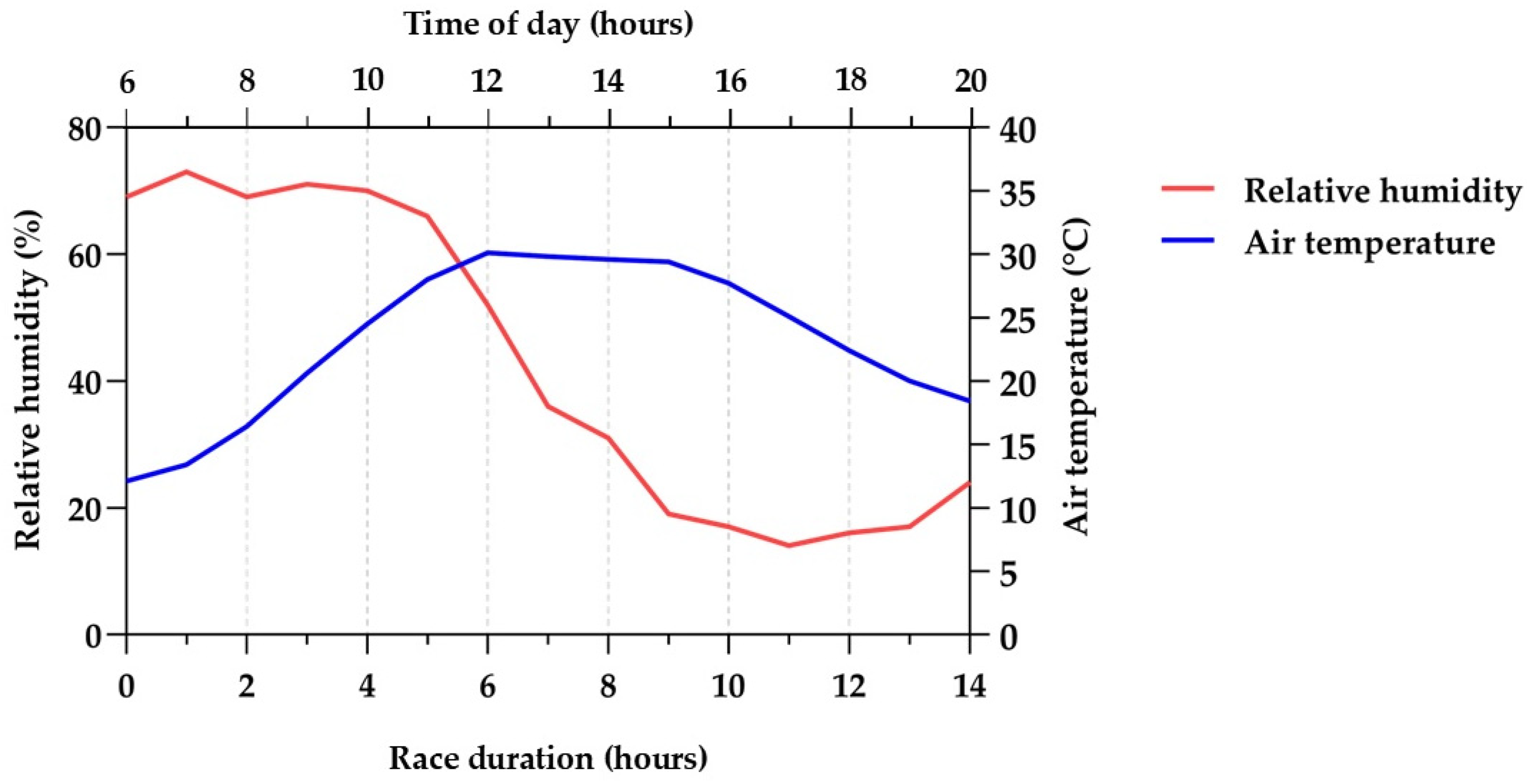
Across race formats, athletes competed under warm environmental conditions, characterized by distinct temperature–humidity dynamics. In the EG race (Figure 1), held on 17 August, started at 06:00 h and had a total duration of 14 h, air temperature increased steadily from approximately 12 °C at the start to nearly 30–31 °C by mid-race, remaining elevated thereafter. Concurrently, relative humidity declined sharply from around 70–75% to 20–30%, reaching a minimum of 14%, indicating a progressively hotter and drier environment.
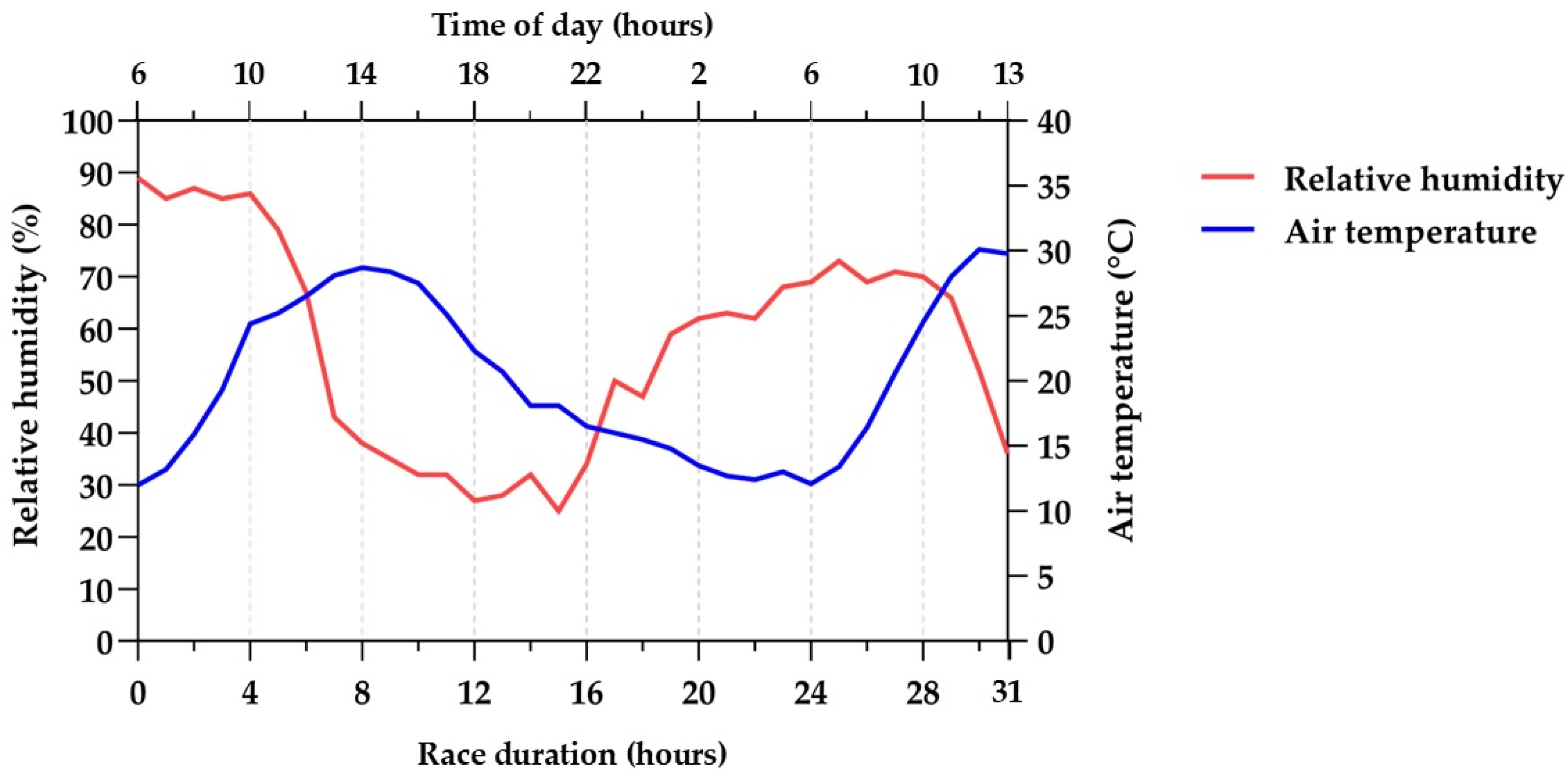
In contrast, the UEG race (Figure 2) was held on 16 August, also started at 06:00 h and had a time limit of 31 h, exhibited a typical diurnal–nocturnal temperature pattern, with an initial rise to ~28–30 °C followed by nocturnal cooling to 14–16 °C, accompanied by a rebound in humidity (up to ~60–75%), and a subsequent warming phase approaching 30 °C toward the end. This pattern created alternating periods of hot–dry and cool–humid conditions throughout the prolonged duration of the event.
Summary climate metrics for both race formats are presented in Table 2, showing climatological and the expressively higher average temperature and lower mean humidity in the EG race (Tave = 23.2 °C; Have = 42.9%) compared to the UEG race (Tave = 20.1 °C; Have = 56.9%).

2.3. Associations Among BMI, Body Mass Change, and Fluid–Electrolyte Intake

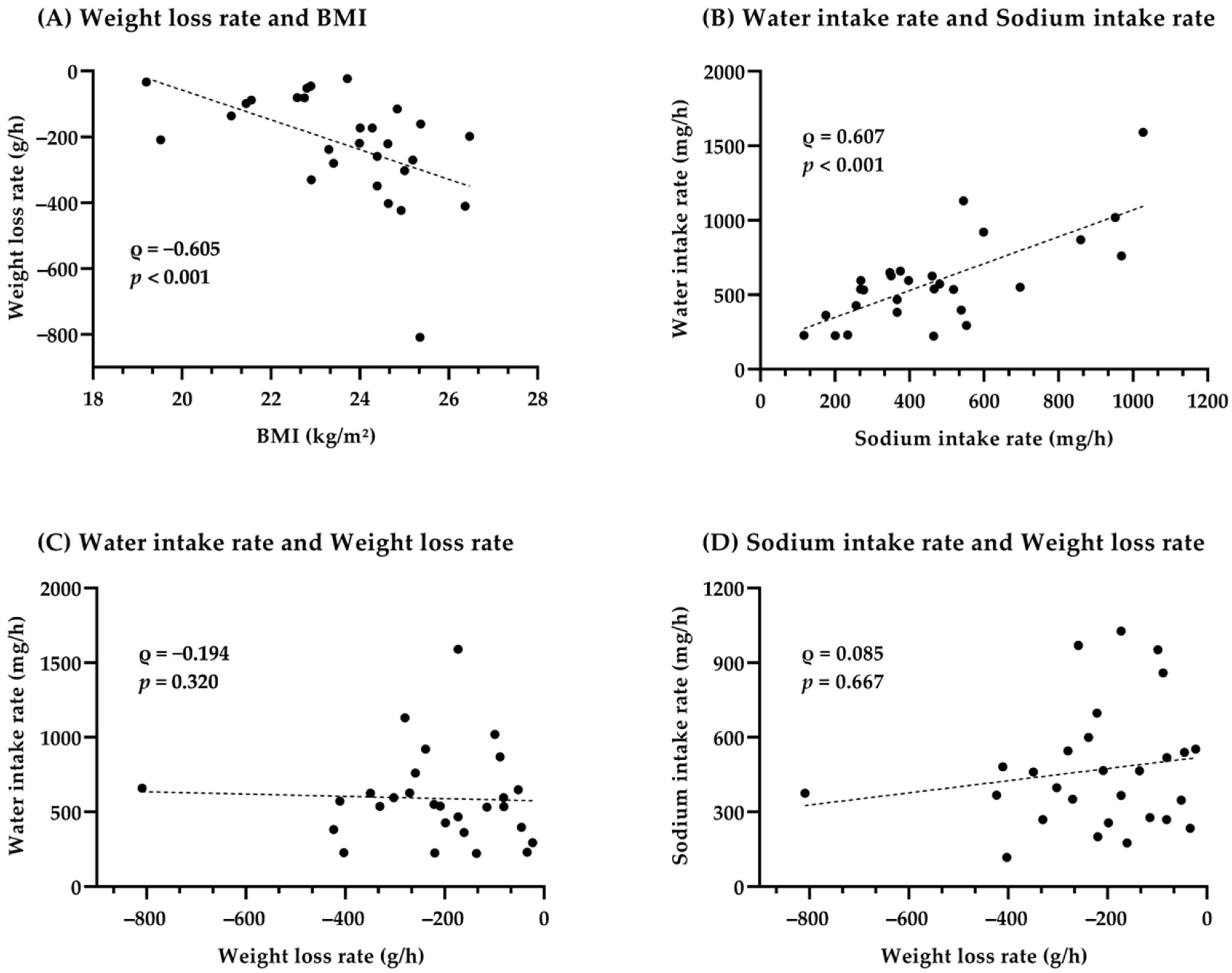
In Spearman analyses (Figure 3), BMI was negatively correlated with WLR (ρ = −0.605; p < 0.001; moderate), indicating greater per-hour mass loss at higher BMI. A positive correlation was observed between WIR and SIR (ρ = 0.607; p < 0.001; moderate), consistent with synchronization of hydration and electrolyte replacement rates. No significant associations were found between WLR and either WIR (ρ = −0.194; p = 0.320; very weak) or SIR (ρ = 0.085; p = 0.667; very weak).

3. Discussion

This study investigated hydration patterns, sodium intake, and body mass changes in trail athletes under real race conditions, aiming to understand how environmental stress and individual characteristics influence these responses. Three main findings emerged: (i) despite similar Δ body mass (kg and %) between groups, the WLR was higher in EG; (ii) UEG ingested higher total volumes of fluid and sodium, consistent with their longer race duration, whereas per-hour intake was greater in EG; and (iii) BMI showed a moderate negative correlation with WLR, while WIR and SIR were positively correlated, indicating a synchronized hydration-electrolyte replacement pattern, though intake rates were not associated with hourly body mass loss.
The higher hourly body mass loss in endurance runners was probably driven by the warmer and drier environmental conditions, which enhanced sweat evaporation, combined with a higher relative exercise intensity maintained throughout the shorter event duration [17,23]. Elevated air temperature and low relative humidity increase the vapor pressure deficit, enhancing sweat evaporation and promoting greater fluid loss per unit time [24]. In contrast, the ultra-endurance race presented a two-phase thermal pattern, with cooler nocturnal conditions and higher relative humidity, which likely reduced evaporative water loss despite the longer exposure [25,26]. These findings are consistent with previous observations indicating that environmental heat stress and pacing intensity, rather than race duration per se, are major contributors to fluid loss during ultra-endurance exercise [27,28].
The absence of a clear relationship between hourly body mass loss and fluid or sodium intake supports the notion that body mass change, although widely used in practice, may not fully capture fluid and electrolyte balance during prolonged exercise [19]. Acute reductions in body mass during prolonged exercise reflect not only sweat losses but also metabolic substrate oxidation, glycogen-associated water release, respiratory water loss, and gastrointestinal content fluctuations [20,29]. Moreover, factors such as gastrointestinal discomfort, which are common during ultra-endurance events, can also influence voluntary fluid and sodium intake [3,30]. In addition, athletes’ opportunities to drink are constrained by terrain and checkpoint distribution, producing large inter-individual variability in intake behavior [31,32]. Thus, greater fluid consumption does not necessarily translate into smaller body mass loss. Hydration behaviors and body mass changes often diverge due to the complex interplay of environmental and physiological factors [33,34].
The negative association between BMI and WLR suggests that athletes with higher body mass may have experienced greater relative dehydration rates, possibly due to increased metabolic heat production and elevated sweat rates required for thermoregulation [24,35]. Athletes with larger body size tend to accumulate more metabolic heat and produce higher sweat rates, but differences in thermoregulatory efficiency, heat dissipation, and pacing behavior can modify these responses [35]. Nevertheless, the influence of morphological characteristics on fluid balance is multifactorial, and BMI remains a limited anthropometric index [16].
The moderate positive correlation between WIR and SIR indicates that athletes tended to co-ingest fluids and electrolytes, aligning with current recommendations that emphasize the synergistic role of sodium in maintaining plasma volume, promoting intestinal water absorption, and reducing the risk of EAH [36]. Sodium enhances fluid retention by stimulating thirst and decreasing urinary output, while also facilitating the absorption of glucose and water through sodium-glucose cotransport in the small intestine [37]. This co-ingestion strategy is particularly relevant in endurance events where sustained sweating and prolonged exposure to environmental stress elevate electrolyte losses and challenge homeostatic regulation [15,36]. Therefore, the observed association reflects an adequate behavioral adaptation to maintain hydration and electrolyte balance under competitive conditions.
The lack of correlation between fluid intake and body mass change indicates that total fluid or sodium consumption alone is not a reliable predictor of hydration adequacy [12,28]. This finding reinforces that hydration status during ultra-endurance exercise is determined by multiple interacting factors, including individual sweat rate and composition, environmental heat load, exercise intensity, and gastrointestinal tolerance. Variability in these parameters can markedly alter fluid turnover and electrolyte balance, making uniform intake targets insufficient to ensure euhydration [16,37]. Moreover, excessive fluid intake, regardless of sodium consumption, may result in dilutional hyponatremia due to a positive fluid balance, whereas insufficient fluid intake may exacerbate dehydration and compromise cardiovascular and hemodynamic stability [12,14,38]. In addition, other cardiovascular risk factors should be considered in endurance athletes, as extreme volumes of exercise have been associated with transient right ventricular dysfunction, myocardial remodeling, and increased incidence of atrial fibrillation, especially in experienced and middle-aged athletes, indicating a cumulative effect of prolonged intense training on cardiac health [38,39,40,41].
Environmental conditions had a substantial impact on hydration responses across both race formats [16,42]. Temperature and humidity values diverged markedly from the expected climate conditions in the city where the event took place (Passa Quatro, Brazil) with the endurance occurring under higher temperatures (≈30 °C vs. climatological average 23.4 °C) and much lower relative humidity (≈20–30% and a dramatic minimum of 14% vs. ~71%), creating a pronounced vapor pressure deficit that intensified evaporative heat loss and increased sweat rates [43]. In contrast, the UEG race spanned a broader range of microclimatic conditions, including hot–dry periods similar to those experienced in the EG, followed by cooler nocturnal phases with higher humidity, which likely reduced evaporative demand and moderated hourly fluid losses despite longer exposure. It is also important to note that climatological averages are based on the urban area of Passa Quatro, whereas the course traversed higher-altitude terrain in the mountain (Serra Fina), where temperature and humidity exhibit sharper fluctuations and more extreme values. These environmental differences help explain the greater WLR observed in endurance athletes, while the alternating thermal conditions in the ultra-endurance contributed to lower hourly losses but higher total intake due to prolonged race duration.
This study offers important strengths, including in-situ data collection during actual competition, integration of environmental variables, and simultaneous assessment of fluid and sodium intake across race formats. Results emphasize that hydration and sodium intake recommendations must consider race duration, environmental stress, and individual athlete characteristics. However, there are a few caveats. (i) The adapted 24-h dietary recall is susceptible to recall bias and may not accurately reflect fragmented intake patterns in technical mountain terrain. (ii) The absence of direct hydration markers, such as sweat rate, sweat sodium concentration, or blood (plasma/serum) sodium measurements, limits the precision of dehydration and electrolyte balance estimates and precludes direct confirmation of EAH. Although point-of-care blood sodium testing (e.g., i-STAT) is increasingly used in endurance event medical settings, such measurements were not feasible in the present field study due to logistical and infrastructural constraints during competition. (iii) Environmental data were obtained from a single weather station, which may not fully represent microclimatic variation along the course. (iv) Additionally, the small and sex-imbalanced sample reduces generalizability. (v) Another limitation is the absence of objective measures of athletes’ fitness level, which could have provided a more comprehensive characterization of participants’ conditioning status. Future studies should incorporate point-of-care blood sodium assessment alongside real-time intake monitoring, multipoint body mass assessments, physiological hydration biomarkers, and georeferenced environmental measures to more accurately characterize hydration dynamics in mountain ultra-endurance settings.

4. Materials and Methods

4.1. Study Design and Data Collection

This cross-sectional study was carried out during La Misión Brasil 2024, Serra Fina, Passa Quatro, Minas Gerais, Brazil with trail athletes. The event comprised 35 km (Endurance Group, EG) and (80 km ultra-endurance Group, UEG) races, which presented total elevation gains of 2691 m and 5511 m, respectively. Participants were invited to participate through the event organization, with announcements posted on the official communication channels. The inclusion criteria were as follows: athletes officially registered for the race, with at least two years of trail running experience, a minimum training frequency of three sessions per week, and participation in either the 35 km or 80 km race distances. Exclusion criteria included failure to provide written informed consent, not completing the race, or not completing any of the proposed assessments during the study procedures.
This study was reported in accordance with the Strengthening the Reporting of Observational Studies in Epidemiology (STROBE) guidelines for cross-sectional studies. The completed STROBE checklist is provided as Supplementary Material. The protocol was approved by the Human Research Ethics Committee of the Federal University of Viçosa (approval no. 4.846.093) and carried out in accordance with the principles of the Declaration of Helsinki and the International Ethical Guidelines for Health-related Research Involving Humans. All participants provided written informed consent before participation.
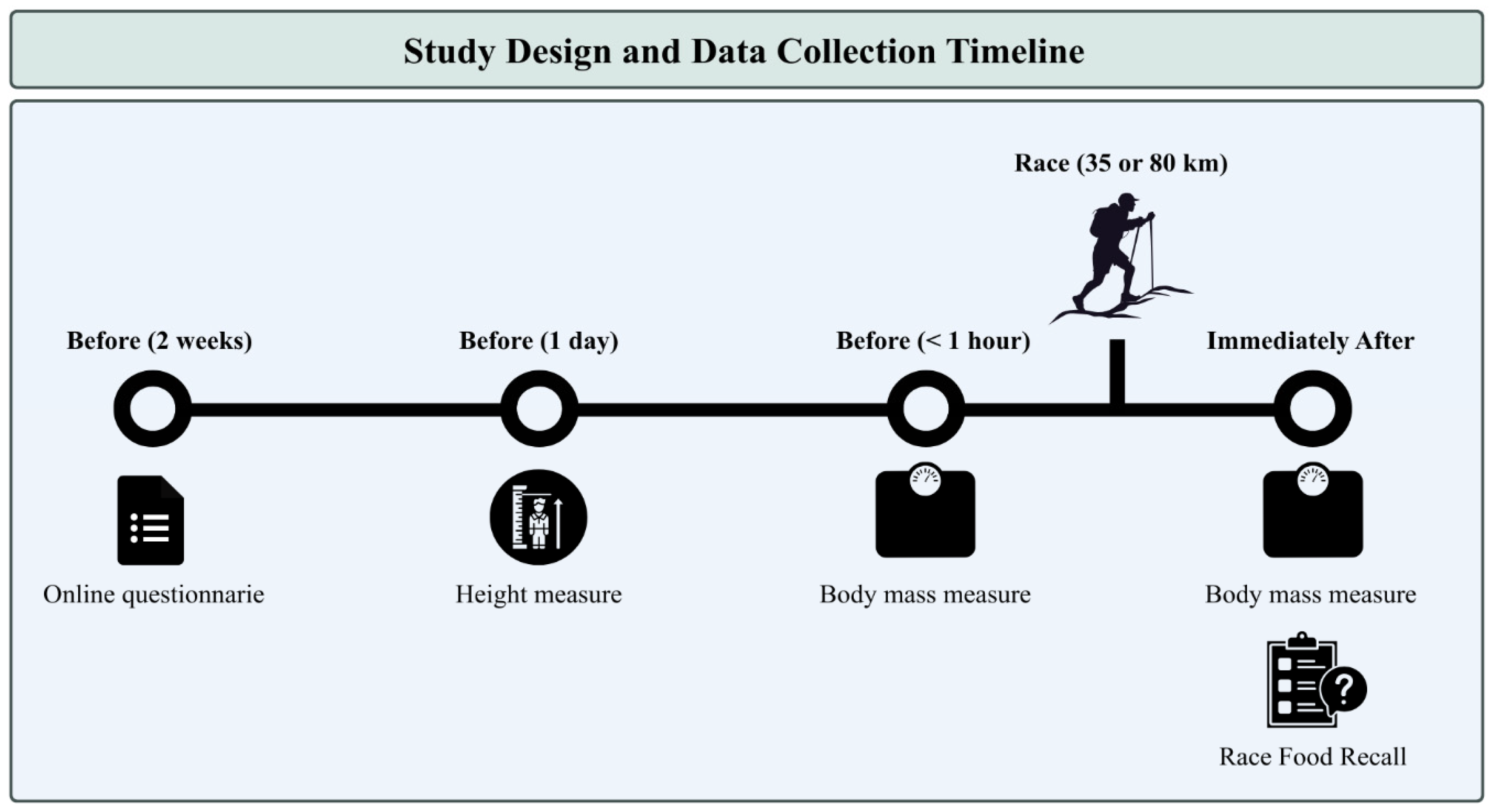
Data collection was conducted in 2024. Participant recruitment took place between August 1 and 5, and data collection was performed between August 15 and 17 during La Misión Brasil 2024. The study procedures were carried out in four stages (Figure 4): (1) Two weeks before race, participants completed an online questionnaire addressing demographic and health-related information as well as signed the informed consent form; (2) on the day before the race, athletes received a detailed explanation of the study procedures, and had their height measured; (3) the body mass was collected before and after race, followed by administration of an adapted 24-h food recall (24-hFR) based on the multiple-pass method (MPM).

4.2. Anthropometric and Dietary Intake Assessment

Body weight was measured using a Multilaser® Digi-Health digital scale (HC022; Multilaser/Grupo Multi, São Paulo, Brazil), and height was measured with a portable AVANUTRI® stadiometer (AVA-305; Avanutri Equipamentos de Avaliação Física, Rio de Janeiro, Brazil). Body mass index (BMI) was then calculated according to the criteria established by the World Health Organization [44].
Dietary intake was assessed using a 24-h dietary recall (24-hFR), administered by trained researchers through a structured multiple-pass method specifically adapted to the context of trail and mountain running events. The assessment encompassed both food and fluid intake during the race, including items provided at checkpoints and aid stations (PCA), as well as those carried and consumed independently by the athletes. All data were entered into the NDSR software, version 2025 (Nutrition Coordinating Center, University of Minnesota, Minneapolis, MN, USA) for nutrient analysis, focusing on the quantification of sodium (mg) and water (L) intake. Hydration-related changes were inferred from before and after race body mass variation combined with reported intake.

4.3. Climate Data and Analysis

Hourly air temperature (°C) and relative humidity (%) data during the event were obtained from an automatic weather station operated by the Brazilian National Institute of Meteorology (INMET), located in Passa Quatro, Minas Gerais, Brazil (22.39° S, 44.96° W; altitude 1017.1 m; station code A529) Brazilian National Institute of Meteorology. These in situ observations were compared with 30-year climatological averages (1994–2023) derived from the Brazilian Daily Weather Gridded Data [45], which represent the expected climate conditions for August in Passa Quatro, Minas Gerais, Brazil. This comparison allowed the identification of deviations from the expected climate and provided context for the extremeness of the environmental conditions experienced during the race.

4.4. Statistical Analysis

Data tabulation and statistical analyses were performed using Microsoft Excel, version 2408 (Microsoft Corporation, Redmond, WA, USA) and Jamovi software, version 2.7.9.0 (Microsoft Corporation, Redmond, WA, USA). A 5% significance level was adopted for all tests. A post hoc statistical power analysis was performed using G*Power (version 3.1.9.7) based on the primary correlation observed in the study (Spearman correlation between BMI and weight loss rate; ρ = 0.605). Assuming a two-tailed test, α = 0.05, and a total sample size of 28 participants, the achieved statistical power was 0.946, indicating adequate sensitivity to detect moderate-to-large correlations.
The distribution of quantitative variables was assessed using the Shapiro-Wilk normality test. Qualitative variables were expressed as absolute and relative frequency, while quantitative variables were presented as median and interquartile range (IQR). The frequency of nutritional monitoring across EG and UEG was compared using Fisher’s exact test due to low expected cell frequencies. To compare Δ body mass, fluid, and sodium intake between the two race categories, the Mann-Whitney U test was used. Associations between Δ body mass and initial BMI, fluid and sodium intake were assessed using the Spearman correlation coefficient (r), classified according to Finney (1974) as follows: 0–0.25: very weak; 0.25–0.5: weak; 0.5–0.75: moderate; 0.75–0.9: strong; and 0.9–1.0: very strong [46]. All graphs were generated using GraphPad Prism (GraphPad Software, San Diego, CA, USA; version 8.0.2).

5. Conclusions

This study suggests that hydration responses in endurance and ultra-endurance trail runners may vary according to environmental stress and race duration. EG showed greater body mass loss per hour, whereas the UEG consumed higher total amounts of water and sodium. Although water and sodium intake rates showed a moderate correlation, these rates were not clearly associated with changes in body mass, highlighting the limited value of using body mass alone to assess hydration status during competition. Overall, the findings suggest that hydration status during mountain endurance events may be influenced by multiple interacting factors, including environmental conditions, pacing strategies, body size, and opportunities for fluid intake, rather than by absolute fluid or sodium intake alone.

Supplementary Materials

The following supporting information can be downloaded at: https://www.mdpi.com/article/10.3390/physiologia6010021/s1, Table S1: STROBE checklist of items included in the reporting of this cross-sectional study, indicating page numbers where each item is addressed.

Author Contributions

Conceptualization, R.M.A., H.d.S.S. and A.C.P.K.; methodology, R.M.A., L.Q.G., H.d.S.S. and A.C.P.K.; original draft preparation, writing—review and editing, R.M.A., M.d.S.F., G.P.S., V.S., L.B.L., P.F., A.M., M.V.L.d.S.Q., H.d.S.S. and A.C.P.K.; data curation, R.M.A., G.F.P., N.d.O.N., H.d.S.S. and A.C.P.K.; visualization, R.M.A. and G.P.S.; funding acquisition, P.F. and A.M. All authors have read and agreed to the published version of the manuscript.

Funding

This work was supported by the Fundação de Amparo à Pesquisa do Estado de Minas Gerais (FAPEMIG), Brazil, under grant number APQ-02146-22.

Institutional Review Board Statement

The study was conducted in accordance with the Declaration of Helsinki and was approved by the Human Research Ethics Committee of the Federal University of Viçosa (approval no. 4.846.093, approval date: 17 August 2021).

Informed Consent Statement

All participants took part voluntarily, provided written informed consent, and received detailed information about the study procedures, in accordance with Resolution No. 466/2012 of the Brazilian National Health Council.

Data Availability Statement

Data supporting the findings of this study are available from the corresponding authors upon reasonable request.

Acknowledgments

The authors wish to thank the organizers of the La Misión Brasil 2024 event for their support and cooperation, as well as all athletes who voluntarily participated in this study.

Conflicts of Interest

The authors declare that there are no conflicts of interest related to this study.

Abbreviations

The following abbreviations are used in this manuscript:
24-hFR24-h food recall
BMIBody mass index
EAH Exercise-associated hyponatremia
EG Endurance group
INMETBrazilian National Institute of Meteorology
ITRA International Trail Running Association
MPM Multiple-pass method
NDSR Nutrition Data System for Research
SIR Sodium intake rate
UEG Ultra-endurance group
WIR Water intake rate
WLR Weight loss rate
WHO World Health Organization

References

  1. ITRA Discover Trail Running. Available online: https://itra.run/About/DiscoverTrailRunning (accessed on 19 October 2025).
  2. Williamson, E. Nutritional implications for ultra-endurance walking and running events. Extrem. Physiol. Med. 2016, 5, 13. [Google Scholar] [CrossRef] [PubMed]
  3. Lavoué, C.; Siracusa, J.; Chalchat, É.; Bourrilhon, C.; Charlot, K. Analysis of food and fluid intake in elite ultra-endurance runners during a 24-h world championship. J. Int. Soc. Sports Nutr. 2020, 17, 36. [Google Scholar] [CrossRef]
  4. Knechtle, B.; Nikolaidis, P.T. Physiology and Pathophysiology in Ultra-Marathon Running. Front. Physiol. 2018, 9, 634. [Google Scholar] [CrossRef] [PubMed]
  5. Gameiro, N.; Rodrigues, F.; Antunes, R.; Matos, R.; Amaro, N.; Jacinto, M.; Monteiro, D. Mental Toughness and Resilience in Trail Runner’s Performance. Percept. Mot. Ski. 2023, 130, 1202–1220. [Google Scholar] [CrossRef]
  6. Nikolaidis, P.T.; Veniamakis, E.; Rosemann, T.; Knechtle, B. Nutrition in Ultra-Endurance: State of the Art. Nutrients 2018, 10, 1995. [Google Scholar] [CrossRef]
  7. Rehrer, N.J. Fluid and electrolyte balance in ultra-endurance sport. Sports Med. 2001, 31, 701–715. [Google Scholar] [CrossRef]
  8. Armstrong, L.E. Rehydration during Endurance Exercise: Challenges, Research, Options, Methods. Nutrients 2021, 13, 887. [Google Scholar] [CrossRef]
  9. Goulet, E.D.B. Effect of exercise-induced dehydration on endurance performance: Evaluating the impact of exercise protocols on outcomes using a meta-analytic procedure. Br. J. Sports Med. 2013, 47, 679–686. [Google Scholar] [CrossRef]
  10. Costa, R.J.S.; Teixeira, A.; Rama, L.; Swancott, A.J.M.; Hardy, L.D.; Lee, B.; Camões-Costa, V.; Gill, S.; Waterman, J.P.; Freeth, E.C.; et al. Water and sodium intake habits and status of ultra-endurance runners during a multi-stage ultra-marathon conducted in a hot ambient environment: An observational field based study. Nutr. J. 2013, 12, 13. [Google Scholar] [CrossRef]
  11. Bright, F.M.; Clark, B.; Jay, O.; Périard, J.D. Elevated Humidity Impairs Evaporative Heat Loss and Self-Paced Exercise Performance in the Heat. Scand. J. Med. Sci. Sports 2025, 35, e70041. [Google Scholar] [CrossRef] [PubMed]
  12. Hew-Butler, T.; Rosner, M.H.; Fowkes-Godek, S.; Dugas, J.P.; Hoffman, M.D.; Lewis, D.P.; Maughan, R.J.; Miller, K.C.; Montain, S.J.; Rehrer, N.J.; et al. Statement of the Third International Exercise-Associated Hyponatremia Consensus Development Conference, Carlsbad, California, 2015. Clin. J. Sport Med. 2015, 25, 303–320. [Google Scholar] [CrossRef]
  13. Scheer, V. Exercise associated hyponatremia in endurance sports: A review with practical recommendations. Arch. Med. Deporte 2020, 37, 260–265. [Google Scholar]
  14. Scheer, V.; Hoffman, M.D. Exercise-associated hyponatremia: Practical guide to its recognition, treatment and avoidance during prolonged exercise. Dtsch. Z. Für Sportmed./Ger. J. Sports Med. 2018, 69, 311–317. [Google Scholar] [CrossRef]
  15. Veniamakis, E.; Kaplanis, G.; Voulgaris, P.; Nikolaidis, P.T. Effects of Sodium Intake on Health and Performance in Endurance and Ultra-Endurance Sports. Int. J. Environ. Res. Public Health 2022, 19, 3651. [Google Scholar] [CrossRef]
  16. American College of Sports Medicine; Sawka, M.N.; Burke, L.M.; Eichner, E.R.; Maughan, R.J.; Montain, S.J.; Stachenfeld, N.S. American College of Sports Medicine position stand. Exercise and fluid replacement. Med. Sci. Sports Exerc. 2007, 39, 377–390. [Google Scholar] [CrossRef]
  17. Cheuvront, S.N.; Kenefick, R.W. Dehydration: Physiology, assessment, and performance effects. Compr. Physiol. 2014, 4, 257–285. [Google Scholar] [CrossRef] [PubMed]
  18. Maughan, R.J.; Shirreffs, S.M.; Leiper, J.B. Errors in the estimation of hydration status from changes in body mass. J. Sports Sci. 2007, 25, 797–804. [Google Scholar] [CrossRef]
  19. Hoffman, M.D.; Goulet, E.D.B.; Maughan, R.J. Considerations in the Use of Body Mass Change to Estimate Change in Hydration Status During a 161-Kilometer Ultramarathon Running Competition. Sports Med. 2018, 48, 243–250. [Google Scholar] [CrossRef] [PubMed]
  20. Pérez-Castillo, Í.M.; Williams, J.A.; López-Chicharro, J.; Mihic, N.; Rueda, R.; Bouzamondo, H.; Horswill, C.A. Compositional Aspects of Beverages Designed to Promote Hydration Before, During, and After Exercise: Concepts Revisited. Nutrients 2024, 16, 17. [Google Scholar] [CrossRef]
  21. McCubbin, A.J. Sodium intake for athletes before, during and after exercise: Review and recommendations. Perform. Nutr. 2025, 1, 11. [Google Scholar] [CrossRef]
  22. Costa, R.J.S.; Gill, S.K.; Hankey, J.; Wright, A.; Marczak, S. Perturbed energy balance and hydration status in ultra-endurance runners during a 24 h ultra-marathon. Br. J. Nutr. 2014, 112, 428–437. [Google Scholar] [CrossRef]
  23. Wendt, D.; Van Loon, L.J.C.; Van Marken Lichtenbelt, W.D. Thermoregulation during exercise in the heat: Strategies for maintaining health and performance. Sports Med. 2007, 37, 669–682. [Google Scholar] [CrossRef]
  24. Beigtan, M.; Gonçalves, M.; Weon, B.M. Heat Transfer by Sweat Droplet Evaporation. Environ. Sci. Technol. 2024, 58, 6532–6539. [Google Scholar] [CrossRef]
  25. Goto, K.; Okazaki, K.; Mündel, T.; Bouscaren, N.; Millet, G.Y.; Racinais, S. Heat Stress Challenges in Marathon vs. Ultra-Endurance Running. Front. Sports Act. Living 2019, 1, 484903. [Google Scholar] [CrossRef]
  26. Jörres, M.; Gunga, H.C.; Steinach, M. Physiological Changes, Activity, and Stress During a 100-km–24-h Walking-March. Front. Physiol. 2021, 12, 640710. [Google Scholar] [CrossRef]
  27. Stearns, R.L.; Casa, D.J.; Lopez, R.M.; McDermott, B.P.; Ganio, M.S.; Decher, N.R.; Scruggs, I.C.; West, A.E.; Armstrong, L.E.; Maresh, C.M. Influence of hydration status on pacing during trail running in the heat. J. Strength Cond. Res. 2009, 23, 2533–2541. [Google Scholar] [CrossRef]
  28. Hoffman, M.D.; Stuempfle, K.J. Hydration strategies, weight change and performance in a 161 km ultramarathon. Res. Sports Med. 2014, 22, 213–225. [Google Scholar] [CrossRef] [PubMed]
  29. Armstrong, L.E.; Johnson, E.C.; Ganio, M.S.; Judelson, D.A.; Vingren, J.L.; Kupchak, B.R.; Kunces, L.J.; Muñoz, C.X.; McKenzie, A.L.; Williamson, K.H. Effective body water and body mass changes during summer ultra-endurance road cycling. J. Sports Sci. 2015, 33, 125–135. [Google Scholar] [CrossRef] [PubMed]
  30. Martínez, P.; Martínez, S.; Mingorance, J.A.; Riera-Sampol, A.; Aguiló, A.; Tauler, P. Gastrointestinal symptoms and nutritional intake among participants in a non-professional cycling event. Eur. J. Appl. Physiol. 2025, 125, 37–48. [Google Scholar] [CrossRef]
  31. Garth, A.K.; Burke, L.M. What do athletes drink during competitive sporting activities? Sports Med. 2013, 43, 539–564. [Google Scholar] [CrossRef] [PubMed]
  32. Martinez, S.; Aguilo, A.; Rodas, L.; Lozano, L.; Moreno, C.; Tauler, P. Energy, macronutrient and water intake during a mountain ultramarathon event: The influence of distance. J. Sports Sci. 2018, 36, 333–339. [Google Scholar] [CrossRef]
  33. Rebelo-Marques, A.; Coelho-Ribeiro, B.; De Sousa Lages, A.; Andrade, R.; Afonso, J.; Pereira, R.; Batista, A.S.; Teixeira, V.H.; Jácome, C. Trends and Missing Links in (De)Hydration Research: A Narrative Review. Nutrients 2024, 16, 1709. [Google Scholar] [CrossRef] [PubMed]
  34. Rüst, C.A.; Knechtle, B.; Knechtle, P.; Wirth, A.; Rosemann, T. Body mass change and ultra-endurance performance: A decrease in body mass is associated with an increased running speed in male 100-km ultramarathoners. J. Strength Cond. Res. 2012, 26, 1505–1516. [Google Scholar] [CrossRef]
  35. Périard, J.D.; Eijsvogels, T.M.H.; Daanen, H.A.M. Exercise under heat stress: Thermoregulation, hydration, performance implications, and mitigation strategies. Physiol. Rev. 2021, 101, 1873–1979. [Google Scholar] [CrossRef]
  36. Seal, A.D.; Kavouras, S.A. A review of risk factors and prevention strategies for exercise associated hyponatremia. Auton. Neurosci. 2022, 238, 102930. [Google Scholar] [CrossRef]
  37. Burke, L.M.; Hawley, J.A.; Wong, S.H.S.; Jeukendrup, A.E. Carbohydrates for training and competition. J. Sports Sci. 2011, 29, 17–27. [Google Scholar] [CrossRef]
  38. Kasiak, P. Role of Cardiopulmonary Exercise Testing in the Monitoring of Cardiovascular Risk Factors in Athletes–State-of-the-Art Review. Vasc. Health Risk Manag. 2026, 22, 575333. [Google Scholar] [CrossRef] [PubMed]
  39. La Gerche, A.; Burns, A.T.; Mooney, D.J.; Inder, W.J.; Taylor, A.J.; Bogaert, J.; MacIsaac, A.I.; Heidbüchel, H.; Prior, D.L. Exercise-induced right ventricular dysfunction and structural remodelling in endurance athletes. Eur. Heart J. 2012, 33, 998–1006. [Google Scholar] [CrossRef]
  40. Molina, L.; Mont, L.; Marrugat, J.; Berruezo, A.; Brugada, J.; Bruguera, J.; Rebato, C.; Elosua, R. Long-term endurance sport practice increases the inci-dence of lone atrial fibrillation in men: A follow-up study. Europace 2008, 10, 618–623. [Google Scholar] [CrossRef]
  41. Eijsvogels, T.M.H.; Molossi, S.; Lee, D.C.; Emery, M.S.; Thompson, P.D. Exercise at the extremes: The amount of exercise to reduce cardio-vascular events. J. Am. Coll. Cardiol. 2016, 67, 316–329. [Google Scholar] [CrossRef] [PubMed]
  42. Périard, J.D.; Racinais, S.; Sawka, M.N. Adaptations and mechanisms of human heat acclimation: Applications for competitive athletes and sports. Scand. J. Med. Sci. Sports 2015, 25, 20–38. [Google Scholar] [CrossRef] [PubMed]
  43. Parsons, K. Human Thermal Environments: The Effects of Hot, Moderate, and Cold Environments on Human Health, Comfort, and Performance, 3rd ed.; CRC Press: Boca Raton, FL, USA, 2014; pp. 1–586. [Google Scholar]
  44. Body Mass Index (BMI). Available online: https://www.who.int/data/gho/data/themes/topics/topic-details/GHO/body-mass-index (accessed on 9 November 2025).
  45. Xavier, A.C.; Scanlon, B.R.; King, C.W.; Alves, A.I. New improved Brazilian daily weather gridded data (1961–2020). Int. J. Climatol. 2022, 42, 8390–8404. [Google Scholar] [CrossRef]
  46. Finney, D.J. Statistics for biologists. Nature 1974, 248, 308. [Google Scholar] [CrossRef]
Figure 1. Temporal variation in air temperature (°C) and relative humidity (%) during the endurance group race. The bottom x-axis represents race duration (hours), while the top x-axis indicates time of day (local clock time, hours).
Physiologia 06 00021 g001
Figure 2. Temporal variation in air temperature (°C) and relative humidity (%) during the 80-km ultra-endurance group race. The bottom x-axis represents race duration (hours), while the top x-axis indicates time of day (local clock time, hours).
Physiologia 06 00021 g002
Figure 3. Associations between weight loss rate and body mass index (BMI), water intake rate, and sodium intake rate in the pooled sample (EG, endurance group; UEG, ultra-endurance group). Associations were assessed using Spearman’s correlation coefficient (r).
Physiologia 06 00021 g003
Figure 4. Study design and data collection timeline.
Physiologia 06 00021 g004
Table 1. Descriptive statistics of anthropometric, hydration, and electrolyte variables between EG and UEG.
CharacteristicsEG (n = 15)UEG (n = 13)Up-Value
Age (years)37.0 (29.5–46.0)42.0 (37.0–46.0)72.50.258
Total time (h)6.95 (5.95–7.79)17.6 (15.5–17.8)0.0<0.001 *
BMI (kg/m2) 24.4 (23.4–25.0)22.9 (21.6–24.0)65.00.140
Body mass before (kg)71.0 (66.4–74.5)65.4 (62.7–75.4)89.50.730
Body mass after (kg)68.7 (65.5–71.4)64.3 (61.3–73.9)88.00.678
Δ body mass (kg)−1.80 (−2.25–−1.45)−2.40 (−3.30–−1.20)91.00.782
Δ body mass (%)−2.60 (−3.60–−2.05)−3.00 (−4.30–−1.90)92.50.836
Weight loss rate (g/h)−270 (−376–−215)−115 (−173–−81.3)31.00.002 *
RWater intake (L)4.139 (3.285–5.469)7.109 (5.209–8.787)39.00.008 *
Water intake rate (mL/h)626 (545–710)427 (294–538)45.00.017 *
Sodium intake (mg)2857 (2606–3938)5789 (3985–9492)33.00.003 *
Sodium intake rate (mg/h)466 (372–572)277 (257–539)64.00.128
Mann–Whitney U test was used for comparisons between independent samples. EG: endurance group; UEG: ultra-endurance group; U: Mann–Whitney; kg: kilograms; h: hours; %: percentage; g: grams; g·h−1: grams per hour; mL·h−1: milliliters per hour; L: liters; mg: milligrams; mg·h−1: milligrams per hour. *: Statistically significant at p < 0.05.
Table 2. Temperatures and humidity during the EG and UEG race period.
Climate VariableClimatological AverageEG RaceUEG Race
Tmax (°C)23.430.130.1
Tmin (°C)7.312.112
Tave (°C)15.423.220.1
Have (%)7142.956.9
Climatological averages and observed air temperature and relative humidity values during the EG race and UEG race. Tmax: maximum air temperature; Tmin: minimum air temperature; Tave: mean air temperature; Have: mean relative humidity; °C: degrees Celsius; %: percentage.
Disclaimer/Publisher’s Note: The statements, opinions and data contained in all publications are solely those of the individual author(s) and contributor(s) and not of MDPI and/or the editor(s). MDPI and/or the editor(s) disclaim responsibility for any injury to people or property resulting from any ideas, methods, instructions or products referred to in the content.