Cerebrovascular Reactivity to Hypocapnia Following Maximal Sprint Exercise Is Better Maintained in Females than Males

Abstract
1. Introduction
2. Results
2.1. Participant Characteristics
2.2. Cardiovascular and Cerebrovascular Variables
2.2.1. Baseline Data
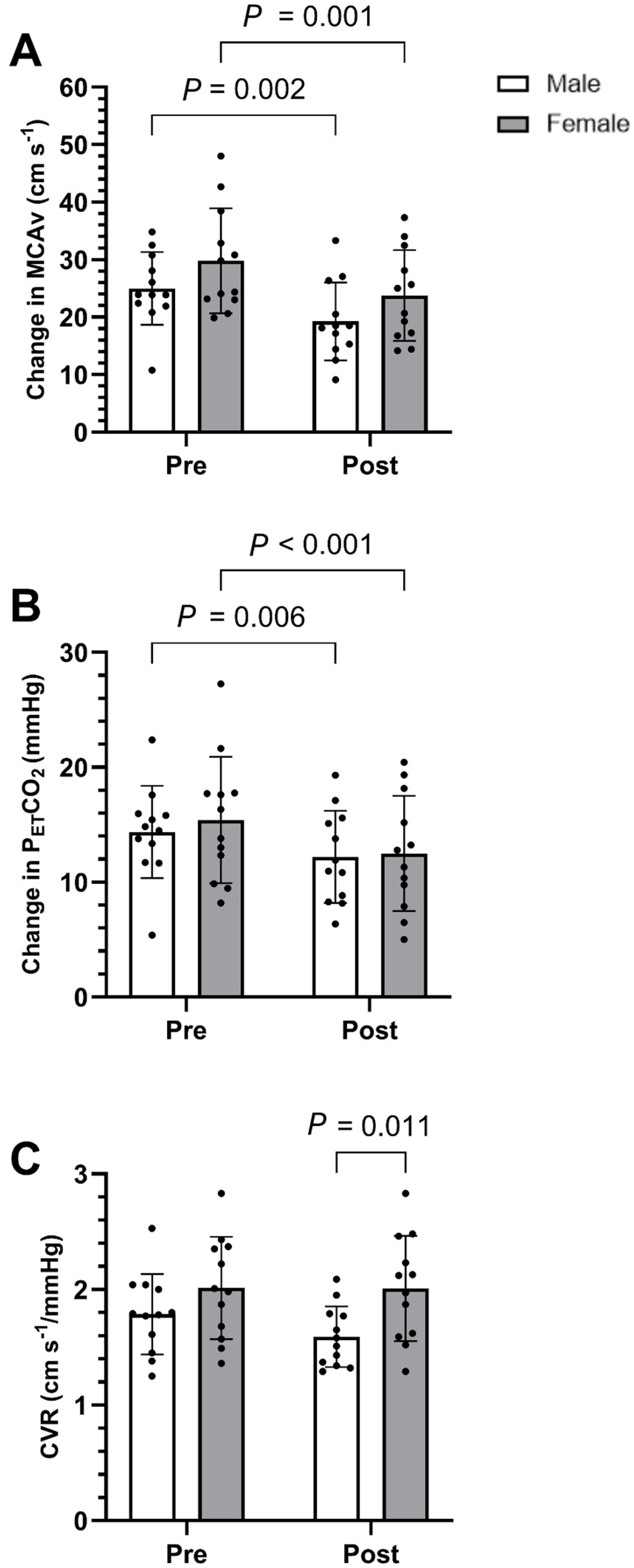
2.2.2. Cerebrovascular Reactivity
3. Discussion
3.1. Effect of Sprint Exercise on CVR to Hypocapnia
3.2. Sex-Related Effects on CVR to Hypocapnia Following Sprint Exercise
3.3. Limitations
4. Materials and Methods
4.1. Participants
4.2. Experimental Protocol
4.2.1. Overview
4.2.2. Preliminary Visit: Familiarization and Ramp Incremental Exercise
4.2.3. Experimental Visit
4.3. Experimental Measures
4.4. Wingate Anaerobic Test
4.5. Data Analyses
4.6. Statistical Analysis
5. Conclusions
Author Contributions
Funding
Institutional Review Board Statement
Informed Consent Statement
Data Availability Statement
Conflicts of Interest
Abbreviations
| CVCi | Cerebrovascular conductance index |
| CVR | Cerebrovascular reactivity |
| dCA | Dynamic cerebral autoregulation |
| HIIE | High-intensity interval exercise |
| MAP | Mean arterial pressure |
| MCAv | Middle cerebral artery velocity |
| MICE | Moderate-intensity continuous exercise |
| min | minute |
| PaCO2 | Partial pressure of arterial carbon dioxide |
| PETCO2 | Partial pressure of end-tidal carbon dioxide |
| PI | Pulsatility index |
| PO | Power output |
| O2 | Oxygen uptake |
| O2max | Maximum oxygen uptake |
| WAnT | Wingate Anaerobic Test |
References
- Carr, J.; Caldwell, H.G.; Ainslie, P.N. Cerebral blood flow, cerebrovascular reactivity and their influence on ventilatory sensitivity. Exp. Physiol. 2021, 106, 1425–1448. [Google Scholar] [CrossRef]
- Sur, S.; Lin, Z.; Li, Y.; Yasar, S.; Rosenberg, P.; Moghekar, A.; Hou, X.; Kalyani, R.; Hazel, K.; Pottanat, G.; et al. Association of cerebrovascular reactivity and Alzheimer pathologic markers with cognitive performance. Neurology 2020, 95, e962–e972. [Google Scholar] [CrossRef] [PubMed]
- Bliss, E.S.; Wong, R.H.; Howe, P.R.; Mills, D.E. Benefits of exercise training on cerebrovascular and cognitive function in ageing. J. Cereb. Blood Flow Metab. 2021, 41, 447–470. [Google Scholar] [CrossRef]
- Whitaker, A.A.; Alwatban, M.; Freemyer, A.; Perales-Puchalt, J.; Billinger, S.A. Effects of high intensity interval exercise on cerebrovascular function: A systematic review. PLoS ONE 2020, 15, e0241248. [Google Scholar] [CrossRef]
- Liang, W.; Liu, C.; Yan, X.; Hou, Y.; Yang, G.; Dai, J.; Wang, S. The impact of sprint interval training versus moderate intensity continuous training on blood pressure and cardiorespiratory health in adults: A systematic review and meta-analysis. PeerJ 2024, 12, e17064. [Google Scholar] [CrossRef]
- Vollaard, N.B.J.; Metcalfe, R.S. Research into the Health Benefits of Sprint Interval Training Should Focus on Protocols with Fewer and Shorter Sprints. Sports Med. 2017, 47, 2443–2451. [Google Scholar] [CrossRef] [PubMed]
- Beneke, R.; Pollmann, C.; Bleif, I.; Leithäuser, R.M.; Hütler, M. How anaerobic is the Wingate Anaerobic Test for humans? Eur. J. Appl. Physiol. 2002, 87, 388–392. [Google Scholar] [CrossRef]
- Péronnet, F.; Aguilaniu, B. Lactic acid buffering, nonmetabolic CO2 and exercise hyperventilation: A critical reappraisal. Respir. Physiol. Neurobiol. 2006, 150, 4–18. [Google Scholar] [CrossRef]
- Sieck, D.C.; Ely, M.R.; Romero, S.A.; Luttrell, M.J.; Abdala, P.M.; Halliwill, J.R. Post-exercise syncope: Wingate syncope test and visual-cognitive function. Physiol. Rep. 2016, 4, e12883. [Google Scholar] [CrossRef]
- Curtelin, D.; Morales-Alamo, D.; Torres-Peralta, R.; Rasmussen, P.; Martin-Rincon, M.; Perez-Valera, M.; Siebenmann, C.; Pérez-Suárez, I.; Cherouveim, E.; Sheel, A.W.; et al. Cerebral blood flow, frontal lobe oxygenation and intra-arterial blood pressure during sprint exercise in normoxia and severe acute hypoxia in humans. J. Cereb. Blood Flow Metab. 2018, 38, 136–150. [Google Scholar] [CrossRef]
- Stuckey, M.I.; Tordi, N.; Mourot, L.; Gurr, L.J.; Rakobowchuk, M.; Millar, P.J.; Toth, R.; MacDonald, M.J.; Kamath, M.V. Autonomic recovery following sprint interval exercise. Scand. J. Med. Sci. Sports 2012, 22, 756–763. [Google Scholar] [CrossRef]
- Weston, M.E.; Koep, J.L.; Lester, A.B.; Barker, A.R.; Bond, B. The acute effect of exercise intensity on peripheral and cerebral vascular function in healthy adults. J. Appl. Physiol. 2022, 133, 461–470. [Google Scholar] [CrossRef]
- Burma, J.S.; Macaulay, A.; Copeland, P.; Khatra, O.; Bouliane, K.J.; Smirl, J.D. Comparison of cerebrovascular reactivity recovery following high-intensity interval training and moderate-intensity continuous training. Physiol. Rep. 2020, 8, e14467. [Google Scholar] [CrossRef] [PubMed]
- Steventon, J.J.; Hansen, A.B.; Whittaker, J.R.; Wildfong, K.W.; Nowak-Flück, D.; Tymko, M.M.; Murphy, K.; Ainslie, P.N. Cerebrovascular Function in the Large Arteries Is Maintained Following Moderate Intensity Exercise. Front. Physiol. 2018, 9, 1657. [Google Scholar] [CrossRef]
- Burma, J.S.; Virk, S.; Smirl, J.D. Systolic versus diastolic differences in cerebrovascular reactivity to hypercapnic and hypocapnic challenges. Eur. J. Appl. Physiol. 2025, 125, 429–442. [Google Scholar] [CrossRef] [PubMed]
- Tallon, C.M.; Barker, A.R.; Nowak-Flück, D.; Ainslie, P.N.; McManus, A.M. The influence of age and sex on cerebrovascular reactivity and ventilatory response to hypercapnia in children and adults. Exp. Physiol. 2020, 105, 1090–1101. [Google Scholar] [CrossRef]
- Kastrup, A.; Thomas, C.; Hartmann, C.; Schabet, M. Sex dependency of cerebrovascular CO2 reactivity in normal subjects. Stroke 1997, 28, 2353–2356. [Google Scholar] [CrossRef] [PubMed]
- Skinner, B.D.; Weaver, S.R.C.; Lucas, S.J.E.; Lucas, R.A.I. Menstrual phase influences cerebrovascular responsiveness in females but may not affect sex differences. Front. Physiol. 2022, 13, 1035452. [Google Scholar] [CrossRef]
- Favre, M.E.; Lim, V.; Falvo, M.J.; Serrador, J.M. Cerebrovascular reactivity and cerebral autoregulation are improved in the supine posture compared to upright in healthy men and women. PLoS ONE 2020, 15, e0229049. [Google Scholar] [CrossRef]
- Koep, J.L.; Bond, B.; Barker, A.R.; Ruediger, S.L.; Pizzey, F.K.; Coombes, J.S.; Bailey, T.G. The relationships between age, sex, and cerebrovascular reactivity to hypercapnia using traditional and kinetic-based analyses in healthy adults. Am. J. Physiol. Heart Circ. Physiol. 2022, 323, H782–H796. [Google Scholar] [CrossRef]
- Miller, K.B.; Howery, A.J.; Rivera-Rivera, L.A.; Johnson, S.C.; Rowley, H.A.; Wieben, O.; Barnes, J.N. Age-Related Reductions in Cerebrovascular Reactivity Using 4D Flow MRI. Front. Aging Neurosci. 2019, 11, 281. [Google Scholar] [CrossRef] [PubMed]
- Willie, C.K.; Colino, F.L.; Bailey, D.M.; Tzeng, Y.C.; Binsted, G.; Jones, L.W.; Haykowsky, M.J.; Bellapart, J.; Ogoh, S.; Smith, K.J.; et al. Utility of transcranial Doppler ultrasound for the integrative assessment of cerebrovascular function. J. Neurosci. Methods 2011, 196, 221–237. [Google Scholar] [CrossRef] [PubMed]
- Stanhewicz, A.E.; Wong, B.J. Counterpoint: Investigators should not control for menstrual cycle phase when performing studies of vascular control that include women. J. Appl. Physiol. 2020, 129, 1117–1119. [Google Scholar] [CrossRef] [PubMed]
- Wenner, M.M.; Stachenfeld, N.S. Point: Investigators should control for menstrual cycle phase when performing studies of vascular control that include women. J. Appl. Physiol. 2020, 129, 1114–1116. [Google Scholar] [CrossRef]
- Ainslie, P.N.; Hoiland, R.L. Transcranial Doppler ultrasound: Valid, invalid, or both? J. Appl. Physiol. 2014, 117, 1081–1083. [Google Scholar] [CrossRef]
- Coverdale, N.S.; Gati, J.S.; Opalevych, O.; Perrotta, A.; Shoemaker, J.K. Cerebral blood flow velocity underestimates cerebral blood flow during modest hypercapnia and hypocapnia. J. Appl. Physiol. 2014, 117, 1090–1096. [Google Scholar] [CrossRef]
- Verbree, J.; Bronzwaer, A.S.; Ghariq, E.; Versluis, M.J.; Daemen, M.J.; van Buchem, M.A.; Dahan, A.; van Lieshout, J.J.; van Osch, M.J. Assessment of middle cerebral artery diameter during hypocapnia and hypercapnia in humans using ultra-high-field MRI. J. Appl. Physiol. 2014, 117, 1084–1089. [Google Scholar] [CrossRef]
- Weston, M.E.; Curtin, E.L.; Buys, P.; Gildea, N.; Egaña, M. The acute effect of maximal sprint exercise on dynamic cerebral autoregulation in healthy young adults. Physiol. Rep. 2025, 13, e70550. [Google Scholar] [CrossRef]
- Poole, D.C.; Jones, A.M. Measurement of the maximum oxygen uptake Vo2max: Vo2peak is no longer acceptable. J. Appl. Physiol. 2017, 122, 997–1002. [Google Scholar] [CrossRef]
- Weston, M.E.; Barker, A.R.; Tomlinson, O.W.; Coombes, J.S.; Bailey, T.G.; Bond, B. Agreement between left and right middle cerebral artery blood velocity responses to incremental and constant work-rate exercise in healthy males and females. Physiol. Meas. 2023, 44, 074001. [Google Scholar] [CrossRef]
- Weston, M.E.; Barker, A.R.; Tomlinson, O.W.; Coombes, J.S.; Bailey, T.G.; Bond, B. Differences in cerebrovascular regulation and ventilatory responses during ramp incremental cycling in children, adolescents, and adults. J. Appl. Physiol. 2021, 131, 1200–1210. [Google Scholar] [CrossRef] [PubMed]
- Cohen, J. Statistical Power Analysis for Behavioral Sciences; Lawrence Erlbum Associate: Hillsdale, NJ, USA, 1988. [Google Scholar]
- Smith, E.C.; Pizzey, F.K.; Askew, C.D.; Mielke, G.I.; Ainslie, P.N.; Coombes, J.S.; Bailey, T.G. Effects of cardiorespiratory fitness and exercise training on cerebrovascular blood flow and reactivity: A systematic review with meta-analyses. Am. J. Physiol. Heart Circ. Physiol. 2021, 321, H59–H76. [Google Scholar] [CrossRef] [PubMed]

| Males | Females | p Value | |
|---|---|---|---|
| n | 12 | 12 | |
| Age, yr | 23 (6) | 21 (3) | 0.75 |
| Height, m | 1.78 ± 0.06 * | 1.63 ± 0.07 | 0.002 |
| Weight, kg | 73.3 ± 9.7 * | 59.6 ± 9.8 | <0.001 |
| BMI, kg·m−2 | 23.0 ± 2.3 | 22.3 ± 2.6 | 0.506 |
| O2max, L·min−1 | 3.67 ± 0.81 * | 2.31 ± 0.77 | <0.001 |
| O2max, mL·kg−1·min−1 | 50.1 ± 7.8 * | 38.6 ± 8.2 | 0.002 |
| WAnT POpeak, W | 929 ± 260 * | 564 ± 158 | <0.001 |
| WAnT POpeak, W·kg −1 | 12.8 (2.6) * | 9.9 (2.5) | 0.003 |
| WAnT POmean, W | 601 ± 122 * | 380 ± 89 | <0.001 |
| WAnT POmean, W·kg −1 | 8.2 ± 1.1 * | 6.4 ± 1.1 | <0.001 |
| Males | Females | |||
|---|---|---|---|---|
| Pre | Post | Pre | Post | |
| n | 12 | 12 | 12 | 12 |
| Baseline PETCO2, mmHg | 36.8 ± 3.1 | 32.1 ± 4.0 * | 36.5 ± 4.6 | 32.1 ± 4.7 * |
| Baseline MCAv, cm·s−1 | 63.5 ± 10.8 | 57.6 ± 10.1 * | 70.1 ± 11.6 | 66.8 ± 10.6 |
| Baseline MAP, mmHg | 81.4 ± 14.6 | 81.8 ± 9.7 | 81.4 ± 18.8 | 86.5 ± 18.5 |
| Baseline CVCi, cm·s−1/mmHg−1 | 0.80 ± 0.19 | 0.71 ± 0.15 * | 0.89 ± 0.18 | 0.80 ± 0.17 * |
| Baseline PI | 0.93 ± 0.13 | 0.88 ± 0.14 | 0.87 ± 0.18 | 0.83 ± 0.12 |
| Change in MCAv, cm·s−1 | 25.0 ± 6.3 | 19.3 ± 6.8 * | 29.8 ± 9.1 | 23.8 ± 7.9 * |
| Change in PETCO2, mmHg | 14.4 ± 4.0 | 12.2 ± 4.0 * | 15.4 ± 5.5 | 12.5 ± 5.0 * |
| CVR, cm·s−1/mmHg | 1.79 ± 0.35 | 1.59 ± 0.26 † | 2.01 ± 0.44 | 2.01 ± 0.46 |
Disclaimer/Publisher’s Note: The statements, opinions and data contained in all publications are solely those of the individual author(s) and contributor(s) and not of MDPI and/or the editor(s). MDPI and/or the editor(s) disclaim responsibility for any injury to people or property resulting from any ideas, methods, instructions or products referred to in the content. |
© 2026 by the authors. Licensee MDPI, Basel, Switzerland. This article is an open access article distributed under the terms and conditions of the Creative Commons Attribution (CC BY) license.
Share and Cite
Buys, P.; Weston, M.E.; Curtin, E.L.; Gildea, N.; Egaña, M. Cerebrovascular Reactivity to Hypocapnia Following Maximal Sprint Exercise Is Better Maintained in Females than Males. Physiologia 2026, 6, 16. https://doi.org/10.3390/physiologia6010016
Buys P, Weston ME, Curtin EL, Gildea N, Egaña M. Cerebrovascular Reactivity to Hypocapnia Following Maximal Sprint Exercise Is Better Maintained in Females than Males. Physiologia. 2026; 6(1):16. https://doi.org/10.3390/physiologia6010016
Chicago/Turabian StyleBuys, Philip, Max E. Weston, Emma L. Curtin, Norita Gildea, and Mikel Egaña. 2026. "Cerebrovascular Reactivity to Hypocapnia Following Maximal Sprint Exercise Is Better Maintained in Females than Males" Physiologia 6, no. 1: 16. https://doi.org/10.3390/physiologia6010016
APA StyleBuys, P., Weston, M. E., Curtin, E. L., Gildea, N., & Egaña, M. (2026). Cerebrovascular Reactivity to Hypocapnia Following Maximal Sprint Exercise Is Better Maintained in Females than Males. Physiologia, 6(1), 16. https://doi.org/10.3390/physiologia6010016