Article

Genomic and Metabolomic Insights into Amazonian Oyster-Associated Cyanobacteria Reveal the First Record of Thainema in South America


by
Mauricio J. Machado
1,
Fernanda R. Jacinavicius
1,
Rafael B. Dextro
1,*,
Anderson M. T. Feitosa
1,
Lucas S. Silva
2,
Francisco A. S. Alves
2,
Ernani Pinto
1,
Marli F. Fiore
1 and
Maria Paula C. Schneider
2,*
1
Center for Nuclear Energy in Agriculture (CENA), University of São Paulo (USP), Avenida Centenário 303, Piracicaba 13416-000, SP, Brazil
2
Laboratory of Genomics and Biotechnology, Biological Sciences Institute, Federal University of Pará (UFPA), Rua Augusto Corrêa, 1, Belém 66075-110, PA, Brazil
*
Authors to whom correspondence should be addressed.
Phycology 2026, 6(3), 74; https://doi.org/10.3390/phycology6030074
Submission received: 25 May 2026 / Revised: 22 June 2026 / Accepted: 8 July 2026 / Published: 10 July 2026
(This article belongs to the Special Issue Advances in Algal Molecular Biology and Biotechnology)

Abstract

Oyster-associated microbiomes represent a dynamic interface between marine hosts and their environment, yet the diversity, evolution, and functional potential of their associated cyanobacteria remain poorly understood. For microbial organisms, such as cyanobacteria, survival requires adaptation to several environmental pressures, including higher metal concentrations and osmotic stress. To investigate these adaptations, two cyanobacterial strains, CENA647 and CENA648, were isolated from oyster surfaces sampled along the Amazon coast. Genomic analysis and untargeted metabolomics were conducted to investigate the taxonomy and functional potential of these strains. Both genomes exhibited high completeness (>99.2%) and low contamination (<2.2%). The total lengths differed, with 8.3 Mbp for CENA647 and 6.5 Mbp for CENA648. The genome size correlated with the number of identified coding regions: 7593 for CENA647 and 5541 for CENA648. Phylogenetic analysis highlights their taxonomic relationships within cyanobacteria adapted to fluctuating salinity, including the first description of the genus Thainema in South America. Comparative genome mining revealed extensive genetic repertoires associated with osmoregulation and metal resistance, consistent with adaptation to oyster-associated environments. Both strains shared predicted metabolites annotated in the metabolomes, with a wide range of compound classes, including amino acids, terpenes, fatty acids, and peptides, as well as several unannotated molecular features. Overall, our findings expand current knowledge of oyster-associated cyanobacteria and highlight their metabolic diversity in the Amazon region, as well as genomic traits that may be associated with adaptation to dynamic estuarine environments.

1. Introduction

Cyanobacteria are recurrent members of marine and estuarine microbiomes, where they contribute to primary production, nutrient cycling, and the biosynthesis of structurally diverse metabolites [1,2,3,4,5,6,7]. In coastal environments, these microorganisms colonize both biotic and abiotic substrates, including coral reefs, rocks, mangroves, and mollusk shells [7,8,9,10]. Cyanobacterial taxa such as Hyella, Leptolyngbya, Mastigocoleus, and Synechococcus have previously been reported in association with oysters, including the commercially important Pacific oyster, Magallana gigas [10,11,12]. Among marine invertebrates, oysters harbor complex microbial communities that directly influence host physiology, environmental adaptation, and aquaculture sustainability [13,14,15].
Estuarine and oyster-associated environments are characterized by intense physicochemical fluctuations, including shifts in salinity, pH, nutrient availability, and metal concentrations [16,17]. These conditions can exert strong selective pressures on associated microbial communities, favoring microorganisms with efficient osmoadaptive mechanisms, metal tolerance systems, and metabolic plasticity [18,19]. In addition, oyster-associated microbiomes are ecologically relevant because they may influence nutrient cycling, microbial interactions, and host health, and represent a potential source of bioactive metabolites and other biotechnologically relevant compounds [13,14,15,16,17,18,19,20]. Despite this ecological relevance, the diversity, adaptive traits, and biosynthetic potential of oyster-associated cyanobacteria remain poorly characterized, particularly in tropical coastal ecosystems.
The Amazon coast is one of the world’s largest and most dynamic estuarine systems, characterized by extensive mangrove forests, high organic input, tidal fluctuations, and pronounced environmental heterogeneity [20,21]. These conditions may favor the establishment of metabolically versatile and stress-tolerant cyanobacterial communities. Although the Amazon basin is recognized as a hotspot of biodiversity and microbial diversity [21,22,23], genomic and metabolomic studies of oyster-associated cyanobacteria from this region remain extremely limited.
Here, we hypothesize that cyanobacteria isolated from Amazonian oysters exhibit unique genomic and metabolic features reflecting their adaptation to local environmental conditions and symbiotic associations. The genomes and untargeted metabolite profiles of cyanobacterial strains isolated from oysters in the Eastern Amazon were evaluated. This approach not only expands our understanding of cyanobacterial biodiversity in an underexplored habitat but also provides insights into their potential roles in aquaculture, biotechnology, and ecosystem health.

2. Material and Methods

2.1. Site Description, Isolation, Culture, and Morphology

The strains CENA 647 and CENA 648 were isolated from the shell surface of oysters (Crassostrea sp.) collected along the Brazilian Amazon coast, at Nazaré do Seco, Maracanã, Pará (0°42′12″ S, 47°33′13″ W) and Santo Antônio de Urindeua, Salinópolis, Pará (0°41′51″ S, 47°22′11″ W), respectively. The sampling area is in the “Salgado Paraense” region, in the Northeast of the State of Pará, Brazil (Figure 1). The isolation was carried out at the Environmental Microbiology Laboratory of the Evandro Chagas Institute (IEC), Pará, Brazil, using water samples and biological material obtained from oyster valves collected in both sites. The samples were stored in dark vials at 4 °C until laboratory processing, which began within 24 h of collection.
The oysters were opened to remove the gonads. Subsequently, the valves were washed with sterile Milli-Q water to remove surface impurities and then transferred to flasks containing BG-11 culture medium to promote the growth of cyanobacteria associated with shell surfaces. For the isolation of the strains, the samples were manually homogenized and, under aseptic conditions in a laminar flow, 100 µL aliquots were inoculated onto sterile Petri dishes containing BG-11 culture media [24], solidified with 2% agar, and supplemented with cycloheximide at a final concentration of 70 mg/L, aiming to inhibit fungal growth. Successive subcultures were performed until unispecific cultures were obtained. The purity of the strains was confirmed by observation under an optical microscope; subsequently, the isolates were transferred to their respective liquid culture media. The cultures were maintained at 24 ± 1 °C under continuous fluorescent illumination of approximately 40 µmol photons m−2 s−1; these conditions are suitable for the growth and maintenance of strains intended for experimental procedures.
The strains were maintained in unicyanobacterial BG-11 culture medium [24] and transferred to the Molecular and Cellular Biology Laboratory collection (CENA/USP) in Piracicaba, São Paulo State, Brazil. The strains were grown in 125 mL Erlenmeyer flasks containing 50 mL of BG-11 at 23 ± 1 °C, without agitation or aeration, and maintained under a 14:10 h light cycle under fluorescent light (45 µmol m−2 s−1). Strains’ morphology was examined using a ZEISS Primostar 3 light microscope equipped with an A-Plan 100×/1.25 oil-immersion objective and coupled to a ZEISS Axiocam 208c digital camera (Carl Zeiss, Oberkochen, Germany).

2.2. DNA Extraction and gDNA NGS Sequencing

Genomic DNA extraction was performed using the PowerSoil DNA Isolation Kit (MoBio), as recommended by the manufacturer, with the following modifications: (1) washing the cells with 1% SDS and distilled water to remove excess heterotrophic microorganisms; and (2) heating to 65 °C during lysis to dissolve the mucilage sheath. DNA quality was confirmed by electrophoresis on a 1% (m/v) agarose gel.
Genome sequencing of CENA647 was performed on PromethION 2 Solo (Oxford Nanopore Technologies, Oxford, United Kingdom). The library was prepared using 50 ng of DNA from this sample with the SQK-RBK114.96 Rapid Barcoding Kit in a multiplexed run. Barcoding was achieved through incubation (30 °C/2 min; 80 °C/2 min), followed by pooling and purification with AMPure XP beads. After Rapid Adapters ligation, the library was loaded onto a PromethION R10.4.1 flow cell. For CENA648 strain sequencing, 1 µg of DNA was used to prepare paired libraries with the SureSelect QXT kit (Agilent Technologies, Santa Clara, CA, USA). The total gDNA was sequenced at the Technological Institute for Sustainable Development Vale (VTISD) using the Illumina NextSeq 500 platform and the NextSeq 500 High Output V2 kit (Illumina) following the manufacturer’s recommendations.

2.3. Assembly and Genome Annotation

The quality of the short-read data was assessed using FastQC 0.11.8 (www.bioinformatics.babraham.ac.uk/projects/fastqc/) (accessed on 7 March 2026). Sequences with Phred quality scores below 20, lengths shorter than 50 bp, and adapters were removed using Trimmomatic v.0.38 [25].
Since both strains were derived from non-axenic unicyanobacterial cultures, a metagenomic assembly workflow was used to separate cyanobacterial genomes from contamination by associated bacteria. The raw ONT long reads from CENA647 were basecalled using Dorado v1.3.1. Reads < 1 kb or Phred < 12 were discarded via NanoFilt v2.8.0 [26], using Porechop v0.2.4 [27]. Metagenomic assembly was performed with Flye v2.9.5 [28] using the --meta flag. The binning step involved mapping high-quality reads against contigs using minimap2 v2.28 [29], followed by sorting BAM files with SAMtools for input to SemiBin2 v2.2.0 [30]. Finally, assembly quality was verified with QUAST v.5.0.2 [31], CheckM v2 [32], and BUSCO v5.8.0 using 719 marker genes for Cyanobacteriota [33].
For strain CENA648, sequenced with the Illumina platform, de novo genome assembly was performed using SPAdes v.3.15.1 [34] with meta parameters [35]. Sequences exhibiting similarity to cyanobacterial references were identified in the assemblies using Kraken2 v.2.1.2 [36], and contamination sequences were removed using KrakenTools v.1.2 [37]. Short sequences were filtered out using SeqKit v2.3.1 [38], and the 16S, 23S, and 5S rRNA genes were identified with Barrnap v0.9. Assembly statistics were obtained using QUAST v.5.0.2 [31], CheckM v2 [32], and BUSCO v5.8.0, with 719 marker genes for Cyanobacteriota [33]. We also used the same methods to assemble the genome of Thainema salinarum MCC5402 for comparative analysis within the genus; the assembly was deposited in the SRA database under accession SRR33532330. The assembled genome statistics are presented in Supplementary Table S1.
Prokka 1.13 [39] was used to annotate both genomes automatically. The core databases used were UniProtKB/Swiss-Prot (bacteria) and Pfam, in default parameters. Functional analyses and metabolic pathways were identified with BlastKOALA [40]. Manual curation was performed to annotate genes related to osmotic regulation, metal tolerance, and exopolysaccharide biosynthesis. Sequence identity and coverage > 80% were used as criteria to identify genes in the assemblies via BLAST v2.16 searches against sequences from strains reported in the literature to possess these functional genes. The genomes were analyzed with PHASTEST to identify prophage regions [41]. Additionally, antiSMASH v8 [42] was used to predict biosynthetic gene clusters (BGCs) involved in secondary metabolism.

2.4. 16S rRNA Gene Phylogeny and Phylogenomic Analyses

The 16S rDNA gene sequences extracted from the genomes were compared with those in databases to construct the phylogenetic tree. In total, 128 nucleotide sequences were obtained and aligned with MUSCLE [43], representing the most closely related sequences and type cyanobacterial strains of the orders Leptolyngbyales, Oculatellales, and Nodosilineales, retrieved from NCBI (https://www.ncbi.nlm.nih.gov/genome/) (accessed on 3 January 2026). MEGA11 [44] was used to infer evolutionary history using the Neighbor-Joining method; evolutionary distances were computed under the Tamura-Nei model with 1000 standard bootstrap replicates. A Maximum-Likelihood tree was generated using IQ-TREE [45], with the TIM3e + R5 model selected by ModelFinder [46] and 1000 bootstrap replicates. Bayesian inferences were performed with MrBayes 3.2 [47] using two separate runs, each with four chains, for 5,000,000 Markov Chain Monte Carlo generations. The tree was visualized with FigTree v.1.4.4 and edited with Inkscape v.1.4 (https://inkscape.org/). The pairwise sequence identity of the closest related 16S rRNA sequences of CENA647 and CENA648 was calculated, and the heatmap was generated using RStudio 2024.12.1 (pheatmap package).
A dataset of 57 reference genomes representing Leptolyngbyales, Oculatellales, and Nodosilineales was compiled from available NCBI genomes (https://www.ncbi.nlm.nih.gov/genome/) (accessed on 3 January 2026). This dataset was used for phylogenomic analysis based on an alignment of 120 bacterial single-copy conserved marker proteins, generated with GTDB-tk v.2.7 [48]. A Maximum-Likelihood tree was constructed using IQ-TREE with the LG + F + R5 model selected by ModelFinder and 1000 bootstraps. The tree was visualized with FigTree v.1.4.4 and edited with Inkscape v.1.4 (https://inkscape.org/).
The whole-genome ANI was also computed between the studied genomes and the reference genomes of Nodosilineales available in the NCBI Database using FastANI v0.1.3 on the KBase platform (https://www.kbase.us/). The Amino Acid Average Identity (AAI) was calculated using the AAI calculator of the Environmental Microbial Genomics Gateway (ENVE-OMICS Gateway) (https://enveomics.scigap.org/). Digital DNA–DNA hybridization (DDH) values were calculated using the Genome-To-Genome Distance Calculator (GGDC 3.0) server [49,50]. The genomes of Oculatella sp. were also included because they clustered with CENA248 in the phylogenomic tree analysis. Orthology analysis across genomes was performed using OrthoVenn3 [51].

2.5. Metabolite Extraction and UHPLC-MS/MS Analysis

Lyophilized cyanobacterial biomass samples (50 mg), including cellular biomass, extracellular exudates, and combined cell + exudate fractions, were extracted with 5 mL of 50% methanol (50:50 methanol–water, v/v) following a protocol previously described [52]. Cell disruption was achieved by vortex mixing and probe sonication at 30% amplitude for 3 min (Omni Sonic Ruptor 400 ultrasonic homogenizer), followed by 1 min of bead-beating. Cellular debris was subsequently removed by centrifugation at 7000× g for 10 min at 4 °C (Eppendorf 5804 R). Supernatants were filtered through 0.22 μm PVDF membrane filters and transferred to HPLC vials before LC–MS analysis. Three independent extraction replicates were prepared from the same batch of lyophilized biomass for each strain, and a single LC–MS injection was used to analyze each extract.
The analysis was conducted using a high-performance liquid chromatography system (Shimadzu© Prominence Liquid Chromatography, Kyoto, Japan) coupled to a high-resolution tandem mass spectrometer (MicroTOF-QII; Bruker Daltonics©, Billerica, MA, USA) equipped with electrospray ionization (ESI), configured as HPLC-ESI-QTOF-MS/MS. Extract and blank samples (50:50 methanol–water, v/v) and 0.5 M acetic acid were injected (10 μL) onto a Luna C18 (2) column (150 × 2.1 mm, 2.6 μm) (Phenomenex, Torrance, CA, USA). The mobile phase consisted of ultra-pure water obtained from a direct-Q8 water purification system (Millipore, Billerica, USA) (A) and acetonitrile (Sigma-Aldrich, St. Louis, MO, USA) (B), both containing 0.2% formic acid (Sigma-Aldrich). Chromatographic separation was performed at a flow rate of 0.4 mL/min with a linear gradient of solvent B from 5% to 90% over 25 min.
The ionization source conditions were as follows: positive ionization, a capillary potential of 4500 V, drying nitrogen gas at 200 °C with a flow rate of 9 mL/min, and a nebulizer pressure of 60 psi. Mass spectra were acquired using electrospray ionization in positive ion mode over the m/z range of 50–1500. The QToF operated in MS scan mode and auto MS/MS mode, performing MS/MS experiments on the three most intense ions from each MS survey scan. Raw data files were converted to the mzXML format using MSConvert© software (version 3.0) from the ProteoWizard tools.

2.6. Data Processing, Molecular Networking Analysis, and Compound Annotation

The converted files were processed with MZMine4 v4.8 [53]. Mass detection was first performed on MS1 and MS2 spectra using absolute intensity thresholds of 5.0 × 10² for MS1 and 5.0 × 10² for MS2. Chromatograms were then constructed using the local minimum search algorithm with a minimum of five consecutive scans, a minimum feature height of 1.0 × 10³, an m/z tolerance of 5.0 ppm (scan-to-scan), and an RT tolerance (intrasample) of 0.05 min. Subsequently, a 13C isotope filtering step was applied to remove redundant isotopic features. Feature alignment across samples was performed using the Join Aligner with m/z tolerances of 3.0 ppm (within-sample) and 5.0 ppm (sample-to-sample). To reduce background signals, solvent blank features were removed, and a row filter was applied to retain only features present in at least two samples. Finally, missing peak intensities were estimated using the peak finder gap-filling module. The resulting feature table was exported and further analyzed in MetaboAnalyst 6.0 (www.metaboanalyst.ca) [54]. Missing values were replaced using left-censored data estimation, setting them to 1/5 of the minimum positive value for each feature as a proxy for its detection limit. The features were normalized using log10 and Pareto scaling. Principal component analysis (PCA) was conducted to identify differences in metabolic profiles among the strains. To examine differences in metabolite profiles between groups, supervised orthogonal partial least-squares discriminant analysis (oPLS-DA) was employed for validation and permutation testing.
The Global Natural Products Social Molecular Network (GNPS2) platform (https://gnps2.org/homepage) was used to generate molecular networks [55]. Molecular networks were constructed by comparing MS/MS data from extracts of each strain with those from blank injections. The following parameters were used for GNPS molecular networking: precursor ion mass tolerance of 0.02 Da, fragment ion mass tolerance of 0.02 Da, minimum cosine score of 0.7, top-k analysis of 10, minimum matched fragment ions of 6, and a minimum cluster size of 2. Additional filters included a precursor peak window of 50 Da and the exclusion of blank spectra. Clusters in the networks were further annotated by comparing MS/MS spectra against in-house databases and the existing literature. The resulting molecular networks and MolNetEnhancer were visualized using Cytoscape 3.8.2.
Metabolite annotation combined accurate mass measurements, isotopic patterns, and MS/MS spectral similarity to enable putative compound identification. Chemical class annotations were performed using the ClassyFire chemical ontology. Accurate masses were used to search the CyanoMetDB [56], PubChem, NPAtlas [57], and MoNA (https://mona.fiehnlab.ucdavis.edu/) databases. Additional database searches were conducted to support compound annotation via in silico predictions using the GNPS theoretical/in silico tools, SIRIUS 4, and CANOPUS [58]. Elementary compositions and deviations from theoretical values (ppm error) were calculated using the SmartFormula algorithm with a 5-ppm threshold, and the ChemCalc web service [59] was used to calculate mass errors.

3. Results

3.1. Genome Assembly and Taxonomy

The genomes of the oyster-associated cyanobacterial strains CENA647 and CENA648 were assembled and annotated to investigate their structural and functional characteristics. CENA647 had a total genome length of 8,330,893 base pairs distributed across 40 contigs, whereas the more fragmented CENA648 assembly had 6,517,618 bp across 173 contigs (Table 1). Both genomes had similar GC content: 50.48% for CENA647 and 50.59% for CENA648. High assembly quality was supported by completeness estimates of 99.32% and 99.29% for CENA647 and CENA648, respectively, and low contamination levels (0.36% and 2.16%). CENA647 showed higher assembly contiguity, with the largest contig and N50 reaching 6,456,130 bp, compared with 435,579 bp and 107,571 bp in CENA648. The number of predicted coding sequences (CDSs) was also higher in CENA647 (7593) than in CENA648 (5541). Both genomes contained a comparable number of tRNA genes (74) and a single tmRNA gene, whereas CENA647 had more rRNA genes (8 vs. 3) and CRISPR loci (9 vs. 6).
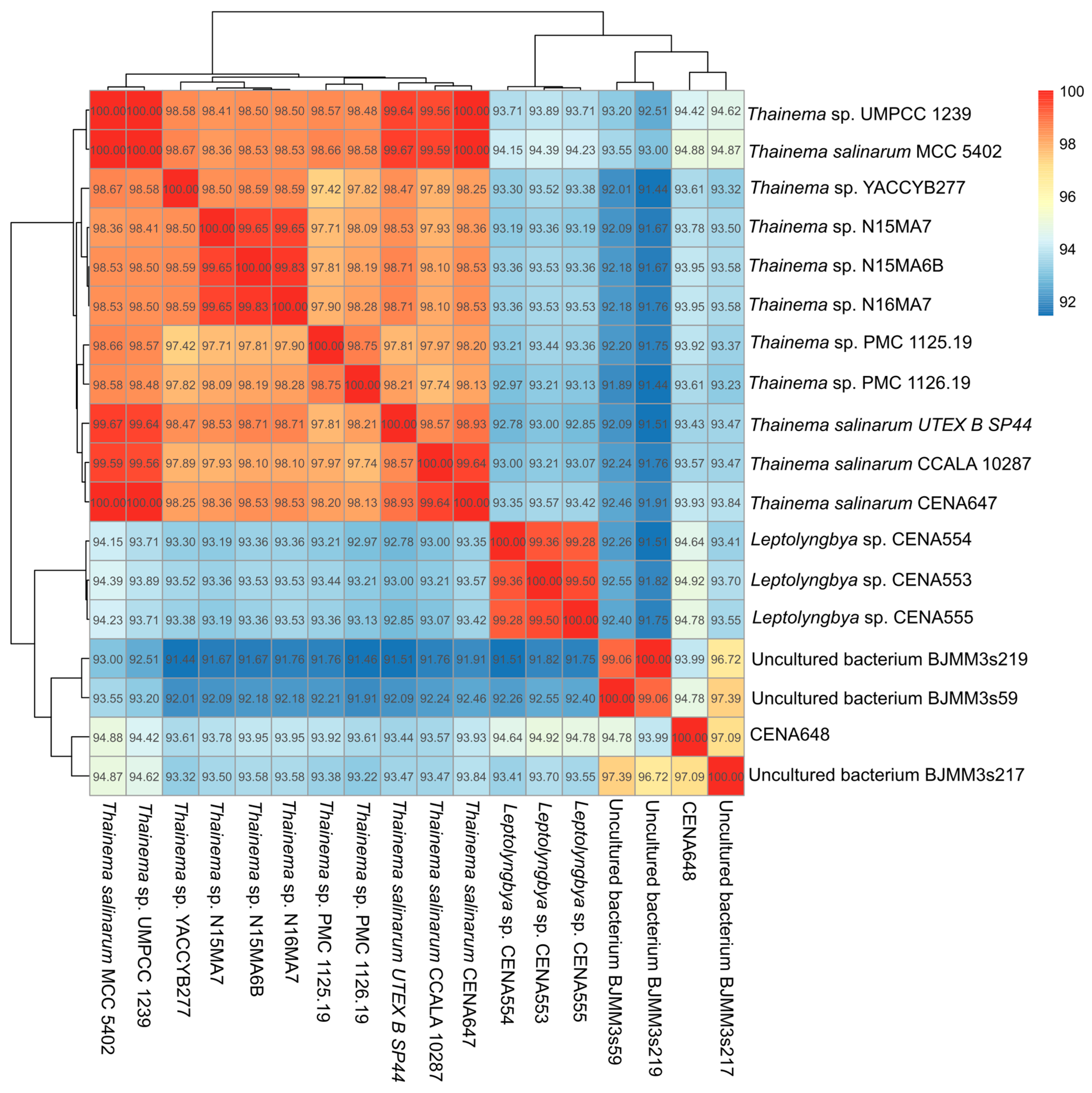
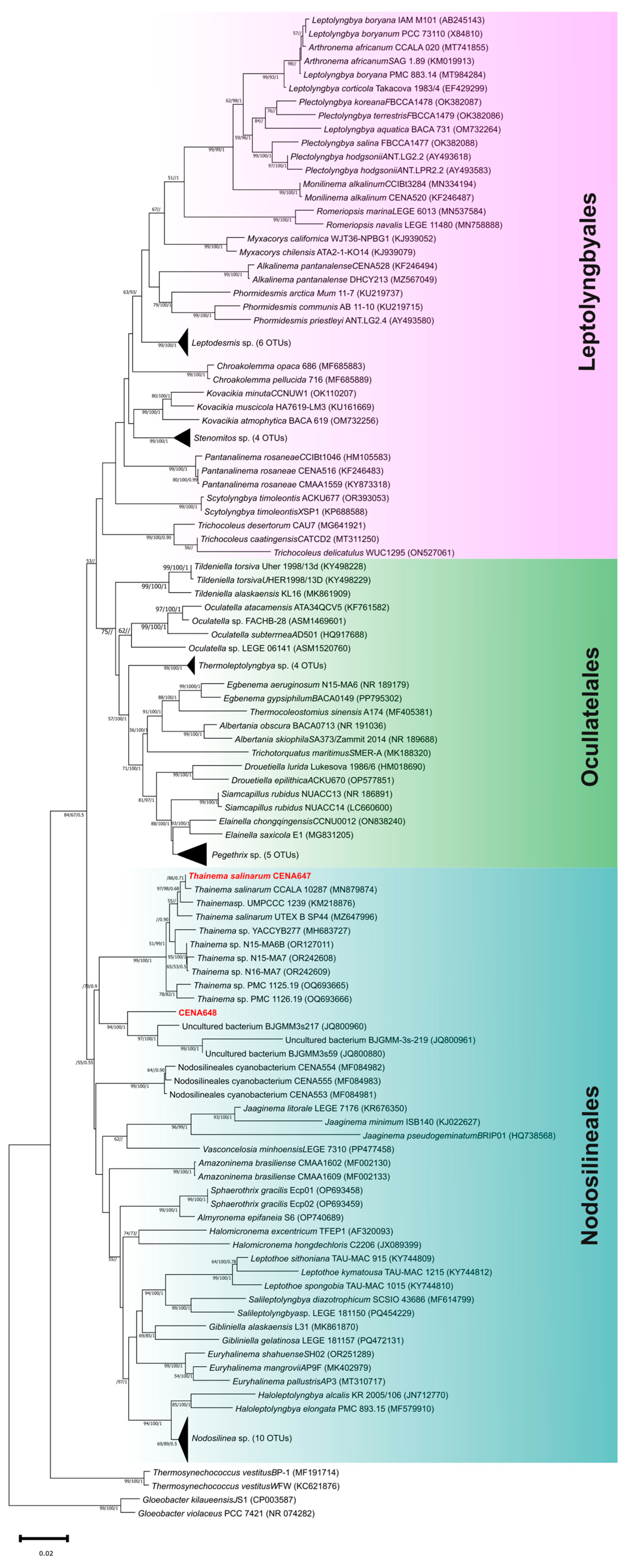
The 16S rRNA sequence of strain CENA647 showed high similarity to other Thainema strains, forming a clade with the type strain Thainema salinarum CCALA 10287 (99.6%) and the T. salinarum UTEX B SP44 (98.93%). CENA647 also showed 100% similarity to the partial 16S rRNA sequence (~1200 bp) recovered from the SRA data for the T. salinarum MCC 5402 assembly. While the strain CENA648 showed low similarity to uncultured bacterial strains (94–97%) and to cyanobacterial strains isolated from the Pantanal biome in Brazil (~94%) (Figure 2), suggesting that CENA648 may represent a distinct cyanobacterial strain or a putative novel species. Because the Neighbor-Joining, Maximum Likelihood, and Bayesian phylogenetic analyses yielded similar topologies, the Neighbor-Joining tree was selected for presentation, along with bootstrap and posterior probability support values (Figure 3).
Although previously described as a member of the order Leptolyngbyales and as a sister clade to the genera Nodosilinea and Halomicronema, Thainema salinarum CENA647 and the other Thainema strains clustered within the recently proposed order Nodosilineales in our analyses. This placement was supported by both the 16S rRNA phylogenetic tree and the whole-genome phylogenomic analysis (Figure 3 and Supplementary Figure S1). This difference from previous classifications may reflect the inclusion of additional strains and newly assembled genomes in the present analyses. Additionally, the genome of T. salinarum CENA647 shared high whole-genome similarity to the MAG recovered from the SRA data for T. salinarum MCC 5402, with ANI values of 97.37%, and DNA–DNA hybridization values of 87.02% (Supplementary Table S2). The divergent one-way AAI values (80.81% to CENA647 and 90.16% to MCC 5402) may reflect differences in assembly completeness, annotation bias, or variation in predicted protein-coding regions between the genomes (7592 and 5950 CDSs, respectively). Nevertheless, the two-way AAI (97.14% across 5213 proteins) supported a close taxonomic relationship between these strains (Supplementary Table S3). The fragmented nature of the assemblies may also have contributed to differences in gene counts and orthology distribution patterns observed in Supplementary Figure S2.
Strain CENA648 clustered within the Nodosilineales clade in the 16S rRNA phylogenetic tree but grouped with Oculatellales in the phylogenomic analysis (Figure 3 and Supplementary Figure S1). This divergence may reflect the limited genomic representation currently available for both Nodosilineales and Oculatellales in public databases, as well as the low similarity between CENA648 and currently available reference genomes. Additionally, all genomes included in the analysis showed low similarity to CENA648, as indicated by DDH and GC-content difference values (Supplementary Table S2). ANI values below 85% across all whole-genome comparisons further supported the distinction of CENA648 from currently available Nodosilineales and Oculatellales genomes (Supplementary Table S2). The conflicting placement of CENA648 between Nodosilineales in the 16S rRNA analysis and Oculatellales in the phylogenomic analysis requires further investigation, supported by additional genomic and morphological data from representative genera of both orders, to securely resolve its taxonomic placement.

3.2. Functional Gene Annotation and Biosynthetic Gene Clusters (BGCs)

The comparative metabolic analysis of strains CENA647 and CENA648, based on DRAM annotation, revealed similar profiles for energy metabolism, carbon utilization, and redox potential (Supplementary Figure S3). The genomes encode components of the five canonical ETC complexes (I–V), although with varying degrees of completeness. ETC complexes I, IV (Low affinity), and V have the highest levels of completeness (~100% in at least one gene). Both genomes also possess nearly complete pathways for glycolysis (Embden-Meyerhof-Parnas), the TCA cycle, and the pentose phosphate pathway, which may indicate metabolic flexibility associated with mixotrophic metabolism. However, experimental validation is still required to confirm these metabolic predictions. Only a limited number of CAZy families were detected, predominantly in CENA647, which includes enzymes for cellulose and hemicellulose degradation, suggesting a possible role in polysaccharide turnover. CENA648 showed no significant CAZy activity, suggesting limited capacity to process complex carbohydrates. Furthermore, both genomes encode genes involved in ammonification and nitric oxide reduction, which are part of nitrogen cycling. Genes encoding enzymes for the conversion of short-chain fatty acids (SCFAs) and alcohol were detected in the genomes. These pathways included acetate metabolism, D-lactate metabolism (CENA647), L-lactate metabolism (CENA648), pyruvate metabolism (CENA648), and alcohol production.
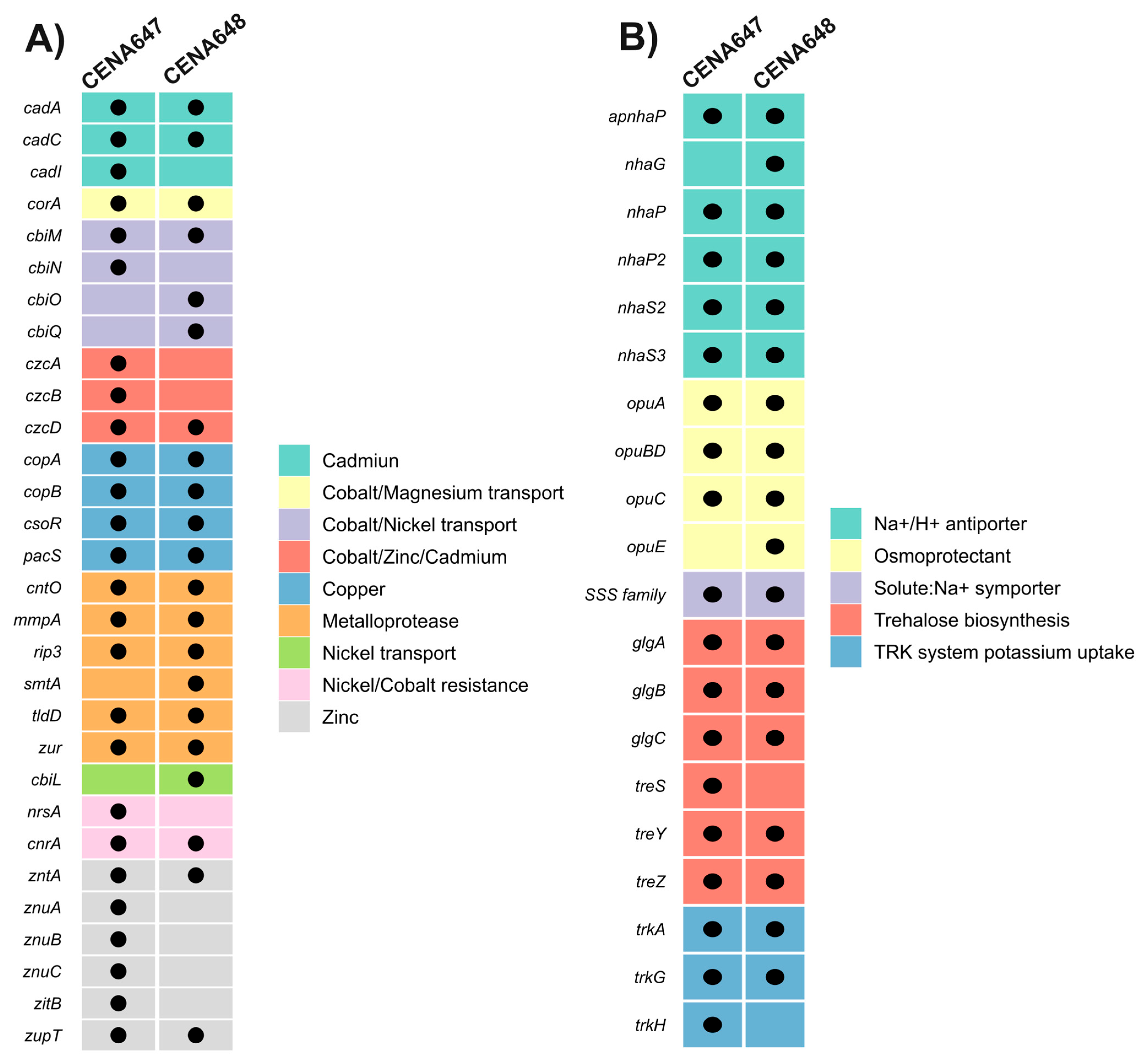
Given the fluctuating salinity and potential metal contamination typical of estuarine and marine ecosystems, we performed a comprehensive functional annotation of genes involved in metal resistance and osmoregulation in the genomes. The annotation revealed a broad repertoire of genes associated with heavy metal resistance across the genomes of CENA647 and CENA648 (Figure 4A). Both strains harbor the cadA and cadC genes, which encode a cadmium-transporting ATPase and a cadmium-responsive transcriptional regulator, respectively. The cadI gene—coding for a cadmium-induced protein—was found only in CENA647. The genomes encode components of several cobalt- and nickel-transport systems. Both strains possess corA and cbiM, which are associated with magnesium/cobalt uptake; cbiN was present only in CENA647, and cbiO and cbiQ were unique to CENA648. Furthermore, the presence of cbiL in CENA648 suggests a more complete cobalamin-associated pathway in this strain. Gene presence alone does not necessarily translate into resistance mechanisms, and functional roles still require further validation using approaches such as transcriptomics or proteomics.
Efflux systems involving the czc genes, including czcA, czcB, and czcD, were observed. These genes mediate resistance to multiple divalent cations, including cobalt (Co2+), zinc (Zn2+), and cadmium (Cd2+). Notably, czcA and czcB were present only in CENA647, whereas czcD was present in both genomes. The nrsA and cnrA genes, involved in cation efflux and nickel and cobalt tolerance, were found in both genomes, with nrsA restricted to CENA647. Copper detoxification pathways also appeared to be conserved in both strains. Both genomes encode the copA and copB ATPases, responsible for Cu+ and Cu2+ efflux, respectively, along with csoR, a transcriptional repressor, and pacS, a putative copper transporter. Regarding zinc resistance mechanisms, the zntA ATPase, which facilitates Zn2+/Cd2+ efflux, is present in both genomes. However, the znuABC high-affinity zinc uptake system (comprising znuA, znuB, and znuC) was found only in the CENA647 genome. The zinc transporters zitB and zupT are differentially distributed: zupT is present in both strains, whereas zitB is present in CENA647 only. Lastly, genes encoding various metalloproteases (e.g., mmpA, rip3, tldD) and regulatory proteins (e.g., zur, a zinc-specific transcriptional regulator) were identified in both genomes, and smtA, a metallothionein involved in metal ion sequestration, was identified only in CENA648, possibly contributing to metal ion buffering capacity.
Among genes associated with osmotic stress tolerance, both genomes encode multiple Na+/H+ antiporters that regulate intracellular pH and ion homeostasis (Figure 4B). Genes such as apnhaP, nhaP, nhaP2, nhaS2, and nhaS3 were conserved in both strains, whereas nhaG was identified only in CENA648. Both strains harbor a gene encoding a solute: Na+ symporter of the SSS family, which may contribute to the uptake of sugars, amino acids, or other osmolytes via sodium gradients. Furthermore, the TRK potassium uptake system, associated with osmoregulatory responses, is represented in both genomes by trkA and trkG, and the gene trkH was found exclusively in CENA647. Osmoprotectant uptake is mediated by ABC transporters encoded by the opuA, opuBD, and opuC genes, all of which were present in both genomes. These systems facilitate the import of compatible solutes, such as glycine betaine and proline. Additionally, opuE, a proline-specific transporter, was uniquely found in CENA648. Trehalose is a well-known compatible solute in cyanobacteria. The genomes of both strains encode multiple enzymes involved in trehalose biosynthesis, including glgA, glgB, glgC, treY, and treZ. However, treS, which encodes a trehalose synthase/amylase and provides an alternative biosynthetic route, was present only in CENA647. Phenotypic assays could further elucidate the functional roles of these genes in oyster-associated cyanobacteria.
Other functionally relevant genetic traits contributing to stress response and defense-related functions were also examined. Genes associated with arsenic resistance, CRISPR-Cas systems, and phage- or temperature-related stress responses were identified (Supplementary Figure S4A). Both strains harbor a core set of arsenic resistance genes, including acr3, arsA, arsB, and arsR, which confer arsenite efflux, ATP-dependent transport, and transcriptional regulation in response to arsenic exposure. The gene arsC, encoding a glutaredoxin-type arsenate reductase, was found exclusively in CENA648. Conversely, arsJ, an arsenic-specific MFS (Major Facilitator Superfamily) exporter, was detected only in CENA647, suggesting differences in the genetic arsenal for arsenic detoxification. The transcriptional regulator cadC, which overlaps with arsR in function, was conserved in both strains and may confer broader regulation of heavy metal stress responses. Additionally, genes encoding the phosphate-specific transport system (pstA, pstB, pstC, pstS) responsible for arsenate uptake were present in both genomes.
Both genomes encode a diverse set of CRISPR-associated genes, consistent with defense systems against foreign genetic elements such as bacteriophages and plasmids (Supplementary Figure S4B). Core cas genes (cas1, cas2, cas3, cas4) were present in both strains, suggesting the presence of adaptation-and-interference modules. CENA647 also carries cas6 and the csc1–3 genes, which are associated with RNA-based interference systems, whereas CENA648 uniquely encodes cmr2 (also known as cas10), suggesting structural divergence between their CRISPR-Cas subtypes. Both strains share the interference components cmr3 and cmr4. In parallel, the pspA gene, which encodes the phage shock protein A and is involved in membrane stabilization during phage infection or envelope stress, was detected in both genomes (Supplementary Figure S4C). Interestingly, the pleC gene, implicated in phage resistance, was found exclusively in CENA647. This observation is consistent with the detection of a prophage region within the CENA647 genome (Supplementary Figure S5), which comprises a suite of phage-related genes, including integrase, tail and head proteins, a portal protein, and multiple phage-like elements. Another small but relevant set of genes related to stress response was identified in both genomes (Supplementary Figure S3). The acrB gene, which encodes a multidrug efflux pump, was conserved, suggesting potential resistance to xenobiotics or environmental antimicrobial compounds. Regarding temperature-related stress, both strains encode htpX, a heat shock protease. Still, only CENA647 encodes cspA, a cold-shock protein, indicating differences in temperature-associated stress-response genes between the strains.
To further explore the biosynthetic potential of the cyanobacterial strains, we performed genome mining with the antiSMASH platform, which predicts secondary metabolite biosynthetic gene clusters (BGCs) (Supplementary Table S4). Analysis of the genomes of strains CENA647 and CENA648 revealed a diverse repertoire of secondary metabolite pathways, including non-ribosomal peptide synthetases (NRPSs), polyketide synthases (PKS), terpene synthases, ribosomally synthesized and post-translationally modified peptides (RiPPs), and lanthipeptides. CENA647 contains fewer BGCs overall but features large hybrid clusters. The first cluster is a hybrid NRPS–T1PKS, co-localized with a terpene biosynthetic locus (Supplementary Figure S6A), corresponding to compounds such as hapalosin, scytocyclamide, minutissamide, and terpenes. The second cluster encodes an NRPS-like biosynthetic pathway (Supplementary Figure S6B). In contrast, CENA648 displays a greater diversity of cluster types; however, most exhibit little or no similarity to known reference pathways, suggesting that they may represent poorly characterized biosynthetic pathways (Supplementary Table S4). Both strains share terpene biosynthesis clusters that encode phytoene synthase, consistent with their capacity to produce hopanoids (triterpenes) and carotenoids (tetraterpenes). In CENA648, the presence of a DUF692 family protein, associated with iron-dependent enzymatic functions, may contribute to the biosynthesis of specialized metabolites or to metal homeostasis. Additionally, the quinoline chelator pathway, mediated by FbnL and FbnM, suggests the potential to produce metallophore-like compounds that sequester and mobilize metal ions. Furthermore, the prediction of NRPS-like clusters involved in lipopeptide production (such as minutissamide and puwainaphycin) suggests that CENA648 could produce amphipathic compounds with antimicrobial, surfactant, or signaling functions.

3.3. Metabolic Profile and Biosynthesis of the Strains CENA647 and CENA648

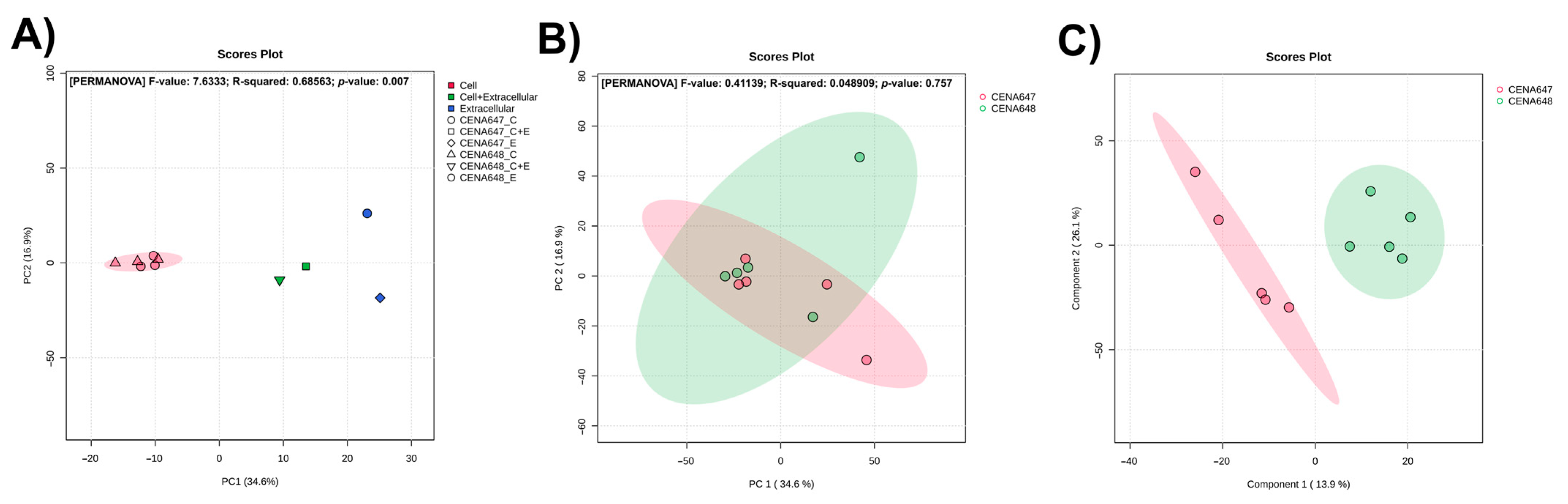
Analyses revealed patterns of metabolic differentiation among strains, with sample type as the primary driver of variation (Supplementary Figure S7). PCA of the total metabolome (Figure 5A) showed separation among the strains’ cell extracts, while PERMANOVA indicated that the grouping factor explained 53.1% of the variation among samples (R2 = 0.531). However, differences between groups were not statistically significant (F = 4.523, p = 0.1). To further explore discriminatory patterns, supervised classification using OPLS-DA was performed, suggesting clearer discrimination between strains (Figure 5B). The model showed high explanatory and predictive values (R2Y = 0.998; Q2 = 0.735) (Figure 5C), consistent with the visual separation observed in both PCA and OPLS-DA score plots. Nevertheless, permutation tests indicated that the model was not statistically significant (pQ2 = 0.101; pR2Y = 0.303), suggesting that the observed separation should be interpreted with caution, particularly given the potential influence of sample size and biological variability.
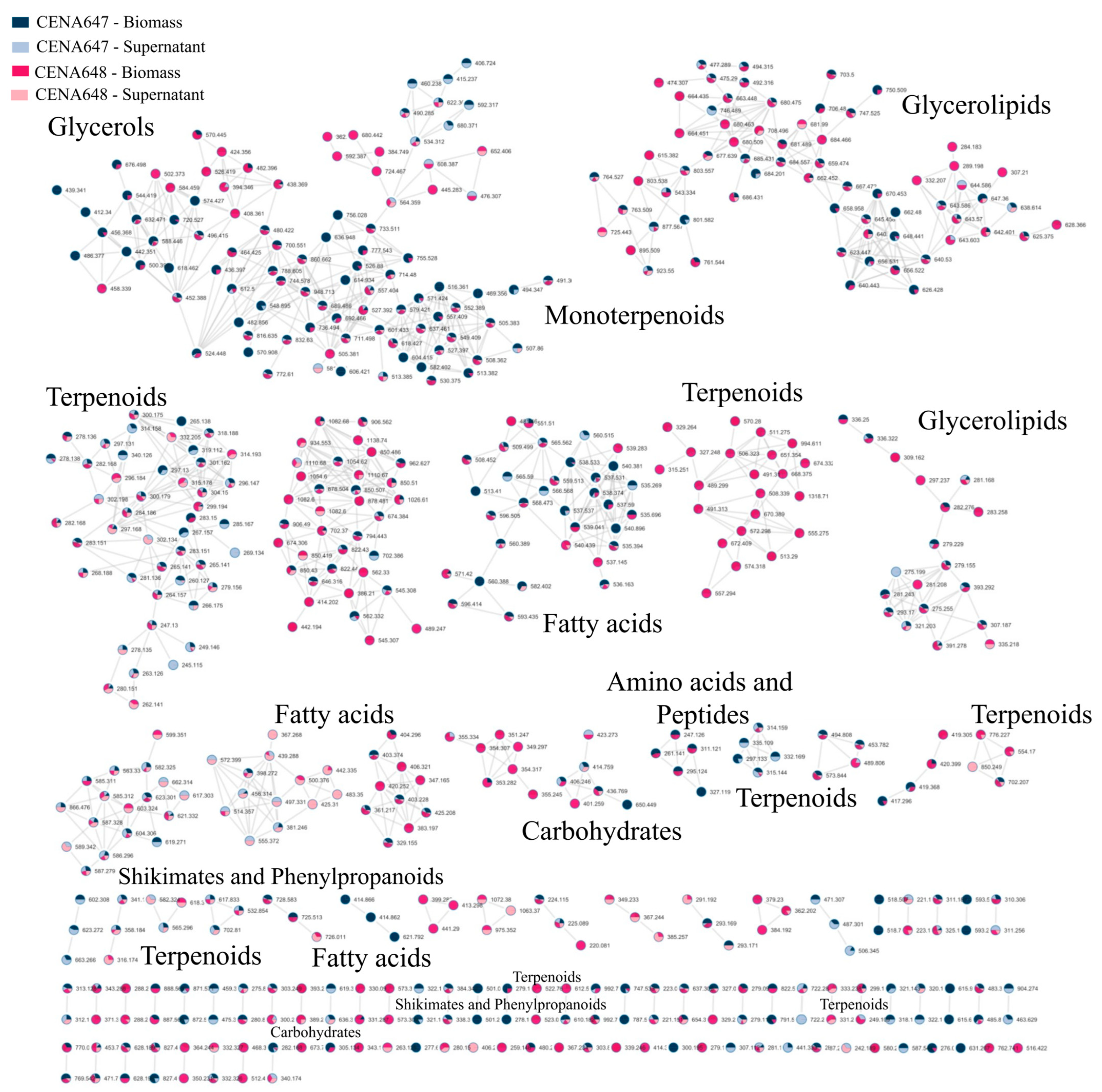
The molecular networking analysis on the GNPS platform revealed a complex and diverse array of metabolites in the strains CENA647 and CENA648, encompassing both shared and strain-specific chemical features (Figure 6). While a significant proportion of metabolites was common to both strains, several clusters were exclusively associated with a particular strain or culture condition, suggesting differences in metabolite composition between strains and culture conditions, as well as a broad spectrum of compound classes (Supplementary Figure S8). Terpenes were the predominant metabolite class in the metabolite profile, with 61 clusters predicted in both strains, along with additional strain-specific representatives. Other significant classes included lipids, porphyrin and chlorophyll derivatives, surfactants, phenolics, and peptides/amino acids. Notably, CENA648 displayed a larger number of unique lipid-related metabolites and nitrogen-containing compounds, whereas CENA647 showed unique surfactant-associated features.
Despite extensive dereplication efforts using accurate mass, retention time (rt), MS2 fragmentation patterns, and spectral library searches, most detected features could not be confidently annotated. Only a limited subset of metabolites showed high-confidence matches to reference spectra, mostly common primary metabolites and widespread compound classes, including dipeptides, diterpenes, fatty acids, nucleosides, carbohydrates, and chlorophyll-derived pigments (Supplementary Table S5).
In contrast, a substantial proportion of the detected molecular features exhibited fragmentation patterns consistent with peptides and lipopeptides yet lacked close matches in available spectral databases. Several of these compounds displayed complex MS2 spectra with diagnostic immonium ions indicative of residues such as Leu/Ile, Glu, and Arg (e.g., m/z 84, m/z 102, m/z 129, m/z 130), internal peptide fragments, and lipid-associated ions (e.g., fatty acyl chain fragments m/z 200–400 with peaks differing by ±2 Da), consistent with both a non-ribosomal origin and a chemically diverse peptide-associated profile. For example, the predicted compound formula C41H75N10OPS (m/z 787.5655 [M+H]+, rt 22.73, m/z error −0.76 ppm) was annotated as a peptide based on its high nitrogen content and MS/MS fragmentation pattern, with the spectrum exhibiting multiple diagnostic amino acid immonium ions (e.g., m/z 130 and 148). The presence of sulfur and phosphorus suggests a chemically modified peptide, potentially with post-translational modifications. Another example was the compound with the predicted molecular formula C43H76N4O10 (m/z 791.5546 [M-H2O+H]+, rt 21.52, m/z error 1.51 ppm), which was predicted to be a lipopeptide based on its elemental composition and MS/MS fragmentation pattern. It was further investigated through integrated genomic and structural analyses, which were consistent with amino acid–derived immonium ions (m/z 130 and m/z 133) and a series of high-mass fragments (m/z 493–551) indicative of a long aliphatic chain.
Among the annotated metabolites, the antioxidant compound ergothioneine (EGT) (C9H15N3O2S, m/z 230.0959 [M+H]+, rt 0.96 min, m/z error −1.83 ppm) was identified in both strains and selected for further in-depth analysis, integrating metabolomic, genomic, and structural approaches (Supplementary Figure S9). Its putative biosynthesis was supported by the presence of the genes hercynine oxygenase (egtB), gamma-glutamyl-hercynylcysteine sulfoxide hydrolase (egtC), and histidine N-alpha-methyltransferase (egtD) in the genomes of CENA647 and CENA648. Although the gene egtE (hercynylcysteine sulfoxide lyase) has not been widely reported in Cyanobacteria, our analysis revealed that strain Thainema salinarum CENA647 harbors egtE together with the egtBCD genes. In CENA648, the egtBCD genes are consistently clustered on the same scaffold, flanked by the glutamine synthase and malate synthase genes, which are enzymes involved in nitrogen and carbon assimilation pathways. In CENA647, all four genes are located on the same scaffold of the assembly. However, the egtBC genes are the only ones positioned adjacent to one another, flanked by a potassium uptake protein and a metallothionein transferase. Upstream of them, egtE is inserted between a dipeptide transporter and an adenyltransferase, while downstream of the egtBC cluster, egtD is inserted between a glutaminase and another adenyltransferase gene.
To further investigate these genes, structural and evolutionary analyses were conducted. As shown in Supplementary Table S6, AlphaFold predictions were used to compare protein structures from strains T. salinarum CENA647 and Cyanobacterium sp. CENA648, and T. salinarum MCC5402 against bacterial and cyanobacterial references, selecting only models with very high confidence (pLDDT > 90%). The results showed that all proteins had higher HSP scores with cyanobacterial homologs, particularly those of Scytonema and Oscillatoria, both known producers of ergothioneine, while sequence identities with canonical producers such as Mycobacterium, Nocardia, and Methylobacterium remained in the 32–44% range. Phylogenetic reconstruction of the EGT clusters (Supplementary Figure S10) was consistent with these observations, showing that cyanobacterial sequences form distinct clades separated from other bacterial producers, with T. salinarum CENA647 grouping with T. salinarum MCC5402. However, the latter genome lacks the egtE gene. In addition, structural comparisons of the predicted tertiary assemblies (Supplementary Figure S11) revealed overall conservation of fold architecture between the most similar bacterial and cyanobacterial proteins, with key similarities in the distribution of α-helices and β-sheets. Nonetheless, cyanobacterial proteins, particularly egtB and egtD, exhibited low-confidence regions (low pLDDT), indicating uncertainty in their structural predictions that warrants further investigation. Together, these analyses show EGT production and support the presence of a conserved EGT-associated biosynthetic organization in T. salinarum CENA647, with structural and phylogenetic characteristics distinct from canonical bacterial references.

4. Discussion

In this study, we present the genomic reports of the cyanobacterial strains Thainema salinarum CENA647 and Cyanobacterium sp. CENA648, isolated from oyster-associated environments. The coastal region of Brazil spans a vast area and harbors an underexplored diversity of cyanobacterial taxonomic and metabolic resources [60]. Oyster-associated microorganisms also represent a largely unexplored source of genetic and metabolic diversity with potential ecological significance. These microbial communities contribute to host health, nutrient cycling, and environmental adaptation, and may also be a potential source of bioactive metabolites [20,61,62]. Environmental conditions such as elevated salinity and pH in tidal systems may favor stress-tolerant microorganisms [63]. Furthermore, the presence of cyanobacteria in oyster-associated environments may have implications for food safety when toxin-producing strains are present [63]. However, no known cyanotoxins (anatoxin, cylindrospermopsin, or microcystin) were identified in either CENA647 or CENA648. Despite the ecological relevance of cyanobacteria in tidal environments, the genomic and metabolic diversity of oyster-associated strains remains poorly characterized.
Although previously described as a member of the Leptolyngbyales order and as a sister clade to the genera Nodosilinea and Halomicronema [64], Thainema salinarum CENA647, together with other Thainema strains, was placed within the recently proposed Nodosilineales order [65]. CENA647 clusters with the reference strain CCALA 10287 of T. salinarum, isolated from an artificial hypersaline environment in Thailand. Other strains within this clade include T. salinarum MCC 5402, isolated from an Indian estuarine mangrove [66]; strains PMC 1125.19 and PMC 1126.19 from mangroves in Mayotte (a French overseas territory); and strains N15-MA6B, N15-MA7, and N16-MA7 from soil samples in Nigeria. Although most reported strains are associated with saline environments, currently available genomes indicate that the genus occupies diverse ecological niches.
The strain CENA648 appears to represent a putative novel cyanobacterial species and was also positioned among Nodosilineales strains in the phylogenetic tree. The most similar sequences correspond to uncultured soil cyanobacteria from the Yellow River delta in China and to periphyton attached to rocks on a Brazilian seashore, highlighting the still-limited genomic representation of cyanobacteria from coastal and estuarine habitats. Additional sampling and genomic characterization will likely improve the taxonomic resolution of strains such as CENA648, which currently shows low similarity to available reference sequences. Describing cyanobacteria solely by morphological or genetic methods, or by unique strains, may lead to species misidentification, particularly within polyphyletic and poorly represented groups [1,67]. In this context, a careful taxonomic assignment was adopted to avoid premature or unsupported classification of this novel species.
Bivalve mollusks, such as oysters, are filter-feeding organisms that can accumulate microbial cells, viruses, and metals in aquatic environments [62]. Cyanobacteria can inhabit oyster surfaces or internal tissues [61] and are likely exposed to osmotic stress and elevated concentrations of heavy metals, including copper, zinc, and arsenic, from natural sources or anthropogenic pollution [68,69,70]. In our study, both strains harbored a diverse, partially overlapping set of metal resistance genes, including those associated with cadmium, copper, zinc, and arsenic tolerance, consistent with the presence of cyanobacteria in metal-rich marine environments. Although the presence of these genes is compatible with potential adaptation, it does not, by itself, demonstrate functional activity, particularly because many of these pathways are widespread among cyanobacteria. Nevertheless, the diversity of transporters, efflux systems, and regulatory genes suggests multiple mechanisms potentially associated with metal stress response. A similar profile of metalloproteases, metal transporters, and cation–anion antiporters was reported in Oxynema mangrovii CENA135, a strain isolated from a coastal mangrove habitat in Brazil [71]. Among natural products, the siderophore anachelin is encoded by genes predicted by the AntiSMASH platform in CENA648. This gene cluster was first identified in Anabaena cylindrica CCAP 1403/2A and subsequently confirmed in A. cylindrica NIES 19 [72,73]. Dmaq-containing siderophores are among the oldest chelating groups and are associated with the biosynthetic precursors FbnL and FbnM, which are detected in the CENA648 genome [74,75]. In oyster-associated cyanobacteria, the presence of siderophore biosynthetic genes suggests possible ecological roles in iron acquisition and metal detoxification under competitive marine conditions [76].
Additionally, both strains possess a comprehensive set of osmoadaptive genes that may support ion homeostasis, osmoprotectant uptake, and compatible solute biosynthesis, including betaine-related compounds (opu genes) and trehalose. The few strain-specific genes (such as nhaG, opuE, treS, and trkH) may reflect differences in osmoadaptive strategies or responses to salinity fluctuations in oyster-associated habitats [77,78]. The presence of multiple CRISPR-Cas arrays within these genomes suggests that, in addition to chemical stressors such as heavy metals and osmotic imbalance, viral predation and horizontal gene transfer may act as selective pressures in oyster-associated environments [79]. Although our data provide genomic potential rather than demonstrate functional activity, the diversity of stress-response and defense-related genes suggests adaptation to the complex oyster-associated microenvironment.
To further investigate the biosynthetic diversity of these strains, we integrated genome mining with metabolomic profiling. Predictions of biosynthetic gene clusters revealed the genetic potential for secondary metabolite production, while metabolomic analyses detected chemically diverse compounds, including terpenoids, fatty acids, peptides, and phenolic derivatives. Notably, Thainema salinarum CENA647 has been reported to produce uncharacterized metabolites that are cytotoxic to Artemia salina, causing 100% lethality at 100 µg/mL [22], suggesting the presence of bioactive secondary metabolites. The high proportion of unannotated metabolomic features also reflects the still-limited representation of cyanobacterial metabolites in public spectral libraries, suggesting the presence of poorly characterized natural products in oyster-associated cyanobacteria.
Ergothioneine (EGT), a sulfur-containing antioxidant detected in both CENA647 and CENA648, has been linked to oxidative stress response, metal detoxification, and nutrient limitation across several microbial groups [80,81,82,83,84]. In our study, the detection of EGT alongside egt-associated genes, including egtBCD in both strains and egtE in T. salinarum CENA647, supports the presence of conserved biosynthetic pathways that may be linked to adaptation to fluctuating estuarine environments. The presence of glutathione-related genes (gshA and gshB) in both genomes further suggests the coexistence of complementary antioxidant systems. Given the elevated metal exposure and environmental instability characteristic of oyster-associated habitats, these antioxidant-related pathways may contribute to cellular protection against oxidative and metal-induced stress.
By integrating genome mining with metabolomic analyses, our results highlight oyster-associated cyanobacteria from the Amazon region as ecologically relevant microorganisms adapted to dynamic coastal environments characterized by high organic loads, fluctuating metal levels, and intense microbial competition. Here, we observed genomic and metabolomic features suggesting that cyanobacterial presence in these habitats may contribute to biogeochemical cycling, metal homeostasis, and the production of metabolites that are potentially involved in microbial interactions within oyster-associated microbiomes.
Untargeted metabolomics and in silico predictions are both powerful approaches for exploring biological systems, but each has important limitations that can affect interpretation and reliability. Untargeted metabolomics, while comprehensive in principle, is constrained by instrument sensitivity, ion suppression, and incomplete metabolite coverage, so many low-abundance or chemically challenging compounds remain undetected. In addition, metabolite identification is often ambiguous due to limited spectral libraries and the presence of isomeric or structurally similar compounds, leading to uncertain annotations [85]. In silico prediction relies heavily on the quality and completeness of training data and primary chemical knowledge bases. These models may struggle with novel compounds outside their chemical space and can propagate biases present in reference datasets. Furthermore, predicted metabolites or pathways often lack experimental validation, making it difficult to distinguish biologically relevant signals [86]. As a result, both approaches benefit from complementary integration and careful experimental confirmation to improve confidence in biological conclusions.
The limited number of available genomes and reliance on in silico analyses and untargeted metabolomics indicate that functional inferences should be interpreted cautiously. Complementary approaches, including targeted metabolite isolation, NMR-based structure elucidation, transcriptomics, and functional validation assays, will be essential for confirming predicted functions and further clarifying the ecological roles of these oyster-associated cyanobacteria.
In conclusion, the integrated genomic and metabolomic characterization of the oyster-associated cyanobacteria Thainema salinarum CENA647 and Cyanobacterium sp. CENA648 expands current knowledge of microbial diversity in the Amazonian estuarine ecosystem and reveals genetic traits associated with life in dynamic oyster-associated habitats. Our results provide the first record of Thainema in South America and suggest that CENA648 may represent a previously undescribed cyanobacterium. Both strains harbor extensive genetic repertoires for osmoregulation, metal tolerance, stress responses, and secondary metabolism. Metabolomic analyses further revealed a chemically diverse profile dominated by terpenes, lipids, peptides, and numerous uncharacterized metabolites. Combined genomic and metabolomic evidence supporting ergothioneine biosynthesis underscores their potential ecological and biotechnological relevance. Together, these findings demonstrate that oyster-associated cyanobacteria represent an underexplored reservoir of taxonomic, functional, and metabolic diversity, offering new insights into microbial adaptation in tropical estuarine systems and laying the groundwork for future studies of their ecological roles, natural products, and applications in biotechnology and aquaculture.

Supplementary Materials

The following supporting information can be downloaded at: https://www.mdpi.com/article/10.3390/phycology6030074/s1, Figure S1: Maximum-Likelihood phylogenomic tree constructed from the alignment of 120 bacterial single-copy conserved marker proteins utilizing GTDB-tk.; Figure S2: Orthologous cluster distribution (A) and shared gene content (B) between T. salinarum strains CENA647 and MCC5402.; Figure S3: Functional annotation of metabolic modules and electron transport complexes in CENA647 and CENA648 genomes using DRAM.; Figure S4: Comparative distribution of genes related to arsenic resistance and transport (A), CRISPR-Cas immune systems (B), and stress response mechanisms (C) in cyanobacterial strains CENA647 and CENA648.; Figure S5: Schematic representation of a putative prophage region identified in the genome of strain CENA647.; Figure S6: Biosynthetic Gene Clusters with high similarity in T. salinarum CENA647.; Figure S7: Heatmap of metabolite abundance patterns across cyanobacterial metabolome samples.; Figure S8: Comparative classification of predicted metabolites annotated in the metabolome of the strains CENA647 and CENA648.; Figure S9: (A) Chromatogram spectrum of the node with precursor m/z 230.092 (B) identified as Ergothioneine in GNPS and Mzmine analysis. (C) Peak area intensity of the annotated feature as ergothioneine (230.0958 m/z, rt 0.94 min).; Figure S10: EGT cluster phylogeny based on the amino acid sequence of Egt-related proteins from several cyanobacterial and bacterial strains.; Figure S11: Predicted tertiary protein structure of (A) canonical bacterial EGT cluster and (B) putative cyanobacterial EGT cluster.; Table S1: In silico DNA-DNA-Hybridization (DDH) and G+C difference values using Genome-to-Genome Distance Calculator 3.0 (GGDC), and whole genome (WG) Average Nucleotide Identity (ANI) for CENA647 and CENA648 with selected reference genomes of Nodosilineales and Oculatellales order.; Table S2: In silico DNA-DNA-Hybridization (DDH) and G+C difference values using Genome-to-Genome Distance Calculator 3.0 (GGDC), and whole genome (WG) Average Nucleotide Identity (ANI) for CENA647 and CENA648 with selected reference genomes of Nodosilineales and Oculatellales order.; Table S3: Average Amino Acid Identity (AAI) between the genomes of T. salinarum strains CENA647 and MCC5402.; Table S4: Predicted Biosynthetic Gene Clusters (BGCs) and associated core genes in cyanobacterial strains CENA647 and CENA648.; Table S5: Predicted metabolites by the databases for Thainema salinarum CENA647 and Cyanobacterium CENA648. Table S6: Comparison of egtBCDE predicted amino acid sequences from CENA648, CENA647, and MCC5402 based on % identity with the tertiary structure of EGT cluster proteins deposited at AlphaFold Protein Structure Database.

Author Contributions

M.J.M.: Conceptualization, Data curation, Formal Analysis, Investigation, Methodology, Software, Writing—original draft, Writing—review and editing. F.R.J.: Conceptualization, Data curation, Formal Analysis, Investigation, Methodology, Software, Writing—original draft, Writing—review and editing. R.B.D.: Conceptualization, Data curation, Formal Analysis, Investigation, Methodology, Software, Writing—original draft, Writing—review and editing. A.M.T.F.: Formal Analysis, Software, Writing—review and editing. L.S.S.: Investigation, Writing—review and editing. F.A.S.A.: Investigation, Writing—review and editing. E.P.: Funding acquisition, Writing—review and editing. M.F.F.: Writing—review and editing. M.P.C.S.: Conceptualization, Funding acquisition, Project administration, Supervision, Writing—review and editing. All authors have read and agreed to the published version of the manuscript.

Funding

M.J.M. was funded by the Brazilian National Council for Scientific and Technological Development (CNPq, 140991/2022-0). M.J.M. and A.M.T.F. were funded by the National Coordination of Higher Education Personnel Formation Program (CAPES, DS-001). R.B.D. and F.R.J. were funded by the State of São Paulo Research Foundation (FAPESP, 2023/08974-6, 2024/02448-3). M.F.F. received funding from the CNPq—Research Productivity Grant. (309476/2022-4). M.P.C.S. received grants from Amazon Foundation to Support Studies and Research (FAPESPA, ICAAF 173/2014), from CNPq (315214/2020-1 and 554321/2010-6), and from the Cross-Cutting Action Infrastructure For The Legal Amazon 2024 (Pro-Amazon) MCTI/FINEP/FNDCT/Grant: 2374/24.

Data Availability Statement

The assembled sequences from the study were deposited in NCBI under BioProject ID PRJNA1430081. Additionally, the Third Party Assembly (TPA) of the SRA, SRR33532330, was deposited under the BioProject PRJNA1430487. This Whole Genome Shotgun project has been deposited at DDBJ/ENA/GenBank under the accession JBYJZJ000000000 (Thainema salinarum CENA647) and JBYJZK000000000 (Cyanobacterium sp. CENA648).

Acknowledgments

R.B.D. thanks Tsai Siu Mui for her support and guidance. During the preparation of this work, the authors used Grammarly to edit and correct grammar, spelling, punctuation, and word choice. After using this tool/service, the authors reviewed and edited the content as needed and took full responsibility for the published article.

Conflicts of Interest

The authors declare no conflicts of interest.

References

  1. Komárek, J. A polyphasic approach for the taxonomy of cyanobacteria: Principles and applications. Eur. J. Phycol. 2016, 51, 346–353. [Google Scholar] [CrossRef] [Scilit]
  2. Massey, I.Y.; Al Osman, M.; Yang, F. An overview on cyanobacterial blooms and toxins production: Their occurrence and influencing factors. Toxin Rev. 2022, 41, 326–346. [Google Scholar] [CrossRef] [Scilit]
  3. Machado, M.J.; Jacinavicius, F.R.; Médice, R.V.; Dextro, R.B.; Feitosa, A.M.; Weiss, M.B.; Pellegrinetti, T.A.; Cotta, S.R.; Crnkovic, C.M.; Fiore, M.F. Genetic and biochemical diversity of terpene biosynthesis in cyanobacterial strains from tropical soda lakes. Front. Microbiol. 2025, 16, 1582103. [Google Scholar] [CrossRef] [Scilit] [PubMed]
  4. Weiss, M.B.; Borges, R.M.; Sullivan, P.; Domingues, J.P.; da Silva, F.H.; Trindade, V.G.; Luo, S.; Orjala, J.; Crnkovic, C.M. Chemical diversity of cyanobacterial natural products. Nat. Prod. Rep. 2025, 42, 6–49. [Google Scholar] [CrossRef] [Scilit] [PubMed]
  5. Sánchez-Baracaldo, P.; Bianchini, G.; Wilson, J.D.; Knoll, A.H. Cyanobacteria and biogeochemical cycles through Earth history. Trends Microbiol. 2022, 30, 143–157. [Google Scholar] [CrossRef] [Scilit] [PubMed]
  6. Saad, M.H.; El-Fakharany, E.M.; Salem, M.S.; Sidkey, N.M. The use of cyanobacterial metabolites as natural medical and biotechnological tools. Biomol. Struct. Dyn. 2022, 40, 2828–2850. [Google Scholar] [CrossRef] [Scilit] [PubMed]
  7. Mutalipassi, M.; Riccio, G.; Mazzella, V.; Galasso, C.; Somma, E.; Chiarore, A.; De Pascale, D.; Zupo, V. Symbioses of cyanobacteria in marine environments: Ecological insights and biotechnological perspectives. Mar. Drugs 2021, 19, 227. [Google Scholar] [CrossRef] [Scilit] [PubMed]
  8. Sant’Anna, C.L.; Azevedo, M.P.; Fiore, M.D.F.; Lorenzi, A.S.; Kaštovský, J.; Komárek, J. Subgeneric diversity of Brasilonema (cyanobacteria, Scytonemataceae). Braz. J. Bot. 2011, 34, 51–62. [Google Scholar] [CrossRef] [Scilit]
  9. Christodoulou, M.; Dextro, R.B.; Wahlsten, M.; Oivanen, P.; Fewer, D.P.; Fiore, M.F. Sivoneniella epilithica gen. et sp. nov., (Leptolyngbyaceae, Cyanobacteria), from Suomenlinna Fortress (UNESCO World Heritage Site), Finland. Eur. J. Phycol. 2026, 61, 79–98. [Google Scholar] [CrossRef] [Scilit]
  10. Avila-Poveda, O.H.; Torres-Arino, A.; Girón-Cruz, D.A.; Cuevas-Aguirre, A. Evidence for accumulation of Synechococcus elongatus (Cyanobacteria: Cyanophyceae) in the tissues of the oyster Crassostrea gigas (Mollusca: Bivalvia). Tissue Cell 2014, 46, 379–387. [Google Scholar] [CrossRef] [Scilit] [PubMed]
  11. Martínez-García, M.F.; Ruesink, J.L.; Grijalva-Chon, J.M.; Lodeiros, C.; Arreola-Lizárraga, J.A.; de la Re-Vega, E.; Varela-Romero, A.; Chávez-Villalba, J. Socioecological factors related to aquaculture introductions and production of Pacific oysters (Crassostrea gigas) worldwide. Rev. Aquac. 2022, 14, 613–629. [Google Scholar] [CrossRef] [Scilit]
  12. Barillé, L.; Le Bris, A.; Méléder, V.; Launeau, P.; Robin, M.; Louvrou, I.; Ribeiro, L. Photosynthetic epibionts and endobionts of Pacific oyster shells from oyster reefs in rocky versus mudflat shores. PLoS ONE 2017, 12, e0185187. [Google Scholar] [CrossRef] [Scilit] [PubMed]
  13. Horodesky, A.; Castilho-Westphal, G.G.; Pont, G.D.; Faoro, H.; Balsanelli, E.; Tadra-Sfeir, M.Z.; Cozer, N.; Pie, M.R.; Ostrensky, A. Metagenomic analysis of the bacterial microbiota associated with cultured oysters (Crassostrea sp.) in estuarine environments. An. Acad. Bras. Ciênc. 2020, 92, e20180432. [Google Scholar] [CrossRef] [Scilit] [PubMed]
  14. Paillard, C.; Gueguen, Y.; Wegner, K.M.; Bass, D.; Pallavicini, A.; Vezzulli, L.; Arzul, I. Recent advances in bivalve-microbiota interactions for disease prevention in aquaculture. Curr. Opin. Biotechnol. 2022, 73, 225–232. [Google Scholar] [CrossRef] [Scilit] [PubMed]
  15. Diner, R.E.; Zimmer-Faust, A.; Cooksey, E.; Allard, S.; Kodera, S.M.; Kunselman, E.; Garodia, Y.; Verhougstraete, M.P.; Allen, A.E.; Griffith, J.; et al. Host and water microbiota are differentially linked to potential human pathogen accumulation in oysters. Appl. Environ. Microbiol. 2023, 89, e00318-23. [Google Scholar] [CrossRef] [Scilit] [PubMed]
  16. Svirčev, Z.; Lalić, D.; Bojadžija Savić, G.; Tokodi, N.; Drobac Backović, D.; Chen, L.; Meriluoto, J.; Codd, G.A. Global geographical and historical overview of cyanotoxin distribution and cyanobacterial poisonings. Arch. Toxicol. 2019, 93, 2429–2481. [Google Scholar] [CrossRef] [Scilit] [PubMed]
  17. Mutoti, M.; Gumbo, J.; Jideani, A.I.O. Occurrence of cyanobacteria in water used for food production: A review. Phys. Chem. Earth Parts A B C 2022, 125, 103101. [Google Scholar] [CrossRef] [Scilit]
  18. Ribeiro, K.F.; Duarte, L.; Crossetti, L.O. Everything is not everywhere: A tale on the biogeography of cyanobacteria. Hydrobiologia 2018, 820, 23–48. [Google Scholar] [CrossRef] [Scilit]
  19. Clerissi, C.; De Lorgeril, J.; Petton, B.; Lucasson, A.; Escoubas, J.M.; Gueguen, Y.; Dégremont, L.; Mitta, G.; Toulza, E. Microbiota composition and evenness predict survival rate of oysters confronted to Pacific oyster mortality syndrome. Front. Microbiol. 2020, 11, 311. [Google Scholar] [CrossRef] [Scilit] [PubMed]
  20. Conceição, M.V.R.; Costa, S.S.; Schaan, A.P.; Ribeiro-dos-Santos, Â.K.C.; Silva, A.; das Graças, D.A.; Schneider, M.P.C.; Baraúna, R.A. Amazonia seasons have an influence in the composition of bacterial gut microbiota of mangrove oysters (Crassostrea gasar). Front. Genet. 2021, 11, 602608. [Google Scholar] [CrossRef] [Scilit] [PubMed]
  21. Dextro, R.B.; Delbaje, E.; Cotta, S.R.; Zehr, J.P.; Fiore, M.F. Trends in free-access genomic data accelerate advances in cyanobacteria taxonomy. J. Phycol. 2021, 57, 1392–1402. [Google Scholar] [CrossRef] [Scilit] [PubMed]
  22. Campos, T.G.V.; Gama, W.A.; Geraldes, V.; Yoon, J.; Crnkovic, C.M.; Pinto, E.; Jacinavicius, F.R. New records on toxic cyanobacteria from Brazil: Exploring their occurrence and geography. Sci. Total Environ. 2024, 931, 172689. [Google Scholar] [CrossRef] [Scilit] [PubMed]
  23. Schneider, M.P.C.; Cunha, E.; Silva, L.; Leão, J.; Tavares, V.C.; Brabo de Sousa, E.; Faustino, S. Cyanobacterial Blooms and the Presence of Cyanotoxins in the Brazilian Amazon. Toxins 2025, 17, 296. [Google Scholar] [CrossRef] [Scilit] [PubMed]
  24. Allen, M.M.; Stanier, R.Y. Growth and division of some unicellular blue-green algae. Microbiology 1968, 51, 199–202. [Google Scholar] [CrossRef] [Scilit] [PubMed]
  25. Bolger, A.M.; Lohse, M.; Usadel, B. Trimmomatic: A Flexible Trimmer for Illumina Sequence Data. Bioinformatics 2024, 30, 2114–2120. [Google Scholar] [CrossRef] [Scilit] [PubMed]
  26. De Coster, W.; D’hert, S.; Schultz, D.T.; Cruts, M.; Van Broeckhoven, C. NanoPack: Visualizing and processing long-read sequencing data. Bioinformatics 2018, 34, 2666–2669. [Google Scholar] [CrossRef] [Scilit] [PubMed]
  27. Bonenfant, Q.; Noé, L.; Touzet, H. Porechop_ABI: Discovering unknown adapters in Oxford Nanopore Technology sequencing reads for downstream trimming. Bioinform. Adv. 2023, 3, vbac085. [Google Scholar] [CrossRef] [Scilit] [PubMed]
  28. Kolmogorov, M.; Yuan, J.; Lin, Y.; Pevzner, P.A. Assembly of long, error-prone reads using repeat graphs. Nat. Biotechnol. 2019, 37, 540–546. [Google Scholar] [CrossRef] [Scilit] [PubMed]
  29. Li, H. Minimap2: Pairwise alignment for nucleotide sequences. Bioinformatics 2018, 34, 3094–3100. [Google Scholar] [CrossRef] [Scilit] [PubMed]
  30. Pan, S.; Zhao, X.M.; Coelho, L.P. SemiBin2: Self-supervised contrastive learning leads to better MAGs for short- and long-read sequencing. Bioinformatics 2023, 39, i21–i29. [Google Scholar] [CrossRef] [Scilit] [PubMed]
  31. Gurevich, A.; Saveliev, V.; Vyahhi, N.; Tesler, G. QUAST: Quality Assessment Tool for Genome Assemblies. Bioinformatics 2013, 29, 1072–1075. [Google Scholar] [CrossRef] [Scilit] [PubMed]
  32. Parks, D.H.; Imelfort, M.; Skennerton, C.T.; Hugenholtz, P.; Tyson, G.W. CheckM: Assessing the Quality of Microbial Genomes Recovered from Isolates, Single Cells, and Metagenomes. Genome Res. 2015, 25, 1043–1055. [Google Scholar] [CrossRef] [Scilit] [PubMed]
  33. Simão, F.A.; Waterhouse, R.M.; Ioannidis, P.; Kriventseva, E.V.; Zdobnov, E.M. BUSCO: Assessing genome assembly and annotation completeness with single-copy orthologs. Bioinformatics 2015, 31, 3210–3212. [Google Scholar] [CrossRef] [Scilit] [PubMed]
  34. Bankevich, A.; Nurk, S.; Antipov, D.; Gurevich, A.A.; Dvorkin, M.; Kulikov, A.S.; Lesin, V.M.; Nikolenko, S.I.; Pham, S.; Prjibelski, A.D.; et al. SPAdes: A New Genome Assembly Algorithm and Its Applications to Single-Cell Sequencing. J. Comput. Biol. 2012, 19, 455–477. [Google Scholar] [CrossRef] [Scilit] [PubMed]
  35. Alvarenga, D.O.; Fiore, M.F.; Varani, A.M. A Metagenomic Approach to Cyanobacterial Genomics. Front. Microbiol. 2017, 8, 809. [Google Scholar] [CrossRef] [Scilit] [PubMed]
  36. Wood, D.E.; Kraken, S.S. Ultrafast Metagenomic Sequence Classification Using Exact Alignments. Genome Biol. 2024, 15, 46. [Google Scholar] [CrossRef] [Scilit] [PubMed]
  37. Lu, J.; Rincon, N.; Wood, D.E.; Breitwieser, F.P.; Pockrandt, C.; Langmead, B.; Salzberg, S.L.; Steinegger, M. Metagenome Analysis Using the Kraken Software Suite. Nat. Protoc. 2022, 17, 2815–2839. [Google Scholar] [CrossRef] [Scilit] [PubMed]
  38. Shen, W.; Le, S.; Li, Y.; Hu, F. SeqKit: A cross-platform and ultrafast toolkit for FASTA/Q file manipulation. PLoS ONE 2016, 11, e0163962. [Google Scholar] [CrossRef] [Scilit] [PubMed]
  39. Seemann, T. Prokka: Rapid Prokaryotic Genome Annotation. Bioinformatics 2014, 30, 2068–2069. [Google Scholar] [CrossRef] [Scilit] [PubMed]
  40. Kanehisa, M.; Sato, Y.; Morishima, K. BlastKOALA and GhostKOALA: KEGG Tools for Functional Characterization of Genome and Metagenome Sequences. J. Mol. Biol. 2016, 428, 726–731. [Google Scholar] [CrossRef] [Scilit] [PubMed]
  41. Wishart, D.S.; Han, S.; Saha, S.; Oler, E.; Peters, H.; Grant, J.R.; Stothard, P.; Gautam, V. PHASTEST: Faster than PHASTER, better than PHAST. Nucleic Acids Res. 2023, 51, W443–W450. [Google Scholar] [CrossRef] [Scilit] [PubMed]
  42. Blin, K.; Shaw, S.; Augustijn, H.E.; Reitz, Z.L.; Biermann, F.; Alanjary, M.; Fetter, A.; Terlouw, B.R.; Metcalf, W.W.; Helfrich, E.J.; et al. AntiSMASH 7.0: New and Improved Predictions for Detection, Regulation, Chemical Structures and Visualisation. Nucleic Acids Res. 2023, 51, W46–W50. [Google Scholar] [CrossRef] [Scilit] [PubMed]
  43. Edgar, R.C. MUSCLE: Multiple sequence alignment with high accuracy and high throughput. Nucleic Acids Res. 2004, 32, 1792–1797. [Google Scholar] [CrossRef] [Scilit] [PubMed]
  44. Tamura, K.; Stecher, G.; Kumar, S. MEGA11: Molecular evolutionary genetics analysis version 11. Mol. Biol. Evol. 2021, 38, 3022–3027. [Google Scholar] [CrossRef] [Scilit] [PubMed]
  45. Nguyen, L.T.; Schmidt, H.A.; Von Haeseler, A.; Minh, B.Q. IQ-TREE: A fast and effective stochastic algorithm for estimating maximum-likelihood phylogenies. Mol. Biol. Evol. 2015, 32, 268–274. [Google Scholar] [CrossRef] [Scilit] [PubMed]
  46. Kalyaanamoorthy, S.; Minh, B.Q.; Wong, T.K.; Von Haeseler, A.; Jermiin, L.S. ModelFinder: Fast model selection for accurate phylogenetic estimates. Nat. Methods 2017, 14, 587–589. [Google Scholar] [CrossRef] [Scilit] [PubMed]
  47. Ronquist, F.; Huelsenbeck, J.P. MrBayes 3: Bayesian phylogenetic inference under mixed models. Bioinformatics 2003, 19, 1572–1574. [Google Scholar] [CrossRef] [Scilit] [PubMed]
  48. Chaumeil, P.A.; Mussig, A.J.; Hugenholtz, P.; Parks, D.H. GTDB-Tk: A toolkit to classify genomes with the Genome Taxonomy Database. Bioinformatics 2020, 36, 1925–1927. [Google Scholar] [CrossRef] [Scilit] [PubMed]
  49. Meier-Kolthoff, J.P.; Klenk, H.P.; Göker, M. Taxonomic Use of DNA G+C Content and DNA–DNA Hybridization in the Genomic Age. Int. J. Syst. Evol. Microbiol. 2014, 64, 352–356. [Google Scholar] [CrossRef] [Scilit] [PubMed]
  50. Meier-Kolthoff, J.P.; Carbasse, J.S.; Peinado-Olarte, R.L.; Göker, M. TYGS and LPSN: A Database Tandem for Fast and Reliable Genome-Based Classification and Nomenclature of Prokaryotes. Nucleic Acids Res. 2022, 50, D801–D807. [Google Scholar] [CrossRef] [Scilit] [PubMed]
  51. Sun, J.; Lu, F.; Luo, Y.; Bie, L.; Xu, L.; Wang, Y. OrthoVenn3: An integrated platform for exploring and visualizing orthologous data across genomes. Nucleic Acids Res. 2023, 51, W397–W403. [Google Scholar] [CrossRef] [Scilit] [PubMed]
  52. Jacinavicius, F.R.; Campos, T.G.V.; Passos, L.S.; Pinto, E.; Geraldes, V. A rapid LC-MS/MS method for multi-class identification and quantification of cyanotoxins. Toxicon 2023, 234, 107282. [Google Scholar] [CrossRef] [Scilit] [PubMed]
  53. Heuckeroth, S.; Damiani, T.; Smirnov, A.; Mokshyna, O.; Brungs, C.; Korf, A.; Smith, J.D.; Stincone, P.; Dreolin, N.; Nothias, L.F.; et al. Reproducible mass spectrometry data processing and compound annotation in MZmine 3. Nat. Protoc. 2024, 19, 2597–2641. [Google Scholar] [CrossRef] [Scilit] [PubMed]
  54. Pang, Z.; Lu, Y.; Zhou, G.; Hui, F.; Xu, L.; Viau, C.; Spigelman, A.F.; MacDonald, P.E.; Wishart, D.S.; Li, S.; et al. MetaboAnalyst 6.0: Towards a unified platform for metabolomics data processing, analysis and interpretation. Nucleic Acids Res. 2024, 52, W398–W406. [Google Scholar] [CrossRef] [Scilit] [PubMed]
  55. Wang, M.; Carver, J.J.; Phelan, V.V.; Sanchez, L.M.; Garg, N.; Peng, Y.; Nguyen, D.D.; Watrous, J.; Kapono, C.A.; Luzzatto-Knaan, T.; et al. Sharing and community curation of mass spectrometry data with global natural products social molecular networking. Nat. Biotechnol. 2016, 34, 828–837. [Google Scholar] [CrossRef] [Scilit] [PubMed]
  56. Jones, M.R.; Pinto, E.; Torres, M.A.; Dörr, F.; Mazur-Marzec, H.; Szubert, K.; Tartaglione, L.; Dell’Aversano, C.; Miles, C.O.; Beach, D.G.; et al. CyanoMetDB, a comprehensive public database of secondary metabolites from cyanobacteria. Water Res. 2021, 196, 117017. [Google Scholar] [CrossRef] [Scilit] [PubMed]
  57. Van Santen, J.A.; Jacob, G.; Singh, A.L.; Aniebok, V.; Balunas, M.J.; Bunsko, D.; Neto, F.C.; Castaño-Espriu, L.; Chang, C.; Clark, T.N.; et al. Cleary Little, The natural products atlas: An open access knowledge base for microbial natural products discovery. ACS Cent. Sci. 2019, 5, 51824–51833. [Google Scholar] [CrossRef] [Scilit] [PubMed]
  58. Dührkop, K.; Fleischauer, M.; Ludwig, M.; Aksenov, A.A.; Melnik, A.V.; Meusel, M.; Dorrestein, P.C.; Rousu, J.; Böcker, S. SIRIUS 4: A rapid tool for turning tandem mass spectra into metabolite structure information. Nat. Methods 2019, 16, 299–302. [Google Scholar] [CrossRef] [Scilit] [PubMed]
  59. Patiny, L.; Borel, A. ChemCalc: A Building Block for Tomorrow’s Chemical Infrastructure. J. Chem. Inf. Model. 2013, 53, 1223–1228. [Google Scholar] [CrossRef] [Scilit] [PubMed]
  60. Caires, T.A.; Affe, H.M.D.J. Brazilian coast: A significant gap in the knowledge of Cyanobacteria and their applications. In Cyanobacteria-Recent Advances in Taxonomy and Applications, 1st ed.; Hozzein, W.N., Ed.; IntechOpen: London, UK, 2021; Volume 1, pp. 77–91. [Google Scholar] [CrossRef] [Scilit]
  61. Chauhan, A.; Wafula, D.; Lewis, D.E.; Pathak, A. Metagenomic assessment of the eastern oyster-associated microbiota. Genome Announc. 2014, 2, 1110–1128. [Google Scholar] [CrossRef] [Scilit] [PubMed]
  62. Oliveira, A.M.; Baraúna, R.A.; Marcon, D.J.; Lago, L.A.; Silva, A.; Lusio, J.; Tavares, R.D.; Tacão, M.; Henriques, I.; Schneider, M.P. Occurrence, antibiotic-resistance and virulence of E. coli strains isolated from mangrove oysters (Crassostrea gasar) farmed in estuaries of Amazonia. Mar. Pollut. Bull. 2020, 157, 111302. [Google Scholar] [CrossRef] [Scilit] [PubMed]
  63. Costa, S.D.S.; das Graças, D.A.; Silva, A.; Veras, A.A.D.O.; Schneider, M.P.C.; Sampaio, D.D.S.; Baraúna, R.A. High-Resolution Metabarcoding Reveals the Microbiome Dynamics of Mangrove Oysters (Crassostrea gasar) and Their Habitat. Mar. Ecol. 2026, 47, e70075. [Google Scholar] [CrossRef] [Scilit]
  64. Rasouli-Dogaheh, S.; Komárek, J.; Chatchawan, T.; Hauer, T. Thainema gen. nov. (Leptolyngbyaceae, Synechococcales): A new genus of simple trichal cyanobacteria isolated from a solar saltern environment in Thailand. PLoS ONE 2022, 17, e0261682. [Google Scholar] [CrossRef] [Scilit] [PubMed]
  65. Strunecký, O.; Ivanova, A.P.; Mareš, J. An updated classification of cyanobacterial orders and families based on phylogenomic and polyphasic analysis. J. Phycol. 2023, 59, 12–51. [Google Scholar] [CrossRef] [Scilit] [PubMed]
  66. Roy, A.R.; Lefler, F.W.; Laughinghouse, H.D., IV; Chakraborty, S.; de los Santos Villalobos, S.; Mukherjee, J. Genome sequences of Almyronema epifaneia and Thainema salinarum isolated from an intertidal mangrove forest. J. Phycol. 2026, 62, 17–24. [Google Scholar] [CrossRef] [Scilit] [PubMed]
  67. Machado, M.J.; Botero, N.B.; Andreote, A.P.D.; Feitosa, A.M.T.; Popin, R.V.; Sivonen, K.; Fiore, M.F. Genomic insights into the taxonomy and metabolism of the Cyanobacterium Pannus brasiliensis CCIBt3594. Taxonomy 2024, 4, 184–198. [Google Scholar] [CrossRef] [Scilit]
  68. Silva, C.A.R.; Rainbow, P.S.; Smith, B.D.; Santos, Z.L. Biomonitoring of trace metal contamination in the Potengi estuary, Natal (Brazil), using the oyster Crassostrea rhizophorae, a local food source. Water Res. 2001, 35, 4072–4078. [Google Scholar] [CrossRef] [Scilit] [PubMed]
  69. Pavón, A.; Riquelme, D.; Jaña, V.; Iribarren, C.; Manzano, C.; Lopez-Joven, C.; Reyes-Cerpa, S.; Navarrete, P.; Pavez, L.; García, K. The high risk of bivalve farming in coastal areas with heavy metal pollution and antibiotic-resistant bacteria: A Chilean perspective. Front. Cell. Infect. Microbiol. 2022, 12, 867446. [Google Scholar] [CrossRef] [Scilit] [PubMed]
  70. Vásquez-Ponce, F.; Gamboa-Acuña, N.; de Oliveira, A.P.; Becerra, J.; Pariona, J.G.; de Oliveira Lima, L.; de Carvalho Elias, A.; Luz, M.S.; Ribas, M.R.; Rocha, G.; et al. Arsenic bioaccumulation in ready-to-eat oysters can contribute to the selection of WHO critical priority Enterobacterales displaying a virulent behavior. Food Res. Int. 2025, 217, 116684. [Google Scholar] [CrossRef] [Scilit] [PubMed]
  71. Apaza-Castillo, G.A.; Dextro, R.B.; Andreote, A.P.; Souza, B.C.; Hosaka, G.K.; Delbaje, E.; Branco, L.H.; Riaño-Pachón, D.M.; Fiore, M.F. Oxynema mangrovii sp. nov., a new filamentous species (Oscillatoriales, Cyanobacteria) from Atlantic Forest mangrove. Front. Microbiol. 2026, 16, 1709185. [Google Scholar] [CrossRef] [Scilit] [PubMed]
  72. Beiderbeck, H.; Taraz, K.; Budzikiewicz, H.; Walsby, A.E. Anachelin, the siderophore of the cyanobacterium Anabaena cylindrica CCAP 1403/2A. Z. Für Naturforschung 2000, 55, 681–687. [Google Scholar] [CrossRef] [Scilit] [PubMed]
  73. Itou, Y.; Okada, S.; Murakami, M. Two structural isomeric siderophores from the freshwater cyanobacterium Anabaena cylindrica (NIES-19). Tetrahedron 2001, 57, 9093–9099. [Google Scholar] [CrossRef] [Scilit]
  74. Vinnik, V.; Zhang, F.; Park, H.; Cook, T.B.; Throckmorton, K.; Pfleger, B.F.; Bugni, T.S.; Thomas, M.G. Structural and biosynthetic analysis of the fabrubactins, unusual siderophores from Agrobacterium fabrum strain C58. ACS Chem. Biol. 2020, 16, 125–135. [Google Scholar] [CrossRef] [Scilit] [PubMed]
  75. Reitz, Z.L.; Pourmohsenin, B.; Susman, M.; Thomsen, E.; Roth, D.; Butler, A.; Ziemert, N.; Medema, M. Automated genome mining predicts structural diversity and taxonomic distribution of peptide metallophores across bacteria. bioRxiv 2025. [Google Scholar] [CrossRef] [Scilit]
  76. Chakraborty, S.; Verma, E.; Singh, S.S. Cyanobacterial siderophores: Ecological and biotechnological significance. In Cyanobacteria, 1st ed.; Mishra, A.K., Tiwari, D.N., Rai, A.N., Eds.; Academic Press: New York, NY, USA, 2019; Volume 1, pp. 383–397. [Google Scholar] [CrossRef] [Scilit]
  77. Oren, A. Cyanobacteria in hypersaline environments: Biodiversity and physiological properties. Biodivers. Conserv. 2015, 24, 781–798. [Google Scholar] [CrossRef] [Scilit]
  78. Rosic, N. Molecular mechanisms of stress tolerance in cyanobacteria. In Ecophysiology and Biochemistry of Cyanobacteria, 1st ed.; Rastogi, R.P., Ed.; Springer Nature: Singapore, 2022; Volume 1, pp. 131–153. [Google Scholar] [CrossRef] [Scilit]
  79. Saleem, A.; Anwar, S.; Saud, S.; Kamal, T.; Fahad, S.; Nawaz, T. Cyanobacteria diversity and ecological roles: Insights into cyanobacterial adaptations and environmental implications. J. Umm AL-Qura Univ. Appl. Sci. 2025, 11, 1–19. [Google Scholar] [CrossRef] [Scilit]
  80. Jones, G.W.; Doyle, S.; Fitzpatrick, D.A. The evolutionary history of the genes involved in the biosynthesis of the antioxidant ergothioneine. Gene 2014, 549, 161–170. [Google Scholar] [CrossRef] [Scilit] [PubMed]
  81. Pfeiffer, C.; Bauer, T.; Surek, B.; Schömig, E.; Gründemann, D. Cyanobacteria produce high levels of ergothioneine. Food Chem. 2011, 129, 1766–1769. [Google Scholar] [CrossRef] [Scilit]
  82. Narainsamy, K.; Farci, S.; Braun, E.; Junot, C.; Cassier-Chauvat, C.; Chauvat, F. Oxidative-stress detoxification and signalling in cyanobacteria: The crucial glutathione synthesis pathway supports the production of ergothioneine and ophthalmate. Mol. Microbiol. 2016, 100, 15–24. [Google Scholar] [CrossRef] [Scilit] [PubMed]
  83. Saini, V.; Cumming, B.M.; Guidry, L.; Lamprecht, D.A.; Adamson, J.H.; Reddy, V.P.; Chinta, K.C.; Mazorodze, J.H.; Glasgow, J.N.; Richard-Greenblatt, M.; et al. Ergothioneine maintains redox and bioenergetic homeostasis essential for drug susceptibility and virulence of Mycobacterium tuberculosis. Cell Rep. 2016, 14, 572–585. [Google Scholar] [CrossRef] [Scilit] [PubMed]
  84. Cumming, B.M.; Chinta, K.C.; Reddy, V.P.; Steyn, A.J. Role of ergothioneine in microbial physiology and pathogenesis. Antioxid. Redox Signal. 2018, 28, 431–444. [Google Scholar] [CrossRef] [Scilit] [PubMed]
  85. Gertsman, I.; Barshop, B.A. Promises and pitfalls of untargeted metabolomics. J. Inherit. Metab. Dis. 2018, 41, 355–366. [Google Scholar] [CrossRef] [Scilit] [PubMed]
  86. Sacan, A.; Ekins, S.; Kortagere, S. Applications and limitations of in silico models in drug discovery. Bioinform. Drug Discov. 2012, 910, 87–124. [Google Scholar] [CrossRef] [Scilit] [PubMed]
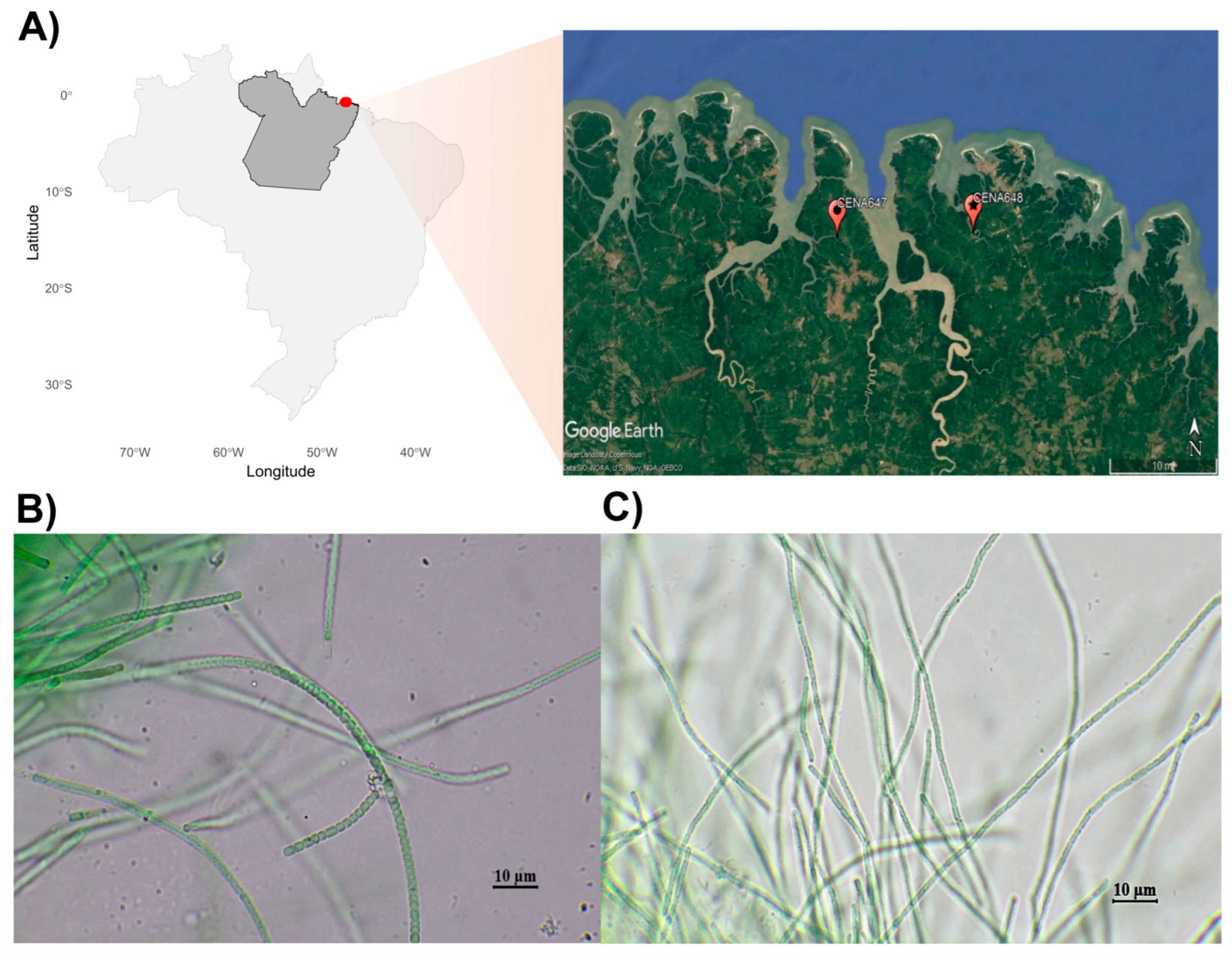
Figure 1. (A) Geographic location of the sampling sites along the Brazilian Amazon coast. The map highlights the state of Pará within Brazil, with red markers indicating the collection sites of strains CENA647 (Nazaré do Seco, municipality of Maracanã) and CENA648 (Santo Antônio de Urindeua, municipality of Salinópolis). (B,C) Light microscopy images show the filamentous morphology of strain CENA647 and CENA648, respectively.
Phycology 06 00074 g001
Figure 2. Heatmap of the pairwise sequence identity derived from 16s rRNA sequences among cyanobacterial strains most closely related to CENA647 and CENA648. Sequence identity values are presented in each cell, with color gradients representing sequence identity percentage intervals and hierarchical clustering indicating relatedness.
Phycology 06 00074 g002
Figure 3. Phylogenetic tree reconstructed based on the 16S rRNA gene sequence. The support values illustrate Neighbor-Joining (NJ) and Maximum-Likelihood (ML) bootstraps (1000 repetitions) with values above 50%, as well as Bayesian posterior probabilities (5,000,000 generations).
Phycology 06 00074 g003
Figure 4. Comparative genomic distribution of metal tolerance. (A) and osmoadaptive genes, (B) in cyanobacterial strains CENA647 and CENA648. Each row represents a gene, and the black dots indicate its presence in the respective genome. Colored backgrounds classify genes by functional category.
Phycology 06 00074 g004
Figure 5. Multivariate visualization of metabolomic profiles of the whole-cell extracts of CENA647 and CENA648. (A) Principal Component Analysis (PCA) of the total metabolome, illustrating the overall structure of the dataset and the natural grouping of samples without prior class information. (B) OPLS-DA score plot showing metabolomic discrimination between strains. (C) OPLS-DA model statistics, including explained variance (R2X and R2Y) and predictive ability (Q2).
Phycology 06 00074 g005
Figure 6. GNPS molecular networking of metabolites from T. salinarum CENA647 and Cyanobacterium sp. CENA648.
Phycology 06 00074 g006
Table 1. Genomic assembly metrics, functional annotation, and quality of the oyster-associated cyanobacteria strains CENA647 and CENA648.
CENA647CENA648
Total Length (bp)8,330,8936,517,618
Number of Contigs40173
GC content (%)50.4850.59
Completeness (%)99.3299.29
Contamination (%)0.362.16
Largest contig6,456,130435,579
N506,456,130107,571
L50118
CDS75935541
CRISPR96
rRNAs83
tRNAs7474
tmRNAs11
BUSCO: Complete707 (98.3%)709 (98.6%)
BUSCO: Duplicated5 (0.7%)4 (06%)
BUSCO: Fragmented4 (0.6%)5 (0.7%)
BUSCO: Missing8 (1.1%)5 (0.7%)
Disclaimer/Publisher’s Note: The statements, opinions and data contained in all publications are solely those of the individual author(s) and contributor(s) and not of MDPI and/or the editor(s). MDPI and/or the editor(s) disclaim responsibility for any injury to people or property resulting from any ideas, methods, instructions or products referred to in the content.