Article

Integrating C-Phycocyanin, and Polyhydroxybutyrate Recovery Using a Triphasic System: Experimental Design and Optimization in Thermotolerant Potamosiphon sp.


by
Andrés F. Barajas-Solano
Department of Environmental Sciences, Universidad Francisco de Paula Santander, Av. Gran Colombia No. 12E-96, Cucuta 540003, Colombia
Phycology 2026, 6(1), 21; https://doi.org/10.3390/phycology6010021
Submission received: 7 December 2025 / Revised: 8 January 2026 / Accepted: 9 January 2026 / Published: 1 February 2026
(This article belongs to the Special Issue Development of Algal Biotechnology)

Abstract

This research assesses a triphasic extraction technique for the sequential retrieval of C-phycocyanin (C-PC) and polyhydroxybutyrate (PHB) from a thermotolerant Potamosiphon sp. strain. A two-stage design-of-experiments methodology was employed (Minimum Run Resolution V factorial design involving six variables, followed by a central composite design (CCD)) to optimize the chosen region. In the factorial stage, PHB ranged from 109.396 to 168.995 mg/g, and the model was significant (F = 22.63, p < 0.0001). Freeze-milling and vortexing were identified as critical elements, underscoring the importance of the t-butanol × (NH4)2SO4 interaction for phase selectivity. The CCD concentrating on freeze-milling and vortex cycles yielded a robust quadratic model (F = 78.18, p < 0.0001), forecasting a peak PHB yield of 191.82 mg/g at six freeze-milling cycles and three vortex cycles (desirability 0.921), while maintaining t-butanol at 19.9 mL, t-butanol concentration at 94.7% (v/v), (NH4)2SO4 at 49.9% (w/v), and vortex duration at 1.2 min. Ten separate trials validated the model’s accuracy, yielding an observed PHB of 191.5 mg/g, which closely matched the model’s prediction. The platform facilitates an integrated downstream process in which C-PC is recovered under moderate conditions before triphasic partitioning. This enables the simultaneous valorization of pigment, lipophilic fraction, and biopolymer inside a unified cyanobacterial biorefinery process.

1. Introduction

Microalgae and cyanobacteria have been repurposed as an array of versatile biotechnological platforms due to their capacity to synthesize various types of industrial metabolites, including natural pigments to biopolymers. Among them, species like Limnospira platensis (formerly Arthrospira platensis) (Cyanophyceae) and Galdieria sulphuraria (Cyanidiophyceae) are commercially cultivated at large scale due to nutritional value, high content of pigments and adaptability to a wide range of growing conditions. L. platensis, commonly known as “Spirulina,” is the most important source of phycocyanin, a high-value blue pigment with applications in foods, cosmetics, and biomedicine [1,2,3]. In addition, this species accumulates polyhydroxybutyrate (PHB) under controlled conditions, expanding its potential for bioplastics applications [4]. G. sulphuraria, for its part, is an acidothermophilic extremophile capable of growing in hostile media (pH 1–3, >40 °C) and under both photoautotrophic and heterotrophic conditions, thereby facilitating industrial cultivation with reduced contamination risk [5,6]. This species produces thermostable phycobiliproteins such as C-phycocyanin (C-PC) with stability superior to that obtained from L. platensis and with emerging applications in industries that require thermal and chemical resistance [7,8]. Its metabolic flexibility also enables the valorization of industrial residues and acidic waters, aligning with circular-economy approaches [9,10]. Taken together, these species represent established and emerging models of commercial exploitation that illustrate the potential of microalgae as biofactories for sustainable applications in the food, textile, pharmaceutical, and bioplastics sectors [11,12].
The biorefinery concept applied to microalgae and cyanobacteria seeks to emulate the petroleum refinery model—in which multiple value-added products are obtained from a single feedstock—while operating within a sustainable, fossil-free paradigm. This approach enables the transformation of biomass into a broad portfolio of metabolites—pigments, proteins, carbohydrates, lipids, and bioplastics—under an integrated, zero-waste valorization scheme [13,14,15,16]. In recent years, the concept has moved from theory to practice: in 2023, the French company Microphyt inaugurated in Baillargues the world’s first industrial-scale microalgae biorefinery, cementing the transition of these technologies toward tangible commercial applications (https://www.cbe.europa.eu/news/scales-unique-microalgae-biorefinery-opens-france, accessed on 1 December 2025). This milestone illustrates how microalgal biorefineries can simultaneously contribute to the circular bioeconomy, industrial CO2 capture, and the generation of high-value-added products [17,18]. Nevertheless, a critical bottleneck persists in downstream processing, as extraction stages still depend heavily on toxic solvents and energy-intensive operations, limiting both sustainability and economic feasibility [19,20,21]. Hence, the urgency to design more sustainable extraction strategies based on green solvents—such as ionic liquids, natural deep eutectic solvents (NaDES), or biodegradable solvents—which have been shown to improve pigment and protein yields while reducing the environmental footprint [21,22,23,24]. Thus, more than a laboratory exercise, microalgal biorefinery stands as a pillar of the modern bioeconomy, requiring processes that maximize recovery of target metabolites with minimal reliance on hazardous chemicals.
The main idea of the biorefinery is to use the microalgal biomass as much as possible, but not all species may have commercial value. Biochemical composition differs according to species and cultivation conditions, which dictate their use as value-added products [25]. They are of particular interest to produce metabolites to be used in industry, like polyhydroxybutyrate (PHB), a biodegradable polymer with strong perspectives for the manufacturing of bioplastics [26] and phycocyanins, pigments having antioxidant activity and colorant properties. Until now, only the source of contenting C-phycocyanin (C-PC) that has been approved for human use is Arthrospira platensis. Yet, G. sulphuraria was added as the second qualified source with safe regulatory status when the U.S. Food and Drug Administration (FDA) approved its use as “Galdieria extract blue” in several food categories in 2025 (https://www.fda.gov/news-events/press-announcements/fda-approves-three-food-colors-natural-sources, accessed on 1 December 2025). Finally, the phytohormones (auxins and cytokinins) in several microalgae are emerging bioactives with potential use as agricultural biostimulants or agroforestry adjuvants [27]. This variety of different types of metabolites plus the regulatory reinforcement for a part of the sources equals a need to design biorefining processes able to recover several value-added products adapted to the biochemistry and regulation specificity of each strain.
Multiphase and ultrasound-assisted extraction approaches have been developed in recent years to improve the recovery of these high-value metabolites from microalgae. One especially promising area is the extraction of C-phycocyanin (C-PC) from Arthrospira/Limnospira sp. and other species, where sonication leads to higher yields than conventional methods like freeze–thaw cycles or maceration and allows for a reduction in the time required for these steps. Ultrasound-assisted wet biomass extraction of L. platensis cut the extraction time from 4 h to as short as 20 min, and the yield increased up to 40% [28,29]. Several authors have reported considerable synergistic effects between ultrasound and ultrafine shear or enzymatic treatment for enhanced cell disruption and C-PC recoveries higher than 90% [30,31]. Ultrasound methods have also been reported in the literature, which enhance C-PC concentration, and they retain antioxidant as well as anti-inflammatory function by avoiding extended thermal degradation [32].
Beyond phycocyanins, three-phase separation/three-phase partitioning (TPS/TPP) systems have been optimized for the simultaneous recovery of multiple metabolites—such as lipids, proteins, and carbohydrates—from Chlorella sp. (Chlorophyta) in a single step, achieving efficiencies > 95% and reducing processing time to nearly one quarter of that required by sequential extractions [33,34]. These advances position TPS/TPP as attractive strategies for microalgal biorefineries. However, direct applications to PHB remain comparatively scarce. Although Cyanophyceae such as Arthrospira/Limnospira or Synechocystis sp. can accumulate PHB at significant levels, most studies report recovery using conventional solvents (e.g., chloroform, hypochlorite) rather than TPS/TPP or ultrasound. This gap highlights an open opportunity to extend multiphase methodologies to the sustainable recovery of biopolymers, as has already been done successfully for proteins and pigments [35].
Within this context, Potamosiphon sp. merits particular attention. This cyanobacterial genus, first described in Colombia and worldwide in the year 2020, has been systematically studied by our research team in the last few years. This thermotolerant strain has demonstrated remarkable biotechnological potential as a producer of phycobiliproteins, notably C-phycocyanin (C-PC) and C-phycoerythrin (C-PE), whose production has been enhanced using fed-batch culture systems, the optimization of light parameters, and the development of new extraction methods [36,37,38,39]. These results imply that Potamosiphon may serve not only as an emerging resource for natural pigments in food, nutraceutical, and cosmetic industries but also as a potential alternative feedstock in an integrated biorefinery system. Internal preliminary analyses from our group also indicate that some Potamosiphon strains accumulate interesting amounts of polyhydroxybutyrate (PHB) and phytohormones, including indole-3-acetic acid (IAA), extending their potential applications to bioplastics and agricultural biostimulants.
With this background, this paper aims to design and validate a three-phase extraction system for the simultaneous and sustainable recovery of C-PC and PHB from Potamosiphon sp., strengthening cyanobacterial biorefinery models based on local, sustainable strains.

2. Materials and Methods

2.1. Strain

Potamosiphon sp. UFPS008 was previously isolated from a thermal spring near Cucuta (Colombia). The strain was kept in solid BG-11 culture media [40] at the INValgae collection (UFPS, Cucuta, Colombia). Initially, the strain was taken from agar slants and the strain was grown in 0.2 L of liquid BG-11 culture media in a 0.5 L Schott GL45 glass flask. The media was aerated by injecting filtered air enriched with 1% (v/v) CO2 at a flow rate of 0.12 L min−1. The culture was exposed to cool-white LED lamps at an intensity of 100 µmol m−2 s−1, 12:12 h photoperiod, and a temperature of 27 ± 1 °C for 15 days.

2.2. Biomass Production

The strain was cultured in triplicate (original plus two replicates) for each experiment in 0.5 L Schott GL45 flasks with a working volume of 0.2 L of liquid BG-11 media. Each flask was connected to a compressed air line mixed with CO2 (1% w/w) at 0.12 Lair min−1, 12:12 h photoperiod at 100 µmol m−2 s−1, and 27 ± 1 °C for 20 days, with a final concentration of 1.179 ± 0.0295 g/L, and a volumetric productivity of 0.0584 ± 0.0015 g L−1 day−1.
After biomass production, each flask was separated from the air line and allowed to settle for about twenty minutes. The precipitated biomass was recovered by centrifugation (4500 rpm, 10 °C, 20 min) and dehydrated (40 °C, 12 h) according to Vergel-Suarez et al. [38] using a food-grade dehydrator. The dried biomass was weighed and used for the extraction experiments.

2.3. Experimental Design of Triphasic System of Extraction

The effect of critical variables (Table 1) on the concentration of PHB was analyzed using a Minimum Run Resolution V Factorial Design with six variables (5 numeric and one categoric) coupled with a surface response in Design-Expert® software (version 13.0, Stat-Ease Inc., Minneapolis, MN, USA).
Factor A (Freeze-milling, cycles) refers to the number of cryogenic grinding cycles (about 20 s each) applied to the C-PC free biomass using liquid nitrogen to rupture cells and facilitate the release of PHB granules. Factor B (t-butanol, mL) denotes the volume of tertiary alcohol added to the slurry to create the organic upper phase, hence controlling the solvent-to-biomass ratio. Factor C (Concentration of t-butanol, % v/v) indicates the volumetric purity of t-butanol that affects phase polarity and PHB/lipid partitioning. Factor D (Ammonium sulfate concentration, % w/v) is the salt concentration in the aqueous phase, which promotes salting-out and stabilizes the interphase. Factor E (Vortex cycles) is the number of high-velocity vortexing cycles (2000 rpm) executed following the incorporation of ammonium sulfate to improve mixing and disruption. Finally, Factor F (Vortex cycle duration, minutes) is the duration of each vortexing cycle, reflecting the total shear exposure. These operational definitions enhance understanding of the principal effects and interactions identified in the factorial ANOVA in Design Expert.
The fully resolved design is presented in Table A1.
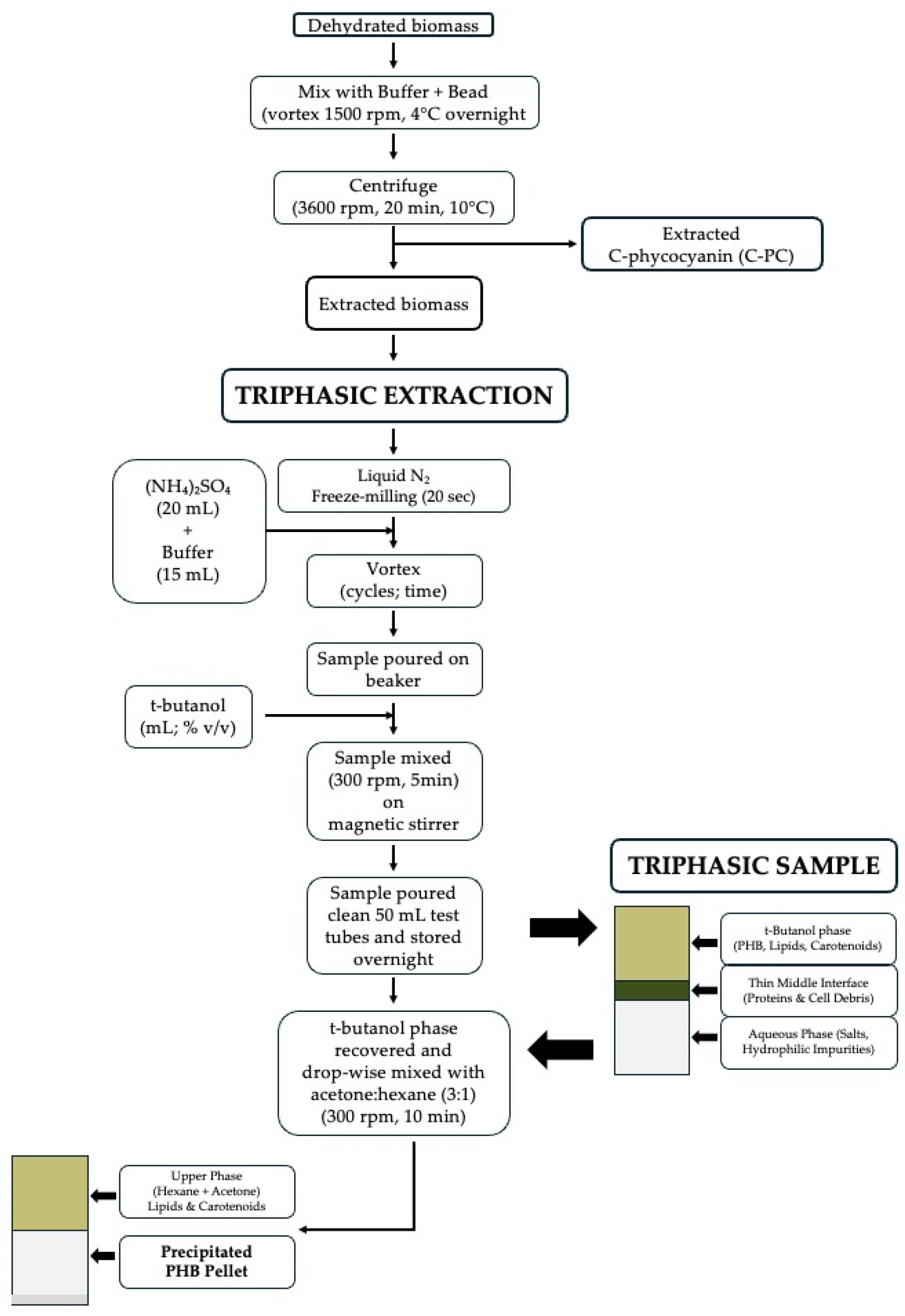
The extraction process was as follows: 10 mg of dehydrated biomass (by triplicate, n = 3) was mixed with 15 mL volume of cold potassium buffer (K2HPO4-KH2PO4) and a known amount of glass beads (0.5 mm diameter) was added according to the method described by Barajas-Solano [41]. The sample was vortexed at 1500 rpm for 30 min (Multi Reax, Heidolph, Schwabach, Bavaria, Germany). The mixture was stored overnight in a refrigerator (4 °C, 8 h) to allow the removal of C-PC. The next day, the samples were centrifuged (3600 rpm, 20 min, 10 °C) and the supernatant rich in C-PC was removed and quantified according to Equation (1) described by Bennett and Bogorad [42], while its purity was obtained using Equation (2) [43,44].
The biomass after extraction was used for the triphasic method. The recovered mass was ground with liquid nitrogen; each cycle of grinding took around 20 s. After grinding the sample, 20 mL of a solution of ammonium sulfate (its concentration changed according to Table A1) and the biomass were redissolved in 15 mL of potassium buffer, which took 20 s, and vortexed again at maximum speed (2000 rpm). The number of cycles and the time of each of the cycles were determined according to Table A1.
After destruction, the sample was poured into 100 mL glass beakers, and an amount of t-butanol was added. The sample was then mixed at 300 rpm on a magnetic stirrer for 5 min to allow the t-butanol to react with the sample. After 5 min, the sample was poured into clean 50 mL test tubes and stored overnight to allow the separation of phases.
The triphasic sample obtained in each experiment consisted of an upper phase rich in t-butanol with diluted PHB, lipids, carotenoids, and other lipophilic metabolites. The middle interface contained mainly proteins and cell debris, while the aqueous phase, rich in ammonium sulfate, contained hydrophilic metabolites such as carbohydrates and others.
The upper phase rich in PHB was removed and poured into clean 100 mL glass beakers and dropwise mixed (to avoid the formation of emulsions) with a solution of acetone/hexane (3:1); the amount of the solution was the same as that of added t-butanol. This new mixture was mixed (using a magnetic stirrer) at 300 rpm for at least 10 min. After mixing, the samples were poured again into clean 50 mL test tubes and stored overnight to allow the separation of phases. The final sample was separated into two phases, where the upper phase contained lipids and carotenoids (acetone/hexane phase), while the lower phase contained the concentrated PHB. This concentrated PHB was then washed three times with cold ethanol and centrifuged.
The flowchart of the extraction process can be found in Figure 1.
The final PHB was measured according to Getachew & Woldesenbet [45]. Briefly, the samples were dissolved in 2 mL of chloroform and transferred to a quartz cuvette. The absorbance was measured at 240 nm using a UV-Vis spectrophotometer. The PHB concentration (mg/mL) was calculated using Equation (3).
C - PC   g L = O D 620 n m 0.474 O D 652 n m 5.34
C - PC   [ purity ] = O D 620 n m 280
PHB   m g m L = O D 240 n m + 0.06292 5.289

2.4. Process Optimization

The most relevant variables were further investigated using a Central Composite Design (CCD). All experiments proposed in the optimization were performed six times (original plus five replicates).

3. Results

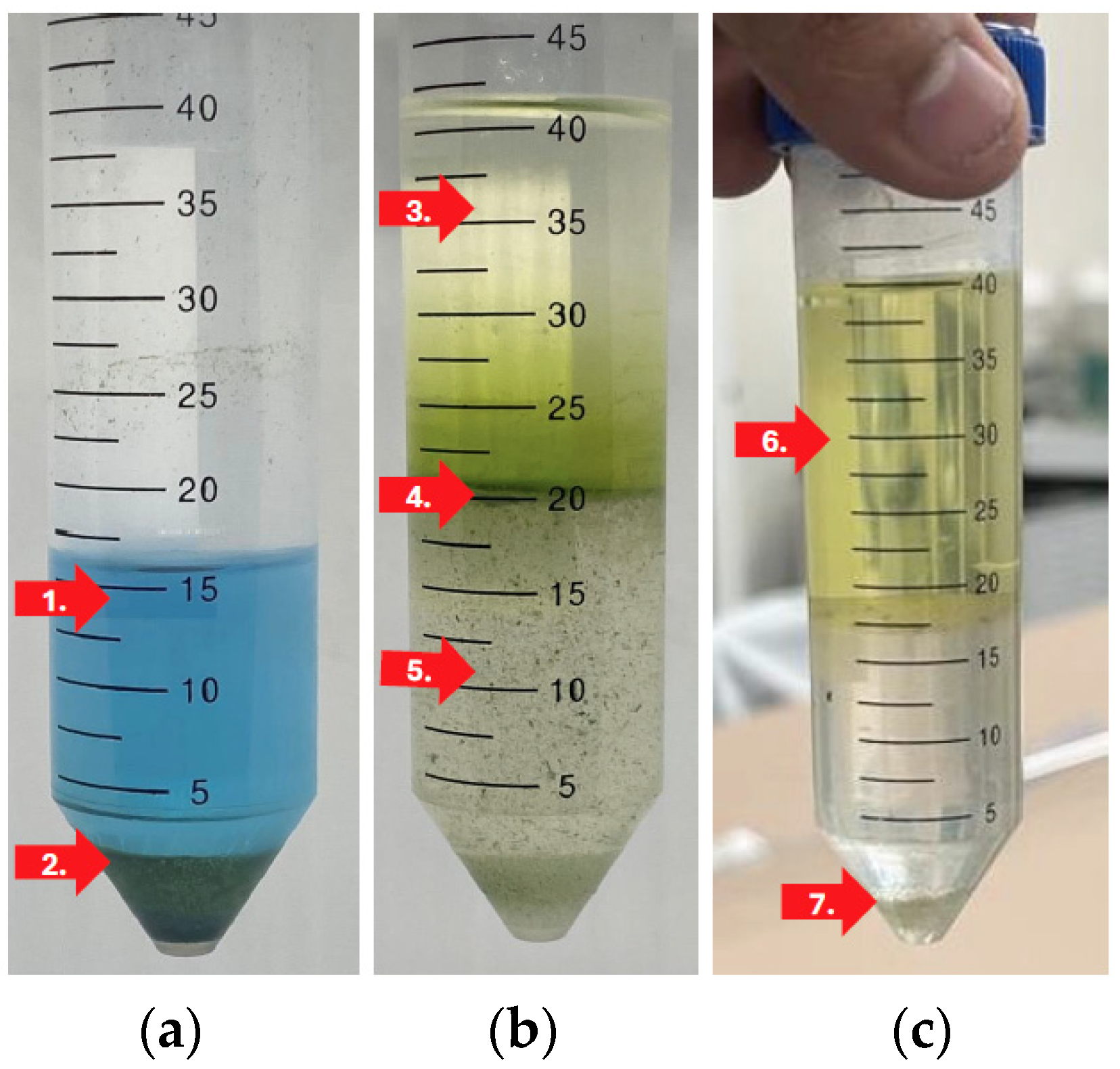
The sequential extraction of several metabolites from the produced cyanobacterial or microalgal biomass is a step forward for improving the sustainability of algae-based biorefineries. Figure 2 shows the extraction sequence tested using biomass from Potamosiphon sp. In this case, the first extracted metabolite was C-PC, which can be easily separated from the biomass under mild conditions, and this metabolite is prone to degradation due to changes in temperature or pH (Figure 2a). After the C-PC was removed, the biomass was thoughtfully destroyed with liquid nitrogen, and then vortexed with ammonium sulphate solution and the lipophilic metabolites were then separated from the biomass using a volume of t-butanol (Figure 2b). Finally, the t-butanol phase was mixed with a volume of acetone/hexane (3:1), which allowed a fast migration of lipophilic metabolites (such as lipids and carotenoids) to the acetone/hexane phase, while maintaining the PHB in the t-butanol phase (Figure 2c).
The ANOVA analysis of the impact of different factors influencing the efficiency of PHB extraction from Potamosiphon sp. is presented in Table 2. The model was highly significant (F-value = 22.63; p-value < 0.0001), indicating that variations observed in PHB yield are not due to chance. On the other hand, the coefficient of determination R2 reached a value of 0.9614, with an adjusted R2 of 0.9189 and a predicted R2 of 0.7793, reflecting good predictive power and internal consistency of the model (difference < 0.2).
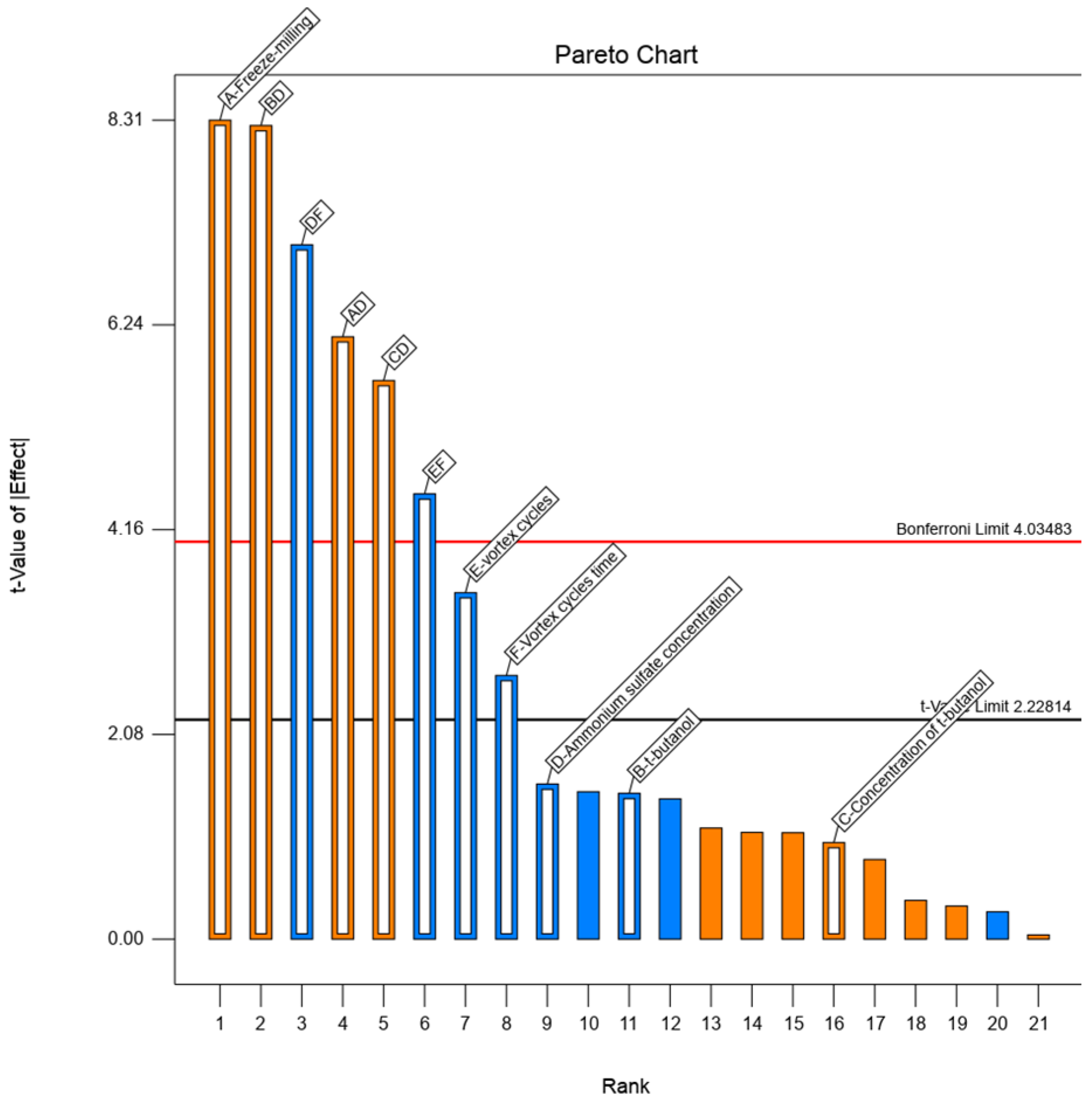
The coefficient of variation (C.V. = 3.55%) and the adequate precision ratio (Adeq Precision = 17.308) confirm the reliability of the fit and the robustness of the experimental signal. Among the individual factors, the number of freeze-milling cycles (A), vortex cycles (E), and the time of each vortex cycle (F) showed significant effects (p < 0.05), as did the AD, BD, CD, DF, and EF interactions. In particular, the terms BD (t-butanol × ammonium sulfate interaction) and DF (ammonium sulfate × vortex time interaction) were highly significant (p < 0.0001), indicating a strong synergy between the chemical conditions of the medium and the mechanical parameters of cell disruption. In contrast, the individual concentrations of t-butanol and ammonium sulfate (B, D) had marginal effects that were not significant at the 95% confidence level.
The Pareto diagram (Figure 3) reveals that the most influential effects on PHB yield correspond to the DF and BD interactions, followed by the main effect of freeze-milling (A). All of them exceed the Bonferroni limit (t = 4.04), confirming their statistically significant contribution. Positive effects (orange bars) indicate that an increase in the levels of the associated factors increases PHB yield, while negative effects (blue bars) suggest a decrease in extraction under those conditions. Thus, a greater number of freeze-milling cycles and a higher combined concentration of t-butanol and ammonium sulfate favor intracellular polymer release, while excessive agitation (high vortex time or cycles) has a negative effect, possibly due to partial degradation of the biopolymer.
Using the numerical optimization module in Design-Expert® (version 13.0, Stat-Ease Inc., Minneapolis, MN, USA) and constraining the response to the experimentally observed PHB range (109.396–168.995 mg/g), the model predicted a maximum PHB yield of 169.06 mg/g, which lies at the upper end of the estimated response interval. The corresponding optimal factor settings were freeze-milling = 4 cycles, t-butanol volume = 19.9 mL, t-butanol concentration = 94.7% (v/v), ammonium sulfate concentration = 49.9% (w/v), vortex cycles = 5, and vortex time = 1.2 min (Table 3).
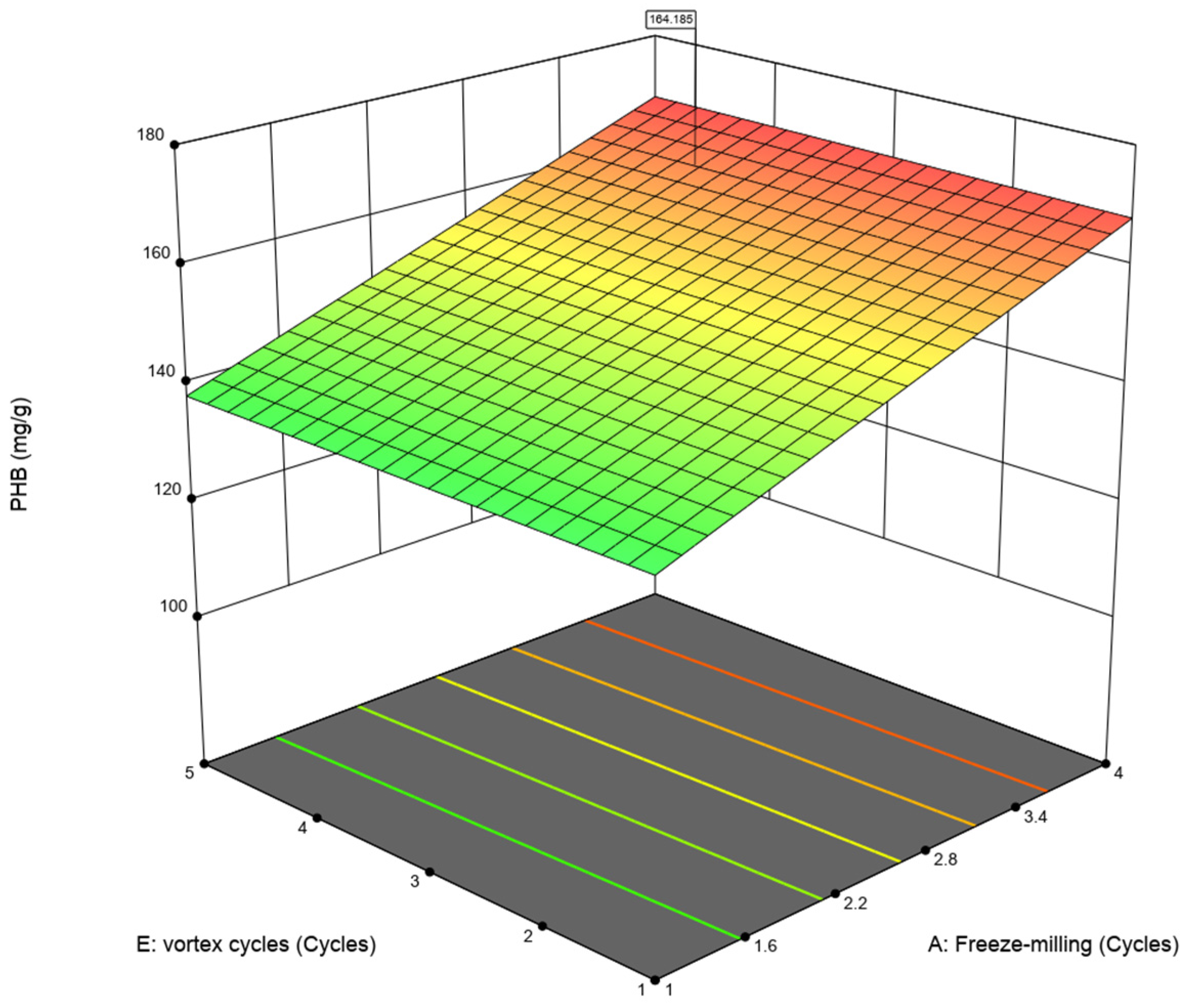
The three-dimensional response surface representing the interaction between freeze-milling cycles (A) and vortex cycles (E) (Figure 4) shows predominantly linear behavior, with no evidence of significant curvature in the experimental range. The simultaneous increase in both factors produces a continuous upward trend in PHB yield, reaching an estimated maximum of 169.06 mg/g. This relationship suggests that the physical disruption process is the main determinant of yield and that the response has not yet reached a saturation point. This positive gradient along the freeze-milling axis indicates that progressive cell fragmentation enhances intracellular polymer release, while increased vortex cycles contribute to improved mixing and solvent contact with cell residues. However, the uniform slope of the response plane indicates that the current range of factors is not sufficient to locate the true global optimum, but rather that it lies in an ascending zone of the experimental space. Consequently, the results obtained in the Minimum Run Resolution V Factorial Design justify the development of a new experimental design.
A Central Composite Design (CCD; 14 runs, 2 blocks) was created to improve the area with the highest PHB recovery found during the screening phase. The focus was on the two main factors: freeze-milling (A) and vortex cycles (E). In this optimization phase, freeze-milling was tested at 0.78 to 9.24 cycles and vortex cycles at 0.17 to 5.83 cycles (Table 4). The other variables, including the volume and concentration of t-butanol, the concentration of ammonium sulfate, and the vortex duration, were kept at the optimized values from the previous phase (Table 3). Table A2 shows the whole CCD run matrix.
The central composite design allowed for refining the experimental space identified in the previous factorial design, focusing on the optimization of freeze-milling cycles (A) and vortex cycles (B) as critical factors for PHB extraction. The statistical analysis (ANOVA) of the adjusted quadratic model is presented in Table 5. According to the results, the model showed excellent predictive and adjustment capacity, with an F value of 78.18 and a p < 0.0001, indicating highly reliable statistical significance.
In terms of individual effects, the number of freeze-milling cycles (A) had a highly significant effect (p = 0.0014), as did the quadratic terms A2 and B2 (p < 0.0001), while the AB interaction also showed a significant effect (p = 0.0258). The analysis of the lack of fit (F = 1.21; p = 0.4140) indicated that the model does not present a significant lack of fit, which shows a good correspondence between the experimental values and those predicted by the model.
Finally, the coefficients of determination showed very good agreement between the adjusted and predicted values: R2 = 0.9824, adjusted R2 = 0.9698, and predicted R2 = 0.9266, with a difference of less than 0.2 between the last two parameters, demonstrating the stability of the model. The coefficient of variation (C.V. = 1.99%) and adequate precision (Adeq Precision = 20.71), which confirms that the signal-to-noise ratio was higher than the threshold recommended by the software (>4), ensuring the reproducibility and sensitivity of the experimental system.
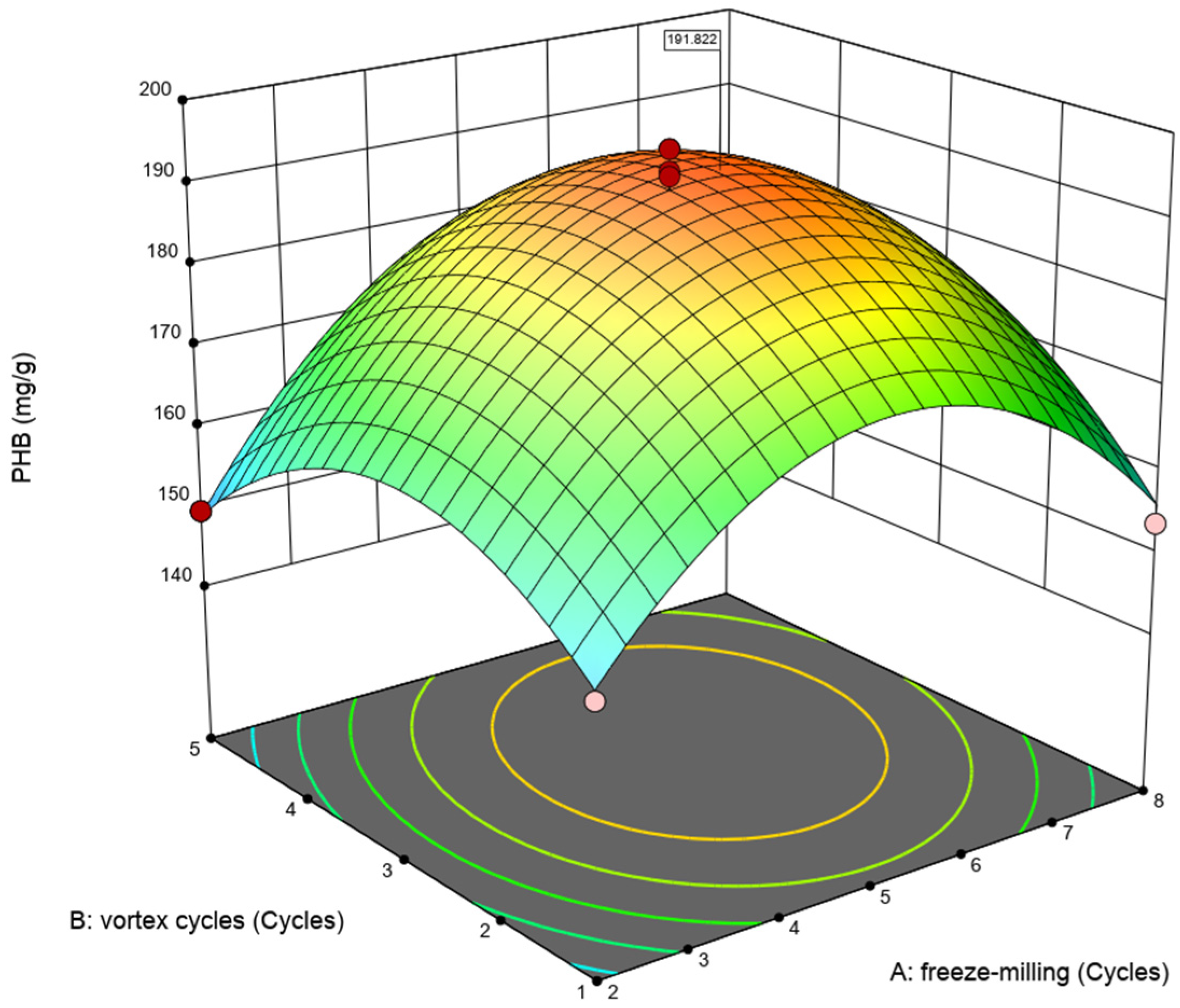
The three-dimensional representation of the model is presented in Figure 5, which shows a gently curved response surface, characteristic of well-fitted quadratic behavior. The simultaneous increase in both factors (freeze-milling and vortexing cycles) generated a progressive increase in PHB concentration, reaching an estimated maximum of 191.82 mg/g in the central zone of the experimental domain. The curvature observed on the surface confirms that the system is approaching a local maximum region and that the response does not follow a strictly linear trend, as observed in the previous factorial design.
The numerical optimization showed that the best number of freeze-milling cycles was 5.66 (rounded to 6) and the best number of vortexing cycles was 3.10 (rounded to 3). This gave an overall desirability of 0.921, which means that the chances of getting the most PHB recovery in the area studied are very high (Table 6). With these optimized settings, the other variables were set as follows: t-butanol at 19.9 mL, t-butanol concentration at 94.7% (v/v), ammonium sulfate concentration at 49.9% (w/v), and vortex duration at 1.2 min. This should give a PHB response of 191.8 mg/g.
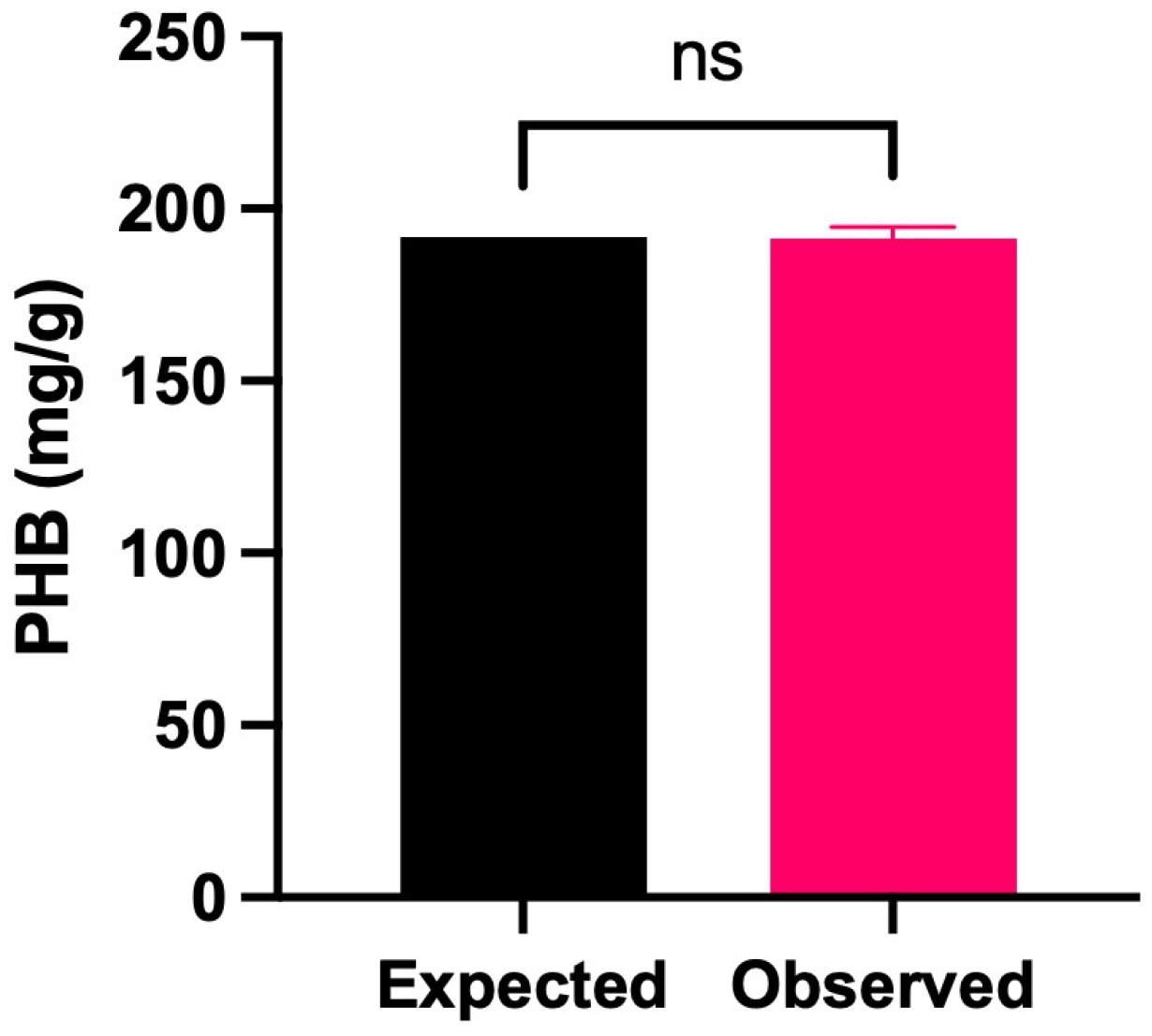
Once the optimal extraction conditions had been established, a validation test was carried out to evaluate the stability and reproducibility of the adjusted quadratic model. To this end, ten independent experiments (one original run and nine replicates) were performed using the optimal conditions defined in Table 6. The average of the experimental PHB values obtained (observed value) was compared with the value predicted by the model (191.82 mg/g) using a t-test to determine whether there were statistically significant differences between the two data sets.
The experimental validation of the quadratic model (Figure 6) confirmed its statistical robustness and predictive power. The experimentally obtained average PHB (191.5 mg/g) showed no significant differences from the value predicted by the model (191.8 mg/g), according to the one-sample t-test (t = 0.3509, gl = 9, p = 0.7337). The absence of significant differences (p > 0.05) demonstrates that the model’s predictions fit the observed values adequately, evidencing high stability and reproducibility of the system under optimal conditions. Consequently, the quadratic model can be considered robust and reliable for predicting PHB yield within the evaluated experimental range.

4. Discussion

The present triphasic extraction strategy positions Potamosiphon sp. within the broader concept of microalgal biorefineries, in which a single biomass is fractionated into multiple high-value products. In this case, the sequential recovery of C-PC, lipophilic compounds (lipids and carotenoids), and, finally, PHB from the residual biomass follows the process developed by Anto et al. [33], which relies on t-butanol to concentrate lipophilic compounds and ammonium sulfate to concentrate hydrophilic compounds. The results of this work extend this vision by demonstrating that the same physicochemical platform can be advanced further along the value chain to recover an intracellular biopolymer that remains in the biomass after pigment extraction, thereby increasing the degree of resource utilization expected from an integrated biorefinery.
Triphasic and three-phase partitioning systems have been widely explored for the recovery of proteins and enzymes from algal and microbial sources because they combine salting-out, solvent partitioning, and flotation in a single step, resulting in efficient phase separation with relatively mild operating conditions. Chia et al. [35] used triphasic partitioning assisted by sonication to enhance protein extraction from Chlorella vulgaris (Chlorophyta), highlighting the advantages of this technique in terms of scalability and compatibility with aqueous systems. However, applications targeting intracellular polyhydroxyalkanoates and PHB are virtually absent in the literature, where most extraction routes still rely on chlorinated solvents, hypochlorite digestion, or enzymatic treatments that are either environmentally burdensome or difficult to scale [46,47]. By adapting a TPP/TPS-type system to PHB recovery, this study therefore addresses a clear methodological gap identified in recent reviews on PHB production from cyanobacteria and microalgae, which consistently emphasize that downstream processing remains one of the main bottlenecks for sustainable PHB bioplastics [48].
From a biorefinery perspective, the sequential extraction implemented here is particularly relevant because PHB is synthesized as an intracellular carbon and energy storage polymer that is generally stable under the aqueous and moderately saline conditions used for pigment and lipid extraction [46,49]. This intrinsic stability means that PHB granules can withstand the first two extraction stages without significant degradation, allowing their subsequent recovery from a biomass that has already yielded high-value pigments and lipophilic fractions, since most cyanobacterial strains can accumulate modest PHB contents under standard cultivation conditions and that the economic feasibility of PHB as a bioplastic depends critically on integrating its production with other co-products, especially pigments and proteins [46,50]. Therefore, the proposed triphasic workflow, which builds on the prior release of C-phycocyanin and lipophilic compounds, fits well within integrated microalgal biorefinery schemes for wastewater-grown or industrial side-stream microalgae, where biopolymers, pigments, and bioactives are sequentially valorized to offset processing costs [49,51].
More broadly, the results support the view emerging from recent techno-economic and technological surveys that microalgae-based PHB processes will be viable only when embedded in multi-product biorefineries that treat biomass as a source of pigments, proteins, lipids, and polymers rather than as a single-product feedstock [49,50,51,52]. Dos Santos Borges et al. [49] showed that microalgae grown in wastewater can produce a portfolio of biopolymers, including PHB. Still, they stressed that the implementation of integrated cascades remains rare at the pilot scale. Likewise, Sharma et al. [50] emphasized that the potential of microalgae for bioplastic production resides in coupling PHA synthesis with simultaneous recovery of carbohydrates and pigments, aligning with circular-economy principles and wastewater remediation. In this context, the triphasic system developed here demonstrates that a single set of solvents and salts can be tuned to operate at different stages of a cascaded process, first enriching C-phycocyanin and lipophilic compounds and then enabling PHB extraction from the remaining biomass. Reusing the same physicochemical platform reduces process complexity. It offers a coherent framework for future intensification strategies, for example, by integrating continuous TPP columns or coupling the triphasic step with membrane separation and solvent recycling [35,49,51].
The choice of a thermotolerant strain enhances the robustness of this scheme, as thermotolerant cyanobacteria or microalgae have been recognized as promising chassis organisms for outdoor cultivation, owing to their thick extracellular matrices and tolerance to fluctuating temperatures, which confer resistance to contamination and environmental stress [46,49]. The results of this work shows that biomass remains structurally resilient during the initial aqueous extraction of C-phycocyanin, preserving PHB granules while allowing efficient pigment release, and that the subsequent exposure to ammonium sulfate followed by t-butanol does not compromise PHB integrity, since PHB granules are protected within the cytoplasm and are less sensitive to the moderate interfacial stresses and ionic strengths typical of TPP/TPS systems, in contrast to labile phycobiliproteins that are intentionally targeted in the first step [33,35,47].
In the present study, the mechanical factors associated with cell rupture—number of freeze-milling and vortexing cycles—were the primary determinants of improving PHB extraction efficiency in the three-phase system. The marked positive effect of both factors and their interaction indicates that the progressive destruction of biomass is the limiting step in facilitating contact between PHB and t-butanol and the ammonium sulfate solution, provided that this disruptive process is not excessive to the point of causing significant degradation of the polymer [33,34]. In cyanobacteria and microalgae, the location of PHB granules in the cytoplasm, often associated with coating proteins and an exopolysaccharide matrix, means that simply permeabilizing the envelope is insufficient; mechanical stress capable of breaking aggregates and “unanchoring” the granules from the cellular framework [47].
The pattern observed in the response surfaces in Figure 4, with increases in PHB as the freeze-milling and vortexing cycles increase, approaching a maximum, suggests the existence of an operating range in which cell fragmentation remains incomplete and the polymer is released incrementally. Comparative studies of PHB extraction methods in Spirulina sp. have shown that procedures combining shear forces and thermal shock (e.g., high-pressure homogenization followed by solvent treatment) achieve better recoveries than methods based solely on chemical agents, as the combination facilitates the breakdown of hydrophobic microdomains where the granules are concentrated [53]. Similarly, Yashavanth and Maiti [54] observed that the choice of rupture method conditions not only the recovery yield but also the thermal properties of the isolated PHB, reinforcing the importance of controlling the intensity of mechanical treatment. In this case, the maximum identified by the quadratic model can be interpreted as a balance point between sufficient fragmentation to release the polymer and over-treatment, where any additional increase in mechanical energy no longer provides measurable benefits.
As for the chemical factors of the three-phase system, the combination of t-butanol and ammonium sulfate defines the partitioning environment in which both residual biomass and intracellular solutes are redistributed. In TPP systems applied to microalgal proteins and metabolites, it has been reported that increased ionic strength promotes the salting-out of macromolecules into the intermediate phase. At the same time, tertiary alcohols modulate the polarity and interfacial tension of the phases, thereby favoring the accumulation of relatively hydrophobic compounds [33,35,55]. The results show that although the main contribution to PHB yield comes from mechanical factors, the interaction between alcohol and salt levels stabilizes the intermediate phase and improves recovery within the optimized conditions.
The t-butanol/ammonium sulfate/liquid N2 triphasic extraction differs qualitatively from the traditional sodium hypochlorite approach regarding cost and toxicity. Sodium hypochlorite (bleach) is cost-effective and highly efficient at lysing cells; however, it oxidizes cellular constituents and may depolymerize PHB into oligomers [56], and it poses environmental hazards. By contrast, tert-butanol (a moderately priced, flammable solvent) and ammonium sulfate (a cheap salting-out agent) allow PHB recovery without harsh oxidizers. T-butanol’s higher boiling point and lower flammability than minor alcohols facilitate safer handling and reuse, and liquid N2 provides a non-chemical cell disruption (freeze-milling) step. Importantly, most prior PHB extraction studies prioritized polymer yield over co-products, often destroying pigments and other metabolites [57]. The current triphasic method separates C-phycocyanin (C-PC) into an aqueous phase, making it easier to get back in its original form as a useful co-product. C-PC is a useful pigment protein that is used in nutraceuticals and food colorings. By 2030, the global market for it is expected to be worth about $280 million [58]; in contrast, PHB is a biodegradable polymer suitable for eco-friendly packaging materials [56].
The co-extraction of C-PC introduces an additional revenue stream, enhancing the cost-effectiveness and environmental sustainability of the entire process. This aligns with recent appeals to optimize numerous outputs and residual biomass in the manufacturing of Cyanobacteriophyta bioplastics [57].
The principle is transferable to other Cyanobacteriophyta; for example, Arthrospira/Limnospira sp., widely cultivated for its phycocyanin-rich biomass, can also accumulate PHB under stress and is considered a promising strain for scale-up [57]. Likewise, S. elongatus (a model unicellular cyanobacterium known to produce PHB) could be employed, as minor unicellular strains are amenable to high-density cultivation in photobioreactors [59]. To comply with food-grade C-PC production standards, substituting chlorinated solvents or harsh chemicals with t-butanol and a food-grade salt is more secure. Ensure the complete elimination of all solvent residues. Finally, the remaining biomass after PHB/C-PC extraction could be further processed to extract residual lipids for biofuels or used as a biofertilizer/biostimulant [16,21]. Finally, several Cyanobacteriophyta are known to release phytohormones and other growth-promoting metabolites [60]; spent biomass could serve as a plant growth enhancer, contributing to a more sustainable, circular biorefinery concept.
So far, the available literature on PHB extraction in Cyanobacteriophyta has traditionally focused on methods using chloroform, sodium hypochlorite, or combinations of detergents and alkalis, in which the chemical stage dominates the process [47,53,61]. However, these protocols often involve aggressive conditions that wash the biomass thoroughly, eliminating other key metabolites produced by the cells, and there is also a risk of degrading the polymer. In this context, the behavior observed in the three-phase system shows that once physical disruption reaches a sufficient level, the alcohol-salt system acts primarily as a partitioning matrix to “concentrate” PHB and other compounds in the desired phase, rather than as a breaking agent itself. This suggests that, for species such as Potamosiphon sp., extraction optimization should prioritize relatively gentle, but repeated, mechanical intensification strategies (e.g., freeze-milling and vortexing cycles). At the same time, chemical formulation can be used as a fine-tuning tool to adjust selectivity and compatibility with subsequent purification steps.
Finally, the predominance of mechanical terms in the model has direct implications for scaling. Unlike chemical reagents, mechanical energy can be supplied by versatile unit operations (cryogenic grinding, high-shear mixers, homogenizers) that can be integrated into continuous biorefinery schemes. Previous work, such as that of Chia et al. [35] and Koyande et al. [34], has shown that combining physical pretreatments with liquid-liquid partitioning systems allows the cell disruption stage to be decoupled from the fractionation stage, thereby improving the robustness of the process against variations in biomass composition.
The shift from the first factorial design (Minimum Run Resolution V) to a quadratic model based on a central composite design (CCD) was a significant step forward in understanding how the physical factors of mechanical disruption and PHB extraction efficiency are related. The initial model showed a mostly linear response surface. However, the CCD showed a statistically significant curvature, allowing the identification of the optimal point in the experimental space. The methodological and conceptual distinction aligns with the typical behavior of cell-disruption-dependent extraction processes, where initial increases in mechanical intensity led to nearly proportional increases in biopolymer release, but eventually approach a saturation point at which the marginal efficiency of disruption diminishes [33,62]. The saturation was apparent in the curved surface generated by the CCD, where the PHB response showed rapid increases with the escalation of freeze-milling and vortexing cycles, ultimately reaching approximately 191.8 mg/g, followed by a region of diminished slope. This behavior aligns with the findings of Costa et al. [53] found that after achieving a sufficient degree of fragmentation, further mechanical energy input does not significantly enhance PHB extraction, as the residual polymer is already firmly bound to resistant cell structures. Also, Yashavanth and Maiti [54] found that the extraction efficiency in Chlorogloeopsis fritschii (formerly Chlorogloea fritschii) (Cyanobacteriophyta) exhibits a nonlinear response, stabilizing once the mechanical treatment exceeds the threshold for total cell wall rupture.
Finally, from a biological perspective, curvilinear behavior suggests that the system is approaching a physiological limit in PHB recovery. This phenomenon has been observed in alternative extraction systems reliant on cell disruption, where recovery efficiency diminishes as the total release of the available biopolymer nears completion, not due to a decline in treatment efficacy, but because the residual fraction of the polymer is either physically shielded or chemically less accessible [54,55,62]. The curvature zone aligns with a yield near the maximum documented for cyanobacteria after combined mechanical pretreatments [53,54]. This corroborates the theory that CCD enabled the identification of the juncture at which the process nears biological saturation of the system, a detail that a linear factorial design would not have revealed.
This study’s three-phase approach efficiently recovered PHB from cyanobacterial biomass; however, the extraction techniques have limitations that must be addressed before practical implementation. The research underscores that a microalgae-based biorefinery approach must assess extraction efficiency, polymer purity, energy consumption, and compatibility with the following processing stages to ensure viability, particularly for bioplastics or functional biomaterials [63,64]. Contemporary PHB purification systems often use alkaline hydrolysis, organic solvents, or selective precipitation, which may increase costs and generate secondary waste, particularly in setups with suboptimal mass and energy balances [65]. Recent technological evaluations indicate that the extraction of microalgae biopolymers remains challenging due to the lack of economical and environmentally benign technologies [49].
Ultimately, future initiatives should prioritize replacing organic solvents with environmentally friendly alternatives and integrating them with innovative technologies. Natural eutectic solvents (NaDES), which have been extensively examined in recent studies for their biodegradability and low toxicity, constitute a promising alternative to organic fractions such as tertiary alcohols in TPP systems [21,22]. Furthermore, integrating techno-economic analyses (TEA) and life cycle assessments (LCAs), which are still infrequently documented for microalgal PHB, would be crucial for establishing this platform across the sector. Dos Santos Borges et al. [49] specifically emphasize that the absence of TEA and LCA studies constrains the practical implementation of microalgal biopolymers, as economic viability relies on a substantial decrease in the CAPEX/OPEX related to extraction. Consequently, the prospective implementation of techniques such as process intensification, the use of renewable energy, integration with bioremediation, and the creation of systems devoid of toxic solvents represents a specific trajectory towards more sustainable biorefineries.

5. Conclusions

This study illustrates that a triphasic extraction strategy functions as a cohesive downstream platform for the sequential valorization of biomass in Potamosiphon sp., facilitating the recovery of C-phycocyanin (C-PC) under mild aqueous conditions, followed by the fractionation of the residual biomass into lipophilic, interfacial, and hydrophilic streams, ultimately leading to the recovery of PHB from the lipophilic phase. Employing a Minimum Run Resolution V factorial design, the triphasic system demonstrated substantial statistical significance (F = 22.63; p < 0.0001) and commendable predictive performance (R2 = 0.9614; R2_adj = 0.9189; R2_pred = 0.7793), affirming that the extraction response was influenced by controllable process variables rather than stochastic variation. Following optimization by CCD, model performance was enhanced (R2 = 0.9824; R2_adj = 0.9698; R2_pred = 0.9266), exhibiting little variability (C.V. = 1.99%) and substantial accuracy (20.71), hence affirming the robustness of the response surface for PHB recovery.
Multivariate analysis and response-surface behavior indicated that freeze-milling cycles and vortex-assisted mixing are the primary factors influencing PHB release. At the same time, the interaction between t-butanol and ammonium sulfate facilitates selective phase partitioning, thereby aiding product separation without jeopardizing the polymer’s integrity. Within the optimized operational parameters, the system achieved a projected PHB maximum of 191.82 mg/g, and experimental validation through 10 independent trials demonstrated remarkable consistency: the measured PHB yield (191.5 mg/g) showed no significant deviation from the predicted value (t = 0.3509, gl = 9, p = 0.7337). These results demonstrate the viability of integrating process intensification (single-platform fractionation) with design-of-experiments optimization to diminish uncertainty and enhance reproducibility in the downstream processing of cyanobacterial PHB, while concurrently promoting the biorefinery concept by maintaining multiple metabolite streams for valorization.
Future research should emphasize scale-up dynamics, solvent recovery and recycling, and techno-economic/life-cycle assessments, while also investigating more sustainable solvent systems (e.g., natural deep eutectic solvents) and expanding the platform to encompass other cyanobacteria and intracellular hydrophobic metabolites to enhance industrial applicability.

Funding

This study received financial support by Universidad Francisco de Paula Santander (Colombia) (FINU 001-2025), the Ministry of Science and Technology of Colombia, and the Colombian Institute of Educational Credit and Technical Studies Abroad (MINCIENCIAS-ICETEX) under the project titled “FOTOLIX” with the ID 2023-0686.

Institutional Review Board Statement

Not applicable.

Informed Consent Statement

Not applicable.

Data Availability Statement

The original contributions presented in this study are included in the article. Further inquiries can be directed to the corresponding author.

Acknowledgments

I would like to express my sincere gratitude to Janet Bibiana García-Martinez for her countless contributions in formulating the experiments and our beloved son, who’s our light and love. I want to thank Jefferson E. Contreras-Ropero and Antonio Zuorro for their insight on the original draft. I also thank Universidad Francisco de Paula Santander (Colombia) for providing the equipment for this paper and The Colombian Ministry of Science Technology and Innovation MINCIENCIAS for the support of national Ph.D. Doctorates through the Francisco José de Caldas scholarship program.

Conflicts of Interest

The author declares no conflicts of interest.

Appendix A

Table A1. Fully resolved Minimum Run Resolution V Factorial Design.
StdRunFactor AFactor BFactor CFactor DFactor EFactor F
Freeze-Millingt-Butanol
Volume
t-Butanol ConcentrationAmmonium
Sulfate
Concentration
Vortex
Cycles
Vortex
Cycles
Time
CyclesmL%%Cyclesmin
11151005015
22420703011
19315705011
104451005055
95451003011
86120705051
2071201005055
3815703051
59120705015
4104201005011
14114201003011
21124201003051
6134201003015
17141201003011
1315120703055
2216151003055
161745703055
1218420705055
71945705015
1520151005051
112145705051
182215703015
Table A2. Fully resolved Central Composite Design.
StdBlockRunFactor AFactor B
Freeze-MillingVortex
Cycles
CyclesCycles
1Block 1121
2281
5353
3425
6553
7653
4785
11Block 2855.828
890.7573
9109.2433
101150.172
141253
131353
121453

References

  1. Irmak, S.O. Taguchi’s Design for Optimization of Phycocyanin Extraction from Arthrospira (Spirulina) platensis. GSC Biol. Pharm. Sci. 2020, 11, 006–013. [Google Scholar] [CrossRef]
  2. Park, J.; Lee, H.; Dinh, T.B.; Choi, S.; De Saeger, J.; Depuydt, S.; Brown, M.T.; Han, T. Commercial Potential of the Cyanobacterium Arthrospira maxima: Physiological and Biochemical Traits and the Purification of Phycocyanin. Biology 2022, 11, 628. [Google Scholar] [CrossRef] [PubMed]
  3. Vernès, L.; Granvillain, P.; Chemat, F.; Vian, M. Phycocyanin from Arthrospira platensis. Production, Extraction and Analysis. Curr. Biotechnol. 2016, 4, 481–491. [Google Scholar] [CrossRef]
  4. Nur, M.M.A. Co-Production of Polyhydroxybutyrate and C-Phycocyanin from Arthrospira platensis Growing on Palm Oil Mill Effluent by Employing UV-C Irradiation. J. Appl. Phycol. 2022, 34, 1389–1396. [Google Scholar] [CrossRef]
  5. Curien, G.; Lyska, D.; Guglielmino, E.; Westhoff, P.; Janetzko, J.; Tardif, M.; Hallopeau, C.; Brugière, S.; Dal Bo, D.; Decelle, J.; et al. Mixotrophic Growth of the Extremophile Galdieria sulphuraria Reveals the Flexibility of Its Carbon Assimilation Metabolism. New Phytol. 2021, 231, 326–338. [Google Scholar] [CrossRef]
  6. Carbone, D.A.; Olivieri, G.; Pollio, A.; Melkonian, M. Comparison of Galdieria Growth and Photosynthetic Activity in Different Culture Systems. AMB Express 2020, 10, 170. [Google Scholar] [CrossRef]
  7. Wan, M.; Zhao, H.; Guo, J.; Yan, L.; Zhang, D.; Bai, W.; Li, Y. Comparison of C-Phycocyanin from Extremophilic Galdieria sulphuraria and Spirulina platensis on Stability and Antioxidant Capacity. Algal Res. 2021, 58, 102391. [Google Scholar] [CrossRef]
  8. Sørensen, L.; Hantke, A.; Eriksen, N.T. Purification of the Photosynthetic Pigment C-Phycocyanin from Heterotrophic Galdieria sulphuraria. J. Sci. Food Agric. 2013, 93, 2933–2938. [Google Scholar] [CrossRef]
  9. Hirooka, S.; Miyagishima, S. Cultivation of Acidophilic Algae Galdieria sulphuraria and Pseudochlorella Sp. YKT1 in Media Derived from Acidic Hot Springs. Front. Microbiol. 2016, 7, 2022. [Google Scholar] [CrossRef]
  10. Lang, I.; Bashir, S.; Lorenz, M.; Rader, S.; Weber, G. Exploiting the Potential of Cyanidiales as a Valuable Resource for Biotechnological Applications. Appl. Phycol. 2022, 3, 199–210. [Google Scholar] [CrossRef]
  11. Chini Zittelli, G.; Lauceri, R.; Faraloni, C.; Silva Benavides, A.M.; Torzillo, G. Valuable Pigments from Microalgae: Phycobiliproteins, Primary Carotenoids, and Fucoxanthin. Photochem. Photobiol. Sci. 2023, 22, 1733–1789. [Google Scholar] [CrossRef] [PubMed]
  12. López-Rodríguez, A.; Mayorga, J.; Flaig, D.; Fuentes, G.; Cotabarren, J.; Obregón, W.D.; Gómez, P.I. Comparison of Two Strains of the Edible Cyanobacteria Arthrospira: Biochemical Characterization and Antioxidant Properties. Food Biosci. 2021, 42, 101144. [Google Scholar] [CrossRef]
  13. Vernès, L.; Li, Y.; Chemat, F.; Abert-Vian, M. Biorefinery Concept as a Key for Sustainable Future to Green Chemistry—The Case of Microalgae; Springer: Berlin/Heidelberg, Germany, 2019; pp. 15–50. [Google Scholar]
  14. Rehmanji, M.; Singh, R.; Nesamma, A.A.; Khan, N.J.; Fatma, T.; Narula, A.; Jutur, P.P. Multifaceted Applications of Microalgal Biomass Valorization to Enriched Biorenewables, a Review of Futuristic Biorefinery Paradigm. Bioresour. Technol. Rep. 2022, 17, 100972. [Google Scholar] [CrossRef]
  15. Goswami, R.K.; Mehariya, S.; Verma, P.; Lavecchia, R.; Zuorro, A. Microalgae-Based Biorefineries for Sustainable Resource Recovery from Wastewater. J. Water Process Eng. 2021, 40, 101747. [Google Scholar] [CrossRef]
  16. Mehariya, S.; Goswami, R.K.; Verma, P.; Lavecchia, R.; Zuorro, A. Integrated Approach for Wastewater Treatment and Biofuel Production in Microalgae Biorefineries. Energies 2021, 14, 2282. [Google Scholar] [CrossRef]
  17. Fal, S.; Smouni, A.; Arroussi, H. El Integrated Microalgae-Based Biorefinery for Wastewater Treatment, Industrial CO2 Sequestration and Microalgal Biomass Valorization: A Circular Bioeconomy Approach. Environ. Adv. 2023, 12, 100365. [Google Scholar] [CrossRef]
  18. Javed, F.; Aslam, M.; Rashid, N.; Shamair, Z.; Khan, A.L.; Yasin, M.; Fazal, T.; Hafeez, A.; Rehman, F.; Rehman, M.S.U.; et al. Microalgae-Based Biofuels, Resource Recovery and Wastewater Treatment: A Pathway Towards Sustainable Biorefinery. Fuel 2019, 255, 115826. [Google Scholar] [CrossRef]
  19. Préat, N.; Taelman, S.E.; De Meester, S.; Allais, F.; Dewulf, J. Identification of Microalgae Biorefinery Scenarios and Development of Mass and Energy Balance Flowsheets. Algal Res. 2020, 45, 101737. [Google Scholar] [CrossRef]
  20. González-Delgado, Á.D.; Kafarov, V. Microalgae Based Biorefinery: Evaluation of Oil Extraction Methods in Terms of Efficiency, Costs, Toxicity and Energy in Lab-Scale. Rev. ION 2013, 26, 27–39. [Google Scholar]
  21. Mehariya, S.; Fratini, F.; Lavecchia, R.; Zuorro, A. Green Extraction of Value-Added Compounds form Microalgae: A Short Review on Natural Deep Eutectic Solvents (NaDES) and Related Pre-Treatments. J. Environ. Chem. Eng. 2021, 9, 105989. [Google Scholar] [CrossRef]
  22. Hilali, S.; Van Gheluwe, L.; Yagmur, M.; Wils, L.; Phelippe, M.; Clément-Larosière, B.; Montigny, B.; Jacquemin, J.; Thiery, E.; Boudesocque-Delaye, L. NaDES-Based Biorefinery of Spirulina (Arthrospira platensis): A New Path for Sustainable High Value-Added Metabolites. Sep. Purif. Technol. 2024, 329, 125123. [Google Scholar] [CrossRef]
  23. Moldes, D.; Rojo, E.M.; Bolado, S.; García-Encina, P.A.; Comesaña-Gándara, B. Biodegradable Solvents: A Promising Tool to Recover Proteins from Microalgae. Appl. Sci. 2022, 12, 2391. [Google Scholar] [CrossRef]
  24. Wils, L.; Yagmur, M.; Phelippe, M.; Montigny, B.; Clément-Larosière, B.; Jacquemin, J.; Boudesocque-Delaye, L. Alternative Solvents for the Biorefinery of Spirulina: Impact of Pretreatment on Free Fatty Acids with High Added Value. Mar. Drugs 2022, 20, 600. [Google Scholar] [CrossRef] [PubMed]
  25. Katiyar, R.; Banerjee, S.; Arora, A. Recent Advances in the Integrated Biorefinery Concept for the Valorization of Algal Biomass through Sustainable Routes. Biofuels Bioprod. Biorefining 2021, 15, 879–898. [Google Scholar] [CrossRef]
  26. Altamira-Algarra, B.; Garcia, J.; Gonzalez-Flo, E. Cyanobacteria Microbiomes for Bioplastic Production: Critical Review of Key Factors and Challenges in Scaling from Laboratory to Industry Set-Ups. Bioresour. Technol. 2025, 422, 132231. [Google Scholar] [CrossRef]
  27. González-González, L.M.; de-Bashan, L.E. Toward the Enhancement of Microalgal Metabolite Production Through Microalgae–Bacteria Consortia. Biology 2021, 10, 282. [Google Scholar] [CrossRef]
  28. Sutanto, H.; Suzery, M. Phyocyanin Extraction from Microalgae Spirulina platensis Assisted by Ultrasound Irradiation: Effect of Time and Temperature. Songklanakarin J. Sci. Technol. 2016, 38, 391. [Google Scholar]
  29. Hardiningtyas, S.D.; Setyaningsih, I.; Susila, A.A.R. Effect of Ultrasonication-Assisted Extraction Time on the Profile of Phycocyanin from Wet Biomass Spirulina plantesis. IOP Conf. Ser. Earth Environ. Sci. 2022, 1033, 012055. [Google Scholar] [CrossRef]
  30. Tavanandi, H.A.; Raghavarao, K.S.M.S. Ultrasound-Assisted Enzymatic Extraction of Natural Food Colorant C-Phycocyanin from Dry Biomass of Arthrospira platensis. LWT 2020, 118, 108802. [Google Scholar] [CrossRef]
  31. Yu, J. Application of an Ultrafine Shearing Method for the Extraction of C-Phycocyanin from Spirulina platensis. Molecules 2017, 22, 2023. [Google Scholar] [CrossRef]
  32. Choi, W.; Lee, H. Effect of Ultrasonic Extraction on Production and Structural Changes of C-Phycocyanin from Marine Spirulina maxima. Int. J. Mol. Sci. 2018, 19, 220. [Google Scholar] [CrossRef] [PubMed]
  33. Anto, S.; Premalatha, M.; Mathimani, T. Extraction and Optimization of Biomolecules Recovery from Chlorella Sp. NITT 02: Unleashing Potential through Ultrasound and Triphasic System of Extraction. J. Appl. Phycol. 2024, 36, 2607–2623. [Google Scholar] [CrossRef]
  34. Koyande, A.K.; Chew, K.W.; Show, P.L.; Munawaroh, H.S.H.; Chang, J.S. Liquid Triphasic Systems as Sustainable Downstream Processing of Chlorella Sp. Biorefinery for Potential Biofuels and Feed Production. Bioresour. Technol. 2021, 333, 125075. [Google Scholar] [CrossRef] [PubMed]
  35. Chia, S.R.; Chew, K.W.; Zaid, H.F.M.; Chu, D.T.; Tao, Y.; Show, P.L. Microalgal Protein Extraction from Chlorella vulgaris FSP-E Using Triphasic Partitioning Technique with Sonication. Front. Bioeng. Biotechnol. 2019, 7, 396. [Google Scholar] [CrossRef]
  36. Contreras-Ropero, J.E.; Barajas-Solano, A.F.; García-Martínez, J.B.; Barajas-Ferreira, C.; Zuorro, A. Optimization of Phycobiliprotein Biosynthesis in Thermotolerant Cyanobacteria Through Light Parameter Adjustment. Results Eng. 2024, 23, 102644. [Google Scholar] [CrossRef]
  37. Contreras-Ropero, J.E.; García-Martínez, J.B.; Barajas-Solano, A.F. Integration of Mathematical and Experimental Modeling for Sustainable Phycobiliprotein Production via Fed-Batch Cultures. S. Afr. J. Chem. Eng. 2025, 51, 35–44. [Google Scholar] [CrossRef]
  38. Vergel-Suarez, A.H.; García-Martínez, J.B.; López-Barrera, G.L.; Barajas-Solano, A.F.; Zuorro, A. Impact of Biomass Drying Process on the Extraction Efficiency of C-Phycoerythrin. BioTech 2023, 12, 30. [Google Scholar] [CrossRef]
  39. Vergel-Suarez, A.H.; García-Martínez, J.B.; López-Barrera, G.L.; Urbina-Suarez, N.A.; Barajas-Solano, A.F. Influence of Critical Parameters on the Extraction of Concentrated C-PE from Thermotolerant Cyanobacteria. BioTech 2024, 13, 21. [Google Scholar] [CrossRef]
  40. Andersen, R.; Berges, J.; Harrison, P.; Watanabe, M. Recipes for Freshwater and Seawater Media; Elsevier: Amsterdam, The Netherlands, 2005. [Google Scholar]
  41. Barajas-Solano, A.F. Optimization of Phycobiliprotein Solubilization from a Thermotolerant Oscillatoria sp. Processes 2022, 10, 836. [Google Scholar] [CrossRef]
  42. Bennett, A.; Bogorad, L. Complementary Chromatic Adaptation in a Filamentous Blue-Green Alga. J. Cell Biol. 1973, 58, 419–435. [Google Scholar] [CrossRef]
  43. Patil, G.; Raghavarao, K.S.M.S. Aqueous Two Phase Extraction for Purification of C-Phycocyanin. Biochem. Eng. J. 2007, 34, 156–164. [Google Scholar] [CrossRef]
  44. Antelo, F.; Anschau, A.; Costa, J.; Kalil, S. Extraction and Purification of C-Phycocyanin from Spirulina platensis in Conventional and Integrated Aqueous Two-Phase Systems. J. Braz. Chem. Soc. 2010, 21, 921–926. [Google Scholar] [CrossRef]
  45. Getachew, A.; Woldesenbet, F. Production of Biodegradable Plastic by Polyhydroxybutyrate (PHB) Accumulating Bacteria Using Low Cost Agricultural Waste Material. BMC Res. Notes 2016, 9, 509. [Google Scholar] [CrossRef] [PubMed]
  46. Afreen, R.; Tyagi, S.; Singh, G.P.; Singh, M. Challenges and Perspectives of Polyhydroxyalkanoate Production from Microalgae/Cyanobacteria and Bacteria as Microbial Factories: An Assessment of Hybrid Biological System. Front. Bioeng. Biotechnol. 2021, 9, 624885. [Google Scholar] [CrossRef]
  47. Ranganadhareddy, A.; Varghese, R. A Review of PHB Production by Cyanobacteria and Its Applications. J. Biochem. Technol. 2022, 13, 50–53. [Google Scholar] [CrossRef]
  48. Mourão, M.M.; Gradíssimo, D.G.; Santos, A.V.; Schneider, M.P.C.; Faustino, S.M.M.; Vasconcelos, V.; Xavier, L.P. Optimization of Polyhydroxybutyrate Production by Amazonian Microalga Stigeoclonium Sp. B23. Biomolecules 2020, 10, 1628. [Google Scholar] [CrossRef]
  49. dos Santos Borges, A.V.; Andrade, B.B.; Santana, J.S.; de Almeida Medeiros, R.M.; de Souza, C.O.; de Jesus Assis, D.; da Silva, J.B.A.; Tavares, P.P.L.G.; Cardoso, L.G. Biopolymers Synthesized by Microalgae Grown in Wastewater: A Technological Survey. Bioenergy Res. 2023, 17, 73–86. [Google Scholar] [CrossRef]
  50. Sharma, R.; Solanki, P.; Chaudhary, M.; Gupta, N.; Kaur, P. Unveiling the Potential of Microalgae for Bioplastic Production from Wastewater–Current Trends, Innovations, and Future Prospects. Biotechnol. Sustain. Mater. 2024, 1, 10. [Google Scholar] [CrossRef]
  51. Mastropetros, S.G.; Pispas, K.; Zagklis, D.; Ali, S.S.; Kornaros, M. Biopolymers Production from Microalgae and Cyanobacteria Cultivated in Wastewater: Recent Advances. Biotechnol. Adv. 2022, 60, 107999. [Google Scholar] [CrossRef]
  52. Price, S.; Kuzhiumparambil, U.; Pernice, M.; Ralph, P.J. Cyanobacterial Polyhydroxybutyrate for Sustainable Bioplastic Production: Critical Review and Perspectives. J. Environ. Chem. Eng. 2020, 8, 104007. [Google Scholar] [CrossRef]
  53. Costa, S.S.; Miranda, A.L.; de Assis, D.J.; Souza, C.O.; de Morais, M.G.; Costa, J.A.V.; Druzian, J.I. Efficacy of Spirulina Sp. Polyhydroxyalkanoates Extraction Methods and Influence on Polymer Properties and Composition. Algal Res. 2018, 33, 231–238. [Google Scholar] [CrossRef]
  54. Yashavanth, P.R.; Maiti, S.K. Recovery and Characterization of Polyhydroxybutyrate from Chlorogloea fritschii TISTR 8527 Using Halogenated and Green Solvents. J. Appl. Phycol. 2024, 36, 2593–2606. [Google Scholar] [CrossRef]
  55. Zhou, J.; Wang, M.; Saraiva, J.A.; Martins, A.P.; Pinto, C.A.; Prieto, M.A.; Simal-Gandara, J.; Cao, H.; Xiao, J.; Barba, F.J. Extraction of Lipids from Microalgae Using Classical and Innovative Approaches. Food Chem. 2022, 384, 132236. [Google Scholar] [CrossRef] [PubMed]
  56. Singh, D.; Rastogi, V.K. Sustainable Production of Polyhydroxybutyrate (PHB) via Valorisation of Aegle Marmelos Shell Waste: Probe Sonication-Assisted Extraction and Optimization Through Box-Behnken Response Surface Methodology. Int. J. Biol. Macromol. 2025, 322, 146758. [Google Scholar] [CrossRef]
  57. Troschl, C.; Meixner, K.; Drosg, B. Cyanobacterial PHA Production—Review of Recent Advances and a Summary of Three Years’ Working Experience Running a Pilot Plant. Bioengineering 2017, 4, 26. [Google Scholar] [CrossRef]
  58. Athiyappan, K.D.; Routray, W.; Paramasivan, B. Phycocyanin from Spirulina: A Comprehensive Review on Cultivation, Extraction, Purification, and Its Application in Food and Allied Industries. Food Humanit. 2024, 2, 100235. [Google Scholar] [CrossRef]
  59. Carpine, R.; Olivieri, G.; Hellingwerf, K.J.; Pollio, A.; Marzocchella, A. Industrial Production of Poly-β-Hydroxybutyrate from CO2: Can Cyanobacteria Meet This Challenge? Processes 2020, 8, 323. [Google Scholar] [CrossRef]
  60. Jurado-Flores, A.; Heredia-Martínez, L.G.; Torres-Cortes, G.; Díaz-Santos, E. Harnessing Microalgae and Cyanobacteria for Sustainable Agriculture: Mechanistic Insights and Applications as Biostimulants, Biofertilizers and Biocontrol Agents. Agriculture 2025, 15, 1842. [Google Scholar] [CrossRef]
  61. Simonazzi, M.; Pezzolesi, L.; Galletti, P.; Gualandi, C.; Pistocchi, R.; De Marco, N.; Paganelli, Z.; Samorì, C. Production of Polyhydroxybutyrate by the Cyanobacterium Cf. Anabaena sp. Int. J. Biol. Macromol. 2021, 191, 92–99. [Google Scholar] [CrossRef]
  62. Wongmoon, C.; Napathorn, S.C. Optimization for the Efficient Recovery of Poly(3-Hydroxybutyrate) Using the Green Solvent 1,3-Dioxolane. Front. Bioeng. Biotechnol. 2022, 10, 1086636. [Google Scholar] [CrossRef]
  63. Anjana, A.; Shukla, S.P.; Kumar, S.; Kumar, K.; Badguzar, V.S. A Two-Step Protocol for Enhanced Recovery of Poly-β-Hydroxy Butyric Acid (PHB) from Spirulina Biomass Produced in Amended Aquaculture Wastewater. Waste Biomass Valorization 2025, 16, 6583–6591. [Google Scholar] [CrossRef]
  64. Rawte, T.; Mav, S.A. Rapid Hypochlorite Method for Extraction of Polyhydroxy Alkanoates from Bacterial Cells. Indian J. Exp. Biol. 2002, 40, 924–929. [Google Scholar]
  65. Ansari, S.; Fatma, T. Cyanobacterial Polyhydroxybutyrate (PHB): Screening, Optimization and Characterization. PLoS ONE 2016, 11, e0158168. [Google Scholar] [CrossRef]
Figure 1. Flowchart of the triphasic extraction system.
Phycology 06 00021 g001
Figure 2. Extraction sequence using a triphasic extraction system. (a) Extraction of phycocyanin using PO4 buffer (1. extracted phycocyanin; 2. disrupted biomass); (b) extraction of lipophilic compounds from hydrophilic compounds (3. lipophilic phase rich in PHB, lipids and carotenoids; 4. interphase with proteins along disrupted biomass; 5. hydrophilic phase rich in carbohydrates, salts and other compounds); (c) separation of lipophilic compounds on t-butanol using a solution of acetone/hexane (6. acetone/hexane (3:1) phase rich in lipids and carotenoids; 7. t-butanol phase rich in PHB).
Phycology 06 00021 g002
Figure 3. Pareto chart of main effects, orange bars show factors with positive effects, while blue bars show negative effects on the response variable.
Phycology 06 00021 g003
Figure 4. Statistical analysis of experimental data. Surface response between vortex cycles and freeze-milling (cycles).
Phycology 06 00021 g004
Figure 5. Surface response between vortex cycles and freeze-milling (cycles).
Phycology 06 00021 g005
Figure 6. t-test analysis of expected vs. observed data of PHB extraction.
Phycology 06 00021 g006
Table 1. Variables and their levels for the triphasic system of extraction.
Coded NameVariablesUnitsLow Level
(−1)
High Level
(+1)
AFreeze-millingCycles14
Bt-butanolmL520
CConcentration of t-butanol% (v/v)70100
DAmmonium sulfate concentration% (w/v)3050
Evortex cyclesCycles15
FVortex cycles timemin15
Table 2. ANOVA analysis of the triphasic system of extraction.
SourceSum of SquaresdfMean SquareF-Valuep-Value
Model5371.9811488.3622.63<0.0001 *
A-Freeze-milling1491.7411491.7469.12<0.0001 *
B-t-butanol47.23147.232.190.1699 **
C-Concentration of t-butanol20.73120.730.96060.3501 **
D-Ammonium sulfate concentration53.44153.442.480.1467 **
E-vortex cycles266.831266.8312.360.0056 *
F-Vortex cycles time154.621154.627.160.0232 *
AD806.871806.8737.390.0001 *
BD1471.6311471.6368.19<0.0001 *
CD693.841693.8432.150.0002 *
DF1071.9111071.9149.67<0.0001 *
EF440.851440.8520.430.0011 *
Residual215.821021.58
Cor Total5587.8121
R20.9614 Std. Dev.4.65
Adjusted R20.9189 Mean130.96
Predicted R20.7793 C.V. %3.55
Adeq Precision17.3082
* Significant, ** Non significant.
Table 3. Optimized values for maximizing PHB extraction using a Minimum Run Resolution V Factorial Design.
Coded NameVariablesUnitsValue
AFreeze-millingCycles4
Bt-butanolmL19.9
CConcentration of t-butanol% (v/v)94.7
DAmmonium sulfate concentration% (w/v)49.9
Evortex cyclesCycles5
FVortex cycles timemin1.2
Table 4. Variables and their levels for the optimized triphasic system of extraction.
Coded NameVariablesUnitsLow Level
(−1)
High Level
(+1)
AFreeze-millingCycles0.789.24
Evortex cycles0.175.83
Table 5. ANOVA analysis of the optimized triphasic system of extraction.
SourceSum of SquaresdfMean SquareF-Valuep-Value
Block1.8311.83
Model4590.375918.0778.18<0.0001 *
A freeze–thaw cycles305.641305.6426.030.0014 *
B-vortex cycles56.21156.214.790.0649 **
AB93.28193.287.940.0258 *
A23059.1313059.13260.52<0.0001 *
B21366.1611366.16116.34<0.0001 *
Residual82.20711.74
Lack of Fit39.09313.031.210.4140 **
Pure Error43.10410.78
Cor Total4674.4013
R20.9824 Std. Dev.3.43
Adjusted R20.9698 Mean171.90
Predicted R20.9266 C.V. %1.99
Adeq Precision20.7057
* Significant, ** Non significant.
Table 6. Conditions to maximize PHB using a triphasic extraction system.
Variables/ResponseUnitsValue
Freeze-millingCycles6
t-butanolmL19.9
Concentration of t-butanol% (v/v)94.7
Ammonium sulfate concentration% (w/v)49.9
vortex cyclesCycles3
Vortex cycles timemin1.2
PHBmg/g191.8
Disclaimer/Publisher’s Note: The statements, opinions and data contained in all publications are solely those of the individual author(s) and contributor(s) and not of MDPI and/or the editor(s). MDPI and/or the editor(s) disclaim responsibility for any injury to people or property resulting from any ideas, methods, instructions or products referred to in the content.