
Article

Further Insights into Influence of Light Intensities on the Production of Long-Chain Hydroxy Fatty Acids, Fatty Diols and Fatty Alcohols in Nannochloropsis oceanica

by
Martina Blasio
1,*,†,
Adele Cutignano
1,2,*,
Angela Sardo
1,
Stefan Schouten
3,4 and
Sergio Balzano
1
1
Stazione Zoologica Anton Dohrn (SZN), Ecosustainable Marine Biotechnologies, Via Acton 55, 80133 Naples, Italy
2
National Research Council (CNR), Institute of Biomolecular Chemistry (ICB), Via Campi Flegrei 34, 80078 Pozzuoli, Italy
3
Department of Marine Microbiology and Biogeochemistry (MMB), NIOZ Royal Netherlands Institute for Sea Research, P.O. Box 59, 1790 AB Den Burg, The Netherlands
4
Department of Earth Sciences, Faculty of Geosciences, Utrecht University, Princetonlaan 8a, 3584 CB Utrecht, The Netherlands
*
Authors to whom correspondence should be addressed.
Current address: National Research Council (CNR), Institute of Applied Science and Intelligent Systems (ISASI), Via Campi Flegrei 34, 80078 Pozzuoli, Italy.
Phycology 2026, 6(1), 11; https://doi.org/10.3390/phycology6010011
Submission received: 21 November 2025 / Revised: 17 December 2025 / Accepted: 6 January 2026 / Published: 8 January 2026

Abstract

Microalgae can modify their metabolic pathways as a response to environmental stimuli such as light, temperature, salinity, and nutrient availability, which critically influence the synthesis of lipids and other biomolecules. While extensive studies have focused on the impact of these environmental variables on the accumulation of valuable compounds such as polyunsaturated fatty acids (PUFAs) and triacylglycerols (TAGs), information on the biosynthesis of specialized metabolites, including long-chain hydroxy fatty acids (LCHFAs), long-chain diols (LCDs), and long-chain alkenols (LCAs) is scarce. These metabolites are thought to contribute to the structural integrity of cell walls in certain microalgae, such as Nannochloropsis spp. (Eustigmatophyceae), where they make up a biopolymer known as algaenan. This study investigates how varying light intensities affect the production of LCHFAs, LCDs, and LCAs in Nannochloropsis oceanica over a 12 h light/dark cycle. Our findings provide insights into the lipid biosynthetic pathways in microalgae, revealing that light strongly drives the production of LCHFAs, whereas LCDs and LCAs are less light-dependent and show more variable responses to different light intensities.

1. Introduction

Microalgal growth is strongly influenced by environmental factors, with light playing a central role as the energy source for photosynthesis and biomass accumulation. Both light intensity and wavelength distribution can affect growth rates: for example, moderate irradiance (≈50 µE·m−2·s−1) promotes steady biomass increase, whereas excessive light (>400 µE·m−2·s−1) can cause photoinhibition and stress in the green microalga Scenedesmus obliquus [1,2]. Blue light has been reported to enhance chlorophyll content and cellular development in diatoms (Nitzschia sp. and Phaeodactylum tricornutum) and in the green alga Tetraselmis suecica, whereas other green algae maximize their chlorophyll content at green (Chlorella vulgaris) or both green and blue lights (Botryococcus braunii) compared to red light [3]. The appropriate combination of red and blue light has been reported to maximize photosynthetic efficiency in Scenedesmus sp. [4]. The photoperiod also shapes growth dynamics, with continuous illumination accelerating cell accumulation in some species, whereas light–dark cycles help maintain metabolic balance in C. vulgaris [5]. Nutrients, especially nitrogen and phosphorus, are essential for the biosynthesis of proteins and nucleic acids, and nutrient deficiencies decrease biomass accumulation while diverting metabolism towards the biosynthesis of storage compounds [6,7]. Other factors, including temperature, salinity, pH, CO2 concentration, and culture density, modulate enzymatic activity and light utilization, defining species-specific optima for growth [8,9].
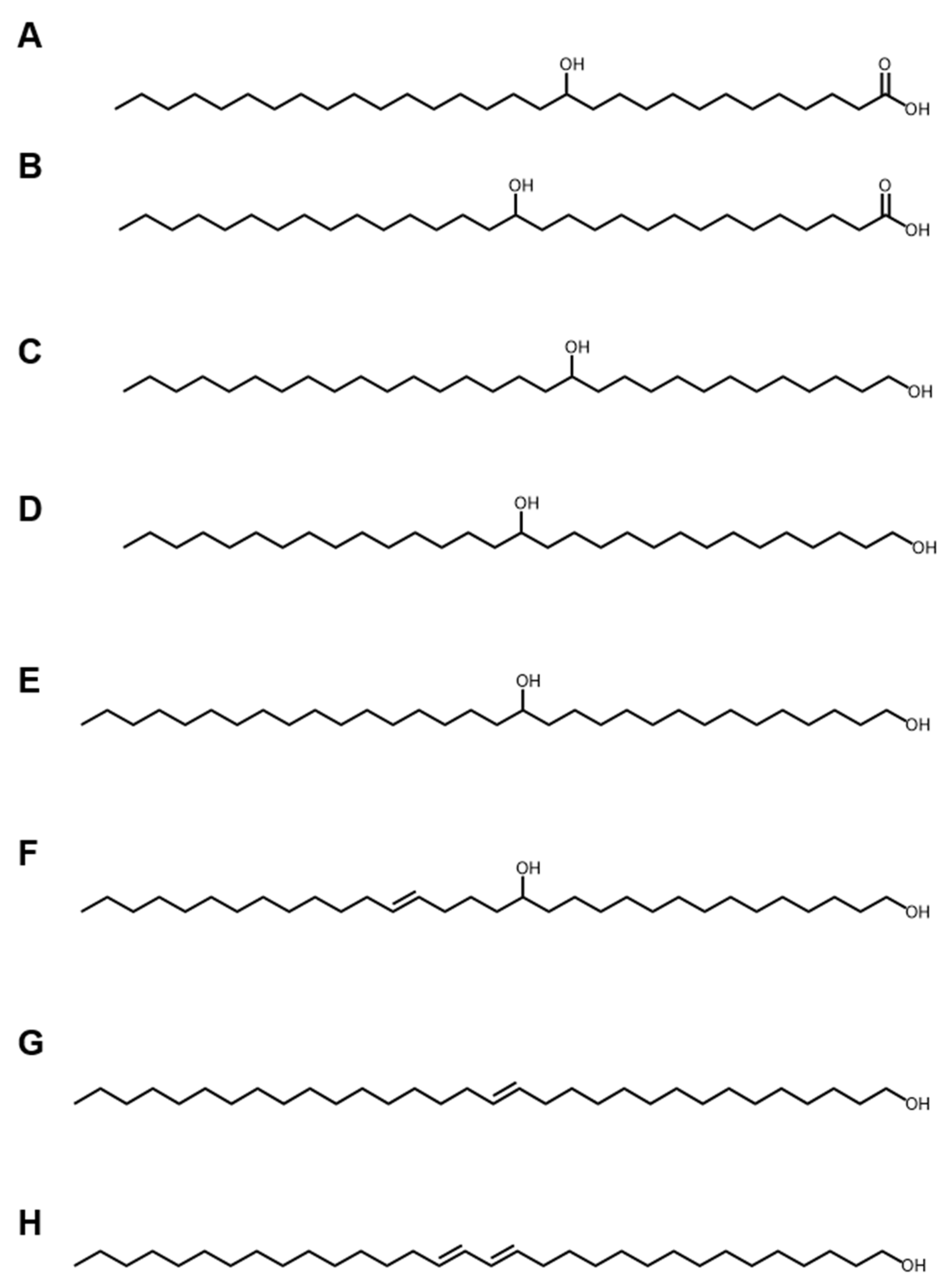
Understanding the environmental parameters that regulate microalgal growth is essential not only for maximizing biomass but also for controlling cellular metabolism and the production of valuable compounds. Within this context, numerous studies have examined the culturing conditions that can trigger the accumulation of valuable compounds like polyunsaturated fatty acids (PUFAs) and triacylglycerols (TAGs) in microalgae [10,11,12,13,14]. However, relatively little is known about the factors that regulate the biosynthesis of more complex secondary metabolites. Oleaginous microalgae from the genus Nannochloropsis (Eustigmatophyceae) contain long-chain aliphatic lipids that have been suggested to be useful for biofuel and polymer development [15]. Long-chain hydroxy fatty acids (LCHFAs), long-chain diols (LCDs), and long-chain alkenols (LCAs) (Figure 1) are thought to be the building blocks of a polymer known as algaenan that occurs in the outer layer of microalgal cell wall [16,17,18]. Algaenans have been previously detected in some species from green algal genera (Botryococcus, Chlorella, Dunaliella, Scenedesmus) and from the eustigmatophycean genus Nannochloropsis [16,17,18,19].
A previous study [20] investigated the impact of various culturing and environmental stress conditions on LCHFAs, LCDs, and LCAs in three Nannochloropsis species. It was found that these lipid classes vary across species and that the concentration of these compounds was not influenced by growth stage but rather by species-specific responses to environmental factors. Nannochloropsis oceanica strain CCMP1779 exhibited the highest levels of LCHFAs, LCDs, and LCAs, thus resulting a suitable model strain for further research. High light intensity is known to promote the accumulation of TAGs, which are primarily composed of C16:0 and C18:0 fatty acids [21,22,23]. The concentration of LCHFAs was found to increase under high-light conditions while the effect on LCD and LCA content did not substantially change. Interestingly, all the factors that enhance total lipid production, such as high light, salinity, and nitrogen deprivation, do not appear to influence the biosynthesis of LCDs and LCAs significantly. However, when N. oceanica and Nannochloropsis gaditana were exposed to prolonged darkness, LCD and LCA levels were found to increase [15]. Interestingly, Fietz et al. [24] observed thicker cell walls in resting cells of Nannochloropsis limnetica compared to actively growing cells and a recent study documented the presence of C32 diols in the red body, a cell organelle thought to be involved in cell wall biosynthesis, during the dark phase of N. oceanica [25]. These studies suggest a main structural role for long chain aliphatic lipids.
Here we aim to investigate changes in LCHFA, LCD, and LCA content in N. oceanica over a 12 h light/dark cycle under different light intensities (25, 150, and 400 μE·m−2·s−1). By acclimating the microalgae to these specific light conditions and analyzing lipid levels at different time points, this research seeks to better understand the role of light on the biosynthesis of these algal metabolites.

2. Materials and Methods

2.1. Growth Conditions and Experimental Design

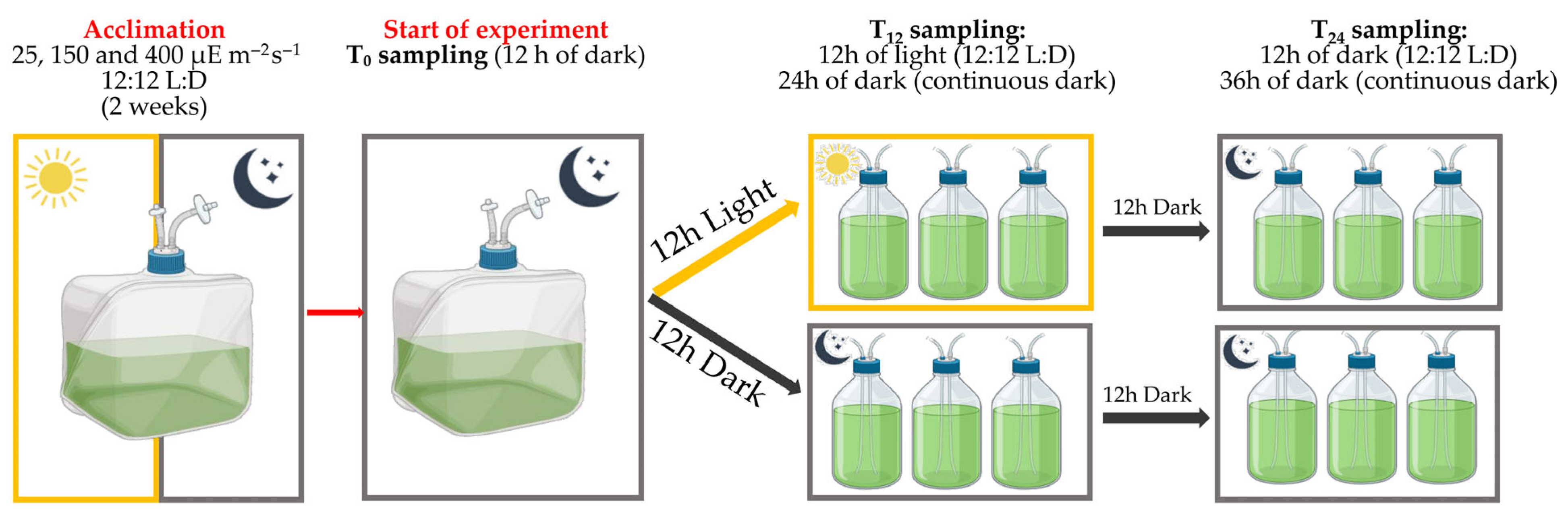
Nannochloropsis oceanica CCMP1779 was obtained from the National Centre for Marine Algae and Microbiota (Bigelow Laboratory for Ocean Sciences, USA) and maintained in silica-free f/2 medium [26] at 20 °C under a 12 h:12 h light/dark cycle. To assess the effects of different light intensities and dark conditions on the production of LCHFAs, LCDs, and LCAs, cells were first cultured in several 10 L carboys for about two weeks to acclimate them under three different light conditions: 150 μE m−2 s−1 (standard light, SL), 25 μE·m−2·s−1 (low light, LL), and 400 μE·m−2·s−1 (high light, HL) while maintained in exponential growth phase, as indicated by the daily increase in microalgal concentration. Pre-trials indicated that, under the culturing conditions used here, N. oceanica CCMP1779 cells are likely to reach the stationary phase at densities ~50 × 106 cell·mL−1; hence, cultures at the density <20 × 106 cell·mL−1, as reported in Table 1, were assumed to be at exponential phase. The irradiance was measured using a lux meter at a distance from the LED systems corresponding to the radius of the carboys. Cultures within carboys were gently aerated with sterile air (at a rate of approximately 3.5 L·min−1) supplied through fill-vented caps connected to sterile rubber tubes equipped with 0.22 µm filters to maintain sterility and then air pumps. During the acclimation period cells were counted daily and a volume of the cultures was daily replaced with sterile media to keep cell density constant over time and across the different culturing conditions (semi-continuous culturing). At the end of the acclimation period, which concluded with a 12 h dark phase, the experimental phase started. From each culturing condition (SL, LL, HL) six 1.5 L volumes (cell density ≈ 8 × 10⁶ cells·mL−1) were collected and poured in triplicate into six 2 L carboys. Three carboys were incubated at the same light irradiance and photoperiod (dark-light conditions) at which the cultures had been previously acclimated whereas the other three carboys were incubated in dark (continuous dark conditions). Cultures were maintained at 20 °C with continuous aeration provided by plastic tubing connected to aquarium pumps. The sampling was performed at three time points over 24 h: at the start of the experiment (Time 0), after 12 h (Time 1), and after 24 h (Time 2) (Figure 2).
At each time point, cells were enumerated by microscopy using a Bürker counting chamber (Mannheim, Germany) and the growth rate (μ) was then calculated according to the following formula:
μ = (log2N2 − log2N0) (T2 − T0)−1
where N2 and N0 represent cell concentration (cells·mL−1) at times T2 and T0, respectively, expressed in days. Subsequently, at each time point, 1 L of culture was harvested by centrifugation at 3800 rpm for 10 min. Pellets were rinsed with MilliQ water, freeze-dried using an Alpha 2–4 LSCplus lyophilizer (Christ, Osterode, Germany), and stored at −80 °C until lipid extraction.

2.2. Lipid Extraction and Analysis

Cell pellets were extracted using a methyl tert-butyl ether (MTBE)/methanol (MeOH)-based protocol. Briefly, lyophilized biomass (40–55 mg) was suspended in 900 μL of MeOH and spiked with 10 μg of 7,16-dihydroxy docosane as the internal standard. After vortexing, 3 mL of MTBE were added, followed by sonication for 5 min and incubation under agitation for 1 h. Phase separation was achieved by adding 750 μL of MilliQ water, followed by centrifugation at 4000 rpm for 10 min. The organic phase was collected, and the extraction was repeated with 1 mL of MTBE to maximize lipid yield. The combined extracts were evaporated under nitrogen stream and stored at −20 °C until analysis.

2.3. Lipid Hydrolysis and Fatty Acid Methylation

To release fatty acids, long chain alcohols and diols from large polar lipids, total lipid extracts were subjected to both base and acid hydrolysis. Saponification was performed with 1 M potassium hydroxide in methanol at 60 °C for 2 h. The pH was adjusted to 4.5 with 6 M hydrochloric acid, followed by extraction with diethyl ether. Following this, acid hydrolysis was carried out on the extract using 1 M hydrochloric acid in methanol at 60 °C for 3 h, with subsequent extraction in diethyl ether. For gas chromatography-mass spectrometry (GC-MS) analyses, fatty acids were converted into the corresponding methyl esters (FAMEs), to increase volatility and reduce polarity. For this purpose, free fatty acids were allowed to react with in-house freshly prepared diazomethane (CH2N2) in ethereal solution for 1 h and then dried under a nitrogen gas stream.

2.4. Fractionation of Total Lipid Extract

To separate FAMEs from the fraction containing LCDs, LCAs, and LCHFAs, total lipid extracts were fractionated using a small silica chromatography column. A Pasteur pipette plugged with cotton wool was packed with silica gel 60 (0.063–0.200 mm, Merck, Milan, Italy) and pre-rinsed with one column volume of 100% petroleum ether. Lipid extracts were dissolved in 100% petroleum ether and loaded onto the column; the chromatographic separation was carried out using a stepwise solvent gradient, first with petroleum ether/diethyl ether (7:3, v/v) and subsequently with dichloromethane/methanol (1:1, v/v). The fractionation process was monitored by thin-layer chromatography (TLC) analysis of the column eluates, and the fraction containing hydroxy fatty acids and alcohols was used for subsequent analysis.

2.5. GC-MS Analysis

For GC-MS analysis, compounds such as hydroxy fatty acid methyl esters and alcohols were first converted into their corresponding trimethylsilyl (TMS) ethers, rendering them volatile and suitable for gas chromatography-mass spectrometry. To this aim, lipid samples were transferred into autosampler vials, and 25 μL of N,O-bis(trimethylsilyl)trifluoroacetamide (BSTFA; Merck, Milan, Italy, CAS Number 25561-30-2) along with 25 μL of pyridine were added. The reaction was allowed to proceed for 1 h at 60 °C, after which samples were cooled to room temperature and diluted with 150 μL of dichloromethane prior to analysis. Derivatized compounds were identified and quantified using an ion-trap mass spectrometer in electron impact (EI) mode (70 eV; Polaris Q, Thermo Scientific, Milan, Italy) coupled to a gas chromatograph (GCQ, Thermo Scientific, Milan, Italy) equipped with a 5% phenyl/methyl polysiloxane column (30 m × 0.25 mm × 0.25 μm, VF-5 ms, Agilent Technologies, Cernusco sul Naviglio, Italy), with helium serving as the carrier gas. Temperature program starts at 180 °C for 2 min, then heats up 10 °C·min−1 to 280 °C, followed by 4 °C·min−1 to 320 °C holding for 6 min. The identification of LCDs, LCAs, and LCHFAs was based on the interpretation of the mass spectra obtained in full scan (m/z 50–700) using Xcalibur software (vers. 2.2 SP1.48, Thermo-Scientific, Milan, Italy), in comparison with literature spectra (e.g., [27]) and NIST database. For quantitative measurement, the peak area of each compound (x) was normalized by IS and expressed as μg·g−1 of dried biomass (DB) as follows:
Cx = (Areax × [IS])/(AreaIS × DB)
where Cx is the amount of the compound of interest (μg·g−1 of DB), Areax and AreaIS are the integrated areas of the peaks of the compounds x and the internal standard 7,16-C22:0 diol, respectively, and IS is the total amount of C22:0 7,16-diol.
To discriminate between 13-OH C30:0 fatty acid and C30:0 diols, which co-elute using the VF-5 column, successive GC–MS analyses were performed by gas-chromatography coupled to single quadrupole mass spectrometer (Agilent Technologies, Amstelveen, The Netherlands) equipped with a CP7740 CP-Sil 5 CB capillary column (25 m × 0.32 mm i.d., 0.12 µm film thickness, Agilent Technologies, Amstelveen, The Netherlands). Helium was used as the carrier gas at a constant flow rate of 2.0 mL·min−1. The oven temperature program was as follows: initial temperature 70 °C (held for 1 min), increased at 20 °C·min−1 to 130 °C, then at 4 °C·min−1 to 320 °C, and held for 25 min. The transfer line, ion source, and quadrupole temperatures were set at 320 °C, 250 °C, and 150 °C, respectively. To harmonize the results obtained from the two GC–MS systems, data from previous analyses on VF-5 column were corrected by partitioning the total contribution of co-eluting 13-OH-C30:0 FA and C30:0 diols according to their relative abundances determined by CP-Sil 5CB column.

2.6. Statistical Analysis

Differences in growth rates and in the total and selected lipid classes (LCAs, LCDs, and LCHFAs) were evaluated using Student’s t-test. Each time point was compared with the preceding one within each light condition. p-values < 0.05 was considered statistically significant. All statistical analyses were performed using GraphPad Prism (version 10.0; GraphPad Software, San Diego, CA, USA).

3. Results

3.1. Growth of Nannochloropsis oceanica Under Different Light Intensities

The growth dynamics and lipid content of N. oceanica strain CCMP1779 were monitored over a 24 h period under varying light conditions (Table 1).
Strains cultured under a 12 h:12 h light/dark photoperiod exhibited a stable cell density during the first 12 h, followed by a significant increase in cell concentration when measured after 24 h (Table 1). Under SL and HL conditions, cell abundance doubled within 24 h, corresponding to growth rates of 1.05 and 0.96 divisions per day, respectively. In contrast, growth was substantially slower at LL conditions, with a division rate of 0.23 per day. In addition, light intensity strongly influenced lipid production, with intracellular lipid concentrations increasing significantly (p < 0.05) during the light phase across all light conditions (Table 1). As expected, growth rate was higher at SL and HL conditions, with lipid concentrations doubling during the 12 h light period (e.g., SL: 720 to 1530 fg·cell−1; HL: 530 to 1200 fg·cell−1) and remaining constant during the subsequent dark phase. However, while cell density increased also during the dark phase (Table 1), lipid concentrations per cell decreased during the subsequent 12 h dark period. Prolonged dark incubation (36 h) further validated the role of light in cell growth and lipid synthesis. Cultures maintained in darkness exhibited minimal changes in both cell density and lipid content, underscoring that light is essential not only for cell division but also for stimulating lipid accumulation during the light phase of the diurnal cycle (Table 2).

3.2. Compositional Changes in LCAs, LCDs, and LCHFAs

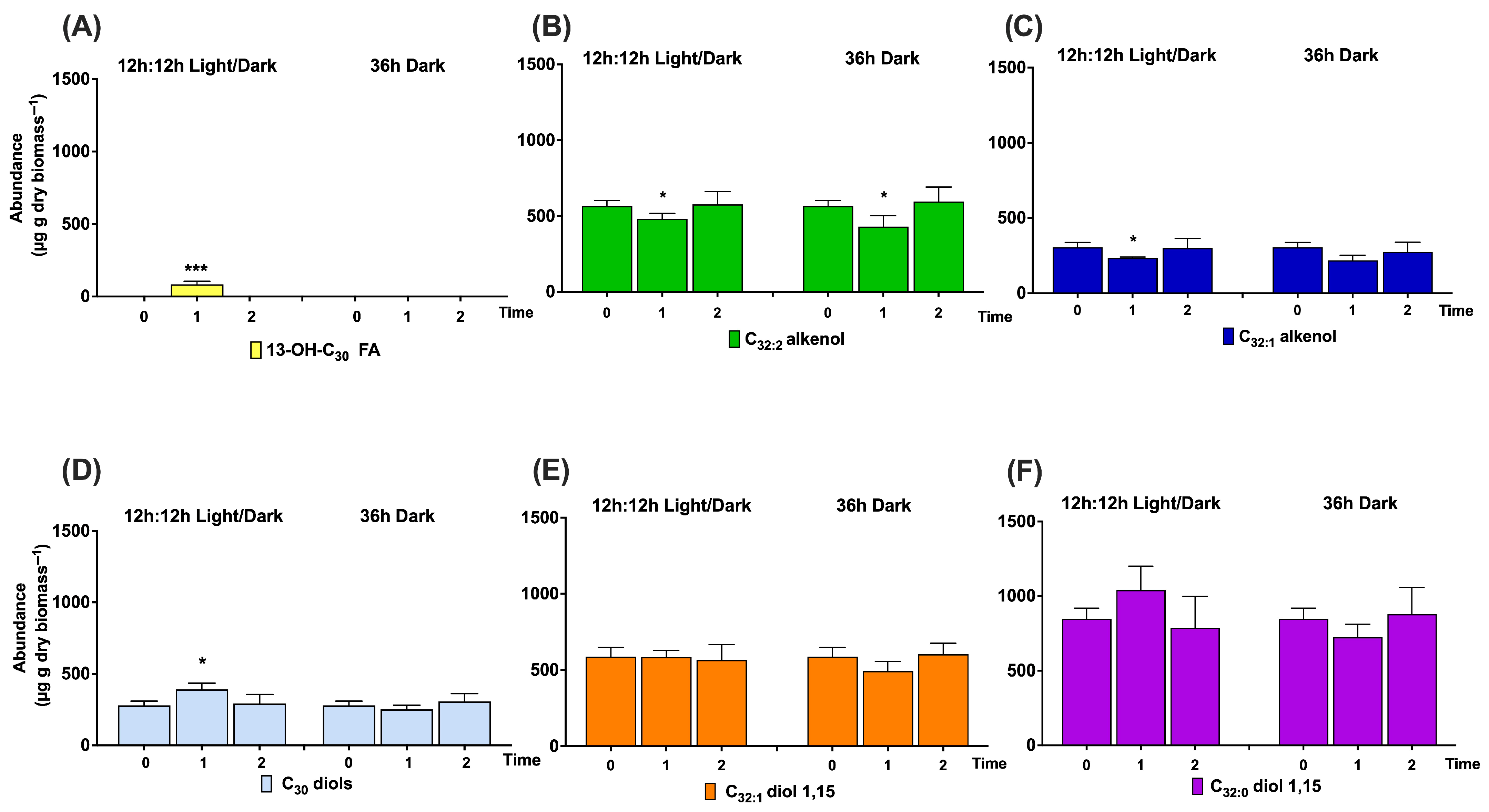
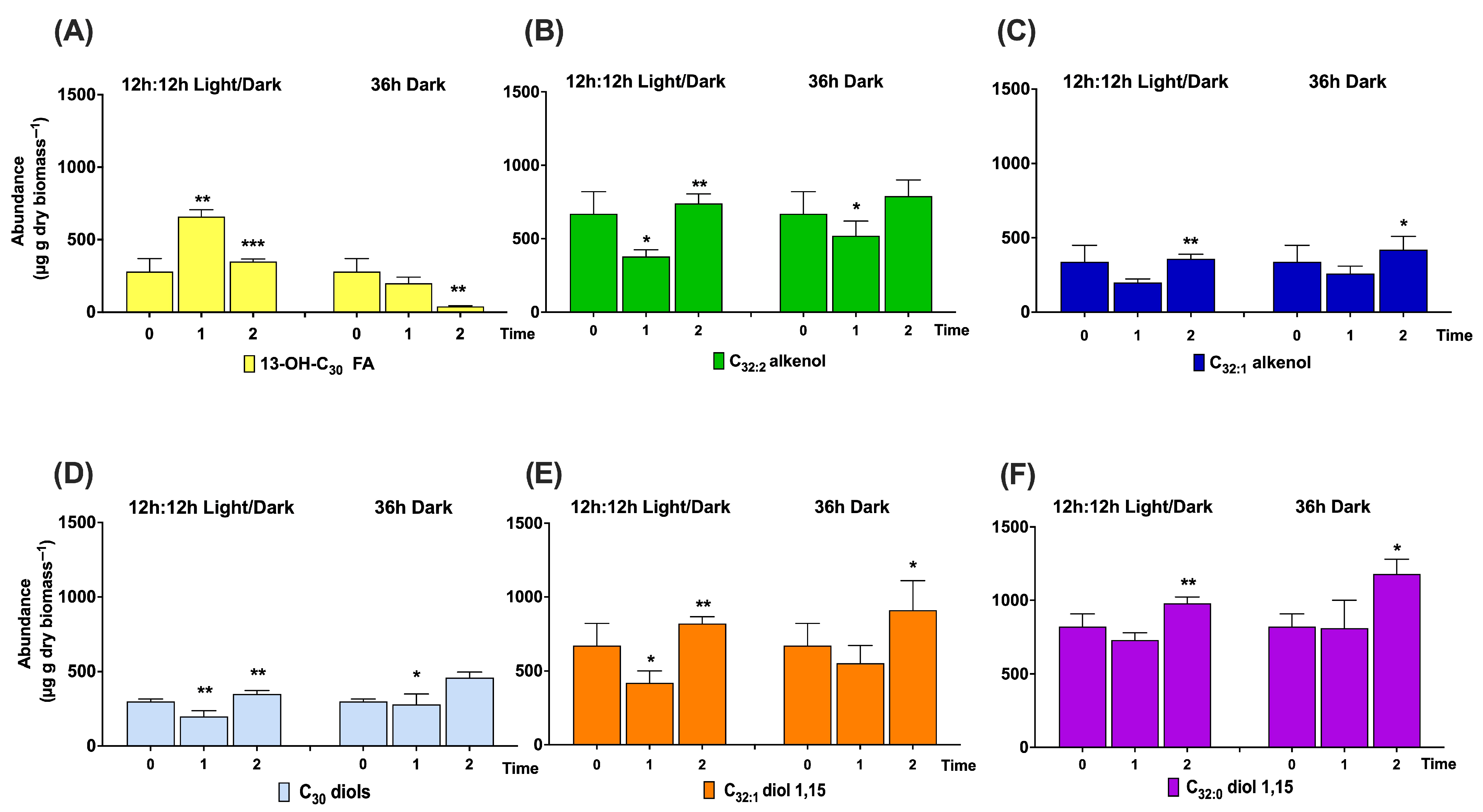
The abundance of individual LCA, LCD and LCHFA contents was also quantified. Under LL conditions, the concentration of C32 diols remained stable over time under both light/dark and dark control treatments (Figure 3). In contrast, a significant increase in C30 diols was observed after 12 h in the light/dark treatment. LCAs exhibited a significant decline after 12 h under both dark/light and continuous dark conditions, whereas the 13-OH-C30 fatty acid (13-OH-C30 FA) was found to be positively correlated with light intensity (p-value = 0.003); it increased significantly after 12 h of light exposure before returning to baseline levels following a 12 h dark period. Notably, 36 h darkness resulted in a marked decrease in 13-OH-C30 fatty acid content, dropping below detection levels.
Similar trends for the 13-OH-C30 FA were observed at SL conditions, which was found to accumulate after 12 h of light exposure, followed by a decrease during the subsequent dark phase (Figure 4). The content progressively diminished during the extended dark incubation, indicating a robust correlation between light exposure and fatty acid production. Conversely, no significant correlation with light was observed for C30 diols: their content was found to increase after dark exposure in both the dark light (Time 1 to Time 2) and the dark (Time 0 to Time 2) treatments (Figure 4). The other LCDs were also found to increase after dark exposure, as found for both C32 diols between Time 1 and Time 2 in the dark/light treatment and between Time 0 and Time 2 in the dark treatment (Figure 4). The LCAs showed a decrease after 12 h of light exposure but returned to initial concentrations after an equivalent dark period.
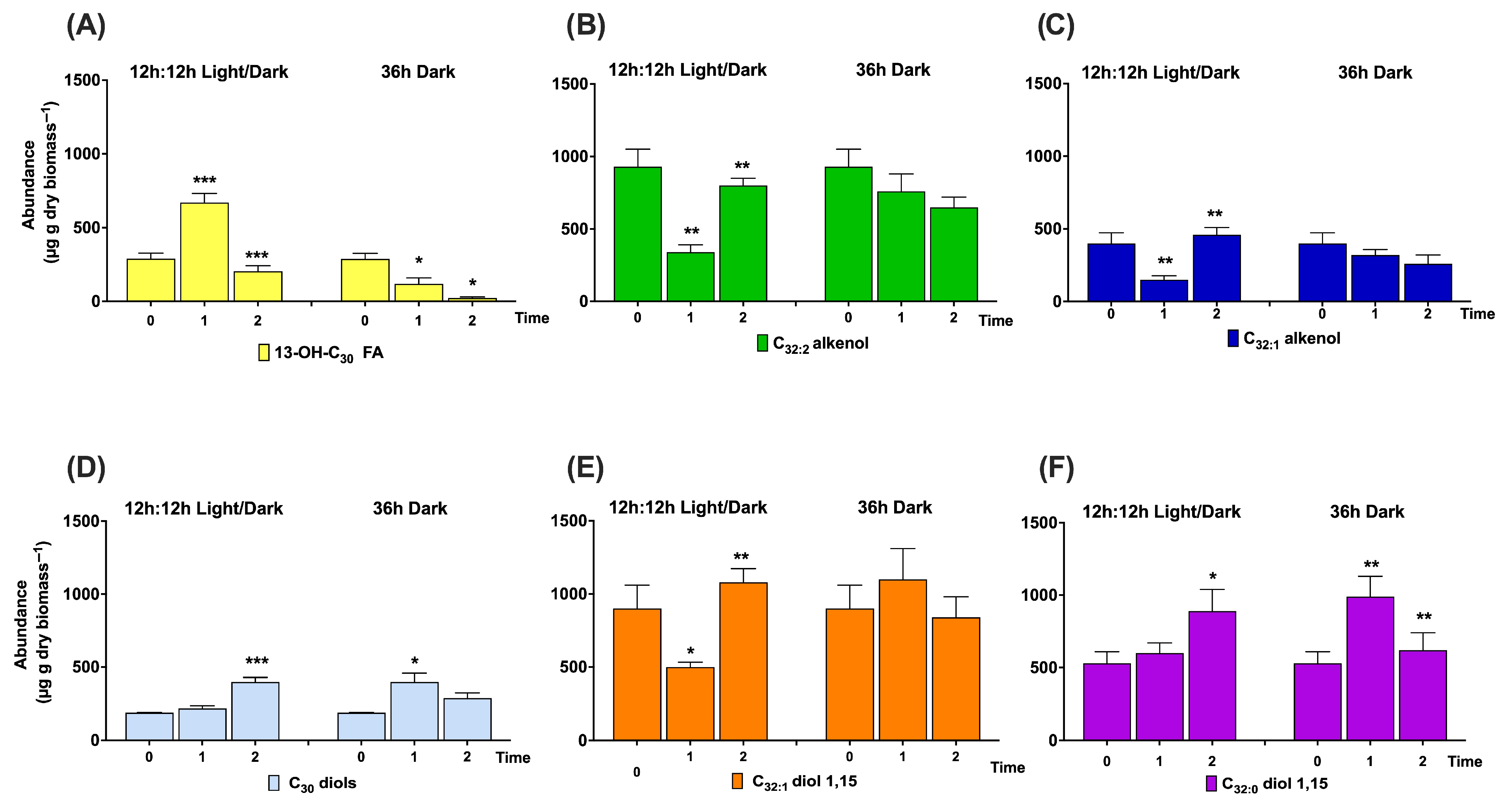
Patterns of variability under HL conditions mirrored those observed under LL and SL conditions. Specifically, the concentration of 13-OH-C30 FA increased after 12 h of light exposure and then decreased during the following dark phase; a sharp decline in 13-OH-C30 FA was instead noted in the dark treatment at the end of the experiments (Figure 5). In contrast, C30 diols decreased when exposed to light but increased during prolonged dark incubation (Figure 5). The LCA content decreased after 12 h under both physiological conditions tested but increased back to initial levels afterward, with more pronounced effects noted under dark/light treatment (Figure 5).
Data analysis across all experiments demonstrated a robust positive correlation between 13-OH-C30 FA abundance and light intensity (ρ < 0.0001). This relationship is evident from higher concentrations of 13-OH-C30 FA observed in cells pre-acclimated to standard-light (SL) and high-light (HL) conditions compared to low light (LL) conditions at Time 0 (T0: LL, not detected; SL, 290 ± 37 µg·g−1 DB; HL, 280 ± 90 µg·g−1 DB) (Table S1). Furthermore, 13-OH-C30 FA levels fluctuated with light exposure, increasing during the light phase, and returning to baseline levels during the dark phase. This light-dependent behavior was confirmed in cultures incubated for 36 h in complete darkness, where concentrations of 13-OH-C30 FA progressively declined. After 36 h of darkness, 13-OH-C30 FA levels dropped significantly below T0 values (T2: LL, not detected; SL, 23 ± 6 µg·g−1 DB; HL, 43 ± 20 µg·g−1 DB). For LCDs, distinct trends were observed depending on light intensity and exposure duration. Under 12 h:12 h light/dark conditions, LCD content decreased after 12 h in SL and HL conditions but increased under LL conditions. In prolonged darkness, LCD abundance exhibited a rise by the end of the incubation in HL conditions (T2) and a significant increase after 24 h of darkness in SL conditions (T1). Interestingly, LL cultures maintained in darkness displayed negligible changes in LCD levels, whereas SL cultures showed an initial increase in LCD content during the light phase, followed by a decline during the subsequent dark phase. In HL cultures, LCD levels at 24 h were higher than at both T0 and T1 (Table S1). Similar light-responsive trends were observed for LCAs under both light/dark cycles and prolonged dark treatments. LCA abundance consistently decreased after 12 h, with reductions more pronounced in cultures exposed to the light phase, particularly under SL and HL conditions. An exception was noted in SL cultures subjected to prolonged darkness, where LCA content declined continuously over the 36 h dark period. These results underscore the intricate interplay between light intensity, exposure duration, and the metabolic dynamics of 13-OH-C30 FA, LCDs, and LCAs, providing critical insights into their regulation under varying environmental conditions. Overall, current results revealed significant differences in the abundance of LCHFAs under varying light intensities. Higher concentrations of LCHFAs were observed under high light (HL) conditions compared to standard light (SL) and low light (LL) (Figure 3, Figure 4 and Figure 5). Furthermore, LCHFA concentrations were consistently higher after 12 h of light exposure than after the dark phase, suggesting that LCHFA synthesis is light-driven.

4. Discussion

Overall, our results align with previous work by [20], which demonstrated increased LCHFA production under HL (irradiance 400 μE·m−2·s−1) compared to LL (25 μE·m−2·s−1) conditions. Furthermore, the present work clarifies that LCHFAs are biosynthesized during the light phase, and their concentration decreases during the dark phase. The progressive decline of LCHFA content in cultures maintained under dark conditions supports the hypothesis that light exposure is essential for LCHFA biosynthesis.
The light-induced increase in LCHFAs correlates with the general enhancement of TAG content in Nannochloropsis spp. under high-light conditions [23,28,29]. Although TAGs in most algae predominantly contain saturated and mono-unsaturated fatty acids (C14–18) [30], certain oil-seed plants, such as Ricinus communis and Physaria fendleri, have been shown to incorporate hydroxylated fatty acids into TAGs [31,32,33]. However, to the best of our knowledge the presence of LCHFAs within TAGs or polar lipids has not been documented in Nannochloropsis spp. including N. oceanica [34,35]. The role of LCHFAs in the biosynthesis of cell wall lipids cannot be excluded. α-, β-, and ω-C24-30 hydroxy fatty acids were previously detected in freshwater Eustigmatophyceae [36,37] and suggested to be associated with the cell wall, as also demonstrated for the green microalgae Tetraedron minimum, Scenedesmus communis, and Pediastrum boryanum [38]. LCHFAs have been proposed as precursors for LCDs and LCAs based on their structural similarities and previous studies [15]. Accordingly, these observations suggest the existence of a shared biosynthetic pathway, likely involving sequential hydroxylation and elongation steps. Despite the pronounced increase in LCHFA production during light exposure, no immediate accumulation of LCDs or LCAs was detected, likely reflecting slower enzymatic conversion of LCHFAs into these downstream metabolites. Specifically, the reduction of the carboxylic group into an alcohol group converting LCHFAs to LCDs, and the subsequent dehydration of mid-chain hydroxyl groups to yield LCAs, may occur at rates too low to be captured within the experimental timeframe. The decrease in LCD and LCA levels during the light phase, followed by an increase during the subsequent dark phase, observed under SL and HL conditions, implies that their biosynthesis may be inhibited by light and promoted under dark conditions. However, the absence of significant accumulation under prolonged dark conditions (Table 1) contrasts with earlier observations [15], during which a sharp increase in LCDs and LCAs was noted after one week of dark incubation. The discrepancy may be attributed to the shorter incubation periods applied during our study, suggesting again that prolonged dark exposure is necessary for significant biosynthesis of these compounds. Cell wall biosynthesis in Nannochloropsis has been recently suggested to take place through the transport of C32 diols by the red body, a pigment rich lipid body [25]. Our findings confirm that the biosynthesis of LCDs and LCAs is not aligned with that of storage lipids (TAG) suggesting a different role for these long chain aliphatic compounds, likely as structural components, as part of the algaenan layer of the Nannochloropsis cell wall. Indeed, unlike TAGs, their concentrations did not correlate with conditions known to affect lipid metabolism, such as light intensity. This is consistent with the proposed role of LCDs and LCAs as precursors for algaenan, a robust extracellular matrix that is suggested to provide mechanical protection against environmental stress. The limited changes in LCD and LCA concentrations during the light phase may indicate that these compounds are synthesized only when needed for cell wall maintenance or repair. The observed patterns of LCD and LCA production in Nannochloropsis contrast with their presence in other taxa. For example, LCDs have been previously observed in diatoms from the genus Proboscia and the Dictyochophycea Apedinella radians [39,40]. However, the influence of light on LCD production by Proboscia spp. and A. radians remains unexplored. Notably, algaenans have not been reported in these taxa, indicating that LCDs and LCAs may serve distinct functional roles and may exhibit differential responses to light. Furthermore, LCDs are key components of epicuticular waxes in higher land plants, forming hydrophobic barriers that protect against environmental stress [41]. These roles further support the hypothesis that LCDs and LCAs in Nannochloropsis serve protective rather than metabolic storage functions.

Supplementary Materials

The following supporting information can be downloaded at: https://www.mdpi.com/article/10.3390/phycology6010011/s1, Table S1. Concentrations of 13-OH-C30 FA, LCDs, and LCAs in µg per g dry weight biomass (DB) during the different experiments carried out at different light regimes.

Author Contributions

Conceptualization, M.B., A.C. and S.B.; methodology, M.B., A.C. and S.B.; validation, M.B., A.C. and S.B.; investigation, M.B., A.C., A.S., S.S. and S.B.; resources, A.C., S.S. and S.B.; data curation, M.B., A.C. and S.B.; writing—original draft preparation, M.B.; writing—review and editing, M.B., A.C., S.S. and S.B.; visualization, M.B.; supervision, A.C. and S.B.; project administration, S.B. All authors have read and agreed to the published version of the manuscript.

Funding

This research received no external funding.

Data Availability Statement

The original contributions presented in this study are included in the article/Supplementary Materials. Further inquiries can be directed to the corresponding authors.

Acknowledgments

Authors are deeply grateful to Mariano Amoruso and Arianna Smerilli for technical support in microalgal culturing, Anchelique Metz for lipid extraction and analyses and Jort Ossebaar for bioinformatic support.

Conflicts of Interest

The authors declare no conflicts of interest.

References

  1. Ho, S.H.; Chen, C.Y.; Chang, J.S. Effect of light intensity and nitrogen starvation on CO2 fixation and lipid/carbohydrate production of an indigenous microalga Scenedesmus obliquus CNW-N. Bioresour. Technol. 2012, 113, 244–252. [Google Scholar] [CrossRef] [PubMed]
  2. Nzayisenga, J.C.; Farge, X.; Groll, S.L.; Sellstedt, A. Effects of light intensity on growth and lipid production in microalgae grown in wastewater. Biotechnol. Biofuels 2020, 13, 4. [Google Scholar] [CrossRef] [PubMed]
  3. Schulze, P.S.C.; Barreira, L.A.; Pereira, H.G.C.; Perales, J.A.; Varela, J.C.S. Light emitting diodes (LEDs) applied to microalgal production. Trends Biotechnol. 2014, 32, 422–430. [Google Scholar] [CrossRef]
  4. Kim, T.H.; Lee, Y.; Han, S.H.; Hwang, S.J. The effects of wavelength and wavelength mixing ratios on microalgae growth and nitrogen, phosphorus removal using Scenedesmus sp. for wastewater treatment. Bioresour. Technol. 2013, 130, 75–80. [Google Scholar] [CrossRef]
  5. Gao, Y.; Bernard, O.; Fanesi, A.; Perré, P.; Lopes, F. The impact of light/dark regimes on structure and physiology of Chlorella vulgaris biofilms. Front. Microbiol. 2023, 14, 1250866. [Google Scholar] [CrossRef]
  6. Yaakob, M.A.; Mohamed, R.M.S.R.; Al-Gheethi, A.; Ravishankar, G.A.; Ambati, R.R. Influence of nitrogen and phosphorus on microalgal growth, biomass, lipid, and fatty acid production: An overview. Cells 2021, 10, 393. [Google Scholar] [CrossRef]
  7. Fattore, N.; Bellan, A.; Pedroletti, L.; Vitulo, N.; Morosinotto, T. Acclimation of photosynthesis and lipids biosynthesis to prolonged nitrogen and phosphorus limitation in Nannochloropsis gaditana. Algal Res. 2021, 58, 102368. [Google Scholar] [CrossRef]
  8. Maltsev, Y.; Kulikovskiy, M.; Maltseva, S. Nitrogen and phosphorus stress as a tool to induce lipid production in microalgae. Microb. Cell Factories 2023, 22, 239. [Google Scholar] [CrossRef]
  9. Narayanan, I.; Pandey, S.; Vinayagam, R.; Selvaraj, R.; Varadavenkatesan, T. A recent update on enhancing lipid and carbohydrate accumulation for sustainable biofuel production in microalgal biomass. Discov. Appl. Sci. 2025, 7, 195. [Google Scholar] [CrossRef]
  10. Zhu, L.D.; Li, Z.H.; Hiltunen, E. Strategies for Lipid Production Improvement in Microalgae as a Biodiesel Feedstock. BioMed Res. Int. 2016, 2016, 8792548. [Google Scholar] [CrossRef]
  11. Ma, X.-N.; Chen, T.-P.; Yang, B.; Liu, J.; Chen, F. Lipid Production from Nannochloropsis. Mar. Drugs 2016, 14, 61. [Google Scholar] [CrossRef]
  12. Paliwal, C.; Mitra, M.; Bhayani, K.; Bharadwaj, S.V.V.; Ghosh, T.; Dubey, S.; Mishra, S. Abiotic stresses as tools for metabolites in microalgae. Bioresour. Technol. 2017, 244, 1216–1226. [Google Scholar] [CrossRef]
  13. Alishah Aratboni, H.; Rafiei, N.; Garcia-Granados, R.; Alemzadeh, A.; Morones-Ramírez, J.R. Biomass and lipid induction strategies in microalgae for biofuel production and other applications. Microb. Cell Factories 2019, 18, 178. [Google Scholar] [CrossRef]
  14. Bibi, F.; Jamal, A.; Huang, Z.; Urynowicz, M.; Ishtiaq Ali, M. Advancement and role of abiotic stresses in microalgae biorefinery with a focus on lipid production. Fuel 2022, 316, 123192. [Google Scholar] [CrossRef]
  15. Balzano, S.; Villanueva, L.; de Bar, M.; Canavesi, D.X.S.; Yildiz, C.; Engelmann, J.C.; Marechal, E.; Lupette, J.; Damste, J.S.S.; Schouten, S. Biosynthesis of Long Chain Alkyl Diols and Long Chain Alkenols in Nannochloropsis spp. (Eustigmatophyceae). Plant Cell Physiol. 2019, 60, 1666–1682. [Google Scholar] [CrossRef]
  16. Gelin, F.; Boogers, I.; Noordeloos, A.A.M.; Sinninghe Damsté, J.S.; Riegman, R.; De Leeuw, J.W. Resistant biomacromolecules in marine microalgae of the classes eustigmatophyceae and chlorophyceae: Geochemical implications. Org. Geochem. 1997, 26, 659–675. [Google Scholar] [CrossRef]
  17. Scholz, M.J.; Weiss, T.L.; Jinkerson, R.E.; Roth, R.; Goodenough, U.; Matthew, C.; Gerken, H.G. Ultrastructure and Composition of the Nannochloropsis gaditana cell wall. Eukaryot. Cell 2014, 13, 1450–1464. [Google Scholar] [CrossRef]
  18. Zhang, Z.; Volkman, J.K. Algaenan structure in the microalga Nannochloropsis oculata characterized from stepwise pyrolysis. Org. Geochem. 2017, 104, 148. [Google Scholar] [CrossRef]
  19. Kodner, R.B.; Summons, R.E.; Knoll, A.H. Phylogenetic investigation of the aliphatic, non-hydrolyzable biopolymer algaenan, with a focus on green algae. Org. Geochem. 2009, 40, 854–862. [Google Scholar] [CrossRef]
  20. Balzano, S.; Villanueva, L.; de Bar, M.; Sinninghe, J.S.; Schouten, S. Impact of culturing conditions on the abundance and composition of long chain alkyl diols in species of the genus Nannochloropsis. Org. Geochem. 2017, 108, 9–17. [Google Scholar] [CrossRef]
  21. Sukenik, A.; Carmeli, Y.; Berner, T. Regulation of fatty acid composition by irradiance level in the Eustigmatophyte Nannochloropsis sp. J. Phycol. 1989, 25, 686–692. [Google Scholar] [CrossRef]
  22. Fábregas, J.; Maseda, A.; Domínguez, A.; Otero, A. The cell composition of Nannochloropsis sp. changes under different irradiances in semicontinuous culture. World J. Microbiol. Biotechnol. 2004, 20, 31–35. [Google Scholar] [CrossRef]
  23. Pal, D.; Khozin-Goldberg, I.; Cohen, Z.; Boussiba, S. The effect of light, salinity, and nitrogen availability on lipid production by Nannochloropsis sp. Appl. Microbiol. Biotechnol. 2011, 90, 1429–1441. [Google Scholar] [CrossRef]
  24. Fietz, S.; Bleiß, W.; Hepperle, D.; Koppitz, H.; Krienitz, L.; Nicklisch, A. First record of Nannochloropsis limnetica (Eustigmatophyceae) in the autotrophic picoplankton from Lake Baikal. J. Phycol. 2005, 41, 780–790. [Google Scholar] [CrossRef]
  25. Gee, C.W.; Andersen-Ranberg, J.; Boynton, E.; Rosen, R.Z.; Jorgens, D.; Grob, P.; Holman, H.Y.N.; Niyogi, K.K. Implicating the red body of Nannochloropsis in forming the recalcitrant cell wall polymer algaenan. Nat. Commun. 2024, 15, 5456. [Google Scholar] [CrossRef]
  26. Guillard, R.R.L. Culture of Phytoplankton for Feeding Marine Invertebrates. In Culture of Marine Invertebrate Animals; Springer US: Boston, MA, USA, 1975; pp. 29–60. [Google Scholar] [CrossRef]
  27. Versteegh, G.J.M.; Blokker, P.; Marshall, C.; Pross, J. Macromolecular composition of the dinoflagellate cyst Thalassiphora pelagica (Oligocene, SW Germany). Org. Geochem. 2007, 38, 1643–1656. [Google Scholar] [CrossRef]
  28. Van Wagenen, J.; Miller, T.W.; Hobbs, S.; Hook, P.; Crowe, B.; Huesemann, M. Effects of Light and Temperature on Fatty Acid Production in Nannochloropsis salina. Energies 2012, 5, 731–740. [Google Scholar] [CrossRef]
  29. Alboresi, A.; Perin, G.; Vitulo, N.; Diretto, G.; Block, M.; Jouhet, J.; Meneghesso, A.; Valle, G.; Giuliano, G.; Maréchal, E.; et al. Light Remodels Lipid Biosynthesis in Nannochloropsis gaditana by Modulating Carbon Partitioning between Organelles. Plant Physiol. 2016, 171, 2468–2482. [Google Scholar] [CrossRef]
  30. Hu, Q.; Sommerfeld, M.; Jarvis, E.; Ghirardi, M.; Posewitz, M.; Seibert, M.; Darzins, A. Microalgal triacylglycerols as feedstocks for biofuel production: Perspectives and advances. Plant J. 2008, 54, 621–639. [Google Scholar] [CrossRef]
  31. Lunn, D.; Wallis, J.G.; Browse, J. Tri-Hydroxy-Triacylglycerol Is Efficiently Produced by Position-Specific Castor Acyltransferases. Plant Physiol. 2019, 179, 1050–1063. [Google Scholar] [CrossRef]
  32. Cahoon, E.B.; Li-Beisson, Y.; Fernie, A.R.; Wen, W. Plant unusual fatty acids: Learning from the less common This review comes from a themed issue on Physiology and metabolism. Curr. Opin. Plant Biol. 2020, 2020, 66–73. [Google Scholar] [CrossRef]
  33. Azeez, A.; Parchuri, P.; Bates, P.D. Suppression of Physaria fendleri SDP1 Increased Seed Oil and Hydroxy Fatty Acid Content While Maintaining Oil Biosynthesis Through Triacylglycerol Remodeling. Front. Plant Sci. 2022, 13, 1861. [Google Scholar] [CrossRef]
  34. Liang, J.; Wen, F.; Liu, J. Transcriptomic and lipidomic analysis of an EPA-containing Nannochloropsis sp. PJ12 in response to nitrogen deprivation. Sci. Rep. 2019, 9, 4540. [Google Scholar] [CrossRef]
  35. Han, D.; Jia, J.; Li, J.; Sommerfeld, M.; Xu, J.; Hu, Q. Metabolic remodeling of membrane glycerolipids in the microalga Nannochloropsis oceanica under nitrogen deprivation. Front. Mar. Sci. 2017, 4, 277428. [Google Scholar] [CrossRef]
  36. Sakthivel, R.; Elumalai, S.; Mohommad Arif, M. Microalgae lipid research, past, present: A critical review for biodiesel production, in the future. J. Exp. Sci. 2011, 2011, 29–49. Available online: https://updatepublishing.com/journal/index.php/jes/article/view/1889 (accessed on 9 November 2025).
  37. Volkman, J.K.; Barrett, S.M.; Blackburn, S.I. Fatty acids and hydroxy fatty acids in three species of freshwater eustigmatophytes. J. Phycol. 1999, 35, 1005–1012. [Google Scholar] [CrossRef]
  38. Blokker, P.; Schouten, S.; Van Den Ende, H.; De Leeuw, J.W.; Sinninghe Damsté, J.S. Cell wall-specific ω-hydroxy fatty acids in some freshwater green microalgae. Phytochemistry 1998, 49, 691–695. [Google Scholar] [CrossRef]
  39. Sinninghe Damsté, J.S.; Rampen, S.; Irene, W.; Rijpstra, C.; Abbas, B.; Muyzer, G.; Schouten, S. A diatomaceous origin for long-chain diols and mid-chain hydroxy methyl alkanoates widely occurring in quaternary marine sediments: Indicators for high-nutrient conditions. Geochim. Cosmochim. Acta 2003, 67, 1339–1348. [Google Scholar] [CrossRef]
  40. Rampen, S.W.; Schouten, S.; Sinninghe Damsté, J.S. Occurrence of long chain 1,14-diols in Apedinella radians. Org. Geochem. 2011, 42, 572–574. [Google Scholar] [CrossRef]
  41. Sharma, P.; Kothari, S.L.; Rathore, M.S.; Gour, V.S. Properties, variations, roles, and potential applications of epicuticular wax: A review. Turk. J. Bot. 2018, 42, 135–149. [Google Scholar] [CrossRef]
Figure 1. Chemical structures of long chain aliphatic lipid derivatives identified in Nannochloropsis oceanica. These compounds include hydroxylated C30 fatty acids, namely (A) 13-OH-C30:0 and (B) 15-OH-C30:0, as well as C30 and C32 diols with different hydroxylation patterns, including (C) 1,13-C30:0 diol, (D) 1,15-C30:0 diol, (E) 1,15-C32:0 diol, and (F) 1,15-C32:1 diol. Finally, two unsaturated alkenols are represented, (G) C32:1 and (H) C32:2 alkenols.
Phycology 06 00011 g001
Figure 2. Schematic representation of the experimental setup used to assess the effects of light and dark conditions on Nannochloropsis oceanica CCMP1779.
Phycology 06 00011 g002
Figure 3. Abundance of (A) 13-OH-C30 FA, (B) C32:2 alkenol, (C) C32:1 alkenol, (D) C30 diols, (E) 1,15-C32:1 diol, and (F) 1,15-C32:0 diol in Nannochloropsis oceanica CCMP1779 acclimated under 25 μE·m−2·s−1 irradiance (LL condition) and then incubated under Light/Dark or Continuous Dark conditions. Values are reported as mean of three replicates. For each light intensity, statistical analysis was performed comparing each time point with its preceding using Student’s t-test. Asterisks denote significant differences (* p-value < 0.05; *** p-value < 0.001).
Phycology 06 00011 g003
Figure 4. Abundance of (A) 13-OH-C30 FA, (B) C32:2 alkenol, (C) C32:1 alkenol, (D) C30 diols, (E) 1,15-C32:1 diol, and (F) 1,15-C32:0 diol in Nannochloropsis oceanica CCMP1779 acclimated under 150 μE·m−2·s−1 irradiance (SL condition) and then incubated under Light/Dark or Continuous Dark treatment. Values are reported as mean and standard deviations as described in Figure 1. Asterisks denote significant differences (* p-value < 0.05; ** p-value < 0.01; *** p-value < 0.001).
Phycology 06 00011 g004
Figure 5. Abundance of (A) 13-OH-C30 FA, (B) C32:2 alkenol, (C) C32:1 alkenol, (D) C30 diols, (E) 1,15-C32:1 diol, and (F) 1,15-C32:0 diol in Nannochloropsis oceanica CCMP1779 acclimated under 400 μE·m−2·s−1 irradiance (HL condition) and then incubated under Light/Dark or Continuous Dark conditions. Values are reported as mean and standard deviations as described in Figure 1. Asterisks denote significant differences (* p-value < 0.05; ** p-value < 0.01; *** p-value < 0.001).
Phycology 06 00011 g005
Table 1. Effect of different light intensities on cell growth and lipid content of N. oceanica CCMP1779 incubated under dark-light conditions a.
Light Intensity (μE·m−2·s−1)TimeCell Density (106 cell·mL−1)Growth Rate
µ (day−1) a
DB b
(mg)
TLE c
(mg)
Lipid
Concentration (fg·cell−1)
Lipids Content (mg/mg DB)
2508.8 ± 0.00.2327.2 ± 2.56.7 ± 0.9760 ± 1000.35 ± 0.13
18.9 ± 0.938.7 ± 1.710.5 ± 0.61270 ± 1100.27 ± 0.02
210.3 ± 1.236.2 ± 2.59.3 ± 0.9900 ± 900.26 ± 0.03
15007.8 ± 0.01.0518.3 ± 0.85.6 ± 0.4720 ± 500.30 ± 0.01
18.7 ± 0.243.1 ± 2.813.3 ± 1.01530 ± 1300.31 ± 0.02
216.2 ± 0.436.6 ± 1.312.2 ± 0.7760 ± 600.34 ± 0.03
40007.8 ± 0.00.9616.8 ± 3.64.1 ± 1.1530 ± 1400.24 ± 0.01
18.5 ± 0.240.4 ± 0.910.2 ± 0.61200 ± 850.25 ± 0.02
215.2 ± 0.533.0 ± 2.79.3 ± 0.1610 ± 300.28 ± 0.02
a Experiments were performed in triplicate using 2 L cultures. Time 0 in both the “Dark/Light” and “Dark” treatments correspond to the same sampling point. Growth rate was calculated after 24 h. Data are expressed as means ± standard deviations from three biological replicates. Bold values indicate statistically significant changes compared with the preceding time point (p < 0.05). Abbreviations: LL, low light intensity; SL, standard light intensity; HL, high light intensity; DB, dry weight biomass; TLE, total lipid extract weight. b Dry biomass. c Total lipid extract weight.
Table 2. Effect of prolonged dark incubation on N. oceanica CCMP1779 cell growth and lipid content a.
Light Intensity (μE·m−2·s−1)TimeCell Density
(106 cell·mL−1)
Growth Rate µ (day−1) aDB b
(mg)
TLE c
(mg)
Lipid Concentration
(fg·cell−1)
Lipid Content (mg/mg DB)
2508.8 ± 0.0−0.1327.2 ± 2.56.7 ± 0.9760 ± 1000.35 ± 0.13
18.0 ± 0.0 28.0 ± 11.07.2 ± 3.31160 ± 2250.25 ± 0.03
28.0 ± 0.2 29.3 ± 1.66.6 ± 0.7820 ± 800.23 ± 0.03
15007.8 ± 0.00.1218.3 ± 0.85.6 ± 0.4720 ± 500.30 ± 0.01
17.9 ± 0.1 21.8 ± 0.65.8 ± 0.2740 ± 300.27 ± 0.02
28.5 ± 0.3 28.9 ± 1.75.1 ± 0.1600 ± 100.18 ± 0.01
40007.8 ± 0.0−0.0116.8 ± 3.64.1 ± 1.1530 ± 1400.24 ± 0.01
17.9 ± 0.1 14.7 ± 1.13.3 ± 0.9420 ± 1100.29 ± 0.04
27.7 ± 0.2 16.0 ± 0.83.2 ± 0.1415 ± 200.25 ± 0.07
a,b,c Experimental details and abbreviations as on Table 1.
Disclaimer/Publisher’s Note: The statements, opinions and data contained in all publications are solely those of the individual author(s) and contributor(s) and not of MDPI and/or the editor(s). MDPI and/or the editor(s) disclaim responsibility for any injury to people or property resulting from any ideas, methods, instructions or products referred to in the content.