Article

High-Solids Processing of Palmaria palmata for Feed Applications: Effects of Alkaline Autoclaving and Sequential Enzymatic Treatment


1
Department of Biology, Faculty of Sciences, University of Porto, Rua do Campo Alegre Ed. FC4, 4169-007 Porto, Portugal
2
CIIMAR—Interdisciplinary Centre of Marine and Environmental Research, University of Porto, Porto de Leixões Cruise Terminal, Av. General Norton de Matos, 4450-208 Matosinhos, Portugal
3
Centre of Biological Engineering, University of Minho, Campus de Gualtar, 4710-057 Braga, Portugal
4
LABBELS—Laboratory in Biotechnology and Bioengineering and Microelectromechanical Systems—Associate Laboratory, 4710-057 Braga, Guimarães, Portugal
*
Author to whom correspondence should be addressed.
Phycology 2026, 6(1), 12; https://doi.org/10.3390/phycology6010012
Submission received: 8 December 2025 / Revised: 29 December 2025 / Accepted: 2 January 2026 / Published: 8 January 2026
(This article belongs to the Special Issue Development of Algal Biotechnology)

Abstract

Macroalgae are increasingly recognized as a valuable source of nutrients and bioactive compounds for animal nutrition, including for aquatic species. However, the complex structure of the macroalgal cell wall limits the accessibility of intracellular components, restricting their use in feeds. To overcome this limitation, macroalgal hydrolysis using various technological treatments has been tested, often employing a low solid-to-water ratio, which complicates downstream processing due to phase separation. In contrast, high-solids loading hydrolysis has the advantage of producing a single and consolidated fraction, simplifying subsequent processing and application. The present study assessed the effectiveness of high-solids loading water or alkaline (0.5 and 1N NaOH) autoclaving for 30 or 60 min, applied alone or followed by sequential enzymatic hydrolysis, using a xylanase-rich enzymatic complex aimed at promoting cell wall disruption and increasing the extractability of intracellular components in the red macroalga Palmaria palmata with minimal free water. The 1N NaOH treatment for 30 min decreased neutral and acid detergent fiber while increasing Folin–Ciocalteu total phenolic content (GAE) (expressed as gallic acid equivalent) and the water-soluble protein fraction and decreased crude protein, indicating enhanced extractability of these components. Microscopic examination showed relatively mild structural changes on the surface of P. palmata after high-solids loading alkaline (1N NaOH) autoclaving for 30 min. Following alkaline or water treatment, the enzymatic complex hydrolysis further increased the Folin–Ciocalteu total phenolic content (GAE), with minimal effects on NDF, ADF, or crude protein. Overall, these results showed that high-solids loading alkaline autoclaving, with or without subsequent enzymatic hydrolysis, effectively disrupts P. palmata cell walls and induces substantial modifications while simplifying processing by avoiding phase separation.

1. Introduction

Macroalgae have emerged as an attractive and sustainable biomass source due to their rapid growth, high productivity, and capacity for CO2 sequestration. These attributes and their potential health benefits have expanded their applications in feed and food supplements, hydrocolloids, nutraceuticals, pharmaceuticals, biofuels, and biomaterials [1,2].
Macroalgae have gained attention as potential feed additives due to their distinctive composition, which includes proteins, carbohydrates, minerals (such as sodium, potassium, calcium, and magnesium), vitamins (A, C, E, and the B-complex), phytochemicals, and polyunsaturated fatty acids (DHA and EPA) [3,4]. These characteristics, combined with their ability to grow in marine environments, make macroalgae a promising option for sustainable biomass production, particularly for use in animal feed formulation [5]. However, the structural complexity of the macroalgae polysaccharide matrix, which is resistant to intestinal enzymatic degradation, limits the accessibility of intracellular components and the efficient utilization of macroalgal nutrients. Macroalgae polysaccharide matrix, composed of diverse cyclic ether sugar molecules with multiple hydroxyl groups and additional functional groups such as amines and carboxylic acids, requires disruption into smaller structural units to improve extractability and processing efficiency [6]. Furthermore, the diversity of sugar monomers and complex polysaccharides complicates the characterization of macroalgae cell walls and the selection of optimal pretreatment methods, as approaches routinely applied to lignocellulosic terrestrial biomass cannot be directly transferred to macroalgae due to the presence of alginates, agar, and/or sulfated polysaccharides with distinct chemical reactivities [6,7].
In aquafeeds, macroalgae have been used as a dietary ingredient or a source of bioactive extracts. Bioactive compounds in macroalgae have potential functional benefits for fish, including antimicrobial and antioxidant effects, which can improve fish immune status and disease resistance [8]. However, the macroalgal inclusion rate in aquafeeds is limited mainly due to their relatively low protein content and reduced energy digestibility [9]. Despite these limitations, several macroalgal species have been evaluated for their nutritional and functional effects when incorporated into aquafeeds at varying inclusion levels, including those as low as 10–15%, depending on the feeding habits of the target species, ranging from carnivorous to herbivorous [10]. Overall, outcomes vary with both macroalgal species and fish species. In general, carnivorous fish appear less tolerant than herbivorous species. Still, low inclusion levels can yield promising effects, such as improved growth performance, feed efficiency, body composition, survival, and disease resistance, whereas higher inclusion levels often lead to the opposite results [10]. Moreover, the nutritional value of macroalgae is strongly dependent on their digestibility [10]. Processing strategies that modify macroalgal structure and improve nutrient bioavailability are therefore recommended to enhance their dietary inclusion in aquafeeds [11].
The edible red macroalgae Palmaria palmata, commonly found in the North Atlantic, has long been used as a food source and holds significant commercial value. It has also been recognized as a potential feed ingredient for livestock, with a protein content ranging from 80 to 350 g/kg [12], including a high proportion of essential amino acids [13]. To ensure its sustainable supply, cultivation methods have been developed for large-scale production [13], with commercial cultivation now established in Portugal under integrated multi-trophic aquaculture (IMTA) conditions. Regardless of the target application, processing macroalgal biomass requires pretreatment to reduce the complexity of the carbohydrate fraction, which remains challenging due to its unique polysaccharide composition. A key distinction between macroalgae and terrestrial plants lies in their polysaccharide profiles. While terrestrial plants predominantly contain starch, cellulose, hemicellulose, and lignin, macroalgae produce a range of unique polysaccharides, including alginate, carrageenan, ulvan, mannitol, laminarin, and others [14]. This biochemical disparity poses challenges for conventional processing methods, particularly enzymatic hydrolysis, as the specific enzymes required to break down these marine polysaccharides are either unavailable or prohibitively expensive [2].
Several methods have been employed to disrupt macroalgal cells, including osmotic shock [15], mechanical grinding [16], ultrasonic treatment [16,17], chemical hydrolysis [17], and biological treatments [18]. Recent studies suggest that combining multiple treatments, such as the combination of alkaline or acid hydrolysis and enzymatic treatments, ultrasonic and microwave treatments, and mechano-chemical or mechano-biological treatments, can enhance cell wall disruption [19]. Chemical treatments using alkali and acid reagents have been proven effective for breaking down macroalgal polysaccharides by dissolving polymers and improving the accessibility of organic compounds [19,20]. This approach increases surface area exposure through fiber swelling and reduction in crystallinity [19,21]. However, chemical treatments require severe processing conditions and may generate inhibitory products, such as furfural, organic acids, and phenolic compounds, that can restrict the downstream process [20]. Moreover, the large-scale use of chemicals on an industrial scale poses environmental concerns, particularly due to the difficulties in managing and disposing of the produced effluents [22].
In contrast, biological treatment may represent a more sustainable and energy-efficient alternative. This approach utilizes enzymes to hydrolyze polysaccharides into smaller molecules and is primarily used to modify the structure and composition of biomass, thereby enhancing the bioavailability of macroalgae [19,23]. However, these treatments face challenges due to the heterogeneous composition of macroalgal cell walls and structure, enzyme-to-substrate specificity, and cost-effectiveness [19]. To overcome these limitations and enhance the efficiency of biological treatments, they are often combined with chemical or mechanical pretreatments, which improve enzyme accessibility and overall process effectiveness [19].
For P. palmata, alkaline treatments using sodium hydroxide (NaOH) under a low solid-to-liquid ratio (1:15, w/v) have been shown to promote cell disruption and enhance protein extractability [18]. Combining alkaline extraction with enzymatic hydrolysis, particularly using xylanase and cellulase, at low biomass-to-solvent ratios (1:20–1:80, w/v), has further enhanced protein recovery and extractability [24,25]. Heat-assisted processing has also been reported to increase cell disruption and the amount of amino acids released [26,27]. However, these approaches rely on a low solid–liquid ratio, resulting in phase separation, which hinders the efficient recovery of both liquid and solid fractions [28,29,30].
In contrast, high-solids loading processing (≥15% solids, w/w), with minimal free water or other chemicals, presents a valuable advantage in biomass valorization by eliminating the need for separate fractions. This approach yields a single, concentrated fraction, thereby reducing solvent consumption, lowering production costs, and enhancing environmental sustainability [14]. High-solids loading treatments may enhance cell wall disruption while avoiding phase separation, allowing for the direct incorporation of a single phase and thereby increasing their potential for incorporation into animal feed or other applications [31]. However, reducing the amount of free water may decrease the effectiveness of hydrolysis due to increased viscosity, poor mixing, and limited water availability, which are essential for the depolymerization processes [32]. This high-solids loading approach has recently been applied to the chlorophyte macroalga Codium tomentosum, yielding promising results, including a decrease in fiber content and an increase in soluble protein and phenolic-related compounds [33]. Given the distinct polysaccharide composition of Rhodophyta, it remains unclear whether similar outcomes can be achieved in red macroalgae, such as P. palmata.
Recognizing the potential of P. palmata as an alternative ingredient for aquafeeds, the present study aimed to evaluate the effects of high-solids loading autoclave treatments using water or alkaline solutions, applied alone or followed by sequential enzymatic hydrolysis, on cell wall disruption and compositional changes in P. palmata. The study focuses on the structural modification and extractability of biomass components under industry-relevant, low-free-water conditions, providing a basis for future studies that directly assess digestibility and nutritional performance in fish.

2. Materials and Methods

2.1. Macroalgae Treatments

P. palmata was provided by Algaplus (Aveiro, Portugal), cultivated under the IMTA system, and used as an unwashed dried powder (<0.250 mm). Based on previous results reported by Harnedy and FitzGerald (2013) [18] and Idowu et al. (2024) [24], the alkaline hydrolysis conditions (alkali type and concentration) and the carbohydrase preparation used in this study were selected. Hydrolysis with water was used as the control. P. palmata was mixed with water or alkaline solutions at a ratio of 25% algae to 75% liquid (w/w) and autoclaved. The treatments that yielded the highest hydrolysis efficiency were selected for subsequent enzymatic hydrolysis. Following the treatments, the samples were dried at 40 °C for 24 h, ground to a particle size of 1 mm, and stored in sealed plastic containers at room temperature until further analysis. All treatments were performed in triplicate.

2.1.1. High-Solids Loading Water and Alkaline Autoclave Hydrolysis

High-solids loading, water, and alkaline autoclave hydrolysis were performed in triplicate. For each replicate, 100 g of dry P. palmata was used. The total moisture content was adjusted to 75%, taking into account the residual moisture of the dried biomass, using either water or 0.5N or 1N NaOH (pH 11). Samples were then autoclaved at 121 °C for 30 or 60 min (treatments labeled as H2O-30, H2O-60, Alk(0.5N)30, Alk(1N)30, Alk(0.5N)60, and Alk(1N)60, respectively).

2.1.2. Enzymatic Hydrolysis

Natugrain® TS-Feed Enzyme from BASF (NAT), a highly purified enzymatic complex containing endo-1,4-β-xylanase (5600 TXU/g) and endo-1,4-β-glucanase (2500 TGU/g), was used for the enzymatic hydrolysis. The enzymatic treatment was performed following the general procedure described by Fernandes et al. [34].
P. palmata, previously hydrolyzed with water or 1N NaOH for 30 min, was cooled to 40 °C before enzymatic treatment. The biomass was then subjected to enzymatic hydrolysis with 0%, 0.2%, or 0.4% NAT (w/w, dry biomass basis), corresponding to 0, 1120, and 2240 TXU xylanase, and 0, 500, and 1000 TGU of glucanase per 100 g of dry biomass, respectively. The enzyme was selected based on previous evidence of xylanase-assisted hydrolysis of P. palmata [12].
Before enzyme addition, the pH of the biomass was adjusted to 3.5 using 5N HCl. The enzyme suspension was prepared in phosphate buffer (pH 5.5, 0.4 M) and added to the biomass to increase the moisture content to approximately 80%, considering an initial moisture content of ~75%, resulting in a final reaction pH of approximately 5.0. For the no-enzyme controls, the same volume of phosphate buffer (without enzyme) was added to both water- and alkaline-treated groups. All samples were incubated at 40 °C for 6h with manual stirring every 30 min to ensure homogeneity.
Treatments were labeled as H2O, H2OEnz0.2%, H2OEnz0.4%, Alk, AlkEnz0.2%, and AlkEnz0.4%, representing autoclaving with water; water autoclaving combined with 0.2% or 0.4% NAT; alkaline autoclaving; and alkaline autoclaving combined with 0.2% or 0.4% NAT, respectively. Enzymatic hydrolysis treatments were performed in triplicate.

2.2. Chemical Analysis

The chemical composition of the samples was determined as follows. Neutral detergent fiber (NDF) and acid detergent fiber (ADF) content were measured following the method of Van Soest et al. (1991) [35] using a Dosi-Fiber apparatus (J.P. Selecta, model 0361432). Crude protein (N × 6.25) was determined by the Kjeldahl method (Kjeltec system; digestor model 1015 and distillation models 1026; Tecator Systems, Höganäs, Sweden).
Soluble protein and Folin–Ciocalteu total phenolic content (GAE) were extracted using distilled water with a solid-to-liquid ratio of 1:5 (w/v) for 30 min at room temperature (≈25 °C), followed by centrifugation at 6500× g for 5 min. Soluble protein content was measured using the Bradford method [36].
Total phenolic compounds were determined using the Folin–Ciocalteu method, using gallic acid as the calibration standard, in accordance with Commission Regulation (EEC) No. 2676/90, and results are expressed as gallic acid equivalents (GAE). Because the Folin–Ciocalteu reagent reacts with a range of reducing substances in addition to phenolics, the values are interpreted as an estimate of total phenolic content (GAE) and overall reducing capacity rather than a definitive quantification of individual phenolic compounds.

2.3. Microscopic Analysis

The untreated and Alk(1N)30 P. palmata samples were attached to aluminum pin stubs using electrically conductive carbon adhesive tape (PELCO Tabs), and the excess tape was removed with compressed air. The samples were then placed on a Phenom Standard Sample Holder and examined in a desktop scanning electron microscope (Phenom ProX, Eindhoven, The Netherlands). The scanning electron microscopy was operated at 5 kV with a spot size of 3.3 for image capture. All the images were taken and processed using ProSuite software version 3.0.

2.4. Statistical Analysis

All data were checked for normality and homogeneity of variances and normalized when necessary, using a natural logarithmic (ln) transformation. Two-way ANOVA was conducted with solvent (water, NaOH 0.5N, and NaOH 1N) and autoclave duration (30 and 60 min) as fixed factors (Table 1), or solvent (water or NaOH 1N) and enzyme concentration (0%, 0.2%, 0.4%) as fixed factors (Table 2). Tukey’s multiple range test was used to detect significant differences among means (p < 0.05). Non-orthogonal contrasts were used to compare the water and alkaline treatments with the untreated control. All statistical analyses were performed using the IBM SPSS Statistics software version 26 (IBM, NY, USA).
Heatmaps with hierarchical clustering were generated using the ClustVis online tool. Data were scaled by unit variance (row-wise Z-score normalization) before clustering. Hierarchical clustering was performed using Euclidean distance as the similarity metric and the average linkage method as the clustering approach. The color scale represents standardized values, with blue indicating lower and red indicating higher relative values [37].

3. Results

The autoclaving treatments significantly affected the proximate composition of P. palmata (Table 1). Compared to the untreated P. palmata, the NDF content decreased, while ADF and crude protein increased, following water treatments for 30 min; however, soluble protein and Folin–Ciocalteu total phenolic content (GAE) remained unaffected. With alkaline treatments, NDF was also reduced, as was ADF, except after Alk(0.5N)30 treatment.
Irrespective of the treatment, treatment time significantly increased NDF and ADF and decreased crude and soluble protein content. NDF, ADF, and crude protein were lower in the alkali treatments than in the water treatment and were consistently lower in the 1 N NaOH treatment than in the 0.5 N NaOH treatment. In contrast, soluble protein showed the opposite response.
The crude protein content was lower in all treatments than in the untreated P. palmata, except for the H2O-30 treatment. Regardless of the treatment time, alkaline treatments yielded a lower crude protein content than water treatments. Additionally, increasing the autoclave time or NaOH concentration led to a higher reduction in protein content, regardless of the treatment.
Soluble protein content increased after alkaline treatments (0.5N and 1N) compared to untreated P. palmata, but not after water treatments. When comparing the alkaline treatments, increasing the normality of NaOH resulted in a higher soluble protein content, whereas increasing the autoclave time reduced soluble protein levels.
The Folin–Ciocalteu total phenolic content (GAE) increased after Alk(1N)30 treatment compared to the untreated P. palmata. When comparing water and alkaline treatments, the Folin–Ciocalteu total phenolic content (GAE) was higher after the Alk(1N) treatment than after the Alk(0.5N) treatment.
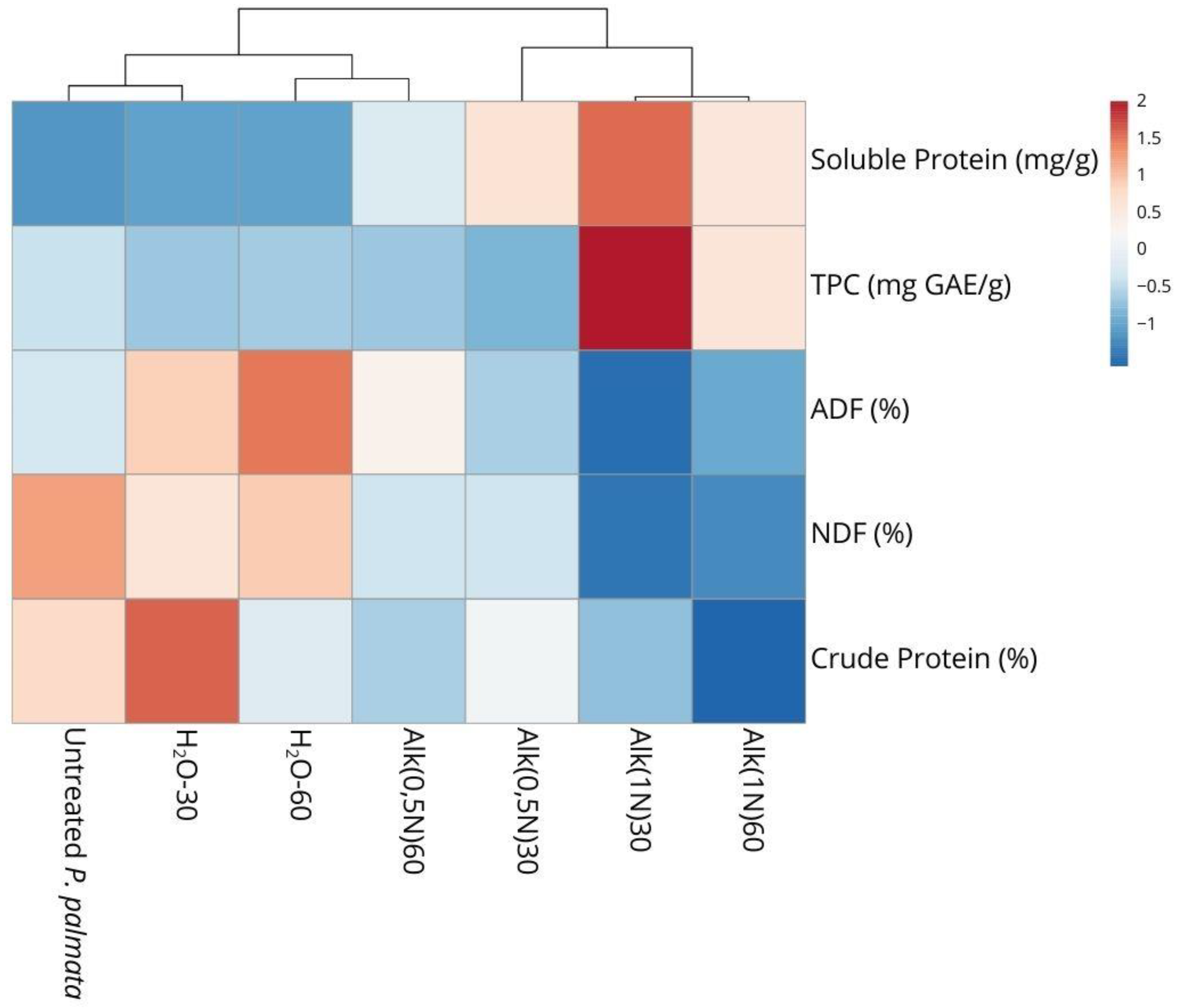
The heatmap analysis of the effects of water and alkaline treatments on the proximate composition of P. palmata revealed two major sample clusters (Figure 1). The first cluster was divided into two subclusters. The first subcluster grouped the untreated P. palmata and the H2O-30 treatment, showing minimal changes in proximate composition. The second subcluster included the H2O-60 treatment and the Alk(0.5N)60 treatment, which showed a slight increase in soluble protein and Folin–Ciocalteu total phenolic content (GAE) and a reduction in ADF and NDF contents. The second major cluster comprised samples subjected to alkaline treatments, which exhibited more pronounced compositional changes. This cluster was also divided into two subclusters: the first comprised the Alk(0.5N)30 treatment, which showed intermediate changes, and the second grouped the most intensive alkaline treatments (Alk(1N)30 and Alk(1N)60), which led to the most significant alterations, including a marked increase in soluble protein and Folin–Ciocalteu total phenolic content (GAE) and a substantial decrease in ADF and NDF levels.
The high-solids loading water and alkaline (1N) autoclaving (30 min) treatments were selected for sequential hydrolysis with NAT, and the proximate composition of P. palmata submitted to these treatments is presented in Table 2. Enzymatic hydrolysis did not promote further changes in the measured parameters, except for an increase in Folin–Ciocalteu total phenolic content (GAE) with the 0.4 NAT treatments.
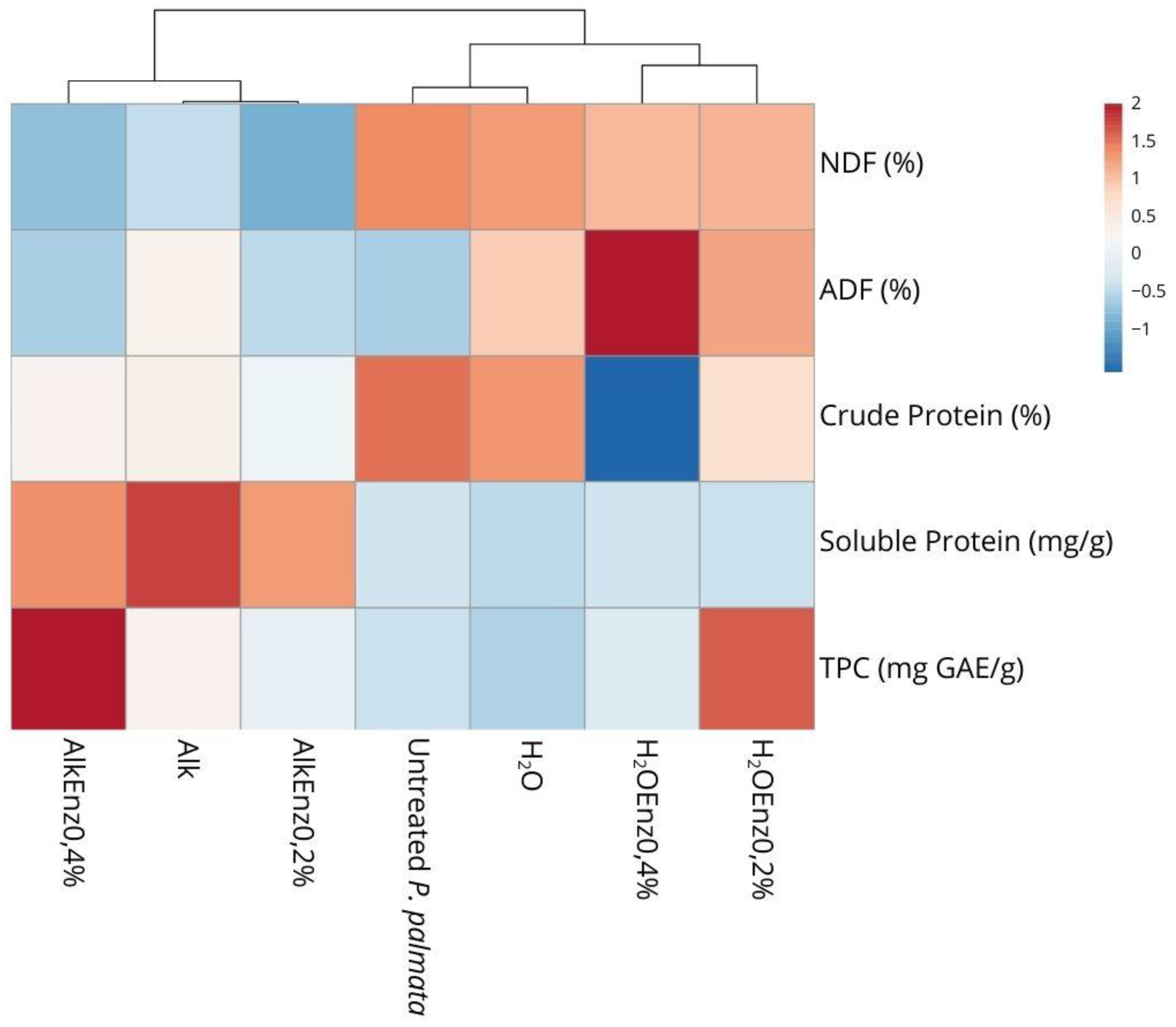
The heatmap analysis divided the treatments into two clusters. The first cluster is divided into two subclusters (Figure 2). The first subcluster grouped untreated P. palmata and the water treatment, indicating that autoclaving with water had a minimal impact on the composition of P. palmata. The second subcluster grouped water treatments followed by enzymatic hydrolysis (H2OEnz0.2% and H2OEnz0.4%). H2OEnz0.2% showed a slight increase in ADF and reduced crude protein, while H2OEnz0.4% exhibited a more pronounced decrease in crude protein and increased Folin–Ciocalteu total phenolic content (GAE). The second cluster grouped the alkaline-treated treatments (Alk, AlkEnz0.2%, and AlkEnz0.4%) and is further divided into two subclusters. The first subcluster includes Alk and AlkEnz0.2%, which exhibited a substantial reduction in NDF and crude protein, accompanied by an increase in soluble protein. The second subcluster consists of AlkEnz0.4%, which differs from the other alkaline treatments due to its significantly higher Folin–Ciocalteu total phenolic content (GAE).
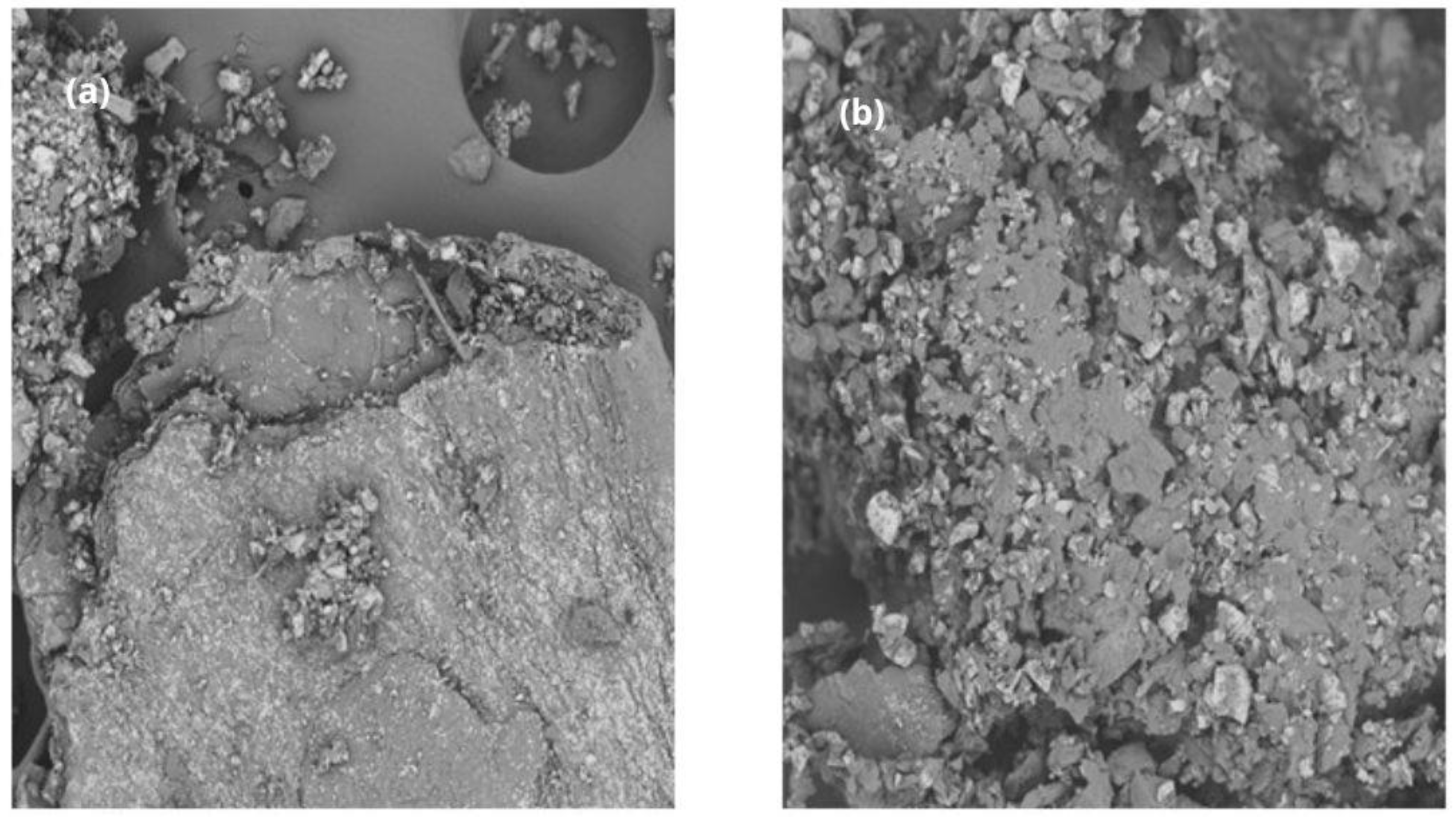
The surface structure of untreated P. palmata and following Alk(1N)30 treatment is presented in Figure 3. The untreated P. palmata exhibited a thoroughly coated surface with visible salts and displayed a highly uneven structure (Figure 3a). Following Alk(1N)30 treatment, the P. palmata surface showed several cracks, albeit with a relatively mild presence (Figure 3b).

4. Discussion

The increasing demand for low-carbon-footprint ingredients for livestock feed has increased the interest in macroalgae as a sustainable feed ingredient. Macroalgae are rich in several bioactive compounds, making them a promising ingredient for producing new diets aligned with the total nutrition concept, which integrates animal growth requirements, disease resistance, overall health maintenance, and a reduced environmental footprint. However, the large-scale incorporation of macroalgae into animal feed remains challenging, particularly due to their high content of indigestible complex carbohydrates [38,39,40,41,42]. In non-ruminant animals, high dietary levels of these complex carbohydrates have been associated with reduced feed digestibility [43]. Therefore, processing strategies to hydrolyze structural macromolecules and alter macroalgal cell wall structure are considered essential for improving their suitability as feed ingredients, particularly by enhancing the accessibility and extractability of intracellular components [6]. P. palmata has a complex cell wall composed of cellulose, glucomannan, and hemicellulose compounds, including sulfated glucan (carrageenan and agar) and xylogalactan [44]. Various treatments have been applied to macroalgae to extract proteins and bioactive compounds and to produce agar and biofuels [45,46]. However, many of these treatments involve high energy and solvent consumption, raising concerns about their environmental impact and cost-effectiveness.
Hydrothermal treatment is commonly used for extracting sulfated galactans (agar and carrageenans) from the cell walls of red macroalgae due to its simplicity and the high water solubility of these compounds at high temperatures [47]. In the present study, high-solids loading autoclaving with water alone resulted in limited structural disruption of P. palmata, as evidenced by minor microscopic structure and solubilization of water-soluble fiber. Compared with untreated P. palmata, water autoclaving resulted in a 14% decrease in NDF and a 6.9% increase in crude protein content, while ADF content increased, indicating limited solubilization of the acid detergent fiber fraction. This apparent increase in ADF may be attributed to carrageenan aggregation into a gel-like structure during hot-water treatment, which can restrict water penetration and hinder hydrolysis during detergent fiber analysis [14,48]. Moreover, regardless of the solvent used, longer autoclaving times resulted in higher apparent NDF and ADF values, indicating a time-dependent effect. These results may be related to increased viscosity and gel network development of sulfated galactans under high-solids (limited free-water) conditions, which can reduce extractability cooling [49]. In macroalgae, viscosity has been reported to increase with longer hot-treatment time [49]. For P. palmata, higher viscosities have also been reported at 50 °C and 90 °C compared with 70 °C, and after 60 min compared with 30 min of extraction [27].
The relatively low efficiency of the hydrothermal treatment of P. palmata was likely due to the limited availability of free water. When higher water-to-solid ratios were used (1:50), higher solubilization was achieved, although protein recovery was always relatively low. Indeed, water extracts of P. palmata, prepared at a ratio of 1:50 (g/mL) and subjected to temperatures of 50, 70, and 90 °C for 15, 30, or 60 min, showed a low protein content but a high carbohydrate content [27]. Similarly, the hydrolysis of P. palmata using a solid-to-liquid ratio of 1:50 and autoclaving at 124 °C for two 15 min cycles demonstrated a moderate yield of protein and a high carbohydrate content [45]. In contrast, boiling dried P. palmata for 15–30 min significantly increased protein bioaccessibility without affecting the amino acid profile, resulting in higher levels of available essential amino acids [25]. Furthermore, hydrothermal pretreatment of Porphyra umbilicalis by autoclaving using a solid-to-liquid ratio of 1:10 (w/v) in reverse osmosis water effectively hydrolyzed the biomass, leading to the release of 3.6–4.6 g/L of total sugars in the hydrolysate [50].
Although water hydrolysis is considered a more eco-friendly and cost-effective process, alkaline hydrolysis under low-solid loading conditions has proven to be more efficient in breaking down structural polysaccharides, promoting fiber degradation, and releasing bioactive compounds [50,51]. In particular, alkaline treatments are more effective for carrageenan hydrolysis, resulting in higher carrageenan yields and selectively removing components with lower gel strength compared to water-based methods [52]. In the present study, alkaline treatments under high-solids loading conditions significantly reduced the NDF and ADF contents, indicating an enhanced disruption of structural polysaccharides despite the presence of minimal free water. Scanning electron microscopy analysis revealed structural changes consistent with the reductions in cell wall disintegration. Similar morphological changes have been reported in other macroalgal species. For example, scanning electron microscopy images of alkaline-pretreated Laminaria digitata (Phaeophyceae), Ulva linza (Chlorophyta), or Porphyra umbilicalis (Rhodophyta) (1.25 N NaOH; 1:10 solid/liquid) also confirmed the disruption of the morphology of all these macroalgae, converting them into an amorphous biomass [27]. Additionally, scanning electron microscopy images of cellulose extracts from Ulva lactuca (Chlorophyta) revealed larger cellulose aggregations in the untreated samples, whereas the alkali-treated samples showed smoother surfaces with smaller nanocellulose particles [53].
Scanning electron microscopy of untreated P. palmata revealed a surface with visible salt deposits, consistent with the use of unwashed biomass. Macroalgae typically contain high mineral levels, including sodium, potassium, and chloride, and this inorganic fraction can constrain feed formulation, potentially affecting the performance and health of terrestrial animals [54]. In aquafeeds, the inclusion of macroalgae has been widely studied, and the replacement of fishmeal with up to 15% is generally well accepted by fish, although this may be higher in some species [10]. Therefore, quantification of ash and mineral content is an important next step when evaluating high-solids alkaline processing for aquafeed applications.
The disruption of structural polysaccharides is crucial for releasing cell walls and intracellular components, mainly proteins and bioactive compounds. In the present study, a significant increase in soluble protein and a decrease in crude protein content of P. palmata were observed after alkaline treatments, which were more effective with a stronger NaOH concentration (1N) and longer treatment times, reflecting enhanced protein extractability rather than an increase in total protein content. Similarly, increasing NaOH concentration for milled oven-dried P. palmata or Saccharina latissima (Phaeophyceae) also increased protein yield [18]. Also, for S. latissima, it was observed that protein yield and protein solubility were higher when extracted at alkaline (NaOH, 1N) compared to the control method at neutral pH [55]. Nevertheless, excessive exposure to alkalis can negatively affect the protein structure and functionality [56].
Polyphenols are secondary metabolites with antioxidant, antimicrobial, and anti-inflammatory properties, and they have attracted interest in animal nutrition as functional feed components due to their potential effects on oxidative status, gut function, and performance [57]. Phenolic composition varies considerably depending on macroalgae species, chemical nature, storage conditions, and the presence of interfering substances [58]. The macroalgal cell wall matrix can limit the extractability and accessibility of these compounds. Therefore, different mechanical, physical, chemical, thermal, and enzymatic treatments have been reported to facilitate cell wall disruption, thereby improving the extraction and accessibility of total phenolic compounds [59]. In the present study, alkaline hydrolysis (1N NaOH) promoted the highest release of total phenolic content, as estimated by the Folin–Ciocalteu assay and expressed as gallic acid equivalents (GAE), in P. palmata. Because the Folin–Ciocalteu assay is not specific to phenolic compounds and responds to a range of reducing substances, the observed increases in total phenolic content are interpreted as changes in extractable phenolic-related compounds and overall reducing capacity rather than definitive evidence of increased individual polyphenols [60]. Similar trends have been reported for Kappaphycus alvarezii and Eucheuma denticulatum (Rhodophyta), where alkaline hydrolysis increased the release of total phenolic compounds [61]. Previously, aqueous extraction of P. palmata under different pH conditions (3, 6, and 9) showed that phenolic compounds were predominantly present in the liquid fraction, with alkaline extraction yielding the highest release of total phenolic compounds [62]. Although antioxidant activity was not directly measured in the present study, increases in phenolic compounds and reducing capacity have been associated with antioxidant potential in macroalgal ingredients, which may contribute to oxidative stress resilience and immune support in terrestrial animals [57] and fish [63].
Combining alkaline and enzymatic treatments is expected to promote macroalgal cell wall hydrolysis more efficiently. Specific enzymes targeting macroalgal polysaccharides are not yet available at a commercial stage; therefore, nonspecific enzymes, such as cellulases, hemicellulases, β-glucanases, and xylanases, which target the complex polysaccharide structures of macroalgae, have been used individually or as part of a multi-enzyme cocktail [64]. Previously, it was observed in P. palmata that protein extraction yield was higher with enzyme-assisted alkaline extraction [18,65,66]. For instance, studies employing Shearzyme® (a xylanase-based complex) in low-solid loading hydrolysis achieved a high protein extraction [67,68]. Similarly, enzymatic saccharification of P. palmata using Viscozyme® L, an enzyme complex including arabinase, cellulase, β-glucanase, hemicellulase, and xylanase, at low-solid loading hydrolysis also promoted the amount of extractable protein and total fatty acids [69]. Additionally, hydrolysis of P. palmata with an endo- and exo-peptidase complex (Umamizyme; 100 mg enzyme) at a low-solid loading also increased the total phenolic extract [70].
In the present work, water- or alkali-pretreated P. palmata was enzymatically hydrolyzed using a high-solids loading hydrolysis ratio and an enzymatic complex that included endo-1,4-β-xylanase and endo-1,4-β-glucanase, selected based on the carbohydrate profile of P. palmata, which is composed of xylose (57%; including mixed-linked xylans, xylogalactans, and acid xylomannans) and galactose (22%) [71]. Contrary to what was observed in the low-solids hydrolysis, the enzymatic treatment in this study did not significantly affect the contents of NDF, ADF, crude protein, or soluble protein. However, Folin–Ciocalteu total phenolic content (GAE) release increased at the highest enzyme concentration. Although a xylanase-rich enzymatic complex was used, the degree of hydrolysis of P. palmata was lower than in previous studies employing xylanase-based enzymatic treatments. For example, alkaline pretreated P. palmata hydrolyzed with four enzymes (Celluclast® 1.5 L, Shearzyme® 500 L, Alcalase® 2.4 L FG, and Viscozyme® L) at 0.2% and 0.4% (w/w) using a 1:20 solid-to-liquid ratio showed that Shearzyme® (a xylanase-based complex) achieved the highest protein extraction [65]. In another study, the combination of cellulase (Celluclast®) and xylanase (Shearzyme®) at 24 U (24 U of cellulose and 24 U of xylanase) and a 1:6 solid-to-liquid ratio resulted in higher P. palmata protein extraction than the control (0 U) or lower enzyme concentration (12 U) [67]. Similarly, enzymatic saccharification of P. palmata using Viscozyme® L at a 5:100 solid-to-liquid ratio resulted in twice the amount of extractable protein and total fatty acids [68]. Additionally, hydrolysis of P. palmata with an endo- and exo-peptidase complex (Umamizyme; 100 mg enzyme) at a 1:25 solid-to-liquid ratio increased total phenolics from approximately 2.5 to 15.5 g GAE/kg extract [69]. Moreover, enzymatic pretreatment with xylanase and cellulase (from Trichoderma longibrachiatum), applied at 10, 50, or 100 U, further enhanced amino acid release, leading to a three-fold increase in extractable amino acids, and its combination with alkaline extraction resulted in higher protein recovery compared to conventional alkaline extraction [25]. The lower hydrolysis efficiency observed in the present study may be attributed to the high-solids loading in enzymatic hydrolysis. Indeed, enzymatic efficiency is influenced by substrate concentration and structure and composition of the macroalgal cell wall, enzyme–substrate interactions, and pretreatment conditions [71]. A limitation in macroalgal biomass processing is the use of commercial enzymes, which were initially designed for terrestrial biomass, that significantly differ in composition from macroalgae in their carbohydrate content [49]. Since macroalgae-specific enzymes are not yet commercially available, it is crucial to identify the specific enzyme activities present in these commercial mixtures and tailor their application to the unique carbohydrate composition of macroalgae [72]. Further studies are therefore required to optimize hydrolysis parameters, such as enzyme concentration and substrate ratio, and clarify the mechanisms of macroalgae cell wall degradation as influenced by different enzyme combinations and ratios.

5. Conclusions

In summary, high-solids loading alkaline autoclaving hydrolysis, especially with 1 N NaOH, resulted in the most significant reductions in NDF, ADF, and crude protein content, while increasing soluble and Folin–Ciocalteu total phenolic content (GAE), indicating an increase in these compounds. Sequential enzymatic hydrolysis, with 0.4% Natugrain® TS-Feed Enzyme, BASF, did not further reduce fiber and protein content but increased Folin–Ciocalteu total phenolic content (GAE). These results suggest that high-solids loading alkaline autoclave treatment is a promising approach for cell wall disruption in P. palmata; however, further optimization of the process is required in subsequent studies.

Author Contributions

Conceptualization, H.P., A.O.-T. and I.B.; methodology, C.R.-O.; validation, H.P., A.O.-T. and I.B.; formal analysis, C.R.-O. and M.F.; investigation, C.R.-O.; resources, H.P.; data curation, C.R.-O.; writing—original draft preparation, C.R.-O.; writing—review and editing, C.R.-O., H.P., A.O.-T. and I.B.; supervision, H.P., A.O.-T. and I.B.; project administration, H.P.; funding acquisition, H.P. All authors have read and agreed to the published version of the manuscript.

Funding

This work was supported by the project “MB4Aqua: Macroalgae biorefinery: a novel approach to produce sustainable feedstuffs and functional additives towards low carbon footprint aquafeeds” (reference 2022.06587.PTDC; DOI:10.54499/CEECINST/00064/2021/CP2812/CT0001), funded by Fundação para a Ciência e Tecnologia (FCT). Ramos-Oliveira Catarina and Ferreira Marta were supported by FCT grants (references 2021.04809.BD and SFRH/BD/143614/2019, respectively).

Institutional Review Board Statement

Not applicable.

Informed Consent Statement

Not applicable.

Data Availability Statement

The original contributions presented in this study are included in the article. Further inquiries can be directed to the corresponding author.

Acknowledgments

The authors would like to express their gratitude to the Laboratory of Animal Science at the Department of Veterinary Clinics, ICBAS-UP, for their invaluable assistance in conducting some analyses used in this study.

Conflicts of Interest

The funders had no role in the design of the study, in the collection, analysis, or interpretation of data, in the writing of the manuscript, or in the decision to publish the results.

Abbreviations

The following abbreviations are used in this manuscript:
NaOHSodium hydroxide
NATNatugrain® TS-Feed Enzyme from BASF
H2OWater-autoclaved
AlkAlkaline autoclaved
H2OEnzWater-enzymatic autoclaved
AlkEnzAlkaline-enzymatic autoclaved
ADFAcid detergent fiber
NDFNeutral detergent fiber
GAEGallic acid equivalents

References

  1. Ishaq, M.; Dincer, I. Development of a novel renewable energy-based integrated system coupling biomass and H2S sources for clean hydrogen production. Renew. Energy 2024, 237, 121642. [Google Scholar] [CrossRef]
  2. Kammler, S.; Romero, A.M.; Burkhardt, C.; Baruth, L.; Antranikian, G.; Liese, A.; Kaltschmitt, M. Macroalgae valorization for the production of polymers, chemicals, and energy. Biomass Bioenergy 2024, 183, 107105. [Google Scholar] [CrossRef]
  3. Corsetto, P.A.; Montorfano, G.; Zava, S.; Colombo, I.; Ingadottir, B.; Jonsdottir, R.; Sveinsdottir, K.; Rizzo, A.M. Characterization of Antioxidant Potential of Seaweed Extracts for Enrichment of Convenience Food. Antioxidants 2020, 9, 249. [Google Scholar] [CrossRef]
  4. Godvin Sharmila, V.; Dinesh Kumar, M.; Pugazhendi, A.; Bajhaiya, A.K.; Gugulothu, P.; Rajesh Banu, J. Biofuel production from Macroalgae: Present scenario and future scope. Bioengineered 2021, 12, 9216–9238. [Google Scholar] [CrossRef]
  5. Madkour, M.; Matter, I.A.; Abdelhady, A.R.Y.; Alaqaly, A.M.; El-Azeem, N.A.A.; Elsharkawy, M. Use of macro- and microalgae in animal nutrition. In Organic Feed Additives for Livestock; Alagawany, M., Sallam, S.M., El-Hack, M.E.A., Eds.; Academic Press: Freiburg, Switzerland, 2025; pp. 107–125. [Google Scholar] [CrossRef]
  6. Martins, A.; Alves, C.; Silva, J.; Pinteus, S.; Gaspar, H.; Pedrosa, R. Sulfated Polysaccharides from Macroalgae—A Simple Roadmap for Chemical Characterization. Polymers 2023, 15, 399. [Google Scholar] [CrossRef]
  7. Li, R.; Xing, R.; Li, H.; Ren, J.; Chen, L.; Yu, Z.; Zhang, H.; Wu, W.; Li, C.; Zhu, L.; et al. From Terrestrial Plants to Marine Macroalgae: A Comprehensive Review of Cell Wall Component-Properties, Extraction, Modification, and Application of Algal Cellulose. J. Agric. Food Chem. 2025, 75, 23759–23782. [Google Scholar] [CrossRef]
  8. Naiel, M.A.; Alagawany, M.; Patra, A.K.; El-Kholy, A.I.; Amer, M.S.; El-Hack, M.E.A. Beneficial impacts and health benefits of macroalgae phenolic molecules on fish production. Aquaculture 2021, 534, 736186. [Google Scholar] [CrossRef]
  9. Øverland, M.; Mydland, L.T.; Skrede, A. Marine macroalgae as sources of protein and bioactive compounds in feed for monogastric animals. J. Sci. Food Agric. 2018, 99, 13–24. [Google Scholar] [CrossRef] [PubMed]
  10. Hughes, A.D.; Twigg, G.C.; Msuya, F.E.; Padmakumar, K.P.; Tocher, D.R. The use of macroalgae in feeds for finfish aquaculture. Front. Aquac. 2025, 4, 1570842. [Google Scholar] [CrossRef]
  11. Ferreira, M.; Salgado, J.M.; Fernandes, H.; Peres, H.; Belo, I. Potential of Red, Green and Brown Seaweeds as Substrates for Solid State Fermentation to Increase Their Nutritional Value and to Produce Enzymes. Foods 2022, 11, 3864. [Google Scholar] [CrossRef]
  12. Krogdahl, Å.; Jaramillo-Torres, A.; Ahlstrøm, Ø.; Chikwati, E.; Aasen, I.-M.; Kortner, T.M. Protein value and health aspects of the seaweeds Saccharina latissima and Palmaria palmata evaluated with mink as model for monogastric animals. Anim. Feed. Sci. Technol. 2021, 276, 114902. [Google Scholar] [CrossRef]
  13. Stévant, P.; Schmedes, P.S.; Le Gall, L.; Wegeberg, S.; Dumay, J.; Rebours, C. Concise review of the red macroalga dulse, Palmaria palmata (L.) Weber & Mohr. J. Appl. Phycol. 2023, 35, 523–550. [Google Scholar] [CrossRef]
  14. Jönsson, M.; Allahgholi, L.; Sardari, R.R.; Hreggviðsson, G.O.; Karlsson, E.N. Extraction and modification of macroalgal polysaccharides for current and next-generation applications. Molecules 2020, 25, 930. [Google Scholar] [CrossRef]
  15. Charoensiddhi, S.; Lorbeer, A.J.; Lahnstein, J.; Bulone, V.; Franco, C.M.; Zhang, W. Enzyme-assisted extraction of carbohydrates from the brown alga Ecklonia radiata: Effect of enzyme type, pH and buffer on sugar yield and molecular weight profiles. Process. Biochem. 2016, 51, 1503–1510. [Google Scholar] [CrossRef]
  16. Kumar, A.K.; Sharma, S. Recent updates on different methods of pretreatment of lignocellulosic feedstocks: A review. Bioresour. Bioprocess. 2017, 4, 1–19. [Google Scholar] [CrossRef] [PubMed]
  17. Karray, R.; Hamza, M.; Sayadi, S. Evaluation of ultrasonic, acid, thermo-alkaline and enzymatic pre-treatments on anaerobic digestion of Ulva rigida for biogas production. Bioresour. Technol. 2015, 187, 205–213. [Google Scholar] [CrossRef]
  18. Harnedy, P.A.; FitzGerald, R.J. Extraction of protein from the macroalga Palmaria palmata. LWT—Food. Sci. Technol. 2013, 51, 375–382. [Google Scholar] [CrossRef]
  19. Olatunji, K.O.; Madyira, D.M.; Amos, J.O. Sustainable enhancement of biogas and methane yield of macroalgae biomass using different pretreatment techniques: A mini-review. Energy Environ. 2023, 35, 1050–1088. [Google Scholar] [CrossRef]
  20. Farghali, M.; AP, Y.; Mohamed, I.M.; Iwasaki, M.; Tangtaweewipat, S.; Ihara, I.; Sakai, R.; Umetsu, K. Thermophilic anaerobic digestion of Sargassum fulvellum macroalgae: Biomass valorization and biogas optimization under different pre-treatment conditions. J. Environ. Chem. Eng. 2021, 9, 106405. [Google Scholar] [CrossRef]
  21. He, Y.; Pang, Y.; Liu, Y.; Li, X.; Wang, K. Physicochemical characterization of rice straw pretreated with sodium hydroxide in the solid state for enhancing biogas production. Energy Fuels 2008, 22, 2775–2781. [Google Scholar] [CrossRef]
  22. Mazur, L.P.; Cechinel, M.A.; de Souza, S.M.U.; Boaventura, R.A.; Vilar, V.J. Brown marine macroalgae as natural cation exchangers for toxic metal removal from industrial wastewaters: A review. J. Environ. Manag. 2018, 223, 215–253. [Google Scholar] [CrossRef] [PubMed]
  23. Dwivedi, S.; Vats, T. Remediation of Dye Containing Wastewater Using Viable Algal Biomass. In Green Materials for Sustainable Water Remediation and Treatment; Mishra, A., Clark, J.H., Eds.; RSC Publishing: Cambridge, UK, 2013; pp. 212–228. [Google Scholar] [CrossRef]
  24. Idowu, A.T.; Amigo-Benavent, M.; FitzGerald, R. Impact of alkaline solution, carbohydrase and biomass:solvent on extraction efficiency, and protein and amino acid profiles of Palmaria palmata protein extracts. Food Bioprod. Process. 2024, 148, 285–297. [Google Scholar] [CrossRef]
  25. Mæhre, H.K.; Jensen, I.-J.; Eilertsen, K.-E. Enzymatic Pre-Treatment Increases the Protein Bioaccessibility and Extractability in Dulse (Palmaria palmata). Mar. Drugs 2016, 14, 196. [Google Scholar] [CrossRef] [PubMed]
  26. Maehre, H.K.; Edvinsen, G.K.; Eilertsen, K.-E.; Elvevoll, E.O. Heat treatment increases the protein bioaccessibility in the red seaweed dulse (Palmaria palmata), but not in the brown seaweed winged kelp (Alaria esculenta). J. Appl. Phycol. 2015, 28, 581–590. [Google Scholar] [CrossRef]
  27. Lafeuille, B.; Francezon, N.; Goulet, C.; Perreault, V.; Turgeon, S.L.; Beaulieu, L. Impact of temperature and cooking time on the physicochemical properties and sensory potential of seaweed water extracts of Palmaria palmata and Saccharina longicruris. J. Appl. Phycol. 2022, 34, 1731–1747. [Google Scholar] [CrossRef]
  28. Quitério, E.; Grosso, C.; Ferraz, R.; Delerue-Matos, C.; Soares, C. A Critical Comparison of the Advanced Extraction Techniques Applied to Obtain Health-Promoting Compounds from Seaweeds. Mar. Drugs 2022, 20, 677. [Google Scholar] [CrossRef]
  29. Arias, A.; Feijoo, G.; Moreira, M.T. Macroalgae biorefineries as a sustainable resource in the extraction of value-added compounds. Algal Res. 2022, 69, 102954. [Google Scholar] [CrossRef]
  30. Ghadiryanfar, M.; Rosentrater, K.A.; Keyhani, A.; Omid, M. A review of macroalgae production, with potential applications in biofuels and bioenergy. Renew. Sustain. Energy Rev. 2016, 54, 473–481. [Google Scholar] [CrossRef]
  31. Shiva; Barba, F.C.; Rodríguez-Jasso, R.M.; Sukumaran, R.K.; Ruiz, H.A. High-solids loading processing for an integrated lignocellulosic biorefinery: Effects of transport phenomena and rheology—A review. Bioresour. Technol. 2022, 351, 127044. [Google Scholar] [CrossRef]
  32. Bhuvaneswari, H.B.; Reddy, N. A review on dielectric properties of biofiber-based composites. Adv. Compos. Hybrid Mater. 2018, 1, 635–648. [Google Scholar] [CrossRef]
  33. Ramos-Oliveira, C.; Ferreira, M.; Belo, I.; Oliva-Teles, A.; Peres, H. Effectiveness of High-Solid Loading Treatments to Enhance Nutrient and Antioxidant Bioavailability in Codium tomentosum. Phycology 2025, 5, 69. [Google Scholar] [CrossRef]
  34. Fernandes, H.; Castro, C.; Salgado, J.M.; Filipe, D.; Moyano, F.; Ferreira, P.; Oliva-Teles, A.; Belo, I.; Peres, H. Application of fermented brewer’s spent grain extract in plant-based diets for European seabass juveniles. Aquaculture 2022, 552, 738013. [Google Scholar] [CrossRef]
  35. Van Soest, P.J.; Robertson, J.B.; Lewis, B.A. Methods for Dietary Fiber, Neutral Detergent Fiber, and Nonstarch Polysaccharides in Relation to Animal Nutrition. J. Dairy Sci. 1991, 74, 3583–3597. [Google Scholar] [CrossRef]
  36. Bradford, M.M. A Rapid and Sensitive Method for the Quantitation of Microgram Quantities of Protein Utilizing the Principle of Protein-Dye Binding. Anal. Biochem. 1976, 72, 248–254. [Google Scholar] [CrossRef] [PubMed]
  37. Metsalu, T.; Vilo, J. ClustVis: A web tool for visualizing clustering of multivariate data using Principal Component Analysis and heatmap. Nucleic Acids Res. 2015, 43, W566–W570. [Google Scholar] [CrossRef] [PubMed]
  38. Kostas, E.T.; Adams, J.M.; Ruiz, H.A.; Durán-Jiménez, G.; Lye, G.J. Macroalgal biorefinery concepts for the circular bioeconomy: A review on biotechnological developments and future perspectives. Renew. Sustain. Energy Rev. 2021, 151, 111553. [Google Scholar] [CrossRef]
  39. Araújo, R.; Vázquez Calderón, F.; Sánchez López, J.; Azevedo, I.C.; Bruhn, A.; Fluch, S.; Garcia Tasende, M.; Ghaderiardakani, F.; Ilmjärv, T.; Laurans, M.; et al. Current Status of the Algae Production Industry in Europe: An Emerging Sector of the Blue Bioeconomy. Front. Mar. Sci. 2021, 7, 1247. [Google Scholar] [CrossRef]
  40. Fernand, F.; Israel, A.; Skjermo, J.; Wichard, T.; Timmermans, K.R.; Golberg, A. Offshore macroalgae biomass for bioenergy production: Environmental aspects, technological achievements and challenges. Renew. Sustain. Energy Rev. 2017, 75, 35–45. [Google Scholar] [CrossRef]
  41. Sadhukhan, J.; Gadkari, S.; Martinez-Hernandez, E.; Ng, K.S.; Shemfe, M.; Torres-Garcia, E.; Lynch, J. Novel macroalgae (seaweed) biorefinery systems for integrated chemical, protein, salt, nutrient and mineral extractions and environmental protection by green synthesis and life cycle sustainability assessments. Green Chem. 2019, 21, 2635–2655. [Google Scholar] [CrossRef]
  42. Afonso, N.C.; Catarino, M.D.; Silva, A.M.S.; Cardoso, S.M. Brown Macroalgae as Valuable Food Ingredients. Antioxidants 2019, 8, 365. [Google Scholar] [CrossRef]
  43. Mæhre, H.K.; Malde, M.K.; Eilertsen, K.-E.; Elvevoll, E.O. Characterization of protein, lipid and mineral contents in common Norwegian seaweeds and evaluation of their potential as food and feed. J. Sci. Food Agric. 2014, 94, 3281–3290. [Google Scholar] [CrossRef] [PubMed]
  44. Baghel, R.S.; Reddy, C.; Singh, R.P. Seaweed-based cellulose: Applications, and future perspectives. Carbohydr. Polym. 2021, 267, 118241. [Google Scholar] [CrossRef] [PubMed]
  45. Connor, J.O.; Meaney, S.; Williams, G.A.; Hayes, M. Extraction of Protein from Four Different Seaweeds Using Three Different Physical Pre-Treatment Strategies. Molecules 2020, 25, 2005. [Google Scholar] [CrossRef]
  46. Lemus, A.; Bird, K.; Kapraun, D.F.; Koehn, F. Agar yield, quality and standing crop biomass of Gelidium serrulatum, Gelidium floridanum and Pterocladia capillacea in Venezuela. Food Hydrocoll. 1991, 5, 469–479. [Google Scholar] [CrossRef]
  47. Ruiz, H.A.; Rodríguez-Jasso, R.M.; Fernandes, B.D.; Vicente, A.A.; Teixeira, J.A. Hydrothermal processing, as an alternative for upgrading agriculture residues and marine biomass according to the biorefinery concept: A review. Renew. Sustain. Energy Rev. 2013, 21, 35–51. [Google Scholar] [CrossRef]
  48. Yun, E.J.; Kim, H.T.; Cho, K.M.; Yu, S.; Kim, S.; Choi, I.-G.; Kim, K.H. Pretreatment and saccharification of red macroalgae to produce fermentable sugars. Bioresour. Technol. 2016, 199, 311–318. [Google Scholar] [CrossRef]
  49. Vinagre, F.; Alegria, M.J.; Ferreira, A.S.; Nunes, C.; Nunes, M.C.; Raymundo, A. Characterization and Gelling Potential of Macroalgae Extracts Obtained Through Eco-Friendly Technologies for Food-Grade Gelled Matrices. Gels 2025, 11, 290. [Google Scholar] [CrossRef]
  50. Greetham, D.; Adams, J.M.; Du, C. The utilization of seawater for the hydrolysis of macroalgae and subsequent bioethanol fermentation. Sci. Rep. 2020, 10, 9728. [Google Scholar] [CrossRef]
  51. Wang, X.; Xie, S.; Chen, W.; Ni, X.; Xu, W.; Luo, Q.; Chen, H. Distribution and biodiversity of benthic macroalgae in the Nanji Islands, China. Front. Mar. Sci. 2025, 12, 1563252. [Google Scholar] [CrossRef]
  52. Bhavsar, P.; Zoccola, M.; Patrucco, A.; Montarsolo, A.; Rovero, G.; Tonin, C. Comparative study on the effects of superheated water and high temperature alkaline hydrolysis on wool keratin. Text. Res. J. 2016, 87, 1696–1705. [Google Scholar] [CrossRef]
  53. Ceaser, R.; Bedzo, O.K.K.; Donkor, K.O. Biorefinery approach to producing polysaccharides from seaweed: A focus on hydrocolloids and nanocellulose. Biomass Convers. Biorefinery 2025, 15, 31393–31415. [Google Scholar] [CrossRef]
  54. Bikker, P.; van Krimpen, M.M.; van Wikselaar, P.; Houweling-Tan, B.; Scaccia, N.; van Hal, J.W.; Huijgen, W.J.J.; Cone, J.W.; López-Contreras, A.M. Biorefinery of the green seaweed Ulva lactuca to produce animal feed, chemicals and biofuels. J. Appl. Phycol. 2016, 28, 3511–3525. [Google Scholar] [CrossRef] [PubMed]
  55. Juul, L.; Haue, S.K.; Bruhn, A.; Boderskov, T.; Dalsgaard, T.K. Alkaline pH increases protein extraction yield and solubility of the extracted protein from sugar kelp (Saccharina latissima). Food Bioprod. Process. 2023, 140, 144–150. [Google Scholar] [CrossRef]
  56. Gomaa, M.; Al-Badaani, A.A.; Hifney, A.F.; Adam, M.S. Industrial optimization of alkaline and bleaching conditions for cellulose extraction from the marine seaweed Ulva lactuca. J. Appl. Phycol. 2021, 33, 4093–4103. [Google Scholar] [CrossRef]
  57. Formato, M.; Cimmino, G.; Brahmi-Chendouh, N.; Piccolella, S.; Pacifico, S. Polyphenols for Livestock Feed: Sustainable Perspectives for Animal Husbandry? Molecules 2022, 27, 7752. [Google Scholar] [CrossRef]
  58. Suwal, S.; Marciniak, A. Technologies for the Extraction, Separation and Purification of polyphenols—A Review. Nepal J. Biotechnol. 2019, 6, 74–91. [Google Scholar] [CrossRef]
  59. Carpena, M.; Garcia-Perez, P.; Garcia-Oliveira, P.; Chamorro, F.; Otero, P.; Lourenço-Lopes, C.; Cao, H.; Simal-Gandara, J.; Prieto, M.A. Biological properties and potential of compounds extracted from red seaweeds. Phytochem. Rev. 2022, 22, 1509–1540. [Google Scholar] [CrossRef]
  60. Torres, P.; Osaki, S.; Silveira, E.; dos Santos, D.Y.; Chow, F. Comprehensive evaluation of Folin-Ciocalteu assay for total phenolic quantification in algae (Chlorophyta, Phaeophyceae, and Rhodophyta). Algal Res. 2024, 80, 103503. [Google Scholar] [CrossRef]
  61. Nallasivam, J.; Prashanth, P.F.; Harisankar, S.; Nori, S.; Suryanarayan, S.; Chakravarthy, S.; Vinu, R. Valorization of red macroalgae biomass via hydrothermal liquefaction using homogeneous catalysts. Bioresour. Technol. 2022, 346, 126515. [Google Scholar] [CrossRef]
  62. Ghelichi, S.; Sørensen, A.-D.M.; Náthia-Neves, G.; Jacobsen, C. pH-Dependent Extraction of Antioxidant Peptides from Red Seaweed Palmaria palmata: A Sequential Approach. Mar. Drugs 2024, 22, 413. [Google Scholar] [CrossRef]
  63. Hu, X.; Ma, W.; Zhang, D.; Tian, Z.; Yang, Y.; Huang, Y.; Hong, Y. Application of Natural Antioxidants as Feed Additives in Aquaculture: A Review. Biology 2025, 14, 87. [Google Scholar] [CrossRef]
  64. Echave, J.; Fraga-Corral, M.; Garcia-Perez, P.; Popović-Djordjević, J.; Avdović, E.H.; Radulović, M.; Xiao, J.; Prieto, M.A.; Simal-Gandara, J. Seaweed Protein Hydrolysates and Bioactive Peptides: Extraction, Purification, and Applications. Mar. Drugs 2021, 19, 500. [Google Scholar] [CrossRef] [PubMed]
  65. Naseri, A.; Marinho, G.S.; Holdt, S.L.; Bartela, J.M.; Jacobsen, C. Enzyme-assisted extraction and characterization of protein from red seaweed Palmaria palmata. Algal. Res. 2020, 47, 101849. [Google Scholar] [CrossRef]
  66. Aasen, I.M.; Sandbakken, I.S.; Toldnes, B.; Roleda, M.Y.; Slizyte, R. Enrichment of the protein content of the macroalgae Saccharina latissima and Palmaria palmata. Algal. Res. 2022, 65, 102727. [Google Scholar] [CrossRef]
  67. Joubert, Y.; Fleurence, J. Simultaneous extraction of proteins and DNA by an enzymatic treatment of the cell wall of Palmaria palmata (Rhodophyta). J. Appl. Phycol. 2008, 20, 55–61. [Google Scholar] [CrossRef]
  68. Schiener, P.; Zhao, S.; Theodoridou, K.; Carey, M.; Mooney-McAuley, K.; Greenwell, C. The nutritional aspects of biorefined Saccharina latissima, Ascophyllum nodosum and Palmaria palmata. Biomass Convers. Biorefinery 2016, 7, 221–235. [Google Scholar] [CrossRef]
  69. Wang, T.; Jónsdóttir, R.; Kristinsson, H.G.; Hreggvidsson, G.O.; Jónsson, J.Ó.; Thorkelsson, G.; Ólafsdóttir, G. Enzyme-enhanced extraction of antioxidant ingredients from red algae Palmaria palmata. LWT 2010, 43, 1387–1393. [Google Scholar] [CrossRef]
  70. Nova, P.; Pimenta-Martins, A.; Maricato, É.; Nunes, C.; Abreu, H.; Coimbra, M.A.; Freitas, A.C.; Gomes, A.M. Chemical Composition and Antioxidant Potential of Five Algae Cultivated in Fully Controlled Closed Systems. Molecules 2023, 28, 4588. [Google Scholar] [CrossRef]
  71. Duncan, S.; Schilling, J. Carbohydrate-hydrolyzing enzyme ratios during fungal degradation of woody and non-woody lignocellulose substrates. Enzym. Microb. Technol. 2010, 47, 363–371. [Google Scholar] [CrossRef]
  72. Van Dyk, J.; Pletschke, B. A review of lignocellulose bioconversion using enzymatic hydrolysis and synergistic cooperation between enzymes—Factors affecting enzymes, conversion and synergy. Biotechnol. Adv. 2012, 30, 1458–1480. [Google Scholar] [CrossRef]
Figure 1. Heatmap of proximal composition (dry matter basis) of Palmaria palmata, either untreated or subjected to high-solids autoclave treatments with water, 0.5N NaOH, or 1N NaOH for 30 or 60 min (Alk(0.5N)30, Alk(1N)30, Alk(0.5N)60, Alk(1N)60). NDF: Neutral detergent fiber; ADF: Acid detergent fiber; TPC: Folin–Ciocalteu total phenolic content (mg gallic acid equivalents/g). Hierarchical clustering of samples is shown above the heatmap.
Phycology 06 00012 g001
Figure 2. Heatmap of proximal composition (dry matter basis) of untreated and pretreated Palmaria palmata (water or 1 N NaOH autoclave, 121 °C, 30 min), followed by sequential enzymatic hydrolysis with Natugrain® TS (treatments: Untreated, H2O, H2OEnz0.2%, H2OEnz0.4%, Alk, AlkEnz0.2%, AlkEnz0.4%). NDF: Neutral detergent fiber; ADF: Acid detergent fiber; TPC: Folin–Ciocalteu total phenolic content (mg gallic acid equivalents/g). Hierarchical clustering is shown above the heatmap.
Phycology 06 00012 g002
Figure 3. Scanning Electron Microscopy images (100 µm) of Palmaria palmata: (a) Untreated; (b) High-solids loading alkaline autoclaving treatment with 1N NaOH for 30 min (Alk(1N)30).
Phycology 06 00012 g003
Table 1. Proximate composition of untreated and treated Palmaria palmata following high-solids loading autoclave treatment with water or alkaline solutions (0.5N or 1N NaOH) for 30 or 60 min (expressed on a dry matter basis).
Sample IDAutoclave TimeSolventNDF
(%)
ADF
(%)
Crude
Protein
(%)
Soluble
Protein
(mg/g)
TPC
(mg GAE/g)
Untreated25.94.8815.93.660.97
H2O-3030 minH2O22.36.2817.03.900.89
Alk(0.5N)300.5N NaOH15.94.5014.96.880.83
Alk(1N)301N NaOH9.563.4513.68.551.72
H2O-6060 minH2O23.97.0114.53.880.89
Alk(0.5N)600.5N NaOH16.05.6413.85.370.88
Alk(1N)601N NaOH10.64.0612.36.701.30
SEM 3.550.700.911.080.25
Non-orthogonal contrast (p-values)
NDFADFCrude proteinSoluble
protein
TPC
Untreated vs. H2O-300.0000.0000.0150.6220.839
Untreated vs. H2O-600.0010.0000.0080.6220.761
Untreated vs. Alk(0.5N)300.0000.0790.0480.0000.685
Untreated vs. Alk(0.5N)600.0000.0060.0000.0050.839
Untreated vs. Alk(1N)300.0000.0000.0000.0000.043
Untreated vs. Alk(1N)600.0000.0040.0000.0000.318
Two-Way ANOVAVariable SourceSolvent
SolventTimeInteractionH2OAlk(0.5N)Alk(1N)
NDF****nscba
ADF******nscba
Crude
Protein
******nscba
Soluble
Protein
*****nsabc
TPC*nsnsabab
Values are expressed as means (n = 3) with pooled standard error of the mean (SEM). NDF: Neutral detergent fiber; ADF: Acid detergent fiber; TPC: Folin–Ciocalteu total phenolic content (mg gallic acid equivalents/g). Two-way ANOVA: ns: non-significant (p ≥ 0.05); * p < 0.05; ** p < 0.01; *** p <0.001. Different lowercase letters (a–c) indicate significant differences among treatments according to two-way ANOVA (p < 0.05); means sharing the same letter are not significantly different.
Table 2. Proximate composition of Palmaria palmata following high-solids loading autoclave pretreatments (121 °C, 30 min) with water or alkaline solution (NaOH, 1N), followed by sequential enzymatic hydrolysis using Natugrain® TS (dry matter basis).
Sample IDPre-
Treatment
PBS Enzyme ⬥⬥NDF
(%)
ADF
(%)
Crude
Protein (%)
Soluble
Protein (mg/g)
TPC
(mg GAE/g)
H2OH2OYes-25.16.9415.23.630.79
H2OEnz0.2%Yes0.2%23.68.4714.13.931.29
H2OEnz0.4%Yes0.4%23.87.3913.23.903.76
Alk1N NaOHYes-12.86.1912.111.11.93
AlkEnz0.2%Yes0.2%9.85.0311.29.401.53
AlkEnz0.4%yes0.4%10.74.9011.89.694.26
SEM 4.151.080.931.910.81
Two-way ANOVAVariable SourceEnzyme
Pre-
treatment
EnzymeInteraction00.2%0.4%
NDF***nsns---
ADF*nsns---
Crude Protein***nsns---
Soluble Protein***nsns---
TPCns***nsaab
Values are expressed as means (n = 3) with pooled standard error of the mean (SEM). Phosphate buffer included in all treatments at 1 mL/1 g (dry weight). ⬥⬥ Natugrain® TS-Feed Enzyme, BASF. NDF: Neutral detergent fiber; ADF: Acid detergent fiber; TPC: Folin–Ciocalteu total phenolic content (mg gallic acid equivalents/g). Two-way ANOVA: ns: non-significant (p ≥ 0.05); * p < 0.05; *** p < 0.001. Different lowercase letters (a,b) indicate significant differences among treatments according to two-way ANOVA (p < 0.05); means sharing the same letter are not significantly different.
Disclaimer/Publisher’s Note: The statements, opinions and data contained in all publications are solely those of the individual author(s) and contributor(s) and not of MDPI and/or the editor(s). MDPI and/or the editor(s) disclaim responsibility for any injury to people or property resulting from any ideas, methods, instructions or products referred to in the content.