
Article

Postweaning Performance and Age at Puberty in Pure- and Crossbred Raramuri Criollo vs. Hereford × Angus Heifers

by
Alvaro Vargas-Cázares
,
Edgar E. Medina-Ortega
,
Felipe A. Rodríguez-Almeida
*,
Agustín Corral-Luna
,
José A. Martínez-Quintana
,
Joel Domínguez-Viveros
,
Octavio Roacho-Estrada
,
J. Guadalupe Pérez-Álvarez
and
Beatriz E. Castro-Valenzuela
*
Facultad de Zootecnia y Ecología, Universidad Autónoma de Chihuahua, Chihuahua 31453, Mexico
*
Authors to whom correspondence should be addressed.
Ruminants 2026, 6(3), 56; https://doi.org/10.3390/ruminants6030056
Submission received: 12 May 2026 / Revised: 3 July 2026 / Accepted: 9 July 2026 / Published: 13 July 2026

Simple Summary

With more than 500 years of natural selection, the Raramuri Criollo (RC) cattle is distinguished by its resilience and ability to adapt and thrive in harsh environmental conditions, making it an attractive option for sustainable livestock farming. This study compared the development performance of pure and crossbred RC heifers with that of a contemporary commercial Hereford × Angus (HA) cross in terms of post-weaning growth and feed efficiency under individually penned conditions, and age and weight at puberty in rangeland and irrigated winter pastures. The results show that under good feeding conditions, the RC heifers and their cross have lower gross feed intake and comparable feeding-to-weight-gain rate to that of the HA cross, and reach puberty at a similar age, even though they exhibit a slower growth rate. The results suggest that development of RC crossbred heifers is competitive in terms of time and weight at puberty, as well as in supplemented feed required under rangeland conditions, where it is essential to ensure adequate nutrition to support their development and maximize their productive and reproductive potential.

Abstract

The Raramuri Criollo (RC) cattle is recognized for its adaptability, resilience, and low feeding requirements under low-input production systems. This study compared the productive and reproductive performance of purebred RC and Angus × Raramuri Criollo (AC) heifers with Hereford × Angus (HA) heifers. Experiment I evaluated post-weaning growth, feed intake, and feed efficiency in a 56 d individual feeding trial using 10 RC, 10 AC, and 8 HA heifers after a 14 d adaptation period; heifers received the experimental diet ad libitum throughout the trial. Experiment II evaluated puberty attainment and growth development of 14 RC, 17 AC, and 11 HA heifers under rangeland with limited supplementation (RLS) and 11 RC, 16 AC, and 10 HA heifers under annual irrigated pasture (AIP). Puberty attainment was determined from two consecutive serum progesterone concentrations >1 ng/mL, and body weight, average daily gain (ADG), age at puberty (AP), and body weight at puberty (BWP) were analyzed using mixed models and Kaplan–Meier survival analysis. Under individual feeding, RC and AC heifers gained 0.56 ± 0.06 and 0.32 ± 0.06 kg/d less and consumed 40.4% and 22.0% less feed than HA heifers (p < 0.05), whereas feed conversion and residual feed intake did not differ among breed groups. Heifers developed under AIP attained puberty earlier than those under RLS (median AP: 369 vs. 546 d; logrank p < 0.001). Overall, AC heifers combined the adaptive capacity of RC cattle with the productive potential of British breeds, achieving a favorable balance among growth, feed intake, feed efficiency, and reproductive development under contrasting development conditions, supporting their use in low-input beef production systems.

1. Introduction

Incorporation of Criollo cattle, a heritage locally adapted breed group, into beef production systems has been promoted [1,2] as an alternative to improve adaptation and resource utilization under limited-input conditions. Criollo cows are between 17 and 25% smaller than commercial beef breeds [3,4], resulting in lower maintenance energy requirements. They also exhibit greater tolerance to the high environmental temperatures common in arid and semi-arid regions [5], where the effects of climate change are expected to be more pronounced.
Previous studies have shown that Criollo cattle exhibit more extensive grazing patterns than conventional beef breeds, traveling approximately 25% greater distances and exploring 83% more area [6,7]. These differences become even more pronounced under forage-limited conditions, as Criollo cattle travel 20–22% farther each day during dry seasons and have been reported to explore nearly three times more area during dry years than conventional beef cattle [8]. Together, these grazing and spatial-use characteristics may enhance adaptation to forage scarcity and environmental variability in extensive rangeland systems and have been associated with a lower environmental footprint than commercial beef breeds [5,8,9,10].
Despite these desirable characteristics, incorporation of Criollo cattle into commercial beef production systems, particularly as maternal lines in crossbreeding programs, has been limited because of the perception that they exhibit poor productive and reproductive performance [11]. However, more than 500 years of natural selection under harsh environments have also conferred exceptional hardiness [9]. Although Criollo cattle generally exhibit lower growth rates than specialized beef breeds [12], growth performance alone does not necessarily reflect biological efficiency, particularly in low-input production systems where feed resources are limited and variable [13]. Nevertheless, feed efficiency, post-weaning growth, and attainment of puberty under commercial feeding conditions have not been thoroughly evaluated in Criollo cattle.
Precocious reproductive activity in beef heifers has important economic implications. Compared with heifers that first calve at three years of age or later, those calving at approximately two years can produce 0.4–0.9 additional calves, reduce heifer feeding costs by approximately US $21.24, decrease production costs by US $26.52, and increase profit by US $25.80 per slaughtered animal per year over the cow’s productive lifetime [14,15]. These benefits are particularly relevant in production systems with restricted breeding seasons and short rainy periods, typical of arid and semi-arid rangelands. Moreover, earlier attainment of puberty increases the likelihood of conception at the beginning of the breeding season, resulting in earlier calving and greater productive longevity, as females calving within the first 21 days of the calving season remained in the herd up to 1.2 years longer and weaned more kilograms of calf over their productive lifetime than females calving later in the season [16].
Age at puberty (AP) and subsequent reproductive performance in beef heifers are influenced by genetic factors (breed, heterosis, and inbreeding), nutrition, and their interactions [17,18]. Heifers generally attain puberty at approximately 60–65% of their mature body weight, typically between 14 and 15 months of age, corresponding to 295–320 kg in British breeds and 340–365 kg in continental breeds [19,20]. Achieving this target is relatively straightforward under high nutritional planes, such as feed supplementation or irrigated pastures, but becomes considerably more difficult under arid rangeland conditions where forage quantity and quality are limited [19]. Therefore, nutritional management should promote balanced growth that supports reproductive development [21]. In the Chihuahua highlands, forage availability is limited during most of the year, and producer surveys have indicated that the average age at first calving of Raramuri Criollo (RC) cows is 3.1 ± 0.83 years [12]. Under improved nutritional and management conditions, however, age at first calving can be reduced to between 1.7 and 2.0 years [22].
Based on the above, the objective of this research was to conduct a comparative performance evaluation of pure- (RC) and crossbred (AC) heifers vs. those of the Hereford × Angus (HA) cross, typical of the state of Chihuahua, regarding: (1) post weaning growth, feed intake, and feed efficiency under individual feeding conditions; and (2) AP and weight at puberty (BWP) under rangeland development conditions with limited supplementation (RLS) vs. development in annual irrigated pastures (AIP). We hypothesized that RC and AC heifers would exhibit lower growth rates and feed intake than HA heifers, while maintaining comparable feed efficiency and attaining puberty at a similar age, but at a lower body weight, under the evaluated developmental conditions.

2. Materials and Methods

One hundred and seven heifers (35 Raramuri Criollo, RC; 43 Angus × Raramuri Criollo, AC; and 29 Angus × Hereford, HA) from the experimental unit “Rancho Teseachi” of the Universidad Autónoma de Chihuahua (UACH; located at 28°35′12.2″ N and 106°06′29.5″ W, in the state of Chihuahua, Mexico) were subjected to two experiments: (1) to analyze their post weaning development performance, under individually penned conditions, and (2) their achievement of puberty, under two distinct developmental conditions [rangeland conditions with limited supplementation (RLS) and annual irrigated pastures (AIP)]. Characteristics of the three breed groups at the beginning of experiments I and II are shown in Table 1. All heifers were moved to the sites of study after weaning.

2.1. Experiment I: Post-Weaning Growth, Feed Intake and Feed Efficiency Under Individually Penned Feeding Conditions

The study was conducted at the Facultad de Zootecnia y Ecología, UACH, located in Chihuahua, Chihuahua, México, at 28°35′12.2″ N and 106°06′29.5″ W. The heifers were in the feeding trial for 70 d, of which the first 14 d were for adaptation and the last 56 d for data collection. Animals were dewormed at the beginning of the study with a single dose of an ivermectin-based product, supplemented with vitamins A, D, and E, following the manufacturer’s recommendations for its application.
The diets used in both phases were formulated to achieve a moderate daily weight gain of 0.6 kg, according to [23] and following NRC recommendations [24] (Table 2) for the growth (Diet 1; first 30 d) and developmental phases (Diet 2; last 26 d). The feed was offered at the same time each morning (7:00 a.m.), weighed individually beforehand, and added 10% surplus, based on the amount consumed the previous day. The amount of feed intake was calculated as the difference between the amount offered and the leftover recorded for each heifer.

Evaluated Variables

Initial (IABW) and final adjusted body weights (FABW) were individually predicted using linear regression of body weights recorded throughout the trial on the corresponding measurement dates. Average daily gain (ADG) was estimated as the regression coefficient [25]. Dry matter intake (DMI) was calculated by multiplying daily feed intake by the dry matter concentration of the diet during each period. Daily DMI values were calculated for each animal and subsequently averaged across the entire experimental period.
Feed efficiency was evaluated using two complementary indicators: Feed Conversion (FC) and Residual Feed Intake (RFI). The FC was calculated as the ratio of the DMI to the ADG averages in the whole period of the test. The RFI was used as an indicator of feed efficiency independent of growth rate and body size [26] and was calculated as described in the Statistical Analysis section. Mid-test metabolic weight (MMW) was calculated as the average of IABW and FABW, raised to the power of 0.75, and included in the prediction model used to estimate RFI.

2.2. Experiment II: Age and Weight at Puberty Under Rangeland Development Conditions with Limited Supplementation vs. Development in Annual Irrigated Pastures

To assess the effects of different development conditions on AP and BWP in RC, AC and HA heifers, two groups of animals were subjected to two contrasting developmental conditions over a two-year period: RLS during the first year (a baseline scenario commonly used by low-input producers) and AIP during the second year (an intervention strategy).
Monthly weather variables (total accumulated precipitation, maximum 24 h precipitation, evaporation, average minimum and maximum temperatures, mean temperature, and average extreme minimum and maximum temperatures; Figure S1) during each feeding plan were taken from records of weather stations located less than 25 miles from the study sites [27]. Data are presented in Figure S2 [28].

2.2.1. Plan I: Development Under Rangeland Conditions with Limited Supplementation

Heifer development under RLS was evaluated in two consecutive phases to determine AP and BWP in the animals from the different genetic groups (Table 1). During the first phase, the study was conducted from January 2018 to September 2018 at the UACH’s “Rancho Las Canoas”, located in the municipality of Gomez Farias at 29°11′25.7″ N 107°37′54.2″ W (Figure S2). The dominant vegetation of the region consists of various species of pines (Pinus spp.) and oaks (Quercus spp.), with a grass understory primarily composed of species from the genera Andropogon, Aristida, Bouteloua, and Muhlenbergia [29,30]. The experimental ranch encompassed approximately 1497 ha and had an estimated carrying capacity of 14 ha/AU/year based on ranch management records. During the study, only the experimental heifers had access to the entire grazing area, making it unlikely that forage availability was substantially limited by grazing pressure. However, pasture biomass, forage availability, and grazing pressure were not directly quantified during the study.
During the second phase, the heifers were transferred to UACH’s experimental ranch, “Rancho Teseachi”, where they remained from September to May of 2019. “Rancho Teseachi” is located within the municipality of Namiquipa, Chihuahua, at 28°53′46.6″ N 107°27′20.4″ W (Figure S2). The region is characterized by pine and oak woodlands, with an herbaceous understory primarily composed of graminoid species, including Bouteloua gracilis, Aristida spp., Bouteloua hirsuta, Muhlenbergia rigida, Schizachyrium cirratum, Cyperus spp., and Lycurus phleoides [31]. During this phase, the heifers were maintained in a 357.44-ha pasture at an approximate stocking rate of 16 ha/AUY. Table 3 presents the chemical composition of rangeland forages corresponding to each phase of the RLS development system. Representative forage samples were collected during May and June under both development conditions (RLS and AIP). At each study site, forage was sampled by hand-clipping vegetation within 25 randomly selected 1-m2 quadrats. The material collected from all quadrats was homogenized to obtain a composite sample representative of the forage available during the sampling period. Samples were subsequently air-dried and submitted to a commercial laboratory for chemical composition analysis.
Given that “Rancho Las Canoas” and “Rancho Teseachi” are located in different geographic areas (Figure S2), different nearby weather stations were used to obtain the precipitation averages for each ranch. The stations for “Rancho Las Canoas” include “Presa el Tintero” and “Temósachic”, while for “Rancho Teseachi” the stations of “Bachíniva”, “Tejolócachi”, and “Temósachic” were used [27].
The animals were supplemented every three days to ensure continuous access, from February to May, with 4 kg of a nutritional supplement for grazing-fed cattle (19.6% protein and 2.31 Mcal/kg) per head. Additionally, they had ad libitum access to three 28 kg protein blocks (28% protein content and 2.54 Mcal/kg), with an estimated average intake of 253 g/animal/d.
From 17 January to 3 November 2018, heifers were weighed approximately once a month to monitor their growth and development. Between 17 January and 15 November 2018, 10 mL of blood was collected into vacuum tubes by coccygeal venipuncture three times per week to determine serum progesterone (P4) concentration. For heifers that had not reached puberty during this sampling period, four additional blood samples were collected five months later (20 and 27 April, and 3 and 8 May 2019) after the initial sampling period [32]. The blood samples were centrifuged at 2600× g for 30 min at room temperature to separate the cellular components from the plasma. Subsequently, the obtained serum was transferred into 2 mL microtubes and stored at −20 °C until further analysis in the laboratory to determine serum P4 concentration.

2.2.2. Plan II: Development Under Annual Irrigated Pastures

From March 2019 to September 2019, heifers from the three genetic groups were developed under AIP. A description of the animals used is in Table 1. The animals were provided with a diet consisting of eight hours of grazing per day. Table 3 shows the chemical composition of the irrigated grassland, which includes a variety of species, including clover (Trifolium spp.), alfalfa (Medicago sativa), triticale (X Triticosecale Wittmack), oats (Avena sativa), ryegrass (Lolium multiflorum), among others. To characterize the nutritional composition of the forage available to the heifers, samples were collected monthly from March through May. During each sampling event, vegetation was clipped from five randomly selected 1-m2 quadrats, and the harvested material was combined into a composite sample representative of that month. Composite samples were air-dried and analyzed for chemical composition. The values presented in Table 3 correspond to the average chemical composition of the samples collected during this period. For the remainder of the day, the heifers grazed a rangeland paddock adjacent to the irrigated pasture at UACH’s Rancho Teseachi, where the vegetation was dominated by weeping lovegrass (Eragrostis curvula), WW-B. Dahl old world bluestem (Bothriochloa bladhii), and grama grasses (Bouteloua spp.), and the supplementation program was the same as those described for the RLS development condition (Section 2.2.1). The procedures for blood sample and serum extraction for P4 determination were carried out in the same manner as in RLS.

2.2.3. Progesterone Serum Determination

Blood samples were collected three times per week to accurately determine the onset of puberty based on two consecutive serum progesterone concentrations ≥1 ng/mL, thereby minimizing uncertainty in estimating age at puberty. All heifers were subjected to the same handling and blood sampling protocol throughout the study, so any potential effects associated with repeated handling were common to all breed groups and development conditions. In both heifer development plans, P4 serum concentrations in heifers were quantified through the ELISA technique with the Progesterone ELISA kit (DRG International, Inc., Springfield, NJ, USA; catalog number EIA-1561, lot 23K078), which contains a polyclonal antibody targeting an antigen epitope in the P4 molecule. When animals passed the threshold of 1 ng/mL P4 concentration levels meant the presence of an active corpus luteum, and the P4 concentration in those samples was confirmed with the ENZO Life Sciences® ELISA kit for bovine progesterone (Farmingdale, NY, USA; catalog number ADI-900-011, lot 0361728C), containing a monoclonal antibody targeting an antigen epitope in the bovine P4 molecule.

2.3. Evaluated Variables

Body weight (BW) was registered throughout the monitored period in both development conditions, and ADG was derived from those measurements as explained in the statistical analysis description section.
The AP was determined based on the first of two consecutive sampling dates on which the P4 serum concentration was greater than 1 ng/mL [33,34]. The BWP on the sampling date was calculated as the sum of the closest previously registered BW and the estimated cumulative weight gain up to that date.
The proportion of heifers attaining puberty was determined for each breed group within each development condition. Heifers were classified as pubertal when they met the criterion for puberty attainment (two consecutive serum progesterone concentrations ≥1 ng/mL). The proportion of pubertal heifers was calculated as the number of pubertal heifers divided by the total number of heifers within each breed group and development condition and expressed as a percentage (n/N × 100).

2.4. Statistical Analysis

Experiment I: Expected feed intake was predicted by the regression of DMI on ADG during the test and metabolic body weight at mid-test, for which PROC GLM of SAS 9.1.3 (Institute, Inc., SAS Institute Inc., Cary, NC, USA). The RFI was determined by subtracting the expected DMI from the observed DMI. Previously, the potential need for adjusting different regression models for each breed group was investigated by incorporating the class effects of the breed groups and their interaction with the predictor variables in the model. To test for differences among breed groups, one-way analysis of variance was conducted for each evaluated variable, adjusting a linear model that included the fixed effect of the breed group. When a significant breed group effect was detected, least squares means were compared using Tukey’s multiple comparison test implemented in SAS 9.1.3 (SAS Institute Inc., Cary, NC, USA).
Experiment II: To analyze the BW over time, separately within each development condition, the PROC MIXED procedure in SAS 9.1.3 (Institute, Inc., SAS Institute Inc., Cary, NC, USA) was employed. The model included fixed effects of breed group, number of weighings (as a repeated measure), their interaction and Julian birth date within year as a covariate. Animal within breed was included as a random effect and the first-order autoregressive [AR(1)] variance-covariance structure, with animal within breed as a SUBJECT and breed as a GROUP, was selected as the best option for the residuals, according to the −2 Log Res Likelihood fitting criteria. To test for specific breed group × time interaction effects, the time period was segmented according to apparent BW rate of change and ADG was calculated for each animal within breed group on each segment [(1) dry and (2) rainy seasons within the RLS development condition; and (1) regular, (2) mature and (3) non-irrigated (rainy season) stages of the AIP]. Then, similarly to BW, the ADG was analyzed separately within each development condition, adjusting a model that included fixed effects of breed group, period segment and the interaction, as well as animal within breed as a random effect. To perform a test for specific breed group × period segment interaction effects, planned pair breed group differences (RC vs. HA and AC vs. HA) were compared between pairs of period segments using the ESTIMATE command of PROC MIXED.
Given that not all the heifers within the breed group met the puberty onset criteria by the end of the sampling period at the RLS development condition, a preliminary statistical analysis for attainment rate of puberty onset by breed group was run with a general Fisher-Freeman-Halton exact test using the PROC FREQ procedure of SAS 9.1.3 (Institute, Inc., SAS Institute Inc., Cary, NC, USA). If statistical significance was found, the three pairwise 2 × 2 Fisher exact tests (AC vs. HA, AC vs. RC, and HA vs. RC) were run, adjusting the resulting p-values with the Holton method. Then, AP was statistically analyzed with the survival nonparametric Kaplan–Meier product-limit estimator [35] using the survival [36] and survminer [37] libraries of the R-package [38]. The event was defined as attainment of puberty, and age (days) at puberty onset (AP) was used as the time variable. Heifers that did not reach puberty during the study period were considered right-censored. First, Kaplan–Meier survival curves were generated separately for the RLS and AIP developmental conditions using the survfit() function, and differences between curves were assessed using the log-rank test [39] and the survdiff() function. Median age at puberty onset and 95% confidence intervals were estimated from the survival distributions. The same procedure was used for paired comparisons among breed groups within the development conditions (RLS and AIP).
In the case of the development condition AIP trial, the threshold of the P4 serum concentration of 1 ng/mL was exceeded in all the heifers under study. So, an additional statistical analysis on AP and BWP was performed, adjusting a general linear model with the PROC MIXED procedure in SAS 9.1.3 (Institute, Inc., SAS Institute Inc., Cary, NC, USA), which included fixed effects of breed group and the Julian date of birth, after testing for non-heterogeneous variance and no breed group by Julian date of birth interaction significance. If the breed group proved to be significant, the same planned pair breed group differences (RC vs. HA and AC vs. HA) were tested with the CONTRAST command of PROC MIXED.

3. Results

3.1. Experiment I: Postweaning Growth, Feed Intake and Feed Efficiency Under Individual Feeding Conditions

Least squares means of variables evaluated by breed group are presented in Table 4. The initial adjusted body weight (IABW) of Hereford × Angus (HA) heifers was 73.63 ± 13.80 and 32.54 ± 13.81 kg greater (p < 0.05) than that of Raramuri Criollo (RC) and Angus × Raramuri Criollo (AC) heifers, respectively. A similar pattern was observed for final adjusted body weight (FABW), with HA heifers weighing 104.5 ± 15.09 and 50.52 ± 15.09 kg more (p < 0.05) than RC and AC heifers, respectively.
Average daily gain (ADG) differed among breed groups (p < 0.05), with HA heifers gaining 0.56 ± 0.06 and 0.32 ± 0.06 kg/d more than RC and AC heifers, respectively. These differences in growth rate were associated with corresponding differences in dry matter intake (DMI), as RC and AC heifers consumed 40.4% and 22.0% less feed, respectively, than HA heifers (p < 0.05). Furthermore, RC and AC heifers demonstrated a comparable (p > 0.05) capacity to transform feed into body weight gain (i.e., FC) to that of the specialized HA cross.
The regression model used to predict the expected DMI for the calculation of residual feed intake (RFI) explained 95.5% of the variation in DMI. The final prediction equation was:
Predicted DMI = −1.59 + 2.06 × ADG + 0.117 × MMBW
Breed group and its interaction effects with the predictor variables were not significant and, therefore, were not retained in the final prediction equation. Least squares means of predicted residual feed intakes (RFI) did not differ among breed groups (p > 0.05) either.
It is important to mention that although the diets were designed under the assumption of a fixed restriction to achieve an ADG of 0.6 kg, with an average daily DMI starting at 3.46, 4.27, and 4.59 kg for RC, AC, and HA, respectively, all of those values were exceeded. In this case, because feed was offered ad libitum with a daily surplus of 10%, the system shifted from a restricted growth model to an ad libitum FI model. Consequently, this feeding management inherently led to a higher feed intake, as the animals systematically consumed more than the calculated base amount when a surplus was permanently available, thus increasing daily weight gain.

3.2. Experiment II: Age and Weight at Puberty Under Rangeland Development Conditions with Limited Supplementation vs. Development in Annual Irrigated Pastures

3.2.1. General Growth and Puberty Results

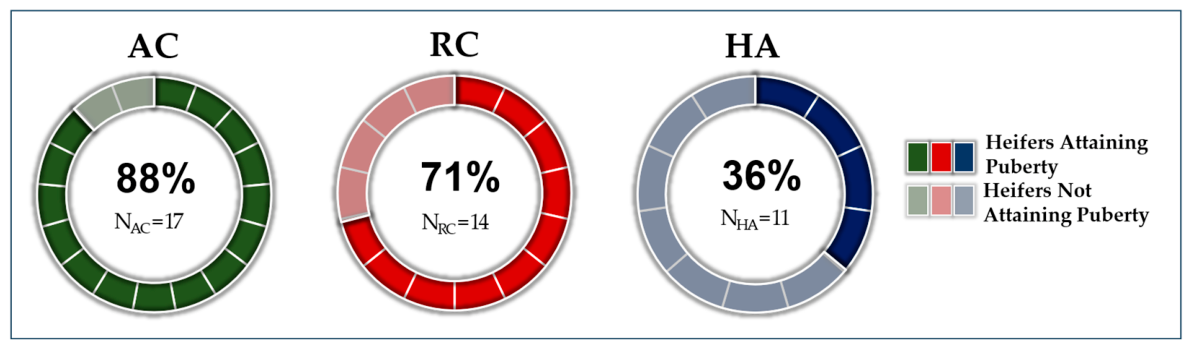
Under RLS, during the initial sampling period (January–November 2018), 50% of the heifers reached puberty, i.e., had two consecutive sampling values of serum P4 concentrations ≥1 ng/mL. The distribution by genetic group was 36% for RC, 71% for AC, and 36% for HA. Due to the low rate obtained after the initial sampling period, additional samplings were conducted five months later (20 and 23 April 2019, and 3 and 8 May 2019) in heifers that had not reached puberty in the first sampling period. These samplings identified additional heifers that reached the puberty criterion, increasing the overall proportion to 69% (10 RC, 15 AC, and 4 HA; p < 0.05; Figure 1). According to the 2 × 2 Fisher’s exact pairwise tests, AC outperformed HA (p = 0.03), but RC did not (p = 0.23), after adjusting the resulting p-values with the Holton method. Under AIP, all heifers (100%) reached puberty during the trial period.
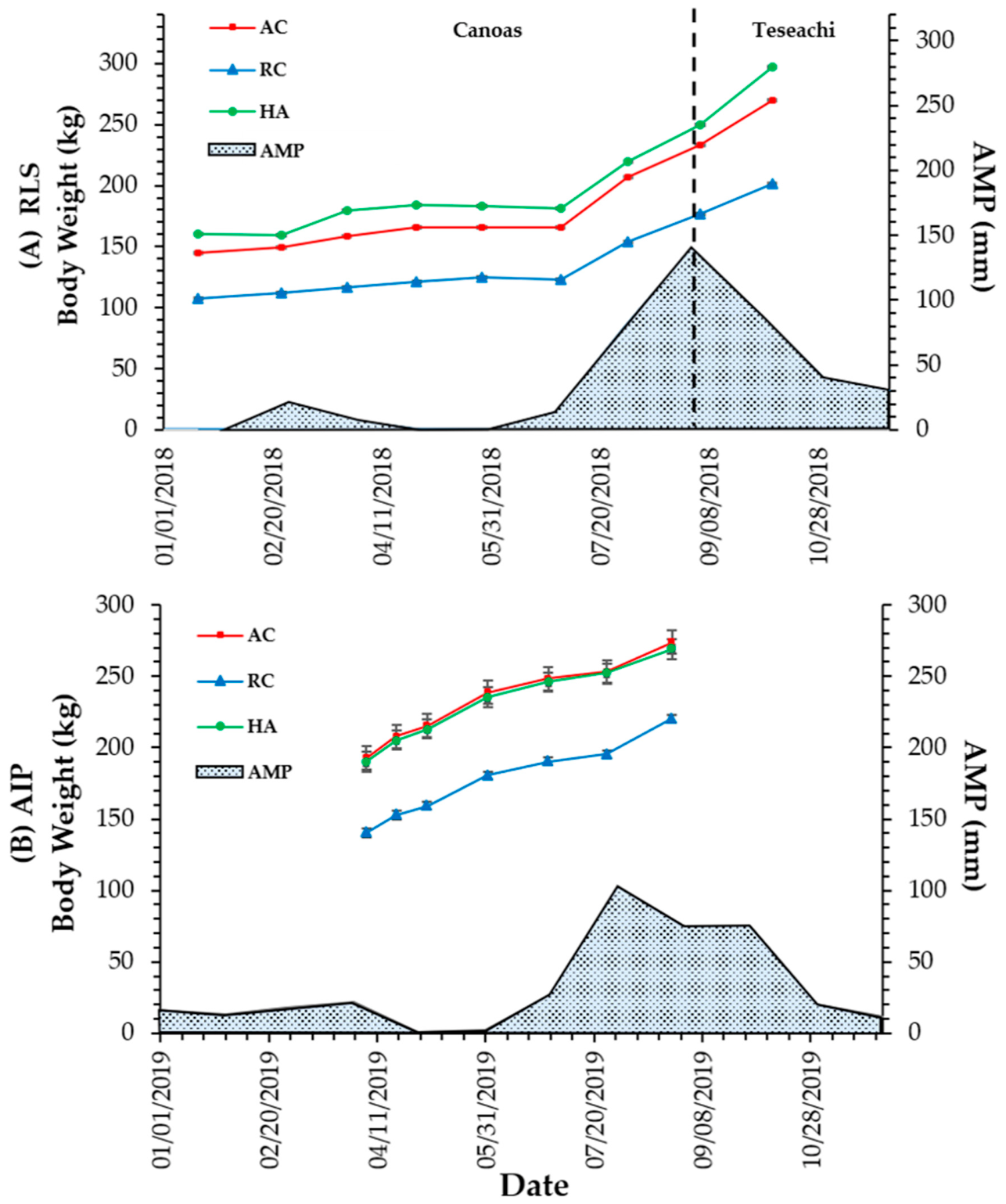
Figure 2 shows the breed group by weighed date interaction effect least square means ± SE of heifers’ body weight (BW) under the two development condition trials. Under RLS, heifer growth was generally slow during the dry season with greater forage nutrient limitations (17 January to 7 July 2018), with ADG least square means of 0.095 ± 0.017, 0.126 ± 0.015 and 0.126 ± 0.017 kg/d for RC, AC and HA, respectively; Table 5. Whereas, during the rainy season (8 July to 7 October 2018), the growth rate was accelerated, with ADG least squares means of 0.681 ± 0.018, 0.887 ± 0.018 and 0.954 ± 0.019 kg/d for CR, AC and HA, respectively; Table 4. A clear interaction effect of breed group by season was observed (Table 4; p < 0.001). The change on the ADG from the dry to the rainy season of HA heifers was 0.241 g/d higher (p < 0.01) than for RC, although it did not achieve significance over the AC breed group (0.068 g/d; p = 0.06). Conversely, under AIP, heifers’ development was more uniform; although there was an interaction of breed group by time, this was especially in terms of the maturity stage of the forage available on the annual irrigated pasture and on the adjacent rangeland paddock, where heifers spent the rest of their time when they were not grazing on the irrigated pasture. As stated in the Statistical Analysis section, the total weighing period for the AIP development condition was segmented into three levels, corresponding to defined phases of the irrigated pasture: (1) productive (6 April to 1 June 2019), (2) mature (2 June to 26 July 2019), and (3) non-irrigated/rainy season (27 July to 25 August 2019). Least squares means and planned comparisons for the interaction effects of breed group by stages of the irrigated pasture are presented in Table 6. During the Productive Phase, least squares means for ADG were 0.823 ± 0.058, 0.717 ± 0.070, and 0.805 ± 0.073 kg/d for AC, RC, and HA heifers, respectively. As the pasture reached the Mature stage, ADG decreased to 0.258 ± 0.058, 0.272 ± 0.070, and 0.308 ± 0.073 kg/d for AC, RC, and HA heifers, respectively. During the Non-irrigated stage, ADG increased back to 0.690 ± 0.058, 0.829 ± 0.070, and 0.564 ± 0.073 kg/d for AC, RC, and HA heifers, respectively. The breed group × developmental phase interaction (Table 6; p < 0.05) reflected differences among breed groups in the magnitude of the ADG changes between developmental phases. The decline in ADG from the Productive to the Mature phase did not differ between HA and either AC (p = 0.57) or RC (p = 0.68). However, the increase in ADG from the Mature to the Non-irrigated phase was greater for RC than for HA heifers (0.301 ± 0.127 kg/d; p = 0.02), whereas the corresponding difference between AC and HA was not significant (0.177 ± 0.118 kg/d; p = 0.14).

3.2.2. Age at Puberty Attainment

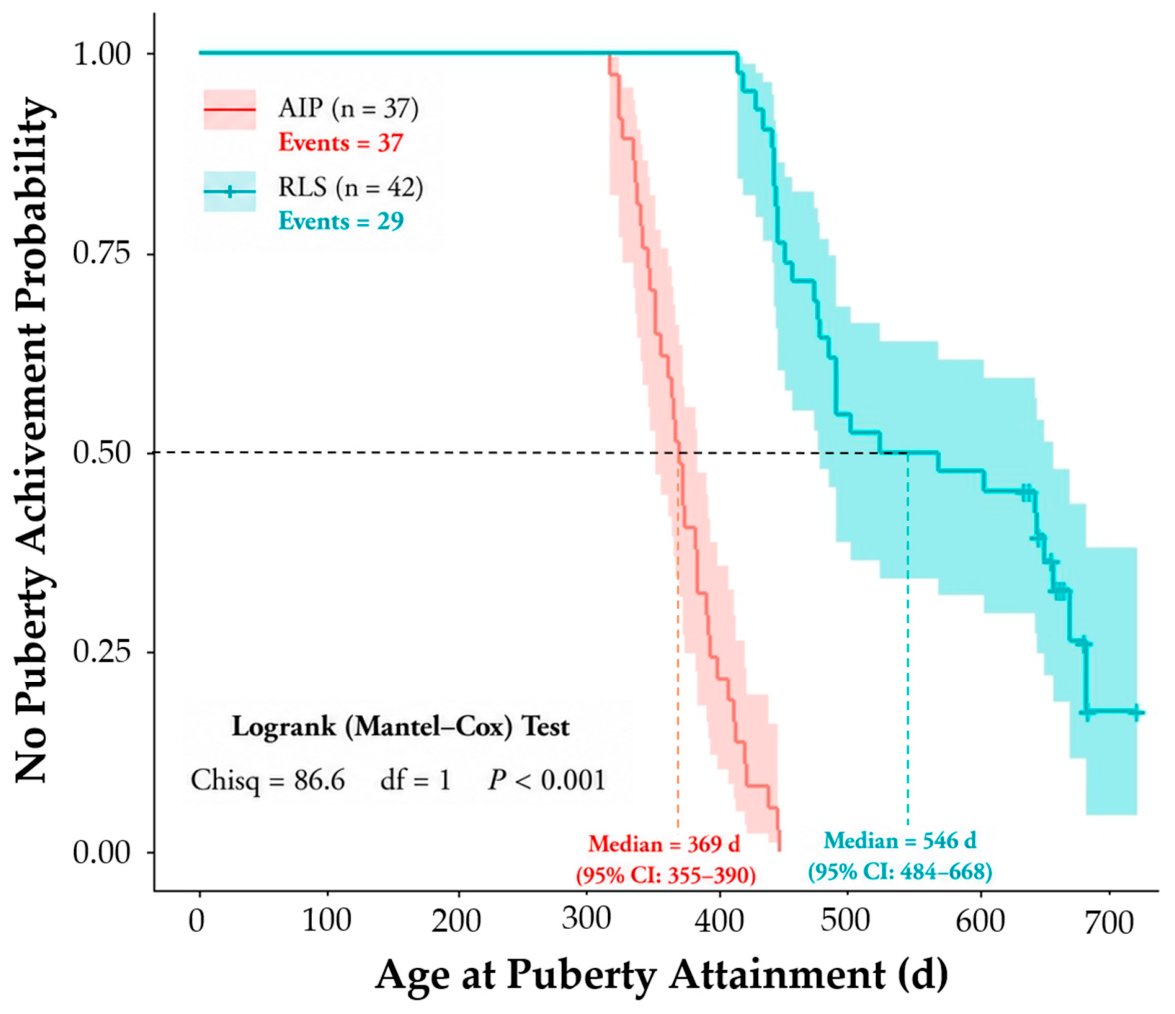
Kaplan–Meier survival analysis confirmed that the development condition markedly influenced age at puberty onset (Figure 3). Heifers developed under the annual irrigated pasture (AIP) condition attained puberty significantly earlier than those developed under rangeland with limited supplementation (RLS) (log-rank test, p < 0.001), with median ages at puberty of 369 and 546 d, respectively.
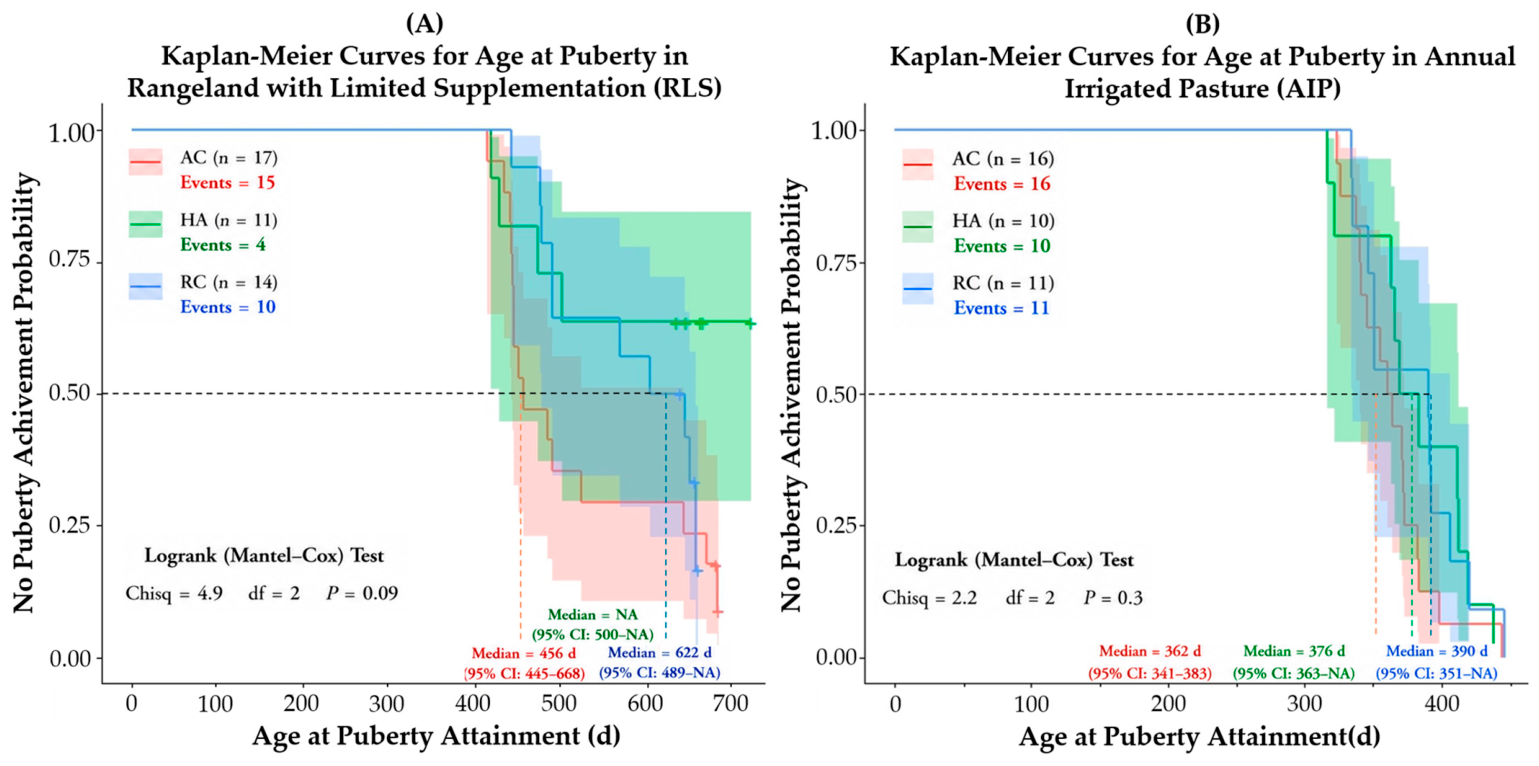
Within the RLS condition, Kaplan–Meier survival curves did not differ significantly among breed groups (Figure 4A; logrank test, p = 0.09). Median ages at puberty were 456 d for AC and 622 d for RC heifers, whereas the median age for HA heifers could not be estimated because fewer than 50% of the animals attained puberty during the observation period. Likewise, no significant differences among breed groups were detected within the AIP condition (Figure 4B; logrank test, p = 0.30), where median ages at puberty were 362, 376, and 390 d for AC, HA, and RC heifers, respectively.

3.2.3. Age (AP) and Body Weight (BWP) at Puberty Attainment Under the AIP Development Condition

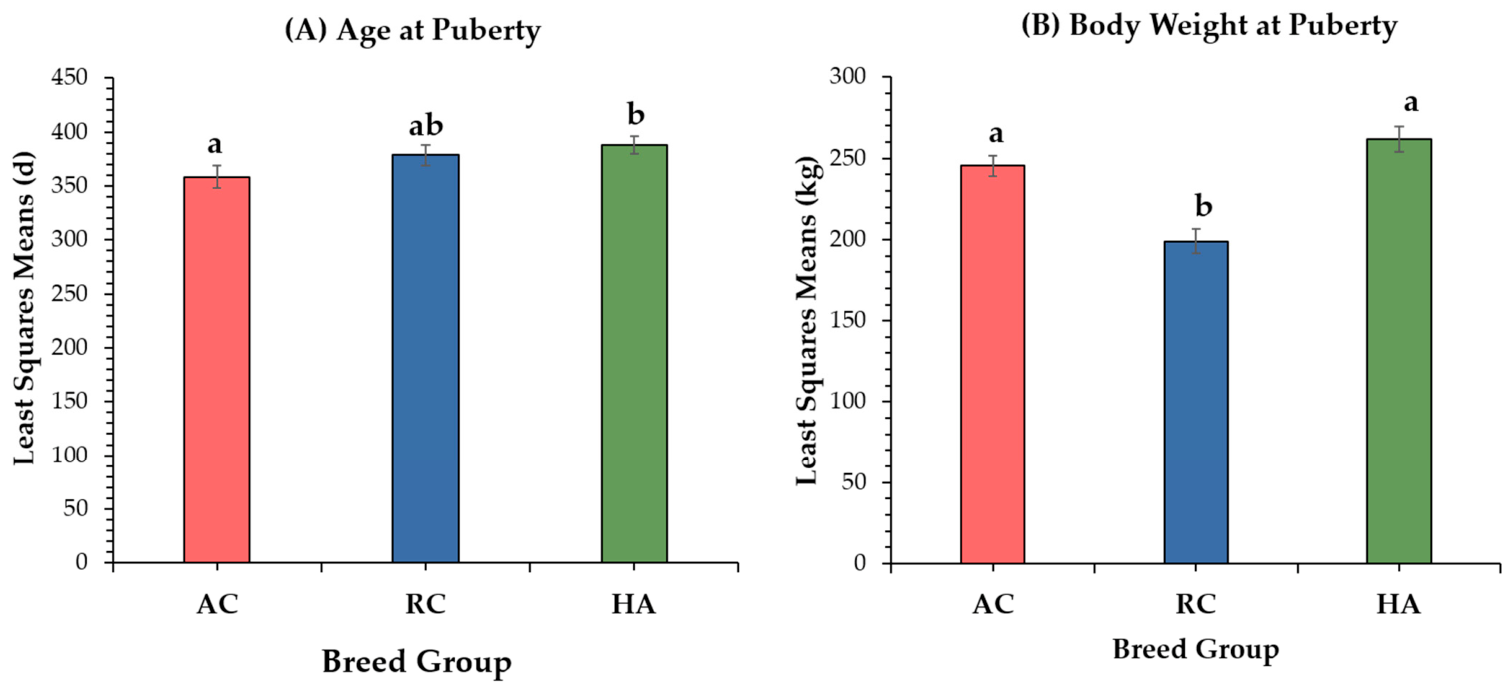
Under the AIP development condition, Julian birth date significantly affected both age at puberty (AP; p < 0.05) and body weight at puberty (BWP; p < 0.05). Breed group significantly affected BWP (p < 0.05), whereas its overall effect on AP was not significant (p > 0.05). Figure 5 presents the least squares means of AP and BWP by breed group, respectively. Least squares means for AP were 358.36 ± 8.28, 378.45 ± 9.75, and 387.83 ± 10.61 d for AC, RC, and HA heifers, respectively (Figure 5A). Although the overall effect of breed group on AP was not significant, planned contrasts indicated that AC heifers reached puberty 29.47 ± 13.84 d earlier than HA heifers (p < 0.05), whereas RC and HA did not differ (p > 0.05). Least squares means for BWP were 245.43 ± 6.23, 199.01 ± 7.34, and 261.89 ± 7.98 kg for AC, RC, and HA heifers, respectively (Figure 5B). Planned contrasts showed that RC heifers reached puberty at a lower body weight than HA heifers (−62.88 ± 10.84 kg; p < 0.05), whereas AC and HA did not differ (p > 0.05). For each one-day increase in Julian birth date, AP decreased by 0.74 ± 0.26 d and BWP decreased by 0.72 ± 0.20 kg; thus, heifers born later in the calving season attained puberty at a younger age and a lower body weight.

4. Discussion

The results of the present study indicate that Raramuri Criollo (RC) and Angus × Raramuri Criollo (AC) heifers possess productive and reproductive attributes that make them suitable for low-input beef production systems in arid and semi-arid environments. Although Hereford × Angus (HA) heifers exhibited greater body weight and average daily gain than RC and AC heifers, these advantages were not accompanied by improvements in feed conversion (FC), residual feed intake (RFI), or reproductive performance. Similar responses have been reported previously, where British-derived crossbred heifers attained greater body weights and reached puberty at heavier weights than Criollo heifers [40]. Together, these findings suggest that greater growth potential does not necessarily translate into improved biological efficiency under environments characterized by variable and often limited nutritional resources. Moreover, breed differences in growth were not constant throughout development, as evidenced by the significant breed group × phase interaction observed under the AIP development condition.
The lower dry matter intake observed in RC and AC heifers, combined with similar FC and RFI values among breed groups, suggests that these animals were able to maintain productive performance while consuming less feed. This characteristic may be particularly advantageous in production systems where forage resources are scarce or highly variable. Supporting this interpretation, RC cows have been reported to maintain body weight while requiring substantially less supplementation than Brangus cows under desert rangeland conditions [41]. Therefore, the lower feed intake observed in RC-derived females may represent an adaptive advantage in environments where feed availability frequently limits animal performance.
The significant breed group × phase interaction observed for ADG under the AIP development condition provides additional insight into the growth responses of the evaluated genetic groups under changing forage conditions. In particular, RC heifers exhibited a greater increase in ADG than HA heifers during the transition from the mature to the non-irrigated (rainy-season) stage, coinciding with the onset of seasonal rainfall. This pattern is consistent with the concept of adaptive capacity described by [42], who proposed that locally adapted ruminants are characterized not only by their ability to tolerate nutritional challenges but also by their capacity to respond rapidly when resource availability improves. Similarly, it has been suggested that future forage-based ruminant production systems will increasingly depend on animals capable of maintaining productive performance under variable climatic and feeding environments rather than maximizing production exclusively under optimal nutritional conditions [43]. Such adaptive responses are particularly advantageous in extensive production systems of arid and semi-arid regions, where forage quantity and quality fluctuate markedly throughout the year.
Although grazing behavior was not quantified in the present study, routine observations made during animal management indicated that RC heifers actively grazed newly vegetated areas surrounding the irrigated pasture following the onset of seasonal rainfall, whereas HA heifers generally remained closer to the entrance of the irrigated paddock while awaiting access to cultivated forage. These observations should be interpreted cautiously because they were not experimentally evaluated. Nevertheless, they are consistent with previous reports demonstrating that Criollo cattle travel greater daily distances, explore larger grazing areas, utilize steeper terrain, and respond more actively to spatial and temporal variation in forage availability than conventional beef breeds, particularly under forage-limited conditions [1,5,6,8]. Collectively, these behavioral characteristics may have facilitated more effective exploitation of newly available forage resources following seasonal rainfall, thereby contributing to the greater recovery in ADG observed in RC heifers during the final stage of AIP development.
Nutritional management exerted a marked influence on reproductive development. Heifers developed under annual irrigated pastures reached puberty at younger ages than those managed under rangeland with limited supplementation (RLS), emphasizing the importance of maintaining an adequate nutritional plane during the replacement phase. Seasonal reductions in forage availability and quality under rangeland conditions likely limited nutrient intake during critical stages of growth, contributing to delayed puberty. Forage quality, nutrient intake, and animal performance fluctuate substantially between dry and rainy seasons in arid and semi-arid grazing systems, influencing growth responses and overall productivity [44]. The strong contrast observed between development conditions in the present study highlights the sensitivity of reproductive maturation to nutritional conditions during the prepubertal period.
Although body weight is commonly used as an indicator of physiological maturity, attainment of a target body weight alone does not guarantee puberty onset. According to the nutrient partitioning concept, available nutrients are preferentially allocated to maintenance, activity, growth, and body reserve deposition before being directed toward reproductive functions [45]. Consequently, when nutrient availability is limited, reproductive processes may be delayed even when heifers continue to grow and gain body weight. This concept may explain why HA heifers exhibited the lowest proportion of animals reaching puberty under RLS despite attaining greater body weights than RC and AC heifers. Although HA heifers continued to grow and achieved heavier body weights, their greater nutritional and energy requirements may have limited the availability of metabolic resources necessary to support reproductive development under the nutritional restrictions characteristic of the RLS condition, which may have contributed to delaying puberty attainment and, consequently, to the lower proportion of HA heifers that reached puberty during the sampling period.
The absence of puberty observed in some heifers under rangeland conditions was likely associated with the effects of nutrition on the endocrine pathways that regulate reproductive maturation. Energy restriction during the prepubertal period can reduce luteinizing hormone (LH) secretion and alter pituitary responsiveness to gonadotropin-releasing hormone (GnRH), thereby delaying activation of the reproductive axis [45,46,47]. This mechanism may have contributed to the delayed attainment of puberty observed under the rangeland development condition with limited supplementation (RLS). Likewise, nutritional restriction can delay first ovulation even when heifers attain body weights commonly associated with puberty [45,46,47,48]. Thus, the onset of puberty depends not only on body weight but also on the availability of metabolic resources necessary to support reproductive development. Reduced nutrient availability alters metabolic signals such as leptin and IGF-I, both of which are involved in activation of the hypothalamic–pituitary–gonadal axis [18,47,48,49,50,51]. Together, these mechanisms provide a plausible explanation for why some heifers remained prepubertal despite continued growth.
The significant effect of Julian birth date suggests that environmental and nutritional conditions experienced during early life may influence subsequent reproductive development. Specifically, age at puberty decreased by 0.74 ± 0.26 d and body weight at puberty decreased by 0.72 ± 0.20 kg for each one-day increase in Julian birth date. Previous studies have reported that heifers born during winter reach puberty at older ages than those born during spring [52]. Likewise, adequate nutritional management during early life supports calf growth and physiological development, particularly under challenging environmental conditions [53]. Together, these findings support the importance of early-life management as a factor influencing reproductive success later in life.
The favorable reproductive performance observed in AC heifers likely reflects the combination of adaptation inherited from RC cattle and the benefits of heterosis. Crossbreeding between locally adapted and specialized breeds has frequently been associated with earlier puberty attainment and improved reproductive performance [17,54,55]. The high proportion of AC heifers reaching puberty under both development conditions suggests that this genetic combination may provide an effective balance between environmental adaptation and productive potential.
The lower body weight at puberty observed in RC heifers is consistent with the smaller mature size characteristic of RC cattle. Recent studies conducted in northern Mexico reported that RC cows were substantially lighter than AC and HA cows and produced lighter calves at birth and weaning [4]. However, differences among breed groups were considerably reduced when calf weaning weight was expressed relative to cow body weight, suggesting that the lower maintenance requirements associated with the smaller mature size of RC cattle may partially offset lower calf weaning weights. Furthermore, AC cows produced calves with weaning weights comparable to those of HA cows while maintaining a smaller mature size. These findings suggest that RC genetics may contribute to alternative production strategies, ranging from improved biological efficiency in purebred RC cows to a favorable balance between adaptation and calf growth in AC females. Therefore, although the lower body weight at puberty observed in RC heifers may be associated with lighter calves later in life, it does not necessarily imply reduced lifetime productivity [4].
An additional finding of practical importance was the reproductive performance observed in AC heifers. In the present study, AC heifers consistently showed the youngest mean age at puberty and the highest proportion of animals attaining puberty under both development conditions (Figure 4A,B and Figure 5), without requiring the greater body weights observed in HA heifers. These results suggest that AC heifers successfully combined the adaptive characteristics of RC cattle with the productive potential of British breeds. This response likely reflects the benefits of heterosis derived from crossing genetically divergent breeds, where greater genetic distance between parental breeds generally results in greater heterotic responses, as classically demonstrated in Bos taurus × Bos indicus crosses [54,55,56]. Consistent with this interpretation, crossbreeding between locally adapted and specialized breeds has frequently been associated with earlier puberty attainment and improved reproductive performance [54,55].
Overall, the present results demonstrate that RC cattle and their crosses represent a valuable alternative for low-input beef production systems in arid and semi-arid regions. However, regardless of genetic background, adequate nutritional management remains essential to promote consistent growth, timely puberty attainment, and optimal reproductive performance.
A limitation of the present study is that the two development conditions were evaluated in different years, which may have introduced environmental variation beyond the nutritional conditions associated with each management strategy. In addition, the number of animals within some breed groups was relatively limited, particularly for puberty-related analyses. Body condition score was not recorded, and measurements of metabolic and endocrine indicators associated with growth and reproductive development, including glucose, β-hydroxybutyrate (BHB), insulin, and IGF-I, could not be completed because of logistical constraints associated with the COVID-19 pandemic. Consequently, the physiological mechanisms linking nutritional status, growth, and puberty attainment could not be directly evaluated.
Despite these limitations, the study provides valuable information regarding growth, feed intake, feed efficiency, and reproductive development of Raramuri Criollo cattle and their crosses under contrasting development conditions. Further research involving larger populations, multiple production cycles, and evaluation of subsequent reproductive performance, including age at first calving, longevity, calf weaning performance, and lifetime productivity, is warranted. Additional studies are also needed to determine whether the earlier attainment of puberty at lower body weights observed in RC and AC females translates into advantages in biological efficiency and long-term productivity under low-input production systems.

5. Conclusions

Criollo Raramuri purebred cattle (RC) and their crossbreds represent a biologically sound alternative for low-input beef production systems in arid and semi-arid regions. Their lower feed intake, comparable feed efficiency indicators (feed conversion, FC; and residual feed intake, RFI), and ability to reach puberty at lighter body weights allow for more efficient use of limited resources. However, even when adapted genetics are used, it is essential to implement proper management practices that promote consistent growth to ensure early puberty and optimal lifetime reproductive performance. The results of this study suggest that RC females may be used as purebred replacements, but even better than that, if feasible, RC genetics may serve as a valuable maternal base in strategically defined crossbreeding programs that incorporate RC crossbred cows, aimed at combining adaptation, reproductive efficiency, and productive performance. Such strategies could contribute to improving the resilience and sustainability of beef production systems in arid and semi-arid regions.

Supplementary Materials

The following supporting information can be downloaded at: https://www.mdpi.com/article/10.3390/ruminants6030056/s1, Figure S1. Climatological variables reported by weather stations during the trait periods [27]; Figure S2. Geographical location of the weather stations and study sites. Basemap image from Google Earth © Google; map data © 2026 Google and contributing data providers (Google, Landsat/Copernicus, and INEGI; accessed June 2026). Colored markers indicating the weather stations and study sites were added by the authors [28].

Author Contributions

Conceptualization, F.A.R.-A., A.C.-L., A.V.-C. and E.E.M.-O.; methodology, A.V.-C., E.E.M.-O., A.C.-L., J.A.M.-Q., B.E.C.-V., O.R.-E. and F.A.R.-A.; formal analysis, A.V.-C., E.E.M.-O., F.A.R.-A., J.G.P.-Á. and J.D.-V.; investigation, A.V.-C., E.E.M.-O., F.A.R.-A., A.C.-L., J.G.P.-Á. and B.E.C.-V.; resources, F.A.R.-A., O.R.-E. and A.C.-L.; data curation, A.V.-C. and E.E.M.-O.; writing—original draft preparation, A.V.-C.; writing—review and editing, A.V.-C., F.A.R.-A., J.A.M.-Q., A.C.-L. and J.D.-V.; supervision, F.A.R.-A., A.C.-L. and O.R.-E.; project administration, A.C.-L. and F.A.R.-A.; funding acquisition, F.A.R.-A. and A.C.-L. All authors have read and agreed to the published version of the manuscript.

Funding

This research received partial funding from Fundación PRODUCE Chihuahua, A.C.

Institutional Review Board Statement

The animal study protocol was conducted in accordance with the Institutional Code for the Regulation of Bioethics and Animal Welfare of the Faculty of Animal Science and Ecology, Autonomous University of Chihuahua (CTFZYE-ACTA-101/2015: Agreement 4.2). The study was reviewed and approved by the Bioethics and Animal Welfare Committee of the Faculty of Animal Science and Ecology, Autonomous University of Chihuahua, on 8 May 2026.

Informed Consent Statement

Not applicable.

Data Availability Statement

The original contributions presented in this study are included in the article/Supplementary Material. Further inquiries can be directed to the corresponding authors.

Acknowledgments

The authors acknowledge that the Universidad Autónoma de Chihuahua and Fundación PRODUCE Chihuahua supported this investigation. The Consejo Nacional de Ciencia y Tecnología (CONACyT) provided graduate study scholarships for Alvaro Vargas-Cázares and Edgar E. Medina-Ortega with registration numbers 292561 and 330180. The authors also thank Andrés F. Cibils for his valuable and insightful feedback during the preparation of the manuscript, as well as for his contributions to improving the English writing of the article. The authors further acknowledge José A. Díaz García for his valuable technical assistance with the implementation of the statistical analyses.

Conflicts of Interest

The authors declare no conflicts of interest.

Abbreviations

The following abbreviations are used in this manuscript:
RCRaramuri Criollo
HAHereford × Angus
ACAngus × Criollo
APAge at puberty
BWPBody weight at puberty
RLSRangeland development conditions with limited supplementation
AIPDevelopment under annual irrigated pastures
UACHUniversidad Autónoma de Chihuahua
ADGAverage daily gain
DMIDry matter intake
FCFeed conversion
RFIResidual feed intake
MMWMid-test metabolic weight
P4Progesterone
NRCNational Research Council
IABWInitial adjusted body weight
FABWFinal adjusted weight
IGF-IInsulin-like growth factor-I
GnRHGonadotropin-releasing hormone
LHLuteinizing hormone

References

  1. Spiegal, S.A.; Estell, R.E.; Cibils, A.F.; James, D.K.; Peinetti, H.R.; Browning, D.M.; Romig, K.B.; Gonzalez, A.L.; Lyons, A.J.; Bestelmeyer, B.T. Seasonal Divergence of Landscape Use by Heritage and Conventional Cattle on Desert Rangeland. Rangel. Ecol. Manag. 2019, 72, 590–601. [Google Scholar] [CrossRef]
  2. Nyamuryekung’e, S.; Cibils, A.F.; Estell, R.E.; VanLeeuwen, D.; Spiegal, S.A.; Steele, C.M.; Gonzalez, A.L.; McIntosh, M.M.; Gong, Q.; Cao, H. Movement, Activity, and Landscape Use Patterns of Heritage and Commercial Beef Cows Grazing Chihuahuan Desert Rangeland. J. Arid Environ. 2022, 199, 104704. [Google Scholar] [CrossRef]
  3. Perea, A.R.; Macon, L.K.; Spetter, M.J.; Funk, M.P.; Bakir, M.; Estell, R.E.; Bestelmeyer, B.T.; Cibils, A.F.; Utsumi, S.A. Differential Response of Angus–Hereford and Rarámuri Criollo Cattle to a Dynamic Feeding Challenge during the Training to an Autonomous Virtual Fencing Collar. J. Anim. Sci. 2026, 104, skag024. [Google Scholar] [CrossRef] [PubMed]
  4. Floriano-López, R.A.; Martinez-Quintana, J.A.; Sandoval-Villalobos, J.; Roacho-Estrada, O.; Villareal-Balderrama, J.; Antillón-Ruiz, J. PSX-2 Productive Performance of Raramuri Criollo, Angus × Raramuri Criollo and Hereford × Angus Cows in a Low-Input Cow-Calf System in Northern Mexico. J. Anim. Sci. 2024, 102, 456–457. [Google Scholar] [CrossRef]
  5. Nyamuryekung’e, S.; Cibils, A.F.; Estell, R.E.; McIntosh, M.M.; VanLeeuwen, D.; Steele, C.; Gonzalez, A.L.; Spiegal, S.A.; Reyes, L.A.; Rodriguez-Almeida, F.A.; et al. Foraging Behavior and Body Temperature of Heritage vs. Commercial Beef Cows in Relation to Desert Ambient Heat. J. Arid Environ. 2021, 193, 104565. [Google Scholar] [CrossRef]
  6. Roacho-Estrada, O.; Rodríguez-Almeida, F.A.; Utsumi, S.A.; Fredrickson, E.L.; Bezanilla-Enríquez, G.A.; Cibils, A.F.; Estell, R.E.; González, A.L. Foraging behavior of Rarámuri Criollo vs. commercial crossbred cows on rangelands of the southwestern United States and northern Mexico. J. Arid Environ. 2023, 212, 104943. [Google Scholar] [CrossRef]
  7. Duni, D.M.; McIntosh, M.M.; Nyamuryekung’e, S.; Cibils, A.F.; Duniway, M.C.; Estell, R.E.; Spiegal, S.A.; Gonzalez, A.L.; Gedefaw, M.G.; Redd, M.; et al. Foraging behavior of Raramuri Criollo vs. Angus cattle grazing California chaparral and Colorado Plateau shrublands. J. Arid Environ. 2023, 213, 104975. [Google Scholar] [CrossRef]
  8. Cibils, A.F.; Estell, R.E.; Spiegal, S.A.; Nyamuryekung’e, S.; McIntosh, M.M.; Duni, D.M.; Herrera-Conegliano, O.A.; Rodríguez-Almeida, F.A.; Roacho-Estrada, O.; Blanco, L.J.; et al. Adapting to climate change on desert rangelands: A multi-site comparison of grazing behavior plasticity of heritage and improved beef cattle. J. Arid Environ. 2023, 209, 104886. [Google Scholar] [CrossRef]
  9. Anderson, D.M.; Estell, R.E.; Gonzalez, A.L.; Cibils, A.F.; Torell, L.A. Criollo cattle: Heritage genetics for arid landscapes. Rangelands 2015, 37, 62–67. [Google Scholar] [CrossRef]
  10. Castaño-Sánchez, J.P.; Rotz, C.A.; McIntosh, M.M.; Tolle, C.; Gifford, C.A.; Duff, G.C.; Spiegal, S.A. Grass Finishing of Criollo Cattle Can Provide an Environmentally Preferred and Cost-Effective Meat Supply Chain from United States Drylands. Agric. Syst. 2023, 210, 103694. [Google Scholar] [CrossRef]
  11. Jurado-Guerra, P.; Sosa-Pérez, G.; Cadena-Iñiguez, P. Agricultural Diagnosis of the Municipality of Uruachi, in the Sierra Tarahumara, Chihuahua, Mexico. Agro Product. 2025, 18, 157–172. [Google Scholar] [CrossRef]
  12. Fierro, L.C.; Ríos, J.G. Del Ganado Criollo de Origen Español a las Razas Especializadas en la Ganadería de Chihuahua. In Historia Ambiental de la Ganadería en México; Hernández, L. (Compiler) Instituto de Ecología, A.C.: Xalapa, Mexico; IRD: Marseille, France, 2001; pp. 75–81. [Google Scholar]
  13. Rashid, H.U.; Khan, T.; Turi, A.A.; Abbas, M.; Ullah, K.; Fusaro, I.; Buonaiuto, G.; Cavallini, D. Impact of urea-molasses treated wheat straw levels in total mixed rations on growth and nutrient digestibility in Azikheli buffalo calves. Trop. Anim. Health Prod. 2025, 57, 110. [Google Scholar] [CrossRef] [PubMed]
  14. Núñez-Domínguez, R.; Cundiff, L.V.; Dickerson, G.E.; Gregory, K.E.; Koch, R.M. Lifetime production of beef heifers calving first at two vs three years of age. J. Anim. Sci. 1991, 69, 3467–3479. [Google Scholar] [CrossRef] [PubMed]
  15. López-Paredes, J.; Pérez-Cabal, M.A.; Jiménez-Montero, J.A.; Alenda, R. Influence of age at first calving in a continuous calving season on productive, functional, and economic performance in a Blonde d’Aquitaine beef population. J. Anim. Sci. 2018, 96, 4015–4027. [Google Scholar] [CrossRef] [PubMed]
  16. Cushman, R.A.; Kill, L.K.; Funston, R.N.; Mousel, E.M.; Perry, G.A. Heifer calving date positively influences calf weaning weights through six parturitions. J. Anim. Sci. 2013, 91, 4486–4491. [Google Scholar] [CrossRef] [PubMed]
  17. Wiltbank, J.N.; Gregory, K.E.; Swiger, L.A.; Ingalls, J.E.; Rothlisberger, J.A.; Koch, R.M. Effects of heterosis on age and weight at puberty in beef heifers. J. Anim. Sci. 1966, 25, 744–751. [Google Scholar] [CrossRef]
  18. Fantuz, F.; Fatica, A.; Salimei, E.; Marcantoni, F.; Todini, L. Nutrition, growth, and age at puberty in heifers. Animals 2024, 14, 2801. [Google Scholar] [CrossRef] [PubMed]
  19. Sprinkle, J.; Tolleson, D. Heifer Development on Rangeland; Arizona Cooperative Extension, College of Agriculture and Life Sciences, The University of Arizona: Tucson, AZ, USA, 2011. [Google Scholar]
  20. Danese, T.; Buonaiuto, G.; Lamanna, M.; Cavallini, D.; Cacchioli, A.; Paci, G. A Case of Starch Overload in Young Dairy Heifers: A Physiological and Nutritional Point of View. Vet. Sci. 2026, 13, 319. [Google Scholar] [CrossRef] [PubMed]
  21. Kasimanickam, R.K.; Kasimanickam, V.R.; McCann, M.L. Difference in body weight at breeding affects reproductive performance in replacement beef heifers and carries consequences to next generation heifers. Animals 2021, 11, 2800. [Google Scholar] [CrossRef] [PubMed]
  22. American Criollo Beef Association. Characteristics of Criollo Cattle. Available online: https://www.leanandtenderbeef.com/About-Criollo-Cattle/Criollo-Cattle/ (accessed on 15 February 2026).
  23. Ferrell, C.L. Effects of postweaning rate of gain on onset of puberty and productive performance of heifers of different breeds. J. Anim. Sci. 1982, 55, 1272–1283. [Google Scholar] [CrossRef] [PubMed]
  24. National Research Council (NRC). Nutrient Requirements of Beef Cattle: Seventh Revised Edition: Update 2000; National Academy Press: Washington, DC, USA, 2000. [Google Scholar] [CrossRef] [PubMed]
  25. Brunes, L.C.; Baldi, F.; Lopes, F.B.; Lôbo, R.B.; Espigolan, R.; Costa, M.F.O.; Stafuzza, N.B.; Magnabosco, C.U. Weighted single-step genome-wide association study and pathway analyses for feed efficiency traits in Nellore cattle. J. Anim. Breed. Genet. 2021, 138, 23–44. [Google Scholar] [CrossRef] [PubMed]
  26. Knott, S.A.; Cummins, L.J.; Dunshea, F.R.; Leury, B.J. The use of different models for the estimation of residual feed intake (RFI) as a measure of feed efficiency in meat sheep. Anim. Feed Sci. Technol. 2008, 143, 242–255. [Google Scholar] [CrossRef]
  27. Servicio Meteorológico Nacional (SMN)—Comisión Nacional del Agua (CONAGUA). Normales Climatológicas por Estado. Available online: https://smn.conagua.gob.mx/es/climatologia/informacion-climatologica/normales-climatologicas-por-estado?estado=chih (accessed on 2 January 2026).
  28. Google Earth. Google Earth Web. Geographical Positioning of Weather Stations and Study Sites. Available online: https://earth.google.com/web/@29.14036286,-107.61229995,2169.59976758a,186281.76444679d,35y,0h,0t,0r/data=CgRCAggBMikKJwolCiExcHl4bUgzaURyWVlYdXZlS1lUZ0tqT3A5dW93bFVJVFIgAToDCgEwQgIIAEoICInd384DEAE?authuser=0 (accessed on 12 January 2026).
  29. Comisión Técnico-Consultiva para la Determinación Regional de los Coeficientes de Agostadero; Secretaría de Agricultura y Recursos Hidráulicos, Subsecretaría de Ganadería: Chihuahua, México, 1978.
  30. Smith, G.; Holechek, J.L.; Cardenas, M. Wildlife numbers on excellent and good condition Chihuahuan Desert rangelands: An observation. J. Range Manag. 1996, 49, 489–493. [Google Scholar] [CrossRef]
  31. Titulaer, M.; Melgoza-Castillo, A.; Panjabi, A.O.; Sanchez-Flores, A.; Martínez-Guerrero, J.H.; Macias-Duarte, A.; Fernandez, J.A. Molecular analysis of stomach contents reveals important grass seeds in the winter diet of Baird’s and Grasshopper sparrows, two declining grassland bird species. PLoS ONE 2017, 12, e0189695. [Google Scholar] [CrossRef] [PubMed]
  32. Moriel, P.; Cooke, R.F.; Bohnert, D.W.; Vendramini, J.M.B.; Arthington, J.D. Effects of energy supplementation frequency and forage quality on performance, reproductive, and physiological responses of replacement beef heifers. J. Anim. Sci. 2012, 90, 2371–2380. [Google Scholar] [CrossRef] [PubMed]
  33. Nafziger, S.R.; Tenley, S.C.; Summers, A.F.; Abedal-Majed, M.A.; Hart, M.; Bergman, J.W.; Bergman, W.; Kurz, S.G.; Davis, J.S.; Wood, J.R.; et al. Attainment and maintenance of pubertal cyclicity may predict reproductive longevity in beef heifers. Biol. Reprod. 2021, 104, 1360–1372. [Google Scholar] [CrossRef] [PubMed]
  34. Abeni, F.; Petrera, F.; Le Cozler, Y. Effects of feeding treatment on growth rates, metabolic profiles and age at puberty, and their relationships in dairy heifers. Animal 2019, 13, 1020–1029. [Google Scholar] [CrossRef] [PubMed]
  35. Kaplan, E.L.; Meier, P. Nonparametric estimation from incomplete observations. J. Am. Stat. Assoc. 1958, 53, 457–481. [Google Scholar] [CrossRef]
  36. Therneau, T. Survival: A Package for Survival Analysis in R, version 3.8-6; CRAN: Vienna, Austria, 2026. Available online: https://CRAN.R-project.org/package=survival (accessed on 30 June 2026).
  37. Kassambara, A.; Kosinski, M.; Biecek, P. Survminer: Drawing Survival Curves Using ‘ggplot2’, version 0.5.2; CRAN: Vienna, Austria, 2026. Available online: https://CRAN.R-project.org/package=survminer (accessed on 30 June 2026).
  38. R Core Team. R: A Language and Environment for Statistical Computing; R Foundation for Statistical Computing: Vienna, Austria, 2025; Available online: https://www.R-project.org/ (accessed on 30 June 2026).
  39. Mantel, N. Evaluation of survival data and two new rank order statistics arising in its consideration. Cancer Chemother. Rep. 1966, 50, 163–170. [Google Scholar] [PubMed]
  40. Valverde-Saenz, S.I.; Walsh, J.D.; Gardner, C.M.; Mulliniks, J.T.; Schilling, B.S.; Hallford, D.M.; Gonzalez, A.L.; Fredrickson, E.L.; Kane, K.K.; Hawkins, D.E. Age at puberty in beef heifers: Criollo cattle versus British crossbred cattle. In Proceedings of the American Society of Animal Science Western Section, Laramie, WY, USA, 24–26 June 2008; Volume 59, p. 237. [Google Scholar]
  41. McIntosh, M.M.; Estell, R.E.; Cibils, A.F.; Cox, A.; Nyamuryekung’e, S.; Duni, D.; Duff, G.C.; Spiegal, S.; Brandani, C.; Utsumi, S.A.; et al. PSX-A-6 Late-breaking: Conventional vs. heritage cattle supplement intake, weight gains, and body condition scores on Chihuahuan Desert pasture. J. Anim. Sci. 2021, 99, 375–376. [Google Scholar] [CrossRef]
  42. Bocquier, F.; González-García, E. Sustainability of ruminant agriculture in the new context: Feeding strategies and features of animal adaptability into the necessary holistic approach. Animal 2010, 4, 1258–1273. [Google Scholar] [CrossRef] [PubMed]
  43. Moorby, J.M.; Fraser, M.D. Review: New feeds and new feeding systems in intensive and semi-intensive forage-fed ruminant livestock systems. Animal 2021, 15, 100297. [Google Scholar] [CrossRef] [PubMed]
  44. McIntosh, M.M.; Cibils, A.F.; Estell, R.E.; Nyamuryekung’e, S.; González, A.L.; Gong, Q.; Cao, H.; Spiegal, S.A.; Soto-Navarro, S.A.; Blair, A.D. Weight gain, grazing behavior and carcass quality of desert grass-fed Rarámuri Criollo vs. crossbred steers. Livest. Sci. 2021, 249, 104511. [Google Scholar] [CrossRef]
  45. Short, R.E.; Adams, D.C. Nutritional and hormonal interrelationships in beef cattle reproduction. Can. J. Anim. Sci. 1988, 68, 29–39. [Google Scholar] [CrossRef]
  46. Day, M.L.; Imakawa, K.; Zalesky, D.D.; Kittok, R.J.; Kinder, J.E. Effects of restriction of dietary energy intake during the prepubertal period on secretion of luteinizing hormone and responsiveness of the pituitary to luteinizing hormone-releasing hormone in heifers. J. Anim. Sci. 1986, 62, 1641–1648. [Google Scholar] [CrossRef] [PubMed]
  47. Patterson, D.J.; Perry, R.C.; Kiracofe, G.H.; Bellows, R.A.; Staigmiller, R.B.; Corah, L.R. Management considerations in heifer development and puberty. J. Anim. Sci. 1992, 70, 4018–4035. [Google Scholar] [CrossRef] [PubMed]
  48. Funston, R.N.; Martin, J.L.; Larson, D.M.; Roberts, A.J. Nutritional aspects of developing replacement heifers. J. Anim. Sci. 2012, 90, 1166–1171. [Google Scholar] [CrossRef] [PubMed]
  49. Sánchez, J.M.; Keogh, K.; Kelly, A.K.; Byrne, C.J.; Lonergan, P.; Kenny, D.A. A high plane of nutrition during early life alters the hypothalamic transcriptome of heifer calves. Sci. Rep. 2021, 11, 13978. [Google Scholar] [CrossRef] [PubMed]
  50. Luna-Pinto, G.; Cronjé, P.B. The roles of the insulin-like growth factor system and leptin as possible mediators of the effects of nutritional restriction on age at puberty and compensatory growth in dairy heifers. S. Afr. J. Anim. Sci. 2000, 30, 155–163. [Google Scholar] [CrossRef]
  51. Rodríguez, A.M.; Calderón-Robles, R.C.; Rosete-Fernández, J.V.; Rodríguez-Hernández, K.; Vera-Ávila, H.R.; Arreguín-Arévalo, J.A.; Nette, T.M.; Gutiérrez-Aguilar, C.G.; González-Padilla, E.; Gómez-Chavarín, M.; et al. Kisspeptin in prepubertal heifers. I. Effects of age on the response of LH, FSH and GH to kisspeptin-10 and its association with IGF-I, leptin and estradiol. Rev. Mex. Cienc. Pecu. 2017, 8, 375–385. [Google Scholar] [CrossRef]
  52. Hauser, E.R. Seasonal effect on female reproduction in the bovine (Bos taurus) (European breeds). Theriogenology 1984, 21, 150–169. [Google Scholar] [CrossRef]
  53. Mortazavi, M.S.; Hajmohammadi, M.; Buonaiuto, G.; Colleluori, R.; Lamanna, M.; Cavallini, D.; Valizadeh, R.; Ebrahimi, S.H.; Oliveira, C.A.F. The Effect of a Pre-Mix of Essential Organic Minerals on Growth, Antioxidant Indices, and Diarrhea Incidence in Dairy Calves Reared in Arid Climates. Ruminants 2025, 5, 22. [Google Scholar] [CrossRef]
  54. Ordoñez, J.V.; Linares, T.G.; Plasse, D.; Verde, O.S.; Burguera, M.H.; Gil, R.A. Comportamiento productivo de Bos taurus y Bos indicus y sus cruces en el Llano venezolano. VI. Estimación de heterosis en edad y peso a pubertad en novillas. In Proceedings of the Memoria de la IV Reunión Latinoamericana de Producción Animal, Guadalajara, México, 26 June 1973; p. 90. [Google Scholar]
  55. Restle, J.; Polli, V.A.; Senna, D.B. Efeito de grupo genético e heterose sobre a idade e peso à puberdade e sobre o desempenho reprodutivo de novilhas de corte. Pesq. Agropec. Bras. 1999, 34, 701–707. [Google Scholar] [CrossRef]
  56. Gregory, K.E.; Cundiff, L.V. Crossbreeding in beef cattle: Evaluation of systems. J. Anim. Sci. 1980, 51, 1224–1242. [Google Scholar] [CrossRef]
Figure 1. Percentages of heifers reaching puberty, out of a total of Ni animals in each of the Raramuri Criollo (RC), Angus × Raramuri Criollo (AC), and Hereford × Angus breed groups under the rangeland development condition with limited supplementation (RLS) after the additional sampling period of April to May of 2019.
Ruminants 06 00056 g001
Figure 2. Least squares means (± SE) of body weight (BW) at each weighing date for Raramuri Criollo (RC), Angus × Raramuri Criollo (AC), and Hereford × Angus (HA) heifers under two development conditions: (A) rangeland with limited supplementation (RLS) and (B) annual irrigated pasture (AIP) during the initially planned monitoring periods, and the monthly accumulated precipitation in 2018 and 2019, respectively [28].
Ruminants 06 00056 g002
Figure 3. Kaplan–Meier survival curves for the rangeland with limited supplementation (RLS) and annual irrigated pasture (AIP) developmental conditions showing the probability of heifers remaining pre-pubertal, with age at puberty onset as the time-to-event variable, in heifers developed under the annual irrigated pasture (AIP) and rangeland with limited supplementation (RLS) development conditions. Shaded areas represent the 95% confidence intervals. Tick marks indicate right-censored observations. The horizontal dashed line indicates the 50% survival probability, and the vertical dashed lines indicate the median age at puberty attainment for each developmental condition.
Ruminants 06 00056 g003
Figure 4. Kaplan–Meier survival curves for the Raramuri Criollo (RC), Angus × Raramuri Criollo (AC), and Hereford × Angus (HA) group breeds showing the probability of a heifer remaining pre-pubertal under (A) the rangeland with limited supplementation (RLS) and (B) the annual irrigated pasture (AIP) development conditions, with age at puberty onset as the time to event variable. Shaded areas represent the 95% confidence intervals. Tick marks (+) indicate right-censored observations. The horizontal dashed line indicates the 50% survival probability, and the vertical dashed lines indicate the median age at puberty attainment for each breed group.
Ruminants 06 00056 g004
Figure 5. Least squares means (± SE) of age at puberty (A) and body weight at puberty (B) of Rarámuri Criollo (RC), Angus × Rarámuri Criollo (AC), and Hereford × Angus (HA) heifers developed under the annual irrigated pasture (AIP) condition. Note: Different superscript letters indicate significant differences based on planned contrasts comparing RC with HA heifers and AC with HA heifers (p < 0.05).
Ruminants 06 00056 g005
Table 1. Initial age and body weight (mean ± SD) of heifers by genetic group: Raramuri Criollo (RC), Angus × Criollo (AC) and Hereford × Angus (HA) in Experiments I and II.
Experiment IExperiment II
Development Condition I (RLS)Development Condition II (AIP)
Genetic
Group
nAge (months)Weight (kg)nAge (months)Weight
(kg)
nAge (months)Weight
(kg)
RC107.8 ± 0.4120.3 ± 22145.8 ± 0.898.4 ± 11118.9 ± 0.1140.3 ± 2.3
AC107.6 ± 0.4158.6 ± 37176.7 ± 0.3150.1 ± 15.1169.2 ± 0.2196.5 ± 7.6
HA88.4 ± 0.5185.8 ± 29116.2 ± 0.9153.5 ± 21.9108.6 ± 0.3184.3 ± 8.5
n: Sample size, RLS: Rangeland development with limited supplementation, AIP: Annual irrigated pasture.
Table 2. Ingredients and chemical dry matter-based composition of diets during the growth (Diet 1) and developmental (Diet 2) phases in Experiment I (post-weaning performance under individual feeding conditions).
Diet Composition (%)Chemical Composition (%)
IngredientDiet 1Diet 2ItemDiet 1Diet 2
Oat Hay 47.8745.11Dry Matter94.1392.96
Alfalfa 19.619.62Humidity 5.877.04
Rolled Corn16.7120.27Crude Protein 10.529.5
Cottonseed Meal9.827.23Ether Extract 3.225.61
Cane Molasses 32.97Organic Matter 92.4591.68
Animal Fat 2.744.56Ash7.558.32
Calcium Carbonate 0.170.04Neutral Detergent Fiber44.8529.57
Calcium Diphosphate 0.090.2Acid Detergent Fiber25.9915.73
Table 3. Chemical composition of pasture forages (dry matter-based) utilized for heifers in rangeland development with limited supplementation (RLS; Rancho Las Canoas and Rancho Teseachi) and in annual irrigated pasture development plans (AIP).
VariableRLSAIP
Rancho Canoas PasturesRancho Teseachi PasturesAnnual Irrigated Pastures
Dry Matter (%)94.6494.0817.2
Humidity (%)5.375.9282.8
Crude Protein (%)4.794.8916.56
Crude Fat (%)2.391.48-
Crude Fiber (%)34.1335.97-
Neutral Detergent Fiber (%)--48.33
Acid Detergent Fiber (%)--9.30
Ash (%)10.549.213.72
Metabolizable Energy
(Mcal/kg−1 DM)
2.072.042.32
Table 4. Least squares means ± SE for initial (IABW) and final linear regression adjusted body weights (FABW), average daily weight gain (ADG), dry matter intake (DMI), feed conversion (FC) and residual feed intake (RFI) in Raramuri Criollo (RC), Angus × Criollo (AC), and Hereford × Angus (HA) heifers.
Breed
Group
nIABW (kg)FABW (kg)ADG (kg)DMI (kg)FC (kg/kg)RFI (kg)
RC10121.6 ± 9.2 c164.2 ± 10.1 c0.77 ± 0.04 c4.87 ± 0.3 c6.32 ± 0.30.05 ± 0.1
AC10162.7 ± 9.2 b218.2 ± 10.1 b1.01 ± 0.04 b6.37 ± 0.3 b6.29 ± 0.3−0.09 ± 0.1
HA8195.2 ± 10.2 a268.7 ± 11.2 a1.33 ± 0.04 a8.15 ± 0.3 a6.13 ± 0.30.05 ± 0.1
a,b,c Means with different superscripts within columns were different (p < 0.05). n = Sample size.
Table 5. Least squares means (± SE) of average daily gain (ADG) for heifer breed groups by period segments (dry and rainy seasons), seasonal change and planned pair breed comparisons of seasonal change under the range-limited supplementation development condition (RLS).
FactorADG per Season (kg/d)Change (kg/d)
DryRainyRainy–Dry
Breed Group
AC0.126 ± 0.0150.887 ± 0.0180.760 ± 0.024
RC0.095 ± 0.0170.681 ± 0.0180.586 ± 0.025
HA0.126 ± 0.0170.954 ± 0.0190.828 ± 0.026
ADG Mean0.116 ± 0.0121.029 ± 0.0120.913 ± 0.017
Planned interaction contrasts Estimate ± SE (kg/d)p-value
AC vs. HA 0.068 ± 0.0350.058
RC vs. HA 0.241 ± 0.036<0.0001
Note: F-test p-values for the ANOVA sources of variation: breed group (p < 0.001), season (p < 0.001), and breed group × season interaction (p < 0.001).
Table 6. Least squares means (± SE) of average daily gain (ADG) of heifer breed groups by period segments (Phases of irrigated pasture), phase-to-phase changes and planned paired breed of phase-to-phase changes under the annual irrigated development condition (AIP).
FactorADG per Phase (kg/d)Change (kg/d)
(1) Productive(2) Mature(3) No Irrigated(Phase 2–1)(Phase 3–2)
Breed Group
AC0.823 ± 0.0580.258 ± 0.0580.690 ± 0.058−0.565 ± 0.0730.433 ± 0.073
RC0.717 ± 0.0700.272 ± 0.0700.829 ± 0.070−0.445 ± 0.0880.557 ± 0.088
HA0.805 ± 0.0730.308 ± 0.0730.564 ± 0.073−0.497 ± 0.0920.256 ± 0.092
ADG Mean:0.782 ± 0.0390.279 ± 0.0390.694 ± 0.039−0.502 ± 0.0490.412 ± 0.049
Planned interaction contrasts Estimate ± SE (kg/d) p-value
Phase 2–1
AC vs. HA −0.068 ± 0.118 0.565
RC vs. HA 0.052 ± 0.127 0.683
Phase 3–2
AC vs. HA 0.177 ± 0.118 0.138
RC vs. HA 0.301 ± 0.127 0.021
Note: F-test p-values for the ANOVA sources of variation: breed group (p = 0.79), developmental phase (p < 0.001), and breed group × developmental phase interaction (p < 0.05).
Disclaimer/Publisher’s Note: The statements, opinions and data contained in all publications are solely those of the individual author(s) and contributor(s) and not of MDPI and/or the editor(s). MDPI and/or the editor(s) disclaim responsibility for any injury to people or property resulting from any ideas, methods, instructions or products referred to in the content.