Article

Effects of a Single α-Tocopherol Injection on Pre-Weaning Average Daily Gain and Serum Metabolites of Beef Steer and Heifer Calves


Department of Human Nutrition, Food and Animal Sciences, University of Hawai’i at Mānoa, 1955 East-West Road, Honolulu, HI 96822, USA
*
Author to whom correspondence should be addressed.
Ruminants 2026, 6(3), 45; https://doi.org/10.3390/ruminants6030045 (registering DOI)
Submission received: 9 May 2026 / Revised: 17 June 2026 / Accepted: 19 June 2026 / Published: 23 June 2026

Simple Summary

Weaning weights can be influenced by a variety of factors, including calf sex, age of dam, health, genetics, stress, calf behavior, and nutrition. This is extremely important, as many beef cattle producers are paid based on weaning weights. Therefore, this trial investigated the effects of a pre-weaning α-tocopherol injection on beef calf performance (growth and behavior) prior to weaning in both steer and heifer calves. Pre-weaning performance was largely not impacted by treatment. However, there was a tendency for the α-tocopherol injection to improve 205 d weaning weights in heifers compared to steer calves. Additionally, serum ɑ-tocopherol was impacted by treatment and calf sex over time. The results suggest that future research may be beneficial to look at how calf sex influences α-tocopherol metabolism in the future.

Abstract

The objective of this trial was to evaluate the impact of an α-tocopherol injection on pre-weaning calf performance including markers of growth and behavior. Sixty-one days prior to weaning, both nursing Angus and Hereford steer calves (SC; n = 16) and Angus and Hereford heifer calves (HC; n = 28) were randomly assigned to one of two treatments: (1) no injectable α-tocopherol (CON; n = 23) or (2) 1500 IU of injectable α-tocopherol administered subcutaneously (VitE; n = 21). Average daily gain (ADG), exit velocity (EV), serum urea nitrogen, serum cortisol, and serum α-tocopherol concentrations were evaluated on d 0, 28, and 61 of the trial. Steer calves increased (p = 0.01) ADG compared to HC, with SC gaining about 13% more than HC. There was no impact (p ≥ 0.20) of injectable vitamin E on calf ADG. As the trial progressed, EV slowed (p = 0.0005) in both HC and SC regardless of treatment. Serum α-tocopherol concentrations were influenced (p = 0.04) by an interaction of treatment, sex, and time, with CON-SC being the only group that did not have serum α-tocopherol concentrations decrease throughout the trial. Overall, this trial found that a pre-weaning vitamin E injectable did not improve pre-weaning calf performance, but calf sex did.

1. Introduction

Many cow calf producers’ income in the U.S. is largely based on calf weaning weights [1]. Weaning weights can be influenced by a variety of factors, which include the calf sex, age of the dam, health, genetics, stress, and nutrition [2,3,4,5]. For beef calves, their primary nutrition comes from nursing from their dam, and as they approach weaning, the calves become increasingly dependent on forage-based diets [5,6]. As such, evaluating pre-weaning management strategies is essential for beef cattle producers, as weaning can impact the lifetime performance of beef cattle [4,5].
Vitamin E is a required micronutrient for beef cattle [7], and it is not stored in significant amounts in the body. The small amount stored is contained in adipose and requires significant processes to mobilize [8]. Due to the difficulty of mobilization, vitamin E needs to be supplemented daily. In grazing animals, even when vitamin E concentrations are high in forages, ruminants typically cannot meet their vitamin E requirements just by grazing [9]. This makes supplementing vitamin E necessary for cattle. Vitamin E is an essential antioxidant [10,11], with α-tocopherol being the most biologically active [12,13]. Weaning and handling stress in cattle can decrease the animal’s antioxidant status and plasma α-tocopherol concentrations [14,15].
Additionally, serum cortisol concentrations 42 days prior to weaning have been found to be negatively correlated with the average daily gain (ADG) during the receiving period in feedlot calves and may be associated with growth rates in cattle [16]. In feedlot steers, administration of a single vitamin E injectable has been found to decrease hair cortisol concentrations following a stressful event [17]. However, before animals are stressed, such as in weaning, it has been suggested that animals be supplemented with vitamin E [14].
In feedlot steers supplemented with increasing amounts of vitamin E, a linear increase in carcass adjusted ADG was observed, suggesting vitamin E may be increasing the lean tissue growth in cattle [18]. A marker of lean tissue growth is serum urea nitrogen (SUN) [19], as SUN is inversely related to nitrogen excretion [19]. As calf weight at weaning is an important factor in cattle producers’ income [1], it is important to look at both metrics of growth, such as the average daily gain or the 205 d weight, and behavior. Behavior has been linked to both growth and stress in cattle [20]. Behavior and temperament in cattle can be evaluated in a variety of ways including by assessing the chute scores and the exit velocity, which is how fast an animal leaves the squeeze chute [21].
Research conducted in sheep has found that the micronutrient (vitamin and minerals) requirements are sex-dependent [22]. Similarly, in both humans and rats, α-tocopherol concentrations are lower in the serum and tissues of males than females [23,24]. Therefore, it is important to evaluate the role that sex plays in the micronutrient nutrition of cattle.
We hypothesized that an α-tocopherol injectable would improve the pre-weaning calf performance, while decreasing serum cortisol concentrations. Therefore, the objective of this study was to evaluate the effects of a single pre-weaning α-tocopherol injection on beef steer and heifer calf performance and behavior leading up to weaning in calves raised in a subtropical environment.

2. Materials and Methods

All live animal experiments, procedures, and protocols were approved by the University of Hawai’i’s Mānoa Institutional Animal Care and Use Committee (Protocol #22-3937).

2.1. Animals, Treatments, and Sample Collection

This experiment was conducted at the University of Hawai’i’s Mealani Research Station (Kamuela, HI, USA). Angus and Hereford calves (162 ± 12 days of age) were used in a 2 × 2 factorial design. Sixty-one days prior to weaning, both nursing steer calves (n = 16; 236 ± 17 kg) and nursing heifer calves (n = 28; 222 ± 23 kg) were randomly assigned to one of two treatments: (1) no injectable α-tocopherol (CON; n = 23) or (2) a single 1500 IU of injectable α-tocopherol administered subcutaneously (VitE; n = 21; Vitamin E 300; Durvet Animal Health; Blue Springs, MI, USA). The initial bodyweight of the calves per treatment was as follows: VitE heifer calves: 219 ± 3 kg, CON heifer calves: 223 ± 4 kg, VitE steer calves: 229 ± 2 kg, CON steer calves: 243 ± 3 kg. The 1500 IU α-tocopherol injection dosage administered to the calves was selected based on the manufacturer recommendations and previous literature that found that this dosage increased plasma α-tocopherol concentrations by four-fold in feedlot steers [25]. Calves were allowed to nurse from their dams throughout the trial, and cow–calf pairs were rotated daily through 1.2-hectare pastures with free access to water. Forage samples were collected on days 0, 13, 28, and 61 of the trial and analyzed by a commercial lab (Dairyland Laboratories, Arcadia, WI, USA) for the nutritional analysis of the pastures throughout the trial (Table 1).
Calves were weighed on d 0, 13, 28, and 61 of the trial, and the weight was used to calculate the individual ADG. To calculate the ADG, the final body weight for that period was subtracted by the initial body weight and divided by the total number of days. In beef cattle, the 205-day adjusted weaning weights allow for the weaning weight of the calf to take into account date of birth and dam age [26]. Weaning weights were taken and used to calculate the 205-day adjusted weaning weights using the following equation from [27]:
a c t u a l   w e i g h t b i r t h   w e i g h t c a l f a g e ×   205 + b i r t h   w e i g h t + d a m   a d j u s t m e n t   f a c t o r
The exit velocity of the calves was taken on d 0, 28, and 61 of the trial using an electronic timing system (FarmTek, Equipment, Dyersville, IA, USA), following the previously published methods [28]. In brief, transmitters were placed 1 m and 3 m in front of the chute for a total distance of 2 m. Blood was collected and harvested as serum via tail bleeding on d 0, 28, and 61 of the trial using 10.0 mL 16 × 100 mm BD Vacutainer Blood Collection Tubes (Franklin Lakes, NJ, USA). Blood samples were allowed to coagulate, kept on ice, and centrifuged (Avanti J-15 Centrifuge, Beckman Coulter, Loveland, CO, USA) at 1000 g for 15 min. Supernatants were collected and aliquoted, and the serum samples were stored at −80 °C until further analysis.

2.2. Serum Metabolite Analysis

The serum metabolites evaluated were SUN, cortisol, and α-tocopherol. Serum urea nitrogen concentrations were detected in duplicate using a commercially available colorimetric assay (Invitrogen, Urea Nitrogen, BUN Colorimetric Detection Kit; ThermoFisher Scientific; Waltham, MA, USA) following the manufacturer’s protocol and the previously published literature [29,30]. Serum samples were further analyzed in duplicate to determine the cortisol concentrations using a commercially available ELISA kit (Invitrogen, Bovine/Sheep Cortisol ELISA Kit; ThermoFisher Scientific; Waltham, MA, USA). To analyze serum α-tocopherol concentrations, serum samples were analyzed in duplicate under subdued light to avoid α-tocopherol degradation using a commercially available ELISA kit (Biomatik, Alpha-Tocopherol ELISA Kit, Wilmington, DE, USA) following the manufacturer’s protocol and the previously published literature [31]. All assay plates were then read on a BioTek Synergy LX multi-mode reader running Gen 5 3.05 (BioTek Instruments, Winooski, VT, USA).

2.3. Statistical Analysis

Statistical analysis was performed using the MIXED procedure of SAS (version 9.4; SAS Inst. Inc., Cary, NC, USA). Nursing Angus and Hereford steer calves and heifer calves were initially stratified by weight and assigned to one of two treatments, CON or VitE. The calf tag was the experimental unit. The fixed effects were calf sex and treatment. All data are presented as the least squares (LS) means ± the standard error of the mean (SEM). The data were tested for normality using the Shapiro–Wilks test. The average daily gain and 205-day adjusted weaning weights were analyzed for differences between sex (steer calves vs. heifer calves), treatment (Con vs. VitE), and sex × treatment. The exit velocity, SUN, serum cortisol, and serum α-tocopherol concentrations were analyzed as repeated measures for differences between the following: sex, treatment, day, sex × treatment, sex × day, treatment × day, and sex × treatment × day. When treatment differences were found to be significant (p ≤ 0.05) LS means were separated using Tukey–Kramer adjustments. When interactions were found to be significant, the main effects of the variable were not discussed individually. If interactions were not significant, the main effects of the variables were discussed individually. Significance was declared at p < 0.05, and tendencies are discussed at 0.05 < p ≤ 0.10.

3. Results

3.1. Beef Calf Growth and Exit Velocity

The calf pre-weaning performance was evaluated using the 205-day adjusted weaning weights and ADG (Table 2). A tendency (p = 0.08) for treatment × sex interaction regarding the 205-day adjusted weaning weight was observed, with CON heifer calves weighing less than both groups of steer calves (Table 2). Throughout the trial, there were no treatment × sex interactions (p ≥ 0.20) for ADG. Additionally, there were no differences (p ≥ 0.20) between VitE and CON calf ADG throughout the trial. However, the steer calves had an increased (p = 0.01) overall ADG compared to the heifer calves. Furthermore, from d 0 to 13 (p = 0.01) and d 28 to 61 (p = 0.02) of the trial, the steer calves had an increased ADG (Table 2). There was no difference (p = 0.75) in ADG from d 13 to 28 between steer and heifer calves (Table 2).
There were no interactions (p ≥ 0.30) observed for EV at the timepoints investigated during the trial (Table 3). Additionally, an α-tocopherol injectable had no impact (p = 0.95) on EV throughout the trial. A tendency was observed with steer calves having a slightly slower (p = 0.10) EV than heifer calves (Table 3). However, the day did have an impact on EV (p = 0.0005), with the calves leaving the chute slower on d 61 of the trial than on both d 0 and 28 of the trial (Table 3).

3.2. Serum Metabolites

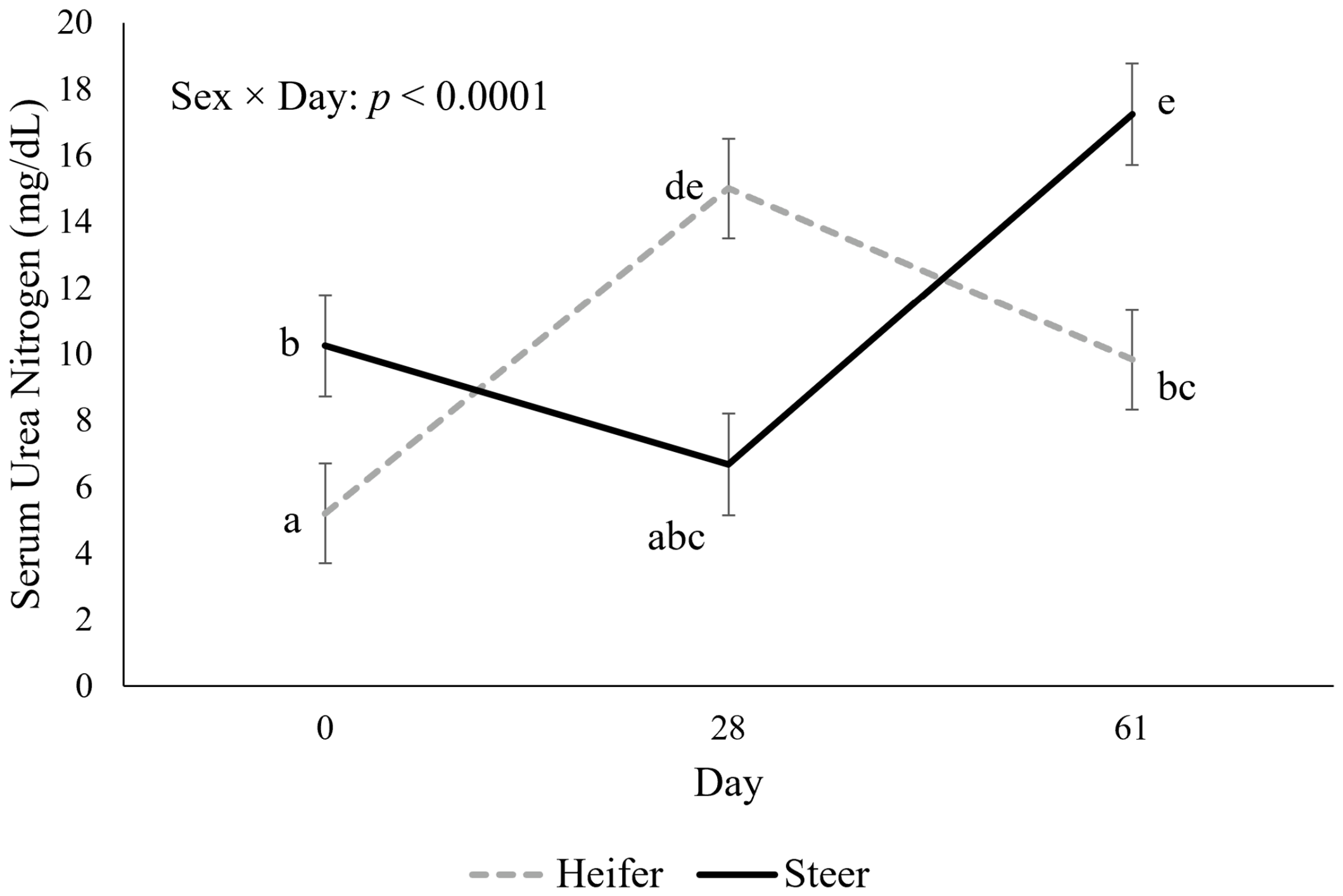
There were no treatment × sex × day (p = 0.33) or treatment × sex interaction (p = 0.72) interactions throughout the trial for SUN concentrations. However, there was a sex × day interaction (p < 0.0001) (Figure 1). On d 0 of the trial, heifer calves had lower SUN concentrations than on d 28 and 61 of the trial and a lower concentration than steer calves on d 0 and 61 of the trial (Figure 1). Additionally, steer calves had increased SUN concentrations on d 61 of the trial when compared to their concentrations on d 0 and 28, as well as in heifer calves on d 0 and 61 (Figure 1).
There were no interactions (p ≥ 0.15) observed for serum cortisol concentrations throughout the course of the trial (Table 4). Additionally, neither sex (p = 0.83) nor vitamin E injection (p = 0.26) influenced the serum cortisol concentrations during the trial (Table 4). The day tended (p = 0.06) to influence the serum cortisol concentration in the calves, with calves having increased serum cortisol concentrations on d 61 of the trial compared to d 0 (Table 4).
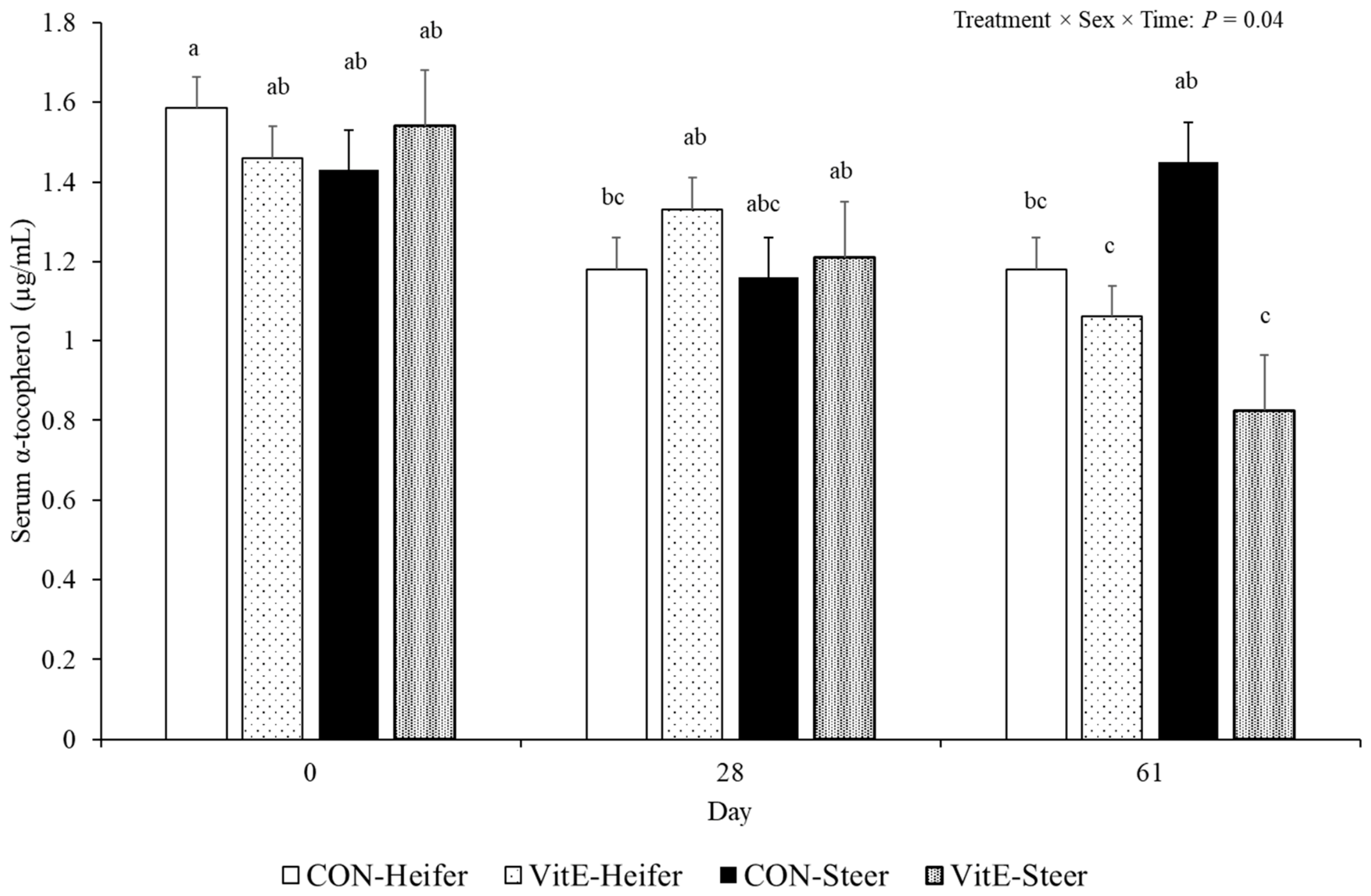
Regarding the α-tocopherol concentrations, a treatment × sex × day (p = 0.04) interaction was observed (Figure 2). Control steer calves were the only treatment group in which serum α-tocopherol concentrations did not decrease as the trial progressed. For CON heifer calves, serum α-tocopherol concentrations decreased as time progressed (Figure 2). On d 61, the VitE steer and heifer calves’ α-tocopherol concentrations were lower than all the other calves when compared to d 0 and lower than their respective concentrations on d 28 (Figure 2).

4. Discussion

In the current trial, VitE calves did not have improved ADG compared to CON calves. This is consistent with other research and meta-analysis that has found that vitamin E does not improve growth in feedlot cattle [17,32,33]. However, other research has found that vitamin E supplementation improves the carcass-adjusted ADG in feedlot steers, suggesting it may be impacting lean tissue anabolism [18]. In the current trial though, the steer calves had an improved ADG during the trial compared to the heifer calves. In growing bulls, steers, and heifers, during the early stages of growth, heifers have a lower ADG than steers and bulls [34]. Additionally, the 205-day adjusted weaning weights tended to be impacted by a sex × treatment interaction. It is important to note, that for a beef calf performance trial, this project had a smaller sample size, which is a limitation. Similarly though, in earlier conducted research, vitamin E supplementation did not improve the ADG in steers, but it did tend to initially improve the ADG in heifers [35]. However, other research has found that Angus bull and steer calves respond better to creep feeding than heifers in regard to the 205-day adjusted weaning weights [36]. This makes sense, as sex has been found to influence micronutrient needs in ruminants [22], and suggests that sex-specific micronutrient requirements could potentially be beneficial for ruminant livestock. However, more research needs to be conducted in this area.
As previously mentioned, SUN can be used as a marker for lean tissue anabolism, as it is inversely related to nitrogen retention [19]. Similar to the ADG results found in the current trial, a single vitamin E injectable 61 d before weaning did not influence the SUN concentrations. Likewise, when Simmental bulls were supplemented with increasing amounts of vitamin E in their total mixed ration, plasma urea nitrogen concentrations were not altered [37]. Despite vitamin E not altering SUN, there was a sex × time interaction noted in the current study. In Friesian calves, sex and calf age impacted the plasma urea nitrogen concentrations [38]. In red deer calves, females have lower plasma urea nitrogen concentrations than males, with the authors of that study hypothesizing that it is due to the higher nutritional requirements of the males [39]. One possible explanation for this is that steer and heifer calves may accrete protein at different rates, but more research is needed to explore the mechanisms of growth between calf sexes to develop management strategies to assist in optimizing production for beef cattle producers.
The exit velocity is one metric that cattle producers can use to evaluate animal behavior [40]. Cattle temperament is known to impact performance, reproduction, and overall animal health. In the current trial, a single pre-weaning α-tocopherol injectable had no impact on the EV. However, there was a slight tendency for heifer calves to have a faster EV than steer calves. In feedlot steers and heifers, sex was found to have a significant impact on the temperament scores, with heifers having higher mean temperament scores than steers [41]. Additionally, day had an impact on the EV in the current study. In feedlot steers, the EV slows as steers are handled more [28]. This is supported by research that found Brahman and Angus heifers become adapted to human handling and become less temperamental the more they are handled [21].
Pre-weaning cortisol concentrations have been linked to growth in receiving calves [16], and it has been suggested to improve the vitamin E status in calves prior to weaning to assist in better preparing them for the next stage of production [14]. However, in the current research, there was no impact on the serum cortisol concentrations at the time points evaluated in the trial. This is similar to results finding plasma cortisol concentrations were not changed in feedlot steers fed increasing dosages of vitamin E [33]. However, hair cortisol concentrations were decreased 21 days post transport in calves that received a vitamin E injection [17]. In the current trial, the calves were not followed after weaning, which is a limitation; so, it may be possible that the vitamin E injection is impacting post-weaning performance. It is also possible that the timing of the vitamin E injection may impact the cortisol concentrations, but more research is needed to look at the timing of a vitamin E injection and the stress response in cattle.
The dosage and single injection used in the trial were initially chosen based on the research that found that 1500 IU increased plasma α-tocopherol concentrations by four-fold in feedlot steers [25]. That was not observed in the present trial. As such, in the future, it may be beneficial to evaluate different dosages of α-tocopherol. The dosage used and no increase in the serum concentrations of α-tocopherol may explain some of the lack of results observed in the current trial. Additionally, a limitation of this trial was how α-tocopherol was evaluated. In cattle, it has been found that serum and liver α-tocopherol are correlated, and as such, serum is commonly used to evaluate α-tocopherol in cattle [33]. In human medicine though, it has been suggested to evaluate the α-tocopherol:cholesterol ratio [42], which was not done in the current trial but could be beneficial to do in future vitamin E related research.
For beef cattle, serum α-tocopherol concentrations are deemed deficient if they fall below 2 µg/mL [43]. In the current trial, all of the calves had serum α-tocopherol concentrations below 2 µg/mL suggesting they were deficient in α-tocopherol prior to and during the trial. As such, it is interesting that a response was not observed, as it has been found that when cattle are deficient in α-tocopherol they have a higher response to vitamin E administration [44]. A possible explanation for the lack of response could be the timing of the administration of the injectable, which was 61 days prior to weaning. It is possible if the injectable was given 14–21 days before weaning, as well as following the calves through post-weaning, a response to the treatment may have been observed. As such, this is a limitation of the study and something that needs to be explored further. Furthermore, only one injection was given 61 days before weaning. Due to the lack of response from the calves, a repeated administration of the injectable may have been beneficial. As just one injection was given rather early compared to when the calves were weaned, this is a limitation of the current study. Typically, a single injection is given when preparing animals for transport [33] or when deficiency is occurring. An injectable is not a substitute for providing continues vitamin E supplementation, such as in a loose premix formulation for cattle [7].
However, following administration of an α-tocopherol injectable, a treatment × sex × day interaction was observed with the control steer group’s serum α-tocopherol being the only group that did not decrease overtime. This suggests that ɑ-tocopherol metabolism in ruminants may be both sex- and time-dependent. As previously mentioned, in both humans and rats, ɑ-tocopherol concentrations are lower in the serum and tissues of males than females, suggesting a sex specific response in relationship to α-tocopherol [23,24]. Similarly, in infertile human couples, it has been found that women have higher serum α-tocopherol concentrations than men, with sex explaining 60% of the variation in α-tocopherol concentrations [45]. Taken together, this suggests that vitamin E metabolism may be sex-dependent. One possible explanation for this is possibly the inherent biological differences between steer calves and heifer calves. This could potentially be related to sex differences in oxidative stress and antioxidant status [46]. In women of reproductive age, there is increased antioxidant enzyme activity [46], and males have been found to have higher oxidative stress markers [47]. As such, more research is needed to evaluate the effect of sex in regard to vitamin E metabolism, so that optimal vitamin supplementation strategies may be developed.

5. Conclusions

Overall, in the current trial, a pre-weaning α-tocopherol injection did not influence pre-weaning calf performance or behavior, but some sex-dependent effects suggest that sex-specific micronutrient supplementation programs may potentially be beneficial and should be investigated moving forward to clarify this interaction. Designing sex-specific micronutrient requirements may be one potential method to improve beef cattle production. Future research is also warranted to investigate different dosages and different timing of administration of a vitamin E injectable to growing beef cattle.

Author Contributions

J.A.R.-R.: Data curation, Formal analysis, Investigation, Writing—original draft, Writing—review and editing; A.H.E.A.: Data curation, Investigation, Writing—review and editing; J.S.B.: Data curation, Investigation, Writing—review and editing; M.F.: Data curation, Investigation, Resources, Writing—review and editing; M.S.T.: Conceptualization, Funding acquisition, Project administration, Writing—review and editing; M.A.O.: Conceptualization, Data curation, Investigation, Methodology, Project administration, Resources, Supervision, Writing—review and editing; C.C.R.: Conceptualization, Data curation, Formal analysis, Funding acquisition, Investigation, Methodology, Project administration, Resources, Software, Supervision, Writing—original draft, Writing—review and editing. All authors have read and agreed to the published version of the manuscript.

Funding

Funding for this project was provided by the University of Hawai’i at Mānoa, College of Tropical Agriculture and Human Resilience Livestock Extension Group, USDA Hatch Funds (HAW2072H), and USDA Multistate Funds (HAW2071R) managed by the College of Tropical Agriculture and Human Resilience.

Institutional Review Board Statement

All live animal experiments, procedures, and protocols were approved by the University of Hawai’i at Mānoa Institutional Animal Care and Use Committee (Protocol #22-3937) on 5 September 2023.

Informed Consent Statement

Not applicable.

Data Availability Statement

The raw data supporting the conclusions of this article will be made available by the authors on request.

Conflicts of Interest

The authors declare no conflict of interest.

Abbreviations

The following abbreviations are used in this manuscript:
ADGAverage daily gain
CONControl treatment group
EVExit velocity
HCHeifer calves
SCSteer calves
SUNSerum urea nitrogen

References

  1. Miller, A.; Faulkner, D.; Knipe, R.; Parrett, D.; Berger, L.; Strohbehn, D. Critical control points for profitability in the cow-calf enterprise. Iowa State Univ. Anim. Ind. Rep. 2002, 1. [Google Scholar]
  2. Pell, E.W.; Thayne, W.V. Factors Influencing Weaning Weight and Grade of West Virginia Beef Calves. J. Anim. Sci. 1978, 46, 596–603. [Google Scholar] [CrossRef]
  3. Harvey, R.W.; Burns, J.C. Creep grazing and early weaning effects on cow and calf productivity. J. Anim. Sci. 1988, 66, 1109–1114. [Google Scholar] [CrossRef] [PubMed]
  4. Price, E.O.; Harris, J.E.; Borgward, R.E.; Sween, M.L.; Connor, J.M. Fenceline contact of beef calves with their dams at weaning reduces the negative effects of separation on behavior and growth rate. J. Anim. Sci. 2003, 81, 116–121. [Google Scholar] [CrossRef] [PubMed]
  5. Greenwood, P.; Cafe, L. Prenatal and pre-weaning growth and nutrition of cattle: Long-term consequences for beef production. Animal 2007, 1, 1283–1296. [Google Scholar] [CrossRef] [PubMed]
  6. Dougherty, R.W.; Allen, R.S.; Burroughs, W.; Jacobson, N.L.; McGilliard, A.D. (Eds.) Physiology of Digestion in the Ruminant: Papers Presented at the Second International Symposium on the Physiology of Digestion in the Ruminant; Ames, IA, USA, August 1964; Butterworths: London, UK, 1965; p. xv-480. [Google Scholar]
  7. National Academies of Sciences, Medicine, Division on Earth, Life Studies and Committee on Nutrient Requirements of Beef Cattle. Nutrient Requirements of Beef Cattle; National Academies Press: Washington, DC, USA, 2016. [Google Scholar]
  8. National Research Council (US); Committee on Nutrient Requirements of Small Ruminants. Nutrient Requirements of Small Ruminants: Sheep, Goats, Cervids, and New World Camelids; China Legal Publishing House: Beijing, China, 2007. [Google Scholar]
  9. Givens, D.I.; Owen, E.; Omed, H.; Axford, R. Forage Evaluation in Ruminant Nutrition; CABI: Wallingford, UK, 2000. [Google Scholar]
  10. Brigelius-Flohé, R. Vitamin E research: Past, now and future. Free. Radic. Biol. Med. 2021, 177, 381–390. [Google Scholar] [CrossRef] [PubMed]
  11. Haga, S.; Ishizaki, H.; Roh, S. The physiological roles of vitamin E and hypovitaminosis E in the transition period of high-yielding dairy cows. Animals 2021, 11, 1088. [Google Scholar] [CrossRef] [PubMed]
  12. Burton, G.; Cheeseman, K.; Doba, T.; Ingold, K.; Slater, T. Vitamin E as an antioxidant in vitro and in vivo. In Proceedings of the Ciba Foundation Symposium 101-Biology of Vitamin E; John Wiley & Sons, Ltd.: Hoboken, NJ, USA, 1983; pp. 4–18. [Google Scholar]
  13. Politis, I. Reevaluation of vitamin E supplementation of dairy cows: Bioavailability, animal health and milk quality. Animal 2012, 6, 1427–1434. [Google Scholar] [CrossRef] [PubMed]
  14. Sconberg, S.; Nockels, C.F.; Bennett, B.W.; Bruyninckx, W.; Blancquaert, A.-M.B.; Craig, A.M. Effects of shipping, handling, adrenocorticotropic hormone, and epinephrine on α-tocopherol content of bovine blood. Am. J. Vet. Res. 1993, 54, 1287–1293. [Google Scholar] [CrossRef]
  15. Ranade, R.; Talukder, S.; Muscatello, G.; Celi, P. Assessment of oxidative stress biomarkers in exhaled breath condensate and blood of dairy heifer calves from birth to weaning. Vet. J. 2014, 202, 583–587. [Google Scholar] [CrossRef] [PubMed]
  16. Foote, A.; Jones, S.; Kuehn, L. Association of preweaning and weaning serum cortisol and metabolites with ADG and incidence of respiratory disease in beef cattle. J. Anim. Sci. 2017, 95, 5012–5019. [Google Scholar] [CrossRef] [PubMed]
  17. Dornbach, C.W.; Beenken-Bobb, A.M.; Shike, D.W.; Hansen, S.L.; McCann, J.C. Effects of injectable vitamin E before or after transit on receiving phase growth performance, health, and blood parameters of beef steers. J. Anim. Sci. 2023, 101, skac333. [Google Scholar] [CrossRef] [PubMed]
  18. Burken, D.B.; Hicks, R.B.; VanOverbeke, D.L.; Hilton, G.G.; Wahrmund, J.L.; Holland, B.P.; Krehbiel, C.R.; Camfield, P.K.; Richards, C.J. Vitamin E supplementation in beef finishing diets containing 35% wet distillers grains with solubles: Feedlot performance and carcass characteristics. J. Anim. Sci. 2012, 90, 1349–1355. [Google Scholar] [CrossRef] [PubMed]
  19. Smith, Z.K.; Johnson, B.J. Mechanisms of steroidal implants to improve beef cattle growth: A review. J. Appl. Anim. Res. 2020, 48, 133–141. [Google Scholar] [CrossRef]
  20. Burdick, N.C.; Randel, R.D.; Carroll, J.A.; Welsh, T.H., Jr. Interactions between temperament, stress, and immune function in cattle. Int. J. Zool. 2011, 2011, 373197. [Google Scholar] [CrossRef]
  21. Cooke, R.F.; Bill, E. Kunkle Interdisciplinary Beef Symposium: Temperament and acclimation to human handling influence growth, health, and reproductive responses in Bos taurus and Bos indicus cattle. J. Anim. Sci. 2014, 92, 5325–5333. [Google Scholar] [CrossRef] [PubMed]
  22. Herbster, C.J.; Abreu, M.L.; Brito Neto, A.S.; Mendes, M.S.; Silva, L.P.d.; Marcondes, M.I.; Mazza, P.H.; Cabral, L.S.; Bezerra, L.R.; Oliveira, R.L. Macromineral requirements for maintenance and growth in male and female hair sheep. Front. Vet. Sci. 2023, 10, 1032429. [Google Scholar] [CrossRef] [PubMed]
  23. Weglicki, W.B.; Luna, Z.; Nair, P.P. Sex and Tissue Specific Differences in Concentrations of α-Tocopherol in Mature and Senescent Rats. Nature 1969, 221, 185–186. [Google Scholar] [CrossRef] [PubMed]
  24. Miwa, K.; Fujita, M. Gender difference in oxidative stress and its genesis by analysis of serum α-tocopherol concentrations in a Japanese population. Int. J. Cardiol. 2008, 129, 453–454. [Google Scholar] [CrossRef] [PubMed]
  25. Plascencia-Jorquera, A.; Alvarez-Almora, E.G.; Zinn, R. A comparison of via of administration of the injection of vitamin E in newly received feedlot calves. Nova Sci. 2015, 7, 11–18. [Google Scholar] [CrossRef][Green Version]
  26. Szabó, F.; Nagy, L.; Dákay, I.; Márton, D.; Török, M.; Bene, S. Effects of breed, age of dam, birth year, birth season and sex on weaning weight of beef calves. Livest. Sci. 2006, 103, 181–185. [Google Scholar] [CrossRef]
  27. Ramsay, J.M.; Hulsman Hanna, L.L.; Ringwall, K.A. Maximizing use of an extension beef cattle data set: Part 3—Weights and growth. J. Ext. 2017, 55, 4. [Google Scholar] [CrossRef]
  28. Reichhardt, C.C.; Bayles, S.A.; Feuz, R.; Motsinger, L.A.; Alberto, A.F.; Okamoto, L.L.; Brown, B.L.; Briggs, R.K.; Roholt, B.W.; Bowman, B.R.; et al. Relationship among cattle breed and anabolic implant protocol relative to feedlot performance: Growth, temperament, feeding behavior, carcass traits, and economic return. Domest. Anim. Endocrinol. 2023, 84–85, 106806. [Google Scholar] [CrossRef] [PubMed]
  29. Reichhardt, C.C.; Messersmith, E.M.; Brady, T.J.; Motsinger, L.A.; Briggs, R.K.; Bowman, B.R.; Hansen, S.L.; Thornton, K.J. Anabolic Implants Varying in Hormone Type and Concentration Influence Performance, Feeding Behavior, Carcass Characteristics, Plasma Trace Mineral Concentrations, and Liver Trace Mineral Concentrations of Angus Sired Steers. Animals 2021, 11, 1964. [Google Scholar] [CrossRef] [PubMed]
  30. Reichhardt, C.C.; Feuz, R.; Brady, T.J.; Motsinger, L.A.; Briggs, R.K.; Bowman, B.R.; Garcia, M.D.; Larsen, R.; Thornton, K.J. Interactions between cattle breed type and anabolic implant strategy impact circulating serum metabolites, feedlot performance, feeding behavior, carcass characteristics, and economic return in beef steers. Domest. Anim. Endocrinol. 2021, 77, 106633. [Google Scholar] [CrossRef] [PubMed]
  31. Rojas-Reyes, J.A.; Blad, T.J.; Bulosan, J.S.; Wanguba, A.S.; Bustamante, Y.; Thornton, K.J.; Odani, J.S.; Reichhardt, C.C. Supplementation of orally drenched ascorbic acid and injectable α-tocopherol reduces markers of naturally acquired parasites in grazing hair sheep. Small Rumin. Res. 2025, 248, 107515. [Google Scholar] [CrossRef]
  32. Elam, N. Impact of vitamin E supplementation on newly received calves: A review and meta-analysis. Prof. Anim. Sci. 2007, 23, 455–458. [Google Scholar] [CrossRef]
  33. Deters, E.L.; Hansen, S.L. Vitamin E supplementation strategies during feedlot receiving: Effects on beef steer performance, antibody response to vaccination, and antioxidant defense. J. Anim. Sci. 2019, 97, 4362–4369. [Google Scholar] [CrossRef]
  34. Blanco, M.; Ripoll, G.; Delavaud, C.; Casasús, I. Performance, carcass and meat quality of young bulls, steers and heifers slaughtered at a common body weight. Livest. Sci. 2020, 240, 104156. [Google Scholar] [CrossRef]
  35. Rivera, J.; Duff, G.; Galyean, M.; Walker, D.; Nunnery, G. Effects of supplemental vitamin E on performance, health, and humoral immune response of beef cattle. J. Anim. Sci. 2002, 80, 933–941. [Google Scholar] [CrossRef] [PubMed]
  36. Anderson, J.; Wilham, R. Weaning weight correction factors from Angus field data. J. Anim. Sci. 1978, 47, 124–130. [Google Scholar] [CrossRef]
  37. Wei, C.; Lin, S.; Wu, J.; Zhao, G.; Zhang, T.; Zheng, W. Supplementing vitamin E to the ration of beef cattle increased the utilization efficiency of dietary nitrogen. Asian-Australas. J. Anim. Sci. 2016, 29, 372. [Google Scholar] [CrossRef] [PubMed][Green Version]
  38. Min, S.; McCutcheon, S.; Mackenzie, D.; Wickham, B. Plasma metabolite and hormone concentrations in Friesian calves of low or high genetic merit: Effects of sex and age. Anim. Sci. 1993, 56, 17–27. [Google Scholar] [CrossRef]
  39. Wilson, E.; Fleming, A.; Vollebregt, M.; Gregorini, P. Relationship between Plasma and Saliva Urea Nitrogen Concentrations in New Zealand Red Deer Calves (Cervus elaphus). Animals 2024, 14, 2565. [Google Scholar] [CrossRef] [PubMed]
  40. Curley, K., Jr.; Paschal, J.; Welsh, T., Jr.; Randel, R. Exit velocity as a measure of cattle temperament is repeatable and associated with serum concentration of cortisol in Brahman bulls. J. Anim. Sci. 2006, 84, 3100–3103. [Google Scholar] [CrossRef] [PubMed]
  41. Voisinet, B.; Grandin, T.; Tatum, J.; O’connor, S.; Struthers, J. Feedlot cattle with calm temperaments have higher average daily gains than cattle with excitable temperaments. J. Anim. Sci. 1997, 75, 892–896. [Google Scholar] [CrossRef] [PubMed]
  42. Berger, M.M.; Talwar, D.; Shenkin, A. Pitfalls in the interpretation of blood tests used to assess and monitor micronutrient nutrition status. Nutr. Clin. Pract. 2023, 38, 56–69. [Google Scholar] [CrossRef] [PubMed]
  43. Adams, C.R. Feedlot cattle need supplemental vitamin E. Feedstuffs 1982, 54, 24–25. [Google Scholar] [CrossRef] [PubMed]
  44. Secrist, D.S.; Owens, F.N.; Gill, D.R.; Boyd, L.J.; Oldfield, J.E. Effects of vitamin E on performance of feedlot cattle: A review. Prof. Anim. Sci. 1997, 13, 47–54. [Google Scholar] [CrossRef]
  45. Al-Azemi, M.K.; Omu, A.E.; Fatinikun, T.; Mannazhath, N.; Abraham, S. Factors contributing to gender differences in serum retinol and α-tocopherol in infertile couples. Reprod. Biomed. Online 2009, 19, 583–590. [Google Scholar] [CrossRef] [PubMed]
  46. Wróblewska, J.; Długosz, A.; Wróblewski, M.; Nuszkiewicz, J.; Wróblewska, W.; Woźniak, A. Sex differences in vitamin metabolism and their role in oxidative stress regulation and cardiometabolic health. Nutrients 2025, 17, 2697. [Google Scholar] [CrossRef] [PubMed]
  47. Ide, T.; Tsutsui, H.; Ohashi, N.; Hayashidani, S.; Suematsu, N.; Tsuchihashi, M.; Tamai, H.; Takeshita, A. Greater oxidative stress in healthy young men compared with premenopausal women. Arterioscler. Thromb. Vasc. Biol. 2002, 22, 438–442. [Google Scholar] [CrossRef] [PubMed]
Figure 1. Serum urea nitrogen concentrations (mg/dL) were determined on d 0, 28, and 61 of the trial as described in the Section 2. Sixty-one days prior to weaning, both nursing Angus and Hereford steer calves (SC; n = 16) and Angus and Hereford heifer calves (HC; n = 28) were assigned to one of two treatments: (1) no injectable α-tocopherol (CON; n = 23) or (2) 1500 IU of injectable ɑ-tocopherol administered subcutaneously (VitE; n = 21; Vitamin E 300; Durvet Animal Health; Blue Springs, MI). Different letters indicate differences (p ≤ 0.05) between each group and time. Data are presented as LS means ± SEM.
Ruminants 06 00045 g001
Figure 2. Serum α-tocopherol concentrations (µg/mL) were determined on d 0, 28, and 61 of the trial as described in the Materials and Methods. Sixty-one days prior to weaning, both nursing Angus and Hereford steer calves (SC; n = 16) and Angus and Hereford heifer calves (HC; n = 28) were assigned to one of two treatments: (1) no injectable ɑ-tocopherol (CON; n = 23) or (2) 1500 IU of injectable ɑ-tocopherol administered subcutaneously (VitE; n = 21; Vitamin E 300; Durvet Animal Health; Blue Springs, MI). Different letters indicate differences (p ≤ 0.05) between each group and time. Data are presented as LS means ± SEM.
Ruminants 06 00045 g002
Table 1. Nutritional analysis of pasture samples over the course of the trial 1.
Feed Analysis (Dry Matter %)Day 0Day 13Day 28Day 61
Crude Protein (%)14.4913.9111.427.17
Acid Detergent Fiber (%)30.9631.6232.7536.89
Neutral Detergent Fiber (%)58.8559.8959.8966.49
Ether Extract (%)3.253.133.352.63
Ash (%)8.077.585.695.20
Mineral Content (Dry Matter %)
Calcium (%)0.350.290.360.34
Phosphorus (%)0.280.270.320.20
Magnesium (%)0.290.250.290.34
Potassium (%)2.702.372.521.48
Sulfur (%)0.180.180.190.22
Sodium (%)0.0780.0680.1580.073
Chloride (%)1.221.101.261.04
Zinc (ppm)52325756
Iron (ppm)142344132646
Manganese (ppm)6854112172
Copper (ppm)8777
1 Pasture samples were collected on days 0, 13, 28, and 61 of the trial for nutritional analysis.
Table 2. Average daily gain and 205-day weights of Angus and Hereford steer and heifer calves following a vitamin E injection.
Calf Sex and Treatments 1 p-Values
ControlVitE
Heifer
Calves
Steer Calves Heifer CalvesSteer CalvesSEM 2SexTRT 3S × T 3
Calves (n)158138
Average Daily Gain, kg
Day 0–130.921.140.911.170.100.010.920.85
Day 13–281.131.070.970.970.110.750.220.75
Day 28–610.710.870.800.920.060.020.200.67
Overall Average Daily Gain, kg (Day 0–61)0.830.940.870.960.040.010.450.67
Total Gain, kg50.3159.5253.1059.972.670.0020.500.63
205 d weight, kg262 x297 z269 xy282 yz6.590.00020.540.08
1 Both steer calves (n = 16) and heifer calves (n = 28) were assigned to one of two treatments: (1) no injectable ɑ-tocopherol (CON; n = 23) or (2) 1500 IU of injectable α-tocopherol administered subcutaneously (VitE; n = 21; Vitamin E 300; Durvet Animal Health; Blue Springs, MI). 2 Standard error of the mean. 3 Treatment (TRT) or S × T (Sex × Treatment). x,y,z Values within a row with different letters tend to be different (0.05 < p ≤ 0.10) from one another.
Table 3. Exit velocity (m/s) of Angus and Hereford steer and heifer calves following a vitamin E injection.
Exit Velocity
(m/s)
SEM 2p-Values
Sex 1
Steer Calves1.170.06p = 0.10
Heifer Calves1.31
Treatments 1
CON1.240.06p = 0.95
VitE1.23
Day
Day 01.36 a0.07p = 0.0005
Day 281.36 a
Day 610.99 b
Sex × Treatment 3 p = 0.30
Sex × Day 3 p = 0.44
Treatment × Day 3 p = 0.80
Sex × Treatment × Day 3 p = 0.80
1 Both steer calves (n = 16) and heifer calves (n = 28) were assigned to one of two treatments: (1) no injectable ɑ-tocopherol (CON; n = 23) or (2) 1500 IU of injectable α-tocopherol administered subcutaneously (VitE; n = 21; Vitamin E 300; Durvet Animal Health; Blue Springs, MI). a,b Values within a column with different letters are different (p ≤ 0.05) from one another. 2 Standard error of the mean. 3 p-values are from when exit velocity (m/s) was analyzed with repeated measures.
Table 4. Serum cortisol concentrations (ng/mL) of Angus and Hereford steer and heifer calves following a vitamin E injection.
Serum Cortisol (ng/mL)SEM 2p-Values
Sex 1
Steer Calves56.325.11p = 0.26
Heifer Calves49.73
Treatments 1
CON53.664.36p = 0.83
VitE52.39
Day
Day 043.65 x6.08p = 0.06
Day 2856.99 y
Day 6158.44 y
Sex × Treatment 3 p = 0.67
Sex × Day 3 p = 0.82
Treatment × Day 3 p = 0.15
Sex × Treatment × Day 3 p = 0.24
1 Both steer calves (n = 16) and heifer calves (n = 28) were assigned to one of two treatments: (1) no injectable α-tocopherol (CON; n = 23) or (2) 1500 IU of injectable ɑ-tocopherol administered subcutaneously (VitE; n = 21; Vitamin E 300; Durvet Animal Health; Blue Springs, MI). x,y Values within a column with different letters tend to be different (0.05 < p ≤ 0.10) from one another. 2 Standard error of the mean. 3 p-values are from when serum cortisol concentrations (ng/mL) were analyzed with repeated measures.
Disclaimer/Publisher’s Note: The statements, opinions and data contained in all publications are solely those of the individual author(s) and contributor(s) and not of MDPI and/or the editor(s). MDPI and/or the editor(s) disclaim responsibility for any injury to people or property resulting from any ideas, methods, instructions or products referred to in the content.