Effect of Iodoform in Maize and Clover Grass Silages: An In Vitro Study
by
 , and
, and
Selene Massaro
1,* ,
,
Britt Jantzen
2,
Anne Marie Dixen Axel
2,
Franco Tagliapietra
1 and
Hanne Helene Hansen
2,* 1
Department of Agronomy, Food, Natural Resources, Animals and Environment (DAFNAE), University of Padua, Viale dell’Università 16, Legnaro, 35020 Padua, Italy
2
Department of Veterinary and Animal Sciences, University of Copenhagen, Grønnegårdsvej 3, 1870 Frederiksberg C, Denmark
*
Authors to whom correspondence should be addressed.
Ruminants 2024, 4(3), 418-432; https://doi.org/10.3390/ruminants4030030
Submission received: 7 June 2024
/
Revised: 9 August 2024
/
Accepted: 29 August 2024
/
Published: 30 August 2024
Simple Summary
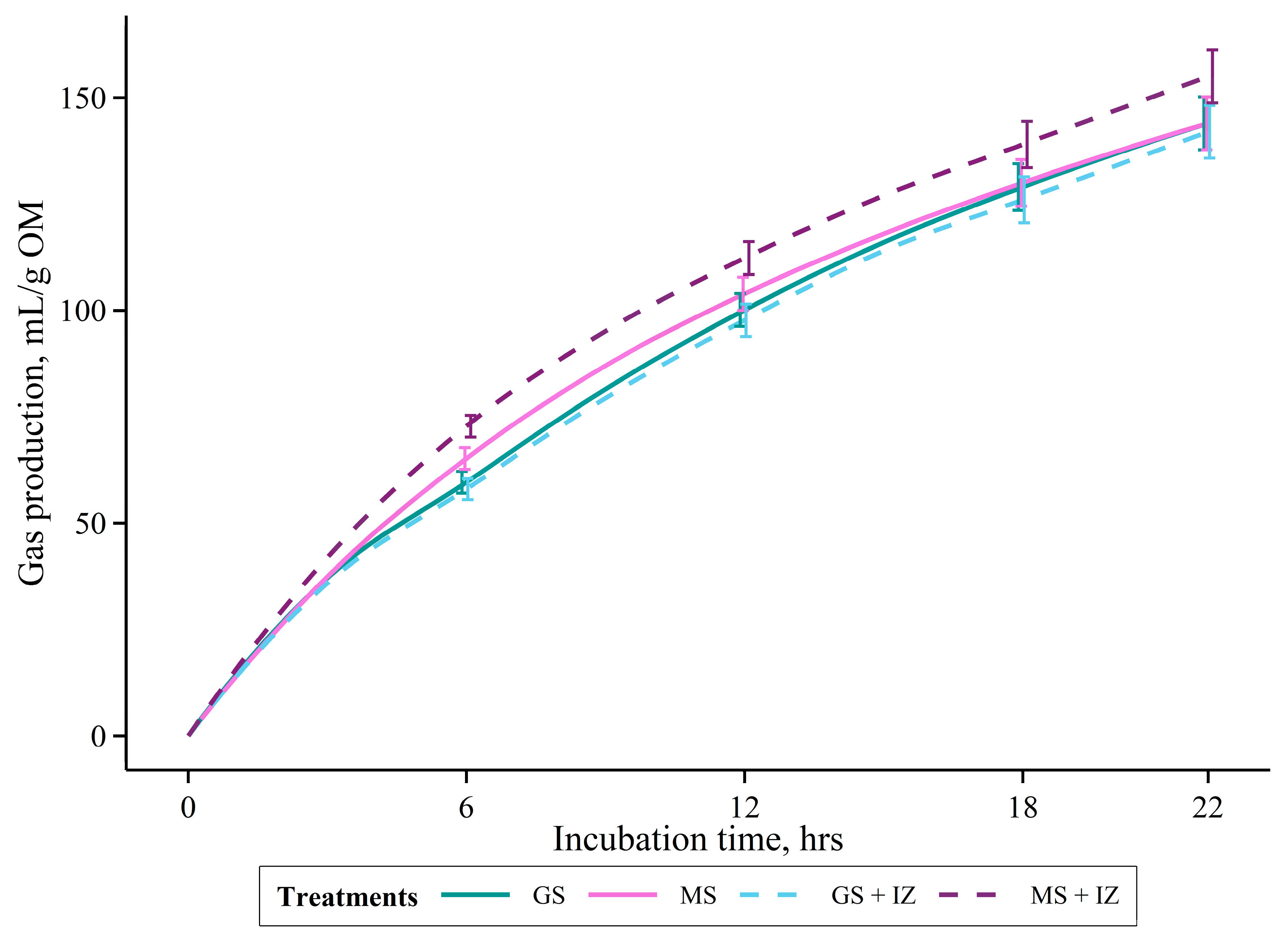
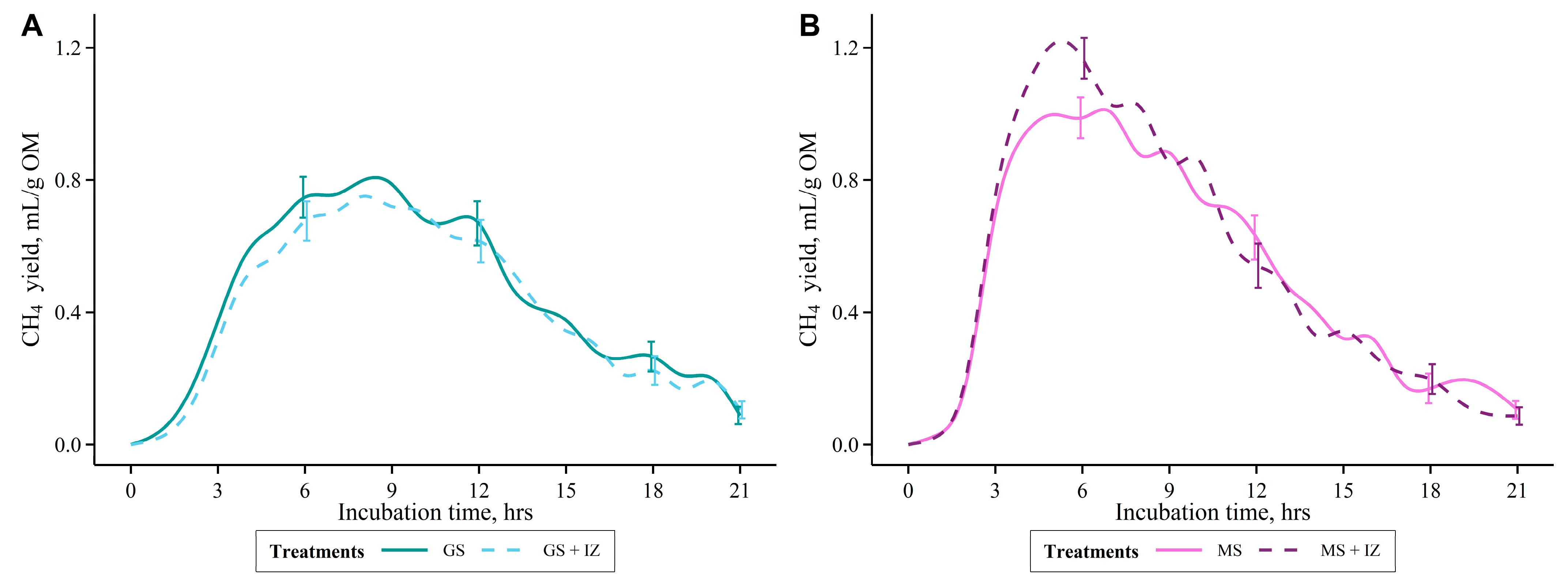
The implementation of new strategies for the reduction of methane emissions by cattle is necessary. Iodoform is an additive that has the potential to inhibit methane production during digestion in ruminants. The present research investigated the effect of iodoform on maize silage and clover grass silage in four 22 h in vitro gas production fermentations with periodic gas chromatography sampling. Iodoform decreased organic matter degradation in both substrates but only significantly in grass silage. The total volatile fatty acid production increased, and the profile was altered, but only significantly in grass silage. There were consistently opposite effects of 0.032 mg/g of dry matter substrate of 0.064% iodoform in zeolite on total gas production and methane production in the two substrates, although not all differences were significant. Iodoform decreased total gas production and methane yield when added to grass silage but consistently and significantly increased both total gas and methane yield when added to maize silage. The efficiency of microbial conversion decreased significantly when iodoform was added to both substrates. These results show differential effects of iodoform on maize silage and clover grass silage and suggest that more research is needed to study the mechanism of methane reduction by iodoform in enteric methane production.
Abstract
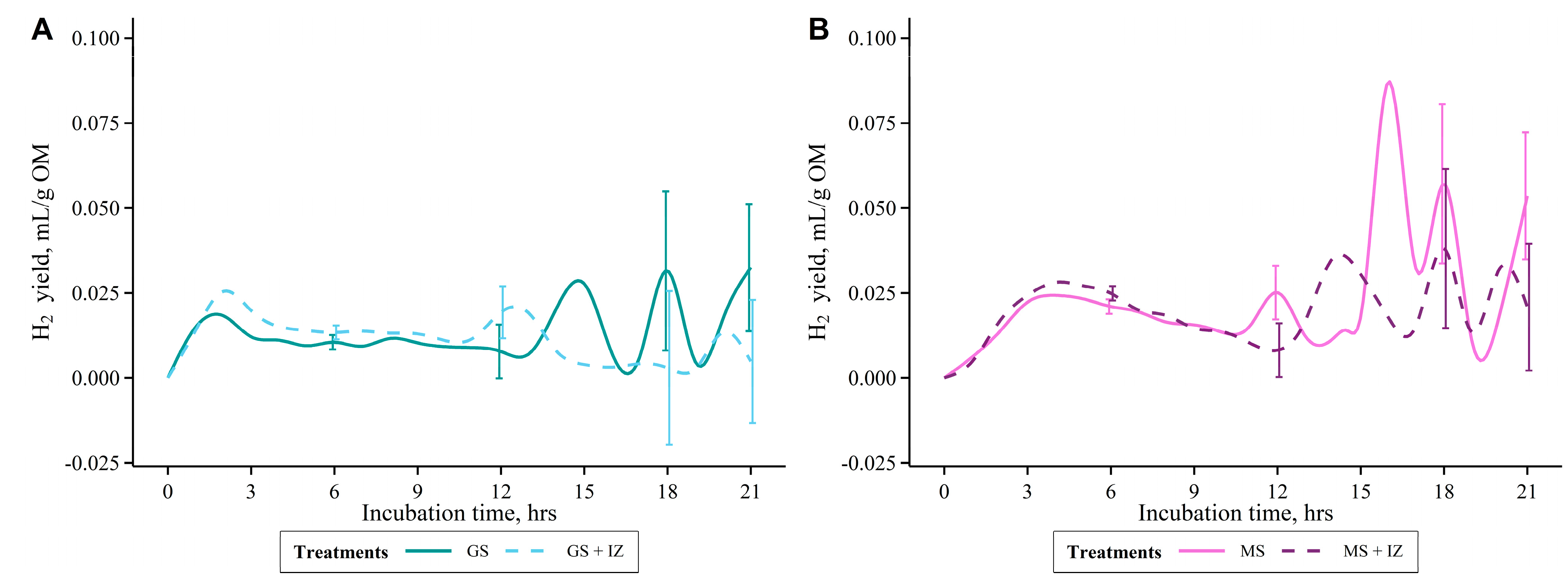
Iodoform has been shown to be an enteric methane-reducing agent. This study aimed to investigate if iodoform differentially affected maize (MS) and clover grass silage (GS). These substrates were used in four 22 h in vitro gas production fermentations with and without 0.032 mg/g of dry matter substrate of 0.064% iodoform in zeolite (IZ). The results of organic matter degradation (dOM, g/g), volatile fatty acids (VFAs, mMol/L), partitioning factor (PF, mg/mL), total gas production (TGP, mL/g OM), and periodic hydrogen and methane yield (mL/g OM) were evaluated. The interaction between substrate and IZ for dOM was significant with significantly less in GS. The interaction between substrate and additive was continuously significant for TGP. The additive in GS numerically decreased the TGP, but significantly increased TGP in MS. The interaction between substrate and additive was sporadically significant with methane, increasing the yield when IZ was added to MS, but a consistent, non-significant, decrease in yield was found when IZ was added to GS. Total VFA production and propionate content increased in both substrates with the addition of IZ, but only significantly in GS. Iodoform significantly decreased the efficiency of microbial conversion (PF) in both substates. Differential effects of iodoform on GS and MS were evident. More research is needed to determine the modes of action of iodoform.
Keywords:
degradation; fermentation; in vitro gas production; iodoform; methane