

Article

The Effect of Boosting Dietary Lactobacillus and Phytochemical Rich Foods on Biomarkers of Longevity—A Phase II Randomised Placebo Controlled Trial


by
Robert J. Thomas
1,2,3,4,*,
Madeleine Williams
4,
Jeffrey W. F. Aldous
2,
Stacey A. Kenfield
5,6 and
Robert U. Newton
7
1
Department of Oncology, Addenbrooke’s, Cambridge University Hospital, Cambridge CB2 0QQ, UK
2
Department of Nutrition and Sports Science, University of Bedfordshire, Bedford MK41 9EA, UK
3
Department of Integrated Medicine, University College London Hospital (UCLH), London NW1 2BU, UK
4
The Primrose Research Unit, Bedfordshire Hospital, Bedford MK42 9DJ, UK
5
Department of Urology, University of California, San Francisco, CA 94158, USA
6
Department of Epidemiology & Biostatistics, University of California, San Francisco, CA 94158, USA
7
Exercise Medicine Research Institute, Edith Cowan University, Perth, WA 6027, Australia
*
Author to whom correspondence should be addressed.
J. Ageing Longev. 2026, 6(2), 35; https://doi.org/10.3390/jal6020035
Submission received: 14 January 2026 / Revised: 12 March 2026 / Accepted: 20 March 2026 / Published: 1 April 2026

Abstract

As men age, systemic inflammation increases, whereas grip strength (GS) and testosterone levels tend to fall. This rate of decline is known to be influenced by gut microbial health, lifestyle and diet but the role for interventions to slow this decline are less well established. This double-blind randomised controlled trial evaluated the impact, and explored the synergistic potential, of boosting phytochemical rich foods and Lactobacillus probiotics on these physical and biological markers. Two hundred and eight men with untreated early prostate cancer managed with observation only (average age 74 years) received a phytochemical rich supplement (PRS) containing concentrated broccoli, green tea, pomegranate, ginger, cranberries and turmeric (YourPhyto). In addition, they were randomised to either a 5-blend Lactobacillus probiotic (PB) capsule (YourGutplus) or a placebo (P). Average GS improved by 2.5 kg from baseline to trial completion, at 4 months in men taking PRS +P (95% CI 1.8–3.4, p < 0.001). In the PRS+PB arm, GS improved by 4.4 kg (95% CI 3.6–5.2, p < 0.001). The odds of grip strength improving was 11.8% greater (p = 0.002, OR = 1.11, 95% CI 1.04–1.20) in the PRS+PB arm. Improvements in systemic inflammation were better in the PRS+PB arm (−0.41 vs. +0.39, p = 0.04). Four-month testosterone levels were greater in the PRS+PB arms (14.75 vs. 13.02 ng/L, 95% CI 0.23 to 3.33 ng/L p = 0.046). In conclusion, boosting dietary phytochemicals was associated with improved GS. The addition of this blend of Lactobacillus further enhanced GS, and reduced markers of inflammation. These data justify longer studies exploring the synergy between phytochemicals and probiotics, on more objective markers of longevity.

1. Introduction

Hallmarks of ageing, in men, include declining testosterone, increased oxidative stress, reduced immune surveillance and excess systemic inflammation, all of which contribute to tissue degeneration, susceptibility to disease, lower strength and physical fitness [1,2]. Within clinical practice and academic research, biomarkers which correlate with ageing include serum testosterone and various measures of systemic inflammation such as neutrophil to lymphocyte ratio [3]. Grip strength is a practical tool, as it has been shown to correlate, not just with overall physical fitness, but with levels of inflammation, cognitive impairment, diabetes, depression, cancer, bone mineral density, falls, all of which are linked to reduced health span [4,5,6,7,8,9,10,11,12,13].
Dietary factors such as phytochemical rich and fermented foods help maintain a healthy gut microbiome which, otherwise, tends to deteriorate with age [4,7,8]. A healthier gut with better immune surveillance and lower inflammation is increasingly being recognised as an important factor for maintaining testosterone levels, supporting physical activity and muscle strength [9,10,11,12,13].
The most well-known mechanisms for the benefits of phytochemicals are via their ability to augment oxidative enzyme function which protects cells from Reactive Oxygen Species (ROS) [9]. During exercise, when intra cellular levels of ROS increase, there is an adaptive upregulation of antioxidant genes such as nuclear related factor-2 (Nrf-2) but the duration of oxidative stress lasts longer if there is deficiency in dietary phytochemicals, especially as people age, when this adaptive process is slower [13,14,15,16]. Phytochemicals also have beneficial anti-inflammatory properties. For example, epigallocatechin-3-gallate, quercetin found in tea, and curcumin, help lower excess inflammation, via inhibition of NF-kappaB [17]. Ginger and turmeric contain natural salicylates, which reduce inflammation via COX-2 and prostaglandins pathways [16,17,18,19,20,21,22,23,24,25,26,27]. Some phytochemicals such as those in pomegranate, tea and cranberries have health benefits via an ability to enhance cellular nitric oxide levels which augments arterial vasodilation increasing muscle, heart, and brain oxygenation [16,17,18,19,20,21,22,23,24,25,26,27,28].
On top of these direct properties, phytochemicals act as prebiotics which support the growth of probiotic bacteria and enhance gut health [29,30,31,32,33,34,35]. The fibre and prebiotic phytochemicals found in broccoli, cranberries, tea, and ginger support the formation of short-chain fatty acids such as butyrate that provide energy for favourable bacteria as well as the cells lining the gut, leading to improved gut wall integrity [32]. Phytochemicals in pomegranate including resveratrol also enhance the formation of a protective biofilm, facilitating adhesion, aggregation, and colony formation [32]. This synergy is mutual, as probiotic bacteria, in return, aid the breakdown of phytochemicals into more readily absorbed, bioactive subunits [32,33,34,35].
Cohort studies have established clear links between diet, lifestyle and the risk of chronic degenerative disease, improved well-being and lifespan, often collectively referred to as longevity [1,2]. Probiotic and phytochemical rich food supplements, independently, have been shown to improve joint stiffness, improve cartilage repair, enhance mobility and physical independence in the elderly and improve strength and sports performance in younger adults [14,15,16,17,18,19,20,21,22,23,24,25,26,27,34,35,36,37,38,39,40,41,42]. What is less well established, and what this study aimed to investigate, is whether enhancing these healthy elements of food, prospectively, could improve biomarkers of longevity, starting in a more elderly cohort. What is more, despite the data highlighting the benefits of combining phytochemicals and probiotics, there is a deficit of intervention studies which evaluate their potential synergy; hence the further justification for this study.

2. Materials and Methods

This phase II randomised controlled trial was conducted in the Oncology department of Bedford Hospital, part of the Cambridge University Hospitals’ network, in partnership with the Institute of Sport Science Bedford University, The Department of Urology and Epidemiology & Biostatistics, University of California and the Exercise Medicine Research Institute, Edith Cowan University, Australia. The Hospital Research and Development and UK National Ethics committees approved the protocol and all amendments (IRAS: 321309). The trial was logged with UK Clinical Trials Registry (ISRCTN: 81939514). The trial was conducted according to the provisions of the Declaration of Helsinki and consort 2025 guidelines for randomised controlled trials. At the end of the trial, the data was independently audited to ensure no inconsistencies or deviation from source data, before being sealed and sent to the external statistician for blinded analysis. Artificial intelligence was not used in any aspect of this trial. The design of this trial was strongly influenced by Melton Mowbray patient advisory group. Involvement was not just for the information sheets but their feedback was crucially inputted in the design of the study itself, including the choice of practical end points, nutritional interventions in each arm and acceptance, and level of placebo. This ensured the design was highly acceptable to participants—which was why it was recruited rapidly and seamlessly with a high level of compliance. The phytochemical rich supplements were made by YourPhyto (Redrose Manufacturing Ltd., Dubmire Industrial Estate, Houghton le Spring DH4 5RJ). The probiotic complex was made by YourGutPlus (Oxford Health Ltd., Longlands Rd, Bicester OX26 5AH).

2.1. Participants

A total of 221 eligible men were considered for recruitment between October 2023 to June 2024 [Figure 1 Consort diagram]. Participants were referred to the recruiting unit by urological and oncological colleagues. They were eligible provided they had histologically confirmed prostate cancer, were not taking androgen deprivation therapy, agreed to cease all other over-the-counter food supplements and were deemed suitable for surveillance following multidisciplinary team discussion. All participants gave written informed consent. Nine men declined trial entry following verbal and written information leaving 212 to consent.

2.2. Randomisation and Masking

Random assignment for the probiotic or placebo (1:1) was conducted by a computer-generated block technique with no subgroup stratification. The supplements were supplied directly to the research unit in white sealed pouches marked A or B containing white capsules identical in colour taste and aroma. The trust secretary, independent to the research unit, was given their allocation and provided this to the scientific committee only after the final statistical analysis. The PRS given to all participants, was open label.
All participants were routinely given verbal and written exercise and healthy living advice in the recruiting oncology department. After consent, 3 withdrew from the PRS+P arm and one from the PRS+PB arm and no parametric or demographic details were recorded so they were not included in the final analysis, leaving 208 evaluable participants. Baseline demographics, including Body Mass Index (BMI) and ethnicity, were similar in both randomised arms except average age, which was marginally higher in the PRS+P arm vs. PRS+PB arm (76 vs. 73 years, p = 0.02, 95% CI 1–6 years) which could be a factor why baseline grip strength was also marginally higher in the PRS+PB vs. PRS+P arm (36.4 vs. 31.1 kg p = 0.03, 95% CI 3.9–4.8) [see Table 1].

2.3. Procedures

All men were given two of the phytochemical-rich food (PRS) capsules a day and were then randomised to take an additional two capsules a day of the probiotic (PB) or placebo (P).
The PRS contained the same combination of foods found to be safe in prior research but this updated version contained additional cranberry and ginger [43]. In total, it contained six different food types which aimed to provide a wide spectrum of synergistically acting phytochemicals yet avoided over consumption of one particular type, which could have led to toxicity [44]. Uniquely, this supplement also contained concentrated extracts from the same plants increasing phytochemical levels which were measured and standardised for consistency. It is now commercially known as YourPhyto. Men took 2 capsules a day for 4 months, each containing Curcuma longa (150 mg) and 50:1 extract, standardised to curcuminoids 95% 500 mg; pomegranate (Punica granatum 150 mg and 50:1 extract,) standardised to 90% ellagic Acid (500 mg); green tea (Camellia sinensis 3:1 extract), standardised to 45% Epigallocatechin gallate (EGCG 150 mg); broccoli (Brassica oleracea 150 mg); ginger (Zingiber officinale Roscoe 5 mg); and cranberry (Vaccinium subg. oxycoccus, extract 25:1 100 mg).
The probiotic (PB) intervention contained 10 billion colony forming bacterial units, plus prebiotics (Inulin and cholecalciferol). This specific combination had been evaluated in previous clinical trials and found to be safe and well-tolerated [27]. It is now commercially known as YourgutPlus. Participants took, either a placebo capsule twice a day, containing inert fillers, or the probiotic capsule each containing: Lactobacillus rhamnosus 300 colony forming units (CFU), 5.6 mg; Lactobacillus plantarum 500 CFU, 5.6 mg; Lactobacillus paracasei 300 CFU, 835 μg; Lactobacillus bulgaricus 50 CFU, 100 mg; Lactococcus lactis 200 CFU, 835 μg; Inulin 90%, 100 mg; and Vitamin D, 2.2 mg (500 International units (IU)), known to have prebiotic properties [45].

2.4. End Points

The primary end point to this aspect of the trial was the GS between the two randomised groups, measured at the study baseline and then at the end of the intervention at 4 months. To calculate grip strength a Camry Electronic Hand Dynamometer was used (Takei Scientific Instruments, Tokyo, Japan). GS measurements were taken with the men in an upright sitting position, with their arms naturally hanging down, and were instructed to grip the dynamometer. Men were requested not to perform any actions such as “pressing against the body” or “swinging”. The grip width of the dynamometer was adjusted so that the second joint of the index finger was at approximately 90 degrees. Grip strength measurements were conducted twice, on the self-reported strongest hand. The recorded values were rounded down to the nearest kilogram, and the highest of the two scores was recorded in the clinical research file (CRF). The secondary end points were levels of systemic inflammation determined by the neutrophil to lymphocyte ratio (NLR) from a full blood count taken at baseline and at 4 months. Serum testosterone levels were taken at 4 months and compared between the two groups.

2.5. Statistical Analysis

A priori power calculation (G∗Power 3) was used to determine the number of participants required for this study at an alpha level of 0.05 and a statistical power of 95% [46]. It was determined that, to detect a moderate effect size change (d = 0.66) between the groups, a total of 85 participants were to be recruited for each group. To compensate for potential dropouts or missing data, a further 20 patients were added per group, making the final recommended target participant recruitment of approximately 210. All inferential statistics were performed using IBM SPSS Statistics (Version 26, IBM Corp., Armonk, NY, USA). Prior to inferential data analysis, all data was checked for normality using histograms or via a Smirnov–Kolomogrov test. Chi-square tests and paired sample t-tests were used to assess the differences in demographics between the groups. A linear mixed model (LMM) was used to evaluate the difference between the two groups. The fixed factors (arm and time) and random (participant) effects for each LMM, were used. The grip strength at baseline was used as a covariate. Using the smallest Hurvich and Tsai criterion (AICC) an appropriate model was chosen for each variable. This type of analysis was preferred as it allows for missing data, can accurately model different covariate structures for repeated measures data and can model between-subject variability. Step down Hommel adjusted post hoc pairwise comparisons were calculated if a significant main effect and/or interaction effect was present. Where a significant main and/or interaction effect was obtained a Sidak post hoc test was used to locate significant differences. A linear regression was also performed on % PSA change from baseline to 4 months with mean grip strength difference over the same time period. Prior to the regression analyses, continuous predictors were assessed for multicollinearity using variance inflation factors (VIF), and categorical variables were dummy-coded where necessary. The Hosmer–Lemeshow goodness-of-fit test was used to evaluate the model’s fit, and Nagelkerke’s R2 was reported to estimate the proportion of variance explained by the model. Odds ratios (OR) with 95% confidence intervals (CI) were calculated for each predictor to quantify the strength and direction of associations with the outcome variable. The two-tailed alpha level was set as p < 0.05 for all statistical tests. Provided men gave written informed consent, had serum analysis and grip strength measures at 4 months they were included in the intention to treat analysis.

3. Results

3.1. Mean Grip Strength

Mean grip strength (GS) significantly increased from baseline to four months in both the PRS + P (mean (SD): 31.1 (±8.7) kg to 33.7 (±9.1) and the PRS+PB (36.4 (±7.3) kg to 40.8 (±7.6) arms, see Table 2. The mean difference from baseline to four months was, however, statistically significantly greater in the PRS+PB versus the PRS+P arm (4.4 vs. 2.5 Kg, p < 0.001, 95% CI 0.8 to 3.0 kg), see Table 3. The odds of GS improving was 11.8% greater (p = 0.002, OR = 1.11, 95% CI 1.04 to 1.20) in PRS+PB compared with the PRS+P arm.

3.2. Inflammation Measured via the Neutrophil to Lymphocyte Ratio (NLR)

In the PRS+P arm the mean NLR increased by 0.39 at four months versus baseline (Table 3). In the PRS+PB arm the mean NLR reduced by 0.41. The difference in the mean change in NLR from baseline to four months between the two arms of 0.79 was statistically significant (p = 0.04. 95% CI 0.03–1.53).

3.3. Testosterone

The average serum testosterone level at four months for men in the PRS+P arm was 13.02 ± 6.99 nmol/L versus 14.75 ± 476 nmol/L in the PRS+PB arm (Table 3). This mean difference of 1.73 nmol/L (12%) was significantly significant (p = 0.046, 95% CI 0.23 to 3.33 nmol/L).

3.4. Adverse and Other Events

There were no significant changes in liver function tests and urea and electrolytes or other blood parameters before or after trial entry. One participant reported loose bowels but four commented that their bowels had improved. One patient developed a mild skin rash; otherwise, the supplements were well tolerated.

4. Discussion

Cohort studies have established clear links between diet, lifestyle and the risk of chronic degenerative disease, well-being and lifespan, often collectively referred to as longevity [1,2]. What is less well established, and what this study aimed to help elucidate, was whether enhancing healthy elements of food, prospectively, could influence physical and biological markers, starting in a more elderly cohort.
This study had two main parts, the first evaluated the impact of these dietary interventions on prostate cancer progression, the results published separately [45]. As this cohort of men were taking no medical treatments for their low-risk disease and have an interest in self-help lifestyle strategies, they were an ideal cohort for a “bolt-on” evaluation of other end points related to longevity, within a randomised controlled setting. These data are presented here for the first time.
This part of the study had a phase II element which found a statistically significant (8%) improvement in average grip strength in a cohort of older men following a four-month intake of the capsule which boosted dietary levels of six phytochemical-rich foods. This finding supports previous studies which have linked better exercise performance after increased intake of phytochemical-rich foods via concentrates or supplements [7,8,9,10,11,12,13,14,15,16,17,18]. Most of these trials, however, involved younger fitter athletes, so it is reassuring to report this benefit in an older cohort. The main caveat to this finding was that there was no control arm, without any PRS. This aspect of the design was influenced by the patient support groups, who advised that a control only arm would be unacceptable to potential participants, risking recruitment failure. As with all phase II analyses, it must be noted that it is possible the improvement from baseline to four months, although interesting and worth further substantiation, could have been a placebo effect.
The randomised element of this study, however, was more robust. It demonstrated that intake of this five-blend Lactobacillus capsule, which aimed to improve gut health, in addition to the PRS, compared to a blinded control, further improved GS—a difference of 57% between the two randomised groups. Although, there is a chance that, at baseline, men in the PRS+PB group were slightly younger and stronger there is nothing in the literature to suggest that these men are more or less likely to respond to a nutritional intervention; hence we believe the difference between the two randomised arms is genuine and statistically robust. This finding supports previous studies which have highlighted the importance of a healthy gut for athletes and the role for probiotic supplements [34,35,36,37]. Laboratory studies have reported a strong beneficial synergy between phytochemicals and probiotic bacteria [27,28,29,30,31,32,33]. We believe, however, that this is the world’s first double-blind RCT to show that a dietary intervention that boosted, and combined, both phytochemical rich foods and Lactobacillus probiotics helped improve strength in a non-athletic, older population. The underlying mechanisms why Lactobacillus probiotics help strength are multifactorial and not yet established but they have previously been shown to help cognitive decline, mood, viral infections and arthritis which affect the ability and motivation to exercise [27,28,29,30,31,32,47]. Whether this improvement in absolute GS, in a combined group of 4.4 kg, although statistically significant, results in improved activity of daily living or quality of life requires further evaluation.
Our data reports a statistically significantly 12% higher testosterone level in the probiotic arm which supports previous studies correlating gut health with declining testosterone and improved strength. Previous studies have linked both testosterone and gut health with improved strength, important in an elderly population as this can help maintain independence, prevent falls and improve quality of life [11,12,13,14]. Average testosterone remained in the normal range in both arms and, reassuringly, in the previous element of this study. Prostate cancer progression was lower in the PRS + PB despite these slightly higher testosterone levels [45]. The main caveat was that testosterone was measured at the end of the trial only and it is possible that these differences could be a result of the slight differences in baseline age demographics between the two randomised groups. Further trials should ensure testosterone is measured at baseline and at the end of the intervention, include more detailed measurements such as bound levels and correlate any changes with quality-of-life scores.
Supporting the synergistic anti-inflammatory action of probiotics and phytochemicals, there was a reduction in NLR in the combined arm of this trial. NLR is a cost-effective, practical surrogate biomarker for inflammation, and previous studies have shown it correlates with gut health [3]. It is not clear from this trial, however, whether these foods reduced inflammation, directly, via an improvement in gut health or other factors such as improved joint function, and mood which enhanced the enthusiasm and ability to exercise, which has also been linked to lower inflammation [1,3,9,10]. To clarify and validate these findings future studies should include more robust biochemical markers of inflammation; C-Reactive protein, P, IL-6, TNF-α should be used more along with a more formal measure of physical activity levels, mood and arthralgia.
The high safety and tolerance found in this study supports similar findings in other nutraceutical and probiotic studies [43,44,45]. Although one man reported indigestion, more men reported improvement in bloating which would be expected with improved gut health. Despite the small rise in testosterone, serum levels remained within the normal range and the reduction in prostate cancer progression, as previously reported, was reassuring [45].
Although this study reflected the demographics of the recruiting hospital’s location, it did not reflect international ethnic diversity. Future research should aim to engage different ethnic groups to ensure these interventions also benefit populations with diverse genetic and dietary backgrounds. As mentioned above, a limitation of the trial was the absence of randomised arms for the placebo alone. On the other hand, the advisory groups indicated that providing the latest-generation PRS to both arms would be appealing to men and could reassure them to stop all other over-the-counter supplements, ubiquitous in this cohort. This aspect of the design, therefore, avoided influence from other supplements which would likely have been different in the two arms. Instead, as all men received the same PRS, this ensured that anything observed between the two arms was attributed to the additional intake of the probiotics.

5. Conclusions

Despite these caveats, the double-blind randomised element of this study highlights a synergy between Lactobacillus probiotics and phytochemical rich foods. The data was most robust for grip strength and NLR although differences in testosterone would need further clarification as this could have been explained by the imbalance in baseline age demographics. Grip strength was a practical tool for this study, is known to be a marker for longevity and is recommend for further studies [4,5]. Although these results are encouraging, for confirmation of absolute improvements in longevity, larger randomised studies, lasting many years, using unequivocal end points of morbidity and mortality, would be needed, such as those investigating statins and antihypertensives. Before allocating research resources for dietary intervention studies, however, short term interventions such as this, using surrogate biomarkers, can help determine which strategies could be selected for more detailed investigation.

Author Contributions

R.J.T.: Methodology, Conceptualization and Supervision. S.A.K.: Methodology and Writing—Original Draft. M.W.: Project administration, Investigation Data Curation. R.U.N.: Writing—Original, Draft Conceptualization Writing—Review and Editing. J.W.F.A.: Validation Formal analysis and Investigation. All authors have read and agreed to the published version of the manuscript.

Funding

Peer reviewed sponsorship was received from the charity “The Bedford Patient Support” for the statistical plan and analysis. The phytochemical rich supplements were specifically made by the UK manufacture’s (YourPhyto, Redrose Manufacturing Ltd., Dubmire Industrial Estate, Houghton le Spring DH4 5RJ) and supplied to the trial unit at zero cost. The probiotic complex, made by YourGutPlus (Oxford Health Ltd., Longlands Rd, Bicester OX26 5AH) were also supplied at zero cost to the trials unit. Neither manufacturer had any editorial input into this study.

Institutional Review Board Statement

The study was peer reviewed and approved by the national ethics committee, IRAS (321309) on 19 March 2023, approved by The Health Research authority and Bedford Hospital R&D department and internationally registered with the ISRCTN (81939514). The manufacturers ensured the supplements complied with international food standards including heavy metal, pesticide and microbial analysis. They were made with Good Manufacturing Practice (GMP) certification.

Informed Consent Statement

Informed consent was obtained from all subjects involved in the study.

Data Availability Statement

The full excel spread sheet can be provided on request by the trial manager: madeleine.williams@bedft.nhs.uk.

Acknowledgments

Thanks to the Melton Mowbray (PROSTaid) patient advisory panel for their crucial input in the design of the study. Thanks to the Bedford Patient Support group charity for increasing awareness of the study, which helped with recruitment and providing funding. Thanks to the manufacturers, for ensuring the supplements complied with international food standards including heavy metal, pesticide and microbial analysis. They were made with Good Manufacturing Practice (GMP) certification.

Conflicts of Interest

The authors declare no conflicts of interest or financial connection with the manufactures of the supplements. Yourgutplus and Yourphyto supplied the supplements free of charge to the trials’ unit. The manufacturers or funders had no role in the design of the study; in the collection, analyses, or interpretation of data; in the writing of the manuscript; or in the decision to publish the results.

Abbreviations

BMIBody Mass Index
CIConfidence Intervals
EGCGEpigallocatechin gallate
GSGrip Strength
IRASIntegrative Research Application system
NLRNeutrophil to Lymphocyte Ratio
PRSPhytochemical Rich Supplement
PPlacebo
PBProbiotic
PCAProstate Cancer
ROSReactive Oxygen Species (ROS)
SDStandard Deviation

References

  1. Finkel, T.; Holbrook, N.J. Oxidants, oxidative stress and the biology of ageing. Nature 2000, 408, 239–247. [Google Scholar] [CrossRef]
  2. López-Otín, C.; Blasco, M.A.; Partridge, L.; Serrano, M.; Kroemer, G. The hallmarks of aging. Cell 2013, 153, 1194–1217. [Google Scholar] [CrossRef] [PubMed]
  3. Buonacera, A.; Stancanelli, B.; Colaci, M.; Malatino, L. Neutrophil to lymphocyte ratio: An emerging marker of the relationships between the immune system and diseases. Int. J. Mol. Sci. 2022, 23, 3636. [Google Scholar] [CrossRef]
  4. Roberts, H.C.; Denison, H.J.; Martin, H.J.; Patel, H.P.; Syddall, H.; Cooper, C.; Sayer, A.A. A review of the measurement of grip strength in clinical and epidemiological studies: Towards a standardised approach. Age Ageing 2011, 40, 423–429. [Google Scholar] [CrossRef]
  5. Cheung, C.L.; Nguyen, U.S.; Au, E.; Tan, K.C.B.; Kung, A.W.C. Association of handgrip strength with chronic diseases and multimorbidity: A cross-sectional study. Age 2013, 35, 929–941. [Google Scholar] [CrossRef]
  6. Bohannon, R.W. Grip strength: An indispensable biomarker for older adults. Clin. Interv. Aging 2019, 14, 1681–1691. [Google Scholar] [CrossRef] [PubMed]
  7. Parra-Soto, S.; Pell, J.P.; Celis-Morales, C.; Ho, F.K. Absolute and relative grip strength as predictors of cancer: Prospective cohort study of 445 552 participants in UK Biobank. J. Cachexia Sarcopenia Muscle 2022, 13, 325–332. [Google Scholar] [CrossRef] [PubMed]
  8. Wilson, O.; Wojcik, K.M.; Kamil, D.; Gorzelitz, J.; Butera, G.; Matthews, C.E.; Jayasekera, J. The associations of muscle-strengthening exercise with recurrence and mortality among breast cancer survivors: A systematic review. Int. J. Behav. Nutr. Phys. Act. 2024, 21, 100. [Google Scholar] [CrossRef]
  9. Thomas, R.; Williams, M.; Aldous, J. Multiple biological mechanisms for the potential influence of phytochemicals on physical activity performance: A narrative review. Nutraceuticals 2023, 3, 353–365. [Google Scholar] [CrossRef]
  10. Thomas, R.; Kenfield, S.A.; Yanagisawa, Y.; Newton, R.U. Why exercise has a crucial role in cancer prevention, risk reduction and improved outcomes. Br. Med. Bull. 2021, 139, 100–119. [Google Scholar] [CrossRef]
  11. Zitzmann, M. Testosterone, mood, behaviour and quality of life. Andrology 2020, 8, 1598–1605. [Google Scholar] [CrossRef]
  12. Chiu, H.T.; Shih, M.T.; Chen, W.L. Examining the association between grip strength and testosterone. Aging Male 2020, 23, 915–922. [Google Scholar] [CrossRef]
  13. Shin, J.H.; Park, Y.H.; Sim, M.; Kim, S.-A.; Joung, H.; Shin, D.-M. Serum level of sex steroid hormone is associated with diversity and profiles of human gut microbiome. Res. Microbiol. 2019, 170, 192–201. [Google Scholar] [CrossRef] [PubMed]
  14. Matsushita, M.; Fujita, K.; Motooka, D.; Hatano, K.; Hata, J.; Nishimoto, M.; Banno, E.; Takezawa, K.; Fukuhara, S.; Kiuchi, H.; et al. Firmicutes in gut microbiota correlate with blood testosterone levels in elderly men. World J. Mens Health 2022, 40, 517–525. [Google Scholar] [CrossRef] [PubMed]
  15. Ammar, A.; Turki, M.; Chtourou, H.; Hammouda, O.; Trabelsi, K.; Kallel, C.; Abdelkarim, O.; Hoekelmann, A.; Bouaziz, M.; Ayadi, F.; et al. Pomegranate supplementation accelerates recovery of muscle damage and soreness and inflammatory markers after a weightlifting training session. PLoS ONE 2016, 11, e0160305. [Google Scholar] [CrossRef] [PubMed]
  16. Gonçalves, A.C.; Gaspar, D.; Flores-Félix, J.D.; Falcão, A.; Alves, G.; Silva, L.R. Effects of functional phenolics dietary supplementation on athletes’ performance and recovery: A review. Int. J. Mol. Sci. 2022, 23, 4652. [Google Scholar] [CrossRef]
  17. Malaguti, M.; Angeloni, C.; Hrelia, S. Polyphenols in exercise performance and prevention of exercise-induced muscle damage. Oxidative Med. Cell. Longev. 2013, 2013, 825928. [Google Scholar] [CrossRef]
  18. Braakhuis, A.J.; Somerville, V.X.; Hurst, R.D. The effect of New Zealand blackcurrant on sport performance and related biomarkers: A systematic review and meta-analysis. J. Int. Soc. Sports Nutr. 2020, 17, 25. [Google Scholar] [CrossRef]
  19. Davis, J.M.; Murphy, E.A.; Carmichael, M.D.; Zielinski, M.R.; Groschwitz, C.M.; Brown, A.S. Curcumin effects on inflammation and performance recovery following eccentric exercise-induced muscle damage. Am. J. Physiol. Regul. Integr. Comp. Physiol. 2007, 292, R2168–R2173. [Google Scholar] [CrossRef]
  20. Jäger, R.; Mohr, A.E.; Carpenter, K.C.; Kerksick, C.M.; Purpura, M.; Moussa, A.; Townsend, J.R.; Lamprecht, M.; West, N.P.; Black, K.; et al. International society of sports nutrition position stand: Probiotics. J. Int. Soc. Sports Nutr. 2019, 16, 62. [Google Scholar] [CrossRef]
  21. Imperatrice, M.; Cuijpers, I.; Troost, F.J.; Sthijns, M.M. Hesperidin functions as an ergogenic aid by increasing endothelial function and decreasing exercise-induced oxidative stress and inflammation, thereby contributing to improved exercise performance. Nutrients 2022, 14, 2955. [Google Scholar] [CrossRef]
  22. Huang, W.C.; Chiu, W.C.; Chuang, H.L.; Tang, D.-W.; Lee, Z.-M.; Wei, L.; Chen, F.-A.; Huang, C.-C. Effect of curcumin supplementation on physiological fatigue and physical performance in mice. Nutrients 2015, 7, 905–921. [Google Scholar] [CrossRef]
  23. Trombold, J.R.; Reinfeld, A.S.; Casler, J.R.; Coyle, E.F. The effect of pomegranate juice supplementation on strength and soreness after eccentric exercise. J. Strength. Cond. Res. 2011, 25, 1782–1788. [Google Scholar] [CrossRef]
  24. Cermak, N.M.; Gibala, M.J.; van Loon, L.J.C. Nitrate supplementation’s improvement of 10-km time-trial performance in trained cyclists. Int. J. Sports Nutr. Exerc. Metab. 2012, 22, 64–71. [Google Scholar] [CrossRef]
  25. Jones, A. Dietary nitrate supplementation and exercise performance. Sports Med. 2014, 44, 35–45. [Google Scholar] [CrossRef]
  26. Bhattacharya, S.O.; Mandal, S.K.; Akhtar, M.S.; Dastider, D. Phytochemicals in the treatment of arthritis: Current knowledge. Int. J. Curr. Pharm. Res. 2020, 12, 1–6. [Google Scholar] [CrossRef]
  27. Zeng, L.; Yang, T.; Yang, K.; Yu, G.; Li, J.; Xiang, W.; Chen, H. Efficacy and safety of curcumin and Curcuma longa extract in the treatment of arthritis: A systematic review and meta-analysis of randomised controlled trials. Front. Immunol. 2022, 13, 891822. [Google Scholar] [CrossRef]
  28. Tian, Z.; Zhang, X.; Sun, M. Phytochemicals mediate autophagy against osteoarthritis by maintaining cartilage homeostasis. Front. Pharmacol. 2021, 12, 795058. [Google Scholar] [CrossRef] [PubMed]
  29. Arcanjo, N.O.; Andrade, M.J.; Padilla, P.; Rodríguez, A.; Madruga, M.S.; Estévez, M. Resveratrol protects Lactobacillus reuteri against H2O2-induced oxidative stress and stimulates antioxidant defences through upregulation of the dhaT gene. Free Radic. Biol. Med. 2019, 135, 38–45. [Google Scholar] [CrossRef]
  30. Davinelli, S.; Scapagnini, G. Interactions between dietary polyphenols and aging gut microbiota: A review. Biofactors 2022, 48, 274–284. [Google Scholar] [CrossRef] [PubMed]
  31. Alves-Santos, A.M.; Sugizaki, C.S.A.; Lima, N.; Naves, M.M.V. Prebiotic effect of dietary polyphenols: A systematic review. J. Funct. Foods 2020, 74, 104169. [Google Scholar] [CrossRef]
  32. Al Azzaz, J.; Al Tarraf, A.; Heumann, A.; Barreira, D.D.S.; Laurent, J.; Assifaoui, A.; Rieu, A.; Guzzo, J.; Lapaquette, P. Resveratrol favors adhesion and biofilm formation of Lacticaseibacillus paracasei subsp. paracasei strain ATCC334. Int. J. Mol. Sci. 2020, 21, 5423. [Google Scholar] [CrossRef]
  33. Scazzocchio, B.; Minghetti, L.; D’Archivio, M. Interaction between gut microbiota and curcumin: A new key of understanding for the health effects of curcumin. Nutrients 2020, 12, 2499. [Google Scholar] [CrossRef]
  34. Morrison, D.J. Formation of short chain fatty acids by the gut microbiota and their impact on human metabolism. Gut Microbes 2016, 7, 189. [Google Scholar] [CrossRef] [PubMed]
  35. Gross, G.; Jacobs, D.M.; Peters, S.; Possemiers, S.; van Duynhoven, J.; Vaughan, E.E.; van de Wiele, T. In vitro bioconversion of polyphenols from black tea and red wine/grape juice by human intestinal microbiota displays strong interindividual variability. J. Agric. Food Chem. 2010, 58, 10236–10246. [Google Scholar] [CrossRef] [PubMed]
  36. Sugimura, Y.; Yang, Y.; Kanda, A.; Mawatari, A.; Tamada, Y.; Mikami, T.; Nakaji, S.; Ihara, K. Association between gut microbiota and muscle strength in Japanese general population of the Iwaki Health Promotion Project. Microorganisms 2024, 12, 622. [Google Scholar] [CrossRef]
  37. Barton, W.; Penney, N.C.; Cronin, O.; Garcia-Perez, I.; Molloy, M.G.; Holmes, E.; Shanahan, F.; Cotter, P.D.; O’Sullivan, O. The microbiome of professional athletes differs from that of more sedentary subjects in composition and particularly at the functional metabolic level. Gut 2018, 67, 625–633. [Google Scholar] [CrossRef]
  38. Lee, M.C.; Ho, C.S.; Hsu, Y.J.; Huang, C.C. Live and heat-killed probiotic Lactobacillus paracasei PS23 accelerated the improvement and recovery of strength and damage biomarkers after exercise-induced muscle damage. Nutrients 2022, 14, 4563. [Google Scholar] [CrossRef]
  39. Di Dio, M.; Calella, P.; Cerullo, G.; Pelullo, C.P.; Di Onofrio, V.; Gallè, F.; Liguori, G. Effects of probiotics supplementation on risk and severity of infections in athletes: A systematic review. Int. J. Environ. Environ. Res. Public Health 2022, 19, 11534. [Google Scholar] [CrossRef] [PubMed]
  40. Ale, E.C.; Binetti, A.G. Role of probiotics, prebiotics, and synbiotics in the elderly: Insights into their applications. Front. Microbiol. 2021, 12, 631254. [Google Scholar] [CrossRef]
  41. Kim, C.S.; Cha, L.; Sim, M.; Jung, S.; Chun, W.Y.; Baik, H.W.; Shin, D.-M.; Cha, L. Probiotic supplementation improves cognitive function and mood with changes in gut microbiota in community-dwelling older adults: A randomized, double-blind, placebo-controlled, multicenter trial. J. Gerontol. A Biol. Sci. Med. Sci. 2021, 76, 32–40. [Google Scholar] [CrossRef]
  42. Rahman, S.O.; Bariguian, F.; Mobasheri, A. The potential role of probiotics in the management of osteoarthritis pain: Current status and future prospects. Curr. Rheumatol. Rep. 2023, 25, 307–326. [Google Scholar] [CrossRef]
  43. Tangestani, H.; Boroujeni, H.K.; Djafarian, K.; Emamat, H.; Shab-Bidar, S. Vitamin D and The Gut Microbiota: A Narrative Literature Review. Clin. Nutr. Res. 2021, 10, 181–191. [Google Scholar] [CrossRef]
  44. Thomas, R.; Williams, M.; Sharma, H.; Chaudry, A.; Bellamy, P. A double-blind, placebo-controlled randomised trial evaluating the effect of a polyphenol-rich whole food supplement on PSA progression in men with prostate cancer—The U.K. NCRN Pomi-T study. Prostate Cancer Prostatic Dis. 2014, 17, 180–186. [Google Scholar] [CrossRef] [PubMed]
  45. Thomas, R.; Kenfield, S.A.; Williams, M.; Newton, R.U.; Aldous, J.; Mitra, A.; Fazili, Z. Increasing Phytochemical-rich Foods and Lactobacillus Probiotics in Men with Low-risk Prostate Cancer—A Randomised, Double-blind, Placebo-controlled Trial. Eur. Urol. Oncol. 2026, 9, 193–198. [Google Scholar] [CrossRef] [PubMed]
  46. Faul, F.; Erdfelder, E.; Lang, A.-G.; Buchner, A. G*Power 3: A flexible statistical power analysis program for the social, behavioral, and biomedical sciences. Behav. Res. Methods 2007, 39, 175–191. [Google Scholar] [CrossRef] [PubMed]
  47. Thomas, R.; Williams, M.; Aldous, J.; Yanagisawa, Y.; Kumar, R.; Forsyth, R.; Chater, A. A randomised, double-blind, placebo-controlled trial evaluating concentrated phytochemical-rich nutritional capsule in addition to a probiotic capsule on clinical outcomes among individuals with COVID-19—The UK Phyto-V Study. COVID 2022, 2, 433–449. [Google Scholar] [CrossRef]
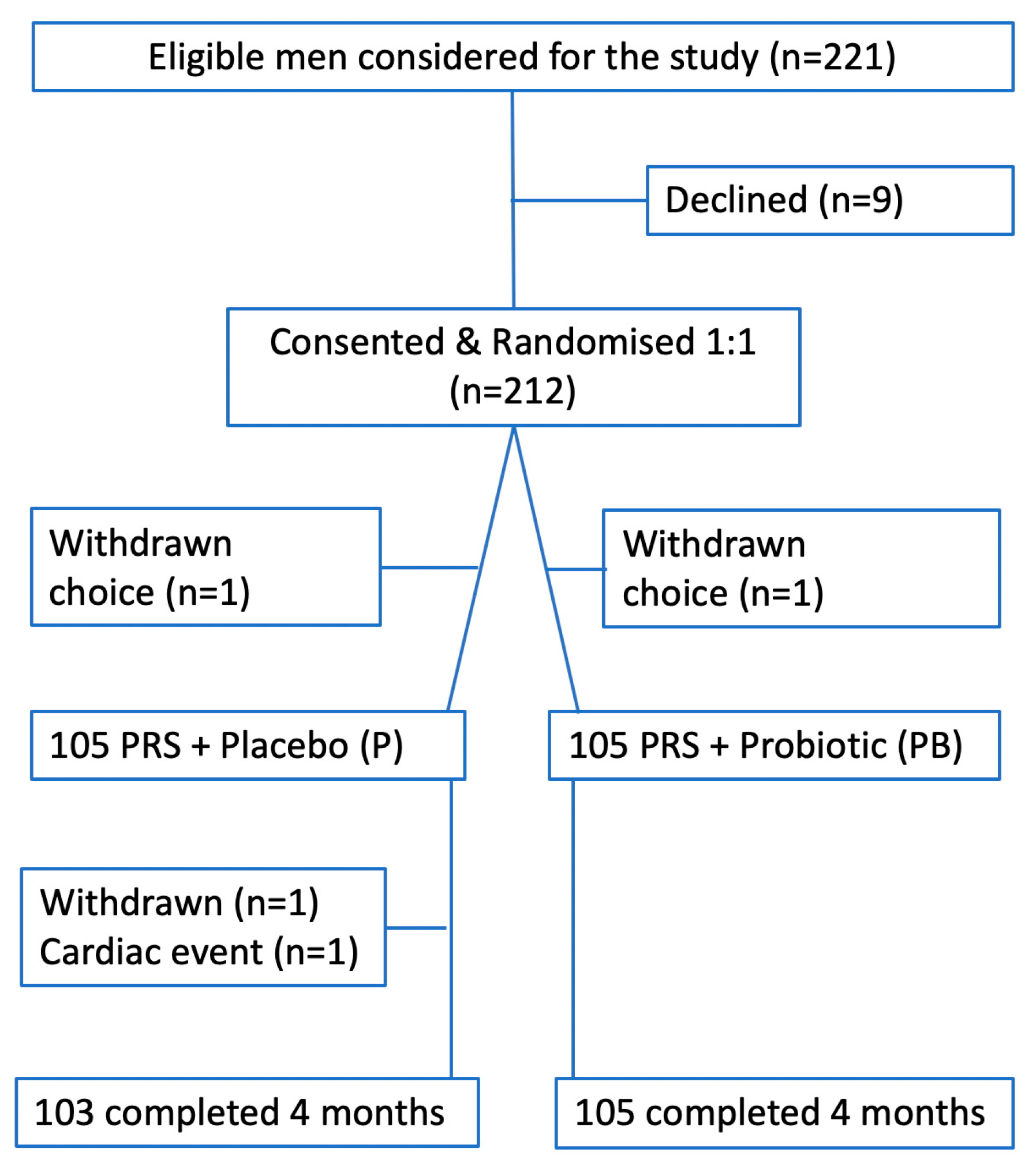
Figure 1. Consort diagram.
Jal 06 00035 g001
Table 1. Demographics between the two randomised groups at baseline.
Category
(n = 208)
PRS+P
(n = 103)
PRS+PB
(n = 105)
Statistical Difference
Average age (74.2 years)7673p = 0.02, 95% CI 1–6 years
Baseline grip strength31.1 kg36.4 kgp = 0.03, 95% CI 3.9–4.8
Age range (50–91 years)50–8950–91NS
BMI (Kg/m2)27.227.5NS
White100 (97%)102 (97%)NS
Non-white33
Table 2. Improvements in grip strength pre- and post-intervention for the two randomised groups.
Baseline4 MonthsPercentage Score Difference Using Mixed Two-Way ANOVA Baseline vs. 4 Months
Grip strength
PRS+P (n = 103)
31.1 kg
(±8.7)
33.7
(±9.1)
Mean Difference = 2.5 Kg (8%),
p < 0.001, 95% CI 1.8–3.4).
Grip strength
PRS+PB (n = 105)
36.4
(±7.3)
40.8
(±7.6)
Mean Difference = 4.4 Kg (11%),
p < 0.001, 95% CI 3.6–5.2).
PRS—Phytochemical rich supplement, P—placebo, PB—probiotic.
Table 3. Differences in grip strength, inflammation and testosterone between the randomised arms.
PRS+P
(n = 103)
PRS+PB
(n = 105)
Mean Difference
(Mixed Two Way ANOVA)
Grip strength change from baseline to 4 months2.5 Kg
±1.8–3.4
4.4 Kg
±3.6–5.2
2.5 Kg (57%),
p < 0.001, 95% CI 0.8 to 3.0).
Serum testosterone at 4 months13.02 nmol/L
±6.99
14.75 nmol/L
±4.76
1.73 ng/L (12%)
(p = 0.046, 95% CI 0.23 to 3.33).
Lymphocyte to neutrophil ratio change from baseline to 4 months+0.39−0.410.79
(p = 0.04. 95% CI 0.03–1.53)
Disclaimer/Publisher’s Note: The statements, opinions and data contained in all publications are solely those of the individual author(s) and contributor(s) and not of MDPI and/or the editor(s). MDPI and/or the editor(s) disclaim responsibility for any injury to people or property resulting from any ideas, methods, instructions or products referred to in the content.


