1. Introduction
Post-disaster reconstruction is widely recognized as a fundamental component of social recovery and economic stabilization following catastrophic events. However, the environmental burden associated with accelerated construction activities and emergency material production systems is frequently underestimated within reconstruction governance processes [
1]. Concrete constitutes the dominant structural material in large-scale rebuilding operations, and the rapid increase in demand commonly results in the extensive deployment of temporary concrete production facilities. In the aftermath of the 2023 Kahramanmaraş earthquakes in Türkiye, reconstruction activities expanded across environmentally sensitive regions containing wetlands, agricultural lands, river basins, protected ecosystems, and densely populated urban areas.
Pre-disaster environmental assessments had already identified several affected provinces as experiencing significant environmental pressures, including air-quality deterioration linked to industrial activity, localized water contamination risks, and solid-waste management challenges [
2]. Moreover, the extraordinary volume of demolition debris generated by the earthquakes introduced additional environmental management challenges associated with hazardous construction materials such as asbestos-containing components, insulation materials, plastic derivatives, and chemically treated construction products [
3]. Similar concerns regarding hazardous constituents in post-disaster demolition waste have been widely documented in environmental engineering and disaster management literature [
4].
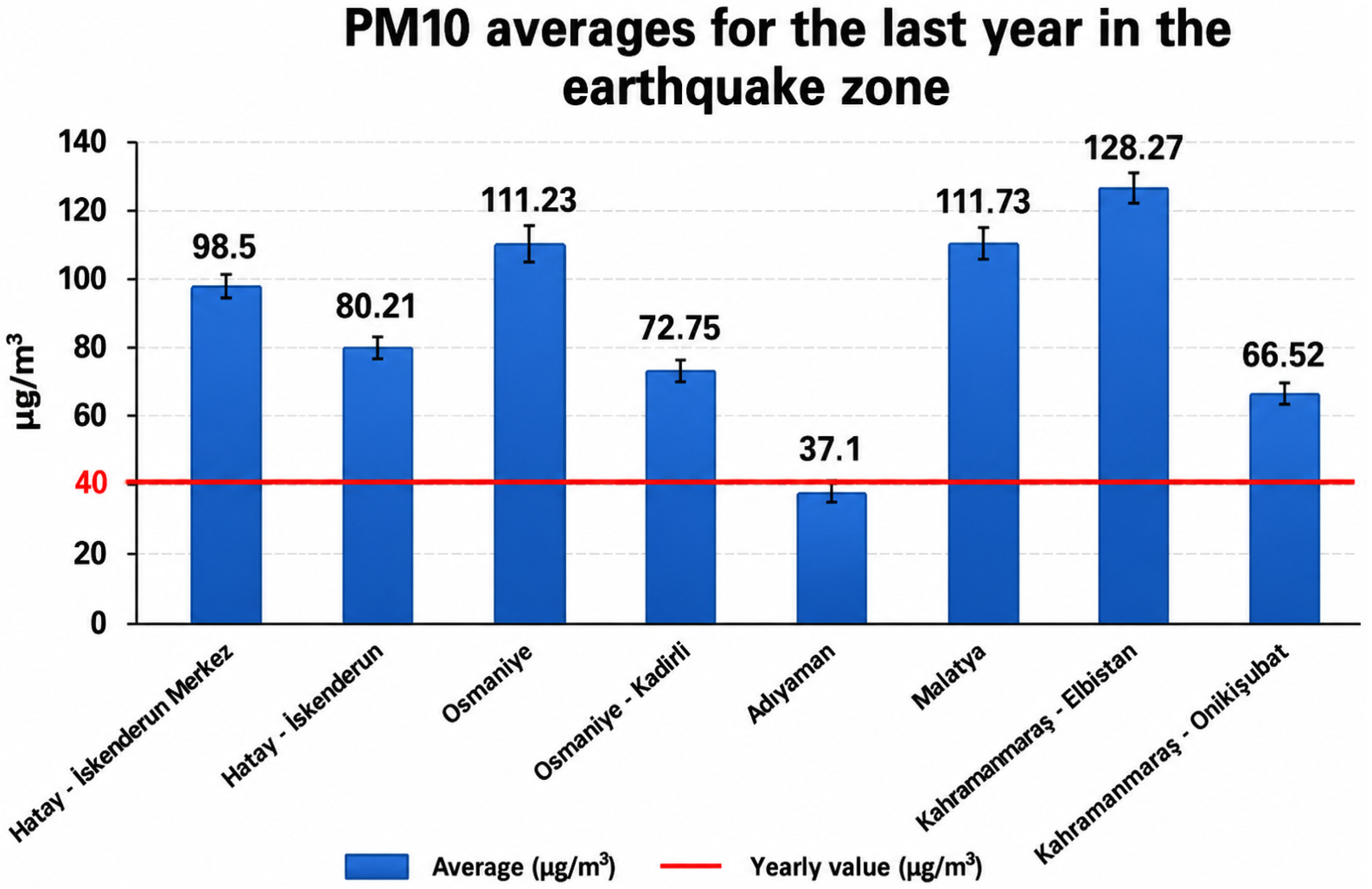
Within this context, temporary concrete plants emerged as critical logistical infrastructures supporting reconstruction speed and material continuity. However, recent publicly reported environmental monitoring summaries and institutional assessments have also raised concerns regarding sustained particulate emissions, localized air-quality deterioration, wastewater management deficiencies, and land-use conflicts associated with accelerated reconstruction activities [
5]. In this study, such publicly available monitoring summaries are used exclusively as contextual and illustrative evidence and are interpreted together with peer-reviewed environmental health literature and established environmental engineering principles.
The urgency of rebuilding after disasters frequently generates institutional pressure to prioritize reconstruction speed over environmental safeguards [
6]. Although such prioritization may be operationally necessary during emergency phases, it can also produce long-term environmental degradation, cumulative ecosystem stress, and public health risks. Existing research on post-disaster reconstruction has predominantly focused on housing recovery, structural resilience, and reconstruction logistics, while relatively limited attention has been given to temporary industrial infrastructures as integrated environmental risk systems.
This gap is particularly important because conventional Environmental Impact Assessment (EIA) frameworks are generally designed for stable regulatory and operational environments. In contrast, post-disaster reconstruction systems are characterized by compressed timelines, temporary industrial infrastructure, emergency regulatory flexibility, weakened inspection capacity, and rapidly changing operational conditions. Accordingly, this study develops an integrated environmental risk assessment framework specifically adapted to emergency reconstruction environments. The framework combines systematic documentary analysis, environmental pathway identification, semi-quantitative risk classification, and comparative benchmarking against international environmental health standards.
The specific objectives of this study are:
To identify multidimensional environmental risk pathways associated with temporary concrete production facilities established during post-disaster reconstruction;
To evaluate the relative severity of these risks through a structured semi-quantitative assessment model;
To develop governance, spatial planning, and operational mitigation strategies capable of reducing environmental risks while maintaining reconstruction efficiency.
Accordingly, the study addresses the following research questions:
What multidimensional environmental impacts emerge from temporary concrete plants established during post-disaster reconstruction?
How can these impacts be systematically evaluated under emergency reconstruction conditions?
Which governance, spatial planning, and operational policy mechanisms can mitigate these risks while maintaining reconstruction efficiency?
Although the empirical observations discussed in this research are informed by reconstruction dynamics following the 2023 Kahramanmaraş earthquakes, the analytical framework developed here is intended to be structurally transferable to broader post-disaster reconstruction contexts worldwide.
2. Methodology
2.1. Research Design
This study applies an integrated qualitative-dominant environmental risk assessment framework to evaluate the environmental and public health implications of temporary concrete production facilities established during post-disaster reconstruction. The methodological approach is designed primarily to identify and systematically classify environmental exposure pathways emerging from accelerated rebuilding processes rather than to quantify emissions from a single industrial facility.
The framework integrates three complementary analytical components:
Systematic documentary analysis of peer-reviewed literature, institutional reports, environmental health studies, and reconstruction-related regulatory documentation;
Environmental pathway modeling used to classify interactions between reconstruction activities and environmental systems;
Semi-quantitative comparative risk assessment used to evaluate the relative severity of identified environmental impacts.
Although the study incorporates semi-quantitative analytical procedures, the overall methodological orientation remains qualitative-dominant because direct field measurements and primary environmental sampling were not feasible under post-disaster operational conditions.
Systematic Literature Review Procedure
A structured literature review was conducted using Web of Science and Scopus databases. Searches were performed using combinations of the following keywords: “post-disaster reconstruction”, “temporary concrete plants”, “construction emissions”, “particulate matter”, “environmental impact”, “construction wastewater”, and “disaster environmental governance”.
The review covered publications between 2000 and 2025. Initial database searches identified 214 records. After duplicate removal and title-abstract screening, 126 studies remained for eligibility assessment. Studies lacking methodological transparency, bibliographic completeness, or direct relevance to environmental engineering, public health, construction sustainability, or post-disaster governance were excluded. Following full-text evaluation, 47 studies were included in the final analytical dataset.
The screening process followed a PRISMA-inspired procedural structure to enhance methodological transparency and reproducibility.
Figure 1 presents the literature screening and selection procedure used in this study.
2.2. Temporal Scope of Analysis
The analytical period covers the primary emergency and early reconstruction phases following the February 2023 Kahramanmaraş earthquake sequence and extends through the active rebuilding period between 2023 and 2025. This timeframe corresponds to the period during which large-scale debris removal, emergency housing construction, permanent residential rebuilding, and temporary industrial material-production installations were documented across multiple affected provinces. National reconstruction scale, structural damage distribution, and debris magnitude were verified using official governmental recovery documentation and national disaster assessment reports.
2.3. Geographical Scope
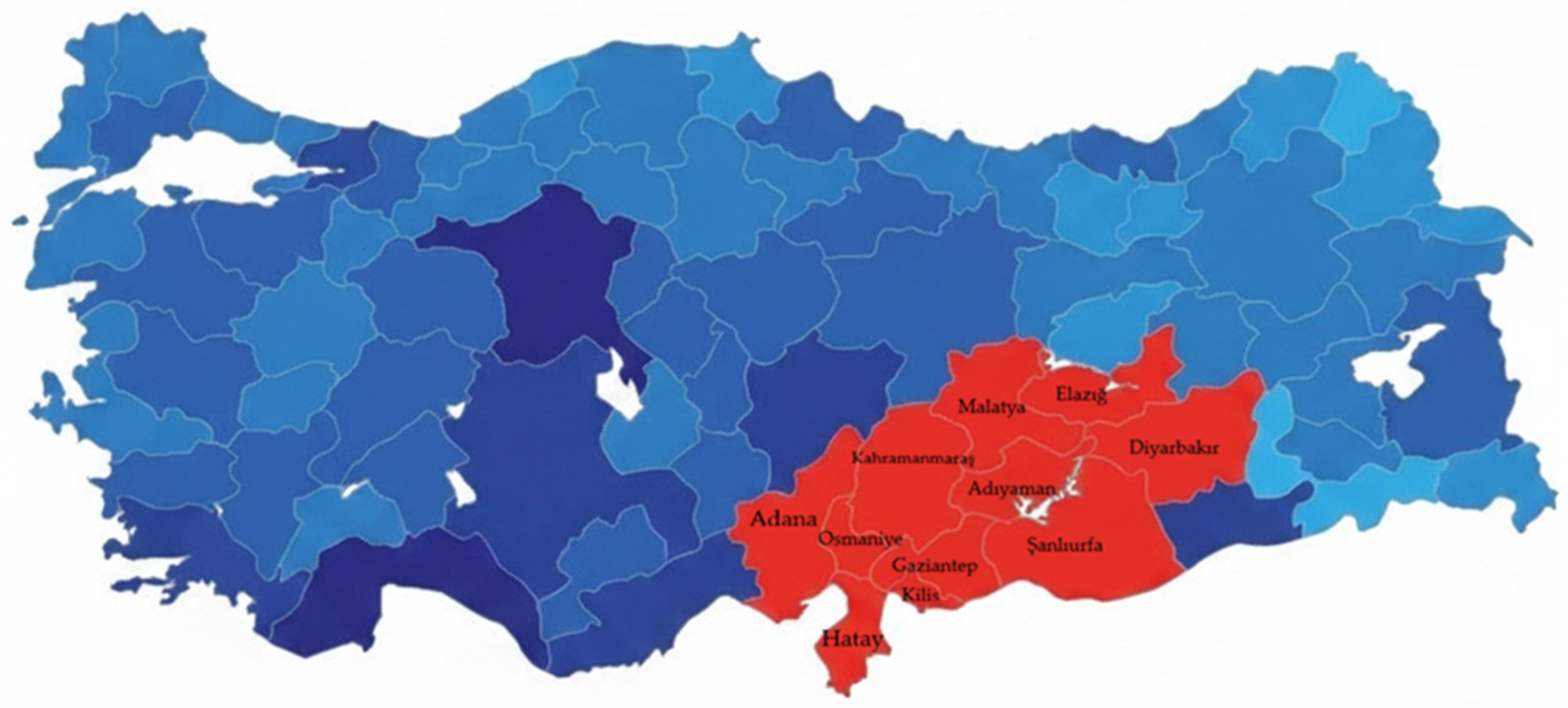
The geographical scope includes major reconstruction zones within the earthquake-affected region of southern Türkiye where intensive rebuilding activity and temporary construction-material production systems were publicly documented (
Figure 1). The analysis particularly considers reconstruction dynamics across provinces including Kahramanmaraş, Hatay, Adıyaman, Gaziantep, and Malatya, which experienced severe structural destruction and accelerated rebuilding timelines requiring large-scale concrete supply capacity. These provinces represent high-intensity reconstruction environments characterized by extensive demolition waste, compressed rebuilding schedules, emergency regulatory procedures, and rapid deployment of temporary industrial infrastructure. The geographical focus of the analysis covers the primary earthquake-affected reconstruction corridor in southern Türkiye, where large-scale structural damage and accelerated rebuilding activities were documented (
Figure 1).
2.4. Data Sources and Documentary Evidence
The analysis is based on triangulated documentary evidence derived from multiple independent institutional and academic sources. These include:
official governmental earthquake assessment and reconstruction reports;
publications from the Ministry of Environment, Urbanization and Climate Change;
national disaster management documentation and recovery statistics;
publicly released environmental monitoring statements and regulatory summaries;
municipal reconstruction announcements and infrastructure updates;
peer-reviewed environmental engineering and environmental health literature.
Key macro-scale reconstruction indicators, including the scale of destruction and debris volume estimates, were verified using official national earthquake recovery documentation, such as reconstruction assessment reports published in 2023 by relevant governmental authorities.
The documentary dataset examined in this study consists of formally published post-earthquake reconstruction and environmental assessment materials issued by national institutions. These include the February 2023 earthquake impact and recovery assessment published by the Republic of Türkiye Ministry of Environment, Urbanization and Climate Change; national reconstruction evaluation reports issued through the Presidency of Strategy and Budget; publicly accessible disaster coordination briefings; and institutional environmental management publications addressing debris handling, reconstruction logistics, and environmental monitoring procedures during the 2023–2025 rebuilding period.
These institutional sources were systematically analyzed alongside peer-reviewed environmental health and environmental engineering literature in order to identify recurring operational patterns and environmental exposure pathways associated with temporary concrete production systems.
The analysis is based on triangulated documentary evidence derived from multiple independent institutional and academic sources, including official governmental reconstruction reports, Ministry of Environment publications, disaster recovery assessments, peer-reviewed environmental engineering literature, public environmental monitoring summaries, and international environmental health guidelines.
Publicly available environmental monitoring summaries, including reports published by civil society organizations, are used exclusively for contextual support and trend illustration. These materials are not treated as standalone primary datasets, and the conclusions of this study do not depend on any single non-peer-reviewed source. Instead, all analytical interpretations are derived through triangulation between institutional documentation, peer-reviewed environmental literature, established environmental engineering principles, and comparative environmental health standards.
2.5. Environmental Risk Identification Procedure
Environmental risk identification was conducted through a systematic and multi-stage analytical procedure based on triangulated documentary evidence. Documented reconstruction logistics, institutional environmental risk statements, and publicly reported operational characteristics of temporary construction infrastructure were comprehensively reviewed in order to identify recurring environmental exposure pathways associated with emergency concrete production systems.
Particular analytical attention was given to the following operational risk sources:
- ✓
particulate emissions from cement transfer and aggregate handling;
- ✓
airborne dust dispersion generated by heavy vehicle circulation;
- ✓
uncontrolled aggregate storage and site layout compression;
- ✓
slurry discharge and sediment runoff risks;
- ✓
temporary land-use allocation practices in proximity to residential zones;
- ✓
cumulative pollution pressures emerging during high-demand reconstruction phases.
Rather than relying on isolated observations, these risk factors were interpreted within the framework of established environmental impact assessment (EIA) principles, construction sustainability models, and emission pathway concepts widely recognized in environmental engineering research.
The identification process followed a structured three-stage procedure:
Stage 1: Extraction of Risk Indicators.
Recurring environmental risk statements were systematically extracted from institutional reports, regulatory documents, and peer-reviewed literature to establish a consistent evidence base.
Stage 2: Classification of Environmental Pathways.
Identified risks were categorized into primary environmental components, including air, water, soil, and noise systems, in order to ensure analytical clarity and comparability.
Stage 3: Validation and Conceptual Alignment.
The categorized risks were cross-checked against established environmental impact assessment frameworks and engineering-based emission models to ensure conceptual consistency and scientific validity.
This stepwise analytical structure enhances methodological transparency and ensures that the environmental risk identification process is both reproducible and transferable to other post-disaster reconstruction contexts.
2.6. Analytical Strategy and Reliability
Post-disaster reconstruction environments present substantial methodological constraints for environmental field research, including restricted site access, rapidly changing construction logistics, temporary regulatory flexibility, heterogeneous inspection capacity, and safety limitations. These conditions frequently prevent standardized long-duration environmental measurement campaigns.
Accordingly, the analytical strategy adopted in this study relies on documentary triangulation and comparative environmental modeling rather than direct site-based measurement. The study therefore prioritizes analytical reliability through convergence between multiple independent evidence streams, including institutional reconstruction reports, environmental engineering literature, environmental health studies, operational reconstruction documentation, and internationally recognized environmental guideline values.
This methodological orientation inevitably introduces limitations regarding empirical precision and localized quantitative validation. Consequently, the semi-quantitative risk classifications developed in this study should be interpreted as comparative analytical indicators rather than direct environmental measurement outputs. Nevertheless, triangulated qualitative assessment approaches are widely recognized within disaster–environment research, particularly under conditions where direct field access remains constrained.
Stage 2: Semi-Quantitative Risk Scoring Model.
Each identified environmental pathway was evaluated using a semi-quantitative comparative risk index based on the following formulation:
where:
Probability refers to the likelihood of occurrence under accelerated reconstruction conditions;
Severity represents the potential magnitude of environmental or public health impact;
Exposure Duration reflects the expected temporal persistence of exposure conditions.
All variables were assessed using a normalized five-point scale ranging from 1 (very low) to 5 (very high). The semi-quantitative environmental risk classification criteria applied in this study are summarized in
Table 1. The scoring criteria were developed through the synthesis of peer-reviewed environmental health literature, environmental engineering standards, reconstruction logistics documentation, and WHO environmental guideline frameworks. An example application of the semi-quantitative scoring model under reconstruction conditions is presented in
Table 2.
Stage 3: Comparative Benchmarking.
The identified environmental risks were comparatively interpreted against internationally recognized environmental health standards, including World Health Organization (WHO) guideline thresholds for particulate matter exposure and environmental noise.
4. Discussion
The findings of this study should be interpreted within the broader context of post-disaster environmental governance and emergency reconstruction planning. While the tension between reconstruction speed and environmental protection has been widely acknowledged in disaster governance literature, existing frameworks frequently focus on housing recovery, infrastructure resilience, and institutional coordination rather than on temporary industrial infrastructures as integrated environmental risk systems.
The analytical contribution of this study lies in its adaptation of environmental risk assessment principles to emergency reconstruction environments characterized by compressed timelines, temporary industrial deployment, emergency regulatory flexibility, and weakened oversight capacity. Unlike conventional Environmental Impact Assessment (EIA) frameworks designed for relatively stable operational conditions, the proposed framework specifically addresses the dynamic and rapidly evolving conditions typical of post-disaster rebuilding systems.
This perspective is also consistent with the principles of the Sendai Framework for Disaster Risk Reduction and “Build Back Better” approaches, both of which emphasize the integration of environmental sustainability and long-term resilience into reconstruction governance [
25,
26]. However, the present study extends these conceptual approaches by focusing specifically on temporary industrial production infrastructures as critical environmental governance components within reconstruction systems.
Table 6 presents an original conceptual classification developed by the authors to illustrate how environmental monitoring capacity, reconstruction intensity, and temporary industrial density may vary across successive reconstruction phases. The matrix is intended as a heuristic analytical model synthesizing observations derived from disaster governance literature and reconstruction management practices.
The governance patterns identified in this study are consistent with broader disaster governance literature documenting environmental management challenges under accelerated reconstruction conditions. Comparative evidence from Haiti highlights the institutional vulnerabilities associated with emergency reconstruction governance [
27], while studies from post-tsunami Aceh and Sri Lanka demonstrate how “build back better” frameworks may conflict with operational reconstruction pressures [
28]. Broader resilience-planning research similarly emphasizes the long-term environmental governance implications of post-disaster reconstruction systems [
29].
Comparative evidence from these contexts reinforces the generalizability of the analytical framework developed in this study. Across different geographical settings, accelerated construction practices and temporary industrial installations consistently generate secondary environmental pressures, highlighting a systemic relationship between emergency governance structures and environmental risk production.
From an engineering and built-environment management perspective, the environmental risks identified are not solely regulatory failures but also reflect deficiencies in design and operational control. Temporary concrete production systems require integrated mitigation measures—including dust suppression systems, enclosed aggregate storage, sedimentation management for slurry discharge, and controlled transport logistics—to minimize airborne particulate emissions and soil and water contamination. The incorporation of such measures into emergency construction planning frameworks would significantly reduce environmental impacts without compromising reconstruction efficiency.
The multidimensional environmental impacts documented in this study—affecting air, water, soil, and acoustic environments—generate cumulative pressures on ecosystems already stressed by disaster conditions. This cumulative effect is particularly critical, as it may undermine the broader objective of sustainable recovery. As emphasized in the literature, effective post-disaster recovery requires not only rebuilding physical infrastructure but also restoring environmental quality and community well-being [
30].
The findings also align with Cutter’s conceptualization of compound and cascading disasters, in which multiple interconnected stressors interact to amplify vulnerability and recovery challenges [
30]. In the Kahramanmaraş reconstruction context, environmental pollution, weakened governance capacity, public health exposure, ecosystem degradation, and psychosocial stress can be interpreted as mutually reinforcing secondary risk mechanisms emerging from the reconstruction process itself.
The policy recommendations proposed in this study—including strategic site selection supported by expedited but comprehensive EIA procedures, mandatory implementation of environmental control technologies, integration of circular economy principles, and enhanced community participation—offer a balanced approach that acknowledges the urgency of reconstruction while safeguarding environmental and public health. These recommendations are consistent with the principles of “building back better” and broader sustainable development frameworks [
2,
4,
26]. Finally, the findings highlight the necessity of integrating environmental governance with ecosystem recovery strategies in post-disaster contexts. Large-scale demolition debris, often containing hazardous materials such as asbestos and chemical compounds, poses significant risks to soil systems, surface waters, and groundwater resources if not properly managed. Addressing these risks requires a phased intervention approach. In the short term, priority actions should include the identification of hazardous debris zones, monitoring of contaminated water systems, and controlled disposal of construction waste. Medium-term strategies should focus on ecosystem rehabilitation, erosion control, and strengthening land-use regulations around environmentally sensitive areas. In the long term, reconstruction policies must incorporate ecosystem restoration, biodiversity protection, and landscape-scale environmental monitoring to ensure that rebuilding efforts enhance, rather than degrade, ecological resilience.
5. Conclusions
Post-disaster reconstruction inevitably requires large-scale material production, making temporary concrete plants operationally indispensable components of recovery systems. However, the findings of this study demonstrate that the environmental and public health risks associated with these facilities are not merely incidental side effects, but structural governance challenges embedded within accelerated rebuilding processes. When reconstruction systems prioritize speed without integrating environmental safeguards, cumulative impacts on air quality, water systems, soil integrity, and community well-being may significantly undermine long-term recovery outcomes.
Accordingly, sustainable post-disaster reconstruction must extend beyond resilient building design and urban planning to include the environmental governance of industrial supply infrastructures. Temporary concrete production facilities should therefore be treated not only as logistical necessities but also as strategic environmental management units requiring structured siting decisions, emission-reduction technologies, and continuous monitoring frameworks.
The analytical framework developed in this study provides a systematic approach for identifying and evaluating these risks, offering a transferable model applicable to post-disaster reconstruction contexts worldwide. Embedding such safeguards within emergency construction governance systems represents a critical step toward aligning rapid rebuilding objectives with long-term ecological resilience and public health protection.
5.1. Policy and Implementation Recommendations
Based on our findings, we propose the following recommendations for policymakers, disaster management agencies, and reconstruction planners:
Strategic Site Selection and Expedited EIA: A rapid but comprehensive Environmental Impact Assessment (EIA) protocol, specifically designed for post-disaster situations, should be implemented. This protocol must absolutely determine the distance of temporary plants from residential areas, agricultural lands, and water resources, and mandate their establishment in designated industrial zones away from these areas. Pre-identified sites for temporary industrial activities should be incorporated into disaster preparedness plans.
Green Technology and Inspection Mandate: The use of state-of-the-art dust suppression, closed-circuit water use, and energy efficiency technologies should be made a legal requirement for temporary plants. The environmental performance of these plants should be continuously and transparently monitored and inspected by relevant ministries and municipalities. Remote sensing and real-time monitoring technologies could enhance inspection capacity in chaotic post-disaster environments.
Promotion of Circular Economy and Alternative Materials: Circular economy principles should be placed at the center of reconstruction. Government incentive mechanisms should be established for using recycled disaster debris as aggregate, widespread use of cement substitute materials (e.g., fly ash, slag), and alternatives such as low-carbon footprint green concrete. This approach simultaneously addresses waste management and reduces demand for virgin materials.
Community Participation and Transparency: Plant siting decisions, monitoring data, and inspection results should be shared transparently with affected communities. Accessible mechanisms should be established for public complaints and suggestions, ensuring community participation. Local knowledge can contribute to identifying sensitive areas and monitoring environmental violations.
Capacity Building for Inspectors: Environmental inspection agencies should receive specific training and resources for post-disaster situations, including protocols for rapid assessment and enforcement in challenging conditions.
5.2. Recommendations for Future Research
The following research directions are prioritized based on the key methodological and empirical limitations identified in this study, particularly the need for field-based validation and quantitative assessment of environmental impacts in post-disaster reconstruction contexts. Addressing these gaps is essential for strengthening the empirical basis of environmental risk evaluation and improving the practical applicability of proposed frameworks.
Future studies should focus on the following areas:
Development of emission inventories: Establishing detailed emission inventories for temporary concrete plants in disaster-affected regions and correlating these with real-time air quality monitoring data to enable more precise quantification of environmental impacts.
Longitudinal public health studies: Conducting long-term epidemiological research in exposed communities to assess chronic health outcomes associated with sustained exposure to particulate matter, noise, and industrial activity.
Innovative production technologies: Developing and evaluating mobile, low-impact concrete plant prototypes powered by renewable energy sources in order to reduce environmental footprints under emergency reconstruction conditions.
Comparative governance analysis: Examining different regulatory and planning approaches to post-disaster industrial siting across countries to identify best practices and transferable policy models.
Economic impact assessment: Quantifying the environmental and public health externalities of temporary concrete plants to support cost–benefit analyses and inform evidence-based reconstruction planning.
Advancing research in these areas will contribute to bridging the gap between conceptual environmental risk frameworks and measurable, data-driven decision-making in post-disaster reconstruction processes.