Article

Supply-Side Dynamics in Platformed Placemaking: Professional Practice in Two Chinese Heritage Districts

Department of Urban and Regional Planning, Faculty of Built Environment, Universiti Malaya, Kuala Lumpur 50603, Malaysia
*
Author to whom correspondence should be addressed.
Architecture 2026, 6(2), 82; https://doi.org/10.3390/architecture6020082
Submission received: 9 April 2026 / Revised: 27 April 2026 / Accepted: 25 May 2026 / Published: 28 May 2026

Abstract

Research on platformed placemaking has concentrated primarily on demand-side processes—how places are consumed, represented, and contested through platform mediation—while the supply side remains underexamined. This study investigates how professional actors interpret platform signals and translate them into spatial practice within heritage district regeneration. Drawing on interviews with 35 planners, designers, and operators involved in Beijing Road and Yongqing Fang in Guangzhou, and complemented by field observation, the analysis identifies four strategic dimensions through which professionals configure heritage spaces for platform visibility: variety design, technological interaction, regional characteristics, and serialized activities. To systematize the processes underlying these strategies, the study proposes professional translation as an analytical framework organized around three interconnected dimensions: platform decoding, spatial–temporal encoding, and professional routinization. The study contributes to platformed placemaking scholarship by systematically documenting and analyzing the interpretive labor through which platform signals enter professional spatial practice, extending existing frameworks from consumption-oriented analysis toward the production side of platform-place dynamics.

1. Introduction

Digital platforms have become consequential forces in the production of urban space. Scholarship on platform urbanism has established that platforms do not merely mediate how places are represented and consumed but actively reshape the conditions under which spatial decisions are made [1,2]. Visibility—rendered quantifiable through metrics of engagement, algorithmic rankings, and viral circulation—now functions as a competitive resource that cities, districts, and individual sites pursue through deliberate spatial strategies [3,4]. These dynamics are particularly pronounced in heritage districts, which have emerged as prominent destinations within platformized circuits of place consumption while remaining subject to conservation mandates and complex governance arrangements. Understanding how the professionals who plan, design, and manage these places interpret and respond to platform dynamics has become an increasingly pressing concern for urban scholarship.
Existing research on platformed placemaking has traced how platform-mediated representations influence place consumption, intensify spatial conflicts, and privilege particular esthetic registers—the photogenic, the spectacular, the readily shareable [5,6]. Tourism scholars have documented how social media reshapes destination evaluation and travel decision-making [7], while housing researchers have examined platform-induced neighborhood transformations and displacement [8]. This body of work, however, has concentrated primarily on demand-side processes—how places are consumed, represented, and contested through platform mediation. The supply side—how professional actors interpret platform signals and translate them into spatial interventions—has received less systematic attention [1,9]. This gap is particularly consequential for heritage districts, where platform-driven visibility pressures intersect with conservation mandates and institutional complexities [10], creating conditions that existing frameworks do not adequately address.
This study addresses this gap by investigating how professional actors—planners, designers, and operators—read and translate platform signals into spatial practice within heritage district regeneration. The central research question is as follows: How do professional actors interpret platform signals and translate them into spatial interventions within heritage district regeneration, and what patterns characterize this emerging practice? Translation is understood here not as automatic transmission but as practical accomplishment requiring professional judgment. Platform signals must be interpreted, negotiated against competing considerations including heritage conservation mandates, and rendered actionable through planning strategies, design decisions, and operational routines.
Addressing this question requires tracing how professionals encounter and respond to platform signals in concrete regeneration projects. The study employs a multiple case study approach [11] examining Beijing Road and Yongqingfang, two historic districts in Guangzhou that rank among the most frequently geotagged heritage destinations in South China. Both districts have undergone comprehensive regeneration involving planning, design, and operational interventions, providing empirical access to the full spectrum of supply-side professional practices. Empirical materials are derived from semi-structured interviews with planners, designers, and operators involved in district regeneration, complemented by the field observation of platform-oriented spatial features and operational practices.

2. Platformed Placemaking: Concepts and the Supply Side Perspective

Urban scholars have increasingly recognized that digital platforms reshape not only how places are experienced and represented but also how they are produced and governed. Plantin et al. [2] argue that platforms have assumed characteristics traditionally associated with infrastructure—ubiquity, embeddedness, and the capacity to shape possibilities for action—while retaining the proprietary logics of commercial enterprises. Within this hybrid formation, visibility emerges as a key resource. Platforms render attention quantifiable through metrics of views, likes, shares, and algorithmic rankings, embedding place representation within what Srnicek [3] terms the extractive circuits of platform capitalism. The concept of platformed placemaking captures these intersections between platform logics and spatial production.
Törnberg [9] defines platformed placemaking as the processes through which platforms mobilize user-generated content to remake spatial imaginaries, transforming how places are discovered, compared, and consumed. Boy and Uitermark [5] demonstrate how Instagram privileges particular esthetic registers—the photogenic, the spectacular, the readily reproducible—while Cocola-Gant and Gago [6] trace how platform-mediated representations intensify material conflicts over urban space. Collectively, this scholarship establishes that platforms do not merely reflect existing spatial conditions but actively participate in remaking them, constituting what Leszczynski [1] characterizes as a fundamental reordering of urban spatial relations through digital mediation.
However, most existing research has approached platformed placemaking from the demand side—focusing on how places are consumed, experienced, and contested through platform mediation, rather than on how they are produced. Three strands of inquiry exemplify this orientation. Tourism scholars have traced how platforms reshape travel decision-making and destination evaluation, documenting the integration of social media into itinerary planning and the emergence of algorithmically curated place discovery [7,12]. Housing and gentrification researchers have examined how residents experience and contest platform-induced neighborhood transformations, analyzing phenomena such as Airbnb’s rent gap effects and platform-mediated touristification [8,13]. Critical scholars of digital culture have investigated how users navigate algorithmically curated representations of urban space, attending to the experiential and affective dimensions of platform-place encounters [14,15].
However, these studies illuminate how platforms mediate place perception, consumption, and contestation. What remains less examined is the production side: how professional actors who shape places anticipate, interpret, and respond to platform dynamics in their spatial practices.
Less attention has been directed toward the supply side—toward the professional actors whose work involves producing and managing places within platformized visibility regimes. Professional responsiveness to external signals—market research, policy directives, community input—is not new. What distinguishes platform signals is their temporal and epistemic characteristics. Platform signals operate in real time and are algorithmically mediated, providing continuous feedback filtered through opaque recommendation systems rather than periodic snapshots of user preferences [16,17]. They are publicly visible and directly tied to attention economies, enabling multiple actors to observe and respond to the same signals simultaneously while linking spatial production to the competitive dynamics of visibility accumulation [4]. These characteristics suggest that supply-side engagement with platform signals involves distinctive interpretive challenges and adaptive practices warranting empirical investigation in their own right.
Understanding supply-side dynamics requires specifying which actors warrant analytical attention. Urban regeneration involves diverse participants—developers, investors, officials, platform companies—yet not all engage equally with the material production of place. This study focuses on planners, designers, and operators for three reasons. First, these professionals exercise direct agency over spatial form and experience, distinguishing them from actors whose influence is primarily financial or regulatory [18,19]. Second, their practices are increasingly oriented toward platform-mediated visibility, as evidenced by the growing professional attention to “Instagrammability” and viral potential in spatial design decisions [4,20]. This positions design and planning professionals at the intersection where platform logics—with their emphasis on engagement metrics and algorithmic amplification—encounter established conventions of heritage conservation, placemaking, and urban esthetics [1,21]. Furthermore, research on policy mobilities has demonstrated that such intermediary professionals play critical roles in translating external signals into local spatial practice [22,23].
Each domain involves distinct logics and temporalities. Planning establishes strategic frameworks—functional programming, spatial organization, development phasing—increasingly informed by platform-derived metrics such as visitor flows, content engagement, and visibility potential [24,25]. Design translates strategic orientations into material form, shaping sensory and esthetic qualities in ways that increasingly contend with platform-inflected expectations [26]. Operation involves continuous adjustment to shifting conditions, a domain where platform temporalities—trending cycles, algorithmic fluctuations, viral attention spikes—exert particular pressure [27]. These domains are analytically distinct but practically interconnected: design anticipates operational use; operation generates signals informing planning revision; planning frameworks enable and constrain design possibilities. The empirical investigation traces how platform signals traverse these domains, attending to both domain-specific logics and cross-domain dynamics.

3. Platformed Placemaking in the Chinese Context

China’s platform ecosystem presents distinctive conditions for platformed placemaking. Douyin, the domestic version of TikTok, had reached over 700 million daily active users by 2023, with algorithmic recommendation mechanisms that prioritize engagement intensity over social network position, generating powerful viral dynamics and rapid content circulation [28,29]. Xiaohongshu, a lifestyle-oriented platform combining social networking with consumer review functions, has cultivated visual cultures centered on esthetic consumption, travel documentation, and place-based content curation [30]. Both platforms have developed location-tagging features, trending place rankings, and hashtag challenge mechanisms that render specific sites algorithmically visible to massive audiences [31].
The DAKA phenomenon—traveling to photograph oneself at designated photogenic locations for social media posting—has emerged as a culturally pervasive practice reshaping how urban places are consumed, represented, and increasingly, produced [32]. These platform dynamics constitute the signaling environment within which planning, design, and operational decisions about Chinese urban places now unfold.
Chinese scholarship addressing platforms and urban space has developed along two largely separate tracks. Tourism researchers have examined how social media transforms destination image and visitor behavior, analyzing user-generated content as a promotional resource and tracing its influence on travel decision-making [33,34].
This work adopts a marketing orientation, treating platforms primarily as communication channels through which destinations reach potential visitors. Questions of how platform dynamics reconfigure the production of destination spaces—rather than their promotion—receive limited attention. Urban and architectural researchers, by contrast, have engaged platforms primarily through the lens of visual culture criticism [35]. Commentary on internet celebrity architecture and photogenic urbanism observes the esthetic convergence of renovated districts, diagnosing a condition of platform-driven homogenization [36]. Yet this critical commentary tends toward symptomatic reading—interpreting built outcomes as expressions of platform logic—rather than investigating the professional practices through which such outcomes are produced.
Heritage districts have become prominent sites within these platformized circuits of placemaking. Historic quarters consistently rank among the most geotagged, hashtagged, and algorithmically recommended destination categories on Chinese platforms, generating sustained visibility that local governments and developers actively pursue [37,38]. Tourism scholarship has documented how destinations orient programming toward social media performance, staging spaces and events for content production rather than solely for on-site experience [39]. Architectural commentary observes the proliferation of statement installations, photographic framing devices, and material palettes calibrated for platform circulation [40]. These observations, however, remain scattered across disciplines. They document symptoms of professional attentiveness to platforms without systematically analyzing how platform signals enter the interpretive practices of those who make spatial decisions.
Research on Chinese urbanism provides rich accounts of heritage district development but largely predates or overlooks platformization. Studies trace project-based governance logics [41,42], entrepreneurial mobilization of heritage for place competition [43], and tensions between conservation mandates and commercial pressures [44]. This literature establishes the institutional intensity surrounding heritage spatial production yet does not examine how platform dynamics reconfigure professional practice. Separately, China’s internet scholarship analyzes platform architectures and user cultures with growing sophistication but rarely extends analysis to material spatial production. The intersection—how planners frame strategic objectives, designers negotiate esthetic parameters, and operators enact adaptive adjustment in response to platform signals—remains underexplored. Chinese historic districts, where platform-driven visibility pressures intersect with heritage mandates and integrated operational governance, offer conditions that render these supply-side dynamics empirically tractable.

4. Research Methods

This study employs a qualitative multiple-case research design to examine how professional actors interpret and operationalize social media signals in urban heritage contexts. Multiple-case designs are particularly suited to “how” and “why” questions concerning contemporary phenomena where boundaries between phenomenon and context are not clearly delineated [11]. The inclusion of two cases follows literal replication logic: selecting cases that share theoretically relevant conditions to examine whether the same process emerges across both, thereby strengthening confidence in the findings’ robustness [11,45]. The exploratory orientation is appropriate given the undertheorized nature of platform-responsive spatial practice in the existing literature. Fieldwork was conducted between June 2024 and January 2025, during which both case sites were actively implementing social media-oriented spatial and operational interventions.

4.1. Case Selection

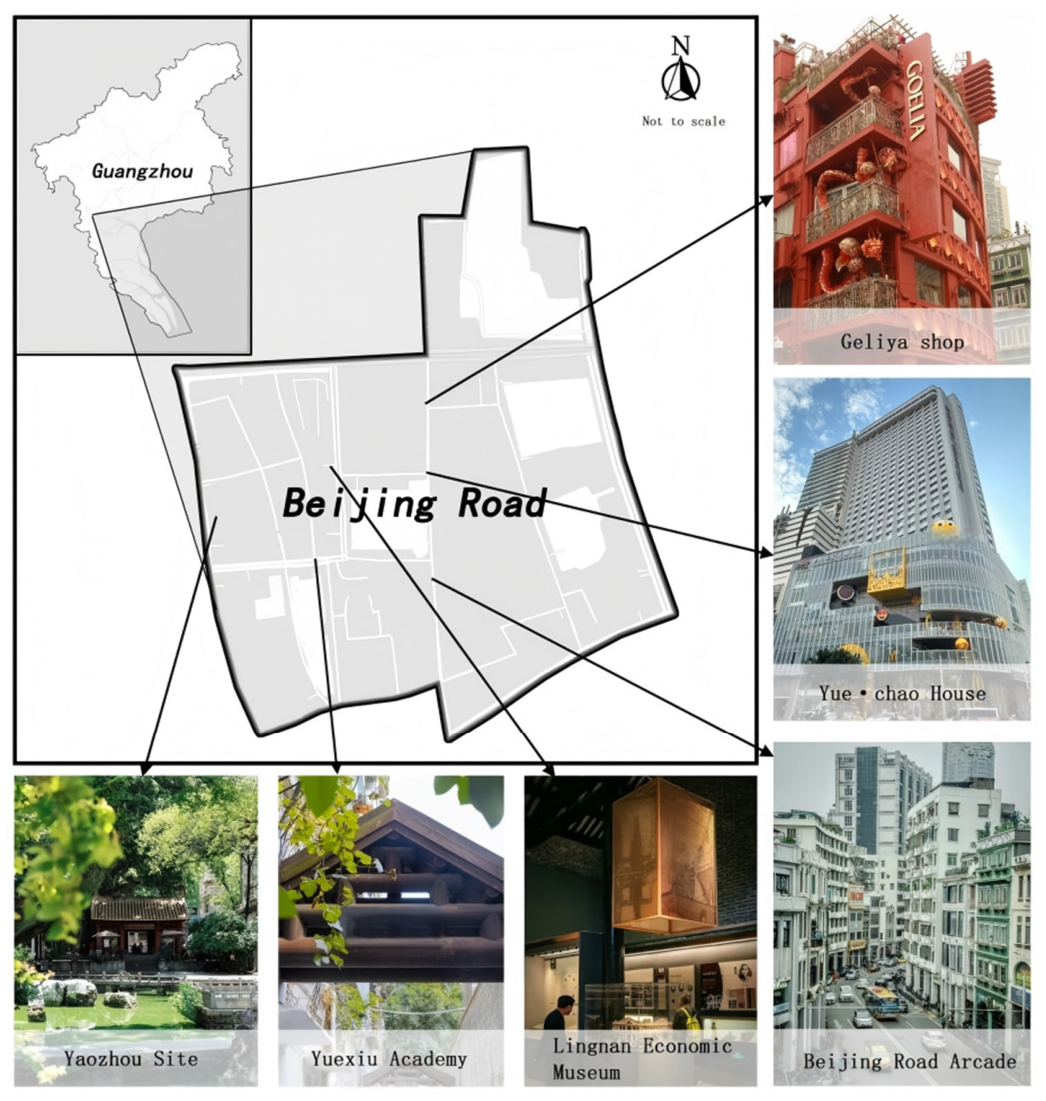
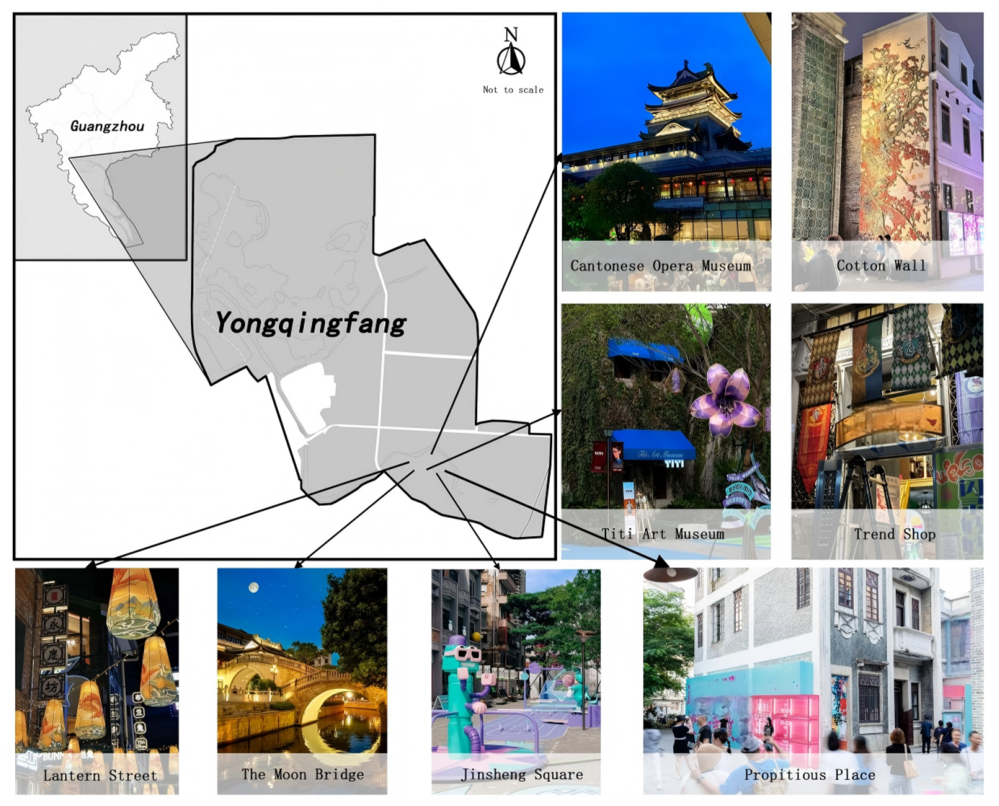
Beijing Road (Figure 1) and Yongqingfang (Figure 2) in Guangzhou were selected through purposive sampling [46] based on shared conditions theoretically relevant to supply-side dynamics in platformed placemaking. First, both sites demonstrate high platform visibility, with substantial presence on Xiaohongshu and Douyin, making the influence of platform signals on professional practice empirically tractable. Second, both feature complete professional practice chains encompassing planning, design, and operation, enabling examination of how platform orientations traverse different professional domains. Third, both have undergone recent comprehensive regeneration within Guangzhou’s heritage tourism governance framework, situating professional practice within comparable institutional and policy conditions. These shared features enable examination of whether similar professional strategies manifest across two distinct yet comparable cases.
The two sites differ in heritage typology: Beijing Road is a commercial heritage street, while Yongqingfang is a renovated residential-commercial compound. These differences, however, are not the analytical focus of this study; rather, the parallel emergence of similar platform-responsive strategies across both sites despite their typological distinctions is the focus. Nevertheless, these shared features enable the examination of whether similar professional strategies and underlying processes manifest across two distinct yet comparable cases.
Beijing Road is a historically significant commercial street in Yuexiu District with origins traceable to the Qin Dynasty. The street underwent comprehensive renovation between 2019 and 2021, repositioning it as a heritage-commercial destination integrating archeological display, retail, and cultural programming [47]. Yongqingfang, located in Liwan District within the Enning Road historic area, is an urban regeneration project transforming traditional Lingnan-style residential fabric into a mixed-use cultural-commercial precinct. Developed through a public–private partnership initiated in 2016, the project has been recognized as a model for Guangzhou’s “micro-renovation” approach to heritage conservation [48].

4.2. Data Collection

Data collection combined semi-structured interviews, direct observation, and social media content review, enabling methodological triangulation to enhance analytical validity [49].
Semi-structured interviews constituted the primary data source. Informants were recruited through purposive and snowball sampling [50], targeting professionals with substantive involvement in the case sites. The final sample comprised 35 informants: 13 urban planners, 14 designers, and 8 commercial operators. Sample size was determined by theoretical saturation—the point at which additional interviews yielded diminishing new insights [51].
Table 1 summarizes the demographic and professional profiles of the 35 informants. The sample comprised 13 urban planners, 14 architects and landscape designers, and 8 commercial operators, with a slight male skew (63%) that reflects the gender composition of senior heritage-sector professionals in Guangzhou. Informants ranged in age from 27 to 55, with professional experience spanning 5 to 25 years (mean ≈ 12 years). Inclusion required that each informant (a) held a professional role directly involving planning, design, or operational decisions at one of the two case sites, and (b) had been actively engaged in the project during or after 2019, coinciding with the intensification of platform-mediated visibility. Of the 35 informants, 16 were primarily associated with Beijing Road and 19 with Yongqingfang, broadly proportional to the scale and complexity of each project.
Interviews lasted 45–90 min. The protocol addressed four thematic areas corresponding to different dimensions of platform-responsive professional practice identified in the literature. First, drawing on scholarship documenting the emergence of platform-mediated place consumption in China [52], we asked how social media considerations enter professional decision-making processes—when and through what channels platform dynamics become salient to spatial practice. Second, informed by research on the distinctive characteristics of platform signals—their real-time temporality, algorithmic mediation, and public visibility [16,17]—we explored how professionals identify, interpret, and evaluate platform-derived information. Third, responding to the literature’s call to examine how platform logics encounter established professional conventions [26,27], we investigated how platform signals translate into specific planning, design, or operational interventions. Fourth, recognizing that professional responsiveness involves not isolated decisions but evolving practice patterns, we examined how platform-responsive strategies become routinized within professional workflows.
Given that professionals’ accounts of market-responsive practice may reflect general commercial sensitivity as much as platform-specific dynamics, the coding and interpretation process privileged practices structurally tied to distinctive platform affordances—algorithmic visibility, short-video formatting, and real-time engagement metrics—over those attributable to longstanding commercial conventions in heritage tourism.
Questions were open-ended, with follow-up probes tailored to each informant’s professional domain and specific project involvement. All interviews were conducted in Mandarin, audio-recorded, and transcribed verbatim; transcripts were translated into English, with selected passages back-translated to verify accuracy. Informants provided written informed consent and are identified by anonymized codes (e.g., PL1 for Planner 1, DE1 for Designer 1, OP1 for Operator 1). Direct observation was conducted at both sites across varied temporal conditions (weekdays/weekends, daytime/evening, regular periods/festivals). Observations focused on spatial configurations, visitor behaviors, operational practices, and material traces of platform-oriented design. Field notes and photographic documentation recorded observations systematically.
Social media content from Xiaohongshu and Douyin was collected to contextualize the platform signals professionals referenced, serving as supplementary rather than primary data [53].

4.3. Data Analysis

Analysis followed thematic analysis procedures outlined by Braun and Clarke [54]. Interview transcripts were coded systematically using NVivo 12, with initial coding remaining close to informants’ language. Codes were subsequently clustered into thematic categories through iterative comparison. Following Miles et al. [55], analysis proceeded at both within-case and cross-case levels, examining each site as a holistic case while identifying patterns across cases. Core themes identified include platform signal recognition, visibility-oriented design strategies, heritage encoding practices, and professional routinization. Analytical rigor was enhanced through investigator triangulation in coding and member checking with selected informants.

5. Social Media Strategy

Both Beijing Road and Yongqing Fang have systematically developed social media DAKA spaces that organize tourists’ routes, stopping rhythms, and interaction modes. The core finding is that professional actors actively read platform-generated signals—trending esthetics, engagement patterns, and visibility cycles—and translate these signals into spatial and operational interventions.
This study identifies social media strategy as a supply-side mode of platformed placemaking: the systematic approaches through which professional groups embed platform-derived demands into the material form, interface expression, and operational rhythm of tourism spaces. The analysis draws primarily on professional accounts of practice, examining how planners, designers, and operators understand and rationalize their work. These narrative accounts reveal not merely what professionals do, but how platform logics have become operative frameworks within spatial production. Field observations complement these accounts at points where material outcomes illuminate the practical consequences of professional reasoning.
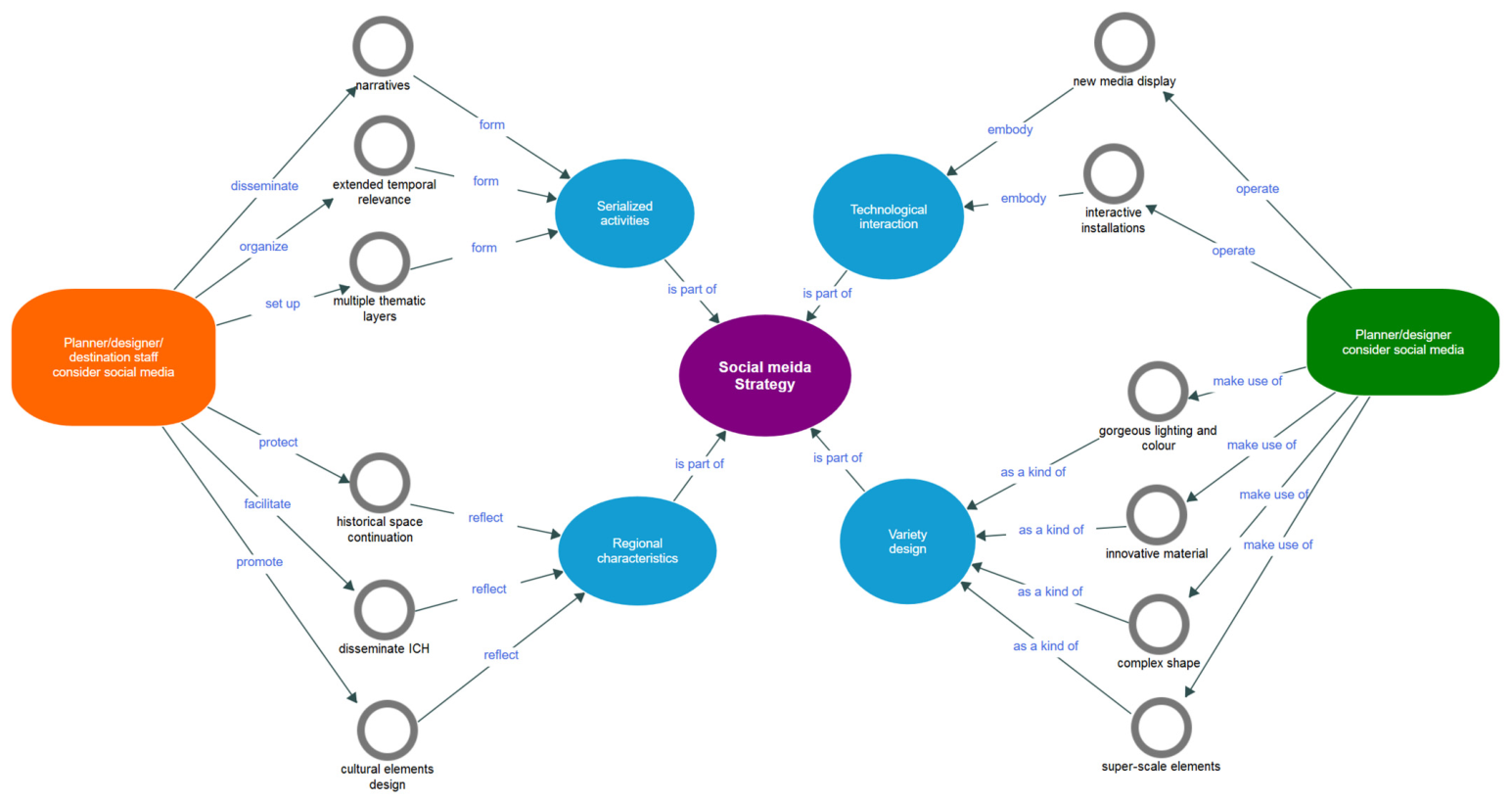
Four strategic dimensions emerged from the data, each representing a distinct mode of translating platform signals into spatial practice: variety design addresses the visual-material dimension; technological interaction concerns participatory engagement; regional characteristics governs cultural differentiation; serialized activities manages temporal rhythms (Figure 3). These dimensions are not discrete categories but interconnected aspects of a coherent professional orientation toward platform-mediated visibility.

5.1. Variety Design

The designers interviewed described a mode of professional attention that treats social media platforms as sources of design intelligence. This practice—monitoring trending content, identifying recurring visual patterns, and extracting actionable insights—has become sufficiently routinized that professionals spoke of it as unremarkable. As one designer put it: “We regularly observe what spreads on RedNote. Certain visual qualities—strong contrasts, unusual materials, dramatic scale—repeatedly appear in trending content” (DE4). What is significant here is not merely the act of observation but its integration into professional workflow: platform esthetics have become operative inputs to design decision-making.
This integration manifests in concrete workflow practices. One designer described the formalization of platform monitoring: “Before starting project now, we conduct what we call ‘platform investigate’—systematically reviewing trending content in the target category. It’s become as standard as site analysis or precedent study” (DE2). Another professional elaborated on the temporal rhythm of this practice: “I check RedNote and Douyin every morning, almost like reading industry news” (DE5).
This platform-informed sensibility translates into spatial form through a repertoire of strategies that share an underlying logic—the optimization of visual impact under conditions of mobile screen viewing and algorithmic content circulation. Material innovation, scale manipulation, geometric complexity, and lighting design each address different aspects of this optimization, yet function as complementary tactics within a unified approach to photographable space.
Material juxtaposition offers one pathway to visual distinction. An architect described deliberate contrast as a design principle: “While preserving historical building materials, we reconstructed the façade using highly contemporary materials. The striking contrast between old and new elements produces exactly the kind of visual tension that performs well on platforms” (DE3). The underlying logic treats heritage fabric not as constraint but as opportunity—the traditional provides a foil against which contemporary interventions gain heightened visibility. Throughout Yongqing Fang, this principle manifests in recurring juxtapositions: polished steel against weathered brick, transparent acrylic framing traditional doorways, fluorescent accents punctuating gray-toned streetscapes.
Scale operates according to a different calculus. Where conventional architectural proportion responds to embodied human perception, platform-oriented design must account for mediation through small screens viewed at variable distances. One designer made this logic explicit: “When renovating the building façade, we deliberately enlarged the exterior columns beyond structural necessity. The original intention was to create differentiation on small screens” (DE6). This represents a significant reorientation of design reasoning—the referent for proportional judgment shifts from the experiencing body to the viewing device. The result, evident along Beijing Road’s northern section, is an architecture of deliberate overstatement: entrance columns exceeding functional proportions, signage scaled for algorithmic rather than pedestrian legibility.
Geometric complexity and lighting design extend this logic into additional registers. “Complex geometric forms immediately capture attention,” one designer observed, contrasting them with “detailed decorative designs” that “prove ineffective on screens” (DE4). Lighting, meanwhile, addresses temporal extension: “Beijing Road’s lighting scheme was deliberate. The northern section features color variations, contrasting with the central section’s focus on architectural highlighting. Nighttime content constitutes a distinct category on platforms” (PL1). Together, these strategies constitute a comprehensive approach to visual optimization—ensuring that spaces perform effectively across the varied conditions of platform-mediated viewing.
At the same time, beyond informing design decisions, platform considerations have begun to reshape evaluative criteria within professional practice. When asked how they assess design quality, several professionals described criteria that would have been peripheral to conventional architectural judgment. One designer stated “When we review proposals internally, someone always asks ‘Will this photograph well? Will it stand out in a feed?’ It’s become a legitimate design criterion, not just an afterthought” (DE4).
However, enacting variety design within heritage settings is not without friction. Several designers noted that conservation review committees sometimes questioned the rationale for creating multiple differentiated visual zones within a single heritage compound. As DE3 explained: “The review panel was concerned that too many distinct spatial atmospheres would compromise the coherence of the historic site. We had to reframe our design as reflecting the layered temporality of the site itself—different dynasties, different functions—rather than admitting it was partly driven by what we knew would generate diverse content on the platform.” This suggests that variety design, while oriented toward platform logic, must be rhetorically reconciled with heritage conservation norms through a process of professional justification. Practitioners do not simply implement platform-responsive strategies; they negotiate their legitimacy within existing institutional frameworks.

5.2. Technological Interaction

If variety design treats space as visual content to be captured, technological interaction reconceives it as interface to be engaged. This distinction marks a qualitative shift in how professionals understand the relationship between tourists and the built environment. Rather than composing scenes for photographic consumption, designers increasingly configure spaces that solicit active participation, generating content through interaction rather than mere observation.
The professionals interviewed articulated clear awareness of this shift. One designer explained: “We discovered tourists preferred new media content—innovative and dynamic elements—when choosing destinations. Interactive moments produce content that stands out in feeds” (DE2). The operative insight concerns algorithmic preference: platforms reward novelty and distinctiveness, qualities more readily achieved through participatory content than through photographs of static scenes. Interaction introduces variability—each tourist’s engagement produces slightly different outcomes, generating the diversity that sustains platform visibility.
This understanding has driven investment in technological infrastructure that transforms physical spaces into interactive interfaces. A planner described one such intervention: “New media screens were a definitive addition. In the ‘Light and Shadow Beijing Road’ area, tourists participate in lighting interactions through mobile phone scanning. The participatory element means each tourist creates slightly different content, generating variety in platform circulation” (PL4). The logic here is precise: interaction produces differentiation, differentiation sustains algorithmic visibility, visibility attracts further visitation. Space becomes instrumental to content production rather than its passive subject.
Interactive installations represent another modality of this approach, one that operates without digital mediation. “Through design of interactive installations, we styled storefronts as exhibitions, transforming shopping into experiences where tourists photograph themselves with displays” (DE5). The Flying Shop in Yongqing Fang exemplifies this strategy. Its designer noted: “The doll at our entrance encourages tourists to pose dynamically. Each interaction produces unique imagery” (DE3). Field observation illuminated how this design intention translates into spatial practice: a persistent queue forms at this location, visitors cycling through poses and angles, the installation functioning less as decorative element than as content-production apparatus.
Yet professionals also described exercising deliberate restraint in their adoption of China-Chic esthetics: a case in which a commercial tenant proposed incorporating a trending visual motif—neon-lit calligraphy installations—into a Lingnan-style heritage courtyard: “I rejected it immediately. The building dates from the late Qing period, and its material language is brick, timber, and gray plaster. That kind of decoration might generate short-term attention, but it would undermine the site’s credibility among more discerning visitors and, frankly, among our own peers” (DE7). Such instances reveal that the adoption of China-Chic esthetics involves selective professional judgment rather than uncritical trend-following. Practitioners draw on their disciplinary training and knowledge of heritage contexts to filter which platform-circulating esthetics are admissible and which cross an implicit boundary of appropriateness.
What unites these varied interventions is a reconceptualization of the tourist–space relationship. Tourists are understood not as viewers of pre-composed scenes but as co-producers of platform content, and space is designed accordingly—configured to enable, guide, and optimize their productive activity.

5.3. Regional Characteristics

The deployment of regional cultural elements reveals a more complex dynamic than straightforward heritage preservation. Professionals described local distinctiveness not as intrinsic value to be protected but as strategic resource to be mobilized within platform economies of attention. This instrumental orientation does not preclude genuine cultural attachment, but it does subordinate preservation logics to platform-derived imperatives.
The underlying problem, as professionals articulated it, concerns esthetic saturation. One designer observed: “Platform content cycles rapidly. What initially stood out becomes commonplace. Local cultural elements provide renewable distinctiveness because they cannot be easily replicated elsewhere” (DE9). This formulation is revealing: regional characteristics acquire value precisely through their resistance to the homogenizing tendencies of platform esthetics. Locality becomes a form of competitive advantage, a source of differentiation in crowded attention markets.
This instrumental logic governs selective processes of cultural emphasis and adaptation. Heritage elements undergo what might be termed platform encoding—transformation that enhances their legibility and impact within social media circulation while retaining sufficient authenticity to sustain claims of local distinctiveness. A designer described this calibration: “During planning, we emphasized preserving Manchurian window patterns and Tanglong doors characteristic of Xiguan. But preservation alone is insufficient—we need innovative combinations that capture attention” (DE8). Preservation and innovation are not opposing impulses here but complementary aspects of a unified strategy: the former supplies authentic material, the latter renders it platform-effective.
While regional distinctiveness constitutes a powerful strategy for platform differentiation, several interviewees acknowledged that platform logic tends to create an uneven hierarchy among heritage elements—amplifying those that are visually photogenic while rendering others less visible. A planner observed: “What performs well on the platform is very specific—logic of the entire lane-and-courtyard system, or the water drainage heritage, is equally significant from a preservation standpoint.” (PL3). This selective amplification does not go unnoticed by professionals. Rather, it represents a point of ongoing negotiation: practitioners work to foreground photogenic elements for platform circulation while internally maintaining awareness that these elements constitute only a partial representation of the site’s heritage value.
This encoding operates across multiple registers. Architectural elements receive enhanced visual treatment—traditional window frames in contrasting colors, doorways with concealed spotlights, heritage details framed by contemporary materials that direct visual attention. Environmental graphics extend cultural motifs into wayfinding systems: “When designing wayfinding signage, we incorporate lion dance elements and paper-cutting motifs. These are essential for creating visual identity that reads as authentically Guangzhou” (DE7). Throughout Beijing Road’s pedestrian zone, abstracted Cantonese motifs mark directional signage, creating a consistent visual vocabulary that reads simultaneously as cultural expression and brand identity.
Intangible heritage presents particular challenges, requiring translation into visual formats amenable to platform circulation. One designer explained: “We installed a retractable screen on arcade windows displaying ICH stories. It functions like an outdoor theatre, making intangible heritage visually compelling” (DE2). An operator elaborated on the affective dimension: “We integrate cultural context in ways that enable emotional connections—and emotional content performs distinctively on platforms” (OP4). Here the logic of platform optimization extends from visual impact to emotional resonance, recognizing that algorithms reward not merely striking imagery but content that generates engagement through affective response.

5.4. Serialized Activities

The strategies examined thus far address spatial dimensions of platformed placemaking—the configuration of physical environments to optimize platform performance. Serialized activities introduces a temporal dimension, revealing how professional actors manage visibility not merely through spatial intervention but through the rhythmic organization of programming and events.
Operators described close attention to the temporal dynamics of platform content. “We noticed that post-event visibility drops significantly within one to two weeks. A single successful event creates a spike followed by decline to baseline” (OP2). This observation reflects sophisticated understanding of platform temporality: content has life cycles, visibility decays according to predictable patterns, and sustained attention requires ongoing content production. Space alone, however effectively designed, cannot maintain visibility without continuous programming.
This recognition generates strategies for temporal governance that operate across multiple scales. At the level of event sequencing, operators design interconnected programming that produces overlapping visibility cycles: “Rather than single peak events, we design interconnected sequences. The Cantonese Opera flash mob was followed immediately by the Hanfu photography event. Each event’s promotional cycle overlaps with the previous event’s decay phase” (OP2). The logic is one of managed succession, each event’s decline anticipated and countered by the rise in its successor.
Annual programming follows festival rhythms, aligning content production with calendrical occasions that concentrate platform activity. A senior operator explained: “We plan our annual calendar to ensure each festival period offers distinctive content. Spring Festival features stamp collection activities, followed by Valentine’s Day themed events, then Lantern Festival programming” (OP2). Field research coincided with a minor festival period, offering direct observation of this temporal strategy in practice: themed decorations installed days prior, promotional materials announcing upcoming programming, staff preparations indicating systematic advance planning. The festival provided occasion, but the programming reflected calculated content production rather than spontaneous celebration.
Weekly cycles introduce finer-grained temporal differentiation. “Weekday programming differs from weekends. We concentrate major activities on Friday evenings and weekends when posting frequency peaks” (OP1). A operator elaborated: “We schedule photo-worthy moments—performer appearances, lighting transitions—to coincide with windows of maximum platform activity” (OP3). This temporal precision—coordinating programming not merely with visitor presence but with anticipated posting behavior—reveals the depth to which platform logics have penetrated operational practice.
The temporal programming strategies described above have diffused rapidly through professional networks, suggesting their transition from innovative practice to industry convention. Operators described learning these approaches through multiple channels. One professional recounted: “The overlapping event cycle strategy—we first encountered it studying the Changsha Wenhe You case. Their approach to maintaining continuous visibility through staggered programming was widely discussed in industry circles, and we adapted it for our context” (OP6).
The imperative to maintain a continuous stream of platform-relevant programming also generates internal tensions within heritage district management teams. An Operator described a recurring debate: “When a trending topic takes off on the platform, the marketing team always wants to respond quickly—tie an event to it, create related content. But our cultural programming colleagues sometimes push back. During one cycle, the team debated for two days whether a particular internet meme was appropriate to associate with our heritage brand. In the end, we decided it wasn’t—it would have felt cheap” (OP4). This account illustrates that the routinisation of platform-responsive event programming is not a frictionless process. It involves recurrent micro-negotiations between commercial responsiveness and cultural stewardship, with outcomes that are neither predetermined nor uniform across different heritage districts.

5.5. Integrative Summary

The preceding sections documented four strategic dimensions through which professional actors configure tourism spaces for platform visibility. Each dimension addresses distinct aspects of platformed placemaking: variety design establishes material conditions for photographability; technological interaction transforms spaces into participatory interfaces; regional characteristics mobilize cultural distinction as competitive resource; serialized activities manage temporal rhythms of content production.
These dimensions function not as parallel strategies but as mutually reinforcing components of an integrated practice. Variety design provides the visual-material substrate that technological interaction activates through participatory mechanisms. Regional characteristics supplies the differentiating cultural content that serialized activities organizes across temporal cycles. Together, the four dimensions constitute a coherent professional orientation toward platform-mediated visibility.
The professional accounts examined above reveal not only what spatial interventions are undertaken but also how practitioners have come to perceive platform dynamics, interpret their implications, and integrate platform-responsive approaches into everyday workflows. The following discussion draws out and systematizes this underlying process, proposing professional translation as an analytical framework for understanding how platform signals become embedded in spatial practice.

6. Discussion

6.1. Professional Translation: An Analytical Framework for Supply Side Platformed Placemaking

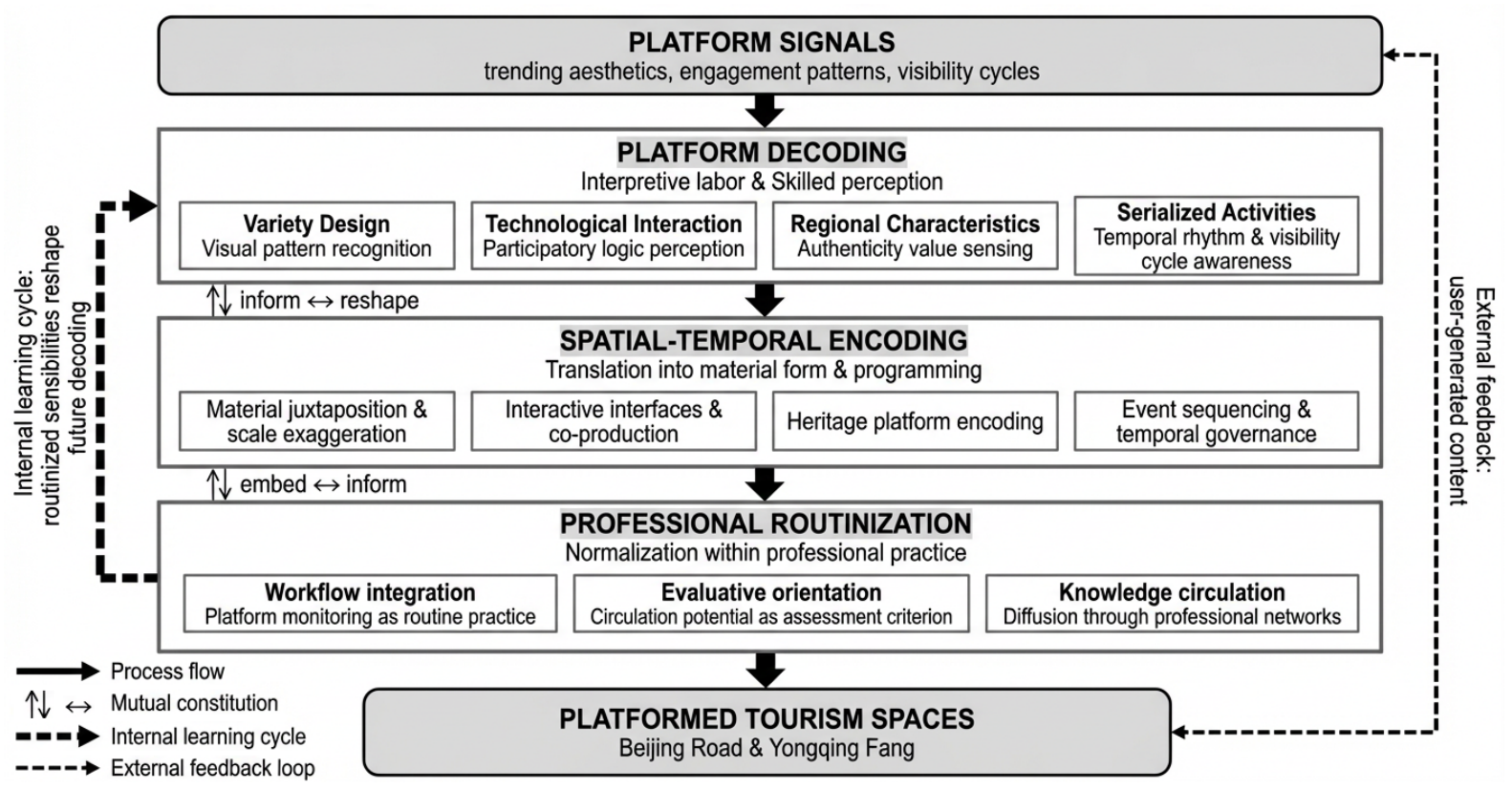
The preceding analysis identified four strategic dimensions—variety design, technological interaction, regional characteristics, and serialized activities—through which professional actors configure heritage spaces for platform visibility. As the professional accounts made evident, these strategies are not adopted in isolation but emerge from practitioners’ ongoing engagement with platform dynamics: monitoring trending content, recognizing algorithmic patterns, adapting programming to visibility cycles. This section draws out and systematizes the underlying process connecting these observable strategies, proposing professional translation as an analytical framework for understanding supply-side dynamics in platformed placemaking (Figure 4).
Professional translation designates the interpretive labor through which platform signals are decoded, converted into spatial and operational interventions, and normalized within everyday professional practice. The distinction between strategy and framework is analytically significant. The four strategic dimensions describe what professionals do; professional translation provides a structured vocabulary for understanding how these practices are organized and how they have become embedded within professional routines. The framework attends not only to conscious decision-making and explicit rationale but also to the tacit sensibilities, habituated judgments, and taken-for-granted orientations that shape professional perception of platform opportunities.
The conceptual move from documenting individual strategies to articulating an integrative framework represents a shift in analytical register—from cataloging professional activities to systematizing the processes through which platform dynamics have entered professional practice. Platform logics function as operative orientations guiding design and programming decisions, woven into professional ways of seeing and evaluating rather than imposed as external constraints.
Existing scholarship on platformed urbanism has concentrated primarily on demand-side dynamics. Research has traced how platforms reshape housing markets and neighborhood composition [6,8], generate displacement through digitally mediated consumption [14], and restructure tourist experience through algorithmic curation [15]. The production side—how professional actors interpret and respond to platform dynamics—has received comparatively limited scholarly attention. Van Dijck et al. [56] called for understanding platform power across institutional domains, yet urban scholarship has been slow to trace how platform logics enter professional practices of planning, design, and operation. Professional translation addresses this lacuna by providing an analytical vocabulary for how platform dynamics enter spatial production. The framework extends Leszczynski’s [1] argument regarding platform-mediated reordering of urban spatial relations by identifying concrete pathways through which such reordering occurs, and complements Törnberg’s [9] framework by revealing recursivity between user-generated content and professional production.
Positioning professional translation within supply-side scholarship reveals its distinctive analytical contribution. McCann and Ward [22] and Peck and Theodore [23] establish that externally originating models undergo active transformation—selection, adaptation, reassembly—as they enter local practice. Professional translation shares this transformative character but operates under distinctive conditions: platform signals are not periodic and expert-curated but continuous, algorithmically amplified, and publicly visible to multiple actors simultaneously [16,17], generating ongoing interpretive demands that require sustained attunement rather than episodic assessment. Moreover, the findings reveal that professionals do not adapt platform signals as coherent models but decompose them into discrete elements—a visual motif, a temporal rhythm, a scalar relationship—evaluating each against heritage and disciplinary criteria before selective recombination. Faulconbridge [57] shows how professional knowledge standardizes through communities of practice; professional translation identifies a parallel but distinct pathway in which convergent orientations emerge not from collegial exchange but from shared exposure to algorithmically distributed signals. Crucially, this convergence remains professionally regulated: conservation mandates and institutional review operate as active constituents of the translation process itself, filtering which platform signals acquire spatial form.

6.2. Three Analytical Dimensions of Professional Translation

The framework is organized around three interconnected analytical dimensions: platform decoding, spatial–temporal encoding, and professional routinization. This tripartite structure shifts from the thematic organization of the findings—structured around four strategic dimensions—to a processual account of how platform-responsive practice is constituted. The four strategy dimensions are not confined to any single analytical dimension but flow through all three, entering each in different forms. Decoding identifies how professionals perceive platform opportunities; encoding traces how these perceptions become material and operational interventions; routinization examines how platform-responsive approaches become normalized within professional culture.
The three dimensions, as visualized in Figure 4, do not constitute a linear sequence but an iterative process. Insights generated through decoding inform encoding practices, which in turn become routinized; routinization shapes future decoding sensibilities, creating an ongoing cycle of platform-responsive adaptation.

6.2.1. Platform Decoding

Platform decoding designates the interpretive labor through which professionals develop sensitivity to platform dynamics and recognize conditions favorable to visibility. As the findings demonstrated, professionals do not engage in systematic data analytics; rather, platform awareness accumulates through habitual engagement with content—noticing what circulates, sensing emerging esthetics, developing feel for algorithmic rhythms.
Schön’s [58] distinction between knowing-in-action and reflection-on-action provides analytical purchase on the uneven character of this process. Knowing-in-action describes the tacit competence embedded in routine performance: practitioners act on accumulated experience without consciously articulating the principles guiding their judgments. Reflection-on-action, by contrast, involves deliberate retrospective examination of one’s own practice assumptions, typically triggered when routine approaches encounter friction or unfamiliar conditions. Among the professionals studied, these two modes are unevenly distributed, and the distribution is not random but disciplinarily patterned.
The habituated monitoring practices documented among designers—where daily platform scanning has acquired the unremarkable quality of reading industry news (Section 5.1)—exemplify knowing-in-action: an internalized sensitivity to platform esthetics that no longer requires conscious deliberation. Operators’ practiced responsiveness to visibility decay patterns and posting frequency peaks (Section 5.4) similarly operates within this mode, governed by accumulated practical experience rather than explicit analysis. In both cases, platform decoding has been absorbed into the texture of everyday professional work.
Reflection-on-action surfaces under different conditions—specifically, when platform signals encounter disciplinary or institutional resistance. The instances documented in the findings are revealing: a designer rejecting a trending visual motif as materially incompatible with a heritage courtyard, another reframing platform-driven spatial differentiation in conservation-legible terms to navigate institutional review (Section 5.1 and Section 5.2). In each case, practitioners stepped outside habitual response to interrogate the relationship between platform logic and professional standards. These moments reveal decoding not as uniform pattern recognition but as a practice that oscillates between absorption and critical distance, depending on the degree to which platform signals align with or challenge established professional commitments.
The roots of this variation lie in what Noordegraaf [59] terms professional jurisdiction—the capacity of expert groups to claim authoritative interpretation over particular domains of practice. Designers and planners working within heritage contexts carry jurisdictional commitments—to material authenticity, spatial coherence, conservation protocols—that function as thresholds triggering reflection. When platform signals fall within the boundaries of these commitments, they are absorbed through knowing-in-action; when they transgress, reflection-on-action is activated. Operators, whose jurisdictional claims center on commercial performance and visitor satisfaction rather than heritage stewardship, encounter fewer such thresholds, which explains why their decoding tends to remain closer to the knowing-in-action mode. This is not a deficiency but a structural consequence of different jurisdictional positions within the professional ecology of heritage regeneration. The selectivity documented across the findings thus constitutes what Ingold [60] terms skilled perception—an attunement to environmental affordances cultivated through sustained professional engagement—but one whose specific contours are shaped by the jurisdictional claims through which different professional groups exercise authority over what counts as a legitimate platform signal (the evidence in Section 5 illustrates these jurisdictional variations).

6.2.2. Spatial–Temporal Encoding

Spatial–temporal encoding translates decoded opportunities into material form and operational programming. The four strategies documented in Section 5 involve markedly different degrees of professional knowledge mediation, forming a gradient that carries consequential analytical implications.
At one end, the encoding of regional characteristics and variety design demands intensive exercise of disciplinary judgment. Determining which heritage elements can sustain adaptive reuse, which traditional motifs can be abstracted without losing cultural legibility, and how material tension, scalar proportion, and compositional contrast can answer platform esthetics—these assessments depend on conservation knowledge, material expertise, and the culturally embedded judgment about authenticity thresholds that Zukin [61] identifies as central to place-based competitive strategy, exercised through what Dinhopl and Gretzel [62] term camera-ready urban. Here, disciplinary knowledge operates simultaneously as gate-keeping function and generative resource, producing spatial forms in which platform logic and professional knowledge are co-constitutive.
At the other end, serialized activities and technological interaction involve encoding processes governed by more explicit and transferable criteria. Operators attuned to patterns of visibility decay, posting rhythms, and programmable event sequences engage what Bucher [27] terms algorithmic temporality—a mode of encoding closer to procedural knowledge than tacit judgment. Configuring participatory interfaces similarly operates on a relatively explicit logic—that interaction generates content differentiation sustaining algorithmic visibility—even as it draws on design expertise in spatial layout and interaction choreography. In these domains, platform signals translate more directly into operational practice with less professional mediation.
This gradient carries a consequential implication. Where encoding relies on tacit disciplinary judgment, platform signals undergo substantial professional transformation before acquiring spatial form; Where encoding is governed by more codifiable and transferable criteria, the scope for such site-specific professional mediation narrows: operators at both sites described structurally similar event-sequencing logics learned through industry circulation (Section 5.4), suggesting that procedural encoding offers fewer entry points for disciplinary knowledge to inflect the translation process. This finding nuances prevailing accounts of platformisation in urban scholarship, which tend to frame platform logics as colonizing or displacing other forms of knowledge [3,56]. Rather than uniform colonization, the evidence demonstrates that professional knowledge systems actively shape the terms on which platform logic is materialized—but do so unevenly, with the degree of professional mediation varying systematically across different domains of spatial and temporal intervention.

6.2.3. Professional Routinization

Professional routinization describes the normalization of platform-responsive practice within organizational workflows. The taken-for-granted quality of platform engagement evident throughout the findings indicates institutional embedding rather than individual idiosyncrasy.
Routinization proceeds through interconnected pathways: platform monitoring becomes integrated into routine workflows with the unremarkable quality of reviewing precedent studies; platform-derived criteria—notably photographability—enter evaluative frameworks alongside established professional standards; and platform orientations circulate through professional networks, producing the kind of practice standardization across design firms that Faulconbridge [57] has documented in other domains. Through these pathways, new sensibilities—attunement to trending esthetics, intuition for shareable spatial qualities—acquire professional value, reshaping what counts as competence in ways that resonate with Yaneva’s [63] observations of designers incorporating emergent knowledge forms.
Routinization does not, however, proceed without friction—and it is these frictions that reveal most about the contested character of platform-responsive professionalism. Three forms are discernible, of which the first is analytically most consequential.
Institutional friction emerges when routinized platform orientations encounter conservation review. What the findings document is not occasional improvisation but a secondary routinization: professionals have developed repeatable discursive repertoires—reframing platform-driven design rationales in heritage-legible terms—to navigate institutional gatekeeping (Section 5.1). This secondary routinization of justification is analytically significant because it reveals a dual-layered normalization process. Platform-responsive design becomes habitual, and simultaneously, the rhetorical labor required to reconcile that practice with conservation norms becomes habitual. The professional does not resolve the tension between platform logic and heritage stewardship; rather, the management of that tension is itself routinized, producing a stable but inherently ambivalent mode of practice.
Intra-organizational friction surfaces between professional groups whose routinized orientations diverge—marketing teams pursuing rapid platform responsiveness against cultural programming colleagues exercising curatorial restraint (Section 5.4). Unlike institutional friction, which generates stabilized discursive workarounds, these competing routines must be negotiated case by case without achieving durable resolution. Disciplinary friction arises at a more reflexive register, when professionals perceive that routinized platform attention systematically amplifies photogenic elements while rendering spatial and infrastructural heritage invisible (Section 5.3). This friction is acknowledged but cannot be resolved within the terms of platform-responsive practice alone—it marks the outer boundary of what routinization can absorb.
These frictions do not arrest routinization; rather, they constitute its ongoing condition, producing a professional landscape in which platform-responsive practice is simultaneously normalized and contested.

6.3. Boundary Conditions and Future Directions

The professional translation framework was developed from two government-supported micro-renovation projects in Guangzhou, operating within institutional environments that encourage commercial activation and embedded in China’s interest-recommendation platform ecology. These conditions shape what flows through the framework’s analytical dimensions. In what follows, each condition is examined to identify how its variation might alter the specific practices populating the framework while the tripartite structure—decoding, encoding, routinization—remains applicable as an organizing vocabulary.
Heritage Typology and Institutional Environment. In both case sites, platform visibility functions as a legitimate spatial production objective, enabling decoded signals to flow into encoding with friction manageable through rhetorical justification (Section 6.2.3). Yet heritage governance in China encompasses sites where conservation mandates and commercial pressures stand in far more restrictive tension [44], and where entrepreneurial mobilization of heritage value is institutionally constrained rather than encouraged [43]. In such contexts, professionals may still develop decoding sensibilities, but encoding could be channeled almost entirely through immaterial interventions—narrative framing, event programming—while material-spatial encoding encounters institutional resistance not as manageable friction but as a structural boundary. Routinization might center on friction management rather than on the workflow integration and evaluative reorientation documented here. Whether the decoding–encoding relationship takes fundamentally different form under restrictive conservation regimes—and whether supply-side actors themselves shift from commissioned professionals to residents and community organizations in primarily residential heritage districts—constitutes a priority for comparative inquiry.
Platform Ecology. Several documented practices implicitly depend on characteristics specific to China’s platform ecosystem. Douyin and Kuaishou employ interest-recommendation algorithms that prioritize engagement intensity over social-network position [29,31], generating the rapid visibility decay that operators described and that drives the temporal urgency of serialized activities. The visual optimization pervading variety design reflects the image-and-short-video content cultures cultivated by these platforms [30]. The convergent decoding orientations across professional groups presuppose publicly visible trending signals—a feature of recommendation-driven architectures whose content distribution logics remain opaque to users yet produce shared signal environments [17]. In platform ecologies with different algorithmic architectures, distribution logics, or dominant content modalities, the temporal grain of encoding, the sensory register of spatial optimization, and the degree of convergence in professional decoding would likely differ. Cross-platform and cross-national comparison constitutes a necessary next step for examining how the framework’s dimensions are populated under different platform conditions.

7. Conclusions

This study investigated how professional actors—planners, designers, and operators—interpret platform signals and translate them into spatial practice within heritage district regeneration. Through empirical research in Beijing Road and Yongqing Fang, two prominent heritage tourism destinations in Guangzhou, the analysis identified four strategic dimensions through which professionals configure heritage spaces for platform visibility: variety design, which establishes material conditions for photographability; technological interaction, which transforms spaces into participatory interfaces; regional characteristics, which mobilizes cultural distinction as competitive resource; and serialized activities, which manages temporal rhythms of content production. To systematize the processes underlying these strategies, the study proposed professional translation as an analytical framework organized around three interconnected dimensions: platform decoding, whereby professionals develop sensitivity to algorithmic dynamics and recognize conditions favorable to visibility; spatial–temporal encoding, through which decoded opportunities become embedded in material form and operational programming; and professional routinization, the normalization of platform-responsive approaches within organizational workflows.
The study contributes to platformed urbanism scholarship by redirecting analytical attention from demand-side processes to supply-side dynamics. Existing research has traced how platforms reshape place consumption, intensify spatial conflicts, and privilege particular esthetic registers, yet the production side—how professional actors anticipate, interpret, and respond to platform dynamics—has received comparatively limited scrutiny. By systematically documenting and classifying platform-responsive professional practices across two heritage districts, this study provides an empirically grounded account of the interpretive labor through which platform signals enter spatial decision-making. The professional translation framework extends Leszczynski’s argument regarding platform-mediated reordering of urban spatial relations by identifying concrete pathways through which such reordering occurs, and complements Törnberg’s framework by revealing recursivity between user-generated content and professional production. The framework’s applicability across two sites with distinct heritage typologies and governance arrangements strengthens confidence in its analytical utility beyond the particularities of individual cases.
At the same time, the findings reveal tensions inherent in platform-responsive heritage practice. Professional actors navigate between platform-driven visibility imperatives and conservation mandates, between the homogenizing pressures of algorithmic esthetics and the place-specific demands of heritage authenticity, between the accelerated temporalities of platform content cycles and the slower rhythms of heritage stewardship. These tensions do not resolve neatly; rather, they constitute an ongoing condition of professional practice in platformized heritage contexts. For practitioners and policymakers, the findings suggest that platform logics have become consequential forces shaping heritage space production, often operating through taken-for-granted professional sensibilities rather than explicit directives. Heritage management frameworks may need to engage more directly with these dynamics, recognizing that professional translation mediates the encounter between platform imperatives and conservation values in ways that warrant critical attention.
Beyond the boundary conditions discussed in Section 6.3, a methodological limitation concerns causal inference. The study relies on professionals’ retrospective accounts, which cannot establish causal directionality with the certainty that longitudinal or comparative designs would afford. The absence of comparison cases—sites not undergoing platformization or the same sites tracked over time—means the study documents professional accounts of platform-responsive practice rather than isolates platform effects from other drivers. Future research employing longitudinal tracking or paired comparison would strengthen causal claims.


Author Contributions

Z.H.: conceptualization, methodology, software. Z.H.: data curation, writing—original draft preparation. Z.H.: visualization, investigation. P.A.T. and H.C.G.: supervision. Z.H.: software, validation. P.A.T. and H.C.G.: writing—reviewing and editing. All authors have read and agreed to the published version of the manuscript.

Funding

This research received no external funding.

Institutional Review Board Statement

This study has been approved by the Universiti Malaya Research Ethics Committee (Non-Medical), with approval number UM.TNC2/UMREC_3888.

Informed Consent Statement

Informed consent was obtained from all subjects involved in the study.

Data Availability Statement

The original contributions presented in this study are included in the article. Further inquiries can be directed to the corresponding author.

Acknowledgments

The authors thank the study participants for their voluntary support in the research.

Conflicts of Interest

The authors declare no conflicts of interest.

References

  1. Leszczynski, A. Glitchy vignettes of platform urbanism. Environ. Plan. D 2020, 38, 189–208. [Google Scholar] [CrossRef]
  2. Plantin, J.-C.; Lagoze, C.; Edwards, P.N.; Sandvig, C. Infrastructure studies meet platform studies in the age of Google and Facebook. New Media Soc. 2018, 20, 293–310. [Google Scholar] [CrossRef]
  3. Srnicek, N. Platform Capitalism; Polity Press: Cambridge, UK, 2017. [Google Scholar]
  4. Zukin, S. Seeing like a city: How tech became urban. Theory Soc. 2020, 49, 941–964. [Google Scholar] [CrossRef] [PubMed]
  5. Boy, J.D.; Uitermark, J. Reassembling the city through Instagram. Trans. Inst. Br. Geogr. 2017, 42, 612–624. [Google Scholar] [CrossRef]
  6. Cocola-Gant, A.; Gago, A. Airbnb, buy-to-let investment and tourism-driven displacement: A case study in Lisbon. Environ. Plan. A 2021, 53, 1671–1688. [Google Scholar] [CrossRef]
  7. Gretzel, U. Influencer marketing in travel and tourism. In Advances in Social Media for Travel, Tourism and Hospitality: New Perspectives, Practice and Cases; Sigala, M., Gretzel, U., Eds.; Routledge: Oxfordshire, UK, 2018; pp. 147–156. [Google Scholar]
  8. Wachsmuth, D.; Weisler, A. Airbnb and the rent gap: Gentrification through the sharing economy. Environ. Plan. A 2018, 50, 1147–1170. [Google Scholar] [CrossRef]
  9. Törnberg, P. Platform placemaking and the digital urban culture of Airbnbification. Urban Transform. 2022, 4, 3. [Google Scholar] [CrossRef]
  10. Xu, D.; Chen, Y. City walk as platform-native counter-mapping: Entangled resistance and algorithmic visibility in Chinese digital urbanism. Media Commun. 2026, 14, 11021. [Google Scholar] [CrossRef]
  11. Yin, R.K. Case Study Research and Applications: Design and Methods, 6th ed.; Sage Publications: Thousand Oaks, CA, USA, 2018. [Google Scholar]
  12. Liu, X.; Mehraliyev, F.; Liu, C.; Schuckert, M. The roles of social media in tourists’ choices of travel components. Tour. Stud. 2020, 20, 27–48. [Google Scholar] [CrossRef]
  13. Ioannides, D.; Röslmaier, M.; van der Zee, E. Airbnb as an instigator of “tourism bubble” expansion in Utrecht’s Lombok neighbourhood. Tour. Geogr. 2019, 21, 822–840. [Google Scholar] [CrossRef]
  14. Zukin, S.; Lindeman, S.; Hurson, L. The omnivore’s neighborhood? Online restaurant reviews, race, and gentrification. J. Consum. Cult. 2017, 17, 459–479. [Google Scholar] [CrossRef]
  15. Schwarz, O. Sociological Theory for Digital Society: The Codes That Bind Us Together; John Wiley & Sons: Hoboken, NJ, USA, 2021. [Google Scholar]
  16. Bucher, T. If…Then: Algorithmic Power and Politics; Oxford University Press: Oxford, UK, 2018. [Google Scholar]
  17. Gillespie, T. Custodians of the Internet: Platforms, Content Moderation, and the Hidden Decisions That Shape Social Media; Yale University Press: New Haven, CT, USA, 2018. [Google Scholar]
  18. Fainstein, S.S. The Just City; Cornell University Press: Ithaca, NY, USA, 2010. [Google Scholar]
  19. Healey, P. Making Better Places: The Planning Project in the Twenty-First Century; Palgrave MacMillan: London, UK, 2010. [Google Scholar]
  20. Leaver, T.; Highfield, T.; Abidin, C. Instagram: Visual Social Media Cultures; Polity Press: Cambridge, UK, 2020. [Google Scholar]
  21. Ash, J.; Kitchin, R.; Leszczynski, A. Digital turn, digital geographies? Prog. Hum. Geogr. 2018, 42, 25–43. [Google Scholar] [CrossRef]
  22. McCann, E.; Ward, K. (Eds.) Mobile Urbanism: Cities and Policymaking in the Global Age; University of Minnesota Press: Minneapolis, MN, USA, 2011. [Google Scholar]
  23. Peck, J.; Theodore, N. Fast Policy: Experimental Statecraft at the Thresholds of Neoliberalism; University of Minnesota Press: Minneapolis, MN, USA, 2015. [Google Scholar] [CrossRef]
  24. Kitchin, R. Thinking critically about and researching algorithms. Inf. Commun. Soc. 2017, 20, 14–29. [Google Scholar] [CrossRef]
  25. Yang, C.; Liu, T. Social media data in urban design and landscape research: A Comprehensive literature review. Land 2022, 11, 1796. [Google Scholar] [CrossRef]
  26. Plantin, J.-C.; Punathambekar, A. Digital media infrastructures: Pipes, platforms, and politics. Media Cult. Soc. 2019, 41, 163–174. [Google Scholar] [CrossRef]
  27. Bucher, T. The algorithmic imaginary: Exploring the ordinary affects of Facebook algorithms. Inf. Commun. Soc. 2017, 20, 30–44. [Google Scholar] [CrossRef]
  28. Kaye, D.B.V.; Chen, X.; Zeng, J. The co-evolution of two Chinese mobile short video apps: Parallel platformization of Douyin and TikTok. Mob. Media Commun. 2021, 9, 229–253. [Google Scholar] [CrossRef]
  29. Zhao, Z. Analysis on the “Douyin (Tiktok) Mania” Phenomenon Based on Recommendation Algorithms. E3S Web Conf. 2021, 235, 03029. [Google Scholar] [CrossRef]
  30. Wang, X.; Zhang, H. Imagining ancient towns through “seeding strategy”: Place symbols and media construction on the Xiaohongshu platform. Heritage 2025, 8, 468. [Google Scholar] [CrossRef]
  31. Plantin, J.-C.; de Seta, G. WeChat as infrastructure: The techno-nationalist shaping of Chinese digital platforms. Chin. J. Commun. 2019, 12, 257–273. [Google Scholar] [CrossRef]
  32. Yitao, C.; Zhixi, Z.; Jie, J.W.; Hongjie, S. What drives the tourist Daka? An empirical study based on the perspective of dual motivation. Asia Pac. J. Tour. Res. 2024, 29, 836–851. [Google Scholar] [CrossRef]
  33. Shen, C. Social media marketing and digital influence for visitor flow management in sustainable heritage tourism. Sci. Rep. 2025, 15, 45767. [Google Scholar] [CrossRef] [PubMed]
  34. Zhao, Z.; Zhu, M.; Hao, X. Share the Gaze: Representation of destination image on the Chinese social platform WeChat Moments. J. Travel Tour. Mark. 2018, 35, 726–739. [Google Scholar] [CrossRef]
  35. Huang, Y.; Zheng, B. Social media users’ visual and emotional preferences of internet-famous sites in urban riverfront public spaces: A case study in Changsha, China. Land 2024, 13, 930. [Google Scholar] [CrossRef]
  36. Liu, L.X. Internet-famous architecture in the new media context: A study on social interaction and urban space reshaping. Urban Archit. 2025, 22, 185–188. [Google Scholar]
  37. Jia, M.; Feng, J.; Chen, Y.; Zhao, C. Visual Analysis of Social Media Data on Experiences at a World Heritage Tourist Destination: Historic Centre of Macau. Buildings 2024, 14, 2188. [Google Scholar] [CrossRef]
  38. Qiu, Q. Identifying the role of intangible cultural heritage in distinguishing cities: A social media study of heritage, place, and sense in Guangzhou, China. J. Destin. Mark. Manag. 2023, 27, 100764. [Google Scholar] [CrossRef]
  39. Tan, Y. Non-place making: Chinese tourists’ production of tourist spaces through social media. Tour. Geogr. 2025; in press. [CrossRef]
  40. Wang, Y.; Xu, R. The formation of internet-famous DAKA sites: An analysis of users’ daily practices in short-video environments. China Youth Study 2021, 2021, 105–112. [Google Scholar]
  41. Wu, F. Planning centrality, market instruments: Governing Chinese urban transformation under state entrepreneurialism. Urban Stud. 2018, 55, 1383–1399. [Google Scholar] [CrossRef]
  42. Shin, H.B. Economic transition and speculative urbanisation in China: Gentrification versus dispossession. Urban Stud. 2016, 53, 471–489. [Google Scholar] [CrossRef]
  43. Oakes, T. China’s urban heritage and the cultural economy. In Beyond the Creative City: Cultural Policy in an East Asian Context; Oakes, T., Kong, L., Eds.; Springer: Berlin/Heidelberg, Germany, 2019; pp. 193–214. [Google Scholar]
  44. He, S.; Wu, F. China’s emerging neoliberal urbanism: Perspectives from urban redevelopment. Antipode 2009, 41, 282–304. [Google Scholar] [CrossRef]
  45. Eisenhardt, K.M.; Graebner, M.E. Theory building from cases: Opportunities and challenges. Acad. Manag. J. 2007, 50, 25–32. [Google Scholar] [CrossRef]
  46. Patton, M.Q. Qualitative Research and Evaluation Methods: Integrating Theory and Practice, 4th ed.; Sage Publications: Thousand Oaks, CA, USA, 2015. [Google Scholar]
  47. Zheng, Y.; Yang, S.Y.; Feng, Z.; Lü, Z.H. Research on renovation and upgrading strategies for Beijing Road Pedestrian Street in Guangzhou from the perspective of cultural memory. In Proceedings of the 2024 Annual China Urban Planning Conference; Renewal, U., Ed.; China Association of City Planning: Beijing, China, 2024; Volume 03, pp. 2765–2775. [Google Scholar]
  48. Zeng, Z.H.; Liang, Z.C.; Wu, Y. Research on the paths of cultural inheritance and innovation: A case study of micro-renovation in Yongqingfang, Guangzhou. China Anc. City 2020, 12, 82–86. [Google Scholar] [CrossRef]
  49. Denzin, N.K. Triangulation 2.0. J. Mix. Methods Res. 2012, 6, 80–88. [Google Scholar] [CrossRef]
  50. Noy, C. Sampling knowledge: The hermeneutics of snowball sampling in qualitative research. Int. J. Soc. Res. Methodol. 2008, 11, 327–344. [Google Scholar] [CrossRef]
  51. Guest, G.; Bunce, A.; Johnson, L. How many interviews are enough? An experiment with data saturation and variability. Field Methods 2006, 18, 59–82. [Google Scholar] [CrossRef]
  52. de Kloet, J.; Poell, T.; Guohua, Z.; Yiu Fai, C. The platformization of Chinese society: Infrastructure, governance, and practice. Chin. J. Commun. 2019, 12, 249–256. [Google Scholar] [CrossRef]
  53. Bowen, G.A. Document analysis as a qualitative research method. Qual. Res. J. 2009, 9, 27–40. [Google Scholar] [CrossRef]
  54. Braun, V.; Clarke, V. Using thematic analysis in psychology. Qual. Res. Psychol. 2006, 3, 77–101. [Google Scholar] [CrossRef]
  55. Miles, M.B.; Huberman, A.M.; Saldaña, J. Qualitative Data Analysis: A Methods Sourcebook, 3rd ed.; Sage Publications: Thousand Oaks, CA, USA, 2014. [Google Scholar]
  56. Van Dijck, J.; Poell, T.; de Waal, M. The Platform Society: Public Values in a Connective World; Oxford University Press: Oxford, UK, 2018. [Google Scholar]
  57. Faulconbridge, J.R. Global architects: Learning and innovation through communities and constellations of practice. Environ. Plan. A 2010, 42, 2842–2858. [Google Scholar] [CrossRef]
  58. Schön, D.A. The Reflective Practitioner: How Professionals Think in Action; Basic Books: New York, NY, USA, 1983. [Google Scholar]
  59. Noordegraaf, M. Protective or connective professionalism? How connected professionals can (still) act as autonomous and authoritative experts. J. Prof. Organ. 2020, 7, 205–223. [Google Scholar] [CrossRef]
  60. Ingold, T. The Perception of the Environment: Essays on Livelihood, Dwelling and Skill; Routledge: Oxfordshire, UK, 2000. [Google Scholar]
  61. Zukin, S. Naked City: The Death and Life of Authentic Urban Places; Oxford University Press: Oxford, UK, 2010. [Google Scholar] [CrossRef]
  62. Dinhopl, A.; Gretzel, U. Selfie-taking as touristic looking. Ann. Tour. Res. 2016, 57, 126–139. [Google Scholar] [CrossRef]
  63. Yaneva, A. The Making of a Building: A Pragmatist Approach to Architecture; Peter Lang Publishing: Lausanne, Switzerland, 2009. [Google Scholar]
Figure 1. Map of Beijing Road. Source: Author.
Architecture 06 00082 g001
Figure 2. Map of Yongqingfang. Source: Author.
Architecture 06 00082 g002
Figure 3. Thematic network of “Social media strategy.” Source: Author used NVIVO for analysis.
Architecture 06 00082 g003
Figure 4. Professional Translation as a Supply-Side Process in Platformed Placemaking.
Architecture 06 00082 g004
Table 1. Summary of informant profiles. Note: BJR = Beijing Road; YQF = Yongqingfang.
Professional GroupnMale/FemaleAge RangeExperience (Years)Case Site (BJR/YQF)
Urban Planners138/530–556–256/7
Architects & Landscape Designers149/527–485–206/8
Commercial Operators85/328–476–154/4
Total3522/1327–555–2516/19
Disclaimer/Publisher’s Note: The statements, opinions and data contained in all publications are solely those of the individual author(s) and contributor(s) and not of MDPI and/or the editor(s). MDPI and/or the editor(s) disclaim responsibility for any injury to people or property resulting from any ideas, methods, instructions or products referred to in the content.