Article

The Role of Glamping in Reinforcing Local Identity—A Landscape Design Approach Hypothesis

by
Luca Trabattoni
1,* and
Margherita Capotorto
2
1
Department of Architecture and Planning, Opole University of Technology, 45002 Opole, Poland
2
Department of Civil Engineering and Architecture, Pavia University, 27100 Pavia, PV, Italy
*
Author to whom correspondence should be addressed.
Architecture 2026, 6(2), 67; https://doi.org/10.3390/architecture6020067
Submission received: 2 March 2026 / Revised: 7 April 2026 / Accepted: 15 April 2026 / Published: 20 April 2026
(This article belongs to the Special Issue Intelligent Ecologies in Architectural Research and Practice)

Abstract

This study investigates the role of glamping within outdoor tourism as a potential tool for preserving and enhancing local landscape identity. Despite its rapid growth, glamping remains weakly defined within regulatory and design frameworks. The paper aims to explore whether a design-oriented approach can redefine glamping as a landscape-based practice rather than a purely market-driven phenomenon, with particular reference to the Italian context. The research adopts a qualitative research-by-design methodology, combining a critical literature review with the development of two pilot projects located in distinct settings: a natural hilly landscape and a rural agricultural context. These projects function as experimental tools to test spatial, ecological, and perceptual design strategies, focusing on settlement density, landscape integration, and experiential quality. The findings identify recurring principles that enable the codification of the glamping–landscape relationship, including low-density configurations, reversibility of structures, respect for existing morphology, and reinforcement of landscape identity. Landscape elements such as topography, vegetation, and visual relationships emerge as primary drivers of design. The study contributes to the discourse by reframing glamping as a landscape design practice, proposing a reversible and context-sensitive model of temporary inhabitation that supports sustainable tourism development.

1. Introduction

1.1. The Intelligence of Outdoor Tourism

The relationship between humans and nature was at the centre of profound philosophical and architectural reflection throughout the twentieth century. In “Homo addittus naturae”, Ernesto Nathan Rogers reflects on the role of humankind and architecture within the natural world [1]. The title itself overturns the idea of “homo faber”, typical of productivist modernity: human beings are not only those who make and transform, but those who dwell. Humanity is part of nature, not a separate or superior entity.
For Rogers, architecture represents the privileged locus of this relationship: building does not mean imposing an abstract form, but instead engaging in dialogue with context, history, landscape, climate, and culture [1] (pp. 2–5). In Rogers’s thought, one can also recognise echoes of Heidegger’s teachings, which criticise the technical and functionalist attitude toward nature conceived as a mere resource “to be exploited,” in favour of a more reciprocal and balanced relationship [2].
In the essay “Building, Dwelling, Thinking”, Heidegger states that the essence of humankind is not domination but dwelling [2]. To dwell means to care for the world, to live in balance with the earth, the sky, mortals, and divinities, united in the concept of the “Fourfold.” Human beings are not masters of nature but its custodians: only by recognising their own limits and finitude can they establish an authentic relationship with it.
Within this theoretical framework, when applied to outdoor tourism, glamping (that means GLAMOUR + CAMPING) can represent an opportunity to articulate a design intelligence grounded in the human/nature relationship, consistent with a conception of dwelling as a practice of care and responsibility.
Outdoor tourism can be defined as a tourism segment focused on experiences and activities in natural environments, in which the relationship with the territory and landscape is central. This type of tourism is articulated through different forms of hospitality, calibrated according to the user’s level of familiarity and engagement with nature. The set of these accommodation modes, commonly referred to as outdoor facilities, includes heterogeneous realities such as agro-tourism establishments, mountain refuges, campsites, and tourist villages. While they share their integration within natural contexts, they differ in terms of services, level of comfort, and modes of environmental use [3].
The concept of intelligence in this field of inquiry can encompass a range of interpretations, from relational intelligence, which fosters relationships among tourists, local communities, and the environment, promoting deep connections that go beyond superficial consumption of the territory, to transformative intelligence. Outdoor tourism operates as a process of landscape and cultural transformation, redefining the perception of places and strengthening local identity. In this sense, the experience could be seen as a process of re-territorialization in which tourism, communities, and the environment actively participate in the construction of shared meanings.
Glamping falls within the category of outdoor tourism, as a market phenomenon, but not as an established activity. While it exists as an official market demand, from a legislative and regulatory standpoint, it falls under the category of camping. For this reason, there is no specific design formula, nor even a particular definition. Still, it can be understood as part of the broader processes and practices that reterritorialize the landscape.
Areas of high landscape value serve as ideal contexts for integrating open-air hospitality facilities, playing a central role in the territory’s tourist appeal and reinforcing its natural identity. It is important to note that in Italy, most outdoor hospitality facilities are located near or within protected landscape systems (ref. Italian landscape protection regulations).
One of the founding compromises of European outdoor tourism, from its origins to the present, regarding landscape use, is its transitory and temporal nature, as widely discussed elsewhere [4]. Outdoor tourism has historically been characterised as a temporary dwelling system primarily linked to holiday periods. The increasingly widespread use of structured accommodation systems, such as maxi-caravans [5], in the European context enables the conversion of areas previously intended as natural reception spaces into nature-oriented hospitality settlements. Contemporary campsite development, therefore, increasingly occurs through the construction of the maxi-caravan landscape [6], coherently addressing both functional landscape use and the landscape’s image. The ease of installation and removability of the maxi-caravan model underpin its current diffusion and largely determine its sustainability (no permanent soil consumption) and its potential (restoration of the original condition) [6,7].
The widespread adoption of these housing models introduces a dual temporality within campsites: first, the temporality of spatial use for hospitality purposes, linked to holiday periods; second, the temporality of the industrial product, which typically has a lifespan of 7–10 years before replacement [4]. However, the specific residential nature of the maxi-caravan [5] opens an additional field of reflection, namely the temporal extension of the use of hospitality structures, which connects to the debate on de-seasonalisation [8,9,10] and the urban role of campsites [11].
Within this framework, glamping introduces a further dimension. Low settlement density, combined with the removability of structures, makes landscape a determining factor. The dwelling act in glamping is not simply the installation of a luxury shelter, but the construction of an experiential and perceptual system that integrates inhabiting practices with the existing and perceived image of the landscape. This process inevitably involves transforming the host landscape. Such transformation, together with the removability of dwelling structures, positions landscape as the stable infrastructure of glamping—a natural infrastructure that evolves while retaining anthropic traces of habitation. This evolving condition constitutes its transitory nature. The aim of this paper is therefore to determine whether it is possible to define strategies for managing this transition process that simultaneously address human needs and preserve landscape identity.
Glamping appears as a radical form of camping, where isolation in nature takes precedence over sharing, leading to a reflection on the valorisation of nature, compromised by the other fundamental aspect of glamping: luxury. The luxury of glamping translates into both isolation and, therefore, an exclusive perception of the landscape, as well as the provision of exclusive services, ranging from exceptional amenities to unique offerings.
The perceived luxury of the glamping experience derives not only from the services provided but also from the opportunity to engage with the landscape in a privileged way, thereby creating lasting memories for the visitor. This is what truly distinguishes glamping from camping in its more traditional sense [12].
Given their growing significance in the global and economic landscape, open-air accommodation facilities, including glamping, are recognised by the World Tourism Organisation (UNWTO) in its Global Code of Ethics for Tourism as a potential driver of sustainable development [13].
Exploring the sustainability of these facilities highlights several essential issues in the contemporary context, such as environmental protection, biodiversity conservation, and minimising the impact of human activities. The need for a sustainable approach is combined with a need to enhance the natural image of the context through a hypertrophic representation that emphasises and valorises its identity.
In constructing an outdoor tourism landscape, we balance the relationship between the prevailing (external) landscape and the internal one. The internal landscape inevitably becomes the primary focus of design. It acquires its own identity, determined by its context but also by its practicality in relation to settlement and usage needs.
Inside the Glamping, however, the relationship with the prevailing landscape becomes crucial. In glamping, this relationship must not only be balanced to offset human impact but must also be clearly foundational. In this sense, glamping is the perfect place to develop the language of landscape sustainability. The emphasis on sustainability, understood as the landscape’s intelligence and, therefore, as the preservation of its naturalness, becomes an identity image and, by extension, a marketing image in glamping. This iconic relationship is more evident in distinctive landscapes, such as rural areas.
This paper investigates design strategies for establishing an open-air tourism accommodation facility that preserves and enhances existing natural conditions, a concept known as “glamping.” The radical dimension of this landscape modus vivendi involves seeking its identity by defining the boundary between conservation and alteration of existing conditions, identifying the luxury factor as the closest possible proximity to the unaltered.

1.2. Research Questions

This paper is part of a broader research project on outdoor tourism, supported by an established body of work [3,4,5,6,11] focusing on sustainable campsite design in relation to urban development and emerging housing systems such as maxi caravans.
Within this consolidated research framework, the present study specifically addresses the topic of glamping, which, as noted, remains comparatively underexplored in the literature. In this sense, the research questions are defined by the authors for the purposes of this paper: they build upon the broader research background but are specifically formulated to investigate the distinct characteristics and design implications of glamping.
Therefore, while grounded in an ongoing line of research, the research questions should be understood as original and specific to this contribution.
The research pursues three primary objectives:
  • Conceive outdoor tourism as a tool for landscape valorization;
  • Use the intelligence of outdoor tourism in the construction of tourism landscapes.
  • Underline Glamping as an opportunity for conservation and the definition of territorial identity in rural or natural settlements.
The aim of this paper is to extend research on outdoor tourism to the glamping sector, which has not yet been defined from a design perspective. For this reason, following the definition of the state-of-the-art and the identification of issues related to the topic, it became possible to formulate research questions. These questions evolved during the investigative work, becoming more specific and enabling the research to acquire the depth and detail necessary for project realization.
The research questions are as follows:
  • How can landscape identity be enhanced by the presence of a Glamping facility structure?
  • Which elements of landscapes can be considered part of the territorial intelligence that supports the construction of a new tourism landscape within the Italian context?
  • Is it possible to approach the Glamping with a design-based strategy instead of a market-oriented one?

1.3. Literature Review

Research on glamping should be situated within a broader cultural framework concerning the evolution of outdoor tourism in relation to landscape, with particular attention to landscape sustainability and the preservation of local landscape identity. According to the World Tourism Organisation, outdoor tourism can be interpreted as a form of temporary inhabitation of the landscape that contributes to the valorisation of local territorial resources, provided that its development remains compatible with ecosystem conservation and the socio-cultural identity of host communities. Within this perspective, sustainable tourism is defined as a model that “takes full account of its current and future economic, social and environmental impacts, addressing the needs of visitors, the industry, the environment and host communities” [13].
As a radicalised form of outdoor tourism, glamping may generate ambivalent outcomes: on the one hand, it can foster enhanced appreciation and preservation of local identity; on the other, it may produce processes of landscape elitization (social and spatial exclusion) as well as scenographic transformation, whereby an alternative, staged environment is constructed.
The tourism literature has emphasised that the tourist experience is mediated by culturally shaped practices of seeing and interpretation. From this perspective, scholarly attention has progressively shifted from mere physical presence in places to the social construction of landscape as an object of desire and meaning. The contribution of John Urry, particularly in The Tourist Gaze, clarified how the tourist gaze selects and organises elements of territory according to shared cultural codes, transforming natural and rural environments into “readable” and consumable landscapes [14,15].
Parallel research on tourist authenticity has shown how the search for contact with nature intertwines with the demand for experiences perceived as authentic yet often mediated through staging. The analyses of Dean MacCannell have been central to understanding this tension between authenticity and representation, which is particularly relevant to contemporary forms of outdoor tourism [16].
Within this broader evolution, glamping emerges as a practice that reinterprets traditional camping through an experiential lens: the natural environment becomes an immersive scenographic setting while simultaneously functioning as a space of comfort, aestheticisation, and personalisation. Nature is no longer merely traversed but is temporarily inhabited through light infrastructures and narratives of sustainable luxury.
The concept of landscape has progressively expanded from an aesthetic category to a relational and identity-based one. Contemporary approaches interpret it as the dynamic outcome of interactions between human communities and the environment, integrating ecological, historical, and symbolic values [17,18].
In this sense, the tourist landscape constitutes a field of negotiation between economic use and cultural protection [19].
Outdoor tourism has historically contributed to the valorisation of marginal, rural, or natural territories, but it has also generated processes of standardisation and banalization of places. The risk is that the landscape is transformed into a thematic product detached from local life. The critical reflection on “non-places” developed by Marc Augé highlights precisely how spaces devoted to mobility and consumption may lose their identity-based rootedness [20].
Glamping represents a radicalisation of this ambiguity: on the one hand, it promises immersion and authenticity; on the other, it introduces globalised aesthetic models that may homogenise local expressions of landscape. Recent literature, therefore, emphasises the importance of assessing not only the environmental impact of such infrastructures but also their symbolic and cultural implications [21].
Sustainability in outdoor tourism was initially addressed primarily in ecological terms, focusing on environmental footprint, land consumption, and resource management. More integrated approaches, however, conceptualise landscape as a complex socio-ecological system in which environmental conservation and cultural continuity are inseparable [22].
Within this integrated perspective, landscape sustainability entails the conservation of the ecological and morphological characteristics of territory, the safeguarding of local cultural and productive practices, the compatibility between tourism infrastructures and the perceptual structure of places, and the active participation of local communities in defining development models [22].
UNESCO’s guidelines on cultural landscapes have further reinforced the view that the protection of territorial heritage requires integrating natural values and human identities, offering an interpretative framework highly relevant to emerging tourism practices [23].
Within a perspective that understands tourism as a form of landscape use, glamping can be interpreted as a mode of cultural mediation that combines the use of nature with the production of landscape meaning [24].
From a landscape perspective, it introduces light, temporary infrastructure that aims to minimise physical impact while simultaneously redefining the perceptual experience of place. The literature on glamping and experiential nature-based tourism identifies several recurring features: the controlled aestheticisation of the environment, the valorisation of silence, views, and isolation as tourism assets, the contemporary reinterpretation of traditional dwelling forms, and the construction of narratives of sustainability and authenticity [15,16,24].
A central issue in the debate concerns the capacity of glamping practices to preserve or transform local landscape identity. Landscape identity does not simply coincide with the visual appearance of territory, but also encompasses collective memory, social uses of space, and economic relations [18].
The primary risk is the “scenographicization” of the landscape, in which local elements are selectively reinterpreted to meet global tourism expectations. However, place-embedded models of glamping (designed with local materials, managed by resident communities, and integrated into rural economies) may contribute to landscape regeneration and strengthen local identity [25,26].
In light of this theoretical evolution, research on glamping can be positioned as a field of inquiry that connects outdoor tourism, landscape studies, and territorial sustainability. It provides a particularly relevant case for examining how emerging forms of hospitality reshape the relationship between tourist experience and place identity.
While the body of literature specifically addressing glamping from a design perspective remains limited, relevant insights can be drawn from studies on nature-based tourism and the spatial organisation of recreational landscapes. In particular, research on nature-based tourism highlights the importance of the relationship between tourist activities and the structural and ecological characteristics of landscapes, emphasising how spatial configuration influences both environmental impact and user experience [27]. Similarly, the concept of carrying capacity provides a critical framework for understanding settlement density and the limits of landscape transformation, shifting the focus from purely quantitative thresholds to qualitative spatial strategies [28]. Furthermore, studies on park tourism underline the role of lightweight, reversible infrastructure in mediating between accessibility and conservation, suggesting that tourism facilities should be conceived as adaptable systems embedded within landscape processes rather than as fixed objects [29].
Taken together, these contributions support a shift toward a more spatially grounded interpretation of outdoor tourism, in which the design of temporary settlements, such as glamping, can be understood as part of a broader landscape-based approach.

1.4. The Phenomenon of Glamping in Italy

Glamping is primarily a tourism offering characterized by certain general and historical features but currently lacks a specific market definition. In fact, the NACE (NACE Rev. 2—55.30 Camping grounds, recreational vehicle parks and trailer parks (NACE is the European statistical classification of economic activities) [28].) code does not explicitly define glamping; instead, it covers all activities related to outdoor tourism, of which glamping is considered a “qualitative” variant.
Furthermore, from a communications and marketing perspective, as well as a scientific communication perspective, glamping is a consolidated tourism sector that requires in-depth analysis of both terminology and content.
The first known peer-reviewed academic article on glamping was published in 2013 by Brooker and Joppe [21]. The author’s reference to glamping was from an edited book chapter [24]. Brooker and Joppe [21] defined glamping as “a lexical combination of ‘glamorous’ and ‘camping’.” Features of glamping were discussed but not included in a formal definition.
Glamping, defined as a linguistic fusion of “glamorous” and “camping,” constitutes an emergent phenomenon within the tourism sector, representing a hybrid accommodation model that integrates the immersive outdoor experiences traditionally associated with camping with the amenities and service standards characteristic of high-end hospitality. This tourism modality enables participants to engage with natural environments while enjoying elevated infrastructure and comfort. Empirical evidence indicates that the concept has experienced substantial growth in recent years, reflecting a shift in consumer preferences toward experiences that concurrently prioritize adventure and comfort [30,31].
Conceptually, glamping can be characterised by a tripartite framework comprising maximal comfort, immersion in natural settings, and minimal environmental impact, aligning it with principles of ecotourism and sustainable travel [32]. This framework enhances experiential value by providing purposefully designed accommodations—commonly referred to as “glamps”—such as yurts, safari tents, treehouses, or luxury cabins. These structures are engineered to integrate seamlessly into natural landscapes, balancing functional comfort, aesthetic considerations, and environmental sensitivity [32].
Historical analyses suggest that the emergence of glamping is linked to innovations in outdoor leisure practices, notably associated with figures such as Thomas Hiram Holding. Such innovations have expanded the accessibility and appeal of camping, attracting demographics that might not otherwise engage in conventional camping activities [33]. The distinction between traditional camping and glamping reflects a broader shift in consumer behaviour, in which comfort, distinctive accommodations, and curated experiential quality are prioritised alongside nature-based recreational activities [31].
As the glamping sector continues to expand, it is critical to evaluate both socio-economic and ecological implications. The integration of high-quality facilities within natural environments requires continuous assessment to mitigate potential environmental impacts and ensure compliance with sustainable tourism objectives [32]. In this context, glamping should be understood not merely as a leisure activity but as a multidimensional intersection of luxury and adventure, which can also potentially contribute to environmental and biodiversity protection through design strategies specifically developed for this purpose.
In the Italian context, outdoor tourism is significant and increasingly important to the overall economic landscape. Specifically, this form of tourism has experienced substantial growth and continues to expand post-pandemic. Glamping fits into this landscape as a specialisation of camping, often as a reserved area within a larger facility and only rarely as a stand-alone structure. Following the pandemic, the Italian tourism sector experienced a significant recovery, marked by renewed growth in both domestic and international demand. According to ISTAT [34], tourist arrivals increased by 13.4% in 2023 compared to 2022, while overnight stays rose by 9.5%, with international visitors accounting for 52.4% of total arrivals. Within this context, outdoor tourism, encompassing campsites, open-air holiday villages, and hybrid forms such as glamping, showed even stronger growth. Data from the Observatory Outdoor indicate approximately 68.6 million overnight stays in outdoor tourism in 2023, surpassing pre-pandemic levels recorded in 2019 [35]. This trend reflects a structural reorientation in traveller preferences toward nature-based experiences, open spaces, and decentralised hospitality models outside traditional urban destinations.
From an economic perspective, outdoor tourism contributes substantially to value creation and employment, particularly in territories characterised by small-scale, localised economies. The wider Travel & Tourism sector generated a significant contribution to the national economy in 2023, including approximately €51.4 billion in “visitor exports,” representing expenditure by foreign tourists [36]. Outdoor tourism forms a key component of this contribution through spending on accommodation, recreational services, food and beverage, local transport, and small and micro-enterprises embedded in regional supply chains. Moreover, the spatial distribution of outdoor tourism supports a more even territorial dispersion of tourist expenditure, fostering development in rural and peripheral regions and mitigating the over-concentration of tourism flows in major urban centres [35,36]. In this regard, the outdoor tourism segment has emerged as a significant driver of post-pandemic economic recovery, generating both direct effects, such as revenue and employment, and indirect effects through local economic multipliers and the valorisation of environmental and cultural resources.
Recent data indicate that the glamping segment in Italy represents a comparatively small but rapidly expanding component of the broader outdoor accommodation market. Estimates suggest approximately 295 glamping structures nationwide, offering around 10,000 bed places, with particularly high concentrations in Tuscany, Piedmont, and Veneto [36]. From an economic perspective, the glamping segment has experienced notable post-pandemic growth: its direct annual market value increased from approximately €13 million in 2018 to roughly €22 million in 2023, suggesting rising demand for upscale outdoor accommodations integrated into natural landscapes. At the same time, this study recognises that glamping remains a niche sector within the broader tourism economy and that its overall economic impact appears limited. Nevertheless, glamping may be interpreted as a best-practice example of landscape-sensitive tourism development, and its future relevance may lie less in quantitative expansion than in its potential symbolic and experimental role, as a small but potentially influential segment capable of informing design practices, sustainability narratives, and alternative models of nature-based hospitality. More broadly, the expansion of glamping aligns with the positive trajectory of the Italian open-air tourism sector, which surpassed pre-pandemic levels in overnight stays in 2023, with a 3% increase compared to 2019 [14]. This trend reflects a structural shift in consumer preferences toward experiential, comfort-oriented, and sustainable forms of tourism, in which glamping serves as a strategic niche combining lifestyle consumption, immersion in nature, and mid-to-high-end hospitality positioning. The “only glamping” structures are even more limited, numbering around 95, and offer approximately 1510 beds throughout Italy.
The lack of specific scientific data makes it challenging to define the relationship between glamping and the landscape clearly. Despite this, it is possible to give a general view of this relationship by operating by landscape categories.
The available research [35,37] allows, however, the identification of recurring patterns of localisation with respect to specific territorial contexts (Table 1). It should be considered that some key strategies determine the location of glamping in Italy:
  • The high perceptive enhancement of the landscape (hills, lakes, medium-altitude mountain areas).
  • It favors “experiential” landscapes, those in which the naturalistic dimension is accessible without advanced technical skills (e.g., light trekking).
  • It responds to the logic of the economy of territorial aesthetics (panoramic views, controlled distance from the urbanized, “immersive” atmosphere).
  • The identification of visually distinctive yet logistically accessible landscapes in which the environment becomes an integral part of the accommodation experience.
Another essential element in the classification of glamping is the types of housing used to provide accommodation. The most important historical reference is the famous “Field of the Cloth of Gold” [44]. This idea of luxury is linked to travel, which in the 16th century was associated with the use of tents. The precariousness of housing related to luxury and comfort led to the development of basic housing systems, including luxury canvas tents, yurts, treehouses, and cabins, specifically designed to offer modern amenities while maintaining an outdoor experience. Craig and Karabas note that the inclusion of diverse accommodation types in glamping, such as cabins and treehouses, enhances its appeal by providing modern conveniences, such as Wi-Fi and other comforts, that traditional camping lacks [45].
The already explained attention of tourists towards the image of the “natural” that necessarily accompanies glamping determines the definition of housing systems that either refer to an “ancestral” connection with the natural (this is the case of references to the vernacular, such as yurts), or guarantee an immersive experience (such as tree houses or plastic bubbles). Brochado and Brochado emphasize that natural environments and tangible components such as privacy are priorities for visitors seeking glamping experiences [46]. This aligns with the findings of Diwyarthi et al., who describe glamping as a trend offering unique, exclusive luxury experiences in natural settings, underscoring the demand for high-quality, immersive accommodations [47]. In addition to the knowledge of “naturalness,” glamping users favor the explicit expression of “sustainability.” Natural and sustainable, understood as iconic as well as content-based paradigms, thus become fundamental arguments for glamping, making it a marketing manifesto. Saayman and Merwe highlight that the popularity of eco-lodges has indeed led to a surge in accommodations, ranging from traditional tents to modern luxury chalets, suggesting a broadening of what is considered glamping [48].
Consistent with this general approach, the structures used in glamping also adapt to different geographic contexts and cultural preferences (Table 2), as noted by Yıldırım and Erkiliç, who point out variations such as cabins and luxury yurts that replace traditional tent structures, indicating a significant shift in how glamping is conceptualized and executed across different regions [49]. The “boutique concept” expressed by Kiryakova-Dineva, namely the need to externalize the luxury of the hospitality system within an image of a naturalistic experience [31], prompts reflection on the potential positive impact of glamping from a truly sustainable human intervention perspective. Prioritizing the image of nature can serve as a strategy to enhance the landscape’s image. It is therefore assumed that the landscape’s characteristics can be preserved and enhanced within a glamping facility.
After highlighting the potential of glamping, it’s essential to recall the critical issues associated with this activity. First, it’s necessary to highlight the issue of landscape language. The need to “metaphorize” the landscape to make it more legible can lead to the construction of a fictitious landscape [14,16]. This practice has been widely discussed in relation to outdoor tourism and amenity-based development. The famous case of the Costa Esmeralda, widely discussed elsewhere, represents a virtuous extreme (the choice of vegetation for the landscape was limited to the region, replicating the image of the Sardinian landscape in general in the Galura region) [31,50]. In other, less virtuous examples, the constructed landscape veers toward the mass-tourism view of that landscape, leading to the establishment of non-native vegetation with problematic consequences for the relevant ecosystem [51,52].
Furthermore, the pursuit of isolation, combined with the need for low population density, creates the possibility of perpetual exploitation of pristine natural areas, with consequent human impact on the ecosystem [53,54]. As scholars note, even low-density tourism can generate cumulative ecological pressure when marketed as wilderness or isolation-based tourism [55].

2. Materials and Methods

Camping Design and Architecture, Lodi–Italy, is a design/research studio founded by the authors to research and design the role of campsites in relation to urban and natural environments [56]. The design experience has developed more than 100 projects involving the conversion, consolidation, or transformation of outdoor accommodation facilities, providing a broad spectrum of design precedents to analyse, spanning different geographical contexts and characterised by diverse settlement approaches and architectural choices. From this experience emerges a comprehensive awareness of the possible design interpretations applicable to territories with varying degrees of fragility and distinct characteristics.
Through a research-by-design approach, the investigation was conducted at both the design and thematic levels, resulting in an outcome aligned with the needs expressed by the territory and its communities.
This research adopts a qualitative research-by-design approach, combined with comparative design applications. This methodological framework was selected because the study aims not to describe the glamping phenomenon from a landscape design perspective and to investigate how design strategies can operationalise landscape-sensitive hospitality and sustainability principles. Within design research, project development serves as both a knowledge-generating process and an analytical tool, enabling the testing of spatial, environmental, and experiential hypotheses.
The professional activity carried out through Camping Design and Architecture is the field of investigation in which to experiment and develop design theories, as has already been done in numerous papers and publications [3,4,5,6,11]. The two projects presented in this paper fit well into this scenario, as they are located in the Glamping project areas. The paper emerged from the possibility of combining the client’s practical needs with the authors’ desire to develop a coherent design strategy that leads to the creation of a Glamping-type structure. In this scenario, the following operational methodology is proposed:
  • Context analysis
The first phase consists of a review of outdoor tourism, with particular attention to sustainability, landscape integration, and emerging interpretations of “intelligent” territories. This step establishes the conceptual framework within which glamping is positioned.
2.
State of the art definition
The second phase defines the state of the art of glamping by analyzing its main typologies, operational characteristics, and frequently cited sustainability advantages. This analytical step clarifies how glamping is framed in existing literature and identifies gaps related to design-oriented perspectives.
3.
Research by design (OUTPUT)
The core of the methodology consists of the design and analysis of two glamping facilities located in two distinct and recognizable landscape contexts. The projects function as exploratory design through which design strategies are tested and evaluated.
These two pilot projects are grounded in professional and research activities with the experiences of Camping Design Architecture (led by the authors), whose project portfolio provides an empirical basis for investigating real design constraints and spatial outcomes. The integration of practice-based knowledge allows the research to move beyond purely theoretical interpretation. The design strategies aim to show how a design approach can respond to the market needs in a more technical way. The design strategies are structured around three thematic dimensions:
Experientiality: The concept of experientiality dominates reflections on the development of glamping projects through the act of designing the relationship between humans and nature. The objective of this particular form of vacation is to foster a sense of place in the tourist, who will perceive the stay as unforgettable.
Landscape aesthetics: During the design process, the question arises as to how the project integrates with the identity of the existing or prevailing landscape in terms of appearance. The perception of aesthetics is evolving, and the aesthetics of objects are becoming as important as their functionality. In contexts such as glamping, the object’s aesthetics take on a fundamental role. “The aesthetics of atmosphere focuses on the human experience in the environment, taking into account the relationship between the human condition and the nature of the environment” [57].
Density and spatial configuration: The distance between accommodation units is analyzed as a key parameter influencing experiential quality, privacy, and the human–nature relationship. Settlement density becomes a primary design variable.
4.
Comparative analysis and research outcomes (OUTCOME)
The final phase compares the two pilot projects’ strategies to identify their potential and limitations. This step supports reflections on the evolution of glamping and contributes to defining the phenomenon primarily from a design perspective rather than exclusively from a market perspective.
Overall, the methodology aims to bridge literature review and practice-based experimentation, positioning glamping as a design research field in which spatial strategies, landscape integration, and experiential quality can be systematically investigated.

3. Pilot Projects

3.1. Pilot Project 1—Spontaneous Natural Landscape

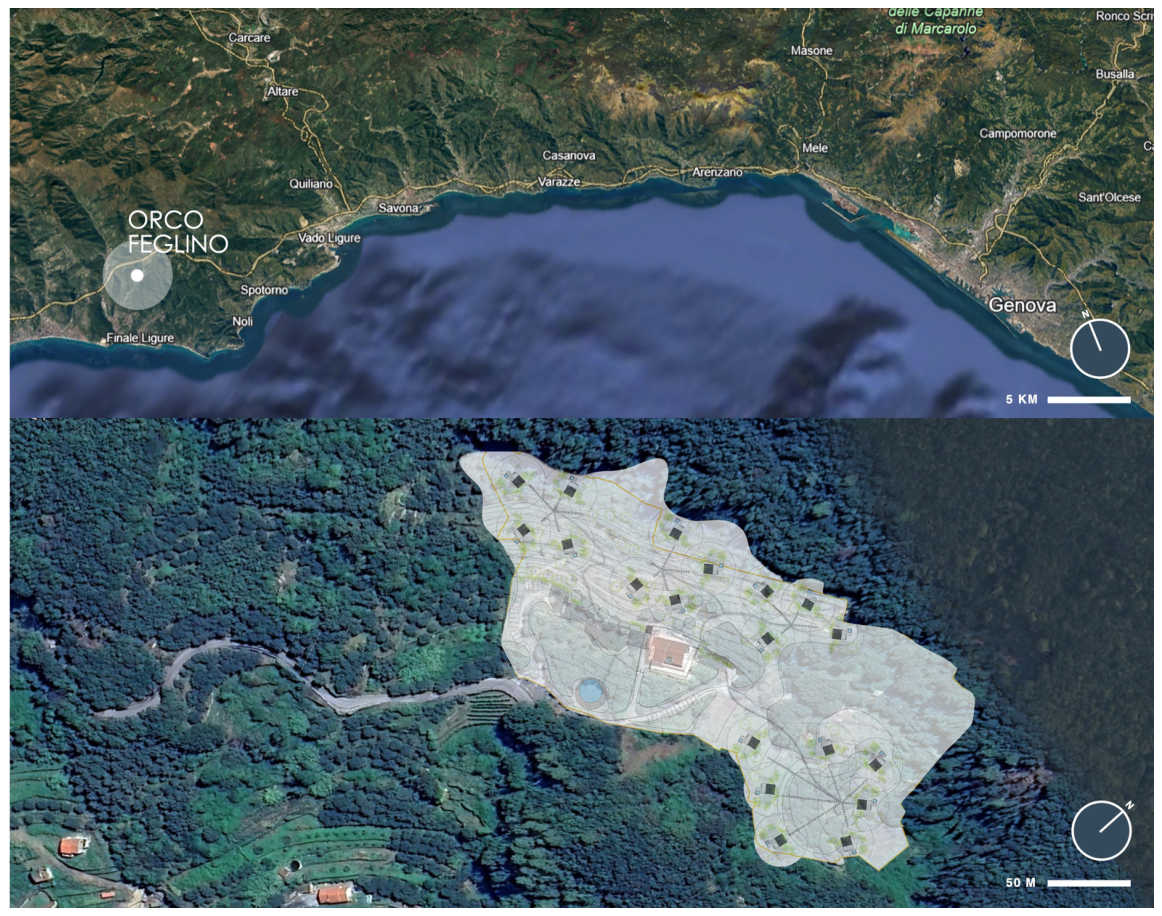
The first pilot project concerns the Ligurian hilly hinterland, in the town of Orco Feglino, in the province of Savona. The client’s requirement was to transform an existing restaurant business into a glamping-style accommodation. The client’s request included the use of lodge tents, but did not specify a specific number of units.
The “blank canvas” scenario opened up the possibility of designing a landscape that considered its pure natural identity, thus evaluating the existing characteristics and the elements that characterize the landscape, and developing a design strategy to inhabit the area while maintaining the needs of the glamping market: a sense of isolation, experiential experience, and comfort.
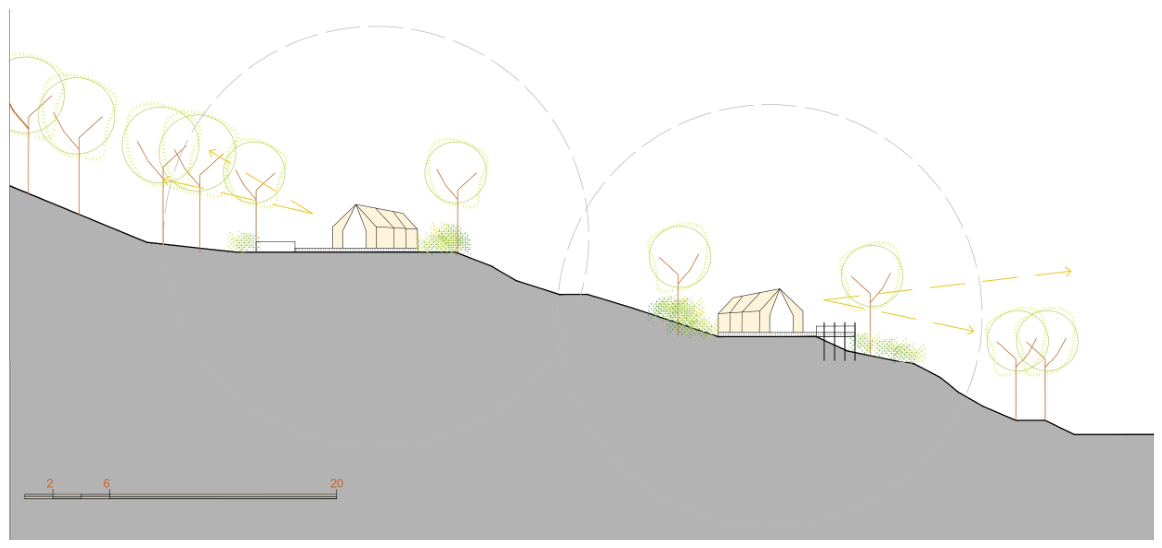
This area features variable morphology, with a 24-m elevation difference across approximately 3 hectares on a single west-facing slope (Figure 1). The glamping facility is designed to expand the services offered to the existing restaurant. The key objectives, from both an economic feasibility and an overall strategic perspective, are to maintain and enhance the existing landscape, which comprises tree-lined sections and clearings on the slopes. The three primary development themes of the project, in relation to the need for glamping services, include enhancing the sense of isolation, creating an immediate, rational access system, and immersing the visitor in the landscape.
When defining a glamping base solution, spatial configuration and density thresholds become essential components for ensuring environmental sustainability, user comfort, and landscape integrity. A widely adopted criterion in eco-accommodation planning is the application of a minimum distance of 15 m between units. This spacing standard is commonly associated with three primary objectives: (1) fire safety and the prevention of structural contagion; (2) the reduction of local ecological pressure—such as soil compaction and vegetation stress—through controlled spatial dispersion; and (3) the improvement of privacy and acoustic comfort, which are fundamental experiential drivers in nature-based tourism settings [53,58]. The minimum distance of 15 m was adopted as a design strategy based on the physical principle of spherical sound propagation (inverse-square law), according to which the sound pressure level decreases by approximately 6 dB for each doubling of distance (ΔL = 20 log10 (r2/r1)). Applied to a typical speaking voice (~60 dB at 1 m), this attenuation results in sound levels approaching natural background noise at around 15 m, where speech is generally still audible as ambient presence but no longer clearly intelligible. This threshold therefore supports the condition of acoustic comfort and perceptual independence between low-density accommodation units embedded within the landscape.
From a landscape-design perspective, adequate spacing also supports visual permeability and reduces the risk of creating an artificial settlement pattern inconsistent with the surrounding environment. Studies on wilderness and rural lodging emphasize the need for “low visual density” to preserve the perception of naturalness, particularly in sensitive or semi-wild contexts [59]. Maintaining a 15-m buffer aligns with these principles, reinforcing the site’s ecological integrity and minimizing human–wildlife conflicts [55].
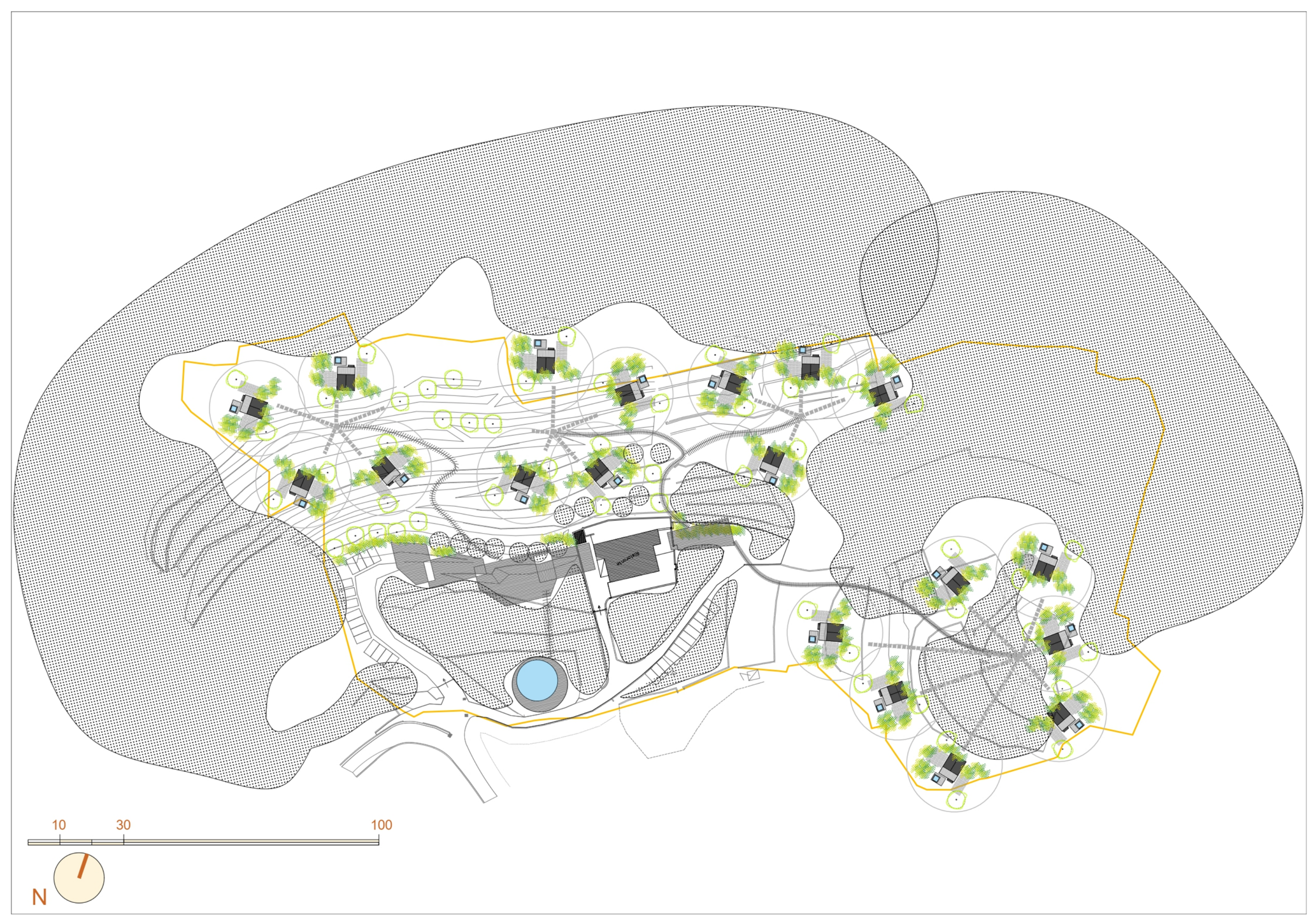
The project draws on these theoretical guidelines to develop a masterplan (Figure 2) that positions the existing restaurant at the center, integrating it with a lounge area featuring a shared pool and common areas. The project then proceeds to define the individual residential unit and its associated space. The selected unit, chosen in line with the client’s brief, is a “lodge” tent, a furnished tent measuring approximately 27 m2 with a fixed outdoor space. The definition of the residential unit determines the construction of a minimal landscape system within which to construct a complex system. The infrastructural approach, which harks back to the Japanese metabolic system, is instrumental in meeting the previously stated parameters. The definition of the “minimum landscape” takes into account an associated area defined by a 15-m radius circumference (Figure 3). The residential unit is positioned at the center of this landscape. A vegetation system is then designed to provide a unified direction consistent with the residential unit’s need for immersion. The lodge tent featured in the project has a single entrance, coinciding with the panoramic portion adjacent to the terrace/veranda described above. We therefore worked with local vegetation, implementing two systems of visual obscuration and recognition: tall trees placed diagonally to the house to identify its position in the landscape, and a system of tall bushes that block the remaining perceptual space. This creates a recognizable mini-landscape that defines a unique panoramic direction and camouflages the unit itself.
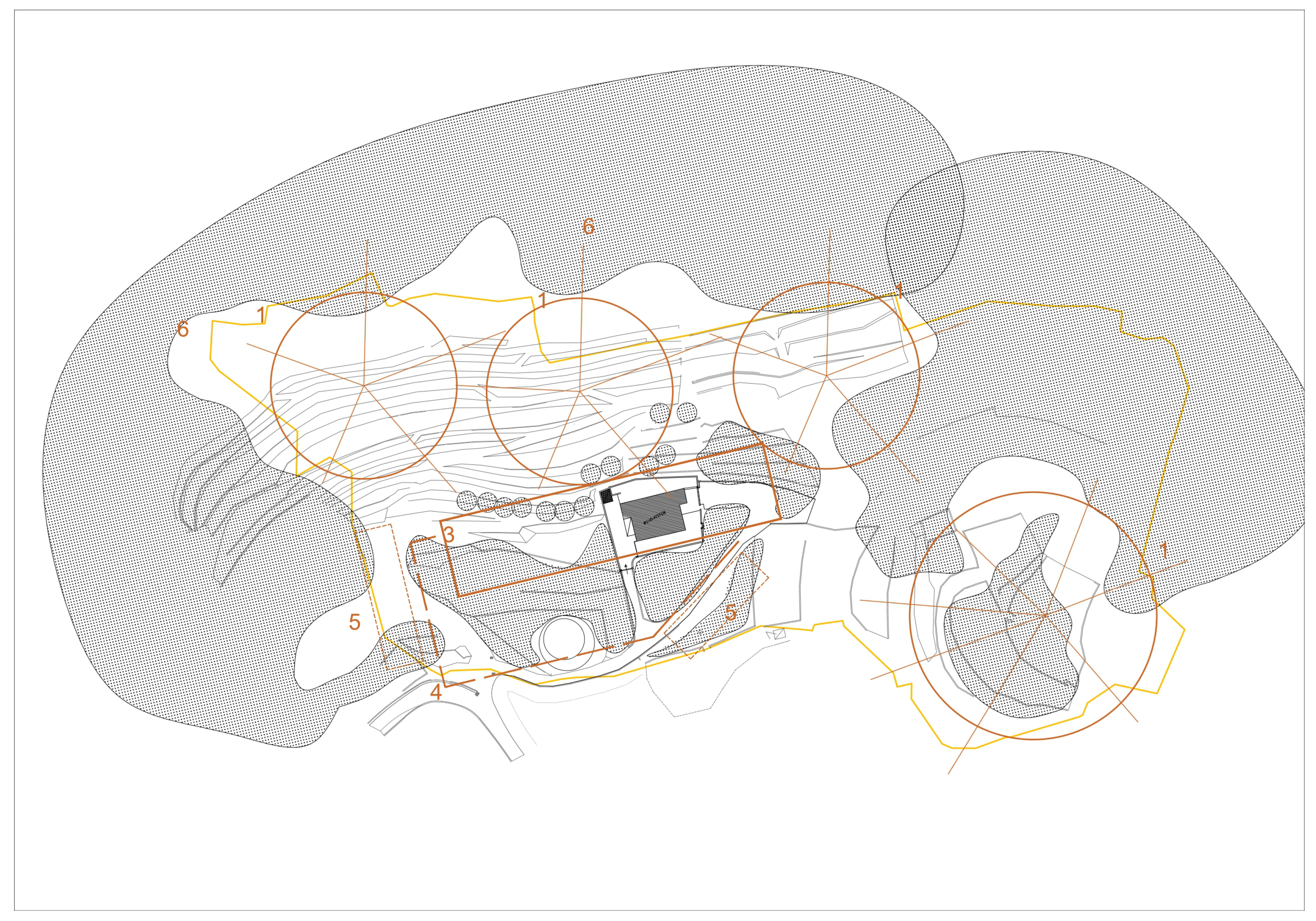
The settlement system is then defined. Taking into account the terrain’s elevation and existing topography, rational and linear connection axes are defined (Figure 4). The area is thus divided into two macro-sectors, one upstream and the other downstream of the existing structure, each characterized by a different landscape. The upstream area (area 1) appears as a large clearing, defined by four terraced systems, surrounded by woodland on three sides and open to the surrounding Ligurian regional landscape. The downstream area (area 2) is densely wooded, with a sequence of empty and less dense regions. In area 1, a connection axis is imagined that linearly follows the development of the terraces and functions as the central connection system; three clusters are positioned along this axis with a radial system that could be described as extroverted. Each unit is placed facing the landscape, and therefore opposite the circle’s center. This creates a system of systems, a composition of oriented micro landscapes that occupy the space while respecting the required density and naturalness parameters. Furthermore, being a monistic system, it can easily adapt to the orography (Figure 4). The variable element is the cluster’s distribution radius system, which, while maintaining a fixed center (on the central distribution system), varies in length with the distance required to reach the optimal location of the housing units within the clearing.
Maintaining the same principle, Area 2 is developed by working interstitially within the existing vegetation. The primary connection defines a path that connects to the existing building. From this point, connecting rays are organized to reach the gaps between the existing trees, and the residential units are positioned according to the dimensions already described.
The highly geometric approach of the settlement system is intended to ensure easy readability and facilitate access to the glamping landscape. The geometric layout is effectively constructed with vegetation and paths, adapting to the terrain and respecting the topographical system.
The desired result is to strengthen the existing natural system. The mountain landscape typical of this area of Liguria is preserved through densification, primarily through arboreal planting. Glamping becomes a principle of reforestation and valorization, offering an immersive experience within the existing natural context.

3.2. Pilot Project 2—Artificial Rural Landscape

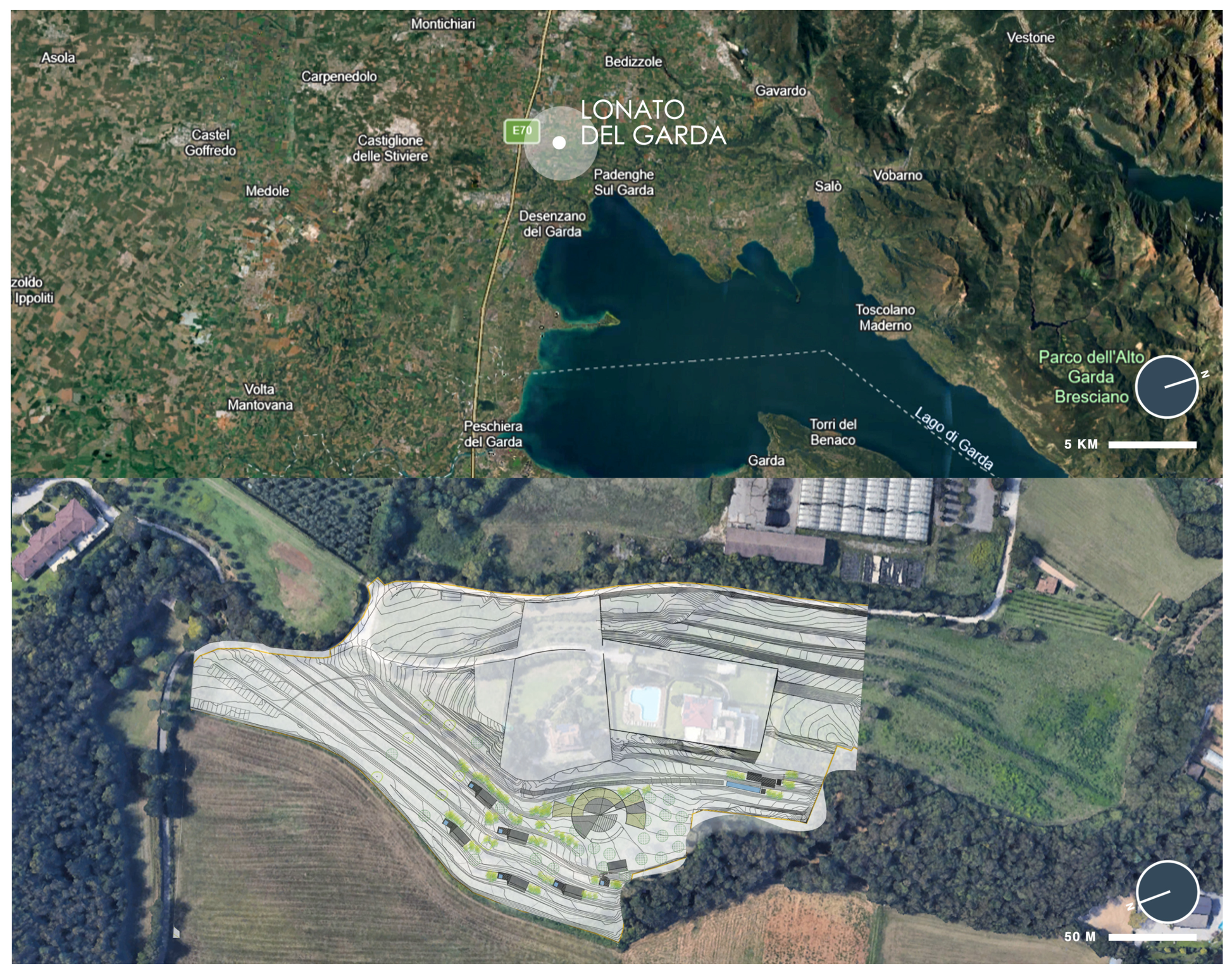
The second project is located in a rural area within the municipality of Lonato, south of Lake Garda, on a small hill partially occupied by a vineyard and surrounded by a panorama of still-active agricultural activities (Figure 5).
In this case, the client’s request concerns the creation of a glamping area within an Agri camping project. Agri camping is a hospitality activity linked to agricultural activities. The client also requests the use of a maxi-caravan system, a luxury mobile home system, as the glamping accommodation. Given these requirements, the morphological characteristics of the land dictate the location of the glamping area within the Agri camping site, based on the ability to accommodate the maxi-caravans. As explained elsewhere, maxi-caravans are an industrial product with predefined standard dimensions and, as such, are binding.
The site comprises a 6.56-hectare land parcel. Within this agricultural holding, two existing residential structures act as internal constraints. The proposal allocates approximately 3.2 hectares to tourism and hospitality functions (Figure 6). The site’s main agricultural character is defined by vineyards (roughly 1 hectare) and scattered olive trees. The project aims to integrate a glamping-style accommodation model with rural and agro-tourism, prioritising experiential engagement with locally produced goods. The site’s morphology, typical of the Garda region, is structured by a sequence of terraced landforms. Situated in a rural setting overlooking a wide agricultural field, the site benefits from substantial landscape and visual amenities, with lake views from the uppermost terraces.
The project aims to develop the glamping idea within a campsite structure to determine whether it is possible to maintain the glamping experientiality from pilot project 01 even within a non-full glamping structure. The primary zoning of the area is a client request that divides the camping area from the glamping area. The second zoning strategy is part of the design and defines the position of the maxi-caravan, the collective spaces for communal activities, and the lounge area.
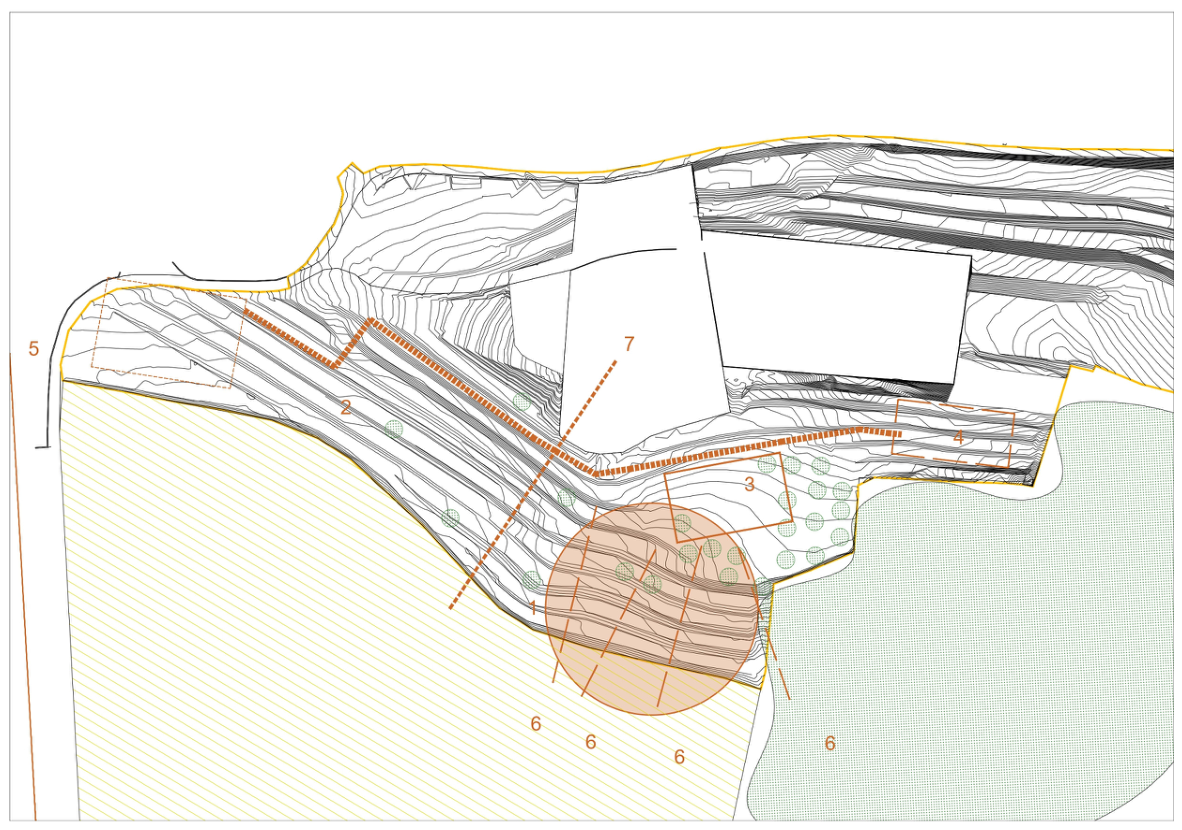
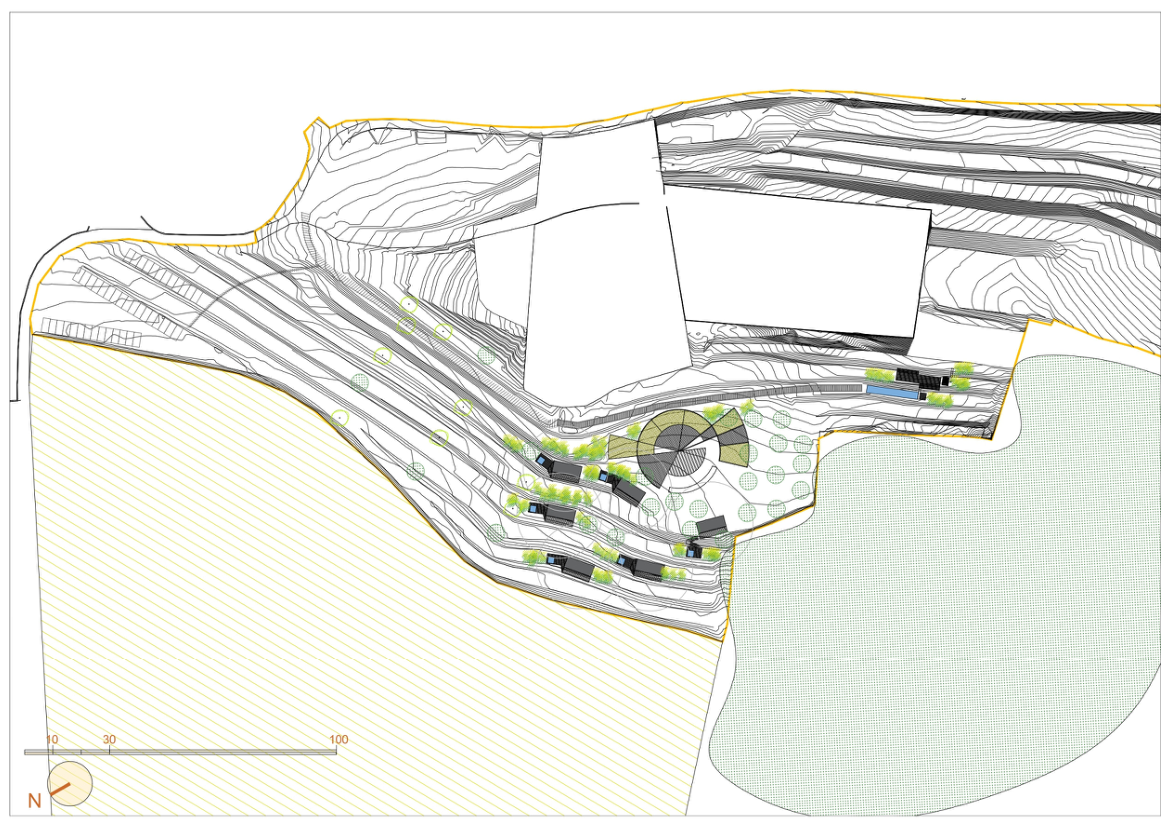
The design intent is to establish an accommodation system that is embedded in the existing landscape character, while simultaneously enhancing the site’s rural and agricultural distinctiveness (Figure 7). A low-impact, landscape-sensitive approach necessitates preserving the existing terraces, which are retained without re-profiling. The terraced structure, therefore, becomes the primary physical constraint shaping the design strategy, particularly regarding the sitting, orientation, and spacing of the accommodation units.
The site exhibits a total elevation change of 16 m, distributed across eight terraces. With increasing elevation, terrace depth decreases, from approximately 4.8 m in the lower section to 3.8 m in the upper section. The central terrace widens substantially, forming a relatively flat area of about 2000 m2, half of which is cultivated as an olive grove.
This configuration reveals a landscape with strong spatial constraints, both in the available footprint for accommodation units (4 × 8.40 m) and in the presence of existing natural features.
The terraced system, together with the olive groves, is a key determinant of the settlement pattern that truly defines the identity of this landscape. The site develops longitudinally along the hill crest, with its lower boundary adjacent to an agricultural field and the upper boundary adjoining a vineyard.
The northern edge interfaces with woodland, while the access road, Via San Martino, defines the southern edge. The project’s conceptual framework treats hospitality infrastructure as a tool for landscape valorisation. An initial assessment of the site’s orographic and landscape conditions defines which facilities can be accommodated and in what quantity. This results in a functional program structured around open-air spaces, maintaining accommodation logic comparable to glamping but unable to fully meet standard spacing requirements.
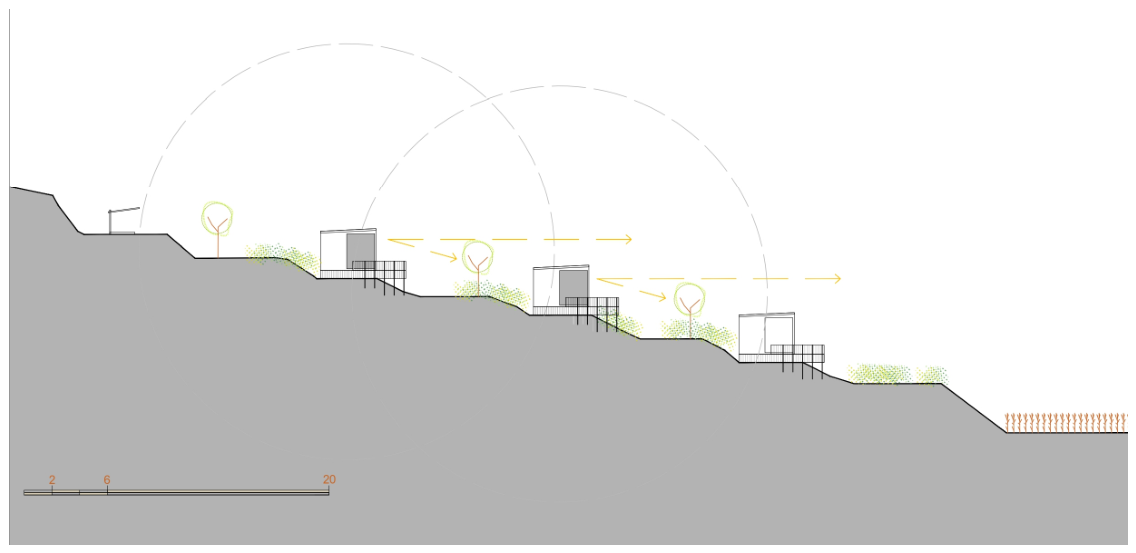
The primary constraint is dimensional: the variable terrace depths limit the feasible siting locations for the accommodation units (maxi-caravans) to two alternatives—an introverted cluster in the central terrace, or a linear, single-direction system along the terraces (Figure 8). The latter is adopted, conceiving the units as perceptually isolated elements positioned within the agricultural landscape. The maxi-caravans are aligned along the terraces with a unified primary outlook towards the external landscape and service access from the rear.
The units consequently form a point-based spatial system that maps terrace widths and elevation changes and are positioned where terrace depth allows adequate placement while maximising inter-unit separation. Although the recommended 15-m privacy radius cannot be achieved, a unidirectional perceptual system, supported by vertical differentiation, provides a comparable sense of privacy and retreat typical of glamping. Beyond typological requirements, the project’s primary objective is to construct a landscape-oriented tourism system. For this reason, most of the site is dedicated to collective and panoramic spaces. The upper terraces host lounge areas, pools, and ancillary amenities, designed to sit lightly on the land and integrate with existing topography (number 4 in Figure 6).
All experiential activities are thus tied to visual exposure and panoramic value, conceptualising the hospitality facility as a continuous amphitheatre embedded within the landscape and oriented toward the lake and horizon.
The communal spaces form an internal protected zone, shielded by the accommodation units and the site’s topographic gradient. These spaces retain their agricultural identity, where present, that of the olive grove, and are enriched with micro-agricultural plots, a set of geometrically organised vegetable gardens that define the edges of the central open space. This area becomes the barycentric core of the tourism facility: a sheltered space bringing together collective functions, with agriculture serving not only as a perceptual element but also as a participatory, recreational activity.
Vegetable cultivation, gardening, and harvesting become central components of the guest experience, accompanied by social and technical spaces that may also host small-scale commercial activities related to the sale of agricultural products. The project thus establishes a dual aesthetic regime in relation to the landscape.
The accommodation units, which could be visually intrusive, are visually downplayed through strict adherence to the existing topography, accepting the resulting variations in level and spacing as intrinsic to a respectful, context-responsive approach.
Conversely, the new agricultural interventions intentionally adopt a more geometric, didactic layout, clearly distinguishing themselves from the existing pattern to ensure design transparency and articulate the site’s identity.

4. Discussion

The objective of defining a system of design strategies to translate the needs of glamping into a systematic approach tied to the landscape is pursued through a comparison of the two pilot projects. From this comparison, some generic strategies emerge, which inevitably need to be adapted to the context and are therefore not intended to be dogmatic solutions, but rather general guidelines for approaching the topic of glamping in a design-based manner.
The two pilot projects are located within two typical configurations of the Italian landscape; their comparison is intended to test the applicability and adaptability of the proposed design strategies across different territorial contexts, thereby further justifying both the choice of cases and the value of their juxtaposition within the research framework.
The research-by-design process underlines that it is possible to codify the glamping–landscape relationship through a hierarchy of design principles:
  • Interpretation and consolidation of the landscape’s identity in terms of morphology, topography and ecosystem (existing vegetation);
  • Settlement system that emphasizes isolation, starting from minimum distance parameters (15 m ray circle);
  • Construction of an optical/perceptual system that enhances the sense of isolation;
  • Reinforcement of the above by using tree and plant species compatible with local ones.
The two projects, despite their different environmental conditions, confirm the transferability of these strategies and support the definition of glamping as a system for inhabiting the landscape, which can enhance its characteristics.
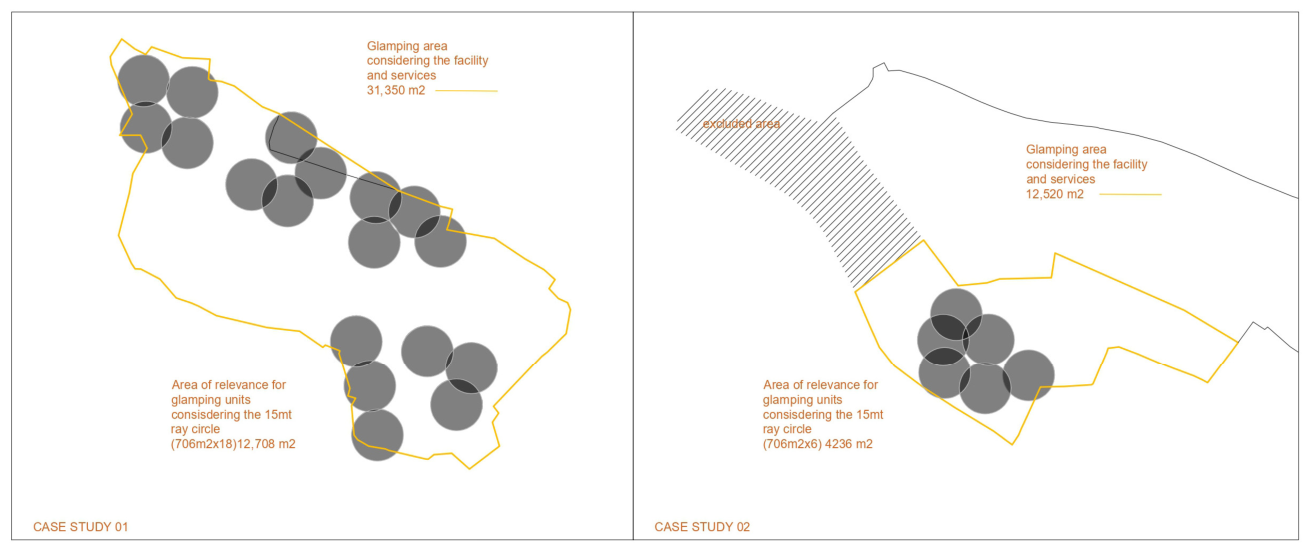
Table 3 summarizes the comparison between the two projects, highlighting the key findings as a consequence of the strategies listed. It can be seen how the different locations and landscape typologies can still be addressed systematically by following the hierarchy of criteria expressed.
First and foremost, the gnoseological value of the existing landscape is clear: knowledge of local morphology and compatible tree species is a foundational prerequisite and forms the basis for the design of the glamping landscape. While a sense of inclusivity within the landscape is essential to foster the immersive experientiality that underpins glamping, the landscape itself, through its fundamental constructive elements, must be coherent.
Table 3. Comparative analysis of the two glamping-based landscape interventions underlying the relation with the existing landscape and settlement characteristics.
CriterionProject 01
Orco Feglino (Liguria)
Project 02
Lonato (Lake Garda)
Typology of facility structureFull glamping areaAgricamping with a glamping zone
Area considering facilities and services (A Tot)31,350.00 mq12,520.00 mq
Landscape Main CharacterizationForestAgricultural
MorphologyLigurian pre-Alps landscape on a single west-facing slope.Terraced agricultural landscape
Main VegetationMosaic of woodland, clearings, and spontaneous vegetation.Vineyards, scattered olive trees, and woodland margins.
Pertinent area of accommodation units (A Un)[πr2 × N° units]
(706 mq × 18) 12,708 mq
[πr2 × N° units]
(706 mq × 6) 4236 mq
Approx. Settlement density (Figure 9)A Tot/A Un = 2.47A Tot/A Un = 2.96
Unit typologyLodge tents + external space Maxi-caravan + veranda
Type of interventionAdaptation to existing morphologyFunctional zoning related to topography constraints
Figure 9. Comparative density diagram of the two case studies.
Architecture 06 00067 g009
In this sense, territorial intelligence emerges from the reading of topography, existing vegetation patterns, morphological systems (forest mass, terraces, agricultural grids), visual cones, and settlement traces. These elements guide the positioning, geometry, and density of the units. In both case studies, such components are not treated as constraints but as generative principles for constructing a tourism landscape coherent with the Italian territorial context.
The construction of such coherence occurs through the emphasis of the prevailing character of the existing landscape. In Case 01, for example, this is achieved by intensifying the forested tree mass and, through settlement geometry, constructing a sense of densification; in Case 02, by contrast, the approach involves creating an agricultural landscape through the planting of olive trees and gardens, while maintaining a rational organizational structure.
Although the two contexts differ significantly in their original landscape conditions (one predominantly forested, the other agricultural), the comparative relevance of the two case studies lies precisely in the consistency of the design approach adopted. The relationship with the landscape becomes the common matrix of intervention: the project inserts itself without modifying the topographic system and without compromising the ecological substrate, while simultaneously constructing an immersive experiential framework. This shared approach allows the two cases to be read side by side as alternative declinations of the same temporary dwelling strategy within different landscape identities.
Landscape identity can be enhanced when the project reinforces, rather than replaces, the prevailing landscape character. In both cases, the settlement system intensifies existing morphological and vegetational features, transforming them into active design devices.
The reading of topography also becomes foundational to the design of the settlement system. In Case 01, the residential units can be positioned by filling existing voids, following a specific geometry that respects the current conditions; in Case 02, development proceeds through zoning that adapts new functions to the constraints imposed by the existing terrain. The settlement system is ultimately mediated by the perception of both the external and internal landscapes. In Case 01, a radial-based geometry allows for the creation of extroverted clusters in which all units face the landscape without mutual interference. In Case 02, the settlement system follows a morphological principle, adapting to terraced landforms and constructing univocal perspectival systems that turn their backs to the common areas of the glamping site while opening toward the horizon.
This leads to a reflection on density. In Case 01, it is possible to maintain an optimal density defined by the distance between units in relation to the length of connecting paths (a circumference with a radius of 15 m); in Case 02, this form of quantification is no longer applicable due to evident landscape constraints. Nevertheless, the explicit affirmation of the predominance of the existing landscape also serves as a validating mechanism for the relaxation of minimum distance requirements. The experiential–perceptual principle is therefore not conveyed solely through the reading of the prevailing (external) landscape, but also—and above all—through the interpretation of the defining characteristics of the internal landscape.
The significance of juxtaposing these two pilot projects is to demonstrate that, regardless of the landscape typology, glamping can be structured as a specific settlement system. The strategies adopted in the two pilot projects are not dogmatic but allow for a sequence of approaches to the accommodation facility’s landscape that reflect the market needs of glamping: isolation and connection with nature. In the design of glamping, the landscape prevails, becoming decisive for the settlement system. Compared to the proposed settlements, it is evident that the form, conditioned by morphology and topography, and the density, based on the perceptual/auditory system, deviate from the usual system of camping design [4].

5. Study Limitation and Recommendation

In light of an application-oriented theoretical framework, it is essential to emphasize the embryonic nature of the approach to a topic that is still in development and therefore currently lacks several critical reflections.
The study addresses a field that is still in formation and, as such, lacks a consolidated body of critical literature. The most widespread scientific approaches to glamping remain predominantly socio-economic, focusing on tourism as a driver of territorial development or as an object of definition and marketing. Consequently, the planning and design dimension of glamping has not yet been sufficiently investigated, largely due to the persistent association of this form of hospitality with notions of minimal intervention and essentiality.
This limited academic foundation constrains the possibility of critically comparing theoretical positions and evaluating design outcomes. In prevailing practice, glamping is frequently resolved at the scale of the individual accommodation unit, typically conceived as a small, luxury structure, while the broader spatial organisation of multiple units within a natural environment is often overlooked. The complexity of settlement patterns, spatial relationships, and preservation-oriented landscape integration, therefore, remains insufficiently theorised.
A further limitation concerns constructability. While this research introduces the issue of anthropic impact through an ecological interpretation of landscape identity, particularly in relation to plant biodiversity, the technical and energetic feasibility of inhabiting sensitive environments warrants deeper investigation. The infrastructural dimension necessary to sustain both landscape integrity and human comfort—including energy, water, and waste systems—has not yet been systematically examined. In this respect, the study of settlement networks should be considered central to future research, particularly through comparison with models of temporary and transitional settlements that may offer replicable strategies.
The research is also limited by the lack of empirical evidence on the ethical and environmental feasibility of glamping as a form of habitation. The construction of a landscape that aims to preserve the identity of a pre-existing environment constitutes an anthropic act that inevitably entails energy expenditure. Similarly, even minimal forms of inhabitation produce measurable resource consumption and waste. Although the present study frames glamping as a potential reinterpretation of the human–nature relationship within outdoor tourism, the balance between anthropic and natural systems has not yet been quantitatively assessed. The evaluation of this equilibrium must extend beyond aesthetic and perceptual considerations to include measurable environmental and energetic performance.
Finally, the research remains primarily theoretical and conceptual. The absence of applied, field-based verification limits the ability to assess the actual environmental impact of glamping settlements across different contexts. Future developments should therefore include collaborative empirical studies with existing facilities to measure energy performance and environmental effects. Such verification would provide the basis for formulating compensatory strategies, including integrated active and passive systems, to define a coherent, ethically grounded model of tourist settlement within the landscape.

6. Conclusions

6.1. Theoretical Implications

As emerging from the research, the proposed design strategies aim to codify the search for a balance between human presence and the natural environment, as framed by the adopted theoretical apparatus. In this perspective, the project is conceived both as an anthropic intervention capable of constructing a meaningful mediation between human and landscape (Rogers; strategies 2, 3) and as a practice of care and enhancement of landscape identity (Heidegger; strategies 1, 4). Strategies 2 and 3 address the settlement system, that is, the interplay between man and nature, balancing technical needs (density, orientation) with experiential ones (isolation, perspective). Strategies 1 and 4, on the other hand, concern the preservation and enhancement of the existing landscape, that is, its care. The interpretation of topography as a priority intervention system remains deterministic within the proposed design approach. Similarly, the use of local vegetation as a tool to enhance the project aims to highlight the need to construct the landscape using landscape tools. The relationship between sky, earth, man, and divinity is pursued as a metaphor for the balance between technical intervention and metaphorical and semantic outcome.
Within the landscape debate, glamping can therefore be understood as a field of experimentation concerning habitability and temporality. Central to glamping is the use of removable dwelling systems (tents, maxi-caravans, and similar structures, as previously discussed). This removability opens a perspective on human–nature compatibility in which human presence does not compromise the existing natural system.
Much of the European landscape, and certainly the Italian landscape addressed in this paper, is the result of long-standing interaction between human activity and natural processes. If glamping is thus conceived as a designed landscape, landscape design becomes foundational in minimizing anthropic impact while maintaining and enhancing the identity of the existing environment. In this sense, the definition of the settlement system is as significant as the architectural design of the individual accommodation units. While the latter derive their value from temporality and removability, the former must emerge from a careful reading of existing conditions, recognizing and activating the landscape’s latent potentials.
Within scholarly reflections on outdoor tourism, a distinction is commonly drawn between the prevailing landscape and the internal landscape. In conventional outdoor accommodation systems, the success and localisation of facilities are primarily determined by the prevailing landscape, such as proximity to the sea, mountains, or other consolidated landscape systems, while the internal landscape plays a secondary role. This study suggests that, within the glamping domain, this relationship is reversed. The prevailing landscape is transposed into the accommodation’s interior, becoming the primary element shaping the tourist experience. In this sense, glamping can be interpreted as a landscape-based practice in which immersion, rather than mere location, defines value.
Glamping, therefore, if designed to respect the landscape’s defining characteristics and thus leverage its form and population density to enhance the landscape itself, can become a system for landscape enhancement. (RQ01)
The concept of luxury is therefore redefined as an immersive and perceptual relationship with the environment. From a theoretical perspective, glamping can be positioned within the landscape debate as a field of experimentation on temporality and habitability. It introduces a model of inhabitation based on reversibility, low impact, and the integration of human and natural systems, contributing to the broader discourse on landscape as a dynamic and designed process.
If the paradigm of camping is that of exceptionality [60] in relation to everyday life, in glamping, the non-exceptionality of place, that is, its extraneity or detachment from the surrounding context, becomes the defining and identity-forming principle.

6.2. Practical Implications

From a design perspective, the findings highlight the importance of balancing settlement density with the construction of an internal landscape that reflects local identity. Glamping should be distinguished not only by its accommodation units but by the configuration of the settlement system as a whole. The use of removable and lightweight structures, such as tents and mobile units, supports a model of temporary settlement in which human presence does not permanently alter the environment. However, the sustainability of such systems depends largely on their spatial organisation. The layout must be derived from a careful reading of the existing landscape, including its morphology, vegetation, and ecological relationships. The system of perceptual/auditory parameters, codified within the 15-m-radius circle, can serve as a clear orientation system for establishing the density of the settlement system, from a design perspective. These parameters, integrated into the landscape’s topography and existing vegetation, can serve as the starting point for glamping design. (RQ02)
In this context, landscape design becomes a fundamental tool to minimize anthropogenic impact while enhancing local identity. The project of the settlement, rather than the object itself, emerges as the primary design field.
Based on the pilot projects presented and the research conducted, it is possible to redefine glamping not only from an experiential or marketing perspective, but also by defining design strategies. These proposals remain a first step in this field of research and must be integrated with further multidisciplinary input, first and foremost, a more systemic approach to sustainability. It is important, however, to have identified the possibility of a paradigm shift in the glamping field, so that landscape preservation and enhancement can be implemented through action rather than just communication. (RQ03)

6.3. Future Research Directions

Future research could expand this study in several directions. The need to define design guidelines is linked to the need to preserve the landscape. Glamping, which by its very nature seeks natural landscapes, risks having a significant environmental impact if not properly structured. In this sense, multidisciplinary fields of future study should be considered. From a landscape planning perspective, one area of interest is the reversibility of the landscape itself. Glamping is built with removable housing systems, making it a viable temporary solution when properly designed. An important aspect to develop is that of sustainability.
Quantitative analyses could be developed to evaluate the environmental impact and optimal density of glamping settlements. Comparative studies across different geographical contexts would also be valuable to test the adaptability of the proposed design principles.
In other contexts, the actual sustainability of camping and its potential role in urban development have been discussed. Similarly, the study of glamping can be framed as a broader reflection on landscape use and preservation. From this perspective, an in-depth sustainability approach, understood as the reduction or compensation of anthropic impact, becomes essential, beginning from the primary premise of glamping: that it constitutes an inhabited landscape which seeks to accommodate the coexistence of human and natural systems without diminishing either.
In this sense, a future field of study certainly concerns technical and practical solutions for water, waste, and energy management, and more generally, all technical strategies for reducing human impact.

Author Contributions

Conceptualization, L.T. and M.C.; methodology, L.T. and M.C.; formal analysis, L.T. and M.C.; investigation, L.T. and M.C.; resources, L.T. and M.C.; data curation, L.T. and M.C.; writing—original draft preparation, L.T. and M.C.; writing—review and editing, L.T. and M.C.; visualization, L.T. and M.C.; supervision, L.T. and M.C. All authors have read and agreed to the published version of the manuscript.

Funding

This research received no external funding.

Institutional Review Board Statement

Not applicable.

Informed Consent Statement

Not applicable.

Data Availability Statement

No new data were created.

Conflicts of Interest

Camping Design and Architecture is a trade name used for campsite design. the paper’s authors, Luca Trabattoni and Margherita Capotorto, are members of Camping Design and Architecture. The authors declare that the research was conducted in the absence of any commercial or financial relationships that could be construed as a potential conflict of interest.

References

  1. Rogers, E.N. Homo additus naturae. Casabella-Continuità 1965, 292, 2–5. [Google Scholar]
  2. Heidegger, M. Building, Dwelling, Thinking. In Poetry, Language, Thought; Hofstadter, A., Ed.; Harper & Row: New York, NY, USA, 2002; pp. 141–160. [Google Scholar]
  3. Trabattoni, L.; Capotorto, M.; Berizzi, C. The Sustainability of Minimum Space: Removable Off-grid Architecture for Outdoor Tourism. In Proceedings of the 6th International Scientific Conference on Environmental Challenges in Civil Engineering, Opole, Poland, 12–14 September 2024. [Google Scholar]
  4. Trabattoni, L. Planning and Designing the Absent City: Campsites as Temporary Settlements; Routledge: London, UK, 2024. [Google Scholar]
  5. Berizzi, C.; Trabattoni, L. Mobile Home: Una Storia Evolutiva; Vicolo del Pavone: Castelnuovo Scrivia, Italy, 2019. [Google Scholar]
  6. Berizzi, C.; Capotorto, M.; Terlicher, G.N.; Trabattoni, L. The sustainability of the campsite as it relates to morphology, climate and landscape. Highlights Sustain. 2023, 2, 185–206. [Google Scholar] [CrossRef]
  7. Martín, X.; Martínez, A.; de Rentería, I. The integration of campsites in cultural landscapes: Architectural actions on the Catalan coast, Spain. Sustainability 2020, 12, 6499. [Google Scholar] [CrossRef]
  8. Cannas, R. An overview of tourism seasonality: Key concepts and policies. Almatourism—J. Tour. Cult. Territ. Dev. 2012, 3, 40–58. [Google Scholar]
  9. Fadda, N.; Rotondo, F.; Giovanelli, L. The implications of tackling seasonality for the governance of a seaside destination: The case of Alghero. Eur. J. Manag. 2016, 16, 127–144. [Google Scholar] [CrossRef]
  10. Cellini, R.; Rizzo, G. Private and public incentive to reduce seasonality: A theoretical model. Economics 2012, 6, 20120043. [Google Scholar] [CrossRef]
  11. Trabattoni, L.; Terlicher, G.; Capotorto, M. Outdoor tourism as a redefinition of the urban fringe: Temporary settlements and landscape transformation. In Proceedings of the ISUF—International Seminar on Urban Form Conference, Belgrade, Serbia, 4–10 September 2023. [Google Scholar]
  12. Mehmetoglu, M.; Engen, M. Pine and Gilmore’s concept of experience economy and its dimensions: An empirical examination in tourism. J. Qual. Assur. Hosp. Tour. 2011, 12, 237–255. [Google Scholar] [CrossRef]
  13. Ministero del Turismo. Art. 3 of the Global Code of Ethics for Tourism. Available online: https://www.ministeroturismo.gov.it/centro-per-la-promozione-del-codice-mondiale-di-etica-del-turismo/ (accessed on 8 January 2026). (In Italian).
  14. Urry, J. The Tourist Gaze: Leisure and Travel in Contemporary Societies; Sage: London, UK, 1990. [Google Scholar]
  15. Urry, J.; Larsen, J. The Tourist Gaze 3.0; Sage: London, UK, 2011. [Google Scholar]
  16. MacCannell, D. The Tourist: A New Theory of the Leisure Class; Schocken Books: New York, NY, USA, 1976. [Google Scholar]
  17. Antrop, M. Why landscapes of the past are important for the future. Landsc. Urban Plan. 2005, 70, 21–34. [Google Scholar] [CrossRef]
  18. Cosgrove, D. Social Formation and Symbolic Landscape, 2nd ed.; University of Wisconsin Press: Madison, WI, USA, 1998. [Google Scholar]
  19. Galeri, P. Training in the care of the common home: Sustainable tourism as a driver for an integral ecology. Form@re—Open J. Form. Rete 2021, 21, 21–35. [Google Scholar] [CrossRef]
  20. Augé, M. Non-lieux: Introduction à une Anthropologie de la Surmodernité; Seuil: Paris, France, 1992. [Google Scholar]
  21. Brooker, E.; Joppe, M. Trends in camping and outdoor hospitality—An international review. J. Outdoor Recreat. Tour. 2013, 3–4, 1–6. [Google Scholar] [CrossRef]
  22. Swanwick, C. Landscape Character Assessment: Guidance for England and Scotland; Countryside Agency: Cheltenham, UK, 2002. [Google Scholar]
  23. UNESCO. Operational Guidelines for the Implementation of the World Heritage Convention; UNESCO: Paris, France, 2008.
  24. Brooker, E.; Joppe, M. A critical review of camping research and direction for future studies. J. Vacat. Mark. 2014, 20, 335–351. [Google Scholar] [CrossRef]
  25. Ivars-Baidal, J.A.; Rodríguez-Sánchez, I.; Vera-Rebollo, J.F. The evolution of mass tourism destinations: New approaches beyond deterministic models in Benidorm (Spain). Tour. Manag. 2013, 34, 184–195. [Google Scholar] [CrossRef]
  26. Taczanowska, K.; González, L.-M.; García-Massó, X.; Zięba, A.; Brandenburg, C.; Muhar, A.; Pellicer-Chenoll, M.; Toca-Herrera, J.-L. Nature-based tourism or mass tourism in nature? Sustainability 2019, 11, 1314. [Google Scholar] [CrossRef]
  27. Fredman, P.; Tyrväinen, L. Frontiers in nature-based tourism. Scand. J. Hosp. Tour. 2010, 10, 177–189. [Google Scholar] [CrossRef]
  28. McCool, S.F.; Lime, D.W. Tourism carrying capacity: Tempting fantasy or useful reality? J. Sustain. Tour. 2001, 9, 372–388. [Google Scholar] [CrossRef]
  29. Eagles, P.F.J. Trends in park tourism: Economics, finance and management. J. Sustain. Tour. 2002, 10, 132–153. [Google Scholar] [CrossRef]
  30. NACE. NACE Rev. 2, Class 55.30 Camping Grounds, Recreational Vehicle Parks and Trailer Parks. Available online: https://inspire.ec.europa.eu/codelist/EconomicActivityNACEValue/I.55.30 (accessed on 12 January 2026).
  31. Kiryakova-Dineva, T.; Vasenska, I.; Koyundzhiyska-Davidkova, B. Glamping—An active back to nature trend in the post-pandemic tourism reality. In Proceedings of the 5th International Conference on Tourism Research; Academic Conferences International Limited: Reading, UK, 2022; Volume 15, pp. 175–182. [Google Scholar] [CrossRef]
  32. Adamovich, V.; Nadda, V.; Haque, A.; Kot, M. Camping vs. glamping tourism: Providers’ perspective in the United Kingdom. J. Environ. Manag. Tour. 2021, 12, 1431–1441. [Google Scholar] [CrossRef]
  33. Pokolodna, M.P.; Ryabev, A. Glamping as a promising type of tourism and hotel business. Bus. Inf. 2021, 6, 157–169. [Google Scholar] [CrossRef]
  34. ISTAT. Movimento turistico in Italia: Anno 2023; Istituto Nazionale di Statistica: Roma, Italy, 2023.
  35. Thrends; FAITA-Federcamping. Osservatorio Outdoor 2024: Rapporto Annuale sul Turismo all’aria Aperta in Italia; Thrends: Milan, Italy, 2024. [Google Scholar]
  36. World Travel & Tourism Council. Travel & Tourism Economic Impact 2023: Italy; WTTC: London, UK, 2023. [Google Scholar]
  37. FAITA-FederCamping. Osservatorio del Turismo all’aria Aperta in Italia 2024; FAITA-FederCamping: Roma, Italy, 2024. [Google Scholar]
  38. Risposte Turismo. Il Fenomeno del Glamping in Italia: Analisi e Prospettive del Turismo Outdoor di Qualità; Risposte Turismo: Venezia, Italy, 2023. [Google Scholar]
  39. ENIT—Agenzia Nazionale del Turismo. Turismo Open Air e Nuove Forme di Ospitalità Sostenibile in Italia; ENIT: Roma, Italy, 2024.
  40. Pambianco Design & Hospitality. Glamping e Turismo Esperienziale in Italia; Pambianco Strategie di Impresa: Milano, Italy, 2023. [Google Scholar]
  41. Campeggi.com. Osservatorio sul Turismo Open Air in Italia—Edizione 2024. Available online: https://www.campeggi.com (accessed on 7 January 2026).
  42. Ecobnb. Glamping in Italia: Tra natura e Lusso Sostenibile. Available online: https://www.ecobnb.it (accessed on 7 January 2026).
  43. Glampinghub. Italy Glamping Market Overview. Available online: https://www.glampinghub.com (accessed on 7 January 2026).
  44. Russell, J.G. Field of Cloth of Gold: Men and Manners in 1520; Routledge: London, UK, 1969. [Google Scholar]
  45. Craig, C.; Karabas, I. Glamping after the coronavirus pandemic. Tour. Hosp. Res. 2021, 21, 251–256. [Google Scholar] [CrossRef]
  46. Brochado, A.; Brochado, F. What makes a glamping experience great? J. Hosp. Tour. Technol. 2019, 10, 15–27. [Google Scholar] [CrossRef]
  47. Diwyarthi, N.; Pratama, I.; Eddy, I. Tourist perspective towards glamping accommodation in the era of Industry 4.0 and Society 5.0. J. Syntax Transform. 2023, 4, 59–76. [Google Scholar] [CrossRef]
  48. Saayman, M.; Van der Merwe, P. Identifying ecotourists’ accommodation needs and preferences. S. Afr. J. Bus. Manag. 2017, 48, 67–76. [Google Scholar] [CrossRef][Green Version]
  49. Yıldırım, G.; Erkılıç, E. An overview of glamping tourism within the context of Middle East tourism: The case of Turkey. J. Recreat. Tour. Res. 2019, 6, 475–489. [Google Scholar] [CrossRef]
  50. Guidoni, E. Costa Smeralda: Architettura e Natura Costruita; Laterza: Rome, Italy, 1992. [Google Scholar]
  51. Daugstad, K. Negotiating landscape in rural tourism. Ann. Tour. Res. 2008, 35, 402–426. [Google Scholar] [CrossRef]
  52. Buckley, R. Environmental Impacts of Ecotourism; CABI Publishing: Wallingford, UK, 2004. [Google Scholar]
  53. Weaver, D. Sustainable Tourism: Theory and Practice; Routledge: London, UK, 2015. [Google Scholar]
  54. Buckley, R. Tourism and environment. Annu. Rev. Environ. Resour. 2011, 36, 397–416. [Google Scholar] [CrossRef]
  55. Leung, Y.-F.; Spenceley, A.; Hvenegaard, G.; Buckley, R. Tourism and Visitor Management in Protected Areas; IUCN: Gland, Switzerland, 2018. [Google Scholar]
  56. Camping Design and Architecture. Available online: https://www.campdesign.it/ (accessed on 8 January 2026).
  57. Sun, T.; Huang, T. Research of glamping tourism based on the aesthetics of atmosphere. Sustainability 2023, 15, 581. [Google Scholar] [CrossRef]
  58. Newsome, D.; Moore, S.A.; Dowling, R.K. Natural Area Tourism: Ecology, Impacts and Management, 2nd ed.; Channel View Publications: Bristol, UK, 2012. [Google Scholar]
  59. UNWTO—World Tourism Organization. Available online: https://www.unwto.org (accessed on 8 January 2026).
  60. Agamben, G. Homo Sacer: Il Potere Sovrano e la Nuda Vita; Einaudi: Torino, Italy, 1995. [Google Scholar]
Figure 1. Orco Feglino Glamping localization map.
Architecture 06 00067 g001
Figure 2. Orco Feglino Glamping design strategies for masterplan with 15m radius circumferences and rays of influence. (1) Units localization; (3) common area; (4) sports area; (5) parking; and (6) perspective lines.
Architecture 06 00067 g002
Figure 3. Orco Feglino Glamping masterplan. Yellow line indicates the border of the glamping area.
Architecture 06 00067 g003
Figure 4. Orco Feglino Glamping landscape section, with optical cones and influence circumferences. Arrows indicate the main view from each unit.
Architecture 06 00067 g004
Figure 5. Lonato Glamping localization map.
Architecture 06 00067 g005
Figure 6. Lonato Glamping design strategies masterplan. (1) Glamping units localization; (2) tents area; (3) common area; (4) lounge area; (5) parking; (6) perspective lines; and (7) functional division [camping/glamping]. Yellow line indicates the border of the glamping area.
Architecture 06 00067 g006
Figure 7. Lonato Glamping masterplan. Yellow line indicates the border of the glamping area.
Architecture 06 00067 g007
Figure 8. Lonato Glamping landscape section, with optical cones and influence circumferences. Arrows indicate the main view from each unit.
Architecture 06 00067 g008
Table 1. Distribution of glamping-only structures in relation to Italian landscapes. We conducted a survey using a mix of scientific sources, such as ISTAT, and industry-specific sources provides a general overview of the distribution of the most common housing types. List of sources: Risposte Turismo (2023) [38]; FAITA-FederCamping (2024) [37]; ENIT (2024) [39]; Pambianco Design & Hospitality (2023) [40]; Campeggi.com (2024) [41]; Ecobnb (2023) [42]; Glampinghub (2024) [43]; ISTAT (2024) [34].
Type of
Landscape
Relative
Presence
Prevalent
Regions
Attractiveness
Characteristics
Hilly–ruralHighTuscany,
Piedmont,
Umbria
Strong connection with farmhouses, wine tourism, and slow tourism; enhancement of the
historic agricultural landscape.
Alpine–Pre-AlpineMedium–HighTrentino-Alto Adige, Valle d’Aosta,
Lombardy
Demand-oriented towards natural wellness, trekking, silence, and controlled isolation.
LacustrineAveragePiedmont,
Lombardy,
Veneto
Research of panoramic contexts and temperate microclimates; glamping integrated into the
already consolidated outdoor
districts.
CoastalMedium–LowSardinia,
Apulia,
Coastal Tuscany
More stringent landscape and regulatory constraints; preference for structures with low visual impact.
Internal and protected areasLow in numerical terms, high in
strategic value
Basilicata,
Molise, Abruzzo
Function of the territorial garrison and a lever for the tourist repopulation of marginal areas.
Table 2. Survey made using a mix of scientific and industry-specific sources, including ISTAT. The table provides a general overview of the distribution of the most common housing types. As already described, there is a lack of scientific sources. List of sources: Risposte Turismo (2023) [38]; FAITA-FederCamping (2024) [37]; ENIT (2024) [39]; Pambianco Design & Hospitality (2023) [40]; Campeggi.com (2024) [41]; Ecobnb (2023) [42]; Glampinghub (2024) [43]; ISTAT (2024) [34].
TypeShort
Description
Materials
Glamping Tents (generic)Large canvas tents with beds and furnishingsCanvas
Safari Tent/Lodge TentColonial-style structures with a verandaCanvas
and wood
YurtCircular tent inspired by Mongolian traditionCanvas
and wood
Geodesic DomeBuckminster Fuller’s hemispherical structuresMetal or wooden structure covered by canvas or transparent polycarbonate
Bubble TentPneumatic architectural units, transparent and without windowsPVC, polyurethane
TreehouseWooden accommodation units built among treesWood
Caravan/Tiny House on WheelsSmall mobile or semi-fixed design houses, often made from renovated vehiclesMixed
materials
Rigid Dome/Glamping PodSemi-rigid dome or igloo-shaped structuresWood or
composite
materials
Other Types (container homes, A-frame cabins, modular units, etc.)Hybrid or experimental structures, often modular or prefabricatedMixed
materials
Disclaimer/Publisher’s Note: The statements, opinions and data contained in all publications are solely those of the individual author(s) and contributor(s) and not of MDPI and/or the editor(s). MDPI and/or the editor(s) disclaim responsibility for any injury to people or property resulting from any ideas, methods, instructions or products referred to in the content.