1. Introduction
The built environment, particularly in historical contexts, is not merely a static repository of structure and materials; rather, it functions as a palimpsest encoding generations of cultural values, social practices, and religious dictates [
1]. This reciprocal relationship between human behaviour and physical space, a term which is known as socio-spatial dynamics, is fundamentally conspicuous in traditional residential architecture, where every design choice, from volumetric arrangement to the placement of thresholds, is a direct expression of societal norms [
2]. Understanding these inherent principles is imperative for effective heritage stewardship and for informing contemporary design that seeks continuity with cultural identity [
3]. Historical Iranian houses, characterised by their introverted spatial configurations, internal courtyards, and controlled visual access, provide an especially robust case study for elucidating these universal architectural laws [
4]. However, a fragmented understanding of how specific spatial elements interact with complex configurational reflections and visual accessibility variables currently impedes the development of a cohesive theoretical model necessary for rigorous academic analysis and preservation strategy [
5].
The challenge inherent in architectural analysis often lies in reconciling disparate empirical findings, such as quantified spatial connectivity and qualitative cultural reflections into a single, coherent predictive model [
6]. Developing a unified socio-spatial framework becomes an indispensable tool for achieving this consolidation, acting as a robust mediator between rigorous academic investigation and tangible design interventions [
7]. Such a framework is paramount for the sustenance of Iranian architectural heritage, as it provides preservation practitioners and policy makers with a validated, systematic structure for understanding the original intent and functionality of historic houses [
8]. It allows for the accurate assessment of how modern adaptations, or even restoration efforts, might inadvertently compromise the subtle balance between privacy (as dictated by sociocultural needs) and view access (as determined by visual permeability) [
9]. This theoretical model moves beyond description to offer an exacting standard for analysis, thereby ensuring that conservation practices are culturally congruous and spatially effective, safeguarding the intrinsic values of these venerable structures for future generations [
10,
11].
This study is founded upon the quantitative outcomes of two previous investigations which quantified the role of socio-cultural reflections on spatial configuration [
12] and the influence of window permeability on socio-spatial accessibility [
13]. Although these works established empirical correlations, a synthesised theoretical framework validated by professional experience remains a gap in the literature. To address this, the current research employs qualitative expert interviews to cross-validate and integrate prior findings, seeking a consensus among leading scholars and practitioners to develop a unified socio-spatial and cultural dynamics framework. Therefore, this research seeks to address the critical challenge of translating the complex social, spatial, and cultural dynamics of the traditional introverted Persian house into more tangible design metrics for contemporary Iranian housing.
The resultant theoretical framework developed through this collaborative expert consensus approach carries significant practical and academic implications [
14]. By offering a validated mechanism for assessing the subtle cultural and spatial relationships, this research will be an invaluable resource for a diverse cohort of professionals, including conservation architects, urban planners, heritage policy makers, and governmental bodies responsible for cultural preservation. The framework furnishes these stakeholders with the necessary tools to formulate evidence-based, culturally sensitive strategies that ensure the perpetuity of these significant architectural assets. Following this introduction, the remainder of the paper is structured into five subsequent sections. The study initially presents the integrated Theoretical Framework derived from the prior quantitative studies, followed by the Materials and Methods Section, which details the rigorous expert qualitative inquiry protocol. The Results Section then systematically presents the consolidated findings, which are thoroughly explored in the Discussion. Finally, the Conclusion summarises the primary contributions and suggests avenues for future scholarly engagement.
2. Theoretical Framework
The development of a unified theoretical framework necessitates the precise delineation and integration of the core analytical components established in the preceding quantitative research. This consolidation effort is structured around two fundamental pillars that collectively define the intersection of socio-spatial dynamics within Iranian cultural heritage houses. The first pillar investigates the relationship between the residents’ deep-seated sociocultural reflections and the calculated attributes of spatial configuration [
12], whilst the second systematically assesses the impact of exterior visual access on the perceived socio-spatial accessibility [
13]. The resultant framework, prior to expert validation, constitutes a hypothetical model wherein the weighted interdependencies between cultural imperatives, spatial topology, and visual interfaces are proposed based on internal correlations; this provides the substantiation and logical necessity for the subsequent qualitative inquiry.
The first foundational pillar, derived from the analysis of sociocultural reflections, posits that the spatial organisation of historical Persian houses is intrinsically an outcome of culturally informed behavioural patterns [
12]. Variables such as the required degrees of privacy [
15], the segregation of semi-public and private spaces [
16], and the cultural performance of hospitality [
17] were compared with objective spatial metrics, most notably the configurational attributes of the architectural plan using space syntax methodology [
18]. This analysis established a paradigmatic link where the functional topology of the dwelling directly mirrors the hierarchy of social engagement and seclusion prescribed by cultural norms [
19]. The resulting set of quantified spatial criteria thus serves as the framework’s invariant core, representing the inherent social coding embedded within the architectural plan that must be tested against expert knowledge for its holistic and professional utility.
The second pillar extends this structural analysis by focusing on the mediation of space through its visual interface with the external environment, specifically focusing on window visual permeability [
13]. While spatial configuration governs the movement and proximity of inhabitants, visual permeability governs the connection and disconnection between the interior and the exterior, critically impacting the balance between topological accessibility and visual permeability [
20]. This study delved into this visual relationship, determining its influence on socio-spatial accessibility and the ease with which users can interact with the house while maintaining culturally qualified privacy. The integration of this dichotomy addresses a long-standing gap in architectural research, demanding a qualitative validation to confirm how practitioners reconcile the trade-off between maximising utility and maintaining cultural venerability in design [
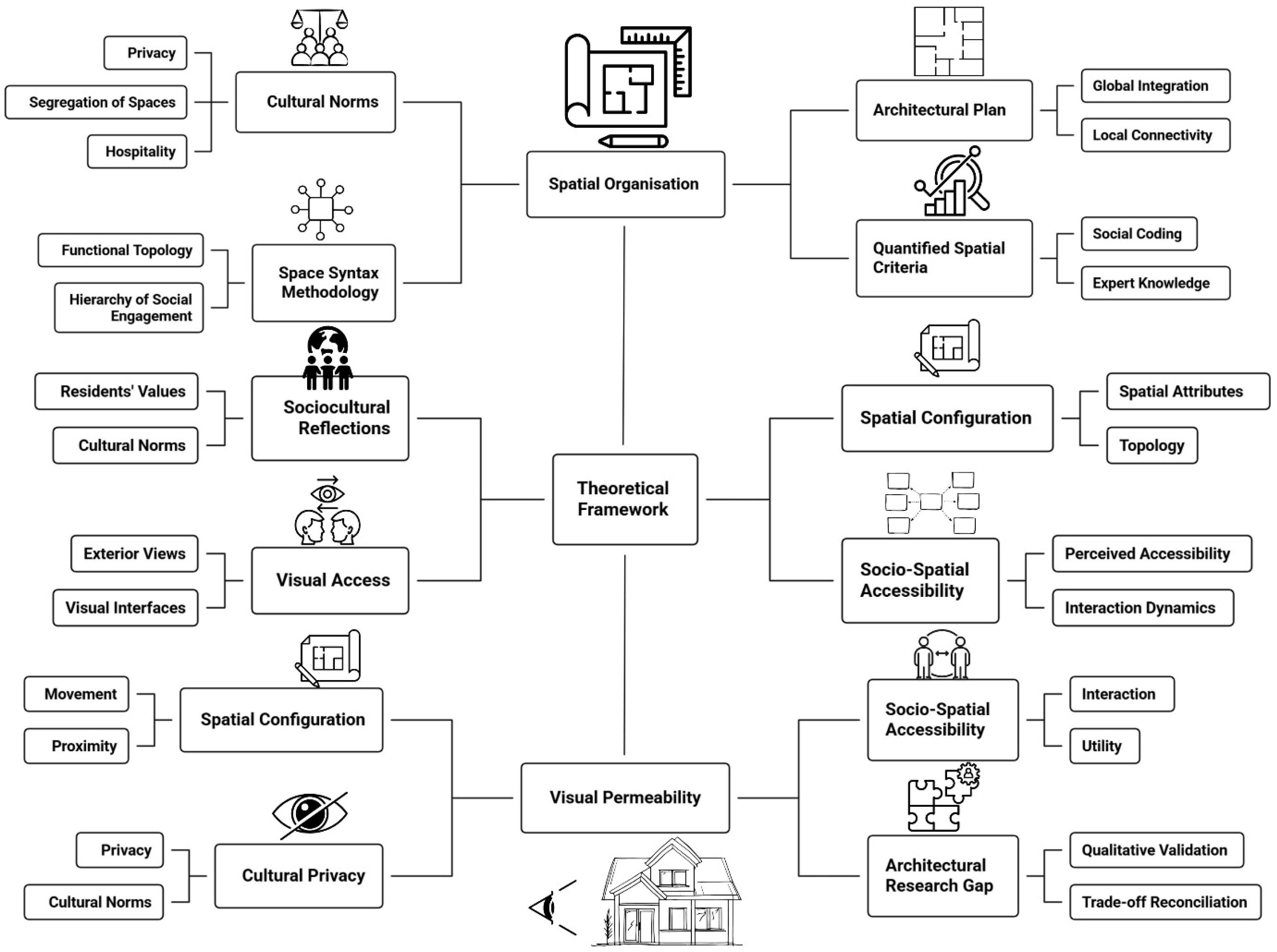
5]. The interrelationship among this incorporative theoretical framework is depicted in
Figure 1.
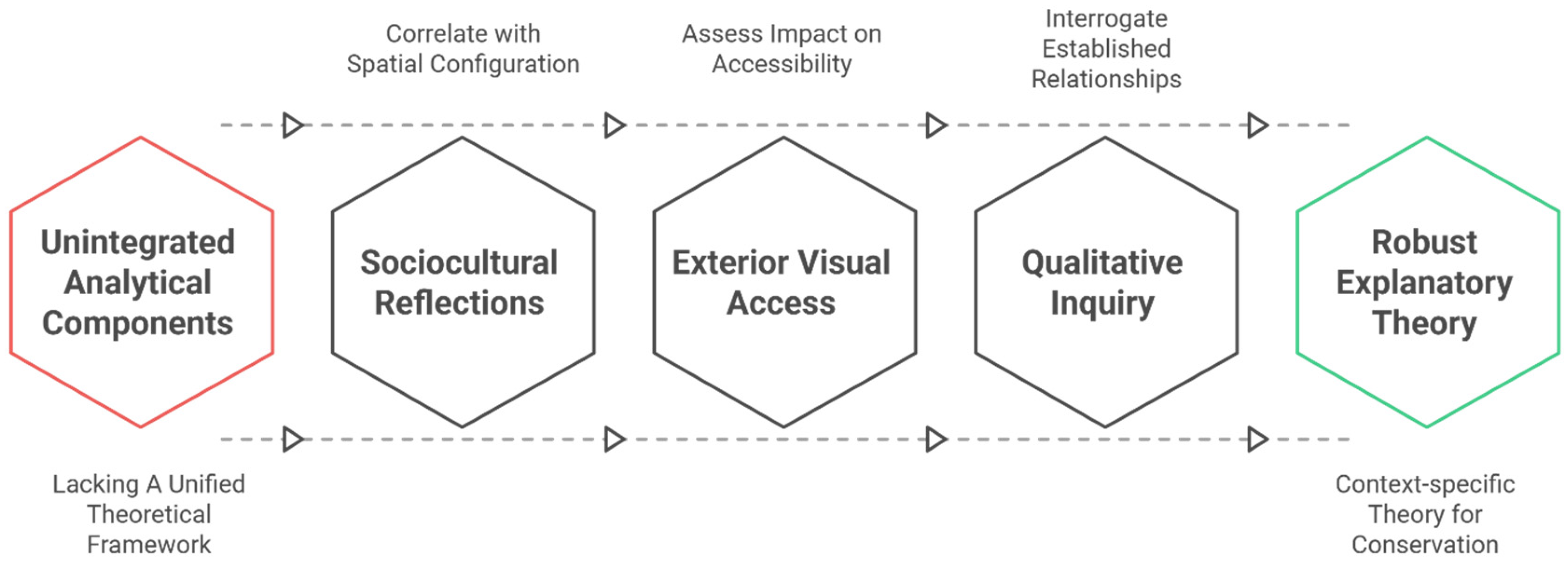
Consequently, the ensuing qualitative phase is designed to specifically interrogate the established relationships and their proposed consolidation. The interviews are formulated to challenge the predictive power and boundary conditions of the empirically derived variables, seeking expert consensus on the interdependencies and weighting mechanisms required to finalise the theoretical framework. The expert community will be invited to evaluate the framework’s utility, confirm the relative importance of specific spatial and visual elements, and ultimately, provide the tacit knowledge necessary to transform a data-driven correlational model into a robust, context-specific explanatory theory for the conservation and analysis of Iranian cultural heritage houses. The process of compensating for this gap through qualitative datasets is visualised in
Figure 2.
4. Results
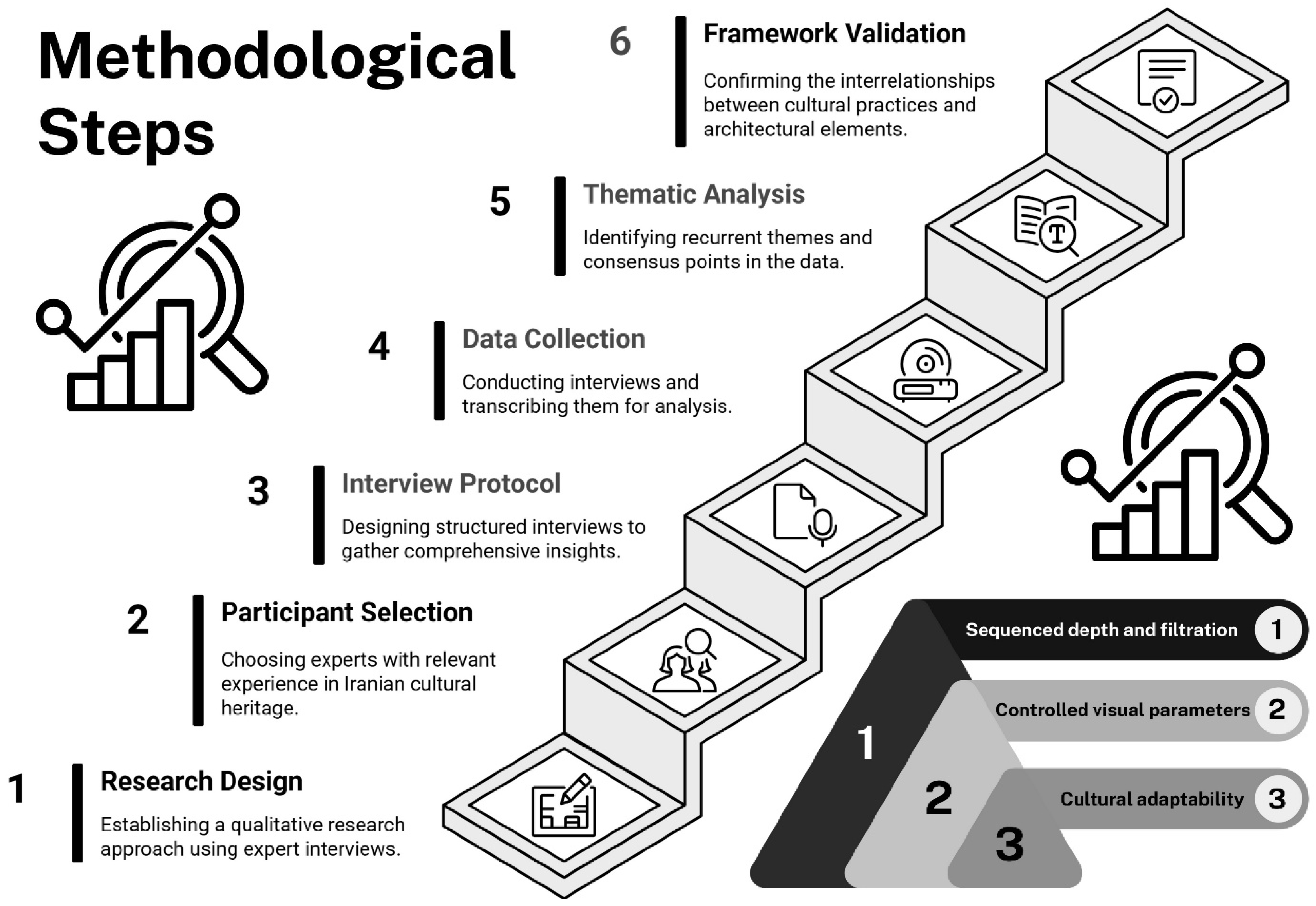
The following findings represent a thematic synthesis of the expert interviews. To maintain empirical clarity, this section focuses exclusively on the consensus and tensions identified within the qualitative dataset, while the theoretical implications and prescriptive regulatory metrics are reserved for the subsequent Discussion. Expert insights have been categorised into key socio-spatial dimensions, with selected verbatim quotations used to illustrate the prevailing professional perspectives. The qualitative data for this study were collected through structured interviews with twenty-four expert participants, carefully selected from a wide array of disciplinary backgrounds, including architectural history and theory, urban planning and design, conservation architecture, building physics, and morphological analysis.
This methodological approach ensured the resultant socio-spatial framework was robustly consolidated, capturing nuanced perspectives from academic rigour to governmental policy implementation and practical design execution. The consensus across this diverse demographic cohort was overwhelming: the foundational principles of introversion and spatial segregation in traditional Persian residential architecture are not merely aesthetic choices but are, in fact, functionally, psychologically, and environmentally mandatory for the dwelling’s long-term social, cultural and physical sustainability. The results uniformly identify the filtering mechanisms such as sequential depth, controlled visual vectors, and thermal buffering as the critical, measurable indices necessary for translating historical patterns into contemporary building regulations and future design principles.
4.1. Spatial Hierarchy
The analysis of expert responses regarding the necessity of spatial segregation (the
andaruni–biruni division) reveals a broad consensus that this configuration remains the ontological core of the Persian house. This transcends mere stylistic preferences, representing the essential structural and cultural foundation as documented by Pirnia and Memarian [
22]. Experts viewed this division as a multifaceted mandate covering cultural, psychological, and environmental functionality. For instance, an architectural historian described the segregation as a ‘cosmological imperative’—referring to the alignment of spatial geometry with a specific cultural worldview [
23]. Meanwhile, a heritage policy analyst affirmed it as the foundational prerequisite of the introverted typology, driven by the principles of
mahram–namahram as documented in the literature [
24]. A housing developer further underscored this by framing the division as the “architectural representation of a social contract,” indicating its continued relevance as a foundational requirement for contemporary design.
Participants predominantly converged on the principle that this segregation is defined by sequential depth rather than a single dividing line, with a focus on enforcing geometric complexity and maximum path length to the private core. A space syntax specialist articulated this through the shift from integrated sequences to segments characterised by high mean depth and low local integration. This structural logic was supported by an urban planner, who confirmed that the asymmetry index of the entry sequence is the most vital property for protecting the domestic sphere. The goal, according to the expert panel, is to ensure the path to the andaruni is consistently the deepest and most intricate route within the dwelling, effectively utilising the dalan (corridor) and hashti (vestibule) as non-hierarchical nodes that serve as perceptual and functional filters.
The hierarchy is further reinforced by material integrity and environmental performance, creating a psychological barrier that eliminates the stress of potential surveillance. A building physics engineer explained that the boundary is functionally defined by the “rate of acoustic and thermal decay” moving toward the stable, climate-controlled core, where thick buffer-like spaces isolate the inner sanctum from external sensory fluctuations. Architectural psychologists and conservation architects argued that this segregation is an essential determinant of domestic comfort, requiring physical depth and material permanence to maintain an “ambiguity of access” at the threshold. Consequently, housing policy analysts emphasised that the configurational depth of these buffer zones must be maintained at a sufficiently high metric to ensure the inner sanctum remains effectively isolated from the rapidly changing urban environment.
4.2. Socio-Spatial Circulation
The analysis of expert testimony regarding movement flow and accessibility suggests that circulation within the traditional house is governed by a pre-emptive social contract embedded in the geometry. This complex flow is fundamentally structured by a system of duality, balancing highly integrated ceremonial routes for public access with segregated, functionally efficient paths for the private household and services. According to experts in housing policy and architectural design, this duality serves to honour the guest while protecting the privacy of the host family—a concept described as “ceremonial staging and functional economy.” In this context, social protocols are physically embedded in the circulation pattern to manage the simultaneous co-existence of diverse user groups within a single building envelope.
The expert panel highlighted that this movement flow functions as a structured narrative or a “ritual of revelation.” The transition from the courtyard to the main hall, or talar, is consistently identified as the most integrated path, designed to maximise dignity through a gradual unfolding of space. An architectural historian noted that this is achieved by a path that sequentially limits and then dramatically expands the field of view, creating a hierarchical deference. Conversely, the rules for service and domestic routes focus on visual minimisation and functional economy. This disparity implies that while the functional depth of service routes remains low to ensure efficiency, their visual depth from ceremonial paths is maximised to maintain the sanctity of the domestic core.
Furthermore, movement protocols are intrinsically linked to sensory and psychological management, utilising geometry to control the transition between public and private realms. An architectural psychologist and a building physics engineer both observed that the sequence of spaces—particularly the obligatory 90-degree turn at the entrance—acts as both an acoustic shield and a thermal buffer, preparing the resident or guest for the stable interior environment. Morphological specialists translated these social rules into “constrained shortest paths,” where the chosen route is defined by social and visual control rather than the path of least physical resistance. To audit these sophisticated asymmetries in contemporary design, architectural designers advocated for a quantifiable “disparity index” between the topological depth of ceremonial paths and the functional depth of service routes.
4.3. Architectural Typology
The architectural typology of the traditional Iranian house, specifically the distinction between single-courtyard and multi-courtyard models, was consistently identified as the structural framework that determines a dwelling’s capacity for social complexity and functional resilience. Experts agreed that typology dictates the robustness of the privacy system and the potential for “spatial concurrency”—the ability to host multiple, segregated social activities simultaneously without conflict. This inherent structural advantage suggests that larger typologies serve as a more sustainable socio-spatial blueprint for multi-family adaptation in contemporary urban settings, as they provide a resilient index for managing diverse user groups within a shared building envelope.
The multi-courtyard typology was noted for its ability to facilitate the complete symbolic and functional decoupling of the social and domestic spheres. Morphological specialists explained this topologically, observing that the multi-courtyard type de-correlates accessibility indices, allowing the public zone (biruni) to maintain high integration for ceremonial purposes while the private core achieves high local integration but minimal global integration. This structural superiority is key to managing high internal social complexity while maintaining seclusion. Furthermore, an environmental dimension was identified, where specialised environmental zones created by multiple courtyards allow inhabitants to shift activities seasonally, thereby maximising functional access to comfortable micro-climatic zones year-round.
Conversely, while the single-courtyard type is regarded as efficient, the expert panel identified significant configurational limitations that necessitate a compromise on privacy during major social events. Participants observed that the single-courtyard model often forces a temporary sacrifice of privacy because the system cannot always support simultaneous public and private functions without psychological intrusion. From an urban management perspective, the multi-courtyard model’s “decentralised configurational logic” was deemed more resilient for adaptive reuse and fractional ownership. Consequently, urban planners suggested that these larger typologies offer a more appropriate basis for designing new multi-unit housing complexes that sustain traditional principles of cultural continuity and social resilience.
4.4. Socio-Economic Functions
The analysis of the relationship between occupational status and architectural form suggests that a house’s configuration occasionally served as a primary determinant for facilitating the owner’s professional duties. Experts across multiple disciplines reached a consensus that the dwelling was not an exclusively residential domain but rather a tailored spatial response to the inhabitant’s professional milieu. An architectural theorist noted that the house acted as a “microcosm of the owner’s world”, where the typological complexity manifested the occupant’s engagement with the wider socio-economic environment. For high-ranking officials, maintaining the dignity of their office required a sophisticated choreography of movement through sequential courtyards, effectively transforming the residence into a “theatre for the exercise of power”.
The findings indicate that the disparity between single- and multi-courtyard layouts was frequently a functional requirement for managing social intercourse and professional petitioners. For governors, an expansive spatial arrangement was identified as a functional necessity to manage numerous petitioners through a clear demarcation between the public biruni and the private andaruni. This was supported by a heritage policy manager, who described the governor’s residence as a “domain for governance” necessitating an abundance of courtyards to regulate various levels of access. Conversely, building engineers suggested that even in simpler layouts, specific vocational tasks—such as the inspection of textiles—meant that spatial orientation and window placement were carefully tailored to provide optimal light quality and environmental conditions for trade.
For the merchant class, the spatial configuration functioned as a versatile machine that utilised specific zones for trade while preserving the sanctuary of domestic life. Urban designers and developers argued that the merchant’s house served as a “nexus for trade,” with circulation meticulously planned to allow for the storage of commodities without disturbing family privacy. While the house acted as a secondary hub for the storage of bazaar goods, environmental psychologists noted that the spatial logic ensured the pressures of the marketplace did not intrude upon the home’s psychological peace. Ultimately, expert testimony suggests that the owner’s vocation acted as a paramount factor in the building’s topology, serving as a “proxy” for the inhabitant’s socio-economic network. Consequently, social housing experts proposed that these historic functional configurations offer models for “configurational resilience” in modern housing to accommodate contemporary home-based vocations.
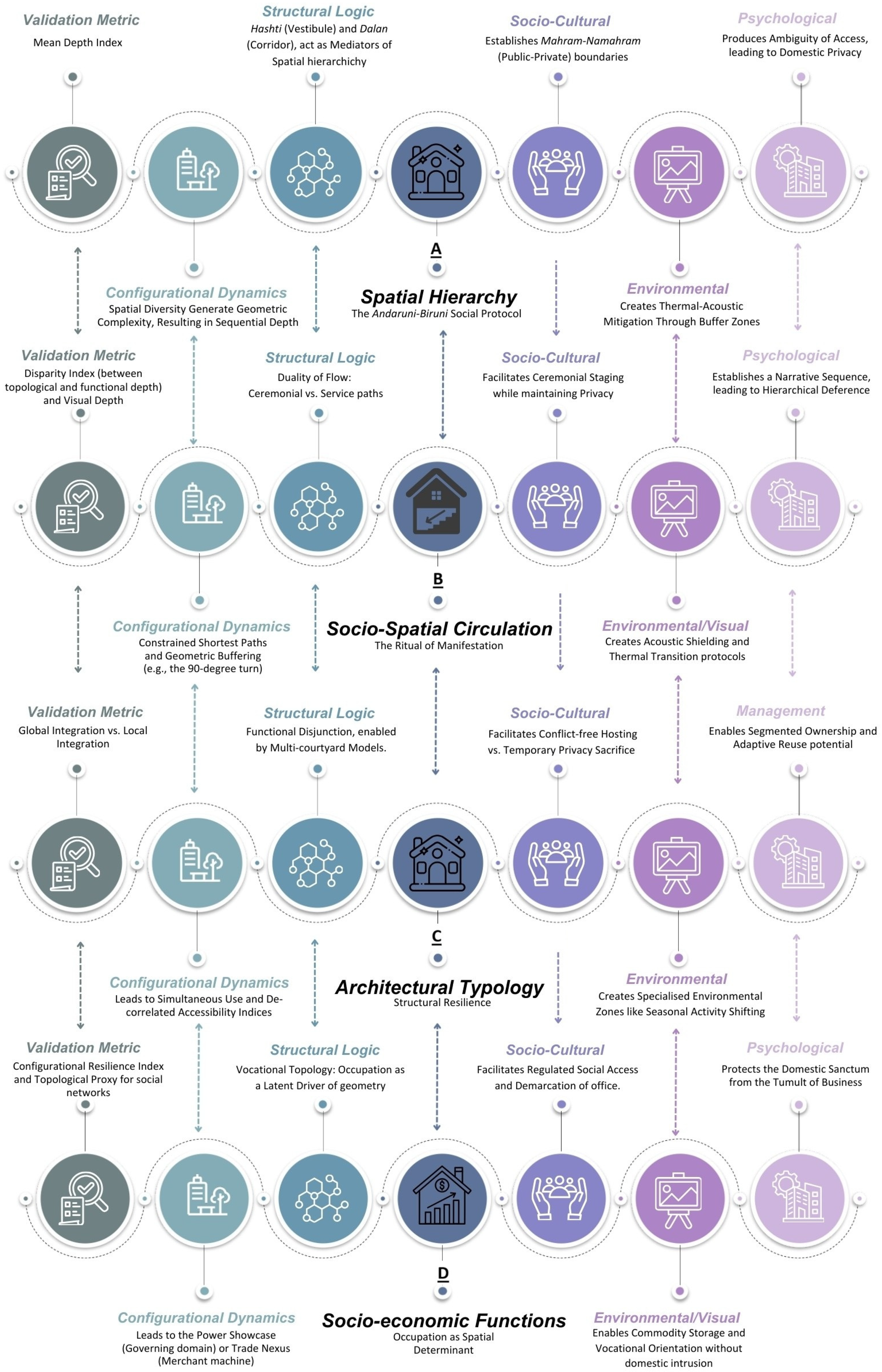
The first thematic cluster (
Figure 4) synthesises the expert consensus on the structural logic of the Persian house, revealing an intricate network of interdependencies. The Spatial Hierarchy is anchored by the
andaruni–biruni dichotomy, which experts identified not as a simple partition, but as a graduated system of domains. Within this hierarchy, the central courtyard emerges as the primary regulator, facilitating the transition between “depth” and “connectivity.” This configuration is inextricably linked to Socio-spatial Circulation, where the “loop” movement pattern allows for high internal connectivity without compromising the privacy of static rooms.
Furthermore, the Architectural Typology is defined by a specific sequential depth pathway, beginning at the entrance and terminating at the interior living spaces. This sequence serves as a psychological and visual buffer, ensuring that accessibility is managed through a “filtering” process. Experts underscored that these spatial arrangements are not merely traditional remnants but are driven by socio-economic functions and gendered spatiality. The relationship between the “guest” domain (biruni) and the “familial” domain (andaruni) ensures that social hospitality and domestic privacy can coexist. Ultimately, the network demonstrates that the “introverted” typology is a high-performance response where circulation, hierarchy, and social function are unified into a single, prescriptive architectural code.
4.5. Visual Permeability
The analysis of window visual permeability demonstrates a critical reconciliation between the environmental necessity for light and air and the cultural requirement for seclusion and social dignity. Experts predominantly agree that seclusion is achieved not through the elimination of visibility, but by strategically controlling the “information content” of the view and ensuring visual ambiguity. An environmental psychologist observed that seclusion is maintained when the psychological “sense of being watched” is eliminated, suggesting that design should focus on perception rather than simple sightline geometry. This conceptual shift implies that quantitative analysis must move beyond measuring aperture size to assessing the degree of visual interference provided by the building envelope.
The consensus findings indicate that effective design strategies are those that introduce “visual noise” through permanent architectural means. Architectural technology engineers argued that the success of a façade should be measured by its ability to maximise the daylight factor while simultaneously enforcing a high visual obstruction index. Elements such as deep window frames, splayed reveals, and dense lattice screens are identified as effective because they restrict the visual intrusion cone while scattering light inward. This geometric control ensures that the cultural mandate of privacy is passively enforced by the architecture itself, effectively decoupling the transmission of useful daylight from the transmission of social information.
The function of screening elements is primarily to act as a “visual distortion field” that renders the interior unreadable from the exterior while maintaining external luminosity for the inhabitant. Architectural theorists and designers explained that the goal is to enforce “visual ambiguity”, where the observer perceives only a complex pattern, while the resident enjoys focused views and diffused light. To ensure cultural continuity in contemporary developments, experts advocated for translating these principles into measurable design parameters, such as a “visual occlusion index” and a “social risk index”. These metrics mathematically validate the role of traditional elements as dynamic filters, ensuring that visual seclusion is a built-in architectural feature rather than a temporary solution.
4.6. Material and Aesthetics
The analysis of elements such as the Orosi (stained-glass window) and the general material palette suggests that aesthetics and material choice in traditional architecture are intrinsically linked to their functional, environmental, and socio-spatial roles. Experts defined these aesthetic qualities as essential components of the building’s performance, particularly in managing light, privacy, and the overall sensory quality of the interior. An architectural theorist provided the basis for this view, describing the Orosi as an element of “applied geometry” whose principal role is the refinement of light to reinforce a sense of tranquility. This perspective elevates aesthetic contribution beyond mere decoration, framing it as a critical factor in the house’s overall socio-spatial quality and domestic comfort.
The functional role of the Orosi and similar elements is defined by their capacity for “light quality engineering,” manipulating the spectral composition and intensity of incoming light. By filtering the spectrum through colour and diffraction, these elements reduce the luminance contrast ratio, creating a uniform, softer light environment that reduces visual stress and enhances psychological well-being. Concurrently, the intricate patterns serve as a primary privacy mechanism. Conservation architects observed that these designs ensure the interior remains “illegible from the outside” due to the complexity of refracted light: a passive security measure integrated directly into the aesthetic fabric. Consequently, participants proposed that the value of the Orosi should be judged by its “visual fragmentation coefficient”, mathematically validating its role as a “visual noise generator”.
Material choices are similarly essential for maintaining the integrity of the spatial hierarchy, with high thermal mass materials in the private core contributing to an aesthetic of permanence and stability. Heritage analysts and building engineers explained that these materials provide the necessary acoustic separation and thermal inertia to ensure the inner sanctum remains “inviolable”. This functional aesthetic guarantees the physical comfort and sensory seclusion that underpins the cultural logic of the dwelling. Therefore, the expert panel suggested that any modern analogue must achieve a triple necessity: visual opacity, high diffuse light, and emotional elevation, ensuring that the material and aesthetic choices sustain the acoustic and thermal integrity of the contemporary Persian dwelling.
4.7. View and Connection
The relationship between interior spaces and the exterior environment is defined by a prioritisation of inward-facing contemplation and the rigorous control of sightlines to prevent intrusion from the public realm. Experts identified the courtyard as a functional “visual sink”, a controlled domestic micro-cosmos toward which all internal views are intentionally funnelled. An architectural historian argued that this orientation reinforces the house’s fundamentally introverted character, ensuring the view is not a passive element but an active exchange with the central environmental and social buffer. This structural choice prioritises a sense of sanctuary, where the visual connection to the courtyard serves as the primary source of external engagement for the inhabitants.
The expert panel noted that optimal visual permeability is defined not only by the quality of the internal view but by the guaranteed exclusion of external urban surveillance. Findings indicate a requirement for zero cross-visibility between adjacent interior private spaces and zero intrusion from the street. A building engineer described this as providing “maximal bi-directional view to the courtyard while guaranteeing zero cross-visibility between units”. This protection of interior views preserves the “dignity of the dwelling”, as noted by architectural designers, who emphasised that eliminating the psychological risk of casual surveillance is essential for maintaining domestic peace within the family’s private sanctum.
To mitigate intrusion, the traditional typology relies on the strategic use of geometry, mass, and vertical offsetting. Elements such as iwans (recessed halls) and high, blind perimeter walls utilize their physical thickness to block external sightlines and limit the angle of view. Restoration architects and structural engineers explained that massive wall thickness provides the necessary depth for deep window recesses and splayed reveals, making views from the public sphere into private rooms difficult or impossible. In contemporary applications, urban morphologists suggested translating these findings into quantifiable constraints, ensuring the “isovist area” of the courtyard does not overlap with public viewpoints and mandating the horizontal and vertical offsetting of windows in high-density developments.
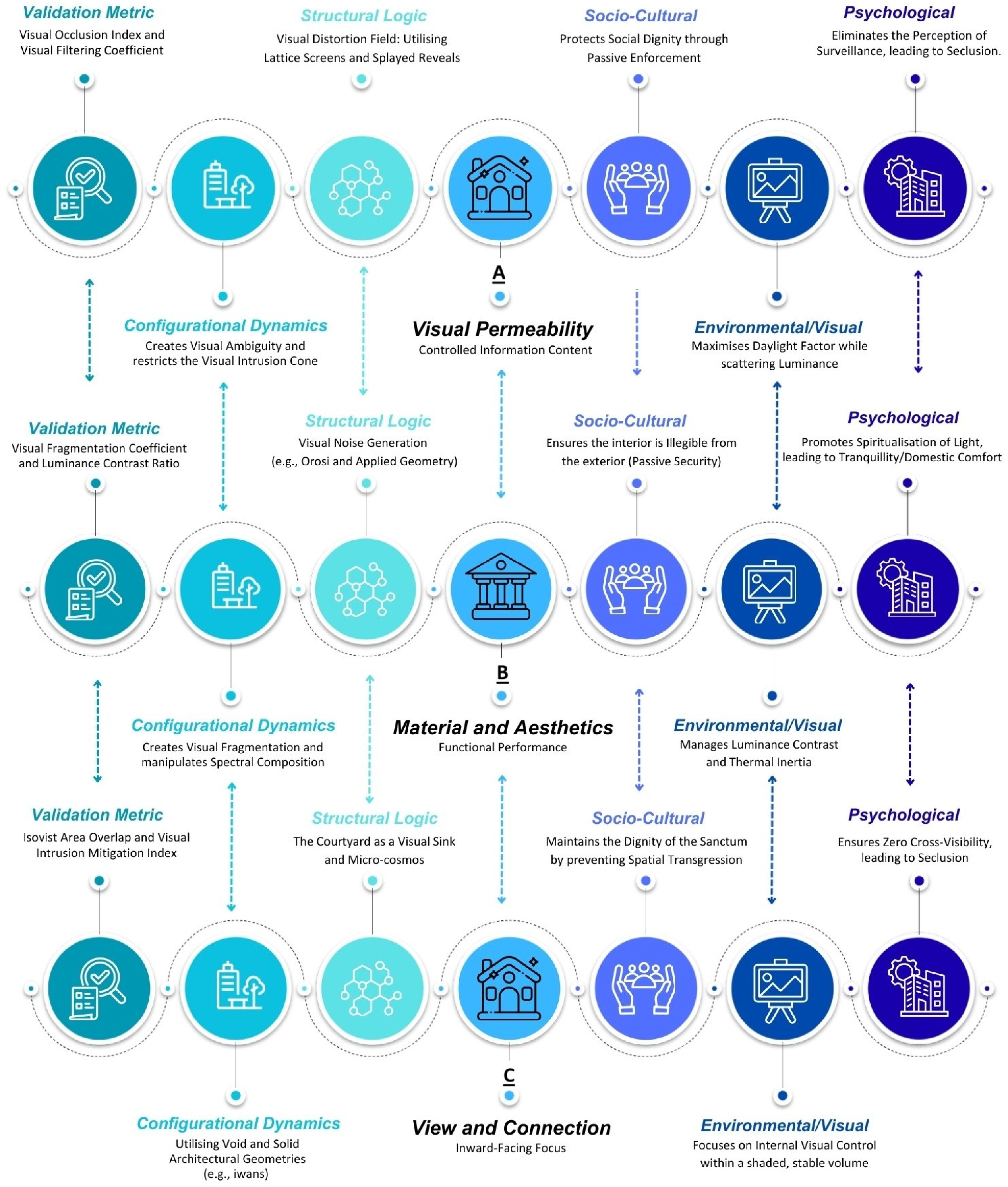
The second thematic cluster (
Figure 5) shifts the focus from spatial configuration to the sophisticated regulation of the sensory environment, particularly the mediation of sight and light. The analysis begins with Visual Permeability, which experts defined as a “controlled information field”. This code is driven by a structural logic that utilises lattice screens (
orosi) and splayed reveals to distort external views while maintaining internal transparency. This creates a specific configurational dynamic that restricts the “visual intrusion cone”, ensuring that the socio-cultural requirement of protecting social dignity is met through passive architectural enforcement. The psychological outcome of this relationship is the elimination of the perception of surveillance, leading to a state of domestic seclusion.
Moving to Material and Aesthetics, the interrelationship evolves into a “functional performance” of the building envelope. Here, the structural logic involves “visual noise generation” via applied geometry, which serves to fragment the visual field. This is not merely decorative; it is an environmental strategy to manage luminance contrast and thermal inertia. This aesthetic layer ensures that the interior remains “illegible” from the exterior, reinforcing socio-cultural passive security and promoting the psychological spiritualisation of light, which contributes to domestic comfort. Finally, the View and Connection code anchors the entire theme through an inward-facing focus. By utilizing the courtyard as a “visual sink,” the architectural geometry ensures that all internal visual control is contained within a shaded, stable volume. This prevents spatial transgression and ensures zero cross-visibility between neighbouring properties, finalising the sanctuary’s role as a micro-cosmos.
4.8. Cultural Practices
The translation of established cultural practices, such as hospitality rituals and multi-generational family structures, into measurable design parameters was identified as a crucial link for ensuring the framework’s relevance in contemporary Iranian housing. Experts strongly advocated for moving beyond aesthetic replication toward codifying the functional logic of these practices. Architectural designers argued that cultural rituals should be translated into parameters of “functional adaptability and spatial integrity”, ensuring that contemporary floor plans accommodate traditional ways of life within current building codes. The consensus suggests that design specifications must evolve into auditable performance targets derived from these enduring socio-cultural requirements.
Regarding hospitality rituals, the findings suggest the creation of specific, detached spatial provisions to honour the guest without compromising family privacy. Participants proposed the introduction of a “detachable guest zone”, with suggestions that a minimum percentage of a unit’s floor area be dedicated to a multi-functional reception space isolated from the core family zone. Housing developers further stated that this ritual requires a “social transition volume”—a vestibule or anteroom that is thermally and acoustically decoupled from the main living area. This ensures the physical re-establishment of traditional exterior-facing functions within a modern, often vertical, residential context.
Traditional family structures, defined by multi-generational living, were translated into parameters for spatial flexibility and “servicing equity”. Cultural heritage specialists and architects argued that modern designs should support the dynamic needs of extended families through “spatial fungibility,” measurable by the ability of a core unit to be serviced by segregated access points and adaptable partitions. To ensure these principles are preserved, space syntax specialists proposed a minimum “mean depth index” for the path leading to guest areas, ensuring it passes through at least two controlled, non-integrated transitional nodes. These indices provide quantitative, performance-based targets that ensure the configurational logic of tradition remains a prerequisite in contemporary design.
4.9. Conservation Policy
The application of a consolidated socio-spatial framework in restoration projects is often impeded by sectoral fragmentation and regulatory rigidity within existing heritage policies. Experts consistently observed that current building codes frequently prioritise aesthetic and material fidelity over the functional integrity of the traditional spatial system. Conservation architects noted that a focus on the “aesthetic look” of a façade, without securing its socio-spatial performance, leads to houses that are visually accurate but functionally obsolete. This gap results in the preservation of a material “veneer” at the cost of the house’s spatial narrative, ultimately failing to sustain the passive environmental and social benefits inherent in the original design.
A significant challenge identified by the expert panel is the failure to codify configurational performance as a core conservation value. Traditional policies often emphasise metric accuracy—such as precise material dimensions—while overlooking the abstract, measurable principles of spatial organisation. Architectural instructors and researchers suggested that building codes lack a “topological fidelity audit” to verify whether structural modifications maintain the house’s original sequence and depth of privacy. This oversight implies that restorative work may inadvertently dismantle the spatial logic that defines the building’s cultural purpose. Consequently, there is a consensus that policy should move beyond prescriptive material lists to embrace the principles of space as fundamental conservation criteria.
To improve modern habitability and the success of adaptive reuse, experts proposed a more integrated approach to regulatory oversight. Current policies often restrict the reconfiguration of service cores, which can render restored dwellings incompatible with contemporary lifestyles and compromise their long-term sustainability. Furthermore, urban managers highlighted that a site’s internal integrity is often threatened by adjacent developments that violate traditional sightlines and privacy buffers. To rectify these issues, the panel advocated for the proposed “passive performance audits” and “integrated codes” that apply principles of visual seclusion and configurational depth not only to the heritage building itself but also to the surrounding urban envelope. This ensures the integrity of the conserved dwelling is protected against external spatial transgressions.
4.10. Future Implementation
The final stage of the analysis consolidates the findings into tangible design paradigms necessary for implementation in new Iranian housing developments, ensuring cultural continuity and social resilience. Experts predominantly rejected the notion of replicating historical forms, advocating instead for the codification of performance—specifically the structural principles of spatial arrangement and visual control. The consensus supports the establishment of spatial sequencing protocols and quantified visual filtering coefficients to embed the socio-spatial logic of introversion into contemporary high-density architecture. This shift implies that cultural logic should be translated into obligatory performance standards that serve as pragmatic instruments for building permit certification.
Regarding spatial arrangement, the primary principle involves re-establishing the traditional layered privacy gradient through formal architectural discipline. Participants proposed the principle of “sequenced entry”, suggesting a minimum of three distinct, non-integrated spatial nodes between public access and the private unit core. This directly translates the andaruni–biruni discipline into modern floor plans. Similarly, architectural designers advocated for an “entrance filtration” requirement, where residential unit entries incorporate at least one 90-degree turn and a dedicated buffer space. These paradigms are intended to preserve the physical and psychological functions of the hashti (vestibule) and dalan (corridor) within modern residential contexts.
For visual control, the framework suggests that seclusion should be an inherent architectural feature rather than a temporary occupant-supplied solution. This is suggested through quantified façade performance metrics, such as the “façade opacity ratio”, which measures the percentage of the external envelope composed of permanent screening or translucent materials. Furthermore, urban morphologists proposed the “visual filtering coefficient” to mathematically ensure that high-density screen systems achieve the necessary degree of visual seclusion. Finally, experts emphasized that sustainable implementation hinges on integrating these verdicts into national building regulations, including required provisions for “spatial flexibility” and independent servicing to support the dynamic requirements of multi-generational habitation.
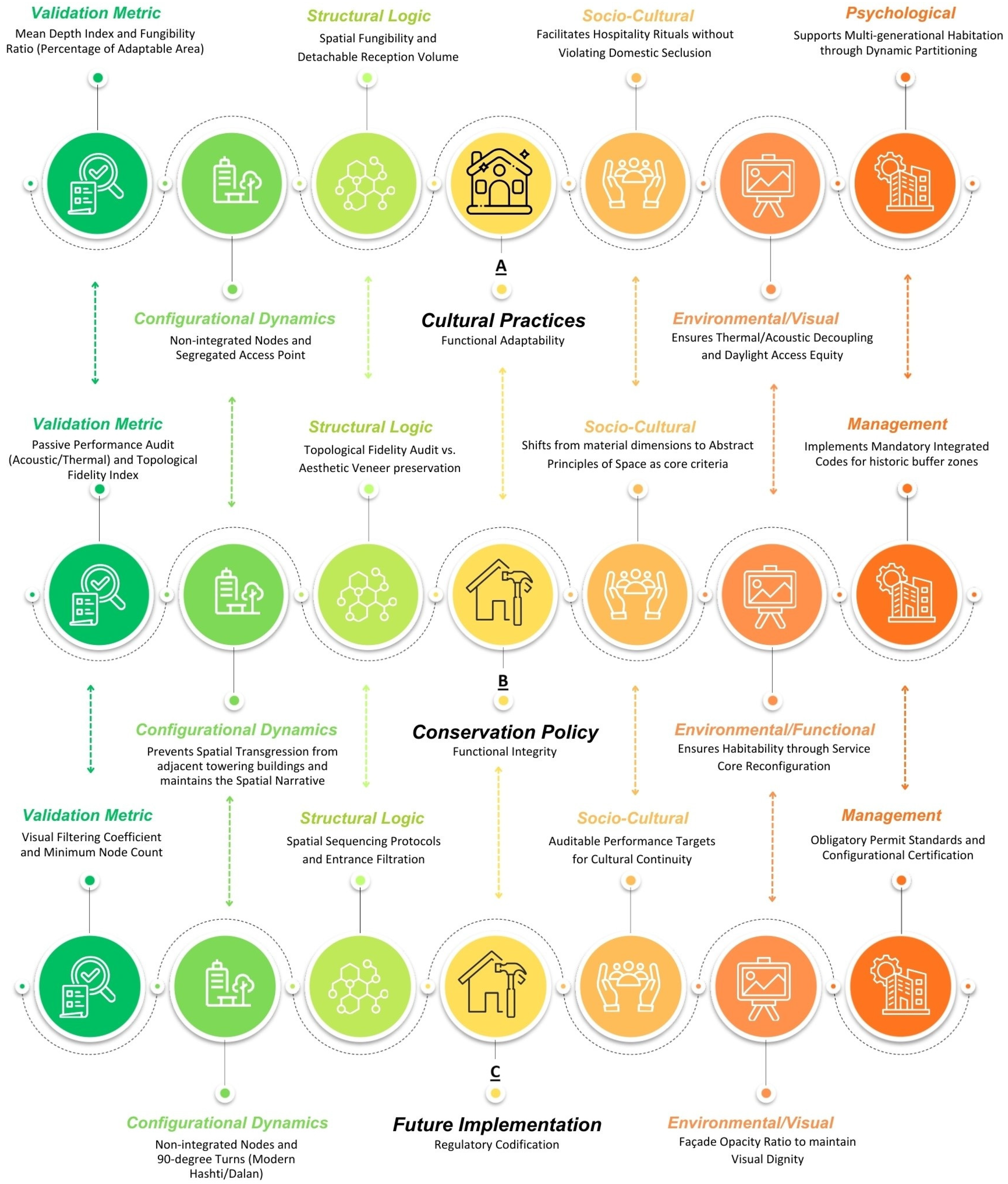
The third thematic cluster (
Figure 6) translates the theoretical findings into a practical roadmap for contemporary urban development, focusing on the systemic challenges of preserving introverted typologies. The analysis begins with Cultural Practices, where the structural logic of spatial fungibility is highlighted as a critical factor for functional adaptability. This allows for modern hospitality rituals to occur without violating the socio-cultural requirement of domestic seclusion. By maintaining non-integrated nodes and segregated access points, a configurational dynamic is established that supports multi-generational habitation through dynamic partitioning, ensuring thermal and acoustic decoupling for all occupants.
Moving into Conservation Policy, the focus shifts toward maintaining “functional integrity” rather than mere aesthetic preservation. Here, the structural logic demands a “topological fidelity audit” to ensure that modern interventions do not destroy the essential spatial sequencing of the house. This requires a socio-cultural shift in perspective, where the principles of space become the core criteria for heritage value. In this context, management should implement such integrated codes for historic buffer zones, using environmental/functional service core reconfigurations to ensure habitability without compromising the spatial narrative. Finally, the theme culminates in Future Implementation, where the goal is regulatory codification. By establishing auditable performance targets and “configurational certification”, the research proposes a framework where the 90-degree turn (modern Hashti) and specific façade opacity ratios are codified into obligatory permit standards. This ensures that the psychological sanctum of the home is protected from the “tumult of business” and the visual transgression of adjacent high-rise developments, securing cultural continuity through law.
4.11. Reflexivity and Nuances in Expert Consensus
While a predominant consensus emerged regarding the ontological necessity of the
andaruni–biruni division, it is essential to acknowledge the nuances and minority positions within the qualitative dataset. Not all experts viewed the rigid application of traditional hierarchies as universally feasible in high-density, low-income housing contexts. A small but significant portion of the panel (approximately 15%) expressed concerns that over-regulating for topological depth might inadvertently lead to spatial inefficiency or increased construction costs, which could alienate developers. Furthermore, some experts highlighted a tension between “cultural fidelity” and “modern lifestyle flexibility”, noting that younger generations might prefer more “open-plan” configurations that challenge traditional visual filtering protocols. By acknowledging these dissenting voices, this study avoids a purely confirmatory stance, recognising that the proposed framework must remain adaptable to the diverse socio-economic realities of contemporary Iran. The resulting metrics, therefore, are intended as a high-performance benchmark rather than a singular, absolute mandate for all residential typologies.
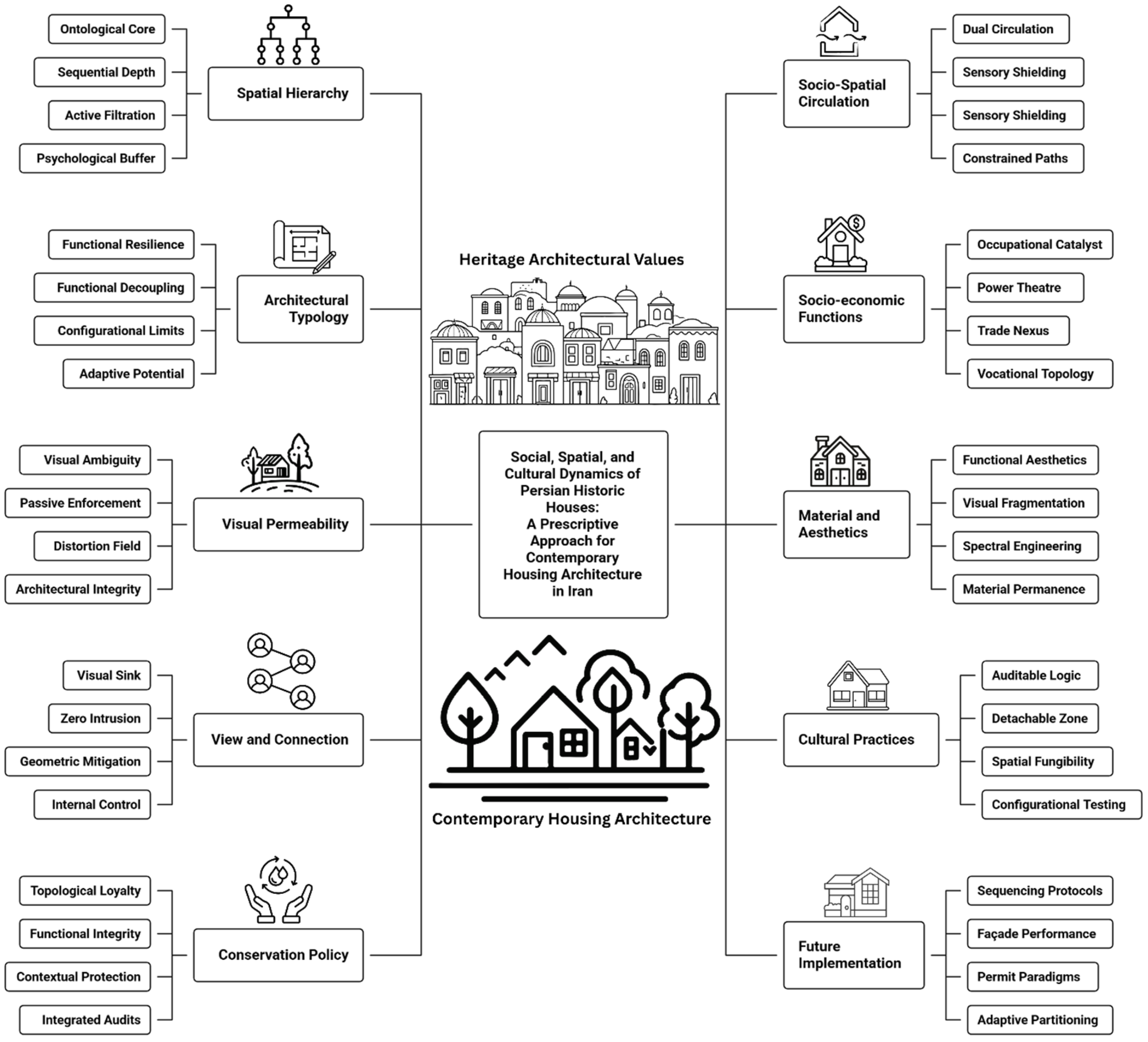
Figure 7 depicts the consolidated paradigmatic framework for architectural protocols in contemporary residential houses.
5. Discussion
5.1. Interpretation of the Results: A Prescriptive Approach
The qualitative data, rigorously collected from twenty-four diverse experts, serves not merely to validate existing literature but to forge a novel, consolidated socio-spatial framework by translating abstract cultural principles into quantifiable, performance-based design parameters. The interpretation hinges on the broad expert consensus that the architecture’s introverted configuration constitutes a context-specific ontological imperative. While a minority of participants expressed reservations regarding the immediate feasibility of certain regulatory shifts, there was an overwhelming agreement on the fundamental socio-spatial necessity of the configuration itself. Rather than an essentialist claim, this is viewed as a fundamental socio-spatial requirement [
23] that simultaneously serves social, economic, psychological, and environmental mandates. This framework shifts the analytical focus from the morphological form of the traditional house to its underlying configurational logic, essential for its sustainable implementation in contemporary practice.
The first critical step toward a prescriptive approach is the translation of social and spatial dynamics into a proposed regulatory tool called the sequenced depth and filtration protocol. This protocol, derived from the expert consensus on the public–private spaces division, suggests a minimum depth value and a minimum of three distinct, non-integrated spatial nodes (the principle of sequenced entry) between the public street and the main family core. This physically ensures that the movement flow is governed by the rule of hierarchical deference and revelation, creating a psychological buffer (the modern hashti or vestibule) that eliminates the stress of casual surveillance, as noted by architectural experts. This approach is prescriptive as it proposes an auditable topological measure, making the privacy mechanism an inherent function of the layout. However, the application of this protocol must remain sensitive to the socio-economic diversity of modern Iran; in high-density or low-income contexts, the “sequenced entry” should be interpreted through flexible vertical thresholds or shared transitional zones rather than a rigid replication of the horizontal hashti, ensuring that spatial integrity does not compromise economic feasibility.
The second prescriptive tool is the controlled visual and environmental regulators, which synthesises the findings on visual permeability, material aesthetics, and passive physics. The framework recommends the use of non-temporary, architectural filtering elements to control light and view. It suggests the specification of a minimum visual filtering coefficient for all street-facing façades, ensuring that the necessary cultural requirement for visual ambiguity is met. This measure simultaneously ensures the maximisation of the daylight factor and the conservation of thermal and acoustic performance, as the dense pattern screens and thick walls are reinterpreted as both light-quality actors and thermal masses. The framework proposes that the façade’s aesthetics are tied directly to measurable environmental and socio-spatial performance targets. While this measure ensures the maximisation of the daylight factor and the conservation of thermal and acoustic performance, it is vital to recognise regional variations within Iran. The filtering intensity and material mass required for the arid plateau of Yazd or Shiraz may differ significantly from the requirements of the humid Caspian, the mountainous north, or the hyper-arid and humid coastal regions of the Persian Gulf. Thus, while the logic of the filtering coefficient is universal, its metric standard must be adapted to local micro-climates to prevent thermal inefficiency or aesthetic monotony.
Finally, the cultural adaptability and resilience requirement translates the complexities of family structure and typology into functional requirements for contemporary living. Addressing the challenges of modern multi-generational habitation, this requirement offers provisions for spatial fungibility and the designation of a detachable guest zone. The residential design in larger units could ideally accommodate at least two independent, yet adjacent and flexible, living arrangements: a response to the multi-courtyard’s superior configurational resilience by ensuring separate access points and acoustically segregated partitions. This approach integrates the cultural imperative for sophisticated hospitality and inter-generational privacy into a measurable set of criteria for unit planning and flexible interior programming. However, a potential tension exists between such prescriptive regulation and contemporary architectural innovation. The framework is not intended to suppress creative expression but to provide a performance-based baseline. By focusing on measurable coefficients rather than fixed forms, the framework allows for “innovation within constraints”, encouraging architects to explore new materials and layouts that satisfy the cultural mandates of privacy and social dignity without being bound by historical mimicry.
In summary, the interpretation of the expert interviews yields a proposed, performance-based consolidated socio-spatial framework for new Iranian housing. This framework shifts policy emphasis from aesthetic replication (the failure of past conservation efforts) to the potential codification of the logic of introversion via three auditable instruments: the sequenced depth and filtration protocol for spatial arrangement, the controlled visual and environmental vector code for façade performance, and the socio-cultural adaptability and resilience requirement for functional planning. This synthesis provides the tangible set of parameters required for regulatory bodies and designers to explore true cultural continuity and sustainable dwelling in the contemporary urban context. By acknowledging potential limitations regarding regionality and socio-economic constraints, this synthesis provides a pragmatic yet flexible set of parameters for regulatory bodies to facilitate cultural continuity in the contemporary urban context. The following table presents the detailed codification of a prescriptive approach to translating the socio-spatial and cultural dynamics of historic Persian houses, as delineated in
Table 2.
5.2. Technical Operationalisation and Regulatory Benchmarking
To bridge the gap between the qualitative outcomes identified by experts and the requirement for an “auditable” permit system, this study operationalises the consolidated socio-spatial framework through three primary computational instruments. These metrics translate the ontological protocols of the Persian house into verifiable performance standards. While the following manual formulas serve as immediate regulatory checks for building permits, the framework is fully compatible with advanced digital simulation. By adopting Convex Space Analysis using DepthmapX software, practitioners can generate justified graphs and isovist maps. Within such digital platforms, the software-generated Mean Depth (MD) or Visibility Graph Analysis (VGA) values are utilised to indicate correlation with benchmarks, providing a scientific guarantee of cultural and spatial fidelity in high-density urban developments.
5.2.1. The Visual Filtering Coefficient (VFC)
The expert consensus regarding “Visual Ambiguity” suggests that privacy is a built-in architectural feature rather than a temporary solution. Grounded in Isovist Theory, established by Benedikt [
25,
26], the VFC measures the occlusion of visual fields at the building threshold. The following formula could be used to quantify the effectiveness of a façade in obstructing external sightlines while admitting light.
In this expression, the ratio of the total open area to the total threshold area represents the basic porosity of the building envelope. However, the critical nuance lies in the integration of the tangent of the angle of incidence (θ), which represents the specific public sightline from the street level. By accounting for this angle, the formula recognises that a perforated screen becomes more opaque as the viewer’s angle becomes more oblique, effectively simulating how traditional latticework or ‘Orosi’ windows function. A mandated benchmark of ≥0.75 ensures that the interior remains unreadable from public thoroughfares. For instance, in a contemporary apartment, an architect would verify compliance by assessing the visibility field from a balcony. At a 45-degree visual field from the street, the projected solid area of a screen must occlude at least 75% of the interior view, thereby preventing the “fishbowl” effect common in modern floor-to-ceiling glazing.
5.2.2. Mean Depth Thresholds
Reflecting the “Sequential Depth” requirements, the mean depth threshold utilises Space Syntax theory, established by Hillier & Hanson [
27], to mandate a minimum topological distance between the urban tumult and the private core. The calculation for Mean Depth (
MD) is defined by the sum of shortest distances (
di) from the entrance to all other nodes in the plan, divided by the total number of spaces minus one (
n − 1).
In this context, the numerator represents the total depth or number of steps required to traverse the house, while the denominator normalises this value against the size of the dwelling. By establishing a benchmark where the ‘Andaruni’ (private core) must maintain a Mean Depth (MD) ≥ 5, the framework ensures that privacy is achieved through configuration rather than locked doors.
This is practically illustrated in a contemporary apartment through a five-step topological sequence: starting from the (1) Exterior Landing or staircase, the inhabitant must pass through an (2) Entry Filter or vestibule for shoe removal, then a (3) Semipublic Living Area, followed by a (4) Transition Corridor, before finally reaching the (5) Private Bedroom or sanctum. This sequence ensures that the most vulnerable domestic zones are topologically secluded from the public entrance.
5.2.3. The Spatial Fungibility Index (SFI)
To address “Socio-economic Resilience” and “Multi-generational Living”, the SFI measures the plan’s capacity for simultaneous, segregated use. It is expressed as the ratio of fungible nodes (
Nfungible) to the total number of rooms (
Ntotal). A fungible node is defined as a room that possesses independent access from a central circulation point, such as a vestibule or ‘Hashti’-inspired node, allowing it to function autonomously.
A benchmark of ≥0.40 is required to ensure the house remains a “versatile machine” capable of hosting guests without disrupting family life. In a typical five-room unit, this means at least two rooms must be accessible without passing through other private living areas. This allows these specific volumes to be “decoupled” from the family core for professional work or hospitality, effectively mimicking the dual-access logic of the traditional Persian courtyard. It should be noted that in the context of contemporary housing, this measure could be adopted based on the functional requirements of inhabitants, particularly when there is a need for the inclusion of socio-economic, multi-generational, or multifunctional necessities.
5.3. Research Contribution Across Prior Literature
The findings of this study resonate with and expand upon a diverse body of international research regarding traditional housing architecture. While previous scholars have explored heritage through the lenses of gendered labour [
28,
29,
30], marginalised domestic actors [
31], and collective memory [
32], this research shifts the focus from historiographical narrative to the codification of functional performance. Unlike the work of Suprapti et al. [
33] and Zhou et al. [
34], which reimagines conservation as a participatory or adaptive endeavour, this study proposes a more rigorous “topological fidelity audit” to ensure that the abstract configurational logic, rather than just the material “veneer”, is preserved during restoration.
In the realm of symbolic and metaphysical spatial orders, where Zulkarnain et al. [
35] and Tarigan et al. [
36] decode moral codes in domestic layouts, this study provides a pragmatic bridge by translating these symbolic values into tangible design metrics. Furthermore, while regional morphological studies have noted how caste [
37], economic imperatives [
38], or aesthetic fences [
39] influence form, this research identifies the “public–private” division as an ontological social contract that necessitates specific, measurable spatial sequencing. The courtyard, a recurring motif in the literature, has been extensively analysed for its role in territoriality in Egypt [
40], symbolic layering in Nigeria [
41], and varying configurational levels in Iran [
42,
43]. However, this study distinguishes itself by defining the courtyard as a “visual sink” with quantifiable “visual” constraints, moving beyond the descriptive findings of prior research [
44] to establish obligatory filtering coefficients for contemporary high-density facades.
Theoretically, the framework aligns with and extends foundational discourses on the production of space and domestic form. By defining the ‘public–private’ division as a context-specific ontological imperative, the study resonates with Rapoport’s seminal assertion that house form is a socio-cultural phenomenon rather than a mere response to climatic or technical constraints [
45]. This alignment confirms that such imperatives are grounded in the enduring cultural logic of the region. However, where Rapoport focuses on the broader socio-cultural determinants, this research adopts a Lefebvrian [
46] perspective by treating the Persian house as a “lived space” where social relations are physically produced through configurational depth. This engagement with the “social logic of space” [
27] moves beyond a deterministic reading of tradition; it treats privacy not as a static absence of sightlines, but as a dynamic regulatory system of environmental regulation [
47], natural surveillance [
48] and territorial control [
49]. Furthermore, by situating these findings within broader debates on “authorised heritage discourse” [
50,
51], the study shifts from the purely descriptive to the critical. It acknowledges that while the framework is prescriptive, it serves as a mediator of ‘power and agency’ [
52,
53], providing the technical instruments necessary for inhabitants to reclaim spatial justice [
54], place-making [
55], and visual dignity [
56], thereby providing a demarcation between street interactions and the social dynamics of house interiors [
57].
Methodologically, this research builds upon the quantitative rigour of space syntax widely used in prior studies [
58,
59,
60,
61]. While previous studies have widely appreciated the diagnostic influence of morphological approaches on accessibility barriers [
62], a synthesised theoretical framework validated by professional experience remains a gap in literature. Yet, while these studies identify configurational patterns of accessibility and connectivity, the current framework integrates these values into a tangible contractual system. It addresses the privacy-accessibility dichotomy noted by Khalil et al. [
63] and the typological adaptations identified by Fathima et al. [
64] by providing precise, technical thresholds for “sequenced depth” that are often absent in broader morphological analyses.
Critiques of modernisation by Formolly and Saraei [
65], Perera and Pernice [
66], and Günçe et al. [
67] highlight the erosion of traditional benefits and communal identity. This study directly responds to these challenges, as well as the cultural mismatches identified by Moayed and Türker [
68], by proposing the “detachable guest zone” and “spatial fungibility” as prerequisites for cultural sustainability. Unlike the findings of Zhang [
69], who noted that visual mimicry fails to foster social cohesion, this study recommends the “configurational genotype” identified by Nazidizaji and Safari [
70] through three specific auditable instruments.
Finally, while environmental adaptation and passive design have been supported by Muñoz-González et al. [
71] and Haraty et al. [
72], this study asserts that thermal and acoustic performance are inseparable from socio-spatial logic. By integrating the flexible “spatial genotypes” discussed by Memarian and Sadoughi [
73] and the transitional value of semi-open spaces noted by Pulhan and Numan [
74] and Foruzanmehr [
75] into a consolidated regulatory framework, this research offers a unique, prescriptive pathway. It ensures that future Iranian housing is certified not merely for its structural safety, but for its adherence to the fundamental socio-spatial contract of the Persian dwelling.
5.4. Implications for Policy and Planning
The integration of the established socio-spatial framework into policy and planning presents a critical opportunity to address the endemic failure of contemporary housing to sustain cultural identity and environmental resilience. The most immediate implication is the necessity for policymakers to abandon the restrictive, aesthetic-only approach to design review, shifting instead to performance-based compliance. This means replacing prescriptive material mandates with proposed topological and geometric metrics, such as the minimum integration values for entry sequences obtained from space syntax analysis. As highlighted by the collected data, the failure to codify configurational depth allows new construction to destroy the privacy system; thus, the framework requires that all new residential units should pass an entrance filtration requirement, which quantifies the necessary psychological, visual and acoustic buffering between the public access point and the domestic core.
The framework demands a radical restructuring of conservation policy by introducing an obligatory topological fidelity audit for all restoration and adaptive reuse projects. Currently, policies are often oblivious to the detrimental configurational effect of well-intended material restoration, leading to functionally obsolete properties. This audit must ensure that any spatial modification maintains the house’s original configurational logic and mean depth structure, thereby preserving the functional comfort that underpins the cultural segregation. Furthermore, planning instruments must adopt the cultural adaptability and resilience requirement, requiring provisions for spatial fungibility and adaptable partitioning within multi-unit housing. This acknowledges the multi-generational family structure, ensuring that new housing remains relevant and serviceable over its lifecycle, preventing the need for future demolition.
Beyond the individual dwelling, the proposed framework extends its implications to the urban context by requiring the establishment of buffer zones and integrated planning codes. The framework persuades that the principles of controlled visual vector and seclusion must be applied not only to the heritage building itself but also to the surrounding new developments. This means applying a strict facade opacity ratio and maximum height restrictions to adjacent parcels, preventing the egregious violation of traditional sightlines and visual dignity that often renders restored houses indefensible against external surveillance. Ultimately, the implication for planners is the necessity of viewing the surrounding urban fabric not as a neutral backdrop, but as an active threat or protector of the introverted dwelling’s socio-spatial integrity, requiring an unprecedented level of integrated regulatory oversight.
Furthermore, while this framework is grounded in configurational logic, its implications extend into the realm of “lived space” and the everyday agency of inhabitants. By codifying the “logic of introversion,” the framework does not merely dictate a static form but provides a stage for the exercise of domestic power and social agency. This aligns with broader international debates on how domestic architecture acts as a mediator of social relations, where the control of visibility and access is fundamentally tied to the dignity and autonomy of the individual within the household. Moving beyond a deterministic view of culture, the proposed metrics recognise that space is “practiced” daily; the detachable guest zones and flexible partitions are designed to empower residents to renegotiate their spatial boundaries in response to shifting family dynamics and modern socio-economic pressures. This positioning allows the framework to resonate with global discourses on the “right to privacy” and “spatial justice”, making the findings relevant to other cultures seeking to balance modern urban density with the preservation of complex social hierarchies.
5.5. Limitations and Future Research Agenda
The present study, while providing a comprehensive consolidated socio-spatial framework, is subject to inherent limitations that circumscribe the direct application of its findings. Firstly, the study is reliant upon qualitative data derived from expert interviews, which, while rich in context and theoretical depth, cannot fully account for the perceptual variability and evolving user preferences of the contemporary Iranian occupant. Crucially, the framework is intrinsically limited to the introverted typology of the Central Plateau (e.g., Yazd, Shiraz, Kashan), overlooking the distinct, often extroverted, architectural typologies prevalent in the coastal regions of Northern Iran (Caspian Sea) and Southern Iran (Persian Gulf). The lifestyle of the modern family, particularly concerning changes in gender roles and technological integration, may introduce deviations from the traditional socio-spatial protocols. Secondly, the framework’s core prescriptive tools, such as the sequenced depth and filtration protocol and the visual filtering coefficient, are proposed metrics that have not yet been empirically validated against real-world performance data in full-scale contemporary residential buildings. Consequently, the transition from these proposed metrics to legislative building codes must be approached with scientific caution. The framework, though robust in its qualitative grounding, currently exists as an operationally promising model rather than a finalised legal instrument. Its integration into the Iranian National Building Regulations would be premature without extensive pilot testing and longitudinal empirical validation within real-world contemporary housing projects. This approach ensures that the prescriptive metrics are not only culturally coherent but also technically and economically viable in the current construction market.
Moving forward, the research agenda must focus on the empirical verification and configurational calibration of the proposed framework. Future studies should undertake a quantitative analysis applying the framework’s metrics, specifically the integration and mean depth values to a diverse sample of newly built residential complexes in Tehran, Shiraz, and Yazd to measure their current performance against the desired sequential depth discipline. It is essential that future research also investigate the efficacy of the potential metrics when applied to the extroverted vernacular houses of Northern and Southern Iran to test the framework’s universality. This should be coupled with longitudinal studies using building performance simulation to validate the controlled visual and environmental vector code by measuring the actual daylight quality, acoustic isolation, and thermal stability achieved by the mandated visual filtering screens and buffer zones. Finally, there is a necessity for user-centric research, employing methods like environmental behavioural mapping to observe how contemporary families utilise the new flexible spaces mandated by the cultural adaptability and resilience requirement, thereby providing essential feedback for the refinement of the framework’s prescriptive parameters.