
Perception of Spatiality in Residential Interiors: An Analysis of the Visual Experience of Space in Motion



Abstract
1. Introduction
1.1. Spatiality
1.2. Review of Previous Research
1.3. Research Aim and Hypotheses
2. Materials and Methods
2.1. Participant Sample
2.2. Set of Visual Stimuli
2.3. Criteria for the Selection of Typological Apartment Models
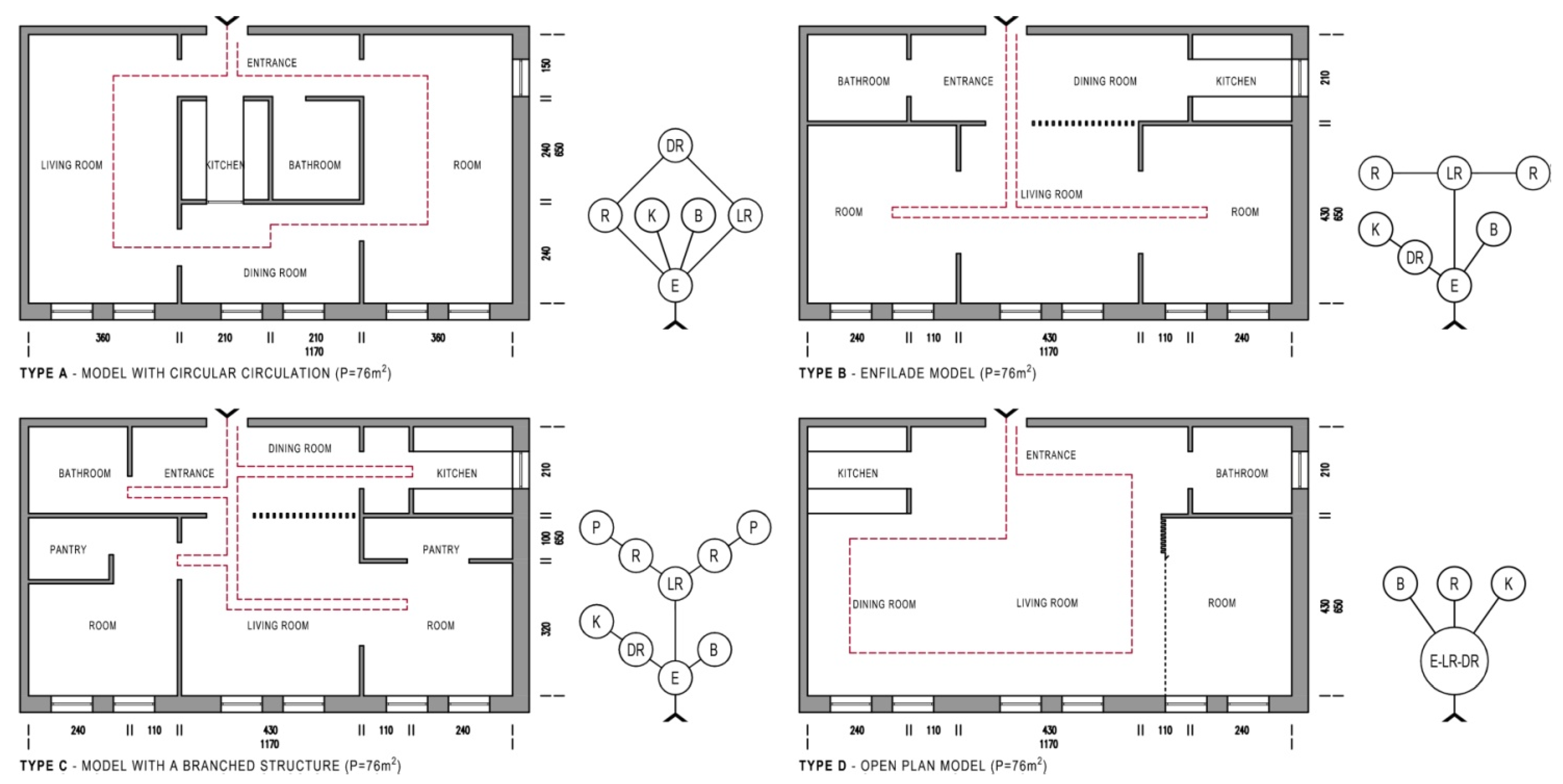
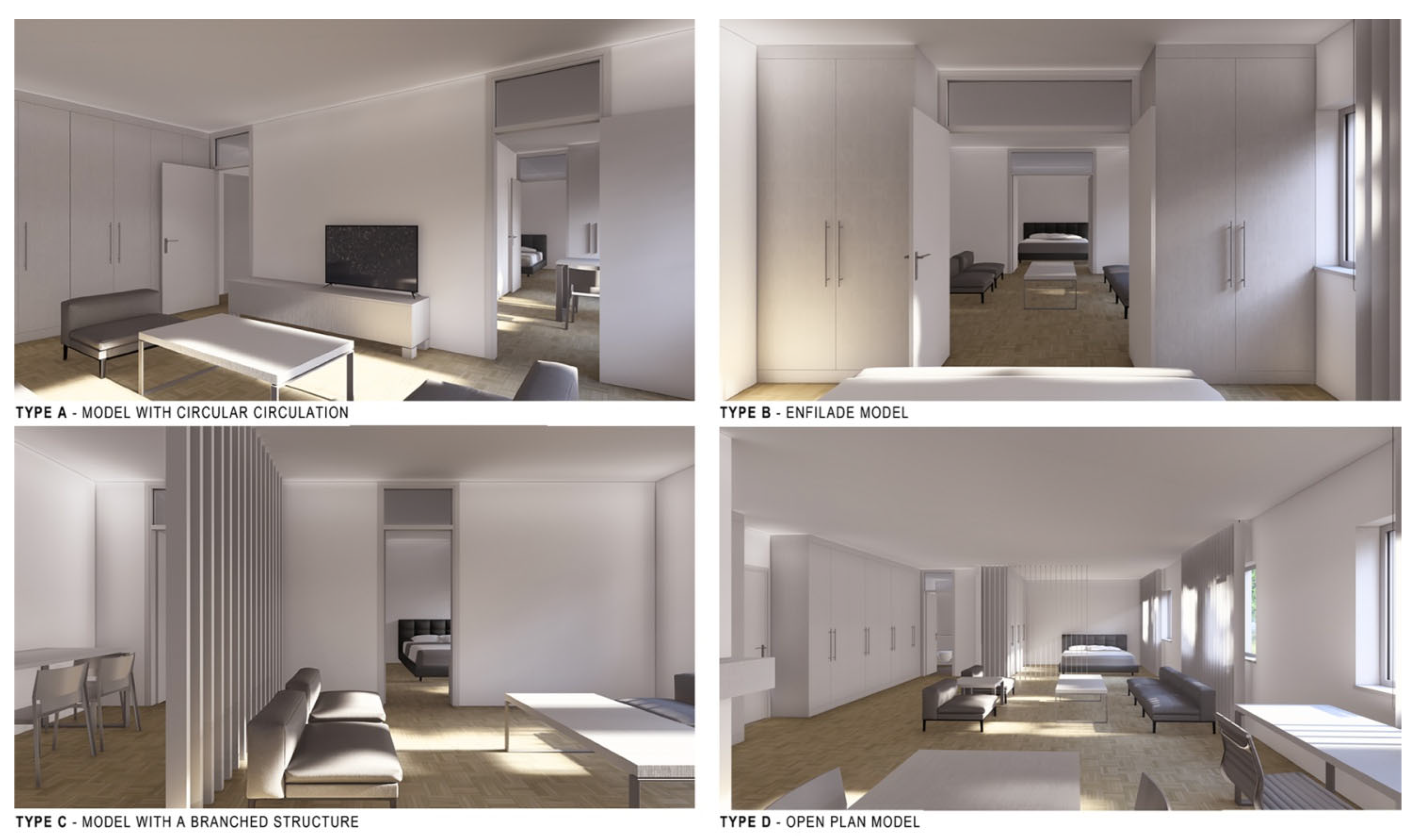
- Type A—Model with circular circulation—This model is characterized by a spatial organization that enables continuous and looped movement through multiple rooms without the need to return along the same path. The spaces are interconnected into a closed circulation loop, generating a pronounced sense of spatial continuity, dynamism, and fluidity. Such a structure encourages an experience of openness and perceptual expansion of the interior, as users can explore the space freely without encountering dead ends or rigid barriers [67].
- Type B—Enfilade model—This model is defined by a linear and axial organization in which rooms are connected sequentially along a clearly defined visual and physical axis. Movement is rectilinear and predictable, with each room accessed through the preceding one in the sequence. This spatial logic produces a sense of directionality and hierarchical order but may limit flexibility and contribute to a perception of enclosure when transitions are strictly sequential [68].
- Type C—Model with a branched structure—This model is characterized by a spatial organization in which multiple paths extend from the entrance zone toward different parts of the apartment, without a central axis or circular circulation. Spaces are interconnected through a network of shorter and longer movement paths, resulting in a fragmented and partially unpredictable movement pattern. While such an organization allows access to different zones from multiple directions, it may also lead to a reduced sense of overall spatial coherence and lower legibility in the holistic experience of the interior [66].
- Type D—Open-plan model—This model is characterized by an open and non-fragmented spatial structure in which functional zones (such as the living area, dining space, and kitchen) are integrated into a single continuous space without internal partition walls. The layout allows free and flexible movement with a high degree of visual connectivity between different activities. Such an organization promotes perceptions of spaciousness, transparency, and spatial elasticity, but in some cases may reduce the sense of intimacy and clear definition of individual zones [67].
2.4. Procedure
2.5. Selection of Scales and Bipolar Pairs for the Assessment of Spaciousness
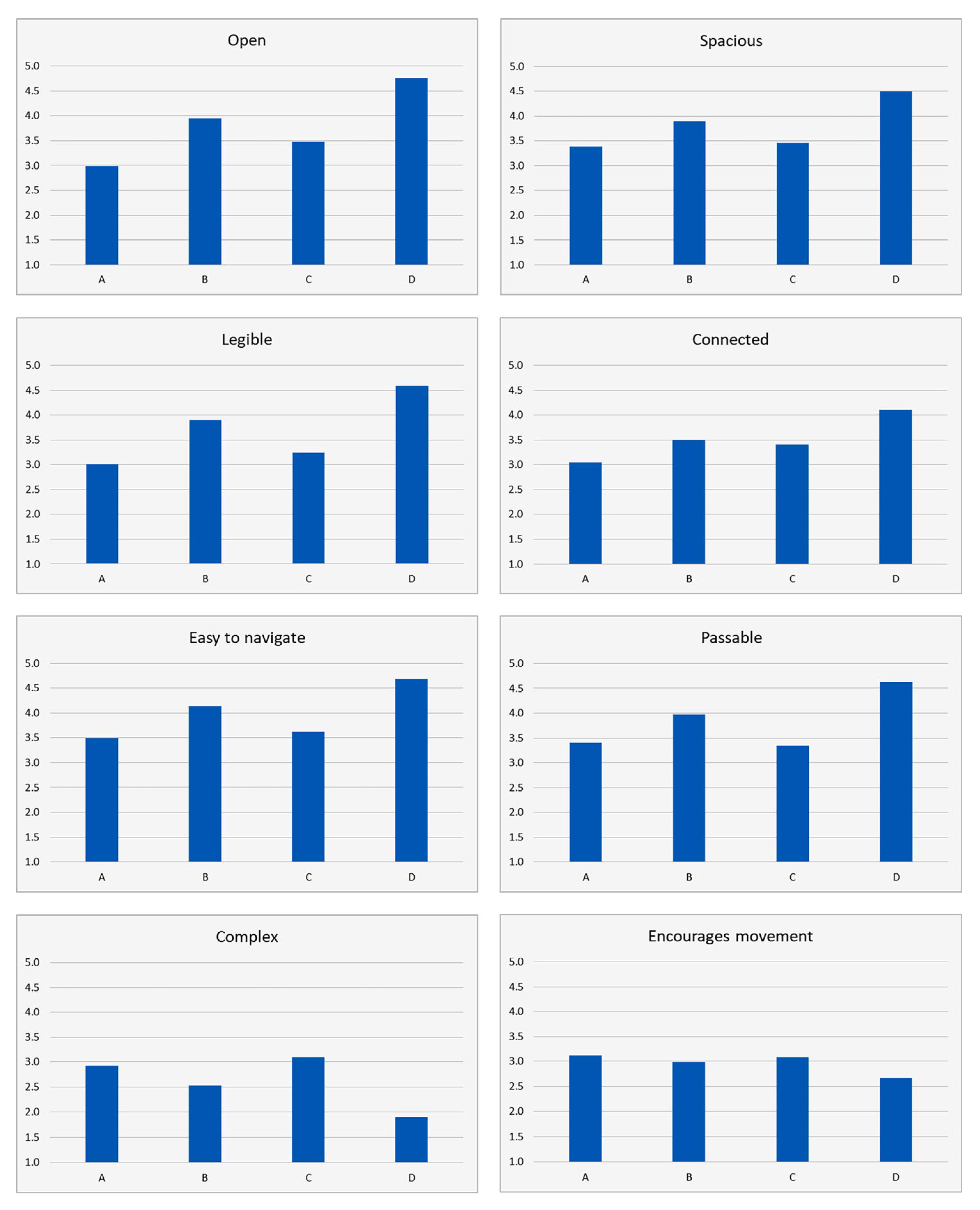
- Enclosed—open (This pair directly reflects the basic perceptual dimension of spaciousness, that is, the impression of visual accessibility and openness of space. It does not refer exclusively to the physical absence of partitions, but also to the subjective sense of communication between different spatial zones.)
- Cramped—spacious (This pair measures an integrative subjective impression of spatial size, independent of actual floor area. The assessment of spaciousness encompasses the combined effect of spatial organization, visibility, and the possibility of movement through the interior.)
- Poorly legible—legible (This pair refers to the degree of visual legibility of space, that is, the extent to which a user can perceive the spatial structure, relationships between zones, and spatial depth from one or multiple positions.)
- Disconnected—connected (This pair describes the perception of structural integrity of space and the degree to which different spatial units are perceptually and functionally linked. A higher level of connectedness often contributes to a more pronounced sense of spatial cohesion.)
- Difficult to navigate—easy to navigate (This pair examines the cognitive legibility of space, that is, how easily a user can understand the spatial logic, orient themselves, and anticipate subsequent paths of movement through the interior.)
- Obstructed—passable (This pair relates to the perceived possibility of movement through space, both physical and visual. A space perceived as passable allows unobstructed movement and continuity of spatial flow.)
- Simple—complex (This pair encompasses the perception of visual and structural complexity of space. Spaciousness often emerges as a result of more complex yet legible spatial–functional relationships, while both excessive simplicity and excessive fragmentation may diminish the quality of spatial experience.)
- Does not encourage movement—encourages movement (This pair measures the extent to which a space motivates the user to move, explore, and visually follow spatial sequences, which represents an important aspect of the experience of spaciousness in interiors perceived in motion.)
2.6. Statistical Analysis
3. Results
3.1. Effects of Spatial Structure
3.2. Effects of Participants’ Expertise
3.3. Summary of Results
4. Discussion
5. Conclusions
Supplementary Materials
Author Contributions
Funding
Institutional Review Board Statement
Informed Consent Statement
Data Availability Statement
Acknowledgments
Conflicts of Interest
References
- Geffner, T. Towards a Smaller Housing Paradigm: A Literature Review of Accessory Dwelling Units and Micro Apartments. Bachelor’s Thesis, Portland State University, Portland, OR, USA, 2018. [Google Scholar]
- Kholid, M.F.; Zaharin, P.M.B. Micro Housing: Typological Study and Implementation in Malaysia. Environ. Behav. Proc. J. 2019, 4, 265–278. [Google Scholar] [CrossRef]
- Alfirević, Đ.; Simonović Alfirević, S. Design Principles for Achieving Interior Spatiality. In Proceedings of the 1st International Conference “SmartArt—Art and Science Applied: From Inspiration to Interaction”; University of Arts in Belgrade, Faculty of Applied Arts: Belgrade, Serbia, 2020; pp. 140–150. [Google Scholar]
- Jammer, M. Concepts of Space: The History of Theories of Space in Physics; Harvard University Press: Cambridge, MA, USA, 1954. [Google Scholar]
- Rasmussen, S.E. Experiencing Architecture; MIT Press: Cambridge, MA, USA, 1964. [Google Scholar]
- Gould, J. The Existence of Absolute Space. Ohio J. Sci. 1962, 62, 101–104. [Google Scholar]
- Asplund, E.G. Our Architectural Conception of Space. Archit. Res. Q. 2000, 4, 151–160. [Google Scholar] [CrossRef]
- Ching, F. Architecture—Form, Space and Order, 3rd ed.; John Wiley & Sons Inc.: Hoboken, NJ, USA, 2007. [Google Scholar]
- Vroman, L.; Lagrange, T. Movement and Experiences in Constructed Spaces: A Description of Spatial Experiences, Based on Movement. In Proceedings of the 9th International Conference on Design and Emotion; Ediciones Uniandes: Bogotá, Colombia, 2014; pp. 429–434. [Google Scholar]
- Kuliga, S.F.; Thrash, T.; Dalton, R.C.; Hölscher, C. Virtual reality as an empirical research tool—Exploring user experience in a real building and a corresponding virtual model. Comput. Environ. Urban Syst. 2015, 54, 363–375. [Google Scholar] [CrossRef]
- Paes, D.; Arantes, E.; Irizarry, J. Immersive Environment for Improving the Understanding of Architectural 3D Models: Comparing User Spatial Perception between Immersive and Traditional Virtual Reality Systems. Autom. Constr. 2017, 84, 292–303. [Google Scholar] [CrossRef]
- Heydarian, A.; Carneiro, J.P.; Gerber, D.; Becerik-Gerber, B.; Hayes, T.; Wood, W. Immersive virtual environments versus physical built environments: A benchmarking study for building design and user-built environment explorations. Autom. Constr. 2015, 54, 116–126. [Google Scholar] [CrossRef]
- Vilar, E.; Rebelo, F.; Noriega, P. Indoor Human Wayfinding Performance Using Vertical and Horizontal Signage in Virtual Reality. Hum. Factors Ergon. Manuf. Serv. Ind. 2012, 24, 601–615. [Google Scholar] [CrossRef]
- Voigt, K.; Roy, V. Editorial: Spatial Dimensions of Moving Experience. Dimens. J. Archit. Knowl. 2021, 1, 7–10. [Google Scholar] [CrossRef]
- Ahmadi, M. The Experience of Movement in the Built Form and Space: A Framework for Movement Evaluation in Architecture. Cogent Arts Humanit. 2019, 6, 1588090. [Google Scholar] [CrossRef]
- Bokharaei, S.; Nasar, J.L. Perceived Spaciousness and Preference in Sequential Experience. Hum. Factors 2016, 58, 1069–1081. [Google Scholar] [CrossRef]
- Tural, A.; Tural, E. Exploring sense of spaciousness in interior settings: Screen-based assessments with eye tracking, and virtual reality evaluations. Front. Psychol. 2024, 15, 1473520. [Google Scholar] [CrossRef] [PubMed]
- Acre, F. Spatial Quality Assessment for Energy-Efficiency Renovation of Dwellings. Ph.D. Thesis, Norwegian University of Science and Technology, Trondheim, Norway, 2017. [Google Scholar]
- Erkelens, C. Perspective Space as a Model for Distance and Size Perception. i-Perception 2017, 8, 2041669517735541. [Google Scholar] [CrossRef] [PubMed]
- Farrell, M. Historical and Philosophical Foundations of Psychology; Cambridge University Press: Cambridge, UK, 2014. [Google Scholar]
- Čanak, M. Otvoren ili zatvoren stan. Arhit. I Urban. 2013, 38, 66–77. [Google Scholar]
- Merriman, P.; Jones, M.; Olsson, G.; Sheppard, E.; Thrift, N.; Tuan, Y. Space and Spatiality in Theory. Dialogues Hum. Geogr. 2012, 2, 3–22. [Google Scholar] [CrossRef]
- Wang, Y. Formal Descriptions of Cognitive Processes of Perceptions on Spatiality, Time, and Motion. Int. J. Cogn. Inform. Nat. Intell. 2009, 3, 84–98. [Google Scholar] [CrossRef]
- Hertzberger, H. Space and the Architect: Lessons in Architecture 2; 010 Publishers: Rotterdam, The Netherlands, 2000. [Google Scholar]
- Van de Ven, C. Space in Architecture: The Evolution of a New Idea in the Theory and History of the Modern Movements; Van Gorcum: Assen, The Netherlands; Maastricht, The Netherlands, 1987. [Google Scholar]
- Ie Lie, K. An Analysis of the Formal Qualities of Space in Architecture. Master’s Thesis, Massachusetts Institute of Technology, Cambridge, MA, USA, 1985. [Google Scholar]
- Rapoport, A. The Study of Spatial Quality. J. Aesthetic Educ. 1970, 4, 81–95. [Google Scholar] [CrossRef]
- Laird, J. Mental Spaciousness. Monist 1921, 31, 161–181. [Google Scholar] [CrossRef]
- Heidegger, M. The Concept of Time: The First Draft of Being and Time; A&C Black: London, UK, 2011. [Google Scholar]
- Merleau-Ponty, M. Phenomenology of Perception; Routledge: London, UK, 2002. [Google Scholar]
- Foucault, M.; Miskowiec, J. Of Other Spaces. Diacritics 1986, 16, 22–27. [Google Scholar] [CrossRef]
- Harvey, D. Social Justice and the City; Johns Hopkins University Press: Baltimore, MD, USA, 1973. [Google Scholar]
- Soja, E. Seeking Spatial Justice; University of Minnesota Press: Minneapolis, MN, USA, 2010. [Google Scholar]
- Perec, G. Vrste Prostora; Meandar: Zagreb, Croatia, 2005. [Google Scholar]
- Liddicoat, S. Perceptions of Spatiality: Supramodal Meanings and Metaphors in Therapeutic Environments. Interiority 2018, 1, 91–111. [Google Scholar] [CrossRef]
- Karlsson, G. The Experience of Spatiality for Congenitally Blind People: A Phenomenological-Psychological Study. Hum. Stud. 1996, 19, 303–330. [Google Scholar] [CrossRef]
- Melling, D. Forms of Experienced Spatiality. J. Br. Soc. Phenomenol. 1982, 13, 277–285. [Google Scholar] [CrossRef]
- Freshwater, D. The Poetics of Space: Researching the Concept of Spatiality Through Relationality. Psychodyn. Pract. 2005, 11, 177–187. [Google Scholar] [CrossRef]
- Tally, R., Jr. Spatiality; Routledge: London, UK, 2012. [Google Scholar] [CrossRef]
- de Vries, D.; Hulsebos, E.M.; Baan, J. Spatial Fluctuations in Measures for Spaciousness. J. Acoust. Soc. Am. 2001, 110, 947–954. [Google Scholar] [CrossRef]
- Griesinger, D. Objective Measures of Spaciousness and Envelopment. In Proceedings of the AES 16th International Conference on Spatial Sound Reproduction; Audio Engineering Society: Rovaniemi, Finland, 1999. [Google Scholar]
- Ozdemir, A. The Effect of Window Views’ Openness and Naturalness on the Perception of Rooms’ Spaciousness and Brightness: A Visual Preference Study. Sci. Res. Essays 2010, 5, 2275–2287. [Google Scholar]
- Stamps, A.E. Evaluating Spaciousness in Static and Dynamic Media. Des. Stud. 2007, 28, 535–557. [Google Scholar] [CrossRef]
- Stamps, A.E. On Shape and Spaciousness. Environ. Behav. 2009, 41, 526–548. [Google Scholar] [CrossRef]
- Stamps, A.E. Effects of Permeability on Perceived Enclosure and Spaciousness. Environ. Behav. 2010, 42, 864–886. [Google Scholar] [CrossRef]
- Stamps, A.E. Effects of Area, Height, Elongation, and Color on Perceived Spaciousness. Environ. Behav. 2011, 43, 252–273. [Google Scholar] [CrossRef]
- Stamps, A.E. Effects of Multiple Boundaries on Perceived Spaciousness and Enclosure. Environ. Behav. 2013, 45, 851–875. [Google Scholar] [CrossRef]
- Azarby, S.; Rice, A. Spatial Perception Imperatives in Virtual Environments: Understanding the Impacts of View Usage Patterns on Spatial Design Decisions in Virtual Reality Systems. Buildings 2023, 13, 160. [Google Scholar] [CrossRef]
- Kalantari, S.; Mostafavi, A.; Xu, T.B.; Lee, A.S.; Qi, Y. Comparing spatial navigation in a virtual environment vs. an identical real environment across the adult lifespan. Comput. Hum. Behav. 2024, 157, 108210. [Google Scholar] [CrossRef]
- Cho, J.Y.; Suh, J. Spatial Ability Performance in Interior Design and Architecture: Comparison of Static and Virtual Reality Modes. Buildings 2023, 13, 3128. [Google Scholar] [CrossRef]
- Tuker, C.; Tong, T. Comparing Field Trips, VR Experiences and Video Representations on Spatial Layout Learning in Complex Buildings. arXiv 2021, arXiv:2105.01968. [Google Scholar] [CrossRef]
- Von Castell, C.; Oberfeld, D.; Hecht, H. The Effect of Furnishing on Perceived Spatial Dimensions and Spaciousness of Interior Space. PLoS ONE 2014, 9, e113267. [Google Scholar] [CrossRef]
- Wang, C.; Lu, W.; Ohno, R.; Gu, Z. Effect of Wall Texture on Perceptual Spaciousness of Indoor Space. Int. J. Environ. Res. Public Health. 2020, 17, 4177. [Google Scholar] [CrossRef] [PubMed]
- Tschumi, B. Architecture and Disjunction; MIT Press: Cambridge, MA, USA, 1996. [Google Scholar]
- Kim, M. A Theoretical Study on the Extended Spatiality of Architecture—Focused on the Conceptual Development & Recognition of Architectural Space Since Modern Architecture. J. Archit. Inst. Korea 2021, 37, 145–152. [Google Scholar] [CrossRef]
- de Groot, D. Spatiality, Virtual Reality, and Creativity: The Effects of Room Size and Environments on Divergent Thinking. Bachelor’s Thesis, Tilburg University, Tilburg, The Netherlands, 2017. [Google Scholar]
- Alfirević, Đ.; Simonović Alfirević, S. Design Principles for Achieving Spatiality in Living Space. Arhit. I Urban. 2019, 48, 37–53. [Google Scholar] [CrossRef]
- Spiliotis, A. Illusionism in Architecture: Anamorphosis Trompe l’Oeil and Other Illusionary Techniques from the Italian Renaissance to Today. Ph.D. Thesis, University of Manchester, Manchester, UK, 2008. [Google Scholar]
- Dernie, D. Notes on the Spatiality of Colour. In Cultural, Theoretical, and Innovative Approaches to Contemporary Interior Design; Crespi, L., Ed.; Information Science Reference: Hershey, PA, USA, 2020. [Google Scholar]
- Al-Zamil, F.A. The Impact of Design Elements on the Perception of Spaciousness in Interior Design. Int. Des. J. 2017, 7, 177–187. Available online: https://www.faa-design.com/files/7/22/7-2-zamil.pdf (accessed on 31 January 2026). [CrossRef][Green Version]
- Ünlü, A.; Edgü, E.; Şalgamcioğlu, M.E.; Canakcioglu, N.G. Exploring Perceived Openness and Spaciousness: The Effects of Semantic and Physical Aspects. Archit. Sci. Rev. 2022, 65, 162–174. [Google Scholar] [CrossRef]
- Kim, D.; Kim, S.; Shin, J.; Yoon, B.; Kim, J.; Lee, J.; Woo, W. The Effects of Spatial Configuration on Relative Translation Gain Thresholds in Redirected Walking. arXiv 2022, arXiv:2206.05522. [Google Scholar] [CrossRef]
- Zejnilovic, E.; Husukić, E.; Licina, D. Perception and evaluation of interior space: Experimental study on color and pattern. Int. Des. Art J. 2023, 5, 13–30. Available online: https://www.idajournal.com/index.php/ida/article/view/188/73 (accessed on 31 January 2026).
- Ruddle, R.A.; Lessels, S. The benefits of using a walking interface to navigate virtual environments. ACM Trans. Comput. Hum. Interact. (TOCHI) 2009, 16, 1–18. [Google Scholar] [CrossRef]
- Suhail, D.H.; Al-Ghabban, B. Movement Flow in Interior Design. J. Lang. Linguist. Stud. 2022, 18, 141–159. [Google Scholar]
- Leupen, B. Polyvalence, a Concept for the Sustainable Dwelling. Nord. J. Archit. Res. 2006, 19, 23–31. [Google Scholar]
- Alfirević, Đ.; Simonović Alfirević, S. Principles of Residential Space Configuration; Special Editions No. 95; Institute of Architecture and Urban & Spatial Planning of Serbia, Faculty of Architecture, University of Belgrade: Belgrade, Serbia, 2024. [Google Scholar]
- Pardo Llorente, M. The Removal of the Corridor in Housing. Bachelor’s Thesis, Universitat Politècnica de Catalunya, Barcelona, Spain, 2023. [Google Scholar]
- Marković, S.; Alfirević, Đ.; Simonović Alfirević, S.; Nikolić, S. Principles for Achieving Legibility in Residential Spaces. Buildings 2025, 15, 1243. [Google Scholar] [CrossRef]
- Connors, M.; Campitelli, G. Expertise and the Representation of Space. Front. Psychol. 2014, 5, 270. [Google Scholar] [CrossRef]
- Aarseth, E. Allegories of Space—The Question of Spatiality in Computer Games. Cybertext Yearb. 2000, 2001, 152–171. [Google Scholar]



| F | df | p | η2 | F | df | p | η2 | ||
|---|---|---|---|---|---|---|---|---|---|
| Open | Spacious | ||||||||
| Structure | 97.252 | 3, 114 | 0.001 | 0.462 | Structure | 50.919 | 3, 114 | 0.001 | 0.311 |
| Expertise | 0.773 | 1, 114 | n.s. | 0.007 | Expertise | 1.599 | 1, 114 | n.s. | 0.014 |
| Legible | Connected | ||||||||
| Structure | 85.145 | 3, 114 | 0.001 | 0.430 | Structure | 24.605 | 3, 114 | 0.001 | 0.179 |
| Expertise | 1.600 | 1, 114 | n.s. | 0.014 | Expertise | 0.318 | 1, 114 | n.s. | 0.003 |
| Easy to navigate | Passable | ||||||||
| Structure | 40.909 | 3, 114 | 0.001 | 0.266 | Structure | 61.069 | 3, 114 | 0.001 | 0.351 |
| Expertise | 0.318 | 1, 114 | n.s. | 0.003 | Expertise | 0.128 | 1, 114 | n.s. | 0.001 |
| Complex | Encourages movement | ||||||||
| Structure | 37.376 | 3, 114 | 0.001 | 0.248 | Structure | 4.257 | 3, 114 | 0.006 | 0.036 |
| Expertise | 0.000 | 1, 114 | n.s. | 0.000 | Expertise | 0.025 | 1, 114 | n.s. | 0.000 |
Disclaimer/Publisher’s Note: The statements, opinions and data contained in all publications are solely those of the individual author(s) and contributor(s) and not of MDPI and/or the editor(s). MDPI and/or the editor(s) disclaim responsibility for any injury to people or property resulting from any ideas, methods, instructions or products referred to in the content. |
© 2026 by the authors. Licensee MDPI, Basel, Switzerland. This article is an open access article distributed under the terms and conditions of the Creative Commons Attribution (CC BY) license.
Share and Cite
Alfirević, Đ.; Marković, S.; Simonović Alfirević, S.; Njegić, T. Perception of Spatiality in Residential Interiors: An Analysis of the Visual Experience of Space in Motion. Architecture 2026, 6, 36. https://doi.org/10.3390/architecture6010036
Alfirević Đ, Marković S, Simonović Alfirević S, Njegić T. Perception of Spatiality in Residential Interiors: An Analysis of the Visual Experience of Space in Motion. Architecture. 2026; 6(1):36. https://doi.org/10.3390/architecture6010036
Chicago/Turabian StyleAlfirević, Đorđe, Slobodan Marković, Sanja Simonović Alfirević, and Tanja Njegić. 2026. "Perception of Spatiality in Residential Interiors: An Analysis of the Visual Experience of Space in Motion" Architecture 6, no. 1: 36. https://doi.org/10.3390/architecture6010036
APA StyleAlfirević, Đ., Marković, S., Simonović Alfirević, S., & Njegić, T. (2026). Perception of Spatiality in Residential Interiors: An Analysis of the Visual Experience of Space in Motion. Architecture, 6(1), 36. https://doi.org/10.3390/architecture6010036