1. Introduction: The Territorial Water System in Andalusia: History, Relevance and Threats
Adopted in 1972, the UNESCO World Heritage Convention established an integrated framework for the preservation of cultural and natural sites. However, the work carried out over decades on ecosystem restoration and the conservation of ecological diversity, which materialised in the creation of the biosphere reserves (1976) or the geopark networks (2004), have historically remained institutionally separated from the safeguarding of tangible historical sites. The establishment of a legal framework and a listing system for safeguarding intangible heritage in 2003 highlighted the link between cultural and environmental values.
Today, the World Heritage List includes 1248 sites. These include 972 cultural, 235 natural and 41 mixed sites. This distribution reveals a critical gap in current heritage classification frameworks, whereby environmental values embedded within sites designated as exclusively cultural remain insufficiently identified, articulated, and assessed. Many of these ‘non-mixed’ sites, such as those covered by this study, were protected almost half a century ago. Accordingly, there is a growing need to update their Outstanding Universal Values in relation to climate change by incorporating the values they hold today, as recognised by society and science. On top of that, in 2023 UNESCO published a guide to the biodiversity hotspots of our planet. It highlights that 20% of the world’s mapped species live in UNESCO World Heritage sites, which occupy only 1% of the Earth’s surface [
1]. World Heritage is thus increasingly understood as a contributor not only to cultural diversity but also to biodiversity conservation.
Within this conceptual framework, this study focuses on southernmost region of Andalusia, Spain, in the south-western corner of Europe for two primary reasons. First, global warming, droughts and adverse atmospheric phenomena resulting from climate change [
2] are turning the region into an area of extreme climatic conditions, reinforcing the need to incorporate studies on natural-cultural capital from this perspective. Second, because a significant part of Andalusia’s cultural heritage, and specifically the World Heritage sites, dates back to the Middle Ages and, more specifically, to the historical period of Al-Andalus. This means that they are steeped in the material and architectural traditions, culture, customs and ways of life inherent to territories marked by a desert climate and an extraordinary appreciation of natural heritage and water systems.
In Al-Andalus—the region of the Iberian Peninsula under Muslim governance from the 8th to the 15th centuries, and the period in which both the Alhambra and the Royal Alcázar of Seville were conceived—water was understood not merely as a practical resource but as a cosmological medium, carrying material, ecological, and spiritual significance. Rooted in the Islamic worldview of
tawḥīd—the Oneness and interdependence of all Creation—water was framed as both a divine gift and a communal responsibility, central to maintaining
mīzān, i.e., balance, between human society and the natural world [
3,
4]. The Qur’an evokes water as a sign of mercy, justice, and equilibrium, embedding its stewardship within an ethic of environmental care and equity [
5].
These environmental ethics were shaped by climatic extremes—scarcity, heat, and irregular rainfall—conditions that remain pressing today, as southern Spain faces increasing water stress and hydrological volatility linked to climate change [
6,
7].
In the arid landscapes of the Arabian Peninsula and Maghreb, these pressures drove remarkable hydraulic ingenuity: qanats, cisterns, and oasis-based irrigation systems evolved to secure life in conditions of scarcity. As Islam expanded westward into the Iberian Peninsula, these desert-born traditions encountered the diverse Mediterranean ecologies of southern Iberia—from the Baetic mountain ranges around Granada to the fertile Guadalquivir River basin of Seville—each shaped by distinct hydrological dynamics [
8]. Over centuries, Andalusi planners developed sophisticated water management systems that combined Qur’anic ideals, inherited Roman infrastructures, and Persian innovations such as the
chahār bāgh, alongside Umayyad oasis practices and Qur’anic conceptions of gardens as earthly reflections of paradise [
9,
10]. Across the Maghreb and Andalusian hinterlands, techniques like terrace agriculture, cistern storage, and hilltop siting were exchanged and adapted to local conditions, embedding a hydraulic ethic into both urban and rural landscapes [
8,
11,
12].
In Andalusia, water-related natural capital has historically supported regulatory functions (hydrological cycles, microclimate moderation), productive activities (irrigated agriculture), and cultural values (aesthetic and symbolic meanings), all deeply embedded in the landscape. The system is articulated through a complex network of river basins—such as the Guadalquivir and Genil in the areas to which the case studies belong—integrated with a historically rich hydraulic infrastructure, including
acequias,
aljibes, canals or fountains. As a result of its different historical layers, the landscape of Andalusia is today a complex system in which natural and cultural components interact dynamically. Among the structural elements of this landscape, the territorial water system plays a central role in shaping the region’s ecological identity, agricultural practices, and settlement patterns. It represents a paradigmatic case of natural capital—as defined by the United Nations’ Natural Capital Framework [
13]—referring to the ensemble of environmental assets (water, soil, vegetation, and biodiversity) that generate essential ecosystem services for human well-being and territorial resilience.
However, this balance is currently threatened by systemic processes associated with the global climate crisis, including rising average temperatures, decreased precipitation, reduced snowpack, and progressive loss of aquifer recharge capacity. These phenomena directly affect water availability for irrigation, thereby inducing ecological stress on historical vegetation and consequently compromising local ecosystem functions, ultimately endangering the conservation of architectural and landscape heritage. The resilience of Andalusia’s water-based eco-cultural systems is progressively undermined by the intensification of all these climate change impacts, which are notably severe in southern Spain [
7]. Several interrelated climatic stressors are contributing to the progressive degradation of the region’s territorial water system, a key component of its natural capital and cultural heritage [
14].
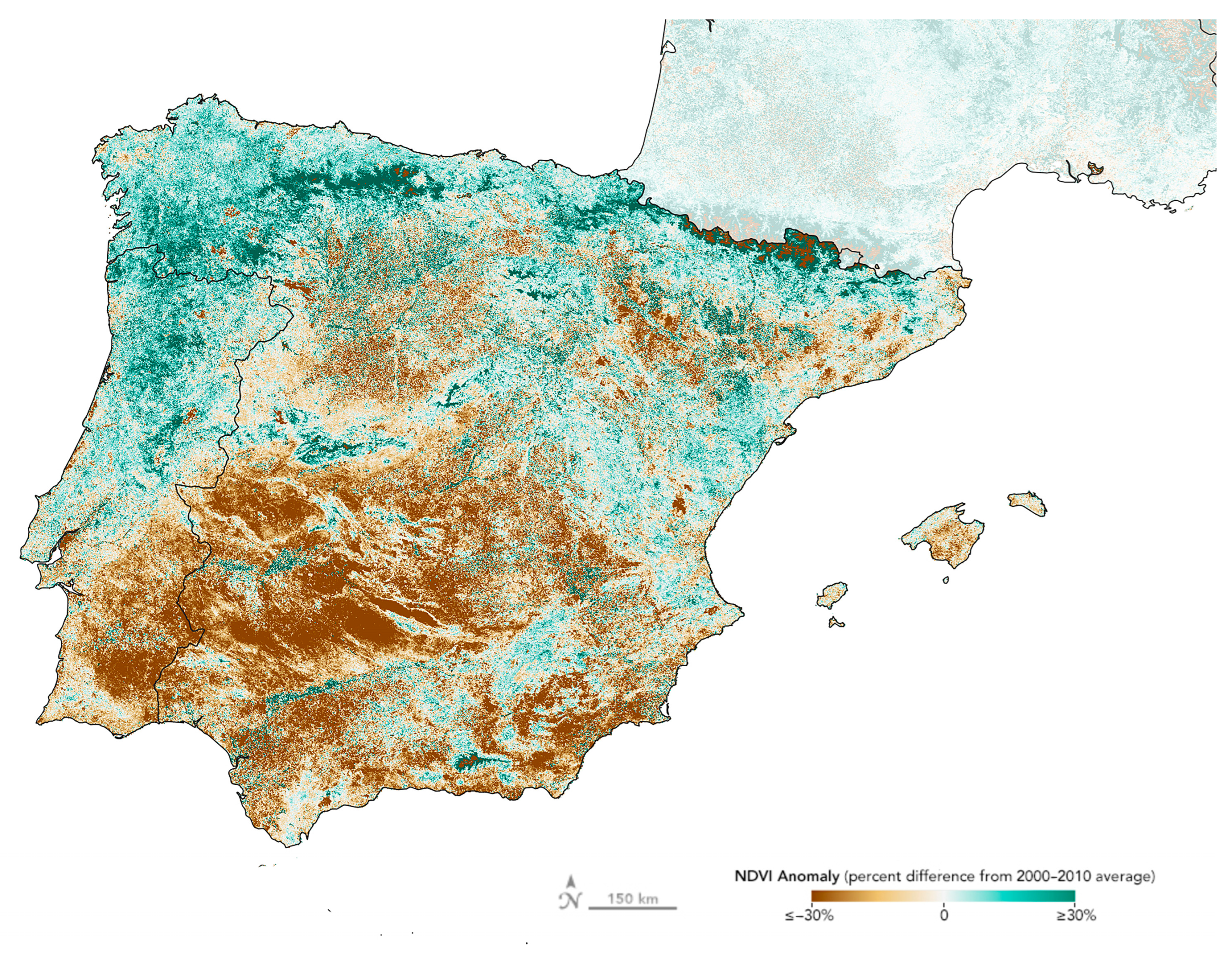
Concurrently, mean annual temperatures in the region have increased by approximately 1.5 °C since the mid-20th century, with projections suggesting further rises of 2–3 °C by 2050 [
7]. More frequent and intense heatwaves have been documented, significantly elevating evapotranspiration rates [
15]. This process accelerates soil moisture depletion and thereby imposes additional physiological stress on vegetation (
Figure 1), particularly on species historically adapted to Mediterranean semi-arid conditions but vulnerable to rapid climatic shifts. A crucial hydrological shift affecting Andalusia is the declining snowpack in the Sierra Nevada mountain range. Satellite and field observations confirm a 30–50% reduction in snow cover extent and earlier melt timing over recent decades. Moreover, increased water demand from agriculture, urbanisation, and tourism—alongside diminished recharge—has resulted in aquifer depletion rates estimated at up to 1 m per year in some areas. Such depletion threatens the operability of historical water management systems, which depend on reliable groundwater levels and spring discharges. Furthermore, this decrease in rainfall, combined with increased temperatures and the consequent alteration of the hydrological regime, raises the risk of wildfire spread.
All this inherited knowledge about water has resulted in a vast legacy linked to hydraulics from ancient times to the present day. This legacy encompasses numerous built elements (including infrastructure associated with the territory, rural areas, agricultural systems, and, more recently, industrial heritage) [
16]. It also includes customs, traditions, and forms of knowledge embedded in local ways of life, which together constitute a significant component of intangible heritage. Such heritage is expressed through religious cults and rituals, historical routes and pilgrimages through the landscape, food and drink production techniques, the preparation of traditional building materials, water-related festivals, and elements of oral tradition, among other examples [
17].
Within this context, there is an urgent need for a critical and integrated reflection on the methods used to map, interpret, and enhance natural capital as an ecological and cultural infrastructure of the landscape. The loss of ecological functionality in traditional water networks entails not only environmental degradation but also cultural and symbolic impoverishment, as it disrupts ecosystem flows that sustain agricultural practices, identity-related rituals, and water-associated intangible heritage. Accordingly, the conservation of the Andalusian landscape requires transdisciplinary approaches that integrate ecological, historical, landscape, and engineering knowledge in order to regenerate the interdependencies between natural and cultural systems that underpin territorial identity.
This article is structured as follows.
Section 2 outlines the research objectives, methodological references, and analytical approach.
Section 3 presents the two case studies, addressing their relevance within Europe’s changing climatic context, their historical significance, their territorial landscape conditions, and the value of their blue infrastructure systems.
Section 4 examines the results related to the case studies’ water systems, assessing their presence or absence within current protection and management documents, proposing a narrative approach to water for both sites, and analysing their climate-related vulnerabilities and benefits.
Section 5 discusses these findings in relation to the analytical framework adopted. Finally,
Section 6 summarises the study’s limitations and presents its main conclusions.
2. Materials and Methods
This research is situated within the framework of a broader research project. Entitled “World Heritage: an Approach To Social Sustainability while Upgrading Cultural Values (WHATS-UP)”, it seeks to develop a methodology for identifying the heritage values of World Heritage sites that extends beyond Outstanding Universal Value by including dimensions particularly relevant to the everyday experience of citizens and is based on the paradigm of social sustainability.
Within this broader context, the primary objective of this paper is to demonstrate the need to jointly evaluate the cultural and environmental values of World Heritage sites. Under the threats posed by climate change, the need to recognise natural and cultural capital is most evident in heritage properties that contain natural and anthropogenic water features among their attributes. For this reason, the water system approach is used to demonstrate that these heritage sites function as biocultural landscapes, and that this condition contributes to their Outstanding Universal Values.
To achieve this objective, the study examines the recognition of natural and cultural capital linked to water at two World Heritage sites on the southern European periphery of Spain: the Royal Alcázar of Seville and the Alhambra in Granada.
Section 3 details the relevance of their selection as case studies.
Methodologically, the study adopts a multi-method analytical framework. To characterise the case studies, an in-depth analysis of the existing academic and institutional literature is conducted to identify the landscape’s territorial conditions and the importance of blue infrastructure in both cases. In addition, historical diagrams and maps illustrating these territorial conditions are identified, enlarged, and manually edited to highlight the imprint of water systems. Finally, Geographic Information Systems are used to map the context and boundaries of UNESCO World Heritage protected areas and their buffer zones with cartographic representation treated as a fundamental analytical tool for the study of heritage landscapes [
18,
19]. To this end, the Spatial Reference Data of Andalusia has been used—specifically the layers of protected cultural assets, protected environments, environmental protection, land use, vegetation cover, topography, and hydrology—as well as georeferenced cadastral data—to represent buildings—and data georeferenced by the authors on elements that no longer exist.
Once the cases have been characterised, a chronological review of all relevant institutional documentation currently in force for the protection and management of these two monumental complexes is carried out. Subsequently, a term-by-term analysis is conducted [
20] to identify explicit references of water as natural and cultural capital, as well as its social, symbolic, or spiritual implications. This process yields the first results: an assessment of how water systems are valued within existing protection and management documents.
Building on these findings, a new narrative approach is proposed. It structures all the findings and absences arising from the above analyses. Drawing on the coding tree recently established by Dai and Hein in their research on the relevance of water as Outstanding Universal Value on the UNESCO World Heritage List [
20], three broad categories are addressed: intangible, tangible, and landscape heritage, with 12 subcategories (see
Section 4.2). Based on the above analyses and results, the different values are incorporated into each category and subcategory according to the authors’ criteria. The fundamental contribution, in addition to the categorisation, is the differentiation of those elements that are not yet included in the institutional discourses previously analysed.
Finally, the values obtained are related to the climate risks identified for the region, resulting in an interpretation of the climate vulnerabilities and the climate benefits that both cases exhibit. The values of the water system affected or reinforced by climate vulnerabilities, risks and benefits have been categorised using separate coding trees for the Real Alcázar and the Alhambra.
3. Description of the Case Studies
As indicated above, the aforementioned methodology has been applied to two case studies in Andalusia, Spain: the Royal Alcázar of Seville and the Alhambra in Granada. The choice of these two World Heritage sites is based on the following criteria:
Both entail a multi-layered historical dimension, but their main period of conception and construction took place under the culture of Al-Andalus;
Both house a fortified palace complex, as well as landscaped areas where natural capital is significant in both spatial and symbolic terms;
Both are located in urban contexts with strong territorial linkages and increasing stress from overtourism and climate change, which aggravate risks to their conservation;
Both were registered around forty years ago, and therefore views on their heritage value have changed substantially since then, prompting a reconsideration under new paradigms.
The Alhambra and Alcázar are understood here as biocultural heritage landscapes—places where ecological systems and cultural knowledge have coevolved, linking hydraulic infrastructures, agricultural practices, and garden design [
8,
12,
21]. Framing them as hydro-ecological systems rather than solely as architectural icons highlights water with both infrastructural and cultural value. Recognising this interconnectedness is essential not only for accurately interpreting their origins but also for reimagining their future within frameworks of resilience, sustainability, and biocultural heritage management.
The Alhambra was conceived first as a territorial water landscape—structured around hydraulic logic, cultivation, and topography—into which monumental architecture was later inserted and animated by water, light, and vegetation [
8]. Following the Christian Reconquista, the Royal Alcázar of Seville inherited and adapted these hydraulic and spatial planning principles, reusing existing infrastructures and garden typologies within a transformed political and cultural context [
8,
9]. Together, the Alhambra and Alcázar reflect different moments within the longer continuum of Al-Andalus, shaped by shared hydraulic ingenuity and enduring territorial cosmologies.
Located within Andalusia, part of the wider Mediterranean biodiversity hotspot and a critical migratory bird corridor along the East Atlantic Flyway, the Alhambra and Alcázar occupy distinct but interconnected ecological contexts. While the Alhambra sits within the foothills of the Baetic mountain ranges, where historic hydraulic systems shaped terraced orchards that continue to sustain biodiversity, the Alcázar is embedded in the fertile Guadalquivir River basin, historically linked to wetland ecologies and migratory bird routes. Considered together, these sites illustrate how water infrastructures, territorial planning, and garden design mediated human–ecological relationships over centuries.
In the monumental complexes of the Alcázar in Seville and the Alhambra in Granada, water is embedded in both architectural and landscape components of the territorial system, not merely as a technical element, but as a symbolic and bioclimatic driver. In these contexts, historical vegetation—comprising Mediterranean shrubland species alongside cultivated varieties such as citrus trees, cypresses, and palms—is sustained by a fine-grained irrigation network that not only enhances environmental comfort but also shapes the sensory and perceptual experience of the space. The existence and functionality of these gardens depend directly on the continuity of ecological processes that ensure water availability, framing them as integrated socio-ecological systems.
3.1. Territorial Landscape Conditions of the Alcázar of Seville
In the Andalusian context, the Seville pilot case allows for an analysis of the relationship between bioregion and natural capital as a key interpretative framework of the territory. The bioregion, understood as a territorial unit defined by recognisable ecological, hydrographic, and morphological characteristics, finds in the Guadalquivir basin one of its main structural references. The river functions as a primary ecological infrastructure, generating biodiversity gradients, sustaining highly productive agricultural systems, and contributing to the hydroclimatic regulation of the Sevillian plain.
Andalusian natural capital—comprising water resources, fertile soils, fluvial habitats, and historically consolidated agricultural landscapes—represents not merely a set of environmental assets, but a functional basis for structuring the essential ecosystem services supporting the local population. In particular, the combination of valley morphology, which frames and delineates the bioregional space, with the fluvial system, which ensures ecological continuity and cultural identity, confers the Sevillian territory a clear bioregional coherence.
Within this framework, natural capital should not be considered a mere reservoir of resources for quantitative cost–benefit accounting, but rather a constitutive element of Andalusian landscape resilience, capable of integrating ecological and cultural dimensions. The bioregional perspective thus enables the analysis to interpret the Seville area as a territorial laboratory in which the sustainable management of natural capital becomes an essential precondition for socio-ecological cohesion and adaptation to climate change.
This valley logic formed the city system between the 8th and 15th centuries, during which the case study developed. During this time, a triangular system of settlements for the city’s defence became consolidated as the present-day settlements of Alcalá de Guadaira, San Juan de Aznalfarache, and Alcalá del Río. In parallel, a set of smaller settlements on ancient alquerías formed the supply and production network, following a city-kingdom operational logic. This central city characteristic was maintained after the Castilian conquest [
22].
Within this, at an urban scale, the Alcázar is positioned, since its origin in the Ixbilia of the 10th century AD, on the southern limit of the city, outside the walls, in a position defined by its relationship with the hydraulic and hydrological system—at that time, the Guadalquivir River was retreating towards the west—the fortifications, the communication routes, and a mix of large urban complexes and extensive green and agricultural spaces, many of which were transformed or disappeared over the centuries [
23]. Its peripheral location enabled the creation of extensive gardens and orchards, reaching an area of 12 hectares of gardens [
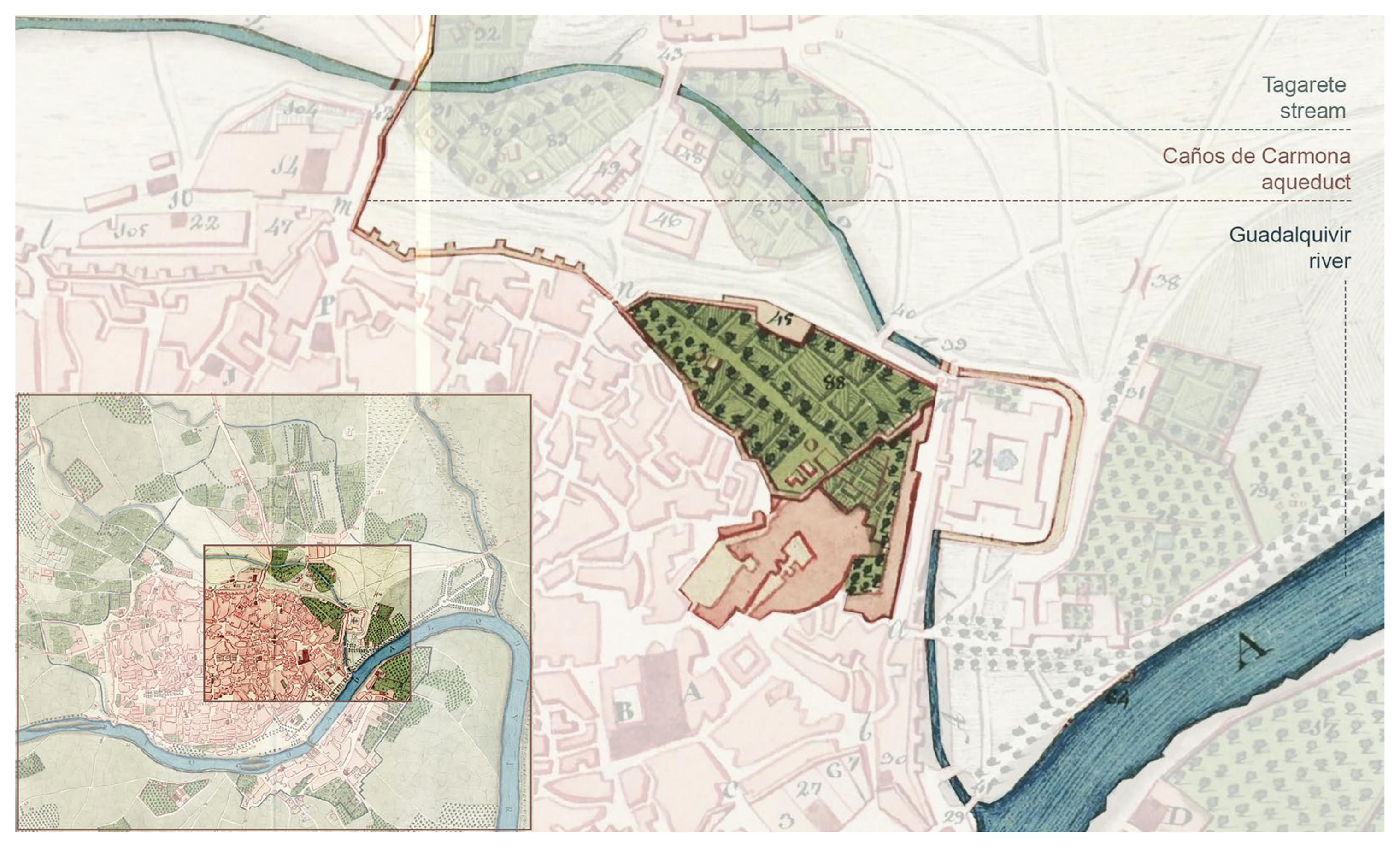
24]. In
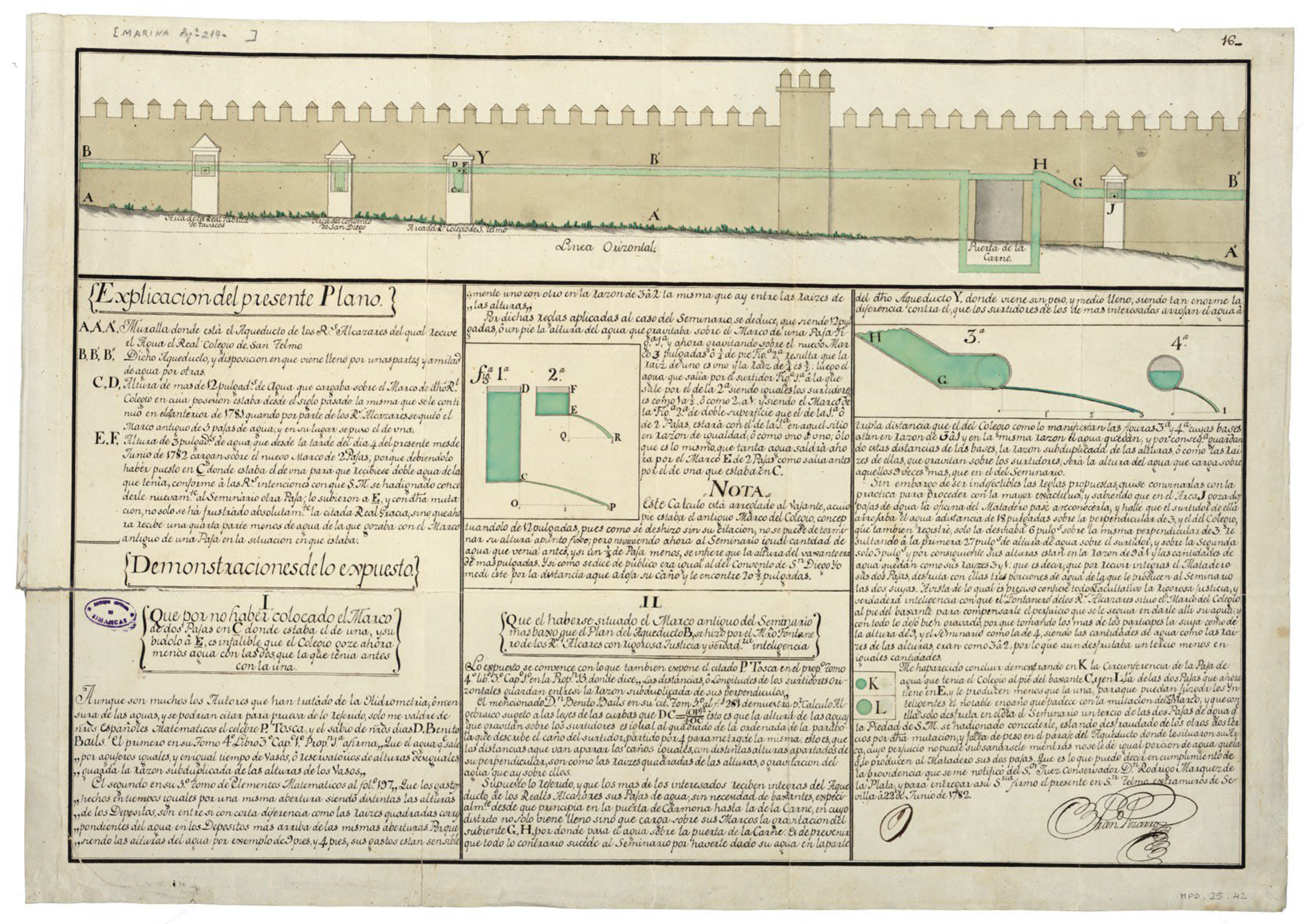
Figure 2, the imprint of its outer areas can be appreciated, as well as its strong connection with the Guadalquivir River and the Tagarete stream from a defensive and strategic perspective, even in the 19th century. For its water supply, the aqueduct of the Caños de Carmona provided water from the Santa Lucía spring in Alcalá de Guadaira, one of these settlements in the defensive axis. Notably, the last section of this aqueduct runs within the wall that borders its gardens (
Figure 3), specifically the current Calle Agua, as can also be seen in
Figure 2. Today, integrated into the urban fabric, the Alcázar is part of the Old Town district and comprises 14 hectares of built area and 7 hectares of gardens.
The hydraulic system used in the orchards and gardens of the Royal Alcázar of Seville, originating from the aqueduct of the Caños de Carmona and running through the surrounding wall, has been extensively recognised and studied. Historically, the supply of the complex was considered a priority, receiving 33% of the water that reached the city [
25]. Its capture and distribution formed a complex network that included fountains, aqueducts, and waterwheels to allow the irrigation and maintenance of its gardens and orchards. These studies reveal the intrinsic relationship between the design of the gardens and their hydraulic solutions [
26].
In addition to being an inseparable part of the gardens’ design and maintenance, water has played a significant role in transforming the territory and the urban landscape over the centuries. As highlighted by Merino del Río, the site’s location is linked to the arrival of the aqueduct in the city and its position in relation to the Tagarete stream and the Guadalquivir River [
23]. Accordingly, water and its transformations are a key factor in this World Heritage site’s landscape and urban considerations.
At another scale, numerous fountains and water features populate the area, alongside more monumental elements such as the Baths of María Padilla, the Water Organ, or the Mercury Pondol, reflecting the continuous imprint of water in its architecture. Gardens such as “de la Alcubilla” or “del Chorrón” also manifest this ongoing presence.
Current management of irrigation water for the gardens has also been taken into account, although the historical systems of water distribution by gravity through ditches are no longer used. Some ponds, like the Mercury Pond, continue to be utilised in the current pressurised system installed in the 1980s [
27].
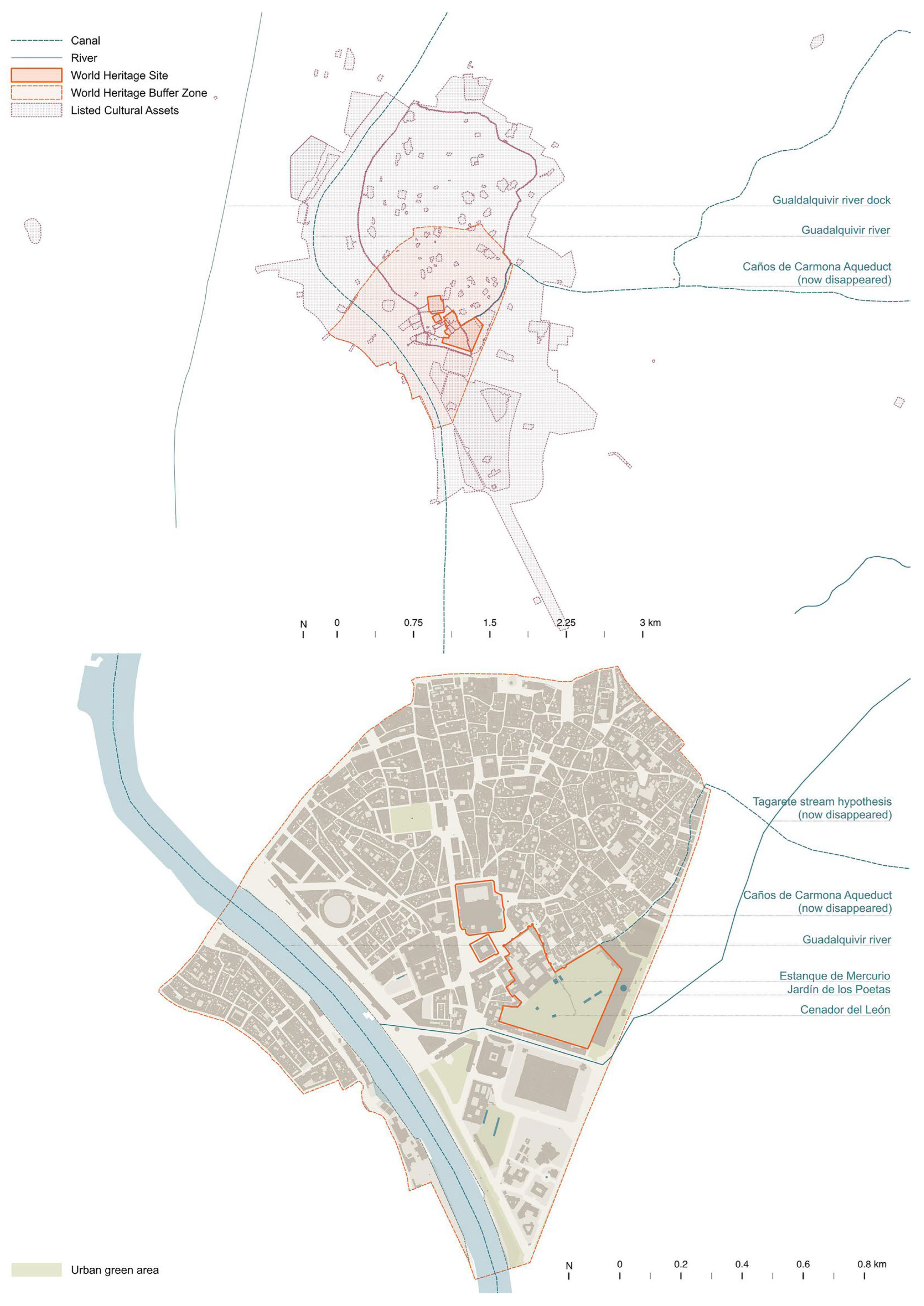
Figure 4 locates the World Heritage site of the Royal Alcázar, the Cathedral, and the Archivo de Indias, along with its Buffer Zone, within the Historic Ensemble of the city of Seville and its current soil coverage. It highlights the site’s peripheral southern location and extent, fully embedded in urban land. In the lower detail image, it is possible to see how the Buffer Zone extends to include part of the Guadalquivir River, as well as the disappeared traces of both the Tagarete Stream—which bordered the Alcázar wall—and the Aqueduct of the Caños de Carmona. This evidence shows these hydraulic networks’ historical, functional, and environmental connections with the site.
3.2. Territorial Landscape Conditions of the Alhambra of Granada
The Alhambra was conceived not as an isolated monument but as the centre of a territorial water landscape, carefully adapted to the geomorphology of the Cerro del Sol and Sabika Hill. Designed from the territory inward, the site’s layout responded to landform, slope, and hydraulic flows, which structured the placement of terraces, orchards, gardens, and palaces [
8,
28,
29]. The monumental complex emerged from an integrated system of productive, ecological, and ceremonial landscapes, where the built environment was subordinated to the natural topography and hydrology.
The Nasrid hydraulic system extended far beyond the palatial walls, integrating a network of terraced orchards supported by retaining walls, gravity-fed channels, and cisterns [
8,
28]. These terraces were not only aesthetic but also hydraulically performative—capturing runoff, reducing erosion, and sustaining perennial productivity in a region marked by seasonal aridity.
Nasrid irrigation sustained both productive orchards and ornamental gardens, creating an ecological layering made possible entirely by water [
12]. This multifunctionality reflects a Nasrid worldview in which water, vegetation, and architecture were conceived as inseparable elements of a unified cosmological landscape.
Today, the territorial condition of the Alhambra remains critical to heritage management. Preserving the buffer zone depends on maintaining the interdependencies between the palace, its orchards, and the wider hydrological catchment [
12,
29,
30]. These relationships are increasingly fragile under the combined pressures of urban encroachment, forest degradation, and climate change, where prolonged droughts, extreme heat events, and reduced river flows are accelerating hydrological stress and threatening the site’s Outstanding Universal Value. Crucially, the Alhambra’s historic water systems also underpin key ecological functions, supporting biodiversity and habitat connectivity within the Mediterranean biodiversity hotspot and along the East Atlantic Flyway [
28,
31].
Figure 4.
Hydrological network and soil coverage of the World Heritage sites of the Cathedral, Royal Alcázar of Seville, and Archivo de Indias within the city of Seville, shown at both territorial and urban scales. Source: Author’s elaboration.
Figure 4.
Hydrological network and soil coverage of the World Heritage sites of the Cathedral, Royal Alcázar of Seville, and Archivo de Indias within the city of Seville, shown at both territorial and urban scales. Source: Author’s elaboration.
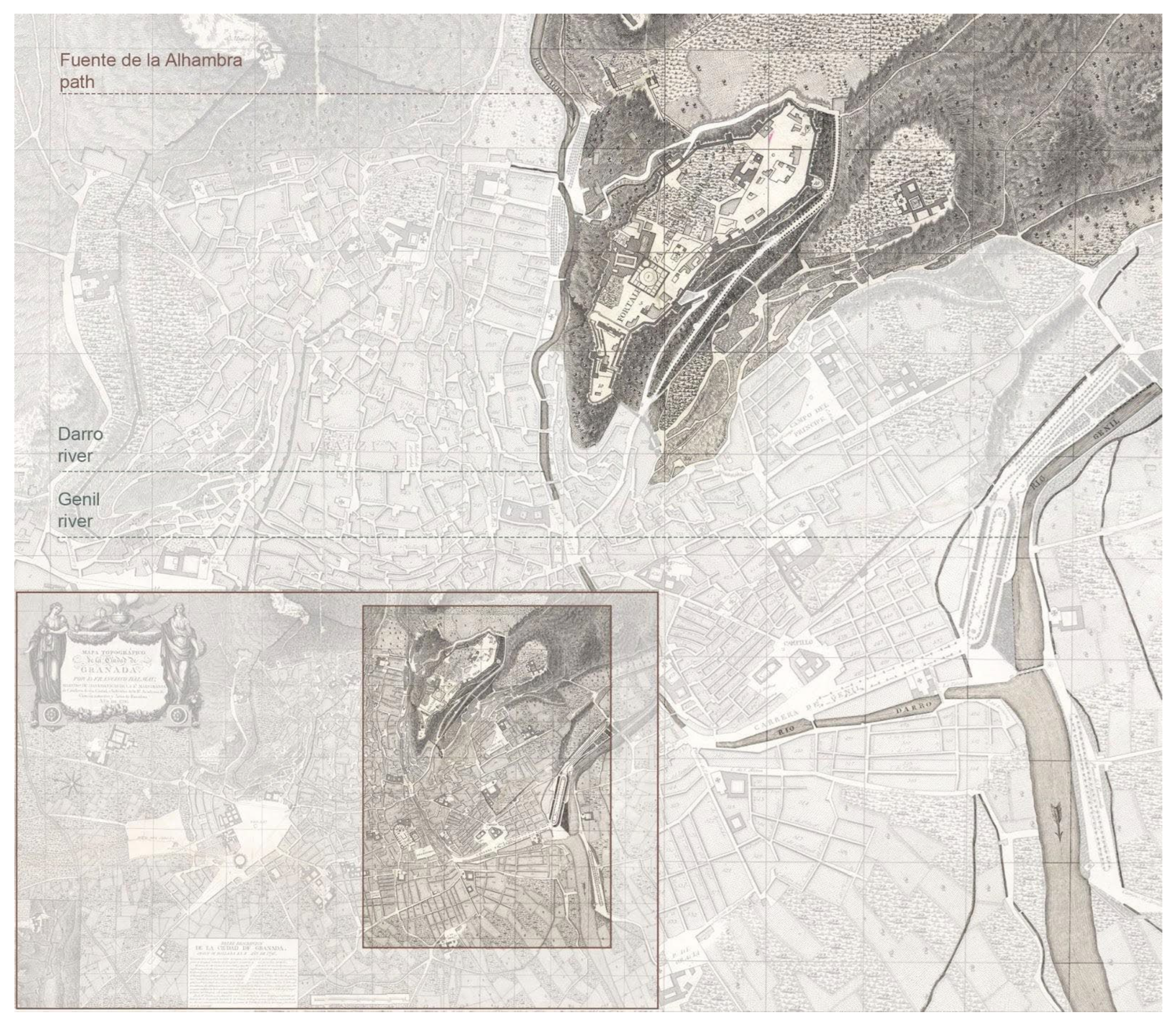
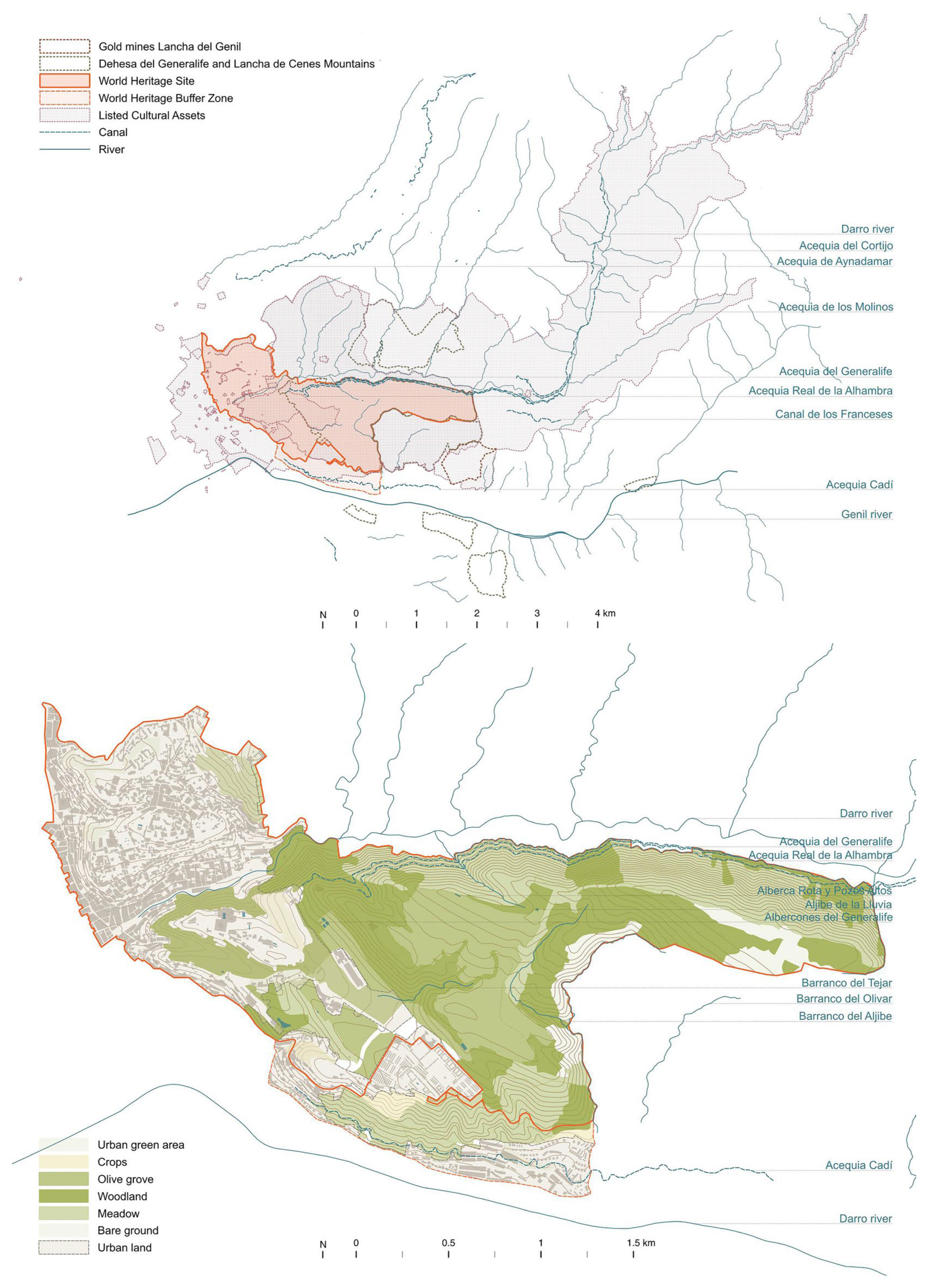
The Alhambra occupies a strategic position on Sabika Hill, situated between the Darro and Genil rivers (
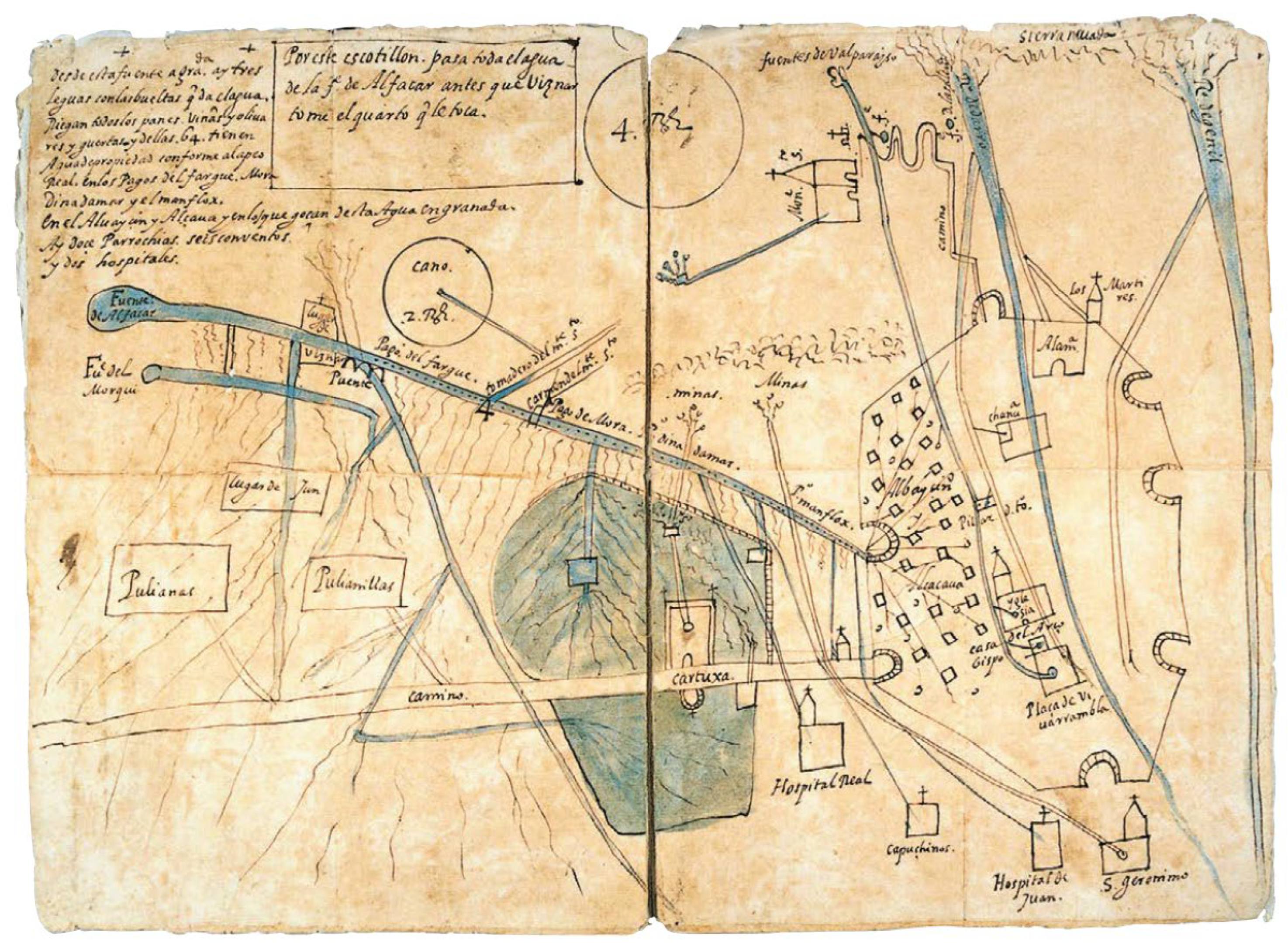
Figure 5), whose waters historically sustained its palaces, gardens, and agricultural terraces. The Darro River, narrow and perennial, served as the principal source of supply through the Acequia Real, which captures water approximately six kilometres upstream at Jesús del Valle. From this point, a carefully engineered system of aqueducts, tunnels, and retaining walls transported water across steep ravines to the Alhambra and Generalife, relying entirely on gravity to ensure continuous distribution [
8,
28].
Within the complex, this water fed an intricate system of secondary acequias (irrigation ditches), albercas (storage pools), and aljibes (cisterns) that sustained huertas (orchards), irrigated gardens, and reflective courtyards, while also providing microclimatic cooling and supporting ceremonial and aesthetic functions [
28,
31]. Terraced slopes along the Sabika Hill integrated cultivated areas, orchards, and wooded edges, demonstrating a finely tuned relationship between hydraulic engineering, vegetation, and topography [
12].
The Genil River, broader and more seasonal, historically supported the fertile Vega de Granada, whose irrigated fields and wetlands formed part of a wider territorial network connected to the Alhambra’s hydraulic system [
28]. Together, the flows of the Darro and Genil sustained an integrated hydrological landscape that linked upland catchments, palatial terraces, and lowland agriculture, reinforcing both food security and landscape resilience during cycles of drought and abundance (
Figure 6). Today, reduced flows in the Darro, rising demand on the Genil basin, and increasing climate variability place new pressures on these interdependencies, which require catchment-scale management strategies to safeguard the Alhambra’s Outstanding Universal Value [
28,
30,
31].
On the Alhambra’s part, water and geology maintained a natural relationship that ensured the supply of its extensive hydraulic system and allowed the siting and sustenance of the entire ensemble [
32]. The more than eight centuries of operation of the Acequia Real of the Alhambra, operational since 1238 and active until 1950, have undoubtedly had a defining impact on the landscape and ecosystem of the Darro Valley [
33].
However, in addition to these systems for carrying and storing water, which are fundamentally linked to the Darro River and have been a fundamental part of the cultural landscape formed by the Alhambra, the Albaicín, and its surrounding territory [
8], water also operated symbolically within the identity of the Alhambra in the form of multiple ornamental fountains, pools, and canals [
34]. The splendour of these systems during the Nasrid dynasty, as well as their subsequent decline under Christian rule and the efforts towards their conservation with the arrival of Torres Balbás as chief architect of the monument’s conservation in the early decades of the 20th century, have been recently studied and mapped by a team of researchers from the School of Architecture of the University of Granada [
35].
This essential relationship between water and the architectural and landscape complex is reflected in the institutions responsible for its conservation and dissemination. As early as 2010, its Patronage launched a series of urban and landscape itineraries, one of which is called “The Conquest of Water: the Water Landscape in Hispanic-Muslim and Christian Culture” [
36].
Figure 7 maps the extent of the World Heritage site and the Buffer Zone of the Alhambra, the Generalife, and the Albaicín, as well as their current land cover. In the upper image, cultural protections are highlighted—the Heritage Zone of the Darro Valley and the Historical Ensemble of Granada—and environmental protections—the Dehesa del Generalife and the Special Protection Zone of Sierra Nevada—upon which the site is situated. By contrast, the lower detailed image reveals how the various vegetation covers across the site account for more than 50% of the site’s surface and demonstrates the extensive natural and artificial hydrological network encompassed within the boundaries of the World Heritage site.
4. Results
The results are organised into three sections encompassing different considerations regarding water systems in the two case studies: their assessment in institutional documents, their reinterpretation through a narrative approach as natural-cultural capital, and the threats they face alongside the benefits they provide.
4.1. Water Systems Valuation in the Current Protection and Management Documents
Both the Alcázar and the Alhambra have a long history of heritage protection at the national and international levels. The Alcázar was declared a Historic-Artistic Monument belonging to the National Artistic Treasure by the Gazette on 4 June 1931. The Alhambra was declared a National Monument in 1870, and the current boundaries of both the property and its surroundings are the result of a new provision made in 2004.
At the same time, international recognition came with the inscription of both on the UNESCO World Heritage List: in 1984, the Alhambra and the Generalife in Granada, and in 1987, the Cathedral, the Royal Alcázar and the Archivo de Indias in Seville. In the case of the Alhambra, the inscription was extended to include the Albaicín district in 1994. The Alhambra was highlighted for representing a unique artistic achievement of humanity and constituting an extraordinary architectural example that illustrates the period of Islamic presence in Spain, while the Seville complex was an exceptional example of an urban centre where Christian, Jewish and Arab cultures coexisted.
It is worth noting that, at the time of their inclusion on the World Heritage List, the heritage approach was predominantly historical, artistic and monumental. As a result, although valid, the criteria for inscription did not explicitly mention the management of associated natural capital and, to an even lesser extent, issues related to water, social cooperation or the impact of tourism. The value and meaning of cultural heritage, far from being static, are transformed over time and with social changes, making it essential to incorporate contemporary paradigms such as social sustainability and climate risk.
The following section presents the results of the specific analysis of the assessment of water systems within the current protection and management documents.
4.1.1. The Royal Alcázar of Seville
For the Royal Alcázar of Seville, the following documents have been reviewed:
Declaración de Monumentos histórico-artísticos pertenecientes al Tesoro Artístico Nacional [
37] (Declaration of historical and artistic monuments belonging to the National Artistic Treasure), Sevilla, 1931;
Decreto 2803/1964, de 27 de agosto, por el que se declaran conjuntos y monumentos histórico-artísticos diversas zonas y edificios en la ciudad de Sevilla [
38] (Decree 2803/1964, of 27 August, declaring various areas and buildings in the city of Seville to be historic-artistic sites and monuments), 1964;
World Heritage Declaration of the Cathedral, the Royal Alcázar and the Archivo de Indias in Seville, 1987–2010 [
39];
Archaeological Research Project at the Royal Alcázar of Seville, 1999 [
40];
Catalogue entries of the urban planning tools of the Historic Centre of Seville, 2007 [
41];
Plan Especial de Protección del Conjunto Histórico de Sevilla, Sector Real Alcázar [
42] (Special Plan for the Protection of the Historic Centre of Seville, Royal Alcázar Sector), 2009.
The World Heritage Declaration of the Cathedral, the Royal Alcázar and the Archivo de Indias in Seville, which was inscribed in 1987 and amended in 2010 with minor modifications to the boundaries, focuses particularly on the historical value of this monumental complex. The descriptive text of the Outstanding Universal Value does not refer to the presence of water in this urban area, nor to the landscaped spaces, even though these constitute, in terms of surface area, a substantial portion of the complex when considering the Gardens of the Alcázar and the Patio de los Naranjos of the Cathedral, as well as the open urban spaces that articulate the spatial relationship between the three monuments.
The Archaeological Research Project carried out at the Alcázar complex [
40], nonetheless, identifies some archaeological elements as evidence of sustainable historical systems: it refers to the hydraulic water wheels of the Lienzo del Agua (Water Section) of the wall and the remains of pipes from the Caños de Carmona (Carmona Water Pipes), which supplied water to both the Alcázar and the surrounding neighbourhood.
In the absence of a published Master Plan for the management of the Alcázar complex and its gardens, reference has been made to the special urban protection plan for this site, specifically the Development of the Advance of the Special Plan for the Protection of the Historic Complex of Seville in its Sector 6 ‘Real Alcázar’ (2009) [
43]. The document makes extensive reference to the landscape value of the Alcázar gardens, which are representative of Mudejar, medieval, Renaissance, Baroque and contemporary gardening art. Specific references are made here to the hydraulic systems that accompany the landscaping works and, specifically, to the Galería del Grutesco and the hydraulic organ that accompanies much of the landscaped area and is linked to the presence of the Torre del Agua (Water Tower) in the wall. It discusses the pools and waterwheels linked to the old agricultural orchards, later converted into contemporary gardens, the Estanque de Mercurio (Mercury Pond) and the Baños de Doña María (Doña María Baths), all of which are of great importance to the monumental complex. However, this document makes no specific reference to the natural capital represented by the landscaped areas themselves—despite identifying plant species and specimens of trees of great age and value—nor to biodiversity, the conservation of permeable and fertile soil, or the bioclimatic values represented by the presence of the garden and hydraulic systems in their urban context.
4.1.2. The Alhambra of Granada
For the Alhambra in Granada, the following documents have been reviewed (based on the work carried out by Rey et al., 2025 [
44]:
World Heritage Declaration of the Alhambra, Generalife and Albaicín, 1984–1994 [
30];
Delimitation of the Historic Centre of Granada, 2003 [
45];
Declaration of Cultural Interest—Monument of the Alhambra and Generalife, 2004 [
46];
Master Plan for the Alhambra and Generalife, 2007–2015–2020 [
28];
Declaration of Cultural Interest—Heritage Area of the Darro Valley, 2017–2023 [
47].
The World Heritage Declaration, initially published in 1984 for the Alhambra and Generalife and revised ten years later to include the Albaicín neighbourhood, expressly mentions water systems as part of the description of Outstanding Universal Value. In addition to referring to the River Darro as a structuring element of the urban complex, it defines it as ‘a real urban system integrating architecture and landscape, and extending its influence in the surrounding area with gardens and unique hydraulic infrastructures’ [
48] (UNESCO, 1994). The intelligent use of water and vegetation is included in the aesthetic and decorative values, as well as in the authenticity, particularly through the preservation of the Arab gardening tradition and its evolution in the Renaissance and contemporary landscaping techniques.
While the initial declarations as a monument and historical-artistic site do not contain descriptions, the remaining documents consulted address this issue and add new valuations in line with the evolution of cultural heritage protection and management criteria over time. The declaration of the Historic Centre of Granada (2003) [
45], for instance, highlights the importance of the physical environment and the territorial dimension that links cultural and natural values. For its part, the declaration of the Alhambra and Generalife Monument as a Site of Cultural Interest (2004) [
46] refers to the value of forests, orchards and water resources. Furthermore, the declaration of the Darro Valley as a Heritage Area (2017–2023) [
47] focuses on the hydraulic system and, specifically, the territorial structuring function of the medieval water infrastructure, as well as the intangible values related to the use of water.
Finally, the Master Plan for the Alhambra and Generalife (2007–2015–2020) [
28] is particularly profuse in identifying values related to the water system and the landscape: it distinguishes the system of
balates,
pratas, games, gardens and the hydraulic system that sustains it; it values the environment in terms of its landscape, fauna, vegetation and geology; soil conservation and good use of water; the confluence of different ecosystems (Darro, forest and Generalife); forestry, hydraulic and horticultural culture; landscape diversity and its permanence to the present day. Even more noteworthy is the position that the Master Plan gives to the natural capital of the Alhambra. Some examples in its content are the express appreciation of the presence of the Alhambra island forest surrounded by the urban fabric; the ecological influence of water use on topographical differences; the use of surplus irrigation water for the forest; the microclimate produced in the enclosure and the surrounding urban fabric; and how the complex forms part of the Sierra Huétor-Granada Darro River ecological corridor. All of this supports the interpretation that the Master Plan considers the Alhambra and Generalife to be part of the green and blue infrastructure of its territorial basis.
4.2. Water Systems New Narrative Approach
Throughout this research, water has been chosen as the element to represent the combination of natural and cultural values present in these two sites. As outlined in the methodology and drawing on the approach recommended by Dai and Hein [
20], this section presents a new narrative approach to water for both sites, based on the landscape characterisation and analysis of their key institutional documents previously made.
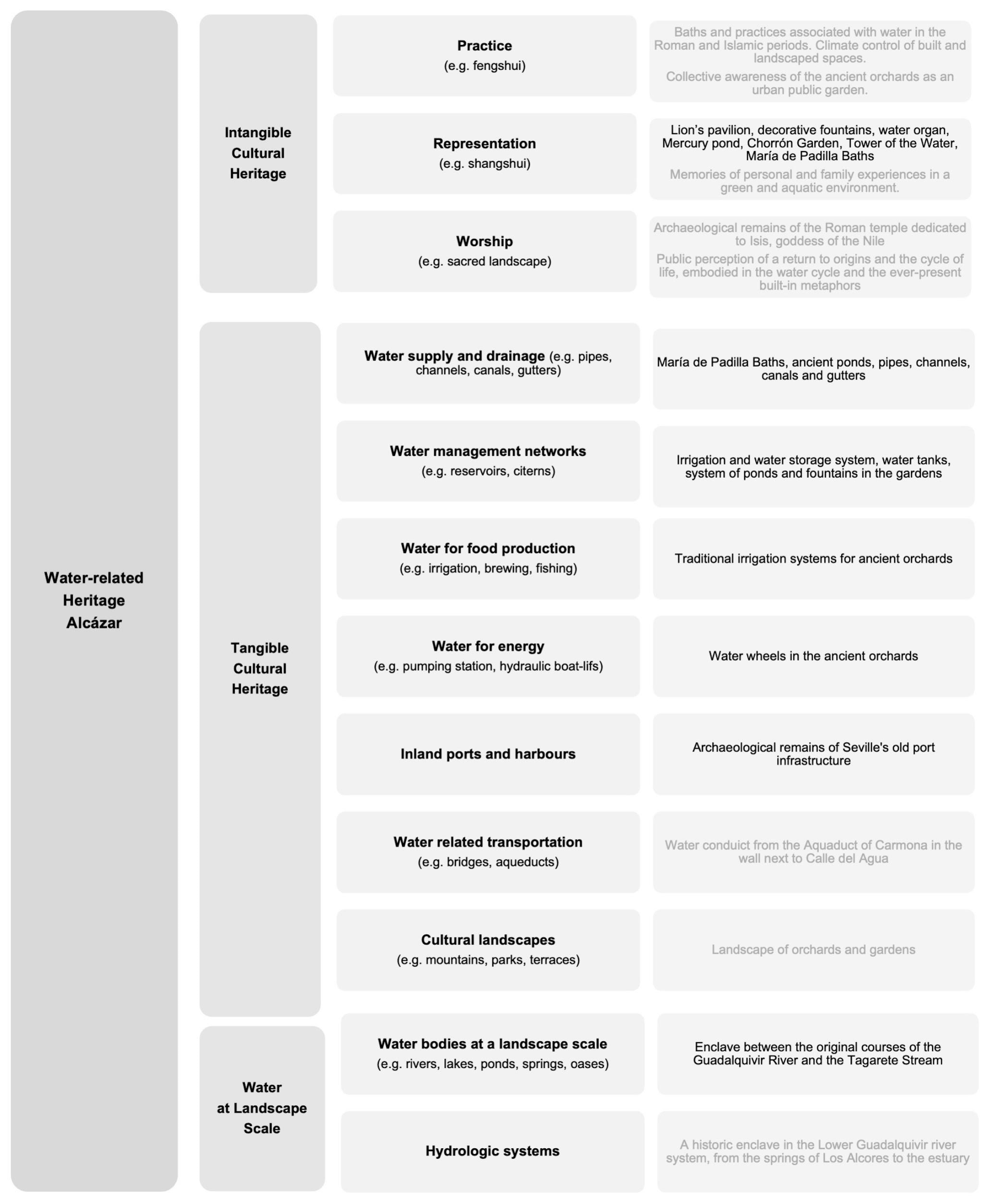
For the Alcázar of Seville (
Figure 8), the most relevant and detailed regulatory framework adopted is the Special Plan for the Protection of the Historic Centre of Seville, Sector 6 ‘Real Alcázar’ (2009) [
42]. This document is therefore taken as the reference document for institutional discourse, as in the previous section. As can be seen in the coding tree above, the Special Plan generally addresses water systems as an integral part of the heritage value of the monumental complex. Following the methodology of Dai and Hein [
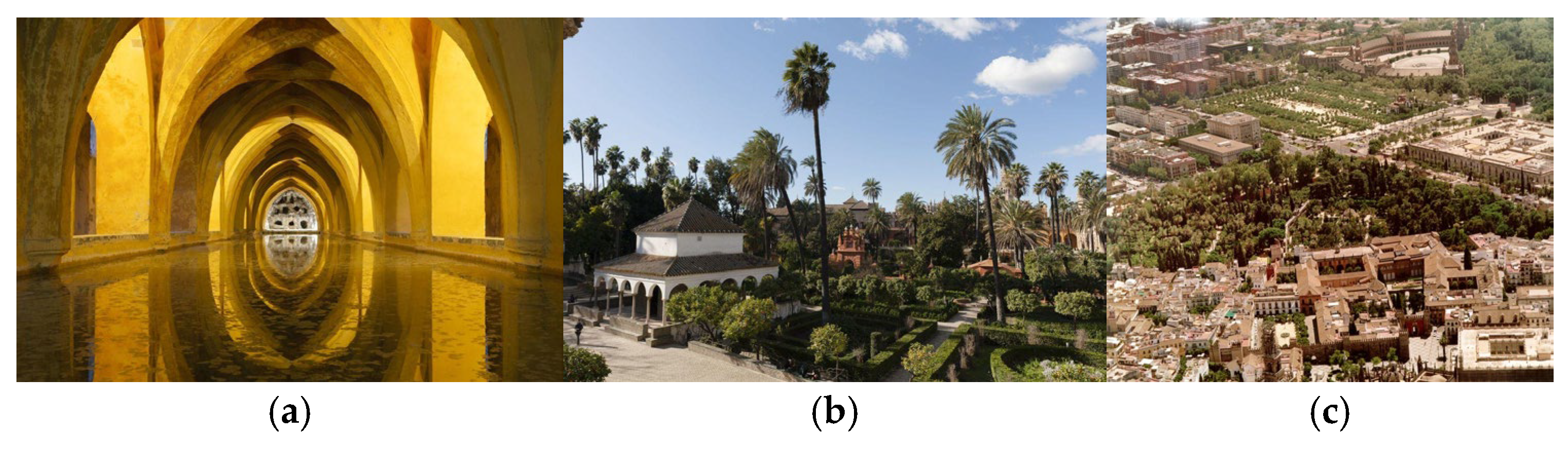
20], most of the attributes related to water are present in the tangible cultural heritage, mainly related to the presence of fountains, irrigation systems and water storage within the garden system of the property (
Figure 9b). This is mainly confirmed in Volume IV of the Plan, which includes the catalogue of protected elements. In addition, some issues related to a more urban or territorial scale of water are mentioned in Volume III, dedicated to the annexes, mainly in the documentation from the archaeological excavations: These references concern the relationship between the Alcázar and the river and port system of the ancient city, which connects with the landscape scale (
Figure 9c). As for values related to intangible cultural heritage, there are few references in the documentation beyond the representation or imagery reflected in the sources and decorative elements of the gardens related to water.
However, there is still ample room for recognition of water systems as natural and cultural capital in the official discourse of the Royal Alcázar of Seville. With regard to intangible values, which embody the symbolic, religious, and other intangible significance and roles attributed to water in the case studies of the Royal Alcázar of Seville (
Figure 9a), official documentation remains particularly limited. Accordingly, it would be appropriate to recognise the value of water-related practices in periods of great relevance to the formation of the complex, both at archaeological levels (Roman or Medieval) and in the built and landscaped areas. Water-based climate control in both built and landscaped spaces could also be highlighted as an undeniable asset of the property. Future documents could also include the discovery, reflected in the scientific literature, of a temple dedicated to Isis [
49,
50], goddess of the Nile, and its possible relationship with the river and port location of the original enclave on which the Alcázar is built. Furthermore, traditional practices and intangible meanings that local citizens have associated with the site’s spaces could be highlighted, especially those referring to its natural capital: the collective awareness of the ancient orchards as an urban public garden; the memories of personal and family experiences in a green and aquatic environment; or the public perception of a return to origins and the cycle of life, embodied in the water cycle and the ever-present built-in metaphors.
Regarding urban aspects and at a landscape scale, the value of the territorial hydraulic system as the origin and determining factor of the architectural structure and open spaces of this monumental complex can and should be reinforced. The presence of water pipes from Los Alcores to the palace grounds inside its walls deserves special mention in institutional discourse, as does the value of the landscape architecture of its system of ancient orchards and gardens. Together, these elements would confer on the Royal Alcázar of Seville’s institutional discourse a sense of natural and cultural capital consistent with water-related systems. The development and publication of a Master Plan for the property represents a unique opportunity to update its discourse and link it to environmental and climate adaptation values.
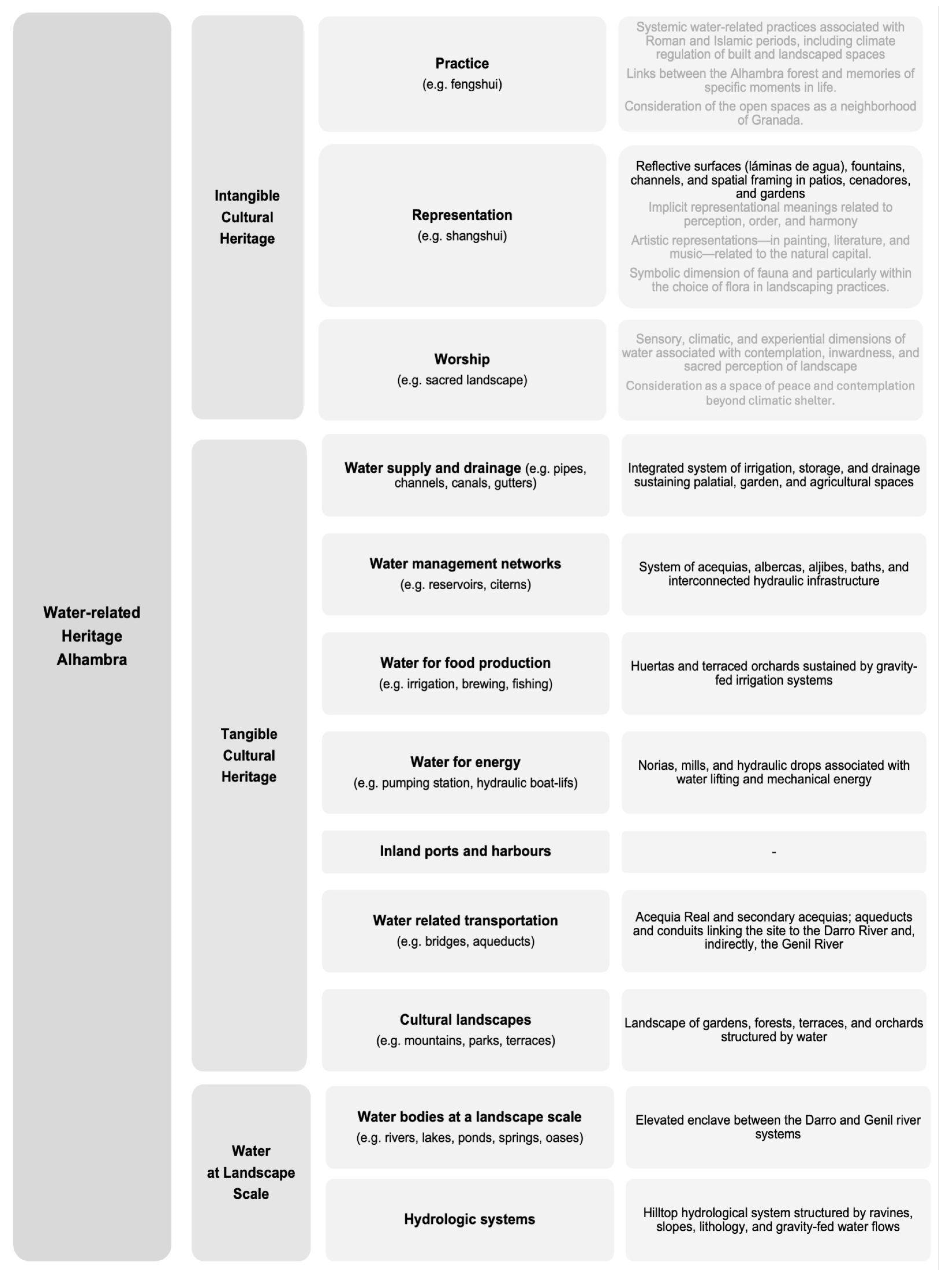
For the Alhambra and Generalife (
Figure 10), the principal reference for institutional discourse is the
Plan Director de la Alhambra y Generalife (2007–2015, extended to 2020) [
28], which is taken as the key regulatory framework, in continuity with the previous section. As reflected in the coding tree presented below, the
Plan Director recognises water primarily as a structural, territorial, and technical system underpinning the monument and its landscape. It identifies the Acequia Real as the main hydraulic backbone linking the Alhambra to the Darro basin and inventories albercas, aljibes, irrigation channels, drainage systems, and other hydraulic infrastructure sustaining palatial courtyards, gardens, and surrounding agricultural areas. Water is therefore acknowledged as a fundamental component of the site’s tangible cultural heritage and as a determinant of its territorial configuration, climatic performance, and productive landscape. Following the narrative methodology proposed by Dai and Hein [
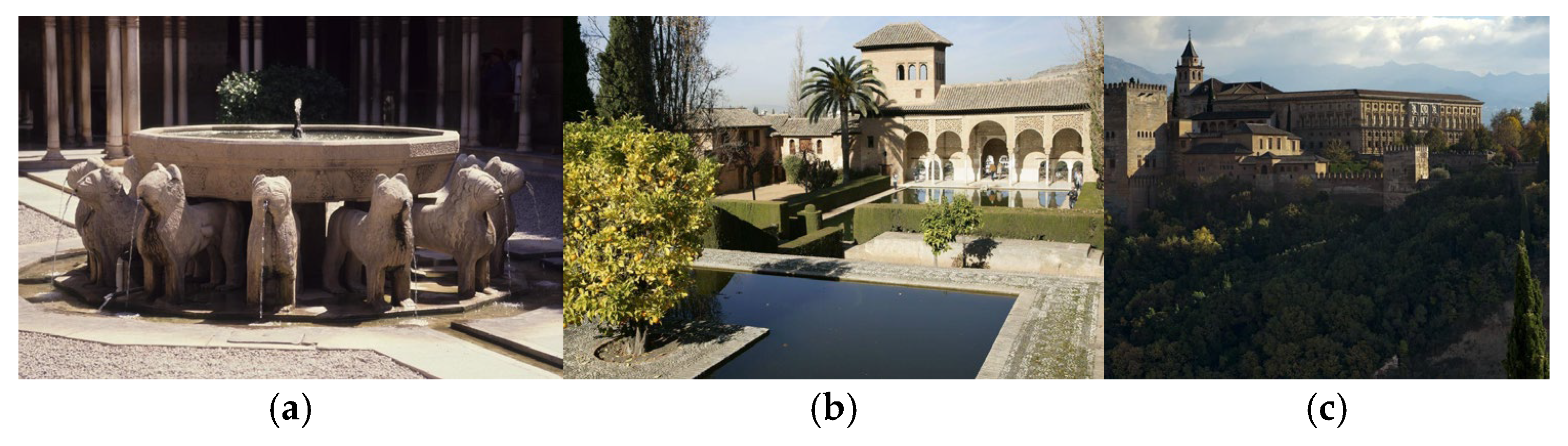
20], most water-related attributes explicitly recognised in the institutional documentation fall within the categories of tangible cultural heritage (
Figure 11a) and water at a landscape scale (
Figure 11b), while references to intangible cultural heritage are fragmented or entirely absent.
However, when read through a narrative lens that seeks to understand water as natural–cultural capital, the institutional discourse of the Alhambra reveals significant gaps. In particular, values associated with intangible cultural heritage—including water-related practices, the representational roles of water in structuring perception and spatial order, and the experiential or sacred dimensions of water—are largely unrecognised or only marginally addressed. While the Plan Director acknowledges the sensory and climatic effects of water, these are largely addressed through operational and conservation frameworks rather than as inherited practices or components of a broader cultural system. Taken together, these absences obscure the environmental ethics embedded in the society that shaped the Alhambra, where water functioned as a relational medium connecting architectural form, landscape organisation, and cultural values.
Future institutional frameworks could integrate these under-recognised dimensions by explicitly linking material water systems to the intangible practices, representations, and values that give them meaning. These dimensions include, for example, the links between the Alhambra forest (
Figure 11c) and memories of specific moments in life, as well as artistic representations—in painting, literature, and music—related to its natural capital. It is also worth noting that the green spaces of the Alhambra are considered a neighbourhood of the city, functioning as a place of refuge associated with the search for peace and the desire for contemplation. Its rich fauna and flora are not only an ecosystemic treasure, but also have a strong symbolic dimension, especially in the choice of plant species for landscaping. Such a reframing would strengthen the understanding of the Alhambra not only as a monument sustained by hydraulic infrastructure, but as a cultural landscape whose original intent and long-term resilience are rooted in the inseparability of natural and cultural processes mediated through water.
4.3. Water Systems Vulnerabilities and Benefits
As outlined in the introduction, the climatic and hydrological stressors affecting Andalusia have direct and indirect impacts on architectural and cultural heritage sites where ecological and symbolic functions of water are interwoven [
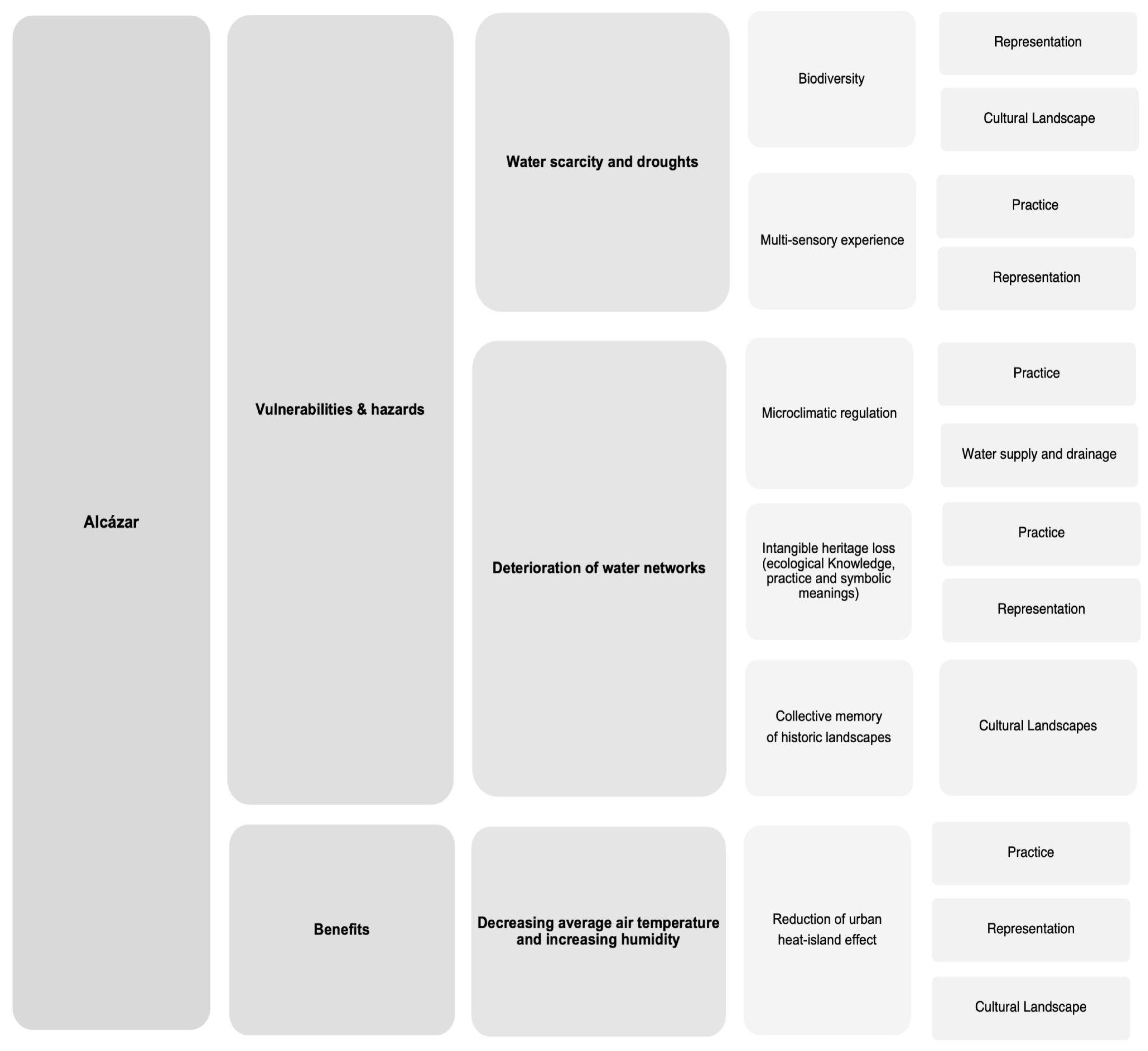
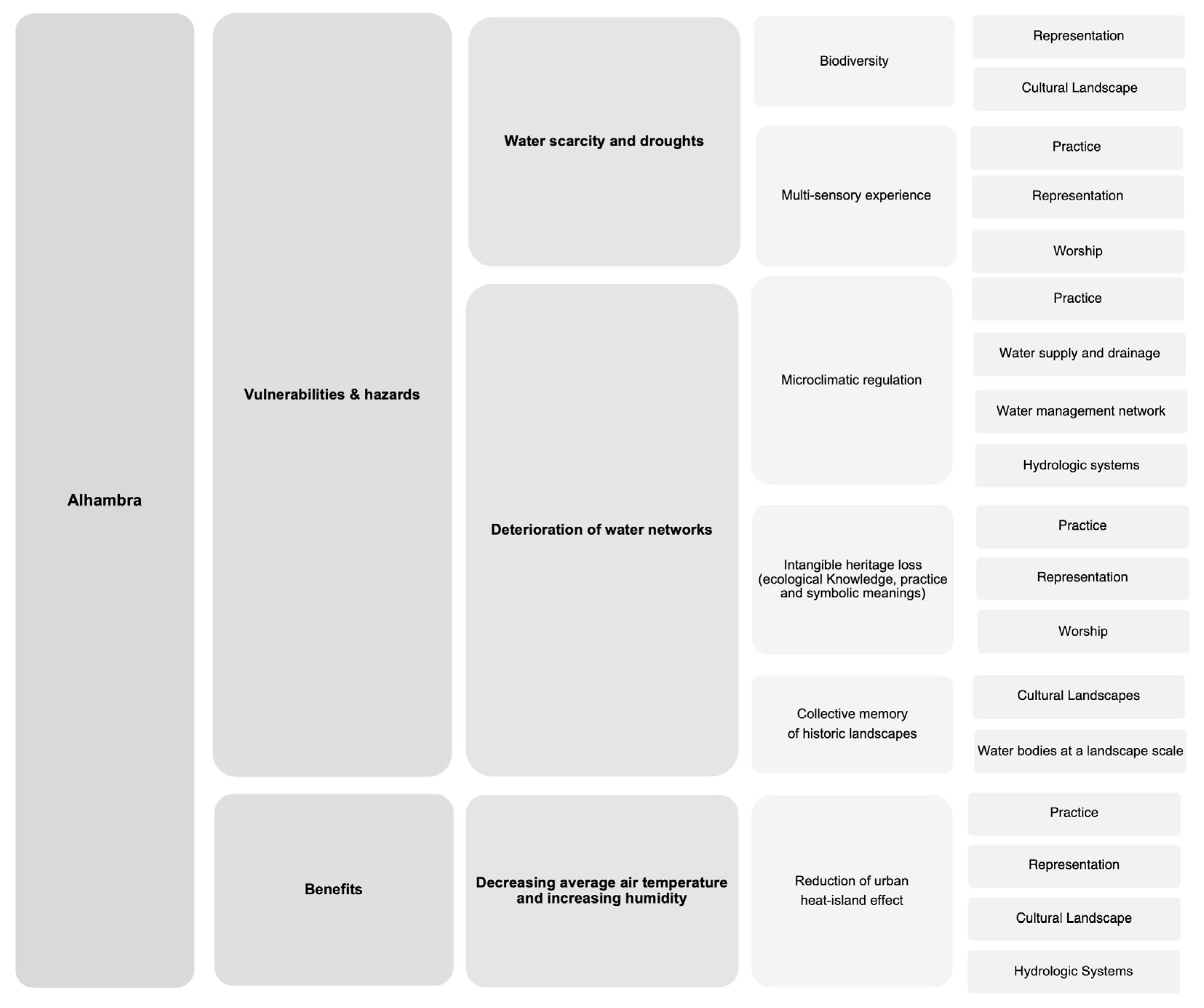
51]. For the cases of the Royal Alcázar and the Alhambra, the above narrative approach coding trees have been used to identify the main climatic vulnerabilities and benefits of their water systems and to determine which tangible, intangible or landscape values -and subsequent elements- are mostly affected or reinforced by them (
Figure 12 and
Figure 13).
Water scarcity and associated drought stress lead to declines in the health and diversity of historic vegetation. This degradation affects not only the biodiversity of local gardens but also their multisensory experience—visual, olfactory, and acoustic—that forms an essential part of local landscape cultural ecosystem services. Moreover, the deterioration of interdependencies of water networks and vegetation undermines the microclimatic regulation that these natural components historically provided. Beyond tangible damage, the weakening of the water-vegetation system that constitutes the core component of natural capital entails a profound loss of intangible heritage, including traditional ecological knowledge, maintenance practices and symbolic meanings associated with water as a metaphor for paradise, wisdom and life [
52]. This disruption threatens to fragment the cultural narratives and collective memory embedded in these historic landscapes, which constitute the permanent ecological matrix of the Andalusian territory.
In addition to considering the potential risks affecting the case studies, it is important to emphasise that these heritage ensembles provide climate benefits and represent a significant asset for the surrounding urban environment. In both cases, the presence of vegetation cover leads to a decrease in average air temperature and an increase in ambient humidity. In the case of the Alcázar, which is integrated into the urban fabric, its contribution to the reduction in the urban heat-island effect in this historical area is particularly significant [
24,
53]. The area of the Alhambra, with a different and much larger territorial condition, remains partially insulated from the urban heat-island effect of the city of Granada [
54]. However, it faces specific climate-related risks within its monumental zone [
55].
5. Discussion: Rethinking Natural Capital as a Heritage Framework: From Conservation to Ecological Activation
The cases of the Royal Alcázar of Seville and the Alhambra of Granada exemplify the potential of rethinking natural–cultural capital within heritage frameworks, shifting from a paradigm of static conservation toward one of ecological activation. Both architectural ensembles demonstrate that cultural heritage is not merely a repository of historical values, but a living interface between natural systems and human communities. Their sophisticated hydraulic infrastructures, gardens, and courtyards embody a historically embedded ecological intelligence, integrating biodiversity, microclimatic regulation, and aesthetic representation within a unified spatial framework.
From a methodological point of view, this research has combined multiple complementary methods, such as the analysis of the academic and institutional literature, the use of georeferenced public datasets, a chronological review of protection and management documents, term-by-term analysis of official documents, the narrative approach to the water system as codified in recent studies on this specific topic, and the use of categorised coding trees to relate different parts of the results.
The review of current regulatory and policy instruments (
Section 4.1) reveals divergent approaches. In the case of the Alcázar, the legal and planning framework—from the
Declaración de Monumentos histórico-artísticos (1931) to the
Plan Especial de Protección del Conjunto Histórico (2009) [
37,
42]—has historically prioritised the monumental and artistic dimensions while offering limited consideration of natural capital. Even when water infrastructures or garden elements are mentioned (as in the
Proyecto de Investigación Arqueológica, 1999), the ecological and bioclimatic functions of these assets remain largely overlooked. By contrast, the Alhambra has progressively embedded ecological values within its protection and management frameworks. From the
World Heritage Declaration (1984–1994) [
30] to the
Plan Director de la Alhambra y Generalife (2007–2015–2020) and the
Zona Patrimonial del Valle del Darro (2017–2023) [
46], the site has incorporated explicit references to biodiversity, water management, and landscape resilience, acknowledging the Alhambra as part of a broader green and blue territorial infrastructure.
After recognising these trajectories, the application of the methodology known as the new narrative approach (
Section 4.2) has shown that the concepts of practice and worship, encompassed in the category of intangible heritage, remain a pending issue in the discourses of both monumental ensembles. Linked to the representational, the artistic, the religious and the social, these values are not considered in all their complexity in any of the official discourses of the case studies. Likewise, in the case of the Royal Alcázar, the hydrological enclave in which it is located—and without which it could not have originated—is also absent from its assessment on a landscape scale, perhaps because it is an urban environment.
Finally, when relating and interpreting the climate data in the region analysed in the introduction with the elements highlighted in this new narrative approach (
Section 4.3), it should be noted that it is precisely these attributes grouped under the concepts of representation, practice, worship or cultural landscape that are most fragile in the face of ongoing climate change.
Therefore, it is important to emphasise that, even with their limitations—discussed in the following section—the different methodologies used have complemented each other and contributed distinct facets to the complex prism that is the recognition of the natural and cultural capital in World Heritage. This comparative analysis highlights complementary trajectories: the need to address regulatory and managerial gaps in Seville; the role of Granada as an advanced laboratory of ecological integration in heritage management; the need to recognise intangible practices and the landscape scale; and the fragility of these intangible attributes and values in the face of climate and social change. When interpreted as active mediators of ecosystem services [
56]—ranging from water supply to cultural and regulatory functions—both sites invite a reconceptualization of natural capital as a dynamic asset embedded within the built environment. Such a perspective reframes heritage not as a static object of protection, but as an adaptive infrastructure capable of fostering socio-ecological resilience.
This reconceptualization strongly resonates with current European strategies. The European Green Deal and the EU Biodiversity Strategy emphasise the integration of natural capital into territorial development; the Nature Restoration Law [
57] calls for innovative frameworks that reconnect cultural landscapes with ecological processes; and the New European Bauhaus [
58] underscores the interdependence of beauty, sustainability, and inclusivity. Within this policy landscape, the Alcázar and the Alhambra emerge as compelling case studies of heritage-led ecological innovation, demonstrating how cultural assets can serve as catalysts for adaptive governance.
While this study employs the vocabulary of natural capital and ecosystem services to align with global policy frameworks—from the UN Sustainable Development Goals [
59] and the Millennium Ecosystem Assessment [
14] to UNESCO’s heritage instruments and the European Green Deal [
60], the New European Bauhaus [
58], and the Nature Restoration Law [
57]—it is important to acknowledge that these terms are not culturally universal. They originate largely in Western economic–ecological discourse, privileging quantification and accounting. As such, they risk marginalising alternative epistemologies through which water and landscape have historically been understood and valued.
Alternative worldviews offer complementary ways of valuing water and landscape: in Islamic thought, principles such as tawḥīd (Oneness), mīzān (balance), and khalīfa (human stewardship or trusteeship) frame water as both a divine trust and a medium of justice, embedding environmental care within spiritual and ethical responsibility [
3,
4]; in Indigenous traditions of North America, rivers and water bodies are understood as living relations or kin with whom reciprocal relations of care and responsibility are maintained; and in the Andean world, the principle of
sumak kawsay (
buen vivir)—enshrined in the constitutions of Ecuador and Bolivia—frames heritage and environmental stewardship as part of a holistic ethic of collective well-being that challenges extractivist growth paradigms.
Bringing these plural frameworks into dialogue with the operational language of natural capital can expand the conceptual ground of heritage management, encouraging more inclusive, ethically grounded, and intercultural approaches to valuing water-based landscapes.
6. Conclusions
This study underscores the importance of adopting water-system thinking in the valuation and management of heritage sites. Nonetheless, translating these conceptual advances into practice raises critical questions: How can interdisciplinary collaborations with technical experts and local administrations be structured to ensure that heritage frameworks operate as drivers of adaptive ecological governance? In what ways might conservation authorities—traditionally oriented toward static preservation—be encouraged to embrace ecological restoration strategies that prioritise the future ecological value of sites rather than solely their historical integrity? How can restoration approaches integrate the profound ecological transformations already underway, in which many plant species once considered native or endemic no longer correspond to the current or projected climatic conditions of Andalusia?
These initial reflections highlight the need to move beyond established paradigms of heritage management by incorporating ecosystem-based design as a central criterion for climate-adaptive strategies and biodiversity improvement plans. Rather than providing definitive solutions, the Alcázar and the Alhambra invite us to reconceive heritage not only as a memory of the past, but as a platform for envisioning resilient futures. Such reflections align with European policy frameworks yet demand experimentation, negotiation and a willingness to rethink the boundaries between conservation, ecological science, civic engagement and territorial governance.
The development of this work has offered new possibilities for considering World Heritage as natural-cultural capital through the application of a methodology originally proposed for a global review. This methodology has been refined under an advanced conceptual paradigm and applied to two specific case studies. The process has yielded insightful results, but limitations in the research have also been identified, which should be addressed in future work.
Terms such as natural capital, biocultural landscape, or ecosystem services have been introduced in the research. These concepts may be unfamiliar to traditional methodologies regarding cultural heritage or may derive from recent policy frameworks and interdisciplinary literature, generally from other disciplines. Their inclusion as a paradigm and their application to the results may be difficult to reconcile with the generally static know-how of cultural heritage studies. This work seeks to link them to other more common concepts, such as natural-cultural capital or social values, in order to facilitate their progressive inclusion through a holistic understanding.
The use of a method for global studies—applicable to a wide variety of cases—could have been a limitation in itself. In this regard, future work could delve deeper into the codification and systematisation of attributes and values, taking into account the geographical, historical, climatic and, especially, cultural particularities of each case study.
Regarding materials, some limitations have been encountered in the preparation of the maps. Specifically, no georeferenced geographical information on climatic aspects has been found at the urban scale, but only at broader territorial scales. This hinders the drawing of conclusions on the ecosystem benefits of heritage assets. The study has been limited to a selection of official, approved and current documents in order to obtain the results in
Section 4.1. Unofficial documents resulting from internal research or planning by institutions could be included in future revisions. Equally pertinent would be to include citizens’ opinions in the assessment of existing narratives, which could yield results to partially fill the identified gaps, particularly with regard to intangible heritage.
The Alhambra in Granada and the Royal Alcázar of Seville demonstrate how water infrastructures function not only as technical solutions but as cultural and ecological systems—core elements of their natural–cultural capital—that sustain resilience under conditions of climatic stress. To update their cultural valuation in line with contemporary sustainability paradigms, practical measures are proposed to be included in decision-making processes regarding protection, management, diffusion and governance:
Biocultural and ecosystem-services awareness should be integrated into forthcoming planning frameworks, such as the next Plan Director of the Alhambra and updated management plans for the Alcázar;
Updates to heritage protection documents should transcend the division between cultural and natural heritage, recognising the value of heritage assets as ecosystem services, especially those marked by a deep relationship with water systems;
The narratives and public dissemination tools on World Heritage assets should be expanded in those areas that have traditionally been less present in official documentation, particularly intangible heritage, landscape and the territorial dimension;
Catchment-scale indicators should be developed to monitor Outstanding Universal Value (OUV) through hydrological and ecological performance;
Studies should be conducted on the perceptions of citizens and users worldwide regarding the ecosystem values of World Heritage sites where water systems have a significant presence;
The apparent disconnect between instruments for the protection, management and dissemination of cultural heritage and its ecosystemic consideration could benefit from better vertical and horizontal communication between different administrations and decision-making bodies, moving towards integrated governance systems and dynamic tools;
An approach to integrated management based on the “5 Cs”—Communication, Cultures, Connections, Comparisons, and Communities—could offer a viable alternative for future endeavours.
Together, these steps would align heritage stewardship with water as both blue infrastructure and cultural symbolism, safeguarding the water-based heritage of Andalusia for future generations. These considerations, applied here to two specific case studies, could be applied to other cultural and territorial contexts marked by climate change and the presence of World Heritage sites where natural capital is relevant.