1. Introduction
The documentation of heritage sites is a crucial process in cultural heritage preservation, facilitating the systematic recording, and management of historically important building structures and landscapes [
1,
2]. Given that heritage sites frequently face challenges from urban development, catastrophic events, and human neglect, appropriate documentation serves as an indispensable basis for planning and research [
3,
4]. The International Council on Monuments and Sites (ICOMOS) refers to heritage documentation as the careful compilation of textual information, high-resolution images, architectural drawings, and digital models to support preservation initiatives and enhance historical understanding [
5]. The basic purposes of heritage documentation include improving conservation and rehabilitation, management of historic buildings, sites, and cultural landscapes, encouraging academic research, providing legal protection within national and international guidelines, and promoting public participation through digital accessibility [
6,
7,
8]. The ongoing evolution of technology has substantially strengthened the accuracy, efficiency, and sustainability of heritage management through the integration of digital documenting mechanisms.
Typically, historical recording has been dependent on manual methods such as measured hand drawings, terrestrial surveys, and conventional photography. Although historically significant, these methods have constraints regarding accuracy, efficacy, and scalability [
9,
10]. Development in digital documentation has led to the extensive use of high-precision technologies, including terrestrial laser scanning (TLS), photogrammetry, Geographic Information Systems (GIS), and unmanned aerial vehicle (UAV) imagery. Terrestrial laser scanning, also known as LiDAR, generates high-resolution three-dimensional (3D) point clouds that facilitate detailed modeling of heritage structures, capturing fine details with millimeter accuracy [
11,
12]. UAV-based photogrammetry enhances documentation by capturing aerial imagery and facilitating the extensive mapping of heritage sites, thereby eliminating accessibility issues associated with manual surveys [
11,
12]. GIS enhance heritage management by incorporating geographical data with historical information, facilitating predictive analysis and informed decision-making for conservation planning [
2,
13].
A significant development in historical documentation is the application of Building Information Modelling (BIM) in historic preservation, referred to as Historical-BIM (H-BIM). In contrast to traditional documentation techniques, H-BIM has revolutionized heritage documentation by integrating diverse information, including 3D laser scans, photogrammetry, and historical archives, into a cohesive digital platform [
14,
15]. Nonetheless, H-BIM entails significant costs, is labor-intensive, and requires technological skills, hence limiting accessibility for non-experts [
2,
16]. Moreover, although H-BIM is excellent in structural modelling, it frequently falls short in real-time visualization and immersive spatial contexts, hence constraining its efficacy in site interpretation [
16,
17]. Thus, 360-degree panoramic imaging mitigates these restrictions by providing an intuitive, immersive, and real-time visualization of cultural heritage sites, thereby enhancing the accessibility and engagement of documentation [
11,
18]. In contrast to H-BIM, 360-degree panoramic imagery captures complex spatial details and facilitates interactive features such as annotations and multimedia overlays, thereby improving interpretation and interdisciplinary cooperation [
18,
19]. Furthermore, it enhances remote accessibility, enabling scholars and the public to virtually investigate heritage sites.
Although the utilization of 360-degree images in museum displays and virtual heritage tourism is increasing, their function in systematic heritage documentation is still insufficiently investigated. Most current research emphasizes the technological and usability dimensions of 360-degree virtual tours, rather than their methodological incorporation into conservation and digital archiving frameworks [
2,
20]. The absence of standardized methods for capturing, processing, and archiving 360-degree photographs represents a significant challenge to utilizing this technology for long-term documentation purposes.
Literature Review
The application of 360-degree panoramic imaging in heritage documentation has gained significant attention in recent years. Several studies have investigated its potential to improve site visualization, accessibility, and conservation. Rahaman, Champion and McMeekin [
19] investigated the effectiveness of interactive 360° panorama tours in improving heritage interpretation and virtual tourism. Their study demonstrated that panoramic images contribute to a more immersive understanding of the spatial context of heritage sites, particularly for remote visitors. However, the research was limited to a single case study, raising concerns about the generalizability of its findings. In a similar vein, Masciotta, et al. [
21] examined the integration of laser scanning and 360° panoramic imaging to enhance digital heritage documentation. Their findings suggested that combining LiDAR technology with panoramic visualization improves the accuracy of digital reconstructions. However, the high costs and technical expertise required for implementation present a challenge for large-scale adoption.
The fusion of range and panoramic images has also been explored as a method to enhance 3D heritage documentation. Bila, et al. [
22] integrated laser scanning and panoramic images to create a textured 3D model of heritage sites. Their study highlighted the advantages of this hybrid approach in improving the detail and reliability of documentation. Nonetheless, the complexity of data processing and integration remains a significant limitation. Similarly, d’Annibale, et al. [
23] developed a low-cost photogrammetric workflow using panoramic images. By integrating Structure-from-Motion (SfM) techniques, they demonstrated that panoramic imagery could be used as an affordable alternative to expensive laser scanning methods. However, while the approach was cost-effective, it lacked the precision required for structural analysis and conservation planning.
Another notable contribution to the field comes from De Amorim, et al. [
24], who employed spherical photogrammetry to document architectural heritage in Brazil. Their study emphasized the scalability and adaptability of panoramic imaging for large-scale heritage documentation. Despite its effectiveness in capturing architectural details, concerns remain regarding the long-term preservation of digital panoramic outputs. Guerra and Gottardi [
25] further explored the comparison between spherical imaging and laser scanning for cultural heritage surveys. Their findings indicated that while 360° cameras provide a quick and affordable means of documentation, their lower metric accuracy limits their applicability for detailed heritage conservation.
A more recent study by Marcos-González, et al. [
26] evaluated the feasibility of using low-cost 360° cameras for documenting architectural heritage. Their study found that consumer-grade panoramic cameras enable rapid and immersive documentation. However, they also noted that manual calibration is required to enhance the accuracy of these images. Pomaska and Bielefeld [
27] explored the use of internet-based panoramic documentation, highlighting its potential to democratize access to heritage sites. While this study underscored the role of web-based platforms in heritage visualization, it did not fully address the challenges associated with data security and long-term archival sustainability.
Theoretical perspectives on panoramic imaging and heritage representation were examined by Thompson [
28]. They argued that panoramic photography enhances the storytelling potential of heritage sites, allowing for a richer engagement with historical narratives. However, their study primarily relied on theoretical discussions rather than empirical testing. In the field of archaeology, Syafar [
29] developed a 360° visualization tool for interactive archaeological documentation. Their web-based system demonstrated how panoramic images could enhance public engagement with historical sites. Nonetheless, the study focused on software development and did not extensively discuss its implications for heritage conservation. A summary of the reviewed articles has also been given in
Table 1. In parallel with academic research, international institutional frameworks have played a crucial role in establishing heritage documentation methods. In particular, the International Council on Monuments and Sites (ICOMOS) produced one of the earliest comprehensive documentation frameworks through the Principles for the Recording of Monuments, Groups of Buildings and Sites (1996) [
5]. These principles identify documentation as a vital base for conservation, emphasizing accuracy, completeness, transparency, and long-term archival responsibility. They continue to inform contemporary digital documenting practices by offering a conceptual and ethical reference for evaluating developing technologies.
More recent institutional contributions from organizations such as UNESCO, CIPA, and the International Society for Photogrammetry and Remote Sensing (ISPRS) expand this essential viewpoint by addressing digital workflows, visualization technologies, and data integration standards for heritage documentation. While UNESCO emphasizes heritage value, policy guidance, and accessibility, CIPA and ISPRS focus on technical accuracy, photogrammetric rigor, and interoperability within digital contexts. Taken together, these frameworks show a similar emphasis on documentation as a decision-support process and provide a crucial reference point for appraising the function of 360° panoramic imagery within established conservation-oriented documentation processes.
While extensive research has been conducted on the use of 360° panoramic imaging for heritage documentation, several gaps remain unaddressed. First, many studies focus on visualization rather than integrating panoramic imaging into formal heritage conservation protocols. The long-term sustainability and archival management of digital panoramic images have not been adequately explored. Second, there is an ongoing debate about the trade-off between accessibility and accuracy. While low-cost panoramic imaging offers an affordable documentation alternative, it often lacks the precision required for conservation and restoration work. Lastly, the user experience of virtual heritage tours remains underexplored. More empirical studies are needed to assess how different audiences interact with panoramic visualizations and how these interactions influence their understanding and appreciation of heritage sites.
This study aims to bridge these gaps by analyzing the impact of 360° panoramic images on heritage documentation. To lead the analysis, this study addresses the following research questions.
RQ1: What are the key strengths and limitations of adopting 360° panoramic images for heritage documentation?
RQ2: How might 360° panoramic imaging enhance documentation practices and decision-making processes within cultural heritage contexts?
While this study analyzes the impact of 360° panoramic imaging on historical documentation in a wide sense, it is vital to distinguish between its professional documentation and conservation-support role and its generalist experiential and outreach applications. These two uses differ in objectives, evaluation criteria, and implications for practice. In this research, both are evaluated within the documentation framework, with professional conservation-related usage viewed alongside generalist applications as complementing components rather than comparable outputs.
It focusses on both technical implementation and user engagement, considering factors such as accuracy, preservation, and accessibility. By integrating insights from previous studies and addressing limitations related to long-term sustainability, this research will contribute to the development of more effective and practical digital documentation methods for heritage sites. It identifies best practices for optimizing panoramic documentation approaches and improving their interoperability with current heritage conservation technologies through user experience studies and the evaluation of various software solutions.
This research contributes to the ongoing discourse on the role of immersive technologies in heritage documentation by examining how 360-degree imagery can facilitate interdisciplinary collaboration and inform conservation decision-making. It aims to position 360-degree panoramic imaging as a vital tool for future historical recording and conservation by addressing significant challenges such as data standardization, integration with heritage databases, and long-term digital preservation.
2. Materials and Methods
A thorough and organized methodology that considers usability, interpretative value, efficiency, sustainability, and technical performance is necessary to evaluate a technology’s impact, especially in the field of heritage documentation. As highlighted by Yin [
30], the evaluation of any digital intervention must align with its intended goals and user contexts, and employ a combination of qualitative and quantitative tools to obtain a holistic insight. Thus, the present study employs a multidimensional evaluative framework to investigate the role and impact of 360° panoramic imaging in enhancing the documentation of heritage sites.
The evaluation of a technology, in general, is grounded in assessing how effectively it meets predefined objectives while identifying its advantages, limitations, and broader implications. Common approaches include comparative performance analysis, stakeholder feedback, usability testing, and cost–benefit assessment [
31,
32]. These methods help identify not only functional efficiencies but also the socio-cultural and economic impacts a technology may exert. Within the heritage field, technological evaluation further necessitates examining the role of the tool in preservation, accessibility, engagement, and knowledge transmission [
3,
19].
Heritage documentation technologies can be evaluated based on specific criteria such as spatial accuracy, data richness, reproducibility, accessibility, time efficiency, and usability [
8,
33]. High-precision tools, such as photogrammetry, terrestrial laser scanning (TLS), and building information modeling (BIM), are typically evaluated through accuracy metrics and fidelity to physical reality. In contrast, interpretive and visual tools, such as 360° panoramas and VR, are often evaluated using qualitative feedback, usability studies, and assessments of their effectiveness in conveying spatial and historical context [
3,
19].
Although not metrically precise, 360° panoramic imaging methods, such as LiDAR or photogrammetry, benefit from immersive visualization and interpretative communication. Consequently, its evaluation must encompass factors such as visual realism, navigational usefulness, media integration potential, and interpretive significance [
19,
20]. Prior research indicates that 360° imaging improves user engagement, facilitates virtual site investigation, and serves as an effective medium for economical, high-impact digital heritage transmission [
18,
20,
29]. A comprehensive strategy, incorporating a SWOT analysis with a literature review, institutional and technical reports, expert interviews, user surveys, and practical testing, has been proposed for these tools.
2.1. The SWOT Analysis
This study employs SWOT analysis as a strategic instrument to evaluate the impact of 360° panorama imaging within the comprehensive landscape of heritage documentation technologies. SWOT, an acronym for Strengths, Weaknesses, Opportunities, and Threats, is widely used in technology evaluation, particularly for its ability to combine both internal factors (capabilities and limitations) and external factors (potential growth and risks) into a cohesive framework [
34,
35]. In contrast to rigid quantitative frameworks, SWOT facilitates reflective interpretation grounded in practical applications, stakeholder feedback, and comparative analysis, rendering it particularly appropriate for swiftly advancing digital documentation technologies.
SWOT analysis is especially beneficial for technologies such as 360° panoramic imaging, which are predominantly visual and interpretive, and are frequently utilized in diverse field settings. It facilitates the identification of the tool’s strengths (e.g., user immersion, rapid deployment), its existing technical and operational constraints (e.g., insufficient spatial accuracy), and its comparative analysis with other documentation technologies regarding future integration, outreach potential, and scalability [
36,
37]. SWOT enables a systematic yet adaptable assessment that connects technical performance with the delivery of heritage value through expert comments, literature analysis, and pilot testing. Compared to usability-focused frameworks or technological acceptance models, which primarily examine user perception and adoption, and standards-based assessments, which emphasize compliance with preset criteria [
38,
39], SWOT analysis offers a broader interpretive review. It permits technical performance, experiential value, institutional context, and future development limits to be examined together. This makes SWOT particularly ideal for exploratory studies of developing historical documentation systems that work across professional, institutional, and public facing contexts.
2.2. Data Collection for SWOT Analysis
This study systematically evaluates the 360° panoramic imaging’s impacts on heritage documentation by employing a multi-method data collection strategy that integrates qualitative and quantitative approaches. Data were collected through five primary sources: literature review, semi-structured expert interviews, survey questionnaires, practical testing, and institutional reports. These sources contributed to the development of the SWOT framework, facilitating the triangulation of findings across technical, experiential, and strategic dimensions. This data collection strategy is summarized in the following
Table 2.
Each data source was explicitly linked to the SWOT analytical dimensions to achieve methodological transparency and analytical coherence. Survey questionnaire data primarily informed the identification of strengths and weaknesses by recording user impressions relating to usability, immersion, and accessibility. Literature review and semi-structured expert interviews contributed to all four SWOT dimensions, with specific attention on opportunities and threats linked with professional application, policy limits, and future development. Institutional and technical reports were generally used to contextualize opportunities and threats, notably those connected to standards, sustainability, policy alignment, and long-term digital preservation. Practical testing of the selected platforms focused on operational strengths and weaknesses, including workflow efficiency, feature availability, and technical restrictions. This structured mapping allows a thorough and triangulated SWOT assessment across technical, experiential, and institutional perspectives.
2.2.1. Literature Review
The literature review offered a fundamental comprehension of the recognized strengths and weaknesses of 360° panoramic imaging. The literature reviewing process was based on a systematic screening of 25 academic sources including peer-reviewed journal articles, conference proceedings, and case studies. These sources were selected for their direct relevance to heritage documentation procedures, digital recording techniques, and conservation-oriented applications of panoramic images. The reviewed literature enabled the identification of strengths, weaknesses opportunities, and threats connected with the use of 360° panoramic images in heritage documentation and conservation-oriented workflows.
2.2.2. Institutional and Technical Reports
Furthermore, publications from organizations such as CIPA, International Council on Monuments and Sites (ICOMOS), International Society for Photogrammetry and Remote Sensing (ISPRS) and United Nations Educational, Scientific and Cultural Organization (UNESCO) were examined to determine potential opportunities and threats, encompassing technical trends, integration practices, and legislative advancements. A total of 15 institutional and technical documents were studied, focusing on digital documentation standards, conservation workflows, and the application of virtual visualization technologies in heritage management. These sources offered comprehensive insights into policy alignment, funding mechanisms, platform sustainability, and the integration potential of 360° imaging in national and international heritage initiatives [
40,
41]. This analytical layer elucidated opportunities (e.g., cross-sector integration, digital diplomacy) and threats (e.g., technological obsolescence, skill deficiencies).
2.2.3. Semi-Structured Expert Interviews
Semi-structured interviews were conducted with eight professionals to obtain qualitative perspectives about the professional use of 360° panoramic images in historical documentation and conservation contexts. While the sample size does not aim at statistical generalization, it is compatible with exploratory qualitative research focused on expert knowledge. The participants represented different disciplinary backgrounds, including museum curators, digital archaeologists, academic researchers, and picture professionals with experience in 360° panoramic technology. This interdisciplinary composition was carefully selected to highlight distinct professional approaches to the use of panoramic imagery in cooperative conservation and documentation activities.
These interviews aimed to explore practical applications, perceived benefits, operational limitations, and aspirations for future improvement. A set of ten open-ended questions was formulated (
Table 3), adhering to qualitative interviewing guidelines in technology studies [
42,
43]. These questions facilitated in-depth discussions while preserving a uniform structure throughout the interviews. The questions were selected to ensure coverage of all SWOT dimensions, facilitating the identification of both internal technical issues (Strengths and Weaknesses) and external contextual influences (Opportunities and Threats).
2.2.4. Survey Questionnaire
A structured survey was conducted to obtain user perspectives from individuals who engaged with 360° panoramic heritage tours. The target respondents comprised students, tourists, teachers, and photographers from Saudi Arabia, all of whom utilized 360° virtual tours through museum websites or educational platforms (
Table 4). The internal SWOT factors, such as strengths and weaknesses, were observed in this phase. A total of 135 responses were gathered. The sample size was determined in accordance with Creswell and Creswell [
44] guidelines for mixed-method studies, recommending 100–150 participants for exploratory research focused on perception analysis. Stratified random sampling was employed to ensure representation across age, education, and user intent (e.g., tourism versus education). The questionnaire consisted of five demographic enquiries and 15 item-specific questions, primarily utilizing a 4-point Likert scale and multiple-choice formats (
Table 4 and
Table 5).
2.2.5. Practical Testing
In the practical testing phase, three prominent 360° panoramic platforms Kuula, 3DVista, and Pano2VR were evaluated to determine their technical performance, usability, and feature capabilities in heritage documentation contexts. The practical testing was conducted using Kuula (web-based platform,
https://www.kuula.com), 3DVista Virtual Tour Pro (3DVista, Málaga, Spain), and Pano2VR (Garden Gnome Software, Vienna, Austria). A medium-sized heritage structure (a historic house) was recorded via a Ricoh Theta Z1 (Ricoh Company, Ltd., Tokyo, Japan) camera. The acquired panoramic photographs were processed and posted to each platform to provide interactive tours. The emphasis was on assessing usability, media integration, navigational efficiency, output quality, customization options, and device compatibility. The aforementioned checklist served as a live testing instrument, wherein each item was manually validated, and remarks concerning functionality and implementation simplicity were appended as shown in
Table 4. This systematic assessment facilitated the comparison of platforms and the identification of the best appropriate instrument for cultural documentation according to field requirements. This phase also collected the strengths and weaknesses of the 360° Panorama platforms.
This triangulated method of data collection ensures the trustworthiness of the SWOT analysis by including both objective facts and subjective opinions. It offers a contextualized evaluation of 360° panoramic imaging in heritage documentation, founded in both theory and practice.
The suggested technique enhances the field of digital heritage by providing a reproducible, strategic framework for assessing documentation technologies that emphasize interpretation, accessibility, and outreach over mere technical accuracy. It integrates existing evaluative frameworks with domain-specific criteria pertinent to cultural heritage. Moreover, it enables researchers and heritage professionals to make educated judgements regarding technology adoption, integration, and policy development. This methodology highlights the strengths and limitations of 360° panoramic imaging in the heritage setting, offering a nuanced knowledge of its actual influence in both practice and planning.
The practical testing phase was conducted by the authors to analyze the technical performance, usability, and workflow integration of selected 360° panoramic platforms in a controlled and consistent manner. While this approach enables systematic comparison across platforms, it is accepted that the evaluation incorporates an element of subjectivity. This limitation is inherent to exploratory and practice-oriented assessments. Future study should increase this component by including structured evaluations completed by several experts, potentially include participants from the semi-structured interviews, to further verify and triangulate the findings.
3. Results
3.1. Literature Review Results
The SWOT analysis in
Table 6 was derived from a systematic examination of peer-reviewed research articles about the application of 360° panoramic imaging in heritage documentation.
Each entry in the table classifies insights into four dimensions: strengths, weaknesses, opportunities, and dangers. The variables were derived from the application, assessment, or discourse surrounding technology in the realm of cultural heritage documentation, visualization, and dissemination. The strengths emphasize the immersive, economical, and user-friendly aspects of 360° imaging, whereas the disadvantages pertain to its constraints in resolution, spatial precision, and editing functionalities. Opportunities exist to integrate with GIS, VR/AR, and web platforms, enhancing accessibility and engagement. Threats represent external obstacles, like software reliance, hardware diversity, and difficulties in standardization. Collectively, these insights establish a vital foundation for evaluating the strategic significance of 360° panoramic technologies in legacy studies and practices.
3.2. Institutional and Technical Reports Results
The SWOT analysis in
Table 7 provides an in-depth review of institutional insights obtained from official publications by CIPA, ICOMOS, and the UNESCO World Heritage Centre. It categorizes the internal and external factors influencing the execution of 360° panoramic imaging in heritage documentation. The attributes emphasize the immersive, interactive, and informative potential of panorama technology in enhancing public engagement and visual narrative. The flaws pertain to technological limitations, encompassing calibration challenges, software constraints, and issues with picture quality. The potential suggests growing institutional support for digital heritage techniques, including the integration of panoramic photos into GIS, VR, and educational platforms. Concurrently, the hazards highlight the risks associated with technological obsolescence, limited post-processing flexibility, and the need for standardized methodologies. This institutional perspective enriches literature-based research and highlights the strategic importance of 360° imagery in the conservation and dissemination of cultural treasures.
3.3. Interviews Results
Eight expert interviews were undertaken to obtain perspectives on the application of 360° panoramic imaging in heritage documentation. The interviews aimed to assess practical experiences, perceived strengths and weaknesses, and external issues related to the technology. The examination of expert interviews was organized into four subject categories: Visual Engagement, Data Management and Usability, Educational Applications, and External Challenges. This method enables a more refined comprehension of the SWOT elements related to 360° panoramic imaging in historical documentation.
Visual Engagement
Experts frequently emphasized the immersive quality and visual efficacy of 360° panoramic imaging as a potent instrument for engaging audiences in historical documentation. The technology was recognized for its capacity to augment visual narratives, rendering it especially successful in educational and public outreach contexts. One respondent remarked, “360° imaging effectively communicates the spatial context of heritage sites, enabling viewers to virtually navigate historic environments”. The incorporation of VR and AR platforms was recognized as a significant possibility, allowing users to engage with panoramic content and obtain contextual information via embedded media and hotspots.
Data Management and Usability
Notwithstanding its visual advantages, 360° imaging was perceived as technically challenging due to issues with data management and usability. Numerous experts highlighted the difficulties associated with big file sizes, with one participant remarking, “Processing and storing panoramic images necessitates considerable resources, rendering it less attainable for smaller institutions”. The absence of established data formats and platform compatibility has surfaced as a critical deficiency, potentially obstructing the long-term usability and interoperability of panoramic datasets. This issue corresponds with the recognized threats associated with technical complexity and data obsolescence.
Educational Applications
Thematic study indicated considerable promise for the educational application of 360° panoramic photography, with experts highlighting its efficacy in fostering immersive learning experiences for remote audiences. A participant remarked, “360° imaging provides a visually captivating medium for presenting educational material, especially in virtual museum displays and heritage tourism”. Moreover, the incorporation of interactive media components, including videos and textual annotations, was proposed as a means to augment instructional efficacy, signifying a significant prospect for further advancement.
External Challenges
Funding and legislative limitations were repeatedly acknowledged as external challenges that affected the implementation of 360° panoramic imaging in heritage documentation. Numerous experts emphasized the substantial cost of equipment and software licenses, which restricts access for underfunded universities. The lack of comprehensive policy frameworks was identified as an obstacle to the long-term implementation and integration of panoramic imaging tools in historic projects. One respondent indicated, “Policy support is crucial to guarantee equitable access to 360° imaging technologies, especially for smaller heritage sites”.
3.4. Survey Results
The survey questionnaire addressed general users with prior expertise with 360° panoramic environments in order to measure usability, accessibility, and visual effectiveness. While these results do not directly address professional conservation decision making, they provide supplemental insights into user interaction and public involvement dimensions. These aspects are relevant to heritage distribution, stakeholder communication, and community-oriented conservation initiatives, which increasingly complement professional documentation techniques
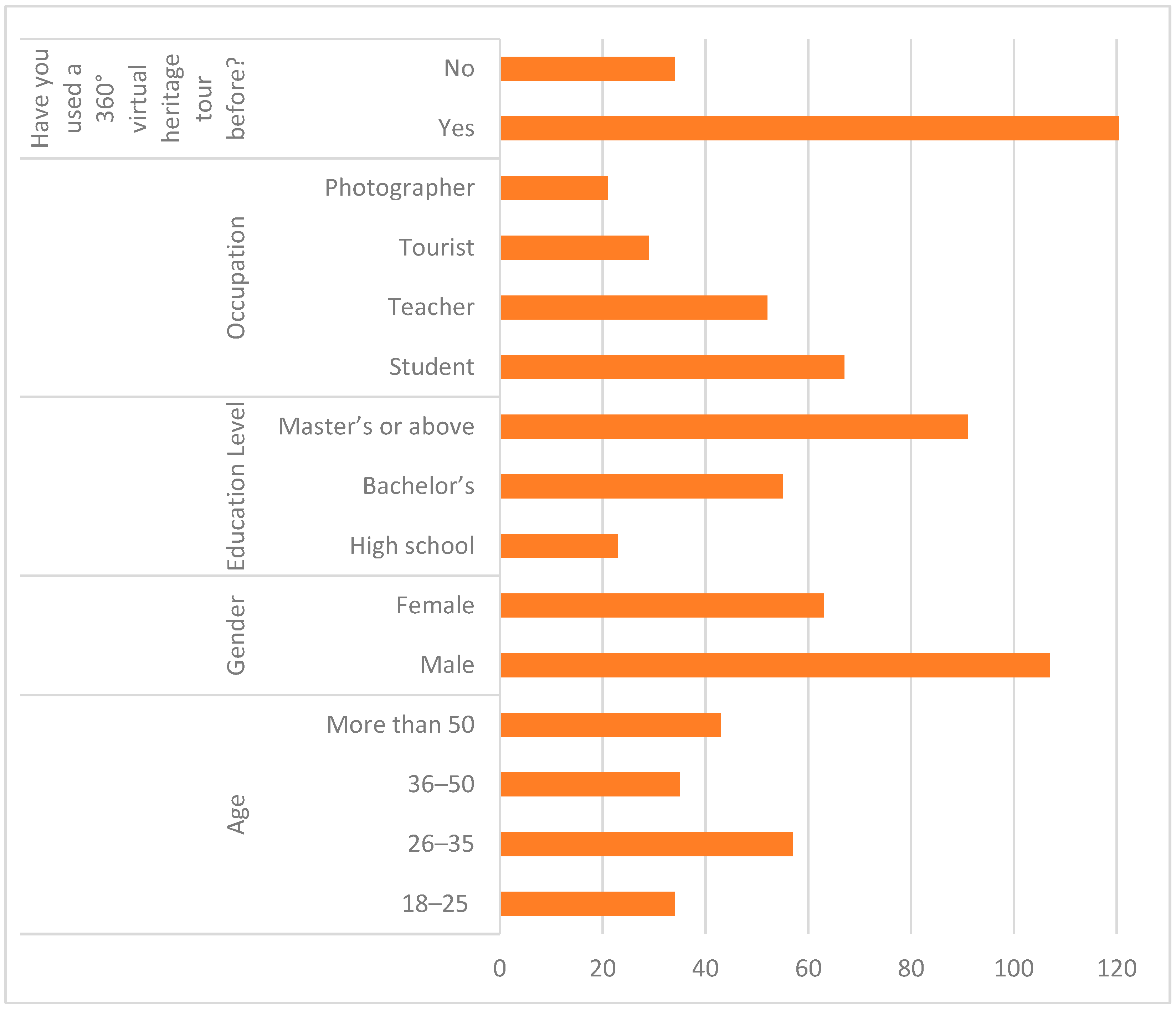
The survey questionnaire method included 135 respondents who had previously participated in a 360° virtual heritage tour and 34 participants who had not, totaling 169 participants (
Figure 1). Most of the participants were male (107), while 63 were female. The age distribution was quite equitable, with the predominant group being individuals aged 26–35 years (57 responses), followed by those over 50 years (43 respondents). The majority of respondents (91) held a Master’s degree or higher, reflecting a well-educated sample, while 55 held a Bachelor’s degree and 23 were high school graduates. The predominant occupational category consisted of students (67), followed by instructors (52), visitors (29), and photographers (21). The diversified respondent profile offered a range of opinions on the application and efficacy of 360° panoramic imaging in heritage documentation, including both seasoned and inexperienced users.
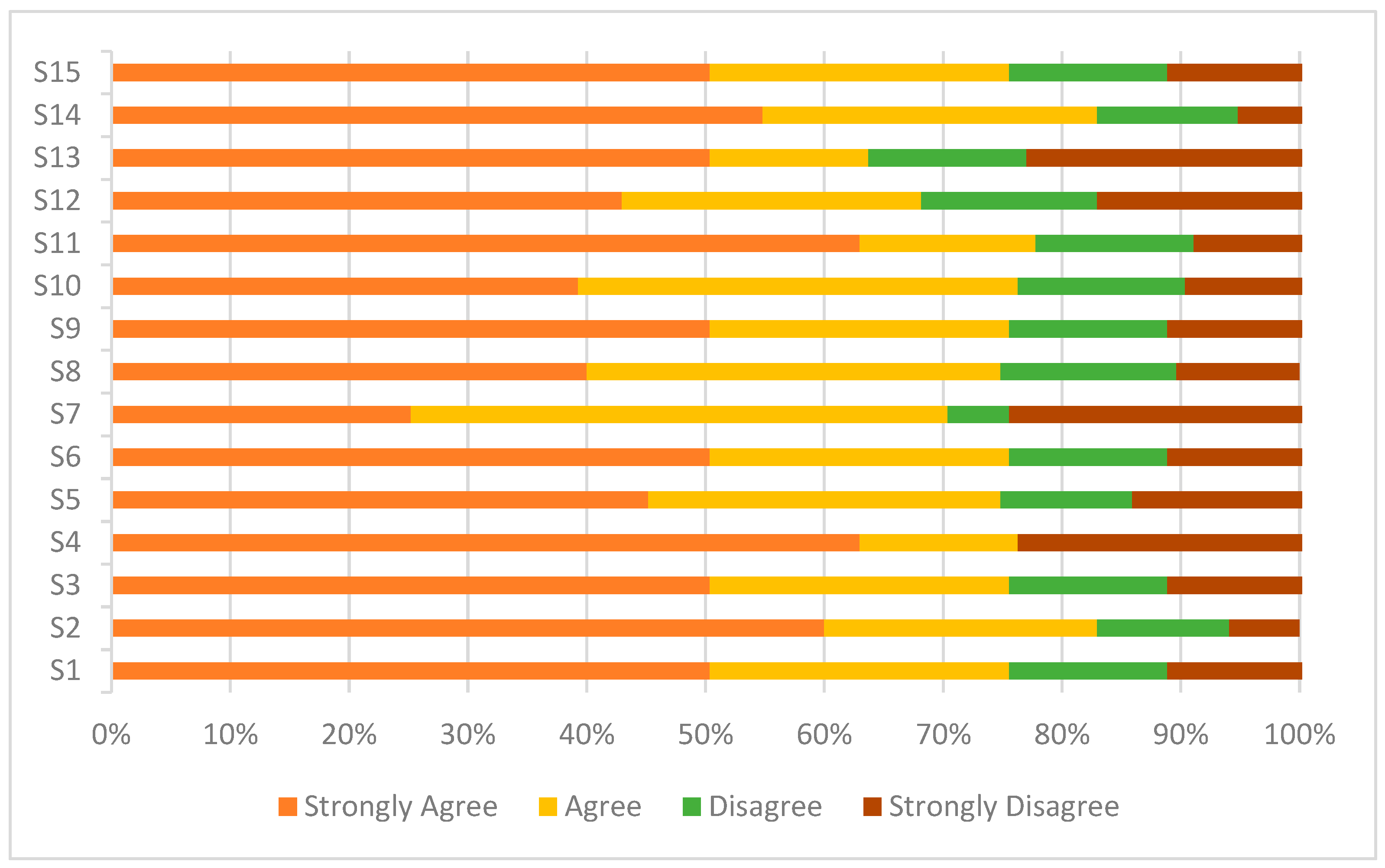
Figure 2 illustrates that the survey findings reveal both the advantages and disadvantages of 360° panoramic imaging in historical documentation. Seventy-five percent of respondents indicated satisfaction with the immersive experience (S3, S14), confirming the technology’s efficacy in delivering visual tales. Furthermore, 62.5% recognized the superior visual quality of the imagery (S5), underscoring its capacity for significant documentation.
A Weighted Average Analysis (WAA) was employed to quantify the overall perception of 360° panoramic images. In this analysis, weights were allocated to each response category on a 4-point Likert scale as follows: 1 = Strongly Agree, 2 = Agree, 3 = Disagree, 4 = Strongly Disagree. The recorded frequencies for each response were 993 for Strongly Agree, 527 for Agree, 238 for Disagree, and 297 for Strongly Disagree. The weighted sum was computed with the subsequent formula:
The WAA was then computed as:
A weighted average of 1.92 indicates a predominant consensus, suggesting that respondents generally regarded 360° panoramic imagery as useful in communicating visual narratives and augmenting user engagement. The investigation reveals considerable dissatisfaction, particularly with media integration and navigation, with 45% expressing discontent with multimedia content (S7) and 25% encountering navigation difficulties (S1). These findings correspond with the SWOT analysis, highlighting the visual advantages and technical constraints of 360° panoramic imaging in cultural heritage documentation.
3.5. Practical Testing Results
The practical testing phase identified clear strengths and weaknesses across the three platforms in terms of use, customization, and output quality (
Table 8). Kuula demonstrated exceptional user-friendliness and cost-efficiency, rendering it ideal for quick implementation and fundamental documentation activities. Nonetheless, it was deficient in sophisticated functionalities, including VR compatibility and analytics integration.
3DVista offered a broad array of features, including high-resolution rendering, extensive export options, and major customization capabilities, but its complexity and expense presented considerable obstacles for novice users. Pano2VR effectively balanced capability and usability, providing dependable media integration, VR support, and versatile hosting options, while necessitating greater technical expertise to fully leverage its features.
The testing revealed that 3DVista is the most comprehensive platform for advanced heritage documentation projects, whereas Kuula is favored for expedient and cost-effective virtual tours, and Pano2VR functions as a flexible intermediary with robust VR capabilities and customization options.
4. Discussion
This study analyzes the impact of 360° panoramic imaging on the documentation of heritage sites through a SWOT analysis. The methodological framework incorporated four data collection techniques: a systematic literature review, institutional reports, expert interviews and surveys, and practical evaluations of leading panoramic platforms (Kuula, 3DVista, and Pano2VR). The results indicate that 360° panoramic imaging significantly improves visual engagement and accessibility, yet it exhibits notable technical constraints in media integration, navigation, and data management.
The literature review highlighted the immersive and visually intuitive characteristics of 360° panoramic imagery, noting its ability to promote spatial comprehension and increase user engagement [
19,
26]. The amalgamation of panoramic imagery with virtual reality and augmented reality platforms is identified as a significant opportunity for enhancing educational outreach and public accessibility to heritage sites [
20,
29]. Numerous studies have highlighted deficiencies in data quality and resolution, particularly in comparison to high-precision methods such as LiDAR and photogrammetry [
22,
25].
Institutional reports from UNESCO, ICOMOS, and CIPA corroborated these findings by highlighting the capacity of 360° imaging to democratize access to heritage monuments via web-based virtual tours [
47]. Concerns were expressed about data preservation, software interoperability, and the absence of standardized archival techniques for panoramic photographs [
27]. The publications emphasized the strategic significance of using 360° images into comprehensive heritage conservation frameworks, especially in areas susceptible to natural disasters and cultural displacement [
47].
Expert interviews offer valuable insights into the practical applications and challenges of 360° imaging in historical documentation. Participants highlighted its efficacy in augmenting spatial narratives and fostering immersive learning experiences, particularly in educational contexts (Participants 3 and 6). Nonetheless, technical limitations such file size, data storage, and user interface complexity were again identified as significant shortcomings. Experts observed the inadequate use of advanced media integration capabilities, indicating the necessity for platform-specific training to optimize interactive features (Participant 5).
Survey findings further corroborated the ambivalent response of 360° panoramic imagery. Seventy-five percent of respondents reported overall pleasure with the immersive experience; however, 45% expressed unhappiness with the media integration, and 25% experienced navigation challenges (S1, S7). The Weighted Average Analysis (WAA) yielded a score of 1.91, indicating a general tendency toward agreement while also highlighting areas of considerable discontent, particularly regarding usability and media integration.
Empirical evaluation of Kuula, 3DVista, and Pano2VR corroborated these conclusions. Kuula received acclaim for its user-friendliness and affordability; however, it was lacking in sophisticated functionalities such as VR compatibility and analytics integration. 3DVista provided wide customization and high-resolution output, albeit with a somewhat elevated cost and increased technological complexity. Pano2VR struck a balance between usefulness and usability; nonetheless, it required specialized skills for the proper implementation of interactive elements and media integration.
The selection of Kuula, 3DVista, and Pano2VR was guided by their widespread acceptance in professional heritage documentation processes and their availability as mature, integrated systems providing panoramic tour creation, multimedia integration, and cross-platform deployment [
48,
49]. These proprietary tools match current industry practice and offer generally stable and accessible workflows for practitioners with diverse technical ability. Open-source or free alternatives were excluded in this analysis due to their relatively limited integrated visit authoring abilities, higher technical setup requirements, or the requirement for advanced development skills, which may restrict their practical applicability in numerous heritage documentation contexts [
50].
At the same time, reliance on proprietary platforms creates key problems around cost, licensing, and long-term sustainability. For tiny or under-resourced institutions, license fees and platform dependencies may offer impediments to access and continuity. This underscores the need to match panoramic documentation efforts with broader values supported by organizations such as ICOMOS and UNESCO, including accessibility, sustainability, and long-term management. These findings show that while private platforms currently offer practical advantages, future research and practice should also examine scalable and sustainable alternatives that balance technical capabilities with institutional capacity [
5,
51].
This study’s findings offer substantial insights into the application and constraints of 360° panoramic imaging in heritage documentation. The principal findings indicate that 360° panoramic imaging significantly improves visual engagement and spatial narrative, especially in educational and outreach settings; however, it poses considerable technical difficulties regarding data integration, navigation, and long-term preservation. This aligns with earlier research that has emphasized the visual and sensory advantages of panoramic imaging, particularly its ability to convey spatial context and create immersive experiences [
19,
29]. The recognized limits of data resolution and media integration align with prior studies on panoramic imaging and digital documentation [
22,
25].
From a conservation-oriented perspective, the findings of this study show that 360° images should be considered as supportive and supplementary recording methods, rather than alone conservation records. Their key value lies in encouraging interdisciplinary collaboration, boosting spatial awareness of heritage assets, and supporting informed communication among conservation professionals, planners, and decision-makers. While panoramic imagery cannot replace measuring survey techniques or standardized conservation documentation, it can play a valuable role in early evaluation, condition overview, and decision-support processes.
Regarding data standardization and integration, the results imply that the efficient use of 360° panoramic images in conservation practice depends on their incorporation within bigger digital ecosystems, such as GIS-based heritage inventory, HBIM environments, or institutional databases. Without structured information, defined naming rules, and integration with current documentation frameworks, the long-term utility of panoramic datasets remains restricted. Furthermore, long-term digital preservation requires specific archiving procedures, including version control, sustainable file formats, and institutional stewardship, to enable continuing accessibility and reuse of panoramic data across time. These elements constitute key considerations for future application and research, extending beyond the exploratory focus of the present work.
Moreover, the study contributes to the literature by methodically analyzing both internal and external determinants that influence the use of 360° imagery in historical documentation. The study integrates insights from institutional reports, expert interviews, and practical testing, thereby reinforcing existing findings and highlighting deficiencies in current practices, particularly in platform interoperability and policy support. The findings reveal that systems such as 3DVista and Pano2VR provide sophisticated media integration and customization; nonetheless, they necessitate elevated technological expertise and entail significant expenses, hence restricting their accessibility for smaller institutions [
27,
47].
The originality of this study lies in its thorough, multi-method approach, which combines qualitative and quantitative data to evaluate the strategic use of 360° panoramic imaging within the broader context of historical documentation. This research employs a SWOT analysis to comprehensively evaluate the strategic positioning of 360° imagery in heritage conservation, contrasting with prior studies that mainly concentrated on technical requirements or user interaction. This method provides a detailed understanding of the advantages and disadvantages of panoramic imagery, while also highlighting the potential for utilizing advanced technologies, such as virtual reality and augmented reality, to enhance educational outreach and public engagement. The use of hands-on testing provides practical insights into platform-specific functionalities, a facet that has been little examined in previous research.
The implications for academic research necessitate more studies to assess hybrid documentation frameworks that combine 360° photography with sophisticated spatial data acquisition techniques such as LiDAR and photogrammetry. Future research could investigate the potential of integrating panoramic photos with 3D point cloud data to improve spatial accuracy while preserving visual immersion [
25,
36]. Moreover, researchers could examine the influence of VR/AR integration in educational modules to evaluate the cognitive and experiential outcomes of interactive heritage content [
28,
29].
The study highlights the necessity for practitioners to choose platform-specific features that correspond with documentation goals and user requirements. Institutions with constrained resources may favor systems such as Kuula, which offer fundamental yet efficient media integration, whereas more sophisticated initiatives could leverage the comprehensive customization capabilities and VR compatibility provided by 3DVista.
In historic documentation, implementing defined standards for data storage, media integration, and user interface design is crucial for optimizing the utility and durability of 360° panoramic archives. UNESCO’s recommendation for data preservation via interoperable formats may provide a framework for archiving panoramic content [
47]. Likewise, the adoption of metadata standards for panoramic images may enhance their integration into digital libraries and educational archives.
5. Conclusions
This study analyzes the impact of 360° panorama imaging in historical documentation, employing a thorough approach of SWOT analysis that included literature reviews, institutional reports, expert interviews, surveys, and practical testing. The results highlight the technology’s efficacy in improving visual engagement and narrative interpretation, rendering it a significant asset for educational outreach and public involvement. Nonetheless, technical constraints related to media integration, navigation, and data management surfaced as significant obstacles, corroborating prior research that underscores the need for enhanced data accuracy and platform interoperability.
Although technologies such as 3DVista and Pano2VR provide significant flexibility and VR compatibility, their technical intricacy and elevated costs provide obstacles to adoption, especially for smaller institutions. In contrast, Kuula offers a more accessible yet less sophisticated alternative, emphasizing the need to align platform functionalities with specific documentation goals.
In conclusion, this study contributes to current research by critically examining the role of 360° panoramic imagery as a decision-support and collaboration-enhancing tool within cultural heritage documentation workflows. The findings reveal that, while panoramic photographs are not substitutes for standardized conservation records or high-precision survey data, they offer significant value in facilitating interdisciplinary communication, preliminary conservation evaluation, and integrated documentation techniques. By clarifying both the potential and the limitations of panoramic imaging, this research offers a structured basis for its informed use in skilled conservation contexts, while highlighting the need for future work focused on standardization, database integration, and long-term digital preservation.
This study’s principal contribution is its multi-method approach, which rigorously incorporates SWOT analysis to offer a strategic perspective on 360° imagery in historical situations. This research employs a comprehensive paradigm that encompasses both the experiential and operational aspects of panoramic imaging, in contrast to previous studies that concentrated exclusively on user interaction or technical requirements.
Future investigations should examine hybrid documentation frameworks that integrate 360° photography with high-precision techniques such as LiDAR and virtual reality to enhance data accuracy and interactive narrative. Furthermore, it is advisable to establish standardized archival processes to guarantee the long-term accessibility and preservation of panoramic information, in accordance with UNESCO’s requirements for digital heritage recording.