Article

Sustainable Valorisation of Banana Inflorescence for Development of Nutraceutical Lozenges

by
Chloe Xi-Kit Chan
1,
Lee Jia Xuan
1,
Norhayati Mustafa Khalid
2,
Mohd Naeem Mohd Nawi
2,
Anandarajagopal Kalusalingam
3,
Poonguzhali Subramanian
4,5,6,* and
Sreelakshmi Sankara Narayanan
1,5,7,*
1
School of Biosciences, Faculty of Health and Medical Sciences, Taylor’s University, Subang Jaya 47500, Selangor, Malaysia
2
Nutrition, Metabolic and Cardiovascular Research Centre, Institute for Medical Research, National Institutes of Health, Ministry of Health, Shah Alam 40170, Selangor, Malaysia
3
School of Pharmacy, KPJ Healthcare University, Nilai 71800, Negeri Sembilan, Malaysia
4
School of Pharmacy, Faculty of Health and Medical Sciences, Taylor’s University, Subang Jaya 47500, Selangor, Malaysia
5
Centre for Active Living, Taylor’s University, Subang Jaya 47500, Selangor, Malaysia
6
Digital Health and Medical Advancement Impact Lab, Taylor’s University, No. 1, Jalan Taylor’s, Subang Jaya 47500, Selangor, Malaysia
7
Food Security and Nutrition Impact Lab, Taylor’s University, Subang Jaya 47500, Selangor, Malaysia
*
Authors to whom correspondence should be addressed.
Biomass 2026, 6(3), 43; https://doi.org/10.3390/biomass6030043
Submission received: 8 April 2026 / Revised: 27 May 2026 / Accepted: 1 June 2026 / Published: 11 June 2026

Abstract

Banana (Musa acuminata), the second most cultivated fruit worldwide, generates approximately 220 tons of agricultural waste per hectare annually, with nearly 80% of the plant biomass remaining underutilised after harvest. Banana inflorescence, an underutilised by-product of banana cultivation, is commonly discarded despite its rich nutritional and bioactive composition, contributing to agricultural waste and environmental concerns. This study aimed to develop and evaluate banana inflorescence lozenges as a nutraceutical supplement while promoting sustainable agricultural waste valorisation. Freeze-dried banana inflorescence powder was incorporated into a hard lozenge formulation using the melt-and-mould method, and the formulation was optimised through physical evaluation. The optimised lozenges demonstrated acceptable mechanical properties, including friability of 0.13%, hardness of 55.16 kg/cm2, and disintegration time of 35 min. Fourier-transform infrared spectroscopy with attenuated total reflectance (FTIR–ATR) confirmed the compatibility between the active ingredient and excipients. The formulated lozenges exhibited a total phenolic content of 22.74 ± 0.74 mg GAE/g DW and moderate antioxidant activity, with ABTS and DPPH IC50 values of 30.65 mg/mL and 72.53 mg/mL, respectively. In vitro antidiabetic assays demonstrated α-glucosidase inhibition of 45.80% and α-amylase inhibition of 98.11%. Mineral analysis further revealed appreciable levels of potassium, magnesium, calcium, and iron. Although some reduction in bioactivity was observed following processing and formulation, banana inflorescence still demonstrated potential as a sustainable functional ingredient for nutraceutical applications and agricultural waste valorisation. Further studies involving stability assessment and in vivo validation are recommended.

1. Introduction

Bananas are the second most cultivated fruit worldwide, grown in over 130 countries and accounting for approximately 16% of global fruit production [1]. Apart from citrus, they are among the most widely cultivated tropical fruits, especially in Southeast Asian countries such as India, the Philippines, and Indonesia [2]. Global banana production is projected to reach 117.85 billion kilograms by 2030 [3], while the market value is expected to grow steadily, reaching 161.37 billion USD by 2029 [4]. With over a thousand banana varieties, the species Musa acuminata and Musa balbisiana are the main edible species [5]. Beyond their significance as a food crop, banana plants have diverse applications in both food and non-food industries, including the development of functional foods, natural food additives, and eco-friendly materials such as biofertilizers, bioplastics, and natural fibre [6]. Despite its economic importance, banana cultivation generates substantial agricultural biomass waste, as most plant parts other than the fruit remain underutilised. Improper disposal of this biomass contributes to environmental pollution and inefficient resource utilisation, highlighting the need for sustainable waste valorisation strategies to align with circular economy goals.
The banana plant consists of several parts, including the leaves, fruits, flowers, pseudo-stem, corm, and roots. Banana fruits are rich in carbohydrates, dietary fibre, vitamins, minerals, and various bioactive phytochemicals [7]. The presence of essential minerals such as phosphorus, sodium, calcium, potassium, magnesium, iron, copper, zinc, and manganese contributes to the nutritional value of bananas and supports overall health and well-being [8]. In addition to their nutritional value, different parts of the banana plant have demonstrated antioxidant, antidiabetic, anticancer, and antimicrobial activities [7], mainly due to the presence of polyphenols, flavonoids, vitamins, and essential minerals [9]. Moreover, since ancient times, certain parts of the banana plant have been recognised for their medicinal properties; banana peels and roots exhibit strong antibacterial activity against both Gram-positive and Gram-negative bacteria, while the leaves possess significant antifungal properties [5].
Banana inflorescence (BI), commonly referred to as the ‘banana heart’, is a dark purple–red structure located at the end of the plant stalk [10]. It consists of layered bracts that enclose male and female flowers [11]. During maturation, the bracts lift, and each female flower develops into a banana while the male flowers remain within the bract and are typically removed by the farmers before the fruit matures. Although BI is edible and commonly used in local dishes in Asian countries such as India, Malaysia, and Thailand [10], it remains largely underutilised and is often discarded as agricultural waste. Approximately 440 kg of inflorescence is generated from every tonne of harvested bananas [12]. Similar to fruit, the inflorescence is rich in minerals and bioactive phytochemicals, including calcium, potassium, magnesium, phosphorus, iron, zinc, phenolics, and saponins [11,13,14,15,16]. Previous studies have reported that the concentration of these minerals in the inflorescence is three to four times higher than that in fruit [13,14], while the total phenolic content (TPC) in the M. acuminata flowers (61.77 mg GAE/g) is significantly higher than in fruit (15.39 mg GAE/g) [15,16]. Despite its nutrient and bioactive profile, BI remains underutilised as a functional food source with potential nutraceutical applications, potential for supporting immunity, growth, and overall health, including potential relevance in supporting glucose metabolism and managing early metabolic risks in children.
Nutraceuticals represent a combination of “nutrition” and “pharmaceutical” and refer to food-derived products that provide health benefits beyond basic nutrition [17]. These products are formulated to meet specific dietary requirements and/or support the prevention of chronic diseases [17]. Nutraceuticals commonly contain bioactive compounds from natural sources, including antioxidants, phytochemicals, fatty acids, amino acids, and probiotics, which contribute to overall health and well-being [18]. Apart from these, they provide essential vitamins, macro- and microminerals to promote human health, and may help prevent, treat, or manage chronic diseases linked to oxidative stress and inflammation [19]. Previous research also highlights that polyphenols and antioxidants can positively influence body mass index, gut microbiome composition, lipid profiles, and glucose metabolism in children with obesity [20]. According to a previous study, diabetes is no longer considered an adult-only disease, and it is increasingly prevalent in children and adolescents, often associated with childhood obesity. This trend underscores the need for early diagnostic and preventative strategies [21]. While many epidemiological studies emphasised the benefits of a plant-based diet with reputed antihyperglycemic potential for Type 2 diabetes in adults [22], interventions can also be safely applied to children due to their affordability and low risk of adverse effects. Children and infants represent a major target group for nutraceutical supplements, as these products support bone and tissue development, enhance immune function, and aid recovery from common childhood conditions such as colds, attention deficit disorder, epilepsy, and asthma [23]. The use of dietary supplements among children has increased in recent decades, with multivitamins and minerals being the most commonly used formulations for immune support, growth and to address inadequate dietary intake [24], thereby contributing to the prevention and management of chronic diseases in this population. This trend reflects the growing market demand for paediatric nutritional supplements, while recent studies highlight increasing interest in plant-based nutraceuticals for improving insulin resistance and hyperglycemic conditions [25].
A pilot study conducted in Malaysia found that nutrient deficiencies are common among children aged 6 months to 12 years, especially in low-income households [26]. Therefore, maintaining an adequate intake of essential macro- and micronutrients is essential during childhood growth and development, as it supports hormonal and cellular processes, energy production, neuromotor development, and immune function, and may reduce the risks of non-communicable diseases in later life [27,28]. BI is rich in bioactive compounds and minerals, and its conversion into chewable tablets or soft lozenges could enhance the nutrient intake in children. Furthermore, utilising this agricultural by-product reduces environmental pollution, offering a sustainable approach to food supplementation. Thus, a BI-based supplement could serve as an alternative to synthetic and/or single-extract nutraceuticals, providing multiple functional benefits in a single tablet [29].
While various parts of a banana plant possess nutritional and functional properties, a single banana plant generates a substantial amount of biomass waste; 80% of its total plant mass becomes agricultural waste after harvesting [12]. Such waste includes pseudostems, peels, leaves, and inflorescence [7]. Moreover, this fibre-rich plant waste is difficult to decompose, contributing to environmental challenges such as greenhouse gas emissions, pollution, and the proliferation of pathogenic organisms, if not properly managed [12]. Transforming BI into value-added nutraceuticals could help mitigate these impacts and represent a sustainable strategy while contributing to the circular economy.
Although banana flowers are consumed in local dishes across Asia, for example, blanched with sambal and rice in Malaysia or as a fried salad in Sri Lanka [30], many children dislike them due to the slightly bitter taste [31]. The bitterness is mainly attributed to the abundance of tannins, which produce an astringent taste when they bind with salivary proteins [32]. In addition, the tedious preparation process before cooking, such as removing the bracts and sepals one by one and thoroughly cleaning and washing the flowers [33], together with their short shelf-life due to the high moisture content and susceptibility to enzymatic browning, which accelerates phytochemical degradation and unfavourable microbial growth [34]. These factors limit their widespread consumption [31].
Previous studies have examined the nutrient profile [11,14], phytochemical composition [10,11], and functional properties of BI [15,16]. In addition, several studies have explored the incorporation of BI into various value-added products like gluten-free chips [35]; biscuits [36,37]; functional bread [38] and beverages [39]. Unlike BI being consumed as a conventional food, the incorporation of BI into a lozenge formulation may provide additional advantages, including enhanced palatability, convenient administration, longer shelf life, and better utilisation of this underutilised agricultural biomass for nutraceutical applications. However, to the best of our knowledge, no study has reported the development of BI-based lozenge formulations. Furthermore, the present study also provides new insights into the feasibility of incorporating BI into a solid dosage formulation, including excipient compatibility, retention of bioactive phytochemicals and minerals after formulation, physicochemical characteristics, and short-term stability evaluation. Therefore, this study aimed to develop and evaluate BIL using the melt and mould technique and to assess their physicochemical properties, antioxidant activity, antidiabetic potential, and mineral composition. This approach not only supports the development of a novel nutraceutical product but also contributes to sustainable biomass valorisation by converting BI, which is often discarded during cultivation, into a value-added functional product aligned with circular bioeconomy principles.

2. Materials and Methods

2.1. Materials

BI of the Berangan cultivar (M. acuminata) was used as the primary raw material. The BI was procured directly from Kia Shing Imp & Exp S/B 141319-M Sdn. Bhd., Johor Bahru, Malaysia, and harvested at the mature flowering stage after full fruit set, approximately 4 months after flowering. Polyethylene Glycol (PEG) 4000 and PEG 6000, hydroxypropyl methylcellulose (HPMC), magnesium stearate, xanthan gum, and 2,2′-azino-bis (3-ethylbenzothiazoline-6-sulfonic acid) (ABTS) were obtained from Macklin, Shanghai, China. Pure stevia (Dr Sweet), gelatine powder (Meriah), and flavouring agent (Lotus’s) were procured from a local supermarket in Kuala Lumpur, while dipotassium hydrogen phosphate and potassium dihydrogen phosphate were obtained from Bendosen, Selangor, Malaysia. 2,2-Diphenyl-1-picrylhydrazyl (DPPH) was obtained from Scientific Phygene, Fuzhou, China, while α-Glucosidase and α-Amylase were purchased from Megazyme, Bray, Ireland. PerkinElmer QC21 standard solution was used as a micromineral standard purchased from PerkinElmer, Waltham, MA, USA. Standard solutions for magnesium, calcium, phosphorus, sodium, and potassium were purchased from Sigma-Aldrich, St. Louis, MO, USA. Nitric Acid and hydrogen peroxide were purchased from Merck, Darmstadt, Germany.

2.2. Preparation of Banana Inflorescence Powder

The BI were collected, thoroughly washed, and manually separated into bracts and flowers. The white flowers, used for BIL preparation, were cut into small pieces, freeze-dried for 24 h, ground into a fine powder, transferred into an air-tight bag, and stored at −20 °C for further use.

2.3. Preparation of Banana Inflorescence Extract

Banana inflorescence powder (BIP) was extracted using 95% ethanol-assisted sonication at a ratio of 1:20 (w/v) for 30 min at 30 °C and 37 kHz to Table 1. Composition of BL formulations enhances the extraction of bioactive compounds. The mixture was then centrifuged at 10,000 rpm for 10 min at 4 °C. The supernatant was filtered through Whatman No.1 filter paper, and the solvent was removed using a rotary evaporator at 30 rpm and 40 °C. A similar extraction procedure was applied to the BIL, which was first ground into powder using a mortar and pestle. The obtained BIP and BIL extracts were stored at 4 °C until further analysis.

2.4. Preliminary Studies and Formulation Optimisation of Lozenge from Banana Inflorescence

In the preliminary studies, blank lozenges (BLs) were prepared using different ratios of each ingredient to achieve optimal consistency, viscosity, and texture. The lozenge mould was first calibrated by preparing a base mixture of PEG 4000 and PEG 6000, stevia, gelatine, xanthan gum, and magnesium stearate in five cavities. The BL were weighed, and the average weight was used to determine the formulation required per mould cavity for subsequent preparations. Table 1 shows the formulations tested with varying amounts of PEG 4000, PEG 6000, gelatine, and HPMC. PEG was weighed in a 100 mL beaker and melted on a hot plate at 80 °C without stirring. The temperature was then reduced, and gelatine was sprinkled onto the melted PEG while gently stirring, ensuring each granule was thoroughly wetted before adding more [40]. Once the gelatine was completely melted, the remaining ingredients were incorporated into the mixture. Flavouring agents were added after removing the beaker from the hot plate. The mixture was then poured into a mould and allowed to cool at room temperature. The BL were assessed for their appearance and texture to select the optimised formulation. Based on the preliminary study, banana inflorescence lozenge (BIL) formulations containing 125 mg of BI were prepared and evaluated for physical appearance and the presence of granules by scraping with a spatula, followed by wetting a small portion with water to manually assess the texture. The formulation exhibiting the most desirable characteristics was selected and subsequently prepared using the melt and mould method as previously described. The selected formulation was then stored in an airtight container for further analysis.

2.5. Physical Evaluation of Banana Inflorescence Lozenges

The formulated BILs were visually examined for colour uniformity, texture, shape, and size, and the observations were recorded [41]. The weight of 20 BILs was individually weighed using an analytical balance (Shimadzu, Kyoto, Japan). The mean weight, standard deviation, and percentage weight variation were calculated [42]. The thickness of 10 BILs was measured with a vernier calliper (Mitutoyo, Kawasaki, Japan), and mean thickness, standard deviation, and percentage variation in thickness and diameter were calculated [41]. Mechanical strength was determined using a breaking force tester (Electrolab, Mumbai, India) on ten randomly selected BILs [43]. Friability was tested by placing ten BILs in a friability tester (Electrolab, India) and rotating the drum at 25 rpm for 100 rotations. The BILs were weighed before and after the test, and the percentage friability was calculated [41]. Disintegration testing was carried out using a Disintegration Tester (Electrolab, India), with six randomly selected BILs placed individually in glass tubes fitted with 10-mesh sieves in a pH 6.8 phosphate-buffered solution maintained at 37 °C. The basket assembly moved vertically to simulate the gastrointestinal tract conditions, and the disintegration time was recorded [42].

2.6. Fourier Transform Infrared—Attenuated Total Reflectance (FTIR-ATR) Analysis

Freeze-dried BIP, BL, and BIL were analysed using FTIR-ATR spectroscopy at room temperature within a spectral range of 4000–400 cm−1 and a resolution of 4 cm−1 [44]. A total of 32 scans were performed for each sample, and the resulting spectra were analysed to identify the characteristic functional group [42].

2.7. Total Phenolic Content and Antioxidant Analysis

2.7.1. Total Phenolic Content Analysis

TPC was determined using the Folin–Ciocalteu method [45]. Gallic acid was used as a standard to prepare a calibration curve in the range of 0.01–0.10 mg/mL. 20 µL of gallic acid standard solutions at different concentrations or sample extract was mixed with 100 µL of 10% Folin–Ciocalteu reagent in a 96-well plate and incubated at room temperature for 5 min, followed by the addition of 80 µL of 7.5% sodium carbonate. The plate was incubated in the dark for 30 min at room temperature, and the absorbance was measured at 765 nm using a microplate reader (Agilent BioTek, Santa Clara, CA, USA). TPC was expressed as milligrams of gallic acid equivalents (mg GAE) per gram of dried extract.

2.7.2. DPPH Radical Scavenging Assay

The DPPH assay was determined as previously described [46]. Trolox was used as a standard to prepare a calibration curve in the range of 0.01–0.10 mg/mL. For the assay, 100 µL of Trolox standard solutions at different concentrations and sample extracts were mixed with 100 µL of 0.1 mM DPPH and incubated at room temperature in the dark for 40 min. After incubation, the absorbance was measured at 517 nm with a microplate reader. The DPPH antioxidant activity was expressed as Trolox equivalent (TE) while the IC50 (half maximal inhibitory concentration) was expressed as mg/mL of the extracts.

2.7.3. ABTS Radical Scavenging Assay

ABTS radical scavenging activity was determined as previously described [46]. Trolox was used as a standard to prepare a calibration curve in the range of 0.01–0.10 mg/mL. The ABTS radical cation (ABTS•+) was generated by dissolving 7 mM of ABTS with 2.45 mM of potassium persulfate (1:1) and allowing the mixture to stand for 12–16 h in the dark at room temperature prior to use. For the assay, 20 µL of Trolox standard solutions at different concentrations or sample extracts were mixed with 180 µL of ABTS•+ solution and incubated in the dark at room temperature for 15 min. After incubation, the absorbance was measured at 734 nm with a microplate reader. The ABTS antioxidant activity was expressed as TE, while the IC50 was expressed as mg/mL of the extracts.

2.8. In Vitro Antidiabetic Activity

2.8.1. α-Glucosidase Inhibitory Activity Assay

α-Glucosidase inhibitory activity was determined as previously described [47]. Acarbose was used as the standard to prepare a calibration curve in the range of 0.00025–0.01 mg/mL. For the assay, 50 µL of 0.1 M phosphate buffer was mixed with 10 µL of the sample extract and 25 µL of α-glucosidase enzyme solution in a 96-well microplate and incubated at room temperature for 10 min. Subsequently, 25 µL of 0.5 mM 4-nitrophenyl-alpha-D-glucopyranoside (p-NPG) was added to initiate the reaction, and the mixture was incubated for 5 min. The enzymatic reaction was terminated by adding 100 µL of 0.2 M sodium carbonate, and the absorbance was measured at 410 nm using a microplate reader.

2.8.2. α-Amylase Inhibitory Activity Assay

The α-Amylase inhibitory activity was determined as previously described [47]. Acarbose was used as the standard to prepare a calibration curve in the range of 0.00025–0.01 mg/mL. For the assay, 50 µL of 0.1 M phosphate buffer was mixed with 10 µL of the sample extract and 25 µL of alpha-amylase enzyme solution in a 96-well microplate and incubated at 37 °C for 10 min. Subsequently, 25 µL 1% starch solution was added as the substrate, and the mixture was incubated for 10 min at 37 °C. The enzymatic reaction was then terminated by adding 100 µL of 3,5-dinitrosalicylic acid (DNS) reagent, and the absorbance was measured at 540 nm with a microplate reader. In both experiments, appropriate solvent blanks were included.

2.9. Mineral Content Analysis

Mineral content (macro minerals: potassium (K), calcium (Ca), magnesium (Mg), and phosphorus (P); microminerals: copper (Cu), iron (Fe), zinc (Zn), selenium (Se), and chromium (Cr)) was measured using Inductively Coupled Optical Emission spectroscopy (ICP-OES) (Optima8300, Perkin Elmer, Shelton, CT, USA) according to the method previously described [48]. Prior to mineral analysis, microwave-assisted acid digestion was carried out to dissolve the sample matrix and release the target minerals. Approximately 0.3 g of each sample was transferred into individual digestion vessels, followed by the addition of 7 mL of 65% of nitric acid and 2 mL of 30% hydrogen peroxide. The vessels were sealed and placed in the microwave digestion system for 90 min, including both the digestion cycle and cooling phase.
After digestion, the samples were transferred into clean tubes, and the digestion vessels were rinsed three times with ultrapure water. The rinsates were combined with the respective digested samples, and the volume was made up to 25 mL with ultrapure water. The resulting solutions were then filtered through a 0.45 µm membrane filter to remove any particulate matter or undissolved solids. For calibration, 80 ppm mixed standard solutions of macrominerals (Sigma-Aldrich, USA) were prepared by diluting a 1000 ppm stock solution with 1% HNO3 to obtain working standards of different concentrations in the range of 5–40 ppm. For microminerals, a 50 ppm of Perkin Elmer QC 21 standard solutions was prepared by diluting 5 mL of 100 ppm stock solution to 50 mL with 1% HNO3 to prepare working standards in the range of 0.01–1 ppm. A 1% HNO3 solution was used as the instrument blank. Calibration curves for each element were constructed from the emission intensities of the standard solutions, and the concentrations of minerals in the samples were determined from the corresponding calibration graphs.

2.10. Accelerated Stability Studies

The prepared BIL were subjected to accelerated stability testing by storing at 40 ± 2 °C and 75% relative humidity [41]. Samples were evaluated after 30 days for changes in colour and physical appearance.

2.11. Statistical Analysis

Experiments, including physical evaluation, TPC, DPPH and ABTS radical scavenging assays, in vitro α-glucosidase and α-amylase inhibition activities, and mineral content analysis, were performed in triplicate. The results were expressed as mean ± standard deviation (SD) and statistically analysed using IBM SPSS Statistics (version 31.0; SPSS Inc., Chicago, IL, USA).

3. Results and Discussion

3.1. Optimisation of Lozenge Formulation

Eleven BL formulations were prepared using different ratios of PEG 4000, PEG 6000, gelatine, and HPMC, as shown in Figure S1. Each formulation was evaluated for its physical characteristics to determine the most suitable composition for further development.
During preliminary evaluation, several formulations exhibited noticeable granularity caused by the presence of undissolved gelatine particles. Although the gelatine was hydrated using the blooming method before incorporation, the hydrated gelatine did not disperse uniformly within the molten PEG base, resulting in phase separation and poor homogeneity. This issue may be attributed to the difficulty in achieving proper dispersion of hydrated gelatine within the molten PEG matrix, leading to incomplete solubilisation and particle formation. Consequently, formulation F11 was excluded due to its unsatisfactory physical properties.
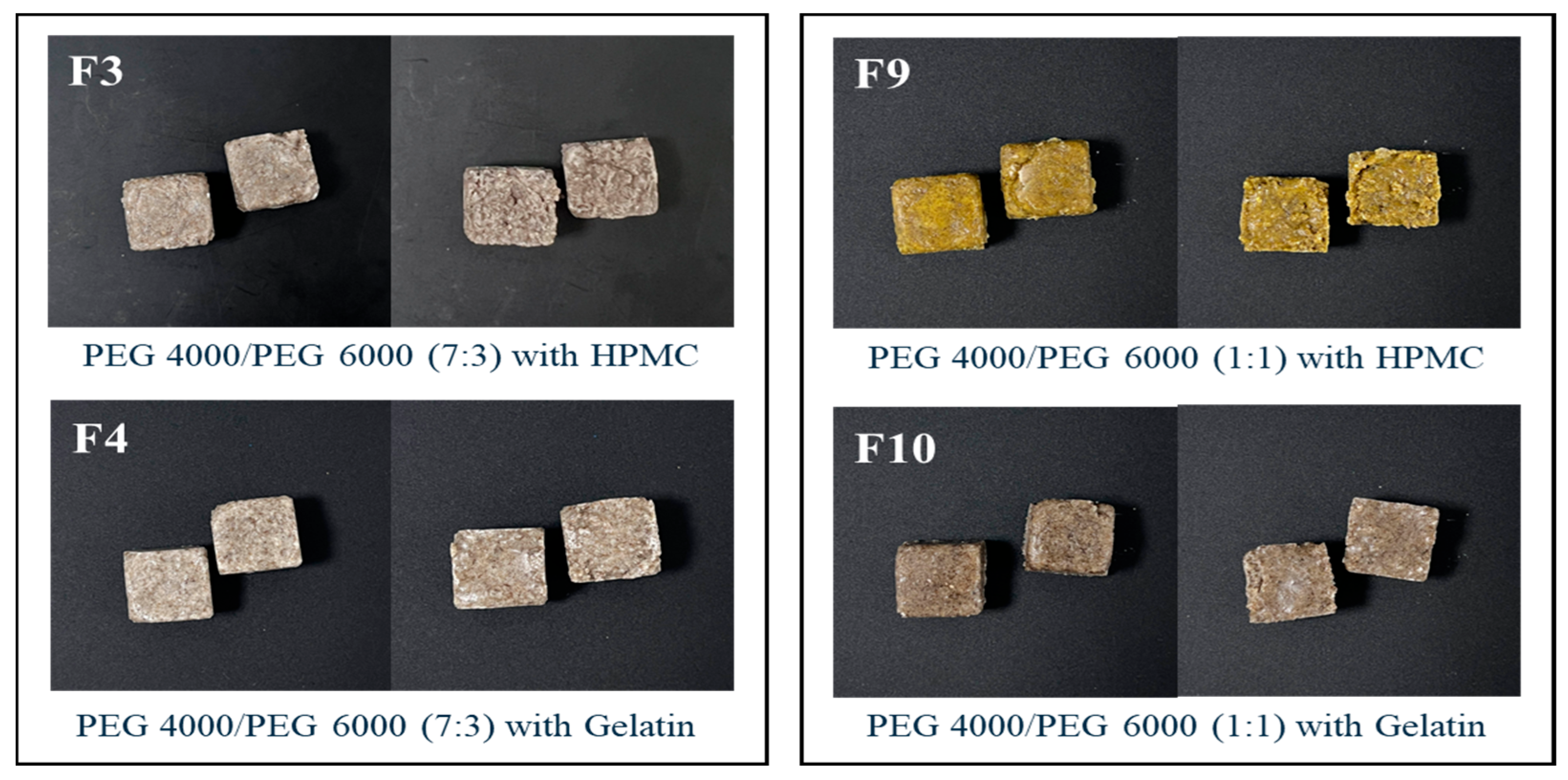
Based on the preliminary assessment, formulations F3, F4, F9, and F10 in Figure 1 demonstrated improved homogeneity and better integration of gelatine or HPMC within the PEG base and were therefore selected for further development. These findings highlight the importance of excipient compatibility and proper incorporation techniques in achieving uniform lozenge formulations. Optimisation of gelatine hydration and incorporation into PEG base is essential to prevent granularity and ensure consistent texture and quality of the final BL.
Further evaluation of the selected formulations revealed that BL containing gelatine exhibited a powdery texture, indicating incomplete dissolution and the presence of granules. In contrast, formulations containing HPMC displayed a smooth and uniform surface. This observation may be attributed to the better dispersion and matrix formation ability of HPMC compared with gelatine [49]. In addition, lozenges with higher proportions of PEG 4000 and PEG 6000 demonstrated improved weight consistency and reduced brittleness, likely due to the ability of the higher molecular weight PEG to form a more stable solid matrix during cooling [50]. Among the tested formulations, F3 was selected as the optimised BL formulation due to its favourable physical characteristics among other formulations. The excipients were uniformly dispersed, and the BL were firm enough to retain their shape without being brittle.
No phase separation was observed, and the formulation could be easily poured into moulds and handled without sticking or crumbling, indicating good manufacturability for potential scale-up. The optimised performance of F3 may be attributed to the balanced ratio of PEGs and HPMC, which facilitated uniform excipient dispersion and effective matrix formation. The resulting BL displayed a smooth and homogenous surface with no visible defects or undissolved particles. Therefore, formulation F3 was selected as the final formulation and used for subsequent stability, physicochemical, and functional evaluations.
PEG is widely used in oral pharmaceutical formulations due to its low toxicity, miscibility with aqueous fluids, and compatibility with many poorly water-soluble compounds. High-molecular-weight PEGs can act as a diluent or hydrophilic carrier in solid formulations. However, precipitation of dissolved compounds may occur when PEG is used alone, therefore hydrophilic polymers or surfactants are often incorporated to improve stability and dispersion of active compounds [51].
Moreover, HPMC and gelatine are common hydrophilic polymers used in oral formulations as binding agents. HPMC generally provides sustained drug release, whereas gelatine facilitates a faster release mechanism [49,52]. When higher molecular weight diluents such as PEG 4000 and PEG 6000 are used, the addition of gelatine may contribute to reduced disintegration time. However, HPMC was selected for the final formulation due to the presence of granules and poor gel formation observed in the gelatine-containing formulations.
Additionally, HPMC exhibits greater moisture resistance compared to gelatine, which helps to preserve moisture-sensitive active ingredients [53]. This observation is supported by studies showing that gelatine-based formulations stored at 75% relative humidity showed reduced hardness compared to HPMC-based formulations [53]. Therefore, incorporating HPMC as a binder may enhance the stability of phenolics and antioxidant-based compounds [54], which is particularly beneficial for BIL formulations rich in phenols and other bioactive compounds.
Many oral formulations, particularly lozenges, require sweeteners and flavourings to mask the bitter or unpleasant taste of the active ingredient and other excipients. However, conventional sweeteners used in lozenges were found to be cariogenic and may contribute to enamel demineralisation and dental caries with frequent consumption [55]. Therefore, stevia (Stevia rabaudiana) was incorporated as the sweetener in the lozenge formulation. Stevia is a natural non-nutritive sweetener, containing steviol glycosides that provide intense sweetness without significant caloric contribution. In addition to its sweetening properties, stevia has been reported to exhibit antimicrobial activity against Streptococcus mutans, Streptococcus sobrinus, and Lactobacillus acidophilus, which are associated with dental caries in children [56]. Therefore, its inclusion may improve palatability while potentially supporting oral health.
Other excipients used in minute amounts included magnesium stearate and xanthan gum. Magnesium stearate acts as a lubricant and anti-adherent, preventing the lozenges from sticking to manufacturing equipment during processing [57]. Lastly, xanthan gum is a common food additive that functions as a viscosity enhancer and prevents sedimentation of compounds within formulations [58]. This property facilitates the uniform distribution of BIP within the lozenge matrix, thereby contributing to improved formulation and better consistency.

3.2. Physical Evaluation of Banana Inflorescence Lozenges

Formulation F3 was selected to prepare 30 BILs. Among these, 20 lozenges were randomly selected for weight variation analysis. Thickness, hardness, and friability were evaluated using 10 randomly selected lozenges, while the disintegration time was determined using six lozenges. The physical parameters of the optimised BILs are presented in Table 2. The average weight of the lozenges was 2.50 g, with a percentage weight variation ranging from +3.37% to −4.81%. The average thickness was 10.39 mm, with a percentage variation between +3.31% and −3.23%. The mean hardness of the lozenges was 55.16 kg/cm2, with a percentage friability of 0.13%. The average disintegration time of the lozenges was 35 min.
According to the United States Pharmacopoeia (USP), the acceptable percentage deviation for the tablet weight and thickness is ±5%, while friability should not exceed 1.0%. The formulated BILs complied with these pharmacopeial requirements, indicating consistency of weight and good mechanical strength. Disintegration time refers to the duration required for a solid dosage form to break down completely, leaving no residue on the apparatus except fragments of insoluble coating [59]. As stated in USP’s guidelines for dietary supplements, lozenges are expected to disintegrate within approximately 30 min in the oral cavity [60]. However, in the present study, the optimised formulation F3 exhibited a slightly longer disintegration time of 35 min. A prolonged disintegration time may influence the release kinetics and systemic availability of bioactive compounds, including phenolics, other antioxidant bioactive compounds, and minerals, as disintegration plays a critical role in determining the dissolution profile of solid dosage forms [61]. The disintegration time is largely influenced by the type and proportion of excipients used in the formulation.
PEG 4000 and PEG 6000 have been shown to enhance the thermal stability of heat-sensitive bioactive compounds, including flavonoids and polyphenols [62], which are abundant in BI. A previous study on amoxicillin trihydrate oral lozenges formulated with approximately 80% (w/w) PEG 4000 reported a hardness of 1.2 kg/cm2, although the disintegration time was not described [40]. In comparison, the BIL developed in the present study exhibited a hardness of 55.16 kg/cm2, which may be attributed to differences in excipient composition, such as an increased amount of PEG and xanthan gum, which can enhance hardness along with the polymer matrix structure, and the presence of insoluble plant-solids from BIP. Previous studies have also shown that increasing PEG 4000 concentration from 10 to 20% can significantly prolong the disintegration time [63]. Therefore, the relatively higher concentration of 70% of PEG 4000 (w/w) used in the present study may have contributed to the extended disintegration profile observed. Overall physical evaluation demonstrated that the optimised BIL formulation possessed adequate mechanical stability and complied with USP requirements, indicating its suitability as a potential nutraceutical delivery system.

3.3. Fourier Transform Infrared Attenuated Total Reflectance (FTIR-ATR) Analysis

FTIR-ATR analysis was used to confirm the presence of BI in the formulated lozenges and to evaluate the compatibility of the active ingredients with the excipients used in the formulation. The analyses were performed on individual excipients (PEG 4000, PEG 6000, HPMC, stevia, magnesium stearate, and xanthan gum), as well as on BIP. Figure S3 illustrates the individual FTIR spectra of the excipients, BIP, and BILs, with their corresponding functional groups listed in Table 3.
Each excipient exhibited distinct characteristic peaks indicating its structural functional groups. According to the spectra, PEGs exhibit characteristic absorption peaks at around 2880 cm−1, 1466 cm−1, 1340 cm−1 (C-H stretching vibrations) as well as 959 cm−1 (C-C stretching vibrations), and 840 cm−1 (CH2 rocking vibrations) [64]. The spectrum of HPMC exhibited peaks at 3441 cm−1, 2896 cm−1, and 1049 cm−1, corresponding to O-H stretching, C-H stretching, and C-O-C stretching vibrations, respectively [65]. In the spectrum of stevia, the sharp peak at 1051 cm−1 indicates C-O-C stretching of ether groups within the sugar ring, confirming the presence of glycosidic bonds [66]. Magnesium stearate can be characterised by two twin peaks, corresponding to C-H stretching vibrations (2914 and 2848 cm−1) and COO– stretching vibrations (1571 and 1539 cm−1) [67]. Lastly, xanthan gum is characterised by COO– stretching vibrations at 1600 and 1404 cm−1, which are indicative of the glucuronic acid and pyruvate groups in its side chain [68]. BI, being a plant-derived material rich in cellulose and other polysaccharides, shows several characteristic peaks corresponding to cellulose structures, including O-H stretching (3281 cm−1), C-H and CH2 stretching (2917 and 2849 cm−1), C-H bending (1375 cm−1), and C-O and O-H stretching (1030 cm−1) [69]. The FTIR spectra of the formulated lozenges showed characteristic peaks corresponding to both BIP and the formulation excipients. Absence of significant peak shifts, disappearance of peaks or formation of new peaks indicates that no major chemical interactions occurred between the active and excipients. This confirms that the functional groups of BIP remained intact during the formulation process, demonstrating the physicochemical compatibility of the active ingredient with the selected excipients [70].
When comparing the FTIR spectra of the BL, BIP, and BILs, several similar peaks were observed. Based on Table 4, most peaks corresponding to the excipients remain unchanged, while some peaks of BIP were not clearly observed. This may be due to the relatively low concentration of BIP (5% w/w) in the formulations, causing the spectra to be predominantly influenced by the excipient matrix. However, there is a broad peak at 3381 cm−1 in the BIL indicates O-H stretching vibrations associated with the BIP.
FTIR-ATR analysis was further used to evaluate the compatibility between the active ingredient and excipients [43] by comparing the spectra of individual components with that of the formulated BIL. The fingerprint region of BILs (1500–500 cm−1) was predominantly influenced by the diluent matrix (PEG 4000 and PEG 6000). As a result, several characteristic peaks of BI appeared weakened or overlapped with the excipients’ peaks. Nevertheless, the presence of BIP in the lozenge formulation was confirmed by the broad peak at 3381 cm−1. Moreover, the absence of new peaks or significant peak shifts confirms the physicochemical compatibility of the excipients with the active ingredient [42]. Overall, these observations collectively confirm that BIP is compatible with the excipients used in the BIL.

3.4. Total Phenolic Content

TPC represents the total amount of phenolic compounds in a substance [46] and is commonly used as an indicator of antioxidant potential. In this study, the TPC of BI extract was found to be 47.19 ± 2.37 mg of GAE/g of dry weight, while the BIL extract exhibited a lower value of 22.74 ± 0.74 mg of GAE/g of dry weight, as illustrated in Table 4. A reduction in TPC upon formulation has been previously reported for late-release soft lozenges containing different plant extracts, attributed to the formulation process [71] and possible interaction between bioactive components and the excipients. Specifically, the inclusion of PEG in formulations has been associated with a decrease in phenolic content. This reduction may be associated with the chemical reactivity of PEG, which can promote oxidation reactions through the formation of peroxides and other secondary oxidation products. Such oxidative processes, together with changes in the physical properties of the formulation, may influence the stability and efficacy of phenolic compounds [72]. In addition, the inclusion of stevia in the BILs may also contribute to additional phenolic compounds in the product [73] while simultaneously improving the palatability of the product. A meta-analysis reported that the TPC of stevia can reach up to 71.26 mg GAE/g, depending on the extraction method used [74]. Furthermore, the incorporation of stevia into food products has been shown to increase the overall TPC values [75]. Therefore, inclusion of stevia in the BIL formulation may provide an additional contribution to the phenolic content while improving the palatability of the product.

3.5. Antioxidant Activity

A combination of DPPH and ABTS radical scavenging assays was used to evaluate the antioxidant activity of BIP and BIL extracts, as the use of multiple antioxidant assays provides a more comprehensive assessment of antioxidant potential in complex samples [76]. Both DPPH and ABTS activities were determined using Trolox standard calibration curves, and the results were expressed as milligrams of TE per gram of dry weight (mg TE/g DW).
Table 4 presents the antioxidant activity of BIP and BIL extracts determined by DPPH and ABTS assays. The IC50 value obtained from the DPPH assay for BI extract was 46.06 mg/mL, while the lozenge extract exhibited a higher IC50 value of 72.53 mg/mL, indicating relatively lower antioxidant activity in the BIL extract. Similarly, the ABTS radical scavenging assay showed an IC50 value of 6.08 mg/mL for the BI extract, while the lozenge extract exhibited a higher IC50 value of 30.65 mg/mL for the BIL extract. IC50 refers to the concentration of substance required to inhibit 50% of radical activity [77], where a lower IC50 value indicates higher antioxidant activity [78]. Previous studies have reported that the antioxidant capacity determined by the ABTS assay is often higher than that reported by DPPH in food matrices [73] because ABTS radicals can react with both hydrophilic and lipophilic antioxidants, including highly pigmented antioxidants [79]. In agreement with this observation, the TE values obtained from the DPPH assay were lower than those obtained from the ABTS assay in the present study.
The antioxidant activity reported in the present study was relatively lower compared to several previously published studies on banana inflorescence extracts. For instance, ethanol extracts of M. balbisiana inflorescence from Thailand demonstrated a DPPH IC50 value of 27.89 mg/mL, while Musa paradisiaca inflorescence extracts showed an ABTS IC50 value of 2.93 mg/mL [80]. In addition, M. acuminata inflorescence extracts obtained through supercritical CO2-assisted extraction reported a lower DPPH IC50 value of 10.39 mg/mL [81], indicating stronger antioxidant activity than the extracts analysed in the present study. The comparatively lower antioxidant activity observed in this study may be attributed to differences in banana cultivar, geographical origin, extraction methods, and the plant parts used for extraction. Furthermore, oxidative degradation of heat-sensitive phenolic compounds during processing and the dilution effect caused by the relatively high proportion of excipients in the lozenge formulation may have further reduced the antioxidant capacity of the final product.
Similar findings have been reported in previous research on BI extracts, where higher antioxidant activity was observed using the ABTS assay compared to the DPPH assay [82]. In addition, a study on durian peel extracts reported that the antioxidant activity of the crude extract was higher than that of its formulated lozenge [83]. The reduction in antioxidant activity in the BIL formulation may also be attributed to oxidative degradation of bioactive compounds during processing and degradation of heat-sensitive phenolic compounds such as flavanols [84,85]. Furthermore, the presence of some excipients may influence the extraction efficacy of phenolic compounds, which are among the major contributors to free radical scavenging activity. Previous studies have reported that polysaccharides and proteins can form complexes with flavonoids through non-covalent interactions, thereby reducing extraction efficiency and analytical recovery [86].
Despite the reduction in antioxidant activity observed in the BIL formulation, the inclusion of stevia may contribute additional antioxidant capacity. Previous studies have reported that the natural sweetener stevia not only provides sweetness but also exhibits free radical scavenging activities, with the antioxidant activity of stevia leaf extract reported as 67.96 mg TE/g [74,75]. Therefore, although the antioxidant activity of the formulated BIL was lower than the crude extract, the retention of measurable radical scavenging activity suggests that the formulation may still serve as a functional nutraceutical delivery system.

3.6. In Vitro α-Glucosidase and α-Amylase Inhibition Activity

The antihyperglycemic potential of BI and BIL extracts was determined using α-glucosidase and α-amylase inhibition assays. α-glucosidase and α-amylase are key digestive enzymes responsible for the breakdown of complex carbohydrates into glucose. Inhibition of these enzymes can delay carbohydrate digestion and glucose absorption, thereby reducing postprandial blood glucose levels and preventing sudden glycaemic spikes [47]. The percentage inhibition of both α-glucosidase and α-amylase was determined using acarbose as the reference standard.
Table 4 shows the inhibitory activities of both the BI and the BIL extract. In the α-glucosidase assay, the percentage inhibition at a concentration of 20 mg/mL of BI extract was 70.19 ± 1.84%, while the percentage inhibition observed for BIL extract was 45.80 ± 0.78%. In contrast, the α-amylase assay showed that the BI extract exhibited 58.30 ± 2.63% inhibition at 20 mg/mL while the BIL extract exhibited a marked increase in the inhibition of 98.11 ± 0.39%. Overall, the results indicate that the BILs retained inhibitory activity against both digestive enzymes despite the formulation process.
The anti-hyperglycemic potential of BI extracts from six edible Malaysian banana cultivars, including Berangan, has previously been evaluated using both α-glucosidase assay and α-amylase inhibition assays. In that study, the Berangan cultivar exhibited an α-amylase inhibition of 62.58 ± 2.32 and α-glucosidase inhibition of 76.58 ± 0.25, which are higher than the values observed for the BI extract samples used in the present study [15].
A similar study developed a black mulberry leaf lozenge targeting α-glucosidase inhibition in paediatric and geriatric populations, which reported a reduction in the inhibitory activity in the formulated black mulberry lozenges (IC50 549.72 ± 10.45) compared to black mulberry leaf crude extract (IC50 357.60 ± 8.44) [87]. This observation suggests that the formulation process may influence the biological activity of plant-derived bioactive compounds.
The higher α-amylase inhibition observed in the BIL extract compared to BI may not be solely attributed to bioactive phytochemicals but could also be influenced by the formulation matrix. The presence of dietary fibre components, including cellulose [88], may interact with α-amylase through non-specific binding, thereby restricting the enzyme’s accessibility to its substrate. Additionally, the increased viscosity of the reaction environment may further limit enzyme access to starch substrates and inhibit starch hydrolysis [Dhital]. Furthermore, BIL contains approximately 30% (w/w) HPMC, a synthetic derivative of natural cellulose. Due to its structural similarity to cellulose, HPMC may also contribute to α-amylase inhibition by modifying enzyme–substrate accessibility [89]. Moreover, the PEG-based matrix may disrupt substrate–enzyme diffusion, slowing the diffusion of α-amylase towards the sugar complex and resulting in greater inhibition [90,91]. Therefore, the observed inhibitory activity likely reflects the combined effects of bioactive phytochemicals and formulation-related interactions.

3.7. Mineral Content Analysis

Mineral content analysis is crucial in assessing the nutritional and medicinal value of plant-based lozenge formulations [42]. In this study, the BIP and the optimised BIL formulation were analysed using ICP-OES to determine macrominerals including magnesium (Mg), phosphorus (P), calcium (Ca), and potassium (K), and microminerals such as copper (Cu), iron (Fe), zinc (Zn), selenium (Se), and chromium (Cr).
Table 5 presents the mineral content in both BI and BIL samples. The results indicated that both macro and microminerals were retained in the BIL formulation; however, their concentrations were lower compared with the original BIP. Previous studies have reported that BI possesses a balanced macro and micro mineral composition, with potassium being the predominant macromineral detected in both BI and BILs, followed by calcium and magnesium, together with considerable amounts of iron, copper, zinc, chromium, and selenium [7,11]. Among these minerals, BI has been identified as a good source of Zn and Fe while relatively higher level of Cu and Cr have also been reported, highlighting the valorisation potential of this agricultural by-product [11].
This observed reduction in mineral concentration in the lozenge formulation may be attributed primarily to the dilution effect caused by the addition of excipients, which increases the overall mass of the formulation, without proportionally increasing the amount of the active ingredient in the product. In addition, possible mineral losses during thermal processing may also contribute to the reduction [92]. Nevertheless, the formulated BIL retained appreciable levels of essential minerals, suggesting its potential application as a functional dietary supplement.

3.8. Stability Studies

The accelerated stability assessment of lozenges focused on physical appearance, particularly colour change, which is considered an indicator of formulation stability. Colour is a sensitive marker for chemical degradation of the active and excipients in the formulations and noticeable changes can indicate potential instability. Since the lozenges are intended for short term use and contain thermostable excipients, monitoring colour provided a practical and rapid evaluation of their physical integrity under stressed conditions. Future studies may include additional parameters such as moisture content, hardness, and quantification of bioactive compounds to comprehensively evaluate stability. For the stability study, four randomly selected BILs were placed in a stability chamber maintained at 45 °C and 75% relative humidity for 30 days. Figure S2 illustrates the appearance of BILs before and after stability testing. Following 30 days of storage, the BILs displayed slight colour darkening; nevertheless, the dosage form remained intact, with no breakage or crumbling upon gentle handling. Although the duration of the stability study in this research was relatively short, similar studies on lozenge formulations have also conducted the stability testing for 30 days [93]. Any observable changes in the formulation after the 30-day period were recorded.
Several limitations in this study should be taken into consideration. Although the disintegration time was close to the acceptable range, it did not meet the USP criterion of less than 30 min. The stability testing was limited to 30 days; therefore, longer-term studies are required to evaluate the stability of the formulation over extended storage periods. Furthermore, physicochemical analyses were not conducted to assess the shelf-life and chemical stability of the formulated lozenges beyond 30-day stability study. Finally, the physiological relevance and bioavailability of the formulated lozenge could not be confirmed due to the lack of in vivo studies. These limitations highlight the need for extended stability studies and in vivo investigations in future research.

3.9. Limitations and Future Studies

Although the developed lozenge demonstrated acceptable preliminary physicochemical and biological properties, there are some limitations that are discussed. The efficacy of lozenge-based nutraceutical systems depends not only on total bioactive content but also on their release behaviour. Matrix-forming excipients such as HPMC and PEG may influence hydration, swelling, viscosity, and diffusion characteristics, thereby affecting the release profile of phenolic compounds and other bioactives [94]. Therefore, future studies should investigate dissolution profiles under simulated salivary conditions and evaluate release kinetics.
FTIR-ATR analysis primarily detects functional group vibrations and major chemical bond changes, including the formation or disappearance of strong interactions. However, it may not effectively resolve weak molecular interactions such as hydrogen bonding or van der Waals forces, particularly when these do not produce significant peak shifts. In this study, FTIR-ATR provided preliminary information regarding the potential chemical compatibility between the banana-derived extract and excipients based on the presence or absence of major functional group alterations. Nevertheless, it is well established in pharmaceutical formulation science that FTIR alone is insufficient to conclusively confirm compatibility in complex multi-component systems [95]. This limitation arises because FTIR is primarily sensitive to vibrational frequency changes and may overlook subtle electronic interactions or weak intermolecular forces. Spectral overlap in polymer–extract systems can further mask minor shifts, making definitive interpretation challenging difficult. In addition, FTIR does not provide information on critical physical state transitions such as crystallinity changes, amorphization, or polymorphic transformations. Therefore, complementary analytical techniques such as differential scanning calorimetry (DSC), X-ray diffraction (XRD), and thermogravimetric analysis (TGA) are recommended to assess thermal behaviour, structural modifications, and decomposition characteristics. Accordingly, FTIR results in this study should be considered indicative rather than confirmatory evidence of compatibility.
The stability assessment was limited to short-term visual observation over 30 days. In general, plant-based formulations are susceptible to moisture uptake, oxidative degradation, and physicochemical instability, which may affect hardness, colour, and bioactive retention during storage [96]. The observed colour changes may be associated with oxidation of phenolic compounds and Maillard-type reactions involving residual sugars and amino compounds [97]. These processes may also reduce TPC and antioxidant activity over time. Hence, future studies should include accelerated stability studies, along with evaluation of moisture content, microbial quality, and bioactive retention, are necessary to confirm product stability and shelf-life.
Future work should apply statistical optimisation using a design-of-experiments (DoE) approach that relates to formulation variables with hardness, friability and disintegration time.

4. Conclusions

The present study demonstrated the feasibility of incorporating BIP into a hard lozenge formulation with acceptable physical and chemical characteristics. The developed BILs exhibited antioxidant and antidiabetic potential, together with the presence of phenolic compounds and essential minerals, supporting their potential application as a functional nutraceutical supplement. Furthermore, this study highlights the value of utilising banana inflorescence, an underutilised agricultural by-product, as a sustainable approach to biomass valorisation and circular bioeconomy practices. Nevertheless, further optimisation is required to improve disintegration time, enhance bioactive retention, and refine analytical accuracy before the product can be fully developed for nutraceutical applications. Future studies should also include sensory evaluation to assess consumer perception and acceptance.

Supplementary Materials

The following supporting information can be downloaded at https://www.mdpi.com/article/10.3390/biomass6030043/s1, Figure S1: Optimisation of Banana Inflorescence Lozenge Formulations (F1–F11); Figure S2: Banana inflorescence lozenges (A). before (B) after stability studies; Figure S3: FTIR-ATR spectra of (A) xanthan gum, (B) magnesium stearate, (C) stevia, (D) HPMC, (E) PEG 6000, (F) PEG 4000, (G) BIP, and (H) BIL.

Author Contributions

Conceptualization, S.S.N. and P.S.; methodology, C.X.-K.C., L.J.X., N.M.K., M.N.M.N., S.S.N. and P.S.; data collection, C.X.-K.C., L.J.X., N.M.K., M.N.M.N., S.S.N. and P.S.; resources, S.S.N., P.S., N.M.K. and M.N.M.N.; data curation, C.X.-K.C., L.J.X. and A.K.; formal analysis, C.X.-K.C., A.K., L.J.X. and S.S.N.; writing—original draft preparation, C.X.-K.C., S.S.N. and P.S.; writing—review and editing, S.S.N., P.S. and A.K.; visualisation, C.X.-K.C.; supervision, S.S.N. and P.S.; project administration, S.S.N.; funding acquisition, S.S.N. All authors have read and agreed to the published version of the manuscript.

Funding

This research was funded by Taylor’s University, Malaysia, from the Final Year Project Fund of the School of Biosciences. This research was also supported by Taylor’s University through the Taylor’s Internal Research Grant Scheme-Impact Lab Grant (TIRGS-ILG/2/2024/SOB/002).

Data Availability Statement

The original contributions presented in this study are included in the article. Further inquiries can be directed to the corresponding author.

Acknowledgments

C.X.-K.C. conducted this research as part of her undergraduate Final Year Project at the School of Biosciences, Taylor’s University.

Conflicts of Interest

The authors declare no conflicts of interest.

Abbreviations

The following abbreviations are used in this manuscript:
BIBanana inflorescence
BIPBanana inflorescence powder
BILBanana inflorescence lozenge
ABTS2,2’-Azino-bis (3-ethylbenzothiazoline-6-sulfonic acid)
DPPH2,2-Diphenyl-1-picrylhydrazyl
FTIR-ATRFourier Transform Infrared-Attenuated Total Reflectance
PEGPolyethylene glycol
HPMCHydroxypropyl Methylcellulose
IC50Half Maximal Inhibitory Concentration
TETrolox Equivalent
TEACTrolox Equivalent Antioxidant Capacity
TPCTotal phenolic content
GAEGallic Acid Equivalent
DWDry weight
USPUnited States Pharmacopoeia
µgMicrogram
mgMilligram
gGram
cm−1Reciprocal centimetre
kHzKilohertz
minMinute
mLMillilitre
ppmParts per million
rpmRevolutions per minute
w/vWeight per volume
w/wWeight per weight
°CDegree Celsius
HNO3Nitric Acid

References

  1. Alzate Acevedo, S.; Díaz Carrillo, Á.J.; Flórez-López, E.; Grande-Tovar, C.D. Recovery of Banana Waste-Loss from Production and Processing: A Contribution to a Circular Economy. Molecules 2021, 26, 5282. [Google Scholar] [CrossRef]
  2. Kumoro, A.C.; Alhanif, M.; Wardhani, D.H. A Critical Review on Tropical Fruits Seeds as Prospective Sources of Nutritional and Bioactive Compounds for Functional Foods Development: A Case of Indonesian Exotic Fruits. Int. J. Food Sci. 2020, 2020, 4051475. [Google Scholar] [CrossRef]
  3. Statista Bananas—Worldwide|Statista Market Forecast. Available online: https://www.statista.com/outlook/cmo/food/fruits-nuts/fresh-fruits/bananas/worldwide (accessed on 9 August 2025).
  4. Wasay, A. Bananas Global Market Report. 2025. Available online: https://www.thebusinessresearchcompany.com/report/bananas-global-market-report (accessed on 9 August 2025).
  5. Mostafa, H.S. Banana Plant as a Source of Valuable Antimicrobial Compounds and Its Current Applications in the Food Sector. J. Food Sci. 2021, 86, 3778–3797. [Google Scholar] [CrossRef] [PubMed]
  6. Choudhury, N.; Nickhil, C.; Deka, S.C. Comprehensive Review on the Nutritional and Therapeutic Value of Banana By-Products and Their Applications in Food and Non-Food Sectors. Food Biosci. 2023, 56, 103416. [Google Scholar] [CrossRef]
  7. Zou, F.; Tan, C.; Zhang, B.; Wu, W.; Shang, N. The Valorization of Banana By-Products: Nutritional Composition, Bioactivities, Applications, and Future Development. Foods 2022, 11, 3170. [Google Scholar] [CrossRef] [PubMed]
  8. Kumari, P. A Review on Banana, Its Nutritional Components and Bioactive Compounds. Pharma Innov. J. 2023, 12, 663–666. [Google Scholar]
  9. Chandimali, N.; Bak, S.G.; Park, E.H.; Lim, H.-J.; Won, Y.-S.; Kim, E.-K.; Park, S.-I.; Lee, S.J. Free Radicals and Their Impact on Health and Antioxidant Defenses: A Review. Cell Death Discov. 2025, 11, 19. [Google Scholar] [CrossRef]
  10. Lau, B.F.; Kong, K.W.; Leong, K.H.; Sun, J.; He, X.; Wang, Z.; Mustafa, M.R.; Ling, T.C.; Ismail, A. Banana Inflorescence: Its Bio-Prospects as an Ingredient for Functional Foods. Trends Food Sci. Technol. 2020, 97, 14–28. [Google Scholar] [CrossRef]
  11. Senevirathna, N.; Karim, A. Banana Inflorescence as a New Source of Bioactive and Pharmacological Ingredients for Food Industry. Food Chem. Adv. 2024, 5, 100814. [Google Scholar] [CrossRef]
  12. Castillo, M.; de Guzman, M.J.K.; Aberilla, J.M. Environmental Sustainability Assessment of Banana Waste Utilization into Food Packaging and Liquid Fertilizer. Sustain. Prod. Consum. 2023, 37, 356–368. [Google Scholar] [CrossRef]
  13. Oyeyinka, B.O.; Afolayan, A.J. Comparative Evaluation of the Nutritive, Mineral, and Antinutritive Composition of Musa sinensis L. (Banana) and Musa paradisiaca L. (Plantain) Fruit Compartments. Plants 2019, 8, 598. [Google Scholar] [CrossRef]
  14. Rosa, R.H.; Fernandes, M.R.; Melo, E.S.D.P.; Arakaki, D.G.; de Lima, N.V.; Leite, L.C.S.; Espindola, P.R.; de Souza, I.D.; do Nascimento, V.A.; Tschinkel, P.F.S.; et al. Determination of Macro- and Microelements in the Inflorescences of Banana Tree Using ICP OES: Evaluation of the Daily Recommendations of Intake for Humans. Sci. World J. 2020, 2020, e8383612. [Google Scholar] [CrossRef]
  15. Marikkar, J.M.N.; Tan, S.J.; Salleh, A.; Shukri, M.A.M.; Azrina, A. Evaluation of Banana (Musa sp.) Flowers of Selected Varieties for Their Antioxidative and Anti-Hyperglycemic Potentials. Int. Food Res. J. 2016, 23, 1988–1995. [Google Scholar]
  16. Yusof, N.; Gani, H.; Sedik, S.N.H. Antioxidant and Antimicrobial Activities of Pisang Berangan (Musa paradisiaca) Pulp and Peel Extracts. J. Agrobiotechnology 2023, 14, 71–82. [Google Scholar] [CrossRef]
  17. Puri, V.; Nagpal, M.; Singh, I.; Singh, M.; Dhingra, G.A.; Huanbutta, K.; Dheer, D.; Sharma, A.; Sangnim, T. A Comprehensive Review on Nutraceuticals: Therapy Support and Formulation Challenges. Nutrients 2022, 14, 4637. [Google Scholar] [CrossRef]
  18. AlAli, M.; Alqubaisy, M.; Aljaafari, M.N.; AlAli, A.O.; Baqais, L.; Molouki, A.; Abushelaibi, A.; Lai, K.-S.; Lim, S.-H.E. Nutraceuticals: Transformation of Conventional Foods into Health Promoters/Disease Preventers and Safety Considerations. Molecules 2021, 26, 2540. [Google Scholar] [CrossRef] [PubMed]
  19. Shah, F.; Nagaraj, K.; Kamalesu, S.; Radhakrishnan, L.; Venkatachalapathy, R. Advancing Nutraceuticals in a Promising Frontier in Modern Healthcare. Food Humanit. 2024, 3, 100462. [Google Scholar] [CrossRef]
  20. Dama, A.; Shpati, K.; Daliu, P.; Dumur, S.; Gorica, E.; Santini, A. Targeting Metabolic Diseases: The Role of Nutraceuticals in Modulating Oxidative Stress and Inflammation. Nutrients 2024, 16, 507. [Google Scholar] [CrossRef] [PubMed]
  21. Cveticanin, L.; Arsenovic, M. Prediction Models for Diabetes in Children and Adolescents: A Review. Appl. Sci. 2025, 15, 2906. [Google Scholar] [CrossRef]
  22. Ansari, P.; Khan, J.T.; Chowdhury, S.; Reberio, A.D.; Kumar, S.; Seidel, V.; Abdel-Wahab, Y.H.A.; Flatt, P.R. Plant-Based Diets and Phytochemicals in the Management of Diabetes Mellitus and Prevention of Its Complications: A Review. Nutrients 2024, 16, 3709. [Google Scholar] [CrossRef]
  23. Djaoudene, O.; Romano, A.; Bradai, Y.D.; Zebiri, F.; Ouchene, A.; Yousfi, Y.; Amrane-Abider, M.; Sahraoui-Remini, Y.; Madani, K. A Global Overview of Dietary Supplements: Regulation, Market Trends, Usage during the COVID-19 Pandemic, and Health Effects. Nutrients 2023, 15, 3320. [Google Scholar] [CrossRef]
  24. Barretto, J.R.; Gouveia, M.A.D.C.; Alves, C. Use of Dietary Supplements by Children and Adolescents. J. Pediatr. 2023, 100, S31–S39. [Google Scholar] [CrossRef]
  25. Rana, A.; Choudhary, P.; Taneja, N.K.; Dhewa, T.; Aluko, R.E.; Samtiya, M. Plant-Based Bioactive Compounds as Anti-Diabetic Agents: A Concise Review. Next Res. 2026, 9, 101771. [Google Scholar] [CrossRef]
  26. Wang, C.C.; Abdul Jalal, M.I.; Song, Z.L.; Teo, Y.P.; Tan, C.A.; Heng, K.V.; Low, M.S.Y.; Anuar Zaini, A.; Lum, L.C.S. A Randomized Pilot Trial of Micronutrient Supplementation for Under-5 Children in an Urban Low-Cost Flat Community in Malaysia: A Framework for Community-Based Research Integration. Int. J. Environ. Res. Public Health 2022, 19, 13878. [Google Scholar] [CrossRef]
  27. Hong, S. Essential Micronutrients in Children and Adolescents with a Focus on Growth and Development: A Narrative Review. J. Yeungnam Med. Sci. 2025, 42, 25. [Google Scholar] [CrossRef] [PubMed]
  28. Seale, L.A.; Yamanaka, A.B.; Hammond, K.; Lim, E.; Wilkens, L.R.; McFall, P.; Aflague, T.F.; Coleman, P.; Fleming, T.; Shallcross, L.; et al. Dietary Micronutrient Intake and the Prevalence of Metabolic Conditions among Children from the United States–Affiliated Pacific Region in the Children’s Healthy Living Program. Curr. Dev. Nutr. 2024, 9, 104531. [Google Scholar] [CrossRef] [PubMed]
  29. Abedelmaksoud, T.G.; Younis, M.I.; Altemimi, A.B.; Tlay, R.H.; Hassan, N.A. Bioactive Compounds of Plant-Based Food: Extraction, Isolation, Identification, Characteristics, and Emerging Applications. Food Sci. Nutr. 2025, 13, e70351. [Google Scholar] [CrossRef]
  30. Thagunna, B. Banana Blossom: Nutritional Value, Health Benefits and Its Utilization. Rev. Food Agric. 2023, 4, 66–70. [Google Scholar] [CrossRef]
  31. Wahab, N.B.A.; Ismail, S.N.; Abidin, M.H.S.Z. Physicochemical and Sensory Characteristics of Banana Blossom Nuggets. Int. J. Res. Innov. Manag. 2020, 6, 56–66. [Google Scholar]
  32. Wu, W.; Zhu, Q.; Wang, W.; Grierson, D.; Yin, X. Molecular Basis of the Formation and Removal of Fruit Astringency. Food Chem. 2022, 372, 131234. [Google Scholar] [CrossRef]
  33. Ambrose, D.C.P.; Sumithra, V.; Vijay, K.; Vinodhini, K. Techniques to Improve the Shelf Life of Freshly Harvested Banana Blossoms. Curr. Agric. Res. J. 2018, 6, 141–149. [Google Scholar] [CrossRef]
  34. Chee, X.C.; Razali, Z.; Somasundram, C.; Ching, J.J.; Abdullah, E.; Tan, C.H. Effects of Different Ripening Stages on the Physiological, Biochemical, and Sensory Properties of Microwave-Dried Berangan Banana (Musa acuminata). J. Food Meas. Charact. 2025, 19, 8021–8037. [Google Scholar] [CrossRef]
  35. Kunyanee, K.; Ngo, T.V.; Kusumawardani, S.; Luangsakul, N. Enhancing Banana Flour Quality through Physical Modifications and Its Application in Gluten-Free Chips Product. Foods 2024, 13, 593. [Google Scholar] [CrossRef]
  36. Nordin, Z.M.; Bakar, I.A.; Omar, M.N.; Mahmood, A. Effect of Consuming Lactogenic Biscuits Formulated with Banana (Musa X Paradisiaca) Flower Flour on Expressed Breast Milk (EBM) among Lactating Working Women. Food Res. 2019, 4, 294–300. [Google Scholar] [CrossRef]
  37. Elancheran, E.; Jayamuthunagai, J. Functional, Physicochemical and Anti-Oxidant Properties of Dehydrated Banana Blossom Powder and Its. Int. J. ChemTech Res. 2014, 6, 4446–4454. [Google Scholar]
  38. Begum, Y.A.; Deka, S.C. Ultrasound-Assisted Extracted Dietary Fibre from Culinary Banana Bract as Matrices for Anthocyanin: Its Preparation, Characterization and Storage Stability. J. Food Sci. Technol. 2020, 57, 2354–2363. [Google Scholar] [CrossRef] [PubMed]
  39. Amornlerdpison, D.; Choommongkol, V.; Narkprasom, K.; Yimyam, S. Bioactive Compounds and Antioxidant Properties of Banana Inflorescence in a Beverage for Maternal Breastfeeding. Appl. Sci. 2021, 11, 343. [Google Scholar] [CrossRef]
  40. Vidyadhara, S.; Sasidhar, R.; Deepti, B.; Wilwin, E.; Sowjanyalakshmi, B. Formulation and Evaluation of Amoxicillin Trihydrate Lozenges. Dhaka Univ. J. Pharm. Sci. 2015, 14, 61–70. [Google Scholar] [CrossRef]
  41. More, J.; Shinde, S.; Shende, M.; Salunkhe, P. Lozenges Formulation and Evaluation: A Review. Int. J. Pharm. Sci. Res. 2022, 7, 290–298. [Google Scholar]
  42. Dahiya, S.; Garg, M. Optimized Formulation of a Fortified Mineral Supplement from Moringa Oleifera Extract Marc: A Sustainable Waste-To-Value Approach. Food Bioprod. Process. 2025, 153, 200–212. [Google Scholar] [CrossRef]
  43. Pathan, D.; Ziyaurrahman, A.; Memon, S.; Joice, A.; Tamboli, R.; Firake, B.; Siddiqui, A.; Chaudhari, S. Formulation and Evaluation of Medicated Soft Lozenges of Montelukast Sodium. J. Reatt. Ther. Dev. Divers. 2023, 6, 922–927. [Google Scholar] [CrossRef]
  44. Socaciu, C.; Fetea, F.; Ranga, F.; Bunea, A.; Dulf, F.; Socaci, S.; Pintea, A. Attenuated Total Reflectance-Fourier Transform Infrared Spectroscopy (ATR-FTIR) Coupled with Chemometrics, to Control the Botanical Authenticity and Quality of Cold-Pressed Functional Oils Commercialized in Romania. Appl. Sci. 2020, 10, 8695. [Google Scholar] [CrossRef]
  45. Aryal, S.; Baniya, M.K.; Danekhu, K.; Kunwar, P.; Gurung, R.; Koirala, N. Total Phenolic Content, Flavonoid Content and Antioxidant Potential of Wild Vegetables from Western Nepal. Plants 2019, 8, 96. [Google Scholar] [CrossRef]
  46. Wołosiak, R.; Drużyńska, B.; Derewiaka, D.; Piecyk, M.; Majewska, E.; Ciecierska, M.; Worobiej, E.; Pakosz, P. Verification of the Conditions for Determination of Antioxidant Activity by ABTS and DPPH Assays—A Practical Approach. Molecules 2021, 27, 50. [Google Scholar] [CrossRef] [PubMed]
  47. Alqahtani, A.S.; Hidayathulla, S.; Rehman, M.T.; ElGamal, A.A.; Al-Massarani, S.; Razmovski-Naumovski, V.; Alqahtani, M.S.; El Dib, R.A.; AlAjmi, M.F. Alpha-Amylase and Alpha-Glucosidase Enzyme Inhibition and Antioxidant Potential of 3-Oxolupenal and Katononic Acid Isolated from Nuxia oppositifolia. Biomolecules 2019, 10, 61. [Google Scholar] [CrossRef]
  48. Deshwal, G.K.; Gómez-Mascaraque, L.G.; Fenelon, M.; Huppertz, T. Determination of Minerals in Soft and Hard Cheese Varieties by ICP-OES: A Comparison of Digestion Methods. Molecules 2023, 28, 3988. [Google Scholar] [CrossRef]
  49. Vlad, R.-A.; Pintea, A.; Pintea, C.; Rédai, E.-M.; Antonoaea, P.; Bîrsan, M.; Ciurba, A. Hydroxypropyl Methylcellulose—A Key Excipient in Pharmaceutical Drug Delivery Systems. Pharmaceutics 2025, 17, 784. [Google Scholar] [CrossRef]
  50. Rowe, R.C.; Sheskey, P.J.; Quinn, M.E. (Eds.) Handbook of Pharmaceutical Excipients, 8th ed.; Pharmaceutical Press: London, UK, 2021. [Google Scholar]
  51. Gullapalli, R.P.; Mazzitelli, C.L. Polyethylene Glycols in Oral and Parenteral Formulations—A Critical Review. Int. J. Pharm. 2015, 496, 219–239. [Google Scholar] [CrossRef] [PubMed]
  52. Ahmed, J.; Boya, D.; Kamal, H. Formulation of a Fast-Dissolving Oral Film Using Gelatin and Sodium Carboxymethyl Cellulose. Zanco J. Med. Sci. 2020, 24, 338–346. [Google Scholar] [CrossRef]
  53. Magramane, S.; Kállai-Szabó, N.; Farkas, D.; Süvegh, K.; Zelkó, R.; Antal, I. Comparative Evaluation of Gelatin and HPMC Inhalation Capsule Shells Exposed to Simulated Humidity Conditions. Pharmaceutics 2025, 17, 877. [Google Scholar] [CrossRef] [PubMed]
  54. Mrázková, M.; Sumczynski, D.; Orsavová, J. Influence of Storage Conditions on Stability of Phenolic Compounds and Antioxidant Activity Values in Nutraceutical Mixtures with Edible Flowers as New Dietary Supplements. Antioxidants 2023, 12, 962. [Google Scholar] [CrossRef] [PubMed]
  55. Augustinho do Nascimento, C.; Kim, R.R.; Ferrari, C.R.; de Souza, B.M.; Braga, A.S.; Magalhães, A.C. Effect of Sweetener Containing Stevia on the Development of Dental Caries in Enamel and Dentin under a Microcosm Biofilm Model. J. Dent. 2021, 115, 103835. [Google Scholar] [CrossRef]
  56. Peteliuk, V.; Rybchuk, L.; Bayliak, M.; Storey, K.B.; Lushchak, O. Natural Sweetener Stevia Rebaudiana: Functionalities, Health Benefits and Potential Risks. EXCLI J. 2021, 20, 1412–1430. [Google Scholar] [CrossRef] [PubMed]
  57. Hobbs, C.A.; Saigo, K.; Koyanagi, M.; Hayashi, S. Magnesium Stearate, a Widely-Used Food Additive, Exhibits a Lack of in Vitro and in Vivo Genotoxic Potential. Toxicol. Rep. 2017, 4, 554–559. [Google Scholar] [CrossRef]
  58. Mortensen, A.; Aguilar, F.; Crebelli, R.; Di Domenico, A.; Frutos, M.J.; Galtier, P.; Gott, D.; Gundert-Remy, U.; Lambré, C.; Leblanc, J.; et al. Re-Evaluation of Xanthan Gum (E 415) as a Food Additive. EFSA J. 2017, 15, e04909. [Google Scholar] [CrossRef]
  59. Lenz, J.; Fuest, F.; Finke, J.H.; Bunjes, H.; Kwade, A.; Juhnke, M. Tablet Disintegration and Dispersion under in Vivo-like Hydrodynamic Conditions. Pharmaceutics 2022, 14, 208. [Google Scholar] [CrossRef]
  60. Sagala, R.J.; Kambira, P.F.A.; Gunawan, U.; Ambarita, G.O. Optimisation of Lozenge Formulation from Citronella (Cymbopogon nardus (L.) Rendle) Extract with Various Binding Materials Using a Simplex Lattice Design Method. Pharm. Educ. 2023, 23, 194–199. [Google Scholar] [CrossRef]
  61. Markl, D.; Zeitler, J.A. A Review of Disintegration Mechanisms and Measurement Techniques. Pharm. Res. 2017, 34, 890–917. [Google Scholar] [CrossRef]
  62. Tomoaia-Cotisel, M.; Kun, A.-Z.; Rácz, C.-P.; Tomoaia, G.; Mocanu, A.; Forizs, E.; Avram, A.; Rácz, L.-Z.; Pop, L.-C.; Sarkozi, M.; et al. Enhanced Stability of Curcumin and Polyethylene Glycol Composites in the Presence of Flavonoids and Whey Protein Concentrate: Synthesis, Structural Evaluation and Thermal Analysis. J. Therm. Anal. Calorim. 2025, 150, 4093–4105. [Google Scholar] [CrossRef]
  63. Sawafta, O.; Alhadid, S.; Abu Awwad, I.A.; Migdadi, E.; Aljaberi, A. Impact of the Manufacturing Technique on the Dissolution-Enhancement Functionality of PEG4000 in Cilostazol Tablets. Pharmacia 2021, 68, 243–250. [Google Scholar] [CrossRef]
  64. Dai, Z.; Huang, Y.; Yang, H.; Yao, P.; Ni, C. Preparation and Biological Applications of Graphene Oxide Functionalized Water-Based Magnetic Fluids. J. Nanosci. Nanotechnol. 2018, 18, 735–742. [Google Scholar] [CrossRef]
  65. Kida, D.; Gładysz, O.; Szulc, M.; Karolewicz, B. Development and Evaluation of a Polyvinyl alcohol—Cellulose Derivative-Based Film with Povidone- Iodine. Polymers 2020, 12, 1271. [Google Scholar] [CrossRef]
  66. Eliwa, N.E.; Ahmed, M.F. Assessment of the Bioactive Compounds in Gamma Irradiated Stevia (Stevia rebaudiana Bertoni) Leaves. BMC Biotechnol. 2025, 25, 73. [Google Scholar] [CrossRef]
  67. Nep, E.I.; Conway, B.R. Preformulation Studies on Grewia Gum as a Formulation Excipient. J. Therm. Anal. Calorim. 2011, 108, 197–205. [Google Scholar] [CrossRef]
  68. Said, M.; Haq, B.; Al Shehri, D.; Rahman, M.M.; Muhammed, N.S.; Mahmoud, M. Modification of Xanthan Gum for a High-Temperature and High-Salinity Reservoir. Polymers 2021, 13, 4212. [Google Scholar] [CrossRef] [PubMed]
  69. Boukir, A.; Mehyaoui, I.; Fellak, S.; Asia, L.; Doumenq, P. The Effect of the Natural Degradation Process on the Cellulose Structure of Moroccan Hardwood Fiber: A Survey on Spectroscopy and Structural Properties. Mediterr. J. Chem. 2019, 8, 179–190. [Google Scholar] [CrossRef]
  70. Diño, S.F.; Edu, A.D.; Francisco, R.G.; Gutierrez, E.; Crucis, P.; Lapuz, A.M.; Carandang, R.R.; Miranda, K.J. Drug-Excipient Compatibility Testing of Cilostazol Using FTIR and DSC Analysis. Philipp. J. Sci. 2023, 152, 2129–2137. [Google Scholar] [CrossRef]
  71. Yıldız, Ö.; Vahapoğlu, B.; Marangoz, M.A.; Güven, E.Ç.; Bayındırlı, A. Determination of Phenolic Compound Profiles and Antioxidant Effect of Plant Extracts on Late-Release Soft Lozenge. J. Nutr. Food Sci. 2021, 3, 167–174. [Google Scholar]
  72. Al Nachar, K.; Hasian, J.; Agha, I.H. Effect of Excipients on the Phenolic Content in Pumpkin Leaf Extracts after Their Introduction into Semisolid Pharmaceutical Forms and Evaluation of in Vitro Stability. Jordan J. Pharm. Sci. 2025, 18, 853–861. [Google Scholar] [CrossRef]
  73. Simlat, M.; Ptak, A.; Wójtowicz, T.; Szewczyk, A. The Content of Phenolic Compounds in Stevia rebaudiana (Bertoni) Plants Derived from Melatonin and NaCl Treated Seeds. Plants 2023, 12, 780. [Google Scholar] [CrossRef]
  74. Papaefthimiou, M.; Kontou, P.I.; Bagos, P.G.; Braliou, G.G. Integration of Antioxidant Activity Assays Data of Stevia Leaf Extracts: A Systematic Review and Meta-Analysis. Antioxidants 2024, 13, 692. [Google Scholar] [CrossRef]
  75. Bender, C.; Killermann, K.; Rehmann, D.; Weidlich, H. Effect of Stevia rebaudiana Bert. Addition to the Antioxidant Activity of Red Raspberry (Rubus idaeus L.) Juices. Beverages 2018, 4, 52. [Google Scholar] [CrossRef]
  76. Larsen, P.; Ahmed, M. Evaluation of Antioxidant Potential of Honey Drops and Honey Lozenges. Food Chem. Adv. 2022, 1, 100013. [Google Scholar] [CrossRef]
  77. Aykul, S.; Martinez-Hackert, E. Determination of Half-Maximal Inhibitory Concentration Using Biosensor-Based Protein Interaction Analysis. Anal. Biochem. 2016, 508, 97–103. [Google Scholar] [CrossRef]
  78. Hussen, E.; Endalew, S.A. In Vitro Antioxidant and Free-Radical Scavenging Activities of Polar Leaf Extracts of Vernonia Amygdalina. BMC Complement. Med. Ther. 2023, 23, 146. [Google Scholar] [CrossRef]
  79. Floegel, A.; Kim, D.-O.; Chung, S.-J.; Koo, S.I.; Chun, O.K. Comparison of ABTS/DPPH Assays to Measure Antioxidant Capacity in Popular Antioxidant-Rich US Foods. J. Food Compos. Anal. 2011, 24, 1043–1048. [Google Scholar] [CrossRef]
  80. Aiemcharoen, P.; Wichienchot, S.; Sermwittayawong, D. Antioxidant and Anti-Diabetic Activities of Crude Ethanolic Extract from the Banana Inflorescence of Musa (ABB Group) Namwa Maliong. Funct. Foods Health Dis. 2022, 12, 161. [Google Scholar] [CrossRef]
  81. Rosli, N.F.S.; Chong, G.H.; Talib, A.A.; Kamaruddin, M.S.H.; Umanan, F.; Hadzir, N.H.N. Extraction of Phenolic Compounds from Banana Inflorescence (Musa acuminata) Using Supercritical Carbon Dioxide. J. Biochem. Microbiol. Biotechnol. 2025, 13, 81–87. [Google Scholar] [CrossRef]
  82. Dias Bertoco Júnior, F.; Marusa Pergo Coelho, É.; Feiten, M.C.; Bolanho Barros, B.C. Ultrasound-Assisted Extraction of Phenolic Compounds and Flavonoids from Banana Inflorescence and Characterization of Its Fibrous Residue. Separations 2025, 12, 109. [Google Scholar] [CrossRef]
  83. Sadeer, N.B.; Montesano, D.; Albrizio, S.; Zengin, G.; Mahomoodally, M.F. The Versatility of Antioxidant Assays in Food Science and Safety—Chemistry, Applications, Strengths, and Limitations. Antioxidants 2020, 9, 709. [Google Scholar] [CrossRef]
  84. Kaewjumpol, G.; Srisamlee, S.; Beckles, D.M.; Luengwilai, K. Enzymatic Browning in Banana Blossoms and Techniques for Its Reduction. Horticulturae 2021, 7, 373. [Google Scholar] [CrossRef]
  85. Tuárez-García, D.A.; Galván-Gámez, H.; Erazo, Y.; Zambrano, C.E.; Rodríguez-Solana, R.; Pereira-Caro, G.; Sánchez-Parra, M.; Moreno-Rojas, J.M.; Ordóñez-Díaz, J.L. Effects of Different Heating Treatments on the Antioxidant Activity and Phenolic Compounds of Ecuadorian Red Dacca Banana. Plants 2023, 12, 2780. [Google Scholar] [CrossRef]
  86. Savic, S.; Petrovic, S.; Knezevic-Jugovic, Z. Separation Strategies for Polyphenols from Plant Extracts: Advances, Challenges, and Applications. Separations 2026, 13, 46. [Google Scholar] [CrossRef]
  87. Budiman, A.; Sofian, F.F.; Santi, N.M.W.S.; Aulifa, D.L. The Formulation of Lozenge Using Black Mulberries (Morus nigra L.) Leaf Extract as an α-Glucosidase Inhibitor. J. Pharm. Bioallied Sci. 2020, 12, 171–176. [Google Scholar] [CrossRef]
  88. Dhital, S.; Gidley, M.J.; Warren, F.J. Inhibition of α-Amylase Activity by Cellulose: Kinetic Analysis and Nutritional Implications. Carbohydr. Polym. 2015, 123, 305–312. [Google Scholar] [CrossRef]
  89. Huang, A.N.; Cheng, H.H.; Hsu, W.Y.; Huang, C.C.; Kuo, H.P. Transition from Binder to Matrix-Forming: The Effect of Hydroxypropyl methylcellulose Concentration on the Properties of Starch/Hydroxypropyl methylcellulose Granules Prepared in a High Shear Granulator. J. Taiwan Inst. Chem. Eng. 2020, 113, 46–55. [Google Scholar] [CrossRef]
  90. Esimbekova, E.N.; Torgashina, I.G.; Nemtseva, E.V.; Kratasyuk, V.A. Enzymes Immobilized into Starch- and Gelatin-Based Hydrogels: Properties and Application in Inhibition Assay. Micromachines 2023, 14, 2217. [Google Scholar] [CrossRef]
  91. Ostrowska, N.; Feig, M.; Trylska, J. Varying Molecular Interactions Explain Aspects of Crowder-Dependent Enzyme Function of a Viral Protease. PLoS Comput. Biol. 2023, 19, e1011054. [Google Scholar] [CrossRef]
  92. Nguyet, N.T.M.; Thuy, D.T.; Tuan, N.N.; Quoc, L.P.T. Effects of Storage, Preparation and Heat Treatment on Water Soluble Vitamins and Minerals of Sauropus androgynous. Curr. Res. Nutr. Food Sci. J. 2022, 10, 685–697. [Google Scholar] [CrossRef]
  93. Chaithanya, A.P.; Prothibha, D.; Ajith Babu, T.K.; Adila, K.K.; Ansifa; Ansiya, S.; Mohammed Hafiz, K.M. Formulation and Evaluation of Herbal Lozenges for Pharyngitis. World J. Pharm. Res. 2020, 9, 1400–1409. [Google Scholar]
  94. Singh, P.; Mishra, G.; Dinda, S.C. Natural Excipients in Pharmaceutical Formulations. In Evidence Based Validation of Traditional Medicines; Mandal, S.C., Chakraborty, R., Sen, S., Eds.; Springer: Singapore, 2021; pp. 829–869. [Google Scholar]
  95. Pasieczna-Patkowska, S.; Cichy, M.; Flieger, J. Application of Fourier Transform Infrared (FTIR) Spectroscopy in Characterization of Green Synthesized Nanoparticles. Molecules 2025, 30, 684. [Google Scholar] [CrossRef] [PubMed]
  96. Hamed, R.R.; Musafer, A.; Eltayib, E.M.; Ayed, M.; Hussien, R.A.; Alshehri, R.F.; Alhamod, M.; Alkhaldi, B. Designing, Characterization, and Optimization of Nystatin Loaded Mucoadhesive Spanlastical Hard Candy Lozenges as a Treatment of Oral Candidiasis: An In-Vivo Study on Rats. Drug Des. Dev. Ther. 2025, 19, 3293–3321. [Google Scholar] [CrossRef] [PubMed]
  97. Michalska-Ciechanowska, A.; Brzezowska, J.; Dolores, M.; López-Parra, M.B.; Montero, L.; Nicolet, N.; Turkiewicz, I.P.; Andlauer, W. Impact of Thermal Processing and Carbohydrate Carriers on Amino Acids, Sugars, Phenolic Compounds, and Maillard Reaction Markers Relevant to Nutritional Quality and Safety of Rosa canina L. Juice Powders. Molecules 2025, 30, 3805. [Google Scholar] [CrossRef] [PubMed]
Figure 1. Banana inflorescence lozenge formulation batches (F3, F4, F9, F10).
Biomass 06 00043 g001
Table 1. Composition of BL formulations.
BatchPEG 4000 (mg)PEG 6000 (mg)HPMC (mg)Gelatine (mg)Stevia (mg)Xanthan Gum (mg)Magnesium Stearate (mg)Flavouring Agents (Drops)
w/w%603030.51q.s.
F14501050750-7512.5252
F24501050-7507512.5252
F31050450750-7512.5252
F41050450-7507512.5252
F501500750-7512.5252
F601500-7507512.5252
F715000750-7512.5252
F815000-7507512.5252
F9750750750-7512.5252
F10750750-7507512.5252
F11 *150150-7007512.5252
* F11: Gelatine bloomed with 2 mL of water before incorporating with other excipients.
Table 2. Physical parameters of BILs.
Properties
Weight (g)2.50 ± 0.066
Thickness (mm)10.39 ± 0.25
Hardness (kg/cm2)55.16 ± 5.32
Friability (%)0.13 ± 0.30
Disintegration time (min)35 ± 1.26
All values are presented as mean ± standard deviation (SD) of triplicate analyses (n = 3).
Table 3. FTIR peaks of excipients, banana inflorescence powder, and banana inflorescence lozenges.
ComponentTransmittance (cm−1)Functional Group
PEG 40002880.425,
1466.100,
1340.792, 1278.648
C-H stretching and bending
1147.195, 1983.965C-O stretching
959.874C-C stretching
840.676CH2 rocking vibrations are specific to the crystalline form of PEG.
2881.238,
1466.097,
1340.612, 1278.701
C-H stretching and bending
PEG 60001146.821, 1095.341C-O stretching
958.442C-C stretching
840.676CH2 rocking vibrations specific to the crystalline form of PEG.
3441.339O-H stretching
HPMC2896.175C-H stretching
1049.679C-O-C asymmetric stretching
3224.330O-H stretching
2910.376,
2926.871,
2955.768, 2969.999
C-H stretching
Stevia1051.009C-O-C stretching ether groups within the sugar ring derived from steviol and glycoside, indicating glycosidic bond.
2914.981, 2848.875Twin peaks relating to C-H stretching vibrations
Magnesium stearate1571.487, 1539.607Twin peaks relating to asymmetric carboxylate (COO–) stretching vibration and symmetric carboxylate stretching vibration.
3288.261O-H stretching
Xanthan Gum1600.579, 1404.612Asymmetrical carboxylate (COO–) stretching and symmetrical carboxylate stretching, indicative of the glucuronic acid and pyruvate groups in the side chains of the molecule.
3281.351O-H stretching vibrations in the crystalline fraction of cellulose.
BIP2917.935, 2849.776C-H and CH2 stretching vibrations indicative of the crystalline fraction of cellulose.
1375.824C-H bending vibration
1030.969C-O and O-H stretching vibrations of polysaccharide in cellulose
3381.504O-H stretching vibrations in the crystalline fraction of cellulose, indicative of BI.
BIL2882.360, 1466.107, 1340.424, 1278.824C-H stretching and bending, indicative of PEG.
1144.910, 1100.903C-O stretching, indicative of PEG.
946.447C-C stretching, indicative of PEG.
841.122CH2 rocking, indicative of PEG.
Table 4. Total phenolic content, antioxidant activity, and antihyperglycemic activity of BIP and BIL extracts.
SampleTPCIC50DPPHTEACDPPHIC50ABTSTEACABTSAGAA
BI Extract47.19 ± 2.3746.061.47 ± 0.146.084.59 ± 0.1770.19 ± 1.8458.30 ± 2.63
BIL Extract22.74 ± 0.7472.530.46 ± 0.0830.650.90 ± 0.0445.80 ± 0.7898.11 ± 0.39
All values are presented as mean ± standard deviation (SD) of triplicate analyses (n = 3). TPC—total phenolic content (mg GAE/g DW), IC50DPPH (mg/mL), TEACDPPH—Trolox equivalent antioxidant capacity of DPPH (mg Trolox/g DW), IC50ABTS (mg/mL), TEACABTS—Trolox equivalent antioxidant capacity of ABTS (mg Trolox/g DW), AG—α-Glucosidase inhibition (%), AA—α-Amylase Inhibition (%).
Table 5. Mineral content in BI and BILs.
MineralSample
BIPBIL
Macrominerals
(mg/100 g)
Mg191.59 ± 1.5045.95 ± 2.30
P274.28 ± 3.2011.11 ± 1.90
Ca294.65 ± 0.2524.42 ± 3.30
K3356.71 ± 1.20251.09 ± 1.56
Microminerals
(mg/100 g)
Cu0.77 ± 4.360.132 ± 3.45
Fe2.88 ± 3.900.81 ± 3.67
Zn3.27 ± 3.270.40 ± 3.20
Se *90.68 ± 2.8962.06 ± 4.39
Cr *29.54 ± 5.6033.13 ± 0.76
All values are presented as mean ± standard deviation (SD) of triplicate analyses (n = 3). * Se, Cr: in µg/100 g.
Disclaimer/Publisher’s Note: The statements, opinions and data contained in all publications are solely those of the individual author(s) and contributor(s) and not of MDPI and/or the editor(s). MDPI and/or the editor(s) disclaim responsibility for any injury to people or property resulting from any ideas, methods, instructions or products referred to in the content.