Entry

Smart Mobility and Last-Mile Rail Integration

College of Management, National Sun Yat-sen University, Kaohsiung 80424, Taiwan
Encyclopedia 2026, 6(1), 26; https://doi.org/10.3390/encyclopedia6010026
Submission received: 22 September 2025 / Revised: 14 November 2025 / Accepted: 26 November 2025 / Published: 20 January 2026
(This article belongs to the Collection Encyclopedia of Digital Society, Industry 5.0 and Smart City)

Definition

Smart-city last-mile rail access, referred to in this entry simply as last-mile access, captures how travelers connect to and from rail stations during the first or last leg of a journey. It encompasses both the design of multimodal connections and the experience of accessibility that results from them. On the supply side, last-mile access involves the coordination of walking, cycling, micromobility, and feeder transit with rail services, supported by digital systems that unify planning, ticketing, and payment. On the demand side, it reflects how efficiently and equitably travelers can reach stations within these coordinated networks. Together, these physical and institutional dimensions extend the functional reach of rail, reduce transfer barriers, and reinforce its role as the backbone of sustainable urban mobility. As cities strive to reduce car dependency while promoting inclusivity and accessibility, last-mile access has become a key indicator of how infrastructure, technology, and governance intersect to deliver more equitable transportation systems.

1. Introduction

Smart cities are increasingly studied in the transport literature as socio-technical systems that align digital technologies with sustainability and citizen-oriented goals. In this paper, the term refers not only to the technological layer of sensors, the Internet of Things (IoT), and analytics, but also to the governance and service-integration capacities that embed these tools in everyday mobility [1,2]. In this perspective, information and communication technologies (ICT), IoT, and data analytics are deployed to optimize networks, manage demand, and reduce environmental externalities. Rail plays a central role in these efforts, as it provides high passenger throughput with relatively low energy use and markedly lower greenhouse gas emissions compared to road or air transport [3,4]. On average, passenger rail requires only one-fifth to one-third of the energy per passenger-kilometer consumed by private cars, and freight rail produces only a fraction of the emissions of equivalent truck transport. Beyond mitigation, rail expansion improves accessibility, air quality, and safety.
The strengths of rail are limited by the reach of the stations and the quality of their connections to the surrounding neighborhoods [5]. This “first-and last-mile problem” describes the distance between trip origins or destinations and the nearest stop. Although often treated together, the two legs pose different challenges: morning first-mile trips from residential areas frequently lack reliable feeder options, while evening last-mile returns face congested curbs and conflicts in the station area. Walking is typically feasible for up to 500–800 m [6], but many residents live or work beyond this threshold, especially in low-density or peri-urban areas. Planning benchmarks are more conservative, often requiring micromobility docks or feeder stops within 300 m of station entrances to ensure practical access [7]. Where connections are inadequate, ridership declines, and vulnerable groups such as older adults, the mobility-impaired, and low-income households bear disproportionate burdens [8,9]. Accessibility is therefore not only a matter of network design but also an equity concern.
Comparative evidence underscores the global scale of this challenge. In European cities, roughly 30–45% of residents live beyond a comfortable walking catchment (≈800 m) of the nearest rail station, with shares rising to 60–70% in lower-density North American metropolitan areas [10,11]. In rapidly urbanizing regions of Asia and Africa, inadequate first-and last-mile connections are associated with rail ridership operating 40–60% below practical capacity, with shortfalls concentrated among low-income households in peripheral neighborhoods [12,13]. These spatial gaps trans-late into tangible welfare losses: households without proximate feeder services routinely face 25–40% longer commute times and reduced access to employment and education [13]. Together, these findings demonstrate that last-mile access is a structural barrier to inclusive mobility, reinforcing the need for integrated approaches that combine spatial design with digital coordination.
This entry synthesizes academic and policy research on smart-city last-mile rail access published primarily between 2015 and 2025. It draws on peer-reviewed research in transport planning, urban studies, and sustainability science, alongside reports from international organizations such as the ITF, OECD, and World Bank, as well as case documentation from metropolitan transport authorities. The synthesis emphasizes conceptual integration rather than systematic review, organizing the evidence around five domains: theoretical foundations, physical and digital infrastructure, implementation models, equity and governance challenges, and sustainability outcomes. Case studies are included to illustrate the spectrum of service models—from public-led and public–private partnerships to technology-driven and informal systems—across diverse geographical and institutional contexts. Indicators cited throughout reflect bench-marks used in policy and planning practice rather than universal standards, situating the discussion in both academic and applied relevance.
To guide readers, the entry is structured to move from conceptual framing to applied synthesis. Section 2 establishes the theoretical foundations linking transit-oriented development (TOD), information and communication technologies (ICT) and intelligent transportation systems (ITS), and Mobility-as-a-Service (MaaS) studies that have evolved largely in parallel. Section 3 identifies the physical and digital components of a smart-city last-mile ecosystem, translating abstract principles into infrastructure and coordination mechanisms. Section 4 examines implementation models—public-led, PPP-based, technology-driven, and informal—illustrated through comparative case studies. Section 5 addresses equity and governance challenges that shape whether technical innovations yield inclusive outcomes, and Section 6 explores sustainability trade-offs across lifecycle emissions, resource recovery, and data governance. Finally, Section 7 synthesizes findings and outlines research pathways for empirical validation. This progression reflects the entry’s dual aim: to consolidate fragmented studies into an integrated conceptual framework and to provide actionable insight for scholars and practitioners seeking to build digitally coordinated, equity-oriented mobility systems.

2. Theoretical Foundations and Historical Context

The challenge of last-mile rail access has evolved in tandem with broader shifts in urban transportation planning. Mid-twentieth-century strategies relied on feeder buses and park-and-ride facilities to extend catchments, later supplemented by bicycle access and pedestrian improvements. These approaches reflected an infrastructure-led paradigm, in which distance was primarily addressed through physical provision. By the late twentieth century, however, rising congestion, fiscal constraints, and environmental concerns had exposed the limitations of infrastructure-only solutions. At the same time, advances in digital technology and governance reforms created scope for more integrated approaches that linked spatial design with data systems and institutional capacity. heories of multimodal coordination, Transit-Oriented Development (TOD), and smart-city innovation now provide complementary foundations to understand the last-mile problem, with key concepts defined in Appendix A for reference.
Information and communication technologies (ICT) and intelligent transportation systems (ITS) situate last-mile access within the broader smart-city agenda. Sensors, data platforms, and adaptive control mechanisms regulate congestion and emissions, while the Internet of Things and machine learning enable predictive analytics and multimodal synchronization [14,15,16]. Yet, effectiveness depends on institutional capacity, trust, and governance, not solely on technical capability [17]. ICT-driven approaches thus combine the promise of real-time optimization with the challenge of embedding digital solutions in complex social systems.
TOD offers a complementary spatial lens, emphasizing how urban form shapes rail access. Higher densities, mixed land use, and pedestrian-oriented design within station catchments are consistently associated with increased ridership and reduced car dependence [18,19]. Beyond design guidance, TOD has a normative orientation, framing accessibility as a central principle of sustainable urban form. Taipei’s application of value capture and land-use incentives in conjunction with rail investment illustrates how TOD can align transport efficiency with broader land-market outcomes [20]. For last-mile access, the insight is that built form and policy shape both demand and social distribution of accessibility.
MaaS emerged as the next stage of this evolution, shifting the focus from physical provision to digital coordination. Rather than introducing a new mode, it reorganizes existing ones by coordinating account-based ticketing, real-time trip planning, and consolidated payments across rail, bus, micromobility, and ride-sourcing providers [21]. Evidence from pilots in Helsinki and Berlin shows reductions in car use and stronger multimodal integration, although persistent obstacles remain around interoperability, governance, and equity [22,23]. In these cases, rail frequently serves as the system’s backbone, illustrating that successful integration depends as much on institutional and regulatory arrangements as on technical platforms.
More recently, debates on city logistics have paralleled passenger-focused approaches by highlighting how the “last segment” of goods delivery generates disproportionate costs and environmental burdens. Interventions such as consolidation centers, cargo bikes, and zero-emission delivery zones demonstrate feasibility and systemic complexity [24,25,26]. Governance, space allocation, and externalities emerge as central concerns, reinforcing a lesson transferable to passenger contexts: technological innovation must be embedded in coordinated institutional frameworks [27].
Taken together, these perspectives highlight how last-mile rail access is shaped by multiple interacting domains of infrastructure, technology, and governance, setting the stage for Section 4, where service models are examined as institutional expressions of these same foundations.

3. Core Components of a Smart-City Last-Mile Access Ecosystem

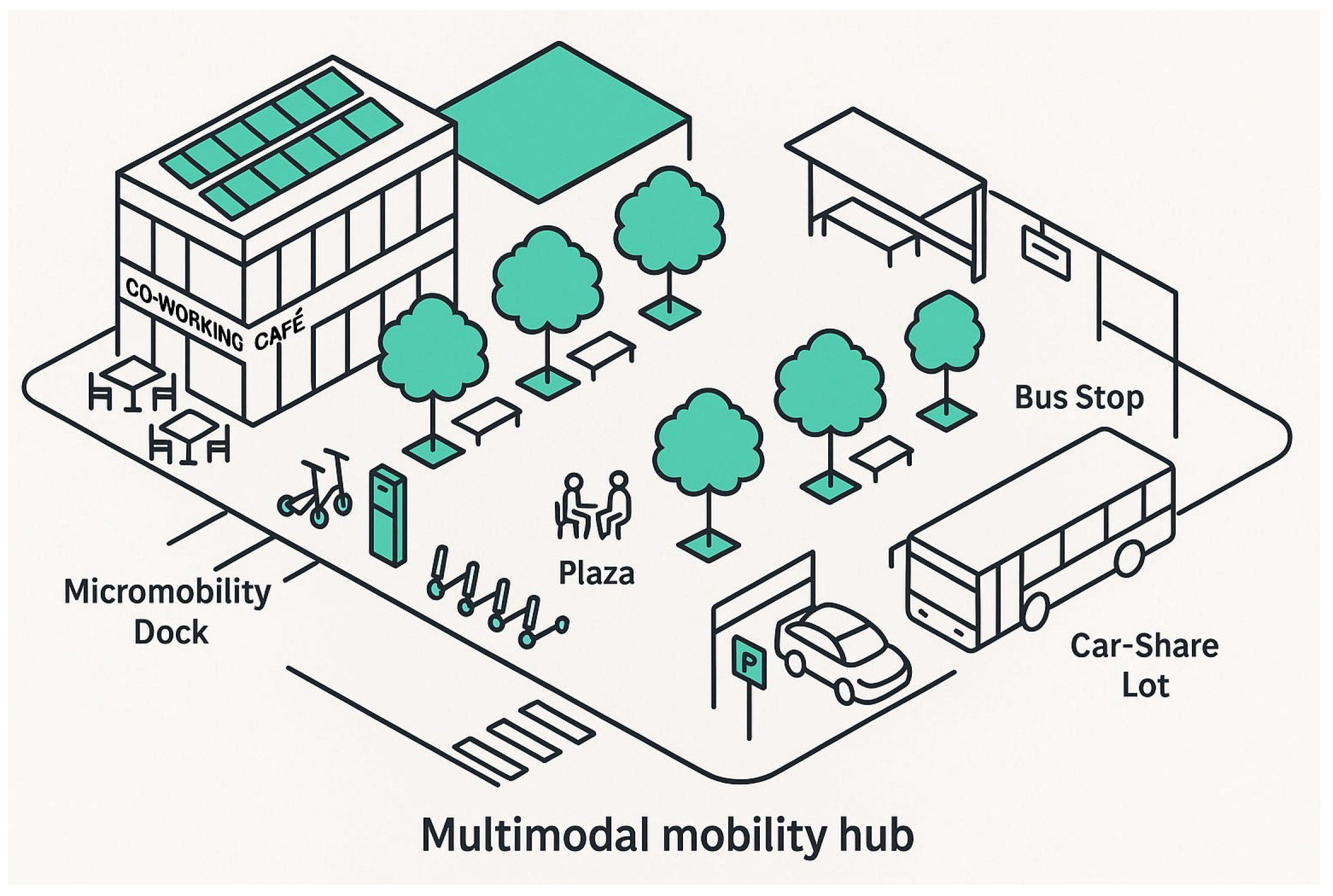
A smart-city last-mile ecosystem, building on the access framework outlined above, integrates physical infrastructure with digital technologies to support seamless connections to rail. Two domains are central: the spatial foundations that enable walking, micromobility, and station-area design, and the digital systems that coordinate planning, ticketing, and operations across modes. Together, these elements constitute the building blocks of efficient and inclusive last-mile access, exemplified in mobility-hub configurations (Figure 1) and assessed using measurable performance benchmarks.

3.1. Physical Infrastructure and Urban Design

The physical setting establishes the conditions for last-mile access. Four elements are especially significant.
Walking and Micromobility. Walking remains the most common form of last-mile access. Studies show that side-walk continuity, separation from traffic, and perceptions of safety strongly influence uptake [28,29]. For cyclists and scooter riders, protected lanes and intersections have become critical. Pre-mid-2010s lane designs in many jurisdictions were dimensioned for conventional bikes, not higher-speed e-bikes or the post-2017 surge in shared e-scooters. Consequently, newer standards specify wider facilities and protected intersections [30,31]. The updated standards now emphasize inclusive safety and efficiency.
Integrated Mobility Hubs. Mid-twentieth-century stations functioned mainly as interchange points, but current practice emphasizes hubs that bring multiple modes and services together in one location. By co-locating bikeshare, e-scooter docks, feeder busses, and car clubs within 100–300 m of station entrances, the hubs extend access beyond the conventional 500–800 m walking buffer [29,32]. Contemporary designs also integrate land-use functions such as co-working cafés and public plazas, alongside user-centered amenities like shaded seating, signage, and wayfinding. Sustainability features, such as solar panels, EV charging, and green roofs, further distinguish these centers as smart infrastructures. Where curb space is constrained, micro-consolidation lockers, cargo-bike bays, and time-windowed loading zones are incorporated to shift freight activity away from station doors and reduce conflicts with pedestrians. When combined with real-time information systems, such hubs not only increase ridership and reduce reliance on private cars but also embody principles of accessibility, inclusivity, and environmental responsibility (Figure 1).
Curb and Space Management. Unmanaged curbs near stations often produce conflicts among buses, taxis, and private vehicles. Recent studies show that unregulated activity contributes to safety risks and congestion [33]. Digital curb management—enabling flexible space allocation through permits, dynamic pricing, and IoT monitoring—improves efficiency and access for vulnerable users, facilitating pickup, drop-off, and freight.
Wayfinding. Signage and navigation tools have long guided passengers, but digital overlays now supplement physical markers. Adequate signage improves legibility, while app-based wayfinding provides real-time orientation and accessibility features [34,35]. For groups such as older adults and those with mobility impairments, clear wayfinding directly affects the usability of rail services.

3.2. Digital Services and Technological Integration

While infrastructure provides access, digital systems increasingly determine how effectively it is used [36,37].
Mobility-as-a-Service Platforms. MaaS pilots such as Helsinki’s Whim and Berlin’s Jelbi show how coordinated ticketing and trip planning can reduce car dependency and support multimodal travel [38,39]. However, their scalability depends less on technical design than on institutional capacity: data-sharing standards, contractual agreements with private operators, and equity measures for users excluded from app-based systems remain central challenges.
IoT and Data Analytics. Sensors and connected devices generate real-time data on vehicle availability, occupancy, and safety. Predictive analytics now allow operators to rebalance fleets proactively, reducing shortages and wait times [40,41]. Whereas rebalancing was historically reactive and labor-intensive, AI-supported forecasting improves reliability and operational efficiency.
Digital–Physical Integration. The convergence of digital and physical systems can enhance usability more than either alone. Hubs equipped with digital signage, smart lockers, and app-linked wayfinding exemplify this approach. When physical and digital cues align, users report greater perceptions of safety and trust, highlighting how last-mile systems are evolving into user-centered ecosystems.

3.3. Performance Indicators

Last-mile access is increasingly evaluated with measurable benchmarks to move beyond descriptive accounts. Five dimensions are especially significant: coverage, access and egress time, equity, sustainability, and governance. These thresholds should not be interpreted as universal standards, but rather as reference points widely cited in planning practice and policy guidance. For example, the 70% station coverage target reflects recommendations in ITF reports rather than empirical consensus, while the 10 min access time is a heuristic adopted in accessibility studies to balance practicality with inclusivity [7,8]. Such benchmarks provide a comparative framework for assessing inclusivity, efficiency, and environmental impact (Table 1).

3.4. Passenger Choices and Preferences

While physical and digital systems determine the availability of last-mile options, actual utilization is driven by how passengers perceive time, cost, safety, and convenience. Mode choice reflects both structural constraints and subjective judgements shaped by age, income, mobility needs, and digital literacy [5,36]. In particular, perceived safety—including lighting, traffic exposure, and crime risk—strongly affects willingness to walk or use micromobility, especially for women and mobility-impaired users [47]. Digital coordination can reduce uncertainty and improve trust: real-time information and integrated ticketing have been shown to shift users toward multimodal access by lowering perceived wait times and simplifying transfers [40].
Preferences also respond to affordability, weather, and environmental values. When shared-mode pricing exceeds a modest share of daily travel budgets, cost-sensitive riders tend to revert to walking or informal services even where higher-quality options exist [5]. Heat, rain, and evening fatigue increase reliance on enclosed feeder services, while sustainability-oriented users increasingly adopt cycling and electrified micromobility when supported by suitable infrastructure. These behavioural dynamics reveal a feedback loop: well-designed hubs and interoperable platforms shape preferences, and evolving preferences signal where governance and infrastructure still fall short. Embedding user-centric behavioral insight in planning is thus fundamental for translating system design into improved access, equity, and rail-based mode shift.

4. Implementation in Practice: Service Models and Case Studies

Implementing smart-city last-mile rail access typically combines public investment with private sector innovation, resulting in service models that balance efficiency, scalability, and equity in different ways. These approaches are best understood along a continuum rather than as isolated categories. On the one hand, fully public-led systems prioritize universal service and direct oversight; on the other hand, informal and hybrid modes rely on community or market provision. Between these poles lie public-private partnerships and technology-driven MaaS platforms, which mix public authority with private sector agility.
Figure 2 illustrates this spectrum, positioning service models along a gradient from fully public-led provision to informal and hybrid systems. The continuum emphasizes that institutional arrangements rarely exist in isolation: public, private, and community roles often overlap, and digital integration can shift models toward new hybrids. This framework highlights that implementation is dynamic, with trade-offs being negotiated differently across various contexts.

4.1. Service Models: Typology and Policy Levers

Four dominant models can be identified in the literature and practice.
Public-led integration. In this model, the state or a public transport authority assumes direct responsibility for last-mile access services. Integration is ensured through co-located infrastructure, fare media compatibility, and low, flat-rate pricing structures. Such systems tend to perform strongly in terms of coverage, equity, and governance; however, innovation may be slower, and financial sustainability often relies on subsidies. Policy levers typically include universal pricing schemes, station-area design standards, and service guarantees in underserved neighborhoods [29,48].
Public–private partnerships (PPPs). PPPs are widely used to integrate micromobility with rail networks [47]. Public authorities provide infrastructure, regulation, and, in some cases, subsidies, while private operators manage fleets, platforms, and maintenance. This division of responsibilities often yields high coverage and efficiency, yet persistent equity gaps remain when private operators prioritize profitable markets. The effective design of PPP depends on contractual requirements such as coverage mandates, equity pricing, and data-sharing obligations [31,49].
Technology-driven MaaS platforms. In this model, the emphasis shifts from physical integration to the digital layer, where a single interface coordinates planning, ticketing, and settlement between multiple providers. Case studies, such as Helsinki’s Whim and Berlin’s Jelbi, highlight how the standardization of data formats and APIs can reduce transfer frictions and make multimodal journeys more attractive [23,38,39]. The policy challenge lies less in designing the platforms themselves than in ensuring interoperability, protecting user data, and extending access to groups without reliable smartphones or bank accounts. Subsidies for digital access, requirements for open standards, and equity-oriented pricing mechanisms represent the principal levers for scaling these systems beyond early pilots.
Informal and hybrid adaptations. In many developing regions, last-mile access often relies on informal modes of transportation, such as shared rickshaws, minibuses, and motorcycle taxis—known locally as matatus, jeepneys, or tuk-tuks. These are not peripheral but constitute the dominant mode of feeder access in much of Sub-Saharan Africa and South and Southeast Asia, where informal paratransit accounts for roughly 40–70% of urban trips and an even larger share of station access in peripheral neighborhoods [50,51]. Increasingly, these services are being digitally coordinated through ride-hailing platforms such as Gojek in Indonesia and Safeboda in Uganda, creating hybrid models that retain the affordability and reach of informal provision while introducing digital payment, GPS tracking, and dynamic routing.
These systems exhibit affordability and responsiveness, but often lack adequate regulatory oversight, fleet renewal, and environmental safeguards. Equity outcomes are mixed: they provide essential access for low-income users yet face challenges of reliability and safety, particularly for women and older passengers. Policy levers include formalization programs that license operators without imposing prohibitive costs, electrification incentives via subsidized battery-swap networks, and data-sharing frameworks that integrate informal providers into coordinated planning processes [50,51]. Their resilience under resource constraints underscores substantial adaptive capacity, but long-term sustainability hinges on governance reforms that formalize operations without eroding flexibility. Viewed comparatively, paratransit highlights that last-mile integration must remain context-specific: approaches successful in Amsterdam or Singapore cannot be transplanted wholesale to Lagos or Mumbai—and vice versa.
Table 2 summarizes how these and other models perform across coverage, access, equity, sustainability, and governance.

4.2. Case Studies Across the Spectrum

These cases are selected to illustrate how public-led, partnership-based, technology-driven, and informal models operate in practice. To avoid reading them as promotional vignettes, the discussion highlights their reported successes, operational costs, ridership impacts, and limitations.
Amsterdam’s OV-fiets. The OV-fiets program exemplifies a fully public-led approach. Operated by the national railway company, bicycles are available at more than 300 stations and accessed directly through the national smartcard. Annual ridership has grown steadily, surpassing five million trips by 2019, and the system now forms an essential feeder to the rail network. Yet its operational model depends on cross-subsidies from rail ticket revenues, raising questions about financial sustainability in contexts without dense cycling cultures or strong national backing [29,48]. In Amsterdam, the scheme succeeds because it builds on pre-existing cycling norms, extensive rail coverage, and a governance framework able to sustain low, flat-rate pricing.
New York City’s Citi Bike. Citi Bike represents a PPP in which the city’s Department of Transportation provides regulation and infrastructure while a private operator manages the fleet and platform. Initial expansion required over $60 million in public investment, and while ridership more than doubled between 2017 and 2022, equity audits show persistent gaps in low-income neighborhoods [49]. The program demonstrates how PPPs can deliver dense coverage and rapid growth, yet service interruptions during operator transitions and reliance on private capital highlight the fragility of the model. Integration with curb management and data-sharing agreements illustrates the potential for efficiency gains, but the challenge of equitable distribution remains unresolved.
Singapore’s SimplyGo MaaS platform. Singapore illustrates a technology-driven approach, with the Land Transport Authority partnering with private operators to develop the SimplyGo app. The platform integrates rail, bus, taxis, and micromobility into a unified payment and journey-planning system. Development costs exceeded S$40 million, but early evaluations report a 12% increase in feeder bus trips to mass rapid transit (MRT) stations relative to pre-app baselines [38]. Digital inclusion programs and targeted subsidies mitigate exclusion risks, though user feedback highlights uneven adoption and periodic system instability. SimplyGo thus demonstrates the promise and limits of centralized governance in scaling MaaS solutions.
Mumbai and Lagos paratransit. In contexts with limited formal integration, informal systems dominate. In Mumbai and Lagos, shared rickshaws and minibuses are increasingly linked to ride-hailing apps, producing hybrid models that expand affordability and spatial reach. These systems excel in responsiveness but operate with aging fleets, inconsistent fares, and limited environmental oversight. Pilot efforts to electrify vehicles or regulate fares have struggled with capital barriers and weak enforcement [50,51]. Their resilience under resource constraints underscores the adaptive capacity of informal providers, yet also illustrates how sustainability and equity hinge on targeted governance reforms.
Viewed together, these cases highlight that performance is not explained solely by service design, but by contextual enablers. Amsterdam leverages its cycling culture and national subsidies, New York grows rapidly but struggles with equity, and Singapore’s governance sustains integration at a high cost. At the same time, Mumbai and Lagos demonstrate adaptive capacity under weak regulation. Success, therefore, depends as much on institutional and cultural conditions as on technical or financial models (see Table 3 for a comparative summary).

5. Challenges and Equity Considerations

The effectiveness of last-mile rail access depends not only on the physical and digital components outlined in Section 3, but also on the institutional and social conditions under which they operate. Even well-designed sidewalks, micromobility hubs, or digital platforms can fail to deliver inclusive outcomes if structural barriers, equity concerns, or sustainability trade-offs remain unaddressed.
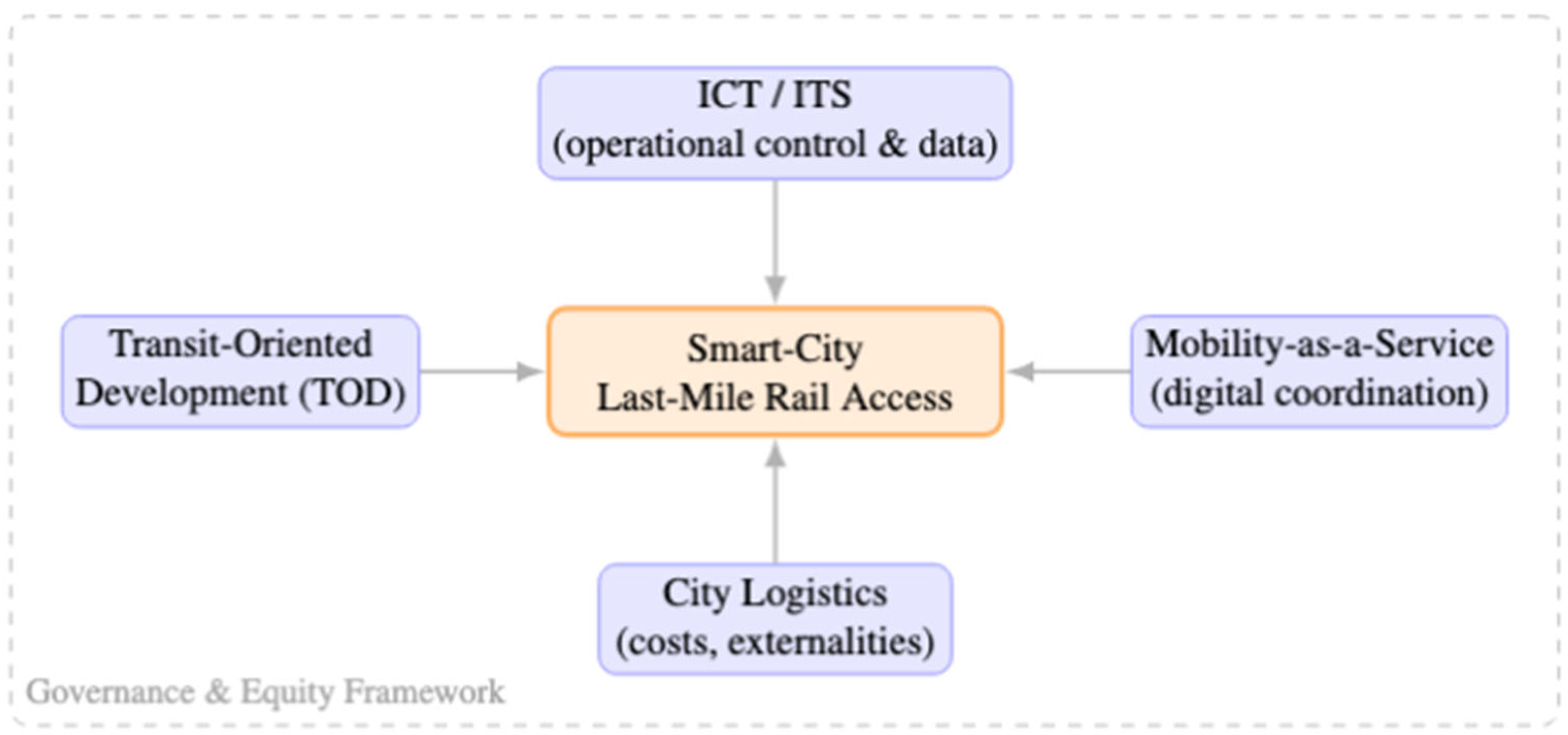
Figure 3 illustrates an integrated framework synthesizing these influences. Transit-oriented development (TOD) provides the spatial foundation; ICT and intelligent transport systems (ITS) enable adaptive operational control; MaaS platforms reduce journey frictions through digital integration; and logistics considerations highlight costs, governance, and externalities. All of these domains operate within the wider constraints of governance and equity. This framework is a reference point for analyzing the challenges and trade-offs discussed in the following subsections.

5.1. Implementation Barriers

Structural and financial constraints persist. Building protected pedestrian corridors, micromobility lanes, charging infrastructure, and digital kiosks often exceeds the fiscal capacity of local governments, especially in rapidly urbanizing regions [3,4]. Public–private partnerships can offset some of these costs, but long-term stability still depends on reliable funding, transparent cost-sharing, and enforceable contracts.
Data governance presents a further obstacle. MaaS platforms rely on continuous data exchange between agencies and private operators, raising concerns about privacy, interoperability, and market power. Regulatory baselines such as the EU’s General Data Protection Regulation (GDPR) provide partial guidance, but U.S. pilots show that fragmented standards still hinder integration [17,24]. Incentives for secure, standardized, and transparent data sharing remain essential.
Digital exclusion compounds these challenges. App-based systems typically require access to a smartphone, digital literacy, and a formal banking account. Yet, around 1.4 billion adults—roughly 24% of the global population—remain unbanked, with rates above 40% in Sub-Saharan Africa and South Asia [52]. Even in high-income countries, elderly and rural residents are often excluded. Without alternatives such as cash ticketing, Short Message Service (SMS) authentication, or staffed kiosks, last-mile access programs risk entrenching inequality.
Passenger and freight flows also compete for limited station space. Stations function as logistics nodes as well as transit gateways, and unmanaged deliveries or ride-hailing pickups during peaks generate congestion, compromise pedestrian safety, and lengthen access times, particularly for mobility-impaired users [10,33]. Mitigation strategies include locating micro-consolidation centers near but not at stations, shifting the final 500–1500 m of freight to cargo bikes, and allocating curbs dynamically or during off-peak hours. Incorporating freight management into last-mile rail planning improves passenger accessibility while reducing local emissions [24,25].

5.2. Equity and Accessibility

Equity is not an isolated concern but a cross-cutting dimension of last-mile access. A structured framework high-lights three dimensions: digital inclusion, geographic coverage, and affordability. Intersectional gender considerations, disability, and safety further shape access.
Digital inclusion. Smartphone penetration remains uneven, and studies show that women, older adults, and low-income groups are disproportionately excluded from app-based services [53]. Policies that mandate alternative access channels—such as smartcards, cash payments, or SMS ticketing—have proven effective in Indian and African cities.
Geographic coverage. Micromobility fleets often concentrate in affluent central neighborhoods, leaving low-income peripheries underserved [29,30]. Equity audits and redistribution mandates are therefore critical. For example, New York City’s Citi Bike program requires a fixed share of docks in outer boroughs to address historical gaps [49].
Affordability. Pricing is a key determinant of participation. San Francisco requires 50% fare reductions on e-scooter trips for qualifying residents, while Bogotá’s BRT feeder system offers discounted access in low-income zones [9,31]. Such measures demonstrate that affordability can be safeguarded without undermining financial viability.
These dimensions can be operationalized through measurable indicators, summarized in Table 4.
By embedding such metrics, equity becomes assessable in the same operational terms as coverage or sustainability.

5.3. Policy Implications

A recurring misconception in transportation policy is that last-mile access represents a largely operational or market-led challenge that requires minimal governance oversight. In reality, the effectiveness of smart-city last-mile systems depends on the institutional frameworks that regulate integration, data sharing, and equitable service delivery. Digital interoperability, open standards, and multimodal coordination cannot emerge organically; they require adaptive regulation and public oversight that align innovation with inclusivity and accountability.
Addressing the implementation barriers and equity gaps identified above, therefore, calls for regulatory frameworks that embed governance capacity at every stage of system design and operation. Drawing on the case studies in Section 4 and the equity metrics in Table 4, five interrelated policy levers emerge as critical.
Mandate equity audits and redistribution. Public authorities should require regular equity assessments disaggregated by income, geography, and demographic group, with contractual requirements for service redistribution where disparities exceed defined thresholds. New York City’s requirement that 50% of new Citi Bike docks be placed in outer boroughs demonstrates how mandates can counteract market-driven concentration in affluent areas [49].
Ensure non-digital access channels. MaaS platforms must provide alternatives to smartphone-based systems, including smartcards, SMS ticketing, cash payment, and staffed kiosks, to prevent exclusion of elderly, low-income, or unbanked populations. Singapore’s SimplyGo includes such provisions, mitigating digital exclusion risks that under-mined early European pilots [38].
Embed community engagement in planning. Top-down deployment fails to align with local needs. Participatory design processes, such as Bogotá’s inclusion of informal-sector representatives in feeder-route planning, enhance legitimacy and public uptake [50]. Governance structures should formalize stakeholder input prior to major service expansions.
Adopt open data standards and interoperability frameworks. Fragmented proprietary systems hinder integration and create vendor lock-ins. Regional standards, such as the EU’s delegated regulations on multimodal travel information, and open APIs lower switching costs and foster competition while safeguarding user privacy [46].
Integrate freight and passenger planning. Station precincts function simultaneously as logistics nodes and transit gateways. Coordinating curb allocation, off-peak delivery windows, and micro-consolidation centers reduces conflicts between freight and passenger flows, improving safety and accessibility for mobility-impaired users [26,33].
Together, these levers demonstrate that effective last-mile access depends not only on technological sophistication but also on governance architectures that align innovation with public interest, regulatory capacity, and social equity. The case evidence in Section 4 indicates that success is more strongly correlated with institutional design and oversight mechanisms than with capital intensity or digital maturity. Sustained progress will require moving beyond the perception of minimal governance toward an understanding of last-mile access as a governed ecosystem in which inclusivity, accountability, and transparency are integral to long-term sustainability.

6. Sustainability and Trade-Offs

While Section 5 highlighted equity and governance as prerequisites for effective last-mile access, sustainability introduces a different but equally decisive dimension. The question is not only whether services are accessible and equitable, but whether they deliver genuine environmental and social benefits once lifecycle, operational, and governance impacts are considered.
This section develops a sustainability assessment structured around four themes: (1) lifecycle emissions, (2) battery recycling and circularity, (3) operational trade-offs, and (4) governance and data risks.

6.1. Lifecycle Impacts

Lifecycle analyses demonstrate that environmental performance depends heavily on manufacturing emissions. For e-bikes and e-scooters, battery production is the dominant contributor, with impacts sensitive to chemistry and energy mix. Lifecycle estimates for e-scooters vary widely (60–100 g CO2-eq per passenger-km), reflecting differences in assumed fleet lifespans, electricity mixes, and whether rebalancing logistics are included [10,45]. Extending service life is one of the most effective interventions, with evidence suggesting that doubling average lifespan can reduce emissions per passenger-kilometer by nearly 40% [45], as illustrated by the comparative figures in Table 5.

6.2. Battery Recycling and Circularity

End-of-life management remains a structural weakness. Global recycling rates for lithium-ion batteries remain very low, typically estimated at 10–15% and rarely exceeding 20%, with significant regional variation [54,55]. Limited recycling capacity generates risks of toxic leaching and undermines the supply security of critical materials such as cobalt and lithium. Policy frameworks in the European Union and China now mandate extended producer responsibility, with targets of 70% material recovery by 2030, though implementation remains uneven [55,56]. Circular economy strategies—such as second-life storage applications and modular battery replacement—are emerging as requirements for aligning micromobility with climate goals.

6.3. Operational Trade-Offs

Operational practices can offset potential sustainability gains. Fleet rebalancing generates emissions comparable to some bus systems when conducted with fossil-fuel vans. By contrast, solutions such as electric cargo bikes, renewable-powered logistics, and swappable batteries have demonstrated reductions of up to 70% in pilot programs [10,25]. Sustainability performance is therefore contingent on vehicle technology and the logistics systems that support it. In station precincts, shifting both service rebalancing and commercial deliveries to zero-emission micro-freight reduces van-kilometers at the curb, simultaneously lowering passenger exposure to conflicts and cutting localized emissions.

6.4. Governance and Data Risks

As Section 5 notes, MaaS platforms raise persistent concerns about privacy, surveillance, and market concentration. From a sustainability perspective, these risks extend beyond access to questions of long-term system resilience. Without transparent data standards and public oversight, cities risk dependency on proprietary platforms and uneven cost distribution across user groups [17,23]. Embedding privacy-by-design principles and mandating open data standards are increasingly seen as necessary complements to technical innovation.
Viewed holistically, sustainability in last-mile rail access cannot be assumed but must be actively managed across design, operations, and governance [57,58]. Lifecycle emissions, battery recycling, fleet logistics, and data governance are leverage points where coordinated policy can determine whether innovations yield genuine environmental and social gains. This underscores that sustainability is not a by-product of technology alone but the outcome of deliberate choices shaping the long-term trajectories of last-mile access systems.

7. Conclusions

7.1. Synthesis of Key Findings

Smart-city last-mile rail access operates as a socio-technical system linking physical design, digital coordination, and governance capacity. Pedestrian and micromobility networks extend the reach of rail stations, while Mobility-as-a-Service (MaaS) platforms unify planning, ticketing, and payment. The effectiveness of these measures depends less on technology itself than on the institutional frameworks that ensure inclusion, data transparency, and equitable service delivery.
In the near term, scaling proven interventions—such as mobility hubs, digital curb management, and integrated feeder transit—offers immediate gains if implemented with fairness and accountability [10,50]. Over the medium term, automation, data analytics, and circular-economy practices will reshape how cities balance efficiency and sustainability, aligning with international goals such as the EU’s 70% materials-recovery target for 2030 [55]. Over the longer term, adaptive, low-emission last-mile rail systems—supported by IoT-based wayfinding, digital twins of station environments, and widespread electrification—will depend on embedding privacy-by-design and equity safeguards within multimodal governance [23,27].
Ultimately, lasting progress in last-mile rail access will require aligning technological innovation with strong public oversight so that micromobility services, MaaS platforms, and feeder systems strengthen—rather than fragment—the reach, inclusivity, and environmental performance of rail networks. In doing so, the expansion of last-mile integration reinforces both station accessibility and the sustainability of rail-based transport.

7.2. Limitations and Future Research Directions

The parameters of an integrative, encyclopedic synthesis bound this entry. It privileges conceptual breadth and cross-domain coherence over exhaustive coverage of every subtopic or regional case. The literature reviewed spans 2015–2025 and draws from peer-reviewed studies and policy reports that emphasize policy relevance and transferability rather than quantitative generalization [1,10,12]. Accordingly, case studies serve as illustrative contrasts of governance and service models, while the performance indicators referenced are drawn from planning practice and pilot evaluations intended as heuristic benchmarks, not universal standards. These boundaries reflect a deliberate focus on conceptual clarity and applicability across contexts rather than methodological completeness.
Building on this foundation, future research should test the propositions implied here through comparative and longitudinal analyses. Cross-city evaluations can explore how institutional capacity, regulatory design, and cultural context mediate the performance of last-mile access systems [3,4]. Quantitative studies could measure the impact of integrated governance and data standards on accessibility and sustainability outcomes, while longitudinal tracking would reveal how digitalization, micromobility markets, and circular resource systems evolve [10,45]. Extending the framework beyond rail—to bus rapid transit, metro–bus hybrids, and emerging shared-mobility corridors—would also clarify the generalizability of the principles outlined here. Advancing this research agenda will ensure that the next generation of last-mile rail solutions deepens equity, resilience, and sustainability while strengthening rail’s role as the backbone of urban mobility systems.

7.3. Toward Empirical Validation

The frameworks and indicators advanced in this entry provide fertile ground for empirical testing and refinement. Having outlined how physical design, digital coordination, and governance capacity intersect to shape last-mile rail performance, the next step is to translate these conceptual dimensions into measurable constructs. Comparative case studies could evaluate how variations in infrastructure investment—such as the density of micromobility networks or the sophistication of curb management systems—impact ridership patterns, station accessibility, and modal equity across different socioeconomic contexts. Quantitative analyses might examine how contrasting service models, whether publicly led, structured as public–private partnerships, or organized through MaaS platforms, influence station-level connectivity, sustainability, and financial viability. Empirical work is also needed to determine the levels of governance capacity required to sustain integrated multimodal systems and to assess the lifecycle sustainability of emerging feeder and access networks under diverse regulatory and policy environments.
Such inquiries would move the discussion from conceptual integration to empirical validation, converting theoretical indicators into tested performance standards that can inform planning practice and policy design. In doing so, they would close the gap between analytical frameworks and evidence-based decision-making, ensuring that future studies not only describe the evolution of last-mile rail integration but also measure its tangible impacts on station accessibility, ridership equity, and the lifecycle sustainability of multimodal feeder networks.

Funding

This research received no external funding.

Institutional Review Board Statement

Not applicable.

Informed Consent Statement

Not applicable.

Data Availability Statement

No new data were created or analyzed in this study. Data sharing is not applicable to this article.

Acknowledgments

During the preparation of this manuscript, the author used a recent version of ChatGPT 5.2 for copyediting and language refinement. The author has reviewed and edited the output and takes full responsibility for the content of this publication.

Conflicts of Interest

The author declares no conflicts of interest.

Appendix A

Table A1. Key Terms and Definitions.
TermDefinition
Smart cityRefers to a socio-technical system integrating digital technologies (ICT, IoT, data analytics) with governance capacity to advance sustainability and citizen-oriented goals [14,17].
Last-mile rail ac-cess/integrationDescribes the coordination of physical and institutional elements—walking, cycling, micro-mobility, and feeder transit—with rail services, enabling equitable and efficient connectivity to stations. “Integration” refers to coordinating processes, while “access” denotes realized outcomes [7,8,29].
MicromobilityIncludes lightweight personal transportation options such as bicycles, e-bikes, and e-scooters, typically used for short trips and accessing stations [10,30,31].
MaaSMobility-as-a-Service—digital platforms that bundle trip planning, ticketing, and payment across multiple providers to reduce transfer frictions and improve multimodal coordination [20,23,38,39].
TODTransit-Oriented Development—compact, mixed-use urban development emphasizing pedestrian design, density, and high-quality access within station catchments [18,19,20].
Catchment areaThe geographic zone within practical access distance of a station, typically ranging between 500 and 800 m on foot [6,7].
Mobility hubA multimodal interchange co-locating micromobility, feeder buses, car clubs, and user amenities near station entrances, often supported by real-time information and shared payment systems [29,31,32].
Curb managementThe dynamic allocation and regulation of curb space for pick-up/drop-off and freight through permits, pricing, and digital monitoring to reduce conflicts and improve safety and access [10,33].
Governance capacityInstitutional capability to coordinate actors, set and enforce standards, share data securely, and sustain inclusive, multimodal service delivery [10,17,46].

References

  1. Martens, W.; Pham, D.T.H.; Pang, J.M. A computational approach to transparency in corporate governance across borders. VMOST J. Soc. Sci. Humanit. 2023, 65, 51–65. [Google Scholar] [CrossRef]
  2. Martens, W. Beyond the Barriers: Institutional Strength as a Shield in Curbing Earnings Manipulation. 2024. Available online: https://ssrn.com/abstract=4963405 (accessed on 19 September 2025).
  3. Craven, N.; Philippe, M.-L. Railways as the Backbone of Environmentally Sustainable Transport and Their Contribution to the Sustainable Development Goals (SDGS); Background paper for plenary session 11; United Nations Centre for Regional Development: Nagoya, Japan, 2017. [Google Scholar]
  4. Sekasi, J.; Martens, M.L. Assessing the contributions of urban light rail transit to the sustainable development of addis ababa. Sustainability 2021, 13, 5667. [Google Scholar] [CrossRef]
  5. Lu, Y.; Kimpton, A.; Prato, C.G.; Sipe, N.; Corcoran, J. First and last mile travel mode choice: A systematic review of the empirical literature. Int. J. Sustain. Transp. 2024, 18, 1–14. [Google Scholar] [CrossRef]
  6. Streb, M. Walkable neighbourhoods: Building in the right places to reduce car dependency. Sustrans. 2022. Available online: https://www.walkwheelcycletrust.org.uk/media/10520/walkable-neighbourhoods-report.pdf?utm_source=chatgpt.com (accessed on 18 September 2025).
  7. Viegas, J.; Martinez, L. Transition to Shared Mobility; International Transport Forum, OECD: Paris, France, 2017; Available online: https://www.itf-oecd.org/sites/default/files/docs/transition-shared-mobility.pdf (accessed on 19 September 2025).
  8. Kåresdotter, E.; Page, J.; Mörtberg, U.; Näsström, H.; Kalantari, Z. First mile/last mile problems in smart and sustainable cities: A case study in stockholm county. Mobil. Plan. Support Syst. 2022, 29, 115–137. [Google Scholar] [CrossRef]
  9. Alfaris, R.E.; Patel, D.; Jalayer, M.; Meenar, M. Barriers associated with the first/last mile trip and solutions to bridge the gap: A scoping literature review. Transp. Res. Rec. 2024, 2678, 38–48. [Google Scholar] [CrossRef]
  10. Forum, I.T. Integrating Public Transport into Mobility as a Service; OECD Publishing: Paris, France, 2021. [Google Scholar]
  11. Currie, G.; Adli, S.N.; Chowdhury, S.; Shiftan, Y. Evaluating spatial justice in rail transit: Access to terminals by foot. J. Transp. Land Use 2018, 11, 45–60. [Google Scholar] [CrossRef]
  12. Bank, W. Transforming the Urban Space Through Transit-Oriented Development: The 3v Approach; World Bank Group: Washington, DC, USA, 2017; Available online: https://www.worldbank.org/en/topic/transport/publication/transforming-the-urban-space-through-transit-oriented-development-the-3v-approach (accessed on 18 September 2025).
  13. Chetty, R.; Hendren, N. The Impacts of Neighborhoods on Intergenerational Mobility I: Childhood Exposure Effects. Q. J. Econ. 2018, 133, 1107–1162. [Google Scholar] [CrossRef]
  14. Gracias, J.S.; Parnell, G.S.; Specking, E.; Pohl, E.A.; Buchanan, R. Smart cities—A structured literature review. Smart Cities 2023, 6, 1719–1743. [Google Scholar] [CrossRef]
  15. Watts, S.; Hoa, N.T.T.; Martens, W.; Doan, D.T.; Guzman, A. An examination of internet of things in the south korean agricultural industry: The case of samsung. World Rev. Entrep. Manag. Sustain. Dev. 2024, 20, 374–396. [Google Scholar] [CrossRef]
  16. Elassy, M.; Al-Hattab, M.; Takruri, M.; Badawi, S. Intelligent transportation systems for sustainable smart cities. Transp. Eng. 2024, 16, 100252. [Google Scholar] [CrossRef]
  17. Lyons, G.; Davidson, C. Guidance for transport planning and policymaking in the face of an uncertain future. Transp. Res. Part A: Policy Pr. 2016, 88, 104–116. [Google Scholar] [CrossRef]
  18. Renne, J.L. Evaluating transit-oriented development using a sustainability framework: Lessons from perth’s network city. In Transit Oriented Development; Edward Elgar Publishing: Cheltenham, UK; Routledge: Oxfordshire, UK, 2005; pp. 115–151. [Google Scholar]
  19. Cervero, R. Transport Infrastructure and the Environment in the Global South: Sustainable Mobility and Urbanism. J. Reg. City Plan. 2014, 25, 174–191. [Google Scholar] [CrossRef]
  20. Yen, B. Transit-oriented development strategy in Taiwan. Asian Transp. Stud. 2022, 9, 100094. [Google Scholar] [CrossRef]
  21. Jittrapirom, P.; Caiati, V.; Feneri, A.-M.; Ebrahimigharehbaghi, S.; González, M.J.A.; Narayan, J. Mobility as a Service: A Critical Review of Definitions, Assessments of Schemes, and Key Challenges. Urban Plan. 2017, 2, 13–25. [Google Scholar] [CrossRef]
  22. Alliance, M. Main Challenges Associated with Maas & Approaches for Overcoming Them; MaaS Alliance Governance Business Models Working Group: Brussels, Belgium, 2019. [Google Scholar]
  23. Moyano, A.; Tejero-Beteta, C.; Sánchez-Cambronero, S. Mobility-as-a-service (maas) and high-speed rail operators: Do not let the train pass! Sustainability 2023, 15, 8474. [Google Scholar] [CrossRef]
  24. Shaheen, S.; Cohen, A.; Dowd, M.; Davis, R. A Framework for Integrating Transportation into Smart Cities; Report 19–29; Mineta Transportation Institute, College of Business, San José State University: San José, CA, USA, 2019. [Google Scholar] [CrossRef]
  25. Forum, W.E. Transforming Urban Logistics: Sustainable and Efficient Last-Mile Delivery in Cities. Available online: https://reports.weforum.org/docs/WEF_Transforming_Urban_Logistics_2024.pdf (accessed on 19 September 2025).
  26. Pritchard, J.P.; Martinez, L. The Final Frontier of Urban Logistics: Tackling the Last Metres; International Transport Forum: Paris, France, 2024; Available online: https://www.itf-oecd.org/sites/default/files/docs/final-frontier-urban-logistics.pdf (accessed on 19 September 2025).
  27. Maas, B. Literature Review of Mobility as a Service. Sustainability 2022, 14, 8962. [Google Scholar] [CrossRef]
  28. O’SUllivan, S.; Morrall, J. Walking Distances to and from Light-Rail Transit Stations. Transp. Res. Rec. J. Transp. Res. Board 1996, 1538, 19–26. [Google Scholar] [CrossRef]
  29. Geurs, K.T.; La Paix, L.; Van Weperen, S. A multi-modal network approach to model public transport accessibility impacts of bicycle-train integration policies. Eur. Transp. Res. Rev. 2016, 8, 25. [Google Scholar] [CrossRef]
  30. Oeschger, G.; Carroll, P.; Caulfield, B. Micromobility and public transport integration: The current state of knowledge. Transp. Res. Part D Transp. Environ. 2020, 89, 102628. [Google Scholar] [CrossRef]
  31. Shaheen, S.; Cohen, A. Shared ride services in North America: Definitions, impacts, and the future of pooling. Transp. Rev. 2019, 39, 427–442. [Google Scholar] [CrossRef]
  32. Nash, C. European rail reform and passenger services—the next steps. Res. Transp. Econ. 2010, 29, 204–211. [Google Scholar] [CrossRef]
  33. Lim, J.; Masoud, N. Dynamic usage allocation and pricing for curb space operation. Transp. Sci. 2024, 58, 1252–1276. [Google Scholar] [CrossRef]
  34. Ahn, S. Evaluating the impact of improvement of wayfinding at a train station. In Proceedings of the Australasian Transport Research Forum (ATRF) 2017 Proceedings, Auckland, New Zealand, 27–29 November 2017. [Google Scholar]
  35. Wang, W.; Wang, Z.; Li, Y.; Mao, Z.; Feng, D. Evaluation and improvement of rail station name list signage on platform for direction by vr experiments with eye-tracker. Int. J. Ind. Ergon. 2025, 109, 103781. [Google Scholar] [CrossRef]
  36. Nagy, S.; Csiszár, C. The quality of smart mobility: A systematic review. Sci. J. Silesian Univ. Technology. Ser. Transport. 2020, 109, 117–127. [Google Scholar] [CrossRef]
  37. Justin, M.P.; Wil, M.; Bui, N.M.C. Online learning for vietnamese hospitality and tourism university students during a time of COVID-19. VNU J. Sci. Educ. Res. 2022, 38. [Google Scholar] [CrossRef]
  38. Meloni, I.; Musolino, G.; Piras, F.; Rindone, C.; Russo, F.; Sottile, E.; Vitetta, A. Mobility as a Service: Insights from pilot studies across different Italian settings. Transp. Eng. 2024, 18, 100294. [Google Scholar] [CrossRef]
  39. Smith, G. Public-private maas: Unchallenged assumptions and issues of conflict in Sweden. Res. Transp. Econ. 2023, 99, 101123. [Google Scholar] [CrossRef]
  40. Malik, F.A.; Dala, L.; Khalid, M.; Busawon, K. Intelligent real-time modelling of rider personal attributes for safe last-mile delivery to provide mobility as a service. Appl. Sci. 2022, 12, 10643. [Google Scholar] [CrossRef]
  41. Miftah, M.; Desrianti, D.I.; Septiani, N.; Fauzi, A.Y.; Williams, C. Big data analytics for smart cities: Optimizing urban traffic management using real-time data processing. J. Comput. Sci. Technol. Appl. 2025, 2, 14–23. [Google Scholar] [CrossRef]
  42. Ferguson, B.; Sanguinetti, L. Integrating micromobility with public transit: A case study of the California bay area. Transp. Res. Rec. 2023. [Google Scholar] [CrossRef]
  43. Li, A.; Gao, K.; Zhao, P.; Axhausen, K.W. Integrating shared e-scooters as the feeder to public transit: A comparative analysis of 124 European cities. Transp. Res. Part C Emerg. Technol. 2024, 160, 104496. [Google Scholar] [CrossRef]
  44. Baumgartner, C.; Helmers, E. Life cycle assessment of electric kick scooters: Consolidating environmental impact quantification and concluding climate-friendly use options. Environ. Sci. Eur. 2024, 36, 96. [Google Scholar] [CrossRef]
  45. Carvalho, M.L.; Temporelli, A.; Brivio, E.; Brambilla, P.C.; Mela, G.; Girardi, P. Batteries in motion: A life cycle assessment and critical resource use analysis of micromobility vehicles with primary Li-ion battery data. J. Energy Storage 2025, 125, 116965. [Google Scholar] [CrossRef]
  46. ERTICO—ITS Europe (Ed.) Mobility as a Service (Maas) and Sustainable Urban Mobility Planning; ERTICO—ITS Europe: Brussels, Belgium, 2019; Available online: https://urban-mobility-observatory.transport.ec.europa.eu/system/files/2023-11/maas_and_sustainable_urban_mobility_planning.pdf (accessed on 19 September 2025).
  47. Oeschger, G.; Caulfield, B.; Carroll, P. Investigating the role of micromobility for first-and last-mile connections to public transport. J. Cycl. Micromobil. Res. 2023, 1, 100001. [Google Scholar] [CrossRef]
  48. Ma, X.; Yuan, Y.; Van Oort, N.; Hoogendoorn, S. Bike-sharing systems’ impact on modal shift: A case study in Delft, the Netherlands. J. Clean. Prod. 2020, 259, 120846. [Google Scholar] [CrossRef]
  49. New York City Department of Transportation. Curb Management Action Plan. Available online: https://www.nyc.gov/html/dot/downloads/pdf/curb-management-action-plan.pdf (accessed on 18 September 2025).
  50. Organisation for Economic Co-Operation and Development (OECD)/International Transport Forum. Transport Innovations from the Global South. Available online: https://www.oecd.org/en/publications/transport-innovations-from-the-global-south_5f8766d5-en.html (accessed on 19 September 2025).
  51. Beza, A.D.; Demissie, M.G.; Kattan, L. Equity implications of emerging mobility services and public transport coopetition. Res. Transp. Bus. Manag. 2025, 46, 100937. [Google Scholar] [CrossRef]
  52. Bank, W. The Global Findex Database 2021: Financial Inclusion, Digital Payments, and Resilience in the Age of COVID-19; The World Bank: Washington, DC, USA, 2022. [Google Scholar]
  53. Jones, P.; Lucas, K. The social consequences of transport decision-making: Clarifying concepts, synthesising knowledge and assessing implications. J. Transp. Geogr. 2012, 21, 4–16. [Google Scholar] [CrossRef]
  54. Sánchez-Díez, E.; Ventosa, E.; Guarnieri, M.; Trovò, A.; Flox, C.; Marcilla, R.; Soavi, F.; Mazur, P.; Aranzabe, E.; Ferret, R. Redox flow batteries: Status and perspective towards sustainable stationary energy storage. J. Power Sources 2021, 481. [Google Scholar] [CrossRef]
  55. International Energy Agency. Recycling of Critical Minerals: Lithium-Ion Batteries. International Energy Agency, Discusses Current Global Recycling Capacity, Regional Concentration (Especially China), and Emerging Policy Frameworks. 2023. Available online: https://iea.blob.core.windows.net/assets/3af7fda6-8fd9-46b7-bede-395f7f8f9943/RecyclingofCriticalMinerals.pdf (accessed on 18 September 2025).
  56. Srinivasan, S.; Shanthakumar, S.; Ashok, B. Sustainable lithium-ion battery recycling: Technologies, regulatory approaches and future trends. Sustain. Mater. Technol. 2025, 35, e00422. [Google Scholar] [CrossRef]
  57. Martens, W. Navigating complexity: Uncovering the intricate dynamics between intellectual capital, efficiency, and performance in taiwan’s banking sector. Qeios Preprint 2024. [Google Scholar] [CrossRef]
  58. Martens, W. Strategic insights: The paradox of intellectual capital’s role in bank efficiency. Qeios 2024. [Google Scholar] [CrossRef]
Figure 1. Isometric 2D schematic Smart mobility hub illustrating multimodal integration (bus, micromobility, car club), sustainable design (solar panels, green roof, EV charging), and user-centered features.
Encyclopedia 06 00026 g001
Figure 2. Service model continuum for last-mile rail access.
Encyclopedia 06 00026 g002
Figure 3. Framework linking spatial, digital, and logistical domains of last-mile rail access, bounded by governance and equity.
Encyclopedia 06 00026 g003
Table 1. Performance indicators and typical benchmarks for smart-city last-mile rail access.
DimensionTypical Benchmark (With References)
CoverageAt least 70% of rail stations with micromobility docks or feeder services located within 300 m [7,10].
Access and egress timeMedian access or egress time of 10 min or less for most users, with results disaggregated by mode and income group [8,9].
EquityShare of stations in low-income or underserved areas proportional to city demographics (equity ratio ≥ 1.0) [42,43].
SustainabilityLifecycle greenhouse gas emissions from last-mile trips less than 30% of car-based alternatives, including vehicle manufacture, operation, and rebalancing [44,45].
GovernanceCompliance with regional interoperability frameworks and adoption of open data-sharing standards [10,46].
Table 2. Comparative assessment of service models for last-mile rail access across five performance dimensions.
Service ModelCoverageAccessEquitySustainabilityGovernance
Public-ledHighModerateHighModerateHigh
integrationuniversal serviceless flexibleflat-rate pricingfleet dependentdirect oversight
PPPsHighHighModerateModerateModerate
(micromobility)dense coverageflexible, scalableunevenelectrificationcontract dependent
distributionvaries
Tech-driven MaaSHighHighModerate–LowModerate–HighModerate
seamlesslow frictionsdigital exclusionif electrifiedstandards vary
planning
Informal/hybridVariableModerateMixedLowLow
contextaffordable,affordable,weak controlslimited regulation
dependentinconsistentunreliable
ParatransitHighHighHighLow–ModerateLow–Moderate
(formalized)demand-affordable,serveselectrificationformalization
responsiveflexiblelow-incomeemergingvarying
Table 3. Comparative features of selected last-mile service models.
CaseCostsRidership ImpactEquity GapsFailure Modes
Amsterdam OV-fietsSubsidized via rail revenues5 m + trips/year; steady growth Low barriers; strong cycling cultureDependent on subsidy; limited transferability
NYC Citi Bike$60 m + public investmentRidership doubled in 2017–2022Outer-borough gaps persistService interruptions; operator churn
Singapore SimplyGoS$40 m + development costs12% increase in feeder bus tripsDigital exclusion mitigated by subsidiesUneven adoption; technical instability
Mumbai/Lagos para.Low entry cost; weak formal financeHigh mode share; adaptive coverageAffordable but unreliable; safety risksAging fleets; poor environmental controls
Table 4. Equity and accessibility metrics for last-mile rail access.
DimensionIllustrative Metric
Digital inclusionShare of services offering non-app alternatives (cash, smartcard, SMS) (%)
Geographic coverageProportion of stations in low-income or peripheral neighborhoods with last-mile services (%)
AffordabilityShare of discounted or subsidized trips for qualifying groups (%)
IntersectionalityAvailability of gender-sensitive design (lighting, safety features) and accessibility features for persons with disabilities (yes/no)
Table 5. Illustrative lifecycle emissions across transport modes (grams CO2-eq per passenger-km).
Mode.Lifecycle EmissionsSource
Private car (petrol)200–250[10,44]
Urban bus (diesel)80–120[44]
E-scooter60–100[10,45]
E-bike20–40[10]
Disclaimer/Publisher’s Note: The statements, opinions and data contained in all publications are solely those of the individual author(s) and contributor(s) and not of MDPI and/or the editor(s). MDPI and/or the editor(s) disclaim responsibility for any injury to people or property resulting from any ideas, methods, instructions or products referred to in the content.