Entry

Digital Twin for Sustainable Social Housing: Integrating BIM and MMC Towards Industry 5.0

School of Civil Engineering and Construction Management, Adelaide University, Mawson Lakes, SA 5095, Australia
*
Author to whom correspondence should be addressed.
Encyclopedia 2026, 6(2), 30; https://doi.org/10.3390/encyclopedia6020030
Submission received: 15 December 2025 / Revised: 14 January 2026 / Accepted: 20 January 2026 / Published: 26 January 2026
(This article belongs to the Collection Encyclopedia of Digital Society, Industry 5.0 and Smart City)

Definition

MMC has been globally recognised as a promising solution for the current global social housing crisis, although persistent challenges remain in relation to limited early-stage design coordination and chronic design inconsistencies, which often cause costly post-design modifications. In response, digital twinning enabled through BIM has emerged as a compelling approach to tackle these challenges. BIM serves a transformative role in advancing sustainable social housing supply by integrating BIM with advanced smart technologies such as AR/VR, IoT, AI, and robotics. Nevertheless, significant constraints continue to impede a wide adoption of BIM due to technical capacity, organisational readiness, knowledge dissemination, and legal frameworks that support embracing BIM and associated smart technologies. Moreover, a notable knowledge gap persists in the application of BIM-enabled digital twinning across the entire project lifecycle of MMC projects, which may be addressed through the integration of Industry 5.0 principles with BIM, emphasising human-centricity, resilience, and sustainability as foundational pillars for future innovation.

1. Introduction

Social infrastructure plays a vital role in achieving Sustainable Development Goals (SDGs) established by the United Nations (UN) under the 2030 Agenda for global prosperity and sustainability [1]. Among them, social housing supply has been recognised as central to achieving these targets, especially those related to no poverty (SDG 1), reduced inequalities (SDG 10), and sustainable cities and communities (SDG 11) [1,2]. However, growing popularity and rapid urbanisation have resulted in a housing shortage worldwide [3]. This has led to higher housing prices, thereby increasing demand for social housing and exceeding their supply owing to their lower financial burden and greater government support [4]. For example, the declining social housing supply in Europe has led to increased inequality and migration, with an overburdened rate of 11.3%, resulting in a demand for more than 450,000 affordable and energy-efficient housing units [5]. While affordability and homelessness are major issues in the Australian housing market, the National Housing Supply and Affordability Council declared that their social housing supply has been declining for over three decades, with the average waiting time exceeding 10 years in 2024 [6]. Furthermore, over 14 years of unfulfilled social housing supply in the UK have led to the sharpest end of a housing crisis, leaving over 150,000 children in temporary accommodations by 2024 [7]. This shortage has been exacerbated by the COVID-19 pandemic and has led to an increase in remote working, causing households to relocate from central areas to suburbs and rural areas [8]. Furthermore, the pandemic’s impact on the economy has led to higher material prices and labour shortages, resulting in increased costs and prolonged durations for housing construction projects [6]. While the housing crisis must be promptly addressed, the construction of housing has been reported to have the highest environmental impact, accounting for 34% of material consumption, 30% of waste, and 37% of global carbon emissions [9,10]. This highlights the need to address the prevailing social housing shortage through affordable, fast, and sustainable solutions. Hence, Modern Methods of Construction (MMC) have been globally recognised as a solution for social housing supply, especially in the USA, UK, Australia, Singapore, and Hong Kong [11].
MMC can be defined as a range of methods that span from off-site and near-site pre-manufacturing to on-site process improvements, mainly focusing on modular construction, prefabricated panelised systems, and components. The latest UK government mandates to adopt MMC in their Construction Playbook 2022, the government guidance on sourcing and contracting public works projects and programmes where they aim to increase its adoption in social housing from the current 10% to 20% by 2028 with the support of their Affordable Homes Programme, serve as a leading example of the government’s interest in promoting this approach across its housing projects [12,13,14]. This is due to its ability to address the challenges in housing supply, reducing carbon emissions by 82%, achieving 20–30% energy savings, minimising waste to under 1%, reducing project time by 20–60% for quick supply, decreasing project costs by 20–40%, 70% less site labour, and improving both quality and health and safety [15,16,17]. However, recurring issues in prefabrication housing projects have impacted their performance, hindering their adoption and benefits.
MMC projects require early collaboration across the project team and seamless coordination across the supply chain to reach design freeze before moving to the manufacturing stage to harvest its full benefits [18]. However, failure to meet these requirements in projects has resulted in a lack of design, workflow and resource coordination, inefficient decision-making support systems, design errors, logistic delays, and post-design changes in MMC projects [19]. These issues can escalate into interface and connection problems in manufacturing and assembly; leaks and defects resulting from poor design coordination among structural, mechanical, electrical, and plumbing (MEP), and architectural plans; overlooked project requirements; and other defects that necessitate costly, time-consuming, and complex modifications in MMC projects [20,21,22]. In response to these challenges, digital twins enabled by Building Information Modelling (BIM) have emerged as a key solution for integrating MMC in the social housing sector, improving performance, sustainability, and value for money in projects [13].
A digital twin is a virtual representation of a physical asset or system that replicates real-world behaviour to facilitate smart management, design, monitoring, prediction, and optimised operation in the built environment. It comprises five main components: target and digital entity data (2D, 3D, and real-time data, as well as data modelling); setup for modelling, simulation, and analysis; infrastructure, including software, hardware, and other relevant tools that enable system operation; interfaces; and system governance [23]. Accordingly, the scope of digital twinning extends far beyond BIM, providing a user-centric functional platform that collects, processes, generates, and updates real-time data to monitor and evaluate the construction project process and asset performance [24]. However, BIM has been globally recognised as a necessary capability for the delivery of construction projects [25]. In MCC, BIM provides an advanced digital platform for managing critical elements of design, construction, delivery, and supply chain management in modular and prefabrication projects [26]. The diverse capabilities of BIM, including early design coordination and seamless communication across supply chains, make it effective in addressing the issues in MMC projects [27,28]. Furthermore, accurate 3D geometry and rich semantic information are critical components in the digital twin, whereby BIM models reflecting updated real-world data can be identified as an essential component for successful digital twins in the built environment [23,24,29]. As a result, BIM digital twinning with different technologies, including Internet of Things (IoT), sensors, Artificial Intelligence (AI), Virtual Reality (VR), and Augmented Reality (AR), offers a plethora of benefits, including 3D visualisation, stakeholder collaboration, efficient and effective decision-making, information management, automation, smart training, and virtual testing, which serve as major enablers in addressing the prevailing issues in prefabricated housing projects [30]. Hence, recent studies have emphasised its key role in paving the way for Industry 5.0, promoting its principles of human-centricity, supply chain resilience, and environmental sustainability in the construction industry [31].
According to the literature, the key directions for the construction industry to move towards Industry 5.0 include adopting automation and robotics, 3D printing and additive manufacturing, digital twinning (AR/VR, IoT, blockchain and smart sensors), BIM, smart materials and sustainability, and modular and prefabricated construction [32,33]. As a result, MMC has been recognised as the most supportive approach for Industry 5.0 in the construction industry [31], where BIM plays an integral and inseparable role in integrating these technologies into modular and prefabricated construction to improve sustainability and affordability in social housing supply [28,33,34,35]. This underscores the importance of exploring the role of BIM in MMC in facilitating a digital twin for sustainable social housing supply as a step towards Industry 5.0.

2. Smart Technologies for BIM Integration with MMC in Social Housing

The recent interest in MMC and related concepts, such as Design for Manufacture and Assembly (DfMA), has created opportunities for innovation in the design, manufacturing, and construction processes [33,36,37]. However, inefficient decision-making has been a significant issue in prefabricated housing projects, primarily due to stakeholders operating independently within their own systems, leading to ineffective information management [38]. These fragmented workflows, poor interoperability, and lack of real-time data have caused disputes and delays in prefabricated housing projects [39]. In addressing these challenges, BIM plays a vital role in 3D visualisation, schedule simulation (4D), cost analysis (5D), stakeholder collaboration, clash detection, design coordination, lifecycle analysis, energy simulation, risk analysis, and safety and facilities management in housing projects [40,41,42]. Beyond that, the studies highlighted BIM’s ability to integrate with advanced technologies for planning, designing, sensing, tracking, and comparing with real-time data [38,43].
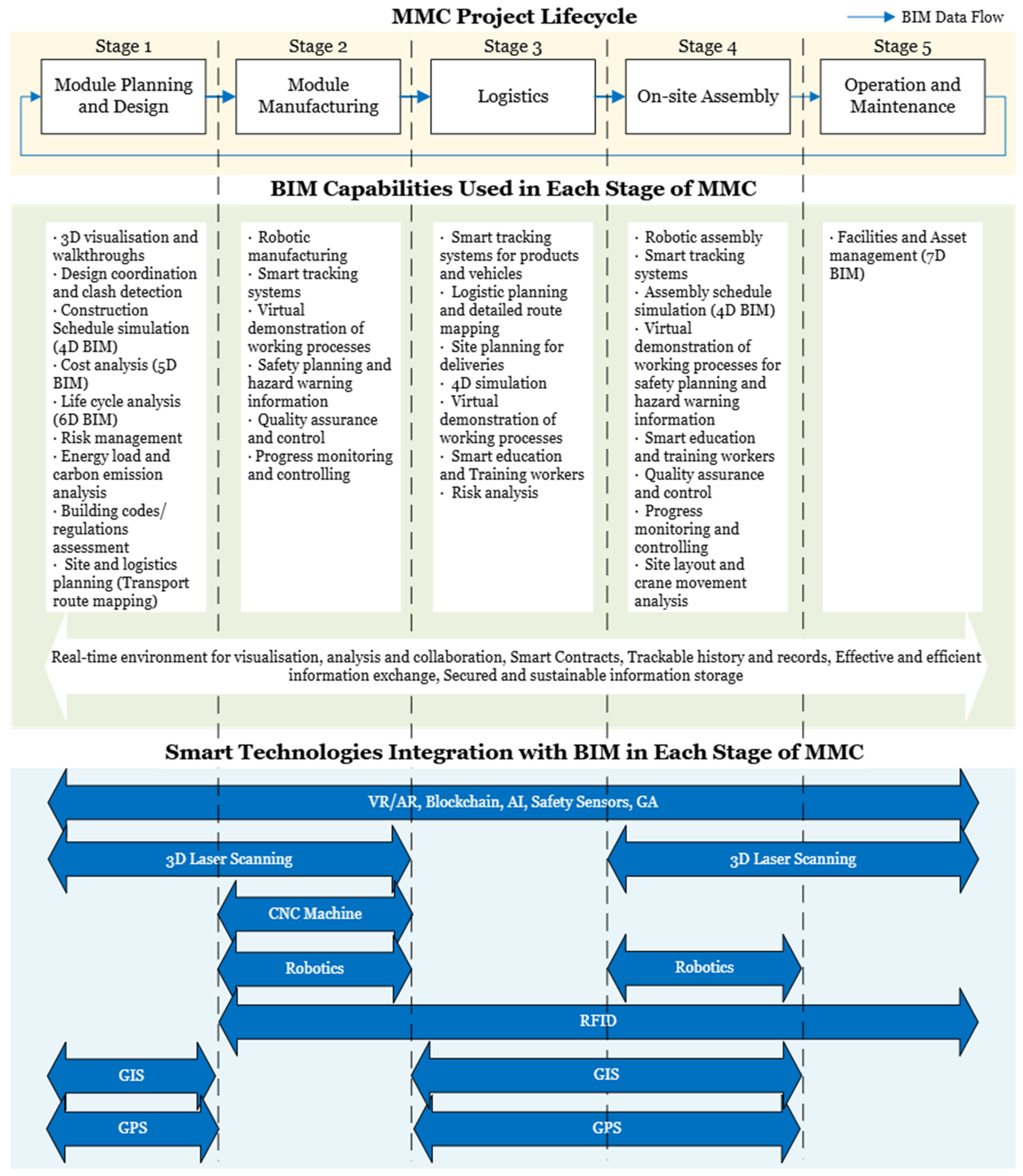
As a result, the BIM adoption has become a trend, pioneering an information revolution in the construction industry [25]. The identified BIM-integrated applications were summarised and reorganised by project stage in Figure 1.
Stage 1—Module Planning and Design: In the design process, BIM promotes the key aspects of MMC approaches, including standardisation, modularisation, and repetition, through BIM libraries [35]. The BIM libraries developed with parametric products enable flexible, user-friendly, and diverse prefabricated house designs with adjustable sizes, joints, and connections, thereby improving human-centric automation and sustainability through reduced repetitive work, minimised waste, and enhanced creativity and productivity [35]. Additionally, BIM enables the generation of solar path diagrams and energy load and carbon emission calculations for energy-efficient designs, material use, and construction [34]. Here, IoT sensors and machine learning can be used to validate real-time data [34]. Virtual sensors provide information such as indoor temperature, humidity, state of building elements, air pollution, sound levels and solar radiation levels [28]. BIM integrated with Genetic Algorithms (GA) facilitate sustainable building envelope designs through testing and optimised design options [28]. The BIM-led sustainable and energy-efficient designs facilitate lower operating and maintenance costs, thereby increasing the affordability of social housing [44]. In site layout planning, BIM can be integrated with Global Positioning System (GPS), Geographic Information System (GIS), GA, and other optimisation algorithms to support data-driven decision-making. This enables the incorporation of positioning, cadastral, and elevation data, including above- and below-ground geographic data (infrastructure and utilities) collected via GPS, 3D laser scanning, and GIS, into BIM using GA to produce 3D land models, a temporary facilities model of the site including yards and sheds, and a tower crane model linked with supply points for the project [45,46]. Here, 3D laser scanning can be used to capture existing site conditions and surrounding buildings [47]. This integration facilitates the integration of spatially enabled digital twinning with 3D and 4D data, as well as property and land-use data, providing an optimal site layout, efficient crane operations, and coordinated site work, improving worker and resource productivity and safety while reducing unnecessary costs and delays in on-site work [45]. BIM facilitates the export of videos demonstrating the construction process and final outcome [47,48]. This further enables construction education, leading to a better understanding of the construction process and communication, thereby reducing project risks [49]. Furthermore, BIM supports the verification and compliance checking of designs against prevailing codes and standards before obtaining approvals [27].
Stage 2—Module Manufacturing: The new generation of BIM platforms, integrated with all relevant information, facilitates seamless integration with robotics and autonomous machines to enhance productivity in factories and on-site work [38]. BIM plugins facilitate the seamless integration of automated systems, including CNC machines, robots, conveyors, and safety sensors, which are crucial in robotic manufacturing, thereby ensuring a safe and efficient manufacturing process [50]. This promotes mass customisation through flexible and cost-effective designs. A Radio-Frequency Identification (RFID)-enabled BIM platform integrates smart construction objects through IoT to support advanced decision-making using real-time data [39,51]. IoT-enabled BIM enables smart construction objects for manufacturing, logistics, and assembly processes, which can be used to develop real-time tracking systems, thereby reducing construction uncertainties [51,52]. The ability of this integration to conduct comprehensive carbon analysis for carbon emission reduction has been proven in the literature [53].
Stage 3—Logistics: BIM linked with GIS and GPS information facilitates detailed route mapping, visualisation, and training workers for component loading, transportation, and unloading components in the project [51]. Here, GIS helps locate products and track the location information of vehicles transporting prefabricated components [38]. Additionally, integrating auto-ID technologies, such as QR codes, also supports linking the BIM model with physical components, enabling the tracking of prefabricated components and efficient logistics [54].
Stage 4—On-site Assembly: According to Zhu et al. [55], BIM data can be easily used to plan task allocation for robots in the assembly of prefabricated housing, ensuring automation and robotics in assembly processes. At the same time, 3D cameras can be integrated with mobile robotic manipulators to track and detect components for assembly rapidly [38]. AR provides assembly instructions with hazard warnings, extracted from BIM platforms and captured via RFID and other sensors [38,47]. The GPS and GIS provide georeferencing for the retrieval of virtual elements in this process [43]. Three-dimensional laser scanning technologies, such as Light Detection and Ranging (LiDAR), can be used to extract accurate as-built surface geometries of structural, mechanical, electrical, and plumbing elements of prefabricated housing units [56]. These geometries can then be integrated and compared with BIM designs to assess quality [56].
Stage 5—Operation and Maintenance: Once the as-built BIM model is developed, it can be updated through 3D laser scanning, supporting facilities management, asset management, and modifications [56]. Similarly, as-built BIM models integrated with IoT, AR, GIS, and AI facilitate data virtualisation and analysis, solution generation, and seamless data management for intelligent decision-making, monitoring of energy consumption and other performance metrics, and asset maintenance prediction [57]. Here, BIM integrated with RFID facilitates maintenance history management by tracking up-to-date data [47].
AI can be used to analyse an extensive amount of data imported to BIM through digital twinning [44]. This enables the optimisation of the design and construction process, allowing for the prediction and mitigation of potential issues using AI algorithms, and ultimately saving time and costs in housing projects [44]. Accordingly, the benefits of these integrations include finding prefabricated components at the factory, accurate positioning and assembly processes, identifying defects during the maintenance stage, and making high-level decisions for an integrated supply chain with enhanced coordination and visibility [38,58]. This facilitates traceability, trackability, and visualisation in projects, improving monitoring, control, and management of manufacturing, logistics, and assembly processes through efficient communication among the project team [39,47,58]. This results in reduced rework, delays, costs, risks, and disputes, as well as higher productivity in prefabrication housing projects [39].
In this process, BIM integrated with VR and AR provides a real-time environment for visualising, analysing, and collaborating, thereby improving decision-making, design applicability, accuracy, quality management, and safety awareness in prefabricated houses [47,49]. Furthermore, BIM has been recognised as the best approach for supply chain management in prefabricated housing projects [59]. BIM integration with blockchain and IoT has been proven to enable seamless supply chain management in the literature [51,59]. Blockchain enables the verification and digitalisation of all business processes in a hack-resistant, tamper-proof, and immutable manner, allowing stakeholders to conveniently access and track construction history and recorded data [60]. This facilitates smart contracts, secure and sustainable information storage, and real-time, trackable supply chain management throughout the project [60].
According to the findings, BIM integrated with advanced technologies in MMC reduces waste, rework, errors, and associated risks, thereby enhancing productivity, sustainability and quality in housing projects. MMC requires robust cross-stage integration for seamless data flow, thereby increasing opportunities for digital twinning and automation [16]. However, the prevailing literature on digital twining with BIM-led MMC has been fragmented, focusing on specific integrations and processes, and has failed to provide evidence of its adoption and benefits across the project stages. For example, although there are limited studies on integrating BIM with other technologies, a noticeable trend in integrating BIM with IoT and RFID can be identified in the literature [39,51,52,53]. However, these studies focus on specific aspects, including mitigating risks, improving schedule performance, tracking carbon emissions, and smart supply chain management in prefabricated housing projects rather than on their implementation across project stages. This approach results in missing links and information, hindering its smooth adoption in housing projects. Furthermore, this trend in studies undermines the significance of BIM in achieving a whole-lifecycle digital ecosystem that supports Industry 5.0 through human-centric decision-making, improved resilience, and sustainability across the project. Hence, this underscores the need for further research to identify BIM applications integrated with advanced technologies across the lifecycle of social housing projects. As a result, this paper conducts an in-depth investigation into the use of BIM by each project stage to provide a holistic understanding of BIM’s role across the project workflow. However, despite the benefits of BIM, its adoption in prefabricated housing projects has been hindered by several challenges.

3. Challenges in Enabling Digital Twin in Social Housing

Several studies have identified challenges to the adoption of BIM for prefabricated housing projects. Among them, the lack of skills and knowledge in using BIM has been identified as a significant challenge to adopting BIM [30]. BIM adoption requires the entire project team to be onboard, with the necessary skills and knowledge to leverage its full benefits [51,61]. However, a noticeable knowledge gap can be identified in the industry for developing higher-detailed BIM models, utilising advanced BIM libraries, and adopting advanced technologies [35]. Lack of standardisation in data structures and content for BIM libraries and processes within the industry has been recognised as one of the reasons for these barriers [27]. This has led to resistance to changing traditional working practices and collaboration in open environments, which demands training for the project team [30,62].
The investment requirements for software, hardware, and training professionals have been a significant challenge to adopting BIM [62]. Housing projects have been mainly handled by small- and medium-sized organisations [61]. Hence, their inability to afford this large initial investment limits the performance and adoption of BIM for housing projects [63]. However, the studies show that, despite the higher initial investment, including the training requirements for BIM adoption, its benefits outweigh these costs in the long-term [44,64]. This can be accelerated through BIM-streamlined design and construction processes, enabling faster, more affordable housing project supply [44].
Prefabrication projects require effective collaboration among stakeholders from the project’s inception [65]. This raises a legal concern regarding the projection of intellectual property in design [62]. This further results in challenges in assigning responsibilities and in allocating liability in collaborative settings, complicating insurance coverage [63]. In addition, a lack of interoperability and technological advancements specific to the construction industry are commonly cited as challenges to BIM adoption in the literature, leading to information loss or distortion during sharing [30].
To obtain an in-depth understanding of the prevailing challenges, they can be categorised into four categories, as shown in Table 1.
The lack of skills and knowledge among practitioners highlights the need for training and development programs to utilise BIM. Small- and medium-sized organisations, the main parties involved in social housing projects, stress the need for financial support to cover the higher initial costs and to drive BIM uptake. Furthermore, the findings emphasise the need to develop standardised procedures and guidance for BIM implementation across the project lifecycle to support sustainable social housing supply. This highlights the significance of the government’s commitment, through incentives, codes, policies, and legislation, to promoting BIM adoption, which plays a crucial role in addressing these prevailing barriers [30]. Overall, prevailing technical, organisational, legal, and knowledge challenges emphasise a significant gap between current digital capabilities and practices and the higher level of integration required in MMC. Hence, it requires more human-centric innovations and procedures that enable a more trustworthy, seamless, and productive BIM environment to address these challenges. Accordingly, Industry 5.0, with its principles of human centricity, resilience, and sustainability, provides opportunities to overcome these challenges in the construction industry.

4. Implication of Digital Twin-Enabled MMC Toward Industry 5.0

The findings demonstrate the continuous use of BIM across the project stages in social housing supply, serving as a digital backbone that integrates advanced technologies to support the successful implementation of modular and prefabricated construction in MMC. The above-structured interpretation of BIM applications highlights its significance for human-centric decision-making and for developing accurate, detailed, and sustainable designs that incorporate all relevant information for successful manufacturing, logistics, and assembly processes, while working collaboratively with a project team. A systematic literature review by Kavirathna and Perera [66] concluded that collaborative robotics, IoT, AI, blockchain, and other digital twins for energy efficiency, lifecycle assessment, optimised workflows, and better planning and risk management are key enabling technologies for Industry 5.0 in the construction industry. This highlights BIM’s capability to integrate advanced technologies into the prefabrication housing project process, leading the construction industry towards Industry 5.0 while addressing the prevailing social housing crisis through MMC, as MMC is recognised as a major contributor to Industry 5.0 in the construction industry [31].

4.1. BIM-Enabled Human-Centricity

The BIM collaborative platforms facilitate early collaboration between designers and the project team, which has been crucial for decision-making and the ultimate success of prefabrication projects [41]. According to the findings, BIM libraries and BIM integration with AI, VR, AR, and other technologies enable mass customisation, delivering flexible, user-friendly, and diverse housing designs that meet clients’ requirements and comfort, rather than being limited to quick production. Its 3D visualisation, walkthroughs, and simulations facilitate the export of videos and the demonstration of working processes to workers, promoting smart education to improve collaboration, quality, skills, health and safety and understanding, thereby reducing human errors, waste, and repetitive work within the projects. Furthermore, BIM collaborative platforms and BIM integration with blockchain ensure trust and collaboration among the project team in a transparent working environment. Most importantly, a detailed BIM model facilitates seamless integration with automated manufacturing and assembly processes using collaborative robots for hazardous and repetitive activities, allowing labourers to focus on value-added activities.
Furthermore, digital twins of IoT, AI, AR and other simulation tools and sensors enhance the performance and sustainability of social housing by providing semantic information from real-time, data-rich BIM models, thereby facilitating the continuous monitoring and prediction of maintenance needs, inefficiencies, and repairs. This minimises disruptions to residents’ lifestyles and improves living conditions and well-being by enhancing thermal comfort, indoor air quality, optimised system performance, and energy efficiency, thereby reducing operational and utility costs.

4.2. BIM-Enabled Sustainability

A literature review by Park et al. [67] highlighted the growing trend of integrating advanced technologies with BIM to achieve sustainability in prefabricated housing projects. Accordingly, the findings of this study highlighted the ability of BIM to integrate with IoT sensors and AI analytics, facilitating the analysis of building environmental data and operational conditions to ensure energy and material efficiency throughout the building’s lifecycle, reducing carbon emissions. Notably, all identified BIM-integrated technologies collectively contribute to reduced waste, rework, repetition, and risk through streamlined decision-making, design, logistics, construction, and monitoring processes, thereby optimising resource use, indoor environmental quality, health and safety, productivity, and the affordability of houses. Furthermore, BIM integrated with sensors enables facilities and asset management to monitor energy use and performance. The optimised housing designs through BIM enable circular construction through the reuse and disassembly of housing components in future. This demonstrates its ability to contribute to economic, environmental, and social sustainability in the social housing supply.

4.3. BIM-Enabled Resilience

The findings highlighted BIM’s ability to enhance supply chain resilience in prefabrication housing projects through efficient information management, collaboration, coordination, live tracking, forecasting, scenario testing, and trust throughout the project lifecycle. Additionally, BIM integrated with real-time data enables the simulation and testing of design and construction performance, allowing for the identification of risks, issues, and errors earlier, facilitating quick recovery and maintenance in housing projects. Its integration with IoT, AI, and robotic manufacturing and assembly ensures high precision, quality, and durability in the housing supply. This ensures the development of designs and structures capable of withstanding environmental, operational, and social disruptions, thereby advancing the principle of resilience in the social housing supply. Accordingly, BIM-interoperable platforms that enable continuous feedback loops and integrated data ecosystems are vital to achieving technological resilience in projects.
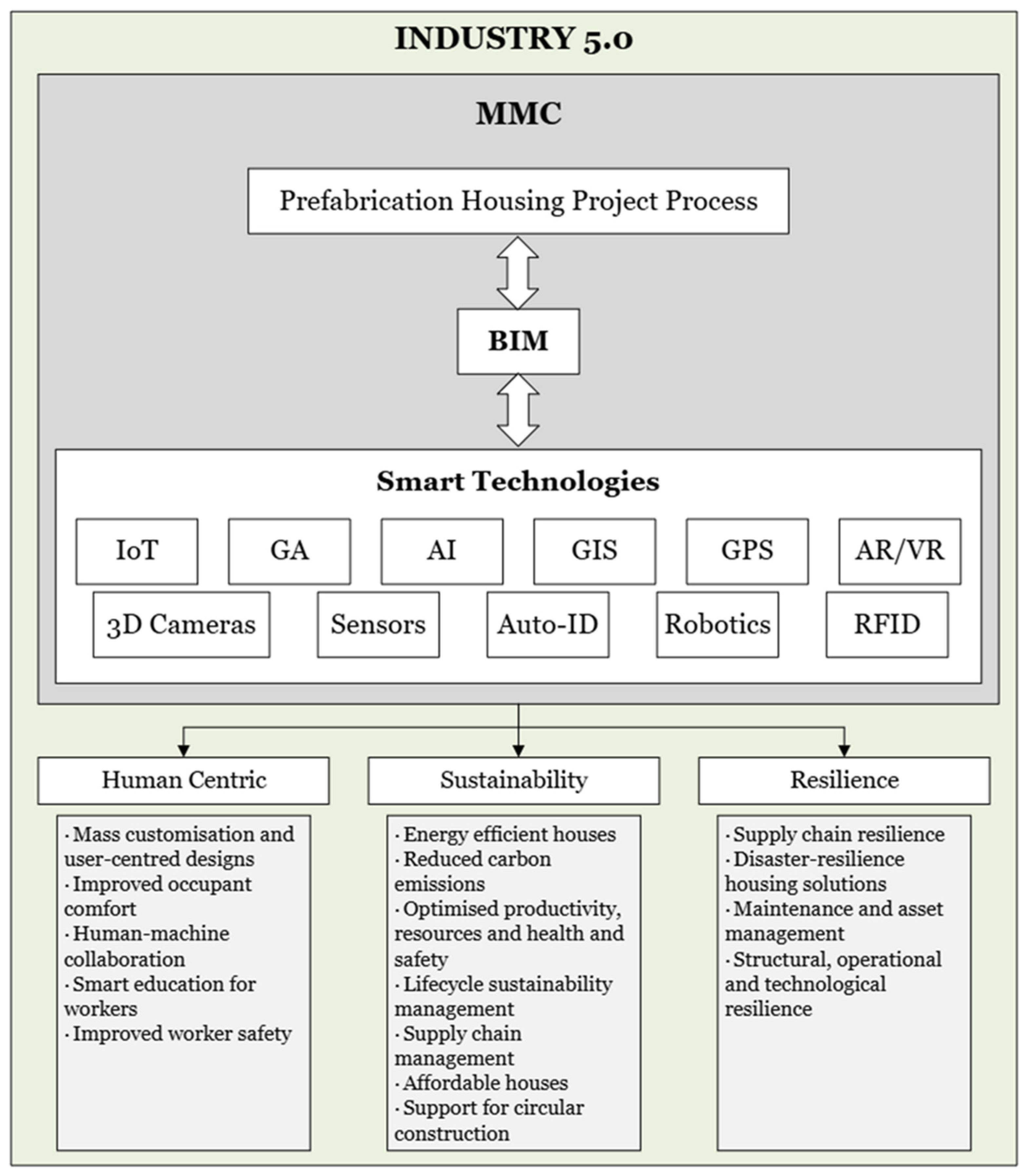
This proves that BIM-led MMC, closely aligning with the UN’s SDGs, supports governments in achieving their sustainability and digitalisation goals while addressing social housing gaps [68]. Its ability to achieve human-centricity, sustainability, and resilience establishes a robust interconnection with Industry 5.0. Figure 2 provides a summary of the findings of this study.
Human-centric practices help address existing skill gaps and enhance understanding, safety, collaboration, and integration, thereby overcoming resistance to BIM use. Digital twinning improves interoperability and seamless data flow throughout the project lifecycle, addressing the majority of the prevailing challenges. This proves that BIM integrated with smart technologies not only achieves Industry 5.0 but also helps overcome prevailing challenges to its adoption. However, the findings emphasise the importance of BIM adoption from the project’s initial decision-making throughout the project to enable automation and Industry 5.0 in housing projects. This establishes a requirement for in-depth investigations of BIM-led MMC throughout the project lifecycle, from the planning phase to the operation and maintenance phase, to realise its full benefits in social housing supply and Industry 5.0.

5. Conclusions

The role of BIM serves as a digital backbone in integrating advanced technologies, such as IoT, GIS, GA, AI, robotics, AR, VR, and sensors across MCC project stages, thereby enabling collaboration, sustainability, and automation in the social housing supply chain. Its ability to achieve human-centricity, sustainability, and resilience in MMC housing projects serves as a driving force for moving the construction industry toward Industry 5.0. Accordingly, BIM-led MMC enables addressing the global social housing crisis while achieving the SDGs, resolving prevailing issues related to rural development, environmental impact, labour shortages, higher costs, and prolonged construction processes while accelerating the construction industry towards Industry 5.0. However, its adoption has been limited due to prevailing technical, organisational, knowledge, and legal challenges. These challenges highlight the need for training and development programs to enhance practitioners’ skills and knowledge, as well as financial support to cover the higher initial costs. Additionally, government initiatives are crucial for enhancing BIM adoption in the social housing supply. BIM integrated with smart technologies evidently abates the current challenges by enabling human-centric, sustainable, and resilient processes that support Industry 5.0.
The findings indicate a considerable knowledge gap for further research on identifying BIM applications throughout the project lifecycle of MMC housing projects, where the majority of studies have focused on specific BIM integrations and processes rather than their implementation across project stages to ensure automation. It further emphasises the need to develop standardised processes and guidelines for BIM adoption and integration with advanced technologies throughout the project to ensure smooth implementation in social housing projects. Overall, the insights gained from this review contribute to a better understanding of BIM integrated with advanced technologies for sustainable social housing supply, realising its benefits and applications, and provide a foundation for further studies aiming to develop frameworks and guidelines to guide its implementation and promote Industry 5.0.

Funding

This research received no external funding.

Institutional Review Board Statement

Not applicable.

Informed Consent Statement

Not applicable.

Data Availability Statement

No new data were created or analysed in this study. Data sharing is not applicable to this article.

Acknowledgments

This research was supported by an Australian Government Research Training Program (RTP) Scholarship.

Conflicts of Interest

The authors declare no conflicts of interest.

Abbreviations

The following abbreviations are used in this manuscript:
SDGsSustainable Development Goals
UNUnited Nations
UKUnited Kingdom
MMCModern Methods of Construction
USAUnited States of America
BIMBuilding Information Modelling
IoTInternet of Things
AIArtificial Intelligence
VRVirtual Reality
ARAugmented Reality
DfMADesign for Manufacture and Assembly
GAGenetic Algorithms
GISGeographic Information Systems
RFIDRadio-Frequency Identification
GPSGeographic Information System
LiDARLight Detection and Ranging

References

  1. UN. United Nations The Sustainable Development Goals Report 2017; UN: New York, NY, USA, 2017. [Google Scholar]
  2. Institute for Economic and Social Research (Institute for Economic and Social Research, Faculty of Economics and Business, Universities Indonesia (LPEM-FEB-UI)). Estimating Social Infrastructure Needs in Diverse and Dynamic Asia; Institute for Economic and Social Research, Faculty of Economics and Business, Universities Indonesia (LPEM-FEB-UI): Jakarta, Indonesia, 2020. [Google Scholar]
  3. Van Noorloos, F.; Cirolia, L.R.; Friendly, A.; Jukur, S.; Schramm, S.; Steel, G.; Valenzuela, L. Incremental Housing as a Node for Intersecting Flows of City-making: Rethinking the Housing Shortage in the Global South. Environ. Urban. 2020, 32, 37–54. [Google Scholar] [CrossRef]
  4. National Housing Supply and Affordability Council. State of the Housing Systems 2025; Australian Government: Canberra, Australia, 2025.
  5. Endo, K.; Edelenbos, J.; Gianoli, A. Sustainable Infrastructure: A Systematic Literature Review on Finance Arrangements and Governance Modes. Public Work. Manag. Policy 2022, 28, 443–475. [Google Scholar] [CrossRef]
  6. National Housing Supply and Affordability Council. State of the Housing System 2024; Australian Government: Canberra, Australia, 2024.
  7. HM Government. Plan for Change: Milestones for Mission-Led Government; HM Government: London, UK, 2024.
  8. Cox, W. Demographia International Housing Affordability; Chapman University: Orange, CA, USA, 2024. [Google Scholar]
  9. United Nations Environmental Programme. 2021 Global Status Report for Building and Construction: Towards a Zero-Emission, Efficient and Resilient Buildings and Construction Sector; UN: Nairobi, Kenya, 2021. [Google Scholar]
  10. Doan, D.T.; Ghaffarianhoseini, A.; Naismith, N.; Zhang, T.; Ghaffarianhoseini, A.; Tookey, J. A Critical Comparison of Green Building Rating Systems. Build. Environ. 2017, 123, 243–260. [Google Scholar] [CrossRef]
  11. Percy, J. The Viability of Constructing Social Housing Infrastructure Using Relocatable Modular Housing on Temporarily Vacant Public Land; University of Melbourne: Victoria, Australia, 2017. [Google Scholar]
  12. Mofid, K.; Selsey, R.V. Modern Methods of Construction; Savills Research: London, UK, 2020. [Google Scholar]
  13. HM Government. The Construction Playbook; HM Government: London, UK, 2022.
  14. National Housing Federation. State of MMC Delivery in Social Housing; National Housing Federation: London, UK, 2024. [Google Scholar]
  15. Hu, X.; Chong, H.-Y. Environmental Sustainability of Off-Site Manufacturing: A Literature Review. Eng. Constr. Archit. Manag. 2019, 28, 332–350. [Google Scholar] [CrossRef]
  16. Bassi, R.; Dunster, A.; Miller, J.; Noonan, K.; Quarry, R. Benefits of Modern Methods of Construction in Housing. In Performance Data and Case Studies; Constructing Excellence: Watford, UK, 2021. [Google Scholar]
  17. Rafa, N.; Khalid, R. Modern Methods of Construction for Net Zero Housing: Implications from the Social Sciences and Humanities; UK Energy Research Centre: London, UK, 2024. [Google Scholar]
  18. Williamson, M.; Ganah, A.; John, G.A. Barriers to Adopting Modern Methods of Construction in the UK. J. Constr. Eng. Manag. Innov. 2019, 2, 30–39. [Google Scholar] [CrossRef]
  19. Jin, R.; Gao, S.; Cheshmehzangi, A.; Aboagye-Nimo, E. A Holistic Review of Off-Site Construction Literature Published Between 2008 and 2018. J. Clean. Prod. 2018, 202, 1202–1219. [Google Scholar] [CrossRef]
  20. Widanage, C.; Kim, K.P.; Ochoa, J.J.; Xing, K. Integrating DfMA and BIM for Sustainable Infrastructure: Industry Perspective. In Proceedings of the International Sustainable Ecological Engineering Design for Society (SEEDS), Leeds, UK, 27–29 August 2024; pp. 433–445. [Google Scholar]
  21. Chourasia, A.; Singhal, S.; Manivannan. Prefabricated Volumetric Modular Construction: A Review on Current Systems, Challenges, and Future Prospects. Pract. Period. Struct. Des. Constr. 2023, 28, 03122009. [Google Scholar] [CrossRef]
  22. Nabi, M.A.; El-adaway, I.H. Understanding the Key Risks Affecting Cost and Schedule Performance of Modular Construction Projects. J. Manag. Eng. 2021, 37, 04021023. [Google Scholar] [CrossRef]
  23. Abdelrahman, M.; Macatulad, E.; Lei, B.; Quintana, M.; Miller, C.; Biljecki, F. What is a Digital Twin Anyway? Deriving the Definition for the Built Environment from Over 15,000 Scientific Publications. Build. Environ. 2025, 274, 112748. [Google Scholar] [CrossRef]
  24. Mousavi, Y.; Gharineiat, Z.; Karimi, A.A.; McDougall, K.; Rossi, A.; Gonizzi Barsanti, S. Digital Twin Technology in Built Environment: A Review of Applications, Capabilities and Challenges. Smart Cities 2024, 7, 2594–2615. [Google Scholar] [CrossRef]
  25. Wang, W.; Guo, H.; Li, X.; Tang, S.; Li, Y.; Xie, L.; Lv, Z. BIM Information Integration Based VR Modeling in Digital Twins in Industry 5.0. J. Ind. Inf. Integr. 2022, 28, 100351. [Google Scholar] [CrossRef]
  26. Ikudayisi, A.E.; Chan, A.P.; Darko, A.; Adedeji, Y.M. Integrated Practices in the Architecture, Engineering, and Construction Industry: Current Scope and Pathway Towards Industry 5.0. J. Build. Eng. 2023, 73, 106788. [Google Scholar] [CrossRef]
  27. Abanda, F.H.; Tah, J.H.M.; Cheung, F.K.T. BIM in Off-site Manufacturing for Buildings. J. Build. Eng. 2017, 14, 89–102. [Google Scholar] [CrossRef]
  28. Parkar, F.; Magar, R. Optimization of Low-cost Housing Projects Using BIM, GIS, and Genetic Algorithm. Int. J. Adv. Technol. Eng. Explor. 2024, 11, 1217. [Google Scholar] [CrossRef]
  29. Moshood, T.D.; Rotimi, J.O.; Shahzad, W.; Bamgbade, J.A. Infrastructure Digital Twin Technology: A New Paradigm for Future Construction Industry. Technol. Soc. 2024, 77, 102519. [Google Scholar] [CrossRef]
  30. Widanage, C.; Kim, K.P. Integrating Design for Manufacture and Assembly (DfMA) with BIM for Infrastructure. Autom. Constr. 2024, 167, 105705. [Google Scholar] [CrossRef]
  31. Hadi, A.; Cheung, F.; Adjei, S.; Dulaimi, A. Aligning Digital Technologies in Off-site Construction with Industry 5.0 Design Principles for a Sustainable Future. In Innovations, Disruptions and Future Trends in the Global Construction Industry; Routledge: London, UK, 2024; p. 284. [Google Scholar]
  32. Musarat, M.A.; Irfan, M.; Alaloul, W.S.; Maqsoom, A.; Ghufran, M. A Review on the Way Forward in Construction through Industrial Revolution 5.0. Sustainability 2023, 15, 13862. [Google Scholar] [CrossRef]
  33. Akhavan, M.; Alivirdi, M.; Jamalpour, A.; Kheradranjbar, M.; Mafi, A.; Jamalpour, R.; Ravanshadnia, M. Impact of Industry 5.0 on the Construction Industry (Construction 5.0): Systematic Literature Review and Bibliometric Analysis. Buildings 2025, 15, 1491. [Google Scholar] [CrossRef]
  34. Ullah, H.; Zhang, H.; Huang, B.; Gong, Y. BIM-Based Digital Construction Strategies to Evaluate Carbon Emissions in Green Prefabricated Buildings. Buildings 2024, 14, 1689. [Google Scholar] [CrossRef]
  35. Cui, Y.; Li, S.; Liu, C.; Sun, N. Creation and Diversified Applications of Plane Module Libraries for Prefabricated Houses Based on BIM. Sustainability 2020, 12, 453. [Google Scholar] [CrossRef]
  36. Liu, Q.; Ma, Y.; Chen, L.; Pedrycz, W.; Skibniewski, M.J.; Chen, Z.-S. Artificial Intelligence for Production, Operations and Logistics Management in Modular Construction Industry: A Systematic Literature Review. Inf. Fusion 2024, 109, 102423. [Google Scholar] [CrossRef]
  37. Jørsfeldt, L.; Klitgaard, A.; Selman, A.; Jeppesen, R. Towards Industry 5.0 Skills—Off-site Construction Settings in Denmark. In Proceedings of the 12th Nordic Conference on Construction Economics and Organisation, Trondheim, Norway, 30–31 May 2024. [Google Scholar]
  38. Li, X.; Shen, G.Q.; Wu, P.; Yue, T. Integrating Building Information Modeling and Prefabrication Housing Production. Autom. Constr. 2019, 100, 46–60. [Google Scholar] [CrossRef]
  39. Li, C.Z.; Zhong, R.Y.; Xue, F.; Xu, G.; Chen, K.; Huang, G.G.; Shen, G.Q. Integrating RFID and BIM Technologies for Mitigating Risks and Improving Schedule Performance of Prefabricated House Construction. J. Clean. Prod. 2017, 165, 1048–1062. [Google Scholar] [CrossRef]
  40. Chen, C.; Tang, L.C.M.; Jin, Y. Development of 5D BIM-Based Management System for Pre-Fabricated Construction in China. In Proceedings of the International Conference on Smart Infrastructure and Construction 2019 (ICSIC), Cambridge, UK, 8–10 July 2019; pp. 215–224. [Google Scholar]
  41. Alfieri, E.; Seghezzi, E.; Sauchelli, M.; Giuda, G.M.D.; Masera, G. A BIM-Based Approach for DfMA in Building Construction: Framework and First Results on an Italian Case Study. Archit. Eng. Des. Manag. 2020, 16, 247–269. [Google Scholar] [CrossRef]
  42. Xu, X.X.; Mumford, T.; Zou, P.X.W. Life-cycle Building Information Modelling (BIM) Engaged Framework for Improving Building Energy Performance. Energy Build. 2021, 231, 16. [Google Scholar] [CrossRef]
  43. Chen, K.; Lu, W.; Peng, Y.; Rowlinson, S.; Huang, G.Q. Bridging BIM and Building: From a Literature Review to an Integrated Conceptual Framework. Int. J. Proj. Manag. 2015, 33, 1405–1416. [Google Scholar] [CrossRef]
  44. Adeyemi, A.B.; Ohakawa, T.C.; Okwandu, A.C.; Iwuanyanwu, O.; Ifechukwu, G.O. Advanced Building Information Modeling (BIM) for Affordable Housing Projects: Enhancing Design Efficiency and Cost Management. J. Build. Inf. Model 2024, 12, 45–60. [Google Scholar]
  45. Yang, B.; Fang, T.; Luo, X.; Liu, B.; Dong, M. A BIM-Based Approach to Automated Prefabricated Building Construction Site Layout Planning. KSCE J. Civ. Eng. 2022, 26, 1535–1552. [Google Scholar] [CrossRef]
  46. The Australia and New Zealand Land Information Council. Principles for Spatially Enabled Digital Twins of the Built and Natural Environment in Australia; ANZLIC: Canberra, Australia, 2019.
  47. Liang, N.; Yu, M.; Ali, R. Research on Design Optimization of Prefabricated Residential Houses Based on BIM Technology. Sci. Program. 2021, 2021, 1422680. [Google Scholar] [CrossRef]
  48. O’Grady, T.M.; Brajkovich, N.; Minunno, R.; Chong, H.-Y.; Morrison, G.M. Circular Economy and Virtual Reality in Advanced BIM-Based Prefabricated Construction. Energies 2021, 14, 4065. [Google Scholar] [CrossRef]
  49. Zhou, M.; Wang, J.; Yu, B.; Chen, K. A Quality Management Method for Prefabricated Building Design Based on BIM and VR-Integrated Technology. Appl. Sci. 2024, 14, 1635. [Google Scholar] [CrossRef]
  50. Metvaei, S.; Aghajamali, K.; Chen, Q.; Lei, Z. Developing a BIM-enabled Robotic Manufacturing Framework to Facilitate Mass Customization of Prefabricated Buildings. Comput. Ind. 2025, 164, 104201. [Google Scholar] [CrossRef]
  51. Kang, K.; Li, M.; Wu, W.; Cheung, H.H.; Zhong, R.Y.; Huang, G.Q. A Case Study of Building Information Modeling-enabled Prefab Logistics for Smart Construction Supply Chain Management. In Geography, Planning and Tourism 2022; Edward Elgar Publishing: Cheltenham, UK, 2022; pp. 395–414. [Google Scholar]
  52. Luo, L.; Ding, Z.; Niu, J.; Zhang, L.; Liao, L. A Digital Project Management Framework for Transnational Prefabricated Housing Projects. Buildings 2024, 14, 2915. [Google Scholar] [CrossRef]
  53. Xu, J.; Zhang, Q.; Teng, Y.; Pan, W. Integrating IoT and BIM for Tracking and Visualising Embodied Carbon of Prefabricated Buildings. Build. Environ. 2023, 242, 110492. [Google Scholar] [CrossRef]
  54. Li, C.Z.; Hong, J.; Xue, F.; Shen, G.Q.; Xu, X.; Mok, M.K. Schedule Risks in Prefabrication Housing Production in Hong Kong: A Social Network Analysis. J. Clean. Prod. 2016, 134, 482–494. [Google Scholar] [CrossRef]
  55. Zhu, A.; Pauwels, P.; Vries, B.D. Smart Component-oriented Method of Construction Robot Coordination for Prefabricated Housing. Autom. Constr. 2021, 129, 103778. [Google Scholar] [CrossRef]
  56. Tan, Y.; Li, S.; Wang, Q. Automated Geometric Quality Inspection of Prefabricated Housing Units Using BIM and LiDAR. Remote Sens. 2020, 12, 2492. [Google Scholar] [CrossRef]
  57. Hu, W.; Ou, Y.; Liu, H.; Ni, P.; Chang, C. Integrating Digital Twin Technologies for Maintenance 4.0 in the Building Industry: A Review and Conceptual Framework. Build. Environ. 2026, 288, 113997. [Google Scholar] [CrossRef]
  58. Zhong, R.Y.; Peng, Y.; Fang, J.; Xu, G.; Xue, F.; Zou, W.; Huang, G.Q. Towards Physical Internet-enabled Prefabricated Housing Construction in Hong Kong. IFAC-PapersOnLine 2015, 48, 1079–1086. [Google Scholar] [CrossRef]
  59. Masood, R.; Lim, J.; González, V.; Roy, K.; Khan, K. A Systematic Review on Supply Chain Management in Prefabricated House-Building Research. Buildings 2022, 12, 40. [Google Scholar] [CrossRef]
  60. Li, C.Z.; Chen, Z.; Xue, F.; Kong, X.T.R.; Xiao, B.; Lai, X.; Zhao, Y. A Blockchain- and IoT-based Smart Product-Service System for the Sustainability of Prefabricated Housing Construction. J. Clean. Prod. 2021, 286, 125391. [Google Scholar] [CrossRef]
  61. Burgess, G.; Jones, M.; Muir, K. BIM in the UK House Building Industry: Opportunities and Barriers to Adoption; University of Cambridge: Cambridge, UK, 2018. [Google Scholar]
  62. Widanage, C.; Kim, K.P. Exploratory Investigation on Global Perspective and Challenges of DfMA and BIM Integration. In Proceedings of the International Technical Conference 2023, Seoul, Republic of Korea, 23–25 August 2023. [Google Scholar]
  63. Mostafa, S.; Kim, K.P.; Tam, V.W.Y.; Rahnamayiezekavat, P. Exploring the Status, Benefits, Barriers and Opportunities of Using BIM for Advancing Prefabrication Practice. Int. J. Constr. Manag. 2018, 20, 146–156. [Google Scholar] [CrossRef]
  64. Gharaibeh, L.; Matarneh, S.; Lantz, B.; Eriksson, K. Quantifying the Influence of BIM Adoption: An In-depth Methodology and Practical Case Studies in Construction. Results Eng. 2024, 23, 102555. [Google Scholar] [CrossRef]
  65. Dong, D.; Zou, Y.; Pan, H.; Zhou, G.; Feng, Y.; Tang, Y. DFMA-oriented Modular and Parametric Design and Secondary Splitting of Vertical PC Components. Sci. Rep. 2023, 13, 3457. [Google Scholar] [CrossRef] [PubMed]
  66. Kavirathna, A.S.; Perera, B.A.K.S. Use of Enabling Technologies with Industry 5.0 to Align with Sustainability in the Construction Industry. FARU J. 2024, 11, 44–52. [Google Scholar] [CrossRef]
  67. Park, K.S.; Park, S.; Moon, S. Offsite construction in housing: A scientometric review of information management trends and technological integration. Eng. Constr. Archit. Manag. 2025, 1–26. [Google Scholar] [CrossRef]
  68. Barata, J.; Kayser, I. Industry 5.0—Past, Present, and Near Future. Procedia Comput. Sci. 2023, 219, 778–788. [Google Scholar] [CrossRef]
Figure 1. BIM Data Flow and Uses throughout the Project Stages.
Encyclopedia 06 00030 g001
Figure 2. Nexus of BIM and Industry 5.0 in Social Housing.
Encyclopedia 06 00030 g002
Table 1. Challenges for BIM Adoption.
CategoryChallengesReference
Technical Challenges
  • Lack of standardised data structures and content for BIM libraries
  • Lack of interoperability
  • Lack of technological advancements specific to the construction industry
[27,30,62]
Organisational Challenges
  • Resistance to change
  • Resistance to collaborating in open platforms
  • Financial incapability of small- to medium-sized organisations to cover the higher initial cost for software, hardware, and training
  • Lack of standardisation in the BIM process
[27,30,44,61,62,63,64]
Knowledge Challenges
  • Lack of skills and knowledge on advanced BIM applications
  • Lack of skills and expertise for digital twinning
[20,30,35,51,61]
Legal Challenges
  • Issues related to protecting intellectual property
  • Assigning responsibility and liability issues in collaboration
  • Complicated insurance coverage
[62,63]
Disclaimer/Publisher’s Note: The statements, opinions and data contained in all publications are solely those of the individual author(s) and contributor(s) and not of MDPI and/or the editor(s). MDPI and/or the editor(s) disclaim responsibility for any injury to people or property resulting from any ideas, methods, instructions or products referred to in the content.