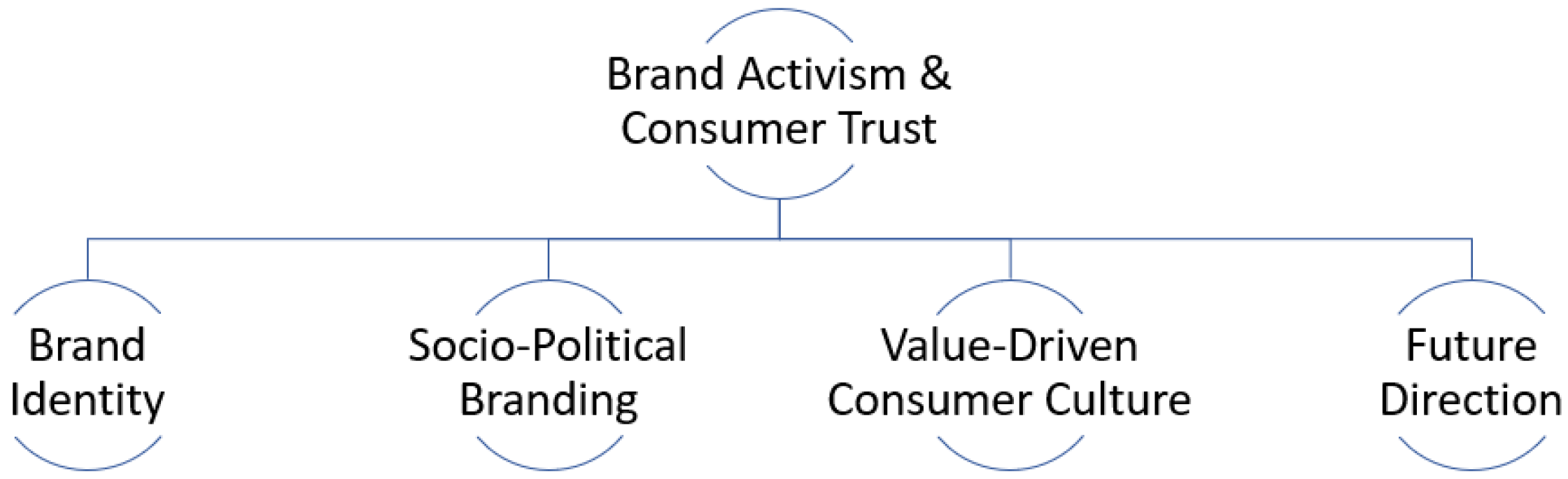


Brand Activism: Gen Z and Socio-Political Branding



Definition
1. Introduction
2. The Evolution of Brand Identity and Consumer Relationships
2.1. Changing Nature of Brand Identity
2.2. Brand Equity and Emotional Loyalty
2.3. Generation Z and Conditional Brand Loyalty
2.4. Digital Engagement and Brand Co-Creation
2.5. Identity Congruence to Brand Betrayal
3. Socio-Political Branding and Brand Activism
3.1. Defining Socio-Political Branding
3.2. Brand Activism as a Strategic Imperative
3.3. Risk of Woke-Washing and Authenticity Gaps
- Continuity, i.e., a brand remains committed to its values over time.
- Credibility, i.e., a brand is believable and competent in its actions.
- Integrity, i.e., a brand aligns its internal practices with its external messaging.
3.4. Emotional Risk and Brand Betrayal
3.5. Advocacy Versus Authenticity
- Stakeholder orientation (actively engaging and responding to the needs of diverse stakeholders, not just consumers).
- Cultural sensitivity (adapting messaging and initiatives to local socio-political contexts).
- Long-term commitment (demonstrating sustained engagement with causes, not one-off campaigns).
- Organizational accountability (accepting responsibility for internal contradictions and addressing them transparently).
4. Gen Z and Value-Driven Consumer Culture
4.1. Understanding Generation Z as Ethical Consumers
4.2. From Passive Consumers to Active Participants
4.3. The Conditional Nature of Loyalty
4.4. Identity, Belonging and Brand Symbolism
5. Future Research Direction
5.1. Cultural Differences
5.2. Organizational Challenges
5.3. Emotional Mechanisms
Author Contributions
Funding
Institutional Review Board Statement
Informed Consent Statement
Data Availability Statement
Conflicts of Interest
References
- Solomon, M.; Englis, B. Reality engineering: Blurring the boundaries between commercial signification and popular culture. J. Curr. Issues Res. Advert. 1994, 16, 1–17. [Google Scholar] [CrossRef]
- Swaminathan, V.; Sorescu, A.; Steenkamp, J.; O’Guinn, T.; Schmitt, B. Branding in a hyperconnected world: Refocusing theories and rethinking boundaries. J. Mark. 2020, 84, 24–46. [Google Scholar] [CrossRef]
- Fournier, S.; Srinivasan, S.; Marrinan, P. Turning socio-political risk to your brand’s advantage. NIM Mark. Intell. Rev. 2021, 13, 18–25. [Google Scholar] [CrossRef]
- Sarkar, C.; Kotler, P. Brand Activism: From Purpose to Action; Penguin Random House: London, UK, 2021. [Google Scholar]
- Vredenburg, J.; Kapitan, S.; Spry, A.; Kemper, J. Brands taking a stand: Authentic brand activism or woke washing? J. Public Policy Mark. 2020, 39, 444–460. [Google Scholar] [CrossRef]
- Khojastehpour, M.; Johns, R. The effect of environmental CSR issues on corporate/brand reputation and corporate profitability. Euro. Bus. Rev. 2014, 26, 330–339. [Google Scholar] [CrossRef]
- Robinson, S.; Wood, S. A “good” new brand—What happens when new brands try to stand out through corporate social responsibility. J. Bus. Res. 2018, 92, 231–241. [Google Scholar] [CrossRef]
- Shirdastian, H.; Laroche, M.; Richard, M. Using big data analytics to study brand authenticity sentiments: The case of Starbucks on Twitter. Int. J. Inf. Manag. 2019, 48, 291–307. [Google Scholar] [CrossRef]
- Ren, Y.; Choe, Y.; Song, H. Antecedents and consequences of brand equity: Evidence from Starbucks coffee brand. Int. J. Hosp. Manag. 2023, 108, 103351. [Google Scholar] [CrossRef]
- Aaker, D. Managing Brand Equity: Capitalizing on the Value of a Brand Name; Free Press: New York, NY, USA, 1991. [Google Scholar]
- Aaker, D. Building Strong Brands; Free Press: New York, NY, USA, 1996. [Google Scholar]
- Keller, K. Conceptualizing, measuring, and managing customer-based brand equity. J. Mark. 1993, 57, 1–22. [Google Scholar] [CrossRef]
- Polat, A.; Çetinsöz, B. The mediating role of brand love in the relationship between consumer-based brand equity and brand loyalty: A research on Starbucks. J. Tour. Serv. 2021, 12, 150–167. [Google Scholar] [CrossRef]
- Walters, P. Are Generation Z Ethical Consumers? In Generation Z Marketing and Management in Tourism and Hospitality: The Future of the Industry; Springer: Cham, Switzerland, 2021; pp. 303–325. [Google Scholar]
- Bhagwat, Y.; Warren, N.; Beck, J.; Watson, G., IV. Corporate sociopolitical activism and firm value. J. Mark. 2020, 84, 1–21. [Google Scholar] [CrossRef]
- Greyser, S. Corporate brand reputation and brand crisis management. Manag. Decis. 2009, 47, 590–602. [Google Scholar] [CrossRef]
- Wadud, I.; Liang, Y.; Polkinghorne, M. Digital Transformation in the UK Retail Sector. Encyclopedia 2025, 5, 142–154. [Google Scholar] [CrossRef]
- Witt, G.; Baird, D. The Gen Z Frequency: How Brands Tune in and Build Credibility; Kogan Page Publishers: New York, NY, USA, 2018. [Google Scholar]
- Francis, T.; Hoefel, F. True Gen’: Generation Z and Its Implications for Companies; McKinsey & Company: São Paulo, Brazil, 2018. [Google Scholar]
- Turner, A. Generation Z: Technology and social interest. J. Individ. Psychol. 2015, 71, 103–113. [Google Scholar] [CrossRef]
- Accenture. To Affinity and Beyond. From Me to We, the Rise of the Purpose-Led Brand; Accenture: Dublin, Ireland, 2018; Available online: https://www.accenture.com/content/dam/accenture/final/a-com-migration/custom/_acnmedia/thought-leadership-assets/pdf/Accenture-CompetitiveAgility-GCPR-POV.pdf#zoom=40 (accessed on 11 October 2025).
- Saldanha, N.; Mulye, R.; Rahman, K. Cancel culture and the consumer: A strategic marketing perspective. J. Strat. Mark. 2023, 31, 1071–1086. [Google Scholar] [CrossRef]
- Demsar, V.; Ferraro, C.; Nguyen, J.; Sands, S. Calling for cancellation: Understanding how markets are shaped to realign with prevailing societal values. J. Macromarketing 2023, 43, 322–350. [Google Scholar] [CrossRef]
- Kapferer, J. The New Strategic Brand Management: Creating and Sustaining Brand Equity Long Term; Kogan Page: London, UK, 2008. [Google Scholar]
- O’Sullivan, H.; Polkinghorne, M.; Chapleo, C.; Cownie, F. Contemporary branding strategies for higher education. Encyclopedia 2024, 4, 1292–1311. [Google Scholar] [CrossRef]
- Veloutsou, C.; Delgado-Ballester, E. New challenges in brand management. Span. J. Mark. 2018, 22, 254–271. [Google Scholar] [CrossRef]
- Firat, A.; Venkatesh, A. Liberatory postmodernism and the re-enchantment of consumption. J. Consum. Res. 1995, 22, 239–267. [Google Scholar] [CrossRef]
- Pine, B.; Gilmore, J. The Experience Economy: Work Is Theatre and Every Business a Stage; Harvard Business School Press: Boston, MA, USA, 1999. [Google Scholar]
- Arnould, E.; Thompson, C. Consumer culture theory (CCT): Twenty years of research. J. Consum. Res. 2005, 31, 868–882. [Google Scholar] [CrossRef]
- Holt, D. How Brands Become Icons: The Principles of Cultural Branding; Harvard University Press: Cambridge, MA, USA, 2004. [Google Scholar]
- Cova, B.; Cova, V. Tribal marketing: The tribalisation of society and its impact on the conduct of marketing. Eur. J. Mark. 2002, 36, 595–620. [Google Scholar] [CrossRef]
- Kapferer, J. The New Strategic Brand Management: Advanced Insights and Strategic Thinking; Kogan Page: London, UK, 2012. [Google Scholar]
- Hatch, M.; Schultz, M. Toward a theory of brand co-creation with implications for brand governance. J. Brand Manag. 2010, 17, 590–604. [Google Scholar] [CrossRef]
- Ind, N.; Iglesias, O.; Schultz, M. Building brands together: Emergence and outcomes of co-creation. Calif. Manag. Rev. 2013, 55, 5–26. [Google Scholar] [CrossRef]
- Black, I.; Veloutsou, C. Working consumers: Co-creation of brand identity, consumer identity and brand community identity. J. Bus. Res. 2017, 70, 416–429. [Google Scholar] [CrossRef]
- Holt, D. Why do brands cause trouble? A dialectical theory of consumer culture and branding. J. Consum. Res. 2002, 29, 70–90. [Google Scholar] [CrossRef]
- Lury, C. Brands: The Logos of the Global Economy; Routledge: Abingdon, UK, 2004. [Google Scholar]
- Thompson, C.; Rindfleisch, A.; Arsel, Z. Emotional branding and the strategic value of the doppelgänger brand image. J. Mark. 2006, 70, 50–64. [Google Scholar] [CrossRef][Green Version]
- Arvidsson, A. Brands: A critical perspective. J. Consum. Cult. 2005, 5, 235–258. [Google Scholar] [CrossRef]
- Fournier, S. Consumers and their brands: Developing relationship theory in consumer research. J. Consum. Res. 1998, 24, 343–373. [Google Scholar] [CrossRef]
- Batra, R.; Ahuvia, A.; Bagozzi, R. Brand love. J. Mark. 2012, 76, 1–16. [Google Scholar] [CrossRef]
- Chang, W. Experiential marketing, brand image and brand loyalty: A case study of Starbucks. Br. Food J. 2020, 123, 209–223. [Google Scholar] [CrossRef]
- Walter, N.; Föhl, U.; Sander, F.; Nies, A. Act as you preach! Authentic brand purpose versus “woke washing’s” impact on brand credibility: The moderating role of cause involvement and consumer skepticism. J. Bus. Res. 2024, 184, 114868. [Google Scholar] [CrossRef]
- Bryson, D.; Atwal, G. Brand hate: The case of Starbucks in France. Br. Food J. 2019, 121, 172–182. [Google Scholar] [CrossRef]
- Agrawal, D. Determining behavioural differences of Y and Z generational cohorts in online shopping. Int. J. Retail. Distrib. Manag. 2022, 50, 880–895. [Google Scholar] [CrossRef]
- Watty, F. Gen Z Online Shopping Behaviour—Statistics and Facts. Statista. Available online: https://www.statista.com/topics/11087/gen-z-online-shopping-behaviour/ (accessed on 25 July 2025).
- Fromm, J.; Read, A. Marketing to Gen Z: The Rules for Reaching This Vast and Very Different Generation of Influencers; AMACOM: New York, NY, USA, 2018. [Google Scholar]
- Priporas, C.; Stylos, N.; Fotiadis, A. Generation Z consumers’ expectations of interactions in smart retailing: A future agenda. Comput. Hum. Behav. 2017, 77, 374–381. [Google Scholar] [CrossRef]
- Djafarova, E.; Foots, S. Exploring ethical consumption of Generation Z: Theory of planned behaviour. Young Consum. 2022, 23, 413–431. [Google Scholar] [CrossRef]
- Shetty, A.; Venkataramaiah, N.; Anand, K. Brand activism and millennials: An empirical investigation into the perception of millennials towards brand activism. Probl. Perspect. Manag. 2019, 17, 163–175. [Google Scholar] [CrossRef]
- Pöyry, E.; Laaksonen, S. Opposing brand activism: Triggers and strategies of consumers’ antibrand actions. Eur. J. Mark. 2022, 56, 261–284. [Google Scholar] [CrossRef]
- Dolot, A. The characteristics of Generation Z. E-Mentor 2018, 74, 44–50. [Google Scholar] [CrossRef]
- Seemiller, C.; Grace, M. Generation Z: A Century in the Making; Routledge: Abingdon, UK, 2018. [Google Scholar] [CrossRef]
- Adi, T.; Arijanti, S. Reputational risk in the social media era: A case study of crisis management strategies for major brands in Indonesia. Oikonomia J. Manag. Econ. Account. 2025, 2, 38–48. [Google Scholar] [CrossRef]
- Lemon, K.; Verhoef, P. Understanding customer experience throughout the customer journey. J. Mark. 2016, 80, 69–96. [Google Scholar] [CrossRef]
- Schmitt, B. Experience marketing: Concepts, frameworks and consumer insights. Found. Trends Mark. 2010, 5, 55–112. [Google Scholar] [CrossRef]
- Orth, U.; De Marchi, R. Understanding the relationships between functional, symbolic and experiential brand beliefs, product experiential attributes, and product schema: Advertising-trial interactions revisited. J. Mark. Theory Pract. 2007, 15, 219–233. [Google Scholar] [CrossRef]
- Joshi, R.; Garg, P. Role of brand experience in shaping brand love. Int. J. Consum. Stud. 2021, 45, 259–272. [Google Scholar] [CrossRef]
- Sirgy, M. Self-concept in consumer behavior: A critical review. J. Consum. Res. 1982, 9, 287–300. [Google Scholar] [CrossRef]
- Mukherjee, S.; Althuizen, N. Brand activism: Does courting controversy help or hurt a brand? Int. J. Res. Mark. 2020, 37, 772–788. [Google Scholar] [CrossRef]
- Grégoire, Y.; Tripp, T.; Legoux, R. When customer love turns into lasting hate: The effects of relationship strength and time on customer revenge and avoidance. J. Mark. 2009, 73, 18–32. [Google Scholar] [CrossRef]
- Shin, S.; Yoon, S. Consumer motivation for the decision to boycott: The social dilemma. Int. J. Consum. Stud. 2018, 42, 439–447. [Google Scholar] [CrossRef]
- Pandey, S.; Ahmad, Y.; Gautam, A. Consumer motivations for boycott. Pac. Bus. Rev. Int. 2021, 14, 51–63. [Google Scholar]
- Stjepić, A.-M.; Vukšić, M.; Suša Vugec, D. Digital literacy of the generation Z students and their attitudes and beliefs towards ICT knowledge and skills. Int. J. Val. Aurea 2019, 5, 17–29. [Google Scholar] [CrossRef]
- Kolter, P.; Sarkar, C. “The Case for Brand Activism”—A Discussion with Philip Kotler and Christian Sarkar. Market. J. 2018. Available online: https://www.marketingjournal.org/the-case-for-brand-activism-a-discussion-with-philip-kotler-and-christian-sarkar/ (accessed on 11 October 2025).
- Bohnen, J. Creating the Political Brand. In Corporate Political Responsibility: How Businesses Can Strengthen Democracy for Mutual Benefit; Springer: Berlin, Heidelberg, 2020; pp. 119–126. [Google Scholar] [CrossRef]
- Moorman, C. Commentary: Brand activism in a political world. J. Public Policy Mark. 2020, 39, 388–392. [Google Scholar] [CrossRef]
- O’Sullivan, H. Antecedents, Nature and Consequences of Brand Success in Comparable Newer Universities. Ph.D. Thesis, Bournemouth University, Poole, UK, 2022. [Google Scholar]
- Eyada, B. Brand activism, the relation and impact on consumer perception: A case study on Nike advertising. Int. J. Mark. Stud. 2020, 12, 30–42. [Google Scholar] [CrossRef]
- Key, T.; Keel, A.; Czaplewski, A.; Olson, E. Brand activism change agents: Strategic storytelling for impact and authenticity. J. Strat. Mark. 2021, 31, 1339–1355. [Google Scholar] [CrossRef]
- Sibai, O.; Mimoun, L.; Boukis, A. Authenticating brand activism: Negotiating the boundaries of free speech to make a change. Psychol. Mark. 2021, 38, 1651–1669. [Google Scholar] [CrossRef]
- Montecchi, M.; Plangger, K.; West, D.; de Ruyter, K. Perceived brand transparency: A conceptualization and measurement scale. Psychol. Mark. 2024, 41, 487–504. [Google Scholar] [CrossRef]
- Wannow, S.; Haupt, M.; Ohlwein, M. Is brand activism an emotional affair? The role of moral emotions in consumer responses to brand activism. J. Brand Manag. 2023, 30, 800–818. [Google Scholar] [CrossRef]
- Hutcherson, C.; Gross, J. The moral emotions: A social–functional account of anger, disgust, and contempt. Psych. Rev. 2011, 118, 315–337. [Google Scholar] [CrossRef]
- Verlegh, P.; Smidts, A.; Antonetti, P.; van Doorn, J. Perspectives: A research-based guide for brand activism. Int. J. Advert. 2024, 43, 459–484. [Google Scholar] [CrossRef]
- Gensler, S.; Völckner, F.; Liu-Thompkins, Y.; Wiertz, C. Managing brands in the social media environment. J. Interact. Mark. 2013, 27, 242–256. [Google Scholar] [CrossRef]
- Oates, C. Sustainability Marketing: Products, Fairtrade, and Greenwashing. In The SAGE Handbook of Marketing Ethics; Eagle, L., Dahl, S., De Pelsmacker, P., Taylor, C., Eds.; SAGE: London, UK, 2020; pp. 226–238. [Google Scholar]
- Beverland, M. Crafting brand authenticity: The case of luxury wines. J. Manag. Stud. 2005, 42, 1003–1029. [Google Scholar] [CrossRef]
- Morhart, F.; Malär, L.; Guèvremont, A.; Girardin, F.; Grohmann, B. Brand authenticity: An integrative framework and measurement scale. J. Consum. Psychol. 2015, 25, 200–218. [Google Scholar] [CrossRef]
- Gallicano, T. A critical analysis of greenwashing claims. Public Relat. J. 2011, 5, 1–21. [Google Scholar]
- Costa, C.; Azevedo, A. Antecedents and consequences of the “cancel culture” firestorm journey for brands: Is there a possibility for forgiveness? J. Mark. Manag. 2024, 40, 289–312. [Google Scholar] [CrossRef]
- Arvidsson, A.; Caliandro, A. Brand public. J. Consum. Res. 2016, 42, 727–748. [Google Scholar] [CrossRef]
- Cammarota, A.; D’Arco, M.; Marino, V.; Resciniti, R. Brand activism: A literature review and future research agenda. Int. J. Consum. Stud. 2023, 47, 1669–1691. [Google Scholar] [CrossRef]
- Rodriguez, M.; Boyer, S.; Fleming, D.; Cohen, S. Managing the next generation of sales, gen Z/millennial cusp: An exploration of grit, entrepreneurship, and loyalty. J. Bus.-Bus. Mark. 2019, 26, 43–55. [Google Scholar] [CrossRef]
- Reimann, M.; MacInnis, D.; Folkes, V.; Uhalde, A.; Pol, G. Insights into the experience of brand betrayal: From what people say and what the brain reveals. J. Assoc. Consum. Res. 2018, 3, 240–254. [Google Scholar] [CrossRef]
- Ittefaq, H.; Akhtar, N.; Siddiqi, U.; Islam, T.; Kuzior, A. The betrayal puzzle: Unraveling the connection between inauthenticity, corporate wrongdoing and brand betrayal with avoidance and reparation. J. Retail. Consum. Serv. 2024, 76, 103597. [Google Scholar] [CrossRef]
- Susanty, A.; Kenny, E. The relationship between brand equity, customer satisfaction, and brand loyalty on coffee shop: Study of Excelso and Starbucks. ASEAN Mark. J. 2015, 7, 14–27. [Google Scholar] [CrossRef]
- Djafarova, E.; Bowes, T. ‘Instagram made me buy it’: Generation Z impulse purchases in fashion industry. J. Retail. Consum. Serv. 2021, 59, 102345. [Google Scholar] [CrossRef]
- Pillay, S. The influence of electronic word-of-mouth adoption on brand love amongst Generation Z consumers. Acta Commer. 2021, 21, 1–11. [Google Scholar] [CrossRef]
- Micheletti, M. Political Virtue and Shopping: Individuals, Consumerism, and Collective Action; Palgrave Macmillan: New York, NY, USA, 2003. [Google Scholar]
- Micheletti, M.; Stolle, D. Political Consumerism: Global Responsibility in Action; Cambridge University Press: Cambridge, UK, 2012. [Google Scholar]
- Hughes, C.; Swaminathan, V.; Brooks, G. Driving brand engagement through online social influencers: An empirical investigation of brand identification, consumer engagement and purchase intention. J. Mark. Theory Pract. 2019, 27, 381–398. [Google Scholar] [CrossRef]
- Shaw, D.; Shui, E. An assessment of ethical obligation and self-identity in ethical consumer decision-making: A structural modelling approach. Int. J. Consum. Stud. 2002, 26, 286–293. [Google Scholar] [CrossRef]
- Wood, S. Generation Z as consumers: Trends and innovation. J. Consum. Mark 2021, 38, 489–500. Available online: https://helenagmartins.wordpress.com/wp-content/uploads/2019/04/genzconsumers.pdf (accessed on 25 October 2025).
- Nguyen, D.; Le, D.; Truong, L.; Truong, N.; Vu, V. The effect of Generation Z’s perceptions of brand activism on brand loyalty: Evidence from Vietnam. Asia Pac. J. Mark. Logist. 2023, 35, 1494–1512. [Google Scholar] [CrossRef]
- Gupta, N.; Gaur, V.; Bhatt, A.; Gaur, S.; Parveez, S. Psychosocial factors in brand perception among Generation Z (The first “Digital Natives”). Libr. Prog.-Libr. Sci. Inf. Technol. Comput. 2024, 44, 351–358. [Google Scholar]
- White, K.; Habib, R.; Hardisty, D. How to SHIFT consumer behaviors to be more sustainable: A literature review and guiding framework. J. Mark. 2019, 83, 22–49. [Google Scholar] [CrossRef]
- Haskova, K. Starbucks marketing analysis. CRIS - Bull. Cent. Res. Interdiscip. Study 2015, 1, 11–29. [Google Scholar] [CrossRef]
- Belk, R. Possessions and the extended self. J. Consum. Res. 1988, 15, 139–168. [Google Scholar] [CrossRef]
- O’Sullivan, H.; Polkinghorne, M.; O’Sullivan, M. Understanding success: An initial investigation considering the alignment of university branding with the expectations of future students. Adm. Sci. 2024, 14, 257. [Google Scholar] [CrossRef]
- O’Sullivan, H.; Chapleo, C.; Cownie, F. Location, vocation, education: Place marketing in the context of English new universities. In Proceedings of the 22nd International Congress on Public & Non-Profit Marketing, Veszprém, Hungary, 5–7 July 2023. [Google Scholar]
- Mwencha, P.; Njuguna, R. Brand activism in the age of Black Lives Matter movement. Atl. Mark. J. 2023, 12, 5. Available online: https://digitalcommons.kennesaw.edu/amj/vol12/iss2/5/ (accessed on 16 October 2025).
- Tsougkou, E.; Karampela, M.; Balabanis, G. Drivers and mechanisms of consumer attitudes toward global brand activists: A mediated approach. Int. Mark. Rev. 2024, 41, 1330–1357. [Google Scholar] [CrossRef]
- Gambetti, R.; Biraghi, S. Branded activism: Navigating the tension between culture and market in social media. Futures 2023, 145, 103080. [Google Scholar] [CrossRef]
- Tutton, J.; Brand, V. Should business have ‘a sense of morality’?: Company director views on corporate engagement with socio-political issues. Public Relat. Rev. 2023, 49, 102278. [Google Scholar] [CrossRef]
- Fournier, S.; Srinivasan, S. Monitoring marketing sources of brand reputation risk. NIM Mark. Intell. Rev. 2023, 15, 46–53. [Google Scholar] [CrossRef]
- Khalifa, D.; Osburg, V. Can brand activism benefit luxury brands? Psychol. Mark. 2025, 42, 1314–1329. [Google Scholar] [CrossRef]
- Sands, S.; Ferraro, C. DEI rollbacks: Consequences and considerations for brand managers. Bus. Horiz. 2025, Adv. Online Pub, 1–8. [Google Scholar] [CrossRef]
- Cammarota, A.; Branca, G. Generation Z consumers’ perspective: How and why should (not) brands engage in activism? Ital. J. Mark. 2025, 2025, 21–50. [Google Scholar] [CrossRef]

Disclaimer/Publisher’s Note: The statements, opinions and data contained in all publications are solely those of the individual author(s) and contributor(s) and not of MDPI and/or the editor(s). MDPI and/or the editor(s) disclaim responsibility for any injury to people or property resulting from any ideas, methods, instructions or products referred to in the content. |
© 2026 by the authors. Licensee MDPI, Basel, Switzerland. This article is an open access article distributed under the terms and conditions of the Creative Commons Attribution (CC BY) license.
Share and Cite
O'Sullivan, H.; Babaee, F.; Polkinghorne, M.; Chapleo, C. Brand Activism: Gen Z and Socio-Political Branding. Encyclopedia 2026, 6, 27. https://doi.org/10.3390/encyclopedia6010027
O'Sullivan H, Babaee F, Polkinghorne M, Chapleo C. Brand Activism: Gen Z and Socio-Political Branding. Encyclopedia. 2026; 6(1):27. https://doi.org/10.3390/encyclopedia6010027
Chicago/Turabian StyleO'Sullivan, Helen, Farnaz Babaee, Martyn Polkinghorne, and Chris Chapleo. 2026. "Brand Activism: Gen Z and Socio-Political Branding" Encyclopedia 6, no. 1: 27. https://doi.org/10.3390/encyclopedia6010027
APA StyleO'Sullivan, H., Babaee, F., Polkinghorne, M., & Chapleo, C. (2026). Brand Activism: Gen Z and Socio-Political Branding. Encyclopedia, 6(1), 27. https://doi.org/10.3390/encyclopedia6010027