
Review

Digital Governance as an Enabler of Economic Recovery and Developmental Transformation: Insights from Greece’s 2010–2018 Financial Adjustment Programmes

Department of Economics, Democritus University of Thrace, 69100 Komotini, Greece
*
Author to whom correspondence should be addressed.
Encyclopedia 2026, 6(1), 22; https://doi.org/10.3390/encyclopedia6010022
Submission received: 21 November 2025 / Revised: 9 January 2026 / Accepted: 15 January 2026 / Published: 19 January 2026
(This article belongs to the Collection Encyclopedia of Entrepreneurship in the Digital Era)

Abstract

Greece’s 2010–2018 adjustment programmes provide an insightful case of how timing of reforms, institutional frictions, and digital transformation jointly condition the outcomes of macroeconomic stabilization efforts. This review builds on programme evaluations, recent academic work, and empirical indicators to analyze the dynamics at the intersection of macroeconomic adjustment, institutional quality, and entrepreneurship, placing emphasis on productivity and the evolving role of digital governance. The paper argues that the asymmetric sequencing of fiscal consolidation, internal devaluation, institution-building, and digital modernization is consistent with deeper and more persistent output losses than initially anticipated, as complementary reforms in product markets and public administration were not yet in place. Recovery momentum was observed when administrative simplification, transparency reforms, and digital public services began to reduce transaction costs, uncertainty, and implementation frictions. In this perspective, digital governance—through initiatives such as Diavgeia, and interoperable registries—acted as an enabling complement to the effectiveness of structural reforms, supporting the shift towards a more innovation-oriented entrepreneurial ecosystem. While the evidence is associative rather than causally identified, the synthesis highlights mechanisms and transferable lessons for the design and sequencing of reform programmes in crisis and recovery contexts.

1. Introduction

In the aftermath of the global financial crisis, Greece entered the 2010s with a large fiscal deficit, high public debt, and a credibility shock after the revision of fiscal statistics in 2009. Unable to roll over its debt at sustainable interest rates, the country requested external financial assistance and subsequently implemented three consecutive adjustment programmes (2010–2012, 2012–2015, 2015–2018) under the joint oversight of the European Commission, the European Central Bank (ECB), and the International Monetary Fund (IMF) [1,2,3].
The programmes shared three broad pillars: (a) rapid fiscal consolidation to restore debt sustainability and regain access to the financial markets; (b) internal devaluation via wage and price adjustment, given that nominal devaluation was not possible in the euro-area membership; and (c) structural reforms intended to raise productivity and competitiveness and improve governance and institutional quality [2,3,4].
Ex post evaluations by the IMF’s Independent Evaluation Office (2016) and by the European Commission (2023) highlight two features of the adjustment programmes that directly underpin the focus of this paper [2,5]: First, the size and the front-loaded nature of the consolidation, leading to contractionary effects and contributing to a deeper and prolonged recession than initially projected [2], and second, the structural reform programme being too complex for the country’s administrative and political capacity, thus resulting in implementation gaps, delays, and reversals [2,5]. The combination of this fiscal tightening imposed on top of an institutional system unable to absorb and enforce the load of the reforms created a persistent misalignment which shaped the “recessionary” dynamics that followed.
Academic work reinforces this assessment. Recently published cross-country evidence for European economies further suggests that the macroeconomic effects of fiscal adjustment and reform programmes are strongly conditioned by institutional quality and implementation capacity, reinforcing the view that policy design alone is insufficient in the absence of effective governance frameworks [6]. A strand of the literature frames the Greek crisis as the interaction of long-standing supply-side weaknesses—low productivity, rigid product markets, weak institutions—with a sudden, demand-crushing fiscal shock [7]. Similar dynamics have been documented in Central and Eastern Europe, where front-loaded austerity during the global financial crisis coincided with output losses, while the subsequent recovery was largely driven by external demand rather than the measures themselves [8]. Simulation-based analyses further show that the specific timing and composition of consolidation—large cuts in public investment, a short initial programme horizon, and prolonged uncertainty—explain much of the unanticipated depth of the recession and the overshooting of debt-to-GDP ratios [3]. Other work highlights the role of institutional deterioration in amplifying output losses beyond what can be explained by austerity alone [9]. Greece’s recovery was also held back by its weak digital competitiveness, shortages in skilled workers, and the slow spread of new technologies. These digital weaknesses created additional frictions throughout the 2010s, which in turn reduced the effectiveness of reforms [10].
A rising body of research argues that state capacity, institutional quality, and administrative effectiveness are critical determinants of whether structural reforms actually translate into sustained productivity gains and entrepreneurial upgrading [11,12]. In this context, digital governance can be understood as an institutional capacity that mitigates information asymmetries, lowers compliance and transaction costs, and enhances the predictability and enforceability of public action [13,14]. These characteristics are particularly pertinent in crisis and adjustment environments, where uncertainty is elevated and reform credibility is fragile. This perspective drives the paper’s emphasis on transparency and digital public services as components of the institutional framework within which adjustment policies operate.
This paper builds on these evaluations and on the academic literature and connects them with the evolution of productivity, entrepreneurship, and digital governance in Greece. It advances three main arguments:
  • Timing: Contractionary measures (fiscal tightening and internal devaluation) were front-loaded, while institution-building and digital modernization were back-loaded.
  • Institutional frictions: Fragmented governance, slow justice, and limited administrative capacity created frictions that dampened and delayed the effects of structural reforms.
  • Digital transformation: Transparency and digital-governance reforms in the late 2010s and early 2020s—especially Diavgeia and gov.gr—represent a second generation of reforms that directly target those frictions and form part of the explanation for Greece’s recent improvement in performance.
The purpose of the study is to examine how macroeconomic adjustment, institutional capacity, and digital governance interacted with and conditioned productivity and entrepreneurial dynamics during and after Greece’s crisis. Greece is treated as a revealing case study of reform within a context of constrained administrative capacity, from which broader lessons can be gained for the formulation and sequencing of adjustment programmes in the digital age. The contribution lies in synthesizing programme evaluations and empirical indicators to highlight digital governance and transparency reforms as complements that condition the effectiveness of structural reforms rather than ancillary or merely technological enhancements.

Approach and Sources

This article adopts a narrative review and analytical-synthesis approach. It draws on four categories of evidence: (a) ex post evaluations by the European Commission, the IMF, and independent bodies; (b) macroeconomic and productivity indicators from Eurostat, OECD (Organisation for Economic Co-operation and Development), ECB, AMECO (annual macro-economic database of the European Commission’s Directorate General for Economic and Financial Affairs), and the Bank of Greece; and (c) entrepreneurship and firm-level data, particularly the Global Entrepreneurship Monitor’s Total Early-Stage Entrepreneurial Activity (GEM-TEA) index and national business demography statistics. The paper integrates these sources to illuminate the interaction between adjustment policies, institutional frictions, and the evolution of productivity and entrepreneurship. This mixed-evidence approach is suited to understanding sequencing effects, implementation capacity, and the enabling role of digital transformation in reform environments. While the paper does not attempt causal identification, the mixed-evidence narrative approach is suited to tracing mechanisms, sequencing effects, and institutional complementarities that can inform testable hypotheses for future research.
Section 2 synthesizes evidence from programme evaluations as well as macroeconomic, productivity, entrepreneurship, and institutional indicators. Section 3 discusses the implications for reform timing, institutional frictions, and the role of digital governance as an enabling complement. Section 4 concludes with lessons for adjustment design, limitations of the analysis, and directions for future research.

2. Evidence from Macroeconomic, Productivity, Entrepreneurial, and Institutional Indicators

2.1. Programme Evaluations and Macroeconomic Outcomes

The primary evidence on the trajectory of Greece’s adjustment comes from the ex post evaluations and macroeconomic datasets. The European Commission (2023) [2] and the IMF’s IEO (Independent Evaluation Office of the International Monetary Fund) (2016) [5] review of the programmes in Greece, Ireland, and Portugal describes Greece’s adjustment as “exceptionally large and front-loaded”, generating contractionary effects that were underestimated when the programme was initially designed. Output, unemployment, and public debt trajectories exhibited a significant deviation from the initial projections, even after accounting for the initial macroeconomic imbalances.
Academic work reinforces these conclusions. Lenoël et al. [3] use the National Institute’s NIGEM model to construct counterfactual scenarios for Greece from 2010 to 2018. Their results suggest that the combination of very rapid consolidation, particularly via cuts in public investment, and the persistence of elevated risk premia explains a substantial share of the output losses and the failure to stabilize the debt ratio as initially forecast. Alternative scenarios featuring more gradual consolidation and more moderate investment cuts would have yielded significantly lower output losses while still achieving fiscal objectives [3].
As stated by [9] using a calibrated dynamic general-equilibrium model, quantify the contribution of institutional factors to Greece’s depression. They find that the deterioration in institutional indicators—such as property-rights protection and rule of law—accounts for a significant portion of the post-2008 GDP decline, over and above the effects of austerity [9]. This finding aligns with broader cross-country evidence that institutional quality is a key determinant of the macroeconomic effects of adjustment programmes.

2.2. Productivity Trends and Structural Reforms

Greece entered the crisis with low levels of total factor productivity (TFP) and a growth model heavily reliant on non-tradables and debt-financed consumption. OECD (2018) documents that, prior to 2009, productivity growth was weak and uneven across sectors, with particularly low performance in services and public administration [15].
During the adjustment years, labour productivity per worker and per hour worked rose modestly after 2013. However, the nature of these gains was largely mechanical, driven by employment contraction and not actual efficiency improvements. The level of structural productivity, which originates in the system of available skills, digital infrastructure, innovation, and regulatory efficiency, remained stagnant.
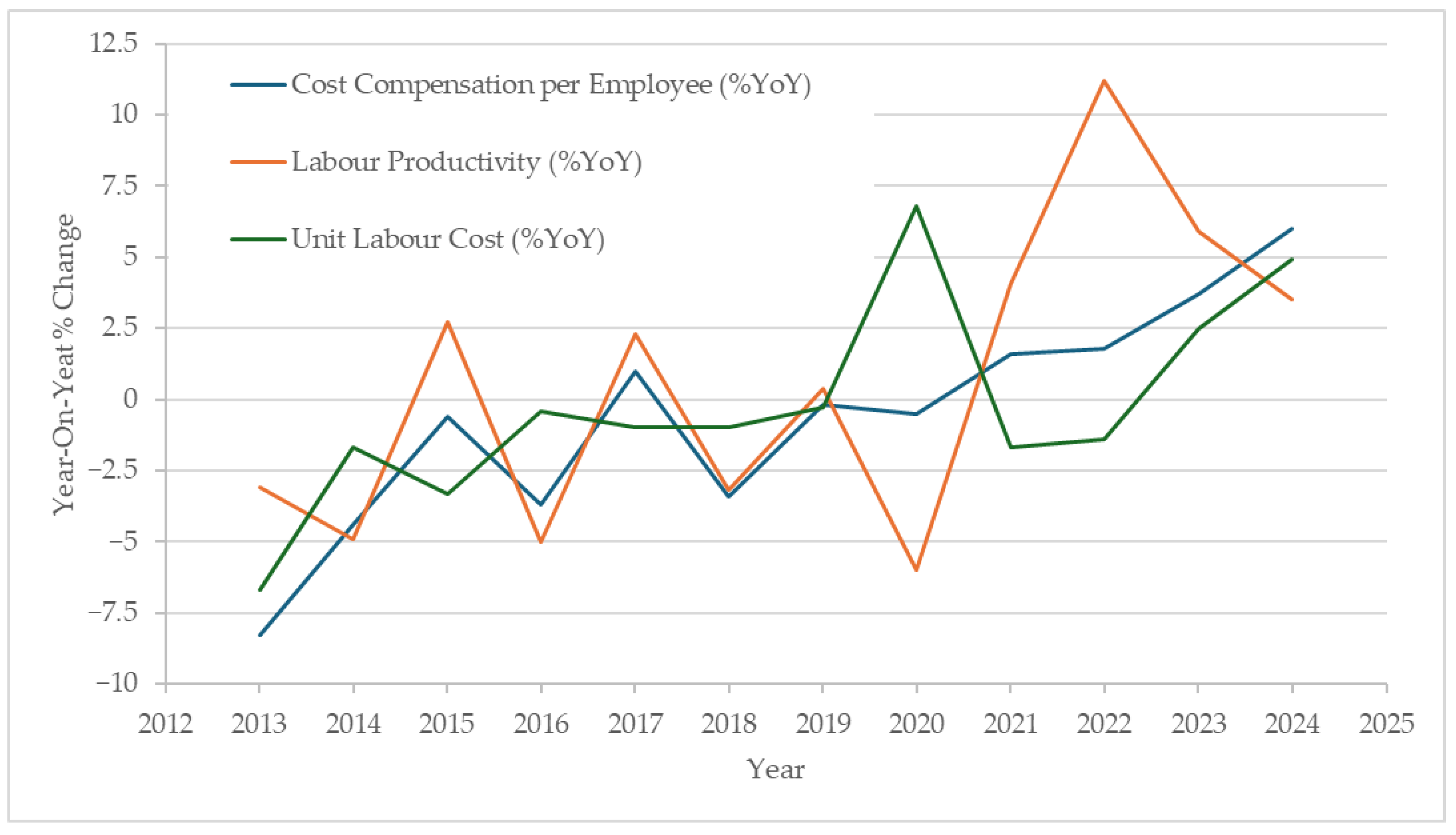
Figure 1 illustrates the evolution of compensation per employee, labour productivity, and unit labour costs (ULC) during and after the adjustment period [16]. As observed, compensation costs per employee exhibited a sharp contraction in the period 2013–2016, while labour productivity mostly remained negative, resulting in steep declines in UCL. This pattern reflects the mechanics of internal devaluation: it was wage compression more than structural efficiency gains that allowed for improvements in cost competitiveness, revealing a decoupling between wage dynamics and productivity performance. After 2021, a more balanced pattern is observed, whereby increases in productivity align with wage growth, partly reflecting institutional improvements.
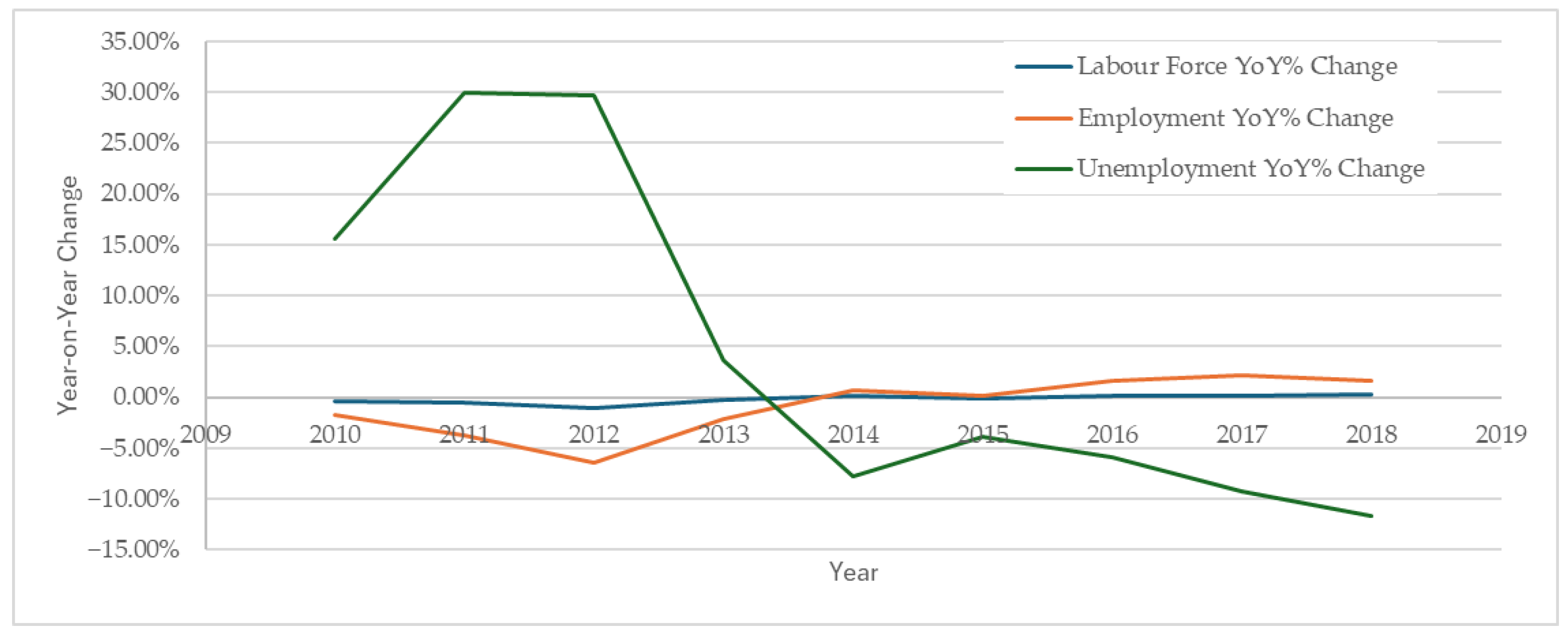
However, the nature of the early-period productivity gains was largely mechanical, driven by labour-shedding rather than genuine efficiency improvement. Eurostat Labour Force Survey data corroborates this dynamic (Figure 2). Between 2010 and 2013, the labour force contracted slightly each year (up to −1.0% in 2012), reflecting discouragement effects and outward migration, while employment declined sharply, with a peak reduction of −6.4% in 2012. Over the same period, unemployment rose explosively by +30.0% in 2011 and +29.7% in 2012. These labour-market developments demonstrate that the observed rise in labour productivity after 2013 was probably not driven by improvements in technological or organizational efficiency. Although employment began to recover after 2014 and unemployment declined, productivity remained broadly stagnant, underscoring the absence of a structural upgrading.
OECD simulations of the potential long-run effects of structural reforms suggest that fully implemented product-market and public-administration reforms could raise Greek output by more than 13% over a decade [17]. However, OECD and European Commission assessments note that implementation was often partial and delayed, especially in product markets, justice, and public administration. This implementation gap helps explain why Greece’s TFP remained low and why divergence from EU peers widened during the crisis.
Research work revealed that unit labour costs may have decreased following the internal devaluation, but the product-market reforms lagged significantly behind, leaving mark-ups, barriers to entry, and incumbent advantages largely intact [7]. This points towards an asymmetric liberalization, whereby wage flexibility occurred in a still inadequately competitive and efficient institutional framework, ultimately leading to weak gains in productive competitiveness.
Bringing together the insights from the micro- and the macro- perspectives, the case of the Greek economy illustrates that TFP is not straightforwardly associated with cost levels. On the contrary, productivity depends on a system of institutional complementarities, among which are transparency, human capital, managerial skills, digital infrastructure, and innovation funding. Cost-based measures, when applied in the absence of these complementarities, are not sufficient to translate into productive competitiveness.
A similar pattern can be deducted from the observation of price- and cost-based competitiveness indicators. Table 1 shows the cumulative changes in the country’s real effective exchange rate (REER) based on unit labour costs and consumer prices, drawing on data from the IMF, ECB, Eurostat, AMECO, and OECD. Greece demonstrated a substantial loss of competitiveness in the 1994–2009 period, while the pattern reversed in the 2009–2013 period with significant REEP depreciation. This trend reflected the reduction in wages and domestic prices associated with the internal devaluation.
Indeed, evidence from a cross-country analysis indicates that the negative effects of austerity on total factor productivity can persist if combined with limited investment in infrastructure, innovation, and public administration. These areas are domains which underpin productivity growth and work as complementarities to cost-focused adjustments.

2.3. Firm Dynamics and Entrepreneurship

Firm dynamics during the adjustment period are an indicator of the deep structural constraints on entrepreneurship. Business demographic data show that, during the height of the crisis in the period 2010–2013, the number of exits exceeded the number of entries, with micro-enterprises experiencing the steepest contraction. Many new firms belonged in a type of “necessity entrepreneurship” ventures in low-productivity services, reflecting limited employment alternatives rather than opportunity-driven activity [19]. This pattern aligns with the broader macroeconomic environment described in Section 2.1 and Section 2.2: internal devaluation policies and demand compression may have brought cost competitiveness, but the productive capacity remained impaired.
Studies of Greece’s business environment highlight three main persistent constraints on entrepreneurship:
  • Regulatory and administrative burdens: Despite some progress, Greece remained among the lowest ranking business environments in the OECD in terms of licencing processes, regulatory fragmentation, and administrative procedures [13].
  • Credit constraints: The domestic banking crisis, with high non-performing loans and deleveraging restricted access to finance, particularly for SMEs and innovative firms.
  • Policy and implementation uncertainty: Frequent changes in tax policy and uncertainty over the programme design and the political developments were factors that increased uncertainty and suppressed investment [20,21].
From the mid-2010s onward, several reforms targeted exactly these constraints. The introduction of one-stop shops for business registration and the digitisation of the General Commercial Registry (GEMI) reduced the entry barriers by cutting processing times and limiting the number in-person interactions required to start a firm. These improvements were reflected in the relevant international indicators: Greece rose from the 109th position in 2010 to the 72nd position in 2014 in the World Bank’s Ease of Doing Business index. This is evidence of actual progress in procedural efficiency even with institutional challenges still persisting.
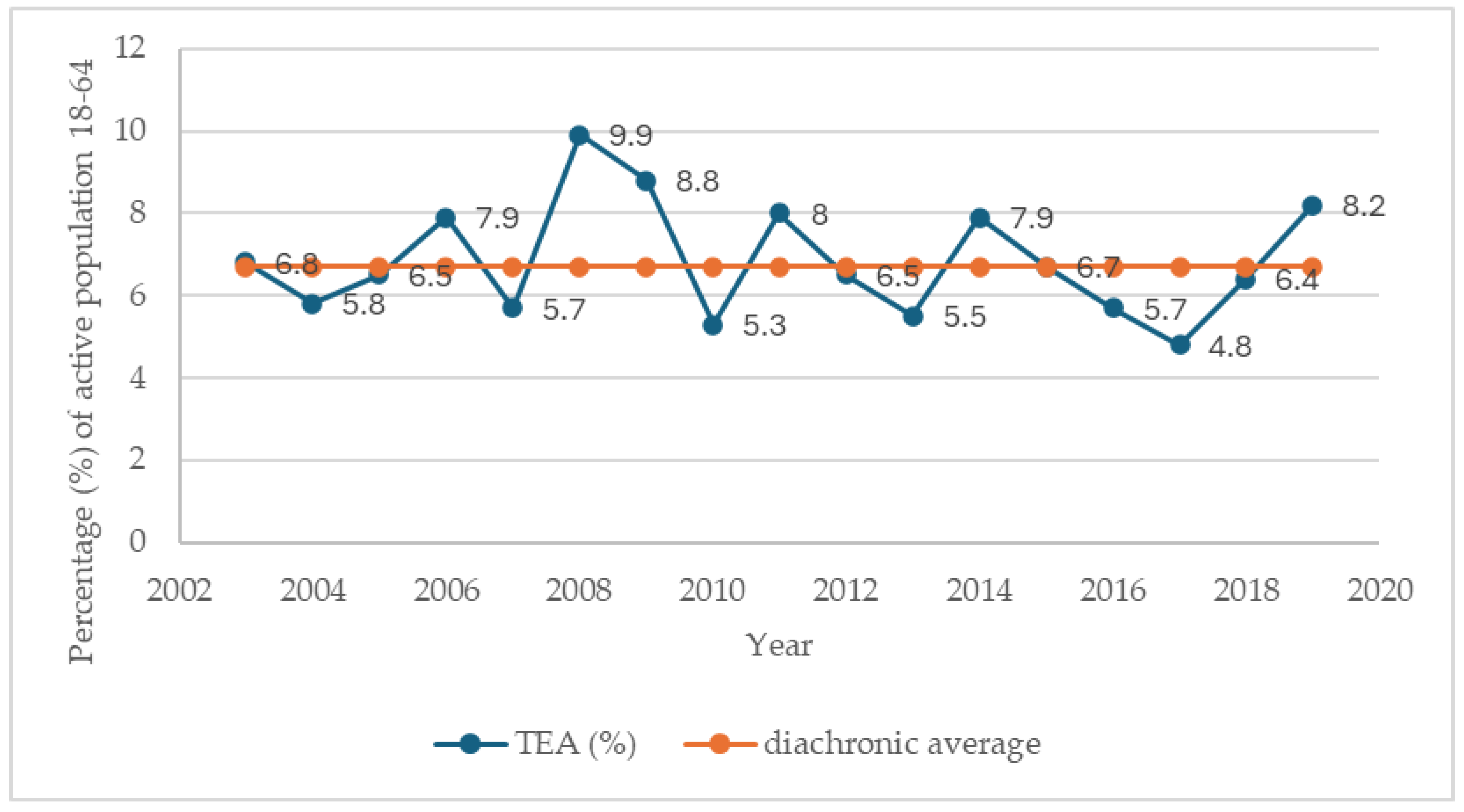
A long-term perspective on entrepreneurial activity reinforces this pattern. Figure 3 presents the evolution of early-stage entrepreneurial activity (TEA) in Greece between 2003 and 2019 [22]. The TEA rate exhibited a pronounced volatility over this period, with a notable peak in 2008–2009, shortly before the crisis unfolded. During the crisis years, TEA declined and reached 4.8% in 2017, a trend aligned with the shift toward necessity -driven self-employment, in an environment of demand compression, credit constraints, and increased policy uncertainty. The qualitative characteristics of entrepreneurship deteriorated, with activity being concentrated in small, consumer-oriented firms serving primarily the domestic market.
Importantly, Figure 3 may also suggest a temporal association between entrepreneurial dynamics and the evolving policy environment. The prolonged weak phase of TEA during the period of front-loaded fiscal consolidation contrasts with the recovery observed after 2018, when TEA recovered to 8.2%, a figure close to the pre-crisis levels, probably connected to the institutional reforms discussed above. The rebound coincides with the gradual implementation of administrative simplification, digital governance reforms, and improved access to financing instruments, suggesting a transition towards a more opportunity-oriented activity. While this association is not interpreted causally, it is consistent with the view that reductions in administrative frictions and uncertainty improved the conditions under which entrepreneurial activity could recover.
In parallel, the introduction of new financing instruments further supported the trend. EU-backed financing instruments such as EquiFund created availability of venture capital and catalyzed the emergence of a small but dynamic startup ecosystem in the fields of the quaternary economy [23,24].
Taken together, these developments were evidence of a broader picture. As transparency tools and digitization of governance shaped a more predictable, accessible, and fair business environment, entrepreneurship shifted from low-productivity to a more innovation-oriented firm creation. In this sense, further to the macroeconomic recovery itself, the evolution of entrepreneurship is closely tied to the degree of institutional and digital modernization.

2.4. Transparency, Digital Governance, and Institutional Modernization

Among the reforms introduced during the adjustment period, two stand out as particularly important for the institutional modernisation: transparency and digital governance.
First, there is the Diavgeia Transparency Programme launched under Law 3861/2010, which requires the online publication of all government and administrative decisions with a unique identification number before gaining legal force. Over time, the platform has accumulated tens of millions of acts across thousands of public bodies. Diavgeia has been widely recognized in open-government assessments as a flagship initiative that enhances accountability, reduces information asymmetries, and increases visibility over regulations, procurement, and public spending [15,25].
Second, there was the creation of the Ministry of Digital Governance and the adoption of the Digital Transformation Bible 2020–2025, which marked a shift from ad hoc and fragmented IT projects to a platform-based approach to governance. Its centrepiece is gov.gr, a unified digital portal that provides citizens and firms with single-point access to a large and growing number of public services, also enabling interoperable registries, digital signatures, authenticated payments, and secure document exchange.
Digitalization reduces what is known as “time tax”—the cost of passing through and addressing bureaucratic procedures. It also increases the predictability of administrative processes and reduces opportunities for informal practices. The move toward an Application Programming Interfaces (APIs)-based public-sector architecture further enhances transparency and lowers transaction costs for SMEs and startups.
Digital Economy and Society Index (DESI) reports show that Greece, while still lagging in some dimensions of private-sector digitalization, has converged rapidly in digital public services for citizens and businesses since 2019 [26]. These reforms directly target the institutional frictions identified earlier, thereby reducing procedural complexity, shortening processing times, and creating a more stable and trustworthy administrative environment.

3. Discussion: Timing, Friction and Causality

The Greek adjustment programme offers a revealing case study on how timing, institutional frictions, and digital transformation interact to shape the effectiveness and distribution of the reform outcomes. Insights presented herein highlight that the macroeconomic trajectory of the programmes cannot be understood without considering the administrative capacity to withstand and support the reforms together with the role of emerging digital tools in reducing the anticipated frictions.

3.1. Timing Asymmetries

Among key findings of programme evaluations and academic research is that the timing of reforms in Greece was highly asymmetric. Fiscal consolidation and internal devaluation were front loaded, producing—early in the onset of the programmes—cuts in wages, pensions, and public expenditure, generating impactful contractionary phenomena. In contrast, institution-building and digital modernization were back loaded, becoming more prominent only from the mid-2010s onward.
Published research provides evidence that a more gradual consolidation and modest cuts to public investment would likely have produced better debt dynamics [3]. Findings presented above underscore this asymmetry. Labour productivity gains observed early in the adjustment phase were mostly mechanical, driven by labour-shedding rather than technological or organizational improvements. Similar conclusions are reached in studies documenting employment rises without productivity or GDP gains in the presence of internal devaluation but without complementary reforms. Evidence from macroeconomic adjustment in Central and Eastern Europe indicates that the depth of output losses in Estonia, Latvia, and Lithuania reflected pre-crisis overheating and a sudden stop in capital inflows rather than the fiscal tightening per se. However, the subsequent growth recovery was largely driven by external demand and export growth and cannot be directly attributed to austerity policies themselves, further suggesting that contractionary fiscal policy is typically most effective when applied during economic booms rather than during recessions [8].
Cross-country evidence on adjustment programmes suggests that both the speed and the composition of reforms matter for growth and investment dynamics, particularly when monetary policy is constrained and macroeconomic uncertainty is increased. Data from 108 countries show that fiscal rules tend to yield persistent improvements only when introduced under favourable economic conditions and supported by strong institutions, whereas rules adopted during periods of economic distress often produce short-lived effects that fade over time [27]. According to recent IMF findings [10], while structural reforms have the potential to raise growth over the medium-term, their effects often take time to materialize and are more pronounced when coordinated across policy areas and supported by strong institutional conditions. Interpreted in this light, the Greek experience illustrates a sequencing problem: fiscal consolidation and wage adjustment progressed faster than reforms aimed at strengthening product-market competition, judicial effectiveness, and administrative capacity. This asymmetry is consistent with the pattern observed in Section 2.1 and Section 2.2 of the present paper, where early competitiveness gains were largely mechanical and not accompanied by sustained productivity upgrading.

3.2. Institutional Frictions and Implementation Capacity

Greece entered the crisis with longstanding structural weaknesses in critical areas like public administration, tax collection, and regulatory enforcement, making the implementation of the adjustment programmes rather complicated [15,28]. The result was an “implementation overload” with too many reforms being pursued simultaneously, leading to insufficient prioritization, limited administrative support and analytical capacity, and, ultimately, partial, delayed, or reversed implementation [17,29]. Empirical work suggests that the institutional friction was a significant contributor to long-run output losses during the 2010s, and further to the short-run effects of the reforms [9]. The pattern is consistent with the broader political economy literature on reform sustainability, which highlights that even economically sound reforms may fail to deliver outcomes when implementation capacity and credible compensatory mechanisms are weak [30].
Moreover, failure to advance product-market reforms diluted the gains from wage adjustment [7], while low investment in innovation, skills, and public administration contributed to a stagnant TFP [15,17]. Cross-country evidence further shows that management practices and the degree of decentralization within organizations are closely linked to productivity and adaptability. Using firm-level data, Bloom, Sadun, and Van Reenen (2012) [31] document that more decentralized decision-making structures are associated with higher productivity, particularly in environments characterized by higher trust and managerial capacity. While their analysis focuses on firms rather than public administrations, it is informative for understanding why highly centralized and capacity-constrained institutional settings may struggle to implement complex reform packages effectively.
At the same time, the literature cautions that measured productivity outcomes may understate underlying structural change when firm entry, exit, and creative destruction are not fully captured by official statistics. In such environments, reforms may alter incentives and behaviour without immediately translating into higher measured productivity. Aghion et al. [32] show that standard productivity measures can miss a non-trivial share of growth associated with firm turnover and quality upgrading, particularly in service sectors. This perspective helps explain why extensive reform activity in Greece did not translate into a rapid or visible improvement in productivity statistics during the adjustment period.
A growing literature emphasizes that the effectiveness of structural reforms depends not only on their formal design but also on the capacity of institutions to implement, enforce, and—further—sustain them. Administrative overload, fragmented governance, and weak coordination can create gaps between de jure reforms and de facto outcomes. IMF evidence highlights that reform payoffs are amplified when reforms are coordinated across areas and institutional conditions are strong [12]. OECD assessments underline how limited administrative capacity and siloed governance can hinder the realization of benefits [11]. Thus, well-designed reforms may deliver weak outcomes, creating a wedge between policy intent and effective practice. Evidence from 19 OECD countries during fiscal consolidation confirms this institutional conditionality, indicating that the effectiveness of fiscal rules depends on how strict and well-embedded these rules are within a country’s institutional framework [33]. This mechanism is closely linked to transparency, as cross-country evidence shows that fiscal rules become effective once sufficient transparency enables monitoring, enforcement, and political accountability [34]. From this perspective, Greece’s experience can be read as a case where institutional frictions may have operated as a wedge between policy intent and economic response, helping to explain why investment, productivity, and entrepreneurial upgrading remained subdued despite extensive legislative reform activity.

3.3. Sequencing, Complementarities, and Conflicting Objectives

The Greek programmes also reveal the importance of policy alignment and sequencing across reform pillars. While rapid fiscal consolidation and internal devaluation were expected to coexist with structural reforms designed to restore competitiveness and investment, in practice, several objectives were mutually constraining, especially in the early phases of adjustment.
(1)
Labour-market liberalization outpaced product-market and judicial reforms
Wages adjusted quickly, but barriers to entry, mark-ups, and slow contract enforcement persisted. This imbalance discouraged investment, weakened incentives for innovation, and limited export growth—the very channels through which internal devaluation was supposed to operate [7,20,21].
(2)
Prolonged uncertainty interacted with austerity
Uncertainty regarding programme design, repeated political shocks, and discussions of euro exit interacted with falling domestic demand to create a “double hit” on private investment and entrepreneurship. TEA indicators (Figure 3) and labour-force dynamics (Figure 2) clearly reflect this environment of depressed expectations.
(3)
Complementarities were missing at critical moments
As Section 2.2 shows, the institutional complementarities necessary for sustained productivity—skills, digital infrastructure, regulatory quality, managerial capabilities—were either weakened or not yet in place during the first half of the adjustment. This helps explain why cost competitiveness improved (Table 1) but productive competitiveness remained stagnant, and it helps motivate the discussion of digital governance and administrative modernization in Section 3.4.

3.4. Digitalization as an Enabling Complement

The late wave of reforms—digital governance, infrastructures supporting transparency, and administrative simplification—provided the missing elements that laid the groundwork for structural reforms to become more effective. Diavgeia platform reduced information asymmetries and provided firms with clear visibility over regulatory and administrative decisions. Gov.gr, the integration of registries, and the use of interoperable data architectures reduced what is often called the “time tax.” APIs and digital signatures lowered compliance and transaction costs, especially for SMEs and startups.
In the sense that these reforms enhanced public trust and made public action more accessible, it is reasonable to say that the digital governance and transparency reforms were not peripheral. They had a central role in the process of making structural reforms implementable and credible. The emerging evidence of improved growth performance and more dynamic entrepreneurship in Greece since 2019—by EU Recovery and Resilience Facility funding and by digital reforms—suggests digital transformation as a core enabler of competitiveness [35,36]. The momentum in entrepreneurship observed after 2018–2019 was reflected in the recovery of TEA and the rise in venture-capital activity through vehicles such as EquiFund and appears closely linked to this institutional modernization. This interpretation is consistent with cross-country evidence from transition economies, including Central and Eastern Europe in the 2010–2020 decade. Karpenko et al. (2023) show that the development of digital public administration is strongly positively associated with government effectiveness—as reflected in transparency, efficiency, and service delivery—while the direct relationship with GDP per capita remains weak, suggesting that digitalization primarily operates by strengthening institutional capacity rather than as a standalone driver of economic growth [37].
Recent international research further underscores that the role of digital government as an institutional reform for capacity-building, going beyond a simply technological upgrade. In this sense, digital governance can be interpreted as a form of institutional and organizational capability, encompassing coordination, skills, data governance, and implementation capacity. Among its benefits are the fact that it enhances coordination, transparency, and service delivery across the public sector by embedding data-driven practices, open government principles, and standardized procedures [11]. In this interpretation, platforms like Diavgeia and gov.gr exemplify how digital tools can reduce administrative transaction costs and enhance the credibility of public actions. At the same time, successful digital transformation is shown to depend on organizational capabilities and civil-service competencies in areas such as data governance, open government, and agile execution, rather than on infrastructure alone [38]. When applied to the Greek context, this perspective suggests that digital governance reforms served as facilitating complements, improving the environment within which product-market, tax, and business-environment reforms could begin to translate into more opportunity-driven entrepreneurial activity and incremental productivity enhancements. While this interpretation is necessarily associative, the temporal alignment between the expansion of digital public services and the subsequent recovery in entrepreneurship and growth performance is consistent with the view that digital governance contributed to strengthening reform transmission.

4. Conclusions and Prospects

This paper has examined Greece’s 2010–2018 adjustment programmes through the lens of timing, institutional frictions, and digital transformation, with a focus on how these dimensions interacted with productivity and entrepreneurial dynamics. Treating Greece as a revealing case of reform under constrained administrative capacity, the analysis has highlighted how front-loaded fiscal consolidation and internal devaluation unfolded in institutional conditions that were not equipped to support the rapid structural change. As a result, early competitiveness gains were largely mechanical, while investment, productivity upgrading, and opportunity-driven entrepreneurship remained subdued.
The synthesis suggests three broader lessons for the design and evaluation of economic adjustment programmes and reform strategies in the digital era. First, institutional readiness is essential for productivity and entrepreneurial upgrading. Although cost-based adjustment—through fiscal consolidation and wage compression—can restore short-run competitiveness and market access, it does not automatically translate into sustained productivity growth. In the absence of strong institutions, effective public administration, and a functioning innovation ecosystem, the response of investment and TFP to relative price changes is weak.
Second, transparency and digital governance can act as friction-reducing and trust-building complements to structural reforms. The expansion of digital governance and transparency reforms—notably Diavgeia, gov.gr, interoperable registries, and platform-based public services—coincided with a phase in which administrative burdens were reduced and the business environment became more predictable, thus creating conditions more conducive to entrepreneurship.
Third, sequencing and adjustment composition are critical. When labour-market liberalization progresses faster than reforms in product markets, justice, and public administration, incentives for investment in technology may be weakened, limiting the channels though which internal devaluation is expected to foster export capacity and long-term growth.
These findings connect Greece’s experience to broader debates on entrepreneurship in the digital era, suggesting that the effectiveness of structural and macroeconomic reforms is conditioned by the maturity of the digital state and the institutional capacity to implement change. From this perspective, digital transformation should not be viewed as a peripheral modernization effort, but rather as a core element of competitiveness and reform credibility, particularly in crisis and post-crisis environments where supporting innovation-oriented business activity is essential. In this respect, current EU instruments such as the Recovery and Resilience Facility can be interpreted not merely as sources of investment funding, but as vehicles for accelerating institutional and digital capacity-building, thereby strengthening the transmission of structural reforms to productivity and entrepreneurship.
This work is based on a narrative synthesis of evaluations and empirical indicators and does not attempt causal identification. The relationships discussed between the timing of reforms, institutional frictions, digital governance, and economic outcomes should therefore be interpreted as associative and mechanism-based and not as definitive causal effects. Future research could employ comparative cross-country designs, sub-national evidence, or quasi-experimental approaches to exploit the variation in the rollout of digital public services and institutional reforms.
Overall, the Greek case illustrates that adjustment programmes entail institutional transformations whose success depends on timing, capacity, and the ability of the state to reduce frictions and enable innovation-oriented entrepreneurship in an increasingly digital policy environment.

Author Contributions

Conceptualization, D.C. and D.D.; methodology, D.C. and E.T.; software, E.T.; validation, E.T. and D.C.; formal analysis, E.T.; investigation, E.T.; resources, E.T.; writing—original draft preparation, E.T.; writing—review and editing, D.D. and D.C.; visualization, E.T.; supervision, D.C. and D.D.; project administration, D.C. and D.D. All authors have read and agreed to the published version of the manuscript.

Funding

This research received no external funding.

Institutional Review Board Statement

Not applicable.

Informed Consent Statement

Not applicable.

Data Availability Statement

The original contributions presented in this study are included in the article. Further inquiries can be directed to the corresponding author.

Conflicts of Interest

The authors declare no conflicts of interest.

References

  1. European Stability Mechanism, ESM Greece|European Stability Mechanism. Available online: https://www.esm.europa.eu/assistance/greece. (accessed on 20 November 2025).
  2. European Commission. Ex-Post Evaluation of the Economic Adjustment Programmes of Greece During the Period 2010–2018; Commission Staff Working Document SWD (2023) 90 final; European Commission: Brussels, Belgium, 2023; Available online: https://commission.europa.eu/about/departments-and-executive-agencies/economic-and-financial-affairs/evaluation-reports-economic-and-financial-affairs-policies-and-spending-activities/ex-post-evaluation-economic-adjustment-programmes-greece-during-period-2010-2018_en (accessed on 15 November 2025).
  3. Lenoël, C.; Macchiarelli, C.; Young, G. Greece 2010–18: What Could Have Been Done Differently? Open Econ. Rev. 2022, 34, 281–315. [Google Scholar] [CrossRef]
  4. International Monetary Fund (IMF). Greece: Ex Post Evaluation of Exceptional Access Under the 2010 Stand-By Arrangement; IMF Country Report No. 13/156; International Monetary Fund: Washington, DC, USA, 2013; Available online: https://www.imf.org/external/pubs/ft/scr/2013/cr13156.pdf (accessed on 15 November 2025).
  5. International Monetary Fund; Independent Evaluation Office (IEO). The IMF and the Crises in Greece, Ireland, and Portugal; Independent Evaluation Office Report; International Monetary Fund: Washington, DC, USA, 2016; Available online: https://ieo.imf.org/en/-/media/ieo/files/evaluations/completed/07-28-2016-the-imf-and-the-crises-in-greece-ireland-and-portugal/eac-full-report.pdf (accessed on 15 November 2025).
  6. Lobonț, O.-R.; Șelaru, D.-A.; Criste, C.; Crăciun, A.F.; Vătavu, S.; Ștefea, P.M. The Sustainability Dilemma: Fiscal Rules, Institutional Quality, and Economic Outcomes in the EU. Systems 2025, 13, 1055. [Google Scholar] [CrossRef]
  7. Ioannides, Y.M.; Pissarides, C.A. Is the Greek Crisis One of Supply or Demand? Brook. Pap. Econ. Act. 2015, 2015, 349–373. [Google Scholar] [CrossRef]
  8. Staehr, K. Austerity in the Baltic States during the Global Financial Crisis. Intereconomics 2013, 48, 293–302. [Google Scholar] [CrossRef]
  9. Economides, G.; Papageorgiou, D.; Philippopoulos, A. Austerity, Assistance and Institutions: Lessons from the Greek Sovereign Debt Crisis. Open Econ. Rev. 2021, 32, 435–478. [Google Scholar] [CrossRef]
  10. Laitsou, E.; Kargas, A.; Varoutas, D. Digital Competitiveness in the European Union Era: The Greek Case. Economies 2020, 8, 85. [Google Scholar] [CrossRef]
  11. OECD. The Path to Becoming a Data-Driven Public Sector; OECD Digital Government Studies; OECD Publishing: Paris, France, 2019. [Google Scholar] [CrossRef]
  12. Ari, A.; Pula, G.; Sun, L. Structural Reforms and Economic Growth: A Machine Learning Approach; IMF Working Papers 2022, WP/22/184; International Monetary Fund: Washington, DC, USA, 2022; Available online: https://www.imf.org/-/media/files/publications/wp/2022/english/wpiea2022184-print-pdf.pdf (accessed on 27 December 2025).
  13. Dener, C.; Nii-Aponsah, H.; Ghunney, L.E.; Johns, K.D. GovTech Maturity Index: The State of Public Sector Digital Transformation; International Development in Focus; World Bank: Washington, DC, USA, 2021. [Google Scholar] [CrossRef]
  14. OECD. Digital Transformation Projects in Greece’s Public Sector: Governance, Procurement and Implementation; OECD Public Governance Reviews; OECD Publishing: Paris, France, 2022. [Google Scholar] [CrossRef]
  15. OECD. OECD Economic Surveys: Greece 2018; OECD Publishing: Paris, France, 2018. [Google Scholar] [CrossRef]
  16. Hellenic Statistical Authority (ELSTAT). The Greek Economy; ELSTAT: Athens, Greece, 2025; Available online: https://www.statistics.gr/documents/20181/18508449/greek+economy_21-03-2025.pdf (accessed on 21 October 2025).
  17. Daude, C. Structural Reforms to Boost Inclusive Growth in Greece. In OECD Economics Department Working Papers; OECD Publishing: Paris, France, 2016; p. 1298. [Google Scholar] [CrossRef]
  18. Anastassatos, T. Greece: Restoring Competitiveness, Rebalancing the Current Account and Shifting toward Export-Oriented Sectors; Eurobank Research; Oikonomia & Agores: Athens, Greece, 2014; Volume IX, Available online: https://www.eurobank.gr/el/omilos/oikonomikes-analuseis/oikonomiki-epitheorisi/2540-report (accessed on 21 October 2025).
  19. Kritikos, A.S.; Handrich, L.; Mattes, A. The Greek private sector remains full of untapped potential. DIW Wkly. Rep. 2018, 29, 264–272. Available online: https://www.diw.de/en/diw_01.c.594754.en/nachrichten/the_greek_private_sector_re...l_of_untapped_potential.html (accessed on 20 November 2025).
  20. Liargovas, P.; Psychalis, M. Do Economic Adjustment Programmes Set Conflicting Objectives? The Case of Greece. Theor. Econ. Lett. 2019, 9, 3065–3087. [Google Scholar] [CrossRef]
  21. Mavridakis, T.; Dovas, D.; Bravou, S. Failure Factors of the Economic Adjustment Programme for Greece. In Economy, Finance and Business in Southeastern and Central Europe; Karasavvoglou, A., Goić, S., Polychronidou, P., Delias, P., Eds.; Springer: Cham, Switzerland, 2018; pp. 143–157. [Google Scholar] [CrossRef]
  22. IOBE (Foundation for Economic and Industrial Research). Annual Entrepreneurship Report 2018–2019: The Entrepreneurial Profile of Greece; IOBE: Athens, Greece, 2019; Available online: https://iobe.gr/wp-content/uploads/2022/05/RES_02_11042022_REP_GR.pdf (accessed on 5 November 2025).
  23. Foundation. Startups in Greece 2024–2025. Available online: https://thefoundation.gr/2024/12/12/startups-in-greece-venture-financing-report-2024-2025/ (accessed on 2 November 2025).
  24. Antoniades, V.; Giakoumelos, M.; Petkakis, T.; Zacharia, Z. Greece’s Startup Ecosystem: A Prime Opportunity for Economic Growth; The Boston Consulting Group: Athens, Greece, 2018; Available online: https://www.sev.org.gr/Uploads/Documents/50906/BCG_Greeces_Startup_Ecosystem_Apr_2018.pdf (accessed on 5 November 2025).
  25. Hellenic Republic. Law 3861/2010—Enhancing Transparency through the Mandatory Online Publication of Laws and Acts (“Diavgeia” Programme). In Government Gazette A’ 112; Hellenic Republic: Athens, Greece, 2010. Available online: https://et.diavgeia.gov.gr (accessed on 22 February 2025).
  26. European Commission (2022) DESI|Shaping Europe’s Digital Future. Available online: https://digital-strategy.ec.europa.eu/en/policies/desi (accessed on 5 November 2025).
  27. Fatás, A.; Gootjes, B.; Mawejje, J. Dynamic Effects of Fiscal Rules: Do Initial Conditions Matter? Policy Res. Work. Pap. 2025, 11066. [Google Scholar] [CrossRef]
  28. Nikitas, V.; Vasilopoulou, V. Public Administration Reforms in Greece during the Economic Adjustment Programmes. In European Economy—Discussion Paper Series; 2022; Discussion Paper 167; Available online: https://economy-finance.ec.europa.eu/document/download/97fb3144-72fb-4ec6-aeef-f35edfdf4292_en?filename=dp167_en.pdf&prefLang=it (accessed on 5 November 2025).
  29. European Commission. Ex-Post Evaluation of the Economic Adjustment Programmes of Greece During the Period 2010–2018; Institutional Paper 207; Publications Office of the European Union: Luxembourg, 2023; Available online: https://economy-finance.ec.europa.eu/document/download/56c17101-8825-4bfe-b9ad-e53dd3d67c77_en?filename=ip207_en.pdf (accessed on 26 January 2025).
  30. Jain, S.; Majumdar, S.; Mukand, S.W. Walk the Line: Conflict, State Capacity and the Political Dynamics of Reform. J. Dev. Econ. 2014, 111, 150–166. [Google Scholar] [CrossRef][Green Version]
  31. Bloom, N.; Sadun, R.; Van Reenen, J. The Organization of Firms across Countries. Q. J. Econ. 2012, 127, 1663–1705. [Google Scholar] [CrossRef]
  32. Aghion, P.; Bergeaud, A.; Boppart, T.; Klenow, P.J.; Li, H. Missing Growth from Creative Destruction. Am. Econ. Rev. 2019, 109, 2795–2822. [Google Scholar] [CrossRef]
  33. Aaskoven, L.; Wiese, R. How Fiscal Rules Matter for Successful Fiscal Consolidations: New Evidence. CESifo Econ. Stud. 2022, 68, 414–433. [Google Scholar] [CrossRef]
  34. Gootjes, B.; de Haan, J. Do Fiscal Rules Need Budget Transparency to Be Effective? Eur. J. Political Econ. 2022, 75, 102210. [Google Scholar] [CrossRef]
  35. Malliaropulos, D.; Papageorgiou, D.; Vasardani, M.; Vourvachaki, E. The Impact of the Recovery and Resilience Facility on the Greek Economy. Econ. Bull. 2021, 53, 7–28. [Google Scholar] [CrossRef]
  36. OECD. OECD Economic Surveys: Greece 2023; OECD Publishing: Paris, France, 2023. [Google Scholar] [CrossRef]
  37. Karpenko, O.; Zaporozhets, T.; Tsedik, M.; Vasiuk, N.; Osmak, A. Digital Transformations of Public Administration in Countries with Transition Economies. Eur. Rev. 2023, 31, 569–588. [Google Scholar] [CrossRef]
  38. UNESCO; International Telecommunication Union (ITU). Artificial Intelligence and Digital Transformation: Competencies for Civil Servants—Working Group Report on AI Capacity Building; UNESCO Publishing: Paris, France, 2022; Available online: https://unesdoc.unesco.org/ark:/48223/pf0000383325 (accessed on 27 December 2025).
Figure 1. Wages, labour productivity, and unit labour costs in Greece (year-on-year change), 2013–2024. Source: National Accounts Division, Hellenic Statistical Authority (ELSTAT) (https://www.statistics.gr/en/home/ (accessed on 14 January 2026)). GDP and its components compiled with base year 2020 = 100 and reference year 2021; 2022–2024 provisional data. Unit labour cost (ULC) is defined as the ratio of labour compensation to real GDP; all branches of economic activity are included.
Encyclopedia 06 00022 g001
Figure 2. Annual percentage change in the labour force, employment, and unemployment in Greece (2010–2018). Based on Eurostat Labour Force Survey data (ages 15–74). Source: Eurostat Labour Force Survey (LFS) (https://ec.europa.eu/eurostat/web/microdata/european-union-labour-force-survey (accessed on 14 January 2026)). Notes: The series are constructed using annual population levels for individuals aged 15–74. Year-on-year percentage changes are calculated from total annual levels of the labour force, employed persons, and unemployed persons.
Encyclopedia 06 00022 g002
Figure 3. Evolution of early-stage entrepreneurial activity (TEA) in Greece, 2003–2019. Source: IOBE (Foundation for Economic and Industrial Research), Global Entrepreneurship Monitor (GEM) Greece, Adult Population Survey (https://www.gemconsortium.org/wiki/1141 (accessed on 14 January 2026)).
Encyclopedia 06 00022 g003
Table 1. Cumulative changes in Greece’s real effective exchange rate (REER), based on unit labour costs, consumer prices, and the GDP deflator. Data are drawn across multiple international sources, illustrating the substantial loss of cost and price competitiveness before the crisis (1994–2009; 2001–2009) and its partial recovery during the adjustment period through internal devaluation (2009–2012; 2009–2013). (https://www.imf.org/external/pubs/ft/scr/2013/cr13156.pdf (accessed on 14 January 2026)).
PeriodIMFEurostat
(vs. EU-17)
ECB
(vs. EU-17)
AMECO
(vs. EU-17)
AMECO
(vs. 24 Industrial Countries)
AMECO
(vs. 37 Industrial Countries)
REER based on Unit Labour Costs (ULC)1994–200924.127.428.3
2001–200921.813.724.519.226.422.9
2009–2012−10.7−10.2−14.9−12.0−13.9−13.6
2009–2013−21.7−18.4−19.1−18.5
PeriodIMFEurostat
(vs. EU-17)
ECB
(vs. EU-17)
ECB(vs. EU-17) 1OECD (vs. 40 Countries)
REER based on Consumer Prices (CPI)1994–200917.614.914.819.5
2001–200919.99.418.317.720.0
2009–2012−2.62.0−4.4−8.1−4.1
2009–2013−5.3−10.2−5.0
1 GDP-deflator-based REER. Source: Eurobank Research (2014) [18], based on data from IMF, Eurostat, ECB, AMECO, and OECD.
Disclaimer/Publisher’s Note: The statements, opinions and data contained in all publications are solely those of the individual author(s) and contributor(s) and not of MDPI and/or the editor(s). MDPI and/or the editor(s) disclaim responsibility for any injury to people or property resulting from any ideas, methods, instructions or products referred to in the content.