1. Introduction
Reading literacy, commonly defined as the ability to read and comprehend written texts, is widely recognized as a cornerstone of human development, shaping one’s academic achievement, career trajectories, and lifelong outcomes [
1]. Pervasive low literacy exacerbates existing socioeconomic disparities, leading to far-reaching social and economic consequences. Despite pressing educational needs and extensive intervention efforts, recent assessment data continue to reveal concerning trends. In the United States, results from the National Assessment of Educational Progress (NAEP) indicate that nearly 40% of fourth-grade and 33% of eighth-grade students fail to meet the basic reading benchmarks—the highest failing rates recorded to date [
2]. Similarly, the Programme for International Student Assessment (PISA) reports that approximately 25% of 15-year-olds in Organization for Economic Cooperation and Development (OECD) countries exhibit low reading proficiency [
3]. These alarming statistics underscore the importance of advancing our understanding of reading literacy to clarify why many learners struggle to achieve reading proficiency and to inform effective educational practices for students at risk of reading difficulties.
Within the construct of reading literacy, reading comprehension stands out as a central component, as the ultimate goal of learning to read is to construct meaning from written texts [
4]. Reading comprehension goes beyond simple decoding, involving multiple linguistic and cognitive resources. To achieve this, readers must coordinate information across word, sentence, and text levels to build coherent mental representations. Notably, a growing body of evidence suggests the dissociation between word decoding and reading comprehension. For instance, some readers identified as “poor comprehenders” can recognize printed words yet still struggle to derive meaning from texts [
4,
5,
6]. This phenomenon indicates that word identification alone is insufficient to achieve successful reading comprehension. Given the growing prevalence of reading difficulties, research on reading literacy has expanded. Perspectives that focus primarily on word decoding exhibit clear limitations. While decoding skills undeniably contribute to reading comprehension, these perspectives pay less attention to the engagement of higher-order cognitive mechanisms in text comprehension. A more comprehensive theoretical perspective is needed—one that integrates both lower- and higher-order processes. At the lower level, for instance, deficits in phonological awareness can undermine the accuracy and fluency of word decoding [
7]. Even when visual word recognition remains intact, reading comprehension may still be constrained if higher-level processes are disrupted. Importantly, this does not diminish the foundational role of decoding in reading, as high-order comprehension processes largely rely on the quality of lexical representations. High-quality lexical representations provide a fundamental basis for text comprehension and contribute to individual differences in comprehension performance. Skilled readers can establish form–meaning mappings, move beyond local word and sentence boundaries, and integrate information into coherent representations of the text. In contrast, less-skilled readers often struggle to coordinate processes across these levels, thus posing challenges to reading comprehension. In this sense, reading comprehension depends on the quality of lexical representations, as well as the involvement of higher-order cognitive operations throughout the progression from word-level decoding to text-level comprehension. Accordingly, fine-grained investigations into lexical representations and their underlying mechanisms are essential for understanding how successful text-level comprehension is achieved.
Several theoretical frameworks have been proposed to account for the mechanisms underlying reading comprehension. The Simple View of Reading (SVR) [
8,
9,
10] posits that reading comprehension is the product of decoding and oral language comprehension, whereas the Construction–Integration model (C-I) [
11,
12,
13,
14] frames comprehension as an iterative process in which meaning is progressively constructed and integrated. These theories have laid a solid foundation for reading research and also reveal significant limitations. The SVR merely provides a coarse description of the interplay between decoding and language comprehension, paying little attention to the specific cognitive mechanisms that drive these processes. Conversely, although the C-I model illustrates the cognitive operations involved in text comprehension, it neglects the contribution of lexical quality (LQ) and leaves unspecified the bidirectional relations between lower- and higher-level processes. As a result, these models fail to explain how linguistic information is integrated across different levels and overlook the detailed cognitive processes essential for constructing meaning from word to text. More broadly, existing models tend to emphasize the end product of comprehension (i.e., the coherent mental representations) while giving less consideration to the real-time cognitive processes through which such representations are generated. To address these theoretical gaps, this entry paper introduces an integrated framework that situates the Lexical Quality Hypothesis (LQH) [
15] within the Reading Systems Framework (RSF) [
16]. The LQH highlights the contribution of high-quality lexical representations—precise and flexible mappings of orthographic, phonological, morpho-syntactic, and semantic properties, along with their bindings. The RSF, on the other hand, positions these representations into multiple knowledge systems through higher-order processes such as sentence parsing, inference generation, comprehension monitoring, and situation model construction. This framework provides a more specific explanation of how word- and text-level mechanisms coordinate to enable successful reading comprehension and identifies the essential cognitive mechanism—Word-to-Text Integration (WTI)—that facilitates this process.
2. Lexical Quality Hypothesis (LQH)
Word-level knowledge is fundamental to literacy achievement, as it enables readers to recognize, retrieve, and integrate words in larger linguistic contexts. Successful comprehension depends on mapping word forms to their meanings, connecting these meanings across sentences, and constructing a coherent text representation. Therefore, individual differences in high-level reading comprehension often stem from differences in low-level word reading. The LQH [
15] was proposed to explain how the quality of lexical representations influences high-level reading comprehension.
2.1. Origin and Development of the LQH
The LQH builds upon the Verbal Efficiency Theory (VET) [
17], which emphasizes the role of word identification in reading. According to this theory, effective word identification depends on the automatic retrieval of orthographic, phonological, and semantic information stored in memory. This automaticity, referred to as verbal efficiency, allows readers to allocate more cognitive resources to higher-level comprehension processes. As a result, reading skill is fundamentally about how efficiently one can process written language, with fluency seen as an outcome of rapid and automatic decoding. However, improving word reading speed alone does not necessarily lead to better comprehension [
18]. While the VET highlights speed as the key difference between skilled and less skilled readers, it largely overlooks the role of word identity (i.e., the combined access to a word’s form and meaning) as the foundation of comprehension. Efficiency arises not only from speed itself, but also from representations that are stable and accessible.
The limitations of the VET led to the development of the LQH, which shifts the focus from processing speed to the quality of lexical representations, referred to as lexical quality (LQ). The LQH attributes differences in reading skill to the quality of word representations, characterized by their precision and flexibility. Precision refers to the specificity and accuracy of encoded linguistic features, while flexibility denotes the adaptability of these representations to contextual constraints. Considering the word ‘chased’, precision is evidenced when a reader automatically retrieves its exact, correct spelling (C-H-A-S-E-D), sound (/ʧeɪst/), and grammatical status as a past-tense verb; flexibility is demonstrated when the same reader seamlessly adapts its meaning across contexts, either literally in ‘the cat chased the dog’ or metaphorically in ‘the journalist chased the story’. Lexical quality is thus an individual property reflecting how efficiently readers encode, store, and access a word’s forms and meanings. Readers differ not only in vocabulary size but also in the quality of their lexical representations that encode form–meaning mappings. In this context, quality entails both precision (e.g., distinguishing
dessert from
desert) and flexibility (e.g., interpreting
cold differently in
a cold drink versus
a cold look). These two properties are essential for navigating form-meaning complexities in reading. Perfetti and Hart [
19] proposed that lexical representations in the mental lexicon consist of three constituents: orthography, phonology, and semantics. The identity of a word emerges from the integration of these constituents, with the quality of each contributing to word identification. Orthographic quality is reflected in a word’s written form: precise orthographic representations reduce confusion among visually similar words, facilitate word identification, and support reading comprehension. Phonological quality refers to awareness of a word’s sound structure. Skilled readers show strong phonological awareness, whereas deficiencies in this domain are often associated with reading difficulties like dyslexia [
7]. Semantic quality pertains to knowledge of a word’s meaning. Readers with limited or unstable semantic knowledge are more susceptible to interference during comprehension, especially when integrating information across sentences.
However, this original LQ framework overlooked grammatical information such as morphological structure and grammatical form [
19]. Recognizing this limitation, Perfetti and colleagues expanded the model by incorporating morpho-syntax as a fourth constituent and introducing a fifth, more abstract element: constituent binding [
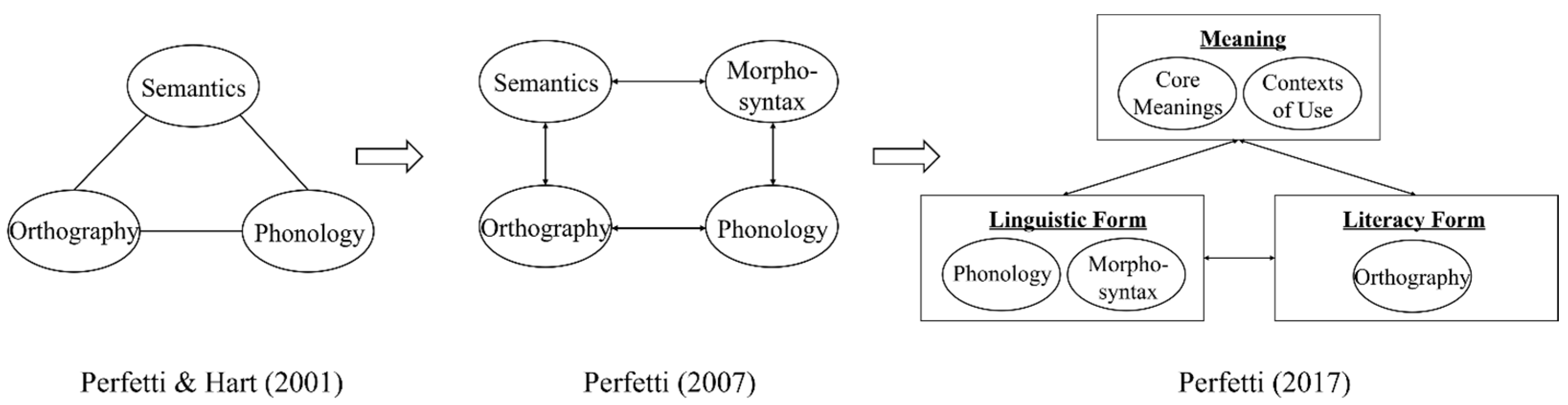
15]. Morpho-syntactic knowledge enables readers to determine a word’s grammatical class and its syntactic role in a sentence. Constituent binding refers to the degree of integration across orthographic, phonological, morpho-syntactic, and semantic information into a unified lexical representation. This binding mechanism ensures the co-activation of all constituents during word identification, thus facilitating the retrieval of a fully specified lexical identity. In a subsequent refinement of the theory, Perfetti and colleagues reorganized these five constituents into three representational domains: linguistic form (phonology and morpho-syntax), literacy form (orthographic knowledge), and meaning (core semantics and contextual use) [
20]. This revised framework extends the linguistic domain beyond phonology to include morpho-syntactic constituent and clarifies that semantics encompasses not only dictionary definition but also conceptual meaning in context. The evolution of LQH is illustrated in
Figure 1.
2.2. Constituents of the LQH and Meanings of High/Low LQ
Despite sharing the same constituent structure, words differ in the quality of their representations within each domain, ranging from high to low LQ (see
Table 1). High-quality orthographic representations are fully specified, with all letters encoded as stable elements. In contrast, low-quality orthographic representations are underspecified, with some letters encoded inconsistently. Within the phonology domain, high-quality representations are defined by word-specific phonological forms coupled with context-sensitive grapheme–phoneme correspondences. Low-quality representations, on the other hand, tend to be unstable because phonological features are underspecified. Regarding morpho-syntax, high-quality representations specify all grammatical categories and morphological forms associated with a word, whereas low-quality representations exhibit incomplete mappings between word forms and their morpho-syntactic functions. Semantic quality also varies: high-quality semantic representations are context-independent and contain meaning information that facilitates distinctions among semantically related words. Low-quality semantic representations are more context-bound, making it difficult to discriminate among related meanings. Finally, high-quality constituent binding reflects strong integration across orthographic, phonological, morpho-syntactic, and semantic constituents, allowing these components to be jointly activated during word identification. Low-quality binding, however, involves weak integration across constituents, thereby undermining word identification, meaning integration, and text comprehension.
In summary, the LQH provides a theoretical framework that explains how lexical representations contribute to reading comprehension. According to the LQH, successful integration of word meaning both within and across sentences depends on the quality of the lexical representations activated during visual word recognition. High-quality lexical representations, composed of five core constituents (i.e., orthographic, phonological, semantic, morpho-syntactic representations, as well as their binding) reinforce rapid and accurate word identification, conserve cognitive resources, and enable efficient meaning construction. Thus, the LQH posits a causal chain from LQ to automatized word reading, then to processing capacity, and ultimately to fluid comprehension [
20]. While the LQH focuses primarily on micro-level word processing, its theoretical implications extend to the broader cognitive architecture of reading that supports text-level comprehension.
3. Reading Systems Framework (RSF)
Comprehension extends beyond mere decoding; it involves integrating lexical information with broader reading processes. This integration necessitates a system that connects lower-order word identification to higher-order cognitive operations, ultimately reflecting the complexity of reading comprehension.
3.1. Background of the RSF
Previous theoretical models have laid a solid foundation for reading comprehension. Two dominant models—the construction-integration (C-I) model [
11] and the situation model [
21]—have clarified the cognitive mechanisms underlying the activation, integration, and mental representation of information during reading comprehension. Both models emphasize top-down processes, particularly the role of readers’ prior knowledge and personal experiences. Building on these foundations, subsequent models, such as the landscape model [
22], structure-building theory [
23], and the event-indexing model [
24], further examined how readers generate inferences to maintain coherence. Coherence is commonly divided into two types: local coherence, which involves establishing connections between adjacent sentences, and global coherence, which entails sustaining a situation-level understanding throughout the text. Inference making is central in both types, as it helps readers resolve discontinuities across sentences, integrate upcoming information with prior text, and construct a coherent text representation that aligns with their existing knowledge and experiences. However, these models tend to overlook the importance of word-level processing. Specifically, the activation of background knowledge and the generation of inferences are often driven by word identification processes, not solely by cognitive abilities or experiential knowledge.
3.2. Core Features, Components, and Structure of the RSF
Responding to this gap, the RSF [
16] conceptualizes reading comprehension as a distributed cognitive system composed of multiple interacting subsystems. Central to the RSF lies word knowledge, defined not merely by vocabulary size, but by the precision and flexibility of form-meaning mappings. Lexical processing serves as the gateway to higher-order comprehension through WTI, the process by which activated lexical representations are incrementally incorporated into a coherent and evolving mental model of the text. The RSF is grounded in three core domains of knowledge: (1) linguistic knowledge, encompassing phonology, morphology, and syntax; (2) orthographic knowledge, which facilitates the mapping from print to sound; and (3) general world knowledge, including background knowledge and familiarity with textual genres and structures. Reading unfolds through a sequence of processes, including sentence parsing, inferential generation, comprehension monitoring, and situation model construction, each drawing selectively on these knowledge sources. Sentence parsing organizes words into syntactic structures, allowing readers to assign grammatical roles such as subject and object, thus establishing the propositional foundation of the text. Inferential generation extends comprehension beyond the literal meaning by leveraging prior knowledge to identify implicit relations, such as underlying causes or unstated consequences. Comprehension monitoring functions as a regulatory mechanism that enables readers to detect ambiguities or misunderstandings, for example, when resolving referential conflicts. Situation model construction integrates information across sentences to build a coherent mental representation of events, one that is enriched by background knowledge and continually updated as new information is processed. Within the RSF, reading involves two types of cognitive processes: constrained and interactive. Constrained processes, such as decoding, are automatic and primarily rely on orthographic and phonological information. Interactive processes, such as inferencing, draw on general knowledge and propositional meaning derived from sentences. Rather than viewing comprehension as a linear accumulation of discrete processes, the RSF frames it as an adaptive interplay of domain-general and domain-specific processes, modulated by the constraints of working memory and cognitive reasoning resources. This integrative model accommodates both lower-level processing demands and higher-level cognitive mechanisms essential to reading comprehension.
3.3. Mechanism of the RSF
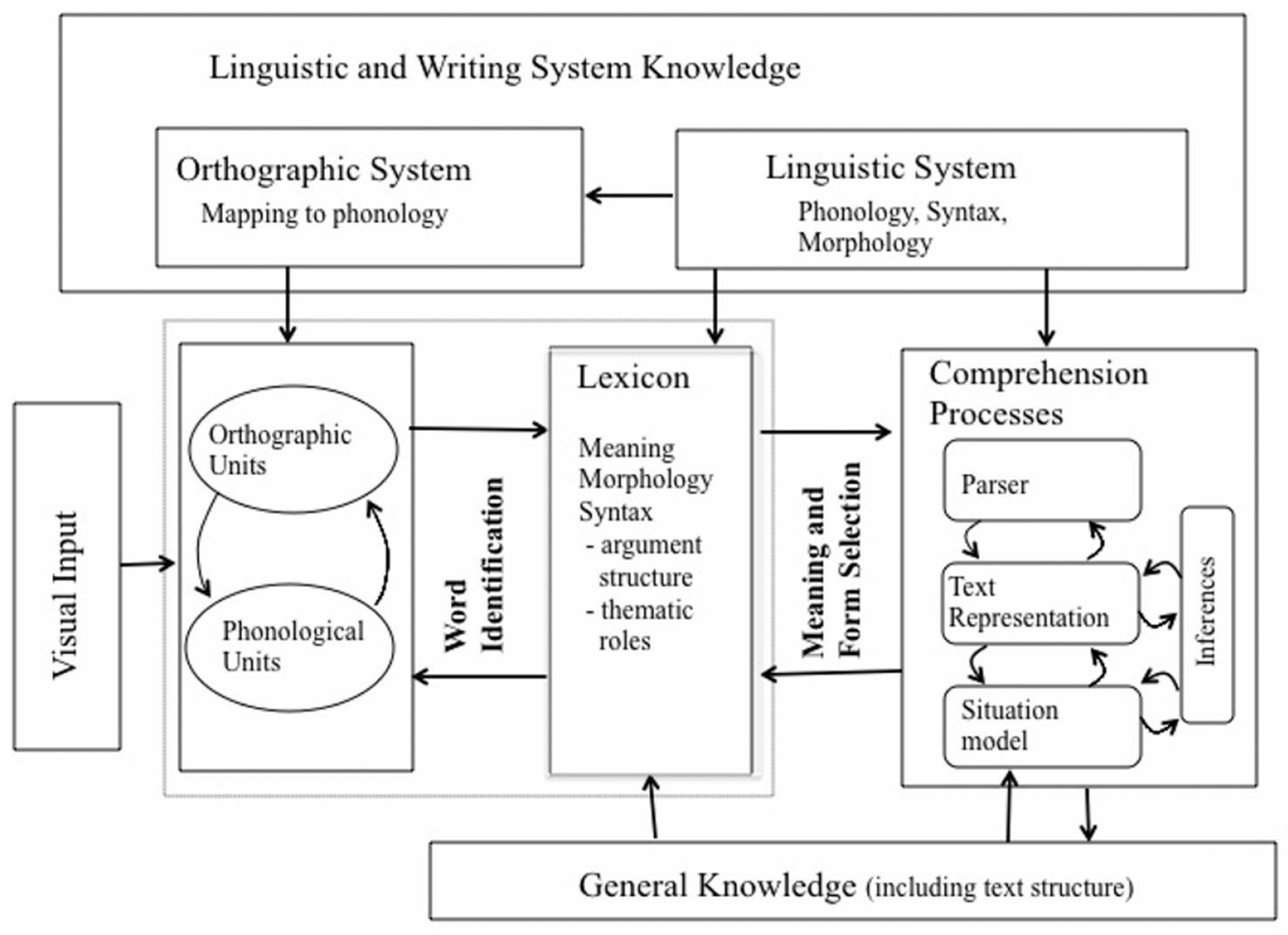
According to the RSF (see
Figure 2), word identification begins with transforming visual input into orthographic and linguistic units. These units activate stored orthographic representations, which in turn, trigger corresponding linguistic representations, including phonological and morphological forms. These representations are then accessed in the mental lexicon, where form-meaning mappings and grammatical properties (e.g., argument structure, thematic roles) are stored. Lexical access allows the reader to retrieve semantic, syntactic, and morphological information, all essential for comprehension. Once retrieved, this lexical information is transmitted to the comprehension system, where syntactic parsing incrementally constructs propositional representations. Propositions are abstract meaning units that identify key participants and their relationships, such as the agent (who performs the action), the action itself, and the patient (who or what is affected). These propositional units are further integrated into coherent sentence-level structures, forming an initial mental representation of the text. For example, when reading the sentence “The cat
chased the dog,” the visual input activates orthographic representations of each word. The reader recognizes the letters in “chased” as a familiar word form stored in memory, which activates its phonological and morphological information, including the understanding that “chased” is the past-tense form of “chase.” This information enables the reader to retrieve the word’s semantic and syntactic properties from the lexicon, such as recognizing that “chased” denotes a completed action performed by one entity towards another. The comprehension system then constructs propositional representations like [Agent: cat, Action: chased, Patient: dog], which are combined into a coherent sentence-level structure. At a higher level, this representation interacts with the situation model, a knowledge-based structure that enables inference generation, cross-sentence integration, and coherence construction. For instance, the reader might imagine the cat running after the dog across a yard, infer the dog’s likely response, or anticipate what might happen next, thereby linking the sentence to broader knowledge and upcoming events. Notably, the RSF characterizes reading comprehension as an interactive and adaptive process involving both bottom-up and top-down processes. Comprehension, therefore, is not a strictly feedforward process, but allows for bidirectional interactions to reanalyze and elaborate, based on textual context.
3.4. Bridging the Gap: Word-to-Text Integration (WTI)
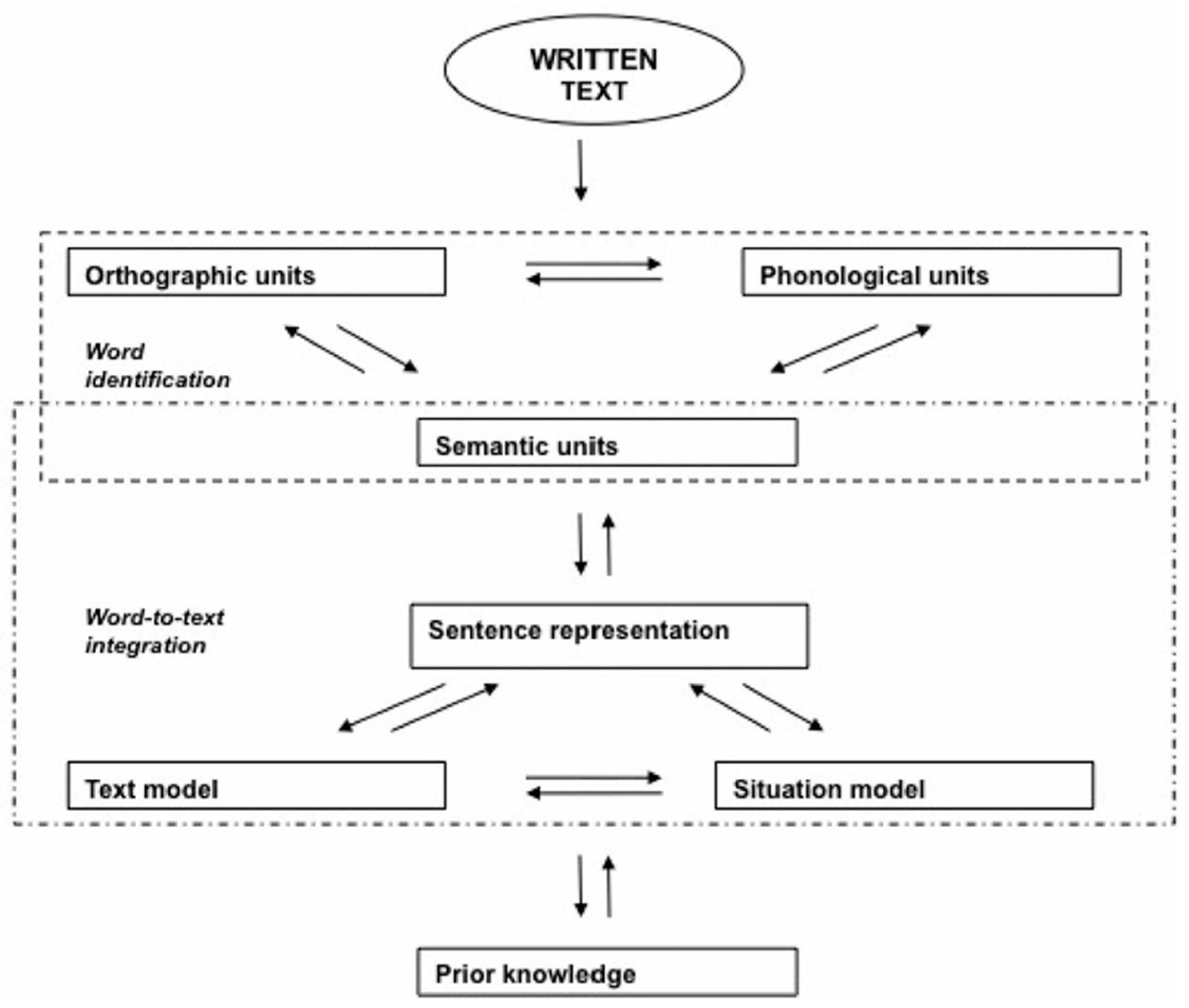
Within the RSF, word comprehension plays an important role, functioning as both the output of the word identification system and the input to the reading comprehension system (see
Figure 3 for an overview on the relevant RSF subsystems). As such, it constitutes a transition point between lower- and higher-level reading processes. The word meanings derived during reading are stored in memory, referred to as the lexicon. However, comprehending a word in context involves more than mere meaning retrieval; it requires integrating activated semantic content into an evolving text, a process known as WTI. Through WTI, readers either link the identified word to an existing referent in the mental model or update the model to accommodate a new one. According to the LQH [
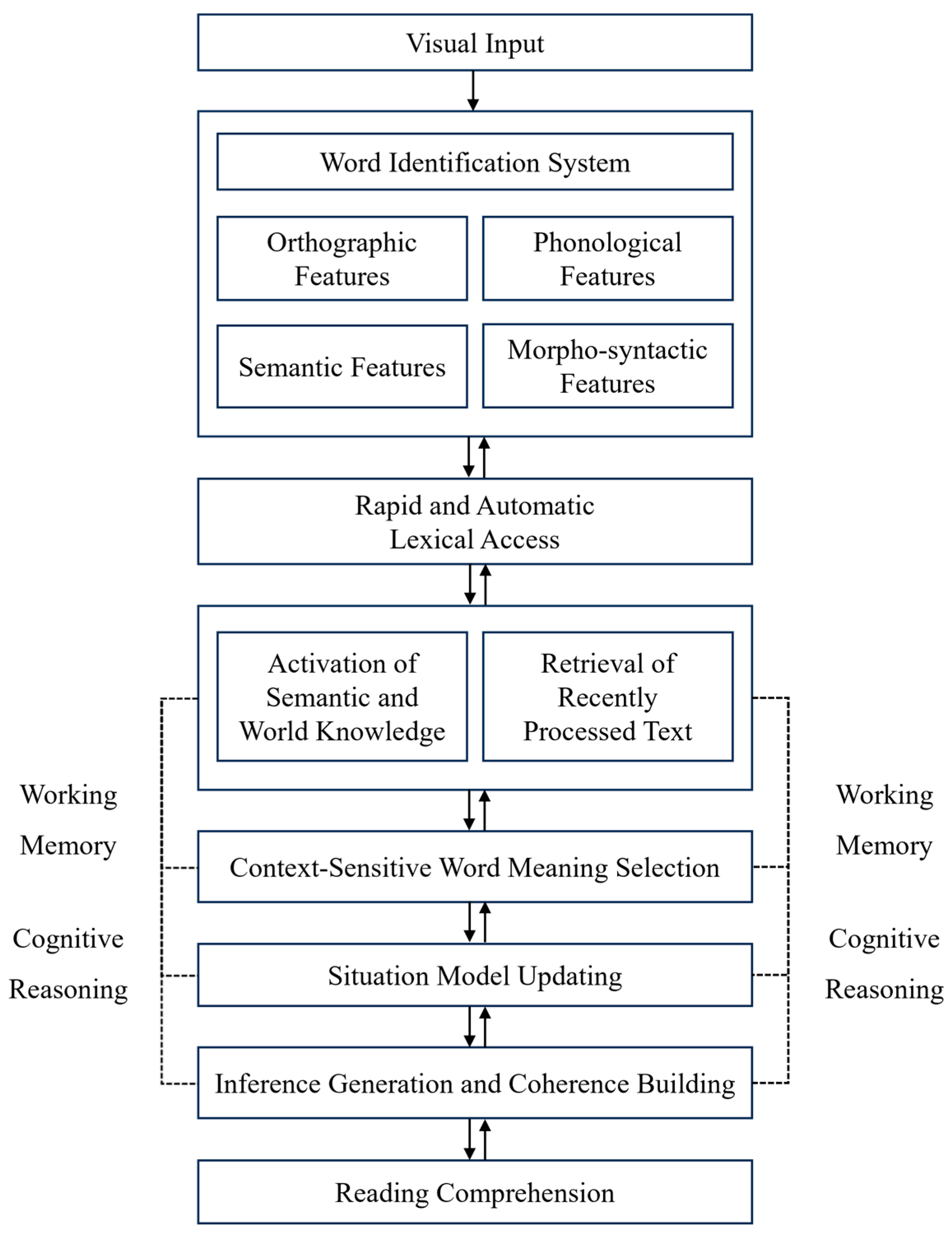
15], the lexicon holds a central position within the RSF. It must drive efficient visual word recognition through high-quality orthographic, phonological, morpho-syntactic, and semantic representations, while also providing accurate information necessary for constructing coherent meaning units. WTI is thus the mechanism through which lexical information is incorporated into the reader’s mental model, positioning the lexicon at the interface between identification and comprehension processes (See
Figure 4 for a flowchart illustrating the sequential stages and bidirectional interactions of WTI). Fluent WTI entails a series of partially overlapping cognitive operations [
16,
25]: (1) rapid and automatic lexical access triggered by orthographic and/or phonological forms; (2) activation of relevant semantic and world knowledge from long-term memory; (3) retrieval of recently processed textual information and/or situation model; (4) context-sensitive selection of appropriate word meanings from the lexicon; and (5) integration of the current word into the developing text representation. It is important to note that individual differences influence the efficiency and accuracy of these operations, with LQ serving as a driving factor. Skilled readers with high LQ typically engage in automatic and fluent WTI with minimal cognitive demands, whereas less-skilled readers may struggle due to low-quality lexical representations. Therefore, LQ, underlies individual differences in WTI and ultimately determines the success of reading comprehension.
Perfetti and colleagues further conceptualize WTI as a paradigm case of sentence-to-sentence integration, enabling readers to continuously update their situation models as new information becomes available. A particularly illustrative phenomenon of this process is
the paraphrase effect, where a newly encountered sentence is more readily integrated when it restates propositions from prior text using different lexical forms. For instance, in the sequence “The dog chased the cat across the yard” followed by “The frightened animal quickly climbed the tree,” the word “animal” does not function merely as a synonym for “cat”, but rather specifies the agent involved in the previous event. This allows readers to connect the incoming information with the previously established chasing scenario, refining their situational model through lexical updating. The paraphrase effect demonstrates that new vocabulary can facilitate incremental updating of readers’ mental representation of the text being read. Although often described as a form of bridging inference [
26], this effect is more accurately understood from a lexical perspective: words serve as retrieval cues that link incoming propositions to previously processed information. Successful integration therefore relies on both precise meaning selection within context and flexible lexical access [
27]. Skilled readers tend to show stronger paraphrase effects, integrating information more rapidly, relying less on memory resources, and maintaining textual coherence more efficiently. In contrast, less skilled readers have difficulty in integration, which often disrupt smooth comprehension [
28]. Collectively, WTI constitutes a central mechanism of reading comprehension, continuously linking word identification to text comprehension. While the paraphrase effect highlights its role in local sentence-to-sentence integration, the maintenance of global coherence relies on precise and flexible lexical knowledge. These lexical processes form the basis for inference-making in skilled reading.
In conclusion, the RSF highlights the role of the lexicon and the importance of WTI in reading comprehension. These processes are fundamentally supported by high-quality lexical knowledge, as specified by the LQH. The LQH explains that high-quality representations facilitate WTI by enabling faster and more accurate meaning retrieval and more flexible context-sensitive integration into the evolving text representation.
4. Empirical Evidence for the LQH and RSF
A robust body of empirical evidence, including experimental and correlational studies, substantiates the frameworks of LQH and RSF, supporting their theoretical claims and advancing research on reading comprehension.
4.1. Empirical Evidence for the LQH
A substantial body of experimental work via group comparison supports the distinct contributions of each constituent (orthographic, phonological, semantic, morpho-syntactic, and their binding) to word identification. Orthographic precision, for instance, plays a crucial role in lexical access. Perfetti and Hart [
19] demonstrated that skilled readers resolved homophones with different spellings (e.g.,
rain vs.
reign) more effectively during a semantic judgment task, indicating that precise orthographic representations facilitate meaning retrieval and reduce lexical ambiguity. Within the phonological domain, Breznitz and Misra [
29] reported that event-related potential (ERP) markers of phonological processing were more asynchronous in less skilled readers than in skilled readers, suggesting less efficient phonological integration. Semantic precision influences ease of meaning retrieval and integration within context, rather than simple visual word identification. Van Dyke, Johns, and Kukona [
30] found that individuals with stronger vocabulary knowledge were less susceptible to interference from semantically related distractors during sentence processing. Regarding morpho-syntactic processing, Reichle and Perfetti [
31] employed a computational model to simulate findings well established in experimental literature. Their results demonstrated that repeated exposure to inflectional variants (e.g.,
runs,
running) increased the familiarity and accessibility of the base form (e.g.,
run), resulting in enhanced word identification. These findings suggest that high-quality morpho-syntactic representations are developed through varied morphological experiences and directly contribute to efficient word reading. Finally, the importance of constituent binding—the integration of orthographic, phonological, morpho-syntactic, and semantic constituents—was demonstrated by Yang, Perfetti, and Schmalhofer [
32]. Their ERP results revealed that strong lexical and conceptual coherence promoted the co-activation of multiple constituents, which in turn benefited word identification.
Serving as the theoretical framework, the LQH has been extensively applied in correlational work, emphasizing the crucial role of LQ in learning to read. Evidence has accumulated across the core components of lexical representation, spanning multiple levels of reading—from word identification to sentence and text comprehension. Orthographic knowledge, which involves both word-specific representations (e.g., stored spellings of familiar words) and generalizable spelling patterns (e.g., applying letter-sound correspondences to unfamiliar words), has been shown to predict accurate word reading [
33,
34]. Recent findings further indicate that orthographic precision not only enhances lower-level decoding but also contributes significantly to higher-order comprehension at the sentence and text levels [
35]. Phonological awareness, particularly the awareness of fine-grained phonemes and the maintenance of precise phonological representations, has long been established as a cornerstone of early reading acquisition. It supports word reading across orthographies with varying degrees of transparency [
36,
37]. Even among populations with atypical language experiences (i.e., deaf readers), phonological awareness remains a strong predictor of reading comprehension [
38]. Semantic knowledge, encompassing both the understanding of individual word meanings and the relation in meanings among words (e.g., synonyms), plays a critical role in reading at multiple levels. Early semantic knowledge is associated with not only word identification [
39,
40] but also reading comprehension at higher text levels [
41]. Morpho-syntactic knowledge, including both knowledge of morphological structures (e.g., derivations and inflections) and syntactic functions, has been found to make unique contributions to word reading and reading comprehension [
42]. Finally, the bindings among these components are critical, as evidenced by a large-scale study of 413 primary school Chinese children showing that morphological knowledge relies on the influence of semantic, phonological, and orthographic factors and uniquely predicts reading comprehension after controlling for character naming and vocabulary knowledge [
43].
4.2. Empirical Evidence for the RSF
Comprehension extends beyond the identification of isolated words; it requires the integration of lexical information into broader textual contexts. The RSF addresses this process through WTI and predicts individual differences: Skilled readers, equipped with high-quality lexical representations, integrate word meanings rapidly and automatically, whereas less skilled readers rely more on cognitive resources to achieve comparable integration, resulting in variability in comprehension outcomes. Perfetti and colleagues—the original proponents of the RSF—have conducted a series of experimental studies to validate these predictions [
28,
32,
44]. Using real-time online measures, such as ERPs, they examined how lexical information is dynamically integrated into ongoing comprehension processes. In ERP experiments, participants typically wear a cap fitted with multiple scalp electrodes that record millisecond-by-millisecond fluctuations in brain electrical activity as they read or make judgments. This method allows researchers to capture the precise neural timing of integration processes. For example, Perfetti, Yang and Schmalhofer [
28] investigated WTI by presenting English adult readers from a university population (16 skilled readers and 18 less skilled readers) with two-sentence passages containing a critical word under four conditions (see
Table 2): (1) explicit repetition (e.g., “
hospital” in both sentences), (2) semantic paraphrase (e.g., “
emergency room” in the first sentence, “
hospital” in the second), (3) inference (e.g., the situation implies a hospital without naming it), and (4) a baseline with no coherent referent for the critical word. Clear differences in WTI processes were observed between skilled and less skilled readers, as determined by a standardized reading test. Skilled readers exhibited reduced N400 amplitudes (an ERP indicator of processing load) in both the repetition and paraphrase conditions, indicating efficient integration even without exact lexical overlap. Additionally, the paraphrase condition elicited a P300 component (an ERP indicator of mental model updating), suggesting that skilled readers actively updated their mental representations in response to novel but inferable information. In contrast, less skilled readers showed delayed and attenuated ERP responses, particularly in the paraphrase and inference conditions. Integration effects were evident primarily in the repetition condition, indicating that their comprehension relied more heavily on exact lexical matches and required greater cognitive effort.
Across multiple studies within this line of work, four consistent findings have emerged. First, WTI begins with word identification and meaning activation, which in turn retrieves relevant contextual representations from memory to refine the situation model [
45]. Second, lexical semantics, rather than syntactic or predictive cues, serve as the primary drivers of this WTI process [
32,
46]. Third, while both forward (prospective) and backward (retrospective) processes are involved, WTI is predominantly memory-based and retrospective, especially across sentence boundaries [
27,
47]. Fourth, WTI is shaped by individual differences in lexical knowledge and comprehension skill, with skilled readers demonstrating more efficient and immediate integration [
44]. Overall, this body of research positions WTI as a central mechanism linking word identification to higher reading comprehension.
4.3. Empirical Evidence for Positioning the LQH Within the RSF
A growing body of empirical research—both experimental and correlational—has examined the embedded LQH within the RSF. The first line of evidence comprises experimental studies, though relatively limited in number, employing fine-grained, real-time measures. One piece of classical evidence comes from an eye-tracking study by Taylor and Perfetti [
48] with 35 native English-speaking adults, which examined how individual differences in LQ contribute to text reading. In Experiment 1, readers with well-developed lexical knowledge exhibited shorter early fixations, particularly for high-frequency words, indicating more efficient visual word recognition. Experiment 2 extended the findings by manipulating the lexical constituents of novel words. Training with orthographic and phonological information enhanced early processing, whereas training with phonological and semantic information supported later rereading and integration processes. Notably, incomplete lexical knowledge slowed first-pass reading, and training effects were mediated by individual differences in LQ. Taken together, these two experiments demonstrate that high LQ facilitates rapid word identification and smooth integration into the developing mental representation of text. In this way, the integrated model exemplifies how word-level knowledge contributes to text-level comprehension. The second, and more extensive, line of evidence comes from correlational studies investigating the relationship between vocabulary and reading comprehension. Vocabulary is widely recognized as influencing reading comprehension indirectly through a range of linguistic and cognitive mediators. For instance, oral language skills have been identified as a crucial pathway through which vocabulary affects comprehension [
49]. Similarly, syntactic skills enhance this relationship by supporting the understanding of sentence structures [
50,
51]. Beyond linguistic factors, cognitive factors such as executive function also play a significant mediating role by facilitating cognitive control and information integration during reading [
52]. Although most studies emphasize indirect pathways, some evidence points to a direct effect of vocabulary on comprehension. Notably, Verhoeven and van Leeuwe’s large-scale longitudinal study of Dutch children demonstrated vocabulary as a consistent and significant predictor of reading comprehension across grades 1 to 6, even after controlling for decoding skills [
53].
This integrated model of reading has been widely applied in contemporary research, demonstrating the pervasive influence of LQ on reading comprehension. Readers with high-quality lexical representations tend to achieve greater comprehension, whereas those with low-quality representations often struggle to construct coherent meaning from text [
15]. Importantly, this influence is evident across developmental stages and reader populations. A substantial body of correlational research has demonstrated that the relationship between word-level reading and reading comprehension remains stable across the lifespan—from early childhood [
54,
55] through adolescence [
56,
57] and into adulthood [
58]. This relationship also holds across diverse reading populations, including typically developing readers as well as individuals who are at risk for, or have been diagnosed with, reading difficulties [
59]. Furthermore, the link between word-level reading and text-level comprehension has been validated across typologically diverse languages, such as English [
60], Dutch [
55], and Chinese [
61], and is observed in both native speakers [
54] and second language learners [
60,
61]. These cross-linguistic and cross-population findings highlight the universality of LQ as a fundamental construct in reading comprehension. Collectively, this body of evidence reaffirms the central role of word-level processing in text-level comprehension and provides robust empirical support for the embedded LQH within the RSF.
5. Comparison Between the RSF and Other Classical Reading Models
Several theoretical models have been proposed to account for how readers construct meaning from text. In addition to the RSF, two other influential models offer valuable insights that share conceptual grounds. These are the Simple View of Reading (SVR) [
8,
9] and the Construction-Integration (C-I) model [
11]. At the word recognition level, the Dual Route Cascaded model [
62] offers a complementary perspective, detailing how readers achieve accurate and automatic word identification through both sublexical decoding and direct lexical access. While both SVR and C-I frameworks highlight essential processes underlying successful reading comprehension, the RSF advances beyond them by combining these perspectives into a more fine-grained and comprehensive model.
5.1. The SVR vs. The RSF
The SVR conceptualizes reading comprehension as the product of two broad components: decoding and linguistic comprehension (R = D × C) [
8]. Decoding refers to the rapid and automatic identification of words, while linguistic comprehension entails constructing meaning at the spoken word, sentence, and discourse levels. Both components are necessary, but neither is sufficient alone, and deficits in either domain can constrain comprehension. Although the SVR emphasizes these two components, it treats them as broad constructs.
Critics have argued that the SVR oversimplifies the construct of reading comprehension by failing to specify the components of linguistic comprehension [
63]. Linguistic comprehension within the SVR is often operationalized as listening comprehension [
9], which encompasses a broad set of oral language skills. While both listening and reading comprehension involve constructing similar mental representations, and listening comprehension can even predict latent reading comprehension [
64], reading comprehension entails more complex cognitive processes, shaped by various factors, including reader characteristics, text features, and task demands [
65]. These complexities suggest that reading comprehension entails demands beyond those captured by listening comprehension. On the one hand, the SVR conceptualizes decoding as a rapid and automatic process of word identification, but it gives limited attention to the fine-grained lexical representations that underpin this process and how word identification is linked to comprehension. Specifically, it overlooks how words develop form-meaning mappings through orthographic, semantic, phonological, and morpho-syntactic information, and how these integrated bindings develop into the evolving text representations. In this regard, the Dual Route Cascaded model sheds new light by illustrating how sublexical grapheme-phoneme conversion and a direct lexical route work together to facilitate accurate word identification. As readers increasingly rely on the lexical route, word identification becomes faster and more automatic. Moreover, the SVR describes linguistic comprehension in broad terms, without specifying the skills and processes that support it. While lower-level processes, such as word identification, are foundational, higher-level text comprehension is often more complicated, requiring the coordinated operation of multiple cognitive processes. Addressing these complexities, the RSF encompasses higher-order processes critical for text comprehension, including sentence parsing, inferential generation, comprehension monitoring, and situation model construction.
Overall, as its name implies, the SVR serves as a simple framework rather than a comprehensive model. It does not fully elucidate how decoding and linguistic comprehension operate or develop, nor does it provide precise constructs for defining and measuring these components. The RSF addresses these limitations by emphasizing that successful reading depends not only on accurate decoding but also on the quality and accessibility of lexical representations. Additionally, the RSF introduces WTI as a central mechanism that bridges lower-order lexical access with higher-order comprehension processes. By incorporating relevant cognitive processes, the RSF constitutes a more holistic perspective with specificity than the SVR.
5.2. The C-I vs. The RSF
The C-I model provides a foundational framework for understanding the cognitive processes underlying text comprehension [
66]. It distinguishes between two interdependent phases: construction and integration. During the construction phase, readers generate a provisional and often incoherent propositional network by combining textual information with their prior knowledge. In the subsequent integration phase, this initial network is evaluated and refined into an elaborated propositional network by suppressing incompatible information and consolidating coherent elements. The resulting refined network constitutes the final text representation, which seamlessly integrates textual input with relevant background knowledge. This two-phase process explains how readers activate, integrate, and organize information during comprehension, emphasizing the significant top-down influences of prior knowledge. Within this model, comprehension operates across two complementary levels: text-based and situation-model understanding. Text-based understanding involves constructing a propositional text base derived directly from the text, encompassing both microstructural (local) and macrostructural (global) levels of organization [
21]. In contrast, situation-model understanding extends beyond linguistic representation by integrating textual information with background knowledge to form a coherent mental model of the described situation. Importantly, these two levels are mutually interdependent rather than functioning as separate outcomes; they work jointly to support the construction of meaning and achieve a unified comprehension process [
67]. The model further identifies inference-making as a central mechanism in building the situation model, enabling readers to bridge coherence gaps and integrate implicit information.
Although the C-I model addresses text-level processing and knowledge-based inferences, it primarily emphasizes higher-order cognitive mechanisms and tends to underrepresent the role of lexical processing in text comprehension. In fact, the activation of relevant background knowledge and the generation of inferences that facilitate mental model construction are often triggered during word identification, rather than being governed exclusively by general cognitive abilities or prior experiences. While the model highlights the top-down influences of readers’ prior knowledge and personal experiences, it neglects the extent to which these higher-level processes depend on accurate and efficient lexical processing. Consequently, the C-I model places less emphasis on the bottom-up contributions of word-level processes to higher-order comprehension.
As we previously introduced in the RSF section, the C-I model serves as the theoretical foundation for the RSF, which extends from the C-I model by specifying how LQ mediates the relationship between word-level representations and text-level comprehension. Additionally, individual readers differ not only in vocabulary size but also in their quality of lexical representations. These differences, arising from word identification processes, underscore the limitations of relying solely on the C-I model to explain readers’ performance in text comprehension
To summarize, despite the prevalence of various theoretical models of reading comprehension, the RSF offers a unique perspective by integrating insights from both word-level and text-level processing. It addresses specific limitations of classical frameworks like the SVR and C-I models by specifying the cognitive mechanisms that connect lexical quality to comprehension outcomes through WTI.
6. Limitations and Future Directions
While the integrated model of reading discussed in this entry offers valuable new perspectives, it is also important to acknowledge its current limitations. These limitations point to useful directions for future research.
First, the empirical evidence supporting the model, especially findings from neurocognitive studies, has methodological constraints. ERP measures, for example, provide accurate temporal resolution for capturing real-time language processing, but they are very sensitive to individual differences and signal noise. This variability can make it difficult to identify the underlying cognitive mechanisms, particularly in populations with diverse reading profiles. In addition, many standardized reading comprehension tests used in correlational studies may include cultural or linguistic biases. Since most existing evidence comes from English-speaking readers, it remains uncertain whether the model applies equally to other languages and cultural contexts. Although cross-linguistic studies are emerging, more work is needed to separate the universal aspects of WTI from those shaped by specific writing systems or cultural backgrounds.
Second, the RSF remains a conceptual model rather than a computational system. Its strength lies in organizing different cognitive components into a coherent framework, but this conceptual nature is also its main limitation. Without an algorithmic specification, the RSF cannot be used to simulate processing so as to figure out how different components function together. Developing it into a computational model would be an important next step. Such a model would formalize the mechanisms linking lexical quality, word identification, and comprehension processes. It would also make it possible to generate precise and testable predictions, estimate the contribution of different components, and identify potential properties that are not obvious from theory alone. This would greatly strengthen the predictive and explanatory power of the integrated reading framework.
7. Conclusions
This entry introduces an integrated model of reading that situates the LQH within the RSF, providing a systematic account of how word-level processing supports text-level comprehension. According to the LQH, high LQ enhances readers’ understanding of well-specified word forms and meanings, resulting in precise and flexible lexical representations. These representations—encompassing orthographic, phonological, semantic, and morpho-syntactic constituents, along with their bindings—not only facilitate accurate and efficient word identification but also lay a solid foundation for meaning construction during reading comprehension. Beyond the identification of individual words, high-quality lexical knowledge further promotes WTI, the process through which readers extract word meanings and coordinate them with broader comprehension systems. The RSF complements the LQH by conceptualizing WTI as the central mechanism that links lower-level word processing to higher-order cognitive operations, including sentence parsing, inferential generation, comprehension monitoring, and the construction of situation models. Within this framework, the mental lexicon serves as a bridge between word identification and text comprehension, enabling readers to integrate new lexical information into evolving mental representations through WTI. Individual differences in reading comprehension are thus often attributed to variations in the efficiency of WTI. Skilled readers tend to incorporate word meanings seamlessly, whereas less skilled readers require greater cognitive resources to achieve similar performance levels. This integrated model clarifies these differences by proposing that high LQ directly enhances the efficiency of WTI, thereby contributing to more effective comprehension.
While traditional models, such as the SVR and the C-I, have offered valuable insights, they tend to underemphasize the foundational role of lexical quality in reading comprehension. Addressing this limitation, the integrated RSF highlights that high-quality lexical representations not only facilitate efficient word identification but also support the higher-level cognitive operations essential for constructing coherent mental representations of text. Framing WTI as the key driver of coordination between word- and text-level processing allows this model to provide a more comprehensive explanation of reading comprehension than traditional approaches. This perspective is reinforced by a growing body of empirical evidence. Experimental findings provide fine-grained insights into the detailed mechanisms by which word-level information is integrated into text-level comprehension, while correlational studies reveal complex relationships between lexical knowledge and comprehension outcomes. Although much of the existing evidence comes from skilled native English readers, recent research has extended the model to more diverse populations, including developing readers and speakers of other languages. Taken together, these findings suggest that integrating word-level quality with system-level processes not only advances theoretical understanding of reading comprehension but also opens new avenues for future empirical inquiry. In particular, such integration provides a valuable theoretical framework for investigating how individual differences in lexical knowledge influence comprehension outcomes across languages, developmental stages, and populations.