1. Introduction
Emerging materials are increasingly developed with the expectation of generating industrial and societal value through market adoption. Despite their unique and enhanced properties, such materials often encounter difficulties in achieving early market entry. One possible reason lies in both technological uncertainty and the limited capacity of existing specification systems to translate material characteristics into decision-relevant information for market use.
This challenge reflects broader issues in how measurement-based information is structured, communicated, and evaluated. Although standardization is acknowledged as a pivotal driver of market diffusion, the current literature offers scarce insight into how specification systems structure information and support decision-making across industries, standards development organizations (SDOs), and markets.
Prevailing perspectives have primarily emphasized compliance and conformity assessment based on predefined criteria, while less attention has been given to the roles of interpretation, comparison, and application-specific evaluation. In this study, comparability refers primarily to the ability to evaluate measurement-based material characteristics across products within common specification frameworks. The terms “Type A” and “Type B” used in this study refer to functional categories of specification standards. To avoid ambiguity with established metrological terminology, it should be clarified that these labels are distinct from the Type A and Type B methods of evaluating measurement uncertainty in the Guide to the Expression of Uncertainty in Measurement (GUM) [
1], though both concepts share a fundamental connection to measurement-based data reliability.
The standardization of emerging materials is particularly challenging because it must accommodate heterogeneous characteristics, diverse measurement practices, and evolving application requirements. In contrast to mature material systems—where standardized specifications and conformity assessment schemes are relatively well established—emerging materials are often associated with independently developed product specifications, diverse measurement approaches, and limited comparability across products, which may hinder effective market evaluation.
Existing studies have examined the relationship between standardization and innovation from economic, institutional, and technological perspectives [
2,
3,
4,
5,
6], while metrological research has focused on measurement validity and applicability [
7]. However, relatively limited attention has been paid to how specification systems organize measurement-based information and support market-oriented decision-making processes.
New specification dynamics are clearly observable in the frontlines of nanotechnology standardization. The recent publication of Type A standards—such as ISO/TS 19808:2020 for carbon nanotube suspensions [
8], ISO/TS 9651:2025 for graphene-related 2D materials [
9], and ISO/TS 21236-2:2021 for clay nanomaterials [
10]—demonstrates an increasing industrial reliance on structured data disclosure rather than rigid pass/fail criteria. While these existing deliverables successfully establish a baseline for characterizing emerging materials, the previous literature offers limited general frameworks to translate such measurement-based information into decision-relevant formats for market adoption, underscoring the practical necessity of the proposed dual-mode framework.
In response to this issue, this study proposes a complementary perspective that interprets standardization as an interaction-based infrastructure for organizing and coordinating information across industries, SDOs, and markets. Within this framework, industry generates and discloses specification information, SDOs organize and harmonize it, and markets evaluate its value in relation to specific applications.
Building on this perspective, the study distinguishes between two complementary types of standards for material specifications.
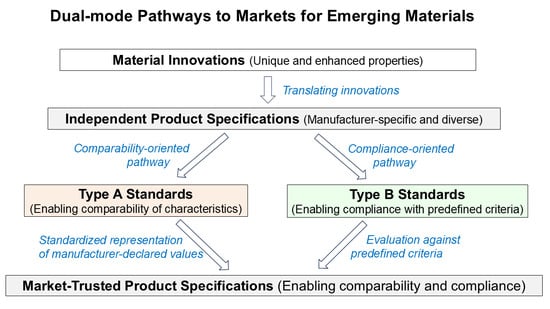
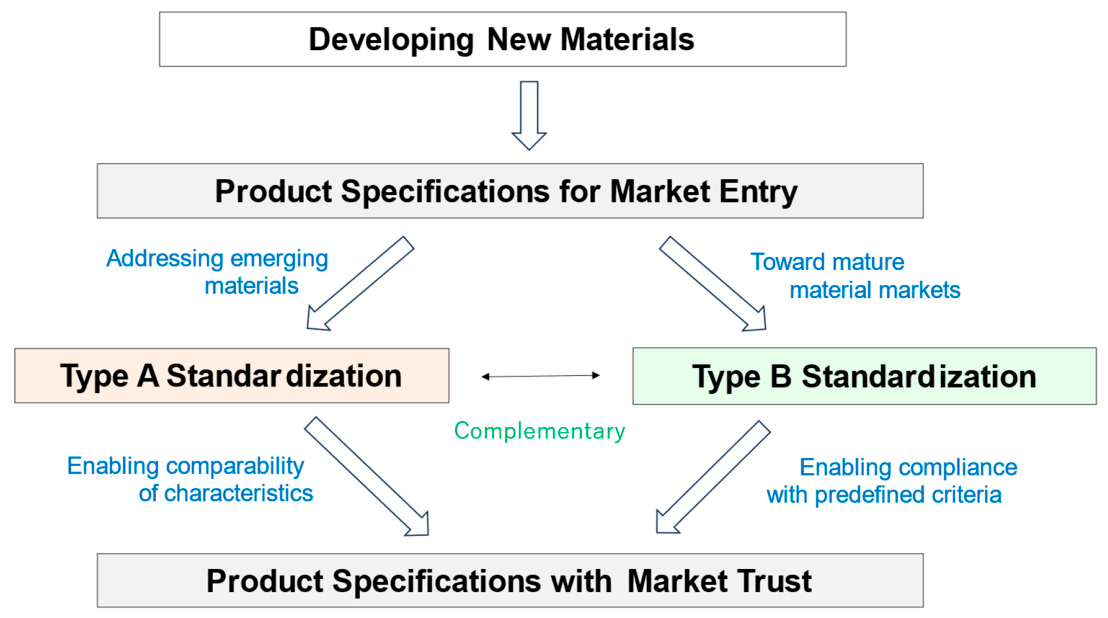
Figure 1 illustrates a structural framework in which product specifications in emerging materials are transformed into decision-relevant information through two distinct but complementary pathways.
Type A standards define frameworks for representing characteristic values and associated measurement uncertainties, enabling application-specific evaluation based on disclosed data. Type B standards define predefined characteristic values and compliance criteria, providing a basis for conformity assessment and quality assurance in more mature material markets. Rather than representing sequential stages, these two types may be understood as complementary mechanisms that support different functions of comparability and compliance under varying technological and market conditions. These distinctions are exemplified in nanomaterial standardization practices, including IEC TS 62565-1:2023 [
11], other parts of the IEC 62565 series, and ISO nanomaterial standards developed by ISO/TC 229 [
12].
In addition to serving as a compliance-oriented system, standardization provides a framework for facilitating the comparative evaluation and market utilization of emerging materials.
Section 2 examines the structural characteristics of these pathways,
Section 3 analyzes their interaction dynamics, and subsequent sections discuss implications for standardization strategies.
2. Structuring of Emerging Material Specification Systems
2.1. Structural Distinction Between Type A and Type B Standards
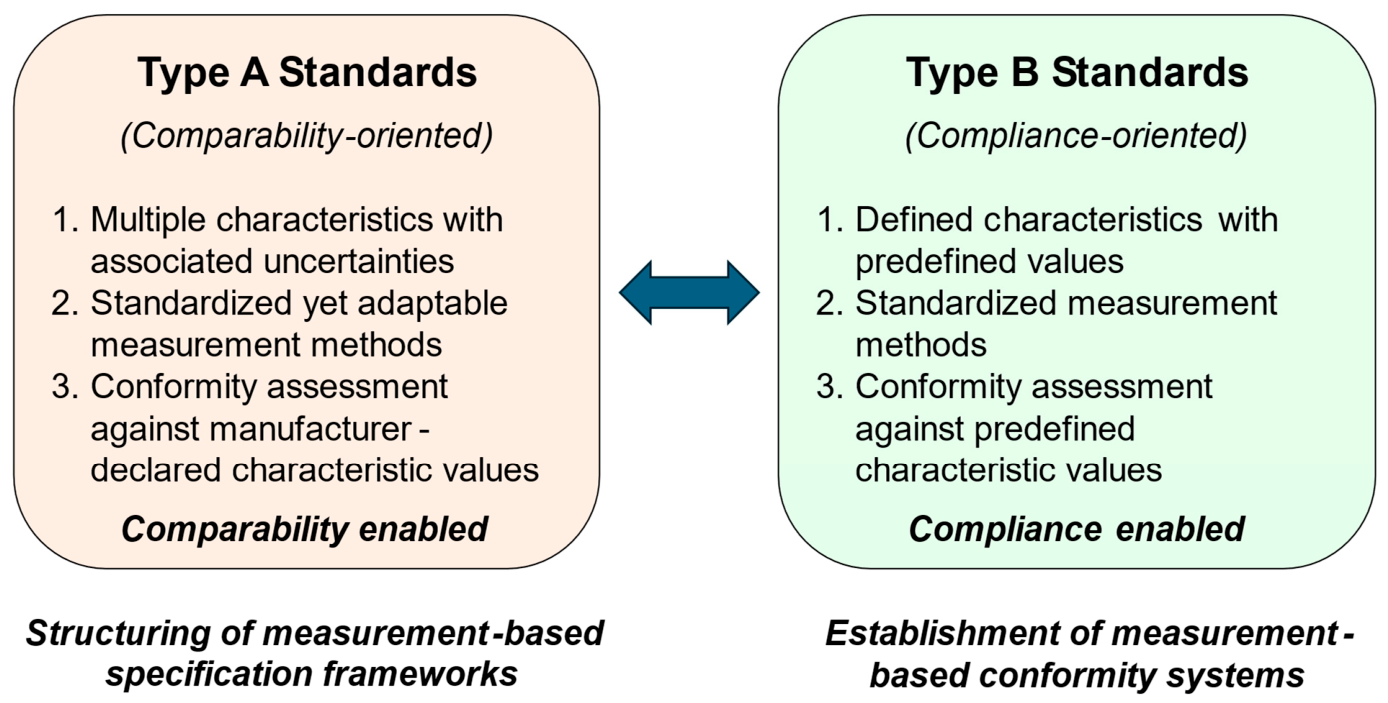
Figure 2 highlights the structural distinction between Type A and Type B standards in emerging materials. These two complementary pathways exhibit different specification structures and conformity assessment logics. Type A standards enable comparability across diverse characteristics with associated uncertainties through standardized yet adaptable measurement methods. They also support evaluation against manufacturer-declared values within a framework for structured disclosure and interpretation. In contrast, Type B standards support compliance through predefined characteristic values, conformity criteria, and standardized methods.
Type B standards operate under more stabilized conditions. They define predefined characteristic values, adopt standardized measurement methods, and support conformity assessment against established criteria. As a result, Type B standards ensure quality assurance and support certification in mature markets.
Type A and Type B standards thus play complementary roles in the standardization of emerging materials, supporting different modes of decision-making under varying conditions of material and market development.
2.2. Structural Differentiation of Product Specification Systems
Product specification systems in industry may exhibit different structural configurations depending on market and material conditions.
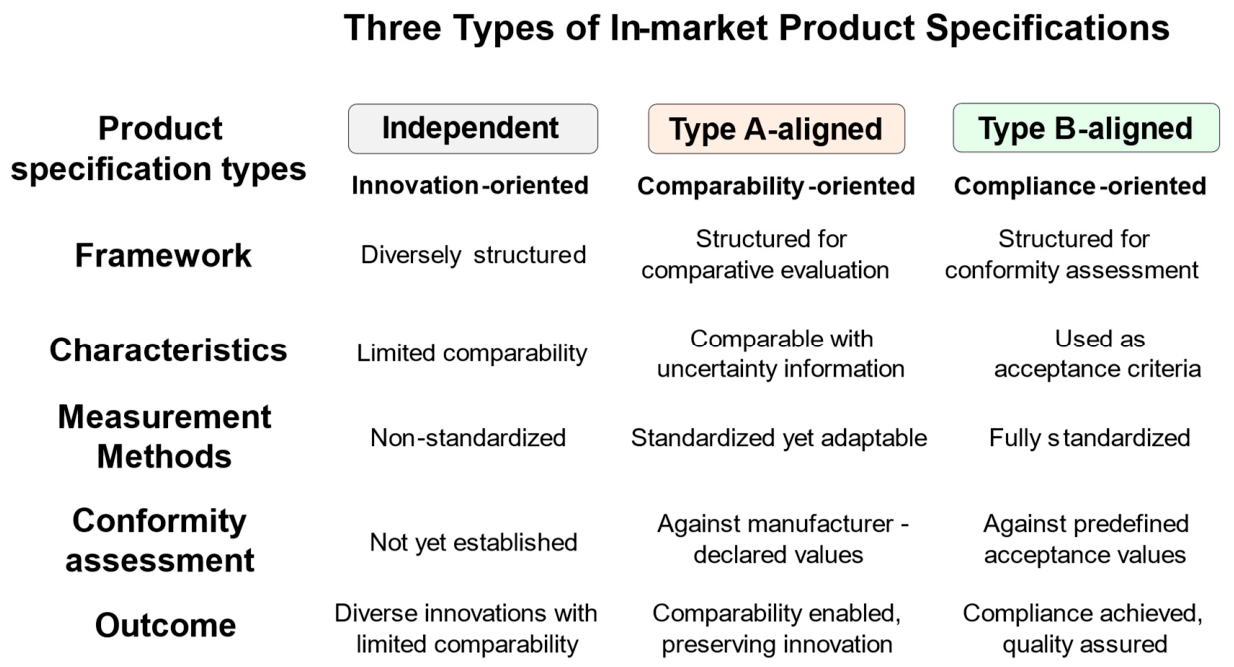
Figure 3 illustrates three typical forms of in-market product specification systems.
In innovation-oriented domains, product specifications are often independently structured, characterized by diverse characteristics and non-standardized measurement methods. In such contexts, comparability across products remains limited, although this diversity may support a broad range of technological innovations and exploratory product development.
Type A standards provide a framework for structuring comparability across diverse product specifications. Within this configuration, manufacturer-issued specifications become comparable through standardized yet adaptable measurement frameworks while preserving characteristic diversity and ongoing innovation. Such frameworks support market evaluation and early-stage adoption of emerging materials.
In mature material domains where product characteristics and acceptance criteria are established, Type B standards support conformity assessment against predefined acceptance values. In these contexts, measurement methods are highly standardized, enabling certification, quality assurance, and broad market acceptance. Type B-aligned product specifications refer to manufacturer-issued specifications that demonstrate conformity with predefined acceptance criteria established by Type B standards. When conformity of these product specifications is ascertained by a certification body, certification provides formal assurance of conformity and supports broader market acceptance.
These differentiated specification frameworks suggest that standardization may perform different coordination functions depending on the characteristics of the market and material domain. Type A-aligned systems primarily support comparability across diverse products, whereas Type B-aligned systems support conformity assessment and standardized quality assurance. Rather than representing competing approaches, these frameworks may be understood as complementary forms of specification coordination associated with different industrial and technological contexts.
While
Figure 3 illustrates the structural differentiation of product specification systems, the following section focuses on the operational characteristics of Type A- and Type B-aligned systems.
3. Interaction Dynamics in the Standardization of Emerging Material Systems
This section examines how Type A- and Type B-aligned specification systems operate and interact across emerging material markets. The analysis focuses on functional differentiation, institutional arrangements for conformity assessment, and interaction dynamics among markets, industry, and SDOs. It further examines how these relationships evolve across phases of material maturity.
The establishment of standardized material specifications is essential to mitigate information asymmetry and facilitate efficient market transactions. It should be noted, however, that while market decision-making broadly encompasses economic, financial, and political considerations, the functional roles of Type A and Type B standards are strictly focused on supporting technical decisions. These standards serve as a reliable infrastructure specifically for evaluating the technical equivalence, performance, and compatibility of materials.
3.1. Functional Differentiation of Type A- and Type B-Aligned Specifications
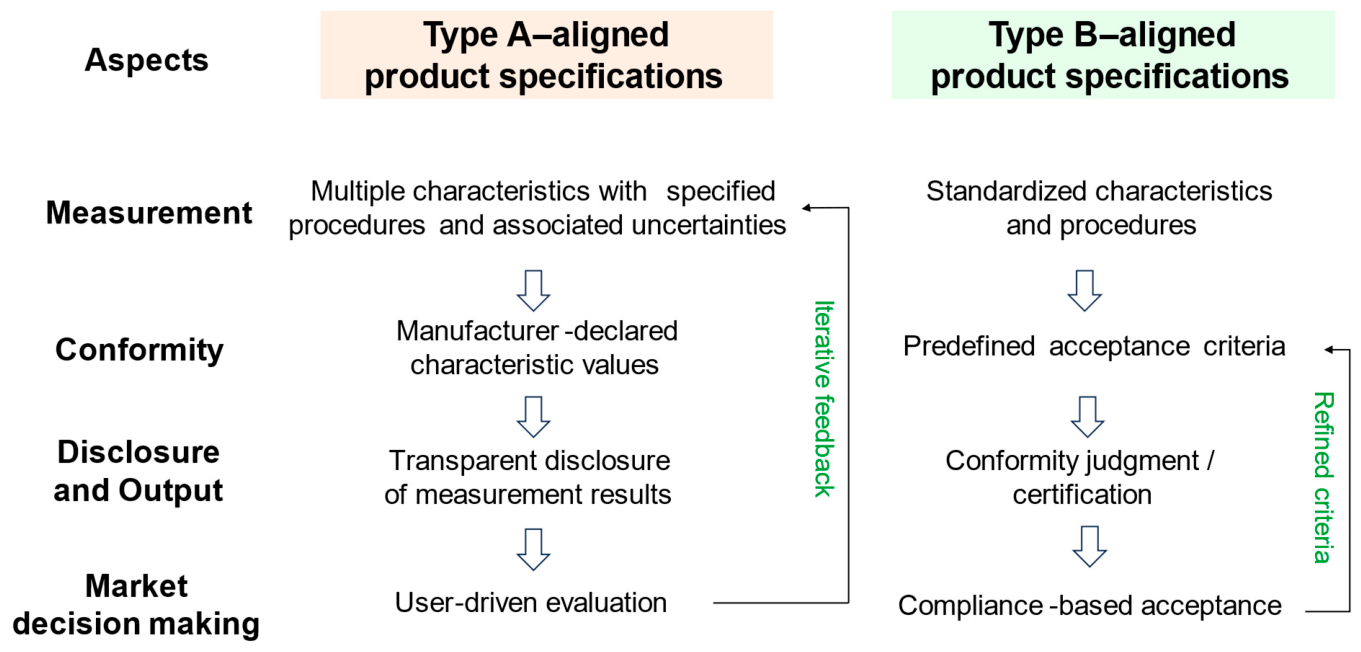
As illustrated in
Figure 4, Type A- and Type B-aligned systems exhibit different operational characteristics in how measurement-based information is disclosed, interpreted, and utilized for market decision-making and conformity assessment.
Type A-aligned product specifications are characterized by the disclosure of relevant characteristic values together with associated uncertainties, enabling application-specific interpretation and market decision-making. Interlaboratory comparison studies may support the evaluation of measurement uncertainty. This data-centric architecture emphasizes transparent disclosure and user-driven contextual interpretation of measured data rather than predefined acceptance criteria, allowing user industries to determine the suitability of materials according to diverse and evolving requirements.
Within such systems, conformity assessment may be performed relative to manufacturer-declared values using standardized measurement frameworks and procedures. Rather than determining conformity against fixed acceptance thresholds, evaluation is conducted through comparative interpretation of disclosed measurement results under shared measurement conditions. Consequently, Type A-aligned systems enable comparability and adaptive decision-making, thereby contributing to market formation in emerging material domains. Furthermore, beyond this enhanced comparability, Type A standards empower users to efficiently screen and select candidate materials by defining a minimum yet essential set of characteristics. In doing so, these standards play a pivotal role in institutionally defining the identity of an emerging material during its early market stages.
In contrast, Type B-aligned systems are structured around predefined characteristic values and acceptance criteria associated with specific applications and performance requirements. Measurement methods and procedures are highly standardized to support reproducible evaluation and conformity assessment against predefined criteria. Under these conditions, certification and quality assurance become increasingly important mechanisms for establishing reliability and market trust.
Compared with Type A-aligned systems, Type B-aligned systems emphasize conformity and consistency rather than contextual interpretation of disclosed measurement results. Such systems support broader industrial harmonization, stable quality assurance, and market acceptance in mature material domains where application requirements and evaluation criteria have become sufficiently stabilized.
These operational differences indicate that Type A- and Type B-aligned systems support distinct but complementary coordination functions. Type A-aligned systems primarily support comparability and adaptive evaluation under conditions of technological and application uncertainty, whereas Type B-aligned systems support conformity assessment and standardized quality assurance under more stabilized market conditions.
3.2. Institutional Architecture of Conformity Assessment and Certification
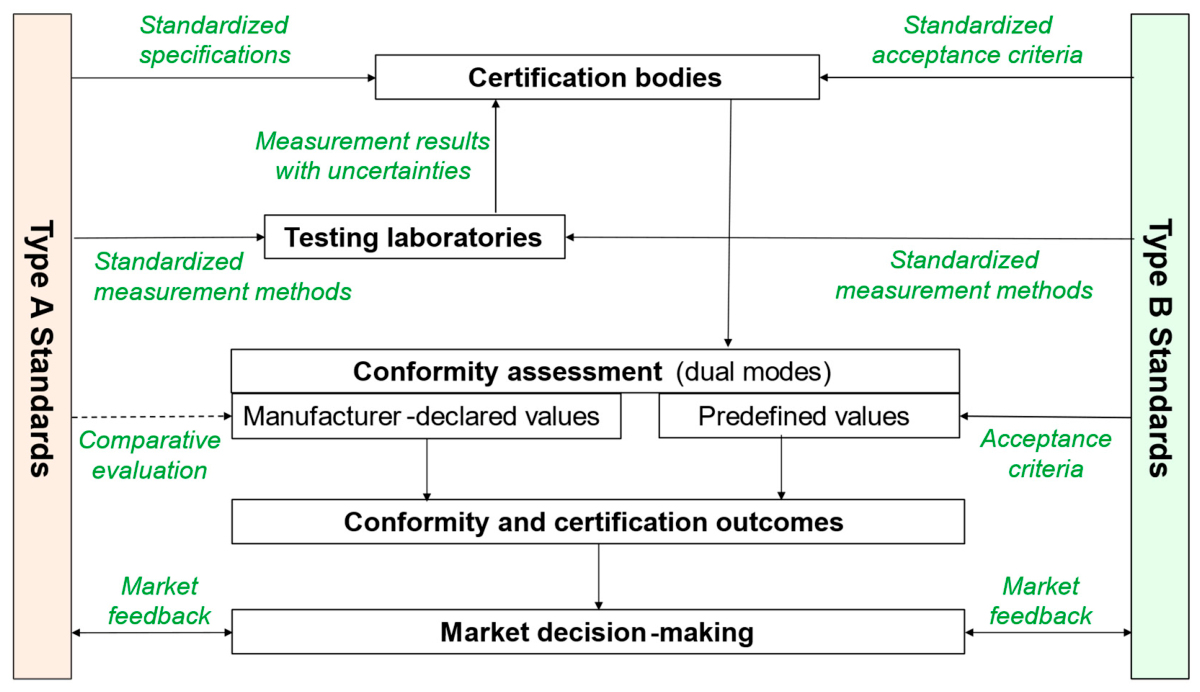
Conformity assessment in emerging materials is shaped by institutional interactions among market forces, industrial practices, and SDO activities. As illustrated in
Figure 5, both Type A and Type B standards are applied to a common institutional process involving testing laboratories and certification bodies. They enable dual pathways to conformity and certification of products: one against manufacturer-declared values and the other against predefined values. This structure extends certification beyond conventional compliance-based frameworks, thereby supporting broader market decision-making, including quality evaluation and assurance of emerging materials.
3.3. Interaction Dynamics Among Research Institutions, Industry, SDOs, and Markets
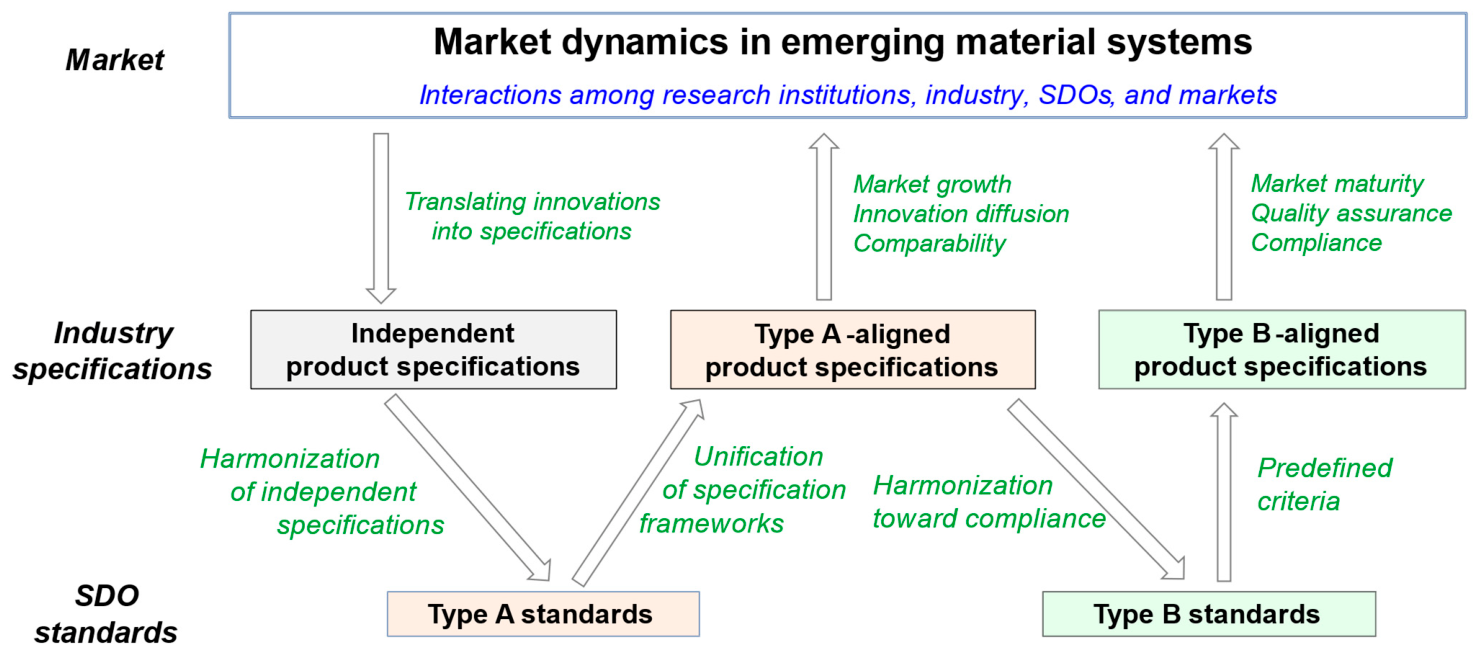
Figure 6 illustrates the interaction dynamics among applied science-oriented research institutions, industry, SDOs and markets. In this study, applied science-oriented research institutions refer to organizations that support the transition of scientific and technological outcomes toward industrial and societal implementation by translating innovations into product specifications through activities such as measurement development, material characterization, specification coordination, and standardization.
The selection among the three industry product specification forms is not determined solely by material maturity, but also by the strategic discretion of individual manufacturers according to their innovation objectives, technological maturity, target applications, market requirements, and certification needs. While there is an inherent evolutionary time-lag in the development of institutional frameworks—where Type A standards precede Type B standards to establish initial comparability—they fundamentally continue to coexist over the long term during the market utilization phase. In this manner, rather than following a rigid, linear replacement pathway, independent, Type A-aligned, and Type B-aligned product specifications simultaneously coexist across materials and application domains to serve complementary functions.
These processes are closely coupled with market dynamics. In early stages, diverse innovations generate fragmented specifications that reflect technological diversity. Applied science-oriented research institutions may contribute to this process by supporting the development of measurement frameworks, material characterization, harmonization activities, and specification infrastructures that facilitate the translation of emerging technologies into industrial applications.
The introduction of Type A-aligned specifications enables the structuring of specification frameworks and improves the comparability of measurement-based material characteristics without constraining innovation, thereby facilitating industrial adoption and early market growth. As markets expand and demands for reliability increase, further harmonization leads to the emergence and adoption of Type B-aligned specifications, supporting quality assurance, market maturation, and strengthened trust.
These interactions indicate that standardization operates as an adaptive infrastructure in which market dynamics, industrial practices, research institutions, and SDO activities are structurally interdependent. Changes in any one domain may therefore induce adaptive responses and reconfigurations in the others, rather than following a simple linear progression.
To bridge the proposed conceptual framework with the practical operations of standards development organizations (SDOs), the roles of Type A and Type B standards can be explicitly mapped onto existing ISO/IEC deliverables. As illustrated in
Figure 6, these standards function to align independent industrial specifications with harmonized frameworks. Consequently, they rely on normative statements realized through Technical Specifications (TSs) for developing technical fields, or International Standards (ISs) for stabilized ones.
For emerging materials, which are often characterized by evolving technologies and markets, it is recommended that a staged evolutionary pathway be prioritized. Under this approach, deliverables are initially published as TSs to capture market feedback and subsequently converted into full ISs. A prominent practical example is found in ISO/TC 229 and IEC/TC 113 (nanotechnologies), where material specification standards are routinely developed first as TSs and later upgraded to ISs as the technology matures.
3.4. Dynamics of Type A and Type B Standards Across Material Maturity Phases
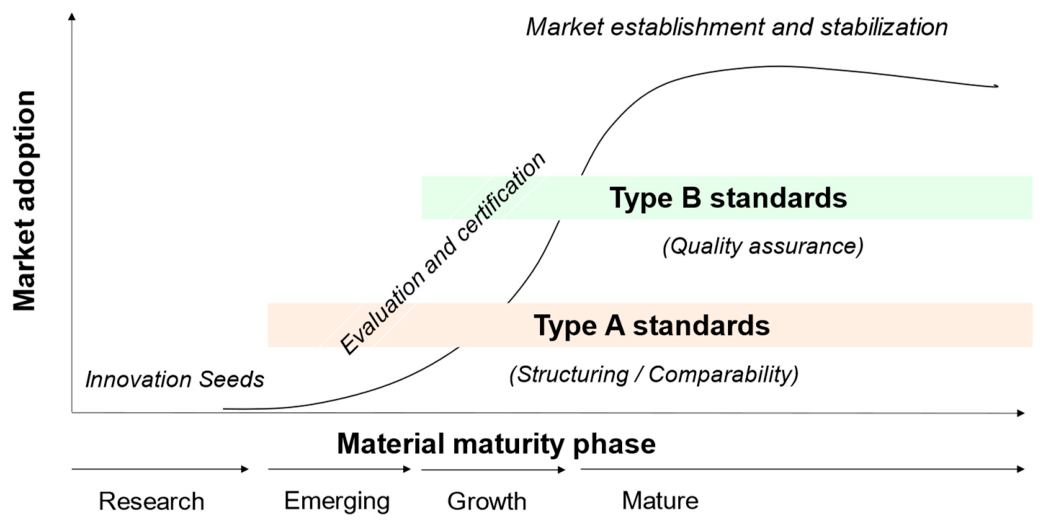
The interactions described in the preceding sections give rise to dynamic relationships among material maturity, market expansion, and standardization.
Figure 7 illustrates the distributed contributions of Type A and Type B standards across material maturity phases.
In emerging phases, diverse innovations originating from research and development coexist with limited market adoption. In such contexts, Type A standards play a central role by enabling comparability across products through the comparative evaluation of measurement-based characteristics without constraining technological diversity. In particular, many Type A standards published by ISO/TC 229 require the evaluation and reporting of measurement uncertainty [
12], thereby reinforcing the metrological basis for the comparative evaluation of material characteristics. Type A standards also provide a basis for conformity assessment against manufacturer-declared values, thereby facilitating market evaluation and the early-stage adoption of emerging materials.
As material markets expand, increasing demands for reliability, certification, and standardized quality assurance strengthen the role of Type B standards. These standards provide predefined acceptance values for application-essential characteristics and fully standardized measurement methods that support conformity assessment, certification, and broader market acceptance.
In mature phases, Type B standards contribute significantly to market stabilization by enabling quality assurance, certification, and reliable large-scale commercialization. At the same time, Type A standards continue to enhance comparability and conformity assessment against manufacturer-declared values in response to ongoing technological innovation and evolving market needs. Rather than representing a unidirectional transition, Type A and Type B standards perform complementary functions with the increasing role of Type B standards.
3.5. Standardization Dynamics in Mature Material Systems
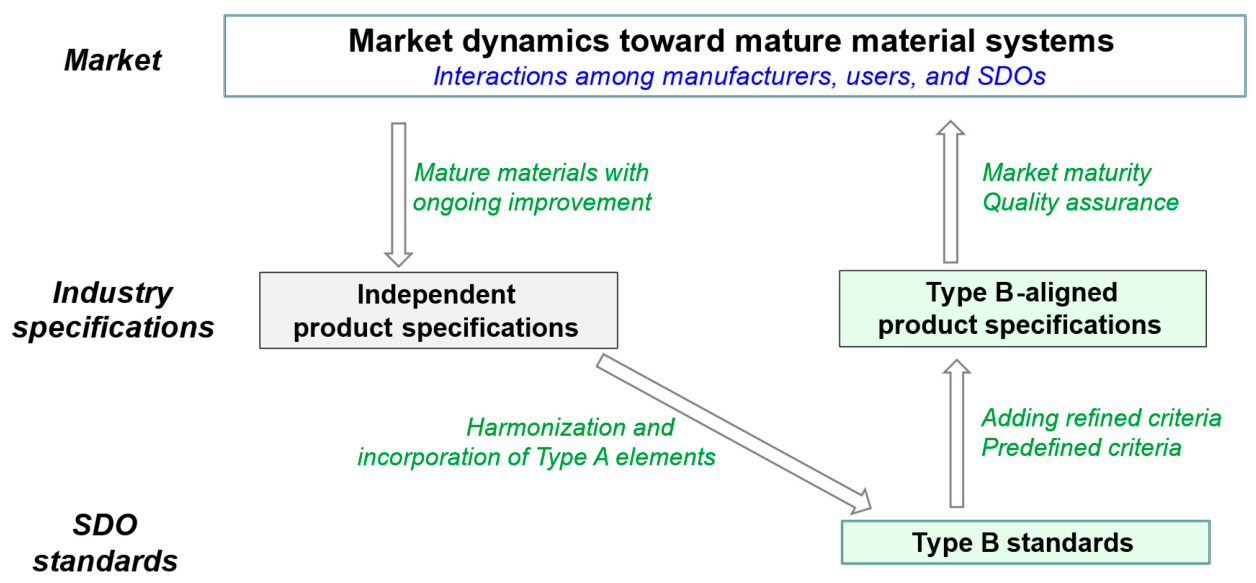
This section focuses on standardization dynamics in mature material systems in a stabilized market context.
In this context, these dynamics operate in a configuration where Type B standards dominate the organization of specification and conformity assessment structures across markets, industry, and SDOs.
Figure 8 illustrates this configuration. Industry specifications are aligned with Type B standards, enabling consistent conformity assessment and certification against predefined characteristic values. Market maturity is sustained through widespread industrial adoption and established certification systems.
Ongoing improvements in material characteristics are progressively incorporated into product specifications, reflecting application-specific requirements. Notably, Type A-based specification elements are increasingly incorporated into Type B-based systems, supporting ongoing refinement and adaptation without requiring fundamental restructuring.
As a result of this incorporation, and because materials are evaluated in relation to specific applications through standardized measurement procedures, dual modes of conformity assessment are sustained: conformity assessment against characteristic values declared by individual companies, and conformity assessment against characteristic values defined by Type B standards.
This stabilized regime demonstrates that standardization in mature material systems combines consolidation and harmonization with sustained dynamics in which stability and flexibility coexist. Type B standards provide a stable foundation for certification and quality assurance, while Type A-based elements sustain adaptability and ongoing innovation.
4. Integrated Framework for Emerging Material Standardization Systems
This section presents an integrated framework that relates specification architecture and standardization dynamics to provide a conceptual perspective on standardization across phases of material maturity. Rather than describing standardization as a linear progression, the framework explains how different specification systems coexist, interact, and fulfill distinct functions under varying technological and market conditions. From this perspective, standardization may be understood not as a static endpoint, but as an adaptive infrastructure shaped by interactions among technological development, industry practices, and institutional standardization activities.
In emerging material domains, specification activities are often diverse, parallel, and independently developed, reflecting evolving material characteristics, measurement methods, and application requirements. In such contexts, standardization provides organizing principles that improve comparability across diverse specification activities without constraining innovation, as illustrated in
Figure 3.
Within this framework, Type A and Type B standards function as complementary but distinct components of an integrated standardization system. Type A standards establish a common structural basis for defining measurement-based characteristics while maintaining flexibility for diverse technological approaches. This contributes to the development of product specifications within a shared framework, translating technological innovation into decision-relevant information, enhancing comparability, and enabling conformity assessment against manufacturer-declared values during early-stage market formation.
In contrast, Type B standards define predefined characteristic values and associated measurement frameworks, providing a shared basis for application-specific performance evaluation. This enables conformity assessment against predefined values within a shared reference framework, supporting reliability, quality assurance, certification, and broader market acceptance in more mature material systems.
Across phases of material maturity, the framework illustrates the coexistence of innovation-oriented and quality assurance-oriented standardization. Type A standards sustain comparability and technological differentiation, whereas Type B standards provide acceptance criteria based on standardized methods, thereby enabling conformity assessment and certification. Importantly, this does not represent a unidirectional transition or a final endpoint. Rather, Type B-aligned systems continue to evolve through the ongoing refinement and extension of predefined characteristic values, while increasingly incorporating Type A-based specification elements.
Overall, the proposed framework suggests that standardization may operate as an integrative mechanism linking scientific research, technological development, and market formation. It clarifies how independently developed product specifications, Type A-aligned specifications, and Type B-aligned specifications may be organized as functionally differentiated systems, thereby providing a conceptual basis for understanding standardization as an enabling infrastructure for the market utilization of emerging materials.
5. Discussion
This study proposes an integrated framework for understanding specification standardization in emerging material systems as an adaptive framework linking measurement, conformity assessment, industrial practice, and market formation. Rather than treating standardization as a linear transition from Type A to Type B standards, the framework clarifies how independently developed product specifications, Type A-aligned product specifications, and Type B-aligned product specifications coexist and fulfill distinct but complementary functions under varying technological and market conditions.
5.1. Complementary Roles of Type A and Type B Standards
The findings suggest that Type A and Type B standards should not be understood as sequential stages of a unidirectional progression, but as functionally differentiated mechanisms within specification systems. Type A standards support comparability by structuring characteristic definitions and measurement methods while preserving diversity in manufacturer-declared values. Type B standards provide predefined acceptance criteria that support conformity assessment, certification, and quality assurance.
These functions operate at different but interconnected levels: Type A standards support market evaluation under technological and application uncertainty, whereas Type B standards support conformity assessment and quality assurance under more stabilized market conditions. Their coexistence suggests that standardization can support both innovation and quality assurance.
This perspective broadens conventional compliance-centered interpretations of standardization by positioning comparability as an important and structurally distinct function in emerging material systems.
5.2. Feasibility of Type A-Based Conformity Assessment
The study highlights the potential role of conformity assessment based on Type A standards. Because Type A standards define characteristics and specify standardized measurement methods and procedures, they can provide a basis for conformity assessment based on manufacturer-declared values.
Despite this technical feasibility, Type A-based conformity assessment remains limited in widespread international practice, partly because emerging material markets often lack the economic scale and institutional conditions needed for third-party certification [
13,
14]. In such contexts, manufacturer self-declaration based on Type A standards may provide a practical alternative [
15].
Nevertheless, a few industrial initiatives demonstrate the feasibility of Type A-based conformity assessment by third-party certification bodies. An industry-led certification system for fine bubble technologies has been established [
16] using ISO-defined measurement methods. Similarly, a certification framework for clay nanomaterials based on ISO Type A standards [
10] has been implemented through collaboration among industrial associations, testing laboratories, and certification bodies [
17,
18]. These cases suggest that conformity assessment may be achievable even without predefined acceptance criteria when supported by appropriate measurement frameworks and institutional arrangements.
From this perspective, standardization in emerging material domains may be understood not as a unidirectional progression toward predefined acceptance criteria, but as a complementary system in which comparability and compliance coexist through different coordination mechanisms.
5.3. Continuing Roles of Type A Functions in Type B Systems
Even in mature material systems dominated by Type B standards, Type A-based comparability functions remain important. Predefined characteristic values and conformity criteria depend on the prior existence of comparable measurement methods and specified characteristics. In this sense, Type B systems do not replace Type A functions but increasingly incorporate them.
This perspective suggests that mature certification systems may accommodate dual modes of conformity assessment: verification against predefined criteria and evaluation against manufacturer-declared values. Standardization may therefore be understood as an integrated system in which comparability and compliance coexist rather than as mutually exclusive approaches.
5.4. Evaluation of Measurement Reliability
To ensure the measurement reliability in the dual-mode standardization framework, establishing a unified guideline for uncertainty evaluation is important. Such a guideline should comprehensively govern both Type A and Type B standards.
The guideline integrates key metrological requirements in an ascending hierarchy of rigor. This includes:
Mandatorily reporting and disclosing specific measurement methods and procedures that are used (whether standardized or non-standardized), providing the baseline for uncertainty component analysis;
Rigorously evaluating method and procedure validity and cross-laboratory measurement consistency assurance (e.g., through round-robin testing);
Systematically analyzing deviations from reference values when using certified reference materials or industrial reference materials to quantify measurement uncertainty, thereby executing traceability path construction.
While fully operationalizing such a comprehensive guideline remains a challenge for future independent research, step-by-step embedding requirements for uncertainty evaluation within Type A standards is crucial as a major contribution to the development of metrology and the field of emerging materials.
5.5. Strategic Implications for Standardization
In applied science-oriented research institutions, accelerating the market deployment of research outcomes has become an increasingly important R&D strategy. Standardization is now widely recognized as a key mechanism supporting this transition by enhancing comparability, harmonization, and market confidence. This study provides a conceptual framework for understanding how dual-mode standardization supports the transition from emerging research outcomes to functioning markets through structured material specifications. Such deployment-oriented research has also been discussed in the context of synthetic R&D, which integrates scientific and technological outcomes with stakeholder needs to facilitate societal and industrial implementation [
19].
For emerging material systems, excessive reliance on Type B standards in early-stage markets may reduce flexibility for technological differentiation by fixing predefined characteristic values and acceptance criteria before technologies and applications become sufficiently stabilized. In such contexts, Type A standards may provide a practical basis for comparability and early market formation.
For mature material systems, standardization strategies may benefit from perspectives beyond purely compliance-oriented approaches. By recognizing the continuing role of Type A functions, Type B-based systems can support not only certification but also the ongoing refinement of product specifications in response to technological progress and evolving market demands.
Manufacturers of emerging materials may adopt independently developed, Type A-aligned, or Type B-aligned product specifications according to technological maturity, target applications, market conditions, and certification requirements. The effectiveness of standards depends not only on their existence, but also on their strategic selection and industrial implementation. Standardization therefore functions not merely as a prescriptive system, but as an adaptive framework whose value depends on effective industrial adoption.
Overall, standardization in emerging material systems may be understood as an adaptive coordination framework balancing comparability, compliance, and innovation across different phases of technological and market maturity.
6. Conclusions
This study proposes a complementary perspective on standardization in emerging material domains as a framework linking industry, standards development organizations (SDOs), and markets for organizing measurement-based information in market evaluation and decision-making. The analysis suggests that Type A and Type B specifications function as complementary components of standardization. In Type A systems, market acceptance decisions are based on the comparative evaluation of characteristic data relative to manufacturer-declared values, whereas in Type B systems they are based on conformity assessment against predefined criteria.
This perspective broadens prevailing compliance-oriented interpretations of standardization by suggesting that comparability and compliance fulfill distinct but complementary market functions. Excessive reliance on Type B standards in early-stage emerging material markets may reduce flexibility for technological differentiation by fixing predefined acceptance criteria before technologies and applications are sufficiently stabilized. In such contexts, market decisions are often based not only on pass/fail conformity, but also on the ability of stakeholders to compare, interpret, and trust measurement results across suppliers and users.
Type A-based systems may provide important conditions for early-stage market acceptance by establishing comparability through shared measurement frameworks, including standardized data formats, uncertainty evaluation, and transparent representation of measured characteristic values. These structures can facilitate informed decision-making under uncertain conditions while preserving flexibility for technological differentiation and continued innovation.
Overall, standardization may be understood as an adaptive framework that structures how information is disclosed, interpreted, and validated, enabling the transition from early market entry to sustained market acceptance. This framework may provide a basis for adaptive standardization strategies aligned with different phases of technological and market maturity.