Article

Geometrical Prediction of Copper-Coated Solid-Wire Deposition by Wire-Arc Additive Manufacturing Based on Artificial Neural Networks and Support Vector Machines


1
Department of Production Technology and Systems, Faculty of Industrial Technology, Technical University of Sofia, 1000 Sofia, Bulgaria
2
Department of Electrical, Electronics and Informatics Engineering, University of Catania, Viale Andrea Doria 6, 95125 Catania, Italy
*
Authors to whom correspondence should be addressed.
Metrology 2026, 6(1), 18; https://doi.org/10.3390/metrology6010018

Submission received: 19 January 2026 / Revised: 24 February 2026 / Accepted: 3 March 2026 / Published: 6 March 2026
(This article belongs to the Special Issue Applied Industrial Metrology: Methods, Uncertainties, and Challenges)

Abstract

Wire and arc additive manufacturing is a promising technology for fabricating large and complex metallic components. Wire arc methods, like MIG and MAG, use an electric arc to melt and deposit metal wire layer-by-layer. The improvement of the surface depends on the multi-bead overlapping model. However, the high quality of multi-layer deposits is reduced by structural irregularities, such as geometric defects, poor fusion, and reduced mechanical properties of the weld bead. The analysis of a single weld bead that solidifies on a base material can be carried out to improve the geometry of the microstructure, to improve the mechanical properties, and to understand the relationship between welding parameters and the bead dimensions. In the present study, current metal welding technologies and strategies in wire-arc additive manufacturing were discussed, and different weld bead geometries using BÖHLER SG2 solid wire were realized, varying the robot’s trajectory length and welding speed. The computational models are proposed to create a dependence between the controllable welding input parameters and resulting geometrical weld bead outputs (width, height, length, and radius) for prediction and optimization. These models, using techniques such as support vector machines and artificial neural networks, can be a good tool for controlling quality by understanding these input–output relationships. However, the SVM has revealed a superior performance based on metrics for the nonlinear and intricate relationships between the geometrical weld beads and welding parameters.

1. Introduction

In engineering and manufacturing technologies, welding-based industrial coatings for small or micro-scale parts are formulated to protect surfaces from corrosive chemicals, abrasive wear under harsh conditions, and high or cryogenic temperatures, which can lead to degradation mechanisms such as oxidation, sulfidation, thermal fatigue, abrasion, sliding, and erosion in the materials [1,2]. Metal structures are realized using modern welding techniques, such as metal inert gas (MIG), tungsten inert gas (TIG), stick, and flux-cored welding [3]. Welding is a manufacturing process that is useful for the construction industry, especially in fabrication and construction processes in which two parts are joined by means of filler material, and, thanks to the fusion process, a weld pool is obtained, which, when cooled, will transform into a fixed joint [4]. Industrial robots have degrees of freedom (number of axes), speed of action, weight to be supported, workspace, and level of programming [5]. The robotic wire-arc additive manufacturing (WAAM) is a 3D printing method that uses a robotic arm with a welding torch to melt a wire and deposit it layer by layer to create large, complex metal parts [6]. It’s a type of directed energy deposition (DED) process that offers high deposition rates, making it suitable for industrial-scale applications in aerospace, naval, and other manufacturing sectors to produce components like wings or engine parts [7,8]. Wire-arc additive manufacturing (WAAM) utilizes an electric arc as a heat source to melt the wire and create a 3D structure via layer-by-layer material deposition [9,10,11]. The quality of the surface and the complexity of the component can be a disadvantage, especially when high accuracy is required [12]. In the WAAM process, the main critical parameters include the welding source, intensity, welding speed, arc voltage and amperage, arc length correction, and dynamic correction [13]. The interaction between parameters of the kinematic system, such as welding speed and welding source, affects the molten pool dynamics, influencing the mechanical properties and surface of the final product by controlling heat input. The welding source is defined by its energy intensity (i.e., arc) and power parameters (current, voltage, and speed)—it is the primary driver of molten pool behavior, directly influencing its geometry, stability, fluid dynamics, and microstructure. A higher-intensity source, such as a laser or hybrid (laser-arc) system, creates a deeper, narrower, and more turbulent pool, whereas lower-intensity arc welding creates a more stable, smaller pool. In contrast, conventional arc welding tends to create shallower, wider, and more rounded pools [14]. Increasing the welding current in arc processes increases the volume of the molten pool and reduces the ratio of depth to width, leading to wider, flatter beads [15]. High-power sources create a larger temperature difference, which influences the final weld shape. The welding source dictates the heat input, which directly controls the volume (size), depth (penetration), velocity (flow), and solidification speed (microstructure) of the molten pool. Heat input is linearly correlated with the characteristic weld bead geometry, including the weld bead height, width, penetration, penetration area, and reinforcement area [16,17,18]. Generally, multiple fusion and solidification thermal cycles produce irregular heat propagation in the microstructure and shape of the bead. The amount of liquefied material increases as heat input increases, increasing the possibility of cracking and internal defect formation, phase transformation, residual stresses, and distortion [19,20]. The effect of torch travel speed and other parameters on microstructure and bead geometry is studied by applying statistical tools to determine the effect of process parameters (wire feed, travel speed, current, and argon flow rate) on the bead’s microstructure and geometry [21,22,23]. In [24,25], travel speed and current significantly affect the weld bead’s microstructure and geometry. Thus, the pre-heat of the substrate leads to smoother material deposition, improving the surface deformation of the deposited metal [6]. Many studies report the effect of WAAM processes on the deformation of microstructure components and the mechanical properties of the deposited layers, influenced by the pool morphology and solidification behavior [26,27,28,29]. These factors are inevitably involved in the optimization of the additive manufacturing process. Numerical computational methods, including artificial neural networks (ANNs) and finite element (FE) simulation, are used for the prediction of bead geometry [30]. An autoregressive model (ARX) estimates outputs based on a sequence of previous inputs and output responses, and has been used to simulate input–output data with noise or the thermal response of a bridge. It has also been used to enhance the geometrical precision of the modified metal inert gas (MIG) welding process based on the short-circuiting (dip) transfer process by associating a nonlinear ARX model with wavelet networks [31,32]. The manufactured additives are produced using cold spray additive manufacturing, suitable for coatings that adopt a supersonic gas jet to accelerate powder particles to 500 to 1000 m/s and enable solid-state deposition onto a substrate through the kinetic energy of the particles without melting, resulting in a mean absolute error of 8.3% [33,34]. An alternative artificial neural network (ANN) model using the backpropagation algorithm was proposed to predict the cross-sectional geometry of a single symmetric track profile in the pulsed-laser powder deposition process, which is highly nonlinear [35]. The performance of the developed models in bead height and width predictions was compared to the track profile using the Gaussian model [36,37]. Other investigations have provided numerical simulations within the WAAM process; however, these are limited by complex models described by physical processes and by the ideal cuboid geometry used in most FE simulations to represent sedimentary layers [38,39,40]. Therefore, the influence of process parameters on the dimensions and microstructure of manufactured parts to achieve optimization should be studied with an efficient, intelligent, and less complex method.
In this study, the prediction of the geometrical dimensions of a deposited layer microstructure fabricated via the WAAM process with copper-coated solid wire BÖHLER SG 2 was achieved using ANN (artificial neural networks) and SVM (support vector machines) under different welding and geometrical parameters. These computational models have established a mathematical relationship between input and output data. The welding parameters, namely welding speed and the robot’s trajectory length, are the input data, and the output data are the geometrical parameters, such as the total continuous length of the weld, weld toe and root radius, the widths of a deposited weld bead at different positions along its length measured using a microscope with high accuracy, and the height of the weld metal measured in the middle of the bead using a caliper. The input data, namely the welding speed, were set in the moderate-high speed range to achieve narrower and shallower weld beads with faster cooling rates, and the trajectory length was considered an independent variable defined as the spatial path programmed for the robot’s end-effector, but it does not directly affect the physics of the melt pool. However, the model analysis can be a useful tool to vary a few parameters, as in this case, welding speed and trajectory length, to accurately predict the complex system geometry with a small number of key parameter combinations. The machine learning models are compared and used for the complex dataset in the analysis of the morphology (weld height, weld width, etc.) of the single deposited layer under different welding speeds and path trajectories. The prediction result of the SVM model is superior to that of the ANN model, and the mean error of the SVM is much lower than that of the ANN. Although the ANN model fits the training data very well, it has poor test performance. The main contributions of this work include the following:
  • A comprehensive overview of fundamental process characteristics of significant additive manufacturing techniques for fabricating large and complex metallic components, including binder jetting, powder bed fusion, sheet lamination, and wire arc directed energy deposition, is investigated. The main parameters of various additive manufacturing technologies are explored, including layer thickness, deposition speed, and temperature, which are crucial for mechanical properties and print quality. In particular, the key parameters for additive manufacturing, such as travel speed, deposition strategy, path planning, current, voltage, and wire feed speed, determine the desired geometry and significantly influence the characteristics of multi-layer structures in terms of bead geometry.
  • The geometry inspection of high-quality weld beads of copper-coated solid wire BÖHLER SG 2 was performed using a microscope and a caliper, offering high levels of accuracy for post-process treatment. The welding procedure was performed using a wire feeding system to melt the metal wire, controlled by the robotic arm controller. In the experiment, the weld bead samples with different trajectory path lengths and welding speeds were realized.
  • A comparison of ANN and SVM for geometry prediction of weld beads (i.e., width, height, radius, and length) from welding parameters, such as welding speed and the robot’s trajectory length.
In Section 2, current metal welding technologies, including material jetting, directed energy deposition (DED), powder bed fusion (PBF), and binder jetting within additive manufacturing (AM) processes, with particular attention to various process variables, challenges, and strategies in wire-arc additive manufacturing, are presented. In Section 3, the welding process conducted using the welding robotic arm and control system, the measurement and testing procedures for quality control of the weld bead, and a brief discussion of the computational models are presented. The results of the ANN and SVM computational models are presented in Section 4. Thus, in Section 5, the conclusion is given.

2. Literature Overview: Metal Additive Manufacturing Methods

Additive manufacturing (AM) is a 3D printing technology used in various industries for the design process involving adding material layer by layer to create objects from 3D model data achieved by utilizing computer-aided design (CAD) software tools [41,42,43]. The additive manufacturing methods can be classified by the American Society for Testing and Materials (ASTM) into VAT photopolymerization, powder bed fusion, binder jetting, material jetting, sheet lamination, material extrusion, and directed energy deposition. One common type of 3D printing technology is material extrusion (ME), also known as fused deposition modeling (FDM), which involves the creation of parts by extruding thermoplastics layer by layer using polylactic acid (PLA), deposited to create each object at a temperature between 190 and 230 degrees Celsius [44]. Metals like super-alloys are processed using fusion-based additive manufacturing (AM) techniques like powder bed fusion (PBF) and directed energy deposition (DED), which melt material layer-by-layer [45]. Wire-arc additive manufacturing (WAAM) and thermal-based methods like high-velocity oxygen fuel (HVOF) are also used. PBF uses a laser or electron beam to fuse powders, DED adds material to a substrate with an energy source, while WAAM uses an arc to melt wire, and HVOF uses a jet of gas to heat and propel molten powder [46]. Using AM with welding methods can be classified as welding-based additive manufacturing (WAM) processes, like wire-arc additive manufacturing (WAAM), laser additive manufacturing (LAM), and electron beam additive manufacturing (EBAM). Previous studies have examined the impact of prominent process variables on mild steel, such as welding speed, welding current, welding voltage, wire feed rate, and gas flow rate, and the quality of the weld based on two key process responses, namely joint penetration and percentage defect, determined by the response surface methodology (RSM) using a central composite design (CCD) method in order to establish the best parameter settings [47]. In the regression analysis, the current and the wire feed rate are the key factors that have a substantial impact on joint penetration, whereas the percentage of defects is heavily dependent on the voltage and the feed rate [48]. Therefore, the ambient environmental conditions can affect the thermal cycle of the weld (heating and cooling rates) and the characteristics of the welded joint, affecting microstructure, hardness, grain morphology, and bead geometry [49]. The desired welding quality can be achieved with high melting power and high welding speed [7]. The essential features and methods of additive manufacturing techniques, such as ultra-torque friction stir deposition, metal binder jetting, sheet lamination, powder bed fusion, and directed energy deposition, based on scientific knowledge, are presented.

2.1. Ultra-Torque Friction Stir Deposition

Ultra-torque friction stir deposition can create components and microstructures with simpler or less complicated geometry, with the capacity to fuse a wide range of multiple materials [50]. In the solid-state technique, the material is not melted, minimizing defects like porosity, and it uses a rotating tool to heat and plastically deform feedstock material and to process structural metals and alloys [51]. The tool moves along a predetermined path, resulting in heat generation by friction and severe plastic deformation and leading to metallurgical bonding between the layers of the sheets. The important process parameters are the rotational speed and tool traverse rate, which influence frictional heat generation (i.e., higher rotational speeds increase frictional heat generation in deposition stages), material feed rate, and the axial force that generates friction between the tool–work material interfaces, which can plasticize the material in the welding zone [52]. The size of the tool and feedstock set limits on the size of features and overall geometric forms. The maximum feed rate is constrained by the axial force limit of the machine, as a higher feed rate causes a higher axial force due to the increased rate of material buildup behind the tool [53]. Cooling and heating conditions also influence the resulting mechanical properties during the build process. The achieved in-plane resolution is very low compared to other AM processes, limited to approximately 10 mm or higher, depending on the tool and feedstock geometry [54]. The poor surface quality on the side walls is primarily caused by flash as a result of excess material forced beyond the deposition tool, causing weak bonds between layers at the edges of the deposited track, where the flash is not mixed with the underlying substrate or previously deposited layers [55,56]. Poor quality on the surface is due to the concentric ring pattern known as onion skin [57]. The layer height is set to a value between 1 and 2 mm; however, higher layer thicknesses (2 and 3 mm) affect the tensile properties of the deposited material in the build direction. Layers of 1 mm present considerably lower fracture strains and ultimate tensile strength [58]. Thinner layers effectively have more layer interfaces in the build direction, but also have an increased number of interface defects than thicker layers.

2.2. Metal Binder Jetting Additive Manufacturing

Metal binder jetting (MBJ) or material jetting is an additive manufacturing technique that builds metal parts layer by layer using a liquid-based binding agent to join the material in a powder bed. The powder parameters and properties, such as particle porosity, impurity levels, and powder flow behavior, substantially influence the process stability and robustness [59]. Tap density plays an important role in the powder bed characteristics, and finer powders, which are more active in sintering, increase the interparticle friction, promoting particle bridging and agglomeration [60]. The powder, or skeletal, density, usually measured with an inert gas pycnometer, is used to analyze particle inner porosity, possible cracks, satellites, and also the phase composition of the material or alloy content, as density depends on possible alloying elements of the metallic material [61]. Particle morphology influences the powder packability and flowability. The metal binder jetting process can build walls with widths from approx. 1.5 mm to more than 80 mm without defects; however, the maximum wall height is limited to eight times the wall width [62].

2.3. Sheet Lamination

Sheet lamination is an additive manufacturing method used to create 3D parts or very large prototypes using sheets of fused metals. The sheet lamination process can be classified into laminated object manufacturing (LOM) and ultrasonic consolidation [63]. The objects are made by a machine that deposits the material sheets or composite prefabricated layers at 0° and 90° and then heats, compresses them from a continuous roll, and cuts the layers to form a single part. The desired geometry is created by bonding these layers using a heat-activated resin [64]. The sheets are first welded together in layers using ultrasonic welding or friction stir welding, and then the desired 2D cross-section is cut from the stacked layers with a laser or a blade. The excess material is removed, leaving a finished part, although some techniques, like ultrasonic additive manufacturing (UAM), integrate CNC machining to build the final shape [65]. However, the traditional LOM method is not able to work on multi-material structures.

2.4. Powder Bed Fusion Additive Manufacturing for Metals

Powder bed fusion (PBF) can produce 3D objects with complex geometries and high accuracy using a heat source, like a laser or electron beam, to melt and fuse layers of metal powder; however, it has a high operational cost and uses toxic metal powder [66,67]. The process involves metal and ceramic powders with grain shape (spherical, irregular, granulated), grain size, and composition that play a crucial role in powder selection for the product [68]. The control and selection of irregular powder grains’ shape and size distribution can increase the density of the powder deposited in a layer before sintering or melting [69]. In powder bed fusion, layers of powder are repeatedly fused; in fact, the platform lowers by one layer’s thickness, and a recoater (or roller) spreads a new layer of powder over the previous one. A heat source, like a laser or electron beam, then fuses the new layer, overlapping with the previous one to ensure strong bonding [70]. This layer-by-layer overlap builds a 3D object from the bottom up. Lack of fusion porosity can affect the mechanical behavior of layers containing defects, irregularly shaped pores, and unmelted powder particles attributed to incorrectly selected processing parameters, such as laser beam fluctuations, surface gas flow, and raw material characteristics [71].

2.5. Direct Energy Deposition

Directed energy deposition (DED) is a process with high deposition rates that utilizes an electric arc or laser to melt metals and alloys in the form of wires or powders employed for producing 3D structures of metallic materials, including the formation of gradient structures [72,73]. DED utilizes wire or powder, employing a robotic arm, and can be classified into wire and arc additive manufacturing (WAAM), wire and laser additive manufacturing (WLAM), and wire and electron beam additive manufacturing (WEAM) processes [74]. The types of DED processes may use a laser as a thermal energy source; wire-fed DED uses an electric arc, a plasma arc, a laser, and an electron beam as a thermal energy source.

2.6. Wire-Arc Additive Manufacturing and Gas Metal Arc Welding

The additive manufacturing technology that uses MIG (metal inert gas) and MAG (metal active gas) deposition is wire-arc additive manufacturing (WAAM), which is a form of directed energy deposition [73,75]. WAAM utilizes a combination of an electric arc as a heat source and a filler wire operated typically as an anode to form a liquid metal pool, thus depositing material layer by layer and creating objects, including large-sized parts. The tip of the wire, as well as the workpiece (cathode), melts under the impact of arc attachment. Gas metal arc welding (GMAW) has revealed many advantages, such as providing shaped parts with high precision dimensional tolerances with a higher deposition rate (15–130 gr/min) compared to AM processes at a lower cost of raw material [76]. The metal inert gas (MIG) welding is the process that is used to melt and join metals by establishing an arc between a continuously fed filler wire and the base metal. The arc and molten weld pool are usually shielded by inert gases (Ar and He), important for weld metal toughness and for preventing oxygen and water vapor from reacting at the point of merger [77]. However, the MIG arc is unstable in pure argon because of instabilities in the cathode spots on the base metal surface, creating weld defects and irregularity of the weld bead, so metal active gas (MAG) welding uses some active gas, like O2, H2, or CO2 mixed with inert shielding gas, improving the arc stability and welding execution [78]. Tungsten inert gas (TIG) has fewer spatters and better weld bead surfaces than welding using MIG with pure Ar, although its process has a slow speed and a small amount of deposited metal [72]. In WAAM, the final product can be optimized by controlling and managing the process parameters like current, voltage, welding speed, welding rate, welding angle, polarity, preheat temperature, shielding gas, gas flow rate, and deposition strategies that also affect the texture, size, shape, and penetration of the joints, along with overall quality, costs, and productivity [79]. Bead roughness decreases with the increasing current and process parameters, including bead thickness, wetting angle, and melt-through depth, which escalates with an increase in arc current [80]. Arc length is controlled by voltage, while wire feed depends on bead height and amperage. The increase of wire feed rates or amperage reduces the wetting angle [81]. Travel speed affects joint quality; in fact, with increasing travel speed, the wetting angle, melt-through depth, and bead width decrease, while bead roughness increases slightly [82]. Conversely, a slower travel speed leads to excessive buildup. By progressively increasing travel speed with each layer, the heat input is reduced by 5–20% between adjacent layers. In wire-arc additive manufacturing, the weld source can move freely around the workspace, processing layer by layer. The large thermal gradient caused by the weld source can lead to condensation on the workpiece and electrode, stress, and cracks inside the workpiece, resulting in lower product quality [83]. The rapid cooling rates and thermal gradients lead to the presence of residual stresses, thus part deformation, layer delamination, reduced geometric tolerance, and compromised mechanical properties, including fracture resistance and fatigue performance [84]. The residual stresses can be described using destructive methods, such as a combination of the ring-core method and hole-drilling, and, in general, by semi-destructive methods. The porosity due to the presence of gas trapped in the material negatively affects its mechanical characteristics, including fatigue resistance, anisotropy, oxidation, and corrosion resistance [85]. Irregularly shaped pores can reduce the strength and structural integrity of the material, leading to substantial dislocation accumulation and stress concentration. The porosity and density can be measured using gas psychrometry, hard X-rays at synchrotron facilities, X-ray micro computed tomography ( μ -CT), image analysis of metallographic cross-sections, ultrasonic pulse-echo velocity measurements, and the Archimedes technique [86]. The porosity can be minimized below 0.035% using the techniques of pulsed GMAW or cold metal transfer with monitored short-circuiting (CMT-PADV) [87]. Cracking and delamination are defects that can compromise the coating’s performance and mechanical properties and lead to grain boundary cracks [88]. Process monitoring and real-time vision process control, integrated with additive manufacturing to enhance part quality, can improve the accuracy of the geometries of multi-layer, multi-bead components where the layers are overlapped [89]. A layer-overlapping (LOS) process is achieved when the new layer is deposited over the previous one to build up the part, despite limitations such as a non-uniform surface profile or height. This process is analyzed through mathematical models, taking into account the position and deposition amount of the layer. The temperature distribution and number of layers determine the quality of deposition after each layer and the profile quality [90]. The trajectory-planning strategy that affects the deposition quality and temperature distribution, causing warping, stress, and defects, includes raster, contour, and zig-zag strategies for the creation of geometrical complexities and the calculation of process parameters incorporated in the weld robot [91]. Therefore, the grain size and morphology are influenced by the temperature gradient. They affect the mechanical properties and anisotropy of metals; for example, finer grain sizes improve the metal’s mechanical properties [92]. In metal manufacturing, metal active gas welding is considered efficient and versatile in automation processes [41,42,43].

3. Materials and Methods

3.1. Experimental Set-Up Description

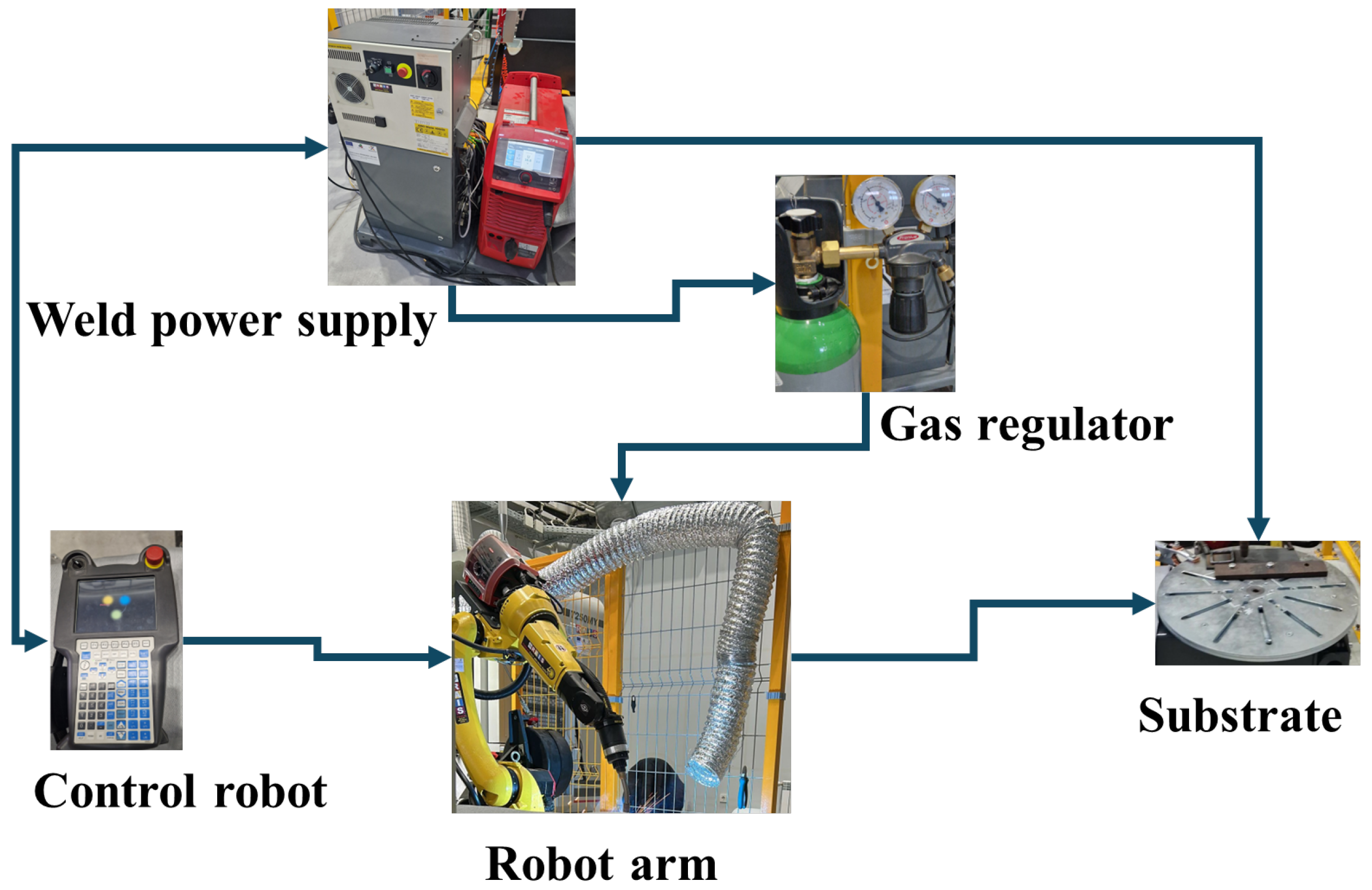
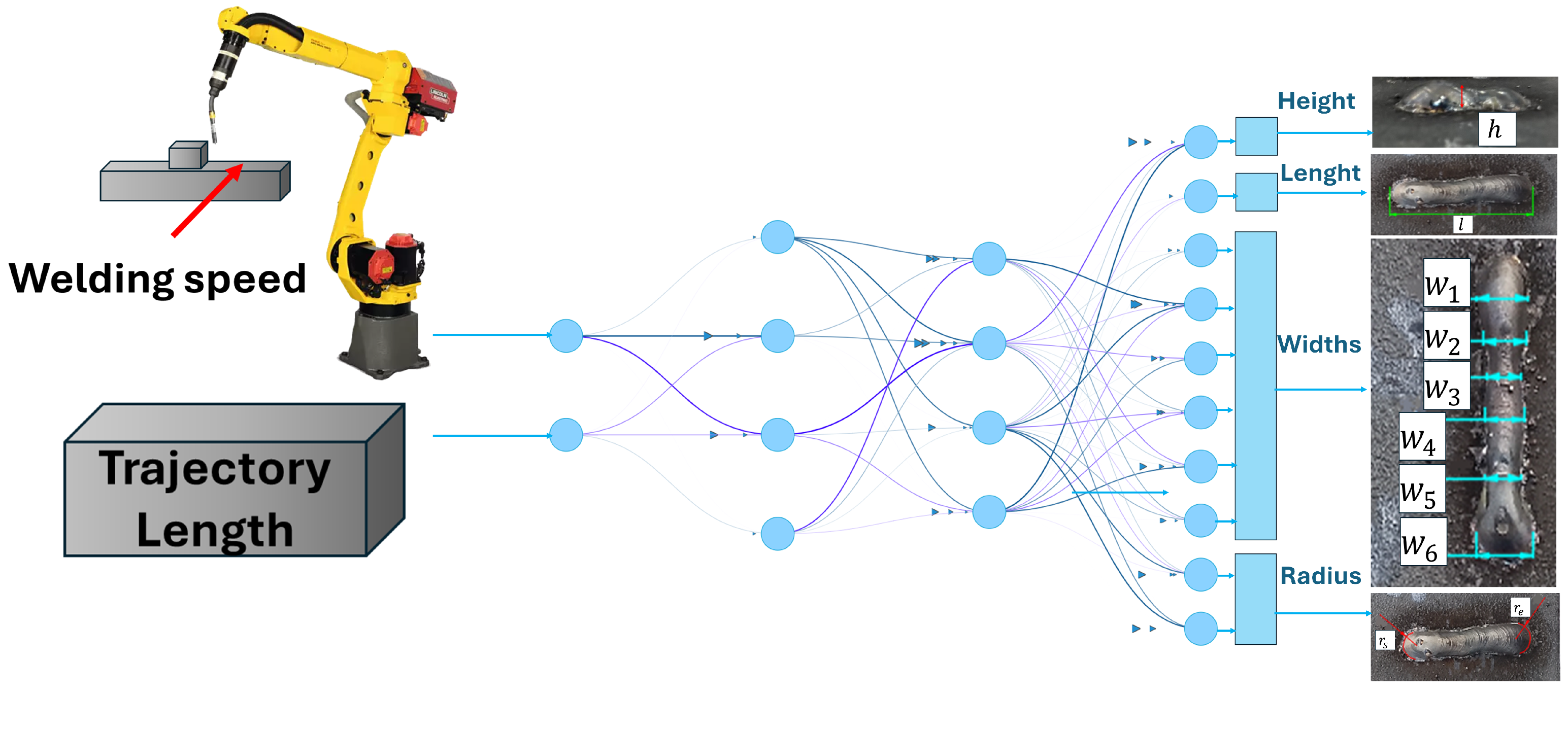
In this study, the single-layer samples of the weld bead were realized using the arc wire welding process with the aim of optimizing the weld bead geometry and process parameters. The welding workstation integrates a welding robotic arm, welding power supply, human–machine interface, and robotic arm control system for the metal-melting process in order to deposit metal wire in layers. The experiments were carried out using a robot-based WAAM system implemented at the laboratory of the Department of Production Technology and Systems, Faculty of Industrial Technology, Technical University—Sofia. The functional architecture of the system is shown in Figure 1.
It includes a FANUC Arc Welding Robot ARC Mate 100iD industrial robot with a R30iB Plus controller from FANUC America Corporation, integrated into a welding application using the Roboguide software (FANUC ROBOGUIDE V10), a welding source provided by the Inverter MIG/MAG wire feeder Fronius TPS 320i, and a manufacturing platform made of a structural steel base plate. The compact design of the Inverter MIG/MAG wire feeder Fronius TPS 320i C/4R/FSC Standard/320 A/ manufactured by FRONIUS INTERNATIONAL GMBH, Froniusstraße 1, A-4643 Pettenbach, Austria, integrates a pipe feeder and a multifunctional, pulsed power source designed for MIG-MAG welding. The built-in wire feeder is designed for spools up to 300 mm. The flexible manufacturing structure uses the ARC Mate 100iD robot, an articulated-arm robot integrated into the arc welding application, using the Roboguide software and the R30iB Plus controller. The welding equipment is based on a TPS/i welding system with a power capacity of up to 600 A and a working voltage of 16.8 V. R-R30iB Plus A-Cabinet is a FANUC standard cabinet with dimensions of 600 × 500 × 470 mm, including the R30i controller, which is designed for very high performance in terms of cycle time, speed, accuracy, and safety, and complete connectivity via an Ethernet network. The iPendant Touch is a control device with an intuitive iHMI interface.
The simple strip geometry samples were printed using wire-arc additive manufacturing. The electrode copper-coated solid wire BÖHLER SG 2, Voestalpine BÖHLER Welding Germany GmbH, with a diameter of 0.8 mm, was used for welding deposition, suitable for many carbon steel welding applications, with the typical mechanical properties (as welded) shown in Table 1.
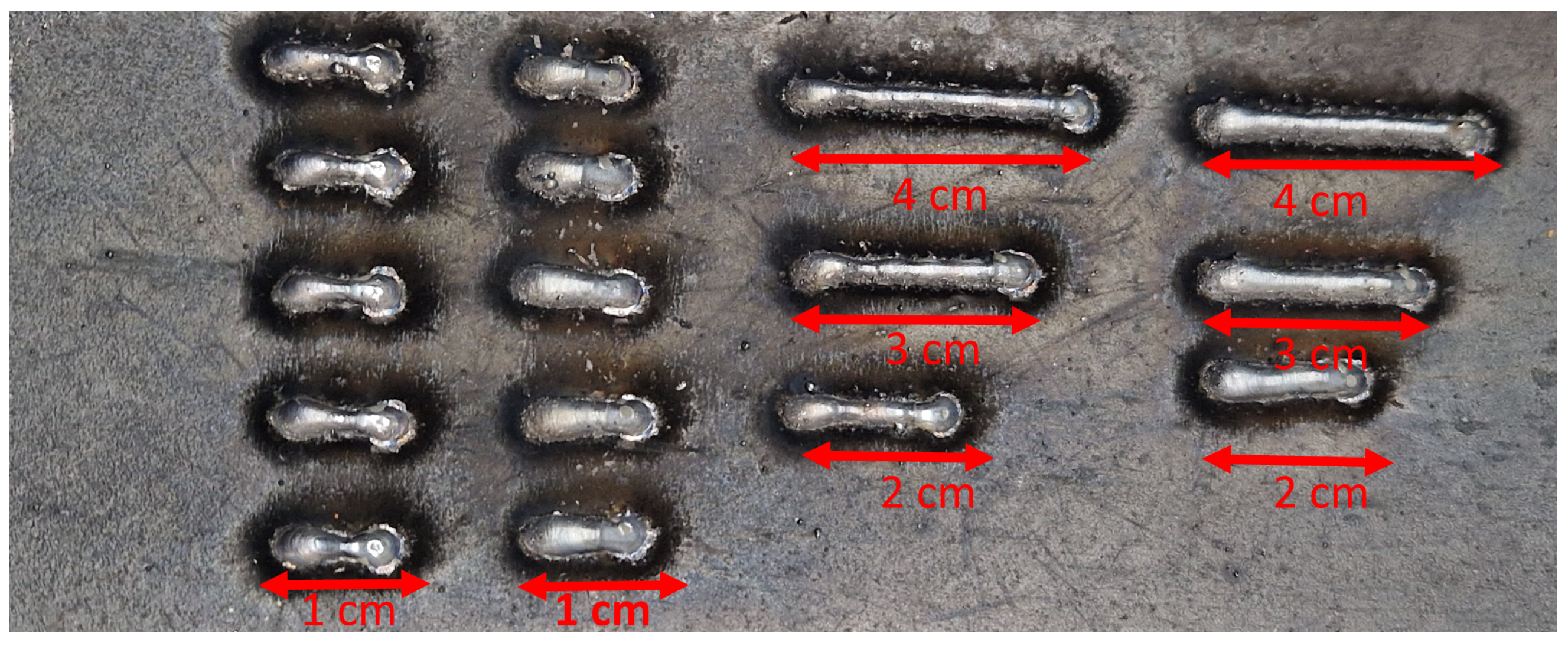
SG2 contains moderate amounts of manganese and silicon to provide sufficient deoxidation over light mill scale. The nominal chemical composition of the studied BÖHLER SG 2 is: C 0.07%, Si 0.85%, and Mn 1.5%, as provided by the manufacturer [93]. The BÖHLER SG2 strip samples were manufactured by the robot ARC Mate 100iD onto a solid steel support structure. In total, 16 samples were printed on the solid structure build plate at the same time. All samples were oriented in the same direction and located in four columns side by side, with five or three samples per row, as shown in Figure 2.
In the melting process, an inert and non-toxic gas mixture of (Ar = 82%) and (CO2 = 18%), stored in a pressurized gas cylinder, is used to produce a smooth, quiet, and stable arc. The pressure of the gas cylinder was 20 MPa (200 bar) at the T = +15 °C. In the procedure, the gas purge is 0.35 s, with gas pre-flow and post-flow of 0.20 s. The arc start (and end) pre-time is 100 msec. The welding parameters controlled to produce acceptable welds include arc current, arc voltage, wire feed speed, electrode travel speed, current density, and preheat temperature. The welding voltage is 16.8 V. The experiments were conducted on a mild steel substrate (S235J2) with dimensions of 26 × 10 × 6 cm, which was cleaned before carrying out the depositions. In the experiment, deposition samples of different sizes were realized using gas metal arc additive manufacturing. The motion termination type, which determines how the robot moves between points, and the taught points determine the “length” of a trajectory path in FANUC robotics. In particular, the weld bead samples with trajectory path lengths of 10 mm, 20 mm, 30 mm, and 40 mm for speeds of 8 mm/s and 5 mm/s were realized. In Fronius TPS1 Inside Enet, the welding conditions are set by the controller, which communicates with the Fronius power source to control welding parameters like current, voltage, and process selection. In this case, the wire-feed speed is set to 5.2 m/min, the welding voltage is 16.8 V, and the current is 80 A. The welding process was performed in 15 minutes to obtain the final welded structures. The welding arc temperature exceeds 1400 °C to melt both the BÖHLER SG 2 wire and the base metal, as reported by [93]. The welding voltage is set to 16.8 V, and the welding speed was varied and set to 5 mm/s and 8 mm/s. The deposited beads with varying welding speeds of 8 mm/s and 5 mm/s demonstrate significant differences in bead geometry, heat input, and solidification in welding processes. Generally, a higher speed (8 mm/s) results in a smaller, narrower, and shallower bead, while a lower speed (5 mm/s) produces a wider, deeper, and more heavily built-up bead due to increased heat input per unit length [94]. The entire procedure of material deposition lasted 2 min for one weld bead. For all tests, a single directional deposition strategy was used for each sample. The contact tip-to-work distance was fixed at 15 mm to maintain stable metal transfer, preventing excessive burn-back or stubbing, and optimizing melting and deposition to achieve a consistent deposition rate and a stable weld bead [95,96]. After the melting process, the next step involved 15 min of cooling at room temperature for the weld beads, and external measurements of dimensions were conducted using a Vernier caliper with high accuracy and under a microscope.

3.2. Measurement Method in Wire-Arc Additive Manufacturing

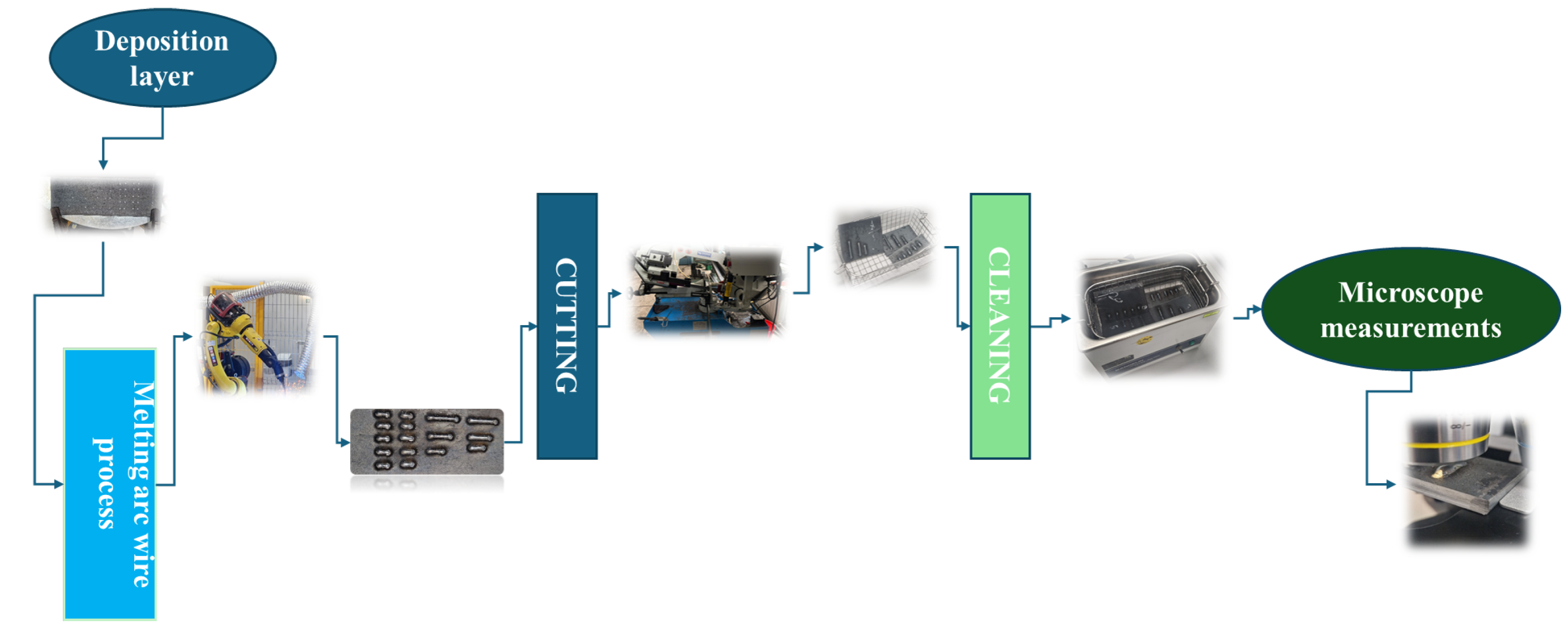
Measurement and testing procedures utilizing a post-process inspection microscope and a caliper are used for quality control of weld size and geometry. However, before the microscope measurements, the strips were treated using the post-process treatment introduced in the process diagram in Figure 3.
After the printing, as-built samples located on a steel plate were cut using the Harris BS260G horizontal bandsaw machine, which has specifications including a blade size of 2455 × 27 × 0.9 mm , a motor power of 1.1 kW ( 1.5 HP ), and a blade speed of 36 / 72 m / min . Its cutting capacity includes a maximum round capacity of 230 mm at 90 and a rectangular capacity of 260 × 150 mm . After that, the samples were cleaned and fully immersed in distilled water for 20 min using a BANDELIN SONOREX SUPER RK ultrasonic bath with internal dimensions of 240 × 140 × 100 mm to remove impurities and prevent any interference with subsequent testing. Distilled water was used because it is free from minerals and other contaminants present in tap water. Then, they were air-dried in the same conditions as the treatment to remove all water. The width and height of the deposited beads are considered critical parameters that significantly influence the accuracy and quality of the final product. In fact, the relevant measurements have demonstrated that the dimensions for each sample change after the deposition, as shown in Figure 2.
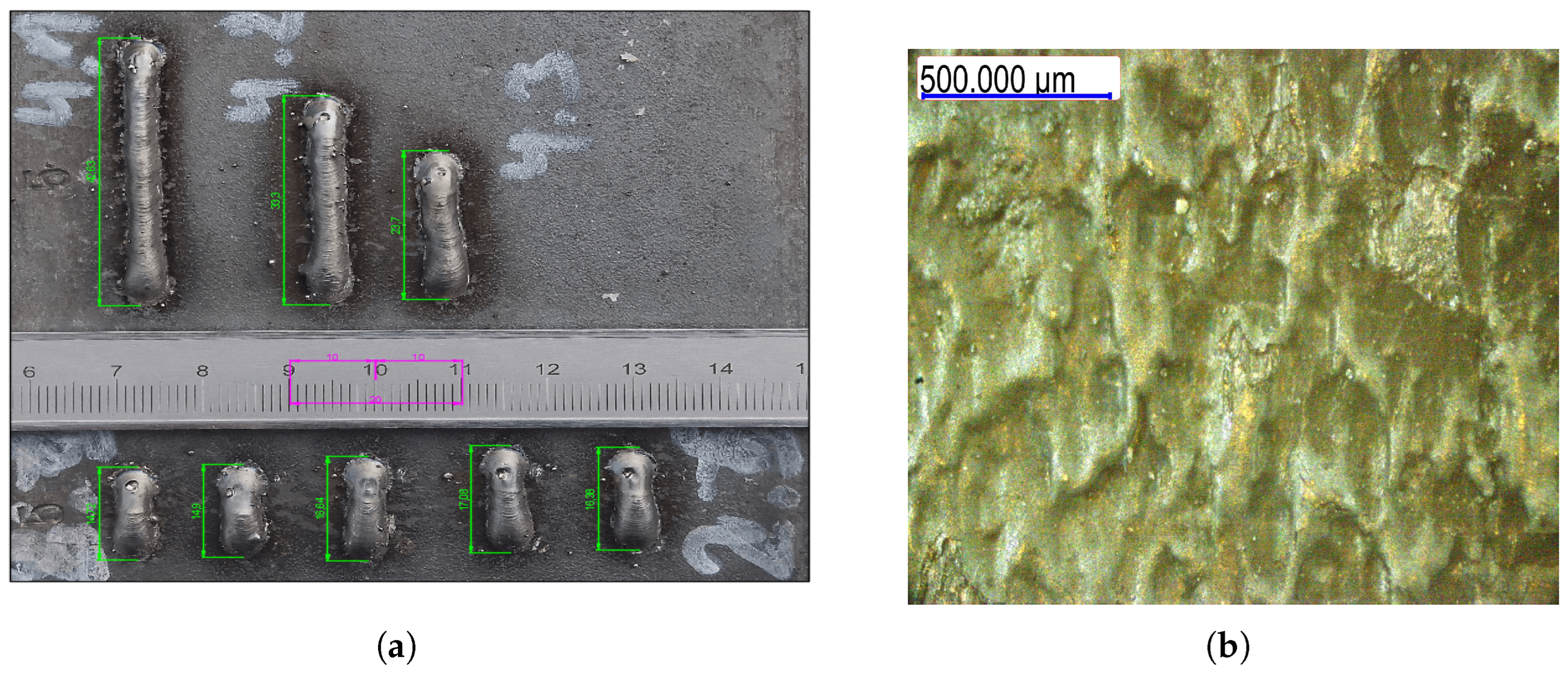
In this case, the deposited beads exhibiting different sizes as shown in Table 2 were realized with a welding speed of 8 mm/s and 5 mm/s and an initial trajectory path defined by the FANUC robot set to 10, 20, 30, and 40 mm. The inconsistent lengths in single-pass weld specimens can be attributed to several factors. For example, welding can introduce localized heat, causing expansion, followed by cooling-induced contraction, which can result in different final lengths. Small variations in the initial length of base metal plates, or inaccuracies in trimming/cutting after welding, can lead to uneven specimen lengths. The measurement tests were initially conducted using a caliper to get a rough estimation of the sample size, as standard practice. After that, the strip dimensions were compared to the morphology measurements conducted using the metallurgical microscope for material analysis, BestScope model BS: BS-6022TRF, with a magnification range of 100×–1000×. Initially, to make accurate measurements, it was required to calibrate the microscope images. The scale calibration process maps a known number of pixels to a known real-world distance (e.g., millimeters or micrometers), also using the stick meter placed within the image frame for measuring the dimensions of different welds obtained in AM (Figure 4a). Therefore, the morphology of the surface metal strip (number 2.2) obtained by additive manufacturing was analyzed under a microscope to identify the weld’s quality, geometric features, and potential defects. The digital image of the metal strip surface shown in Figure 4a was captured with the microscope objective L PLAN 5x 0.12′′, ×100 magnification and a resolution of 5472 × 3648 pixels using the Capture 2.1 software. The microstructure image of the weld metal illustrates the formation of distinct grain zones due to varying heat input, with an average grain size of approximately 100 μm, as shown in Figure 4b.
As shown in Figure 4b, a direct correlation between welding parameters, welding geometric parameters (such as weld height and width), and the weld microstructure (grain size and phase composition) is exhibited [97]. Variations in parameters like welding current, voltage, and travel speed can change the heat input and cooling rate, which in turn dictate the weld pool size, grain refinement or coarsening, and phase transformations. Lower welding speeds result in higher heat input, leading to lower cooling rates, which produce coarser grains and wider, less-desirable columnar zones. Conversely, higher welding speeds or lower heat input result in narrower welds with finer grain structures. Increasing the welding heat input, which is reflected in wider and higher weld beads, produces a more pronounced mixed grain zone, coarser grain sizes, and different phase compositions compared to lower, more controlled heat inputs [98]. Higher current or lower speed produces wider or higher beads with coarser microstructures, while lower current or higher speed produces narrower or shallower beads with refined microstructures.

3.3. Computational Method: Neural Networks and Support Vector Machine

This study focuses on the prediction of weld geometric parameters for copper-coated solid wires in the WAAM process. ANN and support vector machine models are employed to establish correlations between welding speed, trajectory length, and weld geometric parameters (e.g., width, height, radius). In particular, the welding speeds were set from 5 mm/s to 8 mm/s, which represents a moderate-to-high speed range often used in precision applications, and the trajectory length was chosen within the range from 10 mm to 40 mm [99]. A narrower and shallower weld bead and faster cooling rates result from the decrease in heat input per unit length caused by an increase in welding speed from 5 mm/s to 8 mm/s. A speed of 5 mm/s is typically considered a good compromise between productivity and sufficient heat input for appropriate penetration. Faster speeds (about 8 mm/s) usually result in grain refinement and higher hardness in the weld seam, whereas slower speeds (about 5 mm/s) may create a coarser microstructure due to increased heat input. While the trajectory length is considered an independent variable defined as the spatial distance or path programmed for the robot’s end-effector (e.g., path length in mm), it does not directly affect the physics of the melt pool. A change in trajectory path—such as at sharp corners—can force the FANUC robot to decelerate, which indirectly increases local heat accumulation, affecting the melt pool size. The other parameters, like current, heat input, interpass temperature, and arc mode, are not considered in the computational models, although a significant risk can be introduced to the accuracy of the final product and its structural integrity due to non-homogeneous and defective parts. However, the model analysis can be a useful tool to vary a few parameters, as in this case, welding speed and trajectory length, to accurately predict the complex system geometry with a small number of key parameter combinations. The computational method, the neural network (or artificial neural network, ANN) that consists of interconnected nodes and neurons in layers to process complex data for mapping inputs to outputs, and the support vector machine (SVM), are compared and proposed to produce high-quality and repeatable weld beads. The precise control of the welding process using a specialized FANUC robot can be combined with the predictive mathematical model to define the geometry of weld beads based on welding parameters such as the FANUC robot’s trajectory length and welding speed. The welding parameters, such as the FANUC robot’s trajectory length and welding speed, can be used to forecast the geometrical size parameters of the weld bead, such as width, height, and radius, in order to ensure the quality of the deposited weld bead. In particular, welding speed can lead to narrower or wider welds with less or higher penetration, while the robot trajectory length refers to the distance traveled by the robot from its starting point to its destination. Therefore, the relationships between the welding and geometrical parameters can be described and modeled using an artificial neural network, and the performance can be enhanced with an SVM.
The FANUC robot’s trajectory length and the welding speed are provided as inputs to the ANN computational model. In particular, based on the proposed melting procedure, the welding speed and trajectory length vary in the range from 5 mm/s to 8 mm/s and from 10 mm to 40 mm, respectively. The geometrical parameters, such as the height of a weld bead measured using a caliper, as well as the different widths, lengths, and weld toe and root radii of the weld bead measured using a microscope, are considered as output data of the ANN computational model. Some relevant measurement data are reported in Table 2. The developed architecture of the neural network method is shown in Figure 5.
The support vector machine (SVM) was adopted due to its nonlinear data regression capability, using the same parameters as those used in the ANN.
The choice between ANN and SVM for data fitting has involved the balance of performance metrics against dataset size, computational resources, and data dimensionality. The SVM is preferred for small to medium datasets with high dimensionality, as it is more robust to noise and less prone to overfitting. However, ANN is suitable for mapping complex datasets with nonlinear relationships and high-dimensional functions, but it requires regularization to manage overfitting. It is often trained via backpropagation, which can lead to local minima, although it often achieves lower error on extremely complex, large-scale data.

4. Results and Discussion

4.1. Artificial Neural Network

In the first scenario, the feedforward neural network approach was used for multi-target training for all weld metal geometries as output data, and referred to welding speed and weld length parameters as input data. The feedforward neural network model is applied to formulate the mathematical relationships between the input values of the processing parameters, such as weld length and welding speed, and the output geometrical values due to intrinsic nonlinear characteristics. Furthermore, the input parameters, such as welding speed, can influence the final products, determining different geometrical shapes. A feedforward neural network equation defines a function:
y = f ( x ; θ ) = σ ( L ) ( W ( L ) σ ( L 1 ) ( σ ( 1 ) ( W ( 1 ) x + b ( 1 ) ) ) + b ( L ) )
This function maps inputs (x) to outputs (y) through layers, with each layer performing a weighted sum of the previous layer’s output, with W representing the matrix of the weights plus a bias (b), followed by an activation function ( σ ) to approximate complex functions.

4.2. Feedforward Neural Network Results

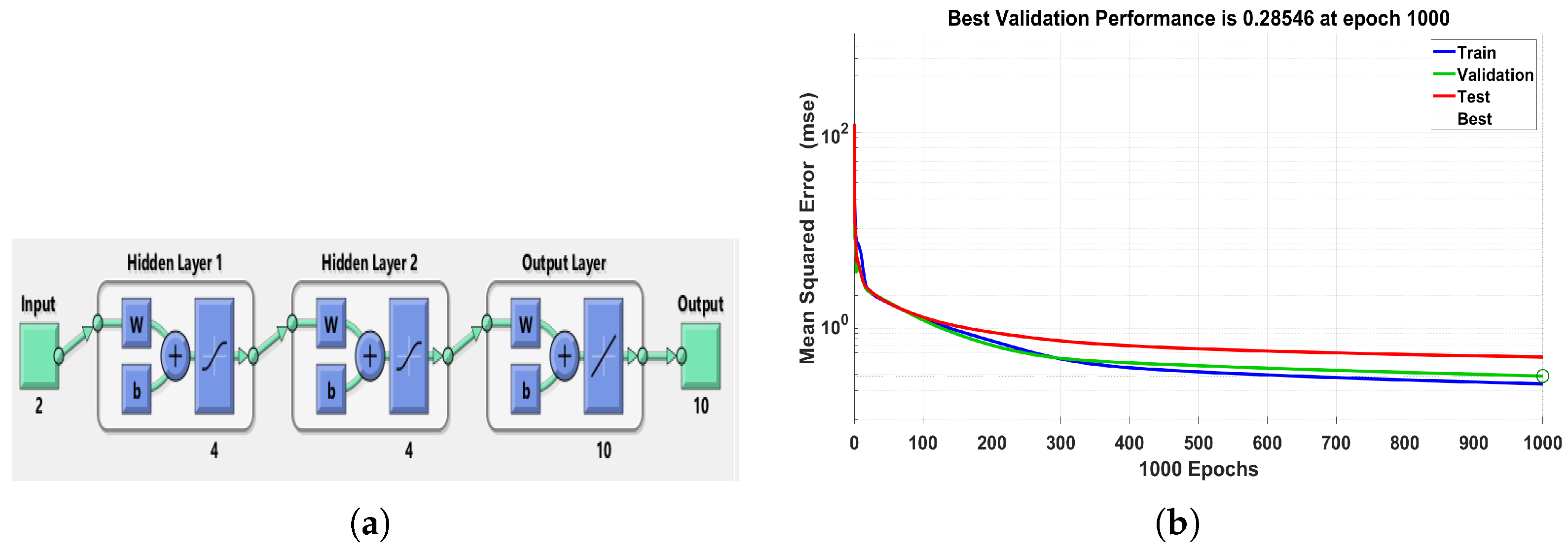
In this work, the feedforward neural network contains three layers: the input layer has three neurons, the only hidden layer has three neurons, and the output layer has ten neurons, as shown in Figure 6a.
The number of neurons in the input layer and output layer is determined by the problem itself. However, the number of neurons in the hidden layers has been selected rigorously due to underfitting and overfitting problems. The activation function is the nonlinear transformation of the input signal. The hyperbolic tangent (tanh) function is used in the first and second layers of this network as a nonlinear activation function. It maps inputs to an output range of −1 to +1. It is expressed by a mathematical formula:
t a n h ( x ) = e x e x e x + e x
where x is the neuron’s input. Therefore, the sigmoid activation function is used to take the x 1 , the neuron’s input weighted sum of the previous layer’s outputs, and to squash it for binary classification. The sigmoid activation function is used using the following formula:
σ ( x 1 ) = 1 1 + e x 1
The number of neurons in the hidden layer was iteratively determined to train the network and identify the optimum number of neurons in the hidden layer. To minimize the differences between the target (experimental weld metal geometrical parameters) and the output (the response of the ANN generated by a weight-adjusting process), the gradient descent algorithm (traingd) was used. The network training function traingd sets the network properties, with the role of minimizing the squared error and updating the weight and bias values according to gradient descent. The mean square error (MSE), which measures the distance between the vector of predictions and the vector of target values, has given the best validation performance of 0.28546 at epoch 1000, as shown in Figure 6b. The selection of epochs, namely the number of complete passes through the training dataset, is a critical hyperparameter optimization process. The role is to find the balance between underfitting (too few epochs) and overfitting (too many epochs), ensuring the model generalizes well to unseen data. The optimal number of epochs is the point where training and validation curves are both low and close together, just before the gap between them widens (a sign of overfitting). As seen in Figure 6b, the green line (validation curve), the train curve, and the red line (test best curve) are low and close together, which signifies that the model is learning effectively and generalizing well to unseen data, without overfitting. After the training, learning, and validation process, the weight parameters associated with hidden layer 1 and input 1 are shown in Table 3, the weight parameters associated with hidden layer 2 and hidden layer 1 are shown in Table 4, and the weights associated with hidden layer 3 (or the output layer) and hidden layer 2 are shown in Table 5. The bias parameters associated with the layers are shown in Table 6 and Table 7.
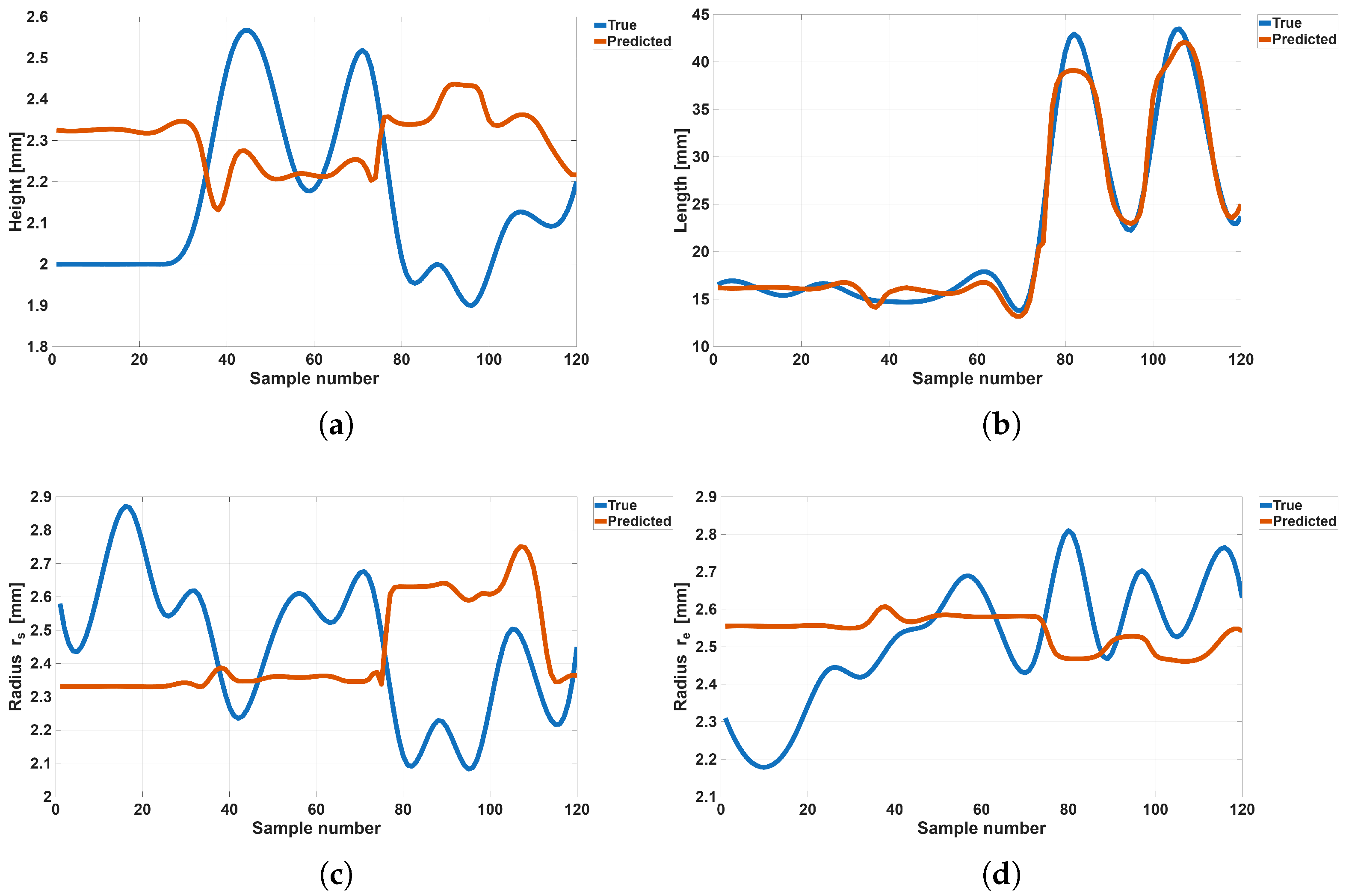
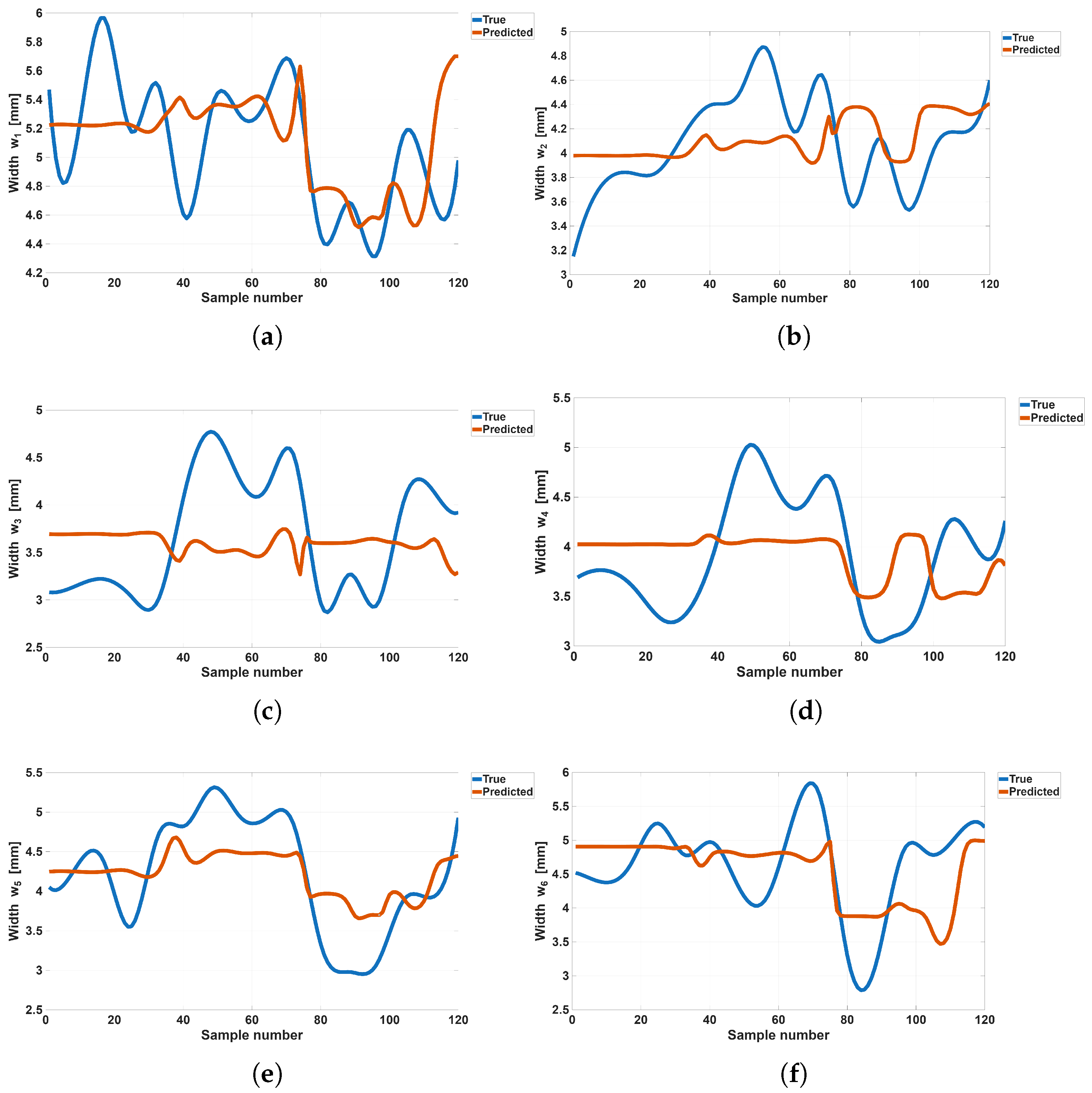
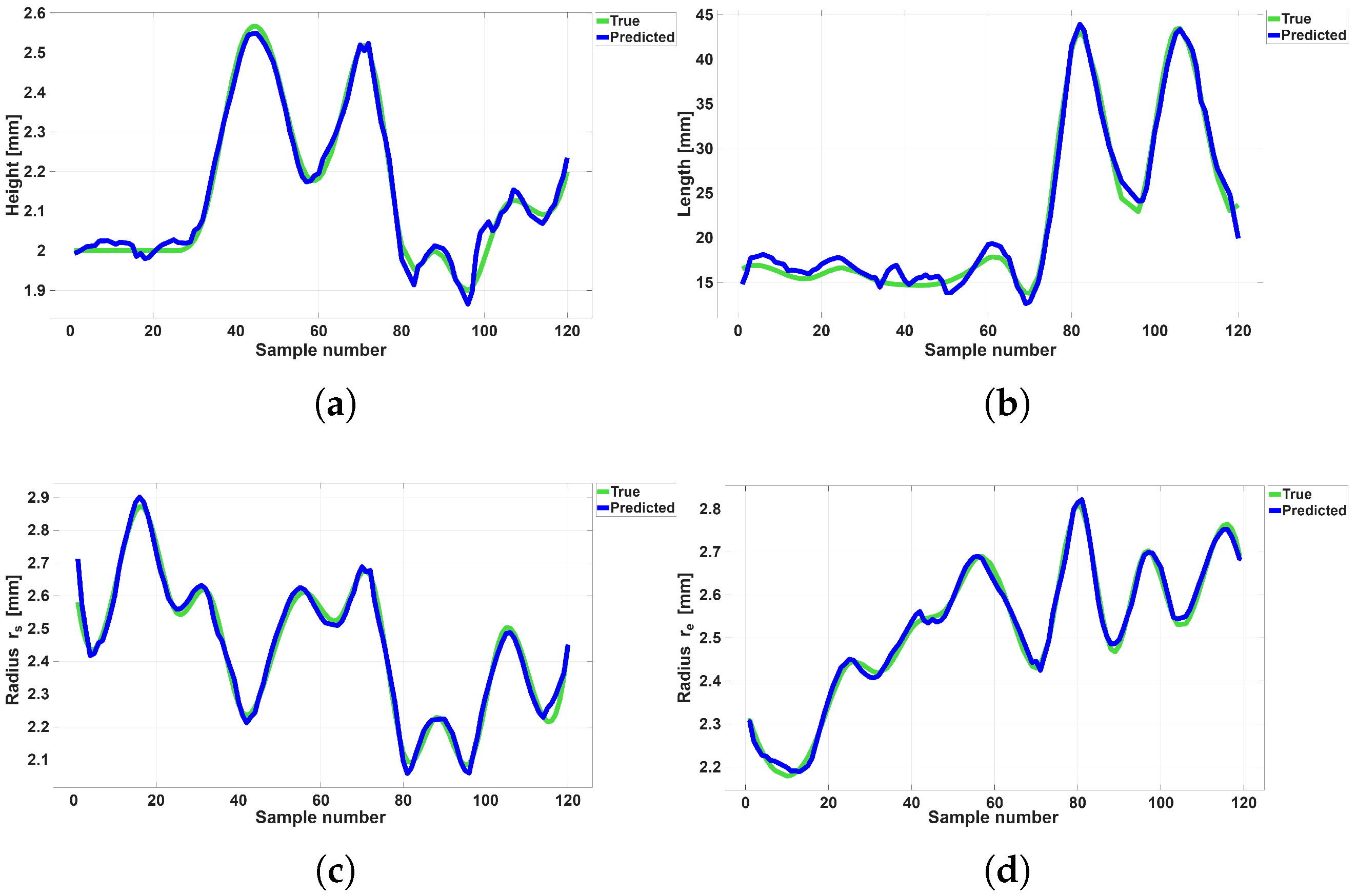
All response plots used to evaluate how well a model’s predictions align with real-world target data are shown in Figure 7. In particular, the comparisons between the predictions and the actual data achieved by ANN are reported in Figure 7 for height, length, weld toe radius ( r s ), and root radius ( r e ), and in Figure 8 for w 1 , ... , w 6 .
For measuring data forecasting, the metrics involved are mean absolute percentage error (MAPE), which is calculated as the average absolute percentage difference between predicted and actual data, and mean absolute error (MAE), calculated as the average absolute difference between actual and predicted values. Lower MAPE/MAE means higher forecasting accuracy, often suggesting low deviations. Generally, an MAPE under 10% is considered excellent. For robust forecasting, it is common to report both metrics along with others to fully understand model performance. The results of the predicted model for weld bead heights as a function of the sample number are reported in Figure 7a with an MAPE of 12.51% and an MAE of 0.26 mm. The results of the predicted model for weld bead lengths as a function of the sample number are reported in Figure 7b, with an MAPE of 4.24% and an MAE of 0.95 mm, showing a more accurate prediction than height, although with a low level of accuracy. In Figure 7d, the MAPE and MAE between predicted and actual values for weld toe radius ( r s ) are 11.0514% and 0.2669 mm, and for root radius ( r e ) are 6.1668% and 0.1516 mm, respectively. Definitely, the weld bead length is identified as the most accurate prediction due to its low MAPE, even though its absolute error is higher than that of other parameters. The predicted model for the root radius is notably more accurate than the model for the weld toe radius.
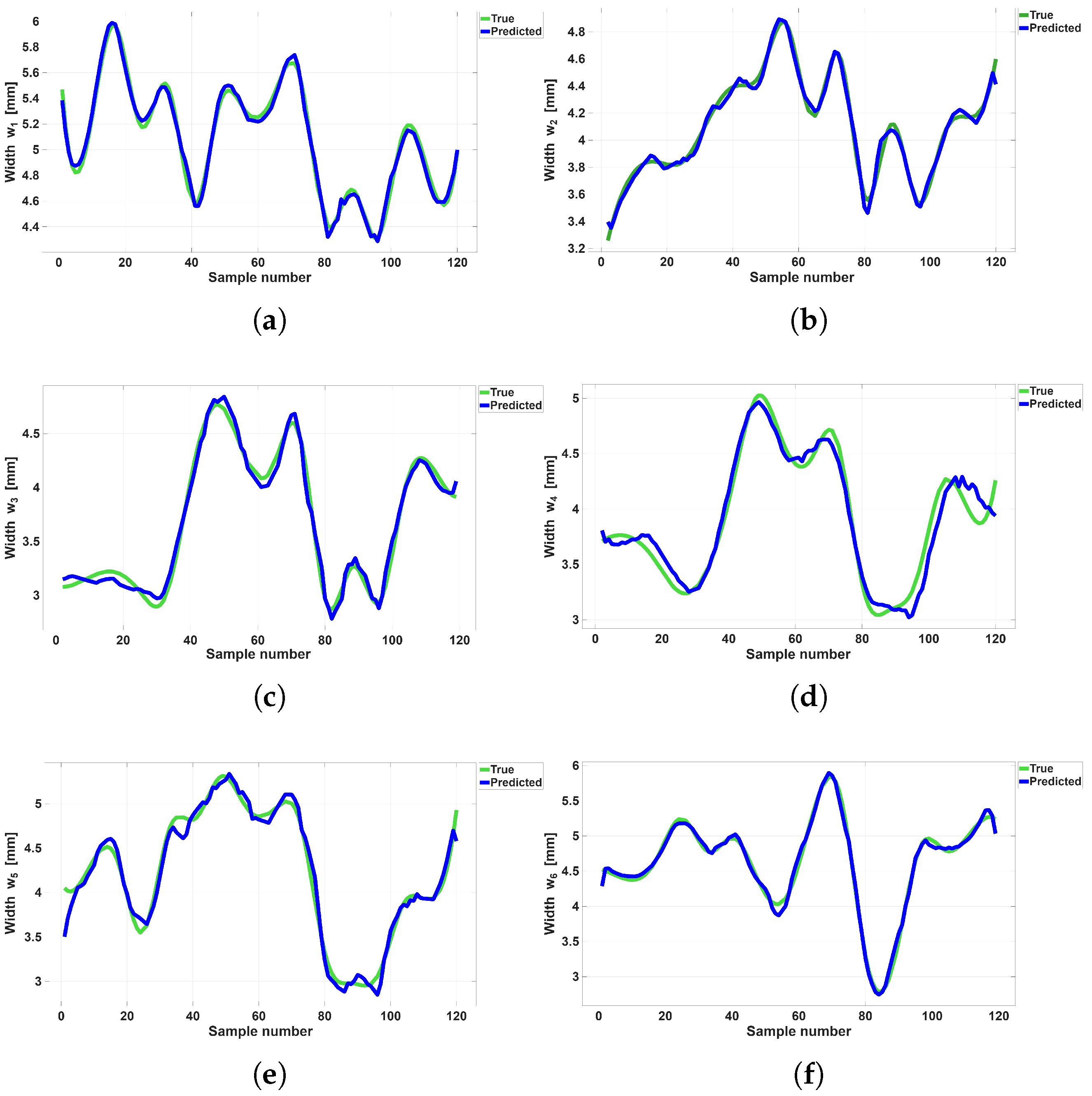
In Figure 8, the response plots of the ANN prediction model for weld bead widths as a function of the sample number are shown. In Figure 8a, the response plot for the ANN prediction model for width w 1 is reported with an MAPE of 6.13% and an MAE of 0.31 mm; in Figure 8b, for width w 2 with an MAPE of 8.01% and an MAE of 0.324 mm; in Figure 8c, for width w 3 with an MAPE of 17.12% and an MAE of 0.628 mm; in Figure 8d, for width w 4 with an MAPE of 13.34% and an MAE of 0.5104 mm; in Figure 8e, for width w 5 with an MAPE of 10.59% and an MAE of 0.4167 mm; in Figure 8f, for width w 6 with an MAPE of 11.79% and an MAE of 0.5190 mm. The ANN model has demonstrated an average MAPE of ∼11% and an MAE of ∼7.33 mm for the prediction of weld bead width, indicating a low level of precision.
Finally, the weld bead width prediction has provided high MAPE and MAE values, showing the low forecasting accuracy of the ANN model.
For this reason, various machine learning model types (tree, efficient linear least squares, SVM, etc.) have been analyzed and compared for predicting the geometrical properties of the weld bead in order to select the suitable algorithm for the specific dataset.
The comparison aims to maximize the predictive accuracy using relevant metrics (e.g., root mean square error (RMSE), mean squared error (MSE), mean absolute error (MAE), …), and computational efficiency based on training time, processing speed, and memory usage (model size). Thus, mean squared error (MSE) is the average of the squared differences between predicted and actual values, root mean squared error (RMSE) is the square root of the MSE, and mean absolute error (MAE) is the average of the absolute differences between predicted and actual values. In this case, the good trade-off between predictive performance and computational efficiency is the cubic support vector machine (SVM), as shown in Table 8. The cubic SVM has revealed a superior performance based on metrics (i.e., MSE ∼ 0.0002 mm) for the non-linear and intricate relationships in the weld bead datasets, but at the disadvantage of prediction speed and training time.

4.3. Support Vector Machine

The support vector machine (SVM) is considered a mathematical extension of the neural network for the best performance. It is considered a powerful supervised machine learning algorithm used for classification and regression, finding the optimal hyperplane in multidimensional space to separate classes in the best possible way by maximizing the distance between them. Given the training dataset:
D = { ( x 1 , y 1 ) , , ( x k , y k ) , , ( x N , y N ) } , x k R n , y k R
The general equation used by a trained nonlinear SVM to predict the class of a new data point ( x ) is a linear combination of the kernel function applied to the support vectors:
f ( x ) = i = 1 N α i y i κ ( x i , x ) + b
where N is the number of support vectors (data points closest to the decision boundary). α i denotes the Lagrange multipliers, which are non-zero only for the support vectors. y i denotes the labels of the support vectors (either +1 or −1).
K ( x i , x ) is the kernel function that calculates the similarity between a support vector ( x i ) and the new data point ( x ). b is the bias or intercept term. The nonlinear mapping function maps the input space to a so-called high-dimensional feature space where linear regression is performed. The optimization problem of the SVM method solves the objective function as follows:
m i n w , ξ , b 1 2 w 2 + C i = 1 n ξ i
where w represents the model weights and b defines a linear classifier, since ξ is in R n . The first term aims to minimize the norm of the model weights ( w ). Minimizing w is equivalent to maximizing the geometric margin between the decision boundary and the nearest data points (support vectors). The second term aims to minimize the committed errors, specifically the total magnitude of the slack variables ( ξ i ). The constant C determines the trade-off between minimizing this training error and maximizing the margin.

4.4. Cubic Support Vector Machine Results

The cubic support vector machine (SVM) is a type of non-linear SVM that uses a cubic polynomial kernel function to compute the relationships between the observations in a higher-dimensional space. The polynomial kernel function has the following equation:
κ x i , x J = x i T x J 3
where x i · x is the dot product (inner product) of the two vectors in the original feature space, with an exponent coefficient equal to 3, which is the degree of the polynomial. The cubic SVM is used for classification, specific complex tasks, and non-linear decision boundaries, generally providing high accuracy on complex and non-linearly separable data. The cubic SVM approximation model was useful for performing nonlinear regression with many observations and for predicting the data. The same training dataset used for ANN investigation has been considered in the cubic SVM method. The geometrical properties measured using the caliper and the microscope, and the welding parameters, such as the welding speed and the FANUC robot’s trajectory length, are defined as the input and output data, respectively, with a total of 120 data points. The dataset involved in this model has a number of observations with a sample size (120 observations) relative to the number of predictors (8) and response classes (11), considered a minimum threshold to avoid extreme overfitting in linear or simple non-linear models. From this perspective, the 8 predictors are reasonably supported by the total sample size. The technique used for cross-validation is k-fold cross-validation to prevent overfitting and guarantee the generalization of the model. The data are partitioned into five folds. The accuracy of the prediction model based on cubic SVM is evaluated based on the following statistical error tests, namely, mean absolute error (MAE) of 0.0118 mm and root mean squared error (RMSE) of 0.0131 mm, as shown in Table 8, allowing us to consider the best model to correctly predict all geometrical dimensions in the weld bead. Therefore, the SVM model for the weld bead geometrical prediction requires kernel parameters to avoid overfitting and maintain high accuracy. The kernel function was chosen as a polynomial with order 3 and a scale of 0.8922. The high computational complexity of SVMs presents significant challenges for real-time applications, making them slower than ANNs. SVMs can be sensitive to noise in experimental data, which can negatively affect the precision of bead width and height predictions. However, from the sensitivity analysis with a low sensitivity index of ∼0.0167, the SVM model remains robust in practical applications, indicating stability in input parameter influence; in contrast, ANNs display much higher sensitivity, ∼0.99, which may reflect lower stability [100]. All calculations were carried out using MATLAB mathematical software (version R2025a) with the linear regression app. All geometrical prediction results for weld beads are reported in response plots in Figure 9 and Figure 10. The response plots in Figure 9 and Figure 10 display the predicted responses of weld bead height, length, widths, and radii versus all recorded sample numbers, demonstrating a high level of accuracy and low error. For robust model training, the dataset for the predictive model, constituted by 120 observations, did not present critical issues that could increase the risk of overfitting. Figure 9a shows the response plot for the cubic SVM prediction model for the height of a weld bead with an MAPE of 0.821% and an MAE of 0.018 mm, and Figure 9b shows the response plot for the cubic SVM prediction model for the length of a weld bead with an MAE of 0.74 mm, MSE of 0.86 mm, and MAPE of 3.81%. Figure 9c shows the response plot for the cubic SVM prediction model for weld toe radius ( r s ) with an MAPE of 0.82% and an MAE of 0.020 mm, and Figure 9d shows the response plot for the cubic SVM prediction model for root radius ( r e ) with an MAPE of 0.47% and an MAE of 0.012 mm. The calculation of the average MAPE (0.65%) and MAE (0.016 mm) for both radii r s and r e represents the accuracy and precision of a measurement or prediction model for the radius of a weld bead, indicating that, on average, the predicted radius deviates from the actual value by only micrometers. A MAPE of 0.65% confirms that this error is extremely small relative to the total size of the bead, signifying a highly reliable model.
In Figure 10a, the response plot for the cubic SVM model prediction for width w 1 is reported with an MAPE of 0.77% and an MAE of 0.039 mm; in Figure 10b, the response plot is reported for width w 2 with an MAPE of 0.86% and an MAE of 0.034 mm; in Figure 10c, the response plot is reported for width w 3 with an MAPE of 1.74% and an MAE of 0.062 mm; in Figure 10d, the response plot is reported for width w 4 with an MAPE of 1.33% and an MAE of 0.050 mm; in Figure 10e, the response plot is reported for width w 5 with an MAPE of 1.94% and an MAE of 0.079 mm; in Figure 10f, the response plot is reported for width w 6 with an MAPE of 1.10% and an MAE of 0.048 mm. The calculated average values of MAPE (1.29%) and MAE (0.052 mm) for all widths w 1 w 6 have confirmed the better model performance and greater predictive accuracy, signifying that the average physical deviation is negligible (only 52 μm), likely falling within standard manufacturing tolerances.
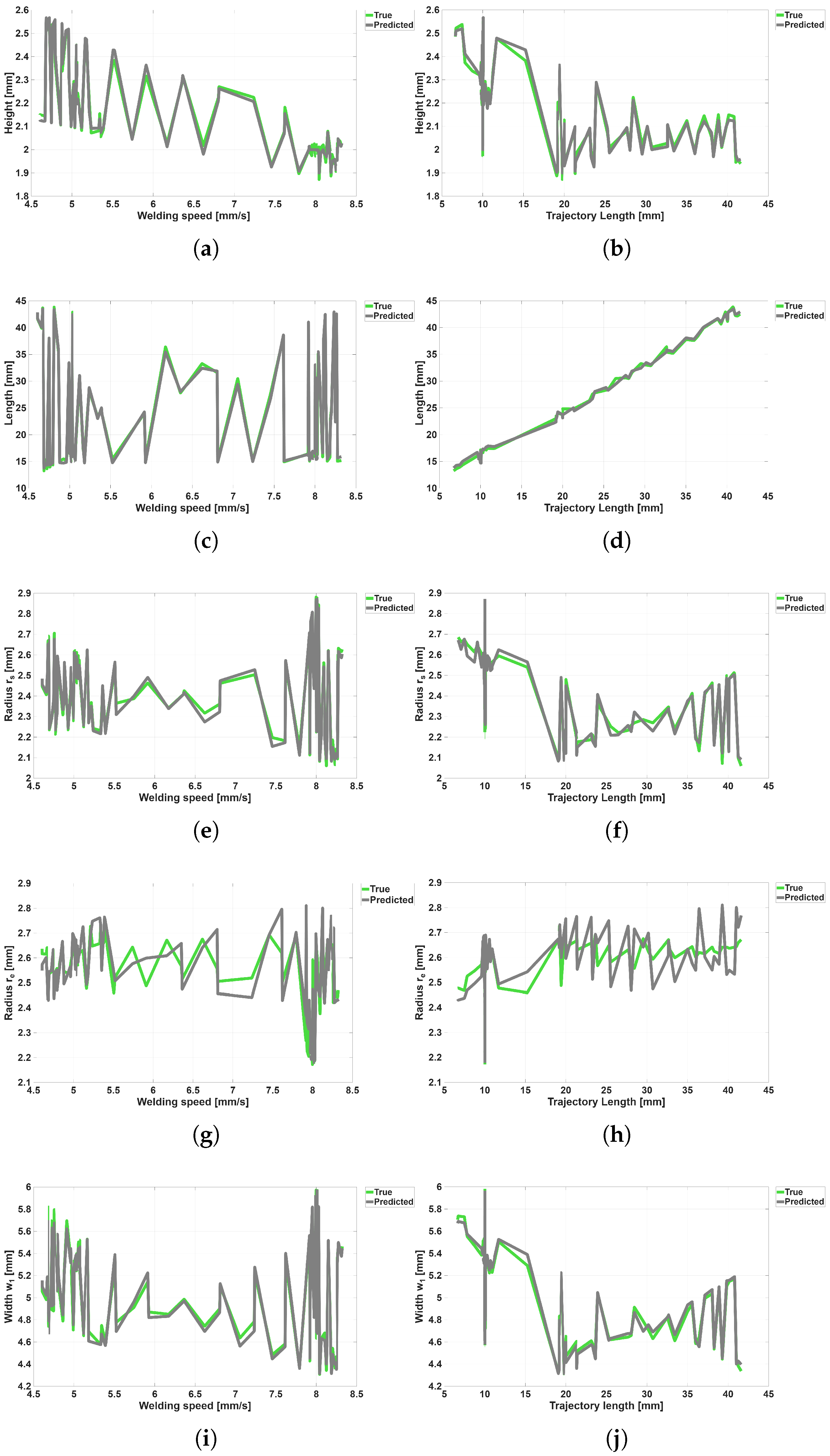
The SVM approach can be considered a good approach to model the dependence of the weld bead geometry on the welding speed and trajectory length. In fact, the SVM model gives better results for all geometrical parameters, and the dependence between the input parameters (welding speed and trajectory length) and the geometrical parameters is calculated. The predicted responses of the geometrical output parameters are plotted against the actual welding speed and trajectory length, and the true responses are reported in Figure 11.
The response plot of the relationship between welding speed and weld bead height (predicted and actual values) is shown in Figure 11a, and the relationship between trajectory length and weld bead height is shown in Figure 11b, with error metrics of MAE of 0.0164 mm, MSE of 0.0004 mm, and MAPE of 0.7651%, indicating low errors for both plots. The decreasing trend of predicted and actual values is exhibited for both plots. The response plot of the relationship between welding speed and weld bead length (predicted and actual values) is shown in Figure 11c, and the relationship between trajectory length and weld bead length is shown in Figure 11d, with error metrics of MAE of 0.0017 mm, MSE of 0.27 mm, and MAPE of 2.29%, indicating low errors for both plots, especially for weld length as a function of trajectory length, which shows a linear dependence. The response plot of the relationship between welding speed and the weld toe radius r s is shown in Figure 11e and the relationship between trajectory length and the weld toe radius r s is shown in Figure 11f, with error metrics of MAE of 0.018 mm, MSE of 0.0005 mm, and MAPE of 0.77%. The response plot of the relationship between welding speed and the weld bead root radius r e is shown in Figure 11e, and the relationship between trajectory length and the weld bead root radius r e is shown in Figure 11f, with the following error metrics: an MAE of 0.2396 mm, an MSE of 0.0052 mm, and an MAPE of 2.34%, which are higher than those for the other geometrical parameters, but still acceptable. The response plot of the relationship between welding speed and weld bead width w 1 is shown in Figure 11i, and the relationship between trajectory length and weld bead width w 1 is shown in Figure 11j. For simplicity, the dependence of weld bead width on trajectory length and welding speed is shown only for width w 1 , with low error metrics of MAE of 0.04 mm, MSE of 0.002 mm, and MAPE of 0.80%. The predictive model for weld width is highly accurate.

5. Conclusions

This study presents a brief overview of the AM process and describes a metal welding process with the experimental setup and equipment for the realization of weld beads using BÖHLER SG2 solid wire. During the welding process, the key welding parameters controlled and monitored by a FANUC robot, such as the robot’s trajectory length and welding speed, were varied to ensure consistent and high-quality welds. However, the designs of the visible weld bead lines deposited during the welding process exhibit an irregular weld bead profile that impacts the mechanical properties and structural integrity of a weld, increasing the likelihood of cracking and premature failure under stress and cyclic loading. The shape and size of a weld bead are obviously determined by several factors, including the welding process and specific operational parameters. So, it is important to analyze and improve the weld bead geometry to minimize defects that could lead to premature failure. In fact, the geometrical properties of a weld bead were measured using both a caliper and a microscope for detailed measurements and morphology analysis. Subsequently, mathematical models (like neural networks and SVM) are proposed to create a dependence between the controllable welding input parameters and resulting geometrical weld bead outputs (width, height, length, and radius) for prediction and optimization. These models, using techniques such as support vector machines (SVMs) and artificial neural networks (ANNs), can be a good tool for controlling quality by understanding these input–output relationships. The neural network model is capable of estimating the geometrical properties of the weld bead based on measurements from the caliper and microscope as a faster and general model with the best validation performance, MSE of 0.28546 mm, and highly non-linear relationships. However, the cubic SVM has revealed better performance for geometrical prediction of weld beads with an MSE of 0.000175 mm and efficiency for non-linear dataset mapping, with complex input-to-output relationships in the weld bead application. The SVM model has given better results than the neural network for the prediction of all geometrical parameters and dependence on welding speed and trajectory length. In fact, the accuracy of the SVM model is very high, as shown by the difference between predicted and actual values of geometric weld bead characteristics, using the metric error MAE. For example, MAE is ∼ 0.017 mm for height, ∼ 0.0017 mm for length, ∼ 0.04 mm for width, and ∼ 0.01 mm for radius; these values are extremely small relative to the total size of the bead, signifying a highly reliable model. For future research, the models can be used to predict the geometry and characteristics of multiple layers in a multi-pass weld for an automated and intelligent welding system in WAAM, and can be implemented in welding machines to allow real-time monitoring of the process for the optimization of process parameters in industrial applications. Therefore, other machine learning models can be proposed to identify defects on the weld bead surface.

Author Contributions

Conceptualization, G.L.S., M.P., E.T. and G.T.; methodology, G.L.S., M.P., E.T., T.T.; software, G.L.S.; validation, G.L.S., M.P., E.T., T.T. and Y.S.; formal analysis, G.L.S., M.P., E.T., G.T. and T.T.; investigation, T.T. and G.L.S.; resources, G.T. and T.T.; data curation, E.T., M.P., V.M. and G.L.S.; writing—original draft preparation, G.L.S., E.T. and M.P.; writing—review and editing, G.L.S.; visualization, G.L.S.; supervision, G.T. and Y.S.; project administration, G.T., A.N. and K.P.; funding acquisition, G.T. All authors have read and agreed to the published version of the manuscript.

Funding

This work has been realized with financial support from the European Regional Development Fund within the Operational Programme “Bulgarian national recovery and resilience plan”, the procedure for direct provision of grants “Establishing of a network of research higher education institutions in Bulgaria”, under the Project BG-RRP-2.004-0005 “Improving the research capacity and quality to achieve international recognition and resilience of TU-Sofia”.

Informed Consent Statement

This article does not contain any studies with human participants or animals performed by any of the authors.

Data Availability Statement

The data presented in this study are available upon request from the corresponding authors. The data are not publicly available due to public funding requirements.

Conflicts of Interest

The authors declare no conflicts of interest.

References

  1. Sellés Cantó, M.Á.; Sánchez-Caballero, S. Book of Abstracts from the 10th International Conference on Tribology in Manufacturing Processes and Advanced Surface Engineering; Trans Tech Publications: Baech, Switzerland, 2024. [Google Scholar]
  2. Rashid, A.B.; Haque, M.; Islam, S.M.; Uddin Labib, K.R.; Chowdhury, P. Breaking boundaries with ceramic matrix composites: A comprehensive overview of materials, manufacturing techniques, transformative applications, recent advancements, and future prospects. Adv. Mater. Sci. Eng. 2024, 2024, 2112358. [Google Scholar] [CrossRef]
  3. Chakravarthy, P.; Agilan, M.; Neethu, N. Flux Bounded Tungsten Inert Gas Welding Process: An Introduction; CRC Press: Boca Raton, FL, USA, 2019. [Google Scholar]
  4. Rahadian, N. Advancements in Welding Technology: A Comprehensive Review of Techniques, Materials, and Applications. J. PEP Bdg. 2025, 2, 62–110. [Google Scholar]
  5. Singh, S.R.; Khanna, P. Wire arc additive manufacturing (WAAM): A new process to shape engineering materials. Mater. Today Proc. 2021, 44, 118–128. [Google Scholar] [CrossRef]
  6. Patel, A.; Patel, V.; Bansal, P.; Bhuva, B. Optimization and Performance Analysis of Submerged Arc Welding: Influence of Bead Geometry, Process Parameters, and Heat-Affected Zone-A review. Int. Res. J. Eng. Technol. 2025, 12, 1012–1015. [Google Scholar]
  7. BİLİR, G.; ŞİMŞİR, M. Investigation of T-Joint Butt Welding of Plain Carbon Steels With Metal Active Gas Welding in Pb Position. MAS J. Appl. Sci. 2025, 10, 249–258. [Google Scholar]
  8. Mallikarjuna, B.; Reutzel, E.W. Reclamation of intermetallic titanium aluminide aero-engine components using directed energy deposition technology. Manuf. Rev. 2022, 9, 27. [Google Scholar] [CrossRef]
  9. Iqbal, H. Wire-Arc Additive Manufacturing (WAAM): Investigation of Process Dynamics, Material Insights, and Application Prospects. Ph.D. Thesis, Università di Bologna, Bologna, Italy, 2025. [Google Scholar]
  10. Jadhav, S.; Kusekar, S.; Belure, A.; Digole, S.; Mali, A.; Cheepu, M.; Mugale, M.; Alkunte, S.; Kim, D. Recent Progress and Scientific Challenges in Wire-Arc Additive Manufacturing of Metallic Multi-Material Structures. J. Manuf. Mater. Process. 2025, 9, 284. [Google Scholar] [CrossRef]
  11. Kerber, E.; Knitt, H.; Fahrendholz-Heiermann, J.L.; Ergin, E.; Brell-Cokcan, S.; Dewald, P.; Sharma, R.; Reisgen, U. Variable layer heights in wire arc additive manufacturing and WAAM information models. Machines 2024, 12, 432. [Google Scholar] [CrossRef]
  12. Lambiase, F.; Yanala, P.B.; Pace, F.; Andreucci, E.; Paoletti, A. A state of the art review of wire arc additive manufacturing (WAAM)—Part 1: Process fundamentals, parameters and materials. Int. J. Adv. Manuf. Technol. 2025, 138, 4965–4993. [Google Scholar] [CrossRef]
  13. Ozaner, O.C.; Talemi, R.; Tjahjowidodo, T.; Sharma, A. The influence of the wire and arc additive manufacturing parameters on the surface irregularities. J. Micromanuf. 2025, 8, 22–31. [Google Scholar] [CrossRef]
  14. Fan, H.; Zhou, P.; Li, J.; Huang, J.; Ni, Y.; Hui, Y. Microstructure and mechanical properties of arc zone and laser zone of TC4 titanium alloy laser–TIG hybrid welded joint. Metals 2022, 12, 1854. [Google Scholar] [CrossRef]
  15. Ehlen, G.; Ludwig, A.; Sahm, P.R. Simulation of time-dependent pool shape during laser spot welding: Transient effects. Metall. Mater. Trans. A 2003, 34, 2947–2961. [Google Scholar] [CrossRef]
  16. Ai, Y.; Liu, X.; Huang, Y.; Yu, L. Numerical analysis of the influence of molten pool instability on the weld formation during the high speed fiber laser welding. Int. J. Heat Mass Transf. 2020, 160, 120103. [Google Scholar] [CrossRef]
  17. Wang, J.; Li, J.; Liu, Z.; Liu, X.; Li, Z.; Zhan, X. Experimental and numerical analysis of molten pool dynamics in adjustable ring-mode laser welding of TC4 titanium alloys. Int. J. Therm. Sci. 2026, 222, 110548. [Google Scholar] [CrossRef]
  18. Guo, K.; Tang, F.; Jia, H.; Zhao, W.; Wei, Y. Study on the influence of ring power ratio on heat flow behavior and solidification characteristics of the molten pool during ring-mode laser welding of aluminum alloy. Int. J. Therm. Sci. 2026, 222, 110584. [Google Scholar] [CrossRef]
  19. Kumar, B.; Bag, S. Phase transformation effect in distortion and residual stress of thin-sheet laser welded Ti-alloy. Opt. Lasers Eng. 2019, 122, 209–224. [Google Scholar] [CrossRef]
  20. Meena, P.; Anant, R. Residual stress formation and distortion in austenitic AISI304 steel pipe weldment with consideration of latent heat using novel prescribed weld temperature. J. Mater. Eng. Perform. 2025, 34, 5933–5949. [Google Scholar] [CrossRef]
  21. Gupta, D.K.; Mulik, R.S. Selection of Process Parameters and its Effect on Bead Geometry, Mechanical Properties, and Microstructure of Inconel 825 Fabricated Using Wire Arc Additive Manufacturing. Met. Mater. Int. 2025, 31, 3744–3760. [Google Scholar] [CrossRef]
  22. Yildirim, M.S.; Ayhan, E.; Aydin, K.; Durgutlu, A. The effect of welding parameters on weld bead geometry in gas tungsten arc welding applications by response surface methodology model. Proc. Inst. Mech. Eng. Part E J. Process Mech. Eng. 2025, 09544089251364992. [Google Scholar] [CrossRef]
  23. Cho, Y.H.; Shehryar Khan, M.; Goodwin, F.E.; Zhou, Y.N. Effect of torch angle and position on bead geometry and joint strength during arc brazing of thin-gauge dual-phase steel. Int. J. Adv. Manuf. Technol. 2022, 121, 543–557. [Google Scholar] [CrossRef]
  24. Khrais, S.; Al Hmoud, H.; Abdel Al, A.; Darabseh, T. Impact of gas metal arc welding parameters on bead geometry and material distortion of AISI 316L. J. Manuf. Mater. Process. 2023, 7, 123. [Google Scholar] [CrossRef]
  25. Roshan, R.; Kumar Naik, A.; Kumar Saxena, K.; Arora, K.S.; Shajan, N.; Msomi, V.; Mehdi, H. Effect of welding speed and wire feed rate on arc characteristics, weld bead and microstructure in standard and pulsed gas metal arc welding. J. Adhes. Sci. Technol. 2023, 37, 3297–3314. [Google Scholar] [CrossRef]
  26. Li, X.; Chen, J.; Wang, Y.; Shi, L.; Wu, D.; Wu, C. Grain morphology characteristics and formation mechanism of wire-arc additive manufactured 316L stainless steel. Int. J. Therm. Sci. 2026, 221, 110445. [Google Scholar] [CrossRef]
  27. Arana, M.; Ukar, E.; Rodriguez, I.; Aguilar, D.; Alvarez, P. Influence of deposition strategy and heat treatment on mechanical properties and microstructure of 2319 aluminium WAAM components. Mater. Des. 2022, 221, 110974. [Google Scholar] [CrossRef]
  28. Ty, A.; Balcaen, Y.; Mokhtari, M.; Alexis, J. Influence of deposit and process parameters on microstructure and mechanical properties of Ti6Al4V obtained by DED-W (PAW). J. Mater. Res. Technol. 2022, 18, 2853–2869. [Google Scholar] [CrossRef]
  29. Wang, J.; Lin, X.; Li, J.; Hu, Y.; Zhou, Y.; Wang, C.; Li, Q.; Huang, W. Effects of deposition strategies on macro/microstructure and mechanical properties of wire and arc additive manufactured Ti6Al4V. Mater. Sci. Eng. A 2019, 754, 735–749. [Google Scholar] [CrossRef]
  30. So, M.S.; Mahdi, M.M.; Kim, D.B.; Shin, J.H. Prediction of Metal Additively Manufactured Bead Geometry Using Deep Neural Network. Sensors 2024, 24, 6250. [Google Scholar] [CrossRef]
  31. Singh, V.P.; Kuriachen, B.; Mahesh, V.; Harursampath, D. Tungsten and Metal Inert Gas Welding: Automation in Welding. In Advanced Welding Techniques; CRC Press: Boca Raton, FL, USA, 2024; pp. 136–152. [Google Scholar]
  32. Mu, H.; Polden, J.; Li, Y.; He, F.; Xia, C.; Pan, Z. Layer-by-layer model-based adaptive control for wire arc additive manufacturing of thin-wall structures. J. Intell. Manuf. 2022, 33, 1165–1180. [Google Scholar] [CrossRef]
  33. Prasad, C.D.; Tiwari, A.; Suryawanshi, S.R.; Dileep, B.; Gowda, A.C.; Masum, H.; Dutt, K.M.; Sunil Prashanth Kumar, S.; Bavan, S. Overview of thermal spray coating on additive manufacturing. Prog. Addit. Manuf. 2025, 10, 4327–4347. [Google Scholar] [CrossRef]
  34. Ashokkumar, M.; Thirumalaikumarasamy, D.; Sonar, T.; Deepak, S.; Vignesh, P.; Anbarasu, M. An overview of cold spray coating in additive manufacturing, component repairing and other engineering applications. J. Mech. Behav. Mater. 2022, 31, 514–534. [Google Scholar] [CrossRef]
  35. Dananjaya, V.; Marimuthu, S.; Yang, R.; Grace, A.N.; Abeykoon, C. Synthesis, properties, applications, 3D printing and machine learning of graphene quantum dots in polymer nanocomposites. Prog. Mater. Sci. 2024, 144, 101282. [Google Scholar] [CrossRef]
  36. Xiong, J.; Zhang, G.; Gao, H.; Wu, L. Modeling of bead section profile and overlapping beads with experimental validation for robotic GMAW-based rapid manufacturing. Robot. Comput.-Integr. Manuf. 2013, 29, 417–423. [Google Scholar] [CrossRef]
  37. Le-Hong, T.; Lin, P.C.; Chen, J.Z.; Pham, T.D.Q.; Van Tran, X. Data-driven models for predictions of geometric characteristics of bead fabricated by selective laser melting. J. Intell. Manuf. 2023, 34, 1241–1257. [Google Scholar] [CrossRef]
  38. Chen, Z.; Yuan, L.; Pan, Z.; Zhu, H.; Ma, N.; Ding, D.; Li, H. A comprehensive review and future perspectives of simulation approaches in wire arc additive manufacturing (WAAM). Int. J. Extrem. Manuf. 2025, 7, 022016. [Google Scholar] [CrossRef]
  39. Feng, G.; Wang, H.; Wang, Y.; Deng, D.; Zhang, J. Numerical simulation of residual stress and deformation in wire arc additive manufacturing. Crystals 2022, 12, 803. [Google Scholar] [CrossRef]
  40. Gupta, D.K.; Mulik, R.S. Numerical simulation and experimental investigation of temperature distribution during the wire arc additive manufacturing (WAAM) process. Prog. Addit. Manuf. 2025, 10, 631–645. [Google Scholar] [CrossRef]
  41. Yao, G.R.; Chang, C.; Cox, S.C.; Zhang, X.F.; Yang, C.; Li, X.Q.; Liu, M.; Song, B.; Cui, Z.Q.; Yin, S.; et al. Establishing the intrinsic connection between microstructure, 3D defects, and the corrosion behavior of selective laser melted WE43 alloys: G.-R. Yao et al. Rare Met. 2025, 44, 9217–9234. [Google Scholar] [CrossRef]
  42. Karouanas, I.; Foteinopoulos, P.; Bikas, H.; Stavropoulos, P. A practical simulation approach for the support of wire arc DED additive manufacturing systems design. Procedia Comput. Sci. 2024, 232, 3161–3172. [Google Scholar] [CrossRef]
  43. Sitharaj, A.; Balasubramanian, A.; Sivanraju, R. Artificial Intelligence in Wire Arc Additive Manufacturing: A Systematic Review and Patent Landscape Analysis. Eng. Rep. 2025, 7, e70518. [Google Scholar] [CrossRef]
  44. Bănică, C.F.; Sover, A.; Anghel, D.C. Printing the future layer by layer: A comprehensive exploration of additive manufacturing in the era of industry 4.0. Appl. Sci. 2024, 14, 9919. [Google Scholar] [CrossRef]
  45. Lehmann, T.; Rose, D.; Ranjbar, E.; Ghasri-Khouzani, M.; Tavakoli, M.; Henein, H.; Wolfe, T.; Jawad Qureshi, A. Large-scale metal additive manufacturing: A holistic review of the state of the art and challenges. Int. Mater. Rev. 2022, 67, 410–459. [Google Scholar] [CrossRef]
  46. Zhang, W.; Xu, C.; Li, C.; Wu, S. Advances in ultrasonic-assisted directed energy deposition (DED) for metal additive manufacturing. Crystals 2024, 14, 114. [Google Scholar] [CrossRef]
  47. Pramanik, D.; Roy, N.; Das, R.K.; Das, S.; Das, S. Optimisation of Metal Active Gas Welding on Mild Steel Using Response Surface Methodology. Int. J. Eng. Inf. Manag. 2025, 1, 55–66. [Google Scholar] [CrossRef]
  48. Casalino, G.; Karamimoghadam, M.; Contuzzi, N. Metal wire additive manufacturing: A comparison between arc laser and laser/arc heat sources. Inventions 2023, 8, 52. [Google Scholar] [CrossRef]
  49. Das, D.; Mitra, J.; Khan, S.; Roy, B.S. A comparative experimental study on metal active gas welding process at low temperature and room temperature. Proc. Inst. Mech. Eng. Part E J. Process Mech. Eng. 2025, 09544089251364577. [Google Scholar] [CrossRef]
  50. Lin, T.C. Experimental Study on Laser Additive Manufacturing of Metal Matrix Nanocomposite; University of California: Los Angeles, CA, USA, 2018. [Google Scholar]
  51. Atwater, M.A.; Guevara, L.N.; Darling, K.A.; Tschopp, M.A. Solid state porous metal production: A review of the capabilities, characteristics, and challenges. Adv. Eng. Mater. 2018, 20, 1700766. [Google Scholar] [CrossRef]
  52. Prabhakar, D.; Shettigar, A.K.; Herbert, M.A.; GC, M.P.; Pimenov, D.Y.; Giasin, K.; Prakash, C. A comprehensive review of friction stir techniques in structural materials and alloys: Challenges and trends. J. Mater. Res. Technol. 2022, 20, 3025–3060. [Google Scholar] [CrossRef]
  53. Qiao, Q.; Tam, C.W.; Guo, D.; Qian, H.; Lin, Y.; Li, Z.; Tam, L.M. In situ monitoring of temperature, force and torque in additive friction stir deposition of AA6061: Effect of rotational driving mode. Mater. Charact. 2025, 227, 115326. [Google Scholar] [CrossRef]
  54. Su, H.; Wu, C.S.; Pittner, A.; Rethmeier, M. Simultaneous measurement of tool torque, traverse force and axial force in friction stir welding. J. Manuf. Process. 2013, 15, 495–500. [Google Scholar] [CrossRef]
  55. Ahmed, M.M.; El-Sayed Seleman, M.M.; Elfishawy, E.; Alzahrani, B.; Touileb, K.; Habba, M.I. The effect of temper condition and feeding speed on the additive manufacturing of AA2011 parts using friction stir deposition. Materials 2021, 14, 6396. [Google Scholar] [CrossRef] [PubMed]
  56. Mugada, K.K.; Adepu, K. Material flow and mechanical properties of friction stir welded Al-Mg-Si alloy: Role of concentric circles shoulder with non-circular pins. Proc. Inst. Mech. Eng. Part C J. Mech. Eng. Sci. 2021, 235, 5487–5499. [Google Scholar] [CrossRef]
  57. Yasa, E.; Poyraz, O.; Molyneux, A.; Sharman, A.; Bilgin, G.M.; Hughes, J. Systematic review on additive friction stir deposition: Materials, processes, monitoring and modelling. Inventions 2024, 9, 116. [Google Scholar] [CrossRef]
  58. Li, X.; Li, X.; Hu, S.; Liu, Y.; Ma, D. Additive friction stir deposition: A review on processes, parameters, characteristics, and applications. Int. J. Adv. Manuf. Technol. 2024, 133, 1111–1128. [Google Scholar] [CrossRef]
  59. Oladunni, O.J.; Lee, C.K.; Ibrahim, I.D.; Olanrewaju, O.A. Advances in sustainable additive manufacturing: A systematic review for construction industry to mitigate greenhouse gas emissions. Front. Built Environ. 2025, 11, 1535626. [Google Scholar] [CrossRef]
  60. Li, M.; Du, W.; Elwany, A.; Pei, Z.; Ma, C. Metal binder jetting additive manufacturing: A literature review. J. Manuf. Sci. Eng. 2020, 142, 090801. [Google Scholar] [CrossRef]
  61. Meenashisundaram, G.; Kumar, Z.; Xu, M.; Nai, S.; Lu, J.; Sheuan Ten, J. Binder jetting additive manufacturing of high porosity 316L stainless steel metal foams. Materials 2020, 13, 3744. [Google Scholar] [CrossRef]
  62. Brika, S.E.; Letenneur, M.; Dion, C.A.; Brailovski, V. Influence of particle morphology and size distribution on the powder flowability and laser powder bed fusion manufacturability of Ti-6Al-4V alloy. Addit. Manuf. 2020, 31, 100929. [Google Scholar] [CrossRef]
  63. Gibson, I.; Rosen, D.W.; Stucker, B. Sheet lamination processes. In Additive Manufacturing Technologies: Rapid Prototyping to Direct Digital Manufacturing; Springer: Boston, MA, USA, 2010; pp. 223–252. [Google Scholar]
  64. Pilipović, A. Sheet lamination. In Polymers for 3D Printing; William Andrew Publishing: Norwich, NY, USA, 2022; pp. 127–136. [Google Scholar]
  65. Haddad, M.; Nixon, K.B.; Wolff, S. Sheet Lamination. In Springer Handbook of Additive Manufacturing; Springer International Publishing: Cham, Switzerland, 2023; pp. 407–423. [Google Scholar]
  66. Ladani, L.; Sadeghilaridjani, M. Review of powder bed fusion additive manufacturing for metals. Metals 2021, 11, 1391. [Google Scholar] [CrossRef]
  67. King, W.E.; Anderson, A.T.; Ferencz, R.M.; Hodge, N.E.; Kamath, C.; Khairallah, S.A.; Rubenchik, A.M. Laser powder bed fusion additive manufacturing of metals; physics, computational, and materials challenges. Appl. Phys. Rev. 2015, 2, 041304. [Google Scholar] [CrossRef]
  68. Bhavar, V.; Kattire, P.; Patil, V.; Khot, S.; Gujar, K.; Singh, R. A review on powder bed fusion technology of metal additive manufacturing. In Additive Manufacturing Handbook; CRC Press: Boca Raton, FL, USA, 2017; pp. 251–253. [Google Scholar]
  69. Trapp, J.; Rubenchik, A.M.; Guss, G.; Matthews, M.J. In situ absorptivity measurements of metallic powders during laser powder-bed fusion additive manufacturing. Appl. Mater. Today 2017, 9, 341–349. [Google Scholar] [CrossRef]
  70. Dejene, N.D.; Lemu, H.G. Current status and challenges of powder bed fusion-based metal additive manufacturing: Literature review. Metals 2023, 13, 424. [Google Scholar] [CrossRef]
  71. Bidulsky, R.; Gobber, F.S.; Bidulska, J.; Ceroni, M.; Kvackaj, T.; Grande, M.A. Coated metal powders for laser powder bed fusion (L-PBF) processing: A review. Metals 2021, 11, 1831. [Google Scholar] [CrossRef]
  72. Nagalingam, A.P.; Shamir, M.; Tureyen, E.B.; Sharman, A.R.C.; Poyraz, O.; Yasa, E.; Hughes, J. Recent progress in wire-arc and wire-laser directed energy deposition (DED) of titanium and aluminium alloys. Int. J. Adv. Manuf. Technol. 2025, 136, 2035–2073. [Google Scholar] [CrossRef]
  73. Costello, S.C.; Cunningham, C.R.; Xu, F.; Shokrani, A.; Dhokia, V.; Newman, S.T. The state-of-the-art of wire arc directed energy deposition (WA-DED) as an additive manufacturing process for large metallic component manufacture. Int. J. Comput. Integr. Manuf. 2023, 36, 469–510. [Google Scholar] [CrossRef]
  74. Ahn, D.G. Directed energy deposition (DED) process: State of the art. Int. J. Precis. Eng. Manuf.-Green Technol. 2021, 8, 703–742. [Google Scholar] [CrossRef]
  75. Ugla, A.; Khaudair, H.J.; Almusawi, A.R. Metal inert gas welding-based-shaped metal deposition in additive layered manufacturing: A review. Int. J. Mech. Mater. Eng. 2019, 13, 3. [Google Scholar]
  76. Nabi, S.; Rathee, S.; Wani, M.; Srivastava, M. Wire Arc Additive Manufacturing through GMAW Route. In Wire Arc Additive Manufacturing; CRC Press: Boca Raton, FL, USA, 2024; pp. 54–70. [Google Scholar]
  77. Derekar, K.S.; Addison, A.; Joshi, S.S.; Zhang, X.; Lawrence, J.; Xu, L.; Melton, G.; Griffiths, D. Effect of pulsed metal inert gas (pulsed-MIG) and cold metal transfer (CMT) techniques on hydrogen dissolution in wire arc additive manufacturing (WAAM) of aluminium. Int. J. Adv. Manuf. Technol. 2020, 107, 311–331. [Google Scholar] [CrossRef]
  78. Sivakumar, M.; Balaji, N.; Kannan, G.R.; Karthikeyan, R. Directed Energy Deposition (DED) Process. In Advances in Additive Manufacturing; Scrivener Publishing LLC: Beverly, MS, USA, 2024; pp. 39–60. [Google Scholar]
  79. Bhuvanesh Kumar, M.; Justus Panicker, C.; Arivazhagan, D. Technologies for Additive Manufacturing of Metals and Their Classification. In Metal Additive Manufacturing: Principles, Techniques and Applications; Scrivener Publishing LLC: Beverly, MS, USA, 2025; pp. 1–26. [Google Scholar]
  80. Morshed-Behbahani, K.; Nasiri, A. Corrosion response of steels fabricated through arc directed energy deposition additive manufacturing: A review. Mater. Horiz. 2024, 11, 3011–3037. [Google Scholar] [CrossRef] [PubMed]
  81. Chen, J.; Chen, B. Progress in additive manufacturing of magnesium alloys: A review. Materials 2024, 17, 3851. [Google Scholar] [CrossRef]
  82. Mishra, S.K.; P. R, S.; Sajin Jose, S.S.; Upadhyay, R.K. Wire arc additive manufacturing: Materials, processes and its constraints. Mater. Manuf. Process. 2025, 40, 723–740. [Google Scholar] [CrossRef]
  83. Kowshik, A.S. Influence of Welding Process on Geometry of WAAM Components. Master’s Thesis, University West, Department of Engineering Science, Trollhättan, Sweden, 2025. [Google Scholar]
  84. Lone, S.F.; Rathod, D.W.; Nazir Ahmad, S. Impact of Cold Metal Transfer and Pulse Multicontrol Heat Inputs on SS316L Wire Arc Additively Manufactured Built-Up Properties and Performance. J. Eng. Mater. Technol. 2026, 148, 011004. [Google Scholar] [CrossRef]
  85. Li, X.; Liu, J.; Wu, H.; Miao, K.; Wu, H.; Li, R.; Liu, C.; Fang, W.; Fan, G. Research progress of residual stress measurement methods. Heliyon 2024, 10, e28348. [Google Scholar] [CrossRef]
  86. Yang, Z.; Dong, S.; Zhang, Y. Particle packing optimization and pore structure assessment of ternary cementitious system based on X-ray computed tomography and mercury intrusion porosimetry. Constr. Build. Mater. 2024, 413, 134913. [Google Scholar] [CrossRef]
  87. Omiyale, B.O.; Jack, T.A.; Ogedengbe, I.I.; Odeyemi, J.; Mishra, D.; Ogbeyemi, A.; Zhang, W.C. Impact of cold metal transfer variants on the mechanical and microstructural properties of aluminum alloys in wire arc additive manufacturing: A critical review. Int. J. Adv. Manuf. Technol. 2025, 140, 1183–1210. [Google Scholar] [CrossRef]
  88. Cui, B.; Zhou, P.; Lv, Y. Research Progress in and Defect Improvement Measures for Laser Cladding. Materials 2025, 18, 3206. [Google Scholar] [CrossRef]
  89. Valcarcel, A.F.; Stevens, C.L.; O’Callaghan, J.M.; Suanda, S.H. Overlapping turbulent boundary layers in an energetic coastal sea. Ocean Sci. 2025, 21, 965–987. [Google Scholar] [CrossRef]
  90. Imran, M.M.; Che Idris, A.; De Silva, L.C.; Kim, Y.B.; Abas, P.E. Advancements in 3D printing: Directed energy deposition techniques, defect analysis, and quality monitoring. Technologies 2024, 12, 86. [Google Scholar] [CrossRef]
  91. Prakash, V.J. Automated Process Planning for Additive Manufacturing with Directed Energy Deposition; Springer: Cham, Switzerland, 2025. [Google Scholar]
  92. Chaurasia, P.K.; Fabry, Ç.; Pittner, A.; De, A.; Rethmeier, M. Automated in situ monitoring and analysis of process signatures and build profiles during wire arc directed energy deposition. Prog. Addit. Manuf. 2025, 11, 39–58. [Google Scholar] [CrossRef]
  93. BÖHLER. BÖHLER, 2024. Available online: https://aipweldingsupplies.co.uk (accessed on 5 February 2026).
  94. Omajene, J.E.; Martikainen, J.; Kah, P. Effect of welding parameters on weld bead shape for welds done underwater. Int. J. Mech. Eng. Appl. 2015, 2, 128–134. [Google Scholar]
  95. Han, S.W.; Yoo, H.; Shin, S.; Kim, H.; Lee, G.; Jeon, J.; Han, S.; Cho, J. Parameter optimization of WAAM with pulsed GMAW for manufacturing propeller-shaped blade. Int. J. Precis. Eng. Manuf. 2023, 24, 1103–1110. [Google Scholar] [CrossRef]
  96. Połaski, P.; Golański, D.; Kołodziejczak, P.; Pakuła, A. Effect of the Electrode Extension on the Geometry of Parts Made of 316LSi Steel by Wire Arc Additive Manufacturing Method. Adv. Sci. Technol. Res. J. 2024, 18, 343–359. [Google Scholar] [CrossRef]
  97. Babu, N.K.; Talari, M.K.; Srirangam, P.; AlFaify, A.Y.; Rehman, A.U. Characterization of microstructure, weld heat input, and mechanical properties of Mg–Al–Zn alloy GTA weldments. Appl. Sci. 2022, 12, 4417. [Google Scholar] [CrossRef]
  98. Hao, H.; Ni, D.; Huang, H.; Wang, D.; Xiao, B.; Nie, Z.; Ma, Z. Effect of welding parameters on microstructure and mechanical properties of friction stir welded Al–Mg–Er alloy. Mater. Sci. Eng. A 2013, 559, 889–896. [Google Scholar] [CrossRef]
  99. Liu, J.; Nie, Y.; Feng, Q.; Liang, X.; Lei, H.; Niu, S.; Lou, M. Influence of Welding Speed on the Microstructure and Mechanical Properties of Laser-Welded Joints in 316L Stainless Steel Sheets. Metals 2025, 15, 624. [Google Scholar] [CrossRef]
  100. Kshirsagar, R.; Jones, S.; Lawrence, J.; Tabor, J. Prediction of bead geometry using a two-stage SVM–ANN algorithm for automated tungsten inert gas (TIG) welds. J. Manuf. Mater. Process. 2019, 3, 39. [Google Scholar] [CrossRef]
Figure 1. Schematic diagram of the robotic melting wire.
Metrology 06 00018 g001
Figure 2. Bead samples realized with different sizes and different welding speeds.
Metrology 06 00018 g002
Figure 3. Diagram of the process chart of samples.
Metrology 06 00018 g003
Figure 4. (a) Measurement size of some weld beads under a microscope; (b) surface of the metal strip under the BestScope model BS:BS-6022TR microscope without active cooling.
Metrology 06 00018 g004
Figure 5. Developed architecture of ANN with inputs and outputs.
Metrology 06 00018 g005
Figure 6. (a) Design view of the neural network structure; (b) training performance of the neural network.
Metrology 06 00018 g006
Figure 7. The response plots for the ANN prediction model show the predicted and observed weld bead geometrical values as a function of the sample number for (a) weld bead heights, (b) weld bead lengths, (c) weld toe radius, and (d) weld bead root radius.
Metrology 06 00018 g007
Figure 8. The response plots for the ANN prediction model show the predicted and observed geometrical values of weld bead widths as a function of the sample number for (a) width w 1 , (b) width w 2 , (c) width w 3 , (d) width w 4 , (e) width w 5 and (f) width w 6 .
Metrology 06 00018 g008
Figure 9. Response plot for cubic SVM prediction models: (a) the predicted and observed geometrical values of height as a function of the sample number, (b) the predicted and observed geometrical values of length as a function of the sample number, (c) the predicted and observed geometrical values of weld toe radius ( r s ) as a function of the sample number, and (d) the predicted and observed geometrical values of weld root radius ( r e ) as a function of the sample number.
Metrology 06 00018 g009
Figure 10. Response plot for cubic SVM prediction models: the predicted and observed geometrical values of all weld bead widths (a) width w 1 , (b) width w 2 , (c) width w 3 , (d) width w 4 , (e) width w 5 and (f) width w 6 as a function of the sample number.
Metrology 06 00018 g010
Figure 11. Response plot for cubic SVM prediction models: the predicted and observed geometrical values of weld bead heights as a function of (a) welding speed and (b) trajectory length, weld bead length as a function of (c) welding speed and (d) trajectory length, weld toe radius ( r s ) as a function of (e) welding speed and (f) trajectory length, weld root radius ( r e ) as a function of (g) welding speed and (h) trajectory length, weld bead width w 1 as a function of welding speed (i) and trajectory length (j).
Metrology 06 00018 g011
Table 1. Mechanical properties of BÖHLER SG 2.
Typical Mechanical Properties (as Welded)
Shielding Gas75% Ar/25% C O 2
Tensile Strength580 MPa
Yield Strength480 MPa
Elongation30% (minimum ≥ 20% or ≥ 22%) ( L 0 = 5 d 0 )
Table 2. Relevant measurement results for weld beads deposited in one layer, performed using a caliper and a microscope for welding speeds of 5 mm/s and 8 mm/s.
Deposition
of One Layer
Sample1.11.21.31.41.52.12.22.32.42.53.13.23.34.14.24.3
Input welding RobotWelding Speed [mm/s]8888855555888555
Trajectory path (Length) [ml10101010101010101010403020403020
Measurements after the depositionMiddle Height [ml22222.12.52.52.22.32.5221.92.12.12.2
Length [mm]16.5316.3815.4216.6515.3114.7214.916.6417.0816.3841.6432.4123.1842.6333.323.7
Width 1 [mm]5.475.15.975.185.54.585.375.295.415.594.434.694.325.164.754.98
Width 2 [mm]3.153.733.843.844.164.44.54.854.174.633.574.123.544.044.174.6
Width 3 [mm]3.083.153.223.0434.174.774.264.194.52.933.272.944.044.183.92
Width 4 [mm]3.693.763.583.263.44.165.024.584.444.633.283.093.354.243.984.26
Width 5 [mm]4.054.314.383.554.714.835.314.944.934.813.282.983.073.893.924.93
Width 6 [mm]4.524.384.635.254.784.974.294.155.365.593.223.164.834.795.085.19
Weld toe radius [mm]2.582.572.872.552.612.252.432.612.532.652.112.232.092.492.292.45
Root radius [mm]2.312.182.262.442.422.532.572.692.542.472.812.472.72.532.72.63
Table 3. Weight to hidden layer 1 from input 1.
i/j12
11.92761.9729
2−1.84071.5628
4−2.1323−2.0933
Table 4. Weight to hidden layer 2 from hidden layer 1.
i/j1234
1−0.175771.3751−1.4229−0.24299
21.11460.58799−1.3797−0.44353;
40.0049168−0.769370.26311−1.0153
Table 5. Weight to hidden layer 3 (or output layer) from hidden layer 2.
i/j1234
1−0.696240.69233−0.45496−0.27289
2−0.0111520.87821−0.551140.080929
3−0.11743−0.0117390.20640.87849
4
100.733410.14311−0.089988−0.03193
Table 6. Bias to layer 1 and bias to layer 2.
i/j1234
b(1)−2.5965−0.018938−0.75416−2.596
b(2)1.857−0.0367110.018685−2.3999
Table 7. Bias to layer 3.
i/j123410
b(3)−0.118210.0874780.76270.20099
Table 8. Comparison of some machine learning model types.
Training ResultsModel
SVM
Model
Tree
Model
Efficient Linear
Least Squares
RMSE [mm]0.01310.08160.137
MSE [mm]0.00017150.0670.019
MAE [mm]0.01180.0640.0134
MAPE [%]0.52.64.6
Prediction speed [obs/s]430010,00024,000
Training Time [s]2.97444.88972.894
Model size (Compact) [kB]8511
Disclaimer/Publisher’s Note: The statements, opinions and data contained in all publications are solely those of the individual author(s) and contributor(s) and not of MDPI and/or the editor(s). MDPI and/or the editor(s) disclaim responsibility for any injury to people or property resulting from any ideas, methods, instructions or products referred to in the content.