Article

Extending Reflectometry Range: A Zero-Crossing Algorithm for Thick Film Metrology

Hardware Development, Western Digital Corp., 5601 Great Oaks Pkwy, San Jose, CA 95119, USA
*
Author to whom correspondence should be addressed.
The authors contributed equally to this work.
Metrology 2026, 6(1), 13; https://doi.org/10.3390/metrology6010013
Submission received: 8 January 2026 / Revised: 12 February 2026 / Accepted: 17 February 2026 / Published: 19 February 2026

Abstract

Accurate and high-efficiency film metrology remains a key challenge in High-Volume Manufacturing (HVM), where conventional spectroscopic reflectometry and white light interferometry (WLI) are either limited by model dependence or throughput. In this work, we extend the measurable film-thickness range of reflectometry to at least 50 µm through a new model-free algorithm, the Linearized Reflectance Zero-Crossing (LRZ) method. The approach builds upon the previously reported Linearized Reflectance Extrema (LRE) technique but eliminates the sensitivity to spectral sampling and fringe attenuation that degrade performance in the thick-film regime. By linearizing phase response and extracting Zero-Crossing positions in wavenumber space, LRZ provides robust and repeatable thickness estimation without iterative fitting, achieving comparable accuracy with much higher computational efficiency than conventional model-based methods. Validation using more than 80 measurements on alumina films over NiFe substrates shows excellent correlation with WLI (r = 0.97) and low gauge repeatability and reproducibility (GR&R < 3%). Moreover, LRZ achieves an average Move-Acquire-Measure (MAM) time of approximately 2 s, which is about 7 times faster than WLI. The proposed method enables fast, accurate, and model-independent optical metrology for thick films, offering a practical solution for advanced HVM process control.

1. Introduction

As microelectronic devices continue to shrink in size and increase in complexity, the demand for precise and reliable thin film metrology in modern High-Volume Manufacturing (HVM) has grown substantially. Accurate thickness control of functional layers—such as dielectrics [1], polymers, nanostructured templates [2], and protective coatings—is critical for maintaining device performance, yield, and long-term reliability [3]. Among various metrology techniques, optical reflectometry has gained wide adoption in production environments due to its non-destructive nature, high throughput, and ease of integration with semiconductor process tools [4]. Reflectometry is an optical metrology technique that measures thin film thickness by analyzing the interference patterns generated by light reflected from the sample surface and underlying layers. The resulting spectral data is fitted to theoretical models, providing accurate and non-destructive calculation of film thickness. In our previous work [5], we proposed a novel model-free methodology, the Linearized Reflectance Extrema (LRE) approach, which directly calculates film thickness from the reflectance extrema, eliminating iterative processes and significantly improving both computational throughput and measurement repeatability in high-volume manufacturing environments.
However, both iterative and LRE approaches will eventually encounter challenges as film thickness increases beyond certain limits. Traditional iterative reflectometry methods are generally limited to film thicknesses below approximately 20–30 µm. This limitation arises from difficulties in resolving high-order spectral fringes, increased ambiguity in layer modeling, and decreased sensitivity at larger optical path differences. Similarly, the LRE method also faces restrictions for very thick films. As the film gets thicker, the fringe frequency in the reflectance spectrum increases, while the sampling rate remains fixed by the spectrometer’s resolution. This leads to unreliable extraction of reflectance extrema, introducing phase errors and ultimately causing significant inaccuracies in thickness calculation. Fourier-based methods like the Discrete Fourier Transform (DFT) have been used for thick film reflectometry, but they come with several practical limitations specific to this application. As Quinten points out [6], Fast Fourier Transform (FFT), the most widely used implementation of the Discrete Fourier Transform (DFT), assumes equidistant sampling, yet reflectance spectra are typically sampled uniformly in wavelength (λ), not in wavenumber (k), which is the physically relevant variable. This mismatch requires interpolation, introducing further inaccuracies. To address this, Quinten proposes combining Fast Fourier Transform (FFT) with grid search and nonlinear regression, though this adds computational complexity. Additionally, the discrete and finite nature of the signal leads to well-known caveats in Fourier analysis: aliasing and spectral leakage [7,8,9]. These constraints restrict the application of reflectometry for monitoring thick transparent or semi-transparent films, which are becoming increasingly important in advanced manufacturing processes, such as wafer bonding [10], 3D packaging [11], and flexible electronics [12]. Non-ideal measurement examples illustrating these limitations are presented in Section 3.2.
Nowadays, many metrology applications in Hard-Disk Drive (HDD) fabrication require measuring the thickness of uniform alumina films over NiFe substrates, with thicknesses ranging from a few hundred nanometers up to 60 µm. Accurately measuring such a broad range has been challenging due to hardware and algorithmic limitations. In this work, we present a novel algorithmic enhancement to standard reflectometry that extends the measurable film thickness range to at least 50 µm—without requiring any hardware modification. Our approach incorporates improved spectral modeling, fringe analysis, and curve-fitting techniques to extract reliable thickness values from high-frequency spectral patterns. The method is validated on thick transparent films using gauge repeatability and reproducibility (GR&R) testing across more than 80 measurements, demonstrating high consistency and robustness.
This purely software-based solution significantly expands the practical application range of reflectometry for HVM without changes to existing tool hardware. It offers a cost-effective, inline-compatible alternative to more complex or slower optical systems such as White Light Interferometry (WLI) and confocal microscopy. Another substitution is the inline dual-beam Focused Ion Beam (FIB)/Scanning Electron Microscopy (SEM) system, which is a destructive technique primarily used for localized thickness verification and process diagnostics.

2. Materials and Methods

2.1. Reflectometry

The reflectometry measurements are based on normal-incidence spectral interference arising from multiple reflections within the thin-film stack. Wafer-level reflectometry measurements were performed using a commercial 200 mm system (NANOSPEC® 9100 Series, P/N 7500-1214-C). The instrument employs both a visible (VIS) halogen lamp and an ultraviolet (UV) deuterium lamp, covering wavelength ranges of 210–750 nm and 400–780 nm, respectively. The detector operates over approximately 190–780 nm. Measurements are acquired at normal incidence, with a nominal spectral bandwidth of ~4 nm and a wavelength sampling interval of ~0.58 nm.

2.2. White Light Interferometry

White light interferometry measurements are based on low-coherence vertical scanning interferometry, where film thickness is extracted from the separation of interference envelopes corresponding to the film surface and substrate interface. The measurements are performed using a Bruker Contour GT-X optical profiler operating in Vertical Scanning Interferometry (VSI) mode. The system uses a broadband LED light source to illuminate the sample. Film thickness measurements are conducted using the vendor-implemented thick-film measurement mode, suitable for semi-transparent films with thicknesses greater than 2 µm. The algorithm identifies modulation envelopes corresponding to the film surface and the substrate interface. When both envelopes exceed the VSI modulation threshold, their separation is computed and divided by the refractive index to determine the film thickness. No topography is measured in this mode. The system includes motorized X/Y/Z, and tip/tilt stages for automated site acquisition. All measurements were performed on production metrology tools maintained under routine daily performance checks and scheduled semi-annual and annual calibrations in a high-volume manufacturing environment. Calibration was performed using certified reference wafers with traceability to National Institute of Standards and Technology (NIST) standards.

2.3. Sampling Plan

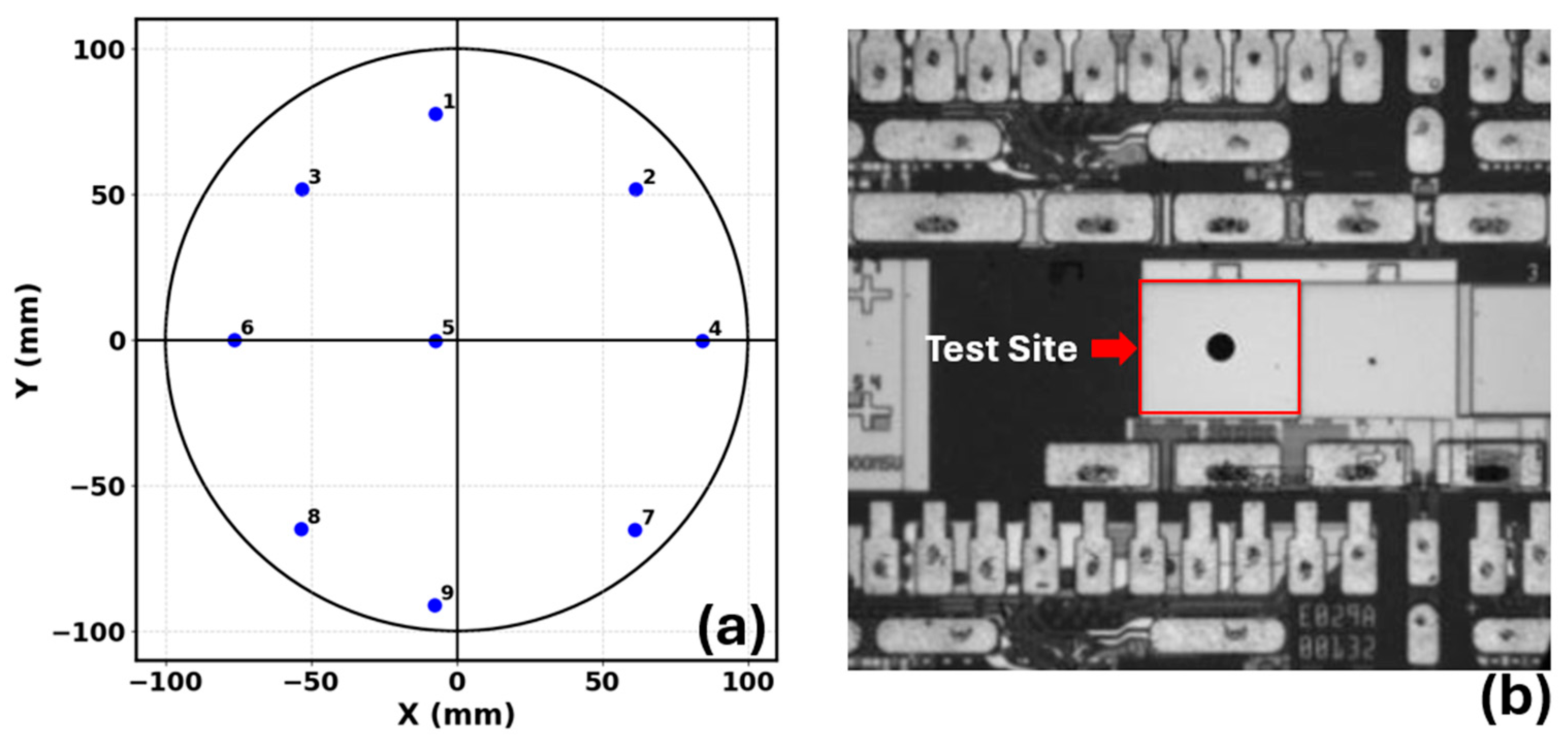
To evaluate the accuracy of the reflectometry algorithm, measurements were performed on a patterned 200 mm wafer using a set of available test devices, as shown in Figure 1a. A total of 9 sites were selected, distributed across the wafer to include the center, intermediate radius, and near-edge regions. The selection provides coverage along both horizontal and vertical axes, as well as diagonal directions, allowing sensitivity to radial and azimuthal variations in film thickness. Figure 1b shows the 4× objective magnification of the testing structure taken by the CCD camera module of the reflectometry. At each site, both tools performed 9 repeated measurements, resulting in a total of 81 data points per tool. This approach ensures statistical robustness while maintaining direct site-to-site comparability between the two metrology techniques.

2.4. GR&R

Repeatability (EV) represents the variation observed when repeated measurements are performed on the same part using a single tool under identical conditions. Its mathematical definition is provided in Equations (1) and (2)
E V = 6 VAR ( within )
V A R w i t h i n = 1 N i = 1 N PART j = 1 N OPERATOR σ i j 2
GR&R (Gage Repeatability and Reproducibility) refers to the actual variation in measurement caused by the measurement system. Since the present study involves only one measurement tool and a fixed operator, the appraiser variation (AV) is negligible, and thus the gauge R&R (GR&R) effectively reduces to EV. The factor of 6 reflects the conventional ±3σ (six-sigma) definition of equipment variation used in this GR&R scheme and is specific to the analysis framework adopted here.
Part Variation (PV) quantifies the variation in measurement results that arises from actual differences among the test samples or sites. In other words, it reflects the true physical variability of the film thickness across the wafer, independent of the measurement system.
P V = 1 N P A R T 1 i = 1 N P A R T ( X i ¯ X ¯ ) 2  
Total Variation (TV) represents the quadratic sum of part-to-part variation and measurement system variation.
T V =   E V 2 + P V 2  
GR&R% quantifies how much of the total variation in a measurement system comes from the gauge itself.
G R & R % = GR & R T V
Per the Automotive Industry Action Group (AIAG) Measurement Systems Analysis (MSA) guideline, a GR&R% below 10% denotes an acceptable measurement system, while values between 10% and 30% may be acceptable depending on the specific application [13,14].
A full EN-based uncertainty comparison as defined in ISO 17043 [15] would require a complete and independently evaluated uncertainty budget for each method and is beyond the scope of this work. Repeatability and GR&R are widely adopted in inline manufacturing metrology and formalized in standards such as AIAG MSA [14] and ISO 5725 [16]. These protocols provide a practical and relevant framework for assessing measurement equivalence in inline manufacturing metrology.
For clarity, the variables and constants used in the above equations are summarized in Table 1.

3. Algorithm Development and Validation

3.1. Theoretical Background

Spectroscopic reflectometry determines thin-film thickness by analyzing interference patterns in the reflected light spectrum generated by multiple reflections within the film stack [17]. In the conventional model-based approach, the measured reflectance spectrum is compared against a theoretical model derived from Fresnel equations, and film thickness is obtained through iterative optimization that minimizes the error between measured and simulated spectra [18]. Because thickness appears implicitly within nonlinear phase terms, this approach does not admit a closed-form solution and is therefore susceptible to local-minimum convergence, particularly for thick films where multiple solutions with comparable error values can coexist. In addition, variations in optical attenuation across tools can distort spectral amplitude, leading to tool-dependent convergence behavior and degraded fleet matching in high-volume manufacturing [19].
For sufficiently thick, low-absorption films, the reflectance spectrum is dominated by periodic interference oscillations whose extrema positions are primarily governed by the accumulated optical phase. Under this condition, the extrema occur at approximately regular intervals in wavenumber space, forming a linear relationship between extrema index and optical path length. The LRE method exploits this behavior by directly extracting spectral peak and valley positions and determining film thickness from the slope of their linear trend, without requiring iterative fitting or detailed prior knowledge of optical constants. By operating on phase information rather than absolute spectral amplitude, LRE reduces sensitivity to attenuation-induced amplitude variations and eliminates convergence ambiguity associated with model-based optimization.

3.2. Limitations of LRE Method and Iterative Fitting Method

In our previous work, the LRE method demonstrated reliable performance for films up to approximately 18 µm. However, this approach becomes less suitable for thicker films, primarily due to the spectrometer’s discrete sampling rate and optical attenuation at large optical paths. As the film thickness increases, the interference fringes become densely packed and attenuated, making it difficult to precisely identify the true peak and valley positions. The sampling-induced limitation for thick films under fixed spectral resolution is further illustrated in Supplementary Figure S1. This leads to phase ambiguity and cumulative phase-shift errors, which significantly degrade the accuracy and repeatability of thickness extraction.
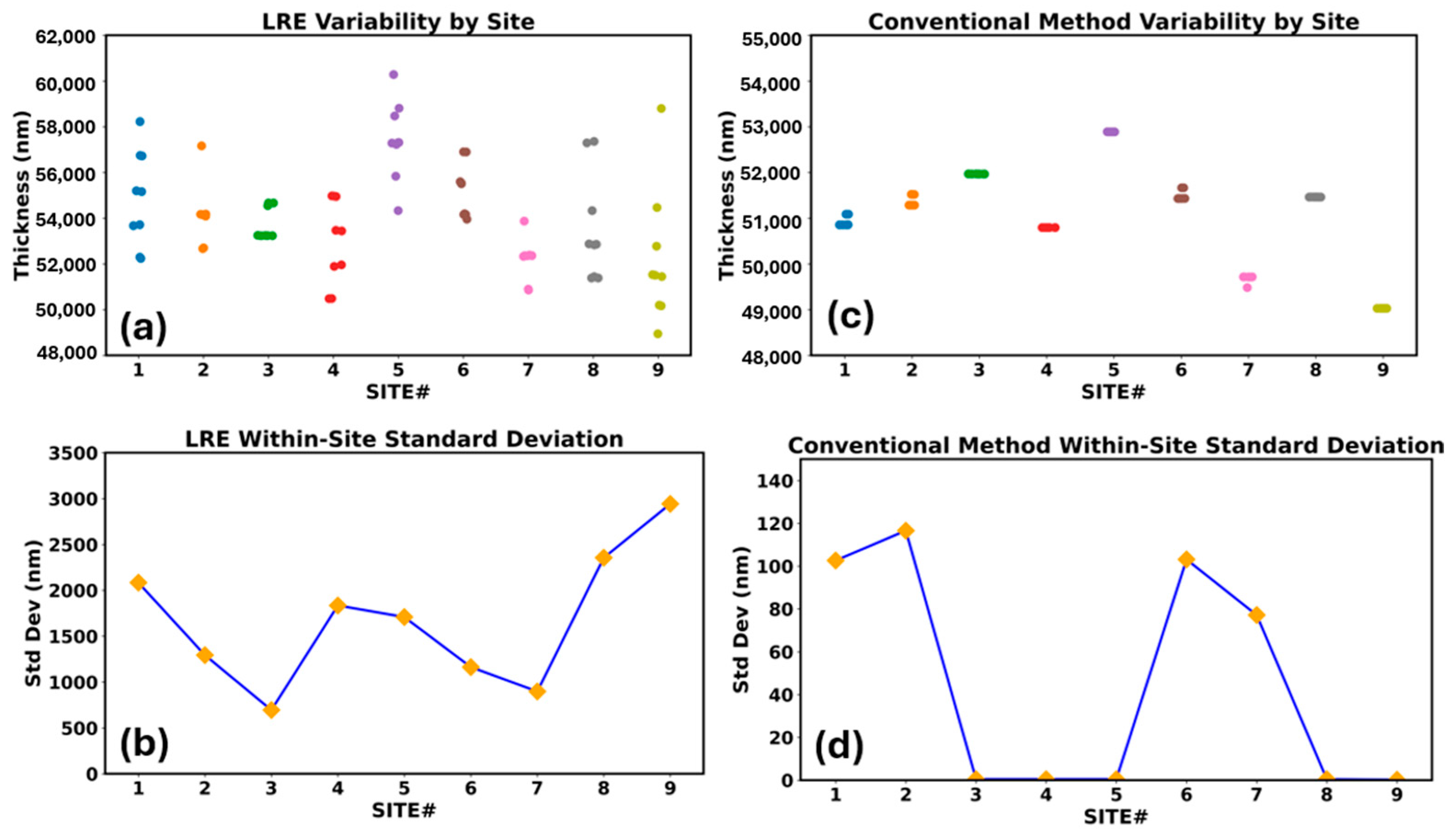
Figure 2a,b present a GR&R analysis of the LRE method applied to a ~54 µm film. Figure 2a shows the measured thickness variability across 9 wafer sites, while the lower panel (2b) displays the corresponding within-site standard deviation. Despite 9 repeated measurements per site, the LRE method exhibits substantial site-to-site fluctuations and large within-site variation, yielding a GR&R% of 75.9%, indicating that the method cannot effectively resolve part-to-part differences. These results confirm that the extrema-based algorithm becomes unreliable for thick-film applications, where dense oscillations and optical attenuation hinder precise extrema detection.
To provide a baseline comparison, we apply the standard model-based spectroscopic reflectometry method, where each measured spectrum is fitted against a theoretical target spectrum derived from a predefined optical model. The material stack is modeled with dispersion relations for the complex refractive index N(λ) + iK(λ): the bottom NiFe substrate is described using a Lorentz oscillator model, and the film layer is modeled using a Cauchy dispersion relation, appropriate for transparent materials in the visible range. The fitting procedure minimizes the squared error between the measured and modeled spectra by floating the film thickness. To mitigate the issue of multiple local minima [5], we use a refined search grid ranging from 40 µm to 60 µm with 600 grid points.
Figure 2c,d show the corresponding GR&R analysis for the conventional iterative method. Compared to the LRE results, the iterative approach demonstrates significantly improved repeatability and stability, with a GR&R of only 5.8%, indicating a highly capable measurement system. The within-site standard deviations are typically below 120 nm, and most sites exhibit consistent fitting convergence. However, despite the improved measurement precision, this approach is computationally expensive—each site requires approximately 60 ms of algorithm processing time, which is approximately 20–30× slower than the non-iterative methods such as LRE or LRZ. Consequently, while the optical model fitting yields acceptable measurement performance, its high computational overhead limits practical throughput in production environments.
Overall, these findings highlight the trade-offs between the LRE and conventional iterative methods for thick-film reflectometry. The LRE method suffers from sampling-induced phase errors and attenuation-driven instability, while the iterative fitting approach achieves better precision at the expense of speed, robustness, and model dependency. These limitations collectively motivate the development of the Linearized Reflectance Zero-Crossing (LRZ) technique introduced in this work, which combines the phase-tracking robustness of a model-free algorithm with the precision of a phase-linearized framework, enabling accurate and repeatable measurement across a wide thickness range.

3.3. LRZ Algorithm Formulation

The challenges discussed in the previous section clearly underscore the limitations of both the iterative model-based and LRE algorithms in handling thick-film measurements (≳35 µm). The iterative approach, while accurate, is computationally intensive and model-dependent, whereas the LRE method suffers from phase instability and poor repeatability under dense fringe conditions. To overcome these challenges, we developed a new algorithm derived from the LRE framework, designed to preserve its model-free nature while improving phase linearity and measurement robustness for thick films. This approach, termed the Linearized Reflectance Zero-Crossing (LRZ) method, is described in detail below.
The mathematical formulation presented here builds upon established thin-film reflectometry approaches in which film thickness is extracted directly from spectral interference behavior rather than through iterative model fitting. Prior studies have demonstrated that thickness can be determined from reflectance extrema spacing or phase evolution in wavenumber space, enabling fast and robust, effectively model-free analysis of spectroscopic reflectance data [20,21,22]. These methods rely on identifying interference features in the measured reflectance spectrum and relating them analytically to film thickness, avoiding nonlinear regression while retaining physical interpretability.
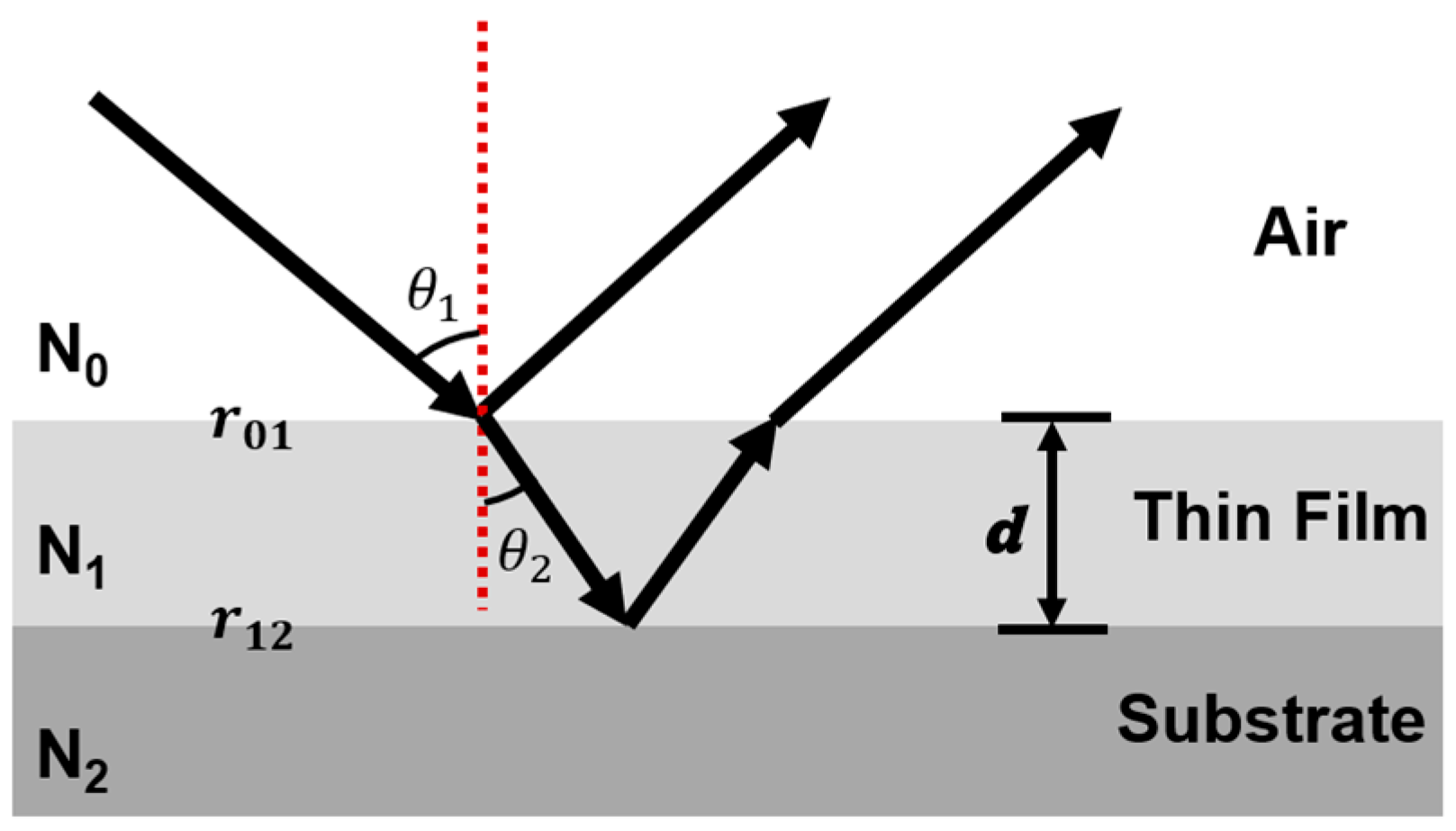
Figure 3 illustrates the optical geometry underlying spectroscopic reflectometry for a single transparent film on a substrate. Light incident from air ( N 0 ) reflects at both the air/film and film/substrate interfaces, characterized by the Fresnel reflection coefficients r 01 and r 12 , while the round-trip propagation through the film of thickness d introduces a phase delay governed by the film’s optical path length. This interference between partial reflections produces the oscillatory reflectance spectrum used for thickness extraction. Building on this physical picture, the following section formulates the LRZ method by tracking phase evolution in wavenumber space and extracting robust zero-crossing features for direct thickness estimation.
Reflectometry relies on analyzing the interaction of light with thin films, using the reflected light spectrum to infer material properties like thickness and refractive index. It is well known that the spectral reflectance can be calculated using the Airy equations Equation (6) [23]
R = r total 2 = r × r = r 01 + r 12 exp i 2 ϕ 1 + r 01 r 12 exp i 2 ϕ 2
where R is the reflectance (measured intensity), defined as the squared magnitude of the total reflection coefficient. r total is the total complex amplitude reflection coefficient of the multilayer stack.
Equation (7) represents the phase shift
ϕ k = k d N 1 k
where
k: wavenumber
k = 2 π λ
d: film thickness.
N 1 k : effective refractive index of the thin film
In many semiconductor and HDD applications, thin film materials such as aluminum oxides, silicon oxides and photoresist have very low extinction coefficients [24]. Therefore, it is safe to assume that the refractive index of the measured thin film N 1 , is a real number. Subsequently, R can be expressed in terms of Equation (8) after expanding both numerator and denominator:
R = r 01 2 + r 12 2 + 2 r 01 r 12 R cos 2 ϕ + r 12 I sin 2 ϕ 1 + r 01 2 r 12 2 + 2 r 01 r 12 R cos 2 ϕ + r 12 I sin 2 ϕ
where r 12 R   and r 12 I refer to the real and imaginary Fresnel reflectance coefficients, respectively. Or, in a simplified expression that will become handy for subsequent derivations in Equation (9):
R = A + B cos ψ C + B cos ψ
where
ψ = 2 k N 1 d + δ
The mean reflectance R ¯ over one full oscillation period can be expressed in closed form using the parameters A, B, C, which depend only weakly on the phase term ψ .
R ¯ = 1 2 π 0 2 π , R ψ   d ψ = A C + C 2 B 2 C 2 B 2
As a result, R ¯ is effectively a constant and does not vary significantly with ψ . This indicates that dispersion has little influence on the overall shape of the reflectance, especially for thicker films. Subtracting this constant from R ψ yields a mean-centered waveform, where the Zero-Crossings carry the information about film thickness.
The Zero-Crossing condition is defined by
R ψ 0 R ¯ = 0
Which can be rearranged as
R ¯ = A + B cos ψ 0 C + B cos ψ 0
Clearing the denominator leads to
A R ¯ C = R ¯ 1 B cos ψ 0
Defining
e =     A R ¯ C B R ¯ 1 ,   e   1
The condition simplifies to
cos ψ 0 = e
All solutions are given by
ψ 0 n = a r c cos e + π n ,   n Z
Substituting into the phase expression, leads to the Zero-Crossing wavenumber as
k n = a r c cos e δ 2 N 1 d + π 2 N 1 d n
This shows a linear dependence of k n on the index n. Differentiating
d k n d n = π 2 N 1 d
so that the optical path length follows as
N 1 d = π 2 d k n d n
Thus, the slope of a straight-line fit of k n versus n directly yields the optical thickness, from which the physical film thickness d can be determined. This assumption is well justified for aluminum oxide and many other semi-transparent dielectric films. Under this condition, N 1 may be treated as a known material constant. Consequently, the film thickness d can be determined directly from the slope d k n d n and the specified value of N 1 . In principle, extrapolation of the fitted line to k = 0 corresponds to the zero-order interference condition. However, in this work the thickness is extracted from the slope, which is less sensitive to phase offsets and experimental uncertainty, consistent with interference-order–based thickness analysis reported previously [25].
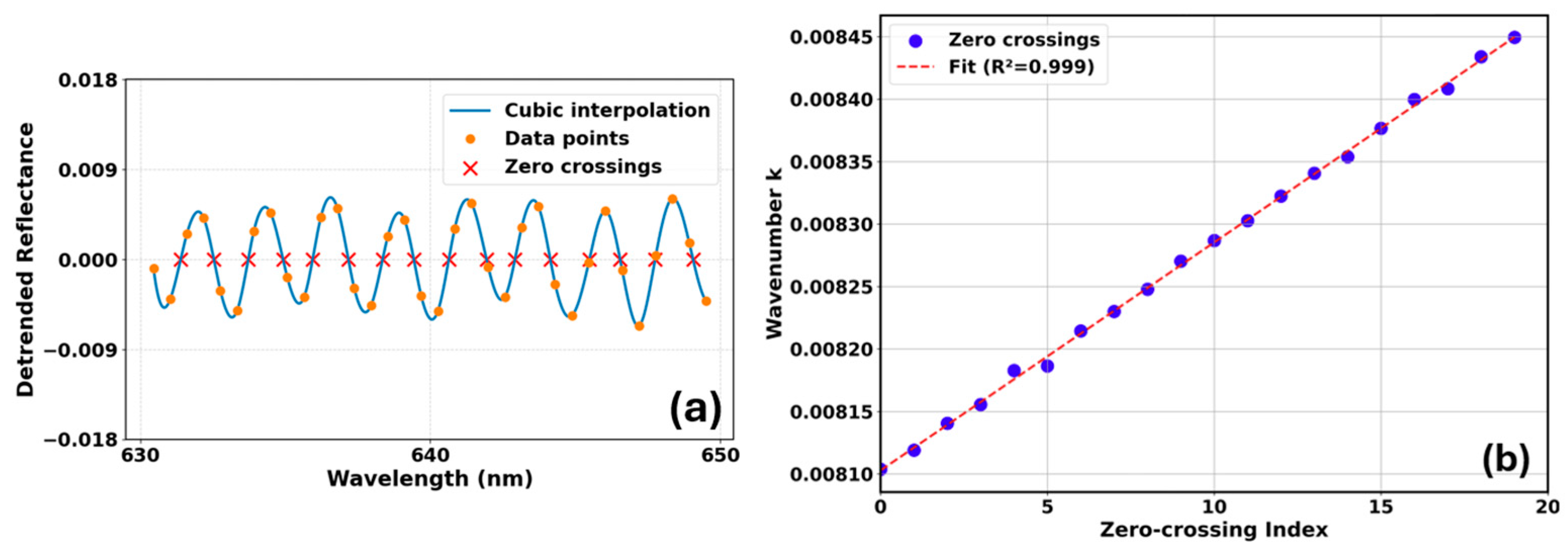
Figure 4a shows the detrended reflectance spectrum within the wavelength range of 630–650 nm. The oscillatory interference fringes are preserved, and the interpolation enables accurate determination of the Zero-Crossing locations (red crosses) between discrete sampling points (orange circles). These Zero-Crossing wavenumbers k n provide the ordered feature set used in Figure 4b, where the linear dependence of k n on fringe order n is established and the slope is used to extract optical thickness. Figure 4b shows the extracted wavenumber positions of the first 20 zero crossings as a function of Zero-Crossing index. The Zero-Crossing wavenumber k n exhibits strong linear dependence on the Zero-Crossing index n with a fitted slope of Δk ≈ 1.8 × 10⁻⁵ nm−1 per fringe order (R2 = 0.999). This slope directly corresponds to the optical path length and is used to extract the film thickness. The near-perfect linearity demonstrates that dispersion effects are negligible within this spectral window, validating the robustness of the Zero-Crossing method. More importantly, this result confirms that the proposed Zero-Crossing approach can be reliably applied to extend reflectometry to the tens-of-microns thickness regime, while providing consistency for cross-validation against WLI measurements.

4. Experimental Results and Discussion

This section presents experimental validation of the proposed LRZ method and discusses its performance relative to white light interferometry in a high-volume manufacturing context. In the experiment, a total of 81 test sites were measured using both reflectometry and white light interferometry (WLI). The measurements were collected at identical test locations, evenly distributed across the wafer, to evaluate the thickness sensitivity and measurement consistency across different wafer positions.
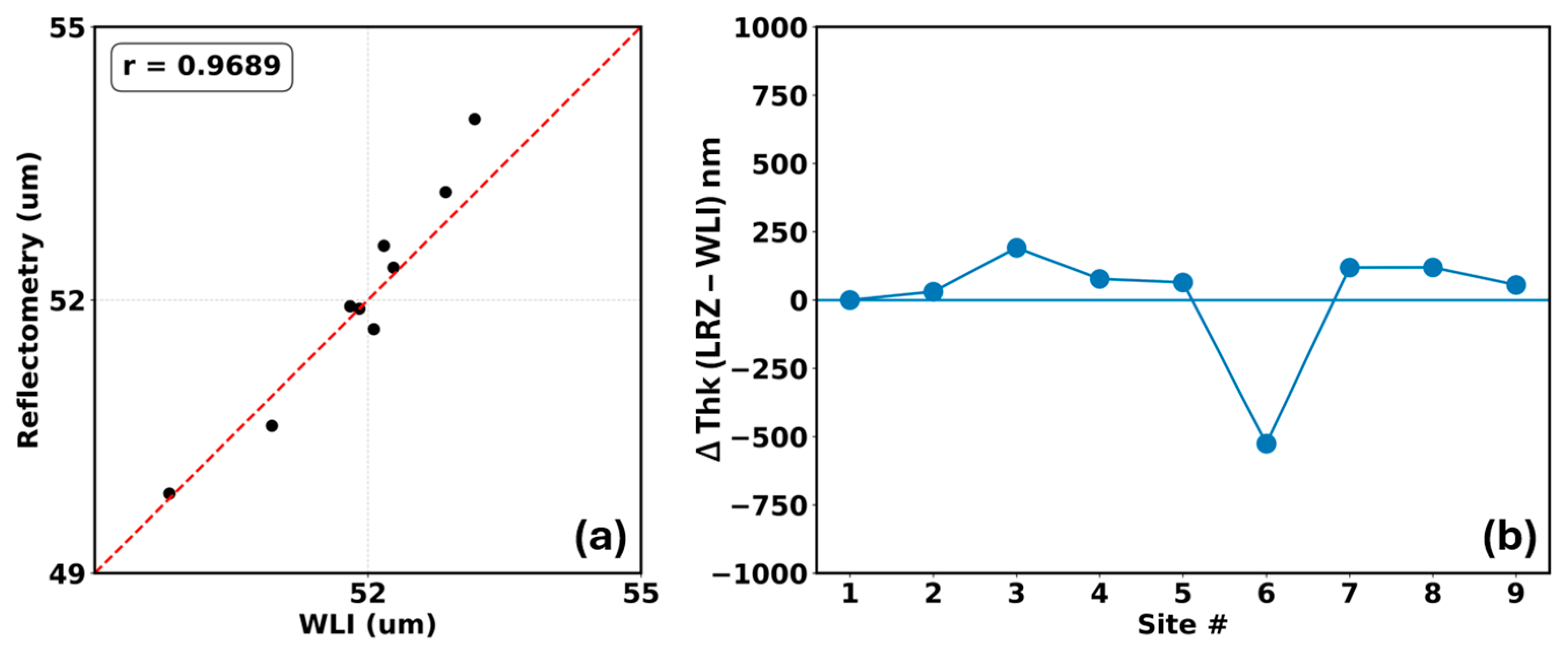
Figure 5a shows the correlation between film thickness measured by reflectometry and white light interferometry (WLI) at 81 test sites across the wafer. An orthogonal regression yields a correlation coefficient of r = 0.9689, indicating excellent agreement between the two metrology techniques. The close alignment of data points along the unity line (red dashed) demonstrates that the Zero-Crossing method in reflectometry provides consistent thickness values when benchmarked against WLI, which is the established standard for this thickness regime. Figure 5b shows the site-by-site thickness difference between LRZ and WLI measurements. Across most sites, the differences remain small and centered near zero, indicating good agreement between the two methods, with one localized deviation observed at Site 6. However, even at Site 6, which shows the largest deviation, the difference corresponds to only ~1.2% of the measured thickness.
This strong correlation validates the robustness of the proposed reflectometry approach for films in the tens-of-microns range. Small deviations from the unity line are expected and generally acceptable for film thickness measurements in the ~50 µm range, as the observed differences are within ~1%. This level of variation is well within the tolerance of both reflectometry and WLI, and is more than sufficient for real-world high-volume manufacturing metrology applications. Moreover, unlike our previous work where reliable reflectometry data up to 18 µm thickness could be demonstrated but without an independent metrology reference, the present study incorporates direct cross-validation with WLI. This confirms that reflectometry can serve as a reliable, non-contact alternative for thick-film measurements and provides a viable path for extending the application range of optical reflectometry in semiconductor metrology.
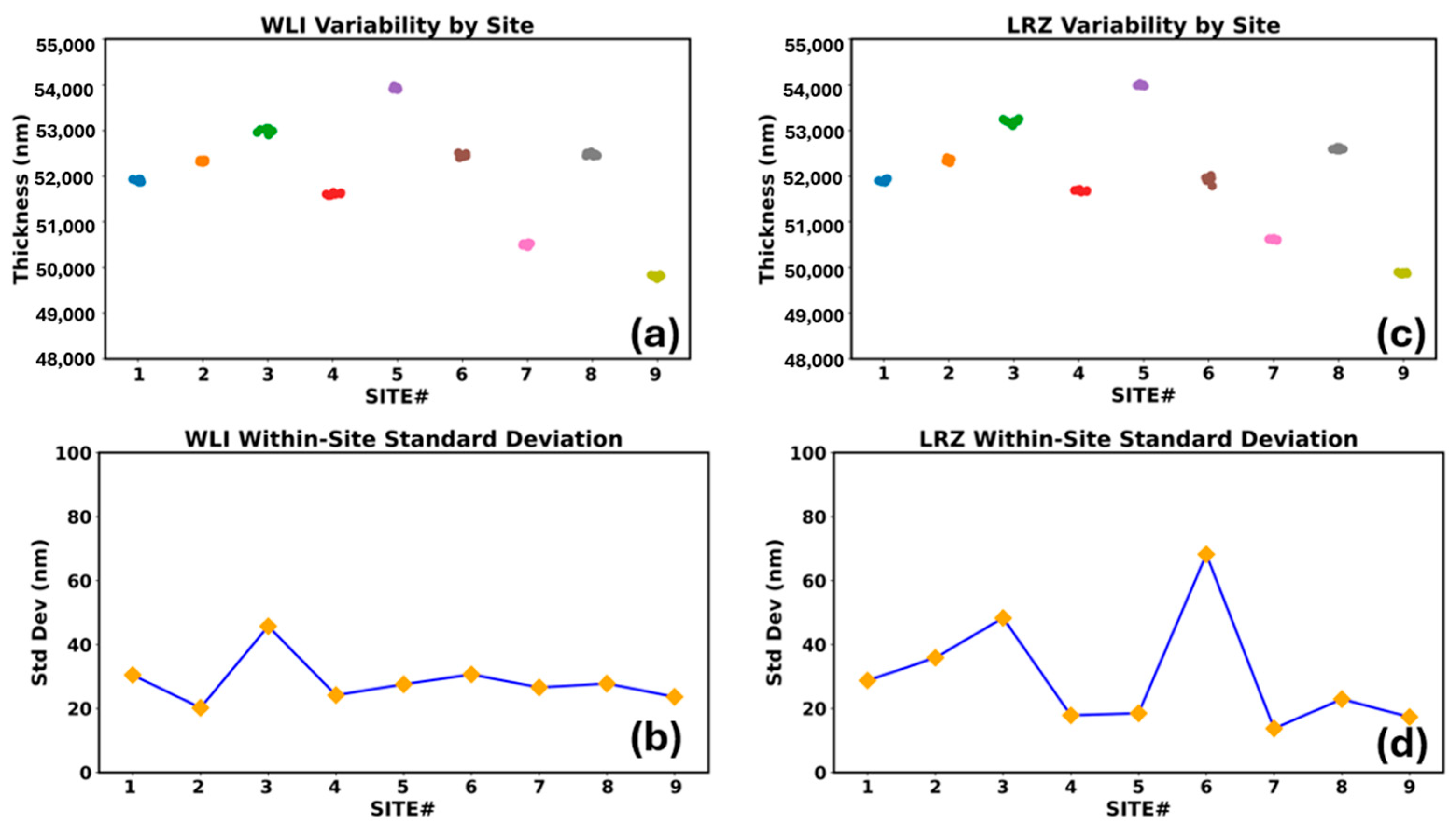
Figure 6 is the comparison of site-to-site variability between WLI and the proposed LRZ method. Figure 6a,c show the measured film thickness values at each wafer site, where both techniques exhibit consistent site-dependent variations. Figure 6b,d present the corresponding within-site standard deviations for WLI and LRZ, respectively.
Both methods demonstrate good repeatability, with typical within-site standard deviations below 50 nm (<0.1% of the ~50 µm film thickness). Although LRZ exhibits slightly larger scatter at certain sites (e.g., site 6), the overall variability remains within acceptable limits for thick-film metrology. The GR&R results demonstrate that LRZ achieves measurement equivalence to WLI for thick-film metrology, with only a 0.41% difference in total GR&R. This level of agreement confirms that LRZ provides WLI-equivalent accuracy and repeatability while offering substantially higher throughput and inline compatibility.
Table 2 shows the comparison of gauge repeatability and reproducibility (GR&R) metrics between the LRZ method and WLI. Both methods show nearly identical total variation (1244.7 nm vs. 1241.2 nm) and low GR&R percentages (2.78% for LRZ and 2.37% for WLI), confirming that LRZ achieves comparable measurement accuracy to the established WLI reference. The repeatability component (EV) is slightly higher for LRZ (34.6 nm vs. 29.4 nm), but the difference remains negligible relative to the ~50 µm film thickness. Overall, the total variation is ~1245 nm, of which less than 3% originates from GR&R. This indicates that the majority of the observed variation arises from true wafer nonuniformity (PV), while the measurement system error (EV/GR&R) remains negligible in comparison.
More importantly, LRZ demonstrates a significant throughput advantage, with an average per-site processing time of approximately 2 s, compared to ~15 s for WLI. This represents a ~7× speed improvement while maintaining equivalent accuracy. Considering that typical HVM metrology involves >50 sampling sites per wafer, the time savings quickly accumulate—reducing total measurement time per wafer from more than 12 min to under 2 min. This substantial efficiency gain highlights the potential of LRZ reflectometry as a practical and scalable alternative to WLI for high-volume manufacturing applications.
Another key advantage of the LRZ method over traditional model-based iterative approaches is its resilience to process excursions. In iterative reflectometry, the solution space is constrained by the predefined grid range. For example, if the search space is limited to 40–60 µm, any measurement outside this range—such as a process excursion resulting in a 30 µm or 70 µm film—will fail to converge, leading to invalid or missing data. In contrast, LRZ does not rely on bounded parameter grids. As long as the reflectance spectrum contains a sufficient number of zero crossings, the algorithm can extract the slope and determine the film thickness. This makes LRZ inherently more robust in detecting unexpected thickness variations, which is critical for monitoring excursions in high-volume manufacturing environments.

5. Conclusions

The Linearized Reflectance Zero-Crossing (LRZ) algorithm successfully extends the measurable thickness range of optical reflectometry to at least 50 µm without requiring any hardware modification. By linearizing the phase information and tracking Zero-Crossing positions in wavenumber space, LRZ provides accurate and repeatable film-thickness estimation while maintaining model-free operation. Experimental validation against white light interferometry (WLI) across 81 wafer sites demonstrates excellent correlation (r = 0.97) and low GR&R (<3%), confirming measurement equivalence. Moreover, LRZ achieves roughly a seven-fold throughput improvement (~2 s per site) compared to WLI, making it a highly efficient and scalable metrology solution for high-volume manufacturing. This purely software-based enhancement offers a practical path to integrate fast, accurate, and model-independent thick-film metrology into production environments.
Future work may focus on a detailed comparison between the proposed LRZ and the previously developed Linearized Reflectance Envelope (LRE) method to further clarify their respective performance domains and limitations. Additionally, systematic exploration of the upper measurable thickness limit of LRZ, potentially beyond 60 µm, will help establish its full operational range and identify conditions where fringe density or detector resolution may become limiting factors. Extending LRZ to multilayer or dispersive films could also broaden its applicability in advanced process control.

Supplementary Materials

The following supporting information can be downloaded at: https://www.mdpi.com/article/10.3390/metrology6010013/s1, Figure S1: Simulated reflectance spectra over the 700–780 nm wavelength range for increasing film thicknesses (5 µm, 25 µm, and 65 µm), sampled at a fixed wavelength interval (Δλ ≈ 0.58 nm) corresponding to the instrument resolution. As film thickness increases, the interference fringe density increases while the number of sampled points within the spectral window remains constant. For sufficiently thick films (e.g., 65 µm), the oscillation frequency approaches the effective sampling limit, resulting in fewer data points per oscillation cycle and increased phase ambiguity. This sampling-induced limitation degrades the reliability of extrema-based thickness extraction methods.

Author Contributions

Z.Z. and E.A.L.-G. surveyed the literature, organized sections, validated mathematical derivations, curated all the figures, and conducted GR&R testing. E.A.L.-G. performed reflectometry test. I.Z., B.Z., V.N., N.Q.H.T. and V.H., provided expert advice and deep insights. M.K., G.Q., P.W. and C.C. managed the scopes and provided the resources. All authors have read and agreed to the published version of the manuscript.

Funding

This research did not receive any funding from external sources outside of Western Digital Corporation.

Data Availability Statement

The reflectometry spectra and WLI data analyzed in this study are not publicly available due to commercial confidentiality. However, the data may be shared upon reasonable request for scientific research purposes, subject to approval by Western Digital Corporation.

Acknowledgments

The authors would like to thank Yingjian Chen, Ian McFadyen and David Chan for their guidance and expertise.

Conflicts of Interest

Authors Zimu Zhou, Enrique A. Lopez-Guerra, Iulica Zana, Vu Nguyen, Nguyen Quoc Huy Tran, Violet Huang, Bojun Zhou, Gary Qian, Michael Kwan, Peter Wilkens and Chester Chien were employed by the company Western Digital. The authors declare no conflicts of interest. The funders had no role in the design of the study; in the collection, analyses, or interpretation of data; in the writing of the manuscript; or in the decision to publish the results.

Abbreviations

The following abbreviations are used in this manuscript:
AIAGAutomotive Industry Action Group
AVAppraiser Variation
DFTDiscrete Fourier Transform
EVEquipment Variation
FIBFocused Ion Beam
GR&RGage Repeatability and Reproducibility
HVMHigh-Volume Manufacturing
LRELinearized Reflectance Extrema
LRZLinearized Reflectance Zero-Crossing
MAMMove-Acquire-Measure
MSMean Square
MSEMean Square Error
PVParts Variation
SEMScanning Electron Microscopy
SSSum of Squares
TVTotal Variation
VARVariance

References

  1. De Roo, J.; Zhou, Z.; Wang, J.; Deblock, L.; Crosby, A.J.; Owen, J.S.; Nonnenmann, S.S. Synthesis of Phosphonic Acid Ligands for Nanocrystal Surface Functionalization and Solution Processed Memristors. Chem. Mater. 2018, 30, 8034–8039. [Google Scholar] [CrossRef]
  2. Zhou, Z.; Nonnenmann, S.S. Progress in Nanoporous Templates: Beyond Anodic Aluminum Oxide and Towards Functional Complex Materials. Materials 2019, 12, 2535. [Google Scholar] [CrossRef] [PubMed]
  3. SIA. International Technology Roadmap for Semiconductors 2.0; The Semiconductor Industry Association (SIA): Washington, DC, USA, 2015. [Google Scholar]
  4. Stenzel, O.; Ohlídal, M. Optical Characterization of Thin Solid Films; Springer: Berlin/Heidelberg, Germany, 2018. [Google Scholar]
  5. Zhou, Z.; Lopez-Guerra, E.A.; Zhou, B.; Kwan, M.; Wilkens, P.; Chien, C. Model-Free Methodology for Thin Film Thickness Analysis by Spectroscopic Reflectometry. J. Micro/Nanopatterning Mater. Metrol. 2025, 24, 024001. [Google Scholar] [CrossRef]
  6. Quinten, M. On the Use of Fast Fourier Transform for Optical Layer Thickness Determination. SN Appl. Sci. 2019, 1, 823. [Google Scholar] [CrossRef]
  7. López-Guerra, E.A.; Uluutku, B.; Solares, S.D. Insights about Aliasing and Spectral Leakage When Analyzing Discrete-Time Finite Viscoelastic Functions. Rep. Mech. Eng. 2023, 4, 104–120. [Google Scholar] [CrossRef]
  8. Lyons, R.G. Understanding Digital Signal Processing, 3rd ed.; Pearson: London, UK, 2010; ISBN 0-13-702741-9. [Google Scholar]
  9. Oppenheim, A.V.; Schafer, R.W. Discrete-Time Signal Processing, 1st ed.; Horton, M., Ed.; Upper Saddle River: Hackensack, NJ, USA, 1989; ISBN 978-0132162920. [Google Scholar]
  10. Orji, N.G.; Badaroglu, M.; Barnes, B.M.; Beitia, C.; Bunday, B.D.; Celano, U.; Kline, R.J.; Neisser, M.; Obeng, Y.; Vladar, A.E. Metrology for the next Generation of Semiconductor Devices. Nat. Electron. 2018, 1, 532–547. [Google Scholar] [CrossRef] [PubMed]
  11. Ku, Y.-S.; Chou, P.-W.; Cheah, W.-Q.; Lo, C.-W. Machine Learning-Based 3D TSV Metrology for Advanced Packaging; SPIE: Bellingham, DC, USA, 2025; p. 137. [Google Scholar]
  12. Zhou, Z.; López-Domínguez, P.; Abdullah, M.; Barber, D.M.; Meng, X.; Park, J.; Van Driessche, I.; Schiffman, J.D.; Crosby, A.J.; Kittilstved, K.R.; et al. Memristive Behavior of Mixed Oxide Nanocrystal Assemblies. ACS Appl. Mater. Interfaces 2021, 13, 21635–21644. [Google Scholar] [CrossRef] [PubMed]
  13. Deshpande, A.A.; Ramya, A.; Vishweshwar, V.; Deshpande, G.R.; Roy, A.K. Applications of Gage Reproducibility & Repeatability (GRR): Understanding and Quantifying the Effect of Variations from Different Sources on a Robust Process Development. Org. Process Res. Dev. 2014, 18, 1614–1621. [Google Scholar] [CrossRef]
  14. Automotive Industry Action Group. Measurement Systems Analysis (MSA) Reference Manual, 4th ed.; AIAG: Southfield, MI, USA, 2010. [Google Scholar]
  15. ISO/IEC 17043:2010; Conformity assessment — General requirements for proficiency testing. International Organization for Standardization: Geneva, Switzerland, 2010.
  16. ISO 5725-2:1994; Accuracy (trueness and precision) of measurement methods and results—Part 2: Basic method for the determination of repeatability and reproducibility of a standard measurement method. ISO: Geneva, Switzerland, 1994.
  17. Taranov, M.A.; Gorshkov, B.G.; Alekseev, A.E.; Konstantinov, Y.A.; Turov, A.T.; Barkov, F.L.; Wang, Z.; Zhao, Z.; Zan, M.S.D.; Kolesnichenko, E.V. Optical Reflectometry, Metrology, and Sensing. Present and Future (Review). Instrum. Exp. Tech. 2023, 66, 713–729. [Google Scholar] [CrossRef]
  18. Skaar, J. Fresnel Equations and the Refractive Index of Active Media. Phys. Rev. E Stat. Nonlin. Soft Matter Phys. 2006, 73, 026605. [Google Scholar] [CrossRef] [PubMed]
  19. King, R.J.; Talim, S.P. A Comparison of Thin Film Measurement by Guided Waves, Ellipsometry and Reflectometry. Opt. Acta 1981, 28, 1107–1123. [Google Scholar] [CrossRef]
  20. Kim, K.; Kwon, S.; Pahk, H.J. Fast Analysis of Film Thickness in Spectroscopic Reflectometry Using Direct Phase Extraction. Curr. Opt. Photonics 2017, 1, 29–33. [Google Scholar] [CrossRef]
  21. Sánchez-Arriaga, N.E.; Tiwari, D.; Hutabarat, W.; Leyland, A.; Tiwari, A. A Spectroscopic Reflectance-Based Low-Cost Thickness Measurement System for Thin Films: Development and Testing. Sensors 2023, 23, 5326. [Google Scholar] [CrossRef] [PubMed]
  22. Stavenga, D.G. Thin Film and Multilayer Optics Cause Structural Colors of Many Insects and Birds. In Proceedings of the Materials Today: Proceedings; Elsevier: Amsterdam, The Netherlands, 2014; Volume 1, pp. 109–121. [Google Scholar]
  23. Ohlídal, I. General Formulae for the Optical Characterization of Single Layers with Spectroscopic Reflectometry. J. Mod. Opt. 1988, 35, 1373–1381. [Google Scholar] [CrossRef]
  24. Kaiser, C.; Zeiske, S.; Meredith, P.; Armin, A. Determining Ultralow Absorption Coefficients of Organic Semiconductors from the Sub-Bandgap Photovoltaic External Quantum Efficiency. Adv. Opt. Mater. 2020, 8, 1901542. [Google Scholar] [CrossRef]
  25. Haitjema, H.; Elich, J. The Physical Properties of Fluorine-Doped Tin Dioxide Films and the Influence of Ageing and Impurity Effects. Sol. Energy Mater. 1987, 16, 79–90. [Google Scholar] [CrossRef]
Figure 1. (a) Sampling map on the 200 mm wafer. (b). Optical image of the testing structure.
Metrology 06 00013 g001
Figure 2. (a,b). LRE variability and within-site standard deviation plots. (c,d). Model-based variability and within-site standard deviation plots. In (a,c), each color corresponds to a specific measurement site, and identical colors indicate the same site across repeated measurements.
Metrology 06 00013 g002
Figure 3. Schematic of the optical arrangement for spectroscopic reflectometry. Light is incident from air (refractive index ( N 0 ) onto a thin film ( N 1 ) of thickness d on a substrate ( N 2 ). Reflections at the air/film and film/substrate interfaces are governed by the Fresnel reflection coefficients r 01 and r 12 , respectively. The incident and refracted angles are denoted by θ1 and θ2.
Metrology 06 00013 g003
Figure 4. (a) Detrended reflectance spectrum within the wavelength range of 630–650 nm, showing preserved interference fringes. Discrete measured data points are indicated by orange circles, while cubic interpolation is used to accurately locate Zero-Crossing positions between sampling points (red crosses). This step demonstrates robust feature localization from discretely sampled spectra. (b) Linear regression of Zero-Crossing wavenumber k n as a function of Zero-Crossing order n. The strong linearity (R2 = 0.999) establishes the proportional relationship between fringe order and wavenumber, from which the optical path length is directly extracted using the slope.
Metrology 06 00013 g004
Figure 5. (a) Correlation between WLI and reflectometry measurement using LRZ algorithm. (b) Mean thickness difference plot between LRZ and WLI.
Metrology 06 00013 g005
Figure 6. (a,b) WLI variability and within-site standard deviation plots. (c,d) LRZ variability and within-site standard deviation plots between WLI and reflectometry measurement using LRZ algorithm. In (a,c), each color corresponds to a specific measurement site, and identical colors indicate the same site across repeated measurements.
Metrology 06 00013 g006
Table 1. GR&R Terms and Definitions.
SymbolDefinition
V A R ( w i t h i n ) Within-site variance of repeated thickness measurements
σ Standard deviation of the corresponding measurement distribution
N Total number of measurements
N PART Number of parts or measurement site
N OPERATOR Number of operators or measurement conditions
X i ¯ Mean thickness of site i, over repeated measurements
X ¯ Grand mean value of the measured thickness
EVEquipment variation, representing measurement repeatability
AVAppraiser variation, variability between operators or measurement conditions
PVPart variation, representing variability between measurement sites
TVTotal variation, combining EV, AV, and PV contributions
Table 2. GR&R Results and Throughput Comparison.
Test ItemLRZWLI
Repeatability (EV)34.6 nm29.4 nm
Total Variation (TV)1244.7 nm1241.2 nm
GR&R %2.78%2.37%
Avg MAM (Move-Acquire-Measure) Time~2 s~15 s
Disclaimer/Publisher’s Note: The statements, opinions and data contained in all publications are solely those of the individual author(s) and contributor(s) and not of MDPI and/or the editor(s). MDPI and/or the editor(s) disclaim responsibility for any injury to people or property resulting from any ideas, methods, instructions or products referred to in the content.