
Spatial Memory and COVID-19: Cognitive Patterns, Assessment Approaches, and Neural Substrates

Abstract
1. Introduction
2. Spatial Memory Alterations After COVID-19
2.1. Spatial Memory in Acute and Post-Acute Phases
2.2. Spatial Memory in PCC
2.3. Factors Moderating Spatial Memory
3. Neuropsychological Assessment of Spatial Memory in COVID-19
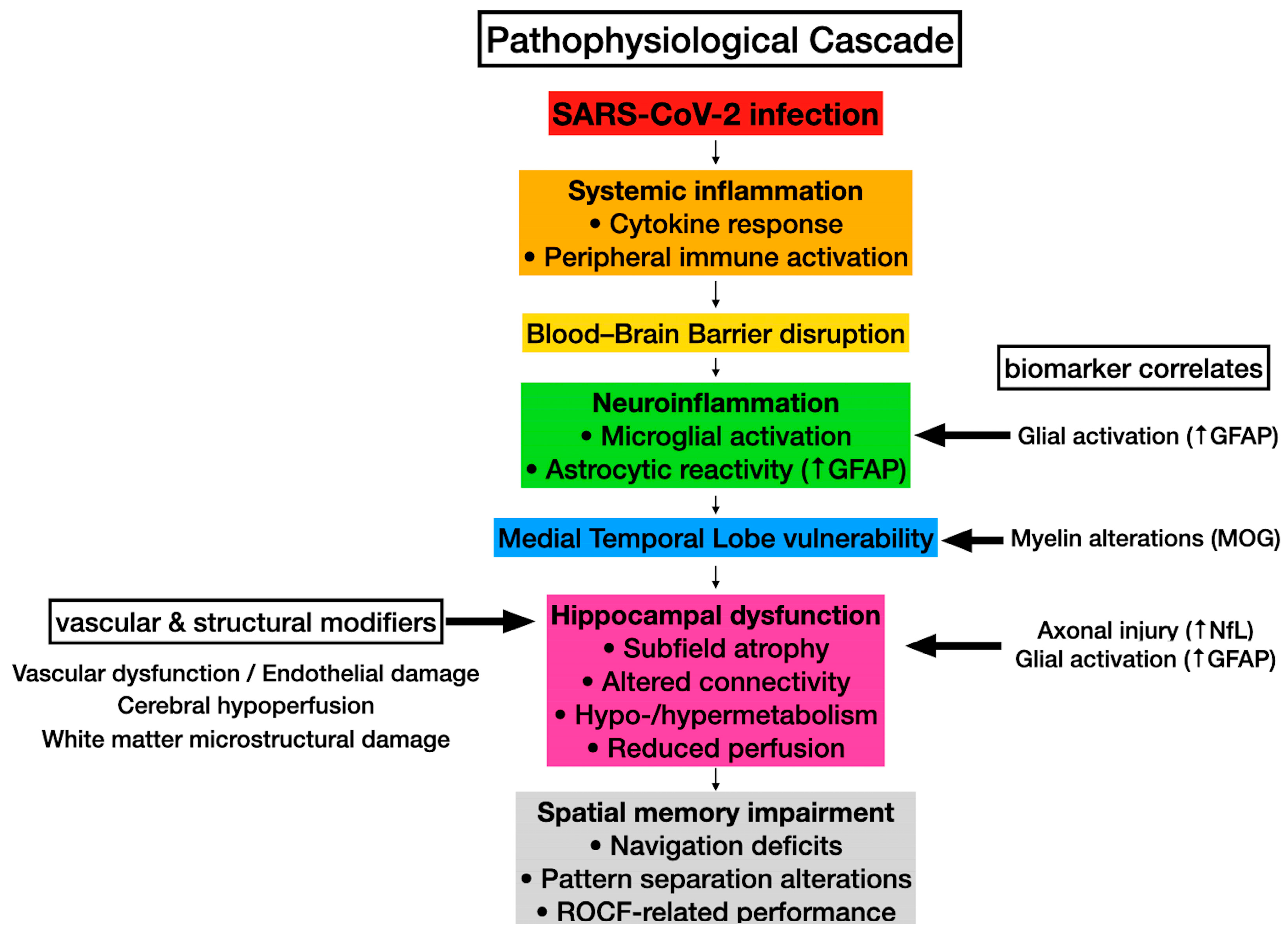
4. Neural Substrates of Spatial Memory Alterations After COVID-19
4.1. Biomarker Studies
4.2. Neuroimaging Studies
5. Methodological Limitations and Gaps in the Current Literature
6. Conclusions
Author Contributions
Funding
Institutional Review Board Statement
Informed Consent Statement
Data Availability Statement
Conflicts of Interest
Abbreviations
| COVID-19 | Coronavirus disease |
| SARS-CoV-2 | Severe acute respiratory syndrome coronavirus 2 |
| PCC | Post COVID-19 condition |
| NICE | National Institute for Health and Care Excellence |
| MTL | Medial temporal lobe |
| MoCA | Montreal Cognitive Assessment |
| MMSE | Mini Mental State Examination |
| PCR | Polymerase chain reaction |
| VR | Virtual reality |
| ROCF | Rey–Osterrieth Complex Figure Test |
| FMT | Figural Memory Test |
| CBTT | Corsi Block Tapping Test |
| SWM | Spatial Working Memory |
| CANTAB | Cambridge Neuropsychological Test Automated Battery |
| SPART | 10/36 Spatial Recall Test |
| NfL | Neurofilament light chain |
| GFAP | Glial fibrillary acidic protein |
| MOG | Myelin oligodendrocyte glycoprotein |
| CCL11 | Eotaxin-1 |
| MRI | Magnetic Resonance Imaging |
| NODDI | Neurite orientation dispersion and density |
| DMN | Default Mode Network |
| DTI | Diffusion Tensor Imaging |
References
- National Institute for Health and Care Excellence (NICE); Royal College of General Practitioners; Healthcare Improvement Scotland SIGN. COVID-19 Rapid Guideline: Managing the Long-Term Effects of COVID-19; National Institute for Health and Care Excellence: London, UK, 2020; Available online: www.nice.org.uk/guidance/ng188 (accessed on 27 January 2026).
- Long, B.; Carius, B.M.; Chavez, S.; Liang, S.Y.; Brady, W.J.; Koyfman, A.; Gottlieb, M. Clinical update on COVID-19 for the emergency clinician: Presentation and evaluation. Am. J. Emerg. Med. 2022, 54, 46–57. [Google Scholar] [CrossRef] [Scilit] [PubMed]
- Agarwal, A.; Hunt, B.; Stegemann, M.; Rochwerg, B.; Lamontagne, F.; Siemieniuk, R.A.; Agoritsas, T.; Askie, L.; Lytvyn, L.; Leo, Y.S.; et al. A living WHO guideline on drugs for covid-19. BMJ 2020, 370, m3379. [Google Scholar] [CrossRef] [Scilit]
- Norouzi, M.; Miar, P.; Norouzi, S.; Nikpour, P. Nervous System Involvement in COVID-19: A Review of the Current Knowledge. Mol. Neurobiol. 2021, 58, 3561–3574. [Google Scholar] [CrossRef] [Scilit]
- Aderinto, N.; Olatunji, G.; Kokori, E.; Ogieuhi, I.J.; Yusuf, I.A.; Egbunu, E.; Ukoaka, B.M.; Babalola, A.E.; Adefusi, T.O.; Aboje, J.E.; et al. COVID-19 and cognitive impairment: A review of the emerging evidence. Discov. Ment. Health 2025, 5, 56. [Google Scholar] [CrossRef] [Scilit]
- Kirchberger, I.; Peilstöcker, D.; Warm, T.D.; Linseisen, J.; Hyhlik-Dürr, A.; Meisinger, C.; Goßlau, Y. Subjective and Objective Cognitive Impairments in Non-Hospitalized Persons 9 Months after SARS-CoV-2 Infection. Viruses 2023, 15, 256. [Google Scholar] [CrossRef] [Scilit]
- Tsiaras, Y.; Kitsakis, N.; Papadopoulou, E.; Karanikas, E.; Kourbetis, D.; Aretouli, E. Neuropsychological Profile of Hospitalized Patients Due to COVID-19: Clinical and Inflammatory Correlates. Arch. Clin. Neuropsychol. 2023, 38, 1564–1577. [Google Scholar] [CrossRef] [Scilit]
- Charles James, J.; Schulze, H.; Siems, N.; Prehn, C.; Quast, D.R.; Trampe, N.; Gold, R.; Faissner, S. Neurological post-COVID syndrome is associated with substantial impairment of verbal short-term and working memory. Sci. Rep. 2025, 15, 1695. [Google Scholar] [CrossRef] [Scilit]
- Alt, L.L.; Bortolini, A.D.; Andreis, B.S.; Schmidt, C.A.; Rugeri, G.; Pagliarin, M.C.T.; Kindel, M.E.D.; Costa, M.F.A.; Costa, N.L.; Dariz, P.H.S.; et al. Memory Impairment in Post-COVID-19 Syndrome; What Is the Evidence? J. Mind Med. Sci. 2024, 11, 285–290. [Google Scholar] [CrossRef] [Scilit]
- Llana, T.; Zorzo, C.; Mendez-Lopez, M.; Mendez, M. Memory alterations after COVID-19 infection: A systematic review. Appl. Neuropsychol. Adult 2024, 31, 292–305. [Google Scholar] [CrossRef] [Scilit]
- Madl, T.; Chen, K.; Montaldi, D.; Trappl, R. Computational cognitive models of spatial memory in navigation space: A review. Neural Netw. 2015, 65, 18–43. [Google Scholar] [CrossRef] [Scilit] [PubMed]
- García-Navarra, S.; Llana, T.; Méndez, M. Spatial memory deficits in Parkinson’s disease: Neural mechanisms and assessment. Am. J. Neurodegener. Dis. 2025, 14, 67–81. [Google Scholar] [CrossRef] [Scilit]
- Park, J.H. Can the Virtual Reality-Based Spatial Memory Test Better Discriminate Mild Cognitive Impairment than Neuropsychological Assessment? Int. J. Environ. Res. Public Health 2022, 19, 9950. [Google Scholar] [CrossRef] [Scilit]
- Montana, J.I.; Tuena, C.; Serino, S.; Cipresso, P.; Riva, G. Neurorehabilitation of Spatial Memory Using Virtual Environments: A Systematic Review. J. Clin. Med. 2019, 8, 1516. [Google Scholar] [CrossRef] [Scilit]
- Ekstrom, A.D.; Huffman, D.J.; Starrett, M. Interacting networks of brain regions underlie human spatial navigation: A review and novel synthesis of the literature. J. Neurophysiol. 2017, 118, 3328–3344. [Google Scholar] [CrossRef] [Scilit]
- Fan, C.L.; Sokolowski, H.M.; Rosenbaum, R.S.; Levine, B. What about “space” is important for episodic memory? Wiley Interdiscip. Rev. Cogn. Sci. 2023, 14, e1645. [Google Scholar] [CrossRef] [Scilit] [PubMed]
- Martín-Pozuelo, N.; Carballo-Costa, L.; Solís-García, M.; Giancola, M.; Piccardi, L.; De Las Cuevas-Terán, I.; Robles-García, V. Measuring spatial navigation during locomotion in children: A systematic review. Heliyon 2024, 10, e33817. [Google Scholar] [CrossRef] [Scilit] [PubMed]
- Llana, T.; Mendez, M.; Juan, M.C.; Mendez-Lopez, M. Navigational object-location memory assessment in real and virtual environments: A systematic review. Behav. Brain Res. 2025, 480, 115388. [Google Scholar] [CrossRef] [Scilit] [PubMed]
- Chandra, S.; Sharma, S.; Chaudhuri, R.; Fiete, I. Episodic and associative memory from spatial scaffolds in the hippocampus. Nature 2025, 638, 739–751. [Google Scholar] [CrossRef] [Scilit]
- Douaud, G.; Lee, S.; Alfaro-Almagro, F.; Arthofer, C.; Wang, C.; McCarthy, P.; Lange, F.; Andersson, J.L.R.; Griffanti, L.; Duff, E.; et al. SARS-CoV-2 is associated with changes in brain structure in UK Biobank. Nature 2022, 604, 697–707. [Google Scholar] [CrossRef] [Scilit]
- Zorzo, C.; Solares, L.; Mendez, M.; Mendez-Lopez, M. Hippocampal alterations after SARS-CoV-2 infection: A systematic review. Behav. Brain Res. 2023, 455, 114662. [Google Scholar] [CrossRef] [Scilit]
- Jacot de Alcântara, I.; Nuber-Champier, A.; Voruz, P.; Cionca, A.; Assal, F.; Péron, J.A. Cognitive Deficits in the Acute Phase of COVID-19: A Review and Meta-Analysis. J. Clin. Med. 2023, 12, 762. [Google Scholar] [CrossRef] [Scilit]
- Cipolli, G.C.; Alonso, V.; Yasuda, C.L.; Assumpção, D.; Cachioni, M.; Melo, R.C.; Hinsliff-Smith, K.; Yassuda, M.S. Cognitive impairment in post-acute COVID-19 syndrome: A scoping review. Comprometimento cognitivo na síndrome pós-COVID-19 aguda: Uma revisão de escopo. Arq. Neuro-Psiquiatr. 2023, 81, 1053–1069. [Google Scholar] [CrossRef] [Scilit]
- Bonizzato, S.; Ghiggia, A.; Ferraro, F.; Galante, E. Cognitive, behavioral, and psychological manifestations of COVID-19 in post-acute rehabilitation setting: Preliminary data of an observational study. Neurol. Sci. 2022, 43, 51–58. [Google Scholar] [CrossRef] [Scilit]
- Peskar, M.; Šimunič, B.; Šlosar, L.; Pišot, S.; Teraž, K.; Gasparini, M.; Pišot, R.; Marusic, U. Effects of COVID-19 on cognition and mood after hospitalization and at 2-month follow-up. Front. Psychol. 2023, 14, 1141809. [Google Scholar] [CrossRef] [Scilit] [PubMed]
- Ferrucci, R.; Dini, M.; Groppo, E.; Rosci, C.; Reitano, M.R.; Bai, F.; Poletti, B.; Brugnera, A.; Silani, V.; D’Arminio Monforte, A.; et al. Long-Lasting Cognitive Abnormalities after COVID-19. Brain Sci. 2021, 11, 235. [Google Scholar] [CrossRef] [Scilit] [PubMed]
- Ferrucci, R.; Dini, M.; Rosci, C.; Capozza, A.; Groppo, E.; Reitano, M.R.; Allocco, E.; Poletti, B.; Brugnera, A.; Bai, F.; et al. One-year cognitive follow-up of COVID-19 hospitalized patients. Eur. J. Neurol. 2022, 29, 2006–2014. [Google Scholar] [CrossRef] [Scilit] [PubMed]
- Serrano Del Pueblo, V.M.; Serrano-Heras, G.; Romero Sánchez, C.M.; Landete, P.P.; Rojas-Bartolome, L.; Feria, I.; Morris, R.G.M.; Strange, B.; Mansilla, F.; Zhang, L.; et al. Brain and cognitive changes in patients with long COVID compared with infection-recovered control subjects. Brain 2024, 147, 3611–3623. [Google Scholar] [CrossRef] [Scilit]
- Mattioli, F.; Stampatori, C.; Righetti, F.; Sala, E.; Tomasi, C.; De Palma, G. Neurological and Cognitive Sequelae of COVID-19: A Four Month Follow-Up. J. Neurol. 2021, 268, 4422–4428. [Google Scholar] [CrossRef] [Scilit]
- Serrano-Castro, P.J.; Garzón-Maldonado, F.J.; Casado-Naranjo, I.; Ollero-Ortiz, A.; Mínguez-Castellanos, A.; Iglesias-Espinosa, M.; Baena-Palomino, P.; Sánchez-Sanchez, V.; Sánchez-Pérez, R.M.; Rubi-Callejon, J.; et al. The cognitive and psychiatric subacute impairment in severe Covid-19. Sci. Rep. 2022, 12, 3563. [Google Scholar] [CrossRef] [Scilit]
- Herrera, E.; Pérez-Sánchez, M.D.C.; San Miguel-Abella, R.; Barrenechea, A.; Blanco, C.; Solares, L.; González, L.; Iza, C.; Castro, I.; Nicolás, E.; et al. Cognitive impairment in young adults with post COVID-19 syndrome. Sci. Rep. 2023, 13, 6378. [Google Scholar] [CrossRef] [Scilit]
- Whiteside, D.M.; Basso, M.R.; Naini, S.M.; Porter, J.; Holker, E.; Waldron, E.J.; Melnik, T.E.; Niskanen, N.; Taylor, S.E. Outcomes in post-acute sequelae of COVID-19 (PASC) at 6 months post-infection Part 1: Cognitive functioning. Clin. Neuropsychol. 2022, 36, 806–828. [Google Scholar] [CrossRef] [Scilit] [PubMed]
- Guillén, N.; Pérez-Millan, A.; Falgàs, N.; Lledo-Ibanez, G.N.; Rami, L.; Sarto, J.; Boti, M.A.; Aralos-Perez, C.; Ruiz-Garcia, R.; Narano, L.; et al. Cognitive profile, neuroimaging and fluid biomarkers in post-acute COVID-19 syndrome. Sci. Rep. 2024, 14, 12927. [Google Scholar] [CrossRef] [Scilit] [PubMed]
- Schlenker, L.S.; Hartung, T.J.; Klabunn, P.; Schwichtenberg, K.; Heine, J.; Adam, L.; Franke, C.; Finke, C. Altered putamen connectivity in patients with neurological post-COVID condition. Brain Commun. 2025, 7, fcaf291. [Google Scholar] [CrossRef] [Scilit] [PubMed]
- Llana, T.; Garces-Arilla, S.; Juan, M.C.; Mendez-Lopez, M.; Mendez, M. An immersive virtual reality-based object-location memory task reveals spatial long-term memory alterations in Long-COVID. Behav. Brain Res. 2024, 471, 115127. [Google Scholar] [CrossRef] [Scilit]
- Meyer, P.; Zaiser, A.K. Insights on the neurocognitive mechanisms underlying hippocampus-dependent memory impairment in COVID-19. Sci. Rep. 2025, 15, 20114. [Google Scholar] [CrossRef] [Scilit]
- Wood, G.K.; Sargent, B.F.; Ahmad, Z.U.; Tharmaratnam, K.; Dunai, C.; Egbe, F.N.; Martin, N.H.; Facer, B.; Pendered, S.L.; Rogers, H.C.; et al. Posthospitalization COVID-19 cognitive deficits at 1 year are global and associated with elevated brain injury markers and gray matter volume reduction. Nat. Med. 2025, 31, 245–257. [Google Scholar] [CrossRef] [Scilit]
- Invernizzi, A.; Renzetti, S.; van Thriel, C.; Rechtman, E.; Patrono, A.; Ambrosi, C.; Mascaro, L.; Corbo, D.; Cagna, G.; Gasparotti, R.; et al. COVID-19 related cognitive, structural and functional brain changes among Italian adolescents and young adults: A multimodal longitudinal case-control study. Transl. Psychiatry 2024, 14, 402. [Google Scholar] [CrossRef] [Scilit]
- Llana, T.; Garces-Arilla, S.; Garcia-Navarra, S.; Mendez-Lopez, M.; Juan, M.C.; Mendez, M. Cybersickness and sense of presence as predictors of VR task performance in individuals with and without Post-COVID-19 condition. Virtual Real. 2025, 29, 167. [Google Scholar] [CrossRef] [Scilit]
- Vergori, A.; Del Duca, G.; Borrelli, P.; Brita, A.C.; Pinnetti, C.; Mastrorosa, I.; Camici, M.; Mondi, A.; Mazzotta, V.; Chinello, P.; et al. Cognitive outcomes and psychological symptoms in an Italian cohort with post-acute COVID-19 condition (PACC). Heliyon 2024, 10, e39431. [Google Scholar] [CrossRef] [Scilit]
- Lagravinese, G.; Castellana, G.; Castellana, F.; Genco, M.; Petrelli, R.; Ruccia, M.; Aliani, M.; Carone, M.; Sardone, R.; Battista, P. Cognitive Deficits among Individuals Admitted to a Post-Acute Pneumological Rehabilitation Unit in Southern Italy after COVID-19 Infection. Brain Sci. 2023, 13, 84. [Google Scholar] [CrossRef] [Scilit]
- Basagni, B.; Abbruzzese, L.; Damora, A.; Conforti, J.; Saviola, D.; De Tanti, A.; Podgorska, A.; Biagioni, C.; Bacci, M.; Gambarelli, C.; et al. Cognition in COVID-19 infected patients undergoing invasive ventilation: Results from a multicenter retrospective study. Appl. Neuropsychol. Adult 2025, 32, 492–501. [Google Scholar] [CrossRef] [Scilit]
- de Pádua Serafim, A.; Saffi, F.; Soares, A.R.A.; Morita, A.M.; Medeiros Assed, M.; de Toledo, S.; Rocca, C.C.A.; Duraes, R.S.S. Cognitive performance of post-covid patients in mild, moderate, and severe clinical situations. BMC Psychol. 2024, 12, 236. [Google Scholar] [CrossRef] [Scilit] [PubMed]
- Paz-Rodríguez, F.; Lozano-Tovar, S.; Rodríguez-Agudelo, Y.; Cruz-Narciso, B.; Rodríguez-Rodríguez, M.; García-Santos, A.; López-González, D.; Soto-Moreno, F.J.; González-Navarro, M.; González-Alonso, K.; et al. Assessment of visuospatial functions in post-Covid 19 patients: Beyond the traditional paradigm. Behav. Brain Res. 2024, 471, 115095. [Google Scholar] [CrossRef] [Scilit]
- Voruz, P.; Cionca, A.; Jacot de Alcântara, I.; Nuber-Champier, A.; Allali, G.; Benzakour, L.; Thomasson, M.; Lalive, P.H.; Lövblad, K.O.; Braillard, O.; et al. Functional Connectivity Underlying Cognitive and Psychiatric Symptoms in Post-COVID-19 Syndrome: Is Anosognosia a Key Determinant? Brain Commun. 2022, 4, fcac057. [Google Scholar] [CrossRef] [Scilit]
- Zhang, X.; Lv, L.; Min, G.; Wang, Q.; Zhao, Y.; Li, Y. Overview of the Complex Figure Test and Its Clinical Application in Neuropsychiatric Disorders, Including Copying and Recall. Front. Neurol. 2021, 12, 680474. [Google Scholar] [CrossRef] [Scilit]
- Delgado-Alonso, C.; Valles-Salgado, M.; Delgado-Álvarez, A.; Yus, M.; Gómez-Ruiz, N.; Jorquera, M.; Polidura, C.; Gil, M.J.; Marcos, A.; Matías-Guiu, J.; et al. Cognitive dysfunction associated with COVID-19: A comprehensive neuropsychological study. J. Psychiatr. Res. 2022, 150, 40–46. [Google Scholar] [CrossRef] [Scilit]
- Figural Memory Test (FGT). Available online: https://marketplace.schuhfried.com/en/FGT (accessed on 12 February 2026).
- Gerstenecker, A.; Martin, R.; Marson, D.C.; Bashir, K.; Triebel, K.L. Introducing demographic corrections for the 10/36 Spatial Recall Test. Int. J. Geriatr. Psychiatry 2016, 31, 406–411. [Google Scholar] [CrossRef] [Scilit] [PubMed]
- Pete, K.N.; Varga, J.T.; Geréb, Z.V.; Gőbel, O.; Sik-Lanyi, C.; Müller, V.; Cserjési, R. Immersive virtual reality intervention to enhance cognitive-affective neuropsychological functions in post-COVID-19 condition: Research protocol and a case report. Acta Psychol. 2026, 263, 106217. [Google Scholar] [CrossRef] [Scilit] [PubMed]
- Chang, Y.; Liu, J.; Xu, X.; Sun, S.; Zhang, J.; Zhang, X.; Lu, G.; Xiao, S.; Cao, Y.; Wu, R.; et al. Subcortical tau deposition and plasma glial fibrillary acidic protein as predictors of cognitive decline in mild cognitive impairment and Alzheimer’s disease. Eur. J. Nucl. Med. Mol. Imaging 2025, 52, 1496–1509. [Google Scholar] [CrossRef] [Scilit]
- Shi, Y.; Lu, X.; Zhang, L.; Shu, H.; Gu, L.; Wang, Z.; Gao, L.; Zhu, J.; Zhang, H.; Zhou, D.; et al. Potential Value of Plasma Amyloid-β, Total Tau, and Neurofilament Light for Identification of Early Alzheimer’s Disease. ACS Chem. Neurosci. 2019, 10, 3479–3485. [Google Scholar] [CrossRef] [Scilit]
- Saucier, J.; Comeau, D.; Robichaud, G.A.; Chamard-Witkowski, L. Reactive gliosis and neuroinflammation: Prime suspects in the pathophysiology of post-acute neuroCOVID-19 syndrome. Front. Neurol. 2023, 14, 1221266. [Google Scholar] [CrossRef] [Scilit] [PubMed]
- Matschke, J.; Lütgehetmann, M.; Hagel, C.; Sperhake, J.P.; Schröder, A.S.; Edler, C.; Mushumba, H.; Fitzek, A.; Allweiss, L.; Dandri, M.; et al. Neuropathology of patients with COVID-19 in Germany: A post-mortem case series. Lancet Neurol. 2020, 19, 919–929. [Google Scholar] [CrossRef] [Scilit]
- Yang, A.C.; Kern, F.; Losada, P.M.; Agam, M.R.; Maat, C.A.; Schmartz, G.P.; Fehlmann, T.; Stein, J.A.; Schaum, N.; Lee, D.P.; et al. Dysregulation of brain and choroid plexus cell types in severe COVID-19. Nature 2021, 595, 565–571. [Google Scholar] [CrossRef] [Scilit]
- Díez-Cirarda, M.; Yus-Fuertes, M.; Sanchez-Sanchez, R.; Gonzalez-Rosa, J.J.; Gonzalez-Escamilla, G.; Gil-Martínez, L.; Delgado-Alonso, C.; Gil-Moreno, M.J.; Valles-Salgado, M.; Cano-Cano, F.; et al. Hippocampal subfield abnormalities and biomarkers of pathologic brain changes: From SARS-CoV-2 acute infection to post-COVID syndrome. EBioMedicine 2023, 94, 104711. [Google Scholar] [CrossRef] [Scilit]
- Cysique, L.A.; Jakabek, D.; Bracken, S.G.; Allen-Davidian, Y.; Heng, B.; Chow, S.; Dehhaghi, M.; Staats Pires, A.; Darley, D.R.; Byrne, A.; et al. The kynurenine pathway relates to post-acute COVID-19 objective cognitive impairment and PASC. Ann. Clin. Transl. Neurol. 2023, 10, 1338–1352. [Google Scholar] [CrossRef] [Scilit] [PubMed]
- Shan, D.; Li, S.; Xu, R.; Nie, G.; Xie, Y.; Han, J.; Gao, X.; Zheng, Y.; Xu, Z.; Dai, Z. Post-COVID-19 human memory impairment: A PRISMA-based systematic review of evidence from brain imaging studies. Front. Aging Neurosci. 2022, 14, 1077384. [Google Scholar] [CrossRef] [Scilit]
- Elkoury, E.; Yehia, A.; Caparelli, E.C.; Geda, Y.E.; Ortega, D.; Yamada, N.; Hakhu, S.; Beeman, S.C.; Ross, T.J.; Yang, Y.; et al. Brain Volumetric Changes Post-COVID-19: A Systematic Review. Brain Sci. 2025, 15, 1255. [Google Scholar] [CrossRef] [Scilit]
- Leitner, M.; Pinter, D.; Ropele, S.; Koini, M. Functional connectivity changes in long-Covid patients with and without cognitive impairment. Cortex 2025, 191, 74–89. [Google Scholar] [CrossRef] [Scilit]
- Madden, D.; Stephens, T.M.; Scott, J.; O’Neal Swann, C.; Prather, K.; Hoffmeister, J.; Ding, L.; Dunn, I.F.; Conner, A.K.; Yuan, H. Functional connectivity of default mode network in non-hospitalized patients with post-COVID cognitive complaints. Front. Neurosci. 2025, 19, 1576393. [Google Scholar] [CrossRef] [Scilit]
- Pacheco-Jaime, L.; Garcia-Vicente, C.; Ariza, M.; Cano, N.; Garolera, M.; Carreras-Vidal, L.; Roura, I.; Capdevila-Lacasa, C.; Oltra, J.; Pardo, J.; et al. Structural brain changes in post-COVID condition and its relationship with cognitive impairment. Brain Commun. 2025, 7, fcaf070. [Google Scholar] [CrossRef] [Scilit] [PubMed]
- Rane Levendovszky, S.; Patel, P.; Zhu, C.; Rutman, A.M.; Basha, M.M. Neuroimaging biomarkers of post-acute sequelae of Coronavirus Disease 2019. Br. J. Radiol. 2025, 98, 1165–1175. [Google Scholar] [CrossRef] [Scilit]
- Slapik, M.; Kronemer, S.I.; Morgan, O.; Bloes, R.; Lieberman, S.; Mandel, J.; Rosenthal, L.; Marvel, C. Visuospatial Organization and Recall in Cerebellar Ataxia. Cerebellum 2019, 18, 33–46. [Google Scholar] [CrossRef] [Scilit] [PubMed]
- Corriveau Lecavalier, N.; Ouellet, É.; Boller, B.; Belleville, S. Use of immersive virtual reality to assess episodic memory: A validation study in older adults. Neuropsychol. Rehabil. 2020, 30, 462–480. [Google Scholar] [CrossRef] [Scilit] [PubMed]
- Krishnan, K.; Miller, A.K.; Reiter, K.; Bonner-Jackson, A. Neurocognitive Profiles in Patients with Persisting Cognitive Symptoms Associated With COVID-19. Arch. Clin. Neuropsychol. 2022, 37, 729–737. [Google Scholar] [CrossRef] [Scilit] [PubMed]


| Study | COVID Population | Memory Domains | Main Findings |
|---|---|---|---|
| Bonizzato et al. [24] | n = 6 PCC patients | Spatial working memory Spatial short-term memory Immediate spatial memory Delayed spatial memory | 37.5% of participants performed below the clinical cut-off on spatial short-term memory and immediate spatial memory |
| Peskar et al. [25] | n = 37 hospitalised PCC patients, assessed acute phase and post-acute phase | Spatial short-term memory | Non-significant changes in immediate spatial short-term memory performance between the acute phase and the post-acute phase (2-month follow-up) |
| Ferruci et al. [26] | n = 38 hospitalized PCC patients | Visuospatial short-term memory Delayed visuospatial memory | Based on normative cut-offs, 15.8% of patients showed impaired visuospatial short-term memory and 18.4% showed impaired delayed visuospatial memory at 4–5 months after hospital discharge |
| Ferrucci et al. [27] | n = 76 hospitalized PCC patients at 5 months; n = 53 reassessed at 12 months | Delayed visuospatial memory | No significant improvement in delayed visuospatial memory from 5 to 12 months after discharge. The proportion below the normative cut-off remained similar (18.2% at 5 months; 18.9% at 12 months) |
| Serrano Del Pueblo et al. [28] | n = 105 83 PCC patients 22 infection-recovered patients | Delayed visuospatial memory | Significant deficits in the PCC group compared to recovered individuals |
| Mattioli et al. [29] | n = 150 120 mild-moderate COVID-19 health care workers 30 non-COVID health care workers controls | Delayed visuospatial memory | No significant differences between COVID-19 and non-COVID controls at 4-month follow-up |
| Serrano-Castro et al. [30] | n = 152 PCC patients’ survivors of severe COVID-19 assessed 90–120 days after hospital discharge | Delayed visuospatial memory | 39.6% of patients showed abnormal performance relative to normative data |
| Herrera et al. [31] | n = 214 PCC patients | Delayed visuospatial memory | Most patients (83.0%) scored in the normal range on delayed visual memory; 13.7% showed mild impairment, while 1.1% showed severe impairment. There were no significant differences between hospitalised and non-hospitalised patients in any test. Delayed visual memory was significantly lower only in patients aged 40–49 than in those aged 50–64 |
| Whiteside et al. [32] | n = 49 PCC patients | Delayed visuospatial memory | Overall, delayed visuospatial memory was largely preserved, with 12.2% of participants showing borderline performance and 10.2% showing impaired performance relative to the normative data |
| Guillén et al. [33] | n = 49 PCC patients with cognitive complaints | Delayed visuospatial memory | Impairment was uncommon at baseline (8%) and ROCFT recall remained within the normal range over follow-up. |
| Schlenker et al. [34] | n = 84 43 PCC patients 41 healthy controls | Delayed visuospatial memory | Patients with PCC performed significantly worse in delayed visuospatial memory than healthy controls |
| Llana et al. [35] | n = 87 66 PCC patients 21 Controls | Navigational object–location memory Spatial short-term memory Spatial working memory | The PCC group showed poorer object–location memory than controls, with fewer correct responses in all recall trials, more attempts in delayed trials, and longer completion times in all trials. Delayed object–location memory appeared to be more impaired than immediate object–location memory in patients with PCC |
| Meyer and Zaiser [36] | n = 250 192 PCC 58 controls | Spatial short-term memory Spatial working memory | Previously infected participants showed significantly lower spatial short-term memory than previously uninfected controls, whereas no significant differences were found in spatial working memory |
| Wood et al. [37] | n = 351 hospitalized PCC patients 2927 normative matched controls | Spatial short-term memory | Performance was below when compared with matched community controls, within a profile of global cognitive deficit |
| Invernizzi et al. [38] | n = 40 13 PCC patients 27 controls | Spatial working memory | No significant direct between-group differences were reported in spatial working memory scores |
| Llana et al. [39] | n = 112 58 PCC patients 54 controls | Object–location memory | No significant differences were found between PCC and non-PCC participants in object–location memory task performance after adjustment for age and sex |
| Vergori et al. [40] | n = 520 PCC patients | Spatial working memory Spatial short-term memory Delayed visuospatial memory | Impairments in spatial short-term and working memory were more frequent in those assessed > 6 months post-infection, whereas delayed visuospatial memory did not differ significantly by time since infection |
| Lagravinese et al. [41] | n = 37 PCC patients 18 without invasive ventilation 19 with invasive ventilation); | Delayed visuospatial memory | At admission, patients who had received invasive mechanical ventilation showed better performance than those without invasive ventilation. Over follow-up, significant improvement was observed only in the non-invasive ventilation group |
| Basagni et al. [42] | n = 57 PCC patients who required invasive ventilation | Delayed visuospatial memory | 27.2% showed abnormal performance on delayed visuospatial memory |
| Pádua Serafim de et al. [43] | n = 302 PCC patients 102 mild 102 moderate 98 severe | Delayed visuospatial memory | Visual memory difficulties increased with clinical severity: 0% in the mild group, 3.0% in the moderate group, and 17.9% in the severe group. Better visual memory performance was associated with lower odds of belonging to the severe group than to the mild group |
| Paz-Rodríguez et al. [44] | n = 77 PCC patients 38 hospitalised with invasive mechanical ventilation 18 hospitalised with non-invasive mechanical ventilation 21 non-hospitalised | Immediate visuospatial memory | No significant differences in visuospatial memory were found across severity groups |
| Test | Domain Assessed | Advantages | Limitations | |
|---|---|---|---|---|
| I. Static/Non-navigational Tasks | ||||
| Rey–Osterrieth Complex Figure test (ROCF) | Visuospatial memory; visual construction | Standardized; clinically interpretable; encoding and delayed recall; low cost | Executive/organizational demands; limited ecological validity; does not assess navigation or allocentric processing | |
| Figural Memory Test (FMT) | Nonverbal episodic (figural) memory | Short- and long-term visual memory; structured learning trials; recognition component; standardized administration | Focuses on visual designs rather than spatial navigation; limited environmental integration | |
| Corsi Block Tapping Test (CBTT) | Spatial working memory (maintenance and manipulation) | Simple and widely used; forward/backward conditions dissociate storage vs. manipulation | Primarily assesses working memory; minimal ecological validity; no large-scale navigation component | |
| CANTAB Spatial Working Memory (SWM) | Strategic spatial working memory | Sensitive to executive strategy use; standardized administration; quantitative indices | Emphasizes working memory over long-term spatial memory; non-navigational | |
| 10/36 Spatial Recall Test (SPART) | Spatial learning and delayed recall (object–location) | Captures acquisition and retention; closer to episodic spatial learning | Non-navigational; limited demands on allocentric mapping | |
| II. Navigational Paradigms | ||||
| Immersive VR Object–Location Paradigm | Spatial memory; allocentric processing; long-term consolidation | High ecological validity; assesses dynamic updating; measures spatial accuracy and consolidation | Limited standardization; derived from few research groups small samples; higher cost; potential cybersickness | |
Disclaimer/Publisher’s Note: The statements, opinions and data contained in all publications are solely those of the individual author(s) and contributor(s) and not of MDPI and/or the editor(s). MDPI and/or the editor(s) disclaim responsibility for any injury to people or property resulting from any ideas, methods, instructions or products referred to in the content. |
© 2026 by the authors. Licensee MDPI, Basel, Switzerland. This article is an open access article distributed under the terms and conditions of the Creative Commons Attribution (CC BY) license.
Share and Cite
Llana, T.; Garces-Arilla, S.; Mendez, M. Spatial Memory and COVID-19: Cognitive Patterns, Assessment Approaches, and Neural Substrates. COVID 2026, 6, 60. https://doi.org/10.3390/covid6040060
Llana T, Garces-Arilla S, Mendez M. Spatial Memory and COVID-19: Cognitive Patterns, Assessment Approaches, and Neural Substrates. COVID. 2026; 6(4):60. https://doi.org/10.3390/covid6040060
Chicago/Turabian StyleLlana, Tania, Sara Garces-Arilla, and Marta Mendez. 2026. "Spatial Memory and COVID-19: Cognitive Patterns, Assessment Approaches, and Neural Substrates" COVID 6, no. 4: 60. https://doi.org/10.3390/covid6040060
APA StyleLlana, T., Garces-Arilla, S., & Mendez, M. (2026). Spatial Memory and COVID-19: Cognitive Patterns, Assessment Approaches, and Neural Substrates. COVID, 6(4), 60. https://doi.org/10.3390/covid6040060