Article

Hydrogen Evolution Kinetics on Noble-Metal-Lean Pd/Ag Nanowire Networks Supported on Graphite

Department of Applied Sciences and Mechatronics, Munich University of Applied Sciences, Lothstr. 34, 80335 München, Germany
*
Author to whom correspondence should be addressed.
Micro 2026, 6(2), 30; https://doi.org/10.3390/micro6020030
Submission received: 12 March 2026 / Revised: 14 April 2026 / Accepted: 24 April 2026 / Published: 30 April 2026

Abstract

The hydrogen evolution reaction (HER) plays a central role in electrochemical hydrogen production and requires catalysts that combine high activity with reduced noble metal usage. In this work, palladium nanoparticles (PdNPs) were deposited onto silver nanowire-modified graphite electrodes (Pd/AgNW/C) to investigate the influence of Pd loading on HER kinetics and catalytic efficiency. The electrodes were prepared by constant-current electrodeposition and characterized using polarization measurements and electrochemical impedance spectroscopy (EIS). The direct current (DC) results showed a pronounced enhancement of HER activity in the presence of Pd, while the highest mass-specific activity was observed at low Pd loadings. Increasing the Pd content further increased the overall current but reduced the catalytic efficiency when normalized to the Pd mass. EIS measurements revealed two contributions to the impedance response associated with processes occurring on different timescales. With increasing cathodic overpotential, both the charge transfer resistance and the low-frequency resistance decreased markedly, indicating accelerated reaction kinetics. The combined DC and alternating current (AC) analyses suggest that the silver nanowire network facilitates efficient electron transport and promotes a favorable dispersion of Pd nanoparticles at low loadings, enabling efficient HER catalysis with reduced noble metal usage.

1. Introduction

Hydrogen has emerged as a key component of future sustainable energy systems due to its role as an efficient chemical energy carrier and its compatibility with fuel cell technologies, which generate energy while producing only water as a reaction product [1]. Its high gravimetric energy density, widespread availability, and environmentally benign nature at the point of use render hydrogen a promising alternative to fossil-based fuels in the transition toward climate-neutral energy infrastructures [2,3].
In addition to energy conversion and storage, hydrogen is an essential feedstock in several large-scale industrial applications, including ammonia synthesis for fertilizer production, petroleum refining, methanol manufacturing and, increasingly, low-carbon processes in the cement and steel industries [4,5]. The steadily rising demand for hydrogen across both energy and industrial sectors highlights the urgent need for sustainable and scalable production routes that support global decarbonization efforts [6,7].
Currently, hydrogen production is largely dominated by fossil fuel-based thermochemical processes such as steam methane reforming and coal gasification [8], which are accompanied by significant carbon dioxide emissions and thus diminish the environmental advantages of hydrogen as an energy carrier [9]. To unlock the full sustainability potential of hydrogen, production pathways that are independent of fossil resources are required. Electrochemical water splitting powered by renewable electricity represents a particularly promising alternative, as it enables the direct conversion of intermittent solar and wind energy into storable chemical energy [10,11]. However, the practical efficiency of water electrolysis is severely limited by sluggish reaction kinetics in both the hydrogen and oxygen evolution reactions, leading to high overpotentials and increased energy consumption [12]. Consequently, the development of advanced electrocatalysts that can effectively lower kinetic barriers and enhance reaction rates is indispensable for improving energy efficiency, reducing operational costs, and enabling the large-scale implementation of renewable hydrogen technologies [13].
Among noble metals, palladium has attracted considerable interest as an electrocatalyst for the hydrogen evolution reaction when evaluated within the conceptual framework of the Sabatier principle and the associated volcano plot. While platinum is located close to the optimum of hydrogen binding energy, palladium exhibits a comparable catalytic behavior and is positioned slightly toward the stronger hydrogen adsorption regime. This interaction strength remains highly favorable for efficient hydrogen evolution, as it supports effective adsorption of reaction intermediates while maintaining rapid charge transfer kinetics [14].
Beyond its intrinsic catalytic properties, palladium offers notable advantages in terms of material availability and economic feasibility. Its higher natural abundance relative to platinum, together with its potentially lower market cost, renders palladium a promising candidate for reducing platinum dependency in noble metal-based electrocatalysts [15,16]. However, the realization of cost-effective hydrogen production critically relies on minimizing palladium usage while maintaining high catalytic performance. Consequently, palladium-based electrocatalyst systems with reduced metal loadings have attracted growing interest, which are commonly achieved through strategies such as surface engineering, composite formation, and alloy design [14,17,18].
Bimetallic silver–palladium (Ag/Pd) electrocatalysts have repeatedly been demonstrated to exhibit higher catalytic activity than their monometallic counterparts, which is commonly attributed to synergistic electronic and interfacial effects between the two metals. Such cooperative interactions have been shown to enhance reaction kinetics in a variety of electrochemical processes, including ethanol and methanol oxidation [19,20]. In the context of the hydrogen evolution reaction, several studies have reported a pronounced reduction in the required overpotential when silver is combined with palladium. For instance, electrodeposited Ag/Pd catalysts on polyaniline-modified nickel foam electrodes achieved significantly lower overpotentials at a current density of −10 mA/cm2 compared to palladium-only systems, an improvement that was accompanied by a reduced charge transfer resistance [21]. Enhanced HER performance has further been observed for nanoporous Pd/Ag surface alloys [22], palladium-doped silver nanoclusters [23], and hybrid architectures incorporating both metals on transition-metal-based supports [24]. Moreover, these bimetallic configurations not only lead to improved catalytic performance but also allow for a reduction in palladium loading [25], suggesting that Ag–Pd combinations represent a viable approach toward more resource-efficient HER electrocatalysts.
The present study examines Pd/Ag nanowire networks supported on graphitic carbon (Pd/AgNW/C) as electrocatalysts for the hydrogen evolution reaction. The interconnected nanowire architecture provides continuous electronic pathways [26] while offering a large number of accessible sites for immobilization of the metallic components. The graphitic carbon support, known for its high electrical conductivity and electrochemical stability [27,28], is presumed to present a rough and defect-rich surface that promotes stable attachment of both nanoparticles and nanowire structures. Such interfacial characteristics are anticipated to facilitate efficient charge transfer between the carbon substrate and the catalytically active metal species [27].
Morphological and structural features of the modified graphite substrates are examined by scanning electron microscopy (SEM), enabling correlation between catalyst distribution, nanowire network integrity, and electrochemical performance. The hydrogen evolution activity is assessed under acidic conditions using linear sweep voltammetry. To elucidate the underlying reaction pathways and rate-limiting steps, kinetic parameters are extracted through Tafel analysis, while electrochemical impedance spectroscopy is employed to resolve dynamic processes occurring at the electrode–electrolyte interface. Owing to its sensitivity to processes occurring on different time scales, impedance spectroscopy provides access to charge transfer kinetics as well as transport-related contributions, thereby offering a comprehensive view of the factors controlling hydrogen evolution [29,30].
Impedance measurements, performed as a function of palladium loading within the nanowire networks, enable systematic investigation of how catalyst amount and spatial arrangement influence kinetic behavior across different overpotential regimes. By directly linking palladium utilization to kinetic response and mechanistic features, this approach allows for the identification of optimal catalyst configurations that maximize activity while minimizing noble metal usage.
In contrast to previously reported Ag/Pd systems, which are often based on alloyed or randomly distributed structures, the present approach employs a defined nanowire-supported architecture. This allows a more direct assessment of how palladium loading and spatial distribution affect the catalytic response, particularly with respect to efficient noble metal utilization.

2. Experimental

2.1. Preparation of Pd/Ag Nanowire-Modified Graphite Electrodes

Silver nanowire (AgNW) networks were prepared using a commercial AgNW ink (Dycotec, Calne, UK) and deposited onto graphite plates (Phywe, Goettingen, Germany) via dip-coating. Prior to coating, the graphite substrates were cleaned by ultrasonication in acetone for 5 min to remove surface contaminants. The employed nanowires exhibit an average length of approximately 25 µm and a mean diameter of about 50 nm. After deposition, the coated substrates were left to dry under ambient conditions for 12 h to allow for complete solvent evaporation.
To establish electrically conductive and mechanically stable nanowire networks, the films were subsequently subjected to thermal treatment at 140 °C for 30 min. Annealing temperatures were deliberately kept well below 205 °C, as higher temperatures are known to induce morphological degradation of silver nanowires, including the formation of spherical particles and the breakdown of the percolation network [31]. This behavior has been attributed to elevated surface stress in nanostructured silver, which substantially lowers the effective melting temperature despite the high bulk melting point of metallic silver [32,33]. The selected annealing conditions promote junction welding between adjacent nanowires while preventing structural disintegration of the network [34].
Palladium deposition was carried out electrochemically using an acidic PdCl2 precursor solution (Merck, Darmstadt, Germany) with a concentration of 9.4 × 10⁻³ mol/L in 0.14 mol/L HCl. Electrodeposition was performed in chronopotentiostatic mode by applying a constant cathodic current of −1 mA for deposition times of 15, 50, 90, 200, 300, and 450 s. This procedure yielded palladium loadings in the range of 4 to 129 µg/cm2. After electrodeposition, the samples were carefully rinsed with deionized water and allowed to dry under ambient conditions.

2.2. Electrochemical Characterization Methods

Electrochemical measurements under both direct current (DC) and alternating current (AC) conditions were conducted using a PalmSens4 potentiostat (PalmSens, Houten, The Netherlands) at room temperature in a conventional three-electrode configuration. The counter-electrode consisted of a graphite plate with a surface area approximately three times larger than that of the working electrode to prevent current constraints. Graphite was selected due to its high chemical inertness in acidic media, thereby avoiding complications associated with platinum counter-electrodes, which are known to undergo partial dissolution and subsequent redeposition onto the working electrode surface [35]. Such processes can significantly alter the intrinsic catalytic behavior of the investigated material and may even lead to apparent activation effects caused by unintended platinum transfer [36]. An Ag/AgCl electrode immersed in 3 M KCl was employed as the reference electrode.
Linear sweep voltammetry (LSV) was performed in 0.5 M H2SO4 at a scan rate of 5 mV/s over a potential range from 0.01 V to −0.23 V versus the reversible hydrogen electrode (RHE). Prior to polarization measurements, cyclic voltammograms were recorded at 50 mV/s until a stable current–potential response was achieved. All potentials were converted to the RHE scale using the relationship ERHE = EAg/AgCl + 0.207 V + 0.059 V∙pH, where the electrolyte pH was determined to be 0.48.
Electrochemical impedance spectroscopy was performed within a frequency range from 50 kHz to 0.02 Hz to (at least partially) cover various kinetic processes with corresponding time constants in the range of 3 × 10⁻⁶ s to 8 s. A sinusoidal AC voltage of 0.01 V was applied. The linearity of the measurements was tested with an AC signal of 5 × 10⁻³ V, giving identical results. For selected electrodes, DC potentials ranging from −10 to −65 mV vs. RHE were applied. The EIS data were taken while varying the DC voltage from low to high overpotentials to ensure that the small current signals at low overpotentials were not disturbed by excessively adherent hydrogen bubbles formed due to the previously applied higher voltages. The real and imaginary parts of the EIS were normalized with respect to the geometric surface of the electrodes. The recorded impedance data were analyzed using the Zview (v.40h) circuit fitting software.

3. Results and Discussion

3.1. Morphological Features of Pd/AgNW/C Electrodes

The surface morphology and microstructure of Pd particles in combination with AgNWs on the graphite substrate was investigated using a scanning electron microscope (LYRA3, TESCAN, Brno, Czech Republic). Two different Pd-loaded electrodes were prepared, where the deposited Pd mass mPd is calculated according to Faraday’s law under consideration of 2 electrons needed for the reduction of Pd2+.
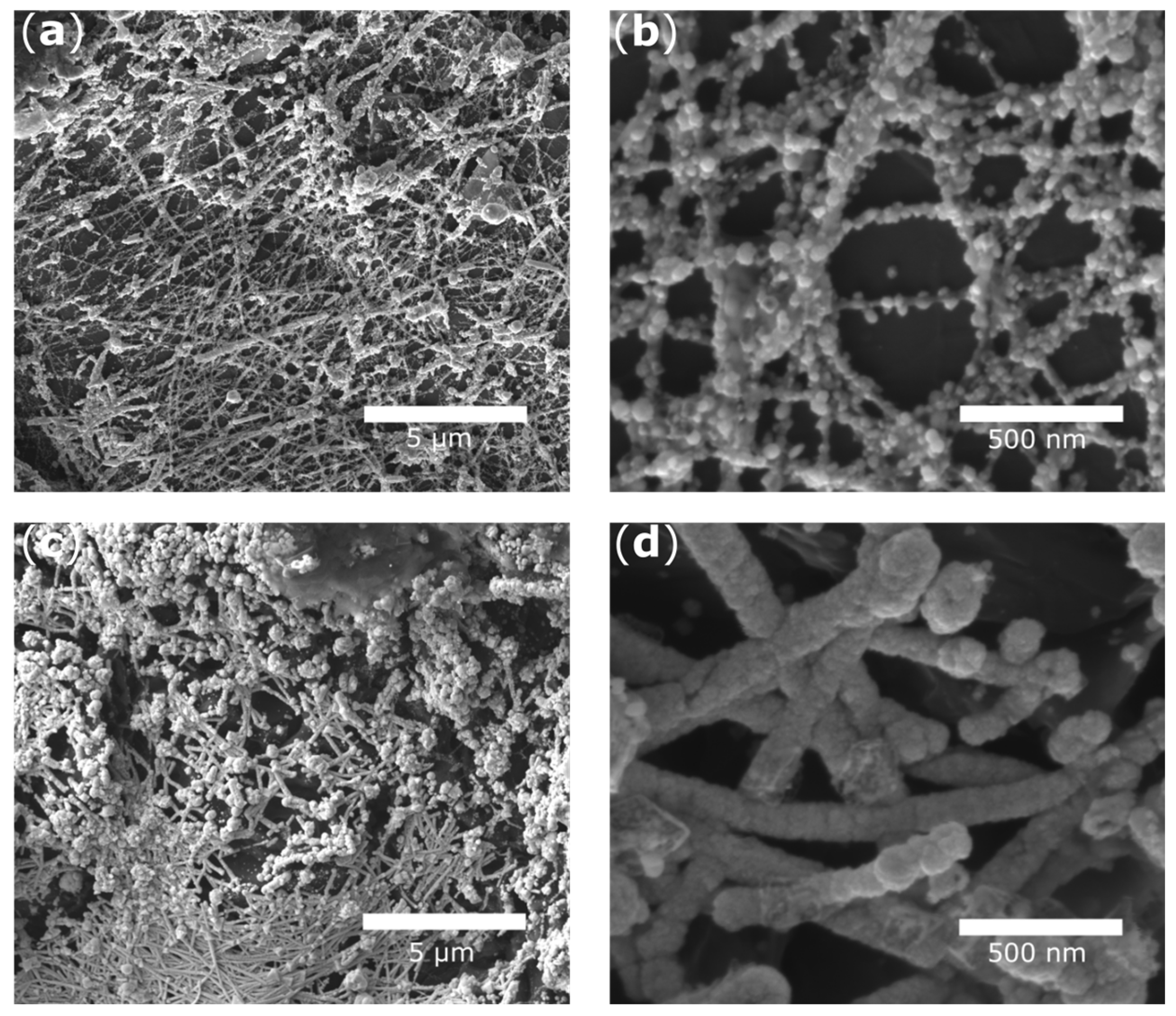
The palladium loadings of the different electrodes, normalized to the geometrical area exposed during electrodeposition, are summarized in Table 1. Representative SEM micrographs of Pd-decorated Ag nanowire-coated graphite electrodes at two distinct metal loadings (25 and 72 µg/cm2) are shown in Figure 1a–d, each displayed at two different magnifications to capture both local and extended structural features.
As evident from Figure 1a,c, the silver nanowires are distributed randomly across the graphite surface, forming an interconnected network characterized by numerous wire–wire junctions. Owing to the post-deposition thermal treatment, these contact points are fused, resulting in a continuous percolation network with high electrical conductivity. In addition to facilitating efficient charge transport, the junction welding enhances the mechanical integrity of the nanowire architecture. A higher density of nanowires is observed in surface depressions of the graphite substrate, where geometric confinement promotes accumulation. Throughout the electrode surface, the nanowires closely follow the topographical features of the substrate, suggesting intimate interfacial contact that is expected to support efficient electron transfer from the graphite to the catalytically active palladium species.
The SEM images further show that palladium nanoparticles are predominantly deposited on the silver nanowires, while only a minor fraction is found directly on the graphite surface. With a low loading of 25 µg/cm2 (Figure 1a,b) it can be seen that individual Pd nanoparticles are growing around the nanowire core. When the wires tend to lie on top, the individual nanoparticles agglomerate to form a complete shell around the wires. In contrast, palladium deposited on nanowires positioned closer to the graphite surface displays a lower particle density and smaller dimensions, on the order of 20 nm, leaving portions of the underlying silver nanowires partially exposed. The lower nanoparticle density may be associated with mass transport limitations during electrodeposition, as nanowires located closer to the graphite surface or within confined regions could experience a reduced palladium ion flux, which may influence local nucleation and growth.
Figure 1c illustrates the morphology obtained at a higher palladium loading of 72 µg/cm2. In contrast to lower coverages, the deposited palladium exhibits markedly increased particle sizes. In addition to Pd-coated nanowires, pronounced agglomerates with a cauliflower-like appearance and lateral dimensions of several hundred nanometers are observed both on the nanowire network and directly on the graphite surface. As shown in Figure 1d, the effective diameter of the nanowires, including the palladium layer, increases to approximately 150 nm.
Both the palladium coatings formed on the silver nanowires and the larger agglomerates display a pronounced surface roughness, indicative of a polycrystalline-like growth mode. Such surface textures imply a heterogeneous atomic arrangement, which can be associated with a high density of palladium sites exhibiting varied coordination environments. In this context, atoms located at steps, edges, and kink-like features are expected to be present and are frequently discussed as catalytically relevant centers for the hydrogen evolution reaction [37].
The chronopotentiometric deposition applied in this work establishes kinetically controlled growth conditions, which are known to promote the formation of non-equilibrium surface structures [38]. For palladium-based electrocatalysts, low-coordinated surface atoms have been reported to influence hydrogen adsorption strength toward a weaker hydrogen binding energy (HBE), an aspect that is particularly relevant considering palladium’s position on the strong hydrogen-binding side of the volcano relationship [39].
In addition, Ag–Pd interfacial sites have been discussed in the literature as potentially catalytically relevant in bimetallic systems [40]. However, the morphological observations indicate that at higher palladium loadings the silver nanowires are largely covered by a continuous palladium layer and by extended agglomerates. Under these conditions, direct Ag–Pd interfacial regions exposed to the electrolyte are expected to be scarce, so that any beneficial electronic contribution of silver is likely to be strongly diminished. In contrast, at lower palladium coverages—where discrete nanoparticles are predominantly located on the nanowire surface and portions of silver remain accessible—interfacial effects may still be present and could contribute to the overall catalytic response.

3.2. Hydrogen Evolution Under DC Polarization

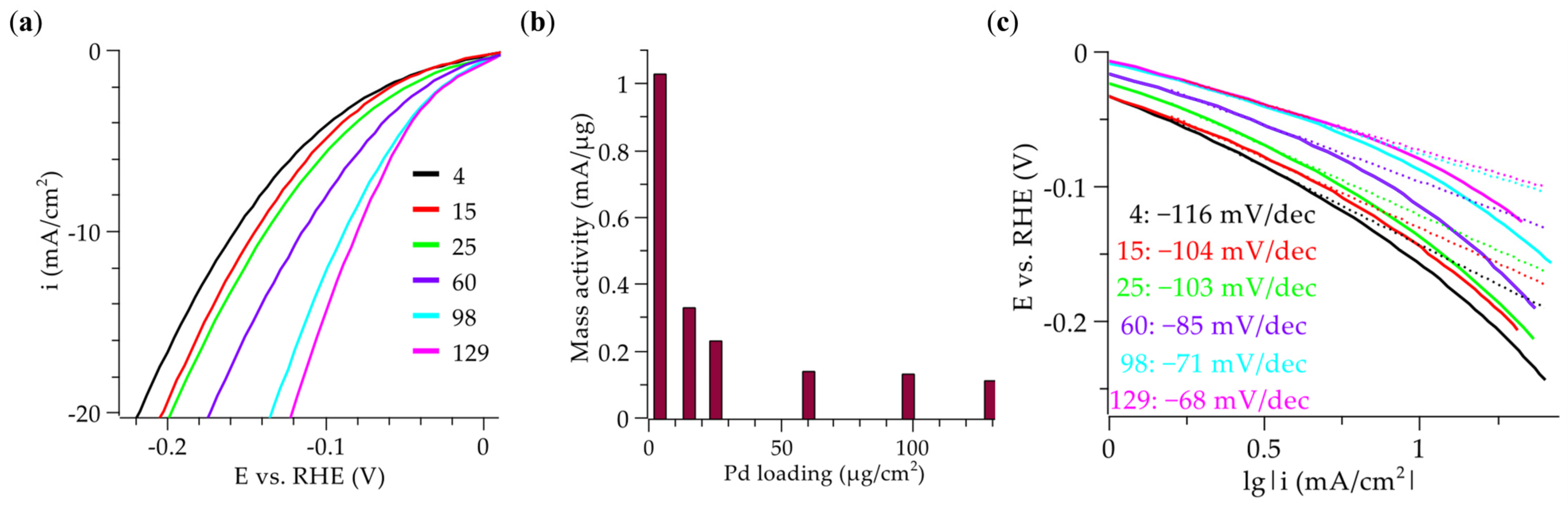
The hydrogen evolution performance of the palladium-modified electrodes was investigated as a function of metal loading by linear sweep voltammetry. Representative current–potential curves are presented in Figure 2a. In order to assess the intrinsic electrocatalytic properties of the electrode architectures, the recorded data were corrected for uncompensated solution resistance. The electrolyte resistance, determined to be approximately 0.8 Ω ∙ cm2, was obtained from the high-frequency intercept measured with a platinum plate under identical cell configuration. This procedure compensates for the ohmic contribution of the electrolyte and external circuit elements while deliberately excluding electronic resistances inherent to the composite electrode materials themselves [41]. As a result, the corrected curves preserve the conductivity characteristics of the graphite-based electrodes and provide a realistic assessment of catalytic behavior under HER conditions [42].
Inspection of the polarization curves reveals a progressively steeper cathodic response with increasing palladium loading, reflecting enhanced hydrogen evolution kinetics. For quantitative comparison, the overpotentials required to achieve a geometric current density of −10 mA/cm2 were extracted and are summarized in Table 1.
The data demonstrate that increasing the palladium content from 4 to 129 µg/cm2 results in an approximate halving of the overpotential. At the highest loading (129 µg/cm2), an overpotential of −80 mV is sufficient to sustain −10 mA/cm2, which is comparable to the performance of a commercial 20 wt% Pd/C catalyst (≈−76 mV) [43]. Notably, even the lowest investigated loading of 4 µg/cm2 produces a substantial decrease in overpotential, by 262 mV relative to the essentially non-catalytic rough graphite substrate [44]. This pronounced improvement at minimal palladium content indicates efficient utilization of the noble metal at low surface coverages.
Evaluation of the data summarized in Table 1 shows that the enhancement in hydrogen evolution performance becomes progressively less pronounced at higher metal contents. Although larger palladium amounts result in lower overpotentials, the additional catalytic benefit gained per increment of deposited metal steadily declines. This behavior indicates a reduced effectiveness of noble metal utilization at elevated surface coverages.
To further assess the effectiveness of palladium for hydrogen evolution, the catalytic response was normalized to the deposited metal mass. The resulting mass activity, defined as the current normalized to the corresponding palladium mass at a fixed overpotential and expressed in mA/µg, is shown in Figure 2b. Figure 2b presents the mass activity evaluated at an overpotential of −100 mV. Over the investigated range from 4 to 129 µg/cm2, the mass-normalized activity decreases by approximately one order of magnitude. Beyond loadings of roughly 60 µg/cm2, the decline becomes less pronounced and approaches a plateau.
This behavior correlates with the morphological evolution observed in the SEM micrographs (Figure 1c,d). At higher palladium contents, the formation of larger particles and extended agglomerates increasingly dominates the surface. Under these conditions, additional deposition primarily contributes to particle growth rather than to the creation of new accessible surface sites. Consequently, the effective metal surface area increases less strongly than the total palladium mass, leading to reduced mass-specific performance.
In contrast, the transition from 4 to 15 µg/cm2 is accompanied by a marked threefold decrease in mass activity. Comparison with the structural analysis (Figure 1) indicates that increasing loading results in a progressively more complete encapsulation of the silver nanowires and thickening of the palladium shell. The exceptionally high mass activity at the lowest loading therefore points to a more efficient metal utilization regime. In this configuration, the small and well-dispersed palladium nanoparticles remain in close electronic interaction with the underlying silver, which may contribute to a modulation of the hydrogen binding properties and thus enhance catalytic turnover. Such size-dependent electronic effects have been reported for palladium particles supported on platinum, where larger agglomerates exhibit a diminished influence of the substrate compared to finely dispersed nanoparticles [45].
A promoting influence of silver nanowire architectures on hydrogen evolution has also been reported in related systems; for instance, Ag nanowires incorporated into a nickel sulfide support containing atomically dispersed platinum were found to enhance HER performance compared to an analogous catalyst in which the nanowires were replaced by nickel foam. In that study, a mass activity of 7.6 mA/µg at −150 mV was achieved, corresponding to an improvement by a factor of 1.3 relative to the AgNW-free reference [46].
A similar tendency is observed in the present system. When comparing the Pd/AgNW/C electrode with a palladium loading of 4 µg/cm2 to a graphite substrate decorated solely with palladium nanoparticles (5 µg/cm2) and lacking silver nanowires, a pronounced difference in mass-normalized activity becomes evident. The Ag-free catalyst exhibits a mass activity of 0.232 mA/µg at −100 mV, which is approximately 4.4 times lower than that of the corresponding Pd/AgNW/C electrode. This comparison suggests that the silver nanowire network contributes to a more efficient utilization of palladium under low loading conditions, consistent with a synergistic interaction between the two metallic components [47].
The hydrogen evolution reaction (HER) in acidic media generally proceeds via a sequence of elementary steps that involve proton discharge and subsequent hydrogen formation [48]. The mechanism is initiated by proton adsorption at an active site (M) of the electrode surface, coupled to an electron transfer step (Volmer reaction). In acidic electrolyte, hydronium ions (H3O+) serve as the proton source:
H 3 O + + M + e M H a d + H 2 O
The adsorbed hydrogen intermediate (Had) can subsequently evolve into molecular hydrogen via two possible pathways. In the electrochemical desorption step (Heyrovsky reaction), a second proton–electron transfer leads directly to H2 formation:
M H a d + H 3 O + + e H 2 + H 2 O + M
Alternatively, two adsorbed hydrogen atoms may recombine chemically in the Tafel step:
M H a d + M H a d H 2 + 2 M
Depending on which elementary step limits the overall reaction rate, the HER follows either a Volmer–Heyrovsky or a Volmer–Tafel mechanism. Insight into the rate-determining step can be obtained from the Tafel slope, defined as the overpotential required to increase the current density by one order of magnitude. Characteristic Tafel slopes are approximately −120 mV/dec for a rate-determining Volmer step, around −40 mV/dec for a Heyrovsky-limited process, and about −30 mV/dec when the Tafel reaction is rate-determining [49].
In the present study, the Tafel slopes determined in the low overpotential regime range from −116 mV/dec for 4 µg/cm2 Pd to −68 mV/dec for 129 µg/cm2 Pd (Figure 2c). These values indicate that hydrogen evolution predominantly follows a Volmer–Heyrovsky pathway, with electrochemical desorption contributing significantly to the rate limitation. At higher overpotentials, corresponding to current densities exceeding −10 mA/cm2, the Tafel curves become progressively steeper. This behavior is consistent with increasing surface coverage by hydrogen intermediates, which shifts the kinetic balance toward a stronger contribution of the Volmer step to the overall rate [50].
A comparison with palladium catalysts lacking the silver nanowire network further highlights the structural influence of the support. For the lowest loading, the Pd/AgNW/C electrode exhibits a Tafel slope of −116 mV/dec, which is substantially lower than the −146 mV/dec previously reported for a Pd/C catalyst with comparable palladium loading but without Ag nanowires [47]. This indicates more favorable HER kinetics in the presence of the nanowire architecture at low metal coverage. In contrast, at high loadings (Pd/AgNW/C: 129 µg/cm2; −68 mV/dec), the Tafel slope exceeds that of a corresponding Ag-free Pd/C electrode (122 µg/cm2; −53 mV/dec).
This trend mirrors the overpotential analysis: at loadings up to approximately 25 µg/cm2, the Ag nanowire network significantly reduces the overpotential required to reach −10 mA/cm2, decreasing from −251 mV for a Pd/C electrode (5 µg/cm2) to −158 mV for the corresponding Pd/AgNW/C system (4 µg/cm2). However, at higher palladium contents the advantage diminishes, and slightly higher overpotentials are required compared to Ag-free analogs (129 µg/cm2 Pd/AgNW/C: −80 mV; 122 µg/cm2 Pd/C: −70 mV). These observations consistently indicate that the beneficial effect of silver is most pronounced at low palladium loadings.
When the catalytic response is evaluated on a mass-normalized basis, a more differentiated picture emerges. The mass activity already decreases at relatively low palladium loadings, indicating that the beneficial effect of the Ag nanowire network on the overpotential is not directly accompanied by a corresponding improvement in noble metal utilization.
Electronic interaction effects may contribute to the observed behavior. Previous studies on polycrystalline platinum substrates decorated with palladium islands have demonstrated that interfacial electronic interactions can induce shifts in the palladium d-band center, thereby modifying the binding energy of hydrogen intermediates in the initial adsorption step of the HER mechanism [45]. Notably, the extent of this electronic modulation has been reported to depend strongly on particle size: smaller islands appear more susceptible to substrate-induced electronic effects, whereas larger and more agglomerated structures exhibit a diminished degree of interaction.
This interpretation aligns well with the present structural observations. SEM analysis at a representative loading of 25 µg/cm2 reveals that palladium is deposited as small nanoparticles that partially enclose the Ag nanowires, allowing for a high degree of interfacial contact, which may facilitate electronic interactions between palladium and silver. The observed morphological progression between low and high loadings suggests that, at even lower palladium contents, smaller and more finely dispersed nanoparticles are formed on the nanowire surface. At higher loadings (e.g., 72 µg/cm2), the nanowires are completely covered by a substantially thicker palladium shell, and additional large agglomerates form on top of the network. In this regime, the proportion of palladium directly influenced by the silver support is reduced, limiting the extent of electronic modulation.
Comparable improvements in HER activity have been reported for palladium-based catalysts modified through alloying or by combination with other catalytic materials; for instance, a Pd–rhodium (Rh) nanocatalyst containing 15.4 at% Rh exhibited a significantly reduced overpotential of −20.6 mV at −10 mA/cm2 compared to −55 mV for monometallic Pd, accompanied by a lower Tafel slope (−41.9 mV/dec vs. −66.7 mV/dec) [51].
Similarly, palladium-based composite and doped systems have been shown to enhance HER performance. In the case of Pd-doped molybdenum disulfide, a moderate decrease in overpotential (−224.6 mV vs. −251.8 mV at −10 mA/cm2) and a slight improvement in Tafel slope (−113 mV/dec vs. −115 mV/dec) were observed compared to the undoped material [52]. Improvements have also been reported for palladium-nickel (Pd3Ni) composites supported on nitrogen-doped carbon, where the introduction of nickel reduced both the overpotential (−91 mV vs. −138 mV) and the Tafel slope (−49.1 mV/dec vs. −87 mV/dec) relative to the monometallic Pd counterpart [53].
These examples illustrate that the catalytic performance of palladium is strongly influenced by its local chemical and structural environment. In this context, the present results indicate that a similar enhancement can be achieved through interaction with a conductive silver nanowire network, particularly at low palladium loadings.
In line with these observations, synergistic Pd/Ag effects have been reported in other material systems. For example, two-dimensional molybdenum disulfide sheets modified with AgPd alloy nanoparticles exhibited enhanced HER activity relative to non-alloyed counterparts, achieving an overpotential of −215 mV at −10 mA/cm2 and a Tafel slope of −81 mV/dec [54]. Similarly, sulfide-containing Pd/Ag clusters demonstrated improved catalytic performance (−290 mV at −10 mA/cm2; −129 mV/dec) compared to monometallic analogs [23]. Incorporation of silver atoms into Pd–Ag alloy surfaces has also been shown to downshift the palladium d-band center, thereby weakening the Pd–H bond strength and improving HER kinetics relative to pure palladium, where the hydrogen binding is on the stronger side of the optimal range, in comparison to platinum [22].
These findings are consistent with the present results, suggesting that palladium nanoparticles benefit from electronic interaction with silver. Owing to the higher Fermi level of silver [55], charge redistribution at the Pd/Ag interface can modify the electronic structure of palladium and optimize hydrogen binding energetics. The magnitude of this effect appears to depend critically on particle size and interfacial contact area, which explains the pronounced enhancement observed at low palladium loadings and its attenuation at higher metal coverages.

3.3. AC-Based Kinetic Investigation of HER

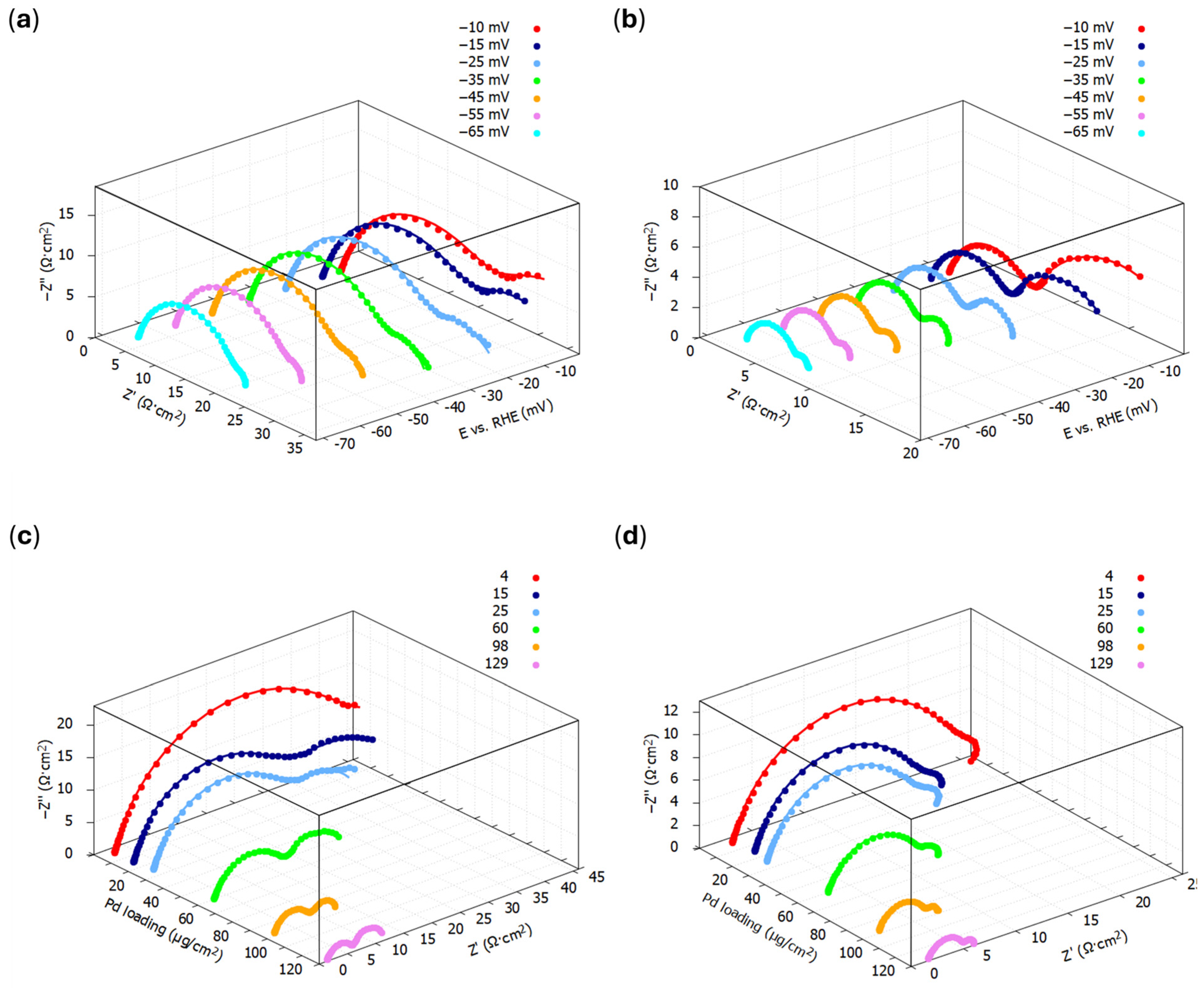
Further insight into the kinetic processes governing hydrogen evolution was obtained by electrochemical impedance spectroscopy. Impedance measurements were performed using six electrodes with different palladium loadings within an overpotential range from −10 to −65 mV vs. RHE. Figure 3a,b present the Nyquist plots of electrodes containing 25 and 98 µg/cm2 Pd recorded at varying overpotentials, whereas Figure 3c,d compare the impedance response of the different electrodes as a function of palladium loading at fixed overpotentials of −25 and −65 mV vs. RHE.
The complex-plane spectra obtained for all investigated electrodes exhibit two distinguishable semicircular features within the studied potential range. In both cases the arcs appear slightly depressed toward the real axis, indicating a deviation from ideal capacitive behavior that is commonly associated with surface heterogeneity and distributed reaction rates [56]. The semicircles observed in the high-frequency (HF) and low-frequency (LF) regions arise from processes occurring on different characteristic timescales. Both contributions display a pronounced dependence on the applied overpotential, decreasing in size as the overpotential becomes more negative. Such potential-dependent behavior is typical for kinetically controlled processes. In general, the semicircle located in the high-frequency region is attributed to the charge transfer resistance at the electrode–electrolyte interface, whereas the feature observed at lower frequencies is often related to slower surface processes such as hydrogen adsorption or transport-related limitations on the electrode surface [25,57].
In addition to the decrease in the diameters of both the HF and LF semicircles with increasingly negative overpotential for the electrodes shown (25 and 98 µg/cm2 Pd), the palladium loading itself also has a pronounced influence on the impedance response. At both moderate (−25 mV) and higher (−65 mV) overpotentials, the semicircle diameters progressively decrease as the palladium content increases. This trend indicates that palladium facilitates the hydrogen evolution reaction and reduces the associated kinetic resistances. The results further suggest that palladium present as a coating on the silver nanowires, as well as larger deposits located on the nanowire network and on the graphite substrate, actively participates in the electrochemical reaction and remains accessible to the reacting species.
The shape of electrochemical impedance spectra has been discussed as a possible indicator of trends in the electrocatalytic behavior of HER-active materials [58]. For highly active catalysts such as Pt and Pd, impedance spectra frequently exhibit two semicircular features with distinct time constants that vary with the applied overpotential. This behavior has been suggested to reflect hydrogen binding energies close to the optimal range for efficient HER catalysis [59,60]. In contrast, metals such as Bi and Pb typically display impedance spectra consisting of a single semicircle over the investigated potential range [61], which has been associated with their comparatively weak hydrogen binding energy [58].
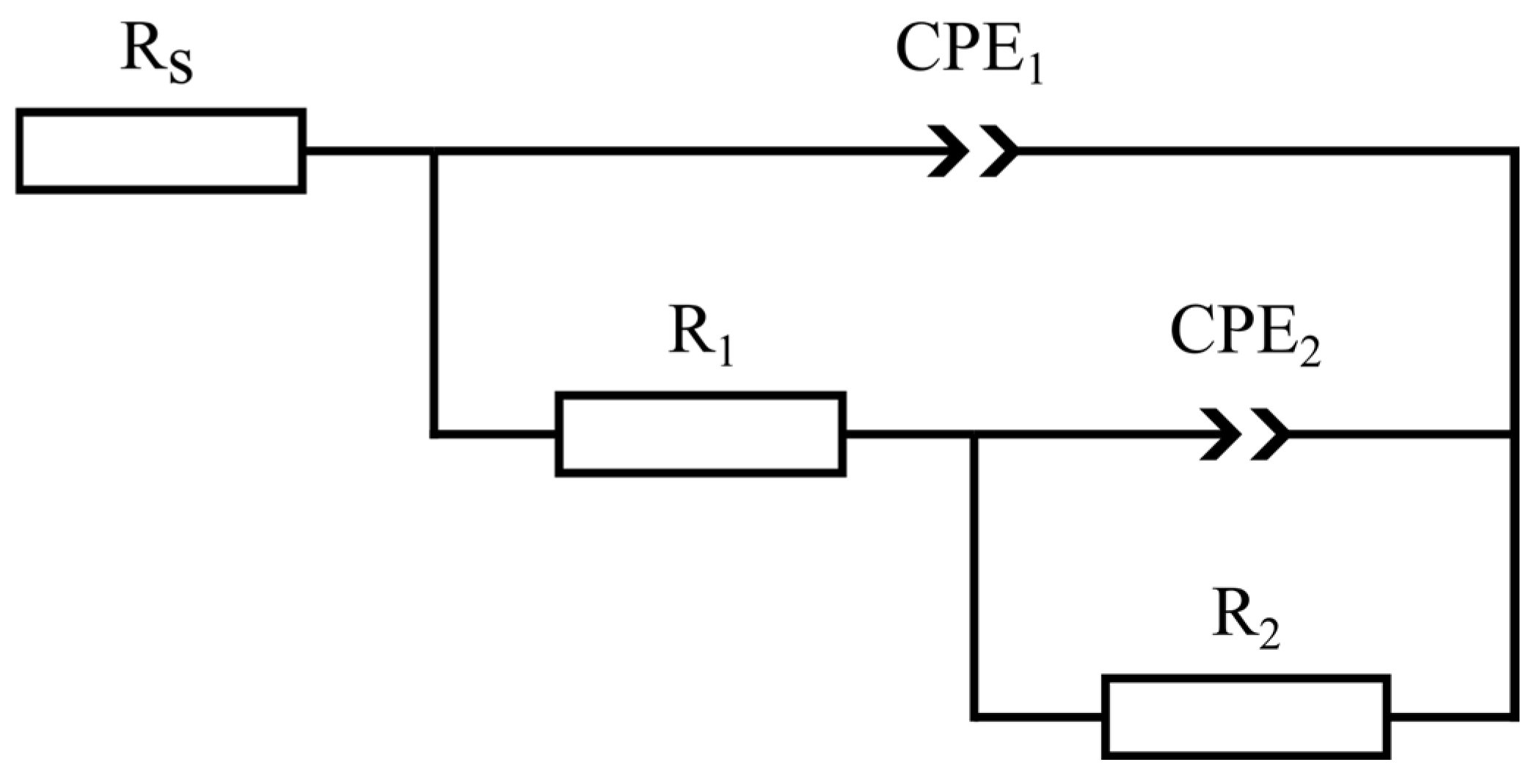
The appearance of two semicircles in the Nyquist representation suggests that the impedance response is governed by two processes occurring on different characteristic timescales. To describe this behavior quantitatively and to extract kinetic parameters, the experimental spectra were fitted using an equivalent circuit composed of two RC branches connected in parallel (Figure 4) [62]. This model reproduces the two capacitive features observed in the impedance spectra. As the experimental arcs deviate from ideal semicircles and appear slightly depressed toward the real axis, constant phase elements (CPE1 and CPE2) were introduced to account for the non-ideal capacitive behavior. The impedance of a constant phase element is given by Equation (1):
Z C P E = 1 Q ( j ω ) n
where Q denotes the capacitance parameter (F∙sn−1∙cm−2), j is the imaginary unit, ω is the angular frequency (rad s−1) and n is a dimensionless exponent describing the deviation from ideal capacitive behavior, with n = 1 corresponding to an ideal capacitor [30]. The use of CPE elements accounts for surface roughness and heterogeneity of the electrode, which lead to a distribution of time constants and a corresponding flattening of the semicircles in the Nyquist plot [63]. Incorporating these elements therefore allows a more accurate description of the experimental impedance response.
In the equivalent circuit shown in Figure 4, Rs represents the electrolyte resistance between the working and reference electrode and corresponds to the high-frequency intercept of the Nyquist plot with the real axis [30]. The elements R1 and CPE1 describe the charge transfer process at the electrode–electrolyte interface, where R1 denotes the charge transfer resistance and CPE1 is associated with the non-ideal double-layer capacitance. The second time constant, represented by R2 and CPE2, corresponds to processes occurring on a slower timescale at the electrode surface. Here, R2 can be considered a pseudoresistive term associated with transport-related effects of hydrogen species near the interface, while CPE2 represents the corresponding pseudocapacitive contribution of the adsorbed hydrogen layer [60,64].
As illustrated in Figure 3a–d, the proposed equivalent circuit provides a satisfactory description of the measured impedance spectra. The fitted curves show good agreement with the experimental data over the entire frequency range, indicating that the model captures the main processes governing the impedance response of the investigated electrodes.
The electrochemical double-layer capacitance (Cdl) values listed in Table 2 were derived using the relationship proposed by Brug et al., which relates the parameters of the equivalent circuit shown in Figure 4 to the effective double-layer capacitance [65].
C d l = Q 1 R s 1 + R 1 1 1 n 1 1 n 1
The pseudocapacitance (Cp) was calculated from the fitted parameters of the equivalent circuit (Figure 4) using a modified form of Equation (2) [60].
C p = Q 2 R s + R 1 1 + R 2 1 1 n 2 1 n 2
The fitted impedance parameters together with the calculated capacitances Cdl and Cp obtained at the lowest (−10 mV) and highest (−65 mV) applied overpotentials for electrodes with different palladium loadings are summarized in Table 2.
The parameters listed in Table 2 indicate that the elements governing the high-frequency response change with the applied cathodic overpotential. As the potential becomes more negative, the charge transfer resistance R1 decreases noticeably, reflected in the progressive shrinkage of the high-frequency semicircle in the impedance spectra. Also a change with potential of the corresponding double-layer capacitance can be observed. These observations collectively suggest that the R1–Cdl element primarily reflects the kinetics of the charge transfer process occurring the hydrogen evolution reaction.
The parameters associated with the second time constant also exhibit changes with increasing cathodic overpotential. In particular, the resistance R2 decreases in parallel with the contraction of the low-frequency semicircle, indicating that the slower process described by the R2–Cp element becomes increasingly facilitated at more negative potentials. The pseudocapacitance Cp shows variations within the investigated potential range and is generally related to surface processes involving hydrogen species at the electrode interface [66]. Accordingly, the R2–Cp element can be considered to reflect the combined influence of hydrogen adsorption and associated mass transport phenomena on the hydrogen evolution reaction.
The Nyquist plots reveal two distinct semicircles over the entire range of palladium loadings and applied potentials, indicating that the underlying processes occur on sufficiently different timescales [58]. Under such conditions, the impedance response can be described by two characteristic time constants associated with the high- and low-frequency contributions. Based on the fitted kinetic parameters listed in Table 2, the characteristic time constants for charge transfer at an overpotential of −65 mV can be estimated as approximately 0.02 s for an electrode with 4 µg/cm2 Pd and 0.0051 s for 129 µg/cm2 Pd [56,66]. These values are considerably smaller—in particular, by a factor of 38 (4 µg/cm2) and 82 (129 µg/cm2)—than those associated with the low-frequency response, indicating that the charge transfer step proceeds on a much shorter timescale than the processes responsible for the second semicircle. The results further suggest that the characteristic timescale of the charge transfer process is strongly dependent on the catalyst content and becomes shorter with increasing palladium loading.
A gradual decrease in the calculated Cdl values is observed for all electrodes at higher HER overpotentials. This trend can be attributed to partial blockage of the electrode surface during hydrogen evolution. The formation and accumulation of hydrogen gas bubbles may temporarily reduce the effective interfacial area by hindering electrolyte access to parts of the surface, thereby lowering the apparent double-layer capacitance [67].
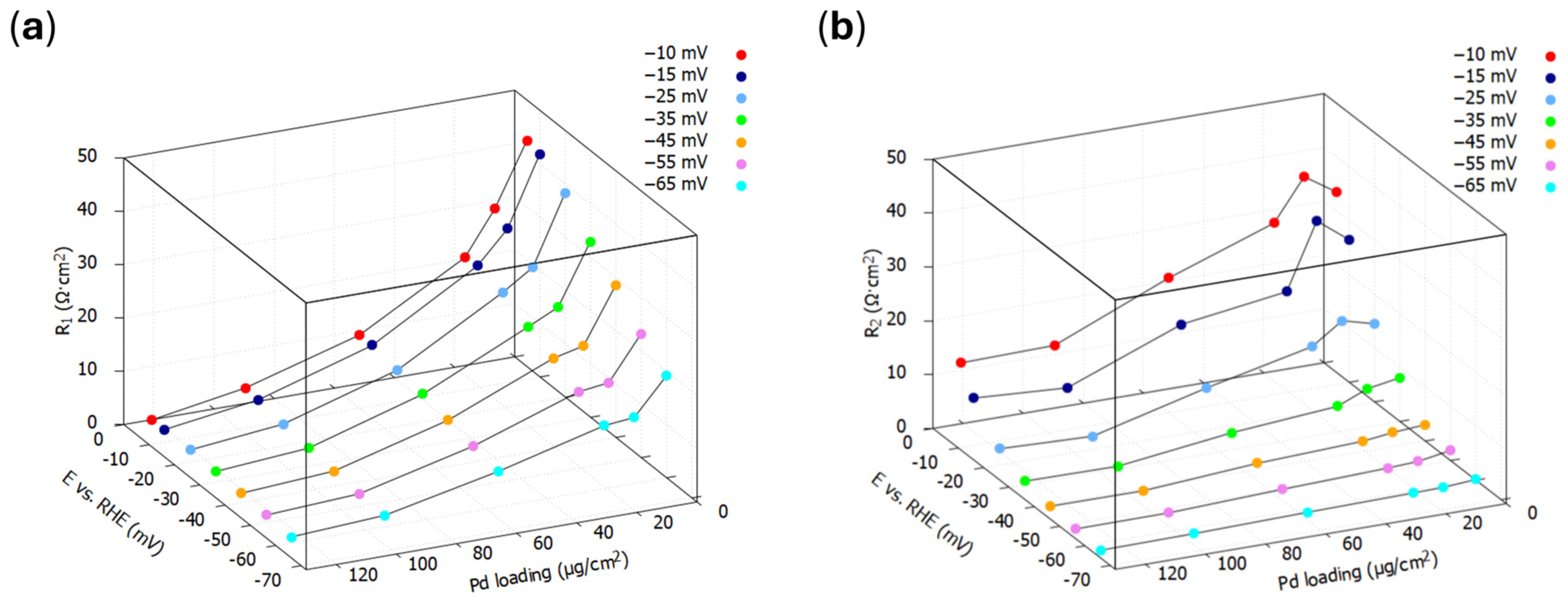
Figure 5a shows the dependence of the charge transfer resistance R1 on the applied overpotential for electrodes with different palladium loadings. For all samples, R1 decreases as the cathodic overpotential becomes more negative, indicating progressively faster electron transfer kinetics during the hydrogen evolution reaction. The magnitude of this decrease, however, varies with the amount of deposited palladium. For the electrode with a Pd loading of 4 µg/cm2, R1 decreases by approximately 52% when the overpotential is increased from −10 mV to −65 mV, whereas the highest loaded electrode (129 µg/cm2) shows a smaller reduction of about 25% over the same potential range.
This indicates that electrodes with lower palladium loadings respond more sensitively to an increasing cathodic driving force. Such behavior suggests that, at low loadings, a larger fraction of the palladium is electrochemically active and effectively coupled to the conductive silver nanowire support. At higher loadings, however, this coupling becomes progressively less effective as an increasing fraction of palladium is incorporated into larger agglomerates or multilayer deposits that are less directly connected to the nanowire structure.
Figure 5b shows the evolution of the second resistance R2 with increasing cathodic overpotential. Compared to the charge transfer resistance R1, the decrease in R2 is substantially more pronounced. For all investigated electrodes, R2 is reduced by approximately 94% when the overpotential is increased from −10 mV to −65 mV. At higher overpotentials, however, the reduction becomes progressively smaller, indicating that the potential dependence of this contribution gradually weakens.
A similar tendency can be observed in the Nyquist plots, where the diameter of the low-frequency semicircle decreases strongly at moderate overpotentials but exhibits only minor additional changes at more negative potentials. Such behavior is typically associated with a progressive increase in hydrogen surface coverage during the hydrogen evolution reaction. As the coverage approaches a quasi-steady state, further increases in overpotential have a diminishing influence on the adsorption-related processes. Under these conditions, the low-frequency semicircle can gradually shrink and may eventually disappear from the impedance spectrum, as reported previously [60].
The resulting increase in hydrogen coverage reduces the relative contribution of surface transport or adsorption-related processes to the overall impedance response. Consequently, the electrochemical behavior at higher overpotentials becomes increasingly dominated by the electron transfer step. This observation is consistent with the growing importance of the Volmer step under strongly cathodic conditions, where the discharge of protons and the formation of adsorbed hydrogen species govern the reaction kinetics. As a result, charge transfer processes increasingly determine the catalytic response at elevated overpotentials.
To further assess the efficiency of palladium utilization, the charge transfer resistance was normalized to the palladium loading, yielding a mass-specific charge transfer resistance R1·Pd-loading. At −10 mV values of 179 Ω·µg, 828 Ω·µg and 590 Ω·µg are obtained for loadings of 4, 60 and 129 µg/cm2, respectively. At −65 mV, these values decrease to 86 Ω·µg (4 µg/cm2), 539 Ω·µg (60 µg/cm2) and 439 Ω·µg (129 µg/cm2).
The significantly lower values at small loadings indicate a more efficient contribution of palladium to the charge transfer process. This behavior is consistent with the mass–activity trends derived from the DC measurements and reflects the importance of dispersion and electronic connectivity for effective catalyst utilization.
A more comprehensive interpretation emerges when the kinetic parameters are considered in relation to the palladium loading. At low loadings (4–15 µg/cm2), the electrodes exhibit high mass-specific activity and efficient noble metal utilization, despite comparatively higher charge transfer resistances. This can be attributed to small, well-dispersed palladium nanoparticles that are closely associated with the silver nanowire network.
At intermediate loadings (around 25 µg/cm2), a transition regime is observed. Here, the overpotential is significantly reduced while a reasonable level of mass-normalized performance is maintained, indicating a balance between increasing active surface area and maintaining effective interaction with the conductive scaffold.
At higher loadings (≥60 µg/cm2), the charge transfer resistance decreases further, reflecting improved overall kinetics. However, this improvement is accompanied by a reduced mass-specific efficiency, as a growing fraction of palladium is present in larger agglomerates or multilayer structures that are less effectively coupled to the nanowire network.
Overall, the catalytic performance of the Pd/AgNW/C system is governed by a trade-off between absolute activity and noble metal utilization. While higher loadings favor lower overpotentials, lower loadings enable a more efficient use of palladium due to improved dispersion and more effective coupling to the silver nanowire network, which promotes efficient palladium utilization even at relatively low noble metal loadings.

4. Conclusions

Palladium nanoparticles deposited on silver nanowire-modified graphite electrodes were investigated as electrocatalysts for the hydrogen evolution reaction using combined DC polarization and electrochemical impedance spectroscopy. The results show that the incorporation of a silver nanowire network enhances the catalytic response, particularly at low palladium loadings, where a pronounced decrease in overpotential and favorable kinetic characteristics are observed.
The electrochemical behavior was found to depend strongly on palladium loading. At low loadings (4–15 µg/cm2), the catalysts exhibit high mass-specific activity, which is attributed to finely dispersed palladium nanoparticles that are effectively electronically coupled to the silver nanowire network. Increasing the loading leads to further reductions in charge transfer resistance but is accompanied by a progressive decline in mass-normalized performance, consistent with structural changes such as particle growth and the formation of larger agglomerations.
These findings indicate that the catalyst architecture and metal distribution influence the observed electrocatalytic behavior. The results further suggest that the silver nanowire network may support more effective utilization of palladium at low loadings and could be considered in the design of noble-metal-lean HER electrocatalysts.

Author Contributions

Conceptualization, M.S.; Methodology, M.S. and N.K.; Investigation, N.K.; Validation, M.S.; Formal Analysis, M.S., N.K., J.R. and H.R.; Resources, M.S.; Data Curation, M.S., N.K., J.R. and H.R.; Writing—original draft preparation, M.S., J.R. and H.R.; Writing—review and editing, J.R. and H.R.; Supervision, M.S.; Project administration, M.S. All authors have read and agreed to the published version of the manuscript.

Funding

This research received no external funding.

Data Availability Statement

The data presented in this study are available on request from the corresponding author.

Acknowledgments

The authors are grateful to Constanze Eulenkamp for her support with the SEM measurements.

Conflicts of Interest

The corresponding author states that there are no conflicts of interest.

References

  1. Hassan, Q.; Algburi, S.; Sameen, A.Z.; Jaszczur, M.; Salman, H.M. Hydrogen as an energy carrier: Properties, storage methods, challenges, and future implications. Environ. Syst. Decis. 2024, 44, 327–350. [Google Scholar] [CrossRef]
  2. Akpasi, S.O.; Smarte Anekwe, I.M.; Tetteh, E.K.; Amune, U.O.; Mustapha, S.I.; Kiambi, S.L. Hydrogen as a clean energy carrier: Advancements, challenges, and its role in a sustainable energy future. Clean Energy 2025, 9, 52–88. [Google Scholar] [CrossRef]
  3. Zhang, L.; Jia, C.; Bai, F.; Wang, W.; An, S.; Zhao, K.; Li, Z.; Li, J.; Sun, H. A comprehensive review of the promising clean energy carrier: Hydrogen production, transportation, storage, and utilization (HPTSU) technologies. Fuel 2024, 355, 129455. [Google Scholar] [CrossRef]
  4. Borup, R.; Krause, T.; Brouwer, J. Hydrogen is essential for industry and transportation decarbonization. Electrochem. Soc. Interface 2021, 30, 79. [Google Scholar] [CrossRef]
  5. Franco, A.; Rocca, M. Renewable electricity and green hydrogen integration for decarbonization of “hard-to-abate” industrial sectors. Electricity 2024, 5, 471–490. [Google Scholar] [CrossRef]
  6. Zhu, Y.; Keoleian, G.A.; Cooper, D.R. The role of hydrogen in decarbonizing US industry: A review. Renew. Sustain. Energy Rev. 2025, 214, 115392. [Google Scholar] [CrossRef]
  7. Curcio, E. Techno-economic analysis of hydrogen production: Costs, policies, and scalability in the transition to net-zero. Int. J. Hydrog. Energy 2025, 128, 473–487. [Google Scholar] [CrossRef]
  8. Fallah Vostakola, M.; Salamatinia, B.; Amini Horri, B. A review on recent progress in the integrated green hydrogen production processes. Energies 2022, 15, 1209. [Google Scholar] [CrossRef]
  9. Kazi, M.K.; Eljack, F.; El-Halwagi, M.M.; Haouari, M. Green hydrogen for industrial sector decarbonization: Costs and impacts on hydrogen economy in Qatar. Comput. Chem. Eng. 2021, 145, 107144. [Google Scholar] [CrossRef]
  10. Mehtab, A.; Ali, S.A.; Sadiq, I.; Shaheen, S.; Khan, H.; Fazil, M.; Pandit, N.A.; Naaz, F.; Ahmad, T. Hydrogen energy as sustainable energy resource for carbon-neutrality realization. ACS Sustain. Resour. Manag. 2024, 1, 604–620. [Google Scholar] [CrossRef]
  11. Qian, Q.; Zhu, Y.; Ahmad, N.; Feng, Y.; Zhang, H.; Cheng, M.; Liu, H.; Xiao, C.; Zhang, G.; Xie, Y. Recent advancements in electrochemical hydrogen production via hybrid water splitting. Adv. Mater. 2024, 36, 2306108. [Google Scholar] [CrossRef]
  12. Peng, J.; Dong, W.; Wang, Z.; Meng, Y.; Liu, W.; Song, P.; Liu, Z. Recent advances in 2D transition metal compounds for electrocatalytic full water splitting in neutral media. Mater. Today Adv. 2020, 8, 100081. [Google Scholar] [CrossRef]
  13. Jiao, Y.; Zheng, Y.; Jaroniec, M.; Qiao, S.Z. Design of electrocatalysts for oxygen-and hydrogen-involving energy conversion reactions. Chem. Soc. Rev. 2015, 44, 2060–2086. [Google Scholar] [CrossRef] [PubMed]
  14. Sarkar, S.; Peter, S.C. An overview on Pd-based electrocatalysts for the hydrogen evolution reaction. Inorg. Chem. Front. 2018, 5, 2060–2080. [Google Scholar] [CrossRef]
  15. Chen, A.; Ostrom, C. Palladium-based nanomaterials: Synthesis and electrochemical applications. Chem. Rev. 2015, 115, 11999−12044. [Google Scholar] [CrossRef]
  16. Li, H.; Li, G. Novel palladium-based nanomaterials for multifunctional ORR/OER/HER electrocatalysis. J. Mater. Chem. A 2023, 11, 9383–9400. [Google Scholar] [CrossRef]
  17. Liu, M.; Wang, X.; Liu, J.; Wang, K.; Jin, S.; Tan, B. Palladium as a superior cocatalyst to platinum for hydrogen evolution using covalent triazine frameworks as a support. ACS Appl. Mater. Interfaces 2020, 12, 12774–12782. [Google Scholar] [CrossRef]
  18. Hadimane, S.; Aralekallu, S.; Sannegowda, L.K. Tuning a palladium (ii) phthalocyanine embedded hybrid electrocatalyst for the hydrogen evolution reaction. Sustain. Energy Fuels 2024, 8, 1775–1787. [Google Scholar] [CrossRef]
  19. Tan, D.X.; Wang, Y.L.; Tan, W.Y.; Yang, X.Y.; Ma, R.H.; Xu, S.Y.; Deng, Z.Y. Controlled synthesis of Pd–Ag nanowire networks with high-density defects as highly efficient electrocatalysts for methanol oxidation reaction. Colloids Surf. A Physicochem. Eng. Asp. 2023, 667, 131324. [Google Scholar] [CrossRef]
  20. Nodehi, Z.; Rafati, A.A.; Ghaffarinejad, A. Palladium-silver polyaniline composite as an efficient catalyst for ethanol oxidation. Appl. Catal. A Gen. 2018, 554, 24–34. [Google Scholar] [CrossRef]
  21. Khoshsang, H.; Ghaffarinejad, A. Electrochemical synthesis of polyaniline silver-palladium composite coated nickel foam as an electrocatalyst for the hydrogen evolution reaction. Inorg. Chem. Commun. 2022, 142, 109631. [Google Scholar] [CrossRef]
  22. Yao, R.Q.; Zhou, Y.T.; Shi, H.; Zhang, Q.H.; Gu, L.; Wen, Z.; Lang, X.Y.; Jiang, Q. Nanoporous palladium–silver surface alloys as efficient and pH-universal catalysts for the hydrogen evolution reaction. ACS Energy Lett. 2019, 4, 1379–1386. [Google Scholar] [CrossRef]
  23. Ni, Y.R.; Pangal, R.T.; Pillay, M.N.; Chiu, T.H.; Kahlal, S.; Saillard, J.Y.; Liu, C.W. Anion-Directed Assembly of a Bimetallic Pd/Ag Nanocluster: Synthesis, Characterization, and HER Activity. Molecules 2025, 30, 404. [Google Scholar] [CrossRef] [PubMed]
  24. Gerlitz, I.; Fiegenbaum-Raz, M.; Bar-Sadan, M.; Cohen, H.; Ismach, A.; Rosen, B.A. Catalytic hydrogen evolution reaction enhancement on vertically aligned MoS2 by synergistic addition of silver and palladium. ChemElectroChem 2020, 7, 4224–4232. [Google Scholar] [CrossRef]
  25. Medina-Orta, R.; Ortega, E.M.; Pérez-Herranz, V.; Sánchez-Loredo, M.G. Nanostructured Pd/Ag/Ni electrocatalysts for the Hydrogen Evolution Reaction. Mater. Today Commun. 2024, 38, 108354. [Google Scholar] [CrossRef]
  26. Kim, J.; Nam, Y.S.; Song, M.H.; Park, H.W. Large pulsed electron beam welded percolation networks of silver nanowires for transparent and flexible electrodes. ACS Appl. Mater. Interfaces 2016, 8, 20938–20945. [Google Scholar] [CrossRef]
  27. Huang, H.; Yan, M.; Yang, C.; He, H.; Jiang, Q.; Yang, L.; Lu, Z.; Sun, Z.; Xu, X.; Bando, Y.; et al. Graphene nanoarchitectonics: Recent advances in graphene-based electrocatalysts for hydrogen evolution reaction. Adv. Mater. 2019, 31, 1903415. [Google Scholar] [CrossRef]
  28. Bessel, C.A.; Laubernds, K.; Rodriguez, N.M.; Baker, R.T.K. Graphite nanofibers as an electrode for fuel cell applications. J. Phys. Chem. B 2001, 105, 1115–1118. [Google Scholar] [CrossRef]
  29. Lasia, A. Electrochemical Impedance Spectroscopy and Its Applications, 1st ed.; Springer: New York, NY, USA, 2014. [Google Scholar] [CrossRef]
  30. Lazanas, A.C.; Prodromidis, M.I. Electrochemical Impedance Spectroscopy—A Tutorial. ACS Meas. Sci. Au 2023, 3, 162–193. [Google Scholar] [CrossRef]
  31. Choo, D.C.; Kim, T.W. Degradation mechanisms of silver nanowire electrodes under ultraviolet irradiation and heat treatment. Sci. Rep. 2017, 7, 1696. [Google Scholar] [CrossRef]
  32. Zhang, M.; Efremov, M.Y.; Schiettekatte, F.; Olson, E.A.; Kwan, A.T.; Lai, S.L.; Wisleder, T.; Greene, J.E.; Allen, L.H. Size-Dependent Melting Point Depression of Nanostructures: Nanocalorimetric Measurements. Phys. Rev. B 2000, 62, 10548–10557. [Google Scholar] [CrossRef]
  33. Efremov, M.Y.; Schiettekatte, F.; Zhang, M.; Olson, E.A.; Kwan, A.T.; Berry, R.S.; Allen, L.H. Discrete Periodic Melting Point Observations for Nanostructure Ensembles. Phys. Rev. Lett. 2000, 85, 3560–3563. [Google Scholar] [CrossRef] [PubMed]
  34. Zellner, D.; Varga, A.; Schwager, M. Effect of morphological changes due conductivity enhancing post treatment on the absorption and photoluminescence of AgNW thin films. J. Nano Res. 2023, 81, 9–20. [Google Scholar] [CrossRef]
  35. Tian, M.; Cousins, C.; Beauchemin, D.; Furuya, Y.; Ohma, A.; Jerkiewicz, G. Influence of the Working and Counter Electrode Surface Area Ratios on the Dissolution of Platinum under Electrochemical Conditions. ACS Catal. 2016, 6, 5108–5116. [Google Scholar] [CrossRef]
  36. Dong, G.; Fang, M.; Wang, H.; Yip, S.; Cheung, H.-Y.; Wang, F.; Wong, C.-Y.; Chu, S.T.; Ho, J.C. Insight into the Electrochemical Activation of Carbon-Based Cathodes for Hydrogen Evolution Reaction. J. Mater. Chem. A 2015, 3, 13080–13086. [Google Scholar] [CrossRef]
  37. Huang, L.; Zheng, C.Y.; Shen, B.; Mirkin, C.A. High-index-facet metal-alloy nanoparticles as fuel cell electrocatalysts. Adv. Mater. 2020, 32, 2002849. [Google Scholar] [CrossRef]
  38. Sheng, T.; Tian, N.; Zhou, Z.Y.; Lin, W.F.; Sun, S.G. Designing Pt-based electrocatalysts with high surface energy. ACS Energy Lett. 2017, 2, 1892–1900. [Google Scholar] [CrossRef]
  39. Zheng, Y.; Jiao, Y.; Zhu, Y.; Li, L.H.; Han, Y.; Chen, Y.; Du, A.; Jaroniec, M.; Qiao, S.Z. Hydrogen evolution by a metal-free electrocatalyst. Nat. Commun. 2014, 5, 3783. [Google Scholar] [CrossRef]
  40. Wang, H.; Zhou, S.; Gilroy, K.D.; Cai, Z.; Xia, Y. Icosahedral nanocrystals of noble metals: Synthesis and applications. Nano Today 2017, 15, 121–144. [Google Scholar] [CrossRef]
  41. Zheng, W. iR compensation for electrocatalysis studies: Considerations and recommendations. ACS Energy Lett. 2023, 8, 1952–1958. [Google Scholar] [CrossRef]
  42. Chung, D.Y.; Park, S.; Lopes, P.P.; Stamenkovic, V.R.; Sung, Y.E.; Markovic, N.M.; Strmcnik, D. Electrokinetic analysis of poorly conductive electrocatalytic materials. ACS Catal. 2020, 10, 4990–4996. [Google Scholar] [CrossRef]
  43. Aygün, M.; Guillen-Soler, M.; Vila-Fungueiriño, J.M.; Kurtoglu, A.; Chamberlain, T.W.; Khlobystov, A.N.; del Carmen Gimenez-Lopez, M. Palladium nanoparticles hardwired in carbon nanoreactors enable continually increasing electrocatalytic activity during the hydrogen evolution reaction. ChemSusChem 2021, 14, 4973–4984. [Google Scholar] [CrossRef] [PubMed]
  44. Schwager, M.; Deuringer, F.; Moser, M.; Ostermair, J.; Richter, J. Hydrogen Evolution Activity of Platinum Nanoparticles Decorated on Silver Nanowire Networks and Graphite Electrodes. Adv. Energy Convers. Mater. 2024, 5, 259–271. [Google Scholar] [CrossRef]
  45. Smiljanić, M.; Rakočević, Z.; Štrbac, S. Electrocatalysis of hydrogen evolution reaction on tri-metallic Rh@Pd/Pt(poly) electrode. Int. J. Hydrog. Energy 2018, 43, 2763–2771. [Google Scholar] [CrossRef]
  46. Zhou, K.L.; Han, C.B.; Wang, Z.; Ke, X.; Wang, C.; Jin, Y.; Zhang, Q.; Liu, J.; Wang, H.; Yan, H. Atomically dispersed platinum modulated by sulfide as an efficient electrocatalyst for hydrogen evolution reaction. Adv. Sci. 2021, 8, 2100347. [Google Scholar] [CrossRef] [PubMed]
  47. Schwager, M.; Eulenkamp, C.; Richter, J. Electrocatalysis of Palladium Nanoparticles on Rough Graphite Electrodes Towards Hydrogen Evolution Reaction. Adv. Energy Convers. Mater. 2025, 6, 149–162. [Google Scholar] [CrossRef]
  48. Peng, Z.; Jia, D.; Al-Enizi, A.M.; Elzatahry, A.A.; Zheng, G. From water oxidation to reduction: Homologous Ni–Co based nanowires as complementary water splitting electrocatalysts. Adv. Energy Mater. 2015, 5, 1402031. [Google Scholar] [CrossRef]
  49. Conway, B.E.; Tilak, B.V. Interfacial processes involving electrocatalytic evolution and oxidation of H2, and the role of chemisorbed H. Electrochim. Acta 2002, 47, 3571–3594. [Google Scholar] [CrossRef]
  50. Shinagawa, T.; Garcia-Esparza, A.T.; Takanabe, K. Insight on Tafel slopes from a microkinetic analysis of aqueous electrocatalysis for energy conversion. Sci. Rep. 2015, 5, 13801. [Google Scholar] [CrossRef]
  51. Ge, Y.; Ge, J.; Huang, B.; Wang, X.; Liu, G.; Shan, X.H.; Ma, L.; Chen, B.; Liu, G.; Du, S.; et al. Synthesis of amorphous Pd-based nanocatalysts for efficient alcoholysis of styrene oxide and electrochemical hydrogen evolution. Nano Res. 2023, 16, 4650–4655. [Google Scholar] [CrossRef]
  52. Teli, A.M.; Mane, S.M.; Mishra, R.K.; Jeon, W.; Shin, J.C. Unveiling the Electrocatalytic Performances of the Pd-MoS2 Catalyst for Methanol-Mediated Overall Water Splitting. Inorganics. Mol. Divers. Preserv. Int. 2025, 13, 21. [Google Scholar] [CrossRef]
  53. Wu, X.; Liu, X.; He, Y.; Lei, L.; Hao, S.; Zhang, X. A ternary PdNiMo alloy as a bifunctional nanocatalyst for the oxygen reduction reaction and hydrogen evolution reaction. Inorg. Chem. Front. 2022, 9, 6574–6583. [Google Scholar] [CrossRef]
  54. Sharma, M.D.; Mahala, C.; Basu, M. AgPd alloy nanoparticles decorated MoS2 2D nanosheets: Efficient hydrogen evolution catalyst in wide pH condition. ChemistrySelect 2019, 4, 378–386. [Google Scholar] [CrossRef]
  55. Tedsree, K.; Li, T.; Jones, S.; Chan, C.W.A.; Yu, K.M.K.; Bagot, P.A.J.; Marquis, E.A.; Smith, G.D.W.; Tsang, S.C.E. Hydrogen production from formic acid decomposition at room temperature using a Ag–Pd core–shell nanocatalyst. Nat. Nanotechnol. 2011, 6, 302–307. [Google Scholar] [CrossRef]
  56. Lasia, A. The Origin of the Constant Phase Element. J. Phys. Chem. Lett. 2022, 13, 580–589. [Google Scholar] [CrossRef] [PubMed]
  57. Niklasson, G.A.; Qiu, Z.; Bayrak Pehlivan, I.; Edvinsson, T. Impedance spectroscopy of water splitting reactions on nanostructured metal-based catalysts. IOP Conf. Ser. Mater. Sci. Eng. 2019, 503, 012005. [Google Scholar] [CrossRef]
  58. Huang, J. Correlation between Electrocatalytic Activity and Impedance Shape: A Theoretical Analysis. PRX Energy 2024, 3, 023001. [Google Scholar] [CrossRef]
  59. Barber, J.H.; Conway, B.E. Structural specificity of the kinetics of the hydrogen evolution reaction on the low-index 64surfaces of Pt single-crystal electrodes in 0.5 M dm−3 NaOH. J. Electroanal. Chem. 1999, 461, 80–89. [Google Scholar] [CrossRef]
  60. Lin, D.; Lasia, A. Electrochemical impedance study of the kinetics of hydrogen evolution at a rough palladium electrode in acidic solution. J. Electroanal. Chem. 2017, 785, 190–195. [Google Scholar] [CrossRef]
  61. Wu, Y.M.; Li, W.S.; Long, X.M.; Wu, F.H.; Chen, H.Y.; Yan, J.H.; Zhang, C.R. Effect of bismuth on hydrogen evolution reaction on lead in sulfuric acid solution. J. Power Sources 2005, 144, 338–345. [Google Scholar] [CrossRef]
  62. Lin, H.H.; Liang, H.I.; Luo, S.C. Modulating surface cation concentration via tuning the molecular structures of ethylene Glycol-Functionalized PEDOT for improved alkaline hydrogen evolution reaction. JACS Au 2024, 4, 3070–3083. [Google Scholar] [CrossRef] [PubMed]
  63. Gateman, S.M.; Gharbi, O.; Gomes de Melo, H.; Ngo, K.; Turmine, M.; Vivier, V. On the use of a constant phase element (CPE) in electrochemistry. Curr. Opin. Electrochem. 2022, 36, 101133. [Google Scholar] [CrossRef]
  64. Bojîncă, R.; Muntean, R.; Crişan, R.; Kellenberger, A. Nickel Electrocatalysts Obtained by Pulsed Current Electrodeposition from Watts and Citrate Baths for Enhanced Hydrogen Evolution Reaction in Alkaline Media. Materials 2025, 18, 2775. [Google Scholar] [CrossRef]
  65. Brug, G.J.; van den Eeden, A.L.G.; Sluyters-Rehbach, M.; Sluyters, J.H. The analysis of electrode impedances complicated by the presence of a constant phase element. J. Electroanal. Chem. 1984, 176, 275–295. [Google Scholar] [CrossRef]
  66. Herraiz-Cardona, I.; Ortega, E.; Pérez-Herranz, V. Impedance study of hydrogen evolution on Ni/Zn and Ni–Co/Zn stainless steel based electrodeposits. Electrochim. Acta 2011, 56, 1308–1315. [Google Scholar] [CrossRef]
  67. Kellenberger, A.; Vaszilcsin, N.; Brandl, W.; Duteanu, N. Kinetics of hydrogen evolution reaction on skeleton nickel and nickeltitanium electrodes obtained by thermal arc spraying technique. Int. J. Hydrog. Energy 2007, 32, 3258–3265. [Google Scholar] [CrossRef]
Figure 1. SEM micrographs of electrodeposited Pd nanoparticles on AgNW-coated graphite: (a) Pd loading mPd = 25 µg/cm2, (c) Pd loading mPd = 72 µg/cm2. (b,d) higher magnifications of (a,c).
Micro 06 00030 g001
Figure 2. (a) Polarization curves of the palladium loaded electrodes (4, 15, 25, 60, 98, 129 µg/cm2 Pd), (b) mass activity at an overpotential of −100 mV vs. RHE, (c) Tafel plots of the various electrodes. Solid lines: experimental data; dashed lines: linear fits (low overpotential region).
Micro 06 00030 g002
Figure 3. Nyquist plots of Pd/AgNW/C electrodes showing (a) a Pd loading of 25 µg/cm2 and (b) 98 µg/cm2 at different overpotentials versus RHE, and Pd-loading-dependent plots at (c) −25 mV and (d) −65 mV versus RHE.
Micro 06 00030 g003
Figure 4. Equivalent electrical circuit with two parallel time constants used to model the EIS response of the HER.
Micro 06 00030 g004
Figure 5. Dependence of the electrode resistances on Pd loading at different overpotentials: (a) charge transfer resistance R1 and (b) mass transfer resistance R2.
Micro 06 00030 g005
Table 1. Kinetic parameters of the Pd/AgNW/C electrodes in 0.5 M H2SO4.
Pd Loading (µg/cm2)415256098129
E−10mA/cm2 (mV)−158−145−137−115−88−80
Mass activity−100mV (mA/µg)1.030.330.230.140.130.11
Tafel slope (mV/dec)−116−104−103−85−71−68
Table 2. Parameters obtained from the fitted impedance spectra of Pd-loaded graphite electrodes in 0.5 M H2SO4.
Pd Loading (µg/cm2)E vs. RHE (mV)Rs
(Ω·cm2)
R1
(Ω·cm2)
R2
(Ω·cm2)
Cdl (mF/cm2)Cp (mF/cm2)
4−102.5544.835.81.536120.26
−652.5721.42.331.134321.30
15−102.5633.139.10.97850.08
−652.5914.71.890.8023208.8
25−103.0024.931.91.56881.07
−653.0014.11.791.275431.1
60−102.9713.825.01.129141.1
−652.988.991.501.046328.6
98−101.977.5216.11.300250.8
−651.964.411.081.056358.1
129−101.814.5715.71.801306.5
−651.813.400.901.497472.2
Disclaimer/Publisher’s Note: The statements, opinions and data contained in all publications are solely those of the individual author(s) and contributor(s) and not of MDPI and/or the editor(s). MDPI and/or the editor(s) disclaim responsibility for any injury to people or property resulting from any ideas, methods, instructions or products referred to in the content.