Article

Synergistic Effects of Microbial Inoculant and Biostimulant Seed Treatments on Winter Wheat Yield Under Variable Moisture Conditions

1
Department of General Agriculture, Uman National University, 1 Universytetska St., 20301 Uman, Ukraine
2
Department of Forest and Agrarian Management, Vasyl Stefanyk Carpathian National University, 57 Shevchenka St., 76018 Ivano-Frankivsk, Ukraine
3
Department of Agrobiotechnology, West Ukrainian National University, 11 Lvivska St., 46009 Ternopil, Ukraine
4
Professor B.V. Lesik Department of Storage, Processing and Standardization of Plant Products, National University of Life and Environmental Sciences of Ukraine, 15 Heroiv Oborony St., 03041 Kyiv, Ukraine
5
Plant Physiology and Cryobiology Team, Czech Agrifood Research Center, 507/73 Drnovska St., 16100 Prague, Czech Republic
6
Department of Biochemistry and Biotechnology, Vasyl Stefanyk Carpathian National University, 57 Shevchenka St., 76018 Ivano-Frankivsk, Ukraine
*
Author to whom correspondence should be addressed.
Crops 2026, 6(3), 56; https://doi.org/10.3390/crops6030056
Submission received: 26 April 2026 / Revised: 27 May 2026 / Accepted: 15 June 2026 / Published: 17 June 2026

Abstract

Improving the productivity and stability of winter wheat under increasingly variable climatic conditions remains a major challenge for sustainable agriculture. This study evaluated the effects of pre-sowing seed treatment with a microbial preparation (Nando BioExpert) and a biostimulant (Vitazyme), applied individually and in combination, on crop establishment, yield components, and grain yield of winter wheat under unstable moisture conditions in the Right-Bank Forest-Steppe of Ukraine. A three-year field experiment demonstrated that both treatments positively influenced plant growth, while their combined application produced a pronounced synergistic effect. Seed treatment enhanced plant establishment, increasing plant density at emergence from 242 plants m−2 in the control to 372 plants m−2 under the combined treatment. This improvement contributed to increased stand-level productive tiller density per unit area. Consequently, grain yield was consistently improved across years, with the combined treatment producing the highest average yield (6.04 t ha−1), corresponding to a 37% increase relative to the control. The results indicate enhanced winter wheat resilience to environmental stress under biological seed treatment. Overall, integrating microbial inoculants with biostimulants represents an effective strategy for improving winter wheat productivity under moisture-limited conditions and supports the transition toward sustainable and resource-efficient crop production systems.

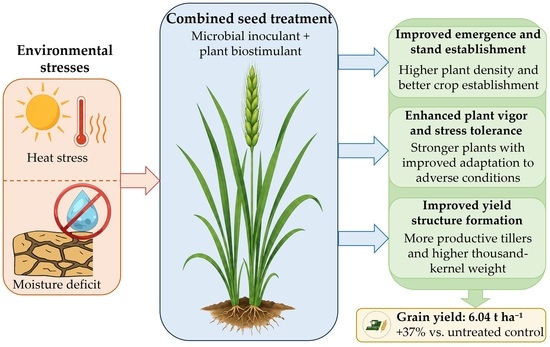
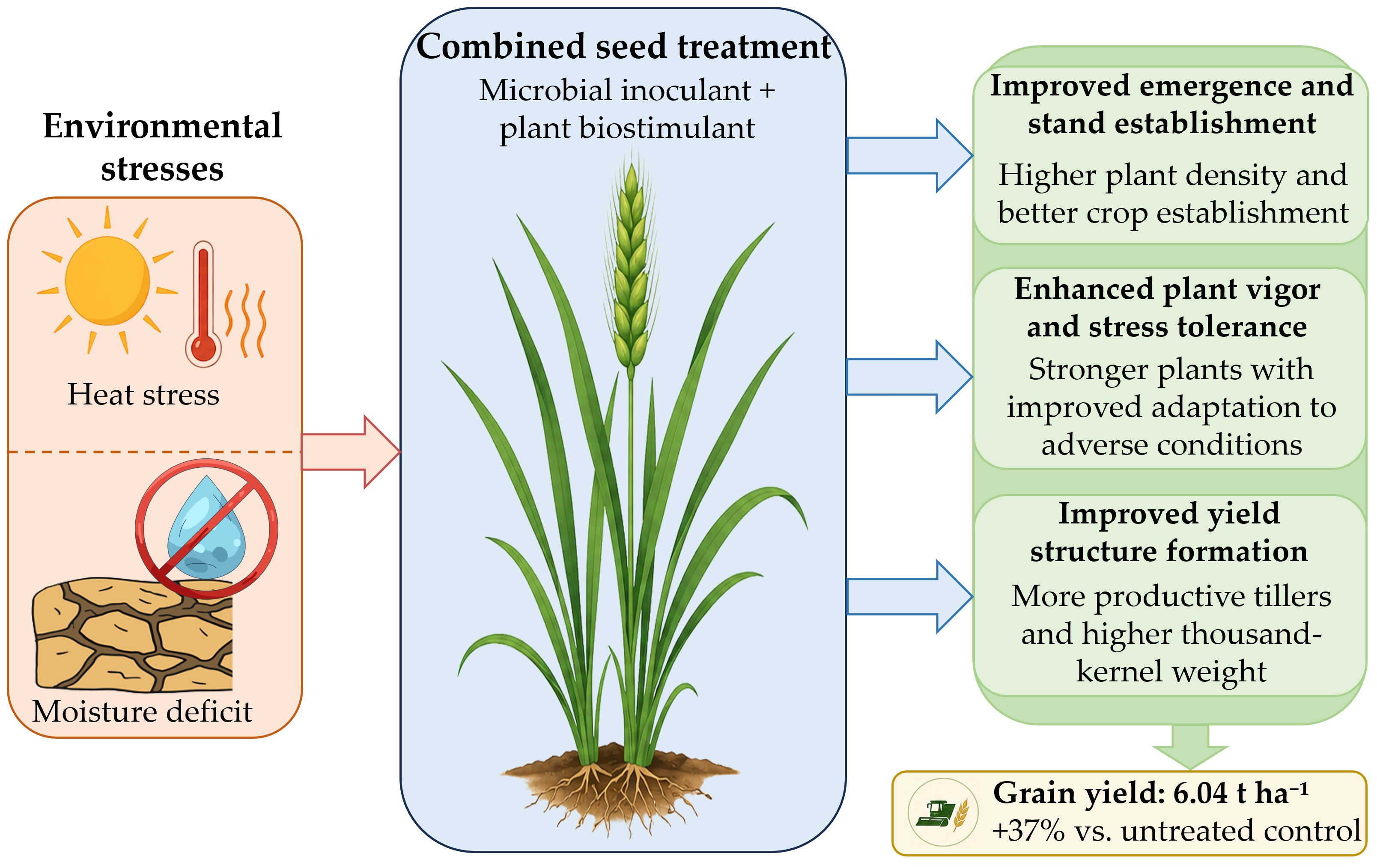
Graphical Abstract

1. Introduction

Wheat is one of the most important cereal crops in the global agri-food system due to its high economic value and multifunctional use. It serves both as a key feed grain and as a primary raw material for the food industry, particularly for high-quality products derived from premium grain classes [1,2]. In addition, a significant proportion of wheat production is oriented toward international trade, contributing to food security in importing countries and reinforcing its strategic role in the global agricultural market [3,4]. According to the Food and Agriculture Organization of the United Nations (FAO), global grain production is projected to exceed 3 billion tons for the first time in the 2025/2026 marketing year, reaching 3.003 billion tons [5], while wheat alone is expected to account for approximately 830 million tons, or 27.6% of total grain output [6].
In Ukraine, winter wheat remains a cornerstone of agricultural production. The projected gross harvest is estimated at 25 million tons, with exports reaching 15.4 million tons of cereals and pulses, including 7.9 million tons of wheat [7]. Winter wheat occupies 23% of the total sown area (5.04 million hectares), with an average yield of 4.56 t/ha [8]. However, despite its importance, the realized productivity of winter wheat remains substantially below the genetic potential of modern cultivars, which can reach 8–10 t/ha or higher [9,10,11]. This yield gap highlights the need for improved agronomic strategies aimed at enhancing crop performance under variable environmental conditions.
The limited realization of yield potential is a complex interaction of factors, including unfavorable weather conditions during the growing season [12,13,14], soil fertility degradation associated with anthropogenic pressure [15], inefficiencies in conventional fertilization systems [16,17], and increasing phytopathological stress coupled with the emergence of pathogen resistance to active substances [18]. These constraints are further exacerbated by climate variability, particularly under conditions of unstable moisture, which directly affects plant establishment, tillering, and grain formation.
In this context, modern wheat cultivation technologies must not only ensure high productivity but also meet the requirements of sustainable agricultural development. Ukraine’s prospective integration into the European Union necessitates alignment with the Farm to Fork (F2F) strategy [19], a key component of the European Green Deal [20]. This strategy aims to reduce the use of plant protection products by 50% and mineral fertilizers by 20% by 2030, while increasing the share of organically managed agricultural land to 25%. At the same time, studies conducted at the V.M. Remeslo Myronivka Institute of Wheat have shown that plant protection products and fertilizers contribute substantially to winter wheat yield formation, accounting for 27% and 17%, respectively, whereas the contribution of preceding crops is estimated at 14% [21,22,23]. Consequently, there is an urgent need to develop environmentally friendly and resource-efficient approaches that maintain productivity while reducing chemical inputs.
One promising direction is the use of innovative fertilizer systems and biological products. Modern controlled-release and targeted nutrient delivery technologies improve nutrient use efficiency and reduce environmental impacts [24,25,26,27]. At the same time, microbiological preparations have demonstrated their effectiveness in enhancing plant nutrition, suppressing soil-borne pathogens, and increasing crop yields under both experimental and field conditions [28,29]. These products, developed through the selection and genetic improvement of beneficial microorganisms, exhibit high biological activity and adaptability within agroecosystems [30,31,32]. Their application contributes to the biologization of crop production systems by improving nutrient availability and reducing reliance on mineral fertilizers and chemical pesticides [33].
In parallel, plant biostimulants represent another important technological approach to increasing crop productivity. These compounds, which include humates, protein hydrolysates, seaweed extracts, chitosan, and other bioactive substances, enhance plant physiological processes and stress tolerance [34,35]. They can be applied either as pre-sowing seed treatments or through foliar application [36,37]. In modern agricultural practice, multicomponent and multifunctional formulations are increasingly used due to their ability to simultaneously stimulate growth, improve nutrient uptake, and enhance plant resilience.
Despite the demonstrated benefits of both microbiological preparations and plant biostimulants [34,35,36,37], their combined application remains insufficiently studied, particularly under conditions of unstable moisture. The potential synergistic interactions between microbial inoculants and biostimulants, which may enhance plant establishment, optimize yield structure formation, and improve overall productivity, are not yet fully understood. Addressing this knowledge gap is essential for developing integrated and sustainable crop management strategies adapted to increasing climatic variability.
Therefore, the aim of this study was to evaluate the effects of pre-sowing seed treatment with the microbial inoculant Nando BioExpert and the biostimulant Vitazyme, applied individually and in combination, on plant density, yield components, and grain yield of winter wheat under conditions of unstable moisture in the Right-Bank Forest-Steppe of Ukraine.

2. Materials and Methods

2.1. Study Site and Soil Characteristics

The field experiment was conducted at the experimental station of Uman National University of Horticulture (Ukraine), located in the Mankivka natural–agricultural district of the Middle Dnipro–Bug region within the Right-Bank Forest-Steppe zone. The geographic coordinates of the site are 48°46′ N latitude and 30°14′ E longitude, at an altitude of 245 m above sea level. The experimental field is situated on a leveled watershed plateau with gentle slopes (2–3°) of southeastern and northwestern exposure, providing relatively uniform topographic conditions.
The soil of the study site is classified as podzolized chernozem with a heavy loam texture. The humus content in the topsoil layer (0–20 cm) ranges from 3.2 to 3.5%, while the degree of base saturation varies between 87 and 97%. The soil reaction is moderately acidic, with a pH of approximately 5.8–6.0. The bulk density of the topsoil is 1.26 g cm−3, total porosity is 51.5%, and maximum hygroscopicity is 6.45% (Table 1).

2.2. Weather Conditions

Weather conditions during the study period (2021–2024), based on data from the Uman meteorological station, were characterized by significant variability relative to long-term averages (Table 2), allowing assessment of treatment effects under contrasting moisture regimes.
The 2021–2022 growing season was marked by severe moisture deficit during the sowing period. In September, total precipitation amounted to 16.2 mm, which was 44.8 mm below the long-term average. This deficit, particularly during the early stages of crop establishment, adversely affected seed germination and emergence.
In contrast, the 2022–2023 growing season was characterized by favorable moisture conditions. Precipitation in September reached 99.2 mm, ensuring adequate soil moisture for germination and early plant development. Increased rainfall during late autumn (November–December) and sufficient precipitation in spring further promoted plant growth, resulting in generally favorable conditions for winter wheat cultivation.
During the 2023–2024 growing season, pronounced moisture deficits were observed in August and September (36.6 and 56.8 mm below average, respectively), leading to reduced field emergence. Subsequent precipitation in October (33.5 mm) partially improved crop development but did not fully compensate for the earlier deficit.
The temperature regime during the study period was characterized by a consistent increase above long-term averages. Annual deviations reached +0.5 °C in 2021–2022, +1.1 °C in 2022–2023, and +2.8 °C in 2023–2024, reflecting a trend toward warmer growing conditions.

2.3. Experimental Design and Crop Management

Sowing was conducted during the recommended agronomic period for winter wheat cultivation in the Right-Bank Forest-Steppe of Ukraine (September), while harvesting was performed at full physiological maturity in July of the following growing season.
The field experiment was conducted as a single-factor trial designed to evaluate the effects of pre-sowing seed treatment with a microbial inoculant and a plant biostimulant. The application rates were selected according to the manufacturers’ recommendations. The experimental treatments included (1) untreated control; (2) microbial inoculant Nando BioExpert (Nando, Kaunas, Lithuania) at 1.0 kg t−1; (3) plant biostimulant Vitazyme (Vital Earth Resources Inc., Gladewater, TX, USA) at 1.0 L t−1; and (4) combined application of the microbial inoculant and plant biostimulant at 1.0 kg t−1 + 1.0 L t−1, respectively.
In all treatments, seeds were additionally treated before sowing with the fungicidal seed dressing Lamardor Pro 180 FS, TH (Bayer AG, Leverkusen, Germany; prothioconazole 100 g L−1 + tebuconazole 60 g L−1 + fluopyram 20 g L−1) at a rate of 0.5 L t−1 to ensure protection against seed- and soil-borne pathogens.
Winter wheat (Triticum aestivum L.) cultivar “Oberih Myronivskyi” (erythrospermum type) was used in the experiment. This cultivar is characterized by high yield potential, medium maturity, winter hardiness, and tolerance to drought and heat stress. It exhibits resistance to lodging and major fungal diseases, including powdery mildew, brown rust, and Septoria leaf blotch. The 1000-kernel weight reaches 51.1 g, test weight is 807 g L−1, and crude protein content ranges from 12.8 to 13.6%, indicating good grain quality. The cultivar is well adapted to diverse environmental conditions and suitable for intensive cultivation systems.
The experiment was arranged in a randomized design with four replications. The total plot area was 576 m2, and the net plot area was 160 m2. The study was conducted in accordance with established agronomic research methodologies [38]. Winter wheat was sown at a rate of 5.0 million viable seeds per hectare using an SZ–3.6 seed drill (Elvorti JSC, Kropyvnytskyi, Ukraine). At sowing, Tarnogran mineral fertilizer (Zakłady Chemiczne “Siarkopol” Tarnobrzeg Sp. z o.o., Tarnobrzeg, Poland) was applied at a rate of 100 kg ha−1. In early spring, ammonium nitrate was applied on frozen–thawed soil at a rate of 110 kg ha−1 using a TERFED VU-3000 spreader (TerFed, Bila Tserkva, Ukraine).

2.4. Description of Preparations

Two commercial products were used in the study: a microbial inoculant (Nando BioExpert) and a plant biostimulant (Vitazyme).
Nando BioExpert (Nando, Lithuania) is a microbiological formulation designed to improve soil fertility and suppress soil-borne pathogens through biological processes such as nitrogen fixation, phosphate solubilization, and enhanced micronutrient availability. The product contains a consortium of beneficial microorganisms, including Paenibacillus azotofixans (1 × 10⁸ CFU/g), Bacillus megaterium (1 × 10⁸ CFU/g), Bacillus mucilaginosus (1 × 10⁸ CFU/g), Bacillus subtilis (1 × 10⁸ CFU/g), Bacillus licheniformis (5 × 10⁸ CFU/g), Bacillus mycoides (1 × 10⁸ CFU/g), Trichoderma viride (1 × 10⁷ CFU/g), and Serendipita indica (2.5 × 10⁶ CFU/g), with a total microbial concentration of 1 × 10⁹ CFU/g [39].
Vitazyme (Plant Designs, Inc., Rochester, NY, USA) is a liquid biostimulant derived from plant-based raw materials and produced through microbiological synthesis. Its active components include brassinosteroids (65–110 μg g−1), 1-triacontanol (60–90 μg g−1), and vitamins B1 (3–5 μg g−1), B2 (0.2–0.4 μg g−1), and B6 (1–3 μg g−1). These compounds enhance plant physiological activity, promote growth, and improve stress tolerance [40]. Previous studies have demonstrated the effectiveness of Vitazyme in improving seed germination and early plant development in cereal crops [41].

2.5. Data Collection and Yield Determination

Grain yield was determined by harvesting the entire accounting plot using a combine harvester. The harvested grain was subsequently adjusted to standard moisture content and 100% purity to ensure comparability across treatments.
To evaluate yield formation, sheaf samples were collected at maturity and analyzed for key yield components, including plant density (plants m−2), productive tiller density (tillers m−2), and thousand-kernel weight (g).

2.6. Statistical Analysis

The experimental data were analyzed by analysis of variance (ANOVA), appropriate for a one-factor field experiment arranged in a randomized complete block design with four replications. Treatment was considered a fixed effect, whereas replication was treated as a random effect. The analysis was conducted separately for each growing season because weather conditions differed across years, following the general procedures described for agricultural experiments by Mead et al. [42] and Gomez and Gomez [43].
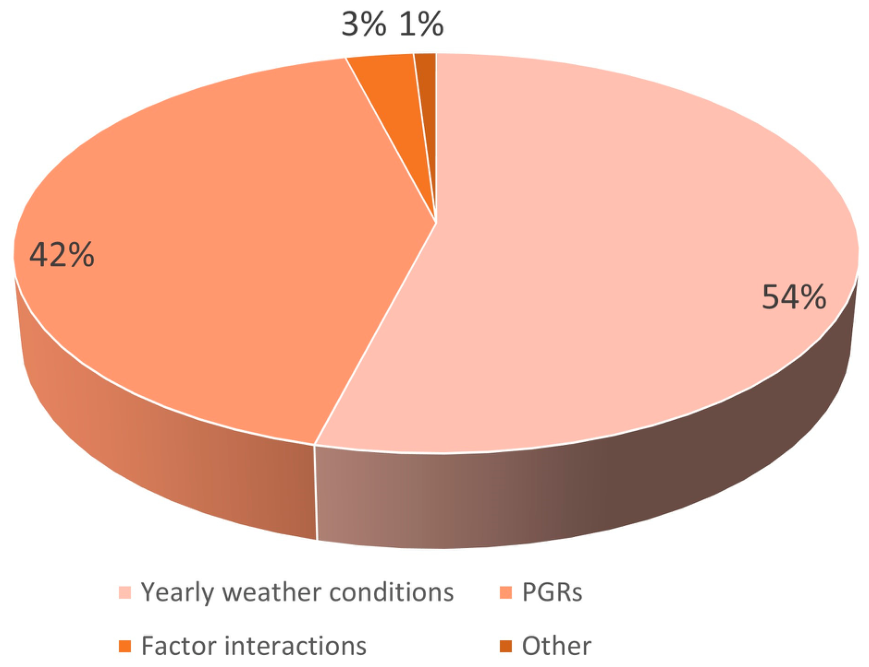
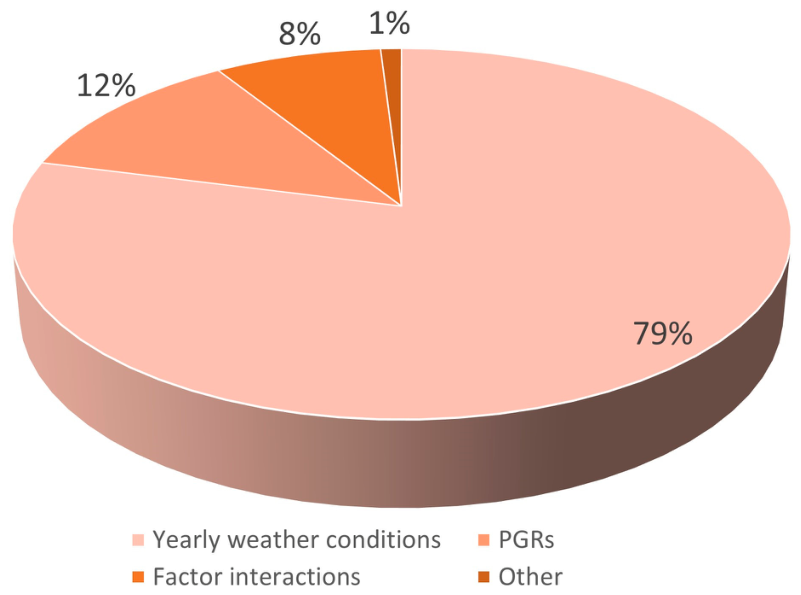
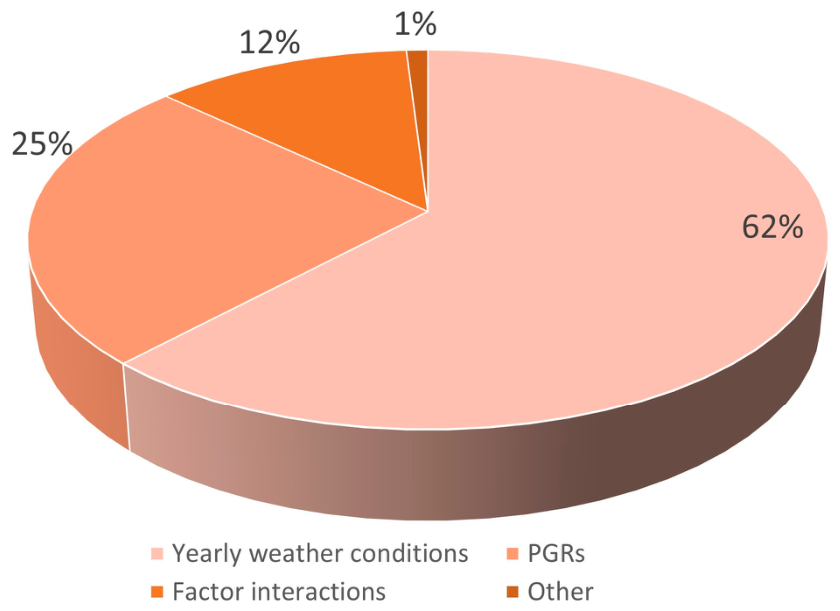
To evaluate the relative contribution of experimental factors to the variability of the studied traits, variance component analysis was performed based on two-way analysis of variance (ANOVA), considering weather conditions (growing years), treatment, and their interaction as sources of variation. The percentage contribution of each factor was calculated from the corresponding sums of squares relative to the total sum of squares. Residual unexplained variation was grouped as “Other.” The obtained proportions were used to construct Figure 1, Figure 2 and Figure 3 illustrating the influence of weather conditions, plant growth regulators (PGRs), and factor interactions on trait formation.
Data are presented as the arithmetic mean (M) ± standard deviation (SD). When ANOVA indicated significant treatment effects, mean comparisons among treatments were performed using Tukey’s honest significant difference test. Differences were considered statistically significant at p ≤ 0.05.
Absolute yield increase was calculated as the difference between the treatment mean and the untreated control. Relative yield increase was expressed as a percentage of the control treatment.

3. Results and Discussion

3.1. Plant Establishment as a Stress-Sensitive Response

Plant establishment proved to be the most responsive stage to pre-sowing seed treatment, particularly under moisture-limited conditions [44]. Representative photographs of the experimental plots during different growth stages and moisture conditions are presented in Supplementary Figure S1. Plant density at emergence varied from 180 to 451 plants m−2 (Table 3), reflecting strong interannual variability driven by rainfall distribution during sowing.
In the untreated control, plant density remained consistently low (180–351 plants m−2), indicating poor establishment under suboptimal moisture conditions. In contrast, the combined application of the microbial inoculant and plant biostimulant resulted in substantially higher plant densities (323–451 plants m−2). Notably, the magnitude of this effect was strongly environment-dependent. Under moisture deficit (2022 and 2024), plant density increased by 79.4% and 75.9%, respectively, whereas under favorable conditions (2023), the increase was limited to 28.5%.
This pattern indicates that the treatment primarily enhances stress resilience rather than baseline growth. The improved establishment under stress conditions can be attributed to enhanced seed vigor, microbial-mediated nutrient mobilization, and stimulation of early metabolic processes. On average, plant density increased to 372 plants m−2, exceeding the control by 53.7%.
Variance analysis confirmed that treatment (54%) and weather conditions (42%) were the dominant factors controlling plant density, with minimal interaction (3%) (Figure 1). From a systems agronomy perspective, early plant establishment represents a critical control point in crop productivity, as it determines the efficiency of subsequent resource capture and canopy development [45,46,47]. Enhancing this stage through biological inputs can therefore improve overall system resilience under climatic variability.

3.2. Yield Structure Formation: Differential Sensitivity of Components

Yield formation in winter wheat is governed by structurally distinct components that differ in their sensitivity to environmental and agronomic factors [48,49]. Productive tiller density exhibited high responsiveness to both moisture availability and treatment (Table 4), whereas thousand-kernel weight showed comparatively lower plasticity.
Productive tiller density ranged from 254 to 541 tillers m−2, with maximum values observed in 2023 under favorable moisture conditions. Under drought conditions (2022 and 2024), tillering was constrained; however, the combined treatment consistently mitigated this limitation, resulting in the highest tiller densities across all years (381–541 tillers m−2). On average, productive tiller density increased by 43.1% compared with the control.
This response suggests that tillering is a key target for agronomic intervention, particularly under stress conditions. The observed effect can be explained by improved root system development, enhanced nutrient acquisition, and hormonal stimulation of lateral shoot formation. From a functional perspective, increased tillering enhances canopy architecture and radiation interception efficiency, which are critical drivers of biomass accumulation and yield formation [50,51].
In contrast, thousand-kernel weight showed a more stable response, increasing from 47.0 g in the control to 48.1–48.6 g in treated variants. Variance analysis indicated that this parameter was primarily determined by weather conditions (79%), with a relatively minor contribution from treatment (12%) (Figure 2). This confirms that grain filling is predominantly controlled by environmental factors, particularly water availability and temperature during the reproductive phase.
Thus, the applied treatments primarily influenced yield through improvements in plant establishment and stand-level productive tiller density per unit area (tillers m−2), while their effect on grain filling was secondary but consistent.

3.3. Grain Yield Formation and Synergistic Effects

Grain yield reflected the integrated response of crop establishment and yield structure formation (Table 5). Across all years, the combined treatment consistently produced the highest yields, demonstrating a stable and reproducible effect.
In 2022, characterized by moisture deficit, yield increased from 3.79 to 4.81 t ha−1 (+26.9%). In 2023, under favorable conditions, yield ranged from 4.17 to 6.08 t ha−1, with the combined treatment achieving the largest relative increase (+45.8%). In 2024, despite early-season drought stress, the combined treatment again produced the highest yield (7.23 t ha−1), 36.9% higher than the control.
On average, yield increased from 4.41 t ha−1 in the control to 6.04 t ha−1 under the combined treatment (+37%). Importantly, the individual application of the microbial inoculant and plant biostimulant resulted in similar yield gains (~24%), whereas their combined application produced a substantially greater effect. This clearly indicates a synergistic interaction rather than an additive response.
The observed synergy likely arises from complementary mechanisms: microbial inoculants enhance nutrient availability and root–soil interactions, while biostimulants stimulate physiological processes, including photosynthesis and stress response pathways. Together, these effects improve both resource acquisition and utilization efficiency. Such integrated biological approaches align with the concept of ecological intensification, where productivity gains are achieved through optimization of biological processes rather than increased external inputs [52,53,54].
These findings are consistent with previous studies reporting yield increases following the application of biological products in winter wheat [55] and biostimulants [27], although the magnitude of the effect observed in the present study highlights the importance of combined application.
Variance analysis further confirmed that yield formation was predominantly influenced by weather conditions (62%), with treatment contributing 25% and their interaction 12% (Figure 3). This indicates that while environmental conditions remain the primary driver of yield, targeted agronomic interventions can significantly enhance crop performance.

3.4. Functional Relationships Among Yield Components

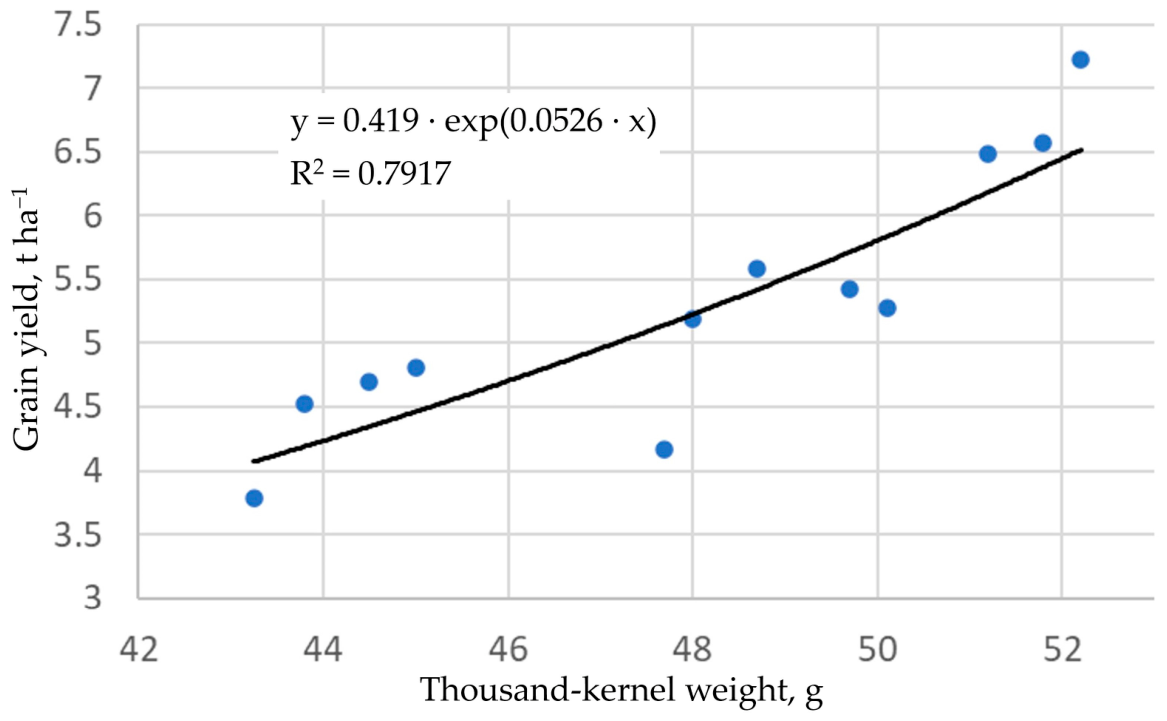
Correlation analysis revealed a strong positive relationship between thousand-kernel weight and grain yield (R2 = 0.7917) (Figure 4), indicating that approximately 79% of yield variability can be explained by variation in grain weight. This highlights the importance of grain filling as a determinant of final productivity.
The positive correlation suggests that incremental increases in thousand-kernel weight result in disproportionate gains in yield, particularly at higher productivity levels. This finding underscores the importance of maintaining favorable conditions during the grain-filling period, as well as the role of treatments that enhance physiological efficiency.
From a systems perspective, yield formation can be viewed as the outcome of coordinated processes governing resource capture (establishment and canopy development) and resource utilization (grain filling). The results of this study demonstrate that the combined use of microbial inoculants and biostimulants effectively strengthens both processes, contributing to improved yield stability under variable environmental conditions. Such approaches are increasingly recognized as essential components of sustainable cropping systems aimed at maintaining productivity while reducing dependence on synthetic inputs [56,57].
The improvement in plant density and yield structure may be explained by the complementary biological functions of the two products. Nando BioExpert contains several plant growth-promoting microorganisms. Species of Bacillus and Paenibacillus are widely reported to support plant growth through nitrogen fixation, phosphate solubilization, production of phytohormones, siderophore formation, and improved nutrient availability in the rhizosphere. These mechanisms can enhance early root growth, nutrient acquisition, and seedling establishment, particularly under moisture stress [58]. Trichoderma spp. may further contribute by stimulating root development, improving micro- and macronutrient uptake, suppressing soil-borne pathogens, and increasing plant tolerance to abiotic stress [59]. In addition, Serendipita indica is known as a beneficial root endophyte that can promote plant growth and improve drought tolerance through enhanced water and nutrient uptake, antioxidant activity, and better physiological performance under stress [60].
The increase in grain yield was therefore not only a consequence of higher initial plant density, but also of improved yield structure formation. The higher productive tiller density observed under the combined treatment suggests that better crop establishment was followed by more effective tiller survival and/or productive tiller formation. However, because individual tillering capacity per plant was not directly measured, it cannot be concluded whether the increase in productive tiller density per unit area (tillers m−2) resulted mainly from a greater number of established plants or from enhanced tillering of individual plants. Vitazyme may have contributed to this response through its bioactive compounds, including brassinosteroids, triacontanol, and vitamins, which are known to stimulate germination, root development, photosynthetic activity, and stress tolerance [61]. The synergistic effect of Nando BioExpert and Vitazyme may therefore be associated with the simultaneous improvement of rhizosphere nutrient availability by microorganisms and physiological stimulation of seedling growth by the biostimulant. Nevertheless, nutrient uptake, nitrogen status, chlorophyll content, SPAD values, and microbial colonization were not directly measured in the present study. Therefore, the proposed mechanisms should be considered as literature-supported explanations, and future studies should include physiological, biochemical, and microbiological measurements to confirm the causal pathways involved.
The present study was limited to field evaluation under one soil type and climatic region, while physiological and biochemical parameters such as nutrient uptake, chlorophyll content, and root architecture were not directly measured. Future studies should investigate the physiological and microbiological mechanisms underlying the observed synergistic effects and evaluate treatment performance across broader environmental conditions and wheat genotypes.

4. Conclusions

Under conditions of unstable moisture in the Right-Bank Forest-Steppe of Ukraine, pre-sowing seed treatment combining a microbial inoculant and a plant biostimulant proved to be the most effective strategy among the tested treatments. Over the three-year study period, the combined treatment increased grain yield to 6.04 t ha−1, exceeding the untreated control by 1.63 t ha−1 (37.0%). The yield improvement was primarily associated with enhanced crop establishment and stand-level yield structure formation, including increased plant density (+53.7%) and productive tiller density per unit area (+43.1%; tillers m−2), while thousand-kernel weight showed a comparatively smaller increase (+3.4%). These findings indicate that the treatment effect was mainly expressed through improved early crop establishment and increased stand-level productive tiller density per unit area (tillers m−2), both of which are critical for yield formation under moisture-limited conditions.
The superior performance of the combined treatment compared with individual applications demonstrates a clear synergistic interaction between microbial inoculants and plant biostimulants, likely associated with complementary effects on nutrient availability, root development, and plant physiological activity. Overall, the results highlight the potential of integrated biological seed treatments as a sustainable agronomic approach for improving winter wheat productivity and resilience under climatic variability while reducing dependence on mineral fertilizers and chemical inputs in accordance with the principles of ecological intensification and the Farm to Fork strategy.

Supplementary Materials

The following supporting information can be downloaded at: https://www.mdpi.com/article/10.3390/crops6030056/s1, Figure S1: Representative photographs of winter wheat experimental plots during different stages of crop development under field conditions in the Right-Bank Forest-Steppe of Ukraine. The images illustrate crop establishment, plant density, vegetative growth, and grain maturation under contrasting moisture conditions during the experimental period (2021–2024). (a) Early crop establishment after emergence; (b) winter wheat stands during vegetative development under moisture-deficit conditions; (c) experimental plots during active spring growth; (d) winter wheat at grain maturation stage before harvest.

Author Contributions

Conceptualization and methodology, O.K. and U.K.; formal analysis, A.L. and O.T.; validation, I.S. and V.V.; writing—original draft preparation, O.K. and U.K.; visualization, V.H. and O.B.; writing—review and editing, O.B. and V.H. All authors have read and agreed to the published version of the manuscript.

Funding

This research received no external funding.

Data Availability Statement

The original contributions presented in this study are included in the article. Further inquiries can be directed to the corresponding author.

Conflicts of Interest

The authors declare no conflicts of interest.

References

  1. Boiko, P.; Demydenko, O.; Shapoval, I.; Kovalenko, N. Efficient winter wheat cultivation in high-productivity different-field crop rotations under the conditions of unstable moisture in the Forest-Steppe zone of Ukraine. Sci. Rep. Natl. Univ. Life Environ. Sci. Ukr. 2024, 20, 77–90. [Google Scholar] [CrossRef] [Scilit]
  2. Karbivska, U.; Myroniuk, I.; Degtyarjov, V.; Senyk, I.; Mykytyn, I.; Voitsekhivska, O.; Voitsekhivskyi, V.; Tytun, O.; Krasnoshtan, V.; Lytvynov, V. Effect of fertilizer application on yield and elemental composition of maize in the western region of Ukraine. J. Ecol. Eng. 2025, 26, 178–186. [Google Scholar] [CrossRef] [Scilit] [PubMed]
  3. Smirnova, I.V. The effect of pre-sowing treatment of seeds with biological preparations on the growth and development of plants of winter wheat varieties. Agrar. Innov. 2023, 18, 114–119. [Google Scholar] [CrossRef] [Scilit]
  4. Drobitko, A.V.; Smirnova, I.V.; Bacean, I. Productivity of winter wheat depending on pre-sowing seed treatment under the conditions of southern Ukraine. Agrar. Innov. 2025, 29, 312–318. [Google Scholar] [CrossRef] [Scilit]
  5. Food and Agriculture Organization of the United Nations. Cereal Supply and Demand Brief. 2025. Available online: https://www.fao.org/worldfoodsituation/csdb/en (accessed on 14 June 2026).
  6. The International Grains Council. The International Grains Council Has Raised Its Forecast for Global Wheat Production in 2025/26 by 3 Million Tons. 2025. Available online: https://www.tridge.com/news/the-international-grains-council-has-raised--dstkyv (accessed on 14 June 2026).
  7. Ministry of Agrarian Policy and Food of Ukraine. Export of Grains, Legumes and Flour from Ukraine. 2026. Available online: https://minagro.gov.ua/napryamki/eksport-do-krain-ies/eksport-z-ukrayini-zernovih-zernobobovih-ta-boroshna (accessed on 14 June 2026).
  8. State Statistics Service of Ukraine. Crop Areas by Type. 2025. Available online: https://www.ukrstat.gov.ua (accessed on 14 June 2026).
  9. Los, R.; Dubovyk, N. Research of modern varieties of winter wheat according to productivity depending on growing conditions. Agrobìologìâ 2022, 2, 119–129. [Google Scholar] [CrossRef] [Scilit]
  10. Barabolia, O.V.; Yanovskyi, R.O. Yield capacity of modern soft winter wheat varieties in the conditions of Kirovohrad region. Agrar. Innov. 2024, 21, 12–21. [Google Scholar] [CrossRef] [Scilit]
  11. Khomina, V.Y.; Sheiko, D.V. Elements of biologization as a means of improving the technological indicators and quality composition of winter wheat grain in the western forest-steppe. Podilian Bull. Agric. Eng. Econ. 2023, 39, 35–40. [Google Scholar] [CrossRef] [Scilit]
  12. Solodushko, M.M. Yield and adaptive potential of modern varieties of soft winter wheat in the Northern Steppe conditions. Plant Var. Stud. Prot. 2014, 3, 61–66. [Google Scholar] [CrossRef] [Scilit]
  13. Marenych, M.M.; Yurchenko, S.O. Influencing of Pre-Sowing Seed Treatment with the Biologically Active Substances on Growth and Development of Plants of Wheat Winter on the Initial Stages. Bull. Poltava State Agrar. Acad. 2017, 28, 38–42. [Google Scholar] [CrossRef] [Scilit]
  14. Rysin, A.; Demydov, O.; Volohdina, H.; Fedorenko, M. Features of the manifestation of biometric indicators in varieties and breeding lines of winter bread wheat at spring renewal of vegetation date in the forest steppe of Ukraine. Sci. Rep. Natl. Univ. Life Environ. Sci. Ukr. 2024, 20. [Google Scholar] [CrossRef] [Scilit]
  15. Shuvar, A.; Senyk, I.; Chubaryk, M.; Pankevych, V.; Orynyk, B.; Brovko, O.; Chubko, O.; Zhuk, M. Phosphate regime of the soils of the Ternopil region. Agroscience Pract. 2024, 3, 24–28. [Google Scholar] [CrossRef] [Scilit] [PubMed]
  16. He, G.; Xie, W.; Fan, L.; Mi, X.; Wang, Z. Innovation and application of technology models for wheat green production in China. Front. Agric. Sci. Eng. 2025, 12, 519–529. [Google Scholar] [CrossRef] [Scilit]
  17. Mathlouthi, F.; Ruggeri, R.; Rossini, A.; Rossini, F. A New Fertilization Approach for Bread Wheat in the Mediterranean Environment: Effects on Yield and Grain Protein Content. Agronomy 2022, 12, 2152. [Google Scholar] [CrossRef] [Scilit]
  18. Wang, N.; Scherm, H. Key Discoveries in Plant Pathology During the Past Half Century: Impacts on the Life Sciences and on Plant Disease Management. Phytopathology® 2023, 113, 588–593. [Google Scholar] [CrossRef] [Scilit] [PubMed]
  19. European Commission. Farm to Fork Strategy. Available online: https://food.ec.europa.eu/horizontal-topics/farm-fork-strategy_en (accessed on 14 June 2026).
  20. European Commission. The European Green Deal. Available online: https://commission.europa.eu/strategy-and-policy/priorities-2019-2024/european-green-deal_en (accessed on 14 June 2026).
  21. Kovalyshyna, H.; Dmytrenko, Y.; Karelov, A.; Sozinov, I.; Kozub, N.; Humenyuk, O.; Mukha, T. Characteristics of new varieties of winter common wheat breeding of the myronivka institute of wheat as the allelic state of the lr34 leaf rust resistance gene. Bìoresursi ì Prir. 2018, 10, 139–146. [Google Scholar] [CrossRef] [Scilit]
  22. Shypp, A.; Kovalyshyna, H. Comparative analysis of yield potential of winter wheat hybrids of the new generation from the originator of the saaten-union gmbh group. Sci. Rep. Natl. Univ. Life Environ. Sci. Ukr. 2024, 20. [Google Scholar] [CrossRef] [Scilit]
  23. Hetman, N.; Karbivska, U.; Tkachuk, O.; Gamajunova, V.; Kurhak, V.; Senyk, I.; Stotska, S.; Kulyk, R.; Hryhoriv, Y.; Tytun, O. The role of Medicago sativa L. in the ecologization of agricultural production. Ecol. Eng. Env. Technol. 2025, 26, 342–349. [Google Scholar] [CrossRef] [Scilit] [PubMed]
  24. Balawejder, M.; Szostek, M.; Gorzelany, J.; Antos, P.; Witek, G.; Matłok, N. A Study on the Potential Fertilization Effects of Microgranule Fertilizer Based on the Protein and Calcined Bones in Maize Cultivation. Sustainability 2020, 12, 1343. [Google Scholar] [CrossRef] [Scilit]
  25. Bielashov, O.; Rozhkov, A.; Kalenska, S.; Karpuk, L.; Marenych, M.; Kuts, O.; Zaitseva, I.; Romanov, O.; Muzafarov, N. Influence of Pre-Sowing Application of Mineral Fertilizers, Root and Foliar Nutrition on Productivity of Winter Tritical Plants. Ecol. Eng. Env. Technol. 2022, 23, 1–14. [Google Scholar] [CrossRef] [Scilit] [PubMed]
  26. Kalenska, S.; Shutyi, O.; Antal, T.; Sonko, R.; Krivov, S. Efficiency of pre-sowing application of complex fertilizers in cultivation technology of soft winter wheat. Sci. Rep. Natl. Univ. Life Environ. Sci. Ukr. 2024, 20. [Google Scholar] [CrossRef] [Scilit]
  27. Kalenska, S.; Shutyi, O.; Antal, T.; Sonko, R.; Kalenskyi, V. Efficiency of pre-sowing wheat seed treatment with a biostimulant. Adv. Agritechnologies 2025, 13, 1–8. [Google Scholar] [CrossRef] [Scilit]
  28. Vinyukov, O.; Chuhrii, H.; Poplevko, V.; Szulc, P.; Sknypa, N. Influence of microbiological preparations on physiological processes of formation of grain productivity of winter wheat. Sci. Prog. Innov. 2022, 2, 11–20. [Google Scholar] [CrossRef] [Scilit]
  29. Vlasiuk, O. Efficacy of microbial preparations in growing spring wheat depending on the fertilization background. Agric. Microbiol. 2020, 31, 51–56. [Google Scholar] [CrossRef] [Scilit]
  30. Bondar, V.; Makarenko, N. Method ecological evaluation of technologies winter wheat growing by influence on soil fertility. Bìoresursi ì Prir. 2018, 10, 129–138. [Google Scholar] [CrossRef] [Scilit]
  31. Shakaliy, S.; Bahan, A.; Yeshchenko, V.; Senchuk, T. Effectiveness of biological elements of winter wheat production technology in the Forestry zone of Ukraine. Taurian Sci. Bull. 2020, 112, 174–180. [Google Scholar] [CrossRef] [Scilit]
  32. Tonkha, O.; Bykin, A. Winter wheat productivity under conditions of uneven fertiliser distribution during application. Sci. Rep. Natl. Univ. Life Environ. Sci. Ukr. 2025, 21, 37–49. [Google Scholar] [CrossRef] [Scilit]
  33. Stamenković, S.; Beškoski, V.; Karabegović, I.; Lazić, M.; Nikolić, N. Microbial fertilizers: A comprehensive review of current findings and future perspectives. Span. J. Agric. Res. 2018, 16, e09R01. [Google Scholar] [CrossRef] [Scilit]
  34. Orlovsky, M.; Tymoshchuk, T.; Konopchuk, O.; Voitsehivsky, V.; Didur, I. The effect of growth technology features on the productivity of winter wheat in the context of Ukrainian Western Polissia. Sci. Horiz. 2019, 84, 77–85. [Google Scholar] [CrossRef] [Scilit]
  35. Yatsukh, K.; Prystatska, O.; Nikishycheva, K.; Tymchuk, I. The influence of the complex application of poisons, growth stimulants and microfertilizers for pre-sowing seed treatment on root rot affection and productivity of winter wheat. Foothill Mt. Agric. Stock. 2023, 74, 164–183. [Google Scholar] [CrossRef] [Scilit]
  36. Amjad Bashir, M.; Rehim, A.; Raza, Q.-U.-A.; Raza, H.M.A.; Zhai, L.; Liu, H.; Wang, H. Biostimulants as plant growth stimulators in modernized agriculture and environmental sustainability. In Technology in Agriculture; Ahmad, F., Sultan, M., Eds.; IntechOpen: London, UK, 2021. [Google Scholar] [CrossRef] [Scilit]
  37. Abobatta, W.F.; Al-Taey, D.K.A. Organic compounds as antistress stimulants in plants: Responses and mechanisms. In Plant Stress Mitigators: Types, Techniques and Functions; Ghorbanpour, M., Shahid, M.A., Eds.; Academic Press: London, UK, 2023; pp. 415–424. [Google Scholar] [CrossRef] [Scilit]
  38. Ermantraut, E.; Karpuk, L.; Vakhnii, S.; Kozak, L.; Pavlichenko, A.; Filipova, L. Methods of Scientific Research in Agronomy: Textbook; Bio Expert: Bila Tserkva, Ukraine, 2018. (In Ukrainian) [Google Scholar]
  39. Nando. BioNPK Powder S. 2026. Available online: https://www.nandobio.com/biostimulants (accessed on 14 June 2026).
  40. Plant Designs, Inc. Vitazyme. Available online: http://www.plantdesigns.com/vitazyme/ (accessed on 14 June 2026).
  41. Kurhak, V.H.; Krasiuk, L.M.; Zhuk, M.M.; Senyk, I.I.; Sydoruk, H.P. Method of Pre-Sowing Treatment of Winter Rye Seeds. Ukraine Patent No. 156345; Application No. u202304656, 12 June 2024. [Google Scholar]
  42. Mead, R.; Curnow, R.N.; Hasted, A.M. Statistical Methods in Agriculture and Experimental Biology, 3rd ed.; CRC Press: Boca Raton, FL, USA, 2002. [Google Scholar]
  43. Gomez, K.A.; Gomez, A.A. Statistical Procedures for Agricultural Research, 2nd ed.; John Wiley & Sons: New York, NY, USA, 1984. [Google Scholar]
  44. Jauregui-Besó, J.; Gracia-Romero, A.; Carrera, C.; Lopes, M.; Araus, J.; Kefauver, S. Winter wheat plant density determination: Robust predictions across varied agronomic conditions using multiscale RGB imaging. Smart Agric. Technol. 2025, 11, 100921. [Google Scholar] [CrossRef] [Scilit]
  45. Albarenque, S.; Basso, B.; Davidson, O.; Maestrini, B.; Melchiori, R. Plant emergence and maize (Zea mays L.) yield across multiple farmers’ fields. Field Crops Res. 2023, 302, 109090. [Google Scholar] [CrossRef] [Scilit]
  46. Zhang, Y.; Yang, X.; Ling, X.; Cui, K.; Huang, J.; Peng, S.; Xiong, D. Leaf width expansion and biomass allocation, rather than photosynthetic rate, drive early vigor in newly developed rice lines. J. Exp. Bot. 2026, erag110. [Google Scholar] [CrossRef] [Scilit] [PubMed]
  47. Virk, G.; Snider, J.; Pilon, C. Physiological Contributors to Early Season Whole-Crop Vigor in Cotton. Crop Sci. 2019, 59, 2774–2783. [Google Scholar] [CrossRef] [Scilit]
  48. Havryliuk, I.; Kovalyshyna, H. Characteristics of soft winter wheat varieties by crop structure and grain quality indicators. Ukr. Black Sea Reg. Agrar. Sci. 2024, 28, 68–84. [Google Scholar] [CrossRef] [Scilit]
  49. Lykhochvor, V.; Aliokhin, V. Formation of winter wheat yield depending on sowing dates. Bull. Lviv. Natl. Environ. Univ. Ser. Agron. 2025, 29, 73–79. [Google Scholar] [CrossRef] [Scilit]
  50. Patil, S.; Jobanputra, A.; Upadhye, V.; Mujahid, M.; Ahmed, S. Field evaluation of novel PGPM consortium bioinoculants for growth regulation and yield enhancement in bread wheat (Triticum aestivum L.) and maize (Zea mays L.). BMC Plant Biol. 2025, 26, 78. [Google Scholar] [CrossRef] [Scilit] [PubMed]
  51. Hřivna, L.; Maco, R.; Dufková, R.; Kouřilová, V.; Burešová, I.; Gregor, T. Effect of weather, nitrogen fertilizer, and biostimulators on the root size and yield components of Hordeum vulgare. Open Agric. 2024, 9, 20220270. [Google Scholar] [CrossRef] [Scilit]
  52. Rouphael, Y.; Colla, G. Synergistic Biostimulatory Action: Designing the Next Generation of Plant Biostimulants for Sustainable Agriculture. Front. Plant Sci. 2018, 9, 1655. [Google Scholar] [CrossRef] [PubMed]
  53. Ain, Q.; Hussain, H.; Zhang, Q.; Maqbool, F.; Ahmad, M.; Mateen, A.; Zheng, L.; Imran, A. Coordinated influence of Funneliformis mosseae and different plant growth-promoting bacteria on growth, root functional traits, and nutrient acquisition by maize. Mycorrhiza 2024, 34, 477–488. [Google Scholar] [CrossRef] [Scilit] [PubMed]
  54. Pathak, D.; Suman, A.; Dass, A.; Sharma, P.; Krishnan, A.; Gond, S. Enhancing wheat growth and nutrient content through integrated microbial and non-microbial biostimulants. Physiol. Plant. 2024, 176, e14485. [Google Scholar] [CrossRef] [Scilit] [PubMed]
  55. Hamaiunova, V.V.; Panfilova, A.V. Repayment of co-using fertilizers and foliar nutrition biopreparations on crops of winter wheat in the Southern Steppe of Ukraine. Sci. Prog. Innov. 2019, 1, 41–48. [Google Scholar] [CrossRef] [Scilit]
  56. Pretty, J. Intensification for redesigned and sustainable agricultural systems. Science 2018, 362, eaav0294. [Google Scholar] [CrossRef] [Scilit] [PubMed]
  57. Rockström, J.; Williams, J.; Daily, G.; Noble, A.; Matthews, N.; Gordon, L.; Wetterstrand, H.; DeClerck, F.; Shah, M.; Steduto, P.; et al. Sustainable intensification of agriculture for human prosperity and global sustainability. Ambio 2016, 46, 4–17. [Google Scholar] [CrossRef] [Scilit] [PubMed]
  58. Wang, J.; Li, R.; Zhang, H.; Wei, G.; Li, Z. Beneficial bacteria activate nutrients and promote wheat growth under conditions of reduced fertilizer application. BMC Microbiol. 2020, 20, 38. [Google Scholar] [CrossRef] [Scilit] [PubMed]
  59. Guzmán-Guzmán, P.; Etesami, H.; Santoyo, G. Trichoderma: A multifunctional agent in plant health and microbiome interactions. BMC Microbiol. 2025, 25, 434. [Google Scholar] [CrossRef] [Scilit] [PubMed]
  60. Saleem, S.; Sekara, A.; Pokluda, R. Serendipita indica—A Review from Agricultural Point of View. Plants 2022, 11, 3417. [Google Scholar] [CrossRef] [Scilit] [PubMed]
  61. Chakma, S.; Chileshe, S.; Thomas, R.; Krishna, P. Cotton Seed Priming with Brassinosteroid Promotes Germination and Seedling Growth. Agronomy 2021, 11, 566. [Google Scholar] [CrossRef] [Scilit]
Figure 1. Effect of weather conditions and the application of different growth-stimulating preparations on the formation of plant density.
Crops 06 00056 g001
Figure 2. Influence of weather conditions and application of different growth-stimulating preparations on the formation of 1000-kernel weight.
Crops 06 00056 g002
Figure 3. Effect of weather conditions and the application of various growth-stimulating preparations on total yield formation.
Crops 06 00056 g003
Figure 4. Relationship between thousand-kernel weight (g) and grain yield (t ha−1) of winter wheat under different seed treatments during 2022–2024. Blue dots represent observed data points, and the black solid line indicates the fitted exponential regression curve.
Crops 06 00056 g004
Table 1. Physical and hydrophysical properties of podzolized chernozem.
IndicatorGenetic Horizons
HeHpiPhiPi(h)Pk
Bulk density, g cm−31.261.341.401.381.38
Particle density, g cm−32.602.652.652.702.70
Total porosity, %51.549.447.248.948.9
Content of fraction < 0.01 mm (physical clay), %42.543.745.248.648.1
Maximum hygroscopicity, %6.455.264.605.105.20
Wilting moisture content, %10.18.507.407.507.30
Field capacity (minimum water-holding capacity), %16.214.617.117.418.0
Table 2. Precipitation regime during the research years (Uman meteorological station), mm.
Month2021–20222022–20232023–2024Long-Term Average Precipitation Total
Ten-Day PeriodsMonthly Total Ten-Day PeriodsMonthly Total Ten-Day PeriodsMonthly Total
IIIIIIIIIIIIIIIIII
August37.94.927.169.930.314.10.044.412.40.00.012.449
September1.27.37.716.218.261.619.499.21.75.50.04.261
October0.07.00.07.04.30.15.010.02.421.69.533.543
November8.54.18.621.20.046.225.671.818.915.927.562.343
December46.425.119.791.27.531.713.953.110.837.57.255.040
January10.06.47.523.93.00.52.56.013.910.25.729.838
February5.21.30.77.25.22.812.520.59.25.10.614.934
March12.50.90.013.40.011.615.627.20.050.738.889.536
April23.010.224.557.780.235.513.91300.026.429.856.241
May0.03.319.122.40.00.042.442.46.20.035.641.852
June14.010.711.636.30.60.514.715.814.042.50.056.581
July1.027.10.028.129.71.461.492.50.40.017.517.968
Total---394 612 417586
Table 3. Winter wheat plant density as affected by pre-sowing seed treatment, plants m−2.
Experimental TreatmentsYears
202220232024Average for
2022–2024
Plant Density, Plants m−2Relative to Control, %Plant Density, Plants m−2Relative to Control, %Plant Density, Plants m−2Relative to Control, %Plant Density, Plants m−2Relative to Control, %
Control180 ± 9 b-351 ± 14 c-195 ± 11 c-242-
Nando BioExpert300 ± 13 a167405 ± 14 b115312 ± 14 b160339140
Vitazyme310 ± 15 a172425 ± 15 ab121320 ± 14 ab164352145
Nando BioExpert + Vitazyme323 ± 15 a179451 ± 16 a128343 ± 14 a175372153
Values are presented as M ± SD of four replicates (n = 4). Means within the same column followed by different letters differ significantly at p ≤ 0.05 according to Tukey’s test.
Table 4. Yield structure components of winter wheat as affected by pre-sowing seed treatment.
Experimental TreatmentsYears
202220232024Average for
2022–2024
Density of Productive Tillers, Tillers m−2Thousand Kernel Weight, gDensity of Productive Tillers, Tillers m−2Thousand Kernel Weight, gDensity of Productive Tillers, Tillers m−2Thousand Kernel Weight, gDensity of Productive Tillers, Tillers m−2Thousand Kernel Weight, g
Control260 ± 10 b43.3 ± 0.8 a420 ± 14 c47.7 ± 1.0 a254 ± 11 c50.1 ± 1.1 a31147.0
Nando BioExpert368 ± 12 a43.8 ± 0.7 a486 ± 14 b49.7 ± 1.1 a374 ± 13 b51.2 ± 1.2 a40948.2
Vitazyme376 ± 13 a44.5 ± 1.0 a510 ± 15 b48.0 ± 1.0 a385 ± 13 b51.8 ± 1.3 a42448.1
Nando BioExpert + Vitazyme381 ± 13 a45.0 ± 0.8 a541 ± 16 a48.7 ± 0.9 a412 ± 14 a52.2 ± 1.2 a44548.6
Values are presented as M ± SD of four replicates (n = 4). Means within the same column followed by different letters differ significantly at p ≤ 0.05 according to Tukey’s test.
Table 5. Effect of pre-sowing seed treatment on winter wheat yield, t ha−1.
Experimental TreatmentsYears
202220232024Average for 2022–2024
Yield, t ha−1Yield Relative to the ControlYield, t ha−1Yield Relative to the ControlYield, t ha−1Yield Relative to the ControlYield, t ha−1Yield Relative to the Control
t ha−1% t ha−1% t ha−1% t ha−1%
Control3.79 ± 0.23 b--4.17 ± 0.24 c--5.28 ± 0.28 c--4.41--
Nando BioExpert4.53 ± 0.27 a0.741205.42 ± 0.33 b1.251306.49 ± 0.34 b1.211235.481.07124
Vitazyme4.70 ± 0.28 a0.911245.19 ± 0.33 b1.021256.57 ± 0.36 b1.291245.491.08125
Nando BioExpert +Vitazyme4.81 ± 0.30 a1.021276.08 ± 0.34 a1.911467.23 ± 0.36 a1.951376.041.63137
Values are presented as M ± SD of four replicates (n = 4). Means within the same column followed by different letters differ significantly at p ≤ 0.05 according to Tukey’s test.
Disclaimer/Publisher’s Note: The statements, opinions and data contained in all publications are solely those of the individual author(s) and contributor(s) and not of MDPI and/or the editor(s). MDPI and/or the editor(s) disclaim responsibility for any injury to people or property resulting from any ideas, methods, instructions or products referred to in the content.