Article

Post-Harvest and Frying Quality of Potato Grown Using Different Planting Methods and Crop Conditions


by
Javier Giovanni Álvarez-Herrera
*,
Marilcen Jaime-Guerrero
and
Juan Diego Becerra-Lagos
Grupo de Investigaciones Agrícolas (GIA), Facultad de Ciencias Agropecuarias, Universidad Pedagógica y Tecnológica de Colombia, Boyacá 153610, Colombia
*
Author to whom correspondence should be addressed.
Crops 2026, 6(3), 55; https://doi.org/10.3390/crops6030055
Submission received: 27 April 2026 / Revised: 3 June 2026 / Accepted: 10 June 2026 / Published: 12 June 2026

Abstract

Potatoes are a crop of great importance for global food security, and their industrialization requires certain postharvest quality characteristics that are affected by cultivation practices. Unlike previous studies that focused on single agronomic factors or genotype effects, to increase knowledge, this work evaluates the interaction between planting method (bag vs. soil) and cultivation condition (greenhouse vs. open field) on postharvest and frying quality of the high-altitude variety ‘Diacol Capiro’. A completely randomized design was used with four treatments arranged in a 2 × 2 factorial layout, where the first factor was the planting method (in bags or in soil) and the second factor was the cultivation conditions (in a greenhouse or in an open field). Tubers grown in a greenhouse, especially with planting in bags, showed greater starch retention, higher firmness, lower soluble solids content, and less mass loss during storage. The starch content varied significantly among treatments, reaching a maximum of 6.9% after 35 days of storage. The specific gravity of the fried potatoes was higher in greenhouse-grown tubers (1.080) than in those planted in the open field (1.070), with values close to the industrial standard (>1.080). The skin luminosity decreased by 16.2% during storage, while the b* parameter of the flesh (yellow color) was higher in tubers from greenhouse planting. Overall, ‘Diacol Capiro’ tubers grown in a greenhouse with planting in bags showed better postharvest attributes and greater potential for frying quality.

1. Introduction

Potato is one of the most important crops worldwide owing to its economic relevance and contribution to food security [1]. It is considered the fourth most important crop globally and is grown in more than 100 countries. Globally, China is the largest producer and consumer of potatoes, followed by Russia, India, and Ukraine [2]. Potatoes are a significant source of carbohydrates, with starch accounting for approximately 68% of their dry mass [3]. Additionally, it provides vitamins, antioxidants such as ascorbic acid and carotenoids, and essential minerals like potassium, phosphorus, magnesium, and copper [4].
This crop stands out for its high yields and broad adaptability, enabling its production across various regions with different soil types and climatic conditions [5]. However, in recent years, potato producers have faced challenges such as increased climate variability, rising incidence of pests and diseases, market price fluctuations, and difficulties in marketing of fresh produce [6], which have led to a decrease in yields and area under cultivation. These conditions have driven the search for alternatives to add value to production, among which potato processing has gained increasing importance [5].
In this context, postharvest tuber quality is a key factor, as it depends on the interaction between genotype and environment [7]. Factors such as the cultivar, planting method, spatial arrangement of the crop, nutrition, and irrigation directly influence the physical, sensory, and physicochemical properties, including starch, sugars, and antioxidant content [8], which affect the nutritional value of the tuber for fresh consumption and directly impact frying quality during industrial processing.
In this regard, the industrial transformation of potatoes into products like French fries and chips presents an opportunity to diversify their use, improve producers’ income stability, and expand markets [1]. However, the success of these processes largely depends on the tubers’ postharvest quality. Zhou et al. [7] pointed out that starch content is one of the most important factors of the final product’s quality, while sugar content directly influences the flavor, color, and aroma of the processed product.
While previous research has examined the effects of individual agronomic factors on potato quality, the combined influence of planting method and cultivation conditions, especially under high-altitude tropical conditions, remains unexplored for the ‘Diacol Capiro’ variety, which is intended for industry. Furthermore, no study has evaluated the interaction between these two factors over storage time using a comprehensive set of physicochemical and colorimetric variables. Therefore, the aim of this research was to evaluate the interactive effect of structural root confinement (planting in bags vs. soil) combined with microclimatic environments (open field and greenhouse) on postharvest behavior and frying quality during the industrialization of ‘Diacol Capiro’ potato tubers grown in Tunja, Boyacá.

2. Materials and Methods

2.1. Location

The field evaluation was conducted at La María farm of the Universidad Pedagógica y Tecnológica de Colombia (UPTC), located in Tunja (Boyacá), at an altitude of 8839 feet (2696 m) with coordinates 5.55288 N and −73.36029 W for the greenhouse area, and 5.55274 N and −73.36038 W for the open field area. In open field conditions, an average temperature of 14.7 °C was recorded, with a relative humidity (RH) of 69.4%, an average solar radiation of 5.0 kWh m−2 day−1, and a precipitation of 234.5 mm during the trial, and an attack of flea beetle (Epitrix spp.) was observed. Inside the greenhouse, the average temperature was 20.9 °C, the RH was 76.9%, and irrigation was applied every 2 days using a 4 L h−1 dripper per plant for 30 ± 5 min. The incidence of powdery mildew (Sphaerotheca pannosa) was recorded. The post-harvest experiments were carried out in the Plant Physiology laboratory at UPTC. During the 66 days of postharvest storage, laboratory environmental conditions were strictly maintained under constant darkness at an average temperature of 16 °C and a RH of 62%. After 66 days of storage, most tubers had lost more than 10% of their fresh weight and exhibited incipient sprouting, which interfered with measurements of postharvest quality traits. Although commercial storage of potatoes for industrial processing can last several months, our objective was to evaluate the treatment’s effects during this early postharvest window under locally relevant conditions. The storage conditions reflect the laboratory environment without active refrigeration or humidification, which is typical for small-scale producers in the Colombian highlands.

2.2. Plant Material

The plant material used was the ‘Diacol Capiro’ potato variety, which is mainly used in the processing industry for making flakes and sticks, because it meets conditions of low reducing sugars and a high percentage of dry matter, ideal characteristics for frying [9]. Currently, it is the second most cultivated variety in Colombia, grown at altitudes between 2000 and 3200 m, with an average cultivation cycle of 165 days. It produces a large number of tubers and is characterized by its elliptical or slightly flattened round shape, with light brown skin and cream-colored flesh [10].

2.3. Experimental Design

A completely randomized design was used with four treatments arranged in a 2 × 2 factorial layout, where the first factor was the planting method (in bags or in soil) and the second factor was the cultivation conditions (in a greenhouse or in the open field). There were six repetitions per treatment, totaling 24 experimental units (EU), each with 21 plants, for a total of 504 plants used in the trial. The spatial arrangement was 0.4 m between plants and 1 m between rows.

2.4. Tuber Parameters

For each experimental unit, the tubers were harvested at the point of ripeness, determined by firmly gripping them with the fingers. If the skin did not come off easily, the potato was considered ready. These were then classified and selected by size and quality, and taken to the Plant Physiology laboratory. There, eight estimations were made over time with a seven-day interval. The tubers for each experimental unit were placed in styrofoam trays T-1 (Ajover Darnel, S.A.S., Cartagena de Indias, Colombia). Among the evaluated variables, mass loss was determined non-destructively by tracking a fixed subset of three tubers at each measurement time, using a VîBRΛ AJ220E semi-analytical balance (Shinko Denshi Co., Ltd., Tokyo, Japan) with an accuracy of 0.001 g.
Among the destructive samples, firmness was measured in the equatorial zone of three tubers per experimental unit at each measurement time using a GY-4 penetrometer (Yueqing Handpi Instruments Co., Ltd., Yueqing, China) with an accuracy of 0.01 N, an 8 mm tip, and a pressure depth of approximately 10 mm. Total soluble solids (TSS) were determined using a Hanna HI 96803 refractometer with a scale from 0% to 85% (Hanna Instruments, Woonsocket, RI, USA), expressed as degrees Brix in the juice extracted from three tubers per experimental unit.
Color was measured in both the flesh and the skin by averaging readings from three tubers per experimental unit. Results were expressed in the CIELab color measurement system, where the parameter a* (values less than 0 indicate a tendency toward green, while values greater than 0 indicate a tendency toward red), b* (values less than 0 suggest a tendency toward blue, and values greater than 0 suggest a tendency toward yellow), and color luminosity (L*; where 0 corresponds to black and 100 to white).
For starch extraction, the tubers were peeled and cut into cubes approximately 3 cm on each side. They were then immersed in a sodium bisulfite solution at 1500 ppm for 30 min at a sample-to-solution ratio of 1:3 (w/v) to prevent enzymatic oxidation and browning of the plant tissue [11]. Next, the samples were homogenized by blending for 2 min, and the resulting suspension was re-immersed in bisulfite solution at a 1:1 ratio (v/v). The mixture was filtered to separate the liquid phase from the fibrous material. The filtrate was kept at 4 °C for 4 h to promote starch sedimentation, following the methodology described by Ali et al. [12]. After this period, the supernatant was removed, and the sediment was washed three times with distilled water to remove soluble impurities. The final wash was centrifuged at 2500 rpm for 12 min. The precipitate, corresponding to the starch, was recovered and dried in an oven at 55 °C for 24 h. Once the starch dried, it was weighed, and the starch percentage was calculated using the gravimetric Equation (1), as described in Ali et al. [12].
Starch   ( % ) = Weight   of   dry   extract   after   extraction   and   over   drying   ( g ) Weight   of   fresh   tuber   sample   used   for   extraction   ( g )   × 100
Approximately 2 kg of potatoes from four repetitions of each treatment was selected, washed, and mechanically peeled. They were then sliced thinly and washed again to remove surface starch. Afterward, they were fried in vegetable oil at 170–180 °C for 3 min, then they were drained of excess oil and cooled. The specific gravity of the potato tubers was determined using Equation (2) as described by Das et al. [13].
Specific   gravity = Weight   of   tuber   in   air Weight   of   tuber   in   air - Weight   of   tuber   in   water
The solids in the liquid phase (SLP) were determined indirectly using the gravimetric method described by Das et al. [13]. The French fries were ground to a homogeneous sample; then, 3 g of the sample was placed in a crucible and dried in a Memmert UNB500 drying oven (Memmert GmbH & Co. KG, Schwabach, Germany) at 105 °C for 3 h. Afterward, the sample was removed from the oven and weighed. The percentage of SLP was calculated as the ratio of the dried sample’s mass to the sample’s initial mass, multiplied by 100. Frying quality was evaluated by a semi-trained sensory panel consisting of five research group members (three females, two males; ages 28–45 years), all with prior experience in sensory evaluation of potato products. Panelists were trained in a 30-min session using reference samples representing each quality level. Each panelist assessed three chips per treatment, rating four attributes: surface color (including absence of dark brown spots), crispness (audible crunch when bitten), flavor intensity (typical potato taste), and overall acceptability. A 0–2 scoring scale was used: 0 = poor, 0.5 = regular, 1 = acceptable, 1.5 = good, 2 = excellent. The final score for each treatment was the average of the five panelists’ scores.

2.5. Statistical Analysis

The data were subjected to a Kolmogorov–Smirnov test to ensure their normality. An analysis of variance (ANOVA) was then performed to determine significant differences between treatments at each sampling point, considering the fixed effects of planting method, crop condition, and their interaction in a completely randomized design with a 2 × 2 factorial arrangement. Additionally, a repeated-measures ANOVA was conducted to evaluate the effect of storage time on each treatment. Tukey’s test was used for multiple comparisons among interactions, main effects, and time points (p < 0.05). The statistical analyses were carried out using SAS OnDemand for Academics 9.4M8 (SAS Institute Inc., Cary, NC, USA), and the figures were generated in the Visual Studio Code 1.98.2 environment with the open-source programming language Python 3.11, using the libraries Matplotlib 3.10.3 and NumPy 2.2.0.

3. Results

3.1. Accumulated Mass Loss (ML)

The analysis of variance showed no significant differences between treatments, nor between the factors planting methods and cultivation conditions at any of the measurement times during the postharvest of potato tubers (Table 1). However, it can be observed in Figure 1a that potatoes planted in a greenhouse and soil (GS) outperformed starting from 7 days after harvest (DAH) by an average of 48.5%, 27.1%, and 26.5% during storage for the open field soil treatments (OFS), greenhouse bag (GB), and open field and bag (OFB), respectively. When analyzing the behavior over time of mass loss, it showed significant differences between the different sampling points and had an increasing trend throughout the entire postharvest phase, reaching an average mass loss of 10% at 66 DAH.

3.2. Firmness

Firmness showed significant differences only from 28 to 42 DAH; at the end of storage, at 66 DAH, the values homogenized and showed no differences (Figure 1b). The tubers from planting in GS exhibited the lowest firmness values throughout storage. The firmness behavior over time decreased, with significant differences between measurements and an average decline of 23.3% (from 141 to 108 N) during the entire post-harvest period.

3.3. Total Soluble Solids (TSS)

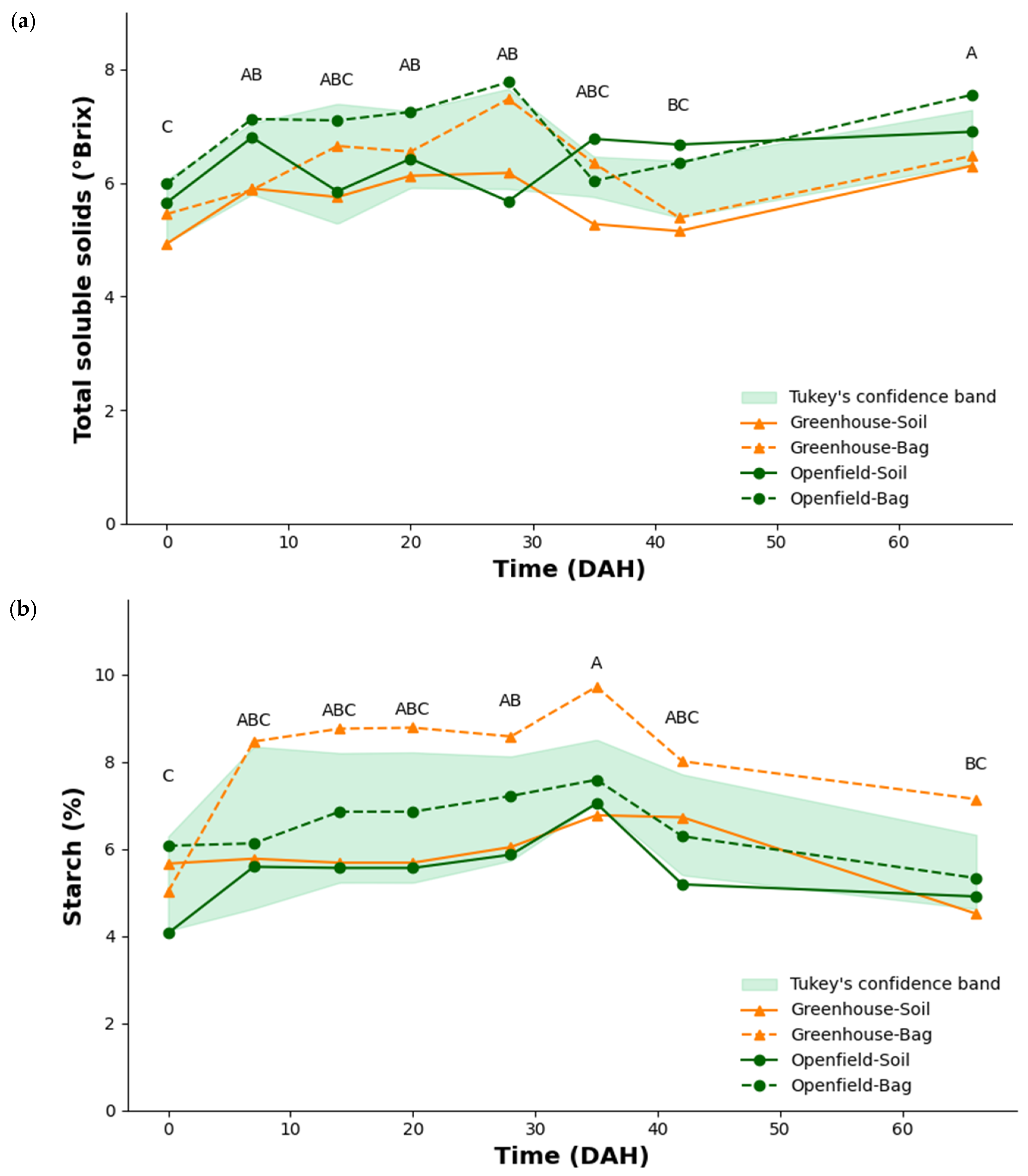
Significant differences were observed only between the treatments at 7 DAH and from 28 DAH to the end of the postharvest period (66 DAH) (Figure 2a). When analyzing the effects of the factors separately, the planting method showed significant differences only at 28 DAH, whereas the planting condition showed significant differences from 35 DAH to 66 DAH (Table 1). Statistical differences were observed among the measurements over time, and a 23.6% increase in TSS during storage was noted, from 5.5 °Brix at harvest to an average of 6.8 °Brix.

3.4. Starch

The starch content varied significantly among treatments from 14 to 66 DAH (Figure 2b). The planting method factor showed significant differences from 14 to 35 DAH and again at 66 DAH, whereas the planting condition factor showed differences only at 35 and 42 DAH (Table 1). The interaction between factors was significant at 66 DAH. The starch behavior showed significant differences over time measurements and exhibited a quadratic pattern, starting with low values (5.2%), increasing up to 35 DAH (6.9%), and decreasing again toward the end of storage (5.47%).

3.5. Skin Color

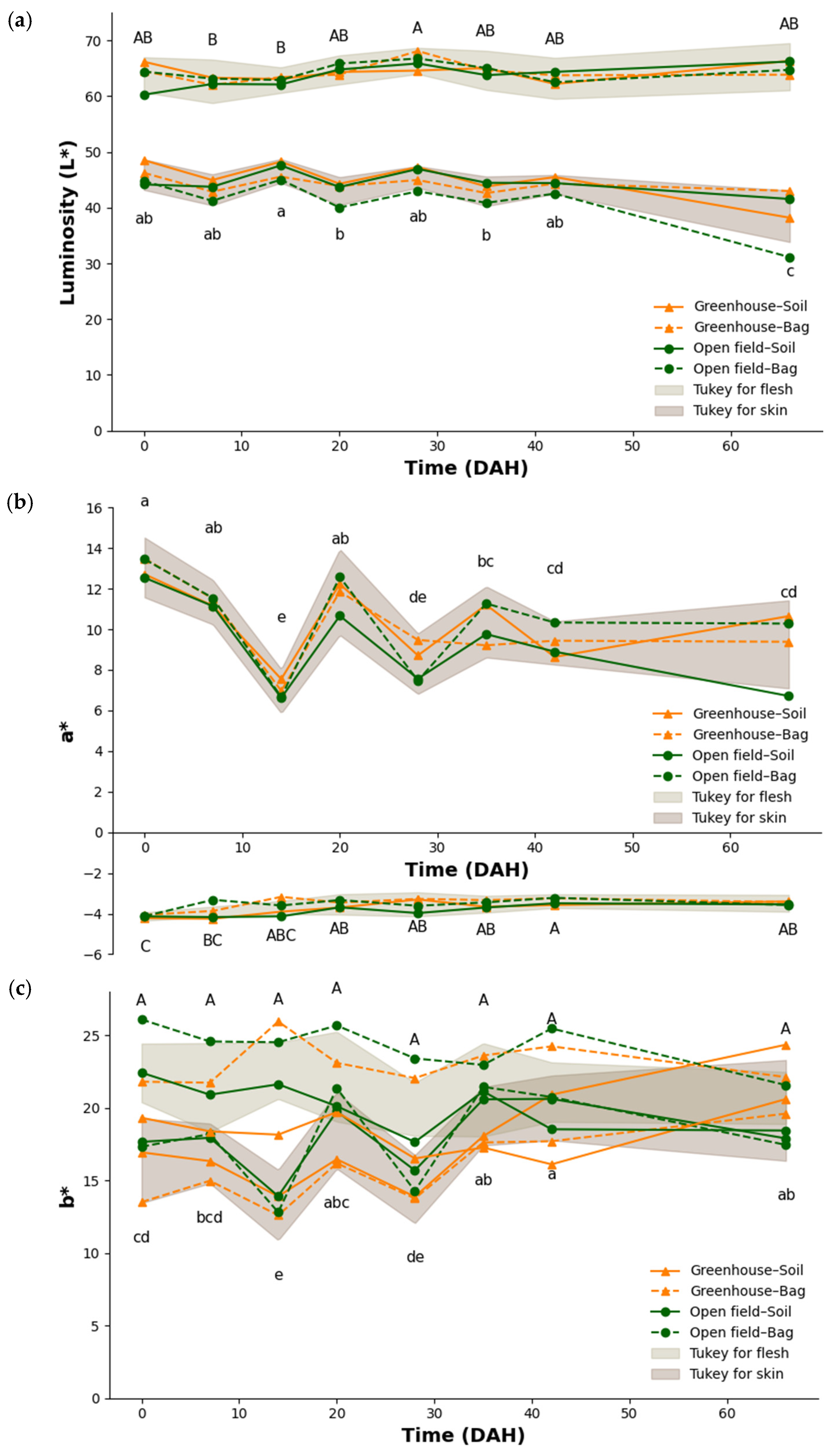
The luminosity of the potato skin showed significant differences between treatments only at 28 and 66 DAH, with the treatment planted in open field and bags (OFB) exhibiting the lowest values throughout storage (Figure 3a). The planting condition factor significantly affected the L* value at the first measurement at harvest, while the planting method influenced the values at 14 and 28 DAH. Additionally, the interaction between factors was significant at 66 DAH (Table 1). There were significant differences over time in the L* values of the potato skin, showing a downward trend with a 16.2% decrease during postharvest, from an average of 45.9 to 38.46 from harvest to the end of storage.
The chroma value a* of the potato skin showed no significant differences between treatments; however, there were statistical differences at 28, 42, and 66 DAH for the factors condition, method, and their interaction, respectively (Figure 3b). Significant differences over time were observed for the a* value, which initially fluctuated widely but then decreased after 35 DAH through the end, with a 29% loss, from 13 to 9.2. The b* chroma of the skin showed significant differences between treatments at 20, 35, and 66 DAH, primarily attributable to the planting condition factor (Figure 3c). Over time, significant differences were observed, and the b* value of the skin increased during postharvest by 21.2%, rising from 16.3 to 19.8.

3.6. Flesh Color

Regarding the luminosity of the flesh of the potato tuber, no significant differences were recorded between treatments, nor between factors separately, nor in the interaction, during the measurements taken. However, differences were observed between measurements over time (Figure 3a), indicating consistent behavior, with an average of 64.1 throughout the postharvest phase. Only significant differences between treatments were found for the a* value of the flesh at 7 and 14 DAH, attributable to the method factor and planting conditions, respectively (Table 1).
There were significant differences between measurements, and the a* value of the flesh increased by 15.6%, from −4.13 to −3.65. The b* value of the potato flesh showed significant differences throughout the entire postharvest period, except for measurements at 7 and 35 DAH. Among measurements over time, the b* value of the flesh did not show significant differences, with a slight decrease of 7.7% during the storage of the potato tubers.

3.7. Specific Gravity and Percentage of Solids in the Liquid Phase (SLP) of French Fries

The specific gravity of the French fries showed a significant difference between treatments; however, the potatoes grown in a greenhouse had an average specific gravity of 1.080, whereas the tubers from plants grown in the open field had an average of 1.070. The tubers from the planting in bags, both in the open field and in the greenhouse, showed the highest values of specific gravity (Table 2). The SLP of the French fry flakes showed significant differences between the treatments. The tubers planted in bags (GB and OFB) exhibited the highest SLP and specific gravity values, surpassing those of tubers planted in soil (OFS and GS).

4. Discussion

4.1. Accumulated Mass Loss (ML)

The lack of significant differences between treatments indicates that neither the planting method (soil or bags) nor the planting condition (greenhouse or open field) affected the ML of the tubers during postharvest. This could be because the tubers from all treatments reached a relatively similar physiological state at harvest, with cuticles and periderm that did not modify their properties in ways that would allow different transpiration processes. The ML in potato tubers during storage is mainly due to transpiration through the skin (97.6%) and respiration through the lenticels (2.4%) [14]. These processes are primarily influenced by relative humidity during storage, the most critical postharvest factor, surpassing cultivation conditions. However, other factors, such as temperature, light, and the tuber’s inherent characteristics, directly influence the abiotic environment and biotic stress during potato storage [15]. Similarly, Haider et al. [3] found significant effects of genotype, storage duration, and the application of growth regulators on the mass loss of potato tubers during postharvest storage. It should be noted that the storage conditions used in this study (16 °C, 62% RH) are warmer and drier than those recommended for long-term commercial potato storage (4 °C, 90–95% RH). These conditions accelerated transpiration and respiration, leading to faster mass loss and starch-to-sugar conversion than would occur under controlled-atmosphere commercial storage. Consequently, our results represent a stress-accelerated postharvest model, and the differences observed between treatments may be greater than those observed under optimal storage conditions.

4.2. Firmness

The significant differences found in the intermediate measurements (28, 35, and 42 DAH) suggest that the treatments affected the rate of tuber softening. Based on previous studies, this could be related to variations in the activity of cell-wall-degrading enzymes such as polygalacturonase and pectin methylesterase, which hydrolyze pectin, allowing water to enter via oxygen bridges formed between the α-(1,4) glycosidic bonds and causing cell separation. This exposes the cell wall components to cellulases and hemicellulases, thereby accelerating degradation and reducing cell wall rigidity, thereby softening tissue [16]. Although we did not measure enzyme activities directly, the observed firmness patterns are consistent with the documented role of these enzymes in postharvest softening [16].
Tubers from the greenhouse maintained greater firmness during storage, which may have resulted from slower starch degradation or a thicker cuticle. Likewise, tubers from the greenhouse treatments experienced less mass loss, suggesting they dehydrated less, which helps preserve turgor and keeps the potatoes firmer for longer. According to Keithellakpam et al. [8], potato quality is affected by physiological development during pre-harvest, where the cultivar type, fertilization, irrigation, and stress interact to determine tuber quality and final acceptance.
It is well known that tuber firmness is one of the most important quality attributes in potato marketing, as it is influenced by various characteristics, including specific gravity, dry matter content, starch content, pectins, cell integrity, calcium, organic acids, age, and storage conditions [17]. In this regard, cultivars with high dry matter content have greater texture stability [8].

4.3. Total Soluble Solids (TSS)

The differences in treatments for both the cultivation conditions and the planting methods suggest a possible modulation of starch-to-sugar conversion. Although we did not measure enzyme activities, amylase and invertase are well-established key enzymes in this process [18]. Therefore, we hypothesize that the observed differences in TSS accumulation across treatments may be associated with differential activity of these enzymes, as previously reported under similar stress conditions [18]. Tubers from open-field cultivation likely accumulated higher sugar levels. This may be related to the lower nighttime temperatures and higher photosynthetically active radiation recorded in the open field, both of which are known to influence starch-sugar conversion during storage [19]. Likewise, the higher incidence of pests (flea beetle) in open fields has possibly caused this behavior. In this regard, Morales-Fernández et al. [19] stated that climatic conditions, soil, and cultivation management determine the sugar concentration in tubers. Similarly, Brążkiewicz et al. [20] reported that during storage, tubers under stress conditions exhibit greater starch hydrolysis, resulting in higher levels of glucose and fructose. This is a key factor in the post-harvest quality of potatoes, especially during processing, since high reducing sugar content during frying leads to darker, browner colors, affecting the quality of the fried potato [21].

4.4. Starch

Starch is the most abundant storage carbohydrate in potatoes, and its degradation during storage determines frying quality [21]. The starch values reported here (5 to 7% fresh weight) are lower than typical literature ranges (10 to 20% fresh weight) [3]. This discrepancy is likely attributable to extraction losses inherent to the gravimetric method, as well as starch hydrolysis during storage, which is known to reduce starch content over time [3]. Nevertheless, the relative differences between treatments are consistent with the specific gravity values and the observed frying quality, indicating that the method reliably captures treatment effects. The significant variations in starch content suggest that the treatments influenced the rate of starch hydrolysis. Tubers from bag planting under greenhouse conditions showed greater starch retention. Although we did not directly measure enzyme activities, previous studies have shown that α-Amylase initiates starch degradation by hydrolyzing the α-(1,4) glycosidic bonds of amylase and amylopectin in response to stress during storage, while the action of starch phosphorylase releases glucose-1-phosphate [22], which possibly began to act from 42 DAH during potato tuber storage, where a decrease in starch content is observed, indicating the tuber’s preparation for sprouting. Regarding this, Haider et al. [3] reported that cultivation conditions (temperature, radiation) modify starch content and frying quality; likewise, the planting method influences the size and structure of starch granules, which affect industrial processing and digestibility [12].

4.5. Skin Color

The significant differences found toward the end of storage suggested that the treatments affected the rate of skin darkening. In this regard, tubers from open-field soil planting probably exhibited greater chlorophyll synthesis (greening) due to constant exposure to direct light, thereby reducing L* values during storage. Furthermore, greening is associated with increased solanine synthesis, which is undesirable for food safety [23]. According to Keithellakpam et al. [8], cultivation practices affect postharvest skin coloration. This behavior is explained because light exposure activates metabolic pathways associated with chlorophyll biosynthesis and related compounds, rapidly increasing the greening of the tuber [24], while tubers planted in greenhouses may have experienced reduced photo-stimulation, as the plastic cover significantly lowered PAR levels and altered light quality, which is known to down-regulate chlorophyll biosynthesis and to reduce the light signal perceived by the plant’s photoreceptors. These receptors regulate multiple physiological and metabolic processes, including pigment accumulation and photosynthetic activity [25].
The absence of significant treatment differences in the a* parameter may indicate that the Diacol Capiro variety has relatively low susceptibility to light-induced greening under our experimental conditions, or that the storage conditions (darkness) minimized further greening after harvest. In this regard, Kangogo et al. [6] reported that skin greening is more influenced by light exposure during storage than by cultivation practices. In potato skin, negative a* values reflect a tendency toward green coloration, indicating chlorophyll synthesis and light-induced greening, while positive values may be due to anthocyanins or the accumulation of phenolic compounds resulting from oxidative stress [26].
Significant differences in the b* parameter of the skin indicate that the treatments altered pigment accumulation or degradation during storage. Tubers from greenhouse cultivation probably retained more carotenoids due to lower exposure to UV radiation. Positive b* values indicate a tendency for the tuber skin to turn yellow, a characteristic associated with carotenoids such as lutein and zeaxanthin, which are influenced by cultivation conditions [2]. Similarly, Ahmed et al. [11] observed that pigment content in potato skin correlates with frying quality.

4.6. Flesh Color

The flesh of the ‘Diacol Capiro’ potato variety has a cream color, and its luminosity depends on the carotenoid content and the absence of anthocyanins. The lack of significant differences between treatments can be attributed to the fact that neither the planting method nor the cultivation conditions modified pigment accumulation in the tuber parenchyma. This is expected, as the flesh coloration is strongly dominated by genetics [4]. Additionally, industrial processing of tubers is more sensitive to the chemical composition of the flesh than to luminosity [1].
The a* parameter of the potato flesh is generally close to zero or slightly negative when greenish tones appear in cream-colored flesh varieties [27], such as Diacol Capiro. The significant differences observed in the initial storage measurements of the a* value could be due to early enzymatic oxidation, which was homogenized by postharvest environmental conditions. The a* value increased during storage, indicating a decrease in green color and a shift toward colors closer to white or yellow, attributed to chlorophyll degradation due to increased activity of enzymes such as polyphenol oxidase, leading to flesh darkening [28]. It is known that the phenolic compound content in the flesh varies according to cultivation conditions and affects color during storage [13].
The differences observed in b* values among treatments during postharvest storage could be attributed to changes in the biosynthesis of flesh carotenoids caused by different planting methods [8]. Tubers grown in bags under greenhouse conditions showed the highest b* values, which coincides with their higher starch content and lower TSS content. In this regard, Haider et al. [3] report that starch accumulation positively correlates with the flesh’s yellow color. Likewise, the b* of the flesh is an indicator of processing quality, as intense yellow tones in fried potatoes indicate lower reducing sugar content and less browning.

4.7. Specific Gravity and Percentage of Solids in the Liquid Phase of French Fries

It is known that specific gravity is the ratio of the mass of the potato to the difference between its mass and that of the same potato submerged in water at 15.6 °C, and is used to estimate the tubers’ frying quality. According to Jarén et al. [29], a specific gravity greater than 1.080 is considered acceptable for industry. Specific gravity differed significantly between planting methods: tubers planted in bags (GB and OFB) had significantly higher specific gravity than those planted directly in soil (Table 2), regardless of the cultivation environment. No significant differences in specific gravity were observed between greenhouse and open field when the same planting method was used. Thus, bag planting, rather than the greenhouse condition per se, was the main driver of increased specific gravity in this study. Consequently, bag planting emerges as a key agronomic practice to enhance the industrial quality of ‘Diacol Capiro’ potatoes, regardless of the cultivation environment. Nevertheless, the SLP values obtained for the French fries are below the 18% minimum standard established by Jarén et al. [29] for classifying potatoes as suitable for frying. In this regard, Das et al. [13] mention that the acceptable range of SLP for potato chips should be between 17.19% and 22.99%. However, in India, it is reported that acceptable dry matter content should be above 20%, ensuring that the French fries have good texture, minimal oil absorption, and an attractive light color. Similarly, Ahmed et al. [30] state that dry matter content is strongly correlated with starch content and specific gravity, both of which contribute to the final quality of French fries. The low values observed in this study are attributed to excess water or low phosphate fertilization levels during the crop’s growth cycle [13]. Still, Westermann et al. [31] reported that applying N and K increases potato yields; however, increasing fertilization with these nutrients decreases specific gravity. It is acknowledged that the sensory evaluation was based on a small panel and should be interpreted as a screening tool. Therefore, the frying quality rating (e.g., “good” for GB and GS) is indicative rather than definitive. Future studies should incorporate instrumental measurement of chip color and a larger consumer panel to validate these findings.

5. Conclusions

Growing potatoes in greenhouses, especially when combined with bag planting, improved the post-harvest and frying quality of the ‘Diacol Capiro’ variety, as it showed a lower soluble solids content, a higher starch content, a more yellow pulp due to higher b* values, and also maintained tuber firmness for a longer period and, although not significant, experienced less mass loss during post-harvest, ideal attributes for industrial processing. The b* parameter of the flesh showed significant differences between treatments in five of the eight storage weeks and had the highest F values, which would indicate that b* is a sensitive indicator of changes induced by the growing conditions. The overall improvement in frying quality resulted from the combined effect of several traits. French fries from greenhouse-grown plants exhibited higher specific gravity and SLP, suggesting a frying quality close to industrial standards, although confirmatory sensory studies with larger panels are needed. Tubers from soil and open-field planting showed less desirable characteristics for the industry, highlighting the potential of protected cultivation planting to produce potatoes with better industrial suitability.

Author Contributions

Conceptualization, J.G.Á.-H.; methodology, J.G.Á.-H. and J.D.B.-L.; software, J.G.Á.-H. and M.J.-G.; validation, M.J.-G.; formal analysis, J.G.Á.-H. and M.J.-G.; investigation, J.D.B.-L.; resources, J.G.Á.-H. and M.J.-G.; data curation, J.G.Á.-H. and M.J.-G.; writing—original draft preparation, J.D.B.-L. and M.J.-G.; writing—review and editing, J.G.Á.-H. and M.J.-G.; visualization, J.G.Á.-H. and M.J.-G.; supervision, J.G.Á.-H.; project administration, J.G.Á.-H.; funding acquisition, J.G.Á.-H. and M.J.-G. All authors have read and agreed to the published version of the manuscript.

Funding

This research was supported by MinCiencias through Call 890-2020 Mechanism 1. The work was carried out within the framework of the project titled “Design, development, and validation of an early detection model for Late Blight in ‘Diacol Capiro’ potato crops through spectral image analysis acquired in the departments of Boyacá and Cundinamarca” and was also funded by the Research Directorate (DIN) of the Universidad Pedagógica y Tecnológica de Colombia, through project SGI 3412. The APC was funded through Call 01 of 2026 from the same institution.

Data Availability Statement

The data will be made available upon request.

Conflicts of Interest

The authors declare no conflicts of interest.

References

  1. Hu, X.; Jiang, H.; Liu, Z.; Gao, M.; Liu, G.; Tian, S.; Zeng, F. The global potato-processing industry: A review of production, products, quality and sustainability. Foods 2025, 14, 1758. [Google Scholar] [CrossRef]
  2. Li, L.; Zhu, T.; Wen, L.; Zhang, T.; Ren, M. Biofortification of potato nutrition. J. Adv. Res. 2024, 75, 23–34. [Google Scholar] [CrossRef]
  3. Haider, M.W.; Nafees, M.; Iqbal, R.; Asad, H.U.; Azeem, F.; Ali, B.; Shaheen, G.; Iqbal, J.; Vyas, S.; Arslan, M.; et al. Postharvest starch and sugars adjustment in potato tubers of wide-ranging dormancy genotypes subjected to various sprout forcing techniques. Sci. Rep. 2023, 13, 14845. [Google Scholar] [CrossRef]
  4. Pandey, J.; Gautam, S.; Scheuring, D.C.; Koym, J.W.; Vales, M.I. Variation and genetic basis of mineral content in potato tubers and prospects for genomic selection. Front. Plant Sci. 2023, 14, 1301297. [Google Scholar] [CrossRef]
  5. Rumallang, A.; Salam, M.; Fudjaja, L.; Diansari, P.; Patandjengi, B.; Darma, R.; Tenriawaru, A.N.; Heliawaty; Akhsan; Rahmadanih; et al. Examining the effect of farm and farmers’ characteristics and input allocation on potato production. Front. Sustain. Food Syst. 2025, 9, 1651329. [Google Scholar] [CrossRef]
  6. Kangogo, E.; Otieno, D.J.; Okello, J.; Mwenye, O.; Kapalasa, E. Impact of farmer training on potato yield: A case of smallholder potato farmers in Malawi. Front. Sustain. Food Syst. 2024, 8, 1496064. [Google Scholar] [CrossRef]
  7. Zhou, B.; Yuan, J.; Liang, L.; Zhang, F.; Wang, Y. Genotype × environment interactions for potato yield and quality traits: Identification of ideotypes adapted in different ecological regions of Northwest China. BMC Plant Biol. 2025, 25, 737. [Google Scholar] [CrossRef] [PubMed]
  8. Keithellakpam, L.B.; Karunakaran, C.; Singh, C.B.; Jayas, D.S.; Danielski, R. A comprehensive review on pre- and post-harvest perspectives of potato quality and non-destructive assessment approaches. Appl. Sci. 2026, 16, 190. [Google Scholar] [CrossRef]
  9. Herrera, C.A.; Porras, P.D. Modelo Productivo De La Papa Variedad Diacol Capiro Para El Departamento De Antioquia; Corporación Colombiana de Investigación Agropecuaria (AGROSAVIA): Bogotá, Colombia, 2015; Available online: http://hdl.handle.net/20.500.12324/13751 (accessed on 25 April 2026).
  10. Becerra-Lagos, J.D.; Jaime-Guerrero, M.; Alvarez-Herrera, J.G. Growth and yield of potatoes cultivated in different planting methods under greenhouse and open field conditions. Rev. Bras. Eng. Agríc. Ambient. 2025, 29, e287826. [Google Scholar] [CrossRef]
  11. Ahmed, Z.; Yusoff, M.S.; N.H., M.K.; Abdul Aziz, H. Synthesis of natural starch from Elaeis guineensis trunk biomass applying bisulphite steeping method: Optimization by RSM. J. Air Waste Manag. Assoc. 2022, 72, 116–130. [Google Scholar] [CrossRef]
  12. Ali, S.M.; Siddique, Y.; Mehnaz, S.; Sadiq, M.B. Extraction and characterization of starch from low-grade potatoes and formulation of gluten-free cookies containing modified potato starch. Heliyon 2023, 9, e19581. [Google Scholar] [CrossRef]
  13. Das, S.; Mitra, B.; Saha, A.; Mandal, S.; Paul, P.K.; El-Sharnouby, M.; Hassan, M.M.; Maitra, S.; Hossain, A. Evaluation of quality parameters of seven processing type potato (Solanum tuberosum L.) cultivars in the Eastern Sub-Himalayan plains. Foods 2021, 10, 1138. [Google Scholar] [CrossRef] [PubMed]
  14. Xanthopoulos, G.T.; Paytosh, S.; Dungan, R.S.; Olsen, N.; Spear, R.; Almeida-Teixeira, G.H. Relative contributions of respiration and transpiration to the weight loss of russet-type potatoes. Biosyst. Eng. 2024, 248, 297–307. [Google Scholar] [CrossRef]
  15. Zhang, S.; Wang, X.; Kinay, P.; Dau, Q. Climate change impacts on potato storage. Foods 2024, 13, 1119. [Google Scholar] [CrossRef]
  16. Xue, C.Y.; Zhou, R.J.; Li, Y.J.; Xiao, D.; Fu, J.F. Cell-wall-degrading enzymes produced in vitro and in vivo by Rhizoctonia solani, the causative fungus of peanut sheath blight. PeerJ 2018, 6, e5580. [Google Scholar] [CrossRef]
  17. Shomer, I.; Levy, D. Cell wall mediated bulkiness as related to the texture of potato (Solanum tuberosum L.) tuber tissue. Potato Res. 1988, 31, 321–334. [Google Scholar] [CrossRef]
  18. Guan, X.; Zhu, L.; Guan, W.; Zhang, Q.; Wang, X.; He, X.; Lin, Q. Transcriptomic changes of starch and sugar conversion during storage of potato tubers treated with citronella essential oil. Postharvest Biol. Technol. 2026, 237, 114319. [Google Scholar] [CrossRef]
  19. Morales-Fernández, S.D.; Mora-Aguilar, R.; Salinas-Moreno, Y.; Rodríguez-Pérez, J.E.; Colinas-León, M.T.; Lozoya-Saldaña, H. Crecimiento y contenido de azúcares de tubérculo de papa en cuatro estados de madurez en condiciones de invernadero. Rev. Chapingo Ser. Hortic. 2018, 24, 53–67. [Google Scholar] [CrossRef]
  20. Brążkiewicz, K.; Pobereżny, J.; Wszelaczyńska, E.; Bogucka, B. Potato starch quality in relation to the treatments and long-term storage of tubers. Sci. Rep. 2025, 15, 4144. [Google Scholar] [CrossRef]
  21. Islam, M.M.; Naznin, S.; Naznin, A.; Uddin, M.N.; Amin, M.N.; Rahman, M.M.; Hasan, M.M.; Alsuhaibani, A.M.; Gaber, A.; Ahmed, S. Dry matter, starch content, reducing sugar, color and crispiness are key parameters of potatoes required for chip processing. Horticulturae 2022, 8, 362. [Google Scholar] [CrossRef]
  22. Hou, J.; Liu, T.; Reid, S.; Zhang, H.; Peng, X.; Sun, K.; Du, J.; Sonnewald, U.; Song, B. Silencing of α-amylase StAmy23 in potato tuber leads to delayed sprouting. Plant Physiol. Biochem. 2019, 139, 411–418. [Google Scholar] [CrossRef]
  23. Zao, X.; Li, W.; Cheng, L.; Yu, B.; Sa, G. Physiological and Molecular Mechanisms of Light-Induced Greening in Potatoes: A Path to Food Safety. Foods 2025, 14, 1798. [Google Scholar] [CrossRef]
  24. Wang, J.; Li, J.; Chen, W.; Yang, Z.; Li, X.; Wang, L.; Cao, S.; Shi, L. The changes in chlorophyll, solanine, and phytohormones during light-induced greening in postharvest potatoes. Postharvest Biol. Technol. 2025, 219, 113291. [Google Scholar] [CrossRef]
  25. Rahman, M.H.; Islam, M.J.; Mumu, U.H.; Ryu, B.R.; Lim, J.D.; Azad, M.O.K.; Cheong, E.J.; Lim, Y.S. Effect of light quality on seed potato (Solanum tuberosum L.) tuberization when aeroponically grown in a controlled greenhouse. Plants 2024, 13, 737. [Google Scholar] [CrossRef]
  26. Tshilongo, L.; Mianda, S.M.; Seke, F.; Laurie, S.M.; Sivakumar, D. Influence of harvesting stages on phytonutrients and antioxidant properties of leaves of five purple-fleshed sweet potato (Ipomoea batatas) genotypes. Foods 2024, 13, 1640. [Google Scholar] [CrossRef]
  27. Tirado-Lara, R.; Tirado-Malaver, R.H. Comportamiento de parámetros biométricos de clones para la obtención de papa baby con pulpa pigmentada. Sci. Agropecu. 2018, 9, 401–410. [Google Scholar] [CrossRef]
  28. Wang, T.; Yan, T.; Shi, J.; Sun, Y.; Wang, Q.; Li, Q. The stability of cell structure and antioxidant enzymes are essential for fresh-cut potato browning. Food Res. Int. 2023, 164, 112449. [Google Scholar] [CrossRef]
  29. Jarén, C.; López, A.; Arazuri, S. Advanced analytical techniques for quality evaluation of potato and its products. In Advances in Potato Chemistry and Technology, 2nd ed.; Singh, J., Kaur, L., Eds.; Academic Press: London, UK, 2016; pp. 563–602. [Google Scholar] [CrossRef]
  30. Ahmed, Z.A.; Mohammed, N.K. Investigating influencing factors on acrylamide content in fried potatoes and mitigating measures: A review. Food Prod. Process. Nutr. 2024, 6, 24. [Google Scholar] [CrossRef]
  31. Westermann, D.T.; Tindall, T.A.; James, D.W.; Hurst, R.L. Nitrogen and potassium fertilization of potatoes: Yield and specific gravity. Am. J. Potato Res. 1994, 71, 417–431. [Google Scholar] [CrossRef]
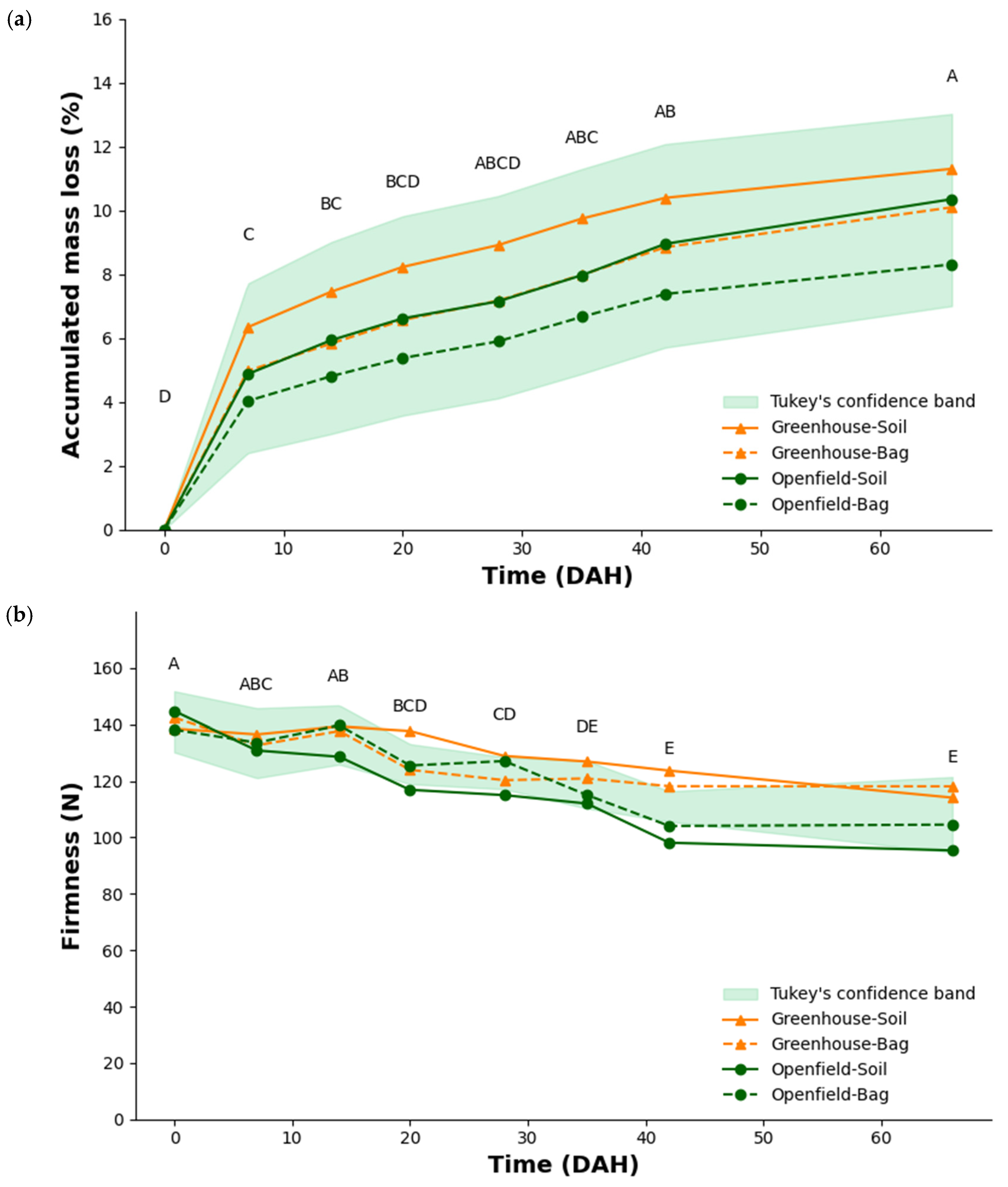
Figure 1. (a) Loss of accumulated mass and (b) firmness of potato tubers during postharvest, from plants subjected to different cultivation conditions and planting methods. DAH: days after harvest. Different uppercase letters indicate significant differences between the various measurements taken over time according to the Tukey test (p < 0.05). Markers outside the Tukey confidence band (p < 0.05) indicate significant differences between treatments at each measurement point.
Crops 06 00055 g001
Figure 2. (a) Total soluble solids and (b) starch of potato tubers during postharvest, from plants subjected to different cultivation conditions and planting methods. DAH: days after harvest. Different uppercase letters indicate significant differences between the various measurements taken over time according to the Tukey test (p < 0.05). Markers outside the Tukey confidence band (p < 0.05) indicate significant differences between treatments at each measurement point.
Crops 06 00055 g002
Figure 3. (a) Luminosity; (b) chromaticity a* green–red; and (c) chromaticity b* blue–yellow of potato tubers during post-harvest from plants subjected to different cultivation conditions and planting methods. DAH: days after harvest. Uppercase and lowercase letters indicate significant differences between measurements taken over time, according to the Tukey test (p < 0.05), for flesh and skin, respectively. Markers outside the Tukey confidence band (p < 0.05) indicate significant differences between treatments at each measurement point.
Crops 06 00055 g003
Table 1. F-values of the ANOVA and mean values for the postharvest variables evaluated in potato tubers from different planting methods and conditions.
DAHSource of VariationMLFirmnessTSSStarchSkin ColorFlesh Color
L*a*b*L*a*b*
0Mean0.00140.995.505.2145.9313.0516.3663.83−4.1422.41
Crop condition0.045.67 *0.284.99 *0.022.684.030.0114.75 **
Planting method0.072.651.750.411.441.830.680.7510.19 **
Interaction1.040.136.65 *1.230.011.243.780.580.37
7Mean5.05133.416.436.5043.1911.3416.8662.66−3.9021.40
Crop condition0.910.1612.92 **2.031.140.006.03 *0.006.92 *3.39
Planting method0.760.010.253.323.020.510.310.0126.49 **5.80 *
Interaction0.040.320.341.480.030.000.680.373.780.01
14Mean6.00136.346.346.7246.596.9513.3162.87−3.7022.56
Crop condition0.790.770.302.050.361.400.010.454.411.23
Planting method0.930.914.579.53 **6.69 *0.271.090.2816.13 **33.44 **
Interaction0.031.630.121.590.000.370.010.040.377.01 *
21Mean6.69126.036.596.7342.9711.8318.4464.71−3.5422.15
Crop condition0.898.17 *2.422.073.460.1811.45 **0.960.081.02
Planting method0.950.573.789.52 **2.930.580.280.061.559.21
Interaction0.0210.98 **0.391.611.891.300.560.390.070.54
28Mean7.28122.836.786.9345.528.3114.4066.32−3.5419.91
Crop condition1.011.710.061.831.634.931.080.003.212.03
Planting method0.980.4116.42 **11.65 **11.79 **0.220.473.880.4741.82 **
Interaction0.0214.49 **0.911.090.850.370.341.380.340.02
35Mean8.08118.746.117.7942.9310.3619.4364.62−3.5321.24
Crop condition1.026.65 *12.35 *7.18 *0.180.1310.98 **0.070.131.11
Planting method1.010.140.9925.28 **3.570.080.050.072.167.11 *
Interaction0.021.2628.97 **11.96 **0.914.400.450.250.042.18
42Mean8.89111.025.896.5644.189.3320.0063.19−3.3821.09
Crop condition0.9259.98 **27.41 **8.78 *3.211.301.690.070.113.48
Planting method1.050.010.034.713.644.84 *2.100.013.5959.63 **
Interaction0.005.01 *1.400.030.200.392.460.950.040.37
66Mean10.01108.056.815.4838.469.2619.8365.28−3.4920.68
Crop condition0.916.40 *13.48 **3.053.742.176.77 *0.030.532.53
Planting method1.291.063.2714.22 **1.641.252.470.970.037.41 *
Interaction0.090.161.087.4411.97 **5.48 *1.700.060.000.90
DAH: days after harvest; ML: mass loss; TSS: total soluble solids. L*: luminosity; a*: chromaticity green–red; b*: chromaticity blue–yellow. * and ** indicate a significant effect between treatments (p < 0.05 and p < 0.01, respectively).
Table 2. Frying quality of Diacol Capiro potato variety from greenhouse and open-field cultivation.
ParameterTreatment
Open Field SoilGreenhouse Soil
Image of the frying quality obtained for the tubersCrops 06 00055 i001Crops 06 00055 i002
Greenhouse and BagOpen Field and Bag
Crops 06 00055 i003Crops 06 00055 i004
Treatment
OFSGSGBOFB
SLP (%)15.03 ± 0.52 d16.67 ± 0.36 bc19.95 ± 0.50 a18.60 ± 0.46 ab
Specific gravity1.070 ± 0.003 b1.080 ± 0.002 b1.098 ± 0.003 a1.091 ± 0.003 a
Quality of fryingAcceptable (1) Good (1.5)Good (1.5)Acceptable (1)
SLP: solids in the liquid phase. OFS: open field and soil; GS: greenhouse and soil; GB: greenhouse and bag; OFB: open field and bag. Different letters per row indicate significant differences between treatments according to Tukey’s test (p < 0.05). ± is the standard error (n = 4).
Disclaimer/Publisher’s Note: The statements, opinions and data contained in all publications are solely those of the individual author(s) and contributor(s) and not of MDPI and/or the editor(s). MDPI and/or the editor(s) disclaim responsibility for any injury to people or property resulting from any ideas, methods, instructions or products referred to in the content.