Article

Biofertilization with AFERT as an Alternative to Mineral Fertilization in Sesame (Sesamum indicum L.) Cultivation


by
Jorge González Aguilera
1,*,
Matheus Basto Angeli Silva
1,
Beatriz Pisa De Andrade
1,
Alexandre Vasco Mariano Muguerrima
1,
Fábio Steiner
1,
Eder Pereira Neves
2,
Alan Mario Zuffo
3,
Tatiane Scilewski da Costa Zanatta
3,
Carlos Genaro Morales Aranibar
4,
Cesar Augusto Masgo Soto
4,
María Paulina Aliaga Martínez
4 and
Luis Morales-Aranibar
5
1
Department of Agronomy, State University of Mato Grosso do Sul (UEMS), Cassilândia Campus, Cassilândia 79543-113, MS, Brazil
2
Department of Mathematics, State University of Mato Grosso do Sul (UEMS), Cassilândia Campus, Cassilândia 79543-113, MS, Brazil
3
Department of Agronomy, State University of Maranhão (UEMA), Balsas Campus, Balsas 65800-000, MA, Brazil
4
Applied Electrochemistry Research Group, Faculty of Sciences, National University of Engineering, Av. Tupac Amaru 210, Rímac 15333, Lima, Peru
5
Agroenvironmental Systems and Sustainability Research Group (GISAS), National Intercultural University of Quillabamba, Cusco 08741, Cusco Region, Peru
*
Author to whom correspondence should be addressed.
Crops 2026, 6(2), 41; https://doi.org/10.3390/crops6020041
Submission received: 11 February 2026 / Revised: 26 March 2026 / Accepted: 30 March 2026 / Published: 1 April 2026
(This article belongs to the Special Issue Soil Fertility Management in Crop Production)

Abstract

Sesame cultivation has expanded in Brazil, but ensuring plant establishment and productivity through fertilization remains a fundamental challenge. In this context, the present work aims to evaluate the effects of different doses of the biofertilizer AFERT on the growth and development of sesame plants under greenhouse conditions. The experiment was conducted in a randomized block design with six treatments and four replications. Five doses were used (2, 1.6, 1.2, 0.8, and 0.4 t ha−1 of AFERT), corresponding to different percentages of fertilization with the biofertilizer AFERT (04-14-12+hydroretainer), and, as a control, the mineral fertilizer NPK (04-14-08) was used at doses of 2 t ha−1 and 50 kg ha−1 of KCl. The variables evaluated were the internal CO2 concentration, transpiration rate, stomatal conductance, net CO2 assimilation rate, intrinsic water use efficiency, water use efficiency, instantaneous carboxylation efficiency, number of pods, plant height, stem diameter, root length, root dry mass, number of grains per plant, and total grain weight. The biofertilizer AFERT demonstrated agronomic potential for sesame cultivation, with a productive performance equivalent [number of grains per plant (84%) and total grain weight (70%)] to that of mineral fertilization regardless of the dose used. Notably, the dose corresponding to 1.2 t ha−1 promoted greater physiological efficiency, with a 36% increase in CO2 assimilation and photosynthetic activity, without improving production components.

1. Introduction

Sesame (Sesamum indicum L.) is a crop of great global importance and is known for its oil-rich seeds that are widely used in the food and cosmetic industries [1]. It is cultivated in approximately 70 countries, especially in Asia and Africa, where the main producers include Sudan, India, Myanmar, and Tanzania, which together account for approximately 64% of the global planted area, totaling 12.8 million hectares [2]. It is a species belonging to the Pedaliaceae family and is considered one of the oldest oilseeds consumed by humanity, with potential for oil extraction, biofuel production, and meal for animal consumption as a byproduct of oil extraction, among other applications [3,4].
Sesame is a crop characterized by drought tolerance and hardiness, with easier production management than other crops, making it an excellent alternative for crop rotation [1,5]. Additionally, it is highly nutritious and can be used to strengthen human nutrition, supported by the existence of an expanding national market and its potential use in the cosmetic and pharmaceutical industries [6,7].
In Brazil, the use of sesame cultivation has significantly increased in recent years. Between 2025 and 2026, the cultivated area increased by 1%, reaching 280 thousand hectares, and production jumped from 1159 thousand tons to 1134 thousand tons [8]. Although this decrease occurred during this current period, compared with traditional crops, such as off-season corn, this crop has shown high profitability and low production costs, especially in regions where the ideal corn sowing window is lost [9].
Currently, the crop is experiencing expansion, with an average productivity decreasing by approximately 2% in yield per hectare [8]. This decrease is associated with technical challenges, such as the lack of specific mechanization and the issue of dehiscence, which leads to seed loss during harvest and, consequently, a loss in productivity [7]. Investments in genetic improvement and management technologies are essential for increasing the productivity and competitiveness of crops [4].
Strategies that increase the amount of sesame under the conditions of the Brazilian Cerrado are important for this crop to become a sustainable alternative for the region [10]. Among the challenges associated with crops, fertilization constitutes a safe strategy that allows the establishment of a crop and ensures productivity in regions where soil and climate limitations determine the success of the crop. Among fertilization practices, the use of organomineral fertilizers or biofertilizers has become a sustainable alternative to reduce chemical fertilizers, promoting good responses in crops such as Arachis hypogaea [11], Glycine max [12], Lactuca sativa [13], Zea mays [14], Coffea arabica [15], pastures [16], and Cocos nucifera [17], among others. In terms of sesame cultivation, reports by Cristo et al. [1], dos Santos [7], Boghdady et al. [18], Abbas et al. [19], Abdelsatar et al. [20], and Noor et al. [21], show some interactions when evaluating the use of mineral and organomineral fertilizers. Currently, there is no information on the ideal dose of the biofertilizer AFERT for sesame.
This study addresses the reduction in the dosage of organomineral-based biofertilizer relative to that of mineral fertilizer and elucidates the synergistic effects of reduced fertilizers on sesame yield under controlled conditions. Unlike previous studies focused on individual treatments, this research hypothesizes that reducing the recommended levels of biofertilizer can promote physiological and agronomic responses in sesame, leading to improved seed yield. To validate this approach, it is essential to conduct specific research with sesame that allows the evaluation of the effects of organic sources on the development of the crop. In this context, the present work aims to evaluate the effects of different doses of AFERT biofertilizer on the growth and development of sesame plants under greenhouse conditions.

2. Materials and Methods

2.1. Experimental Characterization

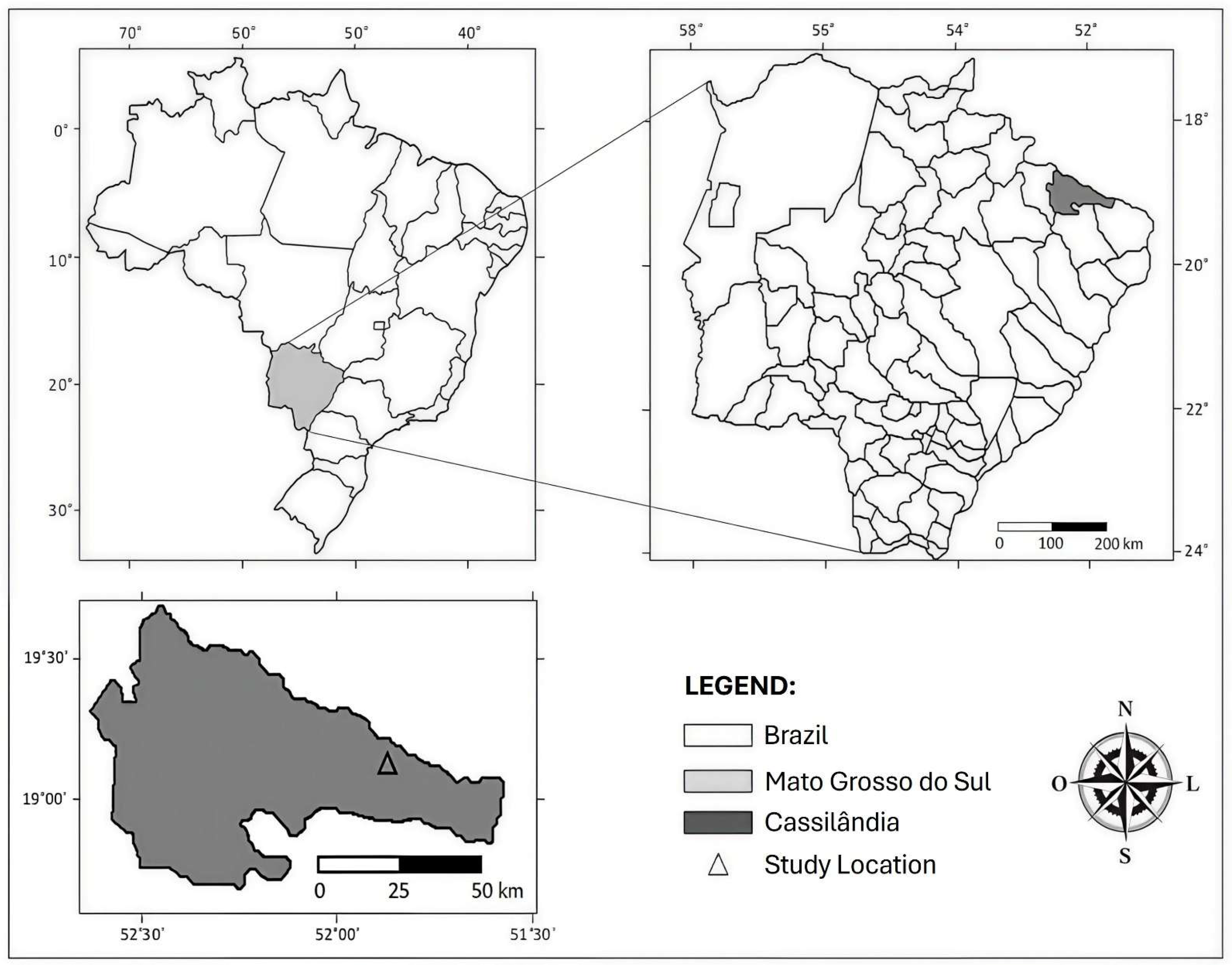
The experiment was conducted under greenhouse conditions at the Agronomic Experimental Station of the State University of Mato Grosso do Sul–UEMS, Cassilândia Unit, MS (19°05′20″ S; 51°48′24″ W and average altitude of 510 m) (Figure 1), from August 2025 to December 2025.
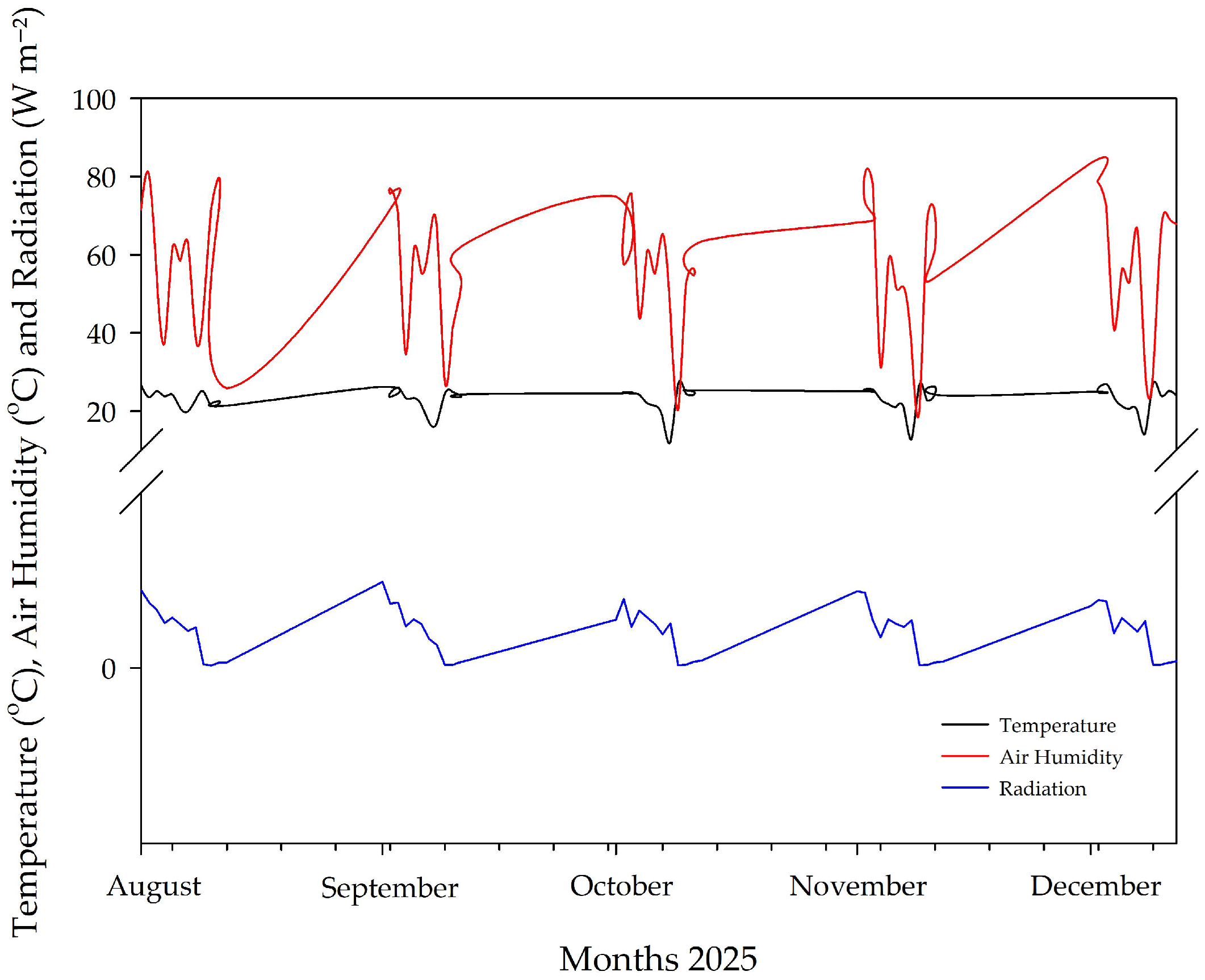
Air temperature (°C), relative humidity (%), and internal global radiation (W m−2) were recorded using an automatic weather station (E4000, Irriplus, Viçosa, Minas Gerais, Brazil) installed inside the center of the greenhouse. Internal global radiation measurements (W m−2) were collected from 10:00 to 17:00 (Figure 2).

2.2. Experimental Design

The experimental design used was a randomized block design with four replications. Five treatments based on the AFERT biofertilizer were employed (100, 80, 60, 40, and 20%, representing 2, 1.6, 1.2, 0.8, and 0.4 t ha−1, respectively), and the control was based on complete mineral fertilizer with the formula 04-14-08 at a rate of 2 t ha−1 and 133 kg ha−1 of KCl. A 100% dose of AFERT is equivalent to the applied dose of mineral fertilizer. AFERT is a pelleted biofertilizer containing a mixture of organic and biological materials encapsulated in a polymer that retains water and allows for the gradual release of nutrients, minimizing leaching and volatilization [22]. Its composition includes bacteria (genera Bacillus, Azospirillum, Pseudomonas, and Bradyrhizobium) and fungi (genera Trichoderma, Rhizobium, Beauveria, and Metarhizium), which complement the response to biofertilizer. The fertilizer AFERT was formulated as 04-14-12 and contains all necessary macro- and micronutrients in sufficient quantities for soil health, optimal performance, and crop production [22]. At 30 days after emergence, top-dressing fertilization was applied with 200, 160, 120, 80, and 40 kg ha−1 of AFERT (02-02-30), whereas in the control treatment (mineral fertilizer), 10 kg ha−1 of urea (45% N) and 100 kg ha−1 of KCl (60% K2O) were applied.

2.3. Implementation and Conduct of the Experiment

Each experimental unit consisted of a pot in which five sesame seeds of the BRS Anahí cultivar were sown and then thinned to leave only two sesame plants per pot. Under greenhouse conditions, pots with a capacity of 5 dm3 were used, filled with a substrate composed of soil collected from the surface layer (0–20 cm) of an Orthic Latoxolic Quartzarenic Neosol (NQo) with a sandy texture (120 g kg−1 of clay, 40 g kg−1 of silt, and 840 g kg−1 of sand). After collection, the soil was air-dried, crumbled, and passed through a 2.0 mm mesh sieve. The chemical characterization of the soil is shown in Table 1. The soil moisture content was maintained close to field capacity with daily manual irrigation. Pest and disease control during the experiment was carried out according to the needs and technical recommendations for sesame cultivation.

2.4. Physiological Assessments

At full flowering of the crop, gas exchange assessments were carried out at the time of full flowering between 9:00 and 10:00 AM under supplemental light, with chamber CO2 at 380 μmol mol−1 and a photon flux density of 1000 μmol m−2 s−1. The evaluations were carried out with an Infra-Red Gas Analyzer–IRGA (LCi, ADC Bioscientific, Hertfordshire, UK) on five plants at random. The substomatal carbon concentration (Ci, µmol CO2 m− 2 s− 1), stomatal conductance (gs, mol de H2O m− 2 s− 1), transpiration (E, mmol de H2O m− 2 s− 1), and net photosynthesis rate (A, µmol de CO2 m− 2 s− 1) were measured. These data were subsequently used to estimate water use efficiency (WUE = A/E, µmol CO2 mol− 1 H2O− 1), intrinsic efficiency of water use (iWUE = A/gs, µmol CO2 mol H2O− 1), and instantaneous carboxylation efficiency (iCi = A/Ci, µmol of CO2 m− 2 s− 1 µmol− 1 m− 2 s− 1).

2.5. Biometric Assessments

At the time of harvest, the yield components were also determined [plant height (PH, cm), number of pods per plant (NP, unit), stem diameter (SD, mm), root length (RL, cm), root dry mass (RDM, g), number of grains per plant (NGP, unit)], and total grain weight (TGW, g). The shoot and root lengths were measured in centimeters with a millimeter ruler with 1 mm precision. The number of pods was counted manually. The stem diameter was measured using a digital electronic caliper with 0.1 mm accuracy. The fresh weights of the root system and shoots of each plant were individually analyzed on a precision balance with an accuracy of 0.001 kg. The collected samples were dried in a forced-air oven at 60 °C for 72 h, after which the dry weights of the roots and shoots were determined using an analytical balance with an accuracy of 0.001 g. The plants of individual plots were harvested and threshed via a manual thresher, and the grains were weighed and extrapolated to grain yield in g plot−1 at 13% humidity (wet basis).

2.6. Statistical Analysis

The data were subjected to analysis of variance (ANOVA), and the means were compared by the Tukey test at 5% probability. Pearson correlations were performed between all the variables, and the relationships between them were verified. First, the mean data were standardized, and then the Euclidean distance between treatments was estimated, considering all the measured variables. With these data, hierarchical clustering was performed using the UPGMA (unweighted pair group method with arithmetic mean) method in conjunction with Tocher clustering [23]. The dendrogram was cut using the Mojema method [24] with k = 1.25. The statistical analyses were performed using RBio statistical software version 236 [25].

3. Results

The results revealed significant differences in most of the measured variables between the evaluated treatments, with the exceptions of gs, iWUE, SD, NGP, and TGW (Table 2). The coefficients of variation were below 30%, except for gs and TGW, whose values were 37.48% and 30.57%, respectively.
The Ci, gs, iWUE, RL, NGP, and TGW did not differ among the different treatments, indicating that the doses of AFERT biofertilizer performed equally to the 100% mineral (Min-2 t ha−1) fertilization when compared by the Tukey test (p < 0.05) (Table 2). For variable E, the best performances were obtained in the Biof-1.6 t ha−1, Biof-1.2 t ha−1, and Biof-0.4 t ha−1 treatments (80%, 60%, and 20% AFERT biofertilizer treatments, respectively). For A, the best performance was achieved in the Biof-1.2 AFERT biofertilizer treatment, which surpassed all the applied treatments (Table 2). iCi was greatest in the 100% mineral treatment, and the Biof was −1.2 t ha−1 and the Biof was −0.8 t ha−1 in terms of the percentage of AFERT biofertilizer. With respect to stem diameter, the Biof–2 t ha−1, Biof–1.6 t ha−1, and Biof–1.2 t ha−1 biofertilizer treatments yielded better results, although they did not differ significantly from the 100% mineral fertilization treatment, all of which demonstrated the best performance (Table 2). These positive results of the biofertilizer can be explained by the presence of a water retainer, which, in addition to promoting greater water retention, contributes to the slow release of nutrients at different doses and corresponds to the release and nutritional needs of sesame at different stages of growth. For the variables WUE, NP, PH, and RDM, the best performance was obtained in the treatment with minerals (Min–2 t ha−1) used as the experimental control under the tested conditions.
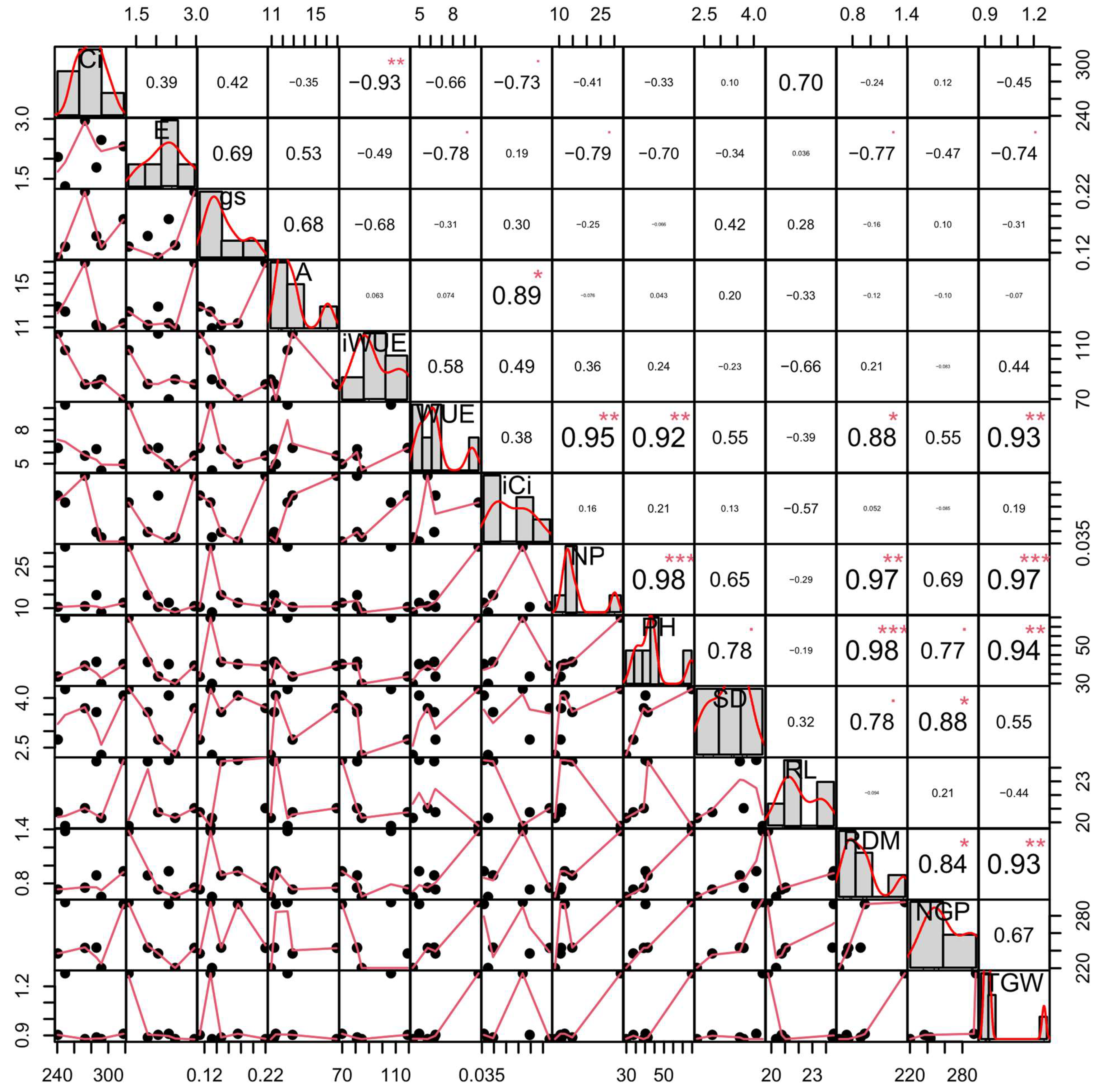
With respect to Figure 3, when the measured variables were considered, there were positive Pearson correlations between iCi × A (r = 0.89, p < 0.05), SD × NGP (r = 0.88, p < 0.05), NP × TGW (r = 0.97, p < 0.001), RDM × NGP (r = 0.84, p < 0.05), RDM × TGW (r = 0.93, p < 0.01), RDM × NP (r = 0.97, p < 0.01), PH × TGW (r = 0.94, p < 0.01), PH × NP (r = 0.98, p < 0.001), PH × RDM (r = 0.98, p < 0.001), WUE × TGW (r = 0.93, p < 0.01), WUE × NP (r = 0.93, p < 0.01), WUE × RDM (r = 0.88, p < 0.05), and WUE × PH (r = 0.92, p < 0.01). However, significant negative correlations (p < 0.01) were found only between iWUE and Ci (r = −0.93).
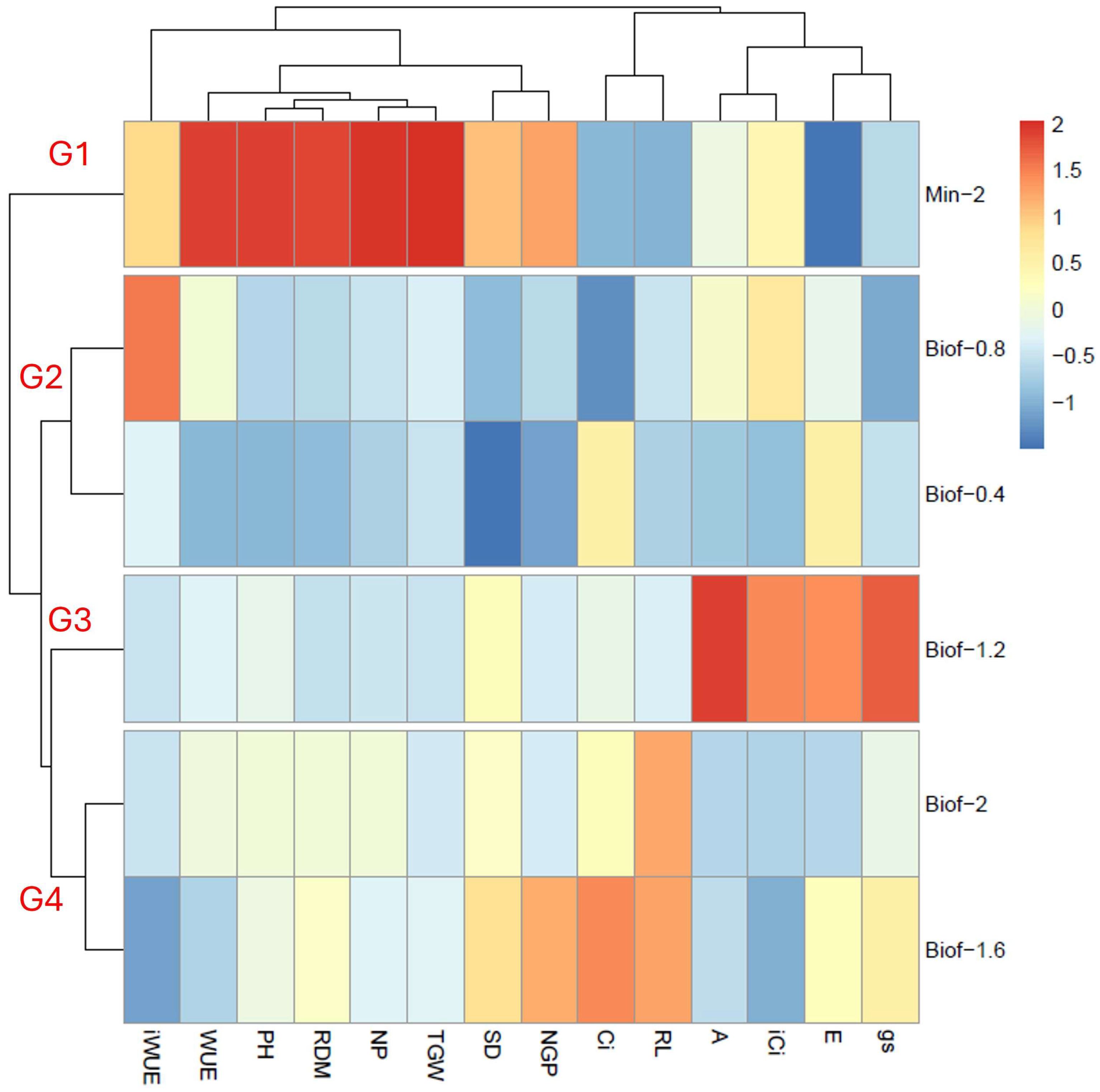
The number of clusters was estimated using the method described by Mojema for calculation, indicating the formation of four groups. The diagram (Figure 4) indicates the relationships between treatments when allocated to different groups, which highlights the differences in relation to the behavior of each treatment. In Figure 4, the six applied treatments were grouped into four groups, among which G1 had only the mineral fertilization treatment (Min-2.0 t ha−1), which showed better performance for the variables (WUE, PH, RDM, NP, and TGW). Compared with the other clusters, cluster 1 presents variables that are superior. The best performance of the variables within the groups is associated with the red colors, which represent higher values for the variables where they are present. The second group (G2) was formed by the treatments Biof-0.8 t ha−1 and Biof-0.4 t ha−1 of the AFERT biofertilizer (Figure 4). However, the G3 group was formed only by the Biof-1.2 t ha−1 treatment of the AFERT biofertilizer, and the best results were obtained for the variables A, iCi, E, and gs. The last group (G4) was formed by the treatments Biof–2 t ha−1 and Biof-1.6 t ha−1 of the AFERT biofertilizer (Figure 4). The grouping shows how the treatments Min-2.0 t ha−1 and Biof-1.2 t ha−1 differed from the remaining treatments, as they were allocated to two different groups, G1 and G3, respectively. When we consider the magnitude of the groups’ performance, we can organize them as G1 > G4 > G2 > G3 (Figure 4).

4. Discussion

The increase in sesame crop production under the conditions of the Brazilian Cerrado is significant, as it is an alternative and sustainable crop for the region [1,7,10] because of its adaptability and resistance to drought [7]. Fertilization management constitutes a safe strategy that allows the establishment of the crop and determines productivity, where the use of fertilizers that employ residues from different production chains is a sustainable alternative in Brazil.
The use of organomineral fertilizers (biofertilizers) has been increasing as a sustainable alternative to reduce the use of chemical fertilizers. This practice promotes good agronomic and economic responses in crops such as soybeans [12], lettuce [13], corn [14], coffee [15], pastures [16], and coconut [17], among other crops, which highlights the potential of these alternative sources.
The results of the present study demonstrate how the biofertilizer AFERT can contribute to sesame nutrition compared with a mineral source with the same nutritional contribution (4-14-12). The reduction in the AFERT dose was efficient and was similar when the variables Ci, gs, iWUE, RL, NGP, and TGW were measured in relation to the mineral fertilization Min-2.0 t ha−1 (Table 2). The effect of the biofertilizer AFERT on sesame demonstrates that, for variables in which the doses do not differ from those of the mineral fertilizer, a decrease in the dose of AFERT, even if it is lower than that of the mineral fertilizer, does not result in a significant difference, thereby ensuring similar performance, especially for NGP (84%) and TGW (70%), which are decisive for obtaining good agricultural production. When comparing mineral and organomineral fertilization, Boghdady et al. [18] reported that the increase in the level of mineral fertilizers used was equal to that induced by treatment with biofertilizers, which replaced half the recommended dose of natural fertilizers, thus reducing environmental pollution caused by the repeated application of mineral fertilizers [26,27]. However, significant differences were detected specifically for NP, PH, SC and RDM when the biofertilizer was applied at different doses, indicating that the treatment containing the mineral source was superior in terms of these variables (Table 2). One difference between the two fertilizers that partly explains the results obtained for agronomic characteristics and photosynthetic efficiency may be related to how these fertilizers react in the soil [21]. Mineral fertilizers are rapidly released and, as a consequence, favor the variables NP, PH, and SD, which show a greater response during the initial development of the crop, and this response is maintained until the end of the experiment (Table 2) when these variables are measured [28]. However, the biofertilizer is slowly released, which contributes to the fact that, during the flowering phase of the crop, at the moment of maximum photosynthetic performance, the best performances of E and A are obtained with AFERT, and the behavior of the variables Ci, gs, iWUE, and iCi is equalized. Noor et al. [21] reported that organomineral fertilization for three consecutive years promoted an increase (74.5%) in the yield response in sesame, surpassing mineral fertilization. These results were related not only to the nutrient content of the compost but also to the improvement in the physical and biological properties of the soil.
The absence of significant differences in Ci, gs, iWUE, RL, NGP and TGW indicates that the doses of the AFERT biofertilizer were able to maintain the physiological and metabolic balance of the plants at levels comparable to those associated with complete mineral fertilization. These findings suggest that the biofertilizer provided nutrients in sufficient quantities, allowing adequate photosynthetic activity and, consequently, stimulating the plant’s physiological processes, thus promoting the performance of the sesame under the tested conditions. The stability of the internal CO2 concentration (Ci) and stomatal conductance (gs) demonstrated that the photosynthetic apparatus operated efficiently and without significant diffusive restrictions, reflecting adequate nutrition and water balance when the experiment was conducted on the basis of the applied treatments [29].
The effect of the biofertilizer was that the greater the reduction in biofertilizer content relative to 100% of the mineral fertilization (Min-2.0 t ha−1), the more negatively it influenced WUE, iCi, NP, PH, SD, and RDM, promoting better performance of mineral fertilization in these variables compared with the biofertilizer used. Similar results were reported by Silva et al. [30], who observed that when increasing doses of biofertilizer were added, it only affected plant height, with no response observed for doses above 75%. Similar results were also reported in sesame by Perin et al. [31] and Grilo and Azevedo [32], who reported a maximum plant height of 1.70 m at a dose of 600 kg ha−1, with a reduction observed at higher doses. The application of steric doses via fertigation had positive effects on sesame growth, resulting in a maximum height of 1.57 m under field conditions [31]
With respect to stem diameter, larger diameters were observed in the treatments that included mineral fertilizer (Min-2.0 t ha−1) and the doses of biofertilizer (Biof–2 t ha−1, Biof-1.6 t ha−1, and Biof-1.2 t ha−1). Similar results were reported by Ribeiro et al. [33] when studying the behavior of different sesame varieties in the field. In contrast, Feitosa et al. [34] evaluated the same variables (SD and PH) and observed nonsignificant results, indicating that organomineral fertilization performed similarly to mineral fertilization, as was also found in the present study for other variables.
With respect to NGP and TGW, no differences were observed between the treatments, indicating that the biofertilizer doses were capable of meeting the nutritional demand of the mineral source. Similar results were reported by Silva et al. [30] when the use of organomineral sources in sesame was compared with the use of mineral fertilization. These two variables (NGP and TGW) directly influence production, and the results show that fertilization with the AFERT biofertilizer promotes performance similar to that of mineral fertilizer, a result that highlights the beneficial effects that the biofertilizer has on the crop and how the reduction in dose does not result in reduced productivity under the tested conditions. Lotfi et al. [35] reported that an increase in the grain yield of wheat genotypes cultivated under vetch residues as an organic fertilizer source improved leaf pigmentation and photosynthetic efficiency, facilitating a longer grain-filling period and resulting in the generation of heavier grains. The application of biofertilizers significantly increased sesame productivity when we considered the response obtained for NGP and TGW. The findings of Molla et al. [36] support that surpassing the capacity of plants for nutrient absorption through excessive fertilization may diminish efficiency and contribute to nutrient losses by leaching or volatilization. This finding reinforces the importance of a balanced fertilization strategy that considers not only the needs of plants but also environmental conditions.
With respect to the parameters related to photosynthesis (A and iCi), as shown in Table 2 and Figure 4, at the Biof-1.2 t ha−1 dose of AFERT, the highest values for A and the lowest for iCi were observed, along with adequate values of Ci, gs, and iWUE. These data confirm better photosynthetic efficiency when this treatment is applied. Similar results were reported by Dalastra et al. [37] and Feitosa et al. [34], who reported different behaviors among cultivars regarding the net photosynthesis rate and CO2 concentration as a result of fertilization.
The highest value of the net CO2 assimilation rate in the Biof-1.2 t ha−1 treatment of the AFERT biofertilizer indicates that intermediate doses provided better nutritional balance, favoring photosynthetic activity and carbon fixation. Similarly, the highest values of instantaneous carboxylation efficiency in the mineral treatment and intermediate doses of biofertilizer suggest an adequate supply of essential nutrients, which optimizes Rubisco activity and the performance of the photosynthetic apparatus [20].
The observed correlations between the variables associated with photosynthesis, agronomic performance, and production components reveal close relationships that determine the behavior of the crop under the tested conditions. Strong positive correlations between iCi and A (r = 0.89, p < 0.05) and negative correlations between iWUE and Ci (r = -0.93) reflect the established photosynthetic efficiency and, as a consequence, the better performance of the crop [38]. A balance in terms of crop development was achieved, as we observed highly significant positive correlations between SD and NGP (r = 0.88, p < 0.05), between NP and TGW (r = 0.97, p < 0.001), between RDM and NGP (r = 0.84, p < 0.05), between RDM and TGW (r = 0.93, p < 0.01), between RDM and NP (r = 0.97, p < 0.01), between PH and TGW (r = 0.94, p < 0.01), between PH and NP (r = 0.98, p < 0.001), and between PH and RDM (r = 0.98, p < 0.001). SD is significantly positively correlated with NGP, indicating that the thicker the stem is, the stronger the nutrient transport capacity of the plant and the greater the number of seeds per plant, reflecting the support of vegetative growth for reproductive growth in sesame. High PH corresponds to high NP (Figure 3), high root dry matter accumulation (RDM), high grain weight (TGW), and high WUE, with positive and significant correlation values above 90%, which results in the response obtained for the sesame crop. Nguyen Quoc et al. [39] reported that the application of biofertilizers significantly improved soil fertility, nutrient uptake, and productivity compared with treatments involving chemical fertilizers, with or without biofertilizers, at the same application rate; these results are similar to those obtained in the present study.
The multivariate clustering approach revealed that the treatments promoted distinct physiological and productive responses, reflecting the effect of the fertilization dose on plant metabolism. The treatment with mineral fertilization resulted in greater water use efficiency and greater productive performance, indicating a fully balanced nutritional supply. On the other hand, the intermediate dose of biofertilizer favored variables related to photosynthetic activity, suggesting that physiological optimization occurred without nutritional excess. Moreover, the effects of lower or higher doses of biofertilizer were intermediate, indicating that nutritional balance directly influences metabolic efficiency and plant performance. Overall, the results demonstrate that adjustments in biofertilizer dosage can modulate physiological and productive responses, which are similar to those associated with conventional mineral fertilization.

5. Conclusions

The biofertilizer AFERT demonstrated productive performance (only for NGP and TGW) equivalent to that of mineral fertilization, mainly at doses ranging from 100% to 60%. The dose corresponding to 60% (Biof-1.2 t ha−1) promoted physiological efficiency, with an increase in CO2 assimilation and photosynthetic activity, without harming productive components. The results indicate that, in relation to mineral fertilization, AFERT can be a viable and sustainable alternative for the nutritional management of crops. Future studies under field conditions will allow us to verify the results obtained and compare the performance of both fertilization sources with a zero-control treatment to estimate the relative productive gains of both treatments.

Author Contributions

Conceptualization, J.G.A., F.S. and L.M.-A.; methodology J.G.A., M.B.A.S., B.P.D.A., A.V.M.M., F.S., E.P.N., A.M.Z., T.S.d.C.Z., C.G.M.A., C.A.M.S., M.P.A.M. and L.M.-A.; software, J.G.A., F.S. and L.M.-A.; validation, J.G.A., M.B.A.S., B.P.D.A., A.V.M.M., F.S., E.P.N., A.M.Z., T.S.d.C.Z., C.G.M.A., C.A.M.S., M.P.A.M. and L.M.-A.; formal analysis J.G.A., M.B.A.S., B.P.D.A., A.V.M.M., F.S., E.P.N., A.M.Z., T.S.d.C.Z., C.G.M.A., C.A.M.S., M.P.A.M. and L.M.-A.; investigation, J.G.A., M.B.A.S., B.P.D.A., A.V.M.M., F.S., E.P.N., A.M.Z., T.S.d.C.Z., C.G.M.A., C.A.M.S., M.P.A.M. and L.M.-A.; resources, J.G.A., F.S. and L.M.-A.; data curation, J.G.A., M.B.A.S., B.P.D.A., A.V.M.M., F.S., E.P.N., A.M.Z., T.S.d.C.Z., C.G.M.A., C.A.M.S., M.P.A.M. and L.M.-A.; writing—original draft preparation, J.G.A., M.B.A.S., B.P.D.A., A.V.M.M., F.S., E.P.N., A.M.Z., T.S.d.C.Z., C.G.M.A., C.A.M.S., M.P.A.M. and L.M.-A.; writing—review and editing, J.G.A., M.B.A.S., B.P.D.A., A.V.M.M., F.S., E.P.N., A.M.Z., T.S.d.C.Z., C.G.M.A., C.A.M.S., M.P.A.M. and L.M.-A.; visualization, J.G.A., M.B.A.S., B.P.D.A., A.V.M.M., F.S., E.P.N., A.M.Z., T.S.d.C.Z., C.G.M.A., C.A.M.S., M.P.A.M. and L.M.-A.; supervision, J.G.A.; project administration, J.G.A., F.S. and A.M.Z.; funding acquisition, J.G.A., F.S. and L.M.-A. All authors have read and agreed to the published version of the manuscript.

Funding

This research received no external funding.

Data Availability Statement

The data presented in this study are available upon request from the corresponding author.

Conflicts of Interest

The authors declare that they have no conflicts of interest.

Abbreviations

The following abbreviations are used in this manuscript:
NQoOrthic Latoxolic Quartzarenic Neosol
CECCation exchange capacity
OMOrganic matter
ANet CO2 assimilation rate
gsStomatal conductance
ETranspiration rate
CiInternal CO2 concentration
WUEWater use efficiency
iWUEIntrinsic water use efficiency
iCiInstantaneous carboxylation efficiency
PHPlant height
NPNumber of pods per plant
SDStem diameter
RLRoot length
RDMRoot dry mass
NGPNumber of grains per plant
TGWTotal grain weight
ANOVAAnalysis of variance
UPGMAUnweighted Pair Group Method with Arithmetic Mean

References

  1. Christo, B.F.; Lorenzoni, R.M.; Junior, E.M.; Júnior, R.D.S.N.; Pagotto, L.O. Sesame: A viable economic alternative for off-season double cropping systems in Mato Grosso, Brazil. Agrometeoros 2024, 32, e027707. [Google Scholar] [CrossRef] [Scilit]
  2. FAOSTAT—Food and Agriculture Organization of the United Nations. Production Quantities of Dry Sesame by Country; Rome, Italy, 2025. [Google Scholar]
  3. Arriel, N.H.C.; Vieira, D.J.; Firmino, P.T. Situação atual e perspectivas da cultura do gergelim no Brasil. In Recursos Genéticos e Melhoramento de Plantas para o Nordeste Brasileiro; Embrapa Semi-Árido: Petrolina, Brazil, 2005. [Google Scholar]
  4. Adorada, D.L.; Jones, L.C.; Liu, J.; Gurr, G.M. Sesame Diseases and Pests: Assessment of Threats to the Establishment of an Australian Industry. Crops 2025, 5, 44. [Google Scholar] [CrossRef] [Scilit]
  5. Jaffar, H.M.; Akhtar, I.; Saleem, M.Z.; Malik, T.; Ayub, A. A Comprehensive Review of the Health Benefits, Nutritional Composition, and Agricultural Aspects of Sesame Seeds. J. Food Biochem. 2025, 2025, 8713698. [Google Scholar] [CrossRef] [Scilit]
  6. Cruz, R.N.; Azevedo, C.A.V.; Fernandes, J.D.; Filho, A.F.M.; Wanderley, J.A.C. Adubação orgânica residual no crescimento e produção do gergelim irrigado com água residuária. Rev. Verde Agroecol. Desenvolv. Sustentável 2013, 8, 37. [Google Scholar]
  7. dos Santos, M.G.; Ribeiro, R.M.P.; Albuquerque, J.R.T.; Lins, H.A.; Barros Júnior, A.P.; Neto, F.B.; Souza, A.R.E. Production performance of sesame cultivars under different nitrogen rates in two crops in the Brazilian semiarid region. Ind. Crops Prod. 2018, 124, 1–8. [Google Scholar] [CrossRef] [Scilit]
  8. CONAB—Companhia Nacional de Abastecimento. Acompanhamento da Safra Brasileira de Grãos, Safra 2025/26, Primeiro Levantamento; CONAB: Brasília, Brazil, 2025; pp. 1–102. [Google Scholar]
  9. Oliveira, A.K.S.; Coêlho, E.D.S.; Santos, G.L.D.; Oliveira, P.H.A.D.; Silva, A.G.C.D.; Silveira, L.M.D.; Barros, A.P. Effects of phosphate fertilization on growth and yield of irrigated sesame in semiarid regions. Acta Sci. Agron. 2025, 47, e72322. [Google Scholar] [CrossRef] [Scilit]
  10. Azevedo, R.P.; Dallacort, R.; Boechat, C.L.; Teodoro, P.E.; Teodoro, L.P.R.; Rossi, F.S.; Silva Junior, C.A. Remotely sensed imagery and machine learning for mapping of sesame crop in the Brazilian Midwest. Remote Sens. Appl. Soc. Environ. 2023, 32, 101018. [Google Scholar] [CrossRef] [Scilit]
  11. Leite, Y.S.A.; Véras, M.L.M.; Melo Filho, J.S.; Costa, F.X. Fontes de adubação orgânica em plantas de amendoim. Rev. Terc. Incluído 2015, 5, 91–100. [Google Scholar] [CrossRef] [Scilit]
  12. Ferão, R.; Lajús, C.R.; Busnello, F.J.; Diel, É.G.P.; Girardi, N.; Bedin, M.; Carlesso, L.C. Propriedades agronômicas da cultura da soja manejada com fertilizantes minerais e organominerais. Aracê 2025, 7, 14859–14876. [Google Scholar] [CrossRef] [Scilit]
  13. Fonseca, J.P.C.A.; Neto, J.M.C.; Lang, M.C. Desenvolvimento da cultura do alface sob diferentes doses de adubo organomineral. Sci. Rural 2024, 28, 12–24. [Google Scholar]
  14. Lima, J.C.; Buligon, E.L.; Marostica, R.; Goufo, P.; Mendonça Costa, M.S.S.; Silva, G.J. Comparative impact of organomineral and organic fertilizers as partial substitutes for synthetic fertilizers in enhancing soil fertility, health, and maize growth. Rev. Agronegócio Meio Ambiente 2026, 19, e13332. [Google Scholar] [CrossRef] [Scilit]
  15. Mota, R.P.D.; Camargo, R.; Franco, M.H.R.; Assis, G.A.; Ferraz-Almeida, R.; Lemes, E.M. Sources and splitting of special fertilizers application in coffee crop. J. Plant Nutr. 2025, 48, 1067–1081. [Google Scholar] [CrossRef] [Scilit]
  16. Santos Caitano, T.B.; Homma, A.K.O. Mercado brasileiro de fertilizantes e corretivos para recuperação de pastagens degradadas no estado do Pará. Colóquio Rev. Desenvolv. Reg. 2025, 22, 248–274. [Google Scholar] [CrossRef] [Scilit]
  17. Atapattu, A.J.; Nuwarapaksha, T.D.; Udumann, S.S.; Dissanayaka, N.S. Integrating Organic Fertilizers in Coconut Farming: Best Practices and Application Techniques. Crops 2025, 5, 17. [Google Scholar] [CrossRef] [Scilit]
  18. Boghdady, M.S.; Nassar, R.M.; Ahmed, F.A. Response of sesame plant (Sesamum orientale L.) to treatments with mineral and biofertilizers. Res. J. Agric. Biol. Sci. 2012, 8, 127–137. [Google Scholar]
  19. Abbas, M.S.; Labib, H.A.; Hamza, M.; Fayed, S.A. Possibilities of Mineral Fertilizer Substitution Via Bio and Organic Fertilizers for Decreasing Environmental Pollution and Improving of Sesame (Sesamum indicum L.) Vegetative Growth. In Agro-Environmental Sustainability in MENA Regions; Springer International Publishing: Cham, Switzerland, 2021; pp. 263–291. [Google Scholar] [CrossRef] [Scilit]
  20. Abdelsatar, M.A.; Elmasry, H.M.; Attia, M.A. Role of potassium fertilizer in improving yield and its components for some sesame varieties under salt-affected soil conditions. SVU-Int. J. Agric. Sci. 2021, 3, 18–30. [Google Scholar] [CrossRef] [Scilit]
  21. Noor, R.S.; Hussain, F.; Abbas, I.; Umair, M.; Sun, Y. Effect of compost and chemical fertilizer application on soil physical properties and productivity of sesame (Sesamum Indicum L.). Biomass Convers. Biorefinery 2023, 13, 905–915. [Google Scholar] [CrossRef] [Scilit]
  22. AFERT. Tecnologia Sustentabilidade. Unidos Pela Produtividade. 2025. Available online: https://afert.bio/beneficios/ (accessed on 25 January 2025).
  23. Cruz, C.D.; Ferreira, F.M.; Pessoni, L.A. Biometria Aplicada ao Estudo da Diversidade Genética; Suprema: Visconde do Rio Branco, Brazil, 2011; 620p. [Google Scholar]
  24. Mojena, R. Hierarchical grouping methods and stopping rules: An evaluation. Comput. J. 1977, 20, 359–363. [Google Scholar] [CrossRef] [Scilit]
  25. Bhering, L.L. Rbio: A Tool for Biometric and Statistical Analysis Using the R Platform. Crop Breed. Appl. Biotechnol. 2017, 17, 87–190. [Google Scholar] [CrossRef] [Scilit]
  26. Torres, J.L.L.; Schopf, T.T.; Franceschi, M. Efeitos do extrato de eucalipto (Eucalyptus grandis) na germinação de gergelim (Sesamum indicum). Rev. Ciências Agrárias Mato Grosso 2026, 1, 69–81. [Google Scholar]
  27. Jalilian, S.; Mondani, F.; Fatemi, A.; Bagheri, A. Evaluation of animal-and green manures coapplication on soil micronutrients and yield of sesame (Sesamum indicum L.) in organic farm condition. J. Plant Nutr. 2022, 45, 2348–2359. [Google Scholar] [CrossRef] [Scilit]
  28. Taha, N.M.; Bukhari, N.A.; Hatamleh, A.A.; Górnik, K.; Sabah, S.S.; Hashem, F.A.; El-Gabry, Y.A.-E.; Shahin, M.G.E.; Lamlom, S.F.; Ahmed, Y.N.; et al. An Attempt to Reduce Nitrogen Fertilization Levels and Their Impact on the Growth and Productivity of Garlic (Allium sativum L.) Under Different Planting Dates. Horticulturae 2024, 10, 1377. [Google Scholar] [CrossRef] [Scilit]
  29. Latique, S. Moroccan Ulva rigida Extracts: A Promising Biostimulant for Improving Growth and Photosynthetic Performance in Salt-Stressed Bean Plants. Crops 2025, 5, 61. [Google Scholar] [CrossRef] [Scilit]
  30. Silva, E.L.G.; Gonçalves, S.B.; Filho, A.F.M.; Arriel, N.H.C.; Queiroz, M.F. Crescimento e produção do gergelim em diferentes níveis de solução organomineral. Rev. Verde Agroecol. Desenvolv. Sustentável 2016, 11, 33–38. [Google Scholar] [CrossRef] [Scilit]
  31. Perin, A.; Cruvinel, D.J.; Silva, J.W.D. Desempenho do gergelim em função da adubação NPK e do nível de fertilidade do solo. Acta Sci. Agron. 2010, 32, 93–98. [Google Scholar] [CrossRef] [Scilit]
  32. Grilo, J.A.S., Jr.; Azevedo, P.V. Crescimento, desenvolvimento e produtividade do gergelim BRS Seda na Agrovila de Canudos, Ceará Mirim (RN). Holos 2013, 2, 19–33. [Google Scholar] [CrossRef] [Scilit]
  33. Ribeiro, R.M.P.; Albuquerque, J.R.T.; Santos, M.G.; Barros, A.P.; Grangeiro, L.C.; Silveira, L.M.D. Growth dynamics of sesame cultivars. Rev. Caatinga 2018, 31, 1062–1068. [Google Scholar] [CrossRef] [Scilit]
  34. Feitosa, S.S.; Demartelaere, A.C.F.; Neto, M.A.B.; Rodrigues, A.L.D.S.; Lima, D.D.C.; Ferreira, A.D.S. Avaliação da fisiologia e teor de óleo das cultivares de gergelim em resposta à aplicação de benziladenina. Braz. J. Dev. 2020, 6, 63113–63132. [Google Scholar] [CrossRef] [Scilit]
  35. Lotfi, R.; Golkari, S.; Abbasi, A.; Rahimzadeh, R.; Mohammadzadeh, A.; Pessarakli, M. Pre-Crop and Residue Management Effects on Photosynthesis Efficiency and Grain Yield of Dryland Wheat Genotypes. Crops 2024, 4, 426–439. [Google Scholar] [CrossRef] [Scilit]
  36. Molla, A.; Fountouli, A.; Emmanouil, C.; Chatzikirou, E.; Skoufogianni, E. Response of Dittany Cultivation to an Organic Fertilization on Nitrogen and Phosphorus Content, Uptake and Use Efficiency. Nitrogen 2025, 6, 58. [Google Scholar] [CrossRef] [Scilit]
  37. Dalastra, G.M.; Echer, M.M.; Guimarães, V.F.; Hachmann, T.L.; Inagaki, A.M. Trocas gasosas e produtividade de três cultivares de meloeiro conduzidas com um e dois frutos por planta. Bragantia 2014, 73, 365–371. [Google Scholar] [CrossRef] [Scilit]
  38. Hussain, S.; Qayyum, A.; Jan, A.; Ilyas, M.; Ahmad, I.; Ahmed, U.; Radicetti, E.; Mihoub, A.; Jamal, A.; Dewir, Y.H. Growth, Yield, and Oil Quality of Sesame (Sesamum indicum L.) Cultivars Under Varying Row Spacings and Biofertilizer Application. Int. J. Plant Prod. 2025, 19, 681–695. [Google Scholar] [CrossRef] [Scilit]
  39. Nguyen Quoc, K.; Le Vinh, T.; Le Thanh, Q.; Tran Ngoc, H.; Do Thi, X.; Huynh Huu, D.; Ly Ngoc Thanh, X.; Le Thi My, T. Effects of biofertilizer supplementation, Rhodopseudomonas spp., on nitrogen and phosphorus uptakes, growth, and yield of sesame (Sesamum indicum L.) on salt-affected soil. J. Plant Nutr. 2024, 47, 1–17. [Google Scholar] [CrossRef] [Scilit]
Figure 1. Location map of the study in the municipality of Cassilândia (Northeast region of the state of Mato Grosso do Sul, Brazil).
Crops 06 00041 g001
Figure 2. Climatic data obtained during the experiment conducted in a greenhouse.
Crops 06 00041 g002
Figure 3. Pearson correlations obtained when evaluating a sesame cultivar with mineral fertilization and doses of fertilization with the biofertilizer AFERT under greenhouse conditions in South Mato Grosso, MS, Brazil. Ci: internal CO2 concentration, E: transpiration rate, gs: stomatal conductance, A: net CO2 assimilation rate, iWUE: intrinsic water use efficiency, WUE: water use efficiency, iCi: instantaneous carboxylation efficiency, NP: number of pods, PH: plant height, SD: stem diameter, RL: root length, RDM: root dry mass, NGP: number of grains per plant, TGW: total grain weight. The correlation values with the symbols *, ** and *** represent significant differences at 0.5, 0.1 and 0.01%, respectively. The diagonal of the figure represents the frequency of the data, and the curve is associated with the distribution of the data. Below the diagonal, the circles with a white background represent the combination of the data for each pair of variables, and the red line represents the curve associated with the distribution of these values.
Crops 06 00041 g003
Figure 4. Heatmap based on average Euclidean distance and clustering obtained when evaluating a sesame with mineral fertilization and doses of biofertilization under greenhouse conditions in South Mato Grosso, MS, Brazil. Ci: internal CO2 concentration, E: transpiration rate, gs: stomatal conductance, A: net CO2 assimilation rate, iWUE: intrinsic water use efficiency, WUE: water use efficiency, iCi: instantaneous carboxylation efficiency, NP: number of pods, PH: plant height, SD: stem diameter, RL: root length, RDM: root dry mass, NGP: number of grains per plant, and TGW: total grain weight.
Crops 06 00041 g004
Table 1. Soil physicochemical characteristics in the experimental area of Cassilândia (Northeast region of the state of Mato Grosso do Sul, Brazil).
pHResin-P
(mg dm−3)
K
(mmolc dm−3)
Ca
(mmolc dm−3)
Mg
(mmolc dm−3)
CEC
(mmolc dm−3)
5.051.210633.2
OM
(g dm−3)
B
(mg dm−3)
Cu
(mg dm−3)
Fe
(mg dm−3)
Zn
(mg dm−3)
V
(%)
90.080.5160.252
Cation exchange capacity (CEC); base saturation (V%); organic matter (OM).
Table 2. Comparison of the means of the variables obtained when different doses of biofertilizers were applied in relation to chemical fertilization in the sesame crop under the soil conditions of the Cerrado of southern Mato Grosso.
Treatments
(t ha−1)
CiEgsAWUEiWUEiCi
Min-2249.25 a1.31 b0.13 a12.44 b10.30 a106.61 a0.052 a
Biof-2286.00 a1.79 b0.15 a11.23 b6.32 b81.20 a0.040 b
Biof-1.6317.75 a2.31 a0.18 a11.38 b4.98 b69.74 a0.036 b
Biof-1.2272.50 a2.96 a0.22 a16.92 a5.73 b81.06 a0.063 a
Biof-0.8240.50 a2.05 b0.11 a12.90 b6.43 b118.98 a0.055 a
Biof-0.4291.75 a2.47 a0.13 a10.92 b4.41 b84.67 a0.038 b
Teste F (p value)0.0550.0030.1540.0490.0810.0010.024
CV (%)12.6222.2237.4821.1426.6124.3925.02
Treatments
(t ha−1)
NPPHSDRLRDMNGPTGW
Min-232.25 a64.84 a4.27 a19.75 a1.97 a295.50 a1.280 a
Biof-214.75 b41.39 b3.58 a24.47 a0.79 b243.50 a0.888 a
Biof-1.612.00 b40.21 b4.07 a24.56 a0.89 b293.25 a0.910 a
Biof-1.210.75 b39.28 b3.69 a21.04 a0.60 b243.25 a0.878 a
Biof-0.810.50 b33.69 c2.75 b20.75 a0.57 b236.75 a0.903 a
Biof-0.48.50 b29.81 c2.29 b20.33 a0.43 b220.25 a0.878 a
Teste F (p value)0.0000.0000.0020.6420.0000.4770.360
CV (%)16.439.3518.3323.6819.5925.1530.57
Ci: internal CO2 concentration (µmol CO2 m− 2 s− 1), E: transpiration rate (mmol de H2O m− 2 s− 1), gs: stomatal conductance (mol de H2O m− 2 s− 1), A: net CO2 assimilation rate (µmol de CO2 m− 2 s− 1), iWUE: intrinsic water use efficiency (µmol CO2 mol H2O− 1), WUE: water use efficiency (µmol CO2 mol− 1 H2O− 1), iCi: instantaneous carboxylation efficiency (µmol of CO2 m− 2 s− 1 µmol−1 m− 2 s− 1), NP: number of pods (unit), PH: plant height (cm), SD: stem diameter (mm), RL: root length (cm), RDM: root dry mass (g), NGP: number of grains per plant (unit), and TGW: total grain weight (g). Different lowercase letters in the column represent statistically significant differences according to the Tukey test at 5% probability.
Disclaimer/Publisher’s Note: The statements, opinions and data contained in all publications are solely those of the individual author(s) and contributor(s) and not of MDPI and/or the editor(s). MDPI and/or the editor(s) disclaim responsibility for any injury to people or property resulting from any ideas, methods, instructions or products referred to in the content.