Article

Protective Row Covers for Management of Flea Beetles in Organic Eggplant Production in the Southeastern US


1
Department of Entomology, Martin-Gatton College of Agriculture, Food, and Environment, University of Kentucky, Lexington, KY 40546, USA
2
Cooperative Extension Service, Martin-Gatton College of Agriculture, Food, and Environment, University of Kentucky, Lexington, KY 40546, USA
3
Department of Horticulture, Martin-Gatton College of Agriculture, Food, and Environment, University of Kentucky, Lexington, KY 40546, USA
4
Department of Entomology, Washington State University, Pullman, WA 99164, USA
*
Author to whom correspondence should be addressed.
Crops 2026, 6(2), 42; https://doi.org/10.3390/crops6020042
Submission received: 2 February 2026 / Revised: 23 March 2026 / Accepted: 30 March 2026 / Published: 2 April 2026

Abstract

Organic eggplant production in the United States is challenged by flea beetles, which stunt eggplant growth and reduce yield. Across four experiments between 2019 and 2024, we compared the effects of various pest management strategies on flea beetle abundance, damage, and marketable yield in eggplant production, focusing on row covers and organic insecticides in later years of the study. Treatments included fine-mesh row covers, organic insecticides, and untreated controls (all years); reflective plastic mulch (2019); various essential oils (2019–2020); conventional insecticide control (2019–2020); and spunbonded row covers (2019–2021). Low flea beetle pressure was observed in 2019 and 2020; consequently, experiments were moved to fields under organic management with more frequent cultivation of solanaceous crops in 2021 and 2024. Samples taken near row cover removal at flowering revealed significantly more flea beetles in the control than fine-mesh row cover treatments in 2019, 2020, and 2021. However, there were never significant differences in flea beetle abundance in samples collected at transplanting or at harvesting. Flea beetle feeding damage at flowering was significantly lower in all row cover treatments than the untreated control in 2019, 2021, and 2024 and the organic insecticide treatment in 2019 and 2021; data was not collected in 2020. There was no difference between treatments in marketable yield in 2019 and 2020; however, the marketable yields of fine-mesh row cover treatments maintained over the entire growing season were 82% and 471% higher than the organic insecticide treatments in 2021 and 2024, respectively. These results indicate that fine-mesh row covers may be a viable pest management strategy in organic eggplant production.

1. Introduction

Damage caused by insect pests is one of the top challenges faced by growers of organic specialty crops [1,2]. While conventional farmers often use effective synthetic insecticides to manage insect pests, these products are prohibited in organic agriculture [3]. Furthermore, the National Organic Program crop pest, weed, and disease management practice standard clarifies that organic insecticides may be used by certified organic growers only as a last resort, after practicing and documenting preventative cultural and nonchemical pest control measures [3].
The insecticides available to organic specialty crop growers are limited in number and tend to have short residual action in field conditions due to their sensitivity to photodegradation [4]. Pyrethrins and spinosad are amongst the most commonly used organic insecticides [5]. A broad-spectrum insecticide derived from Dalmatian chrysanthemum (Tanacetum cinerariifolium (Trevir.)), pyrethrins are active against many pestiferous insects [5]. Pyrethrins degrade rapidly in sunlight, with one study of field-grown tomatoes (Lycopersicon esculentum (Mill.)) and peppers (Capsicum annuum (L.)) revealing a half-life of less than two hours [6]. Spinosad, a product derived from the soil actinomycete Saccharopolyspora spinosa (Mertz and Yao), is active against a narrower range of target pests, including some Coleopterans [5]. It is susceptible to photolysis, and its efficacy has been documented to drop by more than half within a day of application [7]. Because of the short residual action of these insecticides, crops may quickly become vulnerable to invading pests, necessitating frequent re-applications that raise the already high input costs [5].
Organic farmers are incentivized to practice preventative pest management strategies before resorting to organic insecticides. Protective row covers, which create a physical barrier between insect pests and crops, are amongst the most promising strategies that can be employed to prevent pest damage in organic systems. Row covers are typically made of a fine nylon mesh or spunbonded material and are either draped directly over plants (floating row covers) or suspended above the plants using hoops or other structures [8,9]. Mesotunnels are medium-height structures created by affixing row covers over approximately 1 m tall hoops to create space between the crops and the row cover [8]. The buffer zone in mesotunnels prevents insects from ovipositing or feeding through the row cover material and increases air flow [8]. Spunbonded row covers trap heat, which can exceed maximum temperatures tolerable for certain crops in warm conditions [10]. Fine-mesh row covers trap less heat than spunbonded row covers and may be more suitable for warm season production [11]. Evidence suggests that row covers exclude a variety of insect pests [12,13,14], including flea beetles (Phyllotreta spp.) in brassica crops [15,16].
One challenge of using row covers in pollinator-dependent crops is that insect exclusion hinders pollination. Various strategies have been explored to address the problem of pollinator exclusion [8,11,17,18,19]. At anthesis, growers may remove the row cover permanently (on–off) or replace it after pollination occurs (on–off–on). The row cover can be left in place for the full season, with the ends secured open at anthesis (open-ends). Alternatively, the row cover can be sealed for the entire season and stocked with a commercially purchased bee colony (full season). Nelson et al. [8] found comparable or greater muskmelon (Cucumis melo (L.)) yield from a full season treatment compared to an on–off–on row cover treatment. Pulliam et al. [17] found greater acorn squash (Cucurbita pepo (L.)) yield from an open-ends treatment compared to both full season and on–off–on treatments. The effects of pollination strategy may vary depending on the crop.
Another organic pest management strategy that has gained popularity in recent years is the use of aromatic essential oils (concentrated plant extracts) or essential oil mixtures as sprays to repel insect pests [20]. To our knowledge, no previous field studies have tested essential oils for management of flea beetles in eggplant production. However, lab studies have demonstrated that various essential oils cause repellent effects and mortality to other insect pests of eggplant (Solanum melongena (L.)) [21,22].
Reflective plastic mulches can also be used as a strategy to deter insect pests from attacking crops. Plastic (polyethylene) mulch is commonly used in organic fruit and vegetable production for weed suppression due to the dearth of organic-compliant selective herbicides [23] and the positive effects of plastic mulch on crop growth and yield [24]. While black or white plastic mulch is most often used, reflective silver plastic mulch may reflect UV light and repel pests while plants are small [25,26]. Reflective silver mulches reduced populations of Mexican bean beetle (Epilachna varivestis (Mulsant)) in green beans (Phaseolus vulgaris (L.)) [27] and early season thrips (Frankliniella occidentalis (Pergande)) in bell pepper (Capsicum annuum (L.)) production [28] compared to black mulch. Compared to white mulch, reflective silver mulch reduced shoot and pod borer (Leucinodes orbonalis (Guenée)) abundance in eggplant production [29].
Eggplant is a popular crop that has spread from its native range in India [30] to many parts of the world, including the United States. Demand for eggplant has grown in the United States over the past decades, with per capita availability tripling between 1970 and 2024 [31]. Eggplant is self-fertile and self-compatible, but insect pollination has been shown to enhance eggplant yield by as much as fifty percent [32]. In the United States, eggplant flea beetle (Epitrix fuscula (Crotch) (Coleoptera: Chrysomelidae)) and to a lesser extent tobacco flea beetle (Epitrix hirtipennis (Melsheimer) (Coleoptera: Chrysomelidae)) are amongst the most prolific pests of eggplant [33,34]. Colorado potato beetle (Leptinotarsa decemlineata (Say)) and false potato beetle (Leptinotarsa juncta (Germar)) are also significant pests of eggplant in some systems [35,36]. Few studies have focused on the control of eggplant pests using organic compliant practices.
Adult eggplant and tobacco flea beetles feed on the leaves of eggplant, creating clusters of numerous small perforations [34]. This damage is colloquially referred to as “shot holes” [34]. Feeding damage on eggplants can induce mortality in young transplants [33]. Furthermore, defoliation from flea beetles has been shown to reduce eggplant yield [34]. Flea beetles are mobile over both short distances due to their enlarged femurs, which enhance their jumping abilities, and over longer distances due to their flying abilities [37], enabling them to rapidly invade fields of host plants.
The objective of this study was to evaluate a variety of organic-compliant management techniques for controlling flea beetles (Epitrix spp.) in eggplant production with an emphasis on exclusionary row covers. This study encompassed experiments in four years: 2019, 2020, 2021, and 2024. In the first year of the study, the organic management treatments included a fine-mesh row cover, a spunbonded row cover, a rotation of organic insecticides, essential oils sprayed on fine-mesh row covers, and reflective silver plastic mulch. These treatments were compared to a negative control (no treatment) and a positive control (a rotation of conventional insecticides). In subsequent years of the study, some of the organic pest management treatments were removed based on low efficacy in controlling insect pests or detrimental effects on plant growth. These included reflective plastic mulch (excluded after the first year of the study) and essential oils (removed after the second year). Each year of the study was analyzed independently. All cross-year comparisons are descriptive, not inferential. We hypothesized that the organic pest management strategies we tested—reflective mulch, essential oils, organic insecticides, and row covers—would reduce flea beetle abundance compared to the untreated control. To our knowledge, this is the first study to evaluate fine-mesh row covers for flea beetle exclusion in eggplant production. The results of this research may be used by organic eggplant producers to inform their decisions about employing organic-compliant strategies to manage flea beetles.

2. Materials and Methods

2.1. Site

Field studies were conducted during the summers of 2019, 2020, 2021, and 2024 at the University of Kentucky’s 40 ha Horticulture Research Farm, located in Lexington, Kentucky (37°58′25.92″ N, 84°32′5.85″ W), within USDA plant hardiness zone 7a [38]. The farm was split into organic and conventional sections and included a diverse arrangement of horticultural crops. These included, but were not limited to, annual crops such as leafy greens, cucurbits, and solanaceous crops; perennial fruits such as strawberries, cane berries, and blueberries; tree fruits such as apples; cut flowers; and assorted cover crops. The fields in the conventional section of the farm were used inconsistently from year to year, while the organic section of the farm contained a working farm that produced solanaceous crops (tomatoes, peppers, eggplant, and potatoes) throughout the study period. Fields in both sections were located on Bluegrass–Maury silt loams with 2 to 6 percent slopes [39]. The average mean temperature for the experimental growing season (May through August) was 22.6 °C in 2019, 22.1 °C in 2020, 21.9 °C in 2021, and 23.1 °C in 2024 [40]. The total precipitation during each growing season was 52.6 cm in 2019, 45.5 cm in 2020, 55.1 cm in 2021, and 40.4 cm in 2024 [40].
In 2019 and 2020, experiments were conducted in the conventional section of the research farm to allow for the comparison of conventional insecticide treatments as a positive control. However, the 2021 and 2024 experiments were moved to the organic section of the farm in an effort to increase pest pressure, while the conventional management treatments were removed from experiments to adhere to organic regulations. The fields used for the four experiments were separated by up to 700 m. The results from 2021 and 2024 may be confounded by simultaneous changes in treatments and the location change; interpretation should take this into account.

2.2. Experimental Design

Results from the four years were analyzed as independent experiments and are presented separately. For the sake of brevity, aspects of the experimental design and methodology that were common across multiple experiments are grouped in the following sections.

2.3. 2019 Experimental Design and Treatments

The experiment in 2019 was established as a split block design with mulch color as the main factor (N = 4 blocks) and pest management treatments as sub-plots within mulch color treatments. Each block consisted of two paired beds extending the length of the field, one with reflective silver plastic mulch and one with black plastic mulch (Figure S1). Within each plastic bed, we randomized seven different insecticide, essential oil, and row cover treatments (Table 1). No border beds were implemented as the allocated field lacked sufficient area. Within each bed, plots were 3.1 m long, separated by buffers of unplanted plastic that extended 1.2 m, and contained a single row of eggplants transplanted 38.1 cm apart. In 2019 and all subsequent years, the beds were 0.9 m wide and were spaced evenly on 2.1 m centers.
Reflective silver mulch was not used in any subsequent years because it significantly reduced yield compared to the black mulch, and no differences were found between the mulch treatments for any measurements of flea beetle abundance or damage (Section 3.1). Additionally, the presence or absence of chlorotic conditions was assessed on all plants in the experiment one week after transplanting and on the first harvest day in 2019 (Table 2). At both times, all plants in the silver mulch treatment exhibited chlorotic coloring, while no plants in the black mulch treatment were chlorotic. Because of the lack of replication of mulch color, for this paper, we treated the 2019 experiment as a randomized complete block design and only included data from the bed with black mulch within each plot in the analysis of row cover, insecticide, and essential oil treatments presented in Section 3.1.
In 2019, the seven pest management treatments (Table 1) were (1) the untreated, uncovered control treatment (CTRL); (2) the organic insecticide treatment (O-INS), a rotation of pyrethrins (Pyganic 5.0 II) and spinosad (Entrust SC), applied once weekly; (3) the conventional insecticide treatment (C-INS), a rotation of zeta-cypermethrin (Mustang Maxx) and dinotefuran (Scorpion 35SL), applied once weekly; (4) the Agribon treatment (AGR-OO), a spunbonded row cover; (5) the ProtekNet treatment (PNET-OO), a 25 g fine-mesh row cover; (6) the ProtekNet+eucalyptus oil treatment (PNET-OO+E-OIL), a ProtekNet row cover additionally treated twice per week with eucalyptus (Eucalyptus globulus (Labill.)) essential oil; and (7) the ProtekNet+rosemary oil treatment (PNET-OO+R-OIL), a ProtekNet row cover treated twice per week with rosemary (Rosmarinus officinalis (L.)) essential oil. All Agribon and ProtekNet row covers were kept sealed from the time of transplanting until removal when approximately 50% of all plants in the field were flowering (on–off strategy). Row covers were removed from all treatments in an experiment on the same day. This was also true for all subsequent experiments (See Section 2.8.2 for rates used and product sources).

2.4. 2020 Experimental Design and Treatments

In 2020 and each subsequent year, the experiment was established as a randomized complete block design (N = 4 blocks) (Figure S1). In 2020, each block consisted of one raised bed covered in black plastic mulch extending the length of the field, with seven randomized pest management treatments within each bed. Plot dimensions and transplant spacing matched the 2019 experiment.
The 2020 treatments (Table 1) mirrored those in the 2019 trial, except that the PNET-OO+E-OIL and PNET-OO+R-OIL treatments were replaced with two new treatments: (1) the neem (Azadirachta indica) treatment (N-OIL), uncovered and treated twice per week with clarified 70% neem extract, and (2) the Essentria IC3 essential oil treatment (ES-OIL), uncovered and treated twice per week with a commercial mix of rosemary oil, geraniol, and peppermint oil. We decided to eliminate the row covers from the essential oil spray treatments in 2020 due to concerns about the practicality of farmers using both pest management practices simultaneously. Given that the essential oils used and the presence or absence of row covers varied between 2019 and 2020, results from essential oil treatments in the two years are not analogous (see Section 2.8.2 for rates used and product sources).

2.5. 2021 Experimental Design and Treatments

In 2021, four raised plastic beds were incorporated into the field, with the two outer beds acting as border beds to minimize edge effects, the two interior beds acting as experimental beds, and each of the four blocks covering half the length of an experimental bed (Figure S1). Within each bed, 6.1 m long plots were separated by buffers of unplanted plastic that extended 1.5 m.
In 2021, two of the four treatments (Table 1) were the same as in 2019 and 2020: (1) the control (CTRL) and (2) the Agribon treatment (AGR-OO). Two other treatments incorporated ProtekNet and organic insecticides, but these were managed differently than in previous years. The ProtekNet treatment (PNET-OE) consisted of the same fine-mesh row cover material as in past years; however, rather than removing the row cover at flowering, the ends were secured open for the remainder of the season (open-ends). Research on acorn squash and muskmelon by Pulliam et al. [17] and Mphande et al. [18] showed promising early results indicating that the open-ends row cover strategy could produce greater yields than on–off [17] and on–off–on pollination [18] strategies. Consequently, we decided to test this strategy in eggplant production. The organic insecticide treatment (O-INS) included the same products and frequency of application as previous years, but products were applied at lower rates to remain within the limit of the maximum allowable amount of active ingredient applied per season (see Section 2.8.2 for rates used and product sources).

2.6. 2024 Experimental Design and Treatments

In 2024, six raised plastic beds were incorporated into the field (Figure S1). These were divided into two sets of one experimental bed surrounded by two border beds. Within each bed, plots were separated by buffers of unplanted plastic that extended 0.9 m. The experimental unit was a 9.1 m long plot consisting of three raised beds covered with white plastic mulch. The center (experimental) bed in each plot contained a double row of eggplant transplants planted 45.7 cm apart, while border beds contained a single row of eggplant transplanted at the same spacing.
In 2024, the same control (CTRL) and organic insecticide (O-INS) treatments were included as in 2021 (Table 1). Similarly to 2021, the experiment included on–off (ENET-OO) and open-ends (ENET-OE) row cover strategies. However, an 85 g fine-mesh row cover (ExcludeNet) was used for both treatments in 2024. The mesh size of the ExcludeNet product was 0.95 × 0.95 mm, compared to a mesh size of 0.35 × 0.35 mm for the ProtekNet row cover. We decided to use the ExcludeNet product in place of the ProtekNet following pilot testing that revealed that ExcludeNet was more resistant to tearing. Both row cover treatments were kept sealed until approximately 50% of the plants had open flowers, at which time (1) the on–off ExcludeNet row cover treatment (ENET-OO) was removed and (2) the ends of the open-ends ExcludeNet row cover treatment (ENET-OE) were secured open with clips (See Section 2.8.2 for rates used and product sources).

2.7. Field Preparation

‘Galine’ F1 hybrid eggplant (Solanum melongena (L.)) (Johnny’s Selected Seeds, Winslow, ME, USA) was used in all four years of the study. In each year, eggplant seeds were seeded in the greenhouse (in 72-cell trays in the first three years and 128-cell trays in 2024) and later repotted into 50-cell trays (Table 2). To prepare for planting, the fields were disked in 2019 and 2020 (Table 2). Fields were flail-mowed to terminate cover crops and spaded in 2021 and 2024 (Table 2). Cultivation was used for weed suppression prior to transplanting in all four years (Table 2). Compost was applied at a rate of 2.72 metric tons per ha and incorporated into the soil prior to planting in 2019, 2020, and 2021 (Table 2). Beds were formed with one line of drip tape (Aqua Traxx 15.2 cm emitter spacing, The Toro Company, Bloomington, MN, USA) buried per bed under black (2019, 2020, and 2021), silver (2019), and white (2024) plastic mulch (Berry Global, Evansville, IN, USA). Pre-plant Nature Safe 10-0-8 fertilizer (Darling Ingredients Inc., Irving, TX, USA) was incorporated during bed formation at a rate of 44.6 kg N per ha in 2019, 2020, and 2024 and 84 kg N per ha in 2021 (Table 2).
Eggplant seedlings were transplanted into the field six to eight weeks after seeding using a Kubota L5030 tractor (Kubota, Osaka, Japan) with a water wheel transplanter (Rain-Flo Irrigation, East Early, PA, USA) (Table 2). After planting, transplant holes were backfilled with Vermont Compost potting media (Vermont Compost Company, Montpelier, VT, USA) to reduce weed emergence. Calcium nitrate was incorporated by fertigation once midway through the season in 2019 (0.6 kg) and in 2020 (0.3 kg) (Table 2). Following transplanting in 2021 and 2024, 40.3 kg per ha of teff (Eragrostis tef (Zucc.), Corvalis-nitro coat; Welter Seed, Onslow, IA, USA) was broadcast-seeded in the furrows between the raised beds for weed control (Table 2). In all years, the weeds in the furrows were managed throughout the season through manual weeding with scuffle hoes. Additionally, the furrows were mowed once using a walk-behind flail mower (BCS America, Oregon City, OR, USA) six weeks after transplanting in 2024.
In 2024, aphids were managed preventatively to better isolate the effects of flea beetles. All seedlings were treated with an application of spinosad (Entrust SC) with an adjuvant, Nu-Film® P, five days prior to planting due to the presence of aphids in the greenhouse (Table 2). Commercially purchased green lacewing larvae (Chrysoperla rufilabris (Burmeister); ARBICO Organics®, Oro Valley, AZ, USA) were released in all four treatments two and four weeks after transplanting (Table 2). About 5000 larvae, or half of a 5 L bucket of lacewing larvae, were distributed evenly throughout the entire field on each occasion.

2.8. Treatment Implementation

2.8.1. Row Covers

In 2019, 2020, and 2021, a spunbonded row cover was used in the Agribon Row Cover-On–Off treatment (Agribon grade-20, Berry Plastics, IN, USA). A ProtekNet fine-mesh row cover was used in the ProtekNet Row Cover-On–Off treatments in 2019 and 2020 and the ProtekNet Row Cover-Open Ends treatment in 2021 (25 g fine-mesh ProtekNet row cover, Dubois, Montreal, QC, Canada). An ExcludeNet fine-mesh row cover was used in the ExcludeNet Row Cover-On–Off and ExcludeNet Row Cover-Open Ends treatments in 2024 (85 g fine-mesh ExcludeNet row cover, Tek-Knit Industries, Montreal, QC, Canada).
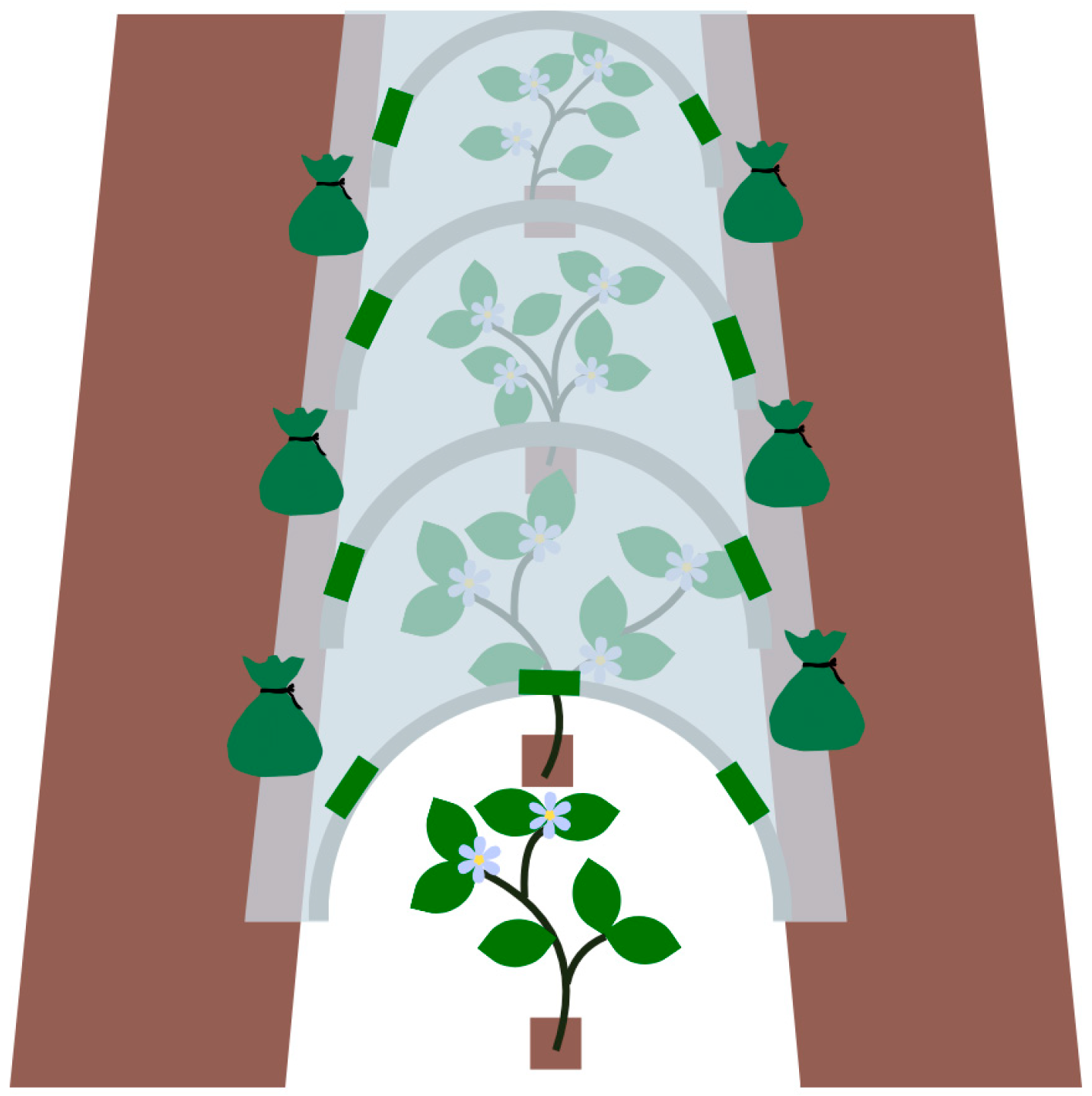
Row covers were established on the same day as transplanting in all years. Spunbonded and fine-mesh row cover treatments were installed over 1 m tall bent Electrical Metallic Tubing (EMT) hoops in structures hereafter referred to as “mesotunnels”. To secure the row covers, 4.5 kg sandbags were placed around the perimeter of the plot and 19 mm snap-on plastic greenhouse clamps (Bootstrap Farmer, Paris, TX, USA) were placed on the outward-facing sides of the hoops (Figure 1). Across all row cover treatments and years, all mesotunnels were kept sealed until approximately half of the eggplant plants in the entire field had open flowers, at which time all row covers were, depending on the treatment, either removed (on–off treatment) or their ends secured open with clips (open-ends treatment) for the remainder of the season to allow pollinators access to the plants (Table 1, Figure 1).

2.8.2. Insecticide and Essential Oil Treatments

Both insecticides and essential oils were mixed with a spreader sticker adjuvant (Nu-Film® P, Miller Chemical & Fertilizer, LLC, Hanover, PA, USA; 0.297 L product/ha). Insecticides were applied to corresponding treatments on a weekly basis across all years, beginning about one week after transplanting into the field (Table 2). All insecticide sprays were made using an electric-powered Jacto backpack sprayer (Jacto, Pompeia, São Paulo, Brazil) and were completed at a spray volume of 1702.4 L per hectare.
Following the labels, the maximum allowable rate was used for each insecticide in 2019 and 2020. These rates were 1.14 L product/ha for Pyganic Crop Protection EC 5.0 (Valent U.S.A. Corporation, MGK, Minneapolis, MN, USA; AI pyrethrins at 5% by volume), 0.73 L product/ha for Entrust SC (Corteva Agriscience [Dow AgroScience], Indianapolis, IN, USA; AI spinosad at 22.5% by volume), 0.026 L active ingredient/ha Mustang Maxx (pyrethroid, Zeta-cypermethrin, FMC Corporation, Philadelphia, PA, USA) and 0.123 L active ingredient/ha for Scorpion 35SL (dinotefuran, Gowan Company, Yuma, AZ, USA). In 2021 and 2024, the lower rate of 0.58 L product/ha was used for both pyrethrins and spinosad. This application rate was the medium value of the range permitted on the label and was selected to avoid spraying more than the maximum allowable amount of active ingredient during the entire growing season.
In 2019 and 2020, essential oils were sprayed twice per week using a spray bottle until row cover removal. In 2019, both the eucalyptus and rosemary essential oils were mixed at 5% solution with 2.5% spreader sticker adjuvant (Nu-Film® P) and 92.5% water and applied at a rate of 121.3 mL of product per 1 m of row. In 2020, we replaced the 2019 essential oil treatments with a commercial essential oil mixture treatment (Essentria IC3, Envincio LLC, Cary, NC, USA) and neem (Azadirachta indica) oil (Safer Brand, Woodstream Corporation, Lititz, PA, USA), both applied directly onto plants twice per week. The Essentria treatment was prepared from a concentrate and mixed at a rate of 23.4 mL Essentria IC3 per liter of water with 2.5% spreader sticker adjuvant (Nu-Film® P). The neem oil treatment was prepared from a concentrate and mixed at a rate of 7.8 mL per liter of water with 2.5% spreader sticker adjuvant (Nu-Film® P). In 2020, the application rate we selected, 48.5 mL of diluted spray per m of row, was lower because the products were applied directly to the plants rather than on the larger surface area of a row cover. Additionally, all essential oil sprays were made before 9:00 a.m. when temperatures were low, as previous trials in brassicaceous greens had phytotoxic burns [15].

2.9. Pest and Yield Measurements

2.9.1. Vacuum Sampling

We made collections by vacuum sampling with an inverted leaf blower (STIHL 5H 56C, STIHL, Inc., Virginia Beach, VA, USA). Following Brockman et al. 2020 [15], we modified protocols from Swezey et al. [41]. Within each plot, six plants were vacuumed for two seconds each. These samples were bagged, stored in a −20 °C freezer, and later analyzed by a trained technician under magnification to determine the number of individual pest species. In all four years, vacuum sampling was conducted when approximately 50% of the plants in each treatment had flowers, immediately after removing or opening the ends of row covers to allow for pollination (Table 2). Vacuum samples were also collected once after the final harvest in 2019 and 2020 (Table 2).

2.9.2. Sticky Traps

In all four years, flea beetles were quantified using sticky trap sampling. For each plot, one 12.7 by 17.8 cm, a double-sided Yellow Insect Trap (ARBICO Organics®, Oro Valley, AZ, USA) was cut in half and the two halves were suspended 0.3 m above the plastic. Traps were placed 1 m (2019 through 2021) or 1.5 m (2024) from each end of each plot (Figure S2). In all four years, the traps were placed in the field approximately one week after transplanting and removed seven days later; additionally, sticky traps were placed in the field for one week during harvest in 2019, at the start of harvest in 2020, and one week before the start of harvest in 2021 (Table 2). Following removal from the field, the traps were placed in a freezer and later analyzed by a trained technician to quantify target pest species.

2.9.3. Visual Surveys

In 2024 only, flea beetles were monitored through weekly visual surveys by trained technicians (Table 2, Figure S2). Flags were used to mark 1 m2 quadrats centered 1.5, 4.6, and 7.6 m from the south end of each plot. Each week, all six plants in each quadrat were carefully inspected, and the number of observed flea beetles was recorded.

2.9.4. Leaf Damage Data

To determine the impact of pest management treatments on flea beetle damage, we measured the number of shot holes per unit leaf area at flowering (removal or opening of the row covers) in all seasons apart from 2020 (Figure S2). Methods varied across years due to changes in the management personnel of the experiments; we report the number of shot holes per 1 cm2 of leaf area in the Section 3 to account for differences in the amount of leaf material sampled. Across experiments, we selected leaves that were half the size of a mature leaf (typically, the third leaf from the apical bud of each plant) to standardize relative age and size of leaves as much as possible. The methodological differences in measurements of leaf damage limit the inferences that can be drawn across experiments.
In 2019, we randomly selected two leaves per treatment and counted shot holes within a standard 7.6 × 12.7 cm section in each leaf (Table 2). In 2021, we randomly selected six leaves per plot, counted the number of shot holes, and measured leaf area using the application LeafByte (Version 1.2.0), which estimates total leaf area from photographs of leaves, on an Apple iPhone SE (Apple, Cupertino, CA, USA) [42] (Table 2). In 2024, during each weekly survey, two plants per quadrat were selected using a random number generator. The number of shot holes visible in a square viewing pane placed over the middle vein of the leaf was recorded (Table 2). For 2024, the averages from the surveys prior to and after flowering (opening or removal of the row covers) are presented separately in Section 3.4.

2.9.5. Harvest Data

We harvested eggplants two to three times per week during all growing seasons for a total of eight times in 2019, five times in 2020, nine times in 2021, and ten times in 2024 (Table 2, Figure S2). The length of harvest in each season was determined by labor availability. In 2019 and 2020, we followed the three central plants in each plot, while in 2021, we followed the four central plants. In 2024, all eggplant fruits from the center bed of each plot (40 plants) were harvested. Fruits were considered ripe when they reached 12.7 cm in length. All ripe fruits were harvested, weighed, and graded according to USDA guidelines [43]. Fancy, grade-1, and grade-2 fruits were considered marketable. Unmarketable fruits were designated as “culls” due to severe damage from disease, insects, or mechanical injury.

2.9.6. Microclimate Data

Microclimate data was recorded in 2024 only. Six Davis Vantage Vue wireless weather loggers (Vantage Vue Model 6242, Davis Instruments, Hayward, CA, USA) were installed after transplanting. Weather data was collected at 30 min intervals from June 24 until 2 August 2024. In three out of four blocks of the field, weather loggers were installed in the uncovered CTRL and the ENET-OE treatments. Each device was attached to a metal pole 36 cm above the ground in the middle of the furrow on the east side of the center bed. The weather loggers collected temperature, wind speed, and relative humidity data.

2.10. Statistical Analysis

We conducted analyses for the 2019, 2020, 2021 and 2024 trials separately given the differences in treatments and plot design in each year of the experiments. For each year, the number of levels within the pest management treatment varied given the design of the experiment. Dependent variables compared across pest management treatments included flea beetle abundance variables (vacuum samples, sticky trap samples, and visual observations), flea beetle damage variables (shotholes per 1 cm2), and marketable yield (kg). Because the 2019 experiment included a split plot design with plastic mulch color as a main treatment and pest management as a sub-treatment, we decided to focus the analysis of the pest management treatments on black plastic mulch only because the silver mulch lowered yield. This would make the 2019 data more comparable to the other years. However, we compare the effect of plastic mulch color by aggregating across pest management treatments so that each mulch color maintained four replicates per treatment. All analyses were conducted with R statistical software (v.4.5.1, R Foundation for Statistical Computing: Vienna, Austria; [44]) using the packages ‘lmerTest’ [45], ‘stats’ [44], ‘multcomp’ [46], ‘car’ [47], ‘FSA’ [48], ‘lme4’ [49], and ‘emmeans’ [50].
To compare the effect of pest management treatments, we utilized general linear mixed models (GLMMs) with a Gaussian distribution in the ‘lme4’ package [49]. For insect count data, sub-sample data within the plot were averaged before analysis, which served to normalize the data and avoid issues with pseudo-replication. For each model, we incorporated pest management treatment as a fixed effect. To nest the randomized block design into the model structure, we incorporated block as a random effect within models. Dependent variables included flea beetle abundance variables (vacuum samples, sticky trap samples, and visual observations), flea beetle damage variables (shotholes per 1 cm2), and marketable yield (kg). In 2019, to compare the effect of plastic mulch color, we averaged across all pest management treatments within each block/plastic mulch bed to maintain a sample size of four replicates per plastic mulch color. We then compared the effect of plastic mulch color (fixed effect) on all dependent variables measured in 2019 using a GLMM with a random effect of block.
We tested all GLMMs for normality using a Shapiro–Wilk test on model residuals. If model residuals were not normally distributed, we transformed independent variables with log or square root transformations to improve the fit to a normal distribution. For models with significant treatment effects, we performed Tukey’s post hoc tests to determine pairwise comparisons of different treatment levels and to control for multiple comparisons.
To assess the effects of treatment on microclimate in 2024, we collected data on the temperature, relative humidity, and wind speed. An average temperature for each day was created by averaging the daily high and low temperatures recorded by the weather logger. The minimum temperatures were the lowest recorded temperature for the day. The maximum temperatures were the highest recorded temperature for the day. Relative humidity and wind speed were measured as the highest measurements recorded during the 30 min intervals. Weather data were analyzed using a GLMM (Gaussian distribution) with the weather variable as the response variable, treatment as the fixed effect, and block and Julian day (date) as random effects. Normality of the data was checked using the Shapiro–Wilk test of model residuals. If the assumptions of normality were not met with transformations, a non-parametric Kruskal–Wallis test was applied (only in the case of average daily temperature).

3. Results

Flea beetles of different species were aggregated into a single category for (1) visual surveys in 2024, due to the difficulty of confidently identifying flea beetles to species in the field, and (2) analysis of sticky traps, due to obscurement of identifying characteristics by insects’ position on the cards. Flea beetles were identified to the species level during vacuum sample processing, although as with visual surveys and sticky traps, we present the total number of flea beetles collected in the following results.

3.1. 2019 Experiment

The treatments in the 2019 experiment were (1) the control (CTRL; no spray, no row cover), (2) the organic insecticide (O-INS: rotation of spinosad and pyrethrins sprayed once per week, no row cover), (3) the conventional insecticide (C-INS; rotation of pyrethroid and dinotefuran sprayed once per week, no row cover), (4) the Agribon Row Cover-On–Off (AGR-OO; spunbonded row cover—removed at flowering), (5) the ProtekNet Row Cover-On–Off (PNET-OO; 25 g fine-mesh row cover—removed at flowering), (6) the ProtekNet Row Cover-On–Off+Rosemary Oil (PNET-OO+R-OIL—25 g fine-mesh row cover—removed at flowering, sprayed with rosemary essential oil twice per week until flowering), and (7) the ProtekNet Row Cover-On–Off+Eucalyptus Oil (PNET-OO+E-OIL—25 g fine-mesh row cover—removed at flowering, sprayed with eucalyptus essential oil twice per week until flowering).

3.1.1. Flea Beetle Abundance (2019)

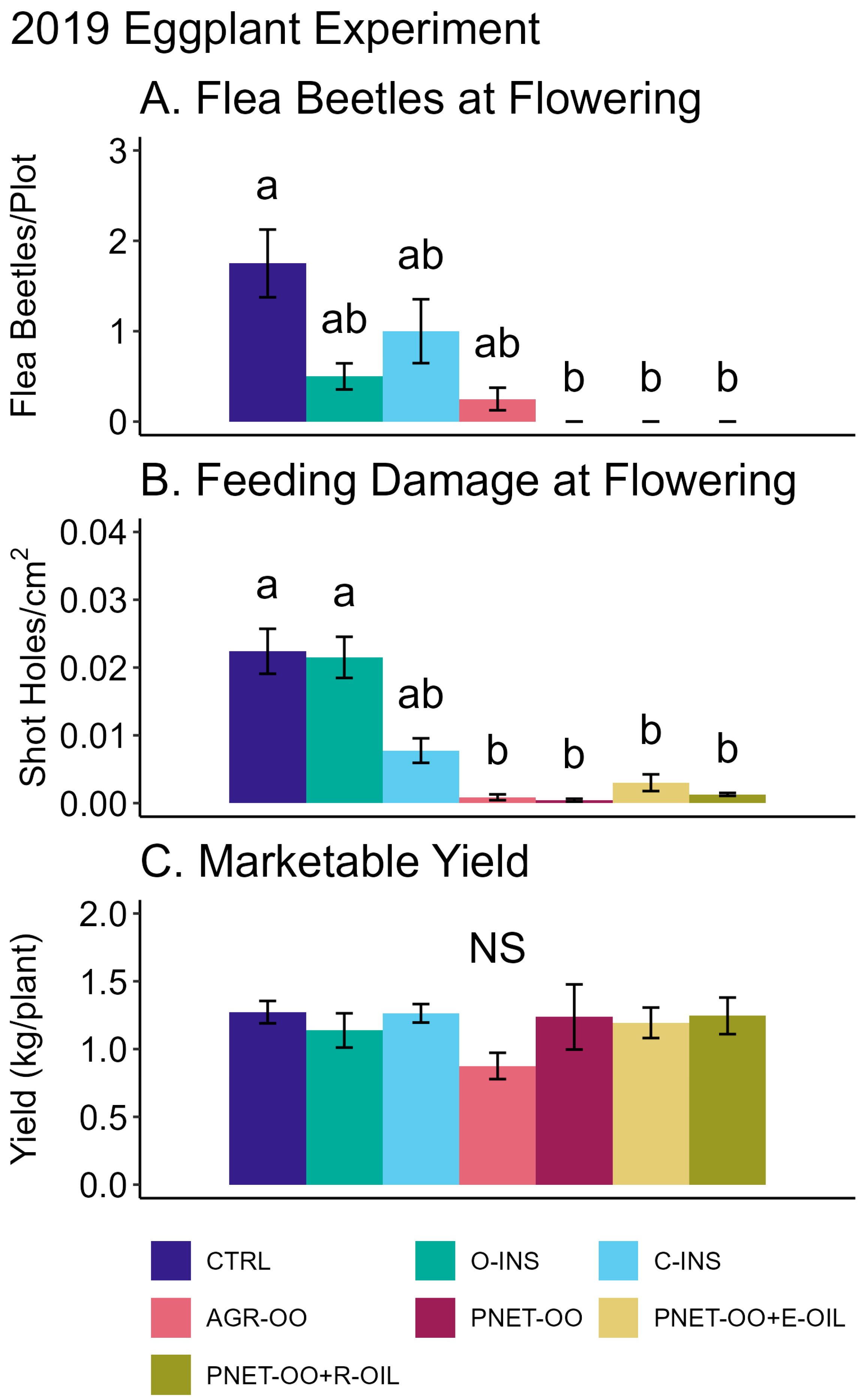
There was a significant effect of pest management treatment on the number of flea beetles found in vacuum samples at flowering (Figure 2, Table 3). The CTRL treatment had a statistically higher number of flea beetles than the PNET-OO, PNET-OO+R-OIL, and PNET-OO+E-OIL treatments. There was a significant effect of pest management treatment on the number of flea beetles found on sticky traps deployed for one week at harvest. There were twice as many flea beetles collected in the CTRL as in the row cover treatments; however, there were no significant pairwise differences between treatments (Table 3). Similarly, there was a significant effect of pest management treatment on the number of flea beetles collected through vacuum samples at harvest; fewer flea beetles were collected in the C-INS treatment than any other treatment, but there were no significant pairwise differences.
There was no effect of pest management treatment on the number of flea beetles found on sticky traps deployed at transplant (Table 3). Finally, there was no effect of plastic mulch color on the number of flea beetles in vacuum samples (at flowering and at harvest) nor on sticky traps (at transplant and at flowering) (Table 4).

3.1.2. Flea Beetle Damage (2019)

There was a significant effect of pest management treatment on the number of shot holes caused by flea beetles at flowering in 2019 (Figure 2, Table 3). A Tukey post hoc test revealed the CTRL and O-INS treatments had significantly more damage than the row cover treatments (AGR-OO, PNET-OO, PNET-OO+E-OIL, and PNET-OO+R-OIL). There was no effect of plastic mulch treatment (Table 4).

3.1.3. Marketable Yield (2019)

Yield did not differ among the insecticide, essential oil, row cover, and control treatments in 2019 (Figure 2, Table 3). The marketable yield from the black mulch treatment was significantly higher than the silver mulch treatment (Table 4).

3.2. 2020 Experiment

The treatments in the 2020 experiment were (1) the control (CTRL; no spray, no row cover), (2) the organic insecticide (O-INS: rotation of spinosad and pyrethrins sprayed once per week, no row cover), (3) the conventional insecticide (C-INS; rotation of pyrethroid and dinotefuran sprayed once per week, no row cover), (4) the Agribon Row Cover-On–Off (AGR-OO; spunbonded row cover—removed at flowering), (5) the ProtekNet Row Cover-On–Off (PNET-OO; 25 g fine-mesh row cover—removed at flowering), (6) the Essentria Essential Oil (ES-OIL; Essentria Essential Oil applied directly onto eggplant twice per week until flowering, no row cover), and (7) the Neem Oil (N-OIL; neem oil applied directly onto eggplant twice per week until flowering, no row cover.

3.2.1. Flea Beetle Abundance (2020)

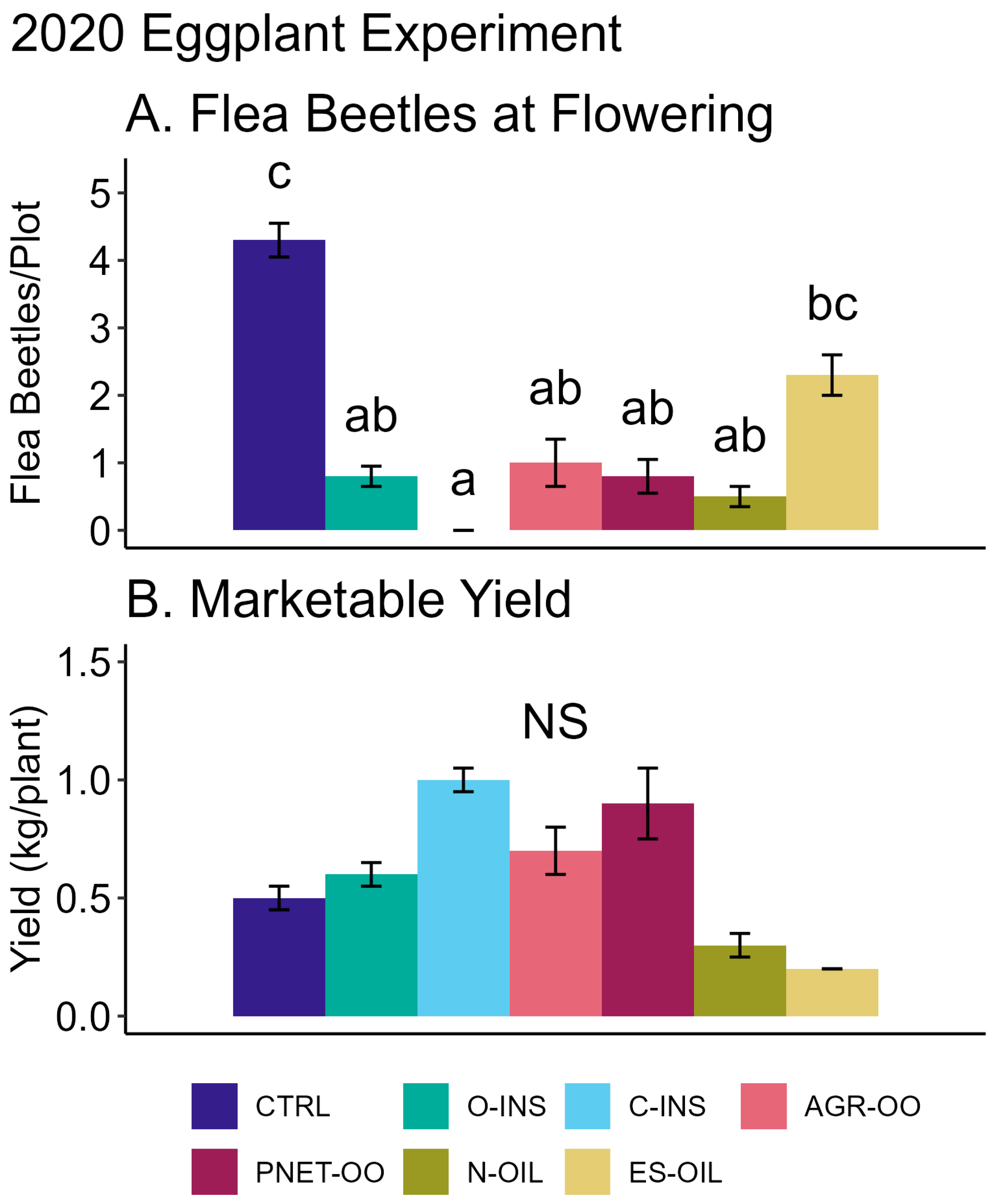
There was a significant effect of pest management treatment on the number of flea beetles found by vacuum sampling when row covers were removed at flowering in 2020 (Figure 3, Table 5). The CTRL treatment had significantly more flea beetles than the O-INS, C-INS, AGR-OO, PNET-OO, and N-OIL treatments. The ES-OIL treatment had significantly more flea beetles than the C-INS treatment. No treatment effects on flea beetle numbers were detected through early-season or late-season sticky traps or vacuum sampling after the last harvest in 2020 (Table 5).

3.2.2. Marketable Yield (2020)

There was a significant effect of pest management treatment on marketable yield in 2020. The highest-yielding treatments (C-INS followed by PNET-OO) had 3.3 and 3 times the yield of the N-OIL treatment and 5 and 4.5 times the yield of the ES-OIL treatment, respectively. However, a Tukey post hoc test revealed no statistically significant differences between treatments (Figure 3, Table 5).

3.3. 2021 Experiment

The treatments in the 2021 experiment were (1) the control (CTRL; no spray, no row cover), (2) the organic insecticide (O-INS: rotation of spinosad and pyrethrins sprayed once per week, no row cover), (3) the Agribon Row Cover-On–Off (AGR-OO; spunbonded row cover—removed at flowering), and (4) the ProtekNet Row Cover-Open Ends (PNET-OE; 25 g fine-mesh row cover—ends opened at flowering).

3.3.1. Flea Beetle Abundance (2021)

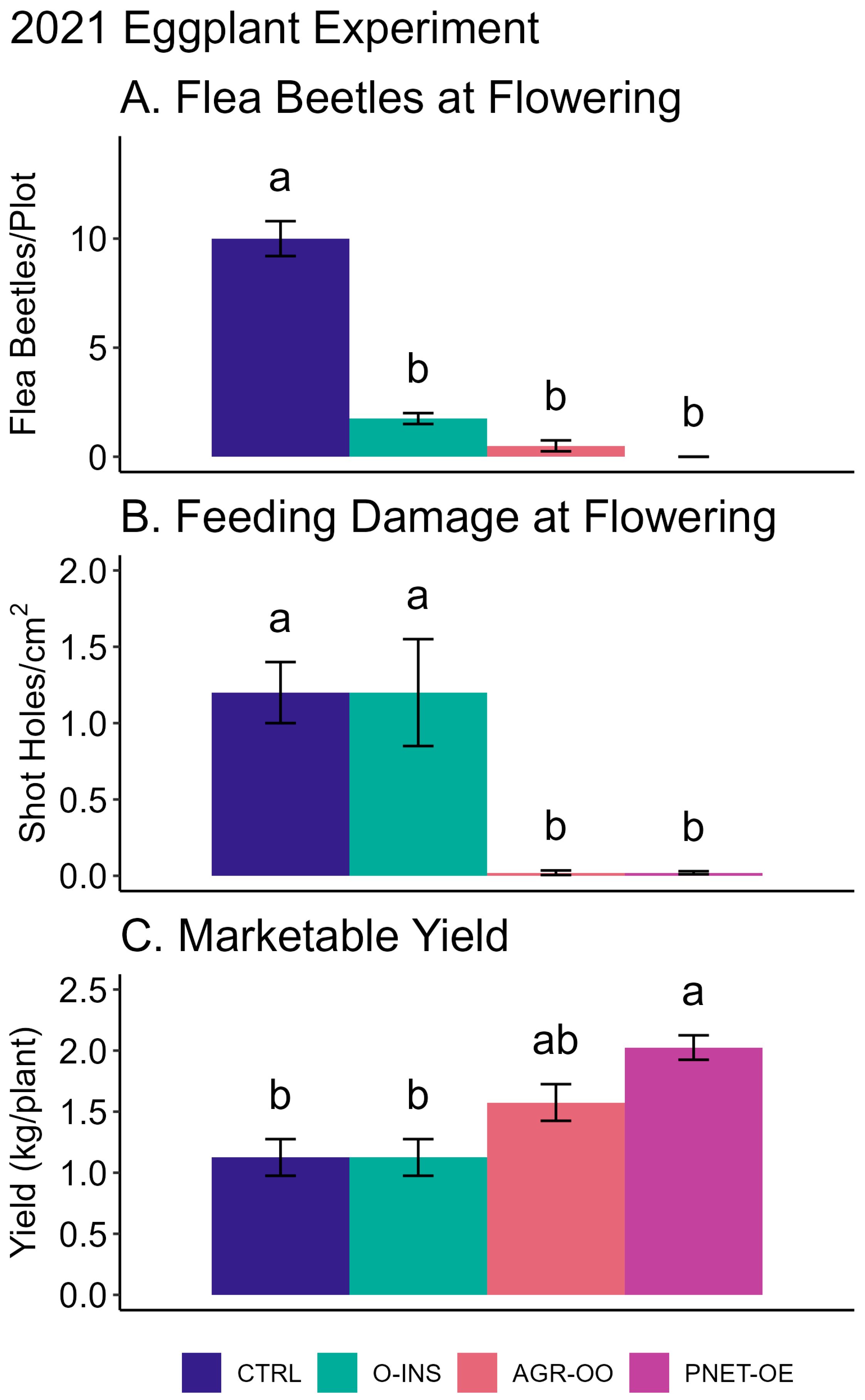
There was a significant effect of pest management treatment on the number of flea beetles collected through vacuum sampling at flowering in 2021 (Figure 4, Table 6). A Tukey post hoc test revealed there were significantly more flea beetles collected from the CTRL treatment than the O-INS, AGR-OO, and PNET-OE treatments. No flea beetles were collected from any of the PNET-OE plots prior to opening of the mesotunnel ends at flowering. There was no significant effect of pest management treatment on the number of flea beetles collected in sticky traps, either in the week following transplant or in the week preceding the first harvest (Table 6).

3.3.2. Flea Beetle Damage (2021)

There was a significant effect of treatment on the number of shot holes at flowering (Figure 4, Table 6). A Tukey post hoc test revealed there were significantly more shot holes in the samples from the uncovered treatments (CTRL and O-INS) than in those from the row cover (AGR-OO and PNET-OE) treatments.

3.3.3. Marketable Yield (2021)

There was a significant effect of pest management treatment on marketable yield (Figure 4, Table 6). The marketable yield was significantly higher from the PNET-OE treatment than CTRL and O-INS treatments.

3.4. 2024 Experiment

The treatments in the 2024 experiment were (1) the control (CTRL; no spray, no row cover), (2) the organic insecticide (O-INS: rotation of spinosad and pyrethrins sprayed once per week, no row cover), (3) the ExcludeNet Row Cover-On–Off (ENET-OO; 85 g fine-mesh row cover—removed at flowering), and (4) the ExcludeNet Row Cover-Open Ends (ENET-OE; 85 g fine-mesh row cover—ends opened at flowering).

3.4.1. Flea Beetle Abundance (2024)

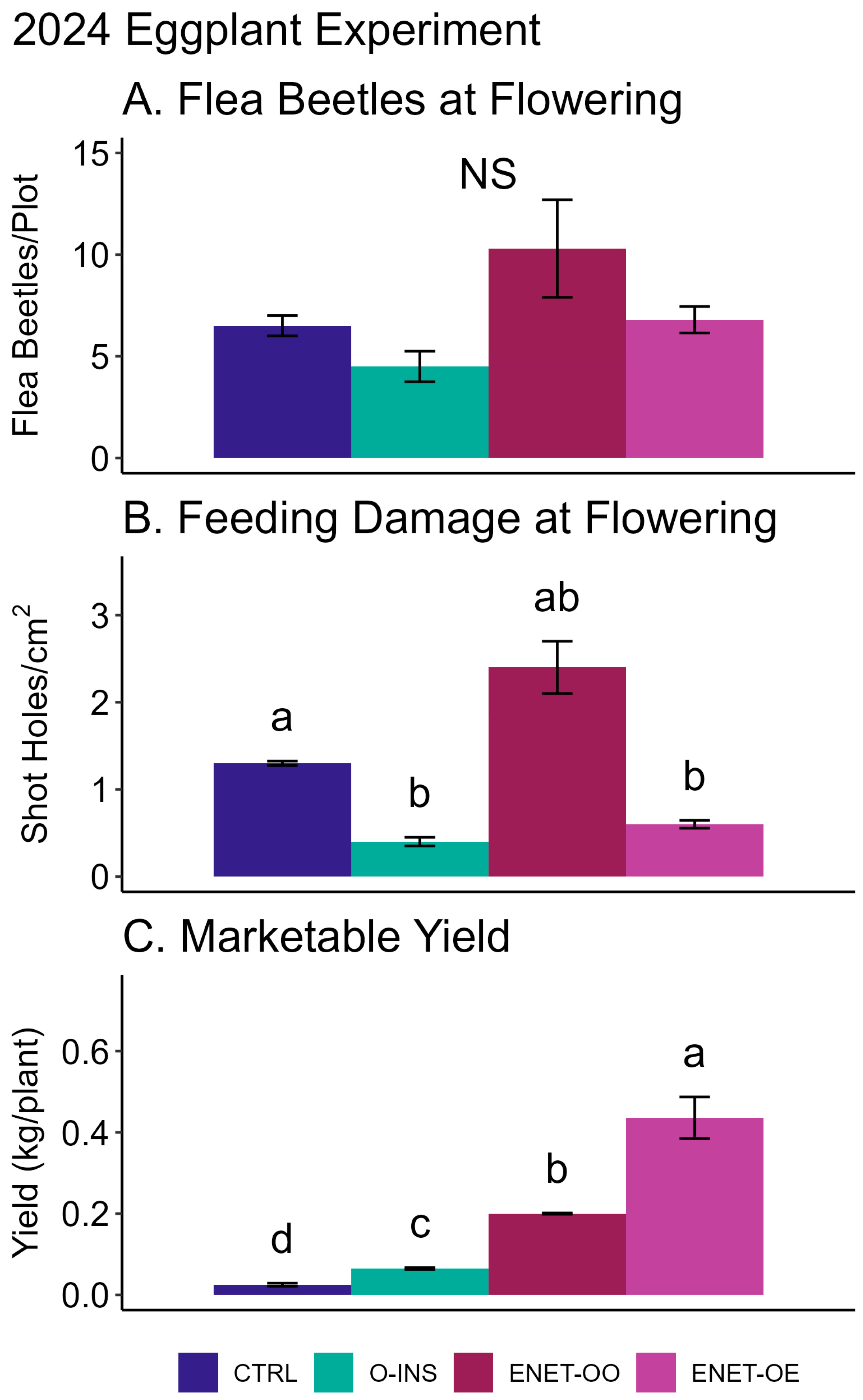
There was a significant effect of pest management treatment on the number of flea beetles observed in weekly visual surveys in 2024, averaged across the season (Table 7). A Tukey post hoc test revealed there were significantly more flea beetles in the CTRL treatment than in the ENET-OO, ENET-OE, and the O-INS treatments. The number of flea beetles in the CTRL treatment was double the number in the O-INS and ENET-OE treatments. There was no significant effect of pest management treatment on the number of flea beetles collected through sticky traps placed in the field for the week following transplanting or through vacuum sampling at flowering in 2024 (Figure 5, Table 7).

3.4.2. Flea Beetle Damage (2024)

There was a significant effect of pest management treatment on the number of shot holes per 1 cm2 of leaf area averaged across the first four, pre-flowering weekly visual surveys, prior to the opening or removal of row covers (Figure 5, Table 7). A Tukey post hoc test revealed there were more shot holes in the CTRL treatment than in the ENET-OO and ENET-OE treatments, and more shot holes in the O-INS treatment than in the ENET-OE treatment.
There was also a significant effect of pest management treatment on the number of shot holes per 1 cm2 of leaf area averaged across the last five weekly visual surveys, following the opening or removal of row covers (Table 7). A Tukey post hoc test revealed there were more shot holes in the CTRL treatment than in the O-INS and ENET-OE treatments, and more shot holes in the ENET-OO treatment than the O-INS treatment.

3.4.3. Marketable Yield (2024)

There was a significant effect of pest management treatment on marketable yield in 2024 (Figure 5, Table 7). Marketable yield from the ENET-OE treatment was over 13 times greater than that for the CTRL treatment, over 5 times greater than that for the O-INS treatment, and 2 times greater than that for the ENET-OO treatment.

3.4.4. Microclimate Data (2024)

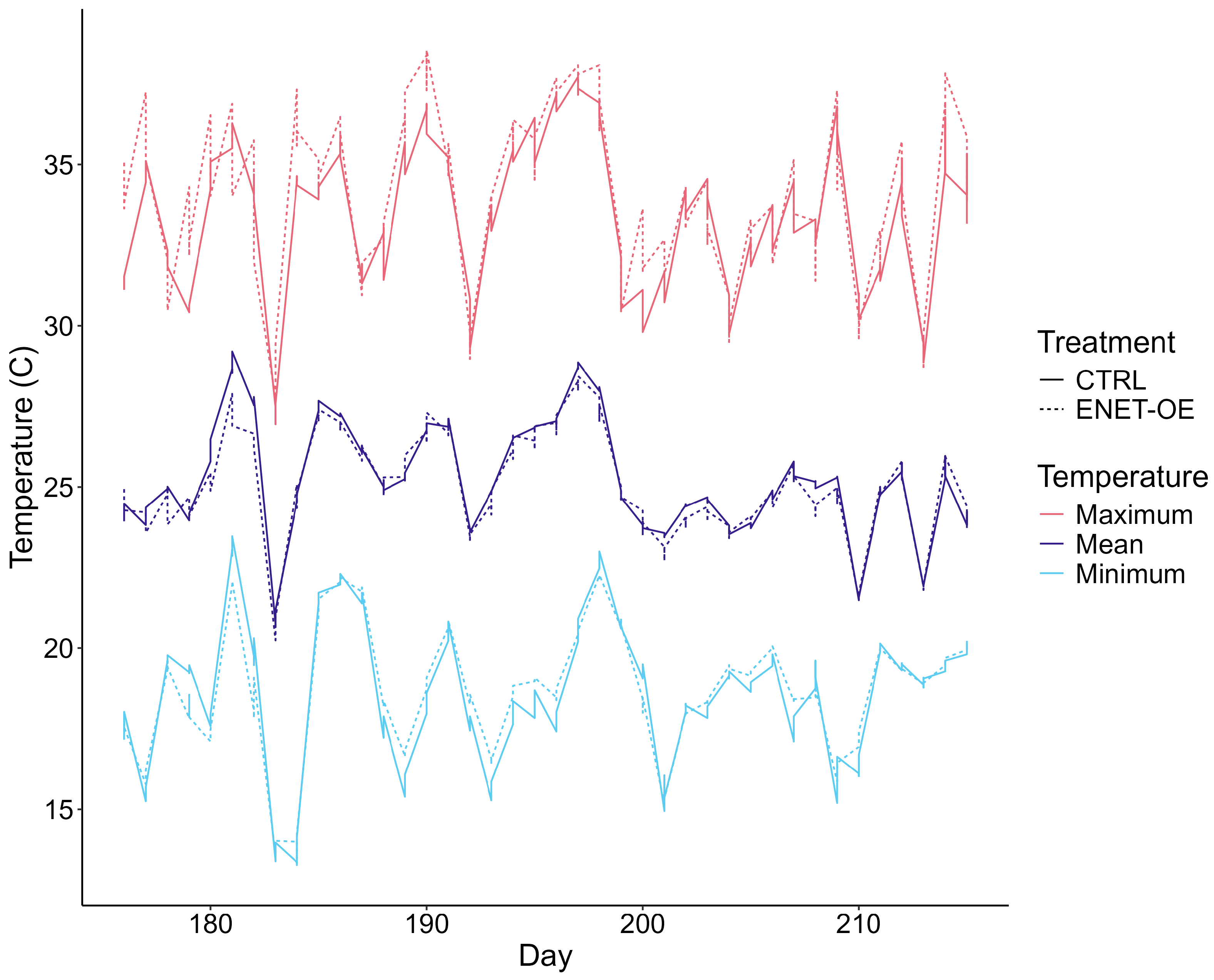
There was no significant effect of treatment on the average temperature during the 2024 growing season (Table 8). However, there was an effect of treatment on the minimum and maximum average temperatures (Table 8). The ENET-OE treatment had slightly higher minimum and maximum temperatures compared to the uncovered CTRL treatment (Figure 6). There was a significant effect of treatment on both mean relative humidity and mean wind speed during the 2024 growing season (Table 8). The ENET-OE treatment had higher relative humidity than the CTRL plots and much lower wind speeds recorded compared to the CTRL treatments.

4. Discussion

Across the years of our study, treatments and management variables varied and therefore results should be interpreted within each year only. Variation in treatments included differences in the concentration of active ingredient applied in the organic insecticide (O-INS) treatment in 2019 and 2020 compared to 2021 and 2024; different fine-mesh row cover products (ProtekNet in 2019 through 2021 and ExcludeNet in 2024); and different pollination management strategies for fine-mesh row cover treatments (on–off in 2019 and 2020 and open-ends in 2021 and 2024) (Table 1). Plot dimensions and spacings of plants varied (Section 2.2; Figure S1). There were also methodological differences between years for certain measurements. In particular, the measurements of leaf damage (Section 2.9.4) and the number of plants harvested (Section 2.9.5) varied across years. The 2019 and 2020 experiments were located in the conventional section of the farm, while the 2021 and 2024 experiments were in the organic section in greater proximity to plantings of solanaceous crops, which may have contributed to greater ambient flea beetle abundance due to the presence of alternate host plants for the insects.
Within each year of our study, we found that fine-mesh row covers provided equivalent or better control of flea beetles than other organic-compliant strategies. In the three years when it was measured (2019, 2020, and 2024), flea beetle feeding damage at flowering was significantly lower in fine-mesh row cover treatments than the corresponding control. Our findings are consistent with past studies in brassica crops in which a ProtekNet treatment reduced flea beetle (Phyllotreta spp.) abundance and feeding damage [15] and a row cover with 0.8 × 0.8 mm mesh size reduced flea beetle feeding damage [16] compared to the corresponding control treatments. It should be noted that there were never significant differences in flea beetle abundance between treatments at transplanting, when flea beetles began to colonize the field, nor in samples collected at harvest time, when row covers had been opened or removed for at least one week. However, fine-mesh row covers reduced flea beetle abundance in 2019, 2020, and 2021 in vacuum samples at flowering collected immediately before row covers were opened or removed. In all three years, ProtekNet row cover treatments (mesh size of 0.35 × 0.35 mm) always had significantly fewer flea beetles than the control and equivalent numbers of flea beetles to the other pest management treatments, indicating that the sealed ProtekNet row covers effectively prevented flea beetles from accessing the plants. However, there was no difference between treatments in vacuum samples at flowering in 2024, suggesting that flea beetles were able to infiltrate the 0.95 × 0.95 mm mesh size of the ExcludeNet row cover.
We found that fine-mesh row covers managed with an open-ends strategy produced greater marketable yield than the corresponding uncovered treatments in 2021 and 2024, the two years of the study when this strategy was tested. Yield increases for the fine-mesh row cover treatments in these years may not have been attributable to pest exclusion alone. In 2024, for example, while significant yield benefits of both ExcludeNet treatments were observed, there was no effect of treatment on two measurements of flea beetle abundance (early season sticky traps and vacuum sampling at flowering). However, we applied spinosad to all seedlings to control aphids prior to transplanting in 2024, which may have suppressed flea beetle abundance during the establishment period. Additionally, the marketable yield from the ExcludeNet Row Cover-Open Ends (ENET-OE) treatment was more than double the marketable yield from the ExcludeNet Row Cover-On–Off (ENET-OO) treatment in 2024, despite no significant differences between the two row cover treatments for any measurements of flea beetle abundance or damage. The mechanism for this difference in yield is unclear. However, microclimate effects during the additional seven weeks when the plants were covered in the ENET-OE treatment may have contributed to the increase in yield. Previous field studies of cabbage and muskmelon production revealed significant effects of treatment on microclimate, including higher soil temperatures and moisture, average relative humidity [51], and average daily maximum temperatures under fine-mesh row covers than in open field conditions [8,51]. In 2024, we found that the minimum and maximum daily temperatures were higher, relative humidity was greater, and wind speed was reduced in the ENET-OE treatment compared to the uncovered control (CTRL) treatment; however, there was no significant difference between treatments in the average daily temperatures. We did not collect microclimate data in the ENET-OO treatment in 2024. To our knowledge, there are no published studies on the microclimate effects of fine-mesh row cover treatments in eggplant production. However, research on shade nets (mesh sizes ranging from 12 × 12 mm to 24 × 24 mm) showed that eggplants grown in net-houses reached taller average heights and produced greater marketable fruit yield, fruits per plant, and per-fruit weight compared to open field conditions [52]. Microclimate effects could also influence flea beetle activity: a study on eggplant in India found that abundance of the flea beetle Phyllotreta striolata was negatively correlated with humidity and positively correlated with temperature [53]. Changes to soil moisture, which were not measured in our study, could affect soil compaction and flea beetle development in the soil during the egg, larval, and pupal stages [33]. More research is needed to better understand the effects of different fine-mesh row cover products on microclimate and flea beetle dynamics and whether these effects influence yield in eggplant production.
Despite potential yield benefits, deploying row covers as a pest management strategy may present various challenges. (1) Maintaining a row cover for a full season in the open-ends strategy represents the opportunity cost of additional time when the row cover cannot be used on another crop. In our study in 2021 and 2024, row covers were maintained on the open-ends treatments for one and a half months after row covers were removed from the on–off treatments. (2) Managing row covers is labor-intensive, although managing fine-mesh row covers or insecticides alone may be comparable in terms of total hours of labor. Utilizing fine-mesh row covers for pest management entails labor to install, maintain, and disassemble mesotunnels, while insecticide applications entail time to calculate, mix, and apply tank mixes and to assemble, disassemble, and clean equipment. In a previous study of acorn squash production, the average total labor hours required to manage untreated control, uncovered pesticide, and unsprayed mesotunnel treatments across an entire growing season was 116.1, 185.8, and 189.8, respectively [9]. (3) Few studies have compared the profitability of fine-mesh row covers to other organic-compliant pest management strategies, although fine-mesh row covers were found to be more profitable than an uncovered treatment of OMRI-listed pesticides in muskmelon [8] and acorn squash [9] production. More research is needed to compare the profitability of fine-mesh row covers to other pest management strategies in eggplant production.
The reflective mulch, essential oils, and organic insecticide treatments were generally less effective than row covers at reducing flea beetle abundance and damage. During the 2019 season, the mulch treatments did not differ in flea beetle abundance or damage (Table 4). Despite evidence from laboratory studies of essential oils [21,54,55], our study did not find positive effects from the application of plant essential oils or commercial essential oil products. We did not see any benefit from spraying rosemary and eucalyptus essential oils on ProtekNet in the ProtekNet Row Cover-On–Off+Rosemary Oil (PNET-OO+R-OIL) and the ProtekNet Row Cover-On–Off+Eucalyptus Oil (PNET-OO+E-OIL) treatments in 2019 compared to the ProtekNet Row Cover-On–Off (PNET-OO) treatment alone. The commercial essential oil mixture and neem oil did not perform well in 2020, as these treatments had lower yields than both the PNET-OO treatment and the conventional insecticide (C-INS) regime (Table 5). We believe this drop in yield may have been due to minor phytotoxic burns caused by the essential oils when sprayed directly on the crop. In previous studies, spraying rosemary essential oil, commercial neem concentrate, and Essentria IC3 directly on the leaves of brassica crops caused phytotoxicity burns [15,56].
The organic insecticide (O-INS) treatment rarely differed from the CTRL in 2019, 2020, and 2021. In 2024, the O-INS treatment had fewer flea beetles, lower flea beetle damage, and higher yield than the CTRL, but the ENET-OE treatment outperformed the O-INS treatment across these metrics. Our results are consistent with previous studies where treatments of pyrethrins and spinosad did not differ from an untreated control in flea beetle abundance in organic-compliant production of leafy greens [15] or eggplants [57]. However, our results contrast with field studies where eggplant flea beetles were effectively controlled by treatments of pyrethrins [5] and spinosad [5,7,58].

5. Conclusions

The results of our study may be a helpful reference for organic eggplant producers. Our results suggest that fine-mesh row covers may effectively provide early-season protection from flea beetles and increase yield when managed with the open-ends strategy. Across four years of experiments, we found that row covers provided equivalent or better control of flea beetles and equivalent or higher marketable yields than the corresponding organic-compliant pest management strategies tested. In the final year of the study, we compared two pollination management strategies (open-ends and on–off) with the same fine-mesh row cover material and found that the open-ends strategy provided yield improvements, although it did not reduce flea beetle abundance across all metrics. The mechanism by which the open-ends strategy increased yield is unclear. More research is needed to compare open-ends and on–off row cover management strategies to better understand effects on microclimate, pollination, and pest pressure.

Supplementary Materials

The following supporting information can be downloaded at: https://www.mdpi.com/article/10.3390/crops6020042/s1, Figure S1: Plot schematics of experimental fields; Figure S2: Sampling locations within plots.

Author Contributions

Conceptualization, E.L., R.B. (Robert Brockman), V.H., D.G., R.B. (Ric Bessin) and M.W.; methodology, E.L., D.G., R.B. (Robert Brockman), V.H., K.F.P., R.B. (Ric Bessin), D.S., M.W. and R.K.; software, D.G., E.L. and R.B. (Robert Brockman); formal analysis, D.G., E.L. and R.B. (Robert Brockman); investigation, E.L., R.B. (Robert Brockman), V.H., K.F.P., D.S. and R.K.; resources, D.G.; data curation, E.L., R.B. (Robert Brockman). and V.H.; writing—original draft preparation, E.L. and R.B. (Robert Brockman); writing—review and editing, E.L., D.G., R.B. (Robert Brockman), V.H., K.F.P., R.B. (Ric Bessin), D.S., M.W. and R.K.; visualization, E.L.; supervision, D.G.; project administration, E.L., R.B. (Robert Brockman), V.H., D.G. and K.F.P.; funding acquisition, D.G., R.B. (Ric Bessin) and M.W. All authors have read and agreed to the published version of the manuscript.

Funding

This research was funded by the National Institute of Food and Agriculture, U.S. Department of Agriculture Hatch Grant (KY008079), the Kentucky Department of Agriculture Specialty Crop Block Grant (AM180100XXXXG007), and the National Institute of Food and Agriculture, U.S. Department of Agriculture Organic Agriculture Research and Extension Initiative Grant (2023-51300-40855).

Data Availability Statement

The original contributions presented in this study are included in the article and Supplementary Materials. Further inquiries can be directed to the corresponding author.

Acknowledgments

We would like to thank Daniel Potter for commenting on project design and for reviewing this manuscript. We would like to thank Steve Diver, Neil Wilson, Aaron German, and Jay Tucker at the University of Kentucky’s Horticulture Research Farm for all their assistance and guidance with plot setup, planting, and maintenance. We would also like to thank Kyla O’Hearn, Kendall Archer, Simon Aaronson, Briana Bazile, Yuuki Cherian, Sarah Clark, Lexi Gauger, Kylie Ryan, Turner Siddens, and Kantima Thongjued for their assistance with harvesting and fieldwork.

Conflicts of Interest

The authors declare no conflicts of interest.

Abbreviations

The following abbreviations are used in this manuscript:
CTRLControl
O-INSOrganic Insecticide
C-INSConventional Insecticide
AGR-OOAgribon Row Cover-On–Off
PNET-OOProtekNet Row Cover-On–Off
PNET-OO+R-OILProtekNet Row Cover + Rosemary Oil-On–Off
PNET-OO+E-OILProtekNet Row Cover + Eucalyptus Oil-On–Off
ES-OILEssentria Essential Oil
N-OILNeem Oil
PNET-OEProtekNet Row Cover-Open Ends
ENET-OOExcludeNet Row Cover-On–Off
ENET-OEExcludeNet Row Cover-Open Ends

References

  1. Snyder, L.; Schonbeck, M.; Velez, T.; Tencer, B. National Organic Research Agenda: Outcomes and Recommendations from the 2020 National Organic & Transitioning Farmer Surveys and Focus Groups; Organic Farming Research Foundation: Santa Cruz, CA, USA, 2022. [Google Scholar]
  2. Cheng, N.; Zhang, W.; Gleason, M. Controlling Pests and Diseases Using Mesotunnels: Understanding Organic Cucurbit Crop Growers’ Preferences and Choices; EB 05-2023; Cornell SC Johnson College of Business, Cornell University: Ithaca, NY, USA, 2023. [Google Scholar]
  3. Part 205-National Organic Program. 2026. Available online: https://www.ecfr.gov/current/title-7/part-205 (accessed on 21 January 2026).
  4. Abubakar, Y.; Tijjani, H.; Egbuna, C.; Adetunji, C.O.; Kala, S.; Kryeziu, T.L.; Ifemeje, J.C.; Patrick-Iwuanyanwu, K.C. Pesticides, history, and classification. In Natural Remedies for Pest, Disease and Weed Control; Elsevier: Amsterdam, The Netherlands, 2020; pp. 29–42. [Google Scholar]
  5. Dively, G.P.; Patton, T.; Barranco, L.; Kulhanek, K. Comparative Efficacy of Common Active Ingredients in Organic Insecticides Against Difficult to Control Insect Pests. Insects 2020, 11, 614. [Google Scholar] [CrossRef]
  6. Antonious, G.F. Residues and half-lives of pyrethrins on field-grown pepper and tomato. J. Environ. Sci. Health Part B 2004, 39, 491–503. [Google Scholar] [CrossRef] [PubMed]
  7. McLeod, P.; Diaz, F.J.; Johnson, D.T. Toxicity, persistence, and efficacy of spinosad, chlorfenapyr, and thiamethoxam on eggplant when applied against the eggplant flea beetle (Coleoptera: Chrysomelidae). J. Econ. Entomol. 2002, 95, 331–335. [Google Scholar] [CrossRef] [PubMed]
  8. Nelson, H.M.; Gonzalez-Acuna, J.F.; Nair, A.; Cheng, N.; Mphande, K.; Badilla-Arias, S.; Zhang, W.; Gleason, M.L. Comparison of Row Cover Systems for Pest Management in Organic Muskmelon in Iowa. HortTechnology 2023, 33, 103–110. [Google Scholar] [CrossRef]
  9. Fiske, K.; Cheng, N.; Kuesel, R.; Zhang, W.; Bessin, R.; Williams, M.A.; Gonthier, D. Row covers limit pests and disease and increase profit in organic acorn squash. Front. Sustain. Food Syst. 2024, 8, 1347924. [Google Scholar] [CrossRef]
  10. Tillman, J.; Nair, A.; Gleason, M.; Batzer, J. Evaluating Strip Tillage and Rowcover Use in Organic and Conventional Muskmelon Production. HortTechnology 2015, 25, 487–495. [Google Scholar] [CrossRef]
  11. Athey, K.J.; Peterson, J.A.; Dreyer, J.; Harwood, J.D.; Williams, M.A. Effect of Breathable Row Covers and Ground Cover on Pest Insect Levels and Cucurbit Yield. J. Econ. Entomol. 2022, 115, 193–200. [Google Scholar] [CrossRef]
  12. Acharya, T.P.; Reiter, M.S.; Welbaum, G.; Arancibia, R.A. Nitrogen Uptake and Use Efficiency in Sweet Basil Production Under Low Tunnels. HortScience 2020, 55, 429–435. [Google Scholar] [CrossRef]
  13. Andersen, C.L.; Hazzard, R.; Van driesche, R.; Mangan, F.X. Alternative Management Tactics for Control of Phyllotreta cruciferae and Phyllotreta striolata (Coleoptera: Chrysomelidae) on Brassica rapa in Massachusetts. J. Econ. Entomol. 2006, 99, 803–810. [Google Scholar] [CrossRef] [PubMed]
  14. Pethybridge, S.J.; Damann, K.; Murphy, S.; Diggins, K.; Gleason, M.L. Optimizing Integrated Pest Management in Mesotunnels for Organic Acorn Squash in New York. Plant Health Prog. 2024, 25, 146–155. [Google Scholar] [CrossRef]
  15. Brockman, R.; Kuesel, R.; Archer, K.; O’Hearn, K.; Wilson, N.; Scott, D.; Williams, M.; Bessin, R.; Gonthier, D. The Impact of Plant Essential Oils and Fine Mesh Row Covers on Flea Beetle (Chrysomelidae) Management in Brassicaceous Greens Production. Insects 2020, 11, 714. [Google Scholar] [CrossRef]
  16. Böckmann, E. Effects of insect net coverage in field vegetables on pests, diseases, natural enemies, and yield. J. Plant Dis. Prot. 2022, 129, 1401–1415. [Google Scholar] [CrossRef]
  17. Pulliam, K.F.; Brockman, R.; Avery, C.; Gauger, A.; Williams, M.; Bessin, R.; Gonthier, D. Balancing row cover pest and pollination management in organic cucurbit production. Renew. Agric. Food Syst. 2025, 41, e1. [Google Scholar] [CrossRef]
  18. Mphande, K.; Badilla-Arias, S.; Cheng, N.; González-Acuña, J.F.; Nair, A.; Zhang, W.; Gleason, M.L. Evaluating Pollination and Weed Control Strategies Under Mesotunnel Systems for Organic Muskmelon Production in Iowa. HortTechnology 2024, 34, 265–279. [Google Scholar] [CrossRef]
  19. Rojas, E.S.; Gleason, M.L.; Batzer, J.C.; Duffy, M. Feasibility of Delaying Removal of Row Covers to Suppress Bacterial Wilt of Muskmelon (Cucumis melo). Plant Disease 2011, 95, 729–734. [Google Scholar] [CrossRef] [PubMed]
  20. Mossa, A.-T.H. Green pesticides: Essential oils as biopesticides in insect-pest management. J. Environ. Sci. Technol. 2016, 9, 354. [Google Scholar] [CrossRef]
  21. Rojht, H.; Košir, I.J.; Trdan, S. Chemical analysis of three herbal extracts and observation of their activity against adults of Acanthoscelides obtectus and Leptinotarsa decemlineata using a video tracking system. J. Plant Dis. Prot. 2012, 119, 59–67. [Google Scholar] [CrossRef]
  22. Pumnuan, J.; Khurnpoon, L.; Insung, A. Insecticidal activity of essential oil formulas and their physiological effects on eggplant. J. Appl. Hortic. 2017, 19, 152–158. [Google Scholar] [CrossRef]
  23. Dayan, F.E.; Duke, S.O. Natural Products for Weed Management in Organic Farming in the USA. Outlooks Pest Manag. 2010, 21, 156–160. [Google Scholar] [CrossRef]
  24. Dentzman, K.E.; Goldberger, J.R. Organic standards, farmers’ perceptions, and the contested case of biodegradable plastic mulch in the United States. J. Rural. Stud. 2020, 73, 203–213. [Google Scholar] [CrossRef]
  25. Kring, J.B. Flight behavior of aphids. Annu. Rev. Entomol. 1972, 17, 461–492. [Google Scholar] [CrossRef]
  26. Summers, C.G.; Mitchell, J.P.; Stapleton, J.J. Management of aphid-borne viruses and Bemisia argentifolii (Homoptera: Aleyrodidae) in zucchini squash by using UV reflective plastic and wheat straw mulches. Environ. Entomol. 2004, 33, 1447–1457. [Google Scholar] [CrossRef]
  27. Nottingham, L.; Kuhar, T. Reflective polyethylene mulch reduces Mexican bean beetle (Coleoptera: Coccinellidae) densities and damage in snap beans. J. Econ. Entomol. 2016, 109, 1785–1792. [Google Scholar] [CrossRef] [PubMed]
  28. Reitz, S.R.; Yearby, E.L.; Funderburk, J.E.; Stavisky, J.; Momol, M.T.; Olson, S.M. Integrated management tactics for Frankliniella thrips (Thysanoptera: Thripidae) in field-grown pepper. J. Econ. Entomol. 2003, 96, 1201–1214. [Google Scholar] [CrossRef]
  29. Wijesooriya, H.D.S.N.; Debarawatta, R.D.N.; Yakandawala, K.; Dabarera, R.; Sanjeevanie, W.A.P. Effect of Growth and Yield of Brinjal (Solanum melongena L.) Grown Under Different Poly Mulches. J. Food Agric. 2015, 8, 25–32. [Google Scholar] [CrossRef]
  30. Doijode, S. Seed Storage of Horticultural Crops; CRC Press: Boca Raton, FL, USA, 2012. [Google Scholar]
  31. Davis, W.V.; Weber, C.; Wakefield, H.; Wechsler, S.J. Vegetables and Pulses Data—Vegetables and Pulses Yearbook Tables; USDA: Washington, DC, USA, 2025.
  32. Paschapur, A.U.; Bhat, S.; Subbanna, A.; Hedau, N.K.; Mishra, K.K.; Kant, L. Insect pollinators of eggplant (Solanum melongena L.) in the Indian Himalayas and their role in enhancement of fruit quality and yield. Arthropod-Plant Interact. 2022, 16, 349–360. [Google Scholar] [CrossRef]
  33. Diaz, F.J.; McLeod, P.J.; Johnson, D.T. Seasonal Occurrence and Distribution of Eggplant Flea Beetle, Epitrix fuscula Crocht (Coleoptera: Chrysomelidae) on Eggplant in Arkansas. J. Kans. Entomol. Soc. 2004, 77, 80–88. [Google Scholar] [CrossRef]
  34. Mason, J.; Alford, A.M.; Kuhar, T.P. Flea Beetle (Coleoptera: Chrysomelidae) Populations, Effects of Feeding Injury, and Efficacy of Insecticide Treatments on Eggplant and Cabbage in Southwest Virginia. J. Econ. Entomol. 2020, 113, 887–895. [Google Scholar] [CrossRef]
  35. Hare, J.D. Ecology and management of the Colorado potato beetle. Annu. Rev. Entomol. 1990, 35, 81–100. [Google Scholar] [CrossRef]
  36. Jacques, R.L.; Fasulo, T.R. Colorado Potato Beetle, Leptinotarsa decemlineata (Say), and False Potato Beetle, Leptinotarsa juncta (Germar) (Insecta: Coleoptera: Chrysomelidae); EENY146; UF/IFAS Extension: Gainesville, FL, USA, 2015. [Google Scholar]
  37. Oku, K.; Vermeer, K.M.; Verbaarschot, P.; De Jong, P.W. Effects of starvation and mating status on the activity of the flea beetle, Phyllotreta nemorum (Coleoptera: Chrysomelidae). Eur. J. Entomol. 2010, 107, 549. [Google Scholar] [CrossRef]
  38. USDA Plant Hardiness Zone Map. Available online: https://planthardiness.ars.usda.gov/ (accessed on 4 December 2025).
  39. Soil Survey Staff, Natural Resources Conservation Service, United States Department of Agriculture. Web Soil Survey. Available online: https://websoilsurvey.nrcs.usda.gov/app/ (accessed on 28 February 2026).
  40. Mahmood, R.; Schargorodski, M.; Foster, S.; Quilligan, A. A Technical Overview of the Kentucky Mesonet. J. Atmos. Ocean. Technol. 2019, 36, 1753–1771. [Google Scholar] [CrossRef]
  41. Swezey, S.L.; Nieto, D.J.; Bryer, J.A. Control of Western Tarnished Plant Bug Lygus hesperus Knight (Hemiptera: Miridae) in California Organic Strawberries Using Alfalfa Trap Crops and Tractor-Mounted Vacuums. Environ. Entomol. 2007, 36, 1457–1465. [Google Scholar] [CrossRef] [PubMed]
  42. Getman-Pickering, Z.L.; Campbell, A.; Aflitto, N.; Grele, A.; Davis, J.K.; Ugine, T.A. LeafByte: A mobile application that measures leaf area and herbivory quickly and accurately. Methods Ecol. Evol. 2020, 11, 215–221. [Google Scholar] [CrossRef]
  43. Specialty Crops Inspection Division, Agricultural Marketing Service, United States Department of Agriculture. United States Standards for Grades of Eggplant; USDA: Washington, DC, USA, 2013.
  44. R Core Team. R: A Language and Environment for Statistical Computing, version 4.5.1; R Foundation for Statistical Computing: Vienna, Austria, 2025. [Google Scholar]
  45. Kuznetsova, A.; Brockhoff, P.B.; Christensen, R.H. lmerTest package: Tests in linear mixed effects models. J. Stat. Softw. 2017, 82, 1–26. [Google Scholar] [CrossRef]
  46. Hothorn, T.; Bretz, F.; Westfall, P. Simultaneous inference in general parametric models. Biom. J. J. Math. Methods Biosci. 2008, 50, 346–363. [Google Scholar] [CrossRef] [PubMed]
  47. Fox, J.; Weisberg, S. An R Companion to Applied Regression; Sage Publications: Teller Road, CA, USA, 2018. [Google Scholar]
  48. Ogle, D.H.; Doll, J.C.; Wheeler, A.P.; Dinno, A. R Package, version 0.9; FSA: Simple Fisheries Stock Assessment Methods; R Foundation for Statistical Computing: Vienna, Austria, 2023. [Google Scholar]
  49. Bates, D.; Maechler, M.; Bolker, B.; Walker, S. Fitting Linear Mixed-Effects Models Using lme4. J. Stat. Softw. 2015, 67, 1–48. [Google Scholar] [CrossRef]
  50. Lenth, R. R Package, version 1.8. 5; Emmeans: Estimated Marginal Means, aka Least-Squares Means; R Foundation for Statistical Computing: Vienna, Austria, 2023. [Google Scholar]
  51. Übelhör, A.; Gruber, S.; Schlayer, M.; Claupein, W. Influence of row covers on soil loss and plant growth in white cabbage cultivation. Plant Soil Environ. 2014, 60, 407–412. [Google Scholar] [CrossRef]
  52. Nguyen, G.N.; Lantzke, N.; van Burgel, A. Effects of Shade Nets on Microclimatic Conditions, Growth, Fruit Yield, and Quality of Eggplant (Solanum melongena L.): A Case Study in Carnarvon, Western Australia. Horticulturae 2022, 8, 696. [Google Scholar] [CrossRef]
  53. Mukhopadhyay, A.K.; Kundu, S.S.; Mondal, B.; Roy, S.D. Effect of weather variables and guild interactions in the seasonal patterns of arthropod fauna in Solanum melongena agro-ecosystem. Int. J. Trop. Insect Sci. 2026, 1–14. [Google Scholar] [CrossRef]
  54. Neupane, A.C.; Sapakuka, S.; Tao, P.; Kafle, L. Repellancy and contact toxicity of clove bud oil and its constituents against German cockroaches, Blatella germanica (Dictyoptera: Blattellidae), under laboratory conditions. Int. J. Pest Manag. 2020, 66, 289–297. [Google Scholar] [CrossRef]
  55. Vendan, S.E.; Manivannan, S.; Sunny, A.M.; Murugesan, R. Phytochemical residue profiles in rice grains fumigated with essential oils for the control of rice weevil. PLoS ONE 2017, 12, e0186020. [Google Scholar] [CrossRef] [PubMed]
  56. Clark, S. Evaluation of Ten Alternative Treatments for the Management of Harlequin Bug (Murgantia histrionica) on Brassica Crops. Master’s Thesis, University of Kentucky, Lexington, KY, USA, 2024. [Google Scholar]
  57. Frank, D.L.; Shamblin, M. Evaluation of OMRI and Reduced-Risk Insecticides for Control of Eggplant Flea Beetle in Eggplant, 2019. In Arthropod Management Tests; Oxford University Press: Oxford, UK, 2020; Volume 45. [Google Scholar] [CrossRef]
  58. Seaman, A.J.; Lange, H.W. Evaluation of Insecticides Allowed for Organic Production Against Crucifer Flea Beetle, 2016. In Arthropod Management Tests; Oxford University Press: Oxford, UK, 2017; Volume 42. [Google Scholar] [CrossRef]
Figure 1. Schematic of a mesotunnel containing a single raised bed covered in white plastic mulch with end of row cover clipped open at flowering.
Crops 06 00042 g001
Figure 2. 2019 eggplant experiment. Average (±SE) (A) number of flea beetles counted in vacuum samples at flowering, (B) number of shot holes from flea beetle feeding per cm2 of leaf area at flowering, and (C) marketable yield (kg/plant). Letters indicate significant differences (p < 0.05) between treatments assessed with Tukey’s post hoc test. ‘NS’ indicates no significant effect of treatment. Treatment abbreviations: control = CTRL, organic insecticide = O-INS, conventional insecticide = C-INS, Agribon Row Cover-On–Off = AGR-OO, ProtekNet Row Cover-On–Off = PNET-OO, ProtekNet Row Cover + Rosemary Oil-On–Off= PNET-OO+R-OIL, ProtekNet Row Cover + Eucalyptus Oil-On–Off = PNET-OO+E-OIL.
Crops 06 00042 g002
Figure 3. 2020 eggplant experiment. Average (±SE) (A) number of flea beetles counted in vacuum samples at flowering and (B) marketable yield (kg/plant). Letters indicate significant differences (p < 0.05) between treatments assessed with Tukey’s post hoc test. ‘NS’ indicates no significant effect of treatment. Treatment abbreviations: control = CTRL, organic insecticide = O-INS, conventional insecticide = C-INS, Agribon Row Cover-On–Off = AGR-OO, ProtekNet Row Cover-On–Off = PNET-OO, Neem Oil = N-OIL, Essentria Essential Oil = ES-OIL.
Crops 06 00042 g003
Figure 4. 2021 eggplant experiment. Average (±SE) (A) number of flea beetles counted in vacuum samples at flowering, (B) number of shot holes from flea beetle feeding per cm2 of leaf area at flowering, and (C) marketable yield (kg/plant). Letters indicate significant differences (p < 0.05) between treatments assessed with Tukey’s post hoc test. Treatment abbreviations: control = CTRL, organic insecticide = O-INS, Agribon Row Cover-On–Off = AGR-OO, ProtekNet Row Cover-Open Ends = PNET-OE.
Crops 06 00042 g004
Figure 5. 2024 eggplant experiment. Average (±SE) (A) number of flea beetles counted in vacuum samples at flowering, (B) number of shot holes from flea beetle feeding per cm2 of leaf area at flowering (the shot hole leaf damage survey conducted during the week when row covers were opened or removed; Table 2), and (C) marketable yield (kg/plant). Letters indicate significant differences (p < 0.05) between treatments assessed with Tukey’s post hoc test. ‘NS’ indicates no significant effect of treatment. Treatment abbreviations: control = CTRL, organic insecticide = O-INS, ExcludeNet Row Cover-On–Off = ENET-OO, ExcludeNet Row Cover-Open Ends = ENET-OE.
Crops 06 00042 g005
Figure 6. 2024 eggplant experiment. Daily maximum, mean, and minimum temperatures recorded in the uncovered CTRL and covered ENET-OE treatments between 24 June and 2 August 2024.
Crops 06 00042 g006
Table 1. Description of the pest management treatments used in the eggplant experiments. The symbol () indicates that the treatment was included in the experiment of the corresponding year.
Treatment NameAbbreviationDescriptionYear
2019 1202020212024
Control CTRLNo spray, no row cover
Organic Insecticide O-INSRotation of spinosad and pyrethrins 2 sprayed once per week, no row cover
Conventional Insecticide C-INSRotation of pyrethroid and dinotefuran 3 sprayed once per week, no row cover
Agribon Row Cover-On–OffAGR-OOSpunbonded row cover 4—removed at flowering
ProtekNet Row Cover-On–OffPNET-OO25 g fine-mesh row cover 5—removed at flowering
ProtekNet Row Cover-On–Off+Rosemary Oil PNET-OO+R-OIL25 g fine-mesh row cover 5—removed at flowering, sprayed with rosemary essential oil 6 twice per week until flowering
ProtekNet Row Cover-On–Off+Eucalyptus Oil PNET-OO+E-OIL25 g fine-mesh row cover 5—removed at flowering, sprayed with eucalyptus essential oil 7 twice per week until flowering
Essentria Essential Oil ES-OILEssentria Essential Oil 8 applied directly onto eggplant twice per week until flowering, no row cover
Neem Oil N-OILNeem oil 9 applied directly onto eggplant twice per week until flowering, no row cover
ProtekNet Row Cover-Open Ends PNET-OE25 g fine-mesh row cover 5—ends opened at
flowering
ExcludeNet Row Cover-On–Off ENET-OO85 g fine-mesh row cover 10—removed at flowering
ExcludeNet Row Cover-Open Ends ENET-OE85 g fine-mesh row cover 10—ends opened at
flowering
1 In 2019, all treatments were grown on both silver and black plastic mulch. All treatments were grown on black plastic mulch in 2020 and 2021 and on white plastic mulch in 2024. 2 Pyganic Crop Protection 5.0II (pyrethrins, Valent U.S.A. Corporation, MGK, Minneapolis, MN, USA) and Entrust SC (spinosad, Corteva Agriscience [Dow AgroScience], Indianapolis, IN, USA). 3 Mustang Maxx (pyrethroid, Zeta-cypermethrin, FMC Corporation, Philadelphia, PA, USA) and Scorpion 35SL (dinotefuran, Gowan Company, Yuma, AZ, USA). 4 Agribon grade-20 (Berry Plastics, Evansville, IN, USA). 5 ProtekNet 25 g fine-mesh row cover (Dubois, Montreal, QC, Canada). 6 Rosemary (Rosmarinus officinalis (L.)) essential oil (Aura Cacia, Frontier Natural Products Co-op, Norway, IA, USA). 7 Eucalyptus (Eucalyptus globulus (Labill.)) essential oil (Aura Cacia, Frontier Natural Products Co-op, Norway, IA, USA). 8 Rosemary oil, geraniol, and peppermint oil mix (Essentria IC3, Envincio LLC, Cary, NC, USA). 9 Neem (Azadirachta indica) oil (Safer Brand, Woodstream Corporation, Lititz, PA, USA). 10 ExcludeNet 85 g fine-mesh row cover (Tek-Knit Industries, Montreal, QC, Canada).
Table 2. Dates of field preparation and sampling activities during the experiments.
Field Preparation
Activity2019202020212024
Field disked19 March27 May----
Compost applied--2 June20 April--
Eggplant seeded in greenhouse19 March7 May19 April3 April
Flail mowed----19 April6 May
Spaded----20 April6 May
Field cultivated4, 18 April; 1 May 8 June17–21 May, 24–28 May, 1 June13 May
Eggplant transferred into 50 cell trays19 April 5 June25 May24 April
Beds formed, fertilizer applied, and plastic mulch and drip tape installed1 May8 June5 May13 May
Eggplant transplanted and row covers implemented7 May18 June16 June20 May
Cover crop seeded----16 June20 May
Insecticide sprayed14, 23 May; 4, 21 June; 9 July7, 15, 21, 30 July24 June; 3, 10, 16, 22, 30 July; 5, 12, 18 AugustAll treatments: 15 May.
O-INS treatment only: 31 May; 6, 14, 19, 28 June; 6, 11, 19 July
Essential oils sprayed7, 13, 16, 24, 28 May2, 6, 13, 21 July----
Row covers removed or ends opened11 June22 July7 July24 June
Fertigated1 July24 July----
Lacewing larvae released------30 May, 20 June
Sampling
Activity2019202020212024
Sticky cards placed in field24 May, 8 July13 June, 3 August23 June, 15 July28 May
Plants surveyed for chlorosis15 May, 24 June------
Vacuum sample11 June, 16 July22 July, 12 August7 July24 June
Visual survey------29 May; 4, 11, 18, 25 June; 2, 9, 16, 24 July
Shot hole leaf damage survey11 June--7 July29 May; 4, 11, 18, 25 June; 2, 9, 16, 24 July
Harvest24, 26, 28 June; 1, 3, 7, 10, 12 July5, 11, 13, 17, 21 August21, 26, 30 July; 3, 6, 10, 13, 17, 20 August8, 12, 15, 19, 22, 25, 30 July; 2, 5, 12 August
Table 3. 2019 eggplant experiment. Mean (±standard error) and statistical comparisons for number of flea beetles (FBs) sampled with vacuum and sticky traps, leaf damage (shot holes per 1 cm2), and marketable yield (kg/plant) for the pest management treatments. Different letters indicate significant differences (p < 0.05) assessed with Tukey’s post hoc test. The overall treatment effects are reported as degrees of freedom (df), F-statistic (F), and p-value.
2019 Means
Treatment 1FB: Sticky Traps, Early SeasonFB: Vacuum Sample at Flowering 2Shot Holes at FloweringFB: Sticky Traps at
Harvest
FB: Vacuum Sample at HarvestMarketable Yield
CTRL0.8 ± 0.51.8 ± 0.8 a0.02 ± 0.007 a16.8 ± 3.57.3 ± 1.61.3 ± 0.2
O-INS0.3 ± 0.10.5 ± 0.3 ab0.02 ± 0.006 a15.1 ± 1.26.8 ± 1.31.1 ± 0.3
C-INS0.5 ± 0.41.0 ± 0.7 ab0.008 ± 0.004 ab9.3 ± 1.43.8 ± 1.51.3 ± 0.1
AGR-OO0.3 ± 0.30.3 ± 0.3 ab0.0009 ± 0.0009 b8.4 ± 1.36.0 ± 1.40.9 ± 0.2
PNET-OO0.1 ± 0.10.0 ± 0.0 b0.0004 ± 0.0004 b7.9 ± 2.05.5 ± 1.61.2 ± 0.5
PNET-OO+E-OIL0.0 ± 0.00.0 ± 0.0 b0.003 ± 0.002 b7.9 ± 2.210.5 ± 2.51.2 ± 0.2
PNET-OO+R-OIL0.1 ± 0.10.0 ± 0.0 b0.001 ± 0.0004 b7.5 ± 2.410.8 ± 1.41.3 ± 0.3
df6, 216, 216, 186, 216, 186, 21
F0.94.07.53.22.70.3
p-value0.50.008<0.0010.020.050.9
1 Treatment abbreviations: control = CTRL, organic insecticide = O-INS, conventional insecticide = C-INS, Agribon Row Cover-On–Off = AGR-OO, ProtekNet Row Cover-On–Off = PNET-OO, ProtekNet Row Cover+Rosemary Oil-On–Off = PNET-OO+R-OIL, ProtekNet Row Cover+Eucalyptus Oil-On–Off = PNET-OO+E-OIL. 2 Square-root-transformed to improve fit.
Table 4. 2019 eggplant experiment. Mean (±standard error) and statistical comparisons for number of flea beetles (FBs) sampled with vacuum and sticky traps, leaf damage (shot holes per 1 cm2), and marketable yield (kg/plant) for the plastic mulch treatments. Bold values indicate significant effects at alpha level = 0.05. The overall treatment effects are reported as degrees of freedom (df), F-statistic (F), and p-value.
TreatmentFB: Sticky Traps, Early SeasonFB: Vacuum Sample at Flowering 1Shot Holes at FloweringFB: Sticky Traps at HarvestFB: Vacuum Sample at HarvestMarketable Yield
Black Plastic0.3 ± 0.060.5 ± 0.040.008 ± 0.00210.4 ± 0.47.2 ± 0.88.2 ± 0.5
Silver Plastic0.2 ± 0.050.4 ± 0.20.007 ± 0.0028.6 ± 1.66.5 ± 1.16.4 ± 0.5
df1, 61, 31, 31, 31, 61, 6
F2.90.60.22.30.36.7
p-value0.10.50.70.20.60.04
1 Square-root transformed to improve fit.
Table 5. 2020 eggplant experiment. Mean (±standard error) and statistical comparisons for number of flea beetles (FBs) caught by vacuum and sticky traps and marketable yield (kg/plant) for the pest management treatments. Different letters indicate significant differences (p < 0.05) assessed with Tukey’s post hoc test. The overall treatment effects are reported as degrees of freedom (df), F-statistic (F), and p-value.
2020 Means
Treatment 1FB: Sticky Traps,
Transplant 2
FB: Vacuum Sample,
Flowering
FB: Sticky Traps, HarvestFB: Vacuum Sample,
Harvest 2
Marketable Yield
CTRL6.8 ± 0.64.3 ± 0.5 a114.5 ± 25.630.5 ± 7.30.5 ± 0.1
O-INS3.3 ± 1.00.8 ± 0.3 bc87.8 ± 16.329.0 ± 8.80.6 ± 0.1
C-INS19.3 ± 9.70.0 ± 0.0 c38.8 ± 6.845.3 ± 19.41.0 ± 0.1
AGR-OO3.0 ± 1.71.0 ± 0.7 bc122.3 ± 15.250.8 ± 30.80.7 ± 0.2
PNET-OO10.3 ± 5.70.8 ± 0.5 bc73.8 ± 25.840.8 ± 8.60.9 ± 0.3
N-OIL7.3 ± 3.20.5 ± 0.3 bc96.0 ± 24.640.3 ± 17.90.3 ± 0.1
ES-OIL7.3 ± 2.42.3 ± 0.6 ab93.5 ± 13.111.8 ± 1.50.2 ± 0.0
df6, 186, 186, 216, 186, 18
F1.810.52.01.33.3
p-value0.1<0.0010.10.30.02
1 Treatment abbreviations: control = CTRL, organic insecticide = O-INS, conventional insecticide = C-INS, Agribon Row Cover-On–Off = AGR-OO, ProtekNet Row Cover-On–Off = PNET-OO, Essentria Essential Oil = ES-OIL, Neem Oil = N-OIL. 2 Log-transformed to improve fit.
Table 6. 2021 eggplant experiment. Mean (±standard error) and statistical comparisons for number of flea beetles (FBs) caught by vacuum and sticky traps, leaf damage (shot holes per 1 cm2), and marketable yield (kg/plant) for the pest management treatments. Different letters indicate significant differences (p < 0.05) assessed with Tukey’s post hoc test. The overall treatment effects are reported as degrees of freedom (df), F-statistic (F), and p-value.
2021—Means
Treatment 1FB: Sticky Traps,
Transplant
FB: Vacuum Sample,
Flowering
Shot Holes at Flowering 2FB: Sticky Traps, HarvestMarketable Yield
CTRL0.5 ± 0.410.0 ± 1.6 a1.2 ± 0.2 a15.0 ± 2.71.1 ± 0.3 b
O-INS0.3 ± 0.31.8 ± 0.5 b1.2 ± 0.3 a16.6 ± 3.31.1 ± 0.3 b
AGR-OO0.0 ± 0.00.5 ± 0.5 b0.02 ± 0.02 b7.9 ± 3.01.6 ± 0.3 ab
PNET-OE0.0 ± 0.00.0 ± 0.0 b0.02 ± 0.007 b15.5 ± 3.02.0 ± 0.2 a
df3, 93, 123, 123, 93, 9
F1.729.432.32.24.7
p-value0.2<0.001<0.0010.20.03
1 Treatment abbreviations: control = CTRL, organic insecticide = O-INS, Agribon Row Cover-On–Off = AGR-OO, ProtekNet Row Cover-Open Ends = PNET-OE. 2 Log-transformed to improve fit.
Table 7. 2024 eggplant experiment. Mean (±standard error) and statistical comparisons for number of flea beetles (FBs) observed in visual surveys and caught by vacuum and sticky traps, leaf damage (shot holes per 1 cm2), and marketable yield (kg/plant) for the pest management treatments. Different letters indicate significant differences (p < 0.05) assessed with Tukey’s post hoc test. The overall treatment effects are reported as degrees of freedom (df), F-statistic (F), and p-value.
2024 Means
Treatment 1FB: Surveys, Entire SeasonFB: Sticky Traps,
Transplant
Shot Holes, Early SeasonFB: Vacuum Sample, FloweringShot Holes, Late SeasonMarketable Yield 2
CTRL16.5 ± 1.6 a15.9 ± 4.21.8 ± 0.1 a6.5 ± 1.02.4 ± 0.4 a0.03 ± 0.008 d
O-INS7.3 ± 1.4 b9.1 ± 2.31.6 ± 0.2 ab4.5 ± 1.50.9 ± 0.2 c0.07 ± 0.005 c
ENET-OO10.7 ± 1.3 b6.1 ± 0.91.1 ± 0.1 bc10.3 ± 4.82.4 ± 0.6 ab0.2 ± 0.003 b
ENET-OE8.3 ± 0.7 b8.8 ± 2.81.0 ± 0.06 c6.8 ± 1.31.4 ± 0.2 bc0.4 ± 0.1 a
df3, 93, 93, 123, 123, 93, 9
F22.33.39.50.810.060.6
p-value<0.0010.070.0020.50.003<0.001
1 Treatment abbreviations: control = CTRL, organic insecticide = O-INS, ExcludeNet Row Cover-On–Off = ENET-OO, ExcludeNet Row Cover-Open Ends = ENET-OE. 2 Log-transformed to improve fit.
Table 8. 2024 eggplant experiment. Mean (±standard error) and statistical comparisons for the average, minimum, and maximum temperature (temp.); relative humidity; and wind speed for the ENET-OE and CTRL treatments. Bold values indicate significant effects at alpha level = 0.05. The overall treatment effects are reported as degrees of freedom (df), F-statistic (F) or chi-squared value (χ2), and p-value.
2024 Microclimate Data
TreatmentAverage
Temp. (°C)
Minimum Temp. (°C)Maximum Temp. (°C)Relative Humidity (%)Wind Speed (kph)
ENET-OE25.0 ± 0.218.7 ± 0.233.8 ± 0.280.5 ± 0.70.5 ± 0.06
CTRL25.2 ± 0.218.6 ± 0.233.4 ± 0.276.4 ± 0.73.8 ± 0.2
df1, 1971, 1971, 1971, 1971, 197
F(χ2)-value 10.9 16.321.5329.9146.1 1
p-value0.30.01<0.001<0.001<0.001
1 Indicates the Kruskal–Wallis test was used to compare treatments and chi-squared was presented instead of the F-value.
Disclaimer/Publisher’s Note: The statements, opinions and data contained in all publications are solely those of the individual author(s) and contributor(s) and not of MDPI and/or the editor(s). MDPI and/or the editor(s) disclaim responsibility for any injury to people or property resulting from any ideas, methods, instructions or products referred to in the content.