1. Introduction
In tropical regions, grasses are the main feed source for ruminants because they produce biomass over long periods and allow ruminants to convert plant resources not directly usable by humans into meat and milk. Among tropical grasses, species and hybrids in the genera
Urochloa and
Megathyrsus are important forage resources because they adapt to different tropical environmental conditions, have high forage-yield potential, and offer good nutritional value. Recently developed forage materials have shown greater biomass accumulation, leaf proportion, and nutritive value; however, their performance depends on genotype, environmental conditions, and agronomic management [
1,
2,
3].
Cayman is one such forage material, a hybrid of the genus
Urochloa selected for its yield potential and adaptation to tropical environments. Under rainfed conditions, Cayman has shown higher dry matter and leaf accumulation than some traditional
Urochloa cultivars, as well as favorable nutritive value for ruminant feeding [
2,
4]. However, harvest age, nutrient availability, and fertilizer type may influence its performance. In studies comparing chemical and organic fertilization, forage accumulation and plant development have not always responded similarly, indicating that the magnitude and timing of the response depend on the nutrient source and the time of evaluation [
3,
5].
Miyagui, a cultivar belonging to
Megathyrsus maximus, is another forage material valued for its erect growth habit and potential to produce forage in cutting and grazing systems. As with other cultivars of this species, its productive performance is closely related to soil fertility and nutrient availability. Although evaluations of Miyagui under organic fertilization have been conducted, published information on its establishment performance remains limited, and available results show inconsistent responses in yield and nutritional composition [
6]. Additional information is therefore needed to evaluate its performance under specific edaphoclimatic conditions and compare its response with that of other tropical forage materials with different growth habits.
Nitrogen is among the nutrients that most strongly influence tropical grass growth because of its role in protein synthesis, leaf tissue formation, and canopy expansion. Adequate nitrogen availability can increase forage accumulation, leaf area, and crude protein concentration; however, nitrogen-use efficiency differs among species, cultivars, and fertilizer sources [
7,
8]. In a comparison of six tropical grasses that included Cayman and a cultivar of
M. maximus, the nitrogen source and rate modified both biomass production and nutrient-use efficiency, demonstrating that a common response cannot be assumed for all forage materials [
9].
Chemical fertilization provides nutrients in rapidly available forms and therefore usually produces more immediate yield responses during early growth stages. However, the exclusive and continuous use of chemical fertilizers can increase production costs and nitrogen losses when the fertilizer source, application rate, or timing does not match plant requirements. In addition, their effects on the soil differ from those observed with organic fertilizers. In tropical pastures, chemical fertilization and liquid animal-derived fertilizers can rapidly increase yield, whereas organic sources usually show more gradual effects related to nutrient release and improvements in some soil properties [
9,
10].
Liquid biofertilizers, produced through manure fermentation, hereafter referred to as biols, provide an alternative for recycling livestock waste and reincorporating nutrients such as nitrogen, phosphorus, potassium, calcium, sulfur, and micronutrients into the system. However, their composition can vary widely according to the type of manure, the ingredients incorporated, the fermentation process, and storage time. In
Urochloa pastures, applying solid and liquid organic fertilizers has favored biomass production and some soil biological indicators, although the response depended on the forage species and the treatment applied [
11]. Other studies show that animal-derived fertilizers can achieve production levels comparable to those obtained with chemical fertilization when they supply sufficient nutrients, but their effects may develop more slowly, especially during initial establishment [
10,
12].
Cayman Blend and Miyagui represent contrasting tropical forage materials with different growth habits, canopy architectures, and reported responses to nutrient supply [
3,
9]. Although their responses to chemical and organic fertilization have been evaluated separately [
5,
6], it remains unclear whether their responses to the same biol sources and application rates would be consistent under common edaphoclimatic and management conditions or would depend on grass identity. A side-by-side comparison within the same experiment is therefore relevant because it minimizes the environmental and management variation that occurs among independent studies and makes it possible to determine whether grass type modifies the productive, nutritional, and energy responses to fertilization. Specifically, the unresolved question was whether the same fertilization regime would produce similar yield and nutritive-value responses in both grasses or generate grass-specific productive and nutritional trade-offs.
Bovine- and rabbit-manure biols were selected to represent two distinct livestock-manure feedstocks and to determine whether biol source influenced the response of the two forage materials. The rates of 400 and 800 L ha−1 were used as lower and higher volumetric application levels, with the latter doubling the former, to evaluate whether increasing the applied volume changed the productive and nutritional responses. These were practical, volume-based application rates and were not intended to provide N, P2O5, or K2O inputs equivalent to those of the chemical treatment. Accordingly, the experiment compared practical fertilization regimes rather than nutrient-equivalent fertilizer sources.
The evaluation was scheduled at 88 days after sowing to characterize the accumulated aboveground growth of both forage materials at their first establishment harvest. Establishment or standardization cuts at approximately 80–90 days after germination or sowing have been used in field studies with
Megathyrsus and
Urochloa grasses, including Cayman [
13,
14]. Accordingly, the harvest in the present study represented the first cutting of the newly sown stands and not an 88-day regrowth cycle.
Therefore, this study aimed to evaluate the dry matter yield, nutritional composition, estimated energy variables, and estimated milk production of Cayman Blend and Miyagui during initial establishment at a single destructive harvest 88 days after sowing. The six regimes comprised a single application of bovine- or rabbit-manure biol at 400 or 800 L ha−1, a single chemical fertilizer application, and an unfertilized control. We hypothesized that grass type would modify the response to fertilization, resulting in a grass × fertilization interaction in which the same treatment would produce different changes in dry matter yield, nutritional composition, and estimated energy value in Cayman Blend and Miyagui. These differences were expected because the contrasting growth habits and canopy architectures of the two forage materials could lead to different patterns of biomass accumulation and nutrient use.
2. Materials and Methods
2.1. Site and Edaphoclimatic Conditions
The experiment was conducted at the Sitio Experimental Aldama of the Instituto Nacional de Investigaciones Forestales, Agrícolas y Pecuarias (INIFAP), located at km 18.5 of the Manuel–Aldama highway, municipality of Aldama, Tamaulipas, Mexico, at coordinates 22°51′49.2″ N and 98°14′09.0″ W, at an altitude of 98 m above sea level. The region has a warm subhumid climate with summer rainfall, AC(Aw
0) [
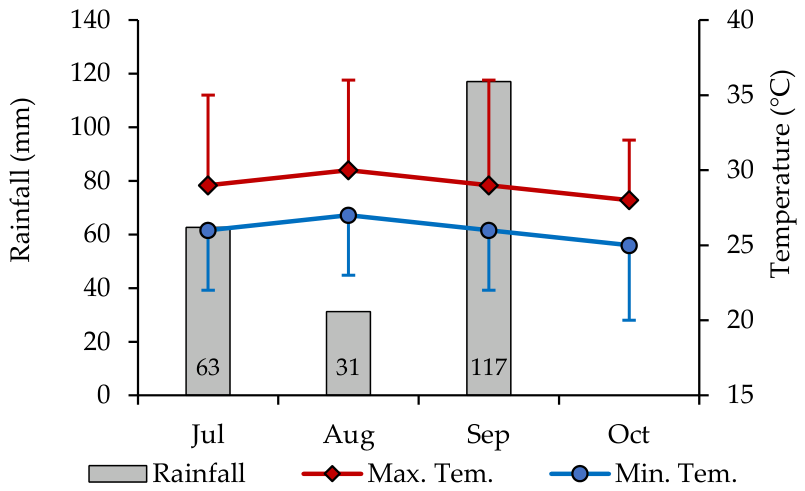
15], and receives a mean annual precipitation of 657 mm and mean temperatures between 18 and 29 °C. Meteorological variables were obtained from a station located at the Aldama Experimental Site, approximately 150 m from the area where the trial was established. During the experimental period, we recorded cumulative precipitation and maximum and minimum air temperatures (
Figure 1). The field evaluation period extended from sowing on 7 July 2025 to the first cutting on 3 October 2025, 88 days after sowing. The experiment was conducted entirely under rainfed conditions, with no supplemental irrigation during the 88-day establishment period. Therefore, crop water supply depended exclusively on the rainfall recorded during the experiment (
Figure 1). Before establishment of the experiment, soil samples were collected from the 0–20 cm soil layer. The soil had a clay-loam texture, with 30–33% clay, a bulk density of 1.25 g cm
−3, and saturation point, field capacity, and permanent wilting point values of 47.0, 25.1, and 14.9%, respectively. The soil had an alkaline pH of 8.36, measured in a 1:2 soil-to-water suspension, an electrical conductivity of 0.72 dS m
−1, an organic matter content of 3.30%, and 50.0% total carbonates. Initial soil fertility analysis showed concentrations of 2.80 mg kg
−1 nitrate-N, 6.30 mg kg
−1 Olsen-extractable P, and 274 mg kg
−1 exchangeable K, as well as a cation-exchange capacity of 37.4 cmolc kg
−1.
2.2. Plant Material, Land Preparation, and Establishment of the Experiment
Two tropical forage materials were evaluated: Cayman Blend [a blend of interspecific Urochloa hybrids (GP 0423 + CIAT GP4009BR)] and Miyagui [Megathyrsus maximus (Jacq.) B.K.Simon & S.W.L.Jacobs]. Before sowing, we conducted viability and germination tests on the commercial seeds. Both seed lots had a mean germination percentage of 85 ± 5%. The experiment covered a total area of 1657 m2. Before land preparation, pre-existing weeds were controlled by applying the amine salt of 2,4-dichlorophenoxyacetic acid (2,4-D) at 2 L ha−1. Subsequently, the soil was mechanically prepared with one subsoiling pass and two harrowing passes. Sowing was carried out on 7 July 2025 using 8 kg ha−1 of commercial seed and an EarthWay® manual precision seeder (EarthWay Products LLC, Bristol, IN, USA). The experimental plots measured 5.6 × 4.0 m (22.4 m2) and contained 15 rows, each 4.0 m long, with 0.40 m between adjacent rows; thus, the 14 inter-row intervals spanned the 5.6-m plot width.
2.3. Experimental Design and Treatments
A randomized complete block design with a split-plot arrangement and three replicates was used. Grass type constituted the main-plot factor, with two levels: Cayman Blend and Miyagui. Fertilization treatments constituted the subplot factor, with six levels (
Table 1). The treatment codes Bov400 and Bov800 denote bovine-manure biol applied at 400 and 800 L ha
−1, respectively, whereas Rab400 and Rab800 denote rabbit-manure biol applied at the corresponding rates. In total, 12 grass × fertilization combinations were evaluated, distributed across 36 experimental plots. The treatments were applied once, 35 days after sowing. The biols were applied undiluted as a soil drench in continuous bands along the rows at the base of the plants. Applications were made using a 20-L hand-operated backpack sprayer (model 289020, Lola Safe, Lagos de Moreno, Jalisco, Mexico).
In the chemical fertilization treatment, 60 kg ha−1 of nitrogen (N) and 60 kg ha−1 of phosphorus pentoxide (P2O5) were applied using urea and monoammonium phosphate (MAP). This corresponded to application rates of 103 kg ha−1 of urea and 115.4 kg ha−1 of MAP. Both fertilizers were mixed before application and placed in bands between the rows at an approximate depth of 5 cm. The fertilizer bands were then covered with soil to reduce nitrogen losses through volatilization.
2.4. Preparation of the Biols
Two liquid biofertilizers were prepared through anaerobic fermentation: one based on bovine manure and the other on rabbit manure. For each formulation, 45 kg of fresh manure, 16 kg of molasses, 10 L of raw milk, 1.8 kg of yeast, 2 kg of ash, 2 kg of rock phosphate powder, 2 kg of phosphites, and sufficient non-chlorinated water to reach the working volume of the container were used. The ingredients were incorporated and mixed in 200 L plastic containers fitted with a lid and metal ring. After mixing the components, non-chlorinated water was added, leaving approximately 20 cm of headspace at the top to allow the accumulation of gases generated during fermentation. Each container was equipped with a gas-release valve connected by a transparent hose to a 2 L polyethylene terephthalate bottle containing water. This device functioned as a hydraulic seal, allowing the gases produced during fermentation to escape while preventing air from entering the container. Fermentation was maintained for 90 days in a ventilated location protected from direct sunlight and rain. At the end of this period, the material was filtered through a 4 mm mesh to separate the solid and liquid fractions. The liquid fraction was designated as the biol and was stored in 20 L containers in a cool, shaded location until field application.
2.5. Chemical Characterization of the Biols
Each biol formulation was prepared as a single batch, and one fresh liquid sample from each batch was submitted to Fertilab
® (Celaya, Guanajuato, Mexico) for chemical characterization. The laboratory reported one analytical result for each measured variable in each biol; therefore, the values presented in
Table 2 are descriptive and were not subjected to statistical analysis. All analyses were conducted on a fresh-matter basis, considering the original moisture content of the samples. The pH and electrical conductivity were determined by potentiometry and electrometry, respectively. Total nitrogen was determined by Dumas combustion, whereas P, K, Ca, Mg, Na, S, Fe, Cu, Mn, Zn, and B were determined by microwave digestion followed by inductively coupled plasma optical emission spectrometry. Moisture was determined gravimetrically, while organic matter, ash, and organic carbon were determined by calcination. All nutrient concentrations were reported in mg L
−1, whereas moisture, organic matter, ash, and organic carbon were expressed as %
w/
w on an as-received basis (
Table 2).
2.6. Evaluation of Establishment and Dry Matter Yield
The initial establishment of Cayman Blend and Miyagui was evaluated through a single destructive cutting conducted 88 days after sowing. The biomass obtained corresponded to the accumulated aboveground growth from sowing to the first harvest; therefore, the evaluation did not represent a regrowth response or productivity under successive cuttings. To minimize potential edge effects, the two outermost rows on each side of the plot and 1 m at each end of the rows were excluded from sampling. After these exclusions, the net plot area measured 4.0 m across the rows and 2.0 m along the rows, corresponding to a usable area of 8.0 m2. Within this net area, two interior rows were randomly selected, and a 1-m-long segment was delimited in each row. All aboveground plant material within the two segments was harvested and combined to form one plot-level sample. Based on the 0.40 m row spacing, the combined row length of 2 m represented a sampled area of 0.80 m2, equivalent to 10% of the net plot area. This sampling procedure was established before data collection and applied consistently across all experimental plots.
Cayman Blend forage was harvested at 10 cm above the soil surface, the height recommended for
Urochloa genotypes [
5]. Miyagui was harvested at 15 cm, a height consistent with experimental harvesting protocols applied to
M. maximus genotypes [
16]. The cutting height for each grass was selected according to its growth habit and architecture. Immediately after harvesting, the material obtained from the two segments was combined and weighed on a digital scale (BAR-6, Rhino Maquinaria S.A. de C.V., Atizapán de Zaragoza, State of Mexico, Mexico) to determine fresh matter yield.
A representative subsample of approximately 200 g of fresh forage was taken from each sampling unit. The subsamples were placed in labeled paper bags and dried in a forced-air oven (CE3F, Sheldon Manufacturing, Inc., Cornelius, OR, USA) at 70 °C until a constant weight was reached. Dry matter (DM) content was calculated as the ratio between the dry weight and fresh weight of the subsample. Total dry matter yield (TDMY) was then calculated from the total fresh matter harvested and the DM content of the subsample and expressed in t ha−1.
2.7. Nutritional Composition and Energy Variables
Nutritional composition and estimated energy values were determined on the forage samples collected at the harvest conducted 88 days after sowing. The samples were dried in a forced-air oven at 70 °C until a constant weight was reached and subsequently ground in a Wiley Model 4 mill (Arthur H. Thomas Co., Philadelphia, PA, USA) fitted with a 1 mm screen. The processed samples were sent to the Forrajera de Ganaderos de Aguascalientes S.A. de C.V. (FOGASA) laboratory, a member of the Dairy One Global Laboratory Network, for analysis by near-infrared reflectance spectroscopy (NIRS).
Each of the 36 experimental plots produced one independently processed forage sample. Samples from the three replicate plots within each grass × fertilization combination were labeled, submitted, and analyzed separately. Therefore, each treatment-combination mean was calculated from three independent field-plot observations. The results were obtained on both as-received and dry matter bases; for the present study, only the values expressed on a dry matter basis were used.
The laboratory report included values for crude protein (CP), neutral detergent fiber (NDF), acid detergent fiber (ADF), lignin (LIG), non-fibrous carbohydrates (NFC), and 30-h in vitro dry matter digestibility (IVD30h). The IVD30h value was included in the laboratory report as part of the NIRS analytical data package and was not determined through a separate in vitro fermentation performed specifically for this study. CP, NDF, ADF, LIG, NFC, and IVD30h were expressed in g kg−1 of dry matter. The FOGASA laboratory used NIRS calibration curves provided by Dairy One (Ithaca, NY, USA).
The laboratory report also included calculated values of net energy for lactation (NEl), net energy for maintenance (NEm), net energy for gain (NEg), and metabolizable energy (ME), expressed in Mcal kg
−1 of dry matter, as well as estimated milk production (EMP), expressed in L t
−1 of dry matter. These variables were provided as calculated outputs of the laboratory analytical package and were not calculated independently by the authors. The specific equations used to generate the energy values were not provided to the authors by the laboratory. Therefore, these results were used only as comparative indicators of forage nutritional potential and not as direct estimates of animal performance. A representative original FOGASA NIRS analytical report and the complete sample-level dataset for all 36 independently analyzed forage samples and all NIRS-derived variables reported in this study are provided in
Supplementary File S1.
2.8. Statistical Analysis
Dry matter yield, nutritional composition, digestibility, estimated energy variables, and estimated milk production obtained 88 days after sowing were analyzed according to a randomized complete block design with a split-plot arrangement and three replicates. Grass was the fixed main-plot factor, fertilization was the fixed subplot factor, and grass × fertilization was their fixed interaction. Block and block × grass were included as random effects. The grass main effect was tested against the block × grass main-plot error term, with 1 numerator and 2 denominator degrees of freedom (df), respectively, whereas fertilization and the grass × fertilization interaction were tested against the subplot residual error, with 5 numerator and 20 denominator df.
Because the grass × fertilization interaction was significant, least-squares means were compared among all 12 grass × fertilization combinations using the Tukey–Kramer adjustment at α = 0.05. The three experimental plots represented the independent replicates for each grass × fertilization combination. Standard errors were calculated from the variation among these three field plots. Analyses were performed using Statistical Analysis System (SAS) software, version 9.0 (SAS Institute Inc., Cary, NC, USA).
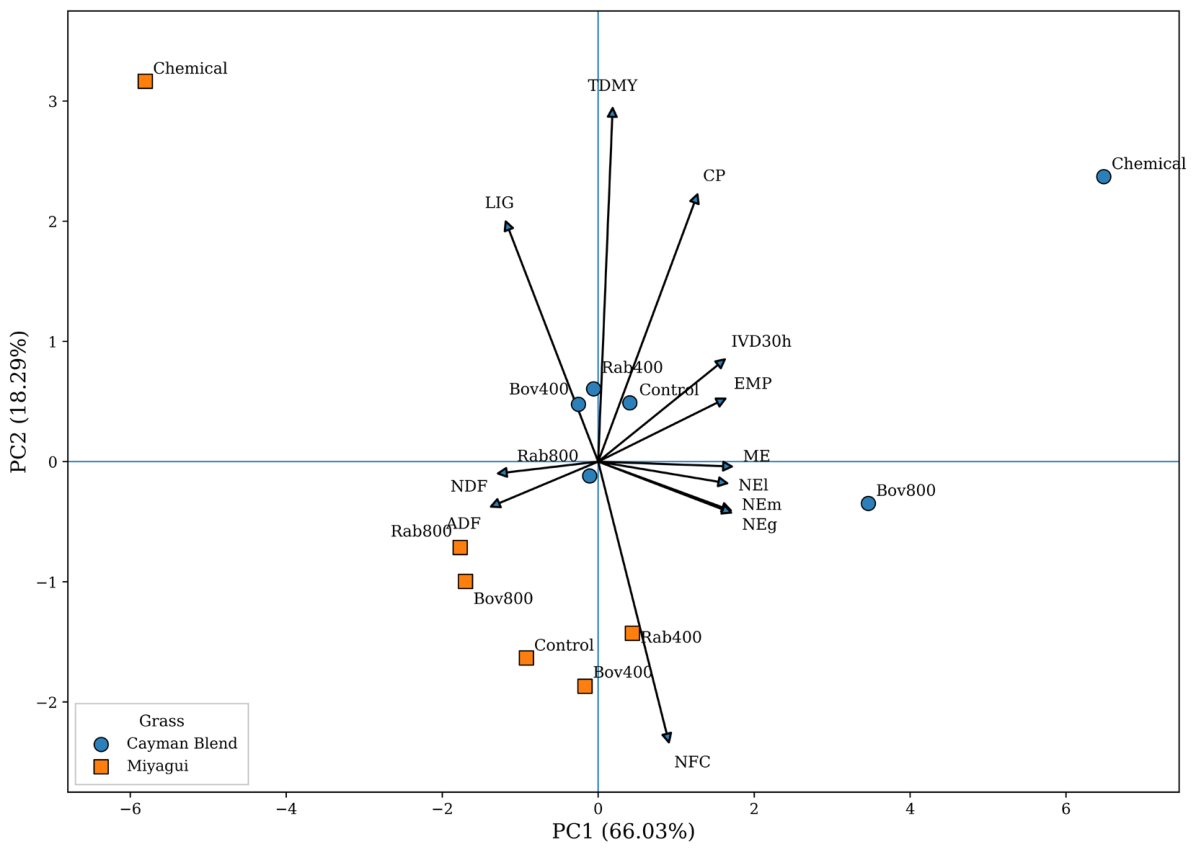
A principal component analysis was performed using the productive, nutritional, digestibility, estimated energy, and estimated milk production variables evaluated at 88 days after sowing. The means of the 12 grass × fertilization combinations were standardized, and the PCA was conducted using the correlation matrix. The first two principal components, which together explained more than 80% of the total variation, were displayed in a biplot. Because the analysis was based on treatment-combination means rather than plot-level observations, the PCA was used only as an exploratory descriptive analysis. The PCA was performed in Python 3.10 [
17,
18,
19].
4. Discussion
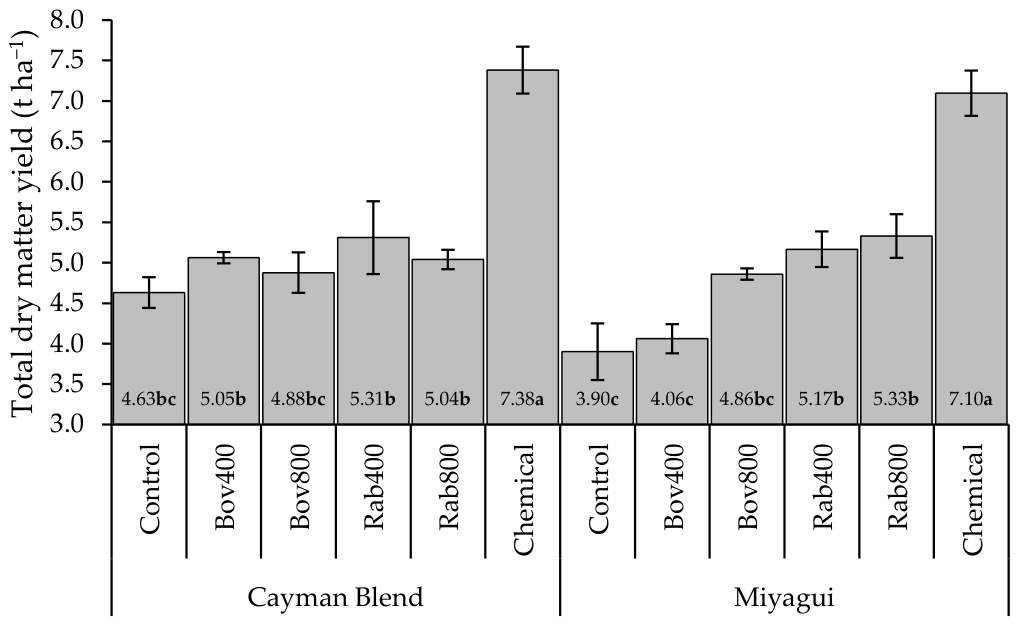
Chemical fertilization produced the greatest dry matter yields in both Cayman Blend and Miyagui at the first harvest. The significant grass × fertilization interaction further indicated that the magnitude of the response to the fertilization treatments depended on the forage material. Although the chemical treatment supplied N and P
2O
5, soil nutrient availability, plant nutrient uptake, tissue mineral concentrations, leaf expansion, and tillering were not measured. Therefore, the greater biomass observed under chemical fertilization cannot be attributed to a specific nutrient or physiological mechanism based on the present results. Previous studies have similarly shown that yield responses of tropical grasses vary with forage genotype, fertilizer source, and application rate [
7,
8,
9].
The greater dry matter yields obtained with chemical fertilization should be interpreted cautiously because the treatments were not nutrient-equivalent. Based on the fresh-matter nutrient concentrations reported by the laboratory and the applied volumes, Bov400 and Bov800 supplied 0.52 and 1.04 kg N ha
−1, respectively, whereas Rab400 and Rab800 supplied 0.56 and 1.12 kg N ha
−1. Their corresponding P
2O
5 inputs ranged from 0.18 to 1.10 kg ha
−1, and their K
2O inputs ranged from 1.73 to 3.66 kg ha
−1. In contrast, the chemical treatment supplied 60 kg N ha
−1 and 60 kg P
2O
5 ha
−1. Therefore, the observed responses represented comparisons among nonequivalent fertilization regimes rather than equivalent nutrient sources. Previous studies have shown that tropical grass responses can vary with fertilizer source and nutrient application rate [
9,
10]. However, because soil nutrient availability, nutrient-release dynamics, and plant nutrient uptake were not measured, the individual contributions of nutrient amount and fertilizer form cannot be separated.
The application methods also differed among the fertilization regimes. The biols were surface-applied as a drench in continuous bands at the base of the plants, whereas the chemical fertilizers were placed in bands between the rows at an approximate depth of 5 cm and subsequently covered with soil. These differences in fertilizer placement and incorporation could have affected nutrient–soil contact, exposure to potential nutrient losses, and nutrient availability to the developing root systems. Because nutrient losses, nutrient movement in the soil, and root uptake were not measured, the contribution of the application method to the observed responses cannot be quantified separately. Therefore, the treatment effects should be interpreted as responses to the complete fertilization regimes evaluated (including fertilizer source, nutrient amount, placement, and incorporation) rather than as isolated effects of fertilizer origin.
The significant grass × fertilization interaction showed that the response to the biols depended on the forage material. In Cayman Blend, none of the biol treatments increased yield relative to the control. In Miyagui, Rab400 and Rab800 increased dry matter yield relative to the control and Bov400, whereas Bov800 was intermediate and did not differ from either group. Differences in growth habit, root distribution, tillering, canopy architecture, and nutrient demand can change how efficiently each grass uses nutrients. Studies with tropical materials confirm that yield response and nitrogen-use efficiency depend on interactions among genotype, fertilization source, and fertilization rate [
7,
9].
The composition of the biols may have partially contributed to the observed differences. The rabbit biol had higher concentrations of phosphorus, magnesium, and several micronutrients, whereas the bovine biol had higher contents of organic matter and organic carbon and a higher C:N ratio. Because each formulation was represented by a single batch, possible batch-to-batch variation in biol composition was not evaluated. However, these relationships should be interpreted cautiously because biol mineralization and nutrient accumulation in plant tissues were not assessed. Therefore, the results represent a short-term response and do not preclude later or cumulative effects of organic fertilizers, whose nutrient release and effects on soil properties generally occur gradually [
10,
11].
In Cayman Blend, chemical fertilization resulted in greater yield and CP concentration, lower NDF, and higher IVD30h relative to the control; however, its ADF and LIG concentrations did not differ from those of the control. Nitrogen availability favors the synthesis of amino acids, enzymes, and plant proteins and, when it mainly stimulates the formation of leaves and young tissues, can reduce the proportion of some structural components and improve digestibility. Nitrogen fertilization increases leaf mass and area in
Urochloa hybrids, although its effects on individual fiber fractions depend on genotype, maturity stage, and environmental conditions [
7,
8].
Interpretation of the 88-day harvest requires a clear distinction between establishment growth and regrowth. In the present study, the harvested forage represented biomass accumulated continuously from sowing to the first cutting, during a period in which root anchorage, tiller formation, canopy development, and aboveground biomass accumulation occurred simultaneously. In contrast, regrowth studies evaluate forage produced by an established sward that resumes growth from surviving tillers, developed root systems, and stored reserves. The timing used here is consistent with establishment or standardization cuts conducted at 80 days after germination in
Megathyrsus grass and at 90 days after sowing in Cayman and other
Urochloa hybrids [
13,
14]. Therefore, the present measurements characterize the productive and nutritional status reached at the end of initial establishment and should not be interpreted as representing an 88-day regrowth interval.
Results from established swards nevertheless provide useful external context when the differences in developmental stage are acknowledged. In a rainfed study conducted in Tamaulipas with established Cayman swards grown in an alkaline soil (pH 8.3) under a mean annual rainfall of 719 mm, dry matter yield increased from 0.95 to 6.32 t ha
−1 between 2 and 10 weeks of regrowth, while CP declined from 149 to 65 g kg
−1 DM and NDF increased from 548 to 694 g kg
−1 DM [
20]. The ranges recorded for Cayman Blend during establishment in the present study (4.63–7.38 t DM ha
−1, 62–96 g CP kg
−1 DM, and 619–693 g NDF kg
−1 DM) overlapped with some of these published values. Another study involving established
Urochloa hybrids, including Cayman, reported overall CP and in vitro dry matter digestibility values of approximately 110 and 700 g kg
−1 DM, respectively, across 4–8 weeks of regrowth [
2]. The IVD30h values obtained here ranged from 600 to 657 g kg
−1 DM. These numerical comparisons should be interpreted cautiously because establishment growth and regrowth represent different developmental stages and because the studies also differed in fertilization, environment, stand age, and analytical procedures.
Cultivar-specific information for Miyagui remains more limited. At 40 days of regrowth in Panama, dry matter yield ranged from 3.47 to 4.55 t ha
−1 and CP from 91 to 106 g kg
−1 DM following the application of 0–20 t ha
−1 of poultry litter [
6]. In the present establishment evaluation, Miyagui produced 3.90–7.10 t DM ha
−1 and contained 55–64 g CP kg
−1 DM at 88 days after sowing. These differences cannot be attributed specifically to harvest age because the studies evaluated different developmental stages and also differed in climate, soil fertility, fertilizer source and rate, and analytical procedures. The cited Miyagui study did not report IVD30h, preventing a direct cultivar-specific comparison for this variable. Thus, the present results provide a characterization of Miyagui at its first establishment harvest rather than an estimate of its expected performance under routine regrowth management.
In Cayman Blend, Bov800 increased IVD30h, NEm, NEg, ME, and EMP relative to the control without increasing dry matter yield, whereas its ADF concentration did not differ from that of the control. This result illustrates that biomass accumulation and specific nutritional indicators do not necessarily respond in the same direction. Bov800 may have modified tissue composition without producing a detectable increase in total biomass; however, this explanation remains a hypothesis because leaf and stem proportions, microbial activity, biol mineralization, and nutrient uptake were not evaluated.
Chemical fertilization produced a contrasting response in Miyagui. Although it increased yield and crude protein concentration, it also increased ADF and lignin and reduced IVD30h. In erect grasses such as
Megathyrsus maximus, nitrogen can stimulate leaf production, stem elongation, and structural tissue formation, particularly when the growth period is prolonged. Nitrogen fertilization has increased biomass production and crude protein concentration in
M. maximus cultivars, but its effects on NDF, ADF, lignin, and digestibility vary with the cultivar, rate, and harvest age [
21,
22,
23].
Chemically fertilized Miyagui combined greater CP with lower IVD30h, showing that CP alone did not fully characterize its nutritional profile. Its greater ADF and LIG concentrations occurred together with lower IVD30h and lower estimated energy values. These patterns represent associations among analytical outputs rather than evidence of a causal mechanism because the fiber fractions, IVD30h, and energy variables were obtained from the same NIRS analytical package and were not measured independently. Lignin and indigestible cell-wall fractions are nevertheless recognized indicators used to differentiate forage nutritional profiles and estimate energy content [
24,
25]. Among the Miyagui treatments, Bov400 had lower NDF than the chemical treatment, whereas Rab400 had the lowest numerical LIG concentration and was lower than the other fertilized combinations but not the control. Because mineral concentrations in plant tissue were not determined, these responses cannot be attributed to a specific nutrient.
The estimated energy variables followed patterns similar to those observed for IVD30h and the fiber fractions. In Cayman Blend, chemical fertilization produced the highest numerical NEm, NEg, ME, and EMP values and did not differ from Bov800, consistent with the comparatively high IVD30h of these treatments rather than with a reduction in ADF. In Miyagui, the lower estimated energy values of the chemical treatment occurred together with greater ADF and LIG concentrations and lower IVD30h. These relationships are presented as descriptive associations among NIRS-derived outputs and not as independent evidence of the nutritional or physiological mechanisms responsible for the observed responses.
EMP was used as a comparative indicator of the nutritional potential of one metric tonne of dry matter and was obtained from the analytical report rather than measured in animals. The greater EMP values observed for chemically fertilized and Bov800-treated Cayman Blend indicate a higher calculated milk-production potential under equivalent intake and management conditions; however, actual animal performance will also depend on animal characteristics, voluntary intake, and the composition of the complete diet.
Because the specific NIRS calibration equations and their validation statistics were not available, the absolute nutritional and energy values should be interpreted with appropriate caution. Nevertheless, all samples were processed and analyzed under the same laboratory protocol, allowing the resulting values to be compared among the grass × fertilization combinations evaluated in this experiment.
Principal component analysis summarized the multivariate patterns observed across the treatment-combination means. PC1 mainly represented a nutritional profile gradient, with IVD30h, the estimated energy variables, and EMP loading in the opposite direction from NDF and ADF. PC2 was associated with dry matter yield, CP, and LIG. This configuration illustrated that greater yield or CP concentration did not necessarily coincide with greater digestibility or estimated energy value. PCA can summarize correlated variables and differentiate forage treatments with contrasting nutritional profiles [
25,
26]. Nevertheless, the relative directions of the vectors in the biplot describe associations among variables and do not establish causal relationships.
The pairwise comparisons and exploratory PCA indicated contrasting productive and nutritional profiles between the two grasses. Under chemical fertilization, Cayman Blend and Miyagui produced similar dry matter yields, but Cayman Blend had greater CP, IVD30h, estimated energy values, and EMP and lower NDF, ADF, and LIG. Accordingly, the two chemically fertilized combinations occupied contrasting positions along the nutritional gradient represented by PC1. The biol-treated and control combinations occupied mostly intermediate positions, whereas Cayman Blend treated with Bov800 was positioned closer to the digestibility and estimated energy vectors. Because the PCA was based on the means of only 12 treatment combinations and no inferential analysis compared the relative magnitudes of the grass and fertilization effects, these patterns should be interpreted descriptively. They do not demonstrate that the inherent characteristics of the grasses exerted a greater influence than fertilization.
In agronomic terms, the contrasting responses of Cayman Blend and Miyagui show that the choice of a fertilization strategy should consider not only biomass accumulation but also forage composition and estimated energy value. Chemical fertilization produced the greatest dry matter yield in both grasses at the first harvest, but its nutritional effects differed between the forage materials. Some biol treatments affected individual productive or nutritive-value variables, but these responses were not consistent between grasses. Because the fertilization regimes supplied different amounts of nutrients and were evaluated after a single application, the results provide a preliminary assessment of these biols during pasture establishment rather than a direct comparison of nutrient-equivalent fertilizer sources.
The low nutrient density of the biols also has an important practical implication. Based solely on their measured fresh-matter N concentrations, supplying a N input equal to the 60 kg N ha
−1 applied in the chemical treatment would require approximately 46,000 L ha
−1 of bovine biol or 43,000 L ha
−1 of rabbit biol, compared with the 400 and 800 L ha
−1 rates evaluated. These calculations do not establish nutrient equivalence because nutrient ratios, release dynamics, and recovery by plants would also differ, but they illustrate why a moderate increase in application volume alone would be unlikely to close the observed yield gap. Future studies should therefore evaluate nutrient-defined strategies rather than only larger volumetric rates. Potential approaches include concentrating the biols, enriching or blending them with mineral nutrients, and applying nutrient-defined doses through split or repeated applications. Concentration or mineral enrichment could increase nutrient delivery per unit volume, whereas split applications might improve synchronization between nutrient supply and plant demand; however, splitting the application would not compensate for an insufficient total nutrient input unless the overall amount supplied were also increased. Studies in forage systems indicate that organic, mixed mineral-organic, and repeated manure applications can produce responses that become evident across successive harvests [
10,
11,
12]. Because concentrated or enriched formulations could also increase salt loading and generate additional handling or economic constraints, future evaluations should monitor soil electrical conductivity, plant nutrient status, cumulative forage yield, and economic feasibility. These alternatives were not evaluated in the present experiment and should be regarded as testable research directions rather than recommendations derived from the current results.
5. Conclusions
The significant grass × fertilization interactions indicate that productive and nutritional responses depended on the specific combination of forage material and fertilization treatment during establishment. Chemical fertilization produced the greatest dry matter yields in Cayman Blend and Miyagui at 88 days after sowing, and the two grasses did not differ in yield under this treatment. Nevertheless, chemically fertilized Cayman Blend had greater CP, IVD30h, estimated energy values, and EMP and lower NDF, ADF, and LIG than chemically fertilized Miyagui. These differences highlight the need to consider forage material and fertilization jointly.
Within Cayman Blend, chemical fertilization increased yield, CP, IVD30h, and estimated energy values and decreased NDF relative to the control, while ADF and LIG were unchanged. In Miyagui, chemical fertilization increased yield, CP, ADF, and LIG but reduced IVD30h, estimated energy values, and EMP. Rab400 and Rab800, but not Bov800, increased Miyagui yield relative to the control. Conversely, Bov800 increased IVD30h, NEm, NEg, ME, and EMP in Cayman Blend without increasing yield.
Under the nonequivalent application regimes evaluated, none of the tested biol rates matched the dry matter yield obtained with chemical fertilization in either grass after a single application. Nevertheless, some biol treatments produced grass-specific responses in yield, digestibility, or estimated energy values. Because nutrient inputs were not standardized, these findings should be interpreted as a comparison of the specific practical fertilization regimes evaluated, rather than as evidence of the intrinsic superiority of chemical fertilizer over biols. The scope of inference is limited to the biol sources, volumetric rates, application methods, soil conditions, single application, and first-harvest evaluation used in this experiment. Future studies should evaluate higher but agronomically feasible application rates, concentrated or mineral-enriched biol formulations, and repeated or split applications across successive harvests, using nutrient-defined treatments and monitoring soil and plant nutrient dynamics, salinity, cumulative forage yield, and economic feasibility.






 ,
,