Systematic Review

Automated and Intelligent Inspection of Airport Pavements: A Systematic Review of Methods, Accuracy and Validation Challenges


1
Department of Civil Engineering and Architecture, University of Beira Interior, 6200-358 Covilhã, Portugal
2
GeoBioTec –Geobiosciences, Geoengineering and Geotechnologies, University of Beira Interior, 6200-358 Covilhã, Portugal
*
Author to whom correspondence should be addressed.
Future Transp. 2025, 5(4), 183; https://doi.org/10.3390/futuretransp5040183

Submission received: 15 October 2025 / Revised: 24 November 2025 / Accepted: 27 November 2025 / Published: 1 December 2025

Abstract

Airport pavement condition assessment plays a critical role in ensuring operational safety, surface functionality, and long-term infrastructure sustainability. Traditional visual inspection methods, although widely used, are increasingly challenged by limitations in accuracy, subjectivity, and scalability. In response, the field has seen a growing adoption of automated and intelligent inspection technologies, incorporating tools such as unmanned aerial vehicles (UAVs), Laser Crack Measurement Systems (LCMS), and machine learning algorithms. This systematic review aims to identify, categorize, and analyze the main technological approaches applied to functional pavement inspections, with a particular focus on surface distress detection. The study examines data collection techniques, processing methods, and validation procedures used in assessing both flexible and rigid airport pavements. Special emphasis is placed on the precision, applicability, and robustness of automated systems in comparison to traditional approaches. The reviewed literature reveals a consistent trend toward greater accuracy and efficiency in systems that integrate deep learning, photogrammetry, and predictive modeling. However, the absence of standardized validation protocols and statistically robust datasets continues to hinder comparability and broader implementation. By mapping existing technologies, identifying methodological gaps, and proposing strategic research directions, this review provides a comprehensive foundation for the development of scalable, data-driven airport pavement management systems.

1. Introduction

1.1. Framework

Airport pavements are critical structural components, essential not only for the safety and operational efficiency of air traffic but also for ensuring the economic sustainability of airports. Responsible for bearing the high and concentrated loads of aircraft, these structures must maintain functional characteristics over time, such as load-bearing capacity, surface regularity, and skid resistance. The deterioration of these properties directly compromises safety during landings, takeoffs, and ground maneuvers, while also generating significant operational and economic impacts [1,2,3,4]. Several studies have shown that pavement performance depends on both functional and structural integrity, which are influenced by operational, environmental, and maintenance factors.
Evaluation systems such as the Aircraft Classification Number/Pavement Classification Number (ACN/PCN), Pavement Condition Index (PCI), International Roughness Index (IRI), and the Coefficient of Friction (COF) are essential to ensure compatibility between aircraft and infrastructure and to monitor performance over time [5,6,7,8,9]. While the ACN/PCN system verifies structural adequacy under applied loads, the PCI, IRI and COF assess functional aspects, such as surface distresses and ride quality [8,9,10,11,12]. With the growth of air traffic and the intensification of operations, however, the need for more accurate, frequent, and automated inspection methods has become evident. To address this challenge, composite indicators have been continuously refined to better capture the cumulative effects of surface irregularities, friction loss, and distresses associated with operational safety [13,14,15,16,17].
In addition, sustainability plays a central role in modern pavement management, requiring that adopted strategies consider not only economic factors but also environmental, operational, and social impacts throughout the entire infrastructure life cycle [5]. The rational use of resources, combined with the timely planning of technically appropriate interventions, contributes to pavement longevity and ensures the continuity of airport operations with high standards of safety and efficiency.

1.2. Airport Pavement Management System (APMS)

Airport Pavement Management Systems (APMSs) have emerged as strategic tools by integrating historical data, field surveys, and predictive modeling, thereby enabling rational and technically informed management practices [3,18,19,20,21]. The systematic and continuous evaluation of airport pavement conditions is essential to support effective and sustainable maintenance decision-making. The lack of reliable diagnostics accelerates the progression of pavement distresses, significantly increases corrective maintenance costs, and compromises the operational availability of runways.
In the context of continuous air traffic growth and the natural aging of runway assets, these systems facilitate more accurate and evidence-based decision-making throughout the pavement life cycle. They guide maintenance and rehabilitation activities based on objective, technical, and measurable criteria. Their primary objective is to maximize pavement durability while minimizing costs through intelligent prioritization of interventions, long-term planning, and efficient allocation of available resources [19,20,21,22].
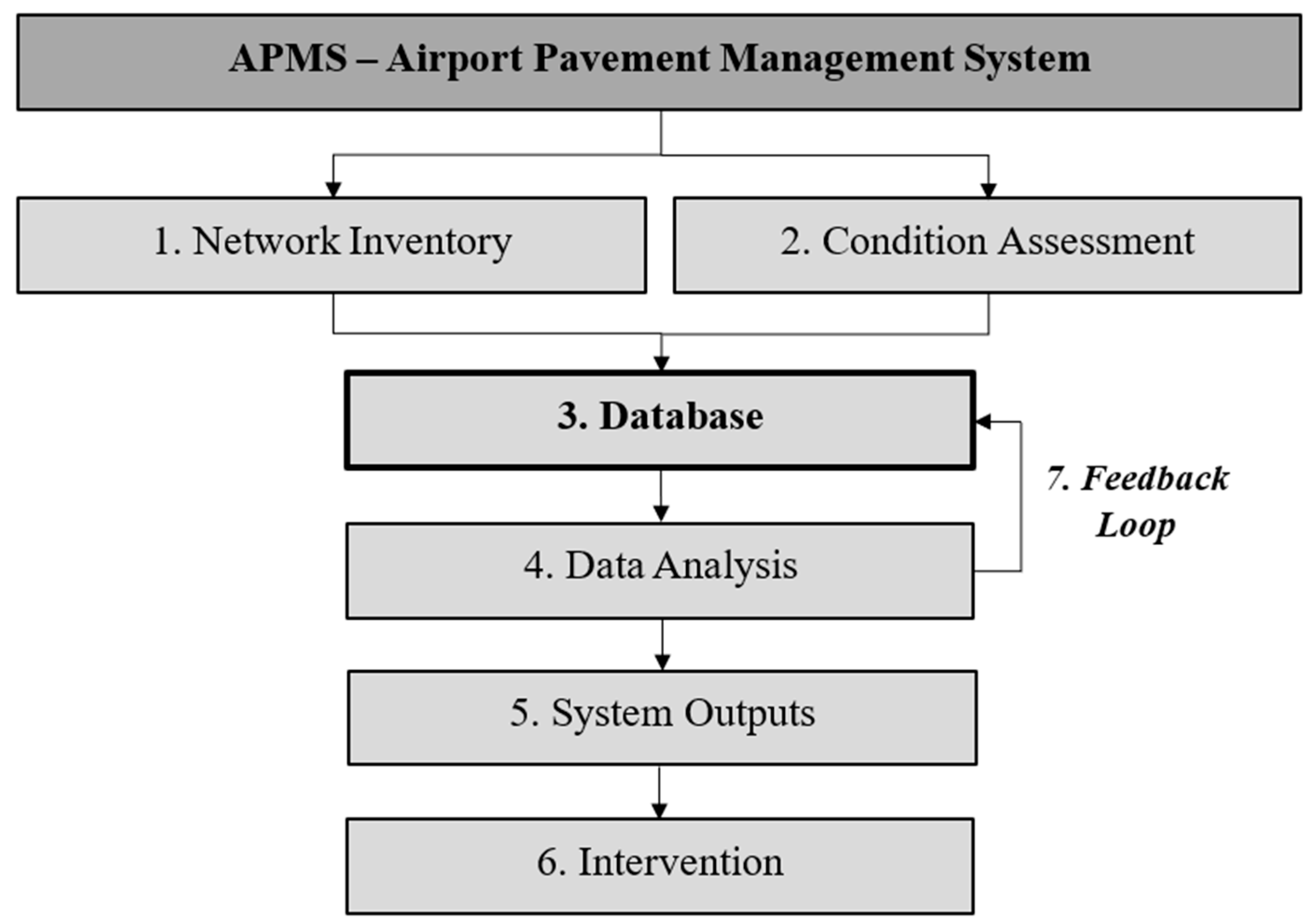
The operation of an APMS is structured around a set of interdependent components that support the collection, storage, analysis, and projection of pavement performance data. The main components include [3,23,24,25,26].
  • Network Inventory: Systematic cataloging of the physical and functional components of airport infrastructure, including runways, taxiways, and apron areas. The inventory encompasses detailed information on materials, geometric characteristics, construction history, past maintenance activities, and traffic load intensity.
  • Condition Assessment: Evaluation of the functional and structural condition of pavements using visual inspections, as well as destructive and non-destructive testing methods. Key performance indicators include the PCI and the ACN/PCN. This component also incorporates advanced technologies such as multifunctional vehicles, Unmanned Aerial Vehicles (UAVs), and Light Detection and Ranging (LiDAR) systems.
  • Database: Centralized and structured storage of all data collected throughout the various stages of pavement management. Ensuring the integrity and continuous updating of the database is essential to perform consistent analyses and to support informed, data-driven decision-making.
  • Data Analysis: Application of predictive models and simulations to estimate pavement distress progression, determine the optimal timing for interventions, and compare maintenance scenarios. This component also encompasses economic analyses focused on cost-effectiveness, return on investment, and overall sustainability.
  • System Outputs: Generation of reports, charts, and thematic maps that prioritize maintenance and rehabilitation actions based on technical, functional, and financial criteria. These outputs provide objective and actionable support for informed decision-making by airport pavement managers.
  • Intervention: Implementation of maintenance, rehabilitation, or reconstruction actions according to the priorities and technical recommendations generated by the APMS. This stage ensures that planned strategies are effectively executed in the field, bridging the gap between diagnostic assessment and practical application, and directly influencing pavement longevity and operational safety.
  • Feedback Loop: Continuous refinement of predictive models through the integration of real-world data obtained from inspections and monitoring. This dynamic process enhances the accuracy of future forecasts and supports adaptive pavement management strategies.
The overall structure of an APMS and its interrelated components is illustrated in Figure 1.
As demonstrated in [15], even during the early stages of implementation, APMSs offer tangible benefits, such as process simplification and more rational decision-making. Among the components that comprise an APMS, the database functions as the central core of the system. Its reliability directly influences the effectiveness of predictive models and operational processes [20,21,22]. In this regard, automated technologies have significantly improved data collection and processing by enhancing accuracy, speed, and standardization, thereby optimizing pavement management workflows.
The adoption of preventive strategies based on structured data can significantly reduce maintenance costs and prevent critical failures. Studies indicate that delays in necessary interventions may lead to increases of up to 50% in total costs and substantially reduce the service life of pavement structures [2,20,21,22]. The overall effectiveness of the system relies on the continuous calibration of data, tailored to local conditions such as traffic volume and climate.
In this context, the pursuit of more effective inspection methods is essential to ensure the integrity, reliability, and representativeness of the data feeding the APMS. The limitations of traditional techniques, such as on-foot visual inspections, have accelerated the adoption of technological approaches that integrate precision, efficiency, speed, and broader spatial coverage. Recent advances have further expanded data collection capabilities through the adoption of non-destructive methods and approaches based on artificial intelligence (AI). Among the most prominent inspection methods are multifunctional vehicles equipped with high-resolution sensors and UAVs, which improve data acquisition, processing, and interpretation, thereby increasing the robustness of decision-support models [27,28,29,30,31,32].
Despite these advances, many studies remain limited to descriptive analyses and lack objective validation criteria. This is particularly evident when considering the applicability of these methods in airports with varying operational profiles and environmental conditions. There is still a shortage of research that systematically evaluates the effectiveness of automated inspection approaches across diverse operational contexts. Furthermore, the absence of standardized metrics undermines results replicability and hinders the reliable large-scale implementation of these technologies [8,30,31,32,33].

1.3. Objectives

Given the challenges described, it is essential to conduct a rigorous evaluation of automated methods for the functional inspection of airport pavements. Aspects such as accuracy, repeatability, and practical applicability must be assessed based on reliable data and robust statistical analysis, moving beyond subjective perceptions and providing quantitative evidence. This is particularly relevant in a context where maintenance decisions and investment planning directly depend on the precision and reliability of the information produced.
Accordingly, this systematic review of the literature aims to identify the evolution and analyze the main technological methods employed in the functional inspection of airport pavements. The study encompasses the characterization of data acquisition techniques, the procedures used for processing and interpreting field data, and the validation criteria applied to assess their accuracy, applicability, and efficiency. Furthermore, statistical validation of these methods is considered a critical step to ensure the robustness of the results and their reliability for integration into inspection systems. Ultimately, this review seeks to map recent advances, identify methodological limitations, and highlight existing gaps in the literature, thereby contributing to the improvement of inspection practices and to the generation of more consistent and reliable data to support the technical management of airport infrastructure.

2. Airport Pavements: Types and Significance of Distress

Airport pavements play a vital role in ensuring the safety and operational efficiency of airport infrastructure. To guarantee optimal performance throughout their service life, three functional characteristics are crucial [4,6,9,23,24,25,26,34,35]:
  • Structural capacity: ensures the integrity of the infrastructure under repeated and heavy loads generated by aircraft.
  • Surface regularity: essential for stability during aircraft movement, preventing structural damage and supporting safe performance.
  • Skid resistance: maintains adequate friction levels, particularly under adverse conditions such as wet pavements.
The progressive development of pavement distresses directly compromises operational safety and drives up corrective intervention costs. To mitigate this, periodic inspections and systematic monitoring are crucial for anticipating failures, optimizing maintenance planning, and accurately assessing distress levels to support timely preventive or corrective actions. Pavement distress progression is a central concern in airport pavement management, as extensive cracking, depressions, friction loss, and plastic deformations compromise the functional performance of runways, especially during takeoff and landing under adverse conditions. In addition, loose particles and structural failures increase the risk of Foreign Object Debris (FOD), endangering aircraft integrity and passenger safety [9,35,36].
In this context, it is essential to understand the structural differences between flexible and rigid pavements, as well as the distress mechanisms to which they are subjected [3,23,37]. Rigid pavements, composed of Portland Cement Concrete (PCC) slabs, exhibit high flexural strength and are preferred in areas exposed to intense static loads, such as apron zones. However, they are more vulnerable to structural distresses and extreme weather conditions. Flexible pavements, consisting of bituminous and granular layers, are widely used on runways and taxiways due to their flexibility and ability to adapt to dynamic traffic loads. Nonetheless, they are more susceptible to distresses caused by repeated loading.
Each pavement type responds differently to climate variations, cyclic traffic loads, and wear processes, requiring specific techniques for measurement, diagnosis, maintenance, and rehabilitation. Therefore, understanding the different types of distress and their underlying causes is essential to guide effective intervention strategies. The ASTM D5340-23 standard [38] provides a detailed and standardized classification of the distresses affecting airport pavements. It establishes criteria for their identification, quantification, classification, and evaluation, with direct application in the determination of the PCI. The standard includes 17 types of distress for flexible pavements and 16 types for rigid pavements, detailing visual inspection procedures as well as severity and extent parameters [38].
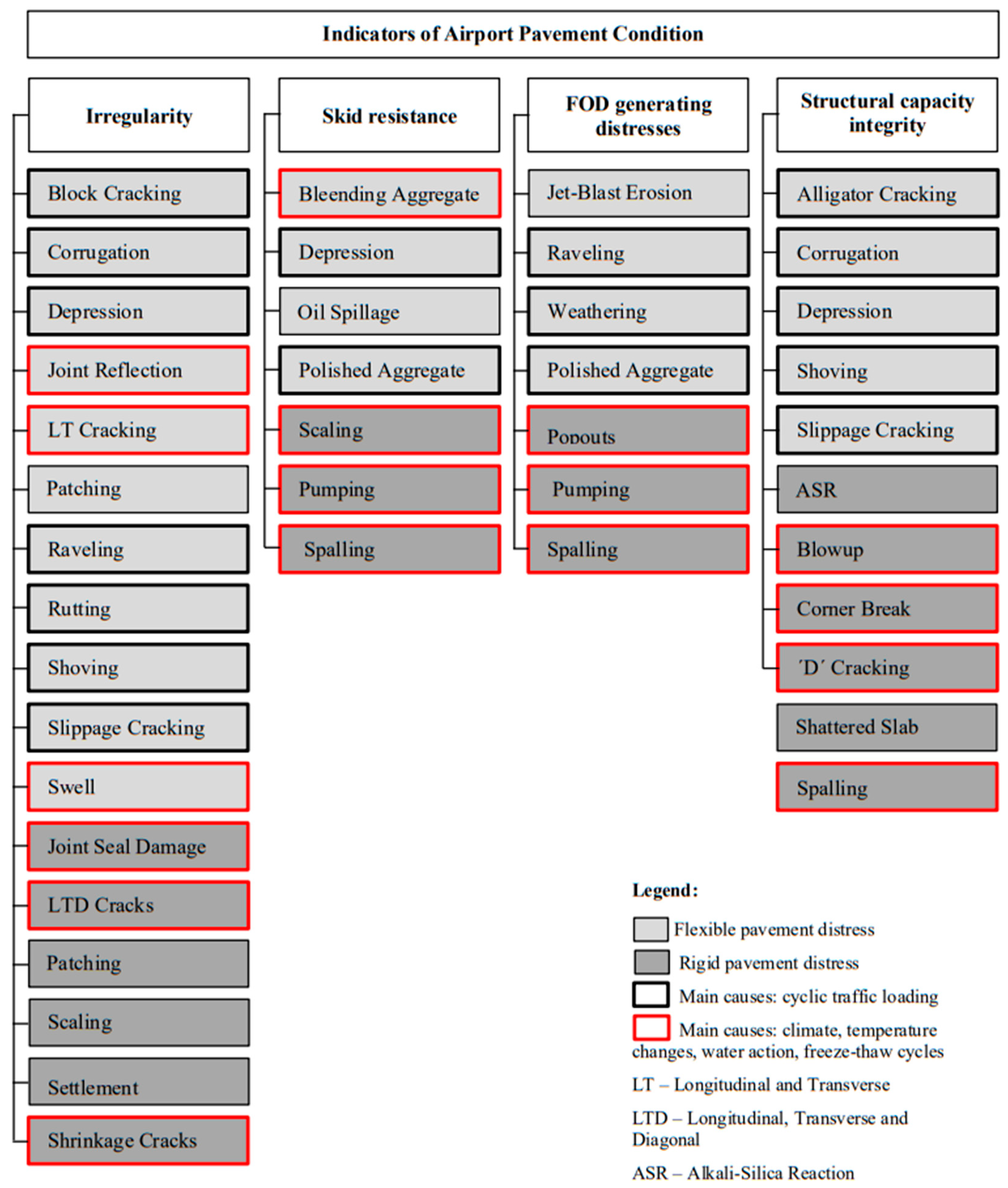
For the purposes of analysis and maintenance prioritization, pavement distresses are often grouped into functional categories. The functional categorization adopted in this study was developed to organize the various types of distress according to their impact on pavement performance, grouped into four main categories: irregularity, skid resistance, FOD-generating distresses, and structural capacity integrity (see Figure 2). Figure 2 presents a flowchart of the main types of airport pavement distresses, as outlined in ASTM D5340-23 [38], which defines the criteria for PCI evaluation and calculation. Each type of distress is associated with the pavement type (flexible or rigid) and with its predominant causes, which may be related to climatic factors (such as temperature variations, freeze–thaw cycles, and water infiltration) or to repeated loading from air traffic.
Figure 2. Functional classification of airport pavement distresses developed based on ASTM D5340-23 [38].
Futuretransp 05 00183 g002
Distresses grouped under “Irregularity” are generally caused by repeated traffic loads or significant climatic variations. These conditions, such as block cracking, depression, corrugation, rutting, shoving, swell, and settlement, affect surface uniformity and ride quality [26,39]. These issues can lead to instability, discomfort, and reduced operational performance.
Distresses related to “Skid resistance” are associated with surface wear or contamination, reducing friction levels and increasing the risk of hydroplaning or skidding [23,26]. Common examples include bleeding, polished aggregate, oil spillage, scaling, and spalling. These distresses are particularly critical in wet or icy conditions, where skid resistance is vital for safe aircraft operations.
The category “FOD-generating distresses” includes surface failures that contribute to the detachment of particles or fragments, such as popouts, pumping, and spalling, typically occurring in high-traffic areas and worsened by mechanical actions like jet-blast erosion and environmental exposure. These failures significantly increase the risk of FOD-related incidents, threatening aircraft integrity and passenger safety.
Finally, “Structural capacity integrity” encompasses distresses that indicate a loss of structural performance, often resulting from fatigue due to repeated aircraft loads, internal reactions in the concrete, or extreme thermal expansion. These include alligator cracking, slippage cracking, ‘D’ cracking, corner break, blowup, and shattered slab, which may severely compromise the load-bearing capacity of the pavement and require urgent rehabilitation [23,39].
The progression of distresses poses serious risks to operational safety, including aircraft control loss, premature tire wear, and FOD events, especially in high-traffic zones such as runways and taxiways [23,25]. Moreover, untreated surface failures may accelerate structural distress, increase corrective maintenance costs, and reduce the operational availability of airport infrastructure [23,39].
In light of these challenges, the ability to accurately detect, quantify, and classify surface distresses is essential for ensuring the safety, functionality, and cost-efficiency of airport pavements. This underscores the increasing relevance of advanced inspection technologies and data-driven analytical methods, which have become central to the development of more reliable and proactive pavement management strategies.

3. Search Method and a First Glance at Publications

This study aimed to identify, characterize, and analyze the main methods and technologies used in the functional inspection of airport pavements, with a focus on surface distress detection, evaluation, and the accuracy of inspection techniques. To this end, a systematic review was conducted using the Scopus database, Elsevier’s renowned bibliographic platform, established in 2004, which indexes peer-reviewed articles, abstracts, and citations curated by subject matter experts. Scopus is considered one of the most comprehensive databases for scientific publications in the fields of engineering and transportation infrastructure.
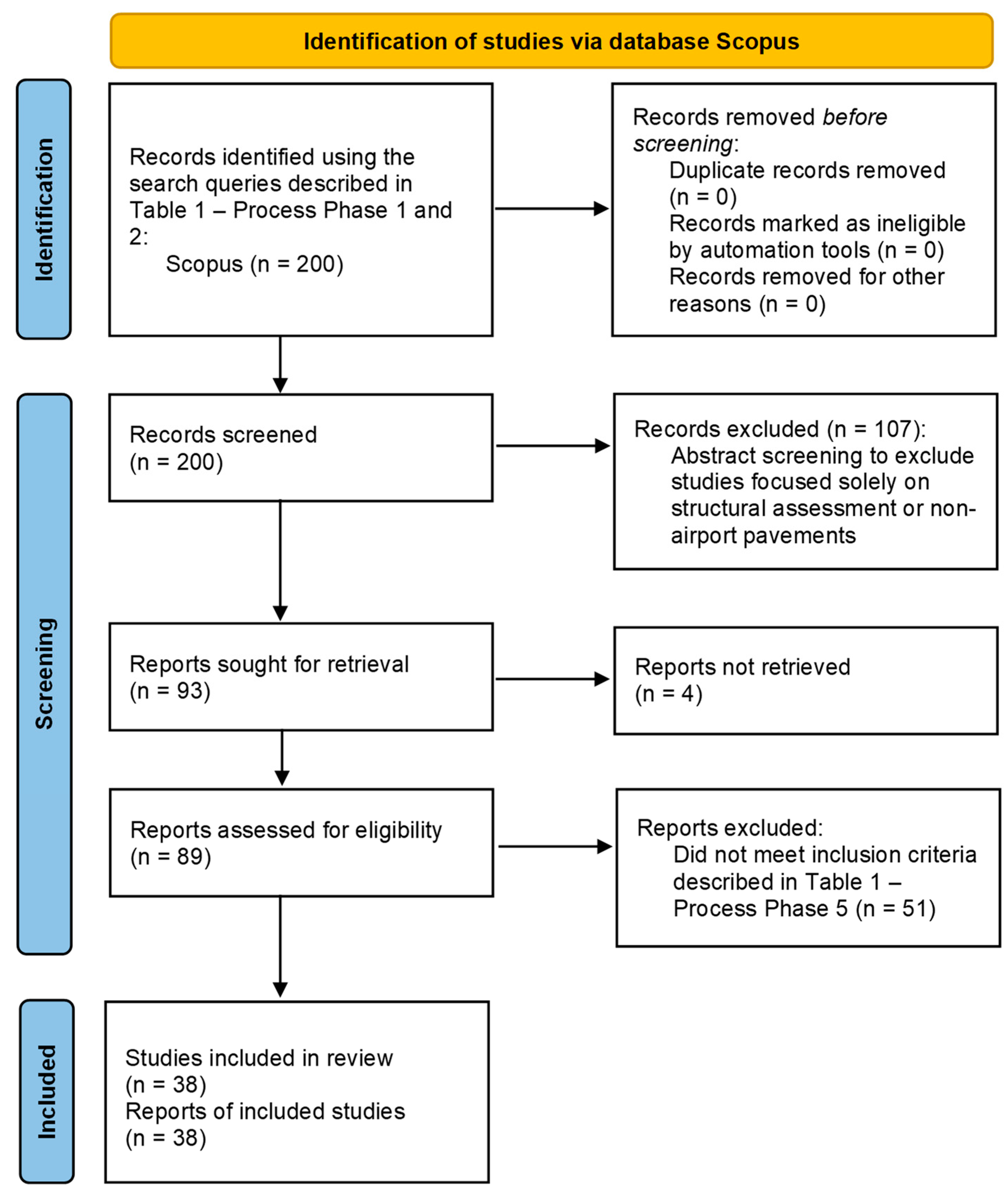
The data collection was performed on 29 November 2024. The publication selection criteria were based on several parameters, including peer-reviewed articles published in scientific journals and relevant international conference proceedings that specifically addressed methodologies applied to airport pavements. Table 1 and Figure 3 present the stages considered in the document screening, exclusion, and analysis process. This rigorous selection procedure aims to ensure the quality, relevance, and scientific rigor of the documents included, reflecting a strong commitment to high standards of academic excellence.
Adhering to the PRISMA 2020 statement [40], this systematic review’s protocol was deposited on the Open Science Framework (OSF). The registration received the identifier 10.17605/OSF.IO/ET6GV.
The document selection process for this review was carried out in five distinct phases, as presented in Table 1. In Phase 1, an initial search was conducted in the Scopus database using terms extracted from the titles, abstracts, and keywords of the documents. Boolean search expressions related to airport pavement infrastructure inspection were applied to ensure broad topic coverage. This search strategy was designed to capture both conventional approaches and advanced technological methodologies, including automated techniques and applications of artificial intelligence.
The search strategy employed a broad set of 13 terms to maximize the retrieval of relevant studies, given previous findings indicating that research specifically on airport pavements remains limited when compared to road pavements [30,31].
Phase 2 involved refining the results based on relevance criteria, restricting the documents to specific subject areas and to scientific publications written in English and published in their final version. No publication date restrictions were applied, as the scope allowed the inclusion of documents published between 1975 and 2024, enabling an assessment of thematic evolution over time. A total of 200 publications were retrieved. However, the final selection (Section 4.2) consists predominantly of studies published from 2013 onward, which represent 81.6% of the included documents and reflect the period of accelerated technological development in automated inspection systems.
In Phase 3, abstract screening was performed to exclude studies clearly focused on structural evaluation, non-airport pavements (e.g., highway or urban pavements) or reviews focused exclusively on general pavement material properties. This step resulted in the exclusion of 107 documents, leaving 93 publications for further analysis.
In Phase 4, 93 documents were reviewed in full. Only those describing functional inspection activities and data collection and/or processing procedures related to airport pavement distress, including case studies, were retained. Among these documents, 19 were not available through the resources accessible at the time, which required contacting the corresponding authors directly. Fifteen authors responded positively and provided the requested material, resulting in a total of 38 documents included for in-depth analysis.
During Phase 5, these 38 publications constituted the final set of studies analyzed in detail in Section 4.2. They were characterized according to temporal distribution, country of origin, authorship, title, and main research focus, as well as research maturity level (initial, intermediate, or advanced). Additional criteria included the technical focus (e.g., database, processing, analysis), the type of pavement inspected (PCC or AC), the inspection methods and equipment used (e.g., multifunctional vehicles, UAVs, manual inspection with cameras, GNSS systems), the types of distress identified (e.g., alligator cracking, longitudinal cracking, raveling), data processing techniques, the use of machine learning and other artificial intelligence applications, big data, 3D modeling, measurement accuracy, evaluation and validation methodologies (e.g., statistical analysis), and key research trends.
A potential risk of bias is acknowledged for publication selection, as the rigorous search strategy was executed exclusively within the Scopus database (despite its breadth) and restricted to English-only publications. To counter this limitation, inclusion and exclusion criteria were rigorously and consistently applied (Table 1). Additionally, direct contact with authors was made to secure full-text articles that were initially unavailable. Given that only four documents ultimately remained unobtainable, it is concluded that the steps taken were effective in minimizing the overall bias.
The complete process of document identification, screening, and selection for this review is summarized in the PRISMA flow diagram (Figure 3). This flowchart outlines each step described in Table 1, detailing the number of records initially retrieved, the criteria applied at different phases, and the subsequent exclusions that led to the final set of included studies.

4. Data Characterization, Trend Analysis, and Discussion

4.1. Document Characterization

The bibliometric analysis conducted in Phases 2 and 5, comprising 200 and 38 documents, respectively, enabled the identification of key quantitative and qualitative aspects of the scientific literature related to the functional inspection of airport pavements. It also facilitated a comparison between the overall trends observed in the full dataset and those reflected in the PRISMA-selected studies.
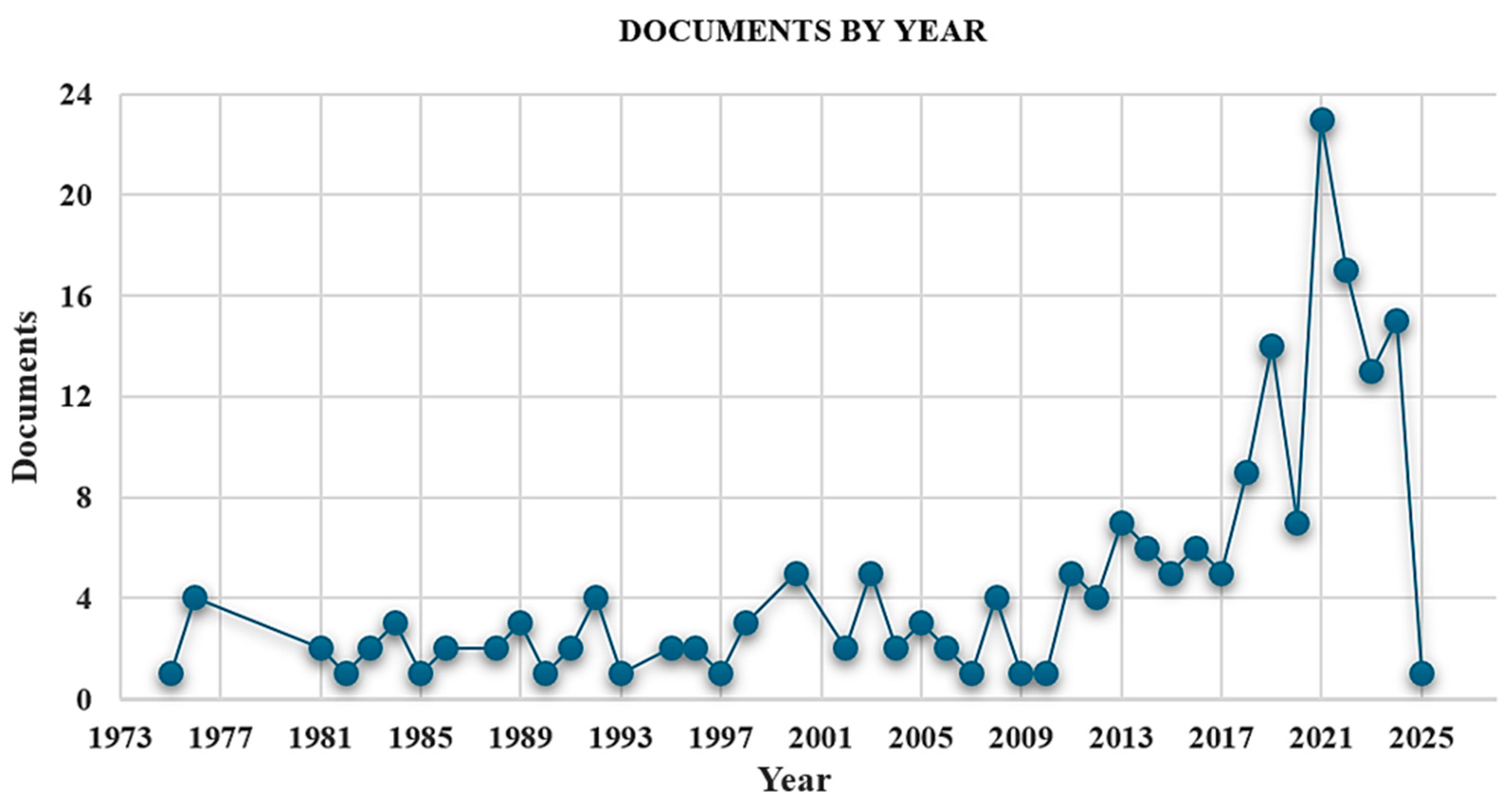
Figure 4 shows the temporal distribution of the total publications identified since 1975. A consistent increase in publication volume is observed over time, with a marked rise beginning in 2017 and peaking in 2021. This trend reflects a recent surge in scientific interest in the application of emerging technologies, such as artificial intelligence and automated sensing systems, for airport pavement management.
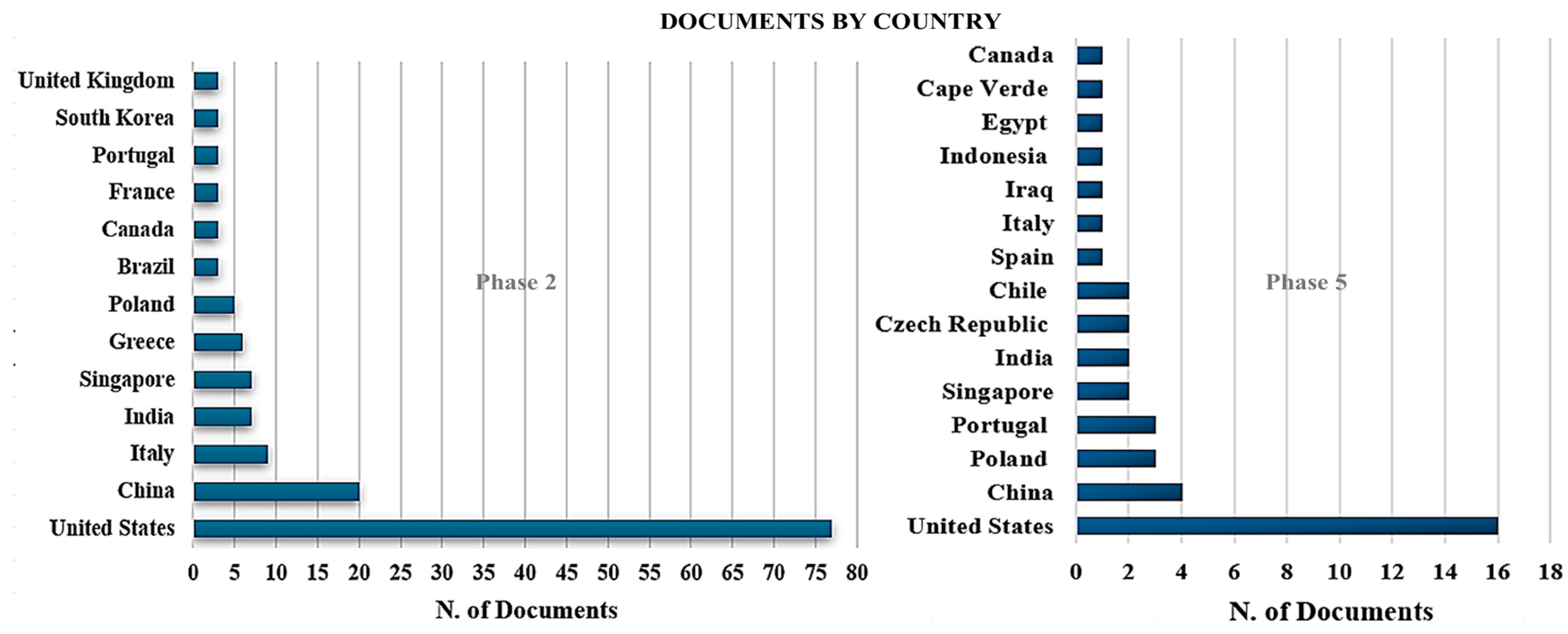
Figure 5 presents the geographical distribution of publications in Phases 2 and 5.
In both phases, the United States leads by a wide margin, with 77 publications in Phase 2 and 16 in Phase 5. China ranks second, with 20 publications in Phase 2 and 4 in Phase 5. Other contributing countries in Phase 2 include Italy (9), India (7) and Singapore (7). In Phase 5, although the total number of documents is smaller, many of these same countries continue to appear, indicating a consistent, though more selective, contribution to the field. Notably, Poland (3) and Portugal (3) stand out, now appearing in 3rd and 4th place. This comparison reflects not only the predominance of countries with extensive airport infrastructure and strong research activity in pavement engineering, but also how the PRISMA filtering narrows the focus to nations producing the most thematically aligned and methodologically robust studies.
The high number of publications from the United States and China may also reflect national policies that promote research funding and strategic investment in infrastructure and air transportation. In China, substantial government investment in UAV technologies and airport infrastructure has driven research on pavement inspection. In the United States, agencies such as the Federal Aviation Administration (FAA) have awarded millions of dollars in grants for research and training in Unmanned Aircraft Systems (UAS). Additionally, recent federal legislation has allocated hundreds of millions more to support UAV-based inspection of critical infrastructure [30,41,42,43].
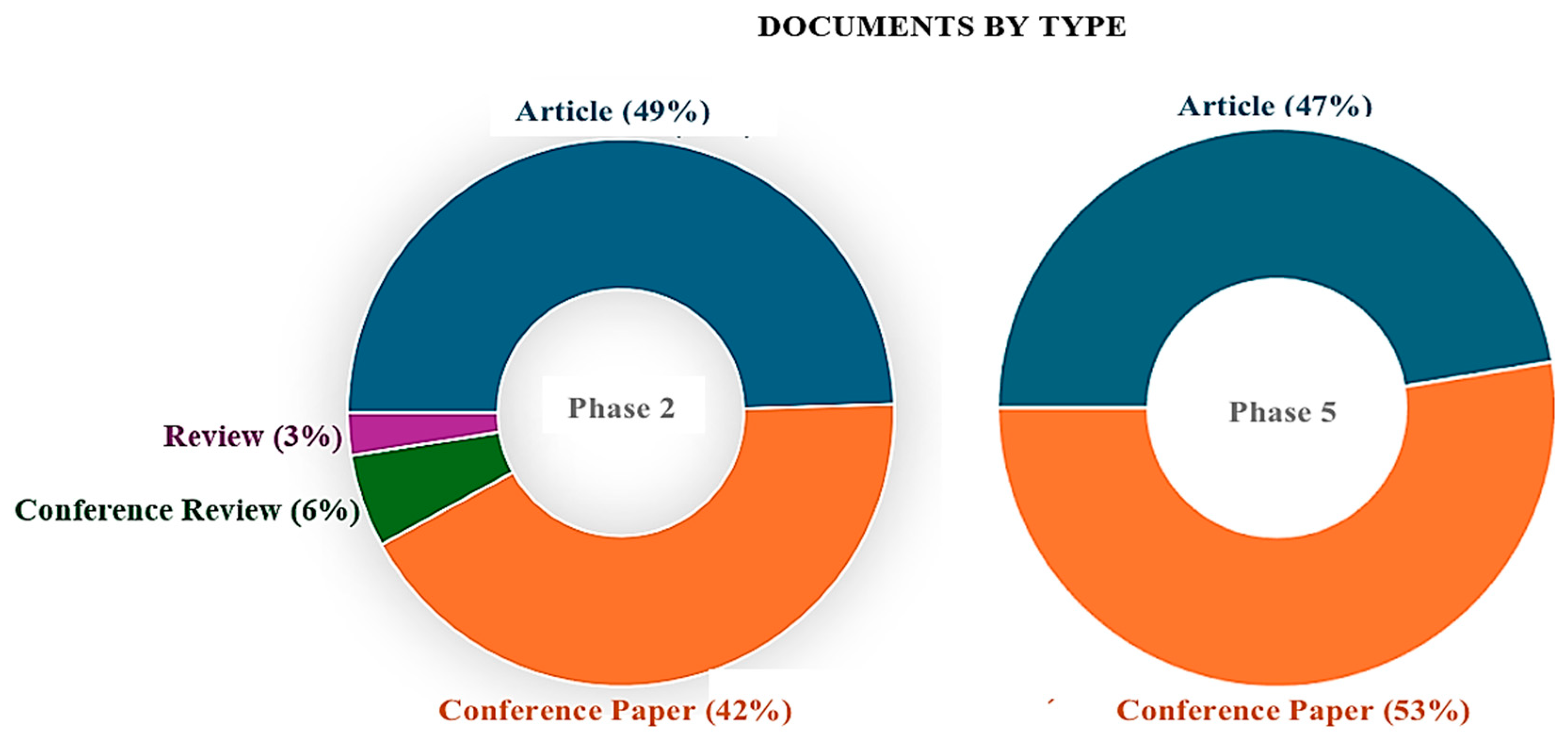
Regarding document type, Figure 6 shows that in Phase 2 the dataset is composed primarily of journal articles (49%) and conference papers (42%), with smaller contributions from conference reviews (6%) and review papers (3%). After applying the PRISMA selection criteria in Phase 5, the composition shifts slightly: journal articles represent 47% of the final set, while conference papers increase to 53%. Review and conference review documents are no longer present in the final selection, which underscores the need for studies that consolidate existing knowledge. This deficiency was identified as a gap in both phases and is one that this review seeks to address.
Overall, these results indicate that both phases are dominated by primary research outputs, with Phase 5 showing a stronger concentration of conference papers closely aligned with emerging technological developments in automated airport pavement inspection.
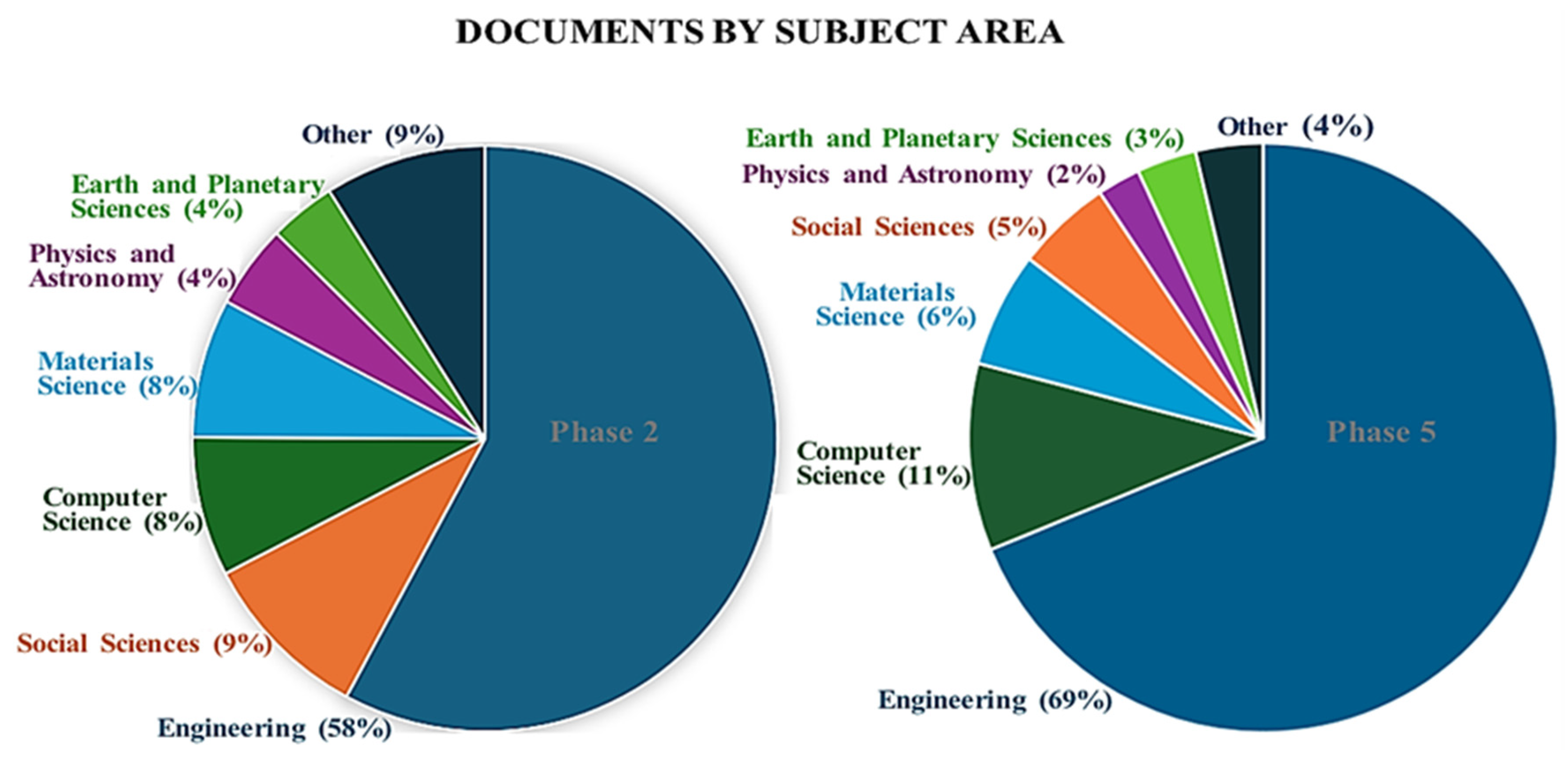
With regard to the subject areas of the publications, Figure 7 shows that in Phase 2 the documents are concentrated primarily in Engineering, which accounts for 58% of the studies, consolidating its position as the dominant technical domain. However, related fields such as Social Sciences (9%), Computer Science (8%), and Materials Science (8%) are also represented, underscoring the interdisciplinary nature of the topic. Publications from other areas were identified as well, although in smaller proportions.
After applying the PRISMA criteria in Phase 5, the dominance of Engineering becomes even more pronounced, increasing to 69% of the selected studies. Computer Science also shows a proportional increase, rising to 10%, reflecting the growing integration of automation, machine learning, and sensing technologies in airport pavement inspection. By contrast, fields such as Social Sciences (5%) and Materials Science (6%) represent smaller shares of the final dataset, consistent with their more peripheral relevance to the core technological focus of this review.
This multidisciplinary profile reflects the increasing integration of digital technologies, data analysis, and organizational approaches in airport infrastructure management.
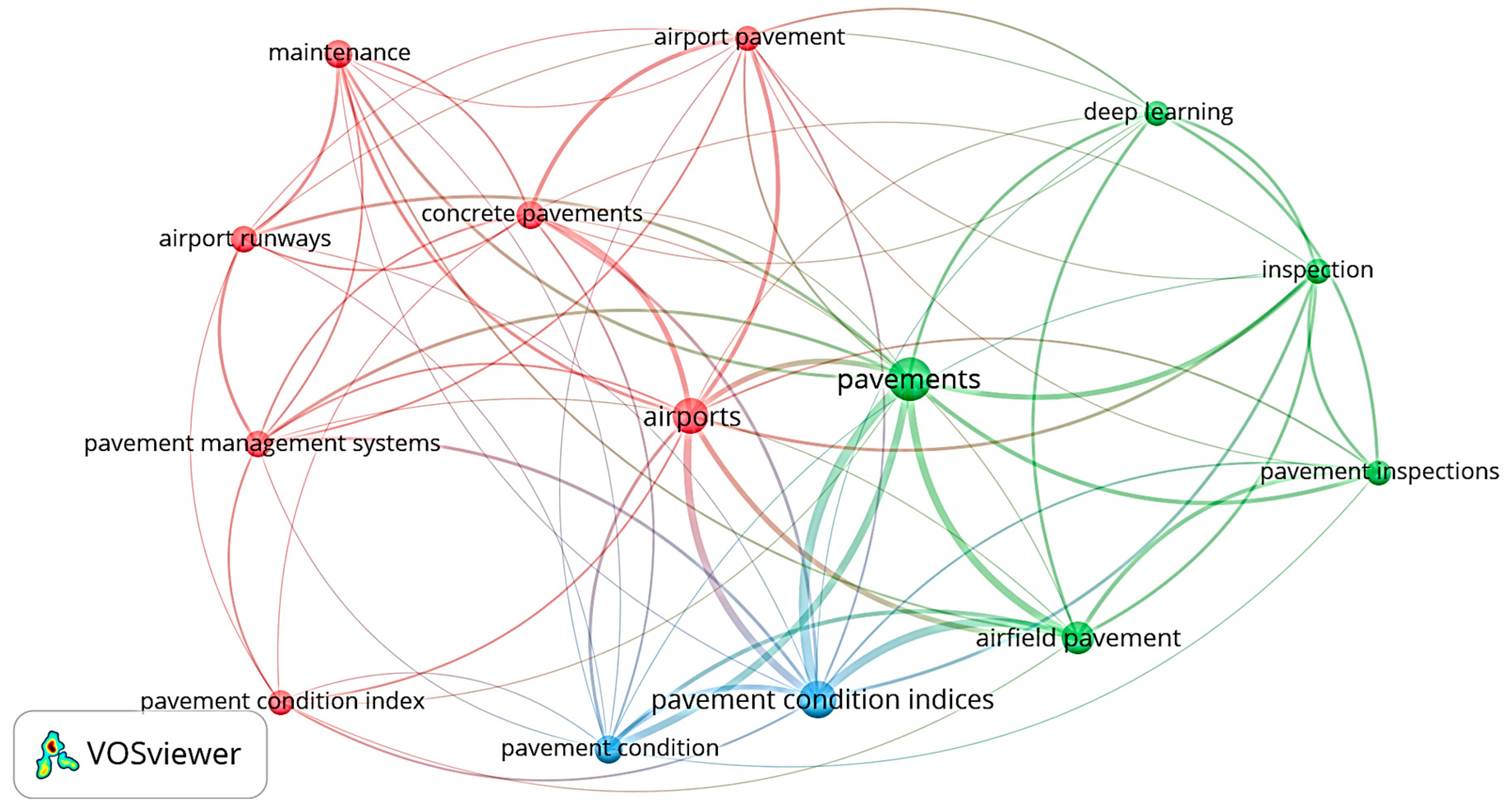
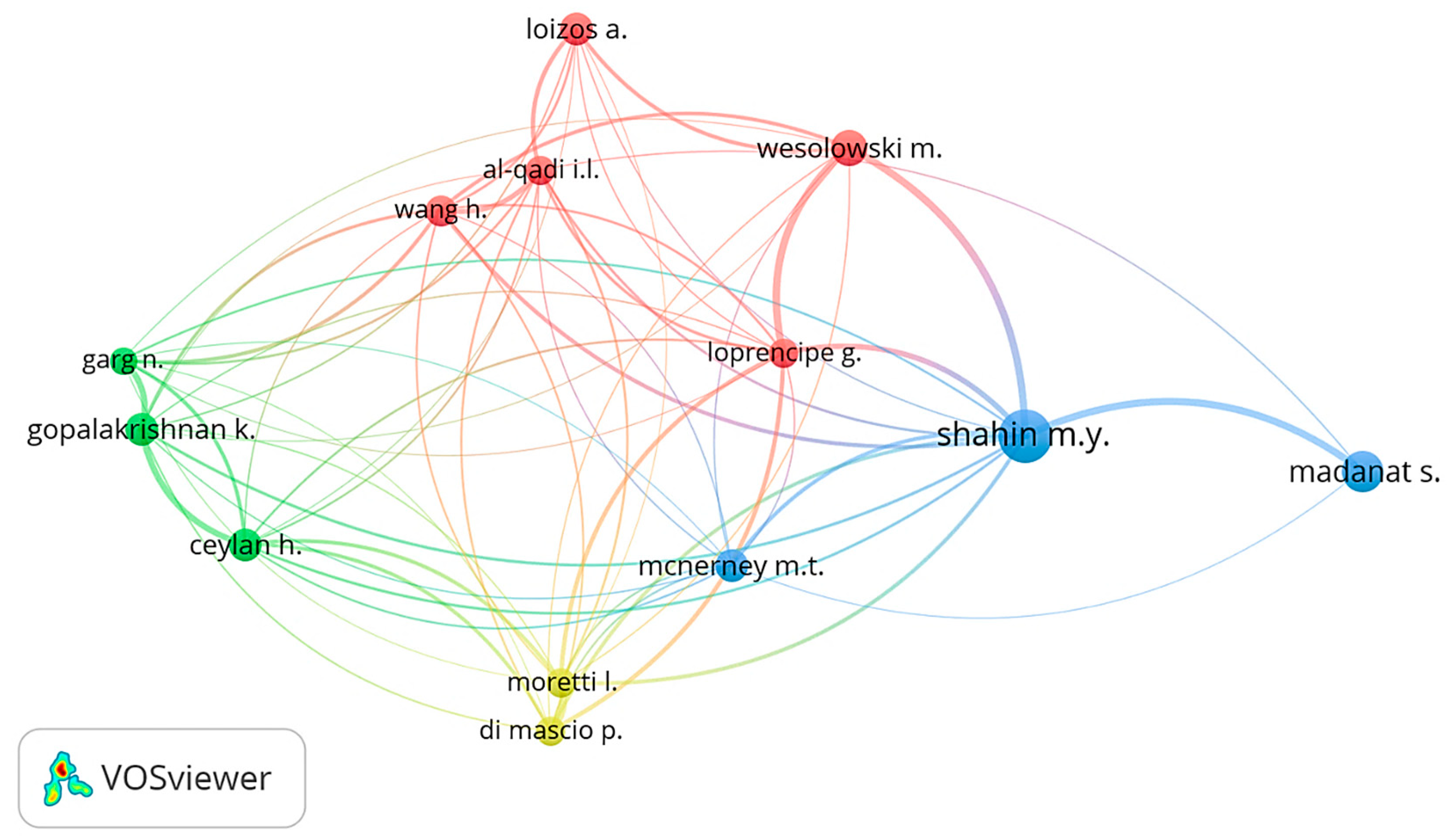
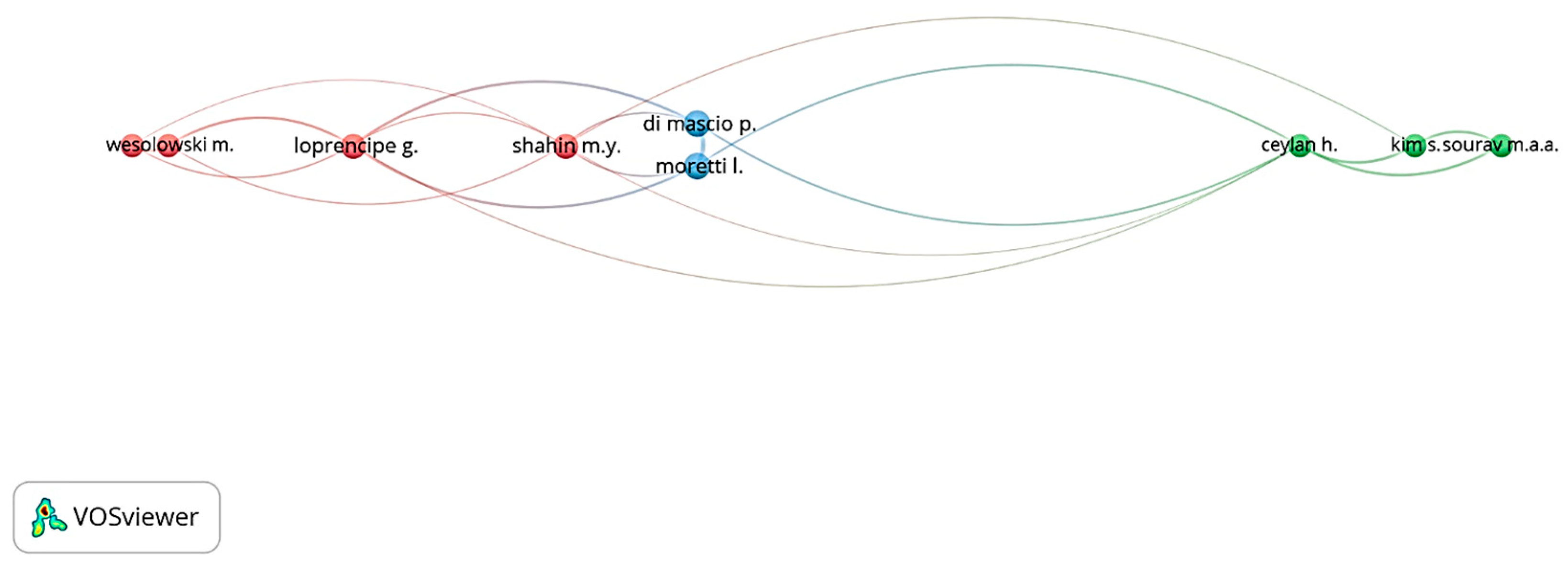
The thematic and intellectual characterization of the selected publication set was further explored through two complementary approaches. First, a keyword co-occurrence analysis was conducted for Phase 5 to examine the thematic relationships among the studies included after PRISMA filtering. Second, an author co-citation analysis was carried out using the broader Phase 2 dataset, allowing us to compare the intellectual structure of the full body of retrieved research with that of the final curated set (Phase 5). Both analyses were performed using VOSviewer 1.6.20 software (see Figure 8, Figure 9 and Figure 10).
Figure 8 presents the keyword co-occurrence map based on the most frequently used terms in the titles, abstracts, and keywords of the analyzed documents. A total of 381 keywords were identified, of which 6 met the minimum threshold of 14 occurrences, resulting in the formation of four thematic clusters. Each color in the map represents a distinct thematic grouping:
  • Red cluster: This cluster groups keywords such as “maintenance,” “airport pavement,” “airport runways,” “pavement management systems,” and “concrete pavements.” It reflects studies focused on infrastructure management, maintenance strategies, and operational aspects of airport pavements.
  • Green cluster: This cluster includes terms such as “pavements,” “deep learning,” “inspection,” and “pavement inspections,” indicating research centered on automated inspection techniques, machine learning applications, and sensing technologies.
  • Blue cluster: This cluster is organized around “pavement condition” and “pavement condition indices,” representing studies dedicated to evaluating pavement damage, performance indicators, and condition-based assessment methodologies.
  • Additional cluster: The smaller connections forming the remaining cluster involve terms such as “airfield pavement,” showing how these concepts bridge condition assessment, airport pavement characteristics, and inspection methodologies.
Overall, the map reveals a strong conceptual integration between pavement condition evaluation, automated inspection technologies, and airport pavement management systems, highlighting the main thematic directions of current research in this field. This structure reinforces the interdisciplinary nature of the topic, connecting transportation engineering, data science, asset management, and technological innovation.
Figure 9 and Figure 10 complement the analysis by presenting the author co-citation map, which reflects the intellectual structure of the field by identifying authors frequently cited together in the analyzed documents.
Within the set of 200 documents, a total of 4.453 cited authors were identified. Applying a relevance threshold of at least 20 citations, 13 authors were selected and grouped into four clusters. Among them, six authors—Shahin, M.Y., McNerney, M.T., Wesolowski, M., Ceylan, H., Moretti, L., and Di Mascio, P.—are also listed as authors of publications included in Phase 5, representing eleven articles from the final dataset [16,44,45,46,47,48,49,50,51,52,53].
In Phase 2, Shahin, M.Y. stands out as the most central node in the network, frequently co-cited with Madanat, S., reflecting his seminal contributions to the development of the Pavement Condition Index (PCI) and Pavement Management Systems (PMS). Other relevant clusters include researchers such as Loizos, A., Wesolowski, M., Al-Qadi, I.L., and Wang, H., who are associated with technical and experimental approaches to pavement characterization. Authors such as Garg, N., Gopalakrishnan, K., and Ceylan, H. form a cluster with an emphasis on technological innovations, including sensor applications and machine learning. The co-citation network also highlights the role of researchers such as Di Mascio, P. and Loprencipe, G., suggesting the presence of a European research stream focused on performance modeling and functional analysis of rigid and flexible pavements in airport environments.
Evidence of the strong links identified in Phase 2, along with the European cluster, continues to be present in the Phase 5 co-citation analysis.
The integrated analysis of Figure 4, Figure 5, Figure 6, Figure 7, Figure 8, Figure 9, Figure 10 reveals sustained growth in the scientific literature on the functional inspection of airport pavements, reflecting both the consolidation of key research lines and an expanding interest in the topic. The studies cover a broad range of themes, with particular emphasis on advances in inspection automation, the applicability of methods across different operational stages, and strategies for data processing and interpretation. These findings contribute to mapping recurring thematic trends, identifying connections among influential authors, and outlining the conceptual structure of the field, offering valuable insights to guide future research and promote interdisciplinary collaboration.
Nevertheless, it is noteworthy that relatively few studies have focused on the rigorous assessment of the accuracy and reliability of the applied methods, particularly concerning the use of statistical techniques for result validation. This gap highlights the need for more robust validation frameworks to support the establishment of automated tools and AI-based models as dependable solutions for airport infrastructure management.
The analysis underscores the growing scientific interest in the functional inspection of airport pavements, the consolidation of relevant topics, and the diversification of methodological approaches. At the same time, it identifies important gaps, especially regarding the validation of applied techniques. These findings provide a solid foundation for the technical analysis presented in the next section, which explores inspection methodologies, emerging technologies, data processing, validation techniques, Big Data, and artificial intelligence.

4.2. Trend Analysis

A total of 38 studies, specifically focusing on procedures for the collection, processing, or analysis of surface distresses, were included in the detailed technical analysis presented in this section.
The primary objective of this analysis is to identify methodological trends, recurring technical challenges, and innovation opportunities in the field of airport pavement functional inspection. To achieve this, key information was extracted and organized from each study, covering three dimensions: (i) study metadata (year of publication, author, country); (ii) technical scope (pavement type, inspection methods and equipment, types of distress addressed, data processing techniques); and (iii) advanced aspects (application of statistical validation, Big Data and artificial intelligence (AI), implementation of 3D modeling, and quality indices for pavement performance evaluation).
The selection of these variables was guided by their technical and scientific relevance in characterizing the maturity level of the approaches, the degree of technological innovation involved, and the practical applicability of the proposed methods. Additionally, these dimensions support a robust comparative analysis across the studies, facilitating the identification of gaps, patterns, and noteworthy contributions.
The results of this analysis are presented in Table 2, Table 3 and Table 4. Table 2 synthesizes both the metadata and the main research focus of the reviewed studies, providing a concise thematic overview of literature. Table 3 summarizes the methodological scope and research maturity levels, while Table 4 highlights advanced aspects, including validation frameworks, Big Data applications, and artificial-intelligence-based approaches. Based on the insights derived from these tables, the following analytical subsections examine in greater depth the assessment methods employed: airport pavement inspection methods (Section 4.3.1), emerging technologies in pavement inspection (Section 4.3.3), and the results achieved in terms of cost, time, accuracy, and complexity (Section 4.3.4).
Table 2 reveals clear trends regarding the temporal evolution and geographical distribution of the studies analyzed. A notable concentration of publications has emerged since 2020, peaking in 2023 and 2024, coinciding with the rapid adoption of automated inspection tools and artificial-intelligence-driven analysis. This growth aligns with the advancement and wider implementation of technologies such as unmanned aerial vehicles (UAVs), high-resolution sensors, and deep-learning-based data processing applied to airport infrastructure management.
Geographically, the United States leads in the number of studies, reflecting substantial investment in applied research within the airport sector and the country’s extensive network of airport facilities [41,42]. China, Portugal, India, Poland, and the Czech Republic also show growing participation, indicating the global diffusion of advanced inspection technologies and the diversification of research contexts across different climatic and operational conditions.
Table 3, in turn, highlights the functional and methodological dimensions of the studies. Most address the inspection of both rigid (PCC) and flexible (AC) pavements, with combined approaches being common. Flexible pavements appear more frequently, which is consistent with their predominance in secondary runways and small- to medium-sized airports, where traffic conditions and climate make maintenance a continuous challenge.
In addition, the most common technical objectives span both data collection and subsequent processing stages. Regarding inspection and data acquisition, there is a clear shift from traditional on-foot surveys toward the adoption of embedded and automated systems, such as multifunctional ground vehicles and UAVs equipped with high-resolution sensors. These advances reflect a growing concern with efficiency, reproducibility, and the reduction of inspector subjectivity during data collection. Beyond acquisition, objectives are concentrated in the stages of database development (organization of records and historical data), data processing (treatment and interpretation of raw data), data analysis (quantitative and visual evaluation of distresses), and change detection (identification of variations over time). Together, these categories demonstrate an evolution not only in the collection but also in the structuring and exploitation of data, reinforcing their role as the foundation for reliable and informed decision-making.
Finally, Table 4 emphasizes the advanced methodological aspects of the reviewed studies. A clear progression in focus is observed according to the research maturity level. Initial-level research tends to rely on traditional on-foot data collection and the visual categorization of pavement distresses, often with a descriptive or comparative approach. Intermediate-level studies demonstrate increased use of embedded systems (e.g., multifunctional vehicles) and analysis software, with particular emphasis on the integration of Geographic Information Systems (GIS) and statistical tools. This stage also includes methods that focus on pavement data analysis for maintenance and rehabilitation planning, even when traditional inspection techniques such as manual surveys are used. Advanced-level studies, on the other hand, incorporate more sophisticated techniques, including AI, integrated sensors, and automated data processing workflows, with an emphasis on precision, reproducibility, and scalability. This progression reflects a clear technological transition, from conventional visual practices to intelligent, data-driven, and predictive inspection systems, consolidating the role of airport pavement management within the broader paradigm of smart infrastructure.
Table 2. Research trend analysis: metadata and thematic focus.
Ref.; Year; CountryAuthorTitleMain Focus
[7]; 2024;
Indonesia
Wibowo, A.; Subagio, B.S.; Rahman, H.; Frazila, R.B.Evaluation of the airport pavement condition index in the aircraft lateral wander areaModeling PCI using lateral wander area
[54]; 2024;
India
Kumar, P.; Gowda, S.; Gupta, A.Implementation of airfield pavement
management system in India
Developing an Airport Pavement Management System for India
[55]; 2024; United StatesFrye, J.J.Climate change impacts on Arctic airfieldsAssessing climate impact on
airfield pavement performance in Arctic regions
[44]; 2024; United StatesSourav, M.A.A.; Ceylan, H.; Brooks, C.; Dobson, R.; Kim, S.; Peshkin, D.; Brynick, M.Use of small unmanned aircraft systems in airfield pavement inspection: implementation and potentialEvaluating UAV-based imagery for automated pavement distress inspection and PCI calculation
[45]; 2024; United StatesSourav, M.A.A; Ceylan, H.; S. Kim, S.; Brynick, M.Integration of small unmanned aircraft
systems and deep learning for efficient
airfield pavement crack detection and
assessment
Detecting airfield pavement
distresses automatically using YOLOv8
[46]; 2024; United StatesMcNerney, M.T.; Bishop, G.; Saur, V.Using AI and change detection in geospatial UAS airfield pavement inspection for
pavement management
Identifying pavement distresses and performing change detection using AI-enabled UAV imagery
[47]; 2023; United StatesMcNerney, M.T.; Bishop, G.; Saur, V.Experiences gained and benefits from using uncrewed aerial systems to calculate
pavement condition index at over 80 airports in the United States
Implementing full-scale UAV-based inspection for airport pavement PCI evaluation
[28]; 2023; SpainAlonso, P.; Gordoa, J.A.I.; Ortega, J.D.; García, S.; Iriarte, F.J.; Nieto, M.Automatic UAV-based airport pavement
inspection using mixed real and virtual
scenarios
Segmenting pavement defects
using UAV imagery and synthetic datasets through deep learning
[56]; 2023; Czech RepublicMaslan, J.; Cicmanec, L.A system for the automatic detection and evaluation of the runway surface cracks
obtained by unmanned aerial vehicle imagery using deep convolutional neural networks
Detecting and measuring
transverse cracks on concrete
runways using UAV and YOLOv2
[57]; 2023;
Iraq
Kareem, N.M.; Ibraheem, A.T.Developing a frame design for airport
pavements maintenance management system
Developing an expert system for airport pavement maintenance
decision support
[32]; 2022; United StatesPietersen, R.A.; Beauregard, M.S.; Einstein, H.H.Automated method for airfield pavement condition index evaluationsAssessing PCI through partially automated UAV imagery and CNN modeling
[58]; 2022;
Chile
Cereceda, D.; Medel-Vera, C.; Ortiz, M.; Tramon, J.Roughness and condition prediction models for airfield pavements using digital image processingEstimating IRI and PCI using
automated digital image
processing
[59]; 2022; ChinaWu, J.; Zhang, Y.; Zhao, X.Multi-task learning for pavement disease
segmentation using wavelet transform
Segmenting pavement diseases with a multi-task deep-learning network
[60]; 2022; ChinaLi, Z.; Zhao, K.; Zheng, P.Research on airport pavement condition
information system
Developing an integrated airport pavement condition information system with intelligent distress management
[61]; 2021; Czech RepublicMaslan, J.; Cicmanec, L.Setting the flight parameters of an unmanned aircraft for distress detection on the concrete runwayOptimizing UAV flight parameters for pavement crack detection
[62]; 2021; ChinaLiu, Z.; Gu, X.; Dong, Q.; Tu, S.; Li, S.3D visualization of airport pavement quality based on BIM and WebGL integrationIntegrating BIM and WebGL for 3D visualization of airport pavement condition
[63]; 2021; United StatesHafiz, A.; Celaya, M.; Jha, V.; Frabizzio, M.Semi-automated method to determine
pavement condition index on airfields
Calculating PCI semi-automatically using 3D laser scanning and Distress Inspector software developed by the authors.
[64]; 2020;
Portugal
Santos, B.; Feitosa, I.; Almeida, P.G.Validation of an indirect data collection method to assess airport pavement conditionValidating a low-cost in-vehicle pavement distress inspection system for APMS applications
[65]; 2020;
India
Vyas, V.; Singh, A.P.; Srivastava, A.Quantification of airfield pavement condition using soft-computing techniquePrioritizing airfield pavement maintenance using fuzzy AHP methodology
[49]; 2020;
Poland
Iwanowski, P.; Wesołowski, M.Evaluation of the cement concrete airfield pavement’s technical condition based on the APCIDeveloping the APCI
integrating structural and surface parameters
[16]; 2020;
Poland
Wesołowski, M.; Iwanowski, P.Evaluation of asphalt concrete airport
pavement conditions based on the Airfield
Pavement Condition Index (APCI) in scope of flight safety
Applying a comprehensive APCI-based method for technical
pavement assessment
[9]; 2019;
Portugal
Carvalho, A.F.C.; Picado Santos, L.G.D.Maintenance of airport pavements: the use of visual inspection and IRI in the definition of degradation trendsAnalyzing PCI and IRI evolution trends for pavement condition
assessment
[66]; 2019;
Cape Verde and Portugal
Lima, D.; Santos, B.; Almeida, P.G.Methodology to assess airport pavement
condition using GPS, laser, video image and GIS
Validating a vehicle-mounted
inspection method for PCI
evaluation in Cape Verde
[50]; 2019;
Italy
Di Mascio, P.; Moretti, L.Implementation of a pavement management system for maintenance and rehabilitation of airport surfacesApplying an integrated APMS for maintenance prioritization in
Italian airport pavements
[67]; 2019; EgyptFathalla, S.; El-Desouky, A.Evaluation of pavement surface conditions for Luxor International AirportEvaluating pavement surface condition at Luxor International Airport using PCI and Micro PAVER
[51]; 2018;
Poland
Zieja, M.; Blacha, K.; Wesołowski, M.Assessment method of the deterioration
degree of asphalt concrete airport pavements
Estimating airport pavement
deterioration using a multicriteria weighted assessment method
[68]; 2017; United States and ChileSahagun, L.K.; Karakouzian, M.; Paz, A.; Fuente-Mella, H.D.L.An investigation of geography and climate
induced distresses patterns on airfield
pavements at US Air Force installations
Analyzing climate-induced distress patterns on U.S. Air Force airfield pavements
[69]; 2016; United StatesDabbiru, L.; Wei, P.; Harsh, A.; White, J.; Ball, J.E.; Aanstoos, J.; Donohoe, P.; Doyle, J.; Jackson, S.; Newman, J.Runway assessment via remote sensingAssessing runway surface
roughness using microwave
remote-sensing techniques
[70]; 2016; United StatesParsons, T.A.; Pullen, B.A.Relationship between climate type and
observed pavement distresses
Correlating climate regions with pavement distress types on USAF airfields
[71]; 2015; ChinaLing, J.-M.; Du, Z.-M.; Yuan, J.; Tang, L.Airfield pavement maintenance and
rehabilitation management: Case study of Shanghai Hongqiao International Airport
Developing a decision-tree
approach for maintenance and
rehabilitation planning at Shanghai International Airport
[72]; 2013; United StatesGraves, S.W.Electro-optical sensor evaluation of airfield pavementIntegrating electro-optical FOD
detection systems for pavement condition monitoring
[73]; 2004;
Canada and Singapore
Huang, B; Fwa, T.; Chan, W.T.Pavement-distress data collection system based on mobile geographic information
system
Designing a mobile GIS-based data-collection system for airport pavement distress surveys
[74]; 2003;
Singapore
Fwa, T.F.; Liu, S.B.; Teng, K.J.Airport pavement condition rating and maintenance-needs assessment using fuzzy logicDeveloping a fuzzy logic-based system for pavement condition
rating and maintenance needs
[75]; 1992; United StatesRada, G.R.; Schwartz, C. W.; Witczak, M.W.; Rabinow, S. D.Integrated pavement management system for Kennedy International AirportImplementing an Integrated
Airport Pavement Management System at John F. Kennedy Airport
[76]; 1992; United StatesHall, J.W.; Grau, R.W.; Grogan, W.P.; Hachiya, Y.Performance indications from army airfield pavement management programEvaluating pavement condition and maintenance alternatives for U.S. Army airfields
[77]; 1992; United StatesEckrose, R.A.; Reynolds, W.G.Implementation of a pavement management system for Indiana airports—a case historyDeveloping a statewide Airport Pavement Management System for Indiana airports
[78]; 1991; United StatesBeaucham, E.B.Evaluating army airfieldsAssessing pavement strength using nondestructive testing (FWD) and PCI evaluation
[53]; 1982; United StatesShahin, M.Y.; Kohn, S.D.Airfield pavement performance prediction and determination of rehabilitation needsPredicting airfield pavement performance and rehabilitation needs
Table 3. Research trend analysis: methodological scope.
Ref.; Pavement TypeResearch Maturity/
Technical Focus
Inspection MethodInspection ToolsType of Pavement Distress
[7]; ACInitial: data processing & analysis; change detection; pavement managementTraditional
on-foot
Image recording, rulerCracking (alligator, LT, block, slippage); rutting; raveling; weathering; patching; bleeding; depression
[54]; AC and PCCIntermediate: database; data processing & analysis; change detection; pavement managementMultifunctional vehicleAutomated Road Survey System (ARSS), Pavement Surface
Imaging System (PSIS)
Cracking; raveling; weathering;
corrugation; rutting; depression
[55]; AC and PCCIntermediate: database; data processing & analysis; predictive modelingTraditional
on-foot
NDT/Geotechnical: rotary
drilling rigs, automatic weather stations
Permafrost settlement; thermal and frost-related cracking; rutting; drainage distress; joint and edge deterioration
[44]; AC and PCCIntermediate: database; data processing & analysis; validation study; pavement managementTraditional
on-foot and UAV-based
UAV: DJI Mavic 2 Pro (RGB, 20 MP), 2 x M2EA (Quad Bayer RGB, 48 MP), FLIR thermal
sensor, Bergen Hexacopter, Tarot X6 (Nikon D850, 45.7 MP), GPS
tablets
Cracking (alligator, corner, block, LTD, D-cracking, shrinkage); joint damage; patching; spalling; popouts; scaling; shattered slabs; ASR; settlement/faulting;
raveling; weathering; swelling; depression; shoving
[45]; AC and PCCAdvanced: database; data processing; change detection; pavement managementUAV-basedDJI Mavic 2 Enterprise Advanced (RGB, 48 MP/Thermal sensor)Cracking (corner, LTD); shattered slabs
[46]; AC and PCCAdvanced: database; data processing & analysis; change detection; pavement managementUAV-basedHigh-resolution geospatial
sensors
Spalling (joint/corner); joint seal damage; depression; raveling; weathering; swell; ASR
[47]; AC and PCCAdvanced: database; data processing & analysis; change detectionUAV-basedSilent Falcon platformCracking (block, joint, LT);
rutting; raveling
[28]; PCC (virtual)Initial: data processing & analysisUAV-based virtualAirSim simulated UAV (physical hardware: NVIDIA Jetson AGX Xavier)Cracking; other minor surface
distress
[56]; PCCIntermediate: database; data processing & analysis; pavement management; validation studyUAV-basedDJI Mavic 2 Enterprise Dual (RGB/Thermal), DJI Pilot v2.5.1.10 Transverse cracking
[57]; AC and PCCInitial: database; data processing & analysis; pavement management; validation studyTraditional
on-foot
Not specifiedCracking (block, corner, LT,
D-cracking; map); scaling; ASR; spalling
[32]; ACAdvanced: database; data processing & analysis; change detection; validation study; pavement managementUAV-basedCustom MAV Hexcopter (FLIR Duo Pro R camera, Mission
Planner 1.3.74 software)
LT cracking; patching; rutting;
raveling
[58]; PCCAdvanced: database; data processing & analysis; validation study; pavement management.Multifunctional vehicleVan-type vehicle, LCMS, HD cameraCracking (block, LT); roughness; scaling; spalling
[59]; PCCIntermediate: database; data processing & analysis; change detection; validation study; pavement managementTraditional
on-foot
Grayscale cameraCracking, patching; repair marks
[60]; AC and PCCIntermediate: Data processing & analysis; pavement managementMultifunctional vehicleDAQ tools (handheld/vehicle-based), control software (DAQ), lighting system, GPSNot specified
[61]; AC and PCCInitial: data processing; validation studyUAV-basedDJI Mavic 2 Enterprise Dual (RGB/Thermal), DJI Pilot
application (version V01.00.0860)
Cracking (unspecified)
[62]; PCCInitial: database; data processing & analysis; pavement managementTraditional
on-foot
Not specifiedPatching; joint damage; subsidence/faulting; punchout
[63]; PCCIntermediate: database; data processing & analysis; pavement management; validation studyMultifunctional vehicle3D LCMS, HD cameras, LiDAR (LDTM), AID-ITV (Integrated Testing Vehicle)Not specified
[64]; ACIntermediate: database; data processing & analysis; change detection; validation study; pavement managementTraditional
on-foot and multifunctional vehicle
Measuring wheel, chalk/ruler, metallic structure, pickup
vehicle, 20 mW laser beams, Garmin Elite video camera, GPS setup (Trimble 4000SSi, GeoXT), laptop
Cracking (alligator, LT);
patching; weathering; raveling; depression
[65]; ACInitial: database; data processing & analysis; pavement managementTraditional
on-foot and NDT (HWD;
GPR)
NDT: Dynatest HWD 8081, GPR (400 MHz antenna), ELMOD 6 softwareCracking (alligator, fatigue, block); raveling; patching; depression; rutting; corrugation; potholes
[49]; PCCInitial: database; data analysisTraditional
on-foot
Not specifiedCracking (slotted, edge, corner); spalling; joint damage; scaling; deep cavities
[16]; ACInitial: database; data analysisTraditional
on-foot
Not specifiedCracking, chipping; rutting; fracturing; raveling
[9]; ACInitial: database; data processing & analysis; validation study; pavement managementTraditional
on-foot and multifunctional vehicle (IRI)
Survey vehicle (tri-laser sensor system—one central, two lateral sensors)Cracking (alligator, block, LT); patching; raveling; rutting; corrugation; depression
[66]; ACInitial: database; data processing & analysis; pavement managementTraditional
on-foot and multifunctional vehicle
Measuring wheel, chalk/ruler, metallic structure, pickup vehicle, 2 × 20 mW laser generators, Garmin Elite video camera, GPS setup (2 Trimble 4000SSi), laptopCracking (alligator, LT); patching; rutting; raveling; depression;
corrugation
[50]; ACInitial: database; data processing & analysis; validation study; pavement managementTraditional
on-foot and multifunctional vehicle
Multifunctional vehicle (FWD; HWD, laser texture scanner, high-resolution cameras, crack scale, laser profilers)Cracking (alligator, block, LT)
[67]; AC and PCCInitial: database; data processing & analysis; pavement managementTraditional
on-foot
Not specifiedCracking (block, LTD, D-cracking, corner, shrinkage); depression; raveling; weathering; patching; oil spillage; polished aggregate; joint damage; scaling; spalling; ASR; popouts; bleeding
[51]; AC (implicit)Initial: database; data analysis; pavement managementTraditional
on-foot
Not specifiedDistress and repair (types not specified)
[68]; AC and PCCInitial: data analysis; pavement managementTraditional
on-foot
Not specifiedCracking (alligator, corner, D-cracking, shrinkage, linear); raveling; joint damage; patching;
scaling; shattered slab; spalling
[69]; ACInitial: data processing & analysis; validation studyRemote sensing (SAR satellite + LiDAR)SAR (TerraSAR-X, TanDEM-X,
X-band), LiDAR (Leica ALS70), GPS (Leica 500 dual-frequency), DEM (Grafnet/Leica Office)
Not specified
[70]; AC and PCCInitial: data analysis; validation studyTraditional
on-foot
Not specifiedCracking (alligator, block, corner, D-cracking, joint reflection); bleeding; raveling; popouts; scaling; rutting; swelling; ASR
[71]; PCCInitial: data analysis; pavement managementNot specifiedNot specifiedCracking (transverse, corner); joint damage; spalling; popouts; scaling; patching
[72]; AC and PCCInitial: database; data processing; validation study; pavement managementTraditional
on-foot and electro-optical sensor
iFerret sensor system, standard camera, steel strips (simulated cracks), ImageJ softwareLT cracking; joint spalling;
patching; shattered slab; faulting
[73]; ACInitial: database; data processing; pavement managementTraditional
on-foot with mobile GIS (GPS/PDA-based)
PDA: DGPS receiver (Topcon Turbo G2), Spectec SD digital camera, mobile GIS (ArcPad), Pocket PC (Compaq iPAQ H3700)Cracking; raveling
[74]; ACIntermediate: data processing & analysis; pavement managementTraditional
on-foot
Ruler and standardized forms Cracking; potholes
[75]; AC and PCCIntermediate: data processing & analysis; pavement managementTraditional
on-foot
Ruler and standardized formsCracking; rutting; spalling
[76]; AC and PCCIntermediate: data processing & analysis; pavement managementTraditional
on-foot
Ruler, standardized forms, FWD/NDTCracking; rutting
[77]; AC and PCCIntermediate: data processing & analysis; pavement managementTraditional
on-foot
Ruler, standardized forms, APMS softwareCracking; raveling; rutting;
spalling
[78]; AC and PCC Initial: data processing & analysis; pavement managementTraditional
on-foot
Ruler, standardized forms, NDTNot specified
[53]; AC and PCCIntermediate: data processing & analysis; pavement managementTraditional
on-foot
Ruler and standardized formsCracking (alligator, LT, block, joint reflection, edge); raveling; bleeding; patching; weathering
Abbreviation Key: ASR—Alkali Silica Reaction; D—Durability; DAQ—Data Acquisition; DEM—Digital Elevation Model; FWD—Falling Weight Deflectometer; HWD—Heavy Weight Deflectometer; IRI—International Roughness Index; LCMS—Laser Crack Measurement System; LDTM—Laser Dynamic Texture Measurement; LT—Longitudinal and Transverse; LTD—Longitudinal, Transverse and Diagonal; NDT—Non-Destructive Testing; PDA—Personal Digital Assistant; SAR—Synthetic Aperture Radar.
Table 4. Research trend analysis: advanced aspects.
Ref.Data Processing Technique(s)AccuracyStatistical Analysis/
Validation
Big Data/
Volume
Quality Index3D
Modelling
AI
[7]Not specified-Regression; standard deviation analysis; and scenario comparisonNo: not
specified
PCI CDF--
[54]GIS-based and PAVER--No: not
specified
PCI--
[55]PAVER; statistical modeling; climatic and geotechnical data analysis-Correlation analysis
between pavement distress and environmental factors; predictive modeling for
deterioration trends
Yes: data from 4 airfields;
climatic/
geotechnical data (no
quantify)
PCI--
[44]Photogrammetry (Agisoft Metashape); DEM and hillshade generation; GIS-based spatial
alignment; PCI
calculation (FAA PAVEAIR)
Pearson correlation R = 0.79–0.90PCI comparison (UAV-based vs. FOG) and
correlation analysis
No: not
specified
PCIDEM;
hillshade (3D surface view)
-
[45]Image annotation (LabelImg); data augmentation; YOLOv8 (nano to large); Roboflow platform; Python-based image
splitting
mAP50: 0.65–0.69; precision up to 0.74;
recall up to 0.72
-No: 5.273
images; high-resolution (8000 × 6000 px); real-time processing
possible (nano/
small models)
--DL with YOLOv8
[46]AI (DL) and change detection software -Comparison with
traditional methods (not
specified)
Yes: data from over 100
airports (no quantity)
PCI-DL (not
specified)
[47]Orthorectification of images and 3D modelling-Correlation analysis
between UAV-derived PCI and manual inspections
Yes: data from over 80 airports (no quantity)PCIOrthoimage; 3D modelling-
[28]DNN-based image segmentation (EfficientNet + Feature Pyramid Network—FPN)F1-score; IoU; ODS; and OIS Performance comparison on synthetic and real datasetsYes: multiple public datasets (no quantity) -Unreal
Engine 5
(virtual 3D simulation); DAQ
CNN
[56]Orthoimage
generation (Agisoft); image annotation/
labeling (Matlab
Image Labeler); DL segmentation/
detection (Matlab DL Toolbox).
Detection performance evaluated using Precision, Recall, F1-score, AP, IoU, LAMR-No: 3.279
images
-Orthomosaic (Agisoft Metashape); DEM; sparce/dense point cloudYOLOv2; ResNet-50 (MATLAB)
[57]RPC software developed by the authors; comparison with
MicroPaver 5.3.2; and EPCM
R2Regression model (PCI vs. IRI) and coefficient of
determination (R2)
No: not
specified
PCI; PSI/PSR-reg. (indirect data)--
[32]Orthoimage generation (Agisoft); data augmentation; semantic segmentation (DeepLabV3+); IoU evaluation≤94% GA and 0.72 IoU in
distress
detection
-No: not
specified
PCIOrthoimage mapping;
3D-printed mount
(SolidWorks CAD)
DeepLabV3 (CNN); ResNet-18/-50;
Xception;
Inception-ResNet-V2 (MATLAB)
[58]LCMS data
processing with MATLAB
R2Non-linear regression analysis (Levenberg-
Marquardt); R2 validation
Yes: 24.825
images
PCI; IRILCMS–3D surface
profiling
-
[59]DWT; semantic
segmentation;
channel attention mechanism; and
feature fusion branch
CPA: 82.67%; IoU: 49.17% (best:69.96% for light, worst:11.59% for crack)Model comparison: U-Net, DeepLabv3, DeepLabv3+, BiSeNet, BiSeNetv2; and
ablation study
No: 3.467
images
--CNNs: ResNet; MTSSN-WT; PyTorch; SGD
[60]DL; GIS; and image processing software--Not specifiedPCI; SCI-DL (not specified)
[61]Digital photogrammetry (Agisoft); sparse/dense point cloud reconstruction; ortho-mosaic/DEM generation; MATLABMSE; RMSE; R2; and
adjusted R2
Regression; theoretical vs. actual spatial resolution (GRD & GSD) validationNo: 3.361
images
-Point cloud reconstruction; surface mesh; DEM-
[62]JSON-OBJ
conversion; PCI view (color/height); WebGL and Three.js.
Not
specified
-Not specifiedPCIBIM (Autodesk Revit); parametric 3D modelling-
[63]Image stitching; GPS alignment correction; point cloud analysis; DI; PCI; export to Paver/XML and GIS/KMLNot
specified
-Yes: 50 units—LCMS and point cloud (moderate
volume)
PCI3D laser scan; point cloud data -
[64]GNSS-based image processing; GIS-based visualization; distress digitization; and PCI calculationStrong
correlation with on-foot inspection (R2 = 0.8993)
Normal tests (Kolmogorov–Smirnov, Shapiro–Wilk), paired t-test; Wilcoxon signed-rank test; PCI;
distress metric comparison (on-foot vs. vehicle)
No: 2.000
images
PCI--
[65]Back calculation (HWD/ELMOD 6); GPR thickness
analysis; deflection bowl analysis; PCI calculation; and fuzzy AHP for
section prioritization
--No: 22.000 data points (HWD; GRP; on-foot inspection)ACN/PCN; PCI; layer moduli-BC--
[49]---No: not
specified
PCI; APCI--
[16]---No: not
specified
PCI; APCI--
[9]Regression; statistical significance testing; and residual analysisHigh for PCI models (adjusted R2 ≤ 88%); low for IRI models (data/fit issues)Regression; hypothesis
testing (t-test); residual analysis; model comparison; data interpolation
No: not
specified
PCI; IRI--
[66]GNSS-based image processing; GIS-based visualization; distress digitization; and PCI calculationPCI variation ≤ 5 points between methodsPCI comparison in-vehicle vs. on-foot inspectionsNo: 2.000
images
PCI--
[50]Back-calculation (HWD); laser-based ETD/PCI; chromatic mapping; profilograph analysis; MFV-based IRI, RUT, and skid resistance processingNot specifiedBased on reference
thresholds
No: not
specified
PCI; IRI; RUT; EDT; ACN/PCN--
[67]MicroPAVER 5.2 software--No: not
specified
PCI--
[51]Statistical analysis with distress indicesNot specifiedHistograms; regression; probability analysis
(distress indices/condition classification)
No: not
specified
Degree Index (D)--
[68]Statistical analysis and geostatistical modeling (kriging via ArcMap)-Weighted averaging; normalization; regression;
hypothesis testing (t-/Mann–Whitney tests); comparison between zones; kriging;
spatial trend analysis
Yes: 50.000+ distress records from 77 USAF installations---
[69]LiDAR-based DEM; TRI calculation;
linear and polynomial regression
R2 ≤ 0.46 (radar vs. TRI)Regression; R2 as fit metric; correlation analysis (radar backscatter vs. TRI; validated with ground-truth LiDAR) No: high-
resolution data with localized scope
TRIDEM from
LiDAR-based
-
[70]PAVER database and statistical
analysis
-ANOVA; main effect
analysis; interaction effect analysis
Yes: 17.565
extrapolated records from >435 k distresses data points
---
[71]Not specified--No: not
specified
PCI--
[72]Image processing: background subtraction, image subtraction, feature measurement (RGB error, pixel sizing, contrast plots)-PCI manual comparison; image inspection; and crack simulation with physical targetsNo: 39 slabs
analyzed;
simulated
images (iFerret)
PCI--
[73]Real-time GPS conversion; chainage mapping; spatial indexing; GIS queryLocation
accuracy ≈ 0.5 m (DGPS)
-No: not
specified
PCI--
[74]Fuzzy logic inference system (fuzzifier, rule engine, defuzzifier); decision rules-No; only expert reviewNo: not
specified
PCI--
[75]Database-driven PMS with forecasting and analysis tools; GIS integration--No: not
specified
PCI--
[76]PCI vs. age trends; core evaluation; decision criteria-No; qualitative comparisons (PCI vs. age trends; core–design; method-based decisions)No: not
specified
PCI--
[77]PCI-based condition scoring; capital
improvement
program via
software; forecasting
--No: not
specified
PCI--
[78]Not specified--No: not
specified
PCI--
[53]Empirical modeling with PCI methodology (precursor to PAVER)--No: not
specified
PCI--
Abbreviation Key: ACN/PCN—Aircraft/Pavement Classification Numbers; AHP—Analytic Hierarchy Process; AP—Average Precision; APCI—Airfield Pavement Condition Index; BC—Backcalculation of layer moduli; BiSeNet—Bilateral Segmentation Network; CDF—Cumulative Damage Factor; CNN—Convolutional Neural Network; CPA—Class Pixel Accuracy; DAQ—Data Acquisition; DEM—Digital Elevation Model; DL—Deep Learning; DI—Distress Quantification Index; DWT—Discrete Wavelet Transform; EDT—Effective Depth of Texture; ELMOD—Evaluation of Layer Moduli and Overlay Design; EPCM—Evaluation of Pavement Condition Model; FOG—Fiber Optic Gyroscope; GA—Global Accuracy; GRD—Ground Range Detected; GSD—Ground Sample Distance; HWD—Heavy Weight Deflectometer; IoU—Intersection over Union; IRI—International Roughness Index; JSON-OBJ—JavaScript Object Notation; LAMR—Log-Average Miss Rate; LCMS—Laser Crack Measurement System; LDTM—Laser Dynamic Texture Measurement; MFV—Mean Feature Vector; MSE—Mean Squared Error; MTSSN-WT—Multi-Task Semantic Segmentation Network with Wavelet Transform; ODS—Optimal Dataset Scale; OIS—Optimal Image Scale; PCI—Pavement Condition Index; PSI—Present Serviceability Index; PSR-reg.—Pavement Surface Rating (regression); ResNet—Residual Network; RMSE—Root Mean Squared Error; RPC—Rating of Pavement Condition; RUT—Rutting index; R2—Coefficient of Determination; SCI—Structural Condition Index; SGD—Stochastic Gradient Descent; TRI—Terrain Ruggedness Index; WEB-JL—Web-based Joint Locator; YOLO—You Only Look Once.
In addition to the methodological and technological dimensions synthesized in Table 2, Table 3 and Table 4, the studies also differ in the type and scope of pavement distresses addressed. The most frequently investigated distresses include longitudinal and transverse cracks, patches, bleeding, weathering, raveling, and plastic deformations such as depressions and rutting. These distresses are particularly critical for the safe and continuous operation of runways, as they directly affect structural performance, ride quality, and the risk of FOD. Early detection is therefore essential for implementing effective preventive maintenance strategies and ensuring the reliable management of airport infrastructure.
Notably, many studies employing advanced technologies, such as UAVs, machine learning, or integrated sensors, tend to concentrate primarily on visible cracking, as it is more easily identified in surface imagery. This focus is largely due to the fact that most automated segmentation and classification models are still trained on datasets centered around crack detection, with less attention given to more complex or less visually prominent distresses such as bleeding, patching, utility cuts, subtle plastic deformations, drainage deficiencies, or chemical reactions like alkali–silica reaction (ASR) and D-cracking.
This trend indicates that while advances in computer vision and remote sensing have enhanced the accuracy of detecting certain distress types, significant gaps remain in the automated detection of other critical categories. These limitations hinder the complete replacement of visual inspections and underscore the need for hybrid approaches that combine remote sensing with on-site technical analysis. Additionally, expanding training datasets and developing more inclusive models is necessary to better capture the full spectrum of pavement conditions.
As such, field validation of automated methods and the development of robust algorithms capable of addressing multiple defect classes are crucial next steps. For airport managers, this means carefully evaluating the technological maturity and contextual suitability of inspection systems before implementation.
This body of evidence lays a strong foundation for the deeper analysis of evaluation methods and emerging technologies presented in the following sections.

4.3. Discussion

4.3.1. Airport Pavement Inspection Methods

The systematic review summarized in Table 2 reveals a wide range of pavement evaluation approaches, reflecting varying levels of technological sophistication and research maturity. Based on the inspection methods adopted, the studies were grouped into three main methodological categories:
The following subsections explore these approaches in greater detail, highlighting their practical applications, limitations, and recent developments.
Most studies still rely on traditional on-foot visual inspection, especially in exploratory research or initial diagnostics [7,51,53]. However, a notable increase is observed in the use of advanced technologies, such as multifunctional vehicles and UAVs equipped with high-resolution sensors, RGB cameras, LiDAR, and LCMS, reflecting a pursuit of greater efficiency, safety, and accuracy in data collection [44,45,46,64].
The Pavement Condition Index (PCI), standardized by ASTM D5340 [38], remains the primary functional condition indicator used to quantify the overall state of airport pavements. Based on visual inspections of surface distresses, it provides a numerical score representing the pavement’s general condition and is widely adopted by international authorities such as the Federal Aviation Administration (FAA) and the International Civil Aviation Organization (ICAO). Large-scale studies, such as that by Covalt et al. (2017) [79], demonstrate its robustness and reliability, applying it in statistical analyses across thousands of airport runways in the United States.
Functional evaluation methods have diversified beyond the traditional PCI, incorporating indicators such as the International Roughness Index (IRI), the Airfield Pavement Condition Index (APCI), and composite indices developed through multicriteria decision-making techniques [9,16,49,50,57,58]. This expansion seeks to overcome PCI’s limitations in detecting early-stage functional issues and to integrate broader performance parameters.
Recent studies have also begun to consider extreme climatic conditions, such as runways located in polar regions or subject to freeze–thaw cycles [55]. A study by the United States Air Force (USAF), based on more than 17.000 PCI records, demonstrated significant correlations between climatic zones (such as cold-dry climates) and specific types of distress, such as frost cracking [70]. This underscores the importance of incorporating geoclimatic variables into predictive models.
Thus, manual methods are gradually giving way to semi-automated and fully automated solutions based on remote sensing, computational intelligence, and spatial data, promoting more efficient and evidence-based airport pavement management.
On-Foot Visual Inspection
Traditional on-foot visual inspections account for a significant portion of the studies included in the systematic review (Table 2). This approach consists of direct observation of surface distresses by trained inspectors, who manually record distress types, severity levels, and extent.
Approximately 40% of the reviewed studies adopt this method, relying on basic equipment such as rulers, digital cameras, measuring wheels, and manual PCI forms [7,51,53,57,64,66,74,75,76,77,78]. These studies primarily focus on small to medium-sized airports, where the availability of embedded technologies remains limited, reflecting the widespread use of this approach in operational contexts with budgetary or technological constraints.
In addition to its standalone use, traditional visual inspection has increasingly been integrated with digital tools and semi-automated analysis methods. Classic studies such as Huang et al. (2004) [73] introduced data collection systems using PDAs with GPS and digital cameras, embedded in mobile GIS platforms, enabling georeferenced recording of distresses with real-time spatial indexing during on-foot inspections.
Furthermore, the studies of Frye (2024) [55] and Parsons & Pullen (2016) [70] examined the influence of climate on pavement deterioration using large datasets collected through on-foot visual inspections, reaffirming the ongoing relevance of this method as a primary data source for systems like PAVER, and as a benchmark for validating and improving emerging automated techniques [55,70].
Complementarily, Graves (2013) [72] explored the use of fixed electro-optical sensors such as iFerret to continuously capture pavement surface imagery, later processed via segmentation and contrast enhancement software, partially automating the interpretation of visual distresses. This type of research illustrates the early steps toward hybrid and automated inspection systems, bridging traditional visual methods with the more advanced vehicle-mounted platforms discussed below.
While effective for localized or structural assessment, these methods face limitations in scalability, dependence on inspector judgment, and reduced operational efficiency in large airport environments.
Multifunctional Vehicle Inspection
With advances in embedded systems, vehicle-mounted inspection platforms have become increasingly prominent in airport pavement evaluation. These multifunctional vehicles, often equipped with high-resolution sensors, cameras, GNSS systems, and integrated processing units, enable continuous and automated data collection along runways. As a result, inspection time is significantly reduced and personnel exposure to operational areas is minimized.
Among the most used technologies are Laser Crack Measurement Systems (LCMS), LiDAR, and high-definition cameras, typically coupled with differential GPS. These tools enable detailed 3D surface mapping and the detection of cracks, depressions, rutting, corrugations, and other surface distresses. The collected data is frequently processed using software such as Agisoft Metashape, MATLAB (Matrix Laboratory), or MicroPAVER, generating accurate indicators such as PCI and IRI [54,57,58,63,64].
Studies by Cereceda et al. (2022) and Hafiz et al. (2021) show that the use of LCMS, cameras, and LiDAR sensors facilitates objective distress quantification with less subjectivity, while also supporting 3D analyses and GIS-based visualization [58,63]. For example, Santos et al. (2020) [64] developed a low-cost system combining embedded lasers and cameras, validated through comparison with manual inspections, achieving high correlation (R2 > 0.89) and PCI variation under five points.
Integrated data acquisition and analysis platforms such as the AID-ITV (Automated Integrated Distress—Inspection and Testing Vehicle) have also been implemented in recent studies. These systems enable faster and safer inspections, particularly on long or high-traffic runways. Automated data collection and spatial visualization contribute to the continuous updating of pavement management systems, integrating historical records and enabling temporal performance analysis [63].
Beyond operational efficiency, vehicle-mounted technologies offer improved statistical reliability in pavement assessments. The combination of sensors and algorithms allows for more accurate pattern recognition, facilitating intervention prioritization based on objective criteria. The growing adoption of these systems reflects a clear trend toward replacing traditional visual inspection with hybrid or fully automated methods, especially in medium and large airports, where scalability is a key requirement [54,58,64].
UAV-Based Inspection
In parallel with multifunctional ground vehicles, aerial platforms based on Unmanned Aerial Vehicles (UAVs) have emerged as a complementary and increasingly prominent solution for airport pavement inspection. The systems enable the rapid, safe, and wide-area collection of high-resolution georeferenced imagery, making them particularly useful in hard-to-access zones or high-traffic airports [44,45,46,47,56].
Most recent studies classified as having intermediate or advanced research maturity employ UAVs equipped with high-definition RGB cameras, thermal sensors, and GNSS systems [28,44,45,46,47,56]. Combined with digital photogrammetry and Digital Elevation Model (DEM) generation, these platforms support the accurate detection of cracks, depressions, patches, and structural failures.
Studies by Sourav et al. (2024) [44,45], McNerney et al. (2023) [47], and Maslan & Cicmanec (2023) [56] demonstrate that data collected via UAV systems can be used to estimate the PCI with strong correlation to traditional visual inspections. Some approaches integrate UAV imagery with deep learning (DL) models capable of automatic image segmentation and distress classification, either in real-time or during post-processing [28,45,56].
Notable examples include the application of advanced algorithms such as YOLOv2, YOLOv8, DeepLabV3+, and EfficientNet-FPN, which have achieved global accuracy levels above 90% and Intersection over Union (IoU) scores exceeding 0.70 [28,32,45,56,59]. For instance, Alonso et al. (2023) [28] validated Convolutional Neural Networks (CNNs) trained on both real and simulated datasets generated using Unreal Engine and AirSim, demonstrating their generalizability across different environmental conditions.
Moreover, UAVs equipped with edge computing units, such as those based on the NVIDIA Jetson AGX Xavier, have enabled real-time distress detection during flight, significantly improving inspection efficiency. This capability is especially valuable in time-sensitive scenarios, such as post-event assessments or intensive maintenance regimes [28].
Despite their potential, UAV adoption still faces challenges. Onboard edge processing units such as the Jetson AGX Xavier remain costly, power-intensive, and difficult to integrate with small UAV platforms, limiting their use mainly to experimental or high-budget contexts. Broader barriers include airspace regulations, sensor calibration, workflow standardization, and battery autonomy, which restrict long-duration or large-area missions [28,44,45,46,47,56]. Nevertheless, the growing adoption of UAVs and continued advancements in hardware and algorithms indicate that this technology is poised to become a central component of modern airport pavement maintenance and management programs.

4.3.2. Functional and Structural Indexes

Beyond data acquisition technologies, a key dimension of functional inspection lies in the indices used to quantify pavement condition. Around 80% of the studies analyzed use the PCI as the primary indicator of functional condition, confirming its dominance in current pavement maintenance practices. The PCI’s standardization has provided a consistent model for performance comparison across airports, supporting uniform maintenance criteria and long-term infrastructure investment planning [9,50,58,79].
MicroPAVER plays a central role in this context, as it enables PCI calculation based on standardized methodologies, while also allowing historical tracking of pavement conditions over time. This makes it a strategic tool for integrated management and decision-making in airport maintenance programs [57,67].
Complementarily, approximately 12% of the reviewed studies apply the International Roughness Index (IRI), typically in conjunction with the PCI, especially for evaluating ride quality and operational safety [9,50,58,79]. Carvalho & Santos (2019) [9] emphasize that functional issues such as longitudinal irregularities may not be adequately captured by the PCI and are better assessed using the IRI, which is based on dynamic measurements of the longitudinal surface profile. Studies such as those by Cereceda et al. (2022) [58], Di Mascio & Moretti (2019) [50], and McNerney et al. (2023) [47] confirm the value of combining IRI with PCI in contexts characterized by heavy traffic, adverse climatic conditions, or severely distressed surfaces.
Other indices have been proposed to address specific contexts. The Airfield Pavement Condition Index (APCI), used in about 5% of the cases, incorporates operational safety parameters and is particularly suited for rigid pavement applications [16,49].
Finally, less than 10% of the studies explore composite or multicriteria approaches, mostly in experimental or early-stage research. These methods, based on fuzzy logic, the Analytic Hierarchy Process (AHP), or other soft computing techniques, combine functional, structural, and environmental variables. Their advantage lies in enabling more comprehensive assessments adapted to the operational reality of each airport, supporting robust and evidence-based decision-making for maintenance prioritization [65,69,74].
Overall, while the PCI continues to dominate due to its standardization and global adoption, the literature indicates a gradual diversification toward complementary and hybrid indices. This evolution reflects the search for more nuanced, reliable, and context-specific evaluation metrics capable of guiding airport pavement management in increasingly complex operational environments.

4.3.3. Emerging Technologies in Pavement Inspection

Building on the methodological transition outlined in the previous sections, from on-foot visual inspection to automated and integrated approaches, several emerging technologies have significantly expanded the scope and effectiveness of airport pavement functional inspection. This expansion is clearly demonstrated by the studies analyzed in Table 3 and Table 4.
In terms of data acquisition, there has been a growing use of electro-optical sensors, high-resolution cameras, and mobile platforms integrated with GIS/GPS, which enhance measurement accuracy and reduce operational errors. These solutions have proven especially effective in large-scale or high-traffic airport environments, enabling safer, faster, and more comprehensive inspections [63,64,66,72,73].
At the same time, advances in data processing have been strongly driven by Deep Neural Networks (DNNs) and other Machine Learning (ML) algorithms, which have enhanced the ability of inspection systems to detect, classify, and predict distress patterns with high accuracy and scalability. The integration of real-world datasets with simulated synthetic data has increased model robustness, representing a milestone in the evolution of automated pavement evaluation [9,28,32,45,56,59].
Complementarily, 3D simulation environments have been employed to train algorithms and test inspection scenarios under controlled conditions. Notable examples include the use of Unreal Engine 5 and AirSim, combined with edge computing hardware like the Jetson AGX Xavier. These systems replicate realistic conditions for data collection and classification workflows, offering a safe and efficient framework for algorithm training [28].
In parallel, pavement management systems (PMS) have evolved into intelligent platforms that integrate distress models, historical records, and predictive simulations. Studies such as Kareem & Ibraheem (2023) [57] and Di Mascio & Moretti (2019) [50] highlight the development of these systems, while more recent approaches have incorporated interactive 3D visualizations using Building Information Modeling (BIM) and WebGL, expanding spatial diagnostic capabilities and decision support [62].
These innovations directly address several limitations inherent in traditional methods, including reliance on on-foot inspection, limited scalability, and difficulties in detecting less visible distresses. Collectively, these emerging technologies represent a new frontier in data-driven, proactive airport pavement management, enabling not only more accurate diagnostics but also the integration of continuous historical, geospatial, and operational data streams into intelligent decision-support platforms.
Data Processing
Data processing has become a central component in recent airport pavement management methodologies, especially with the widespread adoption of automated data collection technologies via UAVs, multifunctional vehicles, and embedded sensors. The transformation of raw data and imagery into interpretable information is critical for ensuring accurate, consistent, and scalable infrastructure assessments.
Among the most common techniques used are digital photogrammetry, orthophoto generation, point cloud reconstruction, and Digital Elevation Modeling (DEM), widely applied in both UAV-based and multifunctional vehicles. Software tools such as Agisoft Metashape are frequently used to reconstruct parametric 3D surface models of pavement structures, supporting detailed mapping and the identification of surface distresses [28,32,44,56].
In more advanced applications, imagery is processed through semantic segmentation techniques powered by deep learning architectures. Algorithms such as DeepLabV3+, EfficientNet-FPN, and detectors like YOLOv2 and YOLOv8, along with CNNs, are used to automate distress classification based on visual patterns, delivering high spatial and semantic accuracy [28,32,56]. These approaches have shown strong performance in detecting surface cracking and other types of distress. For instance, Pietersen et al. (2022) [32] achieved an IoU of 0.72 and global accuracy of 94% using DeepLabV3+, while Maslan & Cicmanec (2023) [56] reported average precision (AP) up to 0.89 using YOLOv2, along with high F1-scores for transverse cracking. Similarly, Alonso et al. (2023) [28] obtained consistent F1-score, ODS, and OIS values by applying EfficientNet with FPN across both real and simulated datasets.
Beyond image analysis, the integration of geospatial data into GIS platforms enables spatial visualization (e.g., thematic maps), correlation with historical maintenance records, environmental conditions, and functional zoning of runway sections, enhancing contextual analysis. Studies such as Huang et al. (2004) [73] and Li et al. (2022) [60] illustrate how georeferenced positioning, when combined with structured digital databases, supports more complete diagnostics and strategic maintenance planning.
Tools such as PAVER and MicroPAVER remain in use, particularly within traditional workflows or in low-automation environments [55,70]. Meanwhile, more advanced systems, such as BIM and WebGL-based rendering libraries, have been integrated into pavement management platforms to simulate distress, visualize their progression over time, and support maintenance prioritization [62].
Some studies apply classical statistical models, such as linear regression, ANOVA, and multivariate modeling, for predictive purposes or to validate new inspection methods. Examples include Santos et al. (2020) [64], who used linear regression to correlate PCI values resulting from traditional visual inspection with those obtained from multifunctional in-vehicle inspection data, and Carvalho & Santos (2019) [9], who applied ANOVA to assess the statistical significance of differences between manual and digital inspection methods. Other works explore multivariate models combined with composite indices derived from fuzzy logic methods, such as the Fuzzy Condition Index and Maintenance Needs Index, which integrate multiple functional and operational criteria to estimate pavement performance and prioritize maintenance under various operating conditions [74].
In addition to regression and ANOVA, other studies employ statistical group comparison tests, such as paired t-tests, Mann–Whitney, and Wilcoxon tests, particularly to validate significant differences between traditional and automated inspection methods. For instance, Santos et al. (2020) [64] used t-tests and Wilcoxon tests to compare the results of traditional on-foot inspections and multifunctional vehicle-based assessments, while Sahagun et al. (2017) [68] applied the Mann–Whitney test to evaluate regional variations in distress manifestations. These nonparametric tests are especially valuable when data do not follow a normal distribution or when sample sizes are limited, making them essential for reinforcing the statistical validity of research findings.
Despite these contributions, relatively few studies rigorously apply intermediate or advanced statistical techniques, highlighting a critical gap in the literature that limits the generalizability of results. In engineering contexts, the reliability of conclusions depends directly on the robustness of the data and the validity of the analytical methods employed. The absence of thorough quantitative validation compromises not only the practical application of new automated methods but also their comparability across different inspection frameworks [14,28,30]. The consistent adoption of validation methods is not only desirable, but essential to ensure the scalability, reliability, and operational relevance of proposed models [14,28,30,64].
In parallel, other authors have explored computational intelligence, based decision support techniques such as fuzzy logic, AHP, and soft computing, with a focus on pavement section prioritization for maintenance and rehabilitation, while considering multiple criteria simultaneously. They offer a more technically grounded basis for prioritization, especially when decision criteria span multiple dimensions and degrees of uncertainty [65,69,74]. Based on the studies summarized in Table 4, Table 5 presents the main data processing and validation techniques identified, grouped by their technical nature and observed frequency of use.
The information in Table 5 reinforces the recent growth of techniques based on artificial intelligence and computer vision, reflecting a trend toward modernization in the field. These findings also confirm the points discussed earlier and help contextualize the transition to more advanced approaches, such as those based on Big Data.
Big Data and Artificial Intelligence (AI)
Recent advancements in airfield pavement inspection and data processing have increasingly integrated Big Data principles and AI-driven analytics, not as stand-alone tools, but as core components of comprehensive decision-support systems. Rather than focusing solely on the detection of visible surface damage, these approaches enable the identification of long-term distress patterns by leveraging heterogeneous datasets, including geospatial, climatic, operational, and historical variables.
As illustrated in Figure 11, which is based on the studies of Kitchin & McArdle (2016), Younas (2019), Ishwarappa & Anuradha (2015), and Geerts & O’Leary (2022) [80,81,82,83], Big Data is characterized by the “5 Vs”: volume, variety, veracity, velocity, and value. Each of these characteristics poses specific challenges and opportunities for pavement management applications.
Figure 11. The 5 vs. of Big Data, adapted from [80,81,82,83].
Futuretransp 05 00183 g011
Volume refers to the massive scale of data, typically ranging from terabytes to petabytes. Variety encompasses the diversity of formats and sources, including structured, semi-structured, and unstructured data. Veracity concerns the reliability and quality of the data, requiring the mitigation of noise, inconsistencies, and uncertainty. Velocity relates to real-time or high-frequency data generation, as seen in sensor networks, IoT devices, or continuous data streams. Finally, value reflects the potential to extract meaningful and actionable insights from these data sources [80,81,82,83].
Based on the analysis of the studies included in the systematic review (Table 2), only about 15% of the publications exhibit characteristics consistent with a Big Data framework, typically involving UAVs with georeferenced sensors, geotechnical sensor networks, high-volume aerial imagery, or integrated historical pavement databases. These studies stand out due to their broader geographic scope, multimodal data integration, and the application of predictive models and machine learning with enhanced generalizability [47,55,57,70].
Most studies, however, rely on small or moderate-sized samples that do not fully meet Big Data criteria. Although these studies may be scalable in theory, they often lack clear reporting on data volume, which hinders cross-study comparisons and compromises result reproducibility.
Table 6 summarizes a classification framework adapted from Ishwarappa & Anuradha (2015) and Geerts & O’Leary (2022) [82,83], tailored to the context of airport pavement inspection.
Table 6. Data processing techniques by technical type and frequency of use, adapted from [82,83].
CategorySize CriterionScope
Small data≤1.000 records/imagesPilot studies, tests, spot inspections
Moderate data1.000 to 10.000 records/imagesLocal or single-task datasets
Large data10.000 to 100.000 recordsRegional studies, multivariate models
Big Data>100.000 records or featuring the 5Vs 1Integrated sources, sensor networks, real-time data, high variety
1 5Vs—Volume, Velocity, Variety, Veracity, Value.
Based on the classification framework proposed in Table 6, most of the studies listed in Table 4 fall into the “small data” or “moderate data” categories, typically relying on datasets of 2.000 to 5.000 images or a few dozen physical samples. Some more advanced works reach up to 25.000 images, which is substantial for computer vision tasks, particularly when high-resolution imagery and manual labeling are involved [28,32,56]. However, the lack of source diversity, extended temporal series, and operational integration limits their classification as true Big Data applications. In many cases, essential metadata fields, such as dataset volume, are either marked as “no” or “not specified” in Table 4. This lack of transparency restricts the ability to assess methodological robustness and undermines the comparability and generalization of findings across studies.
Studies based on synthetic or simulated data also do not meet Big Data criteria. For instance, Graves (2013) [72] used only 39 physical samples and a small set of simulated images with the iFerret system. While the study employed sophisticated computational techniques, it did not significantly expand the actual volume of data for analytical purposes.
Although currently a minority, the use of Big Data in airport pavement inspection is expected to grow, driven by the digitalization of inspection processes, integration of GIS platforms, onboard sensors, and external databases such as climate records [83]. This expansion is also fueled by the demand for robust, context-aware predictive models capable of linking environmental conditions to distress patterns or simulating pavement life cycles based on historical performance data [70].
In parallel, approximately 30% of the studies included in this review already incorporate artificial intelligence [28,32,59]. However, most of these models still operate in controlled environments or rely on limited datasets, which restricts their ability to generalize across different pavement types, environmental conditions, or operational scenarios.
Deep learning methods—particularly CNNs, YOLO-based object detection models, and semantic-segmentation architectures such as DeepLab and Feature Pyramid Networks (FPN)—have become central to modern automated pavement-distress detection. These approaches enable high-precision visual feature extraction and are capable of identifying small-scale surface anomalies from both aerial and ground-based imagery.
In broader applications of airport pavement inspection, YOLO-based detectors and semantic-segmentation methods (e.g., DeepLab, FPN) have achieved detection accuracies above 90% in controlled scenarios [84,85,86,87]. These methods offer significant advantages, including automated feature extraction, scalability to large datasets, and adaptability to heterogeneous pavement conditions. However, their performance remains affected by limitations such as dependence on large annotated datasets, sensitivity to illumination and surface variability, and the need for specialized hardware for real-time processing [28,45,56,86].
CNNs remain the backbone of most AI-based visual-inspection pipelines in the reviewed literature, particularly for identifying cracking patterns, surface defects, and distress severity. Their integration with UAV platforms and ground-based systems is expanding the potential for real-time, autonomous inspection workflows supported by onboard sensors and edge-computing devices.
To date, none of the studies included in this review implement a fully integrated AI pipeline encompassing all stages—automated data acquisition and detection, model training/validation/test, cross-validation, and operational deployment within airport pavement management systems. This gap highlights the need for more robust end-to-end frameworks to ensure technological scalability and real-world applicability.

4.3.4. Results Achieved in Terms of Cost, Time, Accuracy, and Complexity

In addition to the methodological and technological innovations discussed earlier, the systematic review reveals significant differences in practical outcomes, particularly in terms of operational cost, execution time, method accuracy, and implementation complexity.
Studies with low or intermediate maturity levels typically rely on traditional, low-cost methods such as on-foot visual inspections, handheld digital photography, and software tools like MicroPAVER and GIS [7,44,57,67]. Although these approaches have low implementation costs, since they require minimal equipment, they incur high operational costs due to the extensive field time and labor needed to manually document distresses. This reliance on human judgment also increases subjectivity and reduces reproducibility, further elevating indirect costs—particularly when frequent inspections are required.
In contrast, modern solutions using UAVs, LiDAR, and LCMS demand higher initial investment but lead to substantial long-term operational savings, particularly in large airports. These systems minimize the need for runway closures, increase inspection frequency, and reduce manual effort, improving preventive maintenance cycles [32,44,45,47,63,64].
In terms of time efficiency, automated methods significantly outperform traditional ones. Technologies such as multifunctional vehicles and UAVs enable data collection in hours instead of days, even on large-scale or high-traffic runways.
Accuracy varied according to the technique. Approaches based on AI and computer vision, especially those using deep learning and semantic segmentation, demonstrated high performance metrics such as overall accuracy, IoU, and F1-score, outperforming traditional methods in reproducibility and generalization [28].
Some studies applied basic statistical validation methods like linear regression and correlation analysis (R2) [9,64]. However, the use of advanced statistical validation techniques, such as multivariate analysis or cross-validation remains limited, which weakens the generalizability of proposed models.
Finally, implementation complexity correlates with the technological level and required infrastructure. Tools like MicroPAVER remain common due to standardization and simplicity, despite scalability limitations. Advanced methods involving AI, 3D modeling, GIS integration, and embedded sensors offer greater analytical potential but demand specialized hardware and technical expertise, which still limits adoption in smaller or resource-constrained airports.
To provide a clearer understanding of the relative performance of the main inspection technologies, a quantitative comparison was conducted considering both technical and economic parameters. These include the initial investment required for equipment, sensors, and software, as well as recurring operational costs related to field deployment, personnel, maintenance, and data processing. Combined with technical indicators such as ground resolution, inspection speed, crack-detection performance, and required field time per kilometre, these dimensions offer a comprehensive view of the trade-offs among the available pavement-inspection solutions. The main quantitative differences across technologies, based on approximate ranges derived from the studies listed in Table 2, Table 3 and Table 4, are summarised in Table 7.
Table 7. Quantitative comparison of airport pavement inspection technologies in terms of resolution, accuracy, cost, and efficiency.
Technology/PlatformOn-Foot VisualMultifunctional Vehicle UAV (RGB)UAV (LiDAR)AI/DL Pipeline
Main SensorsDigital camera, ruler, GPSLCMS + RGB + DMI + GNSS RGB 20–100 MPLiDAR + RGB + GNSS + SAR CNN/YOLO/DeepLab/FPN pipelines
Typical Ground Resolution (mm/pixel)0.5–1.0 [9,16,50,59,64,66,77]Transverse laser resolution ≈ 1 mm; depth ≈ 0.5 mm; profile spacing ≈ 150 mm [58,63]1.0–3.0 (consolidated)
0.7–7.3 [44];
1.5 [46];
6.4–8.6 [56];
High-res RGB [28,45]
5.0–10.0 mm UAV LiDAR (point spacing); (SAR: ~500 mm/pixel;
airborne Lidar: ~180 mm) [69]
Varies according to
dataset [28,32,56,59]
Average
Inspection Speed (km/h)
0.25–0.35 [9,16]10.0–15.0 [58]3.0–6.0 [28,44]Minor fix
3.0–5.0 km/h (consistent with UAV LiDAR surveys) [69]
Depending on image acquisition platform
Crack Detection (F1/IoU)F1 = 0.81–0.90 [28,32,56]; IoU = 0.70–0.75 [28,32]F1 = 0.81 [56]; IoU = 0.72 [32]; Acc > 90% [28,45]
Correlation with PCI (R2)R2 ≈ 0.89 [63]R2 ≈ 0.79–0.90 [44]
Implementation Costs (10 km)Low HighMediumHigh Medium-High
Operational Cost (10 km)High Medium Low Medium Low
Field Time (1 km)6–10 h [9,16]8–12 min [58,63]15–25 min [28,44,45,46,56]20–30 min [69]
Notes/Key
Limitations
Subjectivity; operational disruptionHigh accuracy, high upfront costLimited battery; regulatory constraintsHigh cost;
superior 3D data
Depending on dataset & validation protocol
The results indicate that vehicle-mounted LCMS and UAV-based platforms provide substantially higher spatial resolution and faster acquisition rates compared with on-foot visual surveys, reducing field time by more than an order of magnitude. LCMS vehicles achieve high precision with only 8–12 min required to survey 1 km of pavement, while UAVs typically require 15–25 min per kilometre for RGB photogrammetry and 20–30 min for LiDAR-based acquisition. In contrast, on-foot PCI surveys may require 3–4 h per kilometre, limiting scalability in large airfields.
UAV-based approaches, particularly when combined with deep-learning segmentation models such as YOLOv8 and DeepLabV3+, achieve F1-scores between 0.81 and 0.90 and IoU values around 0.70–0.75, closely matching the accuracy obtained from vehicle-mounted systems but at significantly lower operational cost. Multifunctional vehicles remain advantageous for high-traffic or large-runway environments due to their stability, multisensor integration, and high measurement consistency, whereas UAVs offer superior flexibility and access to constrained or obstructed areas.
On-foot inspection, while still valuable for calibration, ground truthing, and validation of automated methods, demonstrates limited reproducibility and high operational cost due to the extensive field time required. The incorporation of AI pipelines further enhances detection performance and automation potential, although final accuracy remains dependent on dataset representativeness, annotation quality, and cross-validation strategies.
Overall, automated inspection technologies provide marked improvements in efficiency, safety, and data consistency. Although they require higher initial investment, these costs are offset by substantially reduced field time and operational expenditure over repeated inspections.

5. Conclusions and Future Directions

This review highlights a clear methodological shift in airport pavement functional inspection, characterized by the gradual replacement of traditional visual methods with automated, intelligent, and data-driven approaches. While manual techniques remain widely used, especially in small airports, their limitations in accuracy, execution time, and reproducibility are becoming increasingly evident.
Emerging technologies such as UAVs, LiDAR sensors, LCMS, and AI-based models have shown significant improvements in in-situ operational efficiency and surface distress detection. Recent studies using deep learning, digital photogrammetry, and statistical modeling have reported accuracy levels above 90% and IoU scores exceeding 0.7, demonstrating the technical maturity of these solutions.
While still in an early stage within the airport sector, the convergence of Big Data and AI holds high transformative potential. As digitalization accelerates and historical pavement datasets expand, it will become feasible to deploy evidence-based predictive maintenance models, enabling more accurate, proactive, and adaptive decision-making.
Nevertheless, the large-scale adoption of these emerging technologies faces significant barriers, including high implementation costs, the need for specialized workforce and technical infrastructure, and a lack of standardized validation protocols. Moreover, there is a shortage of studies with representative samples and rigorous statistical validation, which limits model generalizability and undermines result reliability.
In this context, two paradigms coexist: traditional methods, which are accessible and simple but limited in performance and scalability; and emerging methods, which are more accurate, agile, and analytically advanced, yet require greater investment, technical capacity and robust statistical validation. Ensuring a gradual transition between these paradigms remains the key current challenge.
To support this evolution, the following future directions are proposed:
  • Methodological standardization, through the development of integrated protocols covering data collection, processing, and validation, particularly for AI-based methods, where heterogeneous practices hinder result comparability.
  • Gradual and hybrid adoption of technologies, combining well-established traditional methods with low-cost automated solutions. This strategy enables scalable transitions, allowing airports with technical or budgetary constraints to progressively adopt innovations.
  • Strengthening statistical validation, through robust inferential testing and cross-validation, to ensure reliable, generalizable, and replicable results.
  • Integration of Big Data sources to enhance AI applications, enable more accurate predictive modeling, and support better-informed decisions.
  • Customization of inspection solutions, tailored to local operational and budgetary contexts.
The future of airport pavement management will depend on the ability to align technological innovation with practical feasibility, fostering proactive, scalable, and evidence-based systems. Achieving this balance will be essential to ensuring the long-term safety, efficiency, and sustainability of airport infrastructure.

Author Contributions

Conceptualization, I.F. and B.S.; methodology, I.F. and B.S.; formal analysis, I.F. and B.S.; investigation, I.F.; data curation, I.F.; writing—original draft preparation, I.F.; writing—review and editing, B.S. and P.G.A.; visualization, I.F.; supervision, B.S. and P.G.A. All authors have read and agreed to the published version of the manuscript.

Funding

This research was funded by a PhD fellowship from FCT, I.P., under the grant 2022.14684.BD.

Institutional Review Board Statement

Not applicable.

Informed Consent Statement

Not applicable.

Data Availability Statement

The original data presented in the study are openly available in the Scopus database at https://www.elsevier.com/products/scopus (accessed on 23 April 2025).

Acknowledgments

The authors acknowledge the support received for this study from the University of Beira Interior (UBI) and the GeoBioTec Research Unit. This support was provided through the strategic project UID/04035/2025, which was funded by the Fundação para a Ciência e a Tecnologia (FCT), I.P./MCTES, through national funds (PIDDAC).

Conflicts of Interest

The authors declare no conflicts of interest.

References

  1. Orabi, J.; Shatila, W. Life cycle assessment and life cycle cost analysis for airfield pavement: A review article. Innov. Infrastruct. Solut. 2024, 9, 195. [Google Scholar] [CrossRef]
  2. Šabić, M.; Šimić, E.; Damir, D. Airport Pavement Maintenance and Repair. In New Technologies, Development and Application VI; Karabegovic, I., Kovačević, A., Mandzuka, S., Eds.; Lecture Notes in Networks and Systems; Springer: Cham, Switzerland, 2023; Volume 707, pp. 345–351. [Google Scholar] [CrossRef]
  3. Feitosa, I. Validation of an Indirect Auscultation Method for Assessing the Quality of Airport Pavements. Master’s Thesis, University of Beira Interior, Covilhã, Portugal, 2020. Available online: https://ubibliorum.ubi.pt/entities/publication/e62c3c86-8df3-465d-8ba8-ba7d72980334 (accessed on 23 April 2025). (In Portuguese).
  4. Fernandes, C.I. Airport Pavement Management System: Characterization and Applicability. Master’s Thesis, University of Lisbon, Lisbon, Portugal, 2010. Available online: https://fenix.tecnico.ulisboa.pt/downloadFile/395142226863/Tese_CF.pdf (accessed on 23 April 2025). (In Portuguese).
  5. Pittenger, D.M. Sustainable Airport Pavements. In Climate Change, Energy, Sustainability and Pavements; Gopalakrishnan, K., Steyn, W., Harvey, J., Eds.; Green Energy and Technology; Springer: Berlin, Heidelberg, 2014; pp. 353–371. [Google Scholar] [CrossRef]
  6. Moura, I.R.; Silva, F.J.S.; Costa, L.H.G.; Neto, E.D.; Viana, H.R.G. Airport pavement evaluation systems for maintenance strategies development: A systematic literature review. Int. J. Pavement Res. Technol. 2021, 14, 676–687. [Google Scholar] [CrossRef]
  7. Wibowo, A.; Subagio, B.S.; Rahman, H.; Frazila, R.B. Evaluation of the airport pavement condition index in the aircraft lateral wander area. Int. J. GEOMATE 2024, 27, 87–95. [Google Scholar] [CrossRef]
  8. Guo, L.; Wang, H.; Gagnon, J. Comparison analysis of airfield pavement life estimated from different pavement condition indexes. J. Transp. Eng. Part B Pavements 2021, 147, 04021002. [Google Scholar] [CrossRef]
  9. Carvalho, A.F.C.; Picado Santos, L.G. Maintenance of airport pavements: The use of visual inspection and IRI in the definition of degradation trends. Int. J. Pavement Eng. 2019, 20, 425–431. [Google Scholar] [CrossRef]
  10. Sun, J.; Chai, G.; Oh, E.; Bell, P. A review of PCN determination of airport pavements using FWD/HWD test. Int. J. Pavement Res. Technol. 2023, 16, 908–926. [Google Scholar] [CrossRef]
  11. Armeni, A.; Loizos, A. Preliminary evaluation of the ACR-PCR system for reporting the bearing capacity of flexible airfield pavements. Transp. Eng. 2022, 8, 100117. [Google Scholar] [CrossRef]
  12. Roginski, M.J. Effects of aircraft tire pressures on flexible pavements. In Proceedings of the 23rd World Road Congress of the World Road Association (PIARC), Paris, France, 17–21 September 2007; Volume 2, pp. 1473–1481. [Google Scholar]
  13. Liu, S.; Tian, Y.; Liu, L.; Xiang, P.; Zhang, Z. Improvement of Boeing bump method considering aircraft vibration superposition effect. Appl. Sci. 2021, 11, 2147. [Google Scholar] [CrossRef]
  14. Feitosa, I.; Santos, B.; Gama, J.; Almeida, P.G. Statistical analysis of an in-vehicle image-based data collection method for assessing airport pavement condition. Case Stud. Constr. Mater. 2025, 22, e04792. [Google Scholar] [CrossRef]
  15. Di Graziano, A.; Ragusa, E.; Marchetta, V.; Palumbo, A. Analysis of an airport pavement management system during the implementation phase. KSCE J. Civ. Eng. 2021, 25, 1424–1432. [Google Scholar] [CrossRef]
  16. Wesolowski, M.; Iwanowski, P. Evaluation of asphalt concrete airport pavement conditions based on the airfield pavement condition index (APCI) in scope of flight safety. Aerospace 2020, 7, 78. [Google Scholar] [CrossRef]
  17. Wesolowski, M.; Iwanowski, P. Evaluation of natural airfield pavements condition based on the airfield pavement condition index (APCI). Appl. Sci. 2021, 11, 6139. [Google Scholar] [CrossRef]
  18. Di Mascio, P.; Ragnoli, A.; Portas, S.; Santoni, M. Monitor activity for the implementation of a pavement-management system at Cagliari Airport. Sustainability 2021, 13, 9837. [Google Scholar] [CrossRef]
  19. Miah, M.T.; Oh, E.; Chai, G.; Bell, P. An overview of the airport pavement management systems (APMS). Int. J. Pavement Res. Technol. 2020, 13, 581–590. [Google Scholar] [CrossRef]
  20. Babashamsi, P.; Khahro, S.H.; Omar, H.A.; Al-Sabaeei, A.M.; Memon, A.M.; Milad, A.; Khan, M.I.; Sutanto, M.H.; Yusoff, N.I.M. Perspective of life-cycle cost analysis and risk assessment for airport pavement in delaying preventive maintenance. Sustainability 2022, 14, 2905. [Google Scholar] [CrossRef]
  21. Babashamsi, P.; Khahro, S.H.; Omar, H.A.; Rosyidi, S.A.P.; Al-Sabaeei, A.M.; Milad, A.; Bilema, M.; Sutanto, M.H.; Yusoff, N.I.M. A comparative study of probabilistic and deterministic methods for the direct and indirect costs in life cycle cost analysis for airport pavements. Sustainability 2022, 14, 3819. [Google Scholar] [CrossRef]
  22. Arizona Department of Transportation—Aeronautics Group. Airport Pavement Management System (APMS) Executive Summary; Arizona Department of Transportation: Phoenix, AZ, USA, 2013. Available online: https://azdot.gov/sites/default/files/2018/06/2010-apms-update-executive-summary.pdf (accessed on 23 April 2025).
  23. Federal Aviation Administration (FAA). Guidelines and Procedures for Maintenance of Airport Pavements, AC 150/5380–6C; Federal Aviation Administration: Washington, DC, USA, 2014. Available online: https://www.faa.gov/airports/resources/advisory_circulars/index.cfm/go/document.current/documentnumber/150_5380-6 (accessed on 19 April 2024).
  24. Federal Aviation Administration (FAA). Airport Pavement Management Program (PMP), AC 150/5380–7B; Federal Aviation Administration: Washington, DC, USA, 2014. Available online: https://www.faa.gov/documentLibrary/media/Advisory_Circular/150-5380-7B.pdf (accessed on 24 April 2024).
  25. Transportation Research Board (TRB). Common Airport Pavement Maintenance Practices: A Synthesis of Airport Practice; Airport Cooperative Research Program Synthesis 22; National Academy of Sciences: Washington, DC, USA, 2011. [Google Scholar]
  26. Applied Pavement Technology, Inc. Washington Airport Pavement Management Manual; Prepared for the WSDOT Aviation Division and FAA Northwest Mountain Region; Applied Pavement Technology: Urbana, IL, USA, 2019; Available online: https://idea.appliedpavement.com/hosting/washington/reports/2025_WA_APMS_PM_Manual.pdf (accessed on 18 July 2024).
  27. Baldo, N.; Rondinella, F.; Celauro, C. Prediction of airport pavement moduli by machine learning methodology using non-destructive field testing data augmentation. In Lecture Notes in Civil Engineering; Springer: Cham, Switzerland, 2023; Volume 306, pp. 62–75. [Google Scholar] [CrossRef]
  28. Alonso, P.; Gordoa, J.A.I.; Ortega, J.D.; García, S.; Iriarte, F.J.; Nieto, M. Automatic UAV-based airport pavement inspection using mixed real and virtual scenarios. In Proceedings of the Fifteenth International Conference on Machine Vision (ICMV 2022)—SPIE, Rome, Italy, 18–20 November 2022; Volume 12701, p. 1270118. [Google Scholar] [CrossRef]
  29. Parsons, T.A.; Pullen, A. Identification of pavement issues using latent Dirichlet allocation machine learning. In Airfield and Highway Pavements 2023; American Society of Civil Engineers: Reston, VA, USA, 2023; Volume 2, pp. 185–193. [Google Scholar] [CrossRef]
  30. Feitosa, I.; Santos, B.; Almeida, P.G. Pavement inspection in transport infrastructures using unmanned aerial vehicles (UAVs). Sustainability 2024, 16, 2207. [Google Scholar] [CrossRef]
  31. Santos, B.; Studart, A.; Almeida, P. Assessment of Airport Pavement Condition Index (PCI) Using Machine Learning. Appl. Syst. Innov. 2025, 8, 162. [Google Scholar] [CrossRef]
  32. Pietersen, R.A.; Beauregard, M.S.; Einstein, H.H. Automated method for airfield pavement condition index evaluations. Autom. Constr. 2022, 141, 104408. [Google Scholar] [CrossRef]
  33. Noruzoliaee, M.; Zou, B. Airfield infrastructure management using network-level optimization and stochastic duration modeling. Infrastructures 2019, 4, 2. [Google Scholar] [CrossRef]
  34. Stache, J.M.; Doyle, J.D.; Hodo, W.D.; Tingle, J.S. Consideration of asphalt viscoelastic behavior effects for airfield flexible pavement evaluation. In Airfield and Highway Pavements 2023; American Society of Civil Engineers: Reston, VA, USA, 2023; Volume 1, pp. 151–161. [Google Scholar] [CrossRef]
  35. Federal Aviation Administration (FAA). Advisory Circular 150/5320-6G: Airport Pavement Design and Evaluation; Federal Aviation Administration: Washington, DC, USA, 2021. Available online: https://www.faa.gov/documentLibrary/media/Advisory_Circular/150-5320-6G-Pavement-Design.pdf (accessed on 11 January 2025).
  36. Parsons, T.A.; Murrell, S.D. Relationship between foreign object debris, roughness, and friction. J. Transp. Eng. Part B Pavements 2024, 150, 04024035. [Google Scholar] [CrossRef]
  37. Noori, H.; Sarkar, R. Airport pavement distress analysis. Iran. J. Sci. Technol. Trans. Civ. Eng. 2024, 48, 1171–1190. [Google Scholar] [CrossRef]
  38. ASTM D5340-12; Standard Test Method for Airport Pavement Condition Index Surveys. ASTM International: West Conshohocken, PA, USA, 2012; pp. 1–54. [CrossRef]
  39. UFC 3-260-16; Pavement Condition Index Distress Identification Manual for Airfield Pavements. U.S. Army Corps of Engineers: Washington, DC, USA, 2014.
  40. Page, M.J.; McKenzie, J.E.; Bossuyt, P.M.; Boutron, I.; Hoffmann, T.C.; Mulrow, C.D.; Shamseer, L.; Tetzlaff, J.M.; Akl, E.A.; Brennan, S.E.; et al. The PRISMA 2020 statement: An updated guideline for reporting systematic reviews. BMJ. 2021, 372, n71. [Google Scholar] [CrossRef] [PubMed]
  41. U.S. House of Representatives, Drone Infrastructure Inspection Grant Act, House Report 117-460; U.S. Government Publishing Office: Washington, DC, USA, 2022. Available online: https://www.congress.gov/committee-report/117th-congress/house-report/460/1 (accessed on 8 February 2025).
  42. Skydio. 2024 FAA Reauthorization and Drones: What You Need to Know. Skydio Blog, 2023. Available online: https://www.skydio.com/blog/2024-faa-reauthorization-and-drones-what-you-need-to-know (accessed on 8 February 2025).
  43. Chase, M.; Gunness, K.; Morris, K.; Berkowitz, S.; Purser, B. Emerging Trends in China’s Development of Unmanned Systems; RAND Corporation: Santa Monica, CA, USA, 2015; Available online: https://www.rand.org/pubs/research_reports/RR990.html (accessed on 10 February 2025).
  44. Sourav, M.A.A.; Ceylan, H.; Brooks, C.; Dobson, R.; Kim, S.; Peshkin, D.; Brynick, M. Use of small unmanned aircraft systems in airfield pavement inspection: Implementation and potential. Int. J. Pavement Eng. 2024, 25, 2401630. [Google Scholar] [CrossRef]
  45. Sourav, M.A.A.; Ceylan, H.; Kim, S.; Brynick, M. Integration of small unmanned aircraft systems and deep learning for efficient airfield pavement crack detection and assessment. In Proceedings of the International Conference on Transportation and Development 2024, Atlanta, GA, USA, 14–17 June 2024; pp. 884–893. [Google Scholar] [CrossRef]
  46. McNerney, M.T.; Bishop, G.; Saur, V. Using AI and change detection in geospatial UAS airfield pavement inspection for pavement management. In Proceedings of the International Conference on Transportation and Development 2024, Atlanta, GA, USA, 14–17 June 2024; pp. 876–883. [Google Scholar] [CrossRef]
  47. McNerney, M.T.; Bishop, G.; Saur, V. Experiences gained and benefits from using uncrewed aerial systems to calculate pavement condition index at over 80 airports in the United States. In Proceedings of the Airfield and Highway Pavements 2023, Austin, TX, USA, 14–17 June 2023; pp. 244–253. [Google Scholar] [CrossRef]
  48. McNerney, M.T.; Bishop, G.; Saur, V.; Lu, S.; Naputi, J.; Serna, D.; Popko, D. Detailed pavement inspection of airports using remote sensing UAS and machine learning of distress imagery. In Proceedings of the International Conference on Transportation and Development 2022, Seattle, WA, USA, 31 July–3 August 2022; pp. 201–211. [Google Scholar] [CrossRef]
  49. Wesołowski, M.; Iwanowski, P. Evaluation of the cement concrete airfield pavement’s technical condition based on the APCI index. Arch. Civ. Eng. 2020, 66, 237–248. [Google Scholar] [CrossRef]
  50. Di Mascio, P.; Moretti, L. Implementation of a pavement management system for maintenance and rehabilitation of airport surfaces. Case Stud. Constr. Mater. 2019, 11, e00251. [Google Scholar] [CrossRef]
  51. Zieja, M.; Blacha, K.; Wesołowski, M. Assessment method of the deterioration degree of asphalt concrete airport pavements. In Safety and Reliability—Safe Societies in a Changing World; Haugen, S., Ed.; Taylor & Francis Group: London, UK, 2018; p. 62018. [Google Scholar] [CrossRef]
  52. McNerney, M.T. Remaining service life analysis of concrete airfield pavements at Denver International Airport using the FACS method. In Proceedings of the Airfield and Highway Pavements: Efficient Pavements Supporting Transportation’s Future, Bellevue, WA, USA, 30 April–3 May 2008; pp. 358–369. [Google Scholar] [CrossRef]
  53. Shahin, M.Y.; Kohn, S.D. Airfield pavement performance prediction and determination of rehabilitation needs. In Proceedings of the 5th International Conference on the Structural Design of Asphalt Pavements, Delft, The Netherlands, 23–26 August 1982; Volume 1, pp. 637–652. [Google Scholar]
  54. Kumar, P.; Gowda, S.; Gupta, A. Implementation of airfield pavement management system in India. In Recent Advances in Traffic Engineering (RATE 2022); Lecture Notes in Civil Engineering; Springer: Singapore, 2024; Volume 377, pp. 595–606. [Google Scholar] [CrossRef]
  55. Frye, J.J. Climate change impacts to arctic airfields. In Proceedings of the Cold Regions Engineering 2024: Sustainable and Resilient Engineering Solutions for Changing Cold Regions, Salt Lake City, UT, USA, 27–30 August 2024; pp. 552–563. [Google Scholar] [CrossRef]
  56. Maslan, J.; Cicmanec, L. A system for the automatic detection and evaluation of the runway surface cracks obtained by unmanned aerial vehicle imagery using deep convolutional neural networks. Appl. Sci. 2023, 13, 3000. [Google Scholar] [CrossRef]
  57. Kareem, N.M.; Ibraheem, A.T. Developing a frame design for airport pavements maintenance management system. Int. J. Intell. Syst. Appl. Eng. 2023, 11, 498–508. [Google Scholar]
  58. Cereceda, D.; Medel-Vera, C.; Ortiz, M.; Tramon, J. Roughness and condition prediction models for airfield pavements using digital image processing. Autom. Constr. 2022, 139, 104325. [Google Scholar] [CrossRef]
  59. Wu, J.; Zhang, Y.; Zhao, X. Multi-task learning for pavement disease segmentation using wavelet transform. In Proceedings of the 2022 International Joint Conference on Neural Networks (IJCNN), Padua, Italy, 18–23 July 2022; pp. 1–8. [Google Scholar] [CrossRef]
  60. Li, Z.; Zhao, K.; Zheng, P. Research on airport pavement condition information system. In Proceedings of the 7th International Conference on Intelligent Computing and Signal Processing (ICSP), Xi’an, China, 15–17 April 2022; pp. 1400–1403. [Google Scholar] [CrossRef]
  61. Maslan, J.; Cicmanec, L. Setting the flight parameters of an unmanned aircraft for distress detection on the concrete runway. In Proceedings of the 2021 International Conference on Military Technologies (ICMT), Brno, Czech Republic, 23–25 June 2021; pp. 1–7. [Google Scholar] [CrossRef]
  62. Liu, Z.; Gui, X.; Dong, Q.; Tu, S.; Li, S. 3D visualization of airport pavement quality based on BIM and WebGL integration. J. Transp. Eng. Part B Pavements 2021, 147, 04021024. [Google Scholar] [CrossRef]
  63. Hafiz, A.; Celaya, M.; Jha, V.; Frabizzio, M. Semi-automated method to determine pavement condition index on airfields. In Proceedings of the Airfield and Highway Pavements 2021, Austin, TX, USA, 8–11 June 2021; pp. 171–179. [Google Scholar] [CrossRef]
  64. Santos, B.; Almeida, P.G.; Feitosa, I.; Lima, D. Validation of an indirect data collection method to assess airport pavement condition. Case Stud. Constr. Mater. 2020, 13, e00419. [Google Scholar] [CrossRef]
  65. Vyas, V.; Singh, A.P.; Srivastava, A. Quantification of airfield pavement condition using soft-computing technique. World J. Eng. 2020, 17, 877–890. [Google Scholar] [CrossRef]
  66. Lima, D.; Santos, B.; Almeida, P.G. Methodology to assess airport pavement condition using GPS, laser, video image and GIS. In Proceedings of the World Conference on Pavement Asset Management (WCPAM 2017), Baveno, Italy, 12–16 June 2017; pp. 301–307. [Google Scholar]
  67. Fathalla, S.; El-Desouky, A. Evaluation of pavement surface conditions for Luxor International Airport. Eng. Res. J. 2019, 162, 1–14. [Google Scholar] [CrossRef]
  68. Sahagun, L.K.; Karakouzian, M.; Paz, A.; Fuente-Mella, H.D.L. An investigation of geography and climate induced distresses patterns on airfield pavements at US air force installations. Math. Probl. Eng. 2017, 2017, 8721940. [Google Scholar] [CrossRef]
  69. Dabbiru, L.; Wei, P.; Harsh, A.; White, J.; Ball, J.E.; Aanstoos, J.; Donohoe, P.; Doyle, J.; Jackson, S.; Newman, J. Runway assessment via remote sensing. In Proceedings of the 2015 IEEE Applied Imagery Pattern Recognition Workshop (AIPR), Washington, DC, USA, 13–15 October 2015; pp. 1–4. [Google Scholar] [CrossRef]
  70. Parsons, T.A.; Pullen, B.A. Relationship between climate type and observed pavement distresses. In Proceedings of the International Conference on Transportation and Development 2016, Houston, TX, USA, 26–29 June 2016; pp. 88–102. [Google Scholar] [CrossRef]
  71. Ling, J.-M.; Du, Z.-M.; Yuan, J.; Tang, L. Airfield pavement maintenance and rehabilitation management: Case study of Shanghai Hongqiao International Airport. In Advances in Civil Engineering and Building Materials IV; CRC Press: Boca Raton, FL, USA, 2015. [Google Scholar] [CrossRef]
  72. Graves, S.W. Electro-optical sensor evaluation of airfield pavement. In Proceedings of the Airfield and Highway Pavement 2013: Sustainable and Efficient Pavements, Los Angeles, CA, USA, 9–12 June 2013; pp. 585–596. [Google Scholar] [CrossRef]
  73. Huang, B.; Fwa, T.; Chan, W.T. Pavement-distress data collection system based on mobile geographic information system. Transp. Res. Rec. 2004, 1889, 54–62. [Google Scholar] [CrossRef]
  74. Fwa, T.F.; Liu, S.B.; Teng, K.J. Airport pavement condition rating and maintenance-needs assessment using fuzzy logic. In Proceedings of the Airfield Pavements: Challenges and New Technologies, Las Vegas, NV, USA, 5–8 August 2003; pp. 29–38. [Google Scholar] [CrossRef]
  75. Rada, G.R.; Schwartz, C.W.; Witczak, M.W.; Rabinow, S.D. Integrated pavement management system for Kennedy International Airport. J. Transp. Eng. 1992, 118, 666–685. [Google Scholar] [CrossRef]
  76. Hall, J.W.; Grau, R.W.; Grogan, W.P.; Hachiya, Y. Performance indications from army airfield pavement management program. In Pavement Management Implementation; ASTM STP 1121; American Society for Testing and Materials: Philadelphia, PA, USA, 1992; pp. 297–317. [Google Scholar]
  77. Eckrose, R.A.; Reynolds, W.G. Implementation of a pavement management system for Indiana airports—A case history. In Pavement Management Implementation; ASTM STP 1121; American Society for Testing and Materials: Philadelphia, PA, USA, 1992; pp. 228–239. [Google Scholar]
  78. Beaucham, E.B. Evaluating army airfields. Mil. Eng. 1991, 83, 30. [Google Scholar]
  79. Covalt, M.R.; Raczkowski, L.; Fisher, M.; Truschke, C.; Brynick, M. Status of airport pavement conditions in the United States. In Pavement and Asset Management; CRC Press: Boca Raton, FL, USA, 2019; p. 9. [Google Scholar] [CrossRef]
  80. Kitchin, R.; McArdle, G. What Makes Big Data, Big Data? Exploring the Ontological Characteristics of 26 Datasets. Big Data Soc. 2016, 3, 2053951716631130. [Google Scholar] [CrossRef]
  81. Younas, M. Research Challenges of Big Data. Serv. Oriented Comput. Appl. 2019, 13, 105–107. [Google Scholar] [CrossRef]
  82. Anuradha, J. A Brief Introduction on Big Data 5Vs Characteristics and Hadoop Technology. Procedia Comput. Sci. 2015, 48(C), 319–324. [Google Scholar] [CrossRef]
  83. Geerts, G.L.; O’Leary, D.E. V-Matrix: A Wave Theory of Value Creation for Big Data. Int. J. Account. Inf. Syst. 2022, 47, 100575. [Google Scholar] [CrossRef]
  84. Zhang, C.; Nateghinia, E.; Miranda-Moreno, L.F.; Sun, L. Pavement distress detection using convolutional neural networks (CNNs): A case study in Montreal, Canada. Int. J. Transp. Sci. Technol. 2022, 11, 298–309. [Google Scholar] [CrossRef]
  85. Apeagyei, A.; Ademolake, T.E.; Adom-Asamoah, M. Evaluation of deep learning models for classification of asphalt pavement distresses. Int. J. Pavement Eng. 2023, 24, 2180641. [Google Scholar] [CrossRef]
  86. Wang, J.; Li, X.; Xu, Y.; Zhou, Z.; Wu, W.; Li, Z. Optimizing CNN for pavement distress detection via edge-enhanced multi-scale feature fusion. PLoS ONE 2025, 20, e0319299. [Google Scholar] [CrossRef]
  87. Zhang, S.; Bei, Z.; Ling, T.; Chen, Q.; Zhang, L. Research on high-precision recognition model for multi-scene asphalt pavement distresses based on deep learning. Sci. Rep. 2024, 14, 25416. [Google Scholar] [CrossRef]
Figure 1. Main components of an APMS.
Futuretransp 05 00183 g001
Figure 3. PRISMA 2020 flow diagram of the systematic review process.
Futuretransp 05 00183 g003
Figure 4. Document distribution by year (Phase 2).
Futuretransp 05 00183 g004
Figure 5. Distribution of documents by country in Phase 2 and Phase 5.
Futuretransp 05 00183 g005
Figure 6. Distribution of documents by type in Phase 2 and Phase 5.
Futuretransp 05 00183 g006
Figure 7. Distribution of documents by thematic area in Phase 2 and Phase 5.
Futuretransp 05 00183 g007
Figure 8. Keyword co-occurrence mapping of the selected studies (Phase 5).
Futuretransp 05 00183 g008
Figure 9. Co-citation mapping of cited authors from the selected studies (Phase 2).
Futuretransp 05 00183 g009
Figure 10. Co-citation mapping of cited authors from the selected studies (Phase 5) (Minimum threshold: 6 citations).
Futuretransp 05 00183 g010
Table 1. Document selection process.
Process PhaseSelection Criteria
1Initial search in the Scopus database was conducted using terms extracted from the titles, abstracts, and keywords of relevant articles. The following combined search expressions were applied: (“pavement inspection” OR “pavement condition” OR “pavement evaluation” OR “machine learning” OR “big data” OR “artificial intelligence” OR “multifunctional vehicles” OR “laser scanning” OR “Pavement Condition Index” OR “PCI”) AND (“airport pavement” OR “airfield pavement” OR “runway pavement management”).
2Refined of results by subject areas (engineering, materials science, computer science), document type (article, conference paper, conference review, review), publication status (final stage), and language (English).
3Abstract screening was performed to exclude studies focused solely on structural evaluation (e.g., deflectometer tests) or non-airport pavements.
4Full-text review of the screened documents, with retrieval of non-open-access articles through author contact when necessary.
5Final selection of documents that explicitly describe inspection activities or data collection procedures related to airport pavements (e.g., case studies).
Table 5. Data processing techniques by technical type and frequency of use.
Technique TypeData Processing TechniquesFrequency
Geometric and visual techniquesPhotogrammetry/Orthoimage/DEMHigh
Georeferencing and spatial indexingModerate
AI and computer vision techniques Deep learning (e.g., CNNs, YOLO, etc.)High 1
Semantic segmentation (e.g., DeepLab, FPN, etc.)High
Statistical and model-based methodsBasic statistical modeling (e.g., linear regression)Moderate
Advanced and intermediate statistical modelling (e.g., multivariate analysis, ANOVA, etc.)Low
Fuzzy logic/Soft computing/AHPModerate
PAVER/MicroPAVER/GISHigh 2
1 Rapidly growing in recent years, especially in advanced-level studies; 2 Commonly used in early-stage or traditional inspection frameworks.
Disclaimer/Publisher’s Note: The statements, opinions and data contained in all publications are solely those of the individual author(s) and contributor(s) and not of MDPI and/or the editor(s). MDPI and/or the editor(s) disclaim responsibility for any injury to people or property resulting from any ideas, methods, instructions or products referred to in the content.