

Toward Clinically Dependable AI for Brain Tumors: A Unified Diagnostic–Prognostic Framework and Triadic Evaluation Model



Abstract
1. Introduction
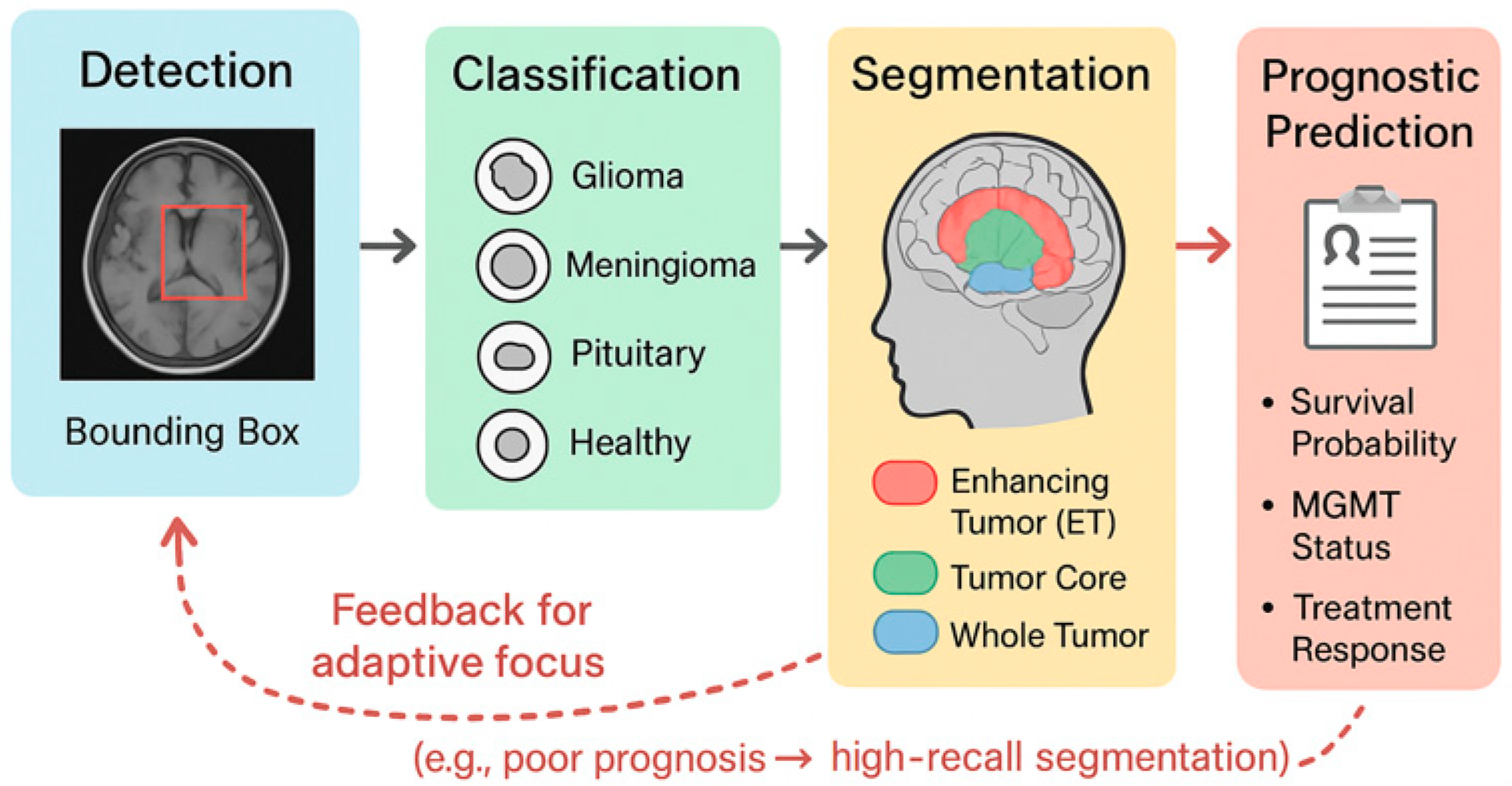
2. A Unified Diagnostic–Prognostic Conceptual Framework
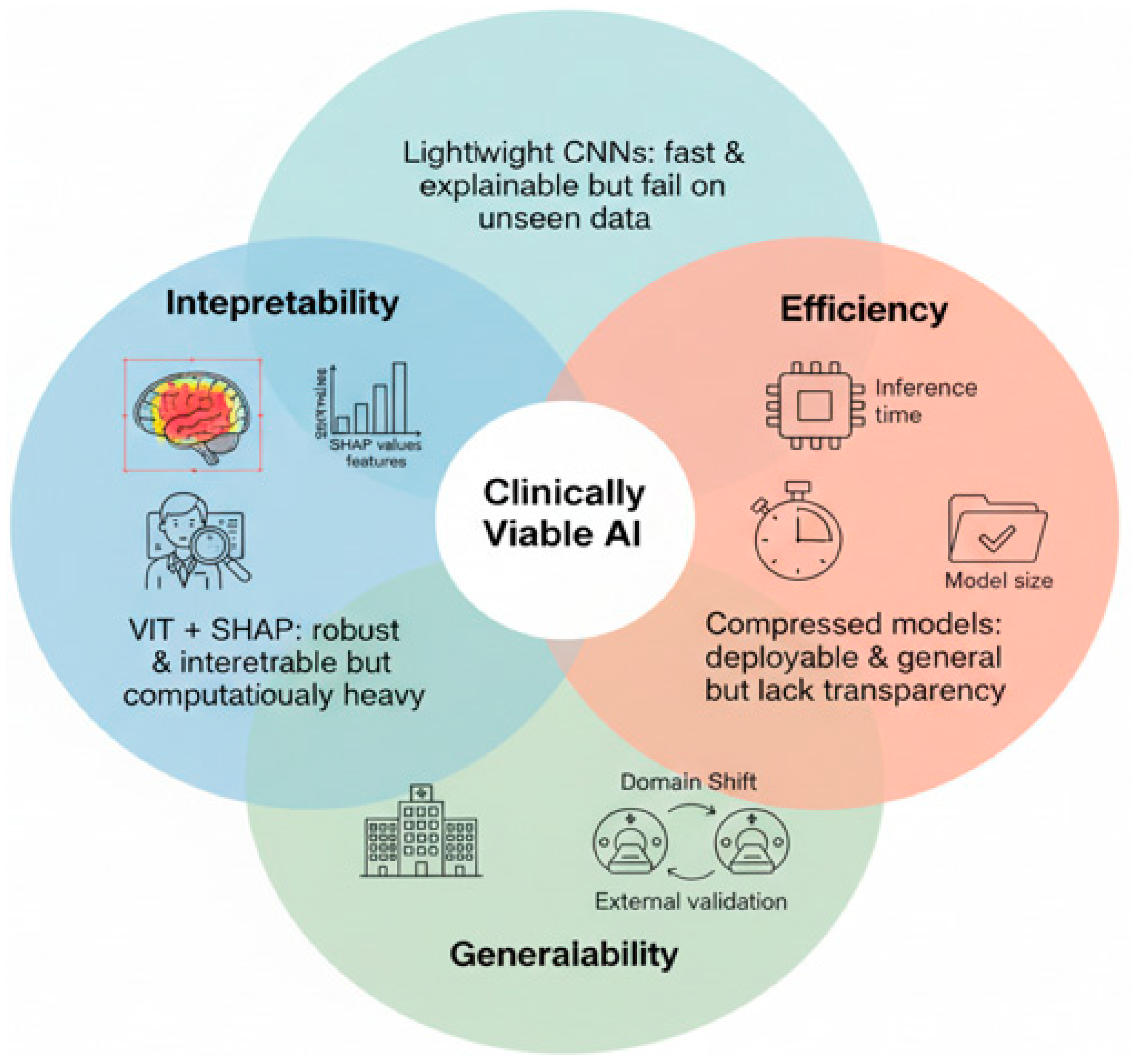
3. Triadic Evaluation Framework
3.1. Interpretability as Clinical Trust
3.2. Efficiency for Real-World Deployment
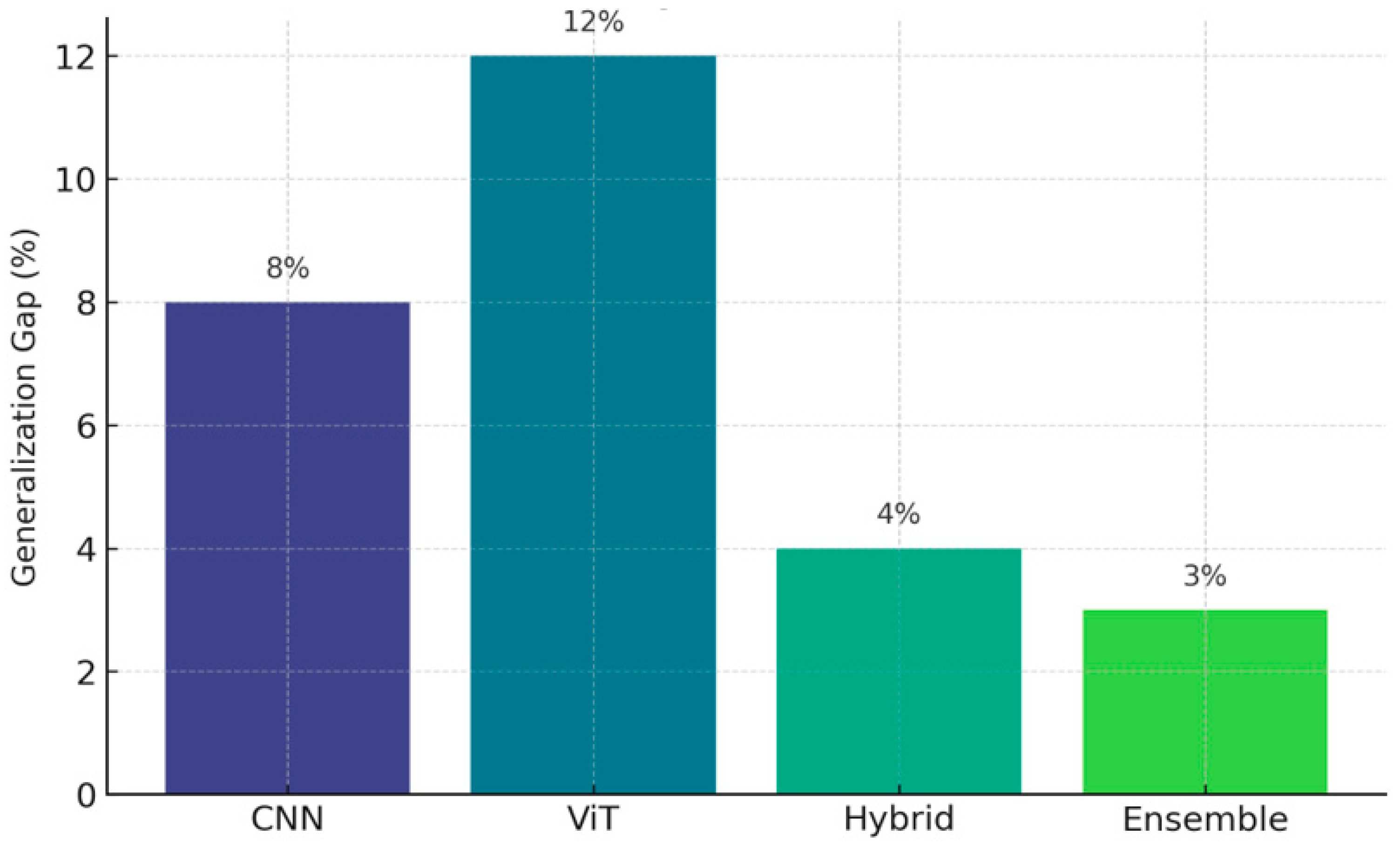
3.3. Generalizability Beyond Benchmark Datasets
4. Methods: Systematic Review and Structured Quantitative Synthesis
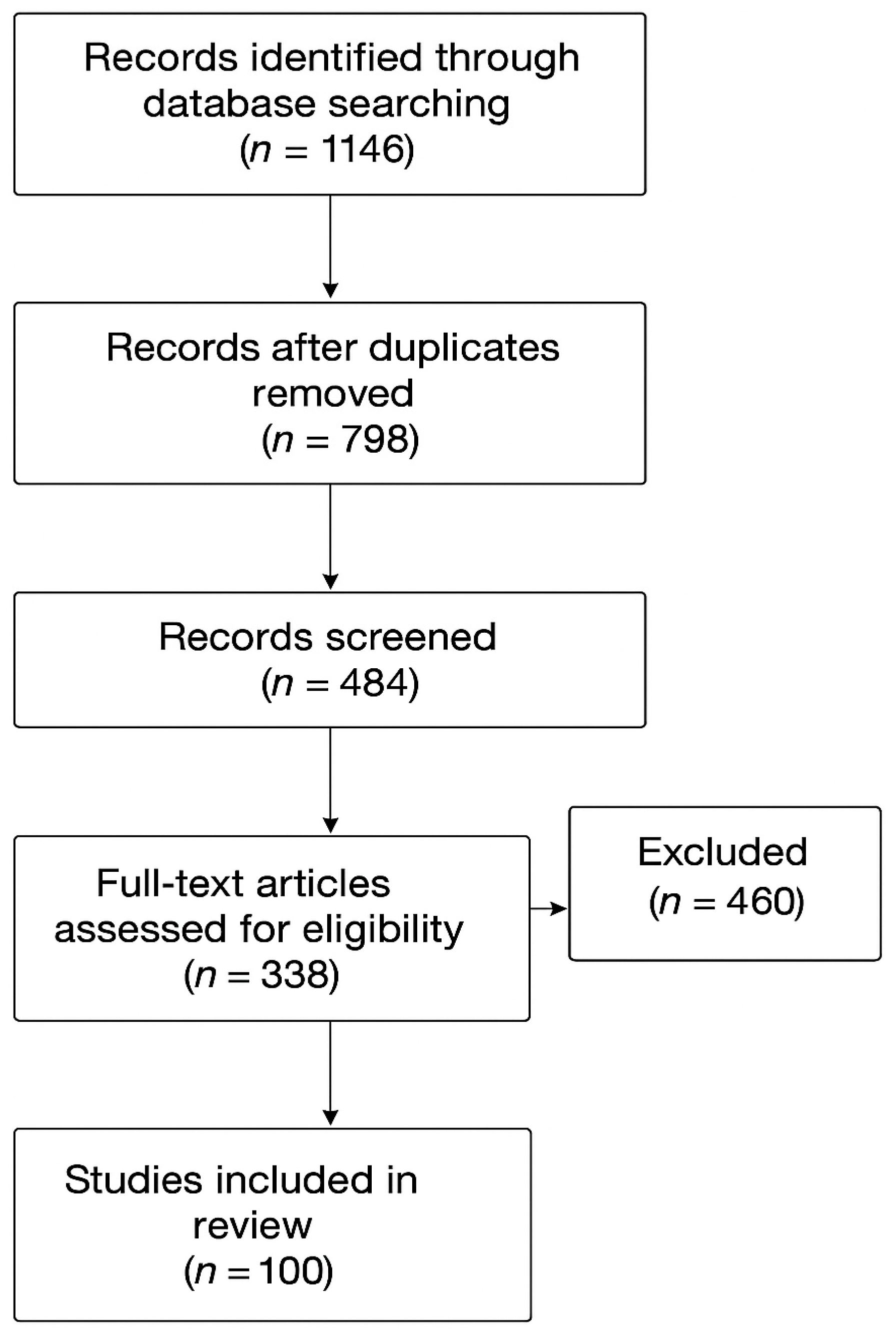
4.1. Systematic Review Protocol
4.2. Structured Quantitative Synthesis of Reported Metrics
5. Critical Analysis of Technical Approaches
5.1. Convolutional Neural Networks: Local Priors at the Cost of Global Context
5.2. Vision Transformers: Global Awareness with Data Hunger
5.3. Hybrid Models: Synergy with Systemic Complexity
5.4. Explainable AI: From Post Hoc Visualization to Diagnostic Justification
6. Data Crisis in Brain Tumor AI
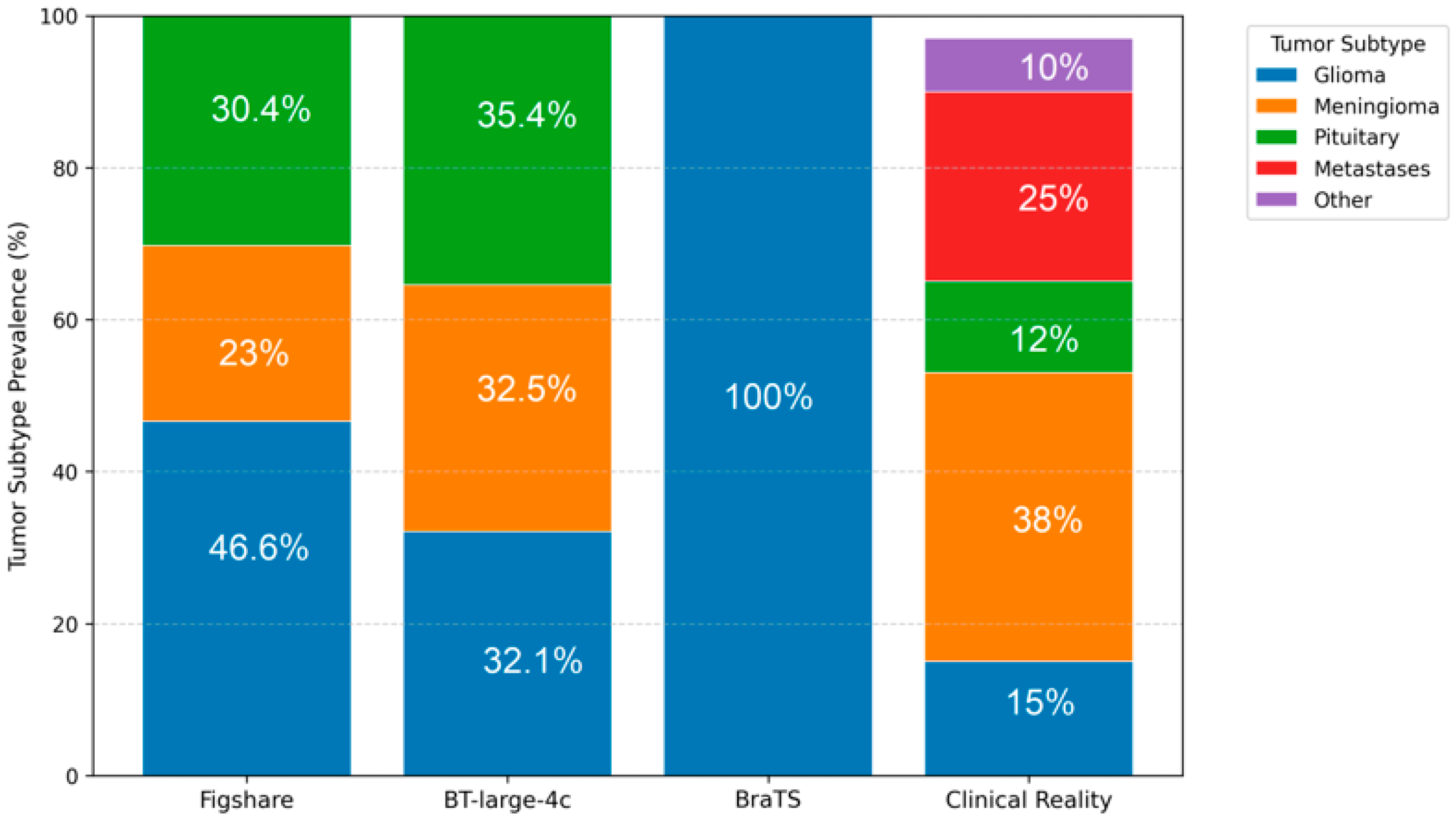
6.1. Dataset Homogeneity and Representativeness Bias
- Figshare contains only three tumor types—glioma (46.5%), meningioma (23.1%), and pituitary (30.4%)—with no metastases, craniopharyngiomas, or rare subtypes [1]. Moreover, its axial/coronal/sagittal slices are derived from only 233 patients, introducing significant inter-slice correlation and inflating cross-validation metrics [25].
6.2. Annotation Scarcity and Expert Variability
6.3. Class Imbalance and Synthetic Data Limitations
6.4. Toward Equitable and Generalizable Data Infrastructure
6.5. Illustrative Synthesis of Reported Trade-Offs
- Studies employing Transformer architectures consistently report among the highest segmentation and classification scores, but also cite the highest computational costs, with reported latencies 3–4 times greater than those of lightweight CNNs.
- Hybrid models occupy a middle ground, often achieving robust performance with moderate efficiency penalties.
- Notably, quantitative interpretability scores were reported in only a handful of studies, and when reported, showed no strong correlation with architectural family.
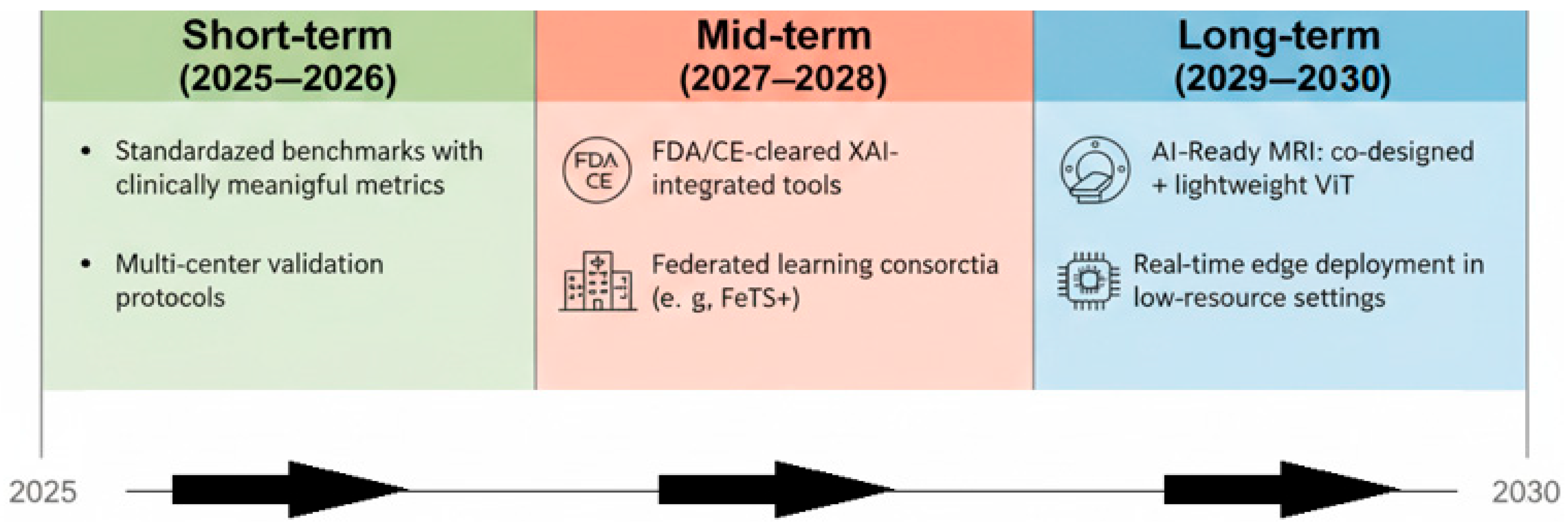
7. Toward Clinical Adoption: A Roadmap
7.1. Short-Term: Standardized Benchmarks with Clinically Meaningful Metrics
7.2. Mid-Term: Regulatory Pathways and Model Transparency
7.3. Long-Term: AI-Ready MRI and Co-Designed Acquisition
7.4. Foundational: Federated Learning for Equitable and Privacy-Preserving AI
- Heterogeneous FL Frameworks: Algorithms that accommodate differences in scanner vendors, protocols, and labeling practices (e.g., FedProx, Ditto) [7].
- Public–Private Partnerships: Initiatives like the FeTS Challenge demonstrate the feasibility of multi-institutional collaboration without data sharing [7].
- Bias-Aware Aggregation: Weight model updates not just by dataset size but by representation of underrepresented tumor subtypes (e.g., metastases, craniopharyngiomas), ensuring equitable performance [7].
8. Limitations
9. Conclusions
Author Contributions
Funding
Data Availability Statement
Acknowledgments
Conflicts of Interest
Abbreviations
| Abbreviation | Full form |
| AI | Artificial Intelligence |
| CBTRUS | Central Brain Tumor Registry of the United States |
| CE | Conformité Européenne (European Conformity) |
| CNN | Convolutional Neural Network |
| CNS | Central Nervous System |
| DL | Deep Learning |
| DWI | Diffusion-Weighted Imaging |
| ET | Enhancing Tumor |
| FDA | U.S. Food and Drug Administration |
| FeTS | Federated Tumor Segmentation |
| FL | Federated Learning |
| FLAIR | Fluid-Attenuated Inversion Recovery |
| FLOPs | Floating Point Operations |
| GAN | Generative Adversarial Network |
| GBM | Glioblastoma Multiforme |
| Grad-CAM | Gradient-weighted Class Activation Mapping |
| HGG | High-Grade Glioma |
| IDH | Isocitrate Dehydrogenase |
| IoU | Intersection over Union |
| LGG | Low-Grade Glioma |
| LIME | Local Interpretable Model-agnostic Explanations |
| MGMT | O6-methylguanine-DNA methyltransferase |
| MRI | Magnetic Resonance Imaging |
| NAS | Neural Architecture Search |
| ROI | Regions of Interest |
| SaMD | Software as a Medical Device |
| SHAP | SHapley Additive exPlanations |
| T1 | T1-weighted imaging |
| T2 | T2-weighted imaging |
| TC | Tumor Core |
| TRL | Technology Readiness Level |
| ViT | Vision Transformer |
| WHO | World Health Organization |
| WT | Whole Tumor |
| XAI | Explainable Artificial Intelligence |
Appendix A
Appendix A.1. Search Strategy
- (“brain tumor” OR “glioma” OR “meningioma” OR “pituitary”) AND
- (“MRI” OR “magnetic resonance imaging”) AND
- (“deep learning” OR “convolutional neural network” OR “vision transformer” OR “transfer learning” OR “explainable AI”)
Appendix A.2. Screening and Selection Process
- (1)
- Title screening—314 records were excluded as out-of-scope (non-MRI, non-deep-learning, or irrelevant), retaining 484 records for abstract review.
- (2)
- Abstract screening—146 records were excluded following abstract review (e.g., non-deep-learning methods, inaccessible full text), retaining 338 records for full-text eligibility assessment.
- (3)
- Full-text eligibility and quality assessment—238 full-text articles were excluded for insufficient methodological detail, missing quantitative metrics, or poor reproducibility, yielding 100 studies included in the qualitative synthesis.

Appendix A.3. Inclusion Criteria
- Published in a peer-reviewed journal.
- High-impact preprints were considered when they introduced foundational models, large-scale validation, or concepts not yet available in the peer-reviewed literature, and were explicitly identified as preprints.
- Written in English.
- Explicitly employed deep-learning or hybrid AI for MRI-based brain-tumor detection, classification, segmentation, or prognosis.
- Reported quantitative performance metrics (e.g., accuracy, Dice score, F1, sensitivity).
- Provided sufficient methodological detail to allow reproducibility.
Appendix A.4. Exclusion Criteria
- Book chapters, or retracted works.
- Studies using non-MRI modalities (e.g., CT, PET) only.
- Pure machine-learning approaches without deep-learning components.
- Articles inaccessible through institutional credentials.
Appendix A.5. Quality Assessment Checklist
Appendix A.6. Data Extraction and Synthesis
- Architecture type (CNN, ViT, hybrid, transfer-learning, XAI),
- Dataset(s) (e.g., Figshare 2017; Br35H 2020; BraTS 2015–2021),
- Preprocessing methods,
- Performance metrics,
- Interpretability tools (Grad-CAM, LIME, SHAP, etc.),
- Computational efficiency indicators (parameters, inference time).
Appendix A.7. Limitations
References
- Hosny, K.M.; Mohammed, M.A. Explainable AI and vision transformers for detection and classification of brain tumor: A comprehensive survey. Artif. Intell. Rev. 2025, 58, 259. [Google Scholar] [CrossRef]
- Miller, K.D.; Ostrom, Q.T.; Kruchko, C.; Patil, N.; Tihan, T.; Cioffi, G.; Fuchs, H.E.; Waite, K.A.; Jemal, A.; Siegel, R.L.; et al. Brain and other central nervous system tumor statistics. CA Cancer J. Clin. 2021, 71, 381–406. [Google Scholar] [CrossRef] [PubMed]
- McNeill, K.A. Epidemiology of brain tumors. Neurol. Clin. 2016, 34, 981–998. [Google Scholar] [CrossRef] [PubMed]
- McKinnon, C.; Nandhabalan, M.; Murray, S.A.; Plaha, P. Glioblastoma: Clinical presentation, diagnosis, and management. BMJ 2021, 374, n1560. [Google Scholar] [CrossRef]
- Panych, L.P.; Madore, B. The physics of MRI safety. J. Magn. Reson. Imaging 2018, 47, 28–43. [Google Scholar] [CrossRef]
- Hamid, M.A.; Khan, N.A. Investigation and classification of MRI brain tumors using feature extraction technique. J. Med. Biol. Eng. 2020, 40, 307–317. [Google Scholar] [CrossRef]
- Satushe, V.; Vyas, V.; Metkar, S.; Singh, D.P. AI in MRI brain tumor diagnosis: A systematic review of machine learning and deep learning advances (2010–2025). Chemom. Intell. Lab. Syst. 2025, 263, 105414. [Google Scholar] [CrossRef]
- Steenwijk, M.D.; Pouwels, P.J.; Daams, M.; Van Dalen, J.W.; Caan, M.W.; Richard, E.; Barkhof, F.; Vrenken, H. Accurate white matter lesion segmentation by k nearest neighbor classification with tissue type priors (kNN-TTPs). NeuroImage Clin. 2013, 3, 462–469. [Google Scholar] [CrossRef]
- Vimala, B.B.; Srinivasan, S.; Mathivanan, S.K.; Mahalakshmi, M.; Jayagopal, P.; Dalu, G.T. Detection and classification of brain tumor using hybrid deep learning models. Sci. Rep. 2023, 13, 23029. [Google Scholar] [CrossRef]
- Abdusalomov, A.B.; Mukhiddinov, M.; Whangbo, T.K. Brain tumor detection based on deep learning approaches and magnetic resonance imaging. Cancers 2023, 15, 4172. [Google Scholar] [CrossRef]
- Verma, P.R.; Bhandari, A.K. Role of Deep Learning in Classification of Brain MRI Images for Prediction of Disorders: A Survey of Emerging Trends. Arch. Computat. Methods Eng. 2023, 30, 4931–4957. [Google Scholar] [CrossRef]
- Aloraini, M.; Khan, A.; Aladhadh, S.; Habib, S.; Alsharekh, M.F.; Islam, M. Combining the transformer and convolution for effective brain tumor classification using MRI images. Appl. Sci. 2023, 13, 3680. [Google Scholar] [CrossRef]
- Dixon, J.; Akinniyi, O.; Abdelhamid, A.; Saleh, G.A.; Rahman, M.M.; Khalifa, F. A hybrid learning architecture for improved brain tumor recognition. Algorithms 2024, 17, 221. [Google Scholar] [CrossRef]
- Volovăț, S.R.; Boboc, D.-I.; Ostafe, M.-R.; Buzea, C.G.; Agop, M.; Ochiuz, L.; Rusu, D.I.; Vasincu, D.; Ungureanu, M.I.; Volovăț, C.C. Utilizing Vision Transformers for Predicting Early Response of Brain Metastasis to Magnetic Resonance Imaging-Guided Stage Gamma Knife Radiosurgery Treatment. Tomography 2025, 11, 15. [Google Scholar] [CrossRef]
- Zhang, H.; Zhou, B.; Zhang, H.; Zhang, Y.; Ouyang, Y.; Su, R.; Tang, X.; Lei, Y.; Huang, B. MultiCubeNet: Multitask deep learning for molecular subtyping and prognostic prediction in gliomas. Neuro-Oncol. Adv. 2025, 7, Vdaf079. [Google Scholar] [CrossRef]
- Kokkalla, S.; Kakarla, J.; Venkateswarlu, I.B.; Singh, M. Three-class brain tumor classification using deep dense inception residual network. Soft Comput. 2021, 25, 8721–8729. [Google Scholar] [CrossRef]
- Aboussaleh, I.; Riffi, J.; El Fazazy, K.; Mahraz, A.M.; Tairi, H. STCPU-Net: Advanced U-shaped deep learning architecture based on Swin transformers and capsule neural network for brain tumor segmentation. Neural. Comput. Appl. 2024, 36, 18549–18565. [Google Scholar] [CrossRef]
- Mbarki, Z.; Ben Slama, A.; Amri, Y.; Trabelsi, H.; Seddik, H. BTS-ADCNN: Brain tumor segmentation based on rapid anisotropic diffusion function combined with convolutional neural network using MR images. J. Supercomput. 2024, 80, 13272–13294. [Google Scholar] [CrossRef]
- Pan, D.; Shen, J.; Al-Huda, Z.; Al-Qaness, M.A.A. VcaNet: Vision Transformer with fusion channel and spatial attention module for 3D brain tumor segmentation. Comput. Biol. Med. 2025, 186, 109662. [Google Scholar] [CrossRef]
- Zeineldin, R.A.; Karar, M.E.; Elshaer, Z.; Coburger, J.; Wirtz, C.R.; Burgert, O.; Mathis-Ullrich, F. Explainable hybrid vision transformers and convolutional network for multimodal glioma segmentation in brain MRI. Sci. Rep. 2024, 14, 3713. [Google Scholar] [CrossRef]
- Tak, D.; Garomsa, B.A.; Chaunzwa, T.L.; Zapaishchykova, A.; Pardo, J.C.; Ye, Z.; Zielke, J.; Ravipati, Y.; Vajapeyam, S.; Mahootiha, M.; et al. A foundation model for generalized brain MRI analysis. medRxiv 2024. [Google Scholar] [CrossRef]
- Pacal, I. A novel Swin transformer approach utilizing residual multi-layer perceptron for diagnosing brain tumors in MRI images. Int. J. Mach. Learn. Cybern. 2024, 15, 3579–3597. [Google Scholar] [CrossRef]
- Zeineldin, R.A.; Karar, M.E.; Elshaer, Z.; Coburger, J.; Wirtz, C.R.; Burgert, O.; Mathis-Ullrich, F. Explainability of deep neural networks for MRI analysis of brain tumors. Int. J. Comput. Assist. Radiol. Surg. 2022, 17, 1673–1683. [Google Scholar] [CrossRef] [PubMed]
- Gaur, L.; Bhandari, M.; Razdan, T.; Mallik, S.; Zhao, Z. Explanation-driven deep learning model for prediction of brain tumour status using MRI image data. Front. Genet. 2022, 13, 822666. [Google Scholar] [CrossRef]
- Hosny, K.M.; Mohammed, M.A.; Salama, R.A.; Elshewey, A.M. Explainable ensemble deep learning-based model for brain tumor detection and classification. Neural. Comput. Appl. 2025, 37, 1289–1306. [Google Scholar] [CrossRef]
- Tabatabaei, S.; Rezaee, K.; Zhu, M. Attention transformer mechanism and fusion-based deep learning architecture for MRI brain tumor classification system. Biomed. Signal Process. Control. 2023, 86, 105119. [Google Scholar] [CrossRef]
- Kang, J.; Ullah, Z.; Gwak, J. MRI-based brain tumor classification using ensemble of deep features and machine learning classifiers. Sensors 2021, 21, 2222. [Google Scholar] [CrossRef]
- Djoumessi, K.; Mensah, S.O.; Berens, P. A Hybrid Fully Convolutional CNN-Transformer Model for Inherently Interpretable Medical Image Classification. Front. Artif. Intell. 2025, 8, 1679310. [Google Scholar] [CrossRef]
- Pasvantis, K.; Protopapadakis, E. Enhancing deep learning model explainability in brain tumor datasets using post-heuristic approaches. J. Imaging 2024, 10, 232. [Google Scholar] [CrossRef]
- Tummala, S.; Kadry, S.; Bukhari, S.A.C.; Rauf, H.T. Classification of brain tumor from magnetic resonance imaging using vision transformers ensembling. Curr. Oncol. 2022, 29, 7498–7511. [Google Scholar] [CrossRef]
- Ferdous, G.J.; Sathi, K.A.; Hossain, A.; Hoque, M.M.; Dewan, M.A.A. LCDEiT: A linear complexity dataefficient image transformer for MRI brain tumor classification. IEEE Access 2023, 11, 20337–20350. [Google Scholar] [CrossRef]
- Alnageeb, M.H.O.; Supriya, M.H. Real-time brain tumour diagnoses using a novel lightweight deep learning model. Comput. Biol Med. 2025, 192, 110242. [Google Scholar] [CrossRef] [PubMed]
- Wang, J.; Lu, S.Y.; Wang, S.H.; Zhang, Y.D. RanMerFormer: Randomized vision transformer with token merging for brain tumor classification. Neurocomputing 2024, 573, 127216. [Google Scholar] [CrossRef]
- Atiya, S.; Ali, T.; Irfan, M.; Khan, W.; Ahmed, H. BitMedViT: Ternary-Quantized Vision Transformer for Medical AI Assistants on the Edge. In Proceedings of the IEEE/ACM International Conference on Computer Aided Design (ICCAD 2025), Munich, Germany, 26–30 October 2025. [Google Scholar] [CrossRef]
- Poornam, S.; Angelina, J.J.R. VITALT: A robust and efficient brain tumor detection system using vision transformer with attention and linear transformation. Neural Comput. Appl. 2024, 36, 6403–6419. [Google Scholar] [CrossRef]
- Satushe, V.; Vyas, V.; Metkar, S.P.; Singh, D.P. Advanced cnn architecture for brain tumor segmentation and classification using brats-goat 2024 dataset. Curr. Med. Imaging Former. Curr. Med. Imaging Rev. 2025, 21, e15734056344235. [Google Scholar] [CrossRef]
- Manthe, M.; Duffner, S.; Lartizien, C. Federated brain tumor segmentation: An extensive benchmark. Med. Image Anal. 2024, 97, 103270. [Google Scholar] [CrossRef]
- Eker, A.G.; Pehlivanoğlu, M.K.; Duru, N.; Dündar, T.T. BrainPixGAN: Generating intraoperative MRI images with mask-based generative networks. Eng. Sci. Technol. Int. J. 2024, 58, 101827. [Google Scholar] [CrossRef]
- Safdari, R.; Nikouei Mahani, M.-A.; Koohi-Moghadam, M.; Bae, K.T. MixStyleFlow: Domain Generalization in Medical Image Segmentation using Normalizing Flows. Med. Image Comput. Comput. Assist. Interv. MICCAI 2025, 15962, 376–385. [Google Scholar] [CrossRef]
- Chen, H.; Qin, Z.; Ding, Y.; Tian, L.; Qin, Z. Brain tumor segmentation with deep convolutional symmetric neural network. Neurocomputing 2020, 392, 305–313. [Google Scholar] [CrossRef]
- Kesav, N.; Jibukumar, M.G. Efficient and low complex architecture for detection and classification of brain tumor using RCNN with two-channel CNN. J. King Saud Univ. Comput. Inf. Sci. 2022, 34, 6229–6242. [Google Scholar] [CrossRef]
- Hammad, M.; ElAffendi, M.; Ateya, A.A.; El-Latif, A.A.A. Efficient brain tumor detection with lightweight end-to-end deep learning model. Cancers 2023, 15, 2837. [Google Scholar] [CrossRef] [PubMed]
- Hussain, T.; Shouno, H. Explainable deep learning approach for multi-class brain magnetic resonance imaging tumor classification and localization using gradient-weighted class activation mapping. Information 2023, 14, 642. [Google Scholar] [CrossRef]
- Ullah, M.S.; Khan, M.A.; Masood, A.; Mzoughi, O.; Saidani, O.; Alturki, N. Brain tumor classification from MRI scans: A framework of hybrid deep learning model with Bayesian optimization and quantum theory-based marine predator algorithm. Front. Oncol. 2024, 14, 1335740. [Google Scholar] [CrossRef] [PubMed]
- Asiri, A.A.; Shaf, A.; Ali, T.; Shakeel, U.; Irfan, M.; Mehdar, K.M.; Halawani, H.T.; Alghamdi, A.H.; Alshamrani, A.F.A.; Alqhtani, S.M. Exploring the power of deep learning: Fine-tuned vision transformer for accurate and efficient brain tumor detection in MRI scans. Diagnostics 2023, 13, 2094. [Google Scholar] [CrossRef]
- Krishnan, P.T.; Krishnadoss, P.; Khandelwal, M.; Gupta, D.; Nihaal, A.; Kumar, T.S. Enhancing brain tumor detection in MRI with a rotation invariant Vision Transformer. Front. Neuroinform. 2024, 18, 1414925. [Google Scholar] [CrossRef]
- Nassar, S.E.; Yasser, I.; Amer, H.M.; Mohamed, M.A. A robust MRI-based brain tumor classification via a hybrid deep learning technique. J. Supercomput. 2024, 80, 2403–2427. [Google Scholar] [CrossRef]
- Rajput, I.S.; Gupta, A.; Jain, V.; Tyagi, S. A transfer learning-based brain tumor classification using magnetic resonance images. Multimed. Tools Appl. 2024, 83, 20487–20506. [Google Scholar] [CrossRef]
- Zulfiqar, F.; Bajwa, U.I.; Mehmood, Y. Multi-class classification of brain tumor types from MR images using EfficientNets. Biomed Signal Process. Control. 2023, 84, 104777. [Google Scholar] [CrossRef]
- Yan, F.; Chen, Y.; Xia, Y.; Wang, Z.; Xiao, R. An explainable brain tumor detection framework for mri analysis. Appl. Sci. 2023, 13, 3438. [Google Scholar] [CrossRef]
- Islam, M.A.; Mridha, M.F.; Safran, M.S.; Alfarhood, S.; Kabir, M.M. Revolutionizing Brain Tumor Detection Using Explainable AI in MRI Images. NMR Biomed. 2025, 38, e70001. [Google Scholar] [CrossRef]
- Cheng, J. Brain tumor dataset figshare. Dataset 2017. [Google Scholar] [CrossRef]
- Menze, B.H.; Jakab, A.; Bauer, S.; Kalpathy-Cramer, J.; Farahani, K.; Kirby, J.; Burren, Y.; Porz, N.; Slotboom, J.; Wiest, R.; et al. The multimodal brain tumor image segmentation benchmark (BRATS). IEEE Trans. Med. Imaging 2015, 34, 1993–2024. [Google Scholar] [CrossRef] [PubMed]
- Nickparvar, M. Brain tumor MRI dataset. Kaggle 2021. [Google Scholar] [CrossRef]
- Maqsood, S.; Damaševičius, R.; Maskeliūnas, R. Multi-Modal Brain Tumor Detection Using Deep Neural Network and Multiclass SVM. Medicina 2022, 58, 1090. [Google Scholar] [CrossRef]
- Bakas, S.; Akbari, H.; Sotiras, A.; Bilello, M.; Rozycki, M.; Kirby, J.S.; Freymann, J.B.; Farahani, K.; Davatzikos, C. Advancing the cancer genome atlas glioma MRI collections with expert segmentation labels and radiomic features. Sci. Data. 2017, 4, 170117. [Google Scholar] [CrossRef]
- Chakrabarty, N. Brain MRI Images for Brain Tumor Detection Dataset. 2019. Available online: https://www.kaggle.com/navoneel/brain-mri-images-for-brain-tumor-detection (accessed on 2 December 2025).
- Reddy, C.K.K.; Reddy, P.A.; Janapati, H.; Assiri, B.; Shuaib, M.; Alam, S.; Sheneamer, A. A fine-tuned vision transformer-based enhanced multi-class brain tumor classification using MRI scan imagery. Front. Oncol. 2024, 14, 1400341. [Google Scholar] [CrossRef]
- Lee, J.H.; Chae, J.W.; Cho, H.C. Improved classification of brain-tumor MRI images through data augmentation and filter application. J. Electr. Eng. Technol. 2023, 18, 3135–3142. [Google Scholar] [CrossRef]
- Roy, P.; Srijon, F.M.S.; Bhowmik, P. An explainable ensemble approach for advanced brain tumor classification applying Dual-GAN mechanism and feature extraction techniques over highly imbalanced data. PLoS ONE 2024, 19, e0310748. [Google Scholar] [CrossRef]
- SinhaRoy, R.; Sen, A. A Hybrid Deep Learning Framework to Predict Alzheimer’s disease progression using generative adversarial networks and deep convolutional neural networks. Arab. J. Sci. Eng. 2024, 49, 3267–3284. [Google Scholar] [CrossRef]
- Badža, M.M.; Barjaktarović, M.Č. Classification of brain tumors from MRI images using a convolutional neural network. Appl. Sci. 2020, 10, 1999. [Google Scholar] [CrossRef]
- Toğaçar, M.; Ergen, B.; Cömert, Z. BrainMRNet: Brain tumor detection using magnetic resonance images with a novel convolutional neural network model. Med. Hypotheses 2020, 134, 109531. [Google Scholar] [CrossRef] [PubMed]
- Huang, Z.; Du, X.; Chen, L.; Li, Y.; Liu, M.; Chou, Y.; Jin, L. Convolutional neural network based on complex networks for brain tumor image classification with a modified activation function. IEEE Access 2020, 8, 89281–89290. [Google Scholar] [CrossRef]
- Ayadi, W.; Elhamzi, W.; Charfi, I.; Atri, M. Deep CNN for brain tumor classification. Neural Process. Lett. 2021, 53, 671–700. [Google Scholar] [CrossRef]
- Abd El Kader, I.; Xu, G.; Shuai, Z.; Saminu, S.; Javaid, I.; Salim Ahmad, I. Differential deep convolutional neural network model for brain tumor classification. Brain Sci. 2021, 11, 352. [Google Scholar] [CrossRef]
- Naseer, A.; Yasir, T.; Azhar, A.; Shakeel, T.; Zafar, K. Computer-aided brain tumor diagnosis: Performance evaluation of deep learner CNN using augmented brain MRI. Int. J. Biomed. Imaging 2021, 2021, 5513500. [Google Scholar] [CrossRef]
- Musallam, A.S.; Sherif, A.S.; Hussein, M.K. A new convolutional neural network architecture for automatic detection of brain tumors in magnetic resonance imaging images. IEEE Access 2022, 10, 2775–2782. [Google Scholar] [CrossRef]
- Kibriya, H.; Masood, M.; Nawaz, M.; Nazir, T. Multiclass classification of brain tumors using a novel CNN architecture. Multimed. Tools Appl. 2022, 81, 29847–29863. [Google Scholar] [CrossRef]
- Khan, M.S.I.; Rahman, A.; Debnath, T.; Karim, M.R.; Nasir, M.K.; Band, S.S.; Mosavi, A.; Dehzangi, I. Accurate brain tumor detection using deep convolutional neural network. Comput. Struct. Biotechnol. J. 2022, 20, 4733–4745. [Google Scholar] [CrossRef]
- Ullah, N.; Khan, M.S.; Khan, J.A.; Choi, A.; Anwar, M.S. A robust end-to-end deep learning-based approach for effective and reliable BTD using MR images. Sensors 2022, 22, 7575. [Google Scholar] [CrossRef]
- Saurav, S.; Sharma, A.; Saini, R.; Singh, S. An attention-guided convolutional neural network for automated classification of brain tumor from MRI. Neural Comput. Appl. 2023, 35, 2541–2560. [Google Scholar] [CrossRef]
- Shahin, A.I.; Aly, W.; Aly, S. MBTFCN: A novel modular fully convolutional network for MRI brain tumor multi-classification. Expert Syst. Appl. 2023, 212, 118776. [Google Scholar] [CrossRef]
- Özkaraca, O.; Bağrıaçık, O.İ.; Gürüler, H.; Khan, F.; Hussain, J.; Khan, J.; Laila, U.E. Multiple brain tumor classification with dense CNN architecture using brain MRI images. Life 2023, 13, 349. [Google Scholar] [CrossRef] [PubMed]
- Mahmud, M.I.; Mamun, M.; Abdelgawad, A. A deep analysis of brain tumor detection from mr images using deep learning networks. Algorithms 2023, 16, 176. [Google Scholar] [CrossRef]
- Ullah, N.; Javed, A.; Alhazmi, A.; Hasnain, S.M.; Tahir, A.; Ashraf, R. TumorDetNet: A unified deep learning model for brain tumor detection and classification. PLoS ONE 2023, 18, e0291200. [Google Scholar] [CrossRef] [PubMed]
- Rehman, A.; Naz, S.; Razzak, M.I.; Akram, F.; Imran, M. A deep learning-based framework for automatic brain tumors classification using transfer learning. Circuits Syst. Signal Process. 2020, 39, 757–775. [Google Scholar] [CrossRef]
- Sadad, T.; Rehman, A.; Munir, A.; Saba, T.; Tariq, U.; Ayesha, N.; Abbasi, R. Brain tumor detection and multiclassification using advanced deep learning techniques. Microsc. Res. Tech. 2021, 84, 1296–1308. [Google Scholar] [CrossRef]
- Polat, Ö.; Güngen, C. Classification of brain tumors from MR images using deep transfer learning. J. Supercomput. 2021, 77, 7236–7252. [Google Scholar] [CrossRef]
- Alanazi, M.F.; Ali, M.U.; Hussain, S.J.; Zafar, A.; Mohatram, M.; Irfan, M.; AlRuwaili, R.; Alruwaili, M.; Ali, N.H.; Albarrak, A.M. Brain tumor/mass classification framework using magnetic-resonance-imaging-based isolated and developed transfer deep-learning model. Sensors 2022, 22, 372. [Google Scholar] [CrossRef]
- Ullah, N.; Khan, J.A.; Khan, M.S.; Khan, W.; Hassan, I.; Obayya, M.; Negm, N.; Salama, A.S. An effective approach to detect and identify brain tumors using transfer learning. Appl. Sci. 2022, 12, 5645. [Google Scholar] [CrossRef]
- Sharma, A.K.; Nandal, A.; Dhaka, A.; Zhou, L.; Alhudhaif, A.; Alenezi, F.; Polat, K. Brain tumor classification using the modified ResNet50 model based on transfer learning. Biomed. Signal Process. Control. 2023, 86, 105299. [Google Scholar] [CrossRef]
- Khushi, H.M.T.; Masood, T.; Jaffar, A.; Rashid, M.; Akram, S. Improved multiclass brain tumor detection via customized pretrained efficientnetb7 model. IEEE Access 2023, 11, 117210–117230. [Google Scholar] [CrossRef]
- Ghosh, A.; Soni, B.; Baruah, U. Transfer learning-based deep feature extraction framework using finetuned efficientNet B7 for multiclass brain tumor classification. Arab. J. Sci. Eng. 2023, 49, 12027–12048. [Google Scholar] [CrossRef]
- Mathivanan, S.K.; Sonaimuthu, S.; Murugesan, S.; Rajadurai, H.; Shivahare, B.D.; Shah, M.A. Employing deep learning and transfer learning for accurate brain tumor detection. Sci. Rep. 2024, 14, 7232. [Google Scholar] [CrossRef]
- Zubair Rahman, A.M.J.; Gupta, M.; Aarathi, S.; Mahesh, T.R.; Vinoth Kumar, V.; Yogesh Kumaran, S.; Guluwadi, S. Advanced AI-driven approach for enhanced brain tumor detection from MRI images utilizing EfficientNetB2 with equalization and homomorphic filtering. BMC Med. Inform. Decis. Mak. 2024, 24, 113. [Google Scholar] [CrossRef] [PubMed]
- İncir, R.; Bozkurt, F. Improving brain tumor classification with combined convolutional neural networks and transfer learning. Knowledge-Based Syst. 2024, 299, 111981. [Google Scholar] [CrossRef]
- Preetha, R.; Priyadarsini, M.J.P.; Nisha, J.S. Automated brain tumor detection from magnetic resonance images using fine-tuned efficientnet-b4 convolutional neural network. IEEE Access 2024, 12, 112181–112195. [Google Scholar] [CrossRef]
- Mavaddati, S. Brain tumors classification using deep models and transfer learning. Multimed. Tools Appl. 2024, 84, 25677–25708. [Google Scholar] [CrossRef]
- Khushi, H.M.T.; Masood, T.; Jaffar, A.; Akram, S. A novel approach to classify brain tumor with an effective transfer learning based deep learning model. Braz. Arch. Biol. Technol. 2024, 67, e24231137. [Google Scholar] [CrossRef]
- Hameed, M.; Zameer, A.; Khan, S.H.; Raja, M.A.Z. ARiViT: Attention-based residual-integrated vision transformer for noisy brain medical image classification. Eur. Phys. J. Plus 2024, 139, 440. [Google Scholar] [CrossRef]
- Hong, S.; Wu, J.; Zhu, L.; Chen, W. Brain tumor classification in VIT-B/16 based on relative position encoding and residual MLP. PLoS ONE 2024, 19, e0298102. [Google Scholar] [CrossRef]
- Şahin, E.; Özdemir, D.; Temurtaş, H. Multi-objective optimization of ViT architecture for efficient brain tumor classification. Biomed. Signal Process. Control. 2024, 91, 105938. [Google Scholar] [CrossRef]
- Asiri, A.A.; Shaf, A.; Ali, T.; Pasha, M.A.; Khan, A.; Irfan, M.; Alqahtani, S.; Alghamdi, A.; Alghamdi, A.H.; Alshamrani, A.F.A.; et al. Advancing brain tumor detection: Harnessing the Swin transformer’s power for accurate classification and performance analysis. PeerJ Comput. Sci. 2024, 10, e1867. [Google Scholar] [CrossRef] [PubMed]
- Priya, A.; Vasudevan, V. Brain tumor classification and detection via hybrid Alexnet-gru based on deep learning. Biomed. Signal Process. Control. 2024, 89, 105716. [Google Scholar] [CrossRef]
- Singh, A.; Shrivastava, R.K.; Srivastava, A. Efficient and compressed deep learning model for brain tumour classification with explainable AI for smart healthcare and information communication systems. Expert Syst. 2025, 42, e13770. [Google Scholar] [CrossRef]
- Bizzo, B.C.; Almeida, R.R.; Michalski, M.; Alkasab, T.K. Artificial intelligence and clinical decision support for radiologists and referring providers. J. Am. Coll. Radiol. 2019, 16, 1351–1356. [Google Scholar] [CrossRef]
- Heckel, R.; Jacob, M.; Chaudhari, A.; Perlman, O.; Shimron, E. Deep learning for accelerated and robust MRI reconstruction. Magn. Reson. Mater. Phys. Biol. Med. 2024, 37, 335–368. [Google Scholar] [CrossRef]
- Monisha, S.M.A.; Rahman, R. Brain Tumor Detection in MRI Based on Federated Learning with YOLOv11. arXiv 2025, arXiv:2503.04087. [Google Scholar] [CrossRef]



| Pillar | Core Objective | Recommended Quantitative Metrics | Essential Reporting Standards | Common Pitfalls (From Our Synthesis) |
|---|---|---|---|---|
| Interpretability | Foster clinical trust and justify decisions. | • Saliency map overlap with expert ROI (IoU) • Consistency of explanations (e.g., SHAP value variance) • Clinician-AI diagnostic agreement (Cohen’s κ) | • Specify XAI method and parameters (e.g., Grad-CAM layer, LIME samples). • Report validation against expert annotations or clinical ground truth. | Post hoc visualizations used without validation (“trust theater”); lack of clinical correlation. |
| Efficiency | Enable deployment in real-world clinical settings. | • Inference latency (ms per volume/slice) • Peak memory footprint (GB) • Parameter count (M)/FLOPs | • Mandatory: Hardware specification (GPU/CPU, model). • Report end-to-end pipeline time, not just forward pass. | Latency reported on high-end GPUs not available in clinics; memory use ignored for 3D models. |
| Generalizability | Ensure robustness across institutions and populations. | • Generalization gap (Δ = Internal Acc. − External Acc.) • Performance on underrepresented subgroups (worst-group accuracy) • Cross-domain Dice/AUC | • Detail external validation cohort characteristics (scanner, demographics). • Report performance per tumor subtype and institution. | Validation only on homogeneous public benchmarks (Figshare/BraTS); missing external testing. |
| Method | Interpretability Depth | Efficiency (FLOPs/Params) | Generalization Gap | Key Clinical Limitation |
|---|---|---|---|---|
| CNNs | Low–Moderate (post hoc Grad-CAM) | High efficiency (e.g., MobileNetV3: 5.6M params) | High (fails on rare subtypes like metastases) | Poor global context; struggles with diffuse gliomas |
| ViTs | Moderate (attention maps lack clinical grounding) | Low efficiency (ViT-L/16: ~55B FLOPs) | Moderate (requires large data; overfits on small datasets) | Computationally prohibitive for edge deployment |
| Hybrid (CNN + ViT) | Moderate–High (fusion enables richer explanations) | Low–Moderate (ensemble overhead) | Low (robust across tumor types) | High inference latency; complex to validate |
| XAI-Integrated | High (SHAP/Grad-CAM + clinician-in-the-loop) | Varies (adds minimal overhead) | Low–Moderate (depends on base model) | Often qualitative; lacks standardized validation |
| Dataset | Tumor Types | Real-World Incidence Alignment | Prognostic Labels | Scanner Diversity | Key Representativeness Limitations |
|---|---|---|---|---|---|
| Figshare | Glioma (46.6%), Meningioma (23%), Pituitary (30.4%) | Overrepresents pituitary; omits metastases | No survival/MGMT | Single institution | No metastases, healthy cases; limited patient count (n = 233) |
| BraTS | Glioma only (LGG/HGG) | Excludes benign tumors | Partial (survival in BraTS 2018+) | Multi-institution | No meningioma, pituitary, or non-tumor cases |
| BT-large-4c | Glioma, Meningioma, Pituitary, Healthy | Better balance but still no metastases | No | Mixed sources, unclear protocols | Lacks metastatic and rare tumors; protocol heterogeneity |
| TCGA-GBM | Glioblastoma only | Narrow scope | Genomic and survival | Multi-center | Not for general tumor diagnosis |
| REMBRANDT | Glioma, Meningioma | Includes rare subtypes | Genomic and clinical | Multi-institution | Smaller sample size; older imaging protocols |
| Model Category | Representative Architectures | Reported Dice Range | Reported Accuracy Range (%) | Reported Latency Range (ms/Slice) | Reported Parameter Range (M) | Interpretability Metric (When Reported) |
|---|---|---|---|---|---|---|
| CNN-based | ResNet-50, DenseNet-121, U-Net variants | 0.85–0.92 | 92–98 | 2–15 | 5–30 | Grad-CAM IoU: 0.68–0.78 (n = 6 studies) |
| Transformer-based | Swin-T, ViT-B/16, TransBTS | 0.89–0.94 | 94–99 | 20–60 | 40–100 | Attention map overlap: 0.60–0.72 (n = 4 studies) |
| Hybrid CNN–ViT | TransUNet, ConvNeXt-ViT, Ensemble models | 0.88–0.93 | 94–98 | 10–25 | 25–60 | Saliency IoU: 0.70–0.76 (n = 4 studies) |
| Study | Model Type | TRL | Evidence of Real-World Validation | Regulatory Pathway Alignment | Clinician-in-the-Loop Evaluation? | Evidence Type Required to Advance |
|---|---|---|---|---|---|---|
| [25] | Ensemble CNN + XAI | 4 | Cross-dataset validation (Figshare, Br35H) | No FDA/CE mention | No | Multi-site retrospective validation (n ≥ 100) |
| [21] | Foundation Model (Brain IAC) | 5 | Tested on 5 external cohorts | Pre-submission regulatory engagement | Radiologist feedback in ablation | Prospective pilot study (n ≥ 50 patients) |
| [37] | Federated ViT | 6 | Multi-hospital FL trial (FeTS) | HIPAA/GDPR-compliant | Prospective usability study | Regulatory approval phase (IDE or 510(k) submission) |
| [22] | Swin Transformer | 3 | Single-dataset (BT-large-4c) | None | No | External validation + error analysis across 2+ centers |
| [48] | Ensemble Transfer Learning | 4 | Hold-out validation only | None | No | Multi-center retrospective benchmarking |
| Initiative | Participating Institutions | Model Architecture | Performance vs. Centralized | Privacy Mechanism | Clinical Utility |
|---|---|---|---|---|---|
| FeTS Challenge | 20+ hospitals | nnU-Net, Swin UNETR | ΔDice = −1.2% | Secure aggregation | High (multi-center segmentation) |
| Brain IAC FL | 8 academic centers | Vision Transformer | ΔAccuracy = −0.8% | Differential privacy (ε = 2.0) | High (prognostic prediction) |
| Private FL Study [37] | 5 hospitals | ResNet50 + SVM | ΔAccuracy = −2.1% | Homomorphic encryption | Moderate (classification only) |
| Federated BTS-ADCNN [18] | 3 sites | Anisotropic diffusion + CNN | ΔDice = −3.5% | No added privacy | Low (small-scale validation) |
Disclaimer/Publisher’s Note: The statements, opinions and data contained in all publications are solely those of the individual author(s) and contributor(s) and not of MDPI and/or the editor(s). MDPI and/or the editor(s) disclaim responsibility for any injury to people or property resulting from any ideas, methods, instructions or products referred to in the content. |
© 2026 by the authors. Licensee MDPI, Basel, Switzerland. This article is an open access article distributed under the terms and conditions of the Creative Commons Attribution (CC BY) license.
Share and Cite
Atiea, M.A.; Gafar, M.; Sarhan, S.; Shaheen, A.M. Toward Clinically Dependable AI for Brain Tumors: A Unified Diagnostic–Prognostic Framework and Triadic Evaluation Model. BioMedInformatics 2026, 6, 7. https://doi.org/10.3390/biomedinformatics6010007
Atiea MA, Gafar M, Sarhan S, Shaheen AM. Toward Clinically Dependable AI for Brain Tumors: A Unified Diagnostic–Prognostic Framework and Triadic Evaluation Model. BioMedInformatics. 2026; 6(1):7. https://doi.org/10.3390/biomedinformatics6010007
Chicago/Turabian StyleAtiea, Mohammed A., Mona Gafar, Shahenda Sarhan, and Abdullah M. Shaheen. 2026. "Toward Clinically Dependable AI for Brain Tumors: A Unified Diagnostic–Prognostic Framework and Triadic Evaluation Model" BioMedInformatics 6, no. 1: 7. https://doi.org/10.3390/biomedinformatics6010007
APA StyleAtiea, M. A., Gafar, M., Sarhan, S., & Shaheen, A. M. (2026). Toward Clinically Dependable AI for Brain Tumors: A Unified Diagnostic–Prognostic Framework and Triadic Evaluation Model. BioMedInformatics, 6(1), 7. https://doi.org/10.3390/biomedinformatics6010007