Article

Analysis of Chlorophyll and Carotenoid Content Variations in Evergreen Forest in Winter Using Vegetation Indices Derived from GCOM-C and MODIS Satellite Data

by
Yasushi Shiraishi
1,
Takuya Hiroshima
2,* and
Satoshi Tsuyuki
2
1
Graduate School of Science and Technology, University of Tsukuba, 1-1-1 Tennoudai, Tsukuba 305-8572, Japan
2
Department of Global Agricultural Sciences, Graduate School of Agricultural and Life Sciences, The University of Tokyo, Tokyo 113-8657, Japan
*
Author to whom correspondence should be addressed.
Geomatics 2026, 6(2), 25; https://doi.org/10.3390/geomatics6020025
Submission received: 28 December 2025 / Revised: 24 February 2026 / Accepted: 2 March 2026 / Published: 10 March 2026

Abstract

The GCOM-C satellite possesses optimal wavelength bands around 530 nm and 570 nm for monitoring seasonal variations in the photochemical reflectance index (PRI) and chlorophyll–carotenoid index (CCI), which are sensitive to carotenoid contents and its ratio to chlorophyll contents, respectively. As well as NDVI, these indices are excellent indicators for monitoring pigment contents of evergreen trees in winter, which are considered susceptible to climate change impacts. In this study, to investigate the characteristics and usefulness of the GCOM-C-derived indices, the seasonal variations in these indices were analyzed between 2018 and 2024 at two evergreen forest sites in Japan, and compared to CCI and NDVI derived from MODIS, which also has a band near 530 nm. The satellite observation results show that the decreases in all indices for both satellites in winter were observed in the order of PRI, CCI, NDVI. This is thought to indicate that carotenoid contents increased in response to the decrease in land surface temperature to mitigate low-temperature stress, followed by a delayed decrease in chlorophyll contents. GCOM-C showed 0.1 larger NDVI values and 0.2 larger CCI values than MODIS, and the difference was estimated to be largely influenced by the disparity in sensor sensitivity in the red bands. The dispersion of each index was reduced by using data with small sensor zenith angles (below 20 degrees for GCOM-C and 0 to 30 degrees for MODIS); however, MODIS showed a decline in observation accuracy due to satellite drifting in 2024. Spectral measurements of leaves collected at the site also showed similar VI decreases; however, the satellite-derived CCI were 0.12 lower, suggesting that reflection from dead leaves influences the satellite data. This study confirmed that GCOM-C, which can measure both PRI and CCI with high spatial resolution, is suitable for observing seasonal variations in carotenoid and chlorophyll contents in evergreen forests.

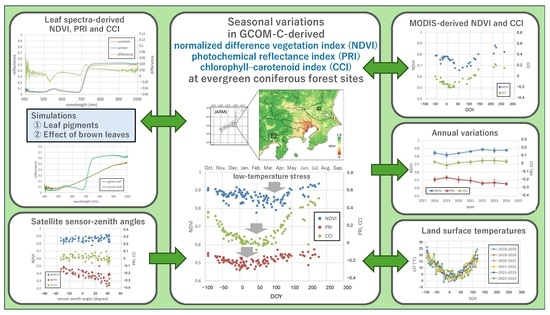
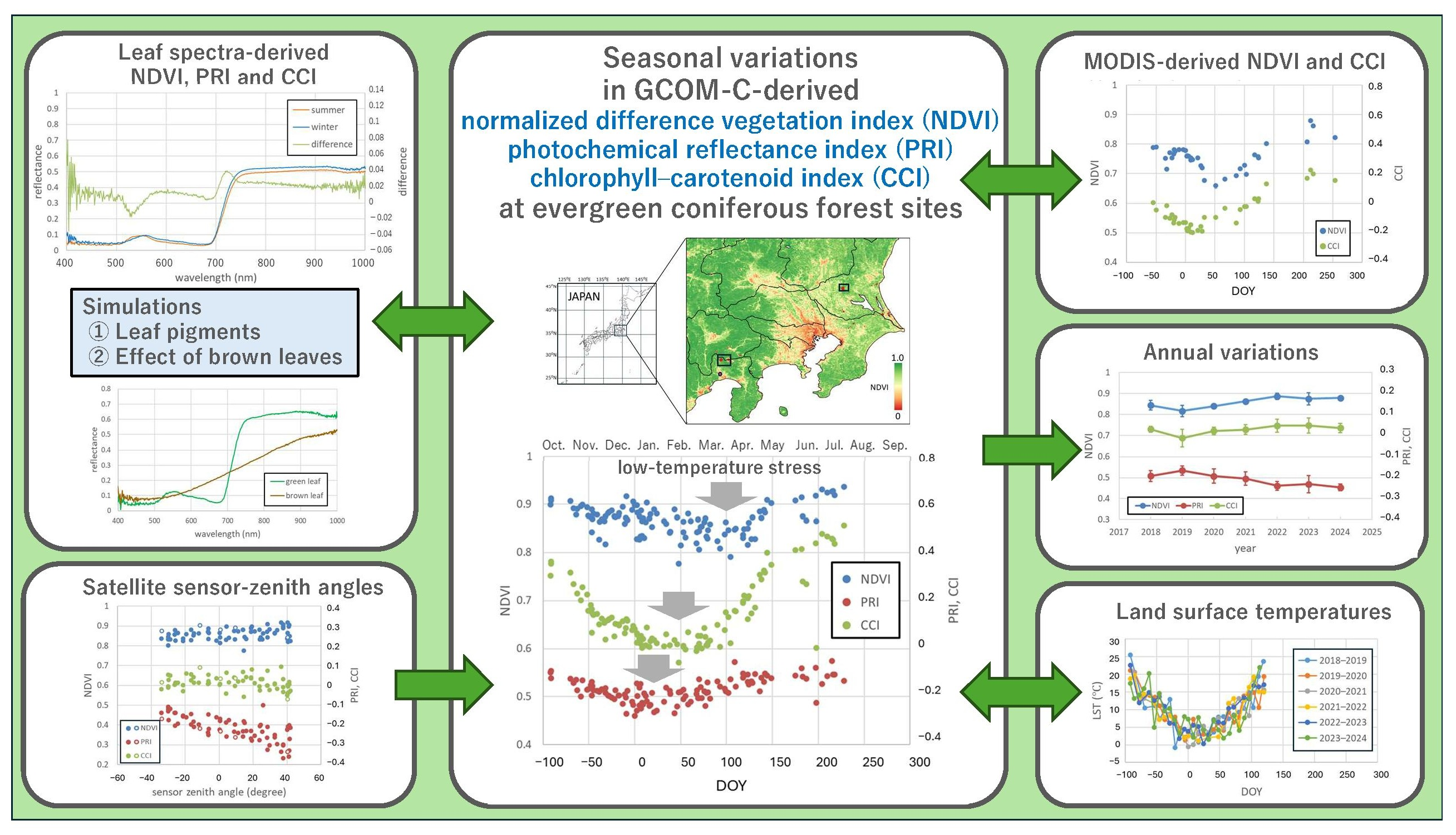
Graphical Abstract

1. Introduction

Monitoring forests is crucial for assessing the long-term impact of large-scale environmental changes such as climate change. Seasonal changes (phenology) in forests are primarily monitored using various vegetation indices (VIs), which are derived from reflectance at specific wavelengths. The normalized difference vegetation index (NDVI) is a representative vegetation index for monitoring seasonal changes in chlorophyll content. As VIs focus on pigments other than chlorophyll, the photochemical reflectance index (PRI) [1,2,3], which serves as an indicator of carotenoid content, and the chlorophyll–carotenoid index (CCI) [1,4,5,6], used as an indicator of the ratio of chlorophyll to carotenoid content, are employed in numerous studies.
These indices are primarily derived from reflectance data obtained from fixed cameras installed on towers or building rooftops within forest monitoring sites, or from earth observation satellites. Monitoring targets are mainly deciduous forests, which exhibit significant variations in NDVI during leaf expansion and autumn leaf fall. On the other hand, evergreen forests allow for leaf observation even during winter, making them an important observation target that complements the monitoring of deciduous forests. In Japan, approximately half of forests are evergreen coniferous forests, most of which are planted forests consisting of species such as Japanese cedar and Japanese cypress, distributed throughout the country. The Pacific coast region in Japan is considered suitable for forest monitoring, especially in winter, because it is less affected by snow and there are many clear days. Long-term monitoring targeting monoculture evergreen forests would allow for more accurate detection of climate change impact.
In evergreen forests, since NDVI seasonal variations are small except during periods of new leaf expansion or flowering, monitoring is usually conducted using combinations of other indices like PRI or CCI [4,5,6]. PRI was proposed by Gamon et al. [7]. It utilizes reflectance around 531 nm, where carotenoid absorption is greater than chlorophyll absorption, and reflectance around 570 nm, a wavelength range where both absorptions are low. This makes PRI highly sensitive to changes in the leaf carotenoid contents. PRI is also widely used as a simple method of evaluating photosynthetic activity from spectral measurements. Correlations among PRI, pigment contents and photosynthetic activities have been evaluated in both deciduous and evergreen trees in many studies [8,9,10,11,12,13].
As carotenoid-related phenology, long-term variations are known to occur, where the carotenoid content within the pigment pool in leaves increases over several months [14]. These seasonal variations are believed to primarily serve as a defense mechanism against environmental stresses, such as the low-temperature conditions of winter in northern forests or the drought conditions of the dry season in semi-arid regions. Particularly under low winter temperatures, when photosynthetic function significantly declines, strong light stress occurs due to sunlight absorption. Carotenoids play a crucial defensive role here: by increasing their concentration within the pigment pool, they suppress the absorption of sunlight by chlorophyll and further scavenge reactive oxygen species and radicals generated by excess energy.
PRI has been used in numerous studies as an indicator for detecting seasonal variations in carotenoid contents [14,15,16]. Gamon et al. [17] observed diurnal and seasonal variations in VIs for both evergreen and deciduous trees, demonstrating that PRI is most strongly influenced by changes in the size of the chlorophyll–carotenoid pool. It is also known that a decrease in chlorophyll content occurs in parallel with an increase in carotenoid content, causing variations in the carotenoid-to-chlorophyll ratio [18,19]. This phenomenon corresponds to the yellowish-green coloration of evergreen leaves in well-lit areas during winter, in which coloration recovers in spring. This is considered a generally observed phenomenon in evergreen trees, regardless of species.
For long-term monitoring of phenology and pigment content variations across wide areas, satellite-based observations are most suitable. For example, satellite data from the Moderate Resolution Imaging Spectroradiometer (MODIS) sensor aboard the Aqua/Terra satellites, the Second-generation Global Imager (SGLI) sensor aboard the Global Change Observation Mission-Climate (GCOM-C) satellite [1,20,21,22] and the Advanced Himawari Imager (AHI) sensor aboard the Himawari-8 satellite [23,24] have been used for this purpose. Numerous studies utilize MODIS, which have been in operation for an extended period, particularly from 2000 to the present [25,26,27]. While the MODIS sensor has a Band around 530 nm, it lacks a Band around 570 nm. Therefore, carotenoid-related index is usually calculated using Band 11 (531 nm) and Band 8 (red), and is referred to as MODIS-derived PRI or MODIS-derived CCI (hereinafter referred to as MODIS-derived CCI). Observations of seasonal variations using MODIS-derived CCI have been extensively studied, primarily for detecting the timing of leaf expansion and leaf fall in deciduous trees [28,29,30]. Ishihara et al. [31] found that the timings of leaf expansion determined by both the spectral-derived PRI and MODIS-derived CCI were consistent.
Studies using MODIS-derived CCI targeting evergreen forests have primarily focused on northern needleleaf forests [32]. Ulsig et al. [33] observed a regular winter decrease in MODIS-derived CCI over more than 20 years using a MODIS dataset processed with MAIAC (multi-angle atmospheric correction) in Finnish coniferous forests. They derived the start and end dates of the growing season from the CCI and NDVI time series. Gamon et al. [34] derived CCIs from both leaf reflectance spectra and MODIS data in Canadian forests. They observed long-term winter decreases in PRI values in both evergreen and deciduous trees, reporting good correlation between both CCIs and that MODIS-derived CCI values fluctuate in agreement with gross primary productivity (GPP) changes derived from leaf gas exchange measurements. Wong et al. [35] reported that CCI variations in northern needleleaf forests comprise three types: diurnal variations attributable to the xanthophyll cycle, seasonal variations in the carotenoid-to-chlorophyll ratio within the pigment pool, and variations during the severe winter when temperatures drop below 0 °C.
Liu et al. [36] compared spectral-derived CCI with MODIS-derived CCI at 84 flux observation sites encompassing various vegetation types, suggesting CCI is useful for evaluating seasonal variations in photosynthetic efficiency under different meteorological conditions. Studies using MODIS data have also been conducted on semi-arid forests, examining the reduction in GPP and the accompanying decrease in CCI due to dry-season drought stress [37,38,39,40,41]. Garbulsky et al. [42] tracked the seasonal changes in MODIS-derived CCI and found a good correlation to radiation use efficiency (RUE) in Mediterranean forests.
GCOM-C has been providing global observation data since 2018. It possesses both bands near 530 nm and 570 nm, enabling the monitoring of both PRI and CCI. It also features a wide swath width (1150 km), high observation frequency (approximately once every two days), and higher land-surface resolution (250 m) than MODIS. Li et al. [20] proposed the normalized difference greenness index (NDGI) derived from GCOM-C data, demonstrating its superiority to MODIS in detecting the onset and end of growth periods at forest monitoring sites in the United States and Europe. Regarding studies using both PRI and CCI, Sasagawa et al. [1] compared seasonal variations at four Phenology Eyes Network (PEN [43]) forest sites with GCOM-C data, demonstrating that CCI showed better agreement than PRI. Mizuno et al. [21] reported that the growth onset for non-evergreen plants was earlier in 2023 and 2024 due to the effects of high temperatures, based on both monitoring results at PEN sites and GCOM-C data. While some studies have used GCOM-C data to monitor forests, no research has yet examined seasonal variations in PRI and CCI in evergreen forests under low-temperature conditions during winter. While MODIS has been operating for an extended period far beyond its design lifespan, GCOM-C is expected to continue operating for a long time and be utilized in numerous studies, particularly for monitoring the impacts of climate change.
This study aims to investigate the characteristics of the GCOM-C-derived indices for monitoring seasonal changes in evergreen forests during winter. At two evergreen conifer forests in the temperate zone in Japan, seasonal variations in GCOM-C-derived NDVI, PRI and CCI were analyzed from 2018 to 2024 and compared to MODIS-derived CCI and NDVI. The difference among GCOM-C-derived VIs and MODIS-derived VIs was analyzed, and the usefulness of the GCOM-C-derived PRI and CCI was discussed. Additionally, VIs derived from leaf-level spectral measurements collected at the site were also analyzed to confirm that a similar winter decrease in VIs occurs as with satellite-derived VIs. Variation in pigment contents was simulated and the differences between spectral-derived VIs and satellite-derived VIs were analyzed.

2. Materials and Methods

2.1. Monitoring Sites

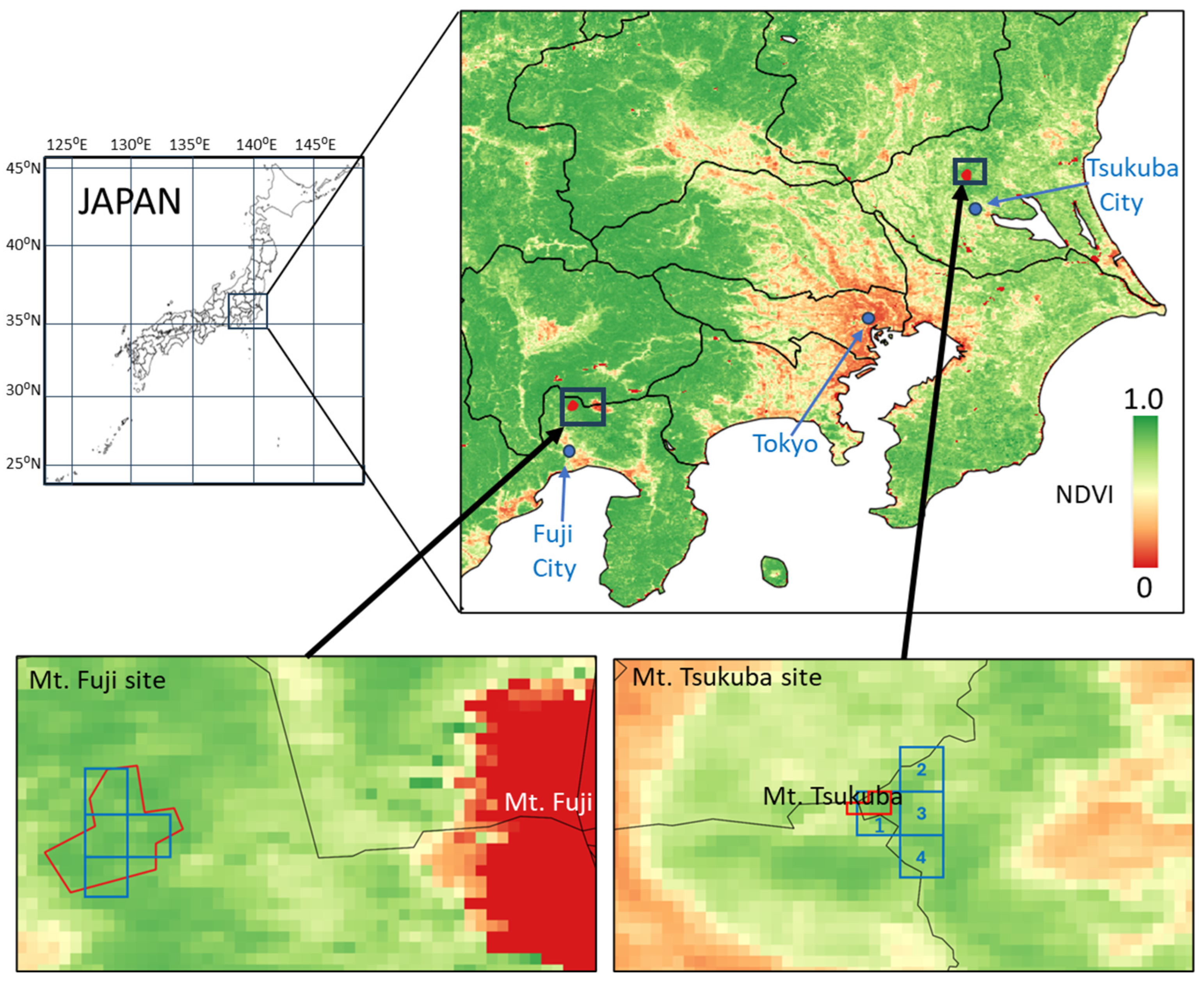
As forest monitoring sites, uniform monoculture forests are desirable. In this study, Japanese cypress (Chamaecyparis obtusa) plantations were selected from national forests where tree species could be confirmed using the forest registry [44]. Among these forests, relatively large plantations that are not covered by snow during winter were targeted: plantations on the slopes of Mount Tsukuba and Mount Fuji (Figure 1).
(1)
Mount Tsukuba site (36°14′ N, 140°07′ E): elevation 500–600 m a.s.l, east-facing slope (25% gradient), area 1 km × 500 m, number of pixels 6 (GCOM-C) and 4 (MODIS), tree age 102–107 years
(2)
Mount Fuji site (35°23′ N, 138°38′ E): elevation 800–1100 m a.s.l, west-facing slope (11% gradient), area 2 km × 2 km, number of pixels 74 (GCOM-C) and 4 (MODIS), tree age 24–64 years
At the Mount Tsukuba site, for MODIS, a larger area than GCOM-C is targeted to secure multiple pixels. At the Mount Fuji site, the areas of both sites are nearly the same. Since air temperature data at the sites were unavailable, daily average temperature data at the nearest meteorological observation points of Japan Meteorological Agency to the sites—Tsukuba City point (36°03.4′ N, 140°07.5′ E, 25.2 m a.s.l, 19 km south of Mount Tsukuba site) and Fuji City (35°11.1′ N, 138°39.8′ E, 66 m a.s.l, 20 km south of Mount Fuji site) [45]—were used to evaluate the correlation with VIs. Daily average temperature and total solar radiation data at the meteorological monitoring points in Tokyo (35°41.5′ N, 139°45.0′ E, 25.2 m a.s.l), located roughly midway between the two sites, were also used to evaluate the relationship of the variations in VIs with variations in temperature and total solar radiation.
For the GCOM-C observation areas, forests identifiable as Japanese cypress forests based on the national forest registry listing tree species were selected at both sites. For MODIS, the same observation area was used at the Mount Fuji site; however, since one MODIS pixel covers an area 16 times larger, the actual observation covers the four pixels shown in Figure 1. Although the pixel counts differ significantly from the 74 pixels for GCOM-C, the observation areas are nearly identical at the Mount Fuji site. Furthermore, the areas surrounding the national forest land consist of evergreen coniferous forests owned by local governments or private entities, with similar topography. It has been confirmed that even during winter, these areas exhibit NDVI values as high as those within the observation area. Therefore, it is considered that GCOM-C and MODIS are observing the same vegetation.
The Mount Tsukuba site has a smaller area of national forest compared to the Mount Fuji site. While GCOM-C observation area was defined as 6 pixels, this corresponds to only 1 pixel on MODIS. To mitigate the high variability that would result from observing just 1 pixel, 4 pixels encompassing the surrounding evergreen coniferous forests (municipal and privately owned forests) were targeted. In Japan, planted forests are highly fragmented, so it is considered meaningful to include such small forests in observation sites.

2.2. Vegetation Indices

Vegetation indices (VIs) including NDVI, PRI, and CCI were evaluated to analyze seasonal changes in evergreen forests. Each index is generally calculated using Equations (1)–(3).
N D V I = ρ ( N I R ) ρ ( r e d ) ρ N I R + ρ ( r e d )
P R I = ρ ( 531 ) ρ ( 570 ) ρ 531 + ρ ( 570 )
C C I = ρ ( 531 ) ρ ( r e d ) ρ 531 + ρ ( r e d )
Here, ρ (λ) indicates the reflectance at wavelength λ nm. In NDVI, the red band typically uses the red wavelength range around 680 nm, while the NIR band uses the near-infrared wavelength range around 800 nm to 900 nm. For calculating each index from GCOM-C data, the band closest to each wavelength range in Equations (1)–(3) was selected (see Section 2.4). However, for MODIS, since there is no band close to 570 nm, only NDVI and CCI were calculated (see Section 2.5). When calculating each index from the reflectance spectra of leaves collected at a monitoring site, the average reflectance values in the same wavelength bands as GCOM-C were used (see Section 2.3).

2.3. Leaf-Level Measurements of Reflectance Spectra and Simulation

To confirm that seasonal variations in VIs similar to satellite observation results are observed in the leaves at the observation site, the leaf-level spectra were measured and spectra-derived VIs were compared to satellite-data-derived VIs. At the Mount Tsukuba site, twenty leaves of Japanese cypress (Chamaecyparis obtusa) were collected from the outermost leaves within 3 m above ground level. For leaf sampling, leaves were collected from trees in well-lit areas with conditions similar to the canopy, but the sunlight conditions were not identical to those in the canopy. Leaf characteristics (pigment content, size, thickness, etc.) can vary between the canopy and areas closer to the ground. However, since the pigments constituting the leaves are considered equivalent, measurements were performed assuming that the same mechanism for mitigating low-temperature stress occurs even in leaves collected from lower, accessible positions.
The reflectance spectra were measured using the ASD FieldSpec HandHeld2 spectrometer (Analytical Spectral Devices, Inc., Boulder, CO, USA; measurement wavelength range: 325–1075 nm; wavelength resolution: ≤3 nm) and a leaf clip. Leaves collected were measured for their spectra in the laboratory within five hours of collection. Calibration was performed using a white reflectance standard. Since Japanese cypress leaves are flat and scale-like, they were measured in the same manner as broadleaf tree leaves. Black paper with near-zero reflectance was placed beneath the leaves inside the leaf clip. Twenty samples were measured in a single session. For each sample measurement, a single 6.8-millisecond scan was repeated 100 times and integrated. The NDVI, PRI and CCI were calculated using Equations (1)–(3) from measured spectra, and the average of twenty measurements was obtained. Measurements were conducted four times from September 2021 to April 2022.
In this study, two types of simulations were conducted using the measured spectra. The first simulation estimated pigment contents. To confirm that seasonal variations in VIs are correlated with changes in leaf pigment contents, direct chemical analysis of pigment contents is desirable, but here pigment contents were estimated from leaf-level spectra using the simulation program PROSPECT. This program is a radiation transfer model developed by Jacquemoud et al. [46], covering the wavelength range of 400–2500 nm, and estimates parameters including the leaf structure index (N), leaf chlorophyll content (CHL µg/cm2), leaf carotenoid content (CAR µg/cm2), brown pigment content (BROWN µg/cm2), equivalent water content (EWT, g/cm2), and leaf mass area (LMA, g/cm2). R package of PROSPECT-D model [47] was utilized, which incorporates anthocyanins content (ANT, µg/cm2) as an additional parameter. Although the program includes an inverse model that calculates parameters from both reflectance and transmittance spectra, since only reflectance spectra were measured in this study, parameters were derived using the curve-fitting method. In this model, each parameter has an effect on the spectrum that is largely confined to the wavelength range shown below; therefore, they can be independently determined through fitting within the range. The parameters were determined such that the difference between the calculated and measured spectra was minimized in the wavelength regions.
Leaf structure parameter (N); 800–900 nm.
Chlorophyll a + b (CHL); 690–720 nm.
Carotenoids (CAR); 510–540 nm.
Anthocyanins (ANT); 560–600 nm.
Since LMA data for Japanese cypress was unavailable, measurement data for Sawara cypress (Chamaecyparis pisifera), which belongs to the same cypress family and collected at the University of Tokyo’s Yayoi Campus (35°43′ N, 139°46′ E, 23 m a.s.l.), was used. LMA was measured directly from dried leaves, which were stored in a dry oven at 80 °C for 72 h.
The second simulation modeled the calculation of VI from satellite data when dead leaves are mixed within the canopy. To estimate the effect of dead/degraded leaves among canopies in satellite-data-derived VIs, VIs were simulated using both spectra of healthy green leaves and brown leaves. The simulation assumed that the canopy contained a mixture of brown and green leaves, and that its reflectance spectrum could be represented as a linear combination of the pure spectra of both colors multiplied by their respective ratios. The canopy spectra were calculated according to Equation (4), and the VI values were then calculated from that spectra. Assuming that the entire canopy contains brown leaves (BL) at a proportion of a and green leaves (GL) at a proportion of (1 − a), VIs were simulated based on measurement spectra and Equation (4), varying the proportion of BLs from 0 to 0.2.
ρ ( w ) = a · ρ BL ( w ) + ( 1 a ) · ρ GL ( w )
ρBL(w) denotes the reflectance from BL at wavelength w, while ρGL(w) denotes the reflectance from GL. The spectrum of brown leaves was measured from collected leaves in winter.

2.4. Calculation of GCOM-C-Derived VIs

For GCOM-C data, Level-2 land-surface-reflectance data corrected for the effects of atmospheric scattering absorption were used from January 2018, when the data became available, through June 2024 [48]. (The specifications of the GCOM-C satellite and the products used in this study are shown in Table S1. Additionally, Table S3 lists all observation dates.) Only data from observation days with no clouds over all pixels at the sites were used and calculated each index using Equations (5)–(7).
N D V I = ρ ( V N 11 ) ρ ( V N 08 ) ρ V N 11 + ρ ( V N 08 )
P R I = ρ ( V N 05 ) ρ ( V N 06 ) ρ V N 05 + ρ ( V N 06 )
C C I = ρ ( V N 05 ) ρ ( V N 08 ) ρ V N 05 + ρ ( V N 08 )
The wavelength ranges for each band are as follows: VN05: 530 nm ±10 nm, VN06: 565 nm ± 10 nm, VN08: 673.5 nm ± 10 nm, VN11: 868.5 nm ± 10 nm [49] (Figure S1a). For evaluating the correlation between the seasonal variation in each index and air temperature of the forest sites, since no meteorological data was measured at the sites, land surface temperature (LST) at each site was used. LST data utilized the Level-2 8-day-statistics data from GCOM-C [50].

2.5. Calculation of MODIS-Derived VIs

MODIS features multiple narrow Bands across the visible spectrum. (The specifications of the MODIS sensor and the products used in this study are shown in Table S1. Additionally, Table S4 lists all observation dates.) Band-11 (526–536 nm) is optimal for evaluating VIs related to carotenoid contents. Since there is no band near 570 nm, only CCI was calculated using Band-1 (620–670 nm) as the reference. The MAIAC MCD19A1 v6 dataset, which contains Bands-1, -2 and -11 [51], was used. This dataset uses data from four to sixteen days before and after the observation date to minimize the impacts of clouds and aerosols. The land surface resolution was 1 km × 1 km due to the resolution of band-11. Although MODIS has accumulated data since 2000, only data from January 2018 to May 2024 were used for comparison with GCOM-C-derived VIs. Only data with no clouds in any of the pixels at the target sites were used and calculated each index using Equations (8) and (9).
N D V I = ρ ( B a n d 2 ) ρ ( B a n d 1 ) ρ B a n d 2 + ρ ( B a n d 1 )
C C I = ρ ( B a n d 11 ) ρ ( B a n d 1 ) ρ B a n d 11 + ρ ( B a n d 1 )
The wavelength ranges of each Band are as follows; Band-1: 645 nm ± 25 nm, Band-2: 858.5 nm ± 17.5 nm, Band-11: 531 nm ± 5 nm [52] (Figure S1b). Band-1 and Band-2 have broader spectral bandwidths and are shifted slightly toward shorter wavelengths compared to the corresponding bands in the GCOM-C/SGLI sensor. For Band-11, while the center wavelength is the same, the wavelength range is slightly narrower.

3. Results

3.1. Spectral-Derived VIs in Leaf-Level Measurement

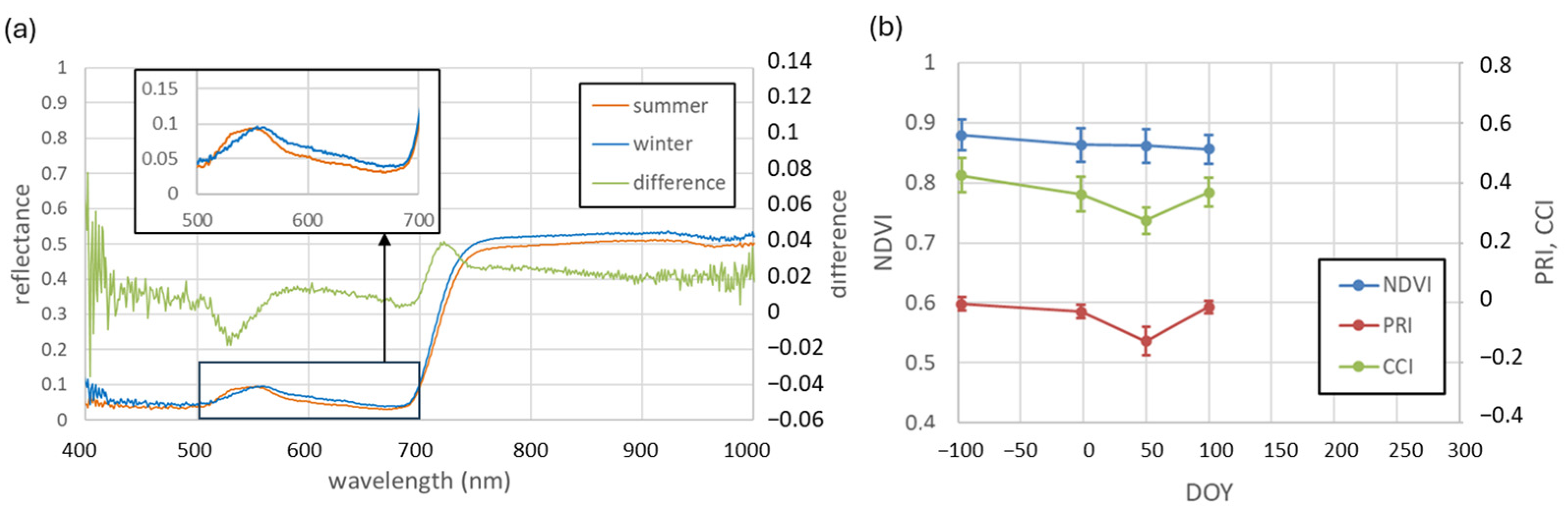
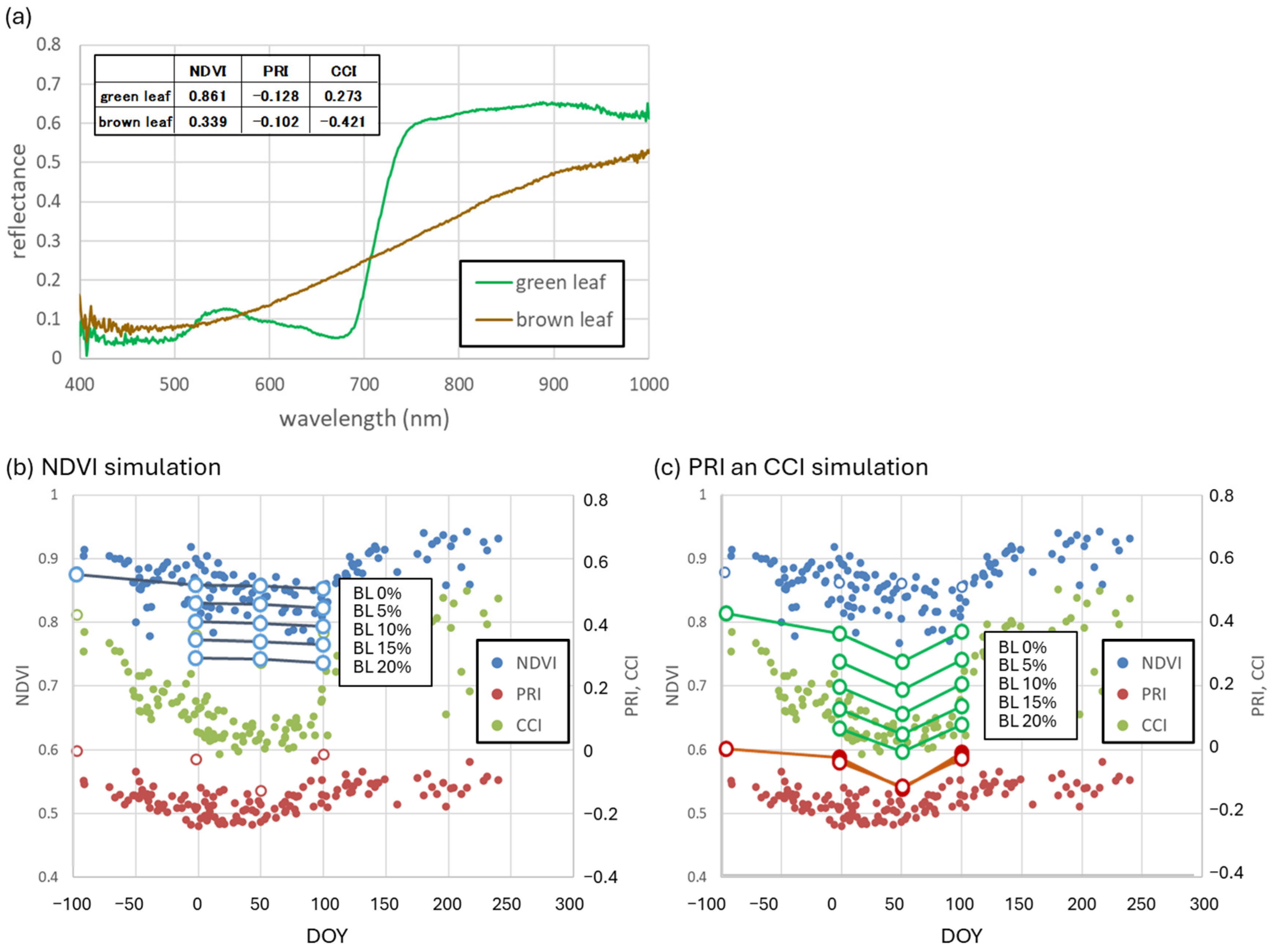
The spectra and their differences in summer (September 2021) and winter (February 2022) for Japanese cypress leaves collected at the Mount Tsukuba site are shown in Figure 2a. In winter, reflectance decreases around 530 nm, which is thought to be due to increased carotenoid content. PRI and CCI using this wavelength range are found to be optimal indices for evaluating seasonal changes in carotenoid content. Reflectance significantly increased around 720 nm, as well as increasing around 570–680 nm, which is thought to be due to decrease in chlorophyll content. While using reflectance around 720 nm is optimal for monitoring seasonal changes in chlorophyll content, it is evident that NDVI using the red bands of both satellites can also sufficiently evaluate seasonal variations. In the near-infrared region, the small dip around 950 nm is attributed to water absorption, and the magnitude of this dip shows no significant change between summer and winter. This suggests that there was no major change in leaf water content.
Additionally, decrease in reflectance in winter was observed in the near-infrared region around 750–1000 nm, suggesting some change in the leaf surface. The amount of the decrease shows significant dispersion depending on the measured leaves. Regarding differences in leaf moisture contents, the dip in water absorption around 950 nm shows no significant dispersion, and it does not affect other wavelength regions. Similar dispersion is observed in the NIR region even during summer, suggesting that changes in cell structure due to low winter temperatures are not the primary cause of dispersion. Physical damage or contamination may be possible causes. However, when calculating NDVI values, the dispersion becomes small, approximately 3% of the NDVI value, so no further discussion is pursued. In contrast, the changes observed in the visible light region described above showed little dispersion between leaves, with the same changes observed in all leaves.
The seasonal variation in each index from September to April of the following year is shown in Figure 2b (the observation dates and data values of mean and standard deviation are also shown in Table S2). Although the data is limited, the decreases in PRI and CCI values during winter are observed. NDVI values also show a gradual decrease. This suggests that, as a mechanism to mitigate light stress under low temperatures, increases in carotenoid content and decreases in chlorophyll content occur simultaneously [18,19].
Table 1 shows PROSPECT-D simulation results (an example of the calculated spectrum is shown in Figure S2). To confirm that the seasonal changes in pigment content observed in other cypress (Cupressaceae) family trees also occur in Japanese cypress collected at the Mount Tsukuba site, simulation results for two reference trees are also indicated. In Japanese cypress, chlorophyll content decreased by 4.4 μg/cm2 during winter, while carotenoid content increased by 19.1 μg/cm2. The chlorophyll-to-carotenoid ratio is approximately 1/2. This result is considered plausible as a mechanism for mitigating winter cold stress. (Changes in molar ratios were discussed in Section 4.4, compared with existing studies on northern forests.) Anthocyanin content also increases, and it is presumed to serve a role similar to that of carotenoids. The results for Japanese cypress are noted to be similar to the simulation results for Sawara cypress. On the other hand, for Chinese arborvitae, the decrease in carotenoid content was smaller. This is presumed to be due to reduced solar radiation received by the trees during winter, likely caused by being shaded by buildings or other trees. Although the simulation results for Japanese cypress do not directly measure pigment content, they are considered to provide important insights for examining the seasonal variations in the VI values derived from satellite data.

3.2. GCOM-C-Derived VIs

3.2.1. Seasonal Variations in VIs

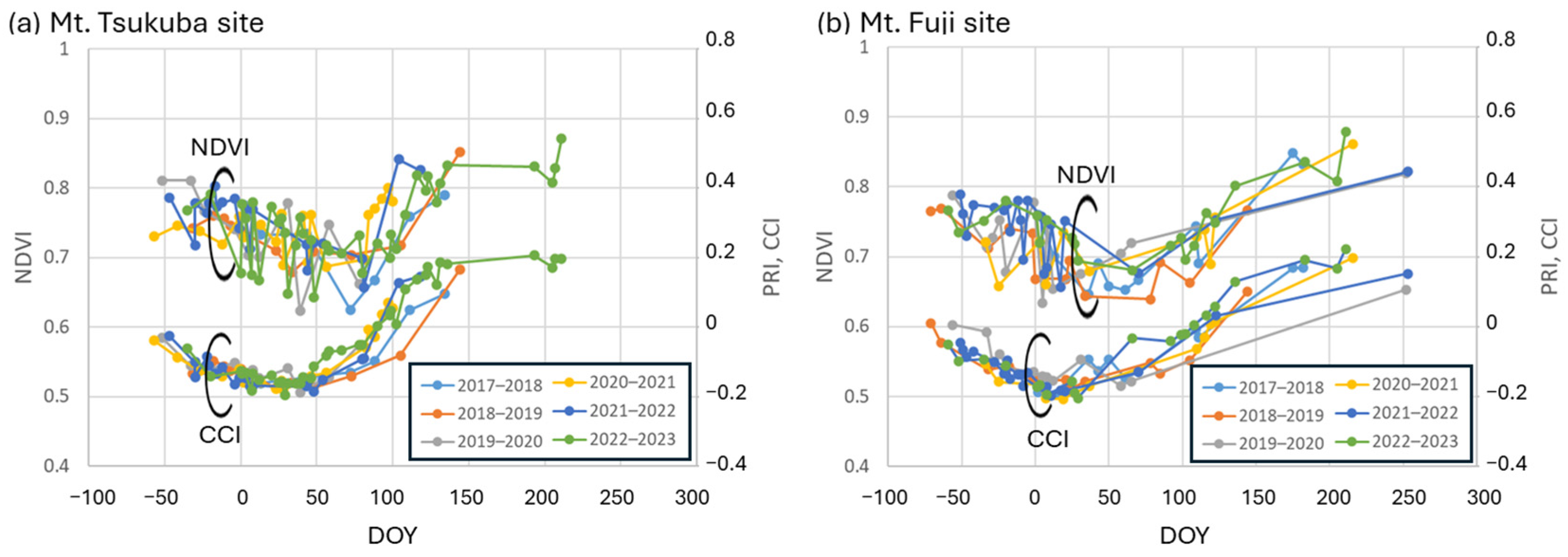
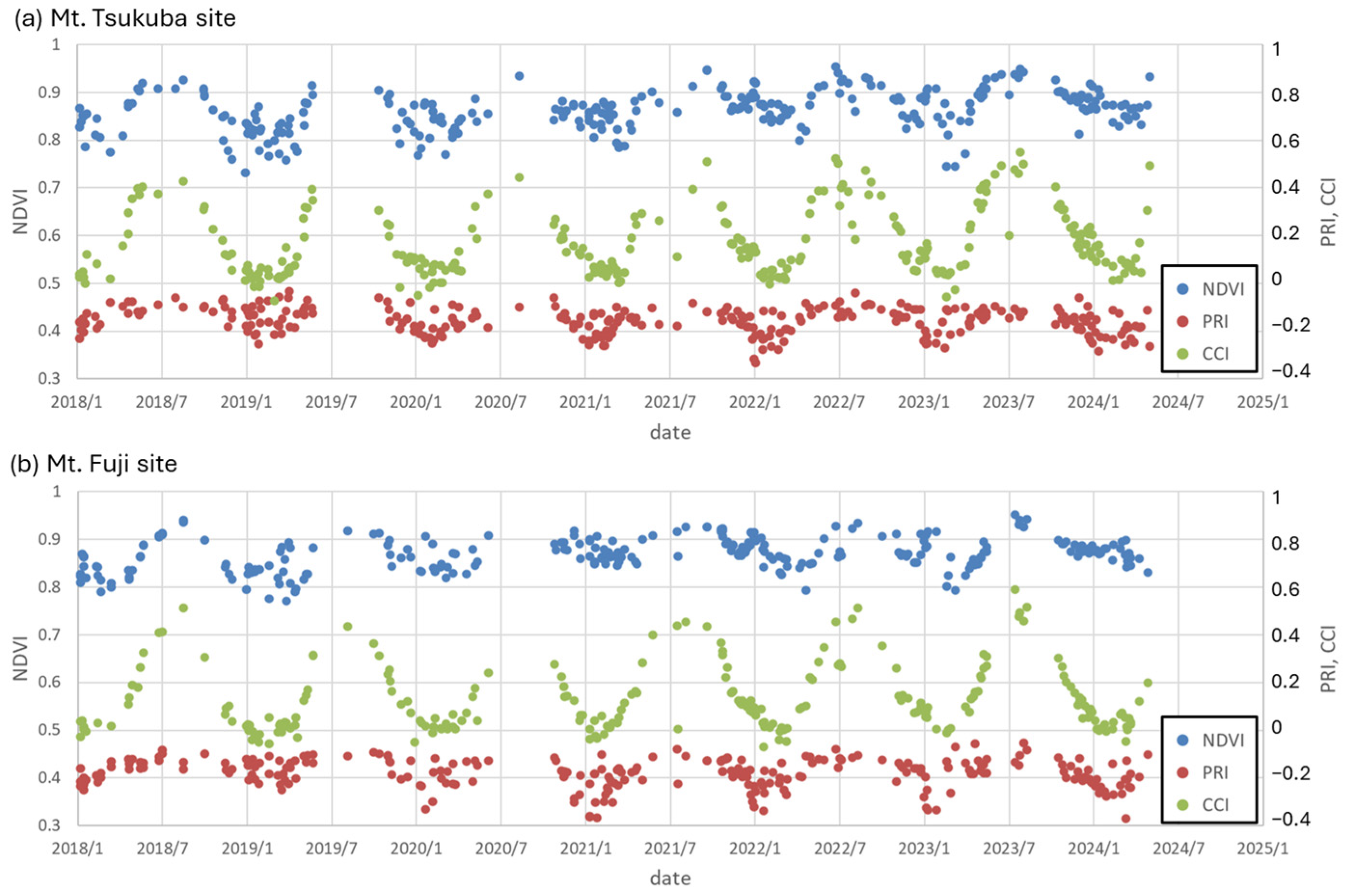
The seasonal changes in GCOM-C-derived VIs at each site from 2018 to 2024 are shown in Figure 3a,b (all observation dates are listed in Table S3). NDVI shows a gradual decrease from around November to April. PRI also decreases from around November to mid-January, then gradually recovers, though it exhibits significant dispersion depending on the observation date. CCI exhibits larger decline and small dispersion compared to PRI, reaching its lowest value around mid-February.
Both sites show nearly identical behavior for each index, with similar declines in magnitude. However, some PRI data at Mount Fuji site indicate significantly lower values. During the hot summer months, because Japan is surrounded by sea, high humidity promotes cloud formation. Consequently, observational data decreases significantly, and there have been observation years when almost no data could be obtained. Therefore, it is difficult to assess the trend of summer VIs based on the observational data. Therefore, this study focused on the seasonal changes from autumn to spring.
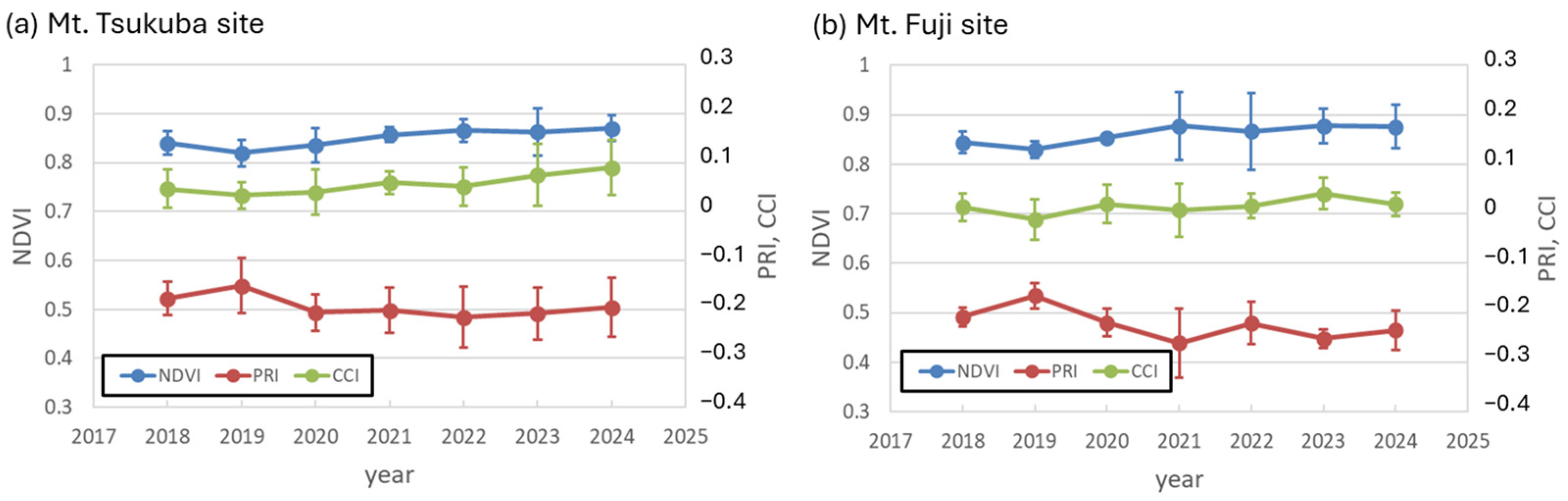
During this observation period, the timing at which each indicator reached its lowest value was nearly identical across observation years, but the lowest values of each VI varied from year to year. Figure 4 shows the annual variation in average VI values in winter (January and February) for both sites. NDVI and CCI have shown a gradual increase since 2019, while PRI has not shown a clear trend. The factor considered to have the greatest impact on VI variation is air temperature. Since air temperature data are unavailable for these sites, the correlations of each average VI values in winter to both GCOM-C derived LSTs and air temperature data obtained at the nearest meteorological observation points during the same period were analyzed (Figures S3–S5). LSTs and air temperatures have decreased since 2020 and increased in 2024. A correlation is observed between the two data (Mount Tsukuba site: R2 = 0.087, Mount Fuji site: R2 = 0.50). In average VI values in winter, the correlation with LSTs was weak, with all R2 values below 0.1. Similarly, all R2 values between VIs and air temperatures were below 0.2. To analyze the correlation with temperature accurately, longer-term observations of both VI variations and air temperature data at the sites are required.
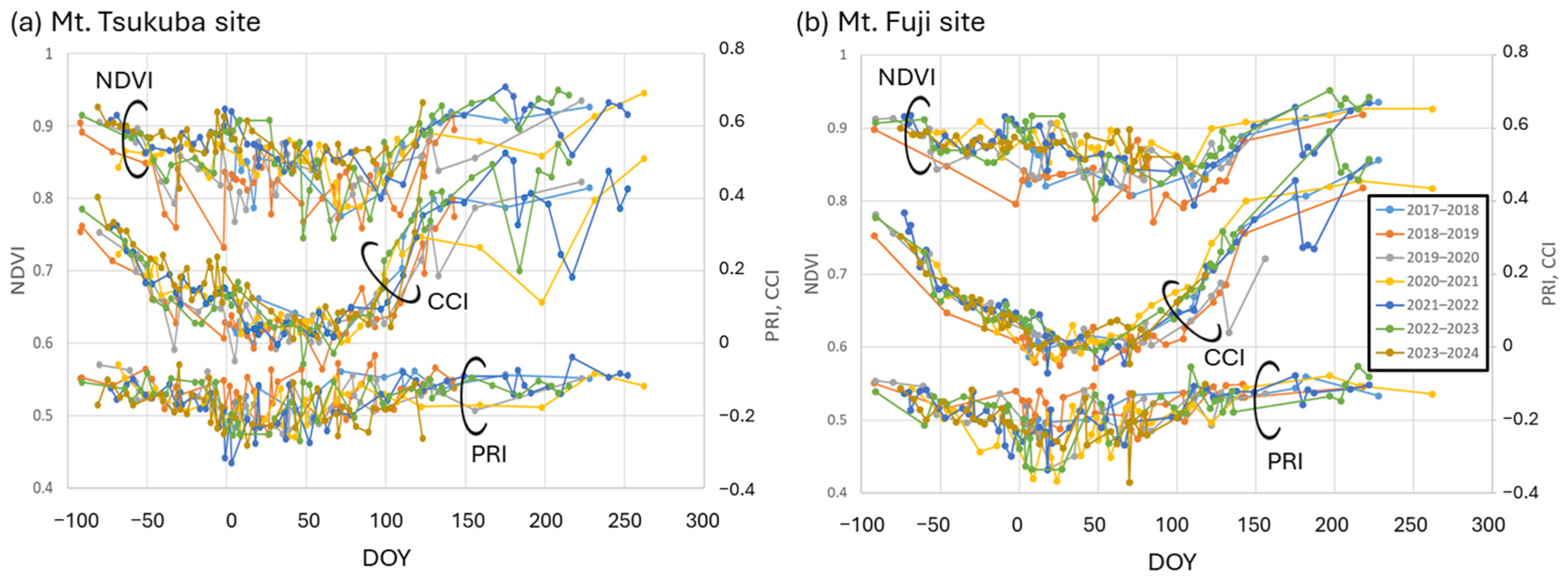
To clarify the winter decreases in VIs and to compare them between the two sites, the same data as Figure 3 were plotted in Figure 5, with the horizontal axis spanning from October to September of the following year, overlaying data from each year. While the changes appear to be largely similar each year, it is evident that NDVI and PRI exhibit particularly large dispersions depending on the observation date. CCI shows smaller dispersions than NDVI and PRI, demonstrating a clear decrease and recovery. Comparing both sites, it is evident that the Mount Fuji site shows less dispersion. This is likely because the Mount Fuji site covers a larger target area, resulting in a greater number of observation pixels. Averaging these pixels reduces the dispersion.
Seasonal variations in NDVI are considered nearly identical at both sites. In PRI, the Mount Fuji site shows slightly lower values, but with greater dispersions. Accumulating more data and reducing dispersions are necessary to evaluate this difference. In CCI, the maximum amount of decrease is nearly the same, but the Mount Fuji site tends to show an earlier onset of decrease and a later recovery. This is presumed to be due to differences in meteorological conditions. The correlation with LSTs at each site is discussed in the Discussion chapter. In summer, fluctuations of VIs, particularly the large dispersion in CCI values, are primarily attributed to the limited number of observations. Other factors include reduced accuracy of observational data due to atmospheric aerosols, variations in new leaf growth between observation years, and the impact of extreme heat on forests. By conducting longer-term observations at more observation sites, it should also be possible to analyze the seasonal variations in VIs throughout the year.

3.2.2. Dependence on Sensor Zenith Angles

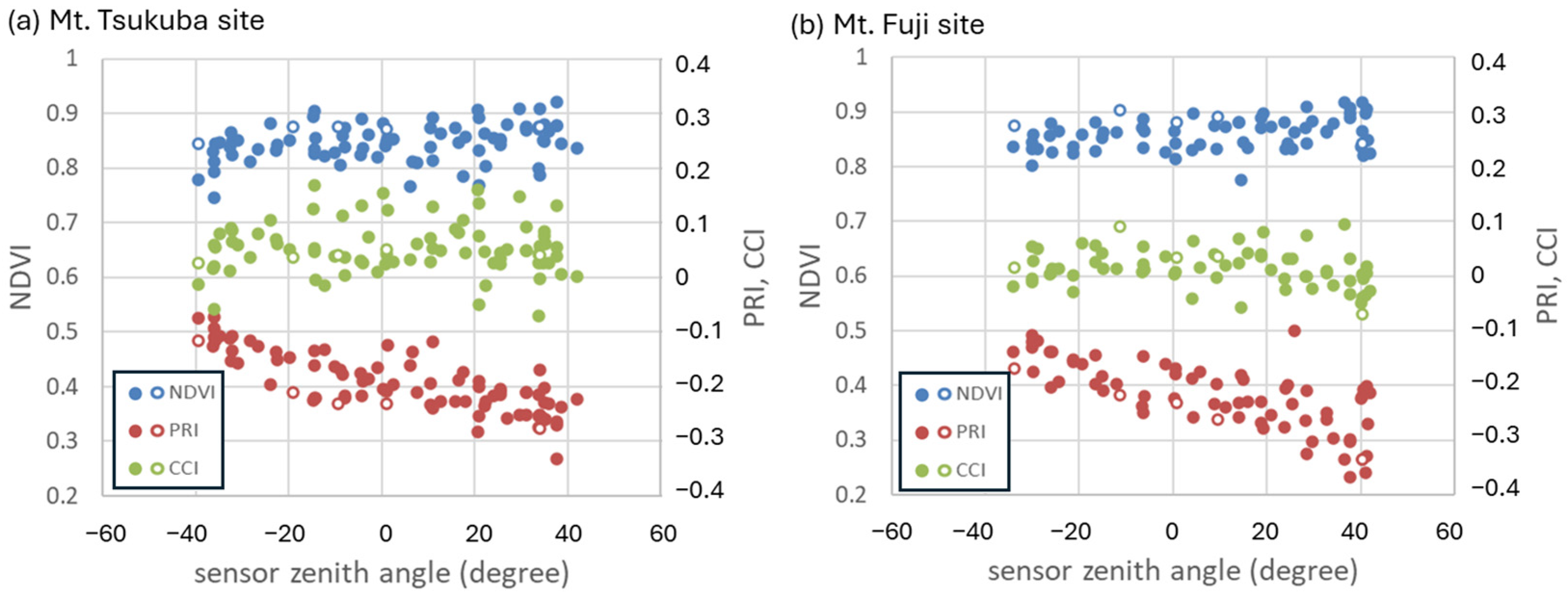
GCOM-C has a wide observation swath of 1150 km, and the sensor zenith angle (SZA) can reach up to 40 degrees at the edges of the observation area. Therefore, SZA may affect the reflectance of each band. Figure 6 show the dependence of each VI on SZA for January and February (2018–2024), when VI variations are small for both sites. NDVI and CCI values remain constant within an SZA of 20 degrees, but fluctuations are observed beyond this range. In contrast, PRI values show a clear SZA dependence at both sites, meaning that the PRI decreases as the observation site moves westward from the satellite’s nadir position and increases as it moves eastward.
On five observations during a short period (14–22 January 2022) with minimal vegetation change, the SZA dependence of the reflectance values in bands VN05 and VN06, used in PRI calculations were analyzed (Figure S6a,b). The results show that VN06 exhibits larger dependence on SZA than VN05, suggesting that this is a contributing factor to the fluctuations in PRI measurements across observation dates.
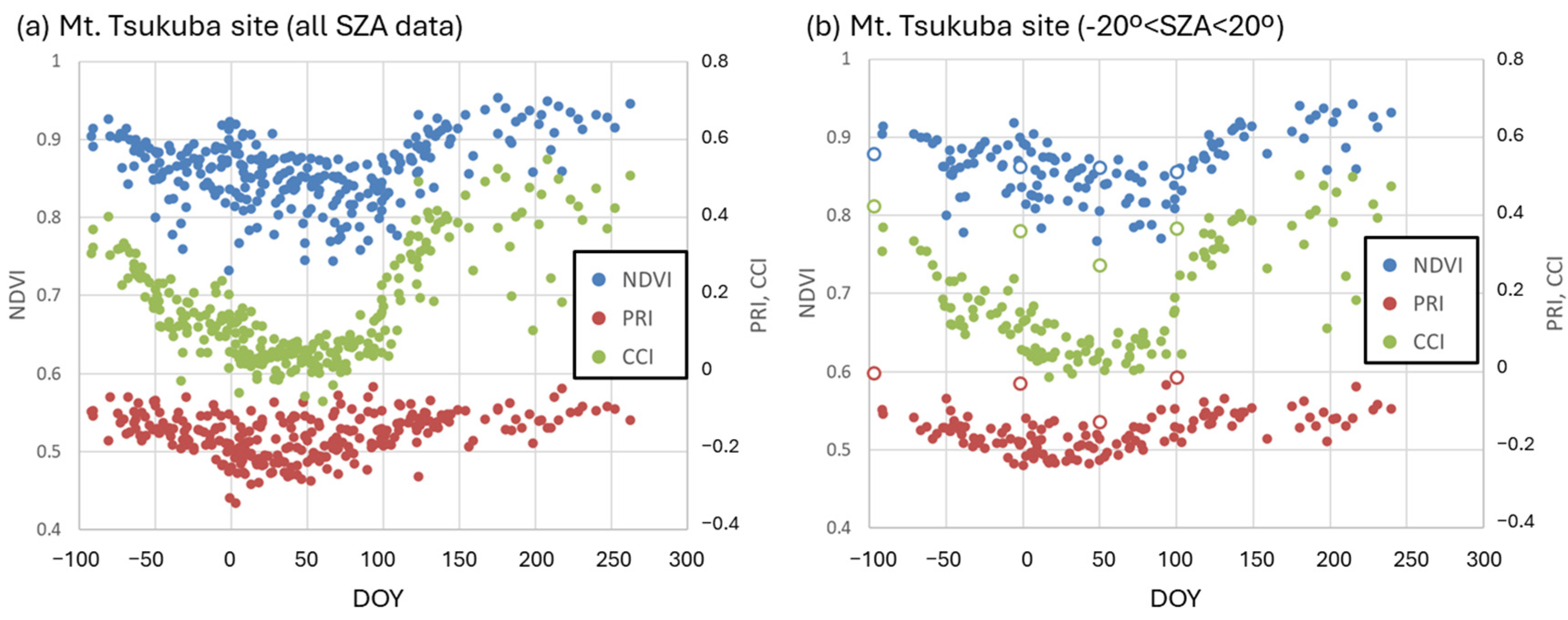
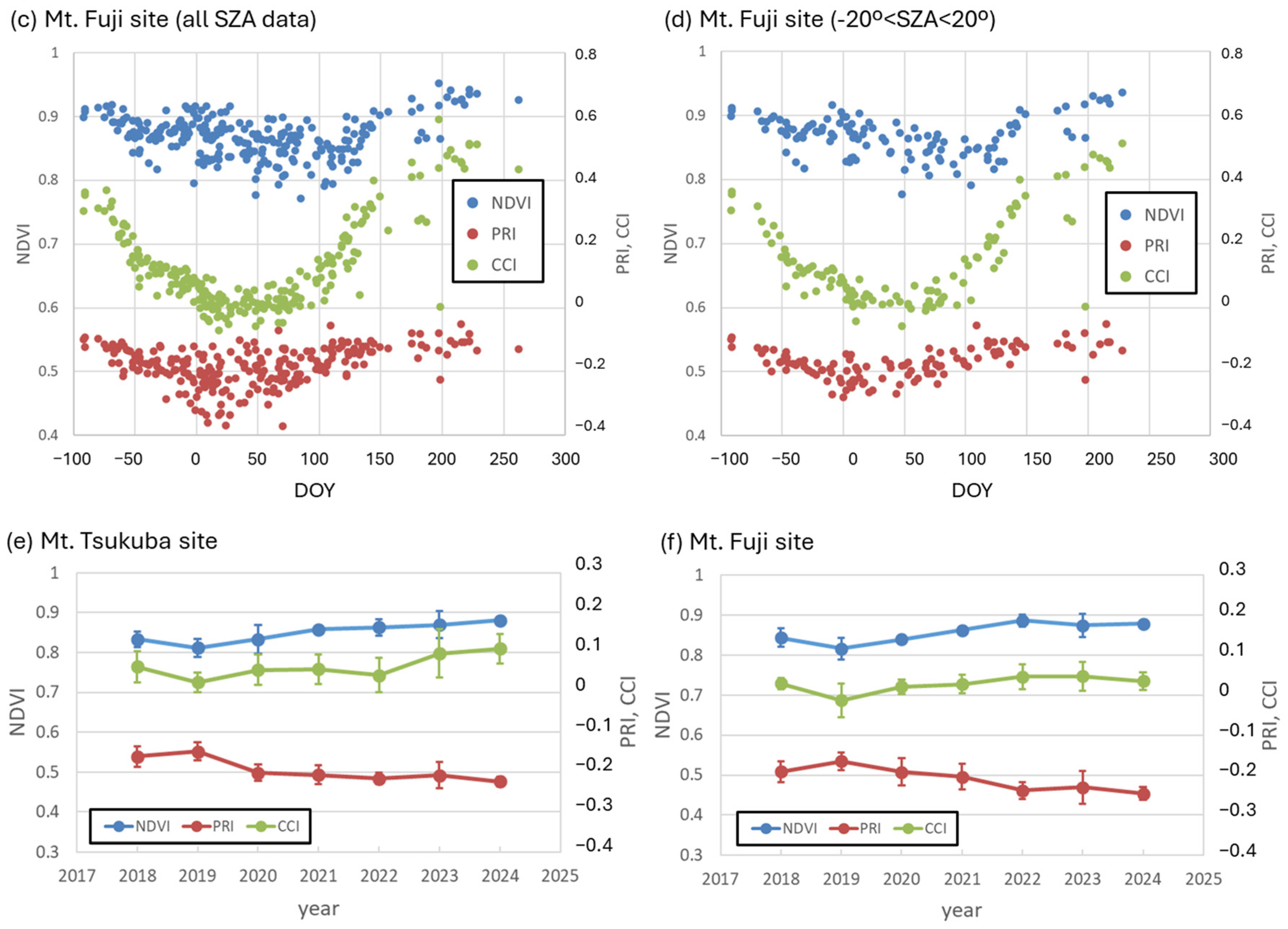
To suppress PRI fluctuations, it is preferable to use only data with SZA close to 0 degrees. However, this would result in insufficient data points, so it was determined optimal to use only data within the range of ±20 degrees. Reducing the number of data points significantly decreases the number of observations per year. Since no clear temperature dependence of VIs was observed during the observation period and the variation between observation years was small compared to the decrease in VIs during winter, the revised results were plotted without distinguishing observation years in Figure 7a–d. The dispersion in PRI shows slight improvement, with the magnitude and timing of the PRI decrease becoming clearer. Extremely low PRI values at the Mount Fuji site were also removed. However, since the reflectance values of VN05 and VN06 are similar, it is considered difficult to further suppress the dispersion in PRI calculated using their difference.
Figure 7e,f indicates the annual variations in average GCOM-C-derived VIs with small SZA values during January and February. When comparing original data shown in Figure 4a,b, standard deviation values of VIs, especially PRI, become significantly small. Furthermore, the increasing trends in NDVI and CCI and the decreasing trend in PRI became more pronounced. Although the correlations of VIs with GCOM-C-derived LSTs and air temperatures remained weak (the maximum R2 is 0.168 in the Mount Fuji site in CCI-vs-LST plot as shown in Figures S7 and S8), these trends may be attributed to rising temperatures promoting tree growth, increasing leaf biomass, and consequently boosting the chlorophyll and carotenoid contents of overall forest.

3.3. Seasonal Variations in MODIS-Derived VIs

The seasonal variations in NDVI and CCI calculated from MODIS data in 2017–2023 are shown in Figure 8 using the same plotting method as Figure 5 (all observation dates are listed in Table S4). The VI values for each pixel in autumn 2018 to summer 2019 were monitored (Figure S9). Although some variation is observed in the NDVI, there are no significant differences between pixels; therefore, the mean values of four pixels were used for the characteristic evaluation of the MODIS-derived VIs and for comparison with the GCOM-C-derived VIs at the Mount Tsukuba site. In Figure 8, CCI shows a clear decrease and recovery. While some dispersion in recovery timing is observed between years, there is little difference in the timing or amount of the decreases across years. NDVI exhibits significant dispersion between observation days during the December to March period. The 2024 data showed different behavior from the 2017–2023 data and will be discussed later.
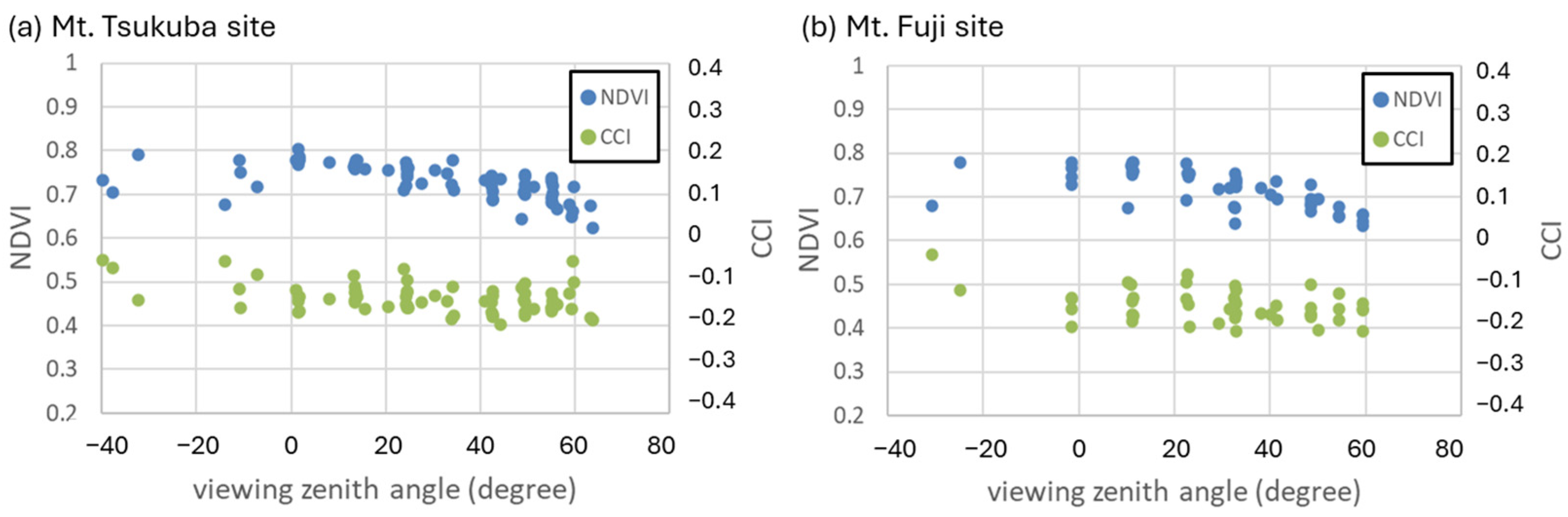
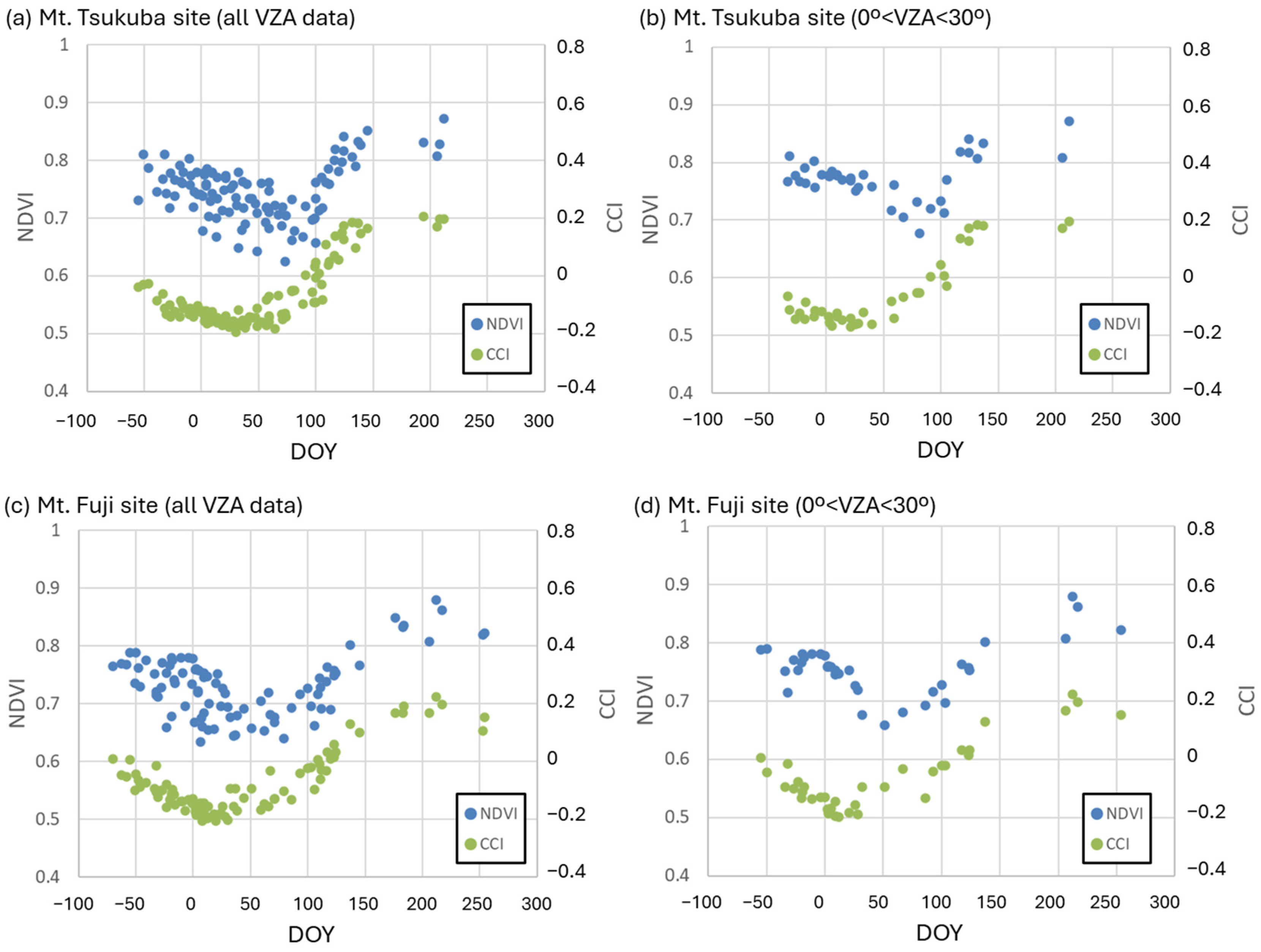
The MAIAC dataset used in this study includes data with viewing zenith angles (VZAs, which are equivalent to SZAs) exceeding 60 degrees. As with the analysis for GCOM-C, the VZA dependency was evaluated. Figure 9 shows the VZA dependence of NDVI and CCI for January and February from 2018 to 2023. While CCI exhibits little dependence, NDVI shows a clear downward trend, particularly when VZA exceeds 30 degrees (i.e., where the observation location is to the west of the nadir position). Furthermore, NDVI also exhibits increased variability when VZA is below 0 degrees (where the observation location is to the east of the nadir position). This is likely due to the significant VZA dependence of Band-2.
To improve the dispersions of VIs, VZA data from 0 to 30 degrees was plotted and compared with the full dataset in Figure 10. In this figure, data were plotted without distinguishing observation years, under the assumption of small inter-year variability. At both sites, the dispersions of VIs were improved significantly, particularly for NDVI. The maximum amount of CCI decreases and its timing (late February to late March) became evident.
In MODIS-derived VIs, annual variation is smaller than those of GCOM-C-derived VIs and the annual trend of variation is not clear. (Figure S10). Correlations between LSTs and VIs are weak with very low R2 values (Figure S11) as well as those between air temperatures and VIs. Although some data show R2 values over 0.5, the trends at the Mount Tsukuba site and the Mount Fuji site are not consistent. As a result, dependence of VIs on temperature were not found in two satellite data during observation period.
The comparison of the seasonal variation in the MODIS-derived NDVI and CCI between 2023 and 2024 (Figure S12a,b) indicated that in 2024, the dispersion of NDVI in observation date is comparable to that in 2023, but the dispersion of CCI has become significantly larger. This is estimated to be caused by the Terra and Aqua satellites drifting off their orbits due to the end of their operational lifespans [53]. It has been reported that this drift has made accurate sensor calibration impossible, resulting in a decline in the data precision. When discussing MODIS-derived VIs in the Discussion section, data from 2018 to 2023 were used.

4. Discussion

4.1. Dependence of VI Seasonal Variations on LST

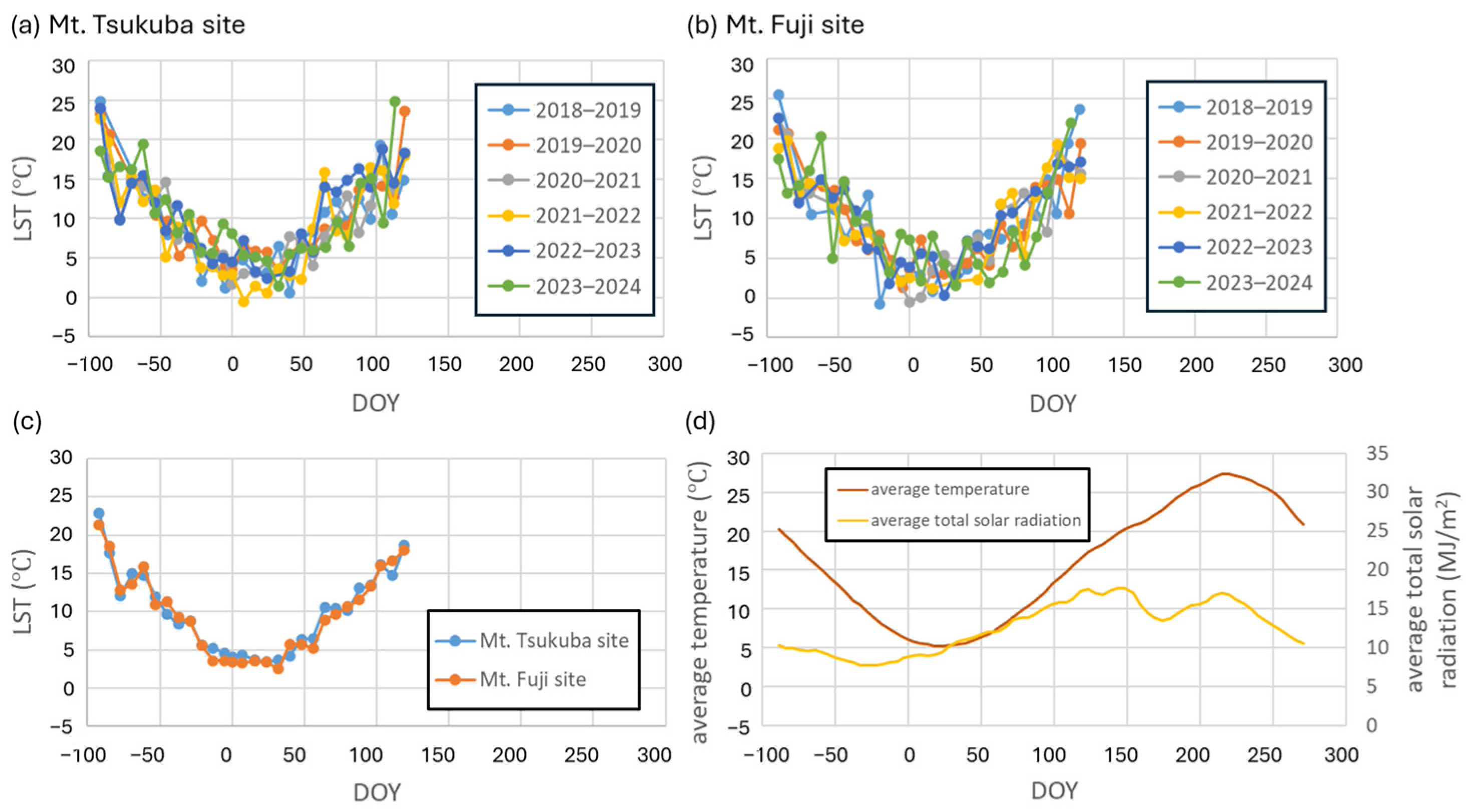
The increase in carotenoid content and decrease in chlorophyll content during winter are thought to be defense mechanisms against light stress under low temperatures, suggesting they are significantly influenced by temperature changes. Since air temperature data were unavailable at both two sites in this study, the correlation with the GCOM-C-derived LSTs were evaluated. Figure 11a,b shows LST changes at each site from 2018 to 2024, while Figure 11c presents the six-year average for both sites.
The seasonal variations in LST at both sites are nearly identical. While LSTs at both sites are approximately 5 °C lower than Tokyo’s air temperature, the timing of their minimum values (late January) is almost identical. Therefore, these LST data are estimated to be consistent with temperature changes at both sites. Comparing the LST data with the variations in each VI shown in Figure 7b,d, the PRI shows its minimum values during late January to early February, coinciding with the period when LST reaches its lowest point. For CCI, the minimum values occur around late February, about one month later than PRI. For NDVI, the minimum values occur around late March, approximately one month later. These results indicate that carotenoid contents increase as temperatures drop, then begin to decrease as temperatures rise. Meanwhile, chlorophyll contents are thought to gradually decrease over a period of two to three months starting in the first half of January.
Figure 11d shows the variations in temperature and total solar radiation in Tokyo (Japan Meteorological Agency data [45]), located 60 km southwest of Mount Tsukuba site, as reference data. Solar radiation begins increasing from the first half of December. Therefore, even as temperatures rise, light stress does not disappear, and it is thought that chlorophyll content continues decreasing due to its effects. Furthermore, as seen in Figure 7b,d, the earlier onset of CCI value decreases and slower recovery at the Mount Fuji site cannot be explained solely by temperature conditions because almost no difference in LST variations was found between the two sites. Other factors, such as differing meteorological conditions like wind patterns due to the presence of Mount Fuji (elevation 3774 m) to the east at the Mount Fuji site, are considered possible. A more detailed investigation of meteorological conditions and other factors is necessary to analyze the difference in both sites.

4.2. Comparison Between GCOM-C- and MODIS-Derived VIs

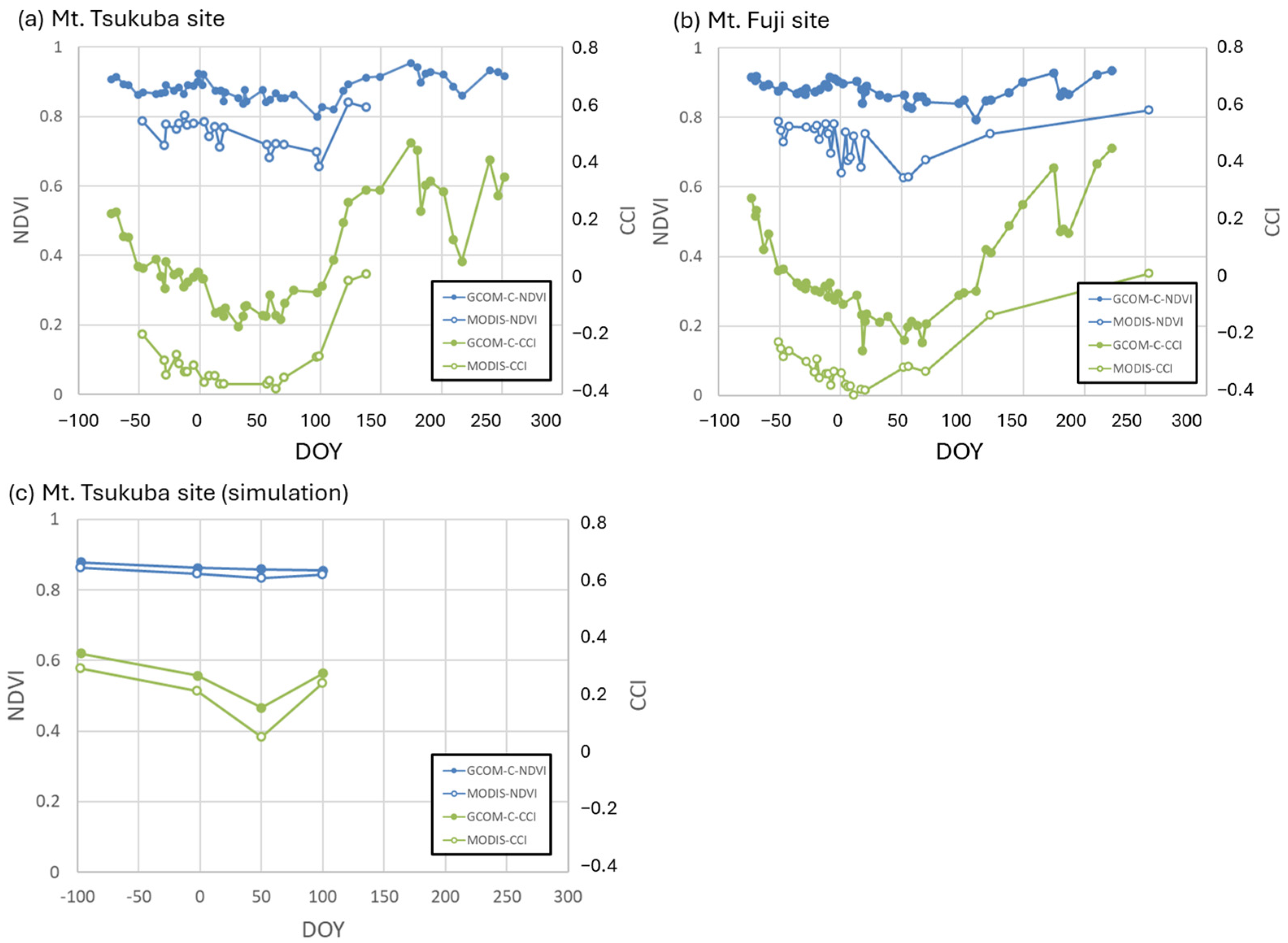
GCOM-C-derived VIs and MODIS-derived VIs were compared; Figure 12a,b shows the seasonal variations in NDVI and CCI values for both sites during 2019–2020. Except for the MODIS-derived NDVI, the dependence on SZA (VZA) is small; therefore, all observed data are plotted here. At both sites, the timings and amounts of decreases for both indices appear to be almost identical. However, clear differences exist in the index values: MODIS-derived VIs are approximately 0.1 lower for NDVI and 0.2 lower for CCI. One possible cause is the difference in RSR (Figure S1), particularly in the red wavelength bands (VN08 and Band-1).
Figure 12c shows the simulation results using relative spectral response (RSR) from each satellite (Figure S1) based on the measured leaf spectrum of Japanese cypress (Figure 2a). The VIs were derived from the band reflectances which were calculated by multiplying the measured spectrum by RSR. Since GCOM-C and MODIS have different RSRs, VI values differ even when using the same spectrum. For both NDVI and CCI, the MODIS-derived VIs showed smaller values. However, the differences were approximately 0.02 for NDVI and 0.03 to 0.08 for CCI, which were insufficient to explain the large discrepancies observed in the satellite-data derived VIs.
The reflectance values of bands used for VI calculation between the two satellites were compared using data observed on the same winter period, when each vegetation index shows nearly equivalent values, for both satellites (Table 2). The reflectance values of 530 nm and 680 nm bands in MODIS were higher than those in GCOM-C. The ratios compared to reflectance values of GCOM-C were 1.59 for the 530 nm. However, it was significantly higher at 2.33 for the 680 nm (red) band. This high reflectance in the red band is the cause of the differences in NDVI and CCI. This is thought to be due to differences in the sensor sensitivity characteristics of the red bands between the two satellite sensors. However, this result is based on evaluations in forests where the reflectance of the red band is relatively low, and it remains to be seen whether similar results can be obtained in areas with higher reflectance in red band.
Next, (1) the VI decrease period (October to December), (2) the winter period showing the minimum VI value (January and February), (3) the recovery period (March to May), and (4) the summer period (June to September), and the characteristics of the VIs derived by both satellites were analyzed for each period. Table 3 summarizes the results for the mean, standard deviation, maximum and minimum values, slope, and R2 value from linear approximation for the VI calculated by both satellites in each period. Due to the limited data availability, the data from 2018 to 2024 were combined for evaluation (graphs are shown in Figure S13).
During the (1) decline period, comparison is difficult for MODIS due to missing October data and the presence of outliers in NDVI values. However, both satellites showed high R2 values (above 0.7 at the Mount Fuji site) for CCI, suggesting equivalent results. The primary cause of outliers is likely insufficient removal of cloud and aerosol effects. During (2) the winter period, when VI values are nearly constant, both satellites show low standard deviation values, but slight differences in slope are observed. During (3) the recovery period, both satellites, as well as both NDVI and CCI, show good correlation (R2 > 0.8) with linear approximation. During (4) the summer period, evaluation is difficult for MODIS due to limited data availability. However, for GCOM-C, an increasing trend is observed for both NDVI and CCI. Although GCOM-C provides more data for such analyses, during periods with sufficient data for analysis, the VIs derived by both satellites are considered to exhibit nearly equivalent characteristics.

4.3. Comparison Between GCOM-C- and Spectral-Derived VIs

When comparing GCOM-C-derived VIs (Figure 7) with spectral-derived VIs (Figure 2b), the NDVI values show good agreement within the range of variation in the GCOM-C-derived values. However, the GCOM-C-derived CCI and PRI values are significantly smaller (difference of 0.12). The primary reason for this discrepancy is likely the difference in sensor sensitivity characteristics between the two. However, since evaluating this difference is difficult, it was assumed that the impact of this difference is small when calculating normalized VIs and instead the differences between individual leaves and forests are examined.
Although spectral-derived VIs represent the characteristics of individual leaves, satellite-data derived VIs are estimated to include reflections from objects other than leaves, such as branches, trunks, degraded leaves, understory vegetations, forest roads, logged areas. When considering reflections from these objects, it is generally thought that in Japanese cypress forests with high leaf density in the canopy and high planting density, reflections from branches, trunks, and understory vegetation are minimal. Furthermore, the study sites were selected to be areas with few forest roads and logged areas. On the other hand, during leaf collection at the Mount Tsukuba site, a significant number of dead leaves were observed during winter. This suggests that a certain proportion of degraded or dead brown leaves are likely present within the canopy observed by satellite during winter.
Assuming that the entire canopy contains brown leaves (BL) at a proportion of a and healthy green leaves (GL) at a proportion of (1 − a), simulations of each index were performed based on measurement spectra from winter and spring (December, February, April). The spectrum of brown leaves was measured from collected leaves in winter. The spectrum of BL increases monotonically from short to long wavelengths (Figure 13a). It is generally known that branches, trunks, and the ground also exhibit similar spectra; this spectrum is considered the typical reflectance spectrum from objects other than leaves. Simulations were performed using Equation (4), varying the proportion of BLs from 0 to 0.2.
The simulation results are shown in Figure 13b,c. As the proportion of BL increases, NDVI and CCI values decrease, but PRI is largely unaffected. For CCI, assuming BL of approximately 10–15% can roughly reproduce the winter decreases in GCOM-C-derived values. However, for NDVI, around 5% is optimal; higher percentages result in excessive decreases. To estimate the proportion of BL more accurately, it is necessary to observe the condition of canopies from above the forest and more precise measurement of the reflectance spectrum from objects other than leaves, particularly accurate evaluation of the short-wavelength region used in PRI calculations.
Moreover, the multiple scattering effect caused by overlapping leaves in the forest should be estimated for more accurate comparison to the results of single leaf measurements. In the visible wavelength region, the absorption of the uppermost leaves is very high due to leaf pigments, so the influence of reflected light from lower leaves beneath the uppermost leaves is small, and it is estimated that the impact on PRI and CCI is minimal. However, in the near-infrared region, the influence of reflection from lower leaves is estimated to be significant, and NDVI is expected to increase by the multiple scattering effect. To more accurate evaluation, further leaf-level measurements, such as measurements of stacked leaves, are necessary.
These simulation results suggest that CCI is particularly sensitive to the influence of reflected light from objects other than leaves. CCI exhibits significant annual variations and is considered a suitable index for detecting the impact of climate change; however, when evaluating long-term variations or comparing different forests, the effects of non-leaf objects must also be considered. On the other hand, CCI is also considered a useful index for evaluating forest conditions, such as the proportion of dead leaves. Meanwhile, PRI is thought to be less affected by reflection from non-leaf objects. Since CCI utilizes the reflectance in the red wavelength band, it is significantly influenced by chlorophyll content. However, this influence is minimal in PRI, making it a suitable index for evaluating changes in carotenoid content. Furthermore, GCOM-C-derived CCI exhibits low SZA dependency (Figure 6), offering the advantage of utilizing more data than PRI, including those with large SZAs. Both PRI and CCI possess distinct advantages; therefore, by evaluating them together, more information about forest conditions is expected to yield.
GCOM-C has bands suitable for calculating both PRI and CCI with higher ground resolution than MODIS. While MODIS has been operating for an extended period far beyond its design lifespan, GCOM-C is expected to continue observations in the future, making it the optimal satellite for forest monitoring. Furthermore, more advanced forest monitoring is expected by combining it with past MODIS observation data as well as other satellite data such as Sentinel-2, which can calculate the red-edge indices that are more sensitive to the variation in chlorophyll content with higher ground resolution. In Japan, there are a large number of monocultural planted forests similar to the observation sites in this study. Extending the findings of this study to these planted forests is expected to facilitate the identification of the effects of climate change. Moreover, increasing the number of observation sites is anticipated to allow for the evaluation of summer vegetation index variations, which could not be assessed in this study due to insufficient data. This is particularly expected to contribute to evaluating the effects of recent summer heatwaves.

4.4. Comparison of MODIS-Derived VIs with Existing Studies in Northern Forests

As mentioned in the introduction section, monitoring of the effects of winter cold stress on evergreen trees has primarily been conducted in coniferous forests of North America and Northern Europe [33,34]. This section examines the comparison between those observational results and the results obtained in this study at sites located in temperate regions. Gamon et al. [34] evaluated both spectral derived CCIs at the leaf- and stand-level measurements and MODIS-derived CCI in North American forests dominated by evergreen conifers. At the Canadian site, the spectral-derived CCI values gradually decreased from 0.4 in summer to −0.05 in winter and rapidly recovered in May. The MODIS derived CCI values at the US flux monitoring site (US-Ho1) decreased from 0.2 to −0.2.
On the other hand, the decrease in MODIS-derived CCI values in this study was approximately from 0.2 to −0.2 at both sites, showing nearly identical decrease. However, CCI value recovery occurred around March. At the Canadian site, winter temperatures drop to −20 °C and the average temperature at the US site is 5 °C. The difference in recovery timing is thought to be primarily due to these temperature differences. Furthermore, the MODIS-derived NDVI value decreased from 0.85 to 0.6. At the Canadian site, leaf degradation due to low winter temperatures is thought to be one factor contributing to the low CCI values. Since the defense mechanism against low-temperature stress is considered similar regardless of species, the significant temperature difference is likely to be the primary factor.
They also reported that during the recovery period of CCI values from March to July, leaf- and stand-level CCI values showed good agreement with photosynthetic rates. Furthermore, throughout the year, CCI values and the chlorophyll/carotenoid molar ratio (measured by chemical method) showed a very strong correlation, indicating that summer CCI values (3.5–4.5) decrease to approximately 2.0 in winter. In the PROSPECT-D simulations in this study, the chlorophyll/carotenoid molar ratio decreased from 2.34 in summer to 1.15 in winter. Although the ratio of decrease is nearly identical, the molar ratio values are lower in this study. The reasons for this difference are presumed to include differences in tree species and temperature differences. Additionally, in the PROSPECT-D simulation, when chlorophyll contents are high, reflectance around 680 nm approaches saturation, making it difficult to accurately simulate high chlorophyll contents.
Regarding the content of each pigment, Wong et al. [4] calculated seasonal changes in white pine (Pinus strobus L.), an evergreen tree, through chemical analysis. They reported that the change from summer to winter involved a decrease in total chlorophyll from 1.8 μmol/g FW (fresh weight) to 1.3 μmol/g FW and an increase in total carotenoids from 0.6 μmol/g FW to 0.75 μmol/g FW. Assuming FW is comparable to the Japanese cypress in this study (approximately 0.03 g/cm2), this translates to a decrease in total chlorophyll from 48 μg/cm2 to 40 μg/cm2 and an increase in total carotenoids from 10 μg/cm2 to 12 μg/cm2. In the PROSPECT-D simulation in this study, the estimated chlorophyll contents decreased from 80.9 μg/cm2 to 76.5 μg/cm2, while carotenoid contents increased from 20.8 μg/cm2 to 39.9 μg/cm2 (Table 1), showing higher values than the study in northern forests. This difference is likely due to tree species and measurement methods.
For comparison with northern forests, leaves close to the canopy should be collected and pigment contents should be directly measured via chemical analysis. When estimating pigment contents from spectra, it is also necessary to devise measurement methods, such as directly collecting leaves from the canopy or measuring spectra over a wide area from above the canopy using observation towers.
In the study by Ulsig et al. [33] on evergreen coniferous forests in Finland, the MODIS-derived CCI decreased significantly from 0.1 to 0.2 in summer to −0.4 in winter. Winter temperatures at the observation site also dropped to −10 °C to −15 °C. The MODIS-derived NDVI decreased substantially from 0.85 to 0.4. The low MODIS-derived CCI values are estimated to be significantly influenced by the substantial leaf degradation occurring during winter. Furthermore, it has been reported that during severe winters below −4 °C, structural changes in leaves cause a significant decrease in reflectance in the near-infrared region [18]. It is presumed that such structural changes in leaves are also related to the decrease in NDVI values. While the sites in this study are located in a temperate region, larger decreases in PRI and NDVI values are expected in northern and alpine areas in Japan where winter temperatures drop further.
When comparing seasonal variations in PRI and CCI across trees and forests in different regions, it is necessary to consider not only regional temperature changes but also, particularly for CCI, the density of leaves within the canopy, that is, sufficient account must be taken of reflection from non-leaf areas. For forest-level observations, it is considered necessary to also account for tree density, understory vegetation, and the proportion of areas such as logged areas and forest roads.

5. Conclusions

Evergreen coniferous forests at two sites in Japan were monitored from 2018 to 2024 using the GCOM-C-derived PRI, CCI and VDVI. A decrease in PRI was found to be nearly synchronous with changes in LSTs. The decrease in CCI occurred approximately one month later, while the decline in NDVI lagged by an additional month. Significant dispersion of PRI was improved by excluding data with large sensor zenith angles (SZAs). MODIS-derived VIs showed a similar winter decrease; however, these values were smaller than GCOM-C-derived VIs, suggesting it might be due to differences in sensor sensitivity, particularly in the red band. Leaf-level VIs were also derived from reflectance spectra of Japanese cypress collected at the site and showed a similar winter decrease to the satellite-derived VIs. It was found that assuming the inclusion of degraded or dead leaves in the canopy could potentially explain lower values of GCOM-C-derived CCIs than spectra-derived CCIs. This study confirmed that CCI is an excellent indicator for evaluating the impact of winter low-temperature stress as well as PRI, and this study suggests that GCOM-C shows promise for monitoring evergreen forests using both indices.

Supplementary Materials

The following supporting information can be downloaded at: https://www.mdpi.com/article/10.3390/geomatics6020025/s1, Figure S1: Relative Spectral Response (RSR) used for VI derivation in GCOM-C/SGLI and Terra/MODIS bands. Figure S2: Measured and PROSPECT-D simulated reflectance spectra of Japanese cypress collected at the Mount Tsukuba site on February 20, 2022. Figure S3: (a) Annual variations in average GCOM-C-derived LSTs in January and February at Mount Tsukuba and Mount Fuji sites. (b) Long-term variations in air temperatures at the weather monitoring points in Tsukuba City and Fuji City. (c) Correlation between average LSTs and average air temperatures in the same years. Figure S4: Correlations between LSTs and GCOM-C-derived NDVIs, PRIs and CCIs at Mount Tsukuba site and Mount Fuji site. Figure S5: Correlations between air temperatures at Tsukuba City/Fuji City points and GCOM-C-derived NDVIs, PRIs and CCIs at Mount Tsukuba site and Mount Fuji site. Figure S6: The dependence of GCOM-C-derived PRIs and related sensor reflectances (VN05 and VN06) on SZAs in the five observation days at Mount Tsukuba site and Mount Fuji site. Figure S7: Correlations between LSTs and GCOM-C-derived VIs with small SZAs at both sites. Figure S8: Correlations between average temperatures at Tsukuba City point and Fuji City point and GCOM-C-derived VIs with small SZA at both sites. Figure S9: The annual variations in MODIS-derived NDVI and CCI in each pixel at Mount Tsukuba site from November 2018 to June 2019. Figure S10: The annual variations in average MODIS-derived VIs with all VZA data and small VZA data during January and February at both sites. Figure S11: Correlations between LSTs and MODIS-derived NDVIs and CCIs at both sites, and correlations between air temperatures at the meteorological monitoring points and MODIS-derived NDVIs and CCIs at both sites. Figure S12: Comparison of MODIS-derived NDVI and CCI variations between 2022–2023 and 2023–2024 at both sites. Figure S13: Variations in GCOM-C and MODIS derived VI values across four periods: (1) the decline phase (October–December), (2) the winter period (January, February), (3) the recovery period (March–May), and (4) the summer period (June–September) for both sites. Table S1: Specifications of GCOM-C/SGLI sensor and Terra/Aqua/MODIS sensor. Table S2: Spectral measurement results for Japanese cypress leaves collected at Mount Tsukuba site. Table S3: All GCOM-C data used in this study. Table S4: All MODIS data used in this study.
Author Contributions

Conceptualization, methodology, software, validation, formal analysis, investigation, data curation, writing—original draft preparation, Y.S.; writing—review and editing, T.H.; writing—review and editing, resources, supervision, S.T. All authors have read and agreed to the published version of the manuscript.

Funding

This research received no external funding.

Institutional Review Board Statement

Not applicable.

Informed Consent Statement

Not applicable.

Data Availability Statement

All satellite data can be downloaded free of charge from the JAXA G-Portal site (GCOM-C, https://gportal.jaxa.jp/gpr/index/index?lang=en, accessed on 22 February 2026) and the NASA Earthdata Search site (MODIS, https://search.earthdata.nasa.gov/, accessed on 22 February 2026). The analyzed datasets used in this study belong to the University of Tokyo, and are not publicly available; however, these datasets can be provided by the corresponding author upon request and with appropriate justification.

Acknowledgments

We are grateful to the members of the Laboratory of Global Forest Environmental Studies, Department of Global Agricultural Sciences, Graduate School of Agricultural and Life Sciences, The University of Tokyo, for their support with data measurements and analysis.

Conflicts of Interest

The authors declare no conflicts of interest.

References

  1. Sasagawa, T.; Akitsu, T.K.; Ide, R.; Takagi, K.; Takanashi, S.; Nakaji, T.; Nasahara, K.N. Accuracy Assessment of Photochemical Reflectance Index (PRI) and Chlorophyll Carotenoid Index (CCI) Derived from GCOM-C/SGLI with In Situ Data. Remote Sens. 2022, 14, 5352. [Google Scholar] [CrossRef]
  2. Garbulsky, M.F.; Peñuelas, J.; Gamon, J.; Inoue, Y.; Filella, I. The photochemical reflectance index (PRI) and the remote sensing of leaf, canopy and ecosystem radiation use efficiencies: A review and meta-analysis. Remote Sens. Environ. 2011, 115, 281. [Google Scholar] [CrossRef]
  3. Zhang, C.; Filella, I.; Garbulsky, M.F.; Peñuelas, J. Affecting Factors and Recent Improvements of the Photochemical Reflectance Index (PRI) for Remotely Sensing Foliar, Canopy and Ecosystemic Radiation-Use Efficiencies. Remote Sens. 2016, 8, 677. [Google Scholar] [CrossRef]
  4. Wong, C.Y.S.; D’Odorico, P.; Bhathena, Y.; Arain, M.A.; Ensminger, I. Carotenoid based vegetation indices for accurate monitoring of the phenology of photosynthesis at the leaf-scale in deciduous and evergreen trees. Remote Sens. Environ. 2019, 233, 111407. [Google Scholar] [CrossRef]
  5. Wong, C.Y.S.; D’odorico, P.; Arain, M.A.; Ensminger, I. Tracking the phenology of photosynthesis using carotenoid-sensitive and near-infrared reflectance vegetation indices in a temperate evergreen and mixed deciduous forest. New Phytol. 2020, 226, 1682. [Google Scholar] [CrossRef]
  6. Springer, K.R.; Wang, R.; Gamon, J.A. Parallel Seasonal Patterns of Photosynthesis, Fluorescence, and Reflectance Indices in Boreal Trees. Remote Sens. 2017, 9, 691. [Google Scholar] [CrossRef]
  7. Gamon, J.A.; Pe, J.; Field, C.B. A Narrow-Waveband Spectral Index That Tracks Diurnal Changes in Photosynthetic Efficiency*. Remote Sens. Environ. 1992, 41, 35–44. [Google Scholar] [CrossRef]
  8. Peñuelas, J.; Filella, I.; Gamon, J.A. Assessment of photosynthetic radiation-use efficiency with spectral reference. New Phytol. 1995, 131, 291–296. [Google Scholar] [CrossRef]
  9. Gamon, J.A.; Surfus, J.S. Assessing leaf pigment content and activity with a reflectometer. New Phytol. 1999, 143, 105. [Google Scholar] [CrossRef]
  10. Sims, D.A.; Gamon, J.A. Relationships between leaf pigment content and spectral reflectance across a wide range of species, leaf structures and developmental stages. Remote Sens. Environ. 2002, 81, 337–354. [Google Scholar] [CrossRef]
  11. Stylinski, C.D.; Oechel, W.C.; Gamon, J.A.; Tissue, D.T.; Miglietta, F.; Raschi, A. Effects of lifelong CO2 enrichment on carboxylation and light utilization of Quercus pubescens Willd. examined with gas exchange, biochemistry and optical techniques. Plant Cell Environ. 2000, 23, 1353–1362. [Google Scholar] [CrossRef]
  12. Yu, Y.; Piao, J.; Fan, W.; Yang, X. Modified photochemical reflectance index to estimate leaf maximum rate of carboxylation based on spectral analysis. Environ. Monit Assess 2020, 192, 788. [Google Scholar] [CrossRef]
  13. Atherton, J.; Nichol, C.J.; Porcar-Castell, A. Using spectral chlorophyll fluorescence and the photochemical reflectance index to predict physiological dynamics. Remote Sens. Environ. 2016, 176, 17. [Google Scholar] [CrossRef]
  14. Filella, I.; Porcar-Castell, A.; Munné-Bosch, S.; Bäck, J.; Garbulsky, M.F.; Peñuelas, J. PRI assessment of long-term changes in carotenoids/chlorophyll ratio and short-term changes in de-epoxidation state of the xanthophyll cycle. Int. J. Remote Sens. 2008, 30, 4443. [Google Scholar] [CrossRef]
  15. Porcar-Castell, A. A high-resolution portrait of the annual dynamics of photochemical and non-photochemical quenching in needles of Pinus sylvestris. Physiol. Plant. 2018, 143, 139–153. [Google Scholar] [CrossRef]
  16. Porcar-Castell, A.; Garcia-Plazaola, J.I.; Nichol, C.J.; Kolari, P.; Olascoaga, B.; Kuusinen, N.; Fernández-Marín, B.; Pulkkinen, M.; Juurola, E.; Nikinmaa, E. Physiology of the seasonal relationship between the photochemical reflectance index and photosynthetic light use efficiency. Oecologia 2012, 170, 313–323. [Google Scholar] [CrossRef] [PubMed]
  17. Gamon, J.A.; Kovalchuck, O.; Wong, C.Y.S.; Harris, A.; Garrity, S.R. Monitoring seasonal and diurnal changes in photosynthetic pigments with automated PRI and NDVI sensors. Biogeosciences 2015, 12, 4149. [Google Scholar] [CrossRef]
  18. Wong, C.Y.S.; Gamon, J.A. Three causes of variation in the photochemical reflectance index (PRI) in evergreen conifers. New Phytol. 2014, 206, 187–195. [Google Scholar] [CrossRef]
  19. Wong, C.Y.S.; Gamon, J.A. The photochemical reflectance index provides an optical indicator of spring photosynthetic activation in evergreen conifers. New Phytol. 2015, 206, 196–208. [Google Scholar] [CrossRef]
  20. Li, M.; Yang, W.; Kondoh, A. Improving Remote Estimation of Vegetation Phenology Using GCOM-C/SGLI Land Surface Reflectance Data. Remote Sens. 2022, 14, 4027. [Google Scholar] [CrossRef]
  21. Mizuno, Y.; Tachikawa, H.; Sasagawa, T.; Kobayashi, T.; Nasahara, K.N. Impact of high temperature in 2023 and 2024 on spring leaf flush phenology in Japan derived by GCOM-C satellite. Sci. Rep. 2025, 15, 12920. [Google Scholar] [CrossRef]
  22. Bayarsaikhan, U.; Akitsu, T.K.; Tachiiri, K.; Sasagawa, T.; Nakano, T.; Uudus, B.; Nasahara, K.N. Early validation study of the photochemical reflectance index (PRI) and the normalized difference vegetation index (NDVI) derived from the GCOM-C satellite in Mongolian grasslands. Int. J. Remote Sens. 2022, 43, 5145–5172. [Google Scholar] [CrossRef]
  23. Miura, T.; Nagai, S.; Takeuchi, M.; Ichii, K.; Yoshioka, H. Improved Characterisation of Vegetation and Land Surface Seasonal Dynamics in Central Japan with Himawari-8 Hypertemporal Data. Sci. Rep. 2019, 9, 15692. [Google Scholar] [CrossRef] [PubMed]
  24. Yan, D.; Zhang, X.; Nagai, S.; Yu, Y.; Akitsu, T.; Nasahara, K.N.; Ide, R.; Maeda, T. Evaluating land surface phenology from the Advanced Himawari Imager using observations from MODIS and the Phenological Eyes Network. Int. J. Appl. Earth Obs. Geoinf. 2019, 79, 71–83. [Google Scholar] [CrossRef]
  25. Hwang, T.; Gholizadeh, H.; Sims, D.A.; Novick, K.A.; Brzostek, E.R.; Phillips, R.P.; Roman, D.T.; Robeson, S.M.; Rahman, A.F. Capturing species-level drought responses in a temperate deciduous forest using ratios of photochemical reflectance indices between sunlit and shaded canopies. Remote Sens. Environ. 2017, 199, 350–359. [Google Scholar] [CrossRef]
  26. Hilker, T.; Lyapustin, A.; Hall, F.G.; Wang, Y.; Coops, N.C.; Drolet, G.; Black, T.A. An assessment of photosynthetic light use efficiency from space: Modeling the atmospheric and directional impacts on PRI reflectance. Remote Sens. Environ. 2009, 113, 2463–2475. [Google Scholar] [CrossRef]
  27. Yin, G.; Verger, A.; Descals, A.; Filella, I.; Peñuelas, J. A Broadband Green-Red Vegetation Index for Monitoring Gross Primary Production Phenology. J. Remote Sens. 2025, 2022, 1–10. [Google Scholar] [CrossRef]
  28. Drolet, G.G.; Huemmrich, K.F.; Hall, F.G.; Middleton, E.M.; Black, T.A.; Barr, A.G.; Margolis, H.A. A MODIS-derived photochemical reflectance index to detect inter-annual variations in the photosynthetic light-use efficiency of a boreal deciduous forest. Remote Sens. Environ. 2005, 98, 212–224. [Google Scholar] [CrossRef]
  29. Drolet, G.G.; Middleton, E.M.; Huemmrich, K.F.; Hall, F.G.; Amiro, B.D.; Barr, A.G.; Black, T.A.; Mccaughey, J.H.; Margolis, H.A. Regional mapping of gross light-use efficiency using MODIS spectral indices. Remote Sens. Environ. 2008, 112, 3064–3078. [Google Scholar] [CrossRef]
  30. Yin, G.; Verger, A.; Filella, I.; Descals, A.; Peñuelas, J. Divergent Estimates of Forest Photosynthetic Phenology Using Structural and Physiological Vegetation Indices. Geophys. Res. Lett. 2020, 47, e2020GL089167. [Google Scholar] [CrossRef]
  31. Mitsunori Ishihara, M.T. Relationship between Light Use Efficiency and Photochemical Reflectance Index using MODIS Data in Japan. J. Agri. Meteol. 2005, 60, 977–980. [Google Scholar] [CrossRef]
  32. Middleton, E.M.; Huemmrich, K.F.; Landis, D.R.; Black, T.A.; Barr, A.G.; Mccaughey, J.H. Photosynthetic efficiency of northern forest ecosystems using a MODIS-derived Photochemical Reflectance Index (PRI). Remote Sens. Environ. 2016, 187, 345–366. [Google Scholar] [CrossRef]
  33. Ulsig, L.; Nichol, C.J.; Huemmrich, K.F.; Landis, D.R.; Middleton, E.M.; Lyapustin, A.I.; Mammarella, I.; Levula, J.; Porcar-Castell, A. Detecting Inter-Annual Variations in the Phenology of Evergreen Conifers Using Long-Term MODIS Vegetation Index Time Series. Remote Sens. 2017, 9, 49. [Google Scholar] [CrossRef]
  34. Gamon, J.A.; Huemmrich, K.F.; Wong, C.Y.S.; Ensminger, I.; Garrity, S.; Hollinger, D.Y.; Noormets, A.; Peñuelas, J. A remotely sensed pigment index reveals photosynthetic phenology in evergreen conifers. Proc. Natl. Acad. Sci. USA 2016, 113, 13087. [Google Scholar] [CrossRef] [PubMed]
  35. Wong, C.Y.S.; Mercado, L.M.; Arain, M.A.; Ensminger, I. Remotely sensed carotenoid dynamics improve modelling photosynthetic phenology in conifer and deciduous forests. Agric. For. Meteorol. 2022, 321, 108977. [Google Scholar] [CrossRef]
  36. Liu, Y.; Wu, C.; Tian, F.; Wang, X.; Gamon, J.A.; Wong, C.Y.S.; Zhang, X.; Gonsamo, A.; Jassal, R.S. Modeling plant phenology by MODIS derived photochemical reflectance index (PRI). Agric. For. Meteorol. 2022, 324, 109095. [Google Scholar] [CrossRef]
  37. Goerner, A.; Reichstein, M.; Tomelleri, E.; Hanan, N.; Rambal, S.; Papale, D.; Dragoni, D.; Schmullius, C. Remote sensing of ecosystem light use efficiency with MODIS-based PRI. Biogeosciences 2011, 8, 189–202. [Google Scholar] [CrossRef]
  38. Yang, J.C.; Magney, T.S.; Yan, D.; Knowles, J.F.; Smith, W.K.; Scott, R.L.; Barron-gafford, G.A. The Photochemical Reflectance Index (PRI) Captures the Ecohydrologic Sensitivity of a Semiarid Mixed Conifer Forest. JGR Biogeosciences 2020, 125, e2019JG005624. [Google Scholar] [CrossRef]
  39. Guarini, R.; Nichol, C.; Clement, R.; Loizzo, R.; Grace, J.; Borghetti, M. The utility of MODIS-sPRI for investigating the photosynthetic light-use efficiency in a Mediterranean deciduous forest. Int. J. Remote Sens. 2014, 35, 6157–6172. [Google Scholar] [CrossRef]
  40. Goerner, A.; Reichstein, M.; Rambal, S. Tracking seasonal drought effects on ecosystem light use efficiency with satellite-based PRI in a Mediterranean forest. Remote Sens. Environ. 2009, 113, 1101–1111. [Google Scholar] [CrossRef]
  41. Moreno, A.; Maselli, F.; Gilabert, M.A.; Chiesi, M.; Martínez, B.; Seufert, G. Assessment of MODIS imagery to track light-use efficiency in a water-limited Mediterranean pine forest. Remote Sens. Environ. 2012, 123, 359–367. [Google Scholar] [CrossRef]
  42. Garbulsky, M.F.; Peñuelas, J.; Ogaya, R.; Filella, I. Leaf and stand-level carbon uptake of a Mediterranean forest estimated using the satellite-derived reflectance indices EVI and PRI. Int. J. Remote Sens. 2012, 34, 1282–1296. [Google Scholar] [CrossRef]
  43. Nasahara, K.N.; Nagai, S. Review: Development of an in situ observation network for terrestrial ecological remote sensing: The Phenological Eyes Network (PEN). Ecol. Res. 2015, 30, 211–223. [Google Scholar] [CrossRef]
  44. Available online: https://nlftp.mlit.go.jp/ksj/gml/datalist/KsjTmplt-A45.html#prefecture08 (accessed on 28 December 2025). (In Japanese)
  45. Available online: https://www.jma.go.jp/jma/indexe.html (accessed on 28 December 2025).
  46. Jacquemoud, S.; Baret, F.; Jaequemoud, S. PROSPECT: A Model of Leaf Optical Properties Spectra. Remote Sens. Environ. 1990, 34, 75–91. [Google Scholar] [CrossRef]
  47. Available online: https://jbferet.gitlab.io/prospect/ (accessed on 28 December 2025).
  48. Available online: https://suzaku.eorc.jaxa.jp/GCOM_C/data/update/Algorithm_RSRF_en.html (accessed on 28 December 2025).
  49. Available online: https://suzaku.eorc.jaxa.jp/GCOM_C/instruments/product.html (accessed on 28 December 2025).
  50. Available online: https://eolp.jaxa.jp/GCOM-C_SGLI_L2_LST.html (accessed on 28 December 2025).
  51. Qin, W.; Fang, H.; Wang, L.; Wei, J.; Zhang, M.; Su, X.; Bilal, M.; Liang, X. MODIS high-resolution MAIAC aerosol product: Global validation and analysis. Atmos. Environ. 2021, 264, 118684. [Google Scholar] [CrossRef]
  52. Available online: https://mcst.gsfc.nasa.gov/calibration/parameters (accessed on 28 December 2025).
  53. Feng, S.; Wehrlé, A.; Cook, J.M.; Anesio, A.M.; Box, J.E.; Benning, L.G.; Tranter, M. The apparent effect of orbital drift on time series of MODIS MOD10A1 albedo on the Greenland ice sheet. Sci. Remote Sens. 2023, 9, 100116. [Google Scholar] [CrossRef]
Figure 1. Locations of Mount Tsukuba site and Mount Fuji site in Japan. In the figure above, blue circles indicate the meteorological observation points of Japan Meteorological Agency [45]. Map colors indicate GCOM-C-derived NDVI values in summer (2 July 2018). Black lines indicate the prefectural and municipal boundaries. In the two figures below, red frames indicate the GCOM-C observed areas (74 pixels for Mount Fuji site and 6 pixels for Mount Tsukuba site). Blue frames indicate the MODIS-observed areas (4 pixels for both sites). Map color in these two maps indicate GCOM-C-derived NDVI values in winter (14 January 2018) to show evergreen vegetation areas.
Geomatics 06 00025 g001
Figure 2. (a) Leaf spectral of Japanese Cypress (Chamaecyparis obtusa) collected at Mount Tsukuba site in summer (25 September 2021) and winter (20 February 2022), and their difference (winter data minus summer data). (b) Seasonal variations in NDVI, PRI and CCI values in Japanese Cypress leaves collected at Mount Tsukuba site from September 2021 to April 2022. DOY indicates the day of year based on 1 January. DOY from October to December in previous year are indicated by negative values.
Geomatics 06 00025 g002
Figure 3. (a) Seasonal variations in GCOM-C-derived NDVI, PRI and CCI values at Mount Tsukuba site from January 2018 to May 2024. (b) Seasonal variations in the same VIs for at Mount Fuji site during the same period.
Geomatics 06 00025 g003
Figure 4. (a) The annual variation in average GCOM-C-derived VIs in January and February at Mount Tsukuba site. (b) The annual variation in the same VIs at Mount Fuji site. Error bars indicate the standard deviation values among the VIs in January and February.
Geomatics 06 00025 g004
Figure 5. (a) Seasonal variations in GCOM-C-derived NDVI, PRI and CCI at Mount Tsukuba site from January 2018 to May 2024. (b) Seasonal variations in the same VIs at Mount Fuji site during the same period.
Geomatics 06 00025 g005
Figure 6. (a) The dependences of GCOM-C-derived NDVI, PRI and CCI values on SZAs at Mount Tsukuba site during January and February from 2018 to 2024 (filled circles). (b) The same dependence at Mount Fuji site during the same period. Positive SZA values indicate that the observation point is located west of the satellite, while negative values indicate that the observation point is located east of the satellite. Open circles show the same dependences of VIs observed in five days within nine days (14–22 January 2022) (Figure S6a,b).
Geomatics 06 00025 g006
Figure 7. (a) Seasonal variations in GCOM-C-derived NDVI, PRI and CCI at Mount Tsukuba site from January 2018 to May 2024 (the same data shown in Figure 5). (b) The same seasonal variations as in (a) using data with small SZA values (less than 20°). Open circles indicate the measured VIs at Mount Tsukuba site (the same data shown in Figure 2b). (c) The same seasonal variations as in (a) at Mount Fuji site. (d) The same seasonal variations as in (c) using data with small SZA values. (e) The annual variation in average GCOM-C-derived VIs with small SZA values during January and February at Mount Tsukuba site, where error bars indicate the standard deviation values among the VIs. (f) The same annual variation in (e) at Mount Fuji site.
Geomatics 06 00025 g007aGeomatics 06 00025 g007b
Figure 8. (a) Annual variations in MODIS-derived NDVIs and CCIs at Mount Tsukuba site from January 2018 to May 2023. (b) The same annual variations at Mount Fuji site.
Geomatics 06 00025 g008
Figure 9. (a) The dependences of MODIS-derived NDVI and CCI values on VZAs at Mount Tsukuba site in January and February from 2018 to 2023. (b) The same dependence at Mount Fuji site.
Geomatics 06 00025 g009
Figure 10. (a) Seasonal variations in MODIS-derived NDVI and CCI values at Mount Tsukuba site from January 2018 to May 2024. (b) The same seasonal variations in (a) using data with small VZA values (from 0 ° to 30°). (c) The same seasonal variations in (a) Mount Fuji site. (d) The same seasonal variations in (c) with small VZA values.
Geomatics 06 00025 g010
Figure 11. (a) Winter variations in LSTs at Mount Tsukuba site derived from GCOM-C 8-day average data from 2018 to 2024. (b) The same winter variations at Mount Fuji site. (c) The same winter variations in average LSTs between 2018 and 2024 at both sites. (d) Seasonal variations in average values of daily average temperature and total solar radiation from October 1991 to September 2020 at the meteorological monitoring point in Tokyo [45].
Geomatics 06 00025 g011
Figure 12. (a) Comparison of NDVI and CCI values derived from GCOM-C and MODIS at Mount Tsukuba site. (b) The same comparison at Mount Fuji site. (c) The simulation results of NDVI and CCI values based on the measured spectra of Japanese cypress collected at Mount Tsukuba site from September 2019 to April 2020 (Figure 2) and RSR of GCOM-C and MODIS (Figure S1).
Geomatics 06 00025 g012
Figure 13. (a) Reflectance spectra in healthy green leaf and dead brown leaf (BL) of Japanese cypress in winter. (b) GCOM-C derived VIs (filled circles) at Mount Tsukuba site with small SZA values and simulation results (open circles) of NDVI based on Equation (4). (c) The same VIs (filled circles) and simulation results (open circles) of PRI and CCI based on Equation (4). In simulations, ratios of brown leaf were varied in 5%, 10%, 15% and 20% (from high VI values to low values). Simulation results indicate PRI values are not affected by the ratio of brown leaves.
Geomatics 06 00025 g013
Table 1. PROSPECT-D simulation results based on measured spectra of Japanese Cypress leaves collected at Mount Tsukuba site in summer (25 September 2021) and winter (20 February 2022). For reference, the same simulation results are shown for two trees of the same cypress family, Sawara cypress (Chamaecyparis pisifera) and Chinese arborvitae (Platycladus orientalis), collected at the University of Tokyo’s Yayoi Campus. The molar ratio was calculated based on the molecular weights of chlorophyll and carotenoids (carotene).
SpeciesJapanese Cypress (Mt. Tsukuba Site)Sawara Cypress (Reference)Chinese Arborvitae (Reference)
date25
September 2021
20 February 2022difference5 October 201915 February 2020difference5 October 201924 February 2020difference
NDVI0.879 0.861 0.018 0.870 0.860 0.010 0.842 0.837 0.004
PRI−0.003 −0.128 0.124 −0.027 −0.152 0.125 −0.012 −0.026 0.014
CCI0.424 0.273 0.151 0.449 0.272 0.177 0.509 0.499 0.010
Leaf structure parameter (N)2.212.68−0.472.782.88−0.12.432.6−0.17
Chlorophyll a + b (CHL)80.976.54.474.172.12.0 48.442.46.0
Carotenoids (CAR)20.839.9−19.119.834.3−14.59.110.3−1.2
Anthocyanins (ANT)3.35.7−2.43.87.2−3.42.43.7−1.3
Brown pigment content (BROWN)000000000
Equivalent water content (EWT)0.0110.01100.0250.0080.0170.0230.0180.005
Leaf mass area (LMA)0.0169 0.0231 −0.0062 0.0169 0.0231 −0.0062 0.0138 0.0167 −0.0029
CHL/CAR ratio (µg/µg)3.89 1.92 3.74 2.10 5.32 4.12
CHL/CAR ratio (mol/mol)2.34 1.15 2.25 1.26 3.19 2.47
Table 2. Comparison of average reflectance values in GCM-C and MODIS bands used for VI calculations during the severe winter period (9 January to 2 February), when each vegetation index shows nearly equivalent values, in 2018–2023.
GCOM-CMODISMODIS/GCOM-C
Ratio
VIsNDVI0.863 0.732
CCI0.020 −0.172
band
reflectance
530 nm0.015 0.024 1.589
680 nm0.015 0.034 2.328
NIR0.209 0.222 1.061
Table 3. Summary of GCOM-C (2018–2024) and MODIS (2018–2023) derived VI values across four periods: (1) the decline period (October–December), (2) the winter period (January, February), (3) the recovery period (March–May), and (4) the summer period (June–September) for both sites. Data counts, mean values, standard deviations, scatter plot slopes, and R2 values of VIs were presented.
Mount Tsukuba SiteMount Fuji Site
GCOM-CMODISGCOM-CMODIS
NDVIPRICCINDVICCINDVIPRICCINDVICCI
(1) October–Decemberdata count37373712123737371212
mean0.8696 −0.1552 0.1829 0.7741 −0.1155 0.8799 −0.1752 0.1544 0.7689 −0.0895
SD0.0310 0.0333 0.0758 0.0189 0.0231 0.0201 0.0280 0.0511 0.0198 0.0371
slope-0.000298-0.000955−0.0022−0.0007−0.000810.000024−0.00130.00030.000042−0.0024
R20.0488 0.4343 0.4482 0.1407 0.1259 0.0757 0.7060 0.7637 0.0012 0.7176
(2) January–Februarydata count36363622223131311111
mean0.8490 −0.1960 0.0542 0.7692 −0.1321 0.8594 −0.2118 0.0286 0.7320 −0.1627
SD0.0302 0.0312 0.0541 0.0203 0.0439 0.0286 0.0371 0.0318 0.0334 0.0357
slope0.000547.80E-06−0.0018−0.000770.000035−0.000420.0002 −0.00054−0.00210.0017
R20.0911 0.0000170.2906 0.5213 0.0002 0.0810 0.0162 0.1057 0.8618 0.4691
(3) March–Maydata count404040151537373799
mean0.8928 −0.1150 0.3349 0.7630 0.0381 0.8494 -0.1530 −0.1530 0.7317 −0.0052
SD0.0390 0.0397 0.1393 0.0510 0.1003 0.0259 0.0393 0.0393 0.0374 0.0669
slope0.00110.0010.0050.00220.00440.0000390.0010 0.0040.0017−0.0026
R20.5465 0.4414 0.8684 0.7793 0.8788 0.1521 0.4462 0.8481 0.8562 0.6282
(4) June–Septemberdata count1616162212121244
mean0.9116 −0.1140 0.3713 0.8395 0.1839 0.9088 −0.1170 0.3850 0.8424 0.1844
SD0.0266 0.0344 0.1124 0.0319 0.0131 0.0244 0.0408 0.1349 0.0289 0.0272
slope0.00020.00070.000840.0110.00440.000910.0001 0.0034−0.00041−0.00085
R20.0267 0.1876 0.0254 110.3633 0.0005 0.1660 0.0709 0.3414
Disclaimer/Publisher’s Note: The statements, opinions and data contained in all publications are solely those of the individual author(s) and contributor(s) and not of MDPI and/or the editor(s). MDPI and/or the editor(s) disclaim responsibility for any injury to people or property resulting from any ideas, methods, instructions or products referred to in the content.