

Analysis of Thermodynamic Processes in Thermal Energy Storage Vessels



Abstract
1. Introduction
- captures phase-change dynamics at reduced saturation pressures, which is relevant when solar or heat pump heating provides variable thermal input;
- enables the design of expansion vessels and safety systems scaled for lower temperature differentials; and
- supports the optimisation of insulation and condensation control to improve energy efficiency in systems where renewable sources exhibit intermittent supply.
Research Gap and Novelty
- Nonlinear properties of the steam table in differential energy balances (Equations (33)–(39)),
- Dynamics of isochoric pressure collapse (steam cushion rupture, Section 4.1),
- Boundary conditions for condensate drainage (isobaric processes, Section 4.3),
- (a)
- An analytical solution for isochoric and isobaric vapor condensation in rigid vessels (Equations (33)–(45)), enabling computation 1000 times faster than CFD while maintaining ±15% accuracy.
- (b)
- Explicit modelling of vapor cushion collapse—a critical failure mode not addressed by one-dimensional vessel models—quantified by the pressure drop time scale τcrit.
- (c)
- Design rules derived directly from sensitivity analysis: maximum kAp = 7.5 W/K (safe shutdown for 400 h), minimum UA = 6000 W/K (start-up in 30 min).
- (d)
2. Materials and Method
- The vessel is rigid and does not undergo deformation work.
- The system remains spatially homogeneous, with well-mixed temperature and vapour quality.
- Heat transfer is dominated by conduction and convection; radiative effects are negligible.
- The vapour is saturated, and non-equilibrium effects are initially neglected, with local thermal equilibrium assumed between phases.
- Heat losses are modelled as proportional to the temperature difference, and the heat transfer coefficient h is parameterised using empirical correlations.
- If condensate drainage is included, the mass and energy balances can be significantly simplified by assuming complete or partial removal of condensate during transients.
- Slow transients (τ > 10 min): diffusion and mass transfer reach equilibrium within the vessel mixing time.
- Moderate subcooling (ΔTsub > 10 K): interfacial condensation is rapid and close to equilibrium.
- Normal district heating operation: condensation rates ṁcond < 1 kg/(m2·s).
- Expected accuracy: ±10–15% compared with non-equilibrium models.
- Rapid decompression (dp/dt > 0.1 bar/s): Vapour cools faster than the liquid can equilibrate; steam enters a metastable superheated state (Tsteam > Tsaturation).
- High-velocity jet injection (>5 m/s): Localised superheat or subcooling zones develop before mixing; mass transfer at the phase boundary becomes the rate-limiting factor.
- Scenarios of vapour cushion collapse (emergency release, rupture): Steam crosses the saturation limit into the superheated region; condensation exhibits delayed nucleation.
- For hot water heating or cooling, the ambient temperature T∞ is specified, with heat fluxes modelled as functions of the temperature difference.
- For vapour processes, the saturation temperature Tsat(p) and the corresponding saturation vapour quality are used as reference states.
- For heat exchanger interactions, specified inlet heat transfer rates and inlet temperatures serve as boundary conditions during heating processes.
- Thermal stratification caused by high-velocity jets or wall effects,
- Flow regime transitions (from bubbly to annular to mist flows) that alter local heat transfer coefficients,
- Non-equilibrium condensation during rapid depressurisation, where local vapour becomes supersaturated.
- Large industrial thermal storage tanks (volumes > 50 L) with transient timescales exceeding 10 min,
- Simple vessel geometry (cylinders/rectangles without internal baffles),
- Sensitivity analysis and parameter identification (e.g., determining insulation effectiveness kAp from cooling curves),
- System-level district heating simulations where component-averaged properties are sufficient,
- Design safety margins and relief valve tuning (tolerance ±10–15%),
- Subcooling with ΔTsub > 10 K (well-mixed, slow equilibration),
- Low injection velocity (<1 m/s).
- Emergency scenarios with depressurisation rates greater than 0.1 bar/s (steam cushion collapse with structural resonance risks),
- Complex geometries with internal baffles, heat exchanger coils, or nozzle arrays,
- Validation of local heat transfer coefficients in novel materials or microchannel systems,
- Transient phenomena lasting under 5 min, where diffusion and mixing cannot be assumed complete,
- Subcooling with ΔTsub < 5 K (rapid, localized condensation),
- High injection velocity (>10 m/s jet injection).
3. Investigation of Thermodynamic Processes in Single-Phase Unsaturated Liquids
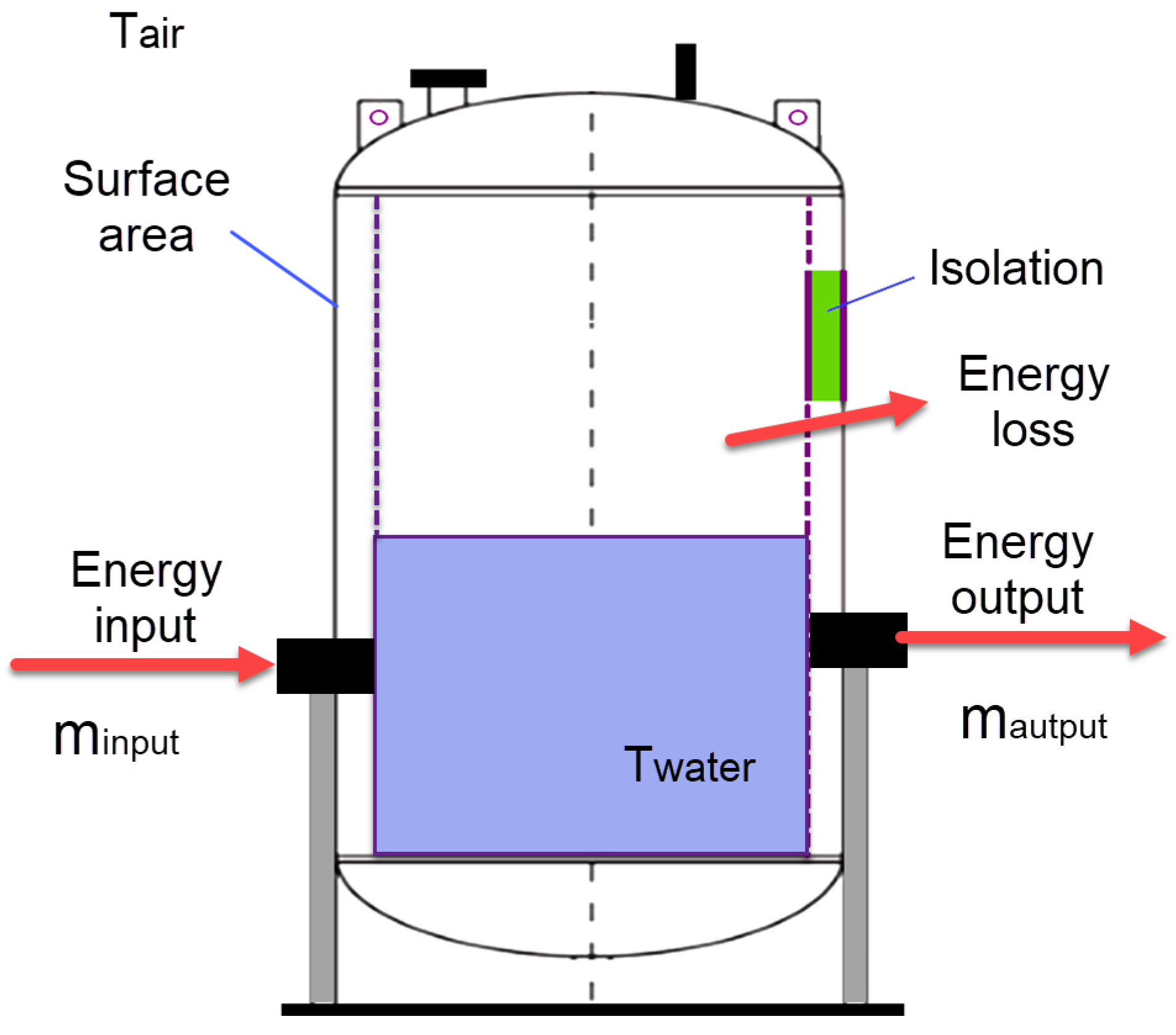
- heat supplied to the tank,
- Δt temperature difference relative to the environment,
- M mass of liquid stored in the tank.
- k heat transfer coefficient between the tank and the environment,
- surface area of the tank insulation,
- c specific heat capacity of the stored fluid.
3.1. Temperature Change in the Fluid When the Tank Is Not Heated
3.2. Temperature Change in the Fluid When the Tank Is Heated
3.3. Temperature Change in the Fluid When the Tank Is Heated via a Heat Exchanger
3.4. Temperature Change When Heating Power Equals Heat Loss
3.5. Parameter Study and Sensitivity Analysis
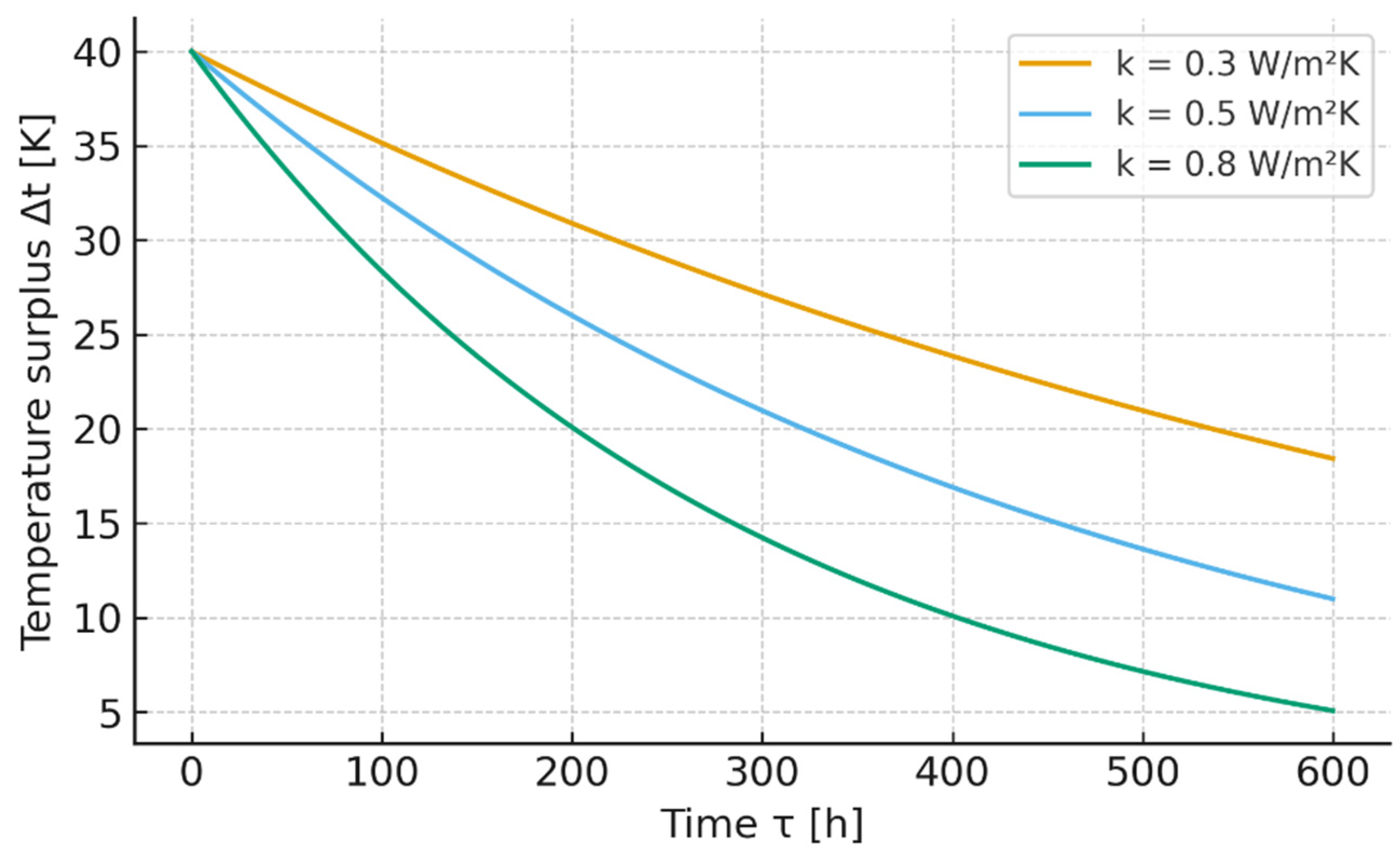
3.5.1. Cooling Behaviour of a Hot-Water Tank
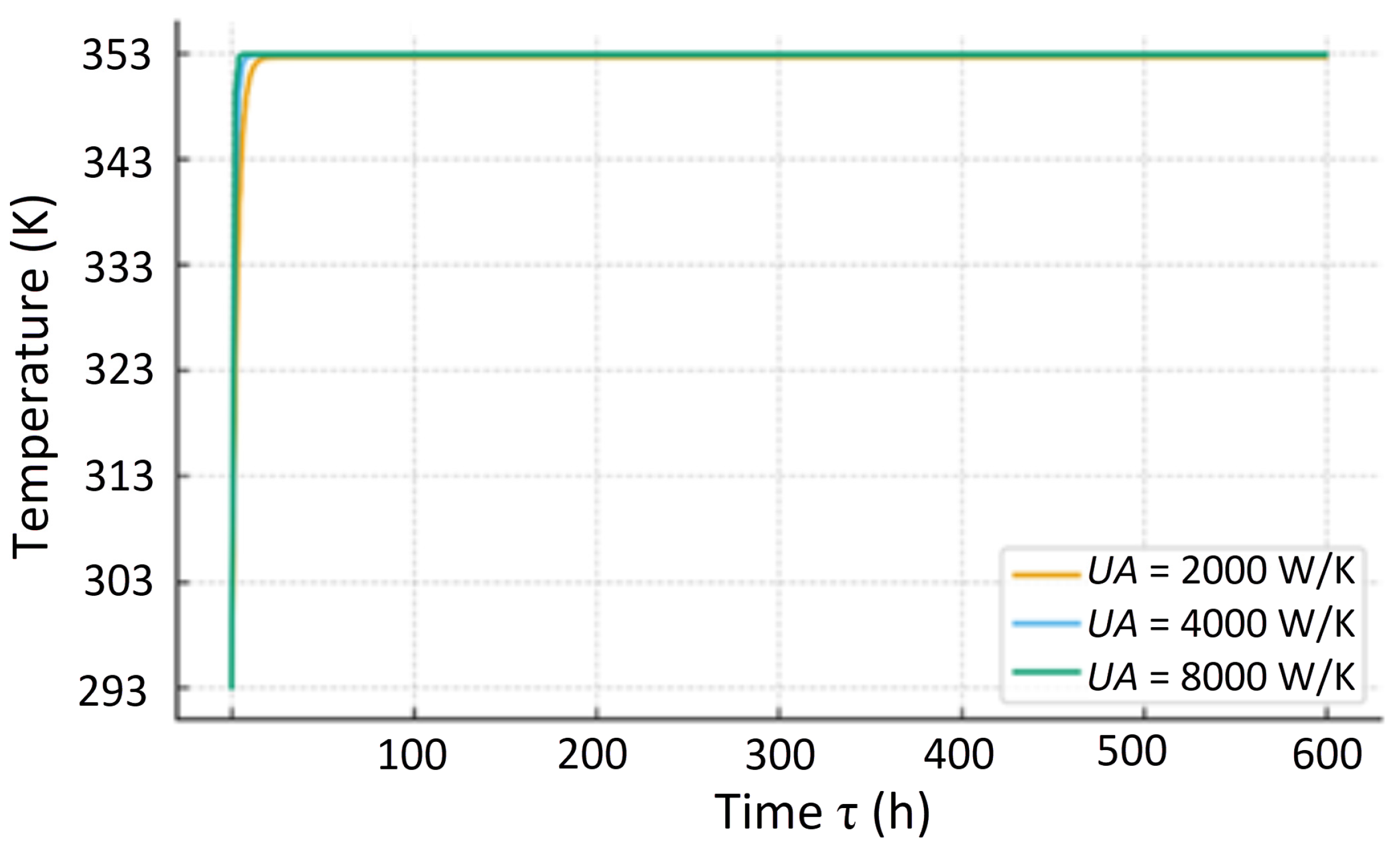
3.5.2. Heating Behaviour with Heat Exchanger
- and tank heat loss coefficient .
4. Saturated Fluid Containing a Vapor Phase (Hot Water)
- h enthalpy of the fluid mixture,
- mass flow rate of steam injected into or removed from the tank,
- enthalpy of saturated dry steam.
4.1. Isochoric Condensation or Boiling
4.1.1. Formulation of the Energy Balance Differential Equation
4.1.2. Consider the Case Where No Fluid or Vapor Is Added to or Removed from the Tank
4.1.3. Solution of the Energy Balance Differential Equations
4.2. Isochoric Condensation with Steam Discharge (Steam Cooling in Piping During Downtime)
4.3. Isobaric Condensation and Isobaric Boiling (Cooling or Heating of Saturated Steam at Constant Pressure)
4.4. Sensitivity of Steam-Filled Pressure Vessels
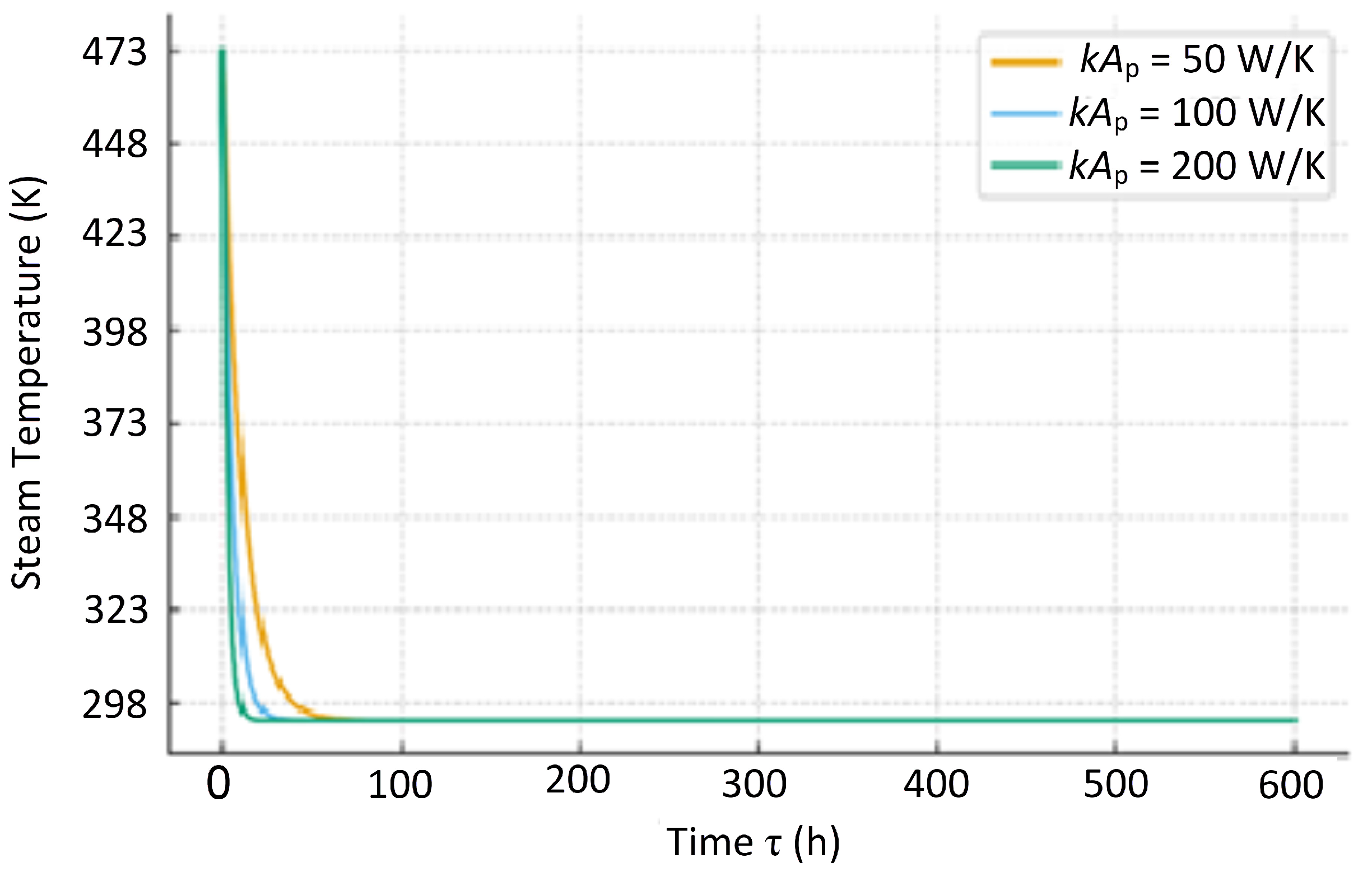
Isochoric Condensation—Sensitivity to
- the vapour temperature decreases much faster,
- the saturation pressure drops abruptly,
- condensation becomes intense,
- the vapour cushion may collapse suddenly.
4.5. Experimental Validation and Comparison with Literature Data
5. Conclusions
- For steam-filled vessels, kAp should be kept below 7.5 W/K to enable safe shutdown durations exceeding 400 h.
- For rapid start-up of hot-water tanks, UA should exceed 6000 W/K for start-up, limiting the warm-up time to approximately 30 min.
- Insulation improvements should target k ≤ 0.3–0.4 W/(m2 K) for large thermal storage vessels to maintain operational stability during shutdown periods.
- Systems with kAp > 100 W/K exhibit rapid vapour-cushion collapse and should be avoided in district heating environments without additional protective measures.
Author Contributions
Funding
Data Availability Statement
Conflicts of Interest
References
- Sarbu, I.; Dorca, A. Review on heat transfer analysis in thermal energy storage using latent heat storage systems and phase change materials. Int. J. Energy Res. 2019, 43, 29–64. [Google Scholar] [CrossRef]
- Torbarina, F.; Lenic, K.; Trp, A.; Kirincic, M. Parametric analysis of system performance and cost of heating systems with heat pump and latent thermal energy storage. Appl. Therm. Eng. 2024, 252, 123717. [Google Scholar] [CrossRef]
- Sarbu, I.; Sebarchievici, C. A Comprehensive Review of Thermal Energy Storage. Sustainability 2018, 10, 191. [Google Scholar] [CrossRef]
- Miliozzi, A.; Nicolini, D.; Napoli, G.; Giorgi, G.; Liberatore, R. Experimental Evaluation of a Combined Sensible and Latent Heat Thermal Energy Storage System. Energies 2025, 18, 5808. [Google Scholar] [CrossRef]
- Kirincic, M.; Trp, A.; Lenic, K. Influence of natural convection during melting and solidification of paraffin in a longitudinally finned shell-and-tube latent thermal energy storage on the applicability of developed numerical models. Renew. Energy 2021, 179, 1329–1344. [Google Scholar] [CrossRef]
- Blecich, P.; Bonefačić, I.; Senčić, T.; Wolf, I. Resilience Under Heatwaves: Croatia’s Power System During the July 2024 Heatwave and the Role of Variable Renewable Energy by 2030. Appl. Sci. 2025, 15, 6440. [Google Scholar] [CrossRef]
- Kirincic, M.; Trp, A.; Lenic, K.; Torbarina, F. Numerical analysis of the influence of geometry parameters on charging and discharging performance of shell-and-tube latent thermal energy storage with longitudinal fins. Appl. Therm. Eng. 2024, 236, 121385. [Google Scholar] [CrossRef]
- Kirincic, M.; Trp, A.; Lenic, K.; Batista, J. Latent thermal energy storage performance enhancement through optimization of geometry parameters. Appl. Energy 2024, 365, 123255. [Google Scholar] [CrossRef]
- Sommer, T.; Mennel, S.; Sulzer, M. Lowering the pressure in district heating and cooling networks by alternating the connection of the expansion vessel. Energy 2019, 172, 991–996. [Google Scholar] [CrossRef]
- Mehmood, K.; Zhang, B.; Jalal, F.E.; Wan, W. Transient flow analysis for pumping system comprising pressure vessel using unsteady friction model. Int. J. Mech. Sci. 2023, 244, 108093. [Google Scholar] [CrossRef]
- Toumi, A.; Sekiou, F.; Afoufou, F. Numerical modeling and simulation of water hammer phenomena using the MacCormack method. Water Pract. Technol. 2024, 19, 2333–2351. [Google Scholar] [CrossRef]
- Stevanovic, V.D.; Maslovaric, B.; Prica, S. Dynamics of steam accumulation. Appl. Therm. Eng. 2012, 37, 73–79. [Google Scholar] [CrossRef]
- Maldonado Castro, D.T.; Madsen, H.; Petersen, S. Simplified modeling approach for district heating networks: Application to high and low temperature regimes. Energy 2021, 218, 119526. [Google Scholar] [CrossRef]
- Nakahara, N.; Sagara, K.; Tsujimoto, M. Water Thermal Storage Tank, Part 2 Mixing Model and Storage Estimation for Temperature-stratified Tanks. ASHRAE Trans. 1988, 94, 371–394. [Google Scholar]
- Atabaki, N.; Bernier, M. A semi-empirical model for residential electric hot water tanks. ASHRAE Trans. 2005, 111, 159–168. [Google Scholar]
- Newton, B.J. Modeling of Solar Storage Tanks. Master’s Thesis, University of Wisconsin-Madison, Madison, WI, USA, 1995. [Google Scholar]
- Yin, S.; Wang, Y.; Yuan, Y.; Li, B. Study of Condensation during Direct Contact between Steam and Water in Pressure-Relief Tank. Energies 2024, 17, 2772. [Google Scholar] [CrossRef]
- Rodríguez, I.; Castro, J.; Pérez-Segarra, C.D.; Oliva, A. Unsteady numerical simulation of the cooling process of vertical storage tanks under laminar natural convection. Int. J. Therm. Sci. 2009, 48, 708–721. [Google Scholar] [CrossRef]
- Mehraj, N.; Mateu, C.; Cabeza, L.F. Artificial intelligence and thermal energy storage: A review of design techniques and applications. J. Energy Storage 2025, 124, 116870. [Google Scholar] [CrossRef]
- Mehraj, N.; Mateu, C.; Zsembinszki, G.; Cabeza, L.F. Optimizing the Design of TES Tanks for Thermal Energy Storage Applications Through an Integrated Biomimetic-Genetic Algorithm Approach. Biomimetics 2025, 10, 197. [Google Scholar] [CrossRef]
- Palacios, A.; Krabben, Y.; Linder, E.; Thamm, A.-K.; Arpagaus, C.; Paranjape, S.; Bless, F.; Carbonell, D.; Schuetz, P.; Worlitschek, J.; et al. Thermal Energy Storage Technology Roadmap for Decarbonising Medium-Temperature Heat Processes—A Review. Sustainability 2025, 17, 9693. [Google Scholar] [CrossRef]
- Kwasi-Effaha, C.C.; Okpako, O. Comprehensive review of emerging trends in thermal energy storage mechanisms, materials and applications. Front. Energy Res. 2025, 13, 1651471. [Google Scholar] [CrossRef]
- Wang, X.; Duan, L.; Gao, G.; Zheng, W.; Sun, D.; Li, J.; Fu, J.; Lin, R. Analysis and Optimization of Thermal Storage Performance of Thermocline Storage Tank with Different Water Distribution Structures. Processes 2025, 13, 629. [Google Scholar] [CrossRef]
- Trevisan, S.; Guédez, R. Thermodynamic analysis of a high-temperature multi-layered sensible-latent thermal energy storage. AIP Conf. Proc. 2020, 2303, 190030. [Google Scholar] [CrossRef]
- Ryu, S.U.; Jeon, B.G.; Kim, S.; Kim, J.; Euh, D.J. Experimental study on the direct contact condensation of steam jet in the passive safety injection tank. J. Nucl. Sci. Technol. 2018, 55, 66–78. [Google Scholar] [CrossRef]
- Kim, H.Y.; Bae, Y.Y.; Song, C.H.; Park, J.K.; Choi, S.M. Experimental study on stable steam condensation in a quenching tank. Int. J. Energy Res. 2001, 25, 239–252. [Google Scholar] [CrossRef]
- Fournier, N.; Adl-Zarrabi, B.; Schmidt, T.; Gauthier, G.; van Helden, W. Task 39: Large Thermal Energy Storages for District Heating, Technology Collaboration Programme on Energy Storage, International Energy Agency. 2024. Available online: https://iea-es.org/task-39/ (accessed on 20 November 2025).
- Chertkov, M.; Novitsky, N.N. Thermal Transients in District Heating Systems. Energy 2019, 184, 22–33. [Google Scholar] [CrossRef]
- Blankschtein, D. The First Law of Thermodynamics for Closed Systems: Derivation and Sample Problems. In Lectures in Classical Thermodynamics with an Introduction to Statistical Mechanics; Springer: Cham, Switzerland, 2020. [Google Scholar] [CrossRef]
- Balmer, R.T. Modern Engineering Thermodynamics; Academic Press: Cambridge, MA, USA, 2011; ISBN 978-0-12-374996-3. [Google Scholar] [CrossRef]
- ANSYS Inc. ANSYS Fluent User Guide: Thermodynamic Wet Steam Properties and Convective Heat Transfer Correlations; ANSYS, Inc.: Canonsburg, PA, USA, 2024. [Google Scholar]
- Çengel, Y.A.; Boles, M.A. Thermodynamics: An Engineering Approach, 8th ed.; McGraw-Hill Education: Columbus, OH, USA, 2015. [Google Scholar]
- Fu, B.-R.; Chang, T.H.; Pan, C. Two-phase flow and heat transfer during steam condensation in a converging microchannel with different convergence angles. Adv. Mech. Eng. 2013, 5, 372898. [Google Scholar] [CrossRef]
- Dirker, J.; Rodríguez, C.; Lewandowski, J.L.V. Thermal energy processes in direct steam generation: A literature review. Front. Energy Res. 2018, 6, 147. [Google Scholar] [CrossRef]
- Luo, Q.; Majó, M.; Calderón, A.; Barreneche, C.; Li, J.; Tian, Y.; Fernández, A.I.; Liu, X. Thermodynamic modeling of a thermal energy storage packed bed tank: Exploring the influence of different particle sizes on overall performance. J. Energy Storage 2025, 119, 116345. [Google Scholar] [CrossRef]
- Harvey, A.; Parry, W.; Bellows, J.; Gallagher, J.; Harwood, R. ASME International Steam Tables for Industrial Use, 3rd ed.; ASME Press: New York, NY, USA, 2014. [Google Scholar] [CrossRef]
- Mazed, D.; Frano, R.L.O.; Aquaro, D.; Del Serra, D.; Sekachev, I.; Olcese, O. Experimental investigation of steam condensation in water tank at sub-atmospheric pressure. Nucl. Eng. Des. 2018, 335, 241–254. [Google Scholar] [CrossRef]
- Teixeira Júnior, M.; Zilio, G.; Mortean, M.V.V.; de Paiva, K.V.; Oliveira, J.L.G. Experimental and numerical analysis of transient thermal stresses on thick-walled cylinder. Int. J. Press. Vessel. Pip. 2023, 202, 104884. [Google Scholar] [CrossRef]
- Kandil, A. Analysis of thick-walled cylindrical pressure vessels under the effect of cyclic internal pressure and cyclic temperature. Int. J. Mech. Sci. 1996, 38, 1319–1332. [Google Scholar] [CrossRef]
- Oh, C.; Lee, S.; Jhung, M.J.; Huh, N.-S. Analytical approach to estimate the thermal stress distribution of reactor pressure vessel nozzle corners with a constant cooldown rate. Int. J. Pres. Ves. Pip. 2022, 197, 104608. [Google Scholar] [CrossRef]




| Component | System Dynamic Role | Vessel Model Application |
|---|---|---|
| Heat accumulators | Peak shaving buffer: Charge during low demand, discharge during surges [12] | Mass/energy balance (Equation (27)) Boundary condition [27]: Tpipe,out(t) → Tvessel,in(t) |
| Expansion Vessels (Pressure regulation) | Thermal expansion compensation, steam cushion collapse prevention | Isochoric condensation (Equation (33)) |
| Pipelines (Distributed storage, 20–40% capacity) | Thermal inertia, wave propagation [28] | Boundary condition [27]: Tpipe,out(t) → Tvessel,in(t) |
Disclaimer/Publisher’s Note: The statements, opinions and data contained in all publications are solely those of the individual author(s) and contributor(s) and not of MDPI and/or the editor(s). MDPI and/or the editor(s) disclaim responsibility for any injury to people or property resulting from any ideas, methods, instructions or products referred to in the content. |
© 2026 by the authors. Licensee MDPI, Basel, Switzerland. This article is an open access article distributed under the terms and conditions of the Creative Commons Attribution (CC BY) license.
Share and Cite
Garbai, L.; Santa, R.; Bošnjaković, M. Analysis of Thermodynamic Processes in Thermal Energy Storage Vessels. Thermo 2026, 6, 5. https://doi.org/10.3390/thermo6010005
Garbai L, Santa R, Bošnjaković M. Analysis of Thermodynamic Processes in Thermal Energy Storage Vessels. Thermo. 2026; 6(1):5. https://doi.org/10.3390/thermo6010005
Chicago/Turabian StyleGarbai, Laszlo, Robert Santa, and Mladen Bošnjaković. 2026. "Analysis of Thermodynamic Processes in Thermal Energy Storage Vessels" Thermo 6, no. 1: 5. https://doi.org/10.3390/thermo6010005
APA StyleGarbai, L., Santa, R., & Bošnjaković, M. (2026). Analysis of Thermodynamic Processes in Thermal Energy Storage Vessels. Thermo, 6(1), 5. https://doi.org/10.3390/thermo6010005