1. Introduction
The present research work is a combined theoretical and experimental study of a typical battery electric vehicle (BEV) thermal management system (TMS) using a Tesla M3 (Model 3) vehicle. To meet the Paris Agreement’s 1.5 °C target, the transport sector’s emissions, which alone contribute 23% of energy-related greenhouse gas emissions IEA (2022), must be reduced. It is estimated that the CO2 budget per person per year should not exceed two tons by 2050. To achieve this, there should be net-zero emissions from 2050. These factors lead to a strong push towards BEVs.
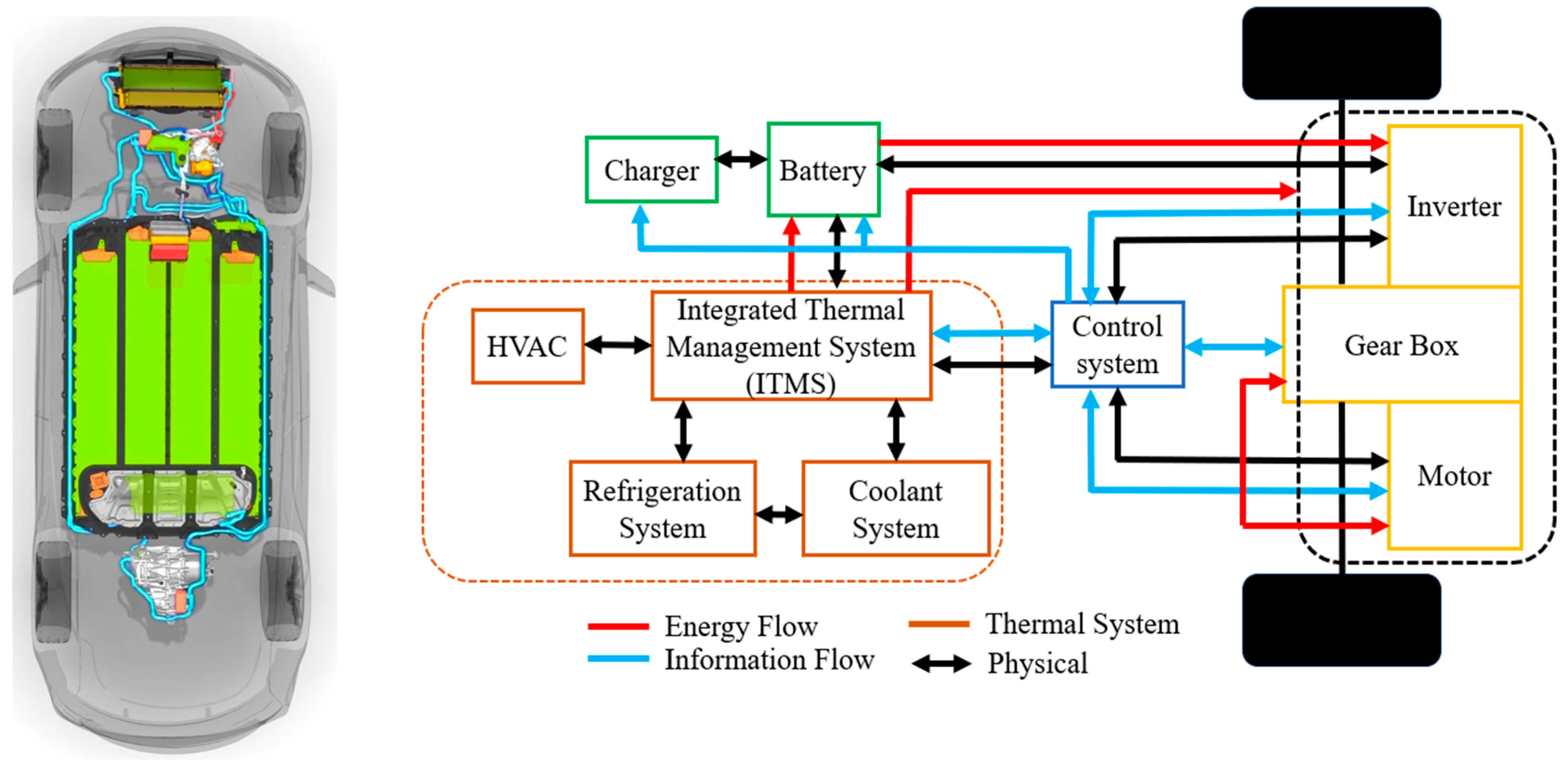
Electric vehicles can be classified as BEVs, plug-in hybrids, or hybrids based on how they draw their power. The current study, which is related to BEVs, has a vehicle architecture as shown in
Figure 1. There are various thermal aspects that are critical and need to be covered in electric vehicles, such as battery safety and performance, cabin thermal loads, motor, and power electronics thermal requirements [
1]. All the major systems are temperature dependent, and their performance and efficiency depend on the maximum allowable working temperature ranges for these systems.
As stated in [
2], the battery and its efficiency, as well as cabin heating, ventilation, and air conditioning (HVAC) requirements, are prime contributors to current problems for range and efficiency in BEVs.
As mentioned in [
3], with individual thermal management systems for batteries, cabin thermal comfort, and motors, it is still not possible to achieve the required performance needed to meet the range targets for BEVs. Therefore, it is necessary to have an Integrated Thermal Management System (ITMS) [
4] when developing BEVs. An ideal ITMS helps to recover the waste heat energy to the maximum possible extent in a vehicle.
ITMSs can also help in reducing the vehicle weight by providing optimal designs and reducing the number of components in HVAC, battery, and motor thermal management systems. This is because of a high degree of coupling of energy between the drive train, battery, and HVAC systems. ITMSs face various problems, like complex architecture, distribution of cold and hot fluids, and the need for control algorithm improvements. So, studying these challenges will help to optimize ITMSs [
4]. The current study on BEVs uses a vehicle architecture as shown in
Figure 1.
Specific Tesla Model 3 vehicle benchmarking data can be found in [
5], with data on thermal management specifically in [
6].
Research carried out in [
5] analyzed ITMSs for waste heat recovery from motor, battery cooling, and cabin thermal comfort. The impact of several factors, like ambient temperature conditions, compressor speed, battery, and motor thermal loads on ITMS cooling and heating performances, was studied.
The proposed ITMS was found to achieve cabin, motor, and battery thermal requirements, except for very harsh environmental conditions. This study showed that battery SOC was reduced by 10.6% due to battery cooling load, while heating COP increased up to 25% due to waste heat recovery. This ITMS layout had a significant impact on driving range by 31.7% as compared to using PTC heaters.
One of the setbacks in this layout by [
5] was having
of less than 1 under extreme ambient conditions of 43 °C; that is, under severe ambient conditions, it could not meet the combined cooling requirements of the battery and cabin.
The study by [
6] found that compressors contribute to the major exergy loss among all the components, which is close to 60% in cooling mode and 40% in heating mode. The ITMSs used in this layout incorporated an external heat exchanger, internal condenser, internal evaporator, and chiller as the main heat exchangers.
This layout explores battery cooling with both the battery radiator and chiller, if required at hot temperatures. Ref. [
6] discussed the exergy analysis of the BEV vehicle for all the modes mentioned. It evaluated the importance of exergy loss of the internal condenser under winter conditions. In this ITMS layout, PTC heater usage as compared to a heat pump air conditioning system was found to be more effective under low compressor speeds and winter conditions. Also, this study, based on exergy analysis, stresses the importance of design optimization of compressors and pressure change components to improve energy utilization during cooling mode.
The heat pump-based system studied by [
7] validated the integration of the refrigerant and battery coolant loops in the range extended electric vehicle for high ambient temperature conditions. In this layout, a chiller is also used from the refrigerant loop for supercooling of the battery if needed. This analysis identifies areas with lower exergy efficiency and minimizes the entropy generation. Another work by [
7] also states that using the chiller, which transfers the excess heat from the battery to the refrigerant via the chiller, helps in reducing the compressor power requirements significantly.
This specific work shows the importance of optimizing the chiller and evaporator systems, which were found to have the lowest exergy efficiencies due to high temperature differences around them, followed by compressors. Further, as stated in [
7], exergoeconomic multi-objective optimization performed on the ITMS led to a 14% increase in exergy efficiency and a 5% decrease in cost, at the expense of a 14% increase in environmental impact.
In the work by [
8], an experimental investigation was undertaken of the integration of a heat pipe heat exchanger (HPHE), which is used for battery preheating and cooling, along with a heat pump air conditioning (HPAC) system. The performance characteristics of the HPHE were evaluated under different conditions ranging from −20 °C to 45 °C. This layout had coolant loop switching with the help of four refrigerant valves for heating and cooling scenarios for different working modes. The parallel loop addition of a chiller to the battery provided two modes of operation for battery cooling: by the chiller or by the external heat exchanger.
Ref. [
9] proposed a general integrated loop (GIL) or an all-in-one simulation model as the main configuration, from which different operating modes, configurations, and control algorithms can be analyzed. The indirect cabin conditioning mode was considered for the study, as this mode makes it easy to connect other TMSs, like motors, batteries, etc., to the vehicle.
This GIL architecture was used to evaluate waste heat recovery from various EV systems, like batteries and drive train components, and to compare it with the so-called ideal configuration, which encompasses all the possible waste heat recovery (WHR) modes but is not feasible due to its complex architecture.
As stated in [
10], a heat pump based on the Octo-valve system designed by Tesla Motors was able to achieve 15 different operating modes for recovering waste heat from a motor, battery, blower, DC-DC, etc. In this paper, the differences between the Tesla patent by [
11] and the production system were discussed.
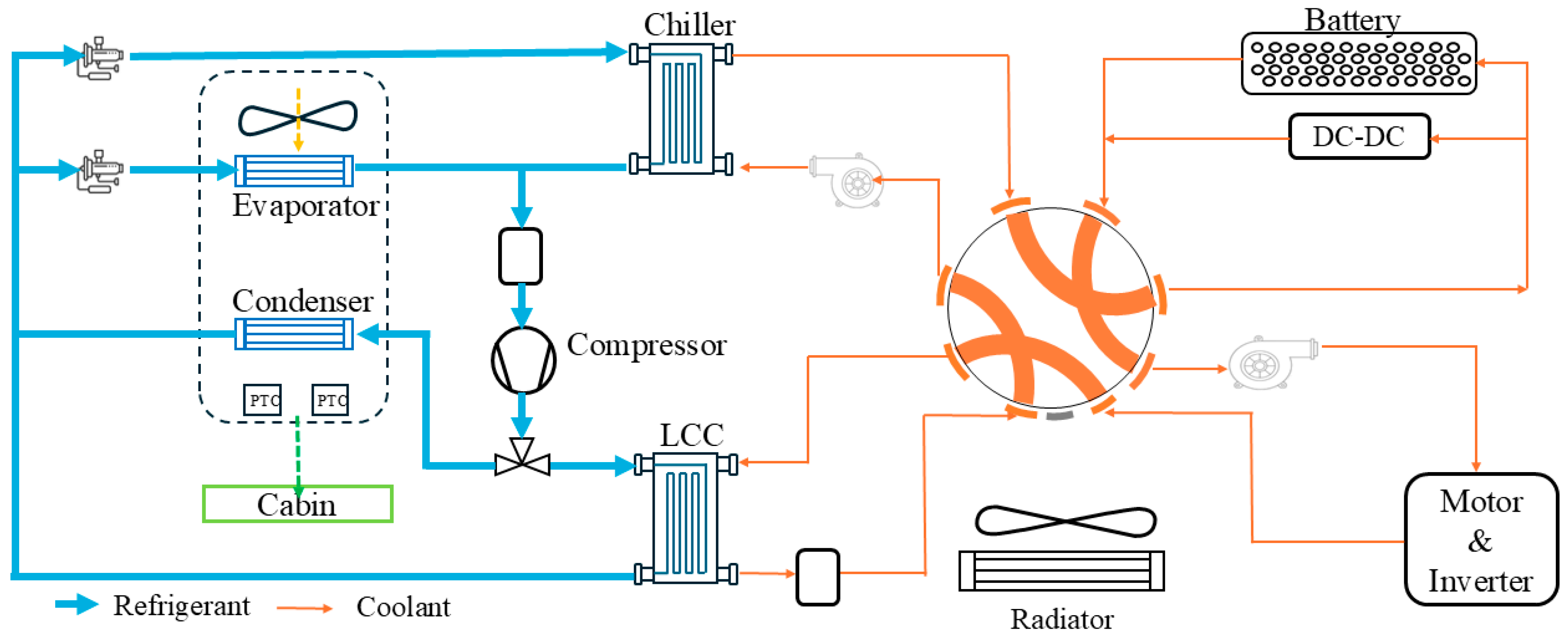
The main idea behind this layout development is to use the waste heat from the battery and motor effectively and thus improve the COP of the heat pump. As stated in [
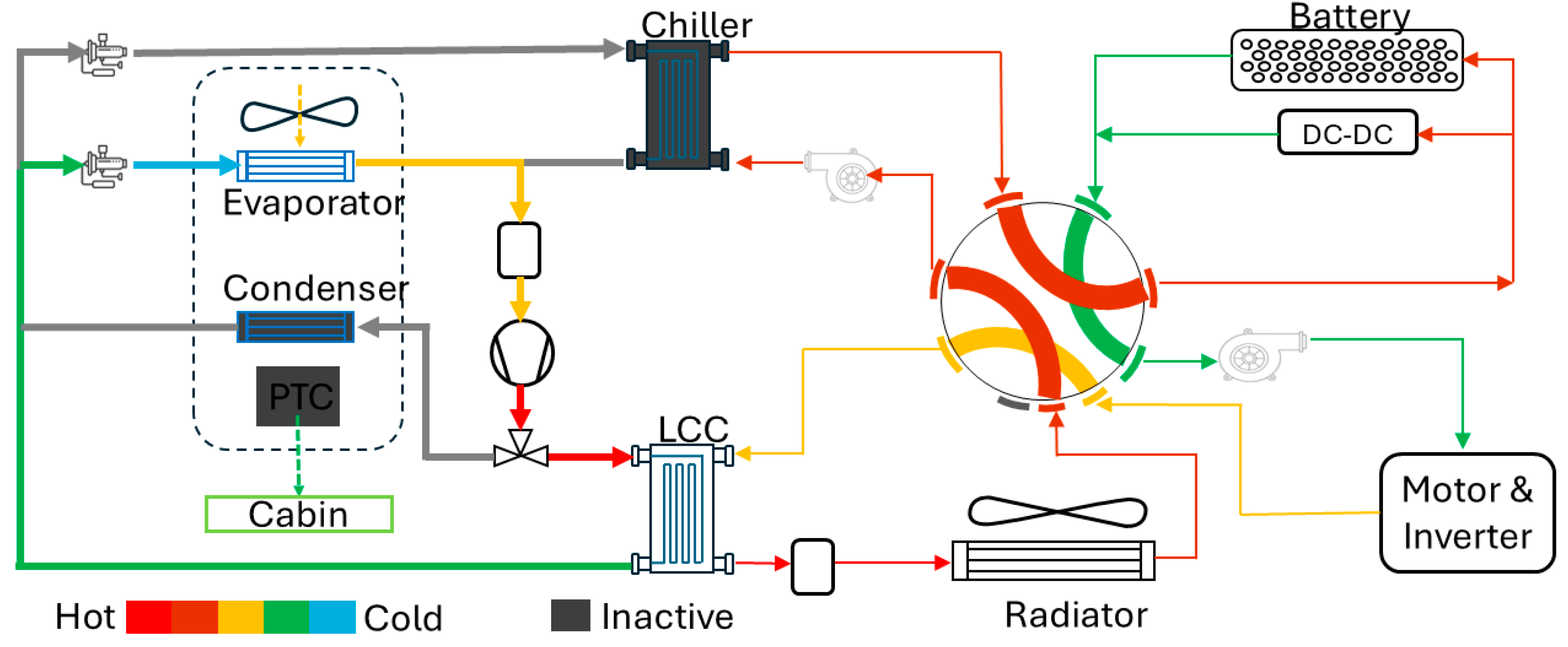
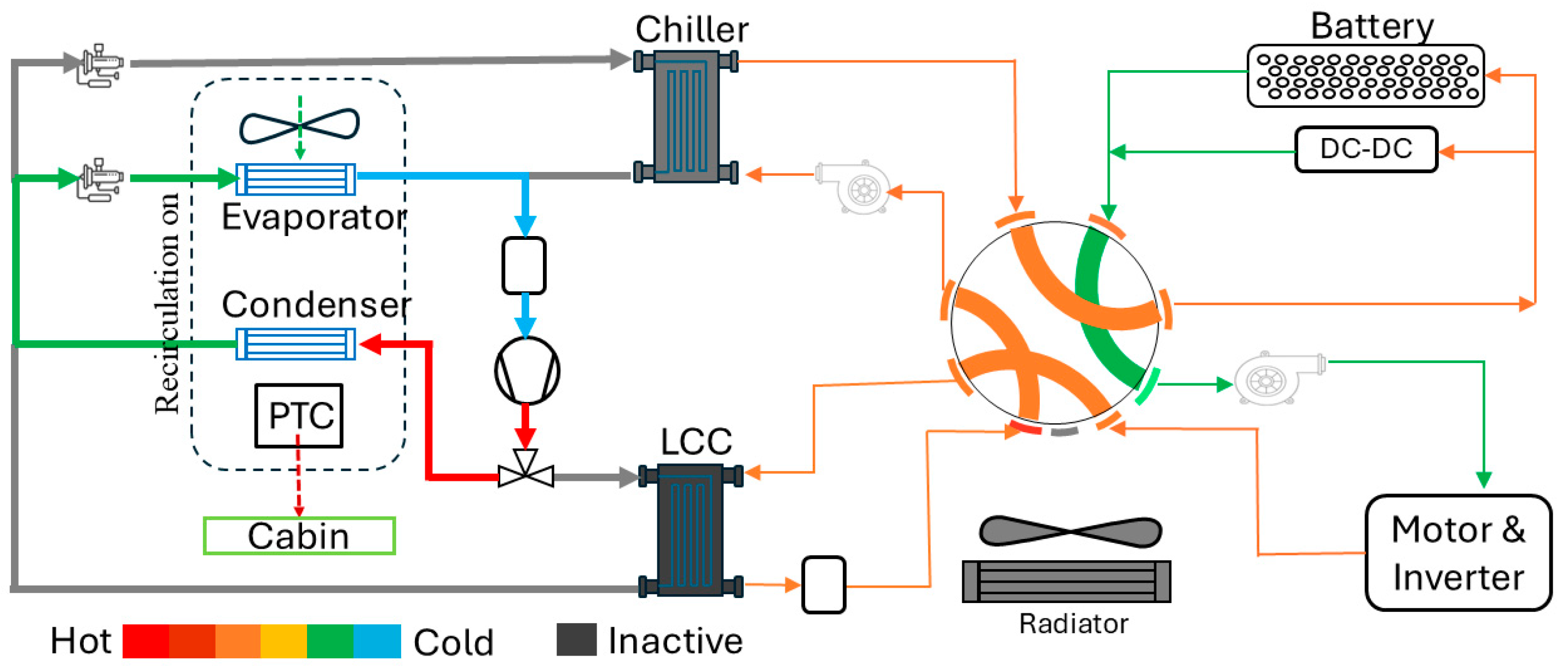
11], this system, shown in
Figure 2 and used by Tesla, also has room for making the blower, motor, and compressor work in an inefficient mode, by which the ITMS can use this heat to meet the cabin and battery thermal requirements when needed.
As mentioned in [
10], with the help of the above-mentioned layout, battery preconditioning modes for heating or cooling under extreme conditions are feasible by using either the chiller or LCC as per the thermal requirements of the battery.
The energy consumption comparison for a complete powertrain warmup was studied in [
10] between the Tesla Octo-valve-based system and a baseline ETMS that had no such complex coolant and refrigerant loops. The baseline system had only two types of basic modes and a chiller. It was found that the Octo-valve-based system consumed only 300 Wh of energy as compared to 640 Wh of energy in the baseline model. So, this study strengthens the superior performance of Octo-valve systems as compared to other simpler systems used in electric vehicles.
Even though the Octo-valve-based innovative ITMS has had very good performance metrics to date in terms of BEV vehicles’ efficiency, and also has the ability to perform well under extreme ambient conditions, the literature includes only brief descriptions based on patents by Tesla or limited sources, as in [
10]. There is not enough academic or industry research to simulate the Octo-valve-based ITMS along with its control strategy for Tesla M3 under different ambient conditions. Validation of the cabin and battery thermal data with experimental tests for the Tesla M3 is also another area where a research gap was observed.
The present work aims to bridge the gaps identified, as discussed above. This work will be carried out in a stage-wise manner by first developing a baseline model for establishing a holistic thermal management system for electric vehicles with the help of knowledge of key components and an initial literature review of ITMSs. From this understanding, and using references in the literature to the Tesla patent [
11], an ITMS for a Loughborough University Tesla model (LUTM) based on the Tesla M3 will be developed.
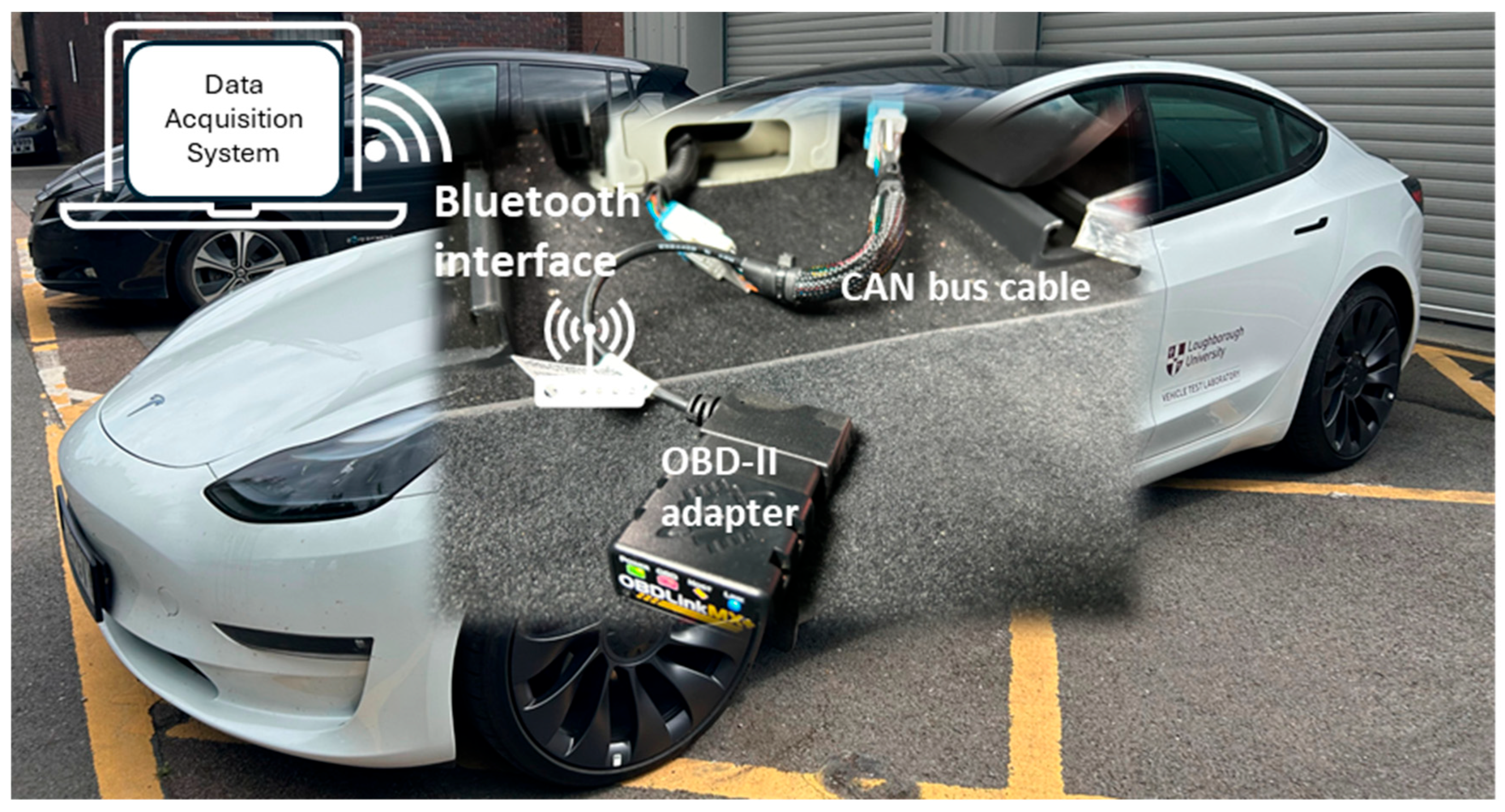
The ITMS developed for the LUTM will encompass the architecture of the thermal system implemented in the production vehicle and the critical Octo-valve control strategy, along with all the other control strategies developed for the blower, compressor, solenoid valves, etc., to address the cabin and battery requirements under different ambient conditions. Further, the model will be validated for the thermal behavior of both the cabin and battery with the experimental data collected from the Tesla M3 (2023) vehicle (see
Appendix B,
Figure A1, Instrumented Tesla 3 model at Loughborough University). As extreme testing conditions for real-world driving will not be available, theoretical cases for these temperatures based on literature references will be presented to show the Octo-valve-based ITMS’s performance at these temperatures for the Tesla M3 LUTM model.
2. Theoretical Background
The main components of the vehicle, like the battery, motor, and inverter, along with their heat-generating phenomenon, together with the climate loads and heat transfer equations of key refrigeration loop components, are considered.
Lithium-ion battery and associated losses:
Net heat generated in a battery reaction can be expressed as:
is the polarization heat loss, which is due to the deviation of the actual electromotive force from its equilibrium electromotive force. This polarization heat loss per unit time during the charging (
) and discharging process (
) can be expressed as:
Polarization resistance can be expressed as:
The resistance of the battery is a function of temperature, SOC, and discharge rate.
As stated in [
12],
which is the heat generated during the side reactions, self-discharged during the electrolyte decomposition, can be neglected for current marketed Li-ion batteries.
The heat generated per unit time due to the electrical resistance component of the battery is expressed as joule heat (
), and like
it can be expressed for both charging and discharging modes as:
So, the amount of heat accumulated by the battery system can be derived based on the energy conservation equation as stated below:
is expressed in the above equations. The heat dissipated covers all forms of heat transfer, starting from the battery cell to the coolant plate and finally to the ambient air, which includes conductive, convective, and radiative heat transfers.
Losses in PMSM motors:
The losses that are observed in the motor are iron losses, copper losses, and friction losses. Iron losses consist of two types: hysteresis losses (
), due to the reversal of the magnetic field, and eddy current losses (
) in the material, due to the changing magnetic field. As stated in [
13], these can be expressed as:
Copper losses or ohmic losses, which are due to the heat loss in the copper winding, can be expressed as:
Friction losses in PMSM motors due to the friction between the rotor and bearings (
and friction between the air and rotor (
) can be expressed as:
The direct current available in the battery pack is converted to the variable frequency alternating current through the inverter. When electric machines function as generators, they produce AC current, so inverters function as rectifiers to convert this AC to DC and distribute it to the battery.
Currently, EV manufacturers are shifting towards silicon carbide (SiC) Metal-Oxide-Semiconductor Field-Effect Transistors (MOSFETs) as they have higher operating temperatures, switching speeds, and switching frequencies when compared to traditional silicon-based Insulated Gate Bipolar Transistors (IGBTs). MOSFETs are highly efficient and have higher power density, because of which a simplified cooling system is sufficient. Though they have incredibly good advantages, some critical issues like reliability, high electromagnetic interference, and difficulty in cooling still need to be addressed.
Liquid cooling methods are more preferable in these types of inverters due to their higher power density, so a liquid-cooled cold plate heat sink, which is embedded with serpentine or U-type copper tubes, can be used [
13]. The cabin loads have a significant impact on the range of vehicles. In a NEDC cycle, in general, there will be a 17.2 to 37.1% reduction in range in the summer, and this can be 17.1 to 54.1% during winter. So, understanding the cabin loads is crucial while designing the ITMS [
14].
Cabin load (
can be expressed as a combination of:
In Equation (13),
is ventilation load,
is radiation load,
is metabolic load, and
is ambient load. Ventilation load occurs when the HVAC is kept in fresh air mode, so this load varies as the fresh air flow rate varies. When performing the ventilation load test, a heater is used to heat the cabin, so the total heating load of the vehicle when the heater and blower are on is given as follows:
In Equation (14),
, as mentioned earlier, is the ambient heating load, which is due to the difference between the cabin temperature and the ambient temperature. This is due to the convection and conduction of heat into the cabin due to the temperature gradient. By removing this heat from the total heating load, we get the ventilation load of the cabin. Ambient heat is expressed as:
k is a function of vehicle facing velocity, as discussed in reference [
15].
Here,
is the radiation intensity of the sun, and
is the projected area of the sunlight on the car windows [
15].
Here, M is the metabolic heat production rate of the body, and is the human body’s surface area.
The refrigeration loop components are all governed by the balance of heat transfer and energy changes happening across the components.
Considering the case of a chiller where heat is transferred from the coolant to the chiller wall and then from the chiller wall to the refrigerant, we use the following equations.
Heat transfer from the coolant that absorbs heat from the battery to the chiller wall is expressed as:
Equation (18) shows the heat transfer from the coolant to the wall through convection and the mass flow rate of coolant. Equation (18) resembles the heat transfer through the wall to the refrigerant. As the refrigerant absorbs this heat from the coolant, its enthalpy and thus temperature change is expressed by Equation (19).
Equations (18)–(20) are applicable to the other heat exchangers that are used in heat pump layout, like the condenser, evaporator, radiator, etc.
The power required for the compressor and coolant pumps is derived through the pressure drop across them and the efficiency of the respective components. Power for a coolant pump is:
The pressure difference (ΔP) across the coolant pump and compressor was obtained directly from the Simscape model as the instantaneous inlet–outlet pressure difference. The model uses built-in hydraulic and refrigerant components based on the Darcy–Weisbach relation for frictional losses.
On the same lines, power consumption by a compressor can be calculated by taking refrigerant properties into account, as shown below:
Figure 3 shows the Holistic Thermal Management Layout for the baseline study of a simple ITMS in general BEVs.
The holistic thermal management model developed from the initial literature review of the ITMS, and the analysis of layout presented by [
16], will be the baseline version for the ITMS that will be explored for the EV model having an Octo-valve or a five-way valve. This layout shows a system-level view to manage the thermal aspects of the powertrain and cabin in an integrated approach rather than considering them individually. Thus, this holistic approach helps optimize energy flows and control the strategy of the systems to improve the overall efficiency of the vehicle.
The Overall Control system incorporates a longitudinal driver model, motor control, and thermal control. The longitudinal driver model takes the inputs of desired vehicle speed, actual speed, and gradient, and generates the acceleration and braking command as outputs. The thermal control system involves the coordinated management of coolant loop control, compressor control, cabin air control, and fan control. Various sensors and predictive controls are used to monitor the thermal conditions of individual components of the powertrain, cabin, and drive train systems and adjust them to optimize the performance of the vehicle.
The baseline holistic thermal management layout has a powertrain and battery thermal model, which is based on the coolant loop. This block has two thermal coolant loops: one for the motor, inverter, and power electronics, and another for the battery cooling. It receives the signal of component temperatures and heat transfer rate from the vehicle model, and through the help of the coolant loop control strategy, the coolant flow is adjusted in these loops to bring the components to optimal working range temperatures.
In this base layout, a four-way valve is used to obtain two types of modes, which can be stated as integrated and separate loops. The working of these two modes is dependent on the ambient conditions. In a hot weather scenario, the temperature of the battery and the motor are both high, so the coolant loop operates in a separate mode, where the chiller will be used to cool the battery, and the radiator will be used to cool the motor.
3. Overall Model
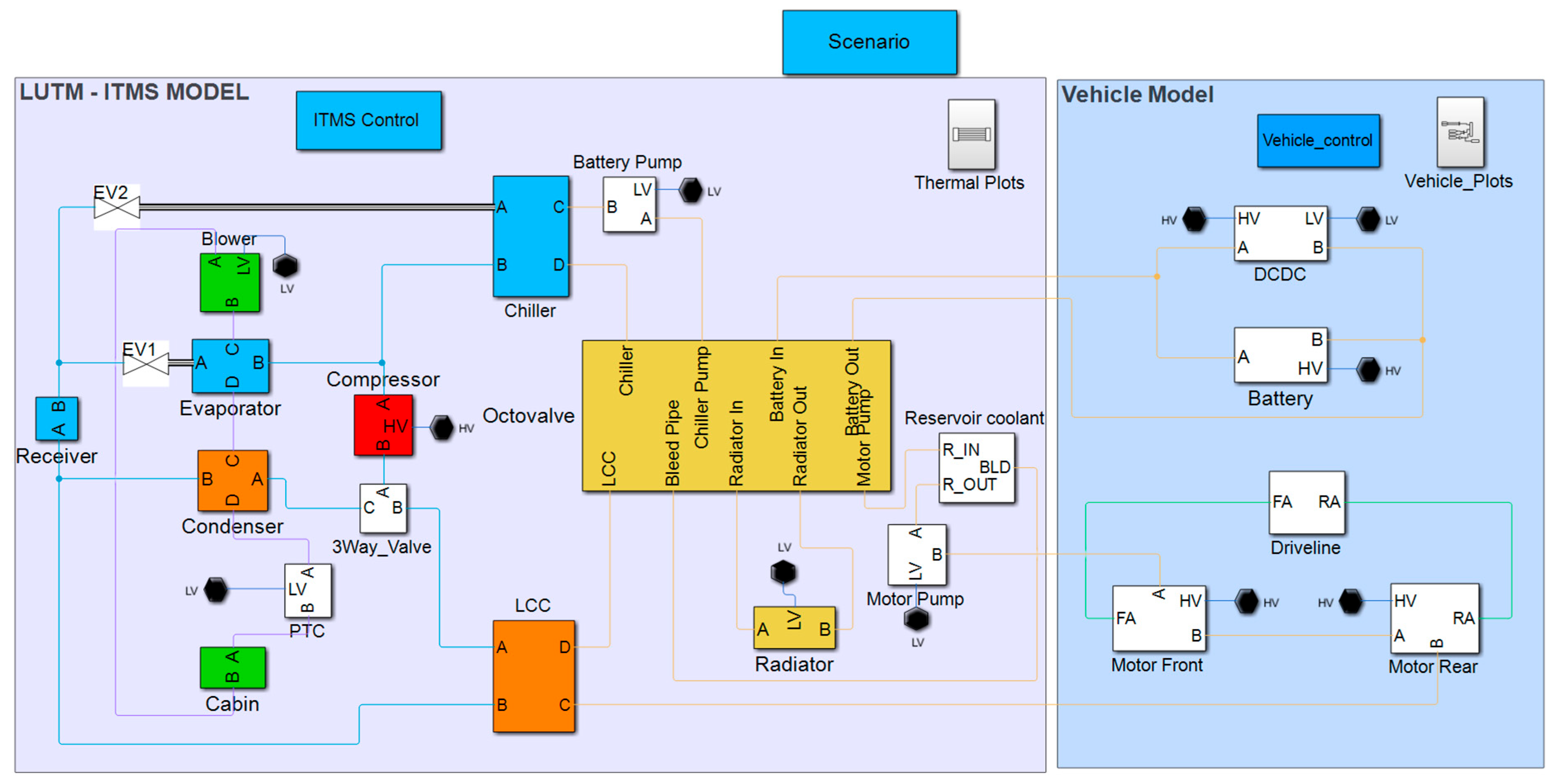
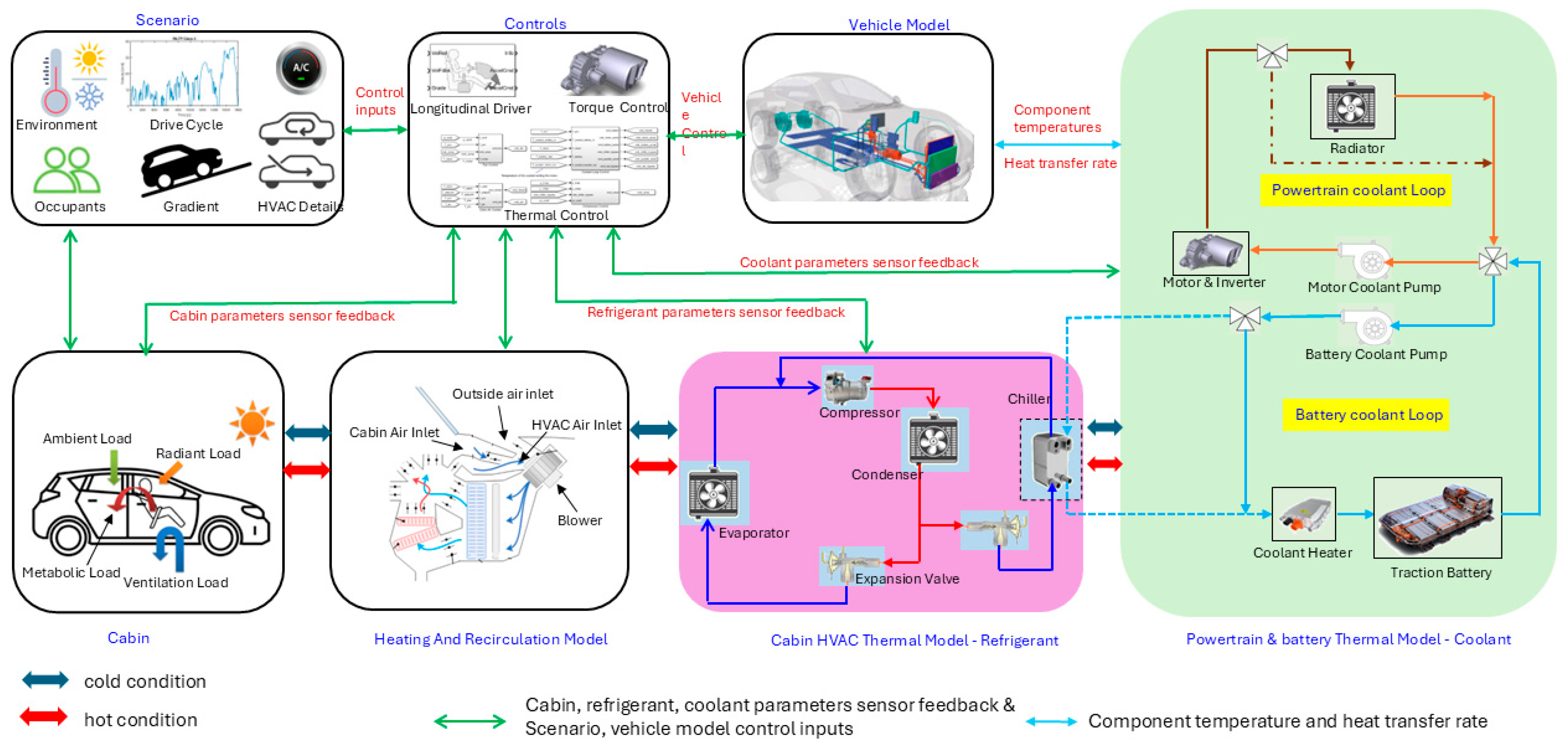
An integrated model of the ITMS and vehicle, the heat signatures of the vehicle model components like motors, battery, and DC-DC are taken into consideration for designing the ITMS architecture along with the refrigeration system, as shown in
Figure 4 below. This type of architecture is key to having thermal interaction between the battery coolant loop and chiller, and if necessary, with the motors. Also, this type of architecture, as stated in [
11], provides cabin heating without the need for more energy-intensive PTC heaters. So, the current heat pump system shown above can be useful for both cabin heating and cooling. As the cabin evaporator and condenser are packed in the same casing, when operated at the same time, this will make the compressor work as a heater, so in this way, we can avoid the more energy-oriented PTC for heating scenarios.
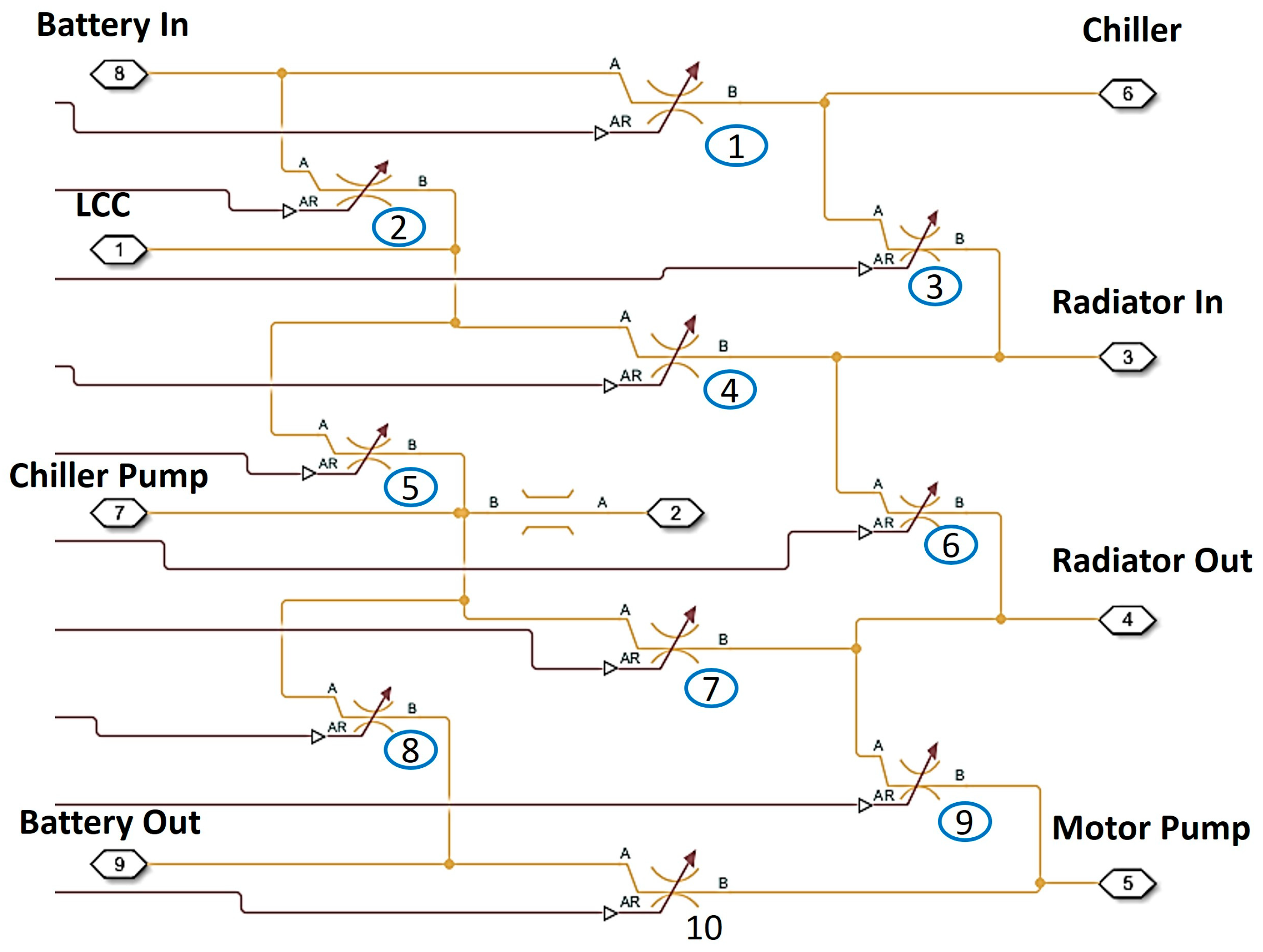
The coolant loop key subsystems cover the control of the Octo-valve, radiator, and shutter, battery cooling plate, and motor coolant loop subsystem. The Octo-valve coolant system design and control strategy development are shown in
Table 1 and
Figure 5. This coolant system has eight ports (as a single coolant reservoir is used for both the battery and coolant pumps, a bleed port is provided for continuity of coolant flow). The Octo-valve or eight-way valve, as defined in [
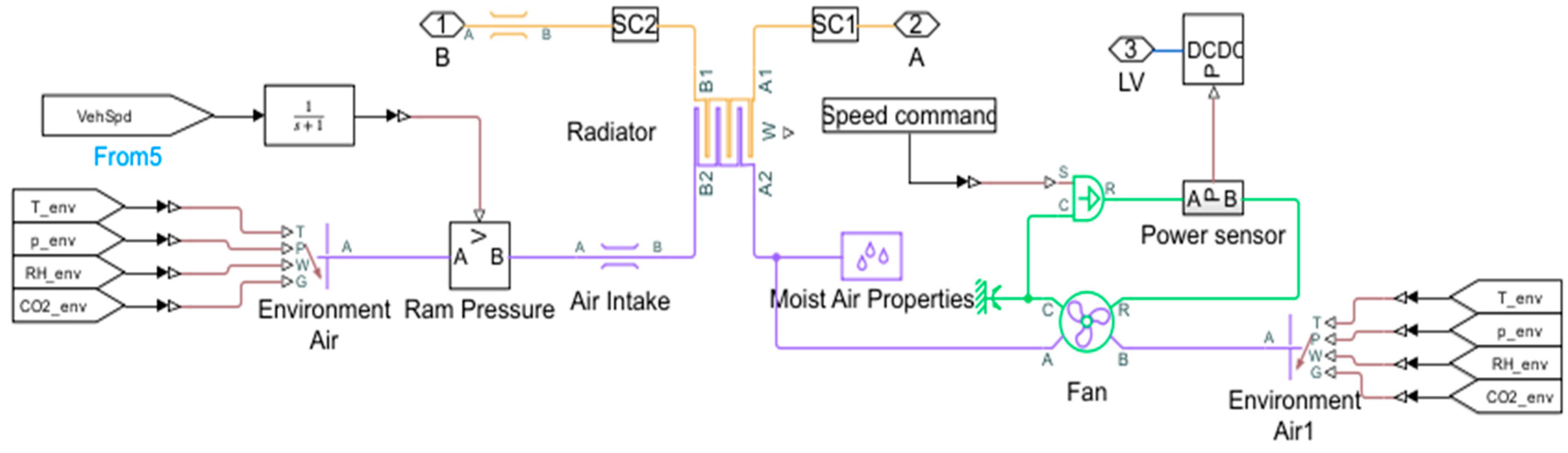
11], is the heart of the ITMS. This hosts the thermal communication between the coolant and refrigerant loop components by having the coolant from the battery and motor loop flow through specific paths. This way, waste heat recovery is possible, which in turn improves the COP of the heat pump system. In conventional electric vehicles, radiators have functional vanes that allow the flow of air through them or stop it when a radiator bypass is needed. A fan is attached to the radiator to suck the air from the ambient environment. So, the fan and radiator vane act in combination to dissipate heat from the coolant that passes through this rectangular tube and fin-type radiator designed in Simscape. The radiator and grill shutter subsystem is shown in
Figure 6.
Radiator shutter activation is modelled inside the ram pressure block by using a local restriction (moist air) available in Simscape. This shutter functions if there is a need for the radiator to dissipate heat through it. A control strategy is designed to implement this radiator shutter activity, which will be discussed in further sections. Other coolant loop components, like motor pumps and coolant reservoir designs, are taken from the reference ETMS layout by [
16]. The model is shown in
Figure 6.
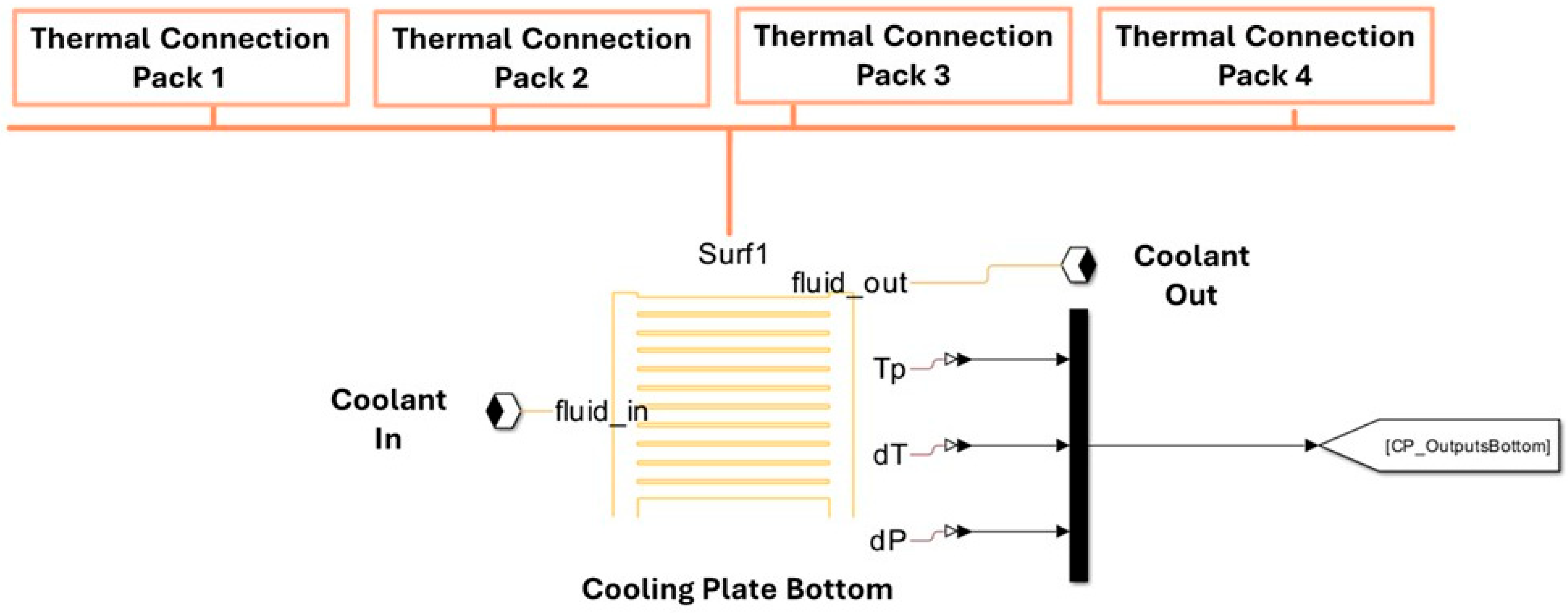
For the simplicity of the architecture, validation of the Tesla M3 and thermal behavior of the battery and cabin, a simple cooling plate system for the battery cooling plate subsystem for thermal requirements, shown in
Figure 7, was considered for the battery cooling/heating.
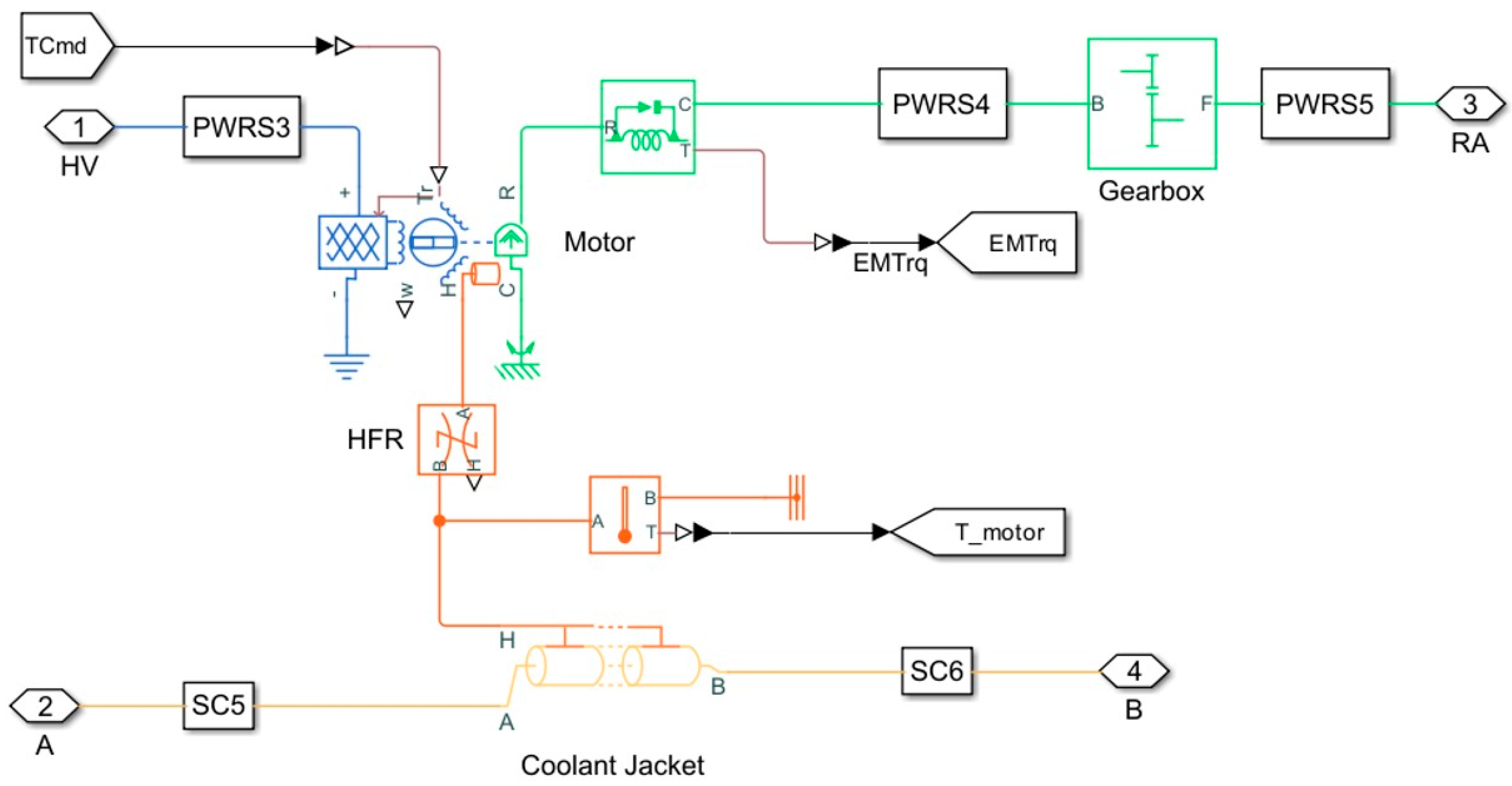
The thermal mass of the winding is assigned to the motor block parameters, which are used for thermal modelling of the motor. When the thermal port is enabled, we can obtain the heat flow and the temperature change in the system due to the electrical losses. Electrical losses for the motor are included using a lookup table where losses are a function of speed and torque. In the motor coolant loop system in
Figure 8, the coolant flows through the coolant jacket and absorbs the heat dissipated by the motor.
The cabin subsystem is modelled as a 1-D model, i.e., a single volume chamber that exchanges heat with the ambient source through conduction, convection, and radiation. The present cabin model helps to attain the average temperature inside the volume chamber; it also considers metabolic heat load from occupants inside.
Solar radiation varies for different ambient temperatures, as stated in [
17]. During warmer conditions, this is close to 800
, whereas this becomes 0 in colder conditions. So, this variation of solar radiation is important while studying cabin thermal behaviour. Also, as further stated in [
18], for heat loads entering through various areas like the glass, roof, and doors, there is a need to consider geometric properties like surface area and thickness. The specifications mentioned in the ETMS layout were considered for the above parameters for the present simulation, as the total cabin volume used in this layout was 3
, which is like the ETMS layout.
To maintain the cabin at a set point temperature, the blower plays a crucial role. The recirculation flap of the blower incorporates the control of air recirculation from the cabin, and if not needed, complete air is sourced from the ambient environment.
For refrigeration loop key components, the physical modelling library of Simscape is used to model these components. Like the other components explained above, these blocks use the effectiveness-NTU method to model the heat transfer through the thermal interaction surface. The pressure target of the compressor is important when considering the heating and cooling scenarios, as the evaporator target temperature varies. For the present study, the control strategy of the compressor incorporates this change in pressure target consideration as per the winter and summer scenarios.
A three-way valve is designed to divide the flow in parallel between the condenser and LCC based on the same kind of logic developed for the recirculation mode. Here, a local restriction (2 p) block of Simscape is used, which is compatible with the refrigerant flow properties.
The PTC heater in the ETMS layout is used for the present simulation. The thermal mass properties (mass and specific heat) of PTC are taken to be the same as the baseline ETMS layout, but the maximum power of PTC was changed to 5 kW for Tesla M3 simulations as stated in [
19]. Here, the PTC heater is modelled to have a convective heat transfer with the constant volume chamber through which the air from the blower passes.
4. Control System
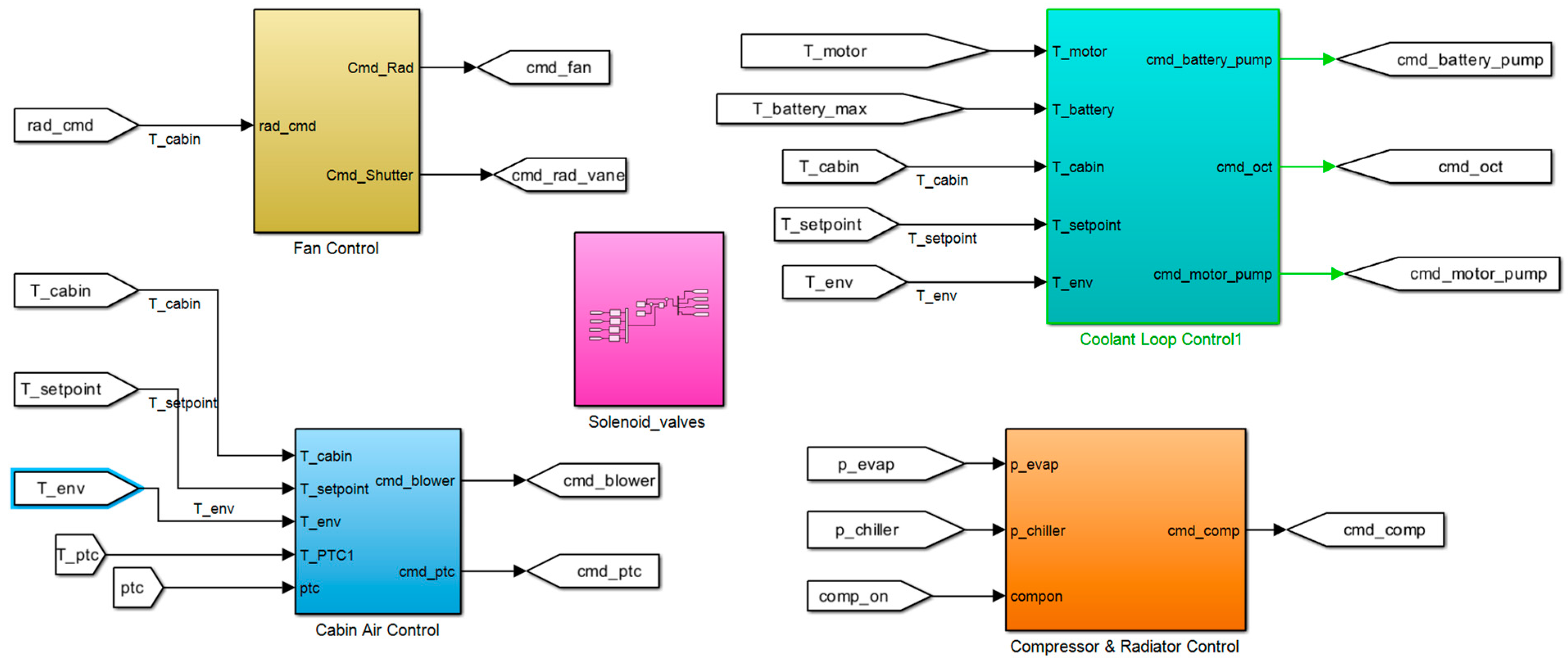
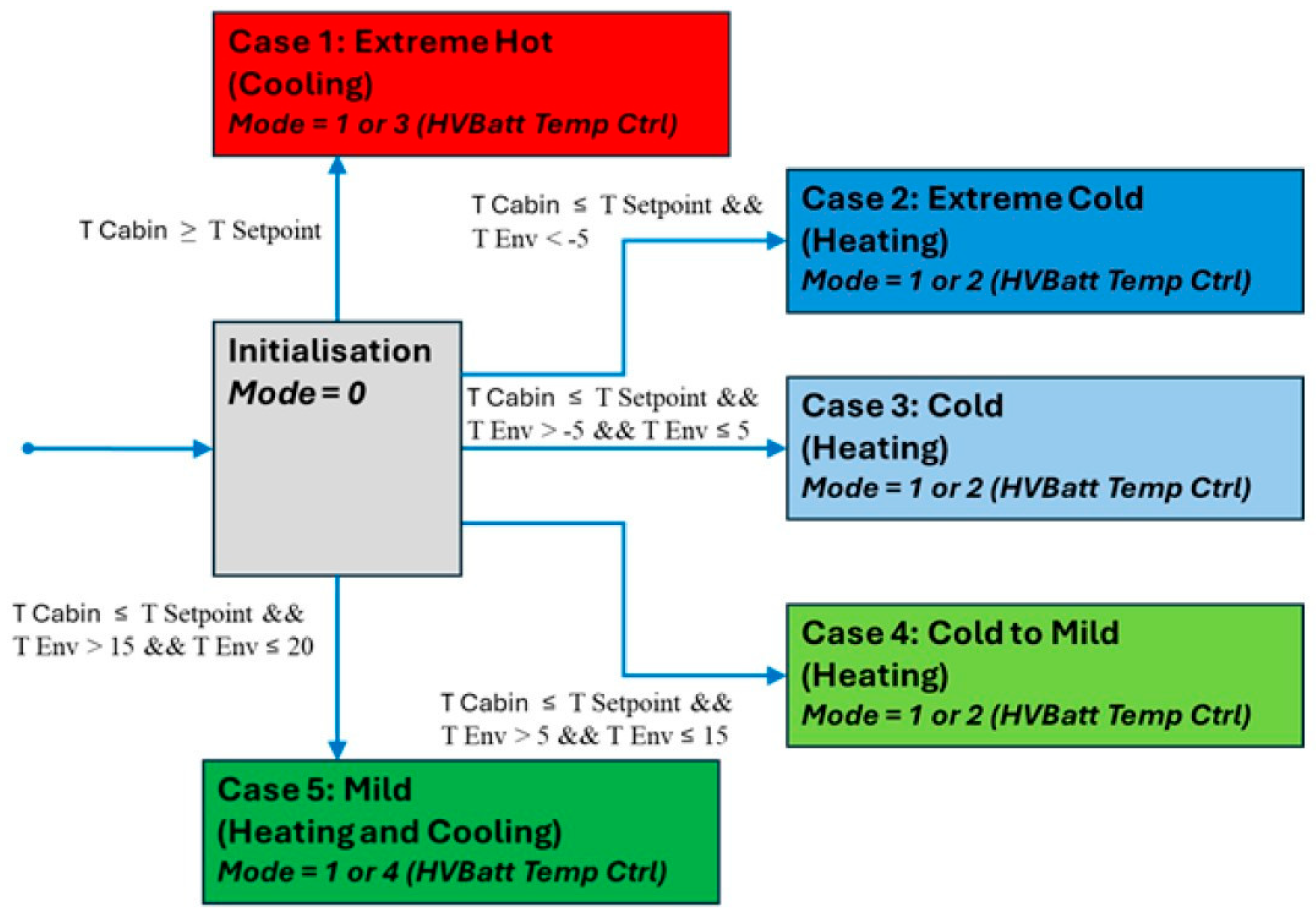
The control strategy for the ITMS for heating and cooling scenarios is developed by dividing them into radiator vane/shutter and fan control, coolant loop/Octo-valve selection control, cabin air control, solenoid valve control, and compressor control, as shown in
Figure 9.
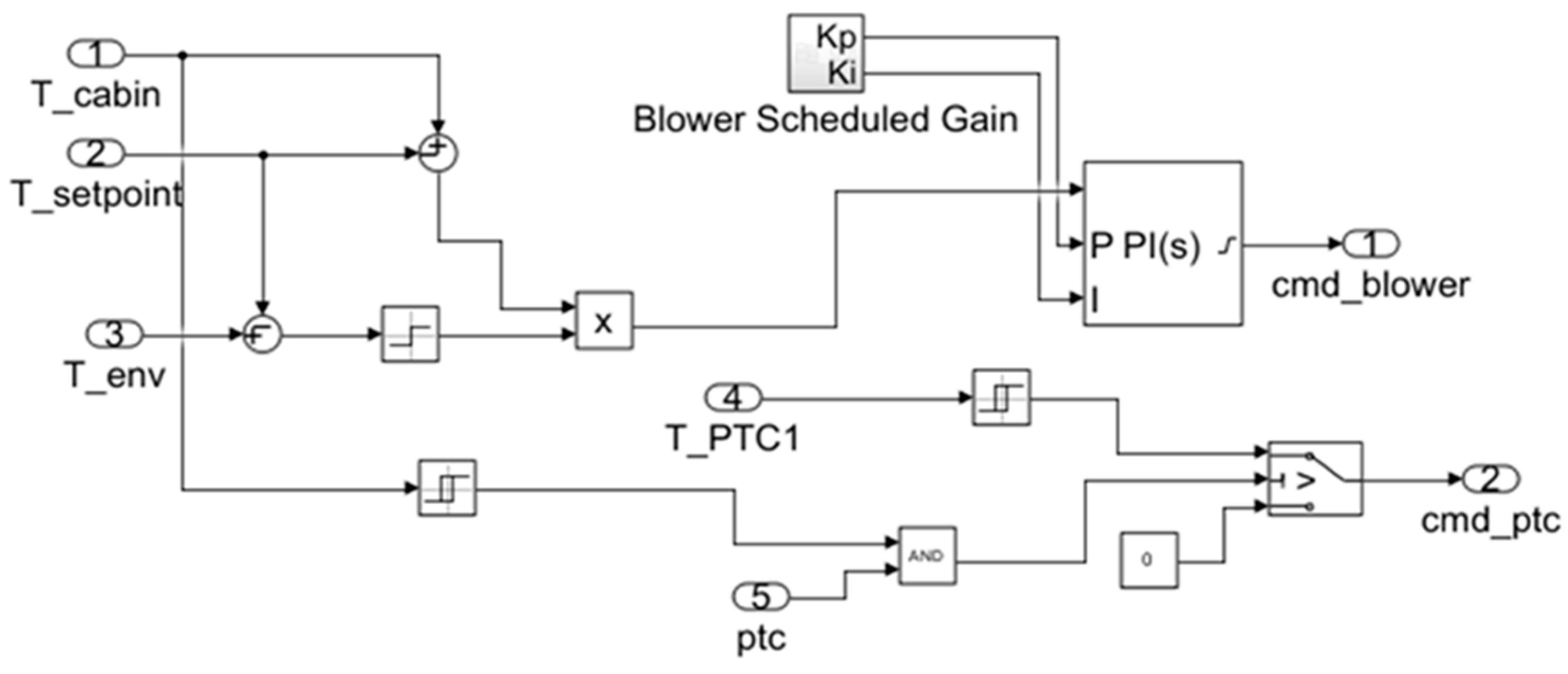
Blower control strategy is based on the difference between cabin temperature and set point temperature. So, as the current study is spread across various temperatures starting from −20 °C to 40 °C, a gain-scheduling PI controller is implemented for the blower controls. The control strategy for the blower with this gain schedule is shown in
Figure 9. Here, a PTC control is also implemented, which activates as per the main PTC control output through the Octo-valve control, as per the ambient temperature. The on and off control of PTC is activated either when the temperature of the PTC reaches 45 °C or when the cabin temperature crosses the hysteresis limit set.
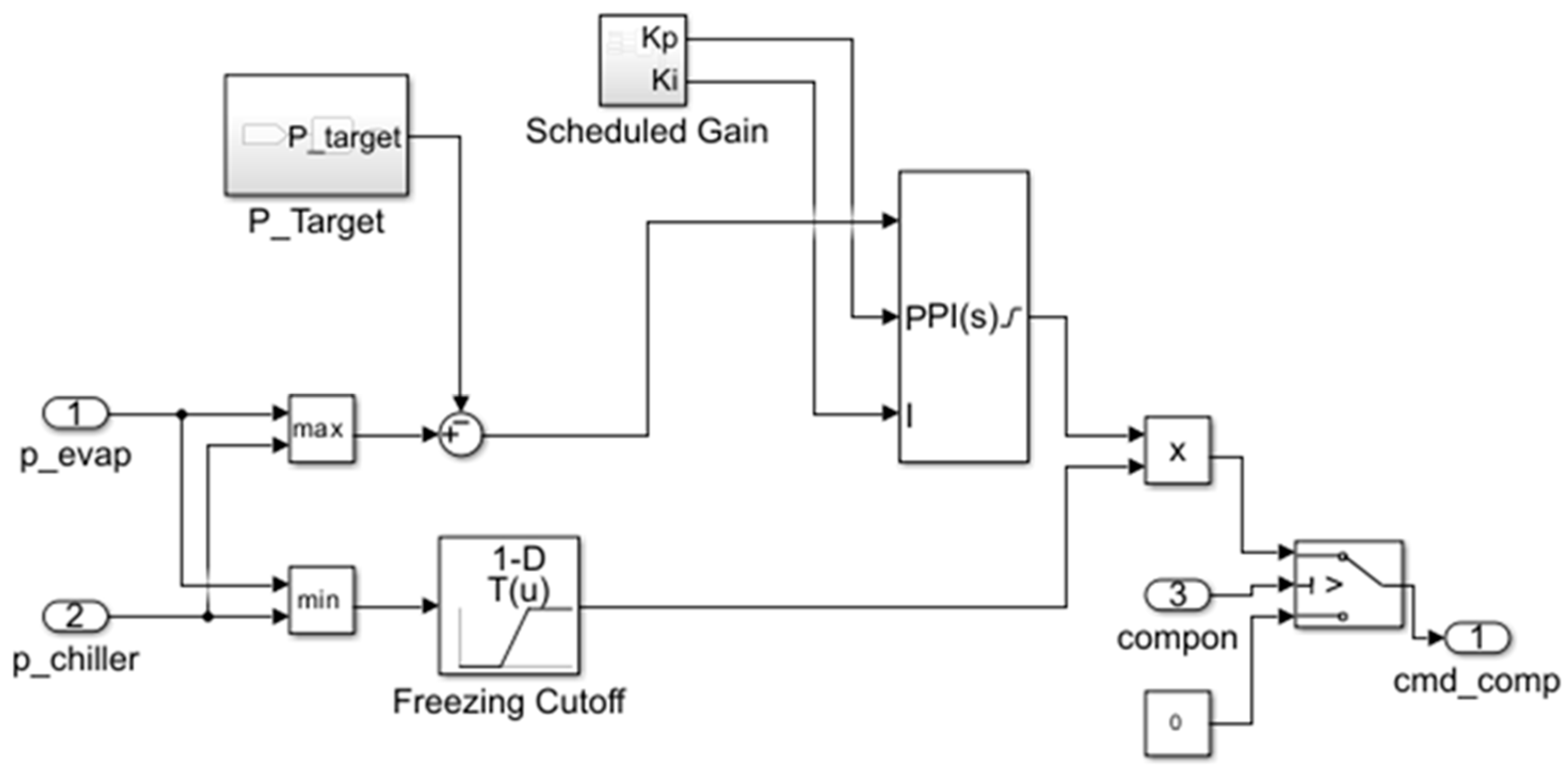
Compressor control is based on the chiller and evaporator pressure difference, with the target pressure considered for summer and winter conditions. There is also a need for gain scheduling in the compressor PI values, as varied temperatures are being simulated. As stated in [
20], the optimal evaporating temperature for summer conditions is close to 1 °C to 2 °C for electric vehicles, whereas in winter this goes up to −12 °C to −16 °C. So, the target pressure ratio, as verified from the p-h chart for the R134a, was updated for the cooling and winter scenario to have 1 °C and −13 °C as the evaporator inlet temperature for the ITMS model.
The gain scheduling
and
values for blower and compressor for the temperatures where experimental validations were feasible are derived from the time taken for cabin cooling and heating. As both the compressor and blower are jointly responsible for cabin cooling, these values were manually finetuned as the system was highly nonlinear and included a lot of physical components rather than friendly Simulink operation-based components.
Figure 10 depicts the blower-cabin air control strategy, and the compressor model is presented in
Figure 11.
Radiator fan and shutter control are derived based on the experimental validation performed for the cabin cooling scenario. As observed from the vehicle logged data, the radiator fan had a simple on and off control strategy. So, as per the input from the main coolant control strategy that will be discussed further, the radiator fan will be working at peak rpm when the heat must be dissipated from the coolant passing through it, and in other cases, a 1-D lookup table is implemented to map motor temperature to corresponding radiator RPM levels and shutter opening values. Here, for the sake of simplicity, a simple on and off controller is selected for radiator shutter control.
Solenoid valve controls are also designed based on the output from the main coolant loop strategy to activate the chiller, evaporator, condenser, and LCC as per the mode decided by the main coolant loop strategy for the Octo-valve. Here, a simple on-and-off type controller is also designed for these valves.
The coolant loop control strategy for the cases under review is at the heart of the entire ITMS and is carefully derived from the vehicle validations for the available temperatures. For other temperatures where a theoretical study was carried out, the control logic was derived from the Tesla patent by [
11]. Cooling from 40 °C and 30 °C is included in
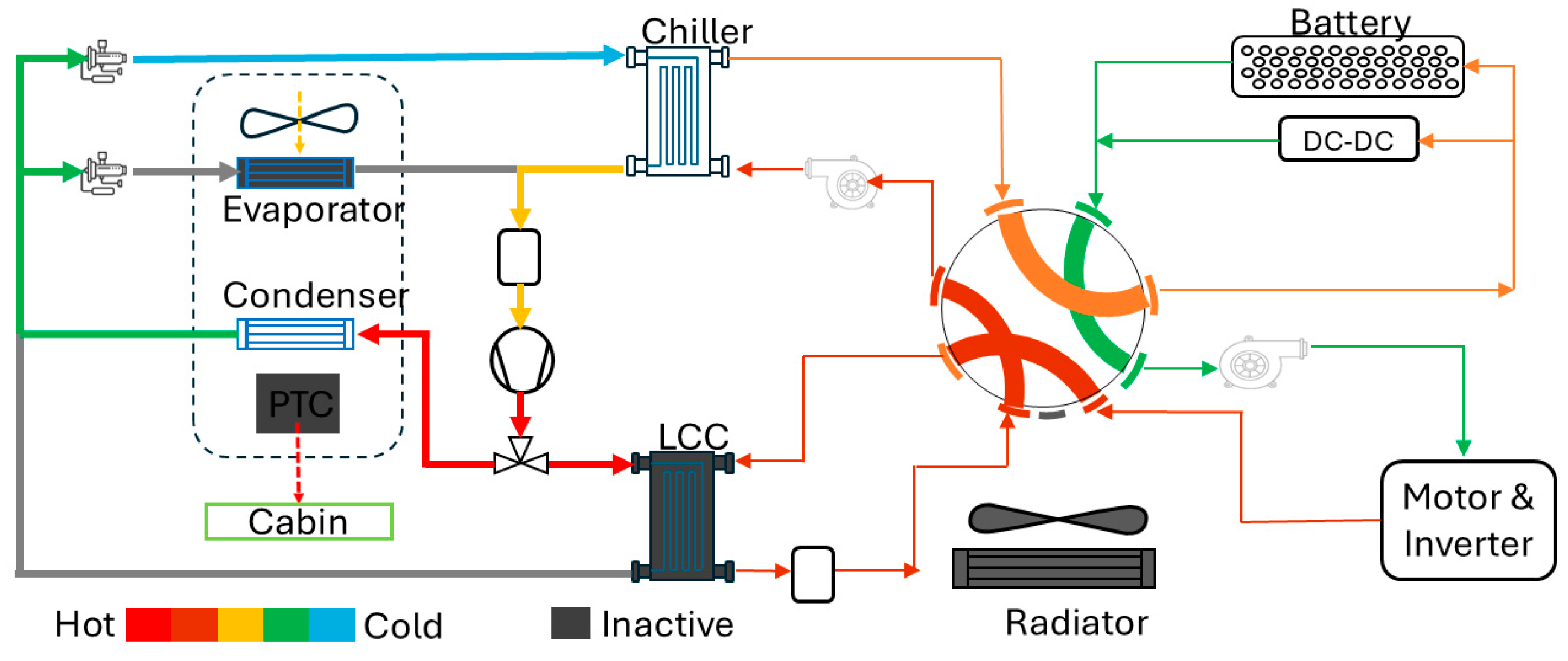
case 1 of the control strategy. Here, in this mode, as validated on the vehicle, for ambient at 30 °C and cabin temperature at 40 °C, Octo-valve mode 1 was selected. The working of this control strategy on the layout is shown in
Figure 12, based on a literature reference. In this mode, the chiller condenser is inactive, and coolant from the battery and motor loop is in series and passes through the radiator.
Here, the radiator fan is activated when the battery temperature is more than 42 °C, as observed on the vehicle. The radiator fan attains minimum RPM levels when the battery temperature reaches 39 °C, to keep the battery operating temperature in the range of 40 °C.
For case 2, heating from the extreme temperature of −20 °C is considered. As this scenario was not available to validate the control strategy experimentally, the present control strategy was used. This study gives the aspect of ITMS energy consumption as compared to total vehicle energy consumption at these critical conditions.
For this case, the Octo-valve is in mode 2, which is radiator bypass mode. At these temperatures, if the battery is also assumed to be in thermal equilibrium with the surroundings, there will be no such thermal energy that can be extracted from the battery, which can be provided to the heat pump to improve COP. Hence, in this mode, as shown in
Figure 13, the chiller is inactive. As energy spent on battery heating is very difficult to recover, and thermal comfort of the cabin is important, the LCC is kept off so that the heated refrigerant from the compressor is used to maintain cabin comfort.
In the present study, internal air recirculation from the condenser back to the evaporator is not considered due to the complexity of control; rather, recirculating the cabin air to the blower is considered for the complete drive cycle. The battery coolant loop is in series with the motor to absorb the heat dissipated by the motor, thus helping increase the battery temperature.
For
case 3, when the ambient temperature is at 0 °C, there is scope for using the thermal energy of the battery at these temperatures. The chiller is active, and PTC is off as compared to case 2 discussed earlier. This strategy is mentioned in the references stated earlier. So, in
Figure 14, for this temperature scenario, the chiller is active, and PTC is off; the rest are all like case 3.
For
case 4, when the ambient temperature is at 10 °C, as the cabin heating load will not be as high as 0 °C, the compressors do not need to work at higher powers. So, the evaporator is not required to be active along with the condenser, as in cases 2 and 3. So, in this mode, as shown in
Figure 15, the condenser and chiller are active, and the Octo-valve is in mode 2, i.e., series mode with radiator bypass. The radiator is activated, and Octo-valve mode shifts to 1 when the battery temperature is more than 42 °C.
For
case 5, as ambient conditions are too high, that is 18 °C, the Octo-valve is in mode 4, where the chiller and radiator are in a loop, so that ambient sourcing is possible in this mode. In this mode, the coolant loop of the motor and battery is in series, and the chiller and condenser are active. As battery temperature rises to 42 °C, Octo-valve shifts to mode 1 and radiator is activated like case 4 (control strategy discussed is implemented in state flow in
Figure 12). Based on the coolant loop control strategy, which encompasses when to activate the battery and motor coolant pumps at their peaks, the control strategy for the battery and motor pumps is derived. Here, when these pumps are not needed to be active at high rpm, they will be operating as per the motor heat lookup map. The motor and battery loop control strategy ensures they operate at the same rpm when they are in series.
5. Experimental Setup and Data Acquisition
Empirical data collection and analysis for Tesla Model 3 HVAC and thermal management systems is carried out based on an experimental study carried out by Steinstraeter et al. [
21] and B. Johnson [
22] for the Tesla M3 vehicle with the available signals from the Bluetooth dongle and adapter.
Test plan details are proposed to obtain the ITMS low-voltage component specification approximations, cabin, battery, and motor thermal data. As mentioned in
Table 2, below, tests were conducted on the vehicle as per the real drive cycle planned for these tests.
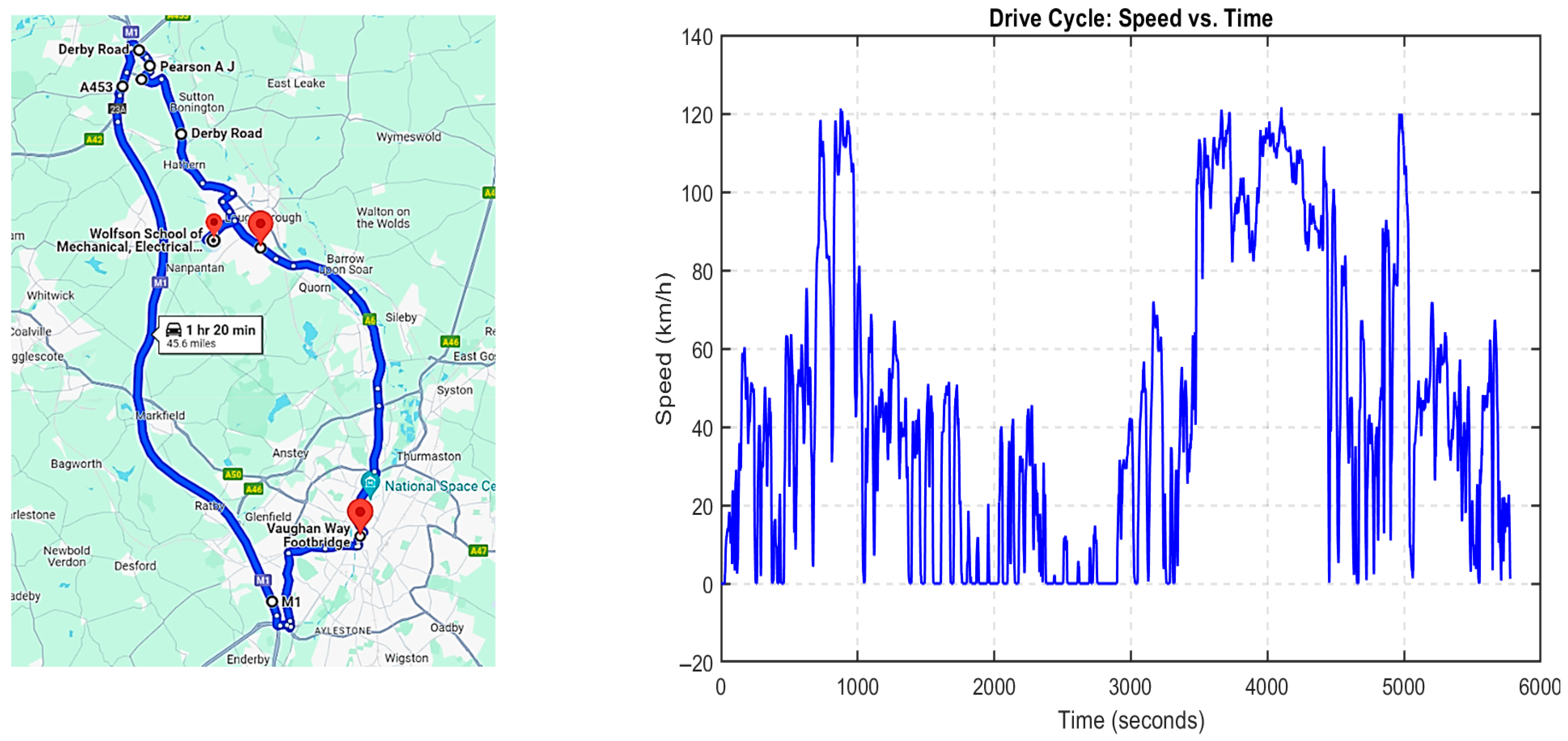
A custom drive cycle, as shown in
Figure 16, was planned for evaluating the ITMS of Tesla M3. Drive cycles include both city and motorway driving, as these driving profiles represent various conditions under which BEV vehicles tend to operate. In motorway driving, as high speeds are maintained for a longer duration, these conditions make the ITMS manage the continuous heat generation from the motor and battery to keep them under the operating temperatures and to keep cabin thermal comfort at the requested levels.
So, by incorporating the drive cycle profiles shown below, the present experimental study aims to capture the holistic evaluation of the ITMSs working under varied real-world driving scenarios.
From the analysis of the test data, it was found that cabin cooling (drive cycle tests) could not achieve the set point temperatures when blower speed was maintained at a constant mid-level rpm. There was also a discrepancy in the heating scenario when the blower speed was kept constant. So, auto mode was analyzed in both cases to deduce the necessary information related to ITMSs.
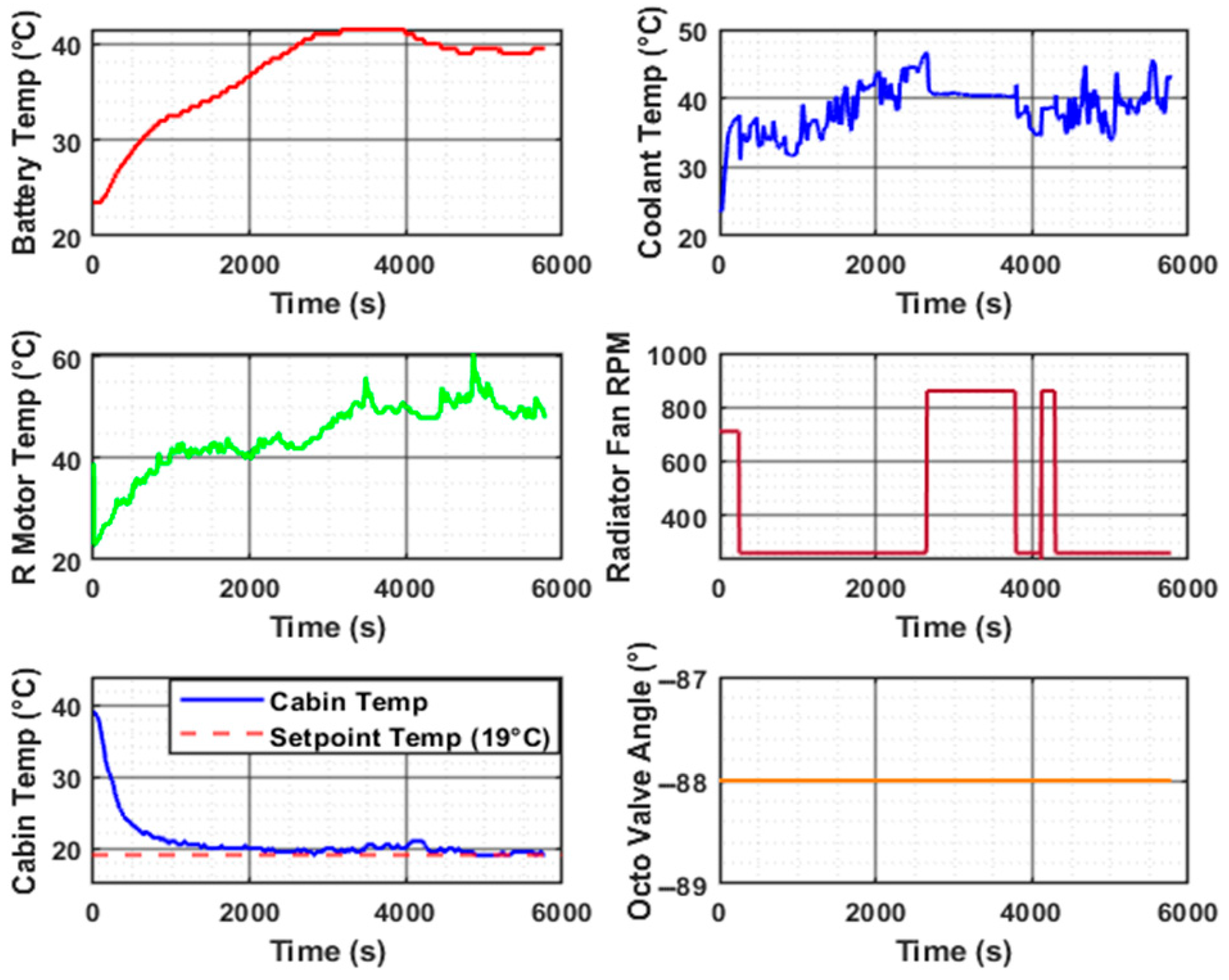
Figure 17 denotes the test data for cabin cooling.
The evaporator, condenser, and PTC heater are all packed in a single casing [
10]. It can be clearly deduced from cooling plots, as shown in the figure. The LCC and the evaporator are active in the ITMS. High-pressure and temperature refrigerant passing through the LCC exchanges the heat with the coolant flowing through it. Further, the heated coolant flows through the battery and heats it up. Once the temperature of the battery attains 42 °C, as shown in
Figure 17, the radiator fan is operated at peak rpm and helps in bringing the temperature of the battery and motor down. This flow of coolant through the battery and motor is in series; it is achieved with the help of the Octo-valve, which switches to series mode. When the battery reaches a temperature of 39 °C, the radiator fan reaches a minimum level.
It was observed from the drive cycle data that vehicles in the motorway driving phase from 3500 to 4500 s, which is causing ITMS to manage the high temperatures in the battery and motor. By ensuring this Octo-valve mode in series, battery temperature and motor temperature are maintained under their operating conditions. In this test, it is also observed that Octo-valve is in series mode throughout the test, and the radiator fan RPM is controlled as per the thermal needs of the powertrain.
As radiator shutter data was not available from the logged signals, it is assumed to have the same control command as the radiator fan for the present simulation model.
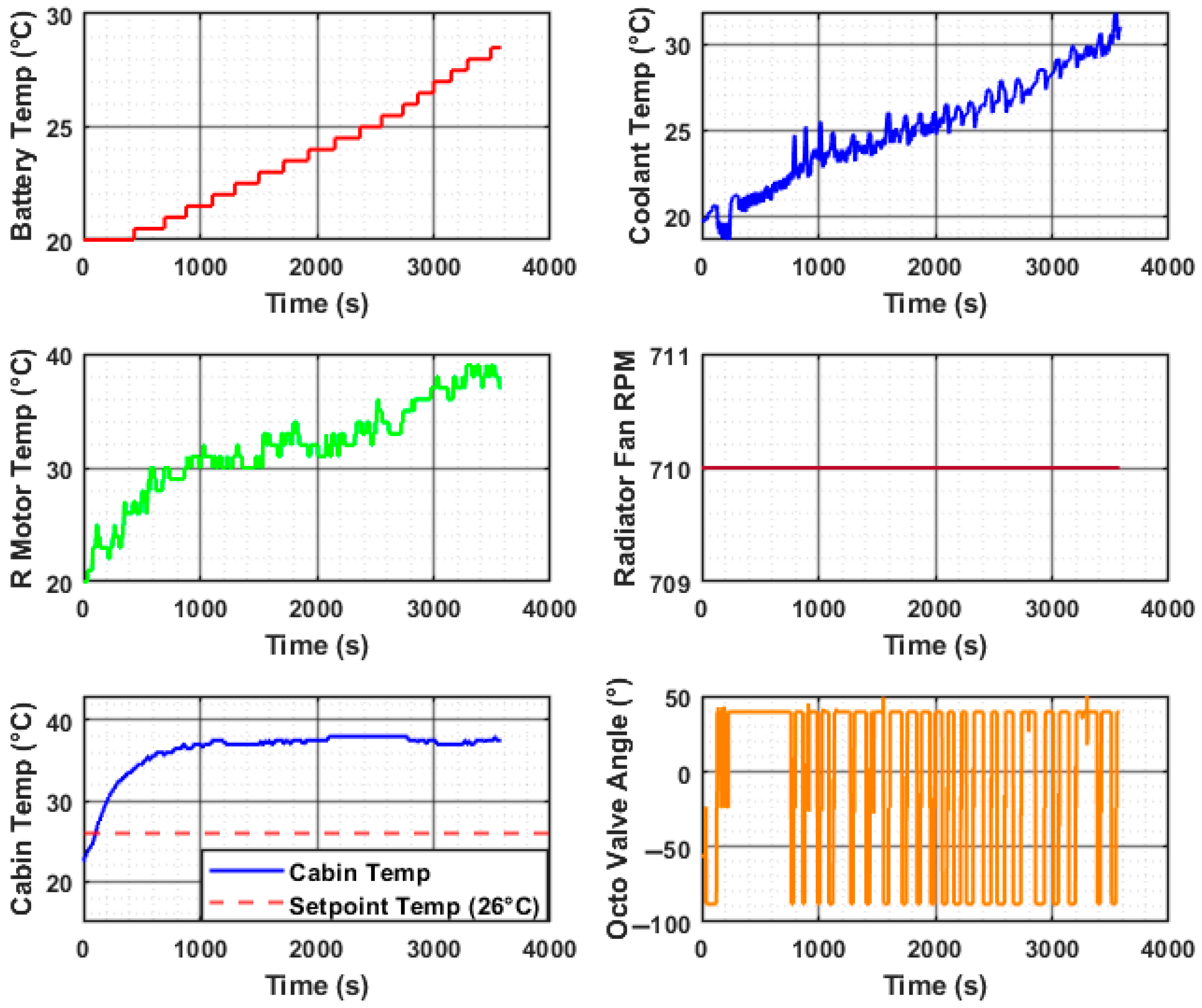
The cabin heating scenario that under the test conditions set on the vehicle, the cabin temperature rose above the set point temperature and settled at 37.5 °C. The duct temperature was close to 60 deg in this case. As the condenser, evaporator, and PTC are packed in the HVAC casing together, the thermal interaction of moist air with the heated condenser unit and other heated components in the duct tends toward achieving thermal equilibrium with the cabin air. This may be one of the reasons for the cabin temperature to spike. Also, the ITMS controller in the vehicle may not be tuned for the ambient temperature of 20 °C that was assessed on the vehicle.
In
Figure 17, the Octo-valve angle signal did not follow the modes description presented in Wray and Ebrahimi, 2022 [
10] and Mancini et al., 2021 [
11]. As per the control strategy, it should follow the Octo-valve mode 4, which has a chiller and radiator in one loop for ambient sourcing. Further, in this mode, coolant flows through the battery and motors in a series configuration. In this mode, heat is sourced from the ambient air with the help of a radiator. The heated coolant exchanges this absorbed heat with the refrigerant in the chiller, thus helping the compressor to work less as the temperature gradient between the condenser and evaporator outlet decreases.
The phenomenon described above was not available from the Octo-valve data shown in
Figure 18. So, there is a need to check this at further lower ambient temperatures, like 5 °C, which were not available during testing.
This section discusses parameterization of various components and the methodology used to attain the numerical values of the model.
Parameterization of low-voltage ITMS components was based on a comparison of the DC-DC energy consumption of the vehicle and the cooling demands of the cabin with the data from the simulation model for the cooling test (Auto mode). An approximation of parameters for ITMS low-voltage (LV) components was performed.
ITMS low-voltage components like radiator, blower, motor, and battery coolant pumps consume the maximum low-voltage power output of DC-DC. So, the parametrization for these components involved a combined study at the individual component level and the holistic DC-DC energy consumption study for the complete drive cycle.
For the individual component study, battery, and DC-DC models from the vehicle model of the LUTM layout were considered for energy consumption calculations. This study helped to determine the maximum energy usage by individual components under the low and peak inputs. These were further used in the complete drive cycle for an energy consumption study of the LV components and their validation. From the initial literature study, it was found in the Tesla patent by [
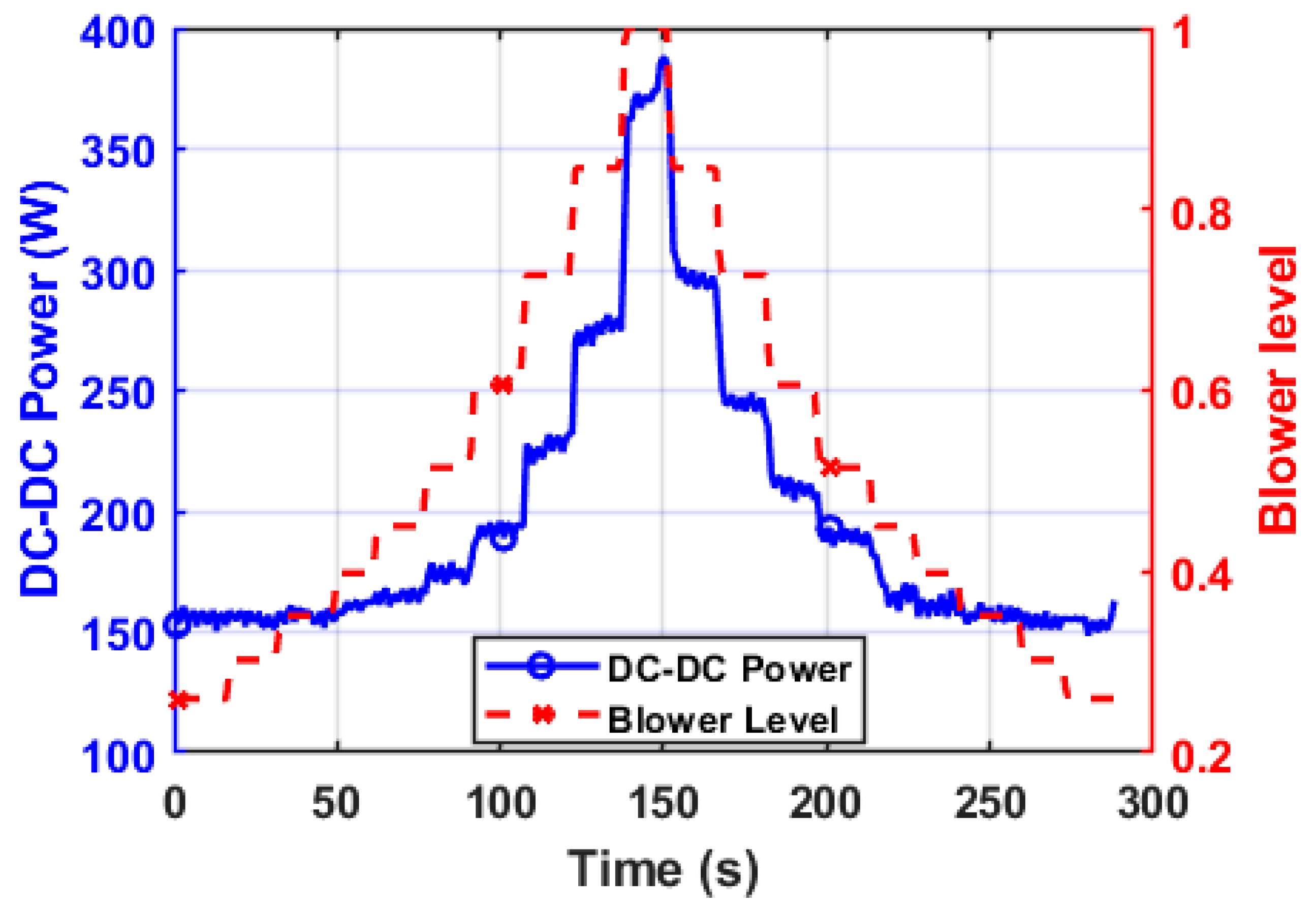
11] that the power of the blower is close to 400 W. This was further validated on the vehicle, as shown in
Figure 19, which shows power consumption at various blower speed levels.
Baseline values for the parameters for LV components are taken from the ETMS layout. These were manually fine-tuned using the above-described procedure.
As the simulation model included physical models rather than a parameterization-friendly Simulink model, performing manual fine-tuning by having appropriate system knowledge gave faster parametrization results.
For coolant pumps, parameters like flow resistances of the coolant loop components, pump speed, and volumetric displacement were fine-tuned by considering the thermal data of the battery and rear motor as per drive cycle tests for cooling. These parameters were key contributors to battery and motor thermal behavior.
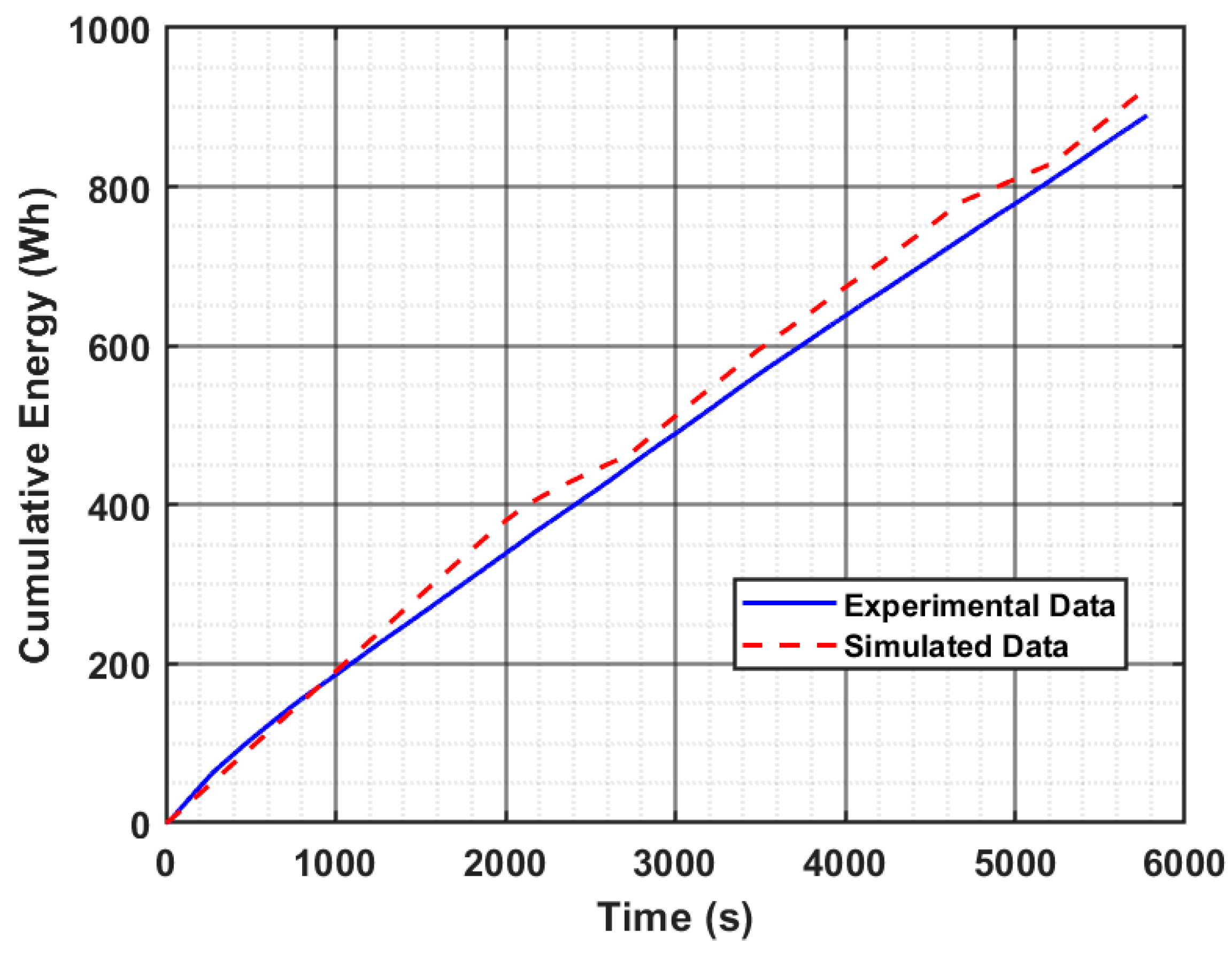
Radiator fan speed specifications and flow resistance for air intake have a key impact on both the refrigerant loop (for Octo-valve in mode 3) and coolant loop (for power train and battery cooling). These were approximated based on thermal data of the cooling drive cycle and individual component level analysis of blower and coolant pumps, such that the net energy consumption of the low-voltage ITMS components is in close range of the energy consumption of DC-DC as per the vehicle data. As with other low-voltage components like 12 V batteries, the infotainment system is not considered. The control strategy used for the simulated model is based on simple PID and on-off controllers. DC-DC energy consumption for the vehicle data has some deviation from the simulated data, as shown in the cumulative energy consumption plot in
Figure 20. The MAE and MRE values for this are 18.6 Wh and 2.1%, respectively.
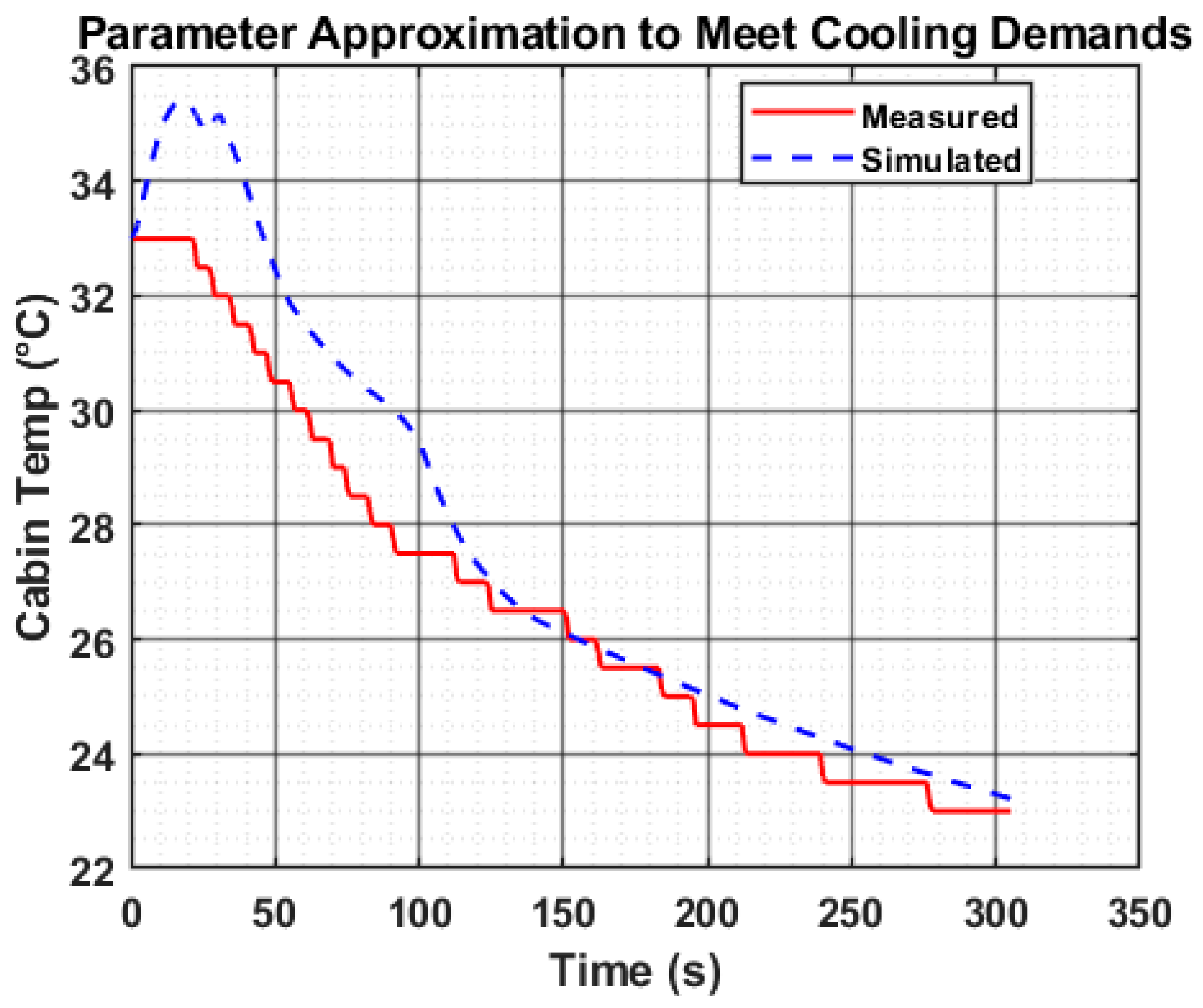
Based on 5 min tests performed for cabin cooling stationary tests, evaporator and LCC parameters were approximated to meet the cooling demands. As compressor parameters were not available for the Tesla M3, ETMS layout compressor parameters were considered for the LUTM simulation model.
After each set of iterations was performed in a similar manner, explained above for the blower, the evaporator, and LCC specifications were approximated.
Figure 21 shows the ability of the evaporator and LCC to meet the cooling demands in short-cycle stationary tests. The MAE and MRE for cabin temperature measured are 1.1 °C and 3.8%. These were further verified in driving cycle tests. A plate heat exchanger was used for the LCC and chiller on the vehicle. For the sake of simplifying the flow-related problems due to high pressure drops inside these components, in the present simulation, a simple shell-and-tube-type heat exchanger is considered that lets the refrigerant absorb heat from the coolant. This similar approach is followed in the ETMS layout (Lorenzo N and Steve M, 2023) [
17].
The total approximate heat transfer area of the LCC unit (plate type heat exchanger) with specifications of 150 mm × 75 mm × 95 mm on the Tesla M3 was 0.42 m
2. As mentioned in [
23], the heat transfer coefficient of a plate-type heat exchanger is three to four times higher than for a shell-and-tube type heat exchanger, so for the present simulation for the shell-and-tube type, a total heat transfer surface area of 1.7 m
2 is considered to obtain the same benefits as the plate type. Further, the above-described refrigerant loop components were used for validation in drive cycle tests conducted for cabin cooling.
To reduce the thermal system complexity for the present validation, the oil heat exchangers for the front and rear motors were not considered. Following the ETMS layout, a cooling jacket with coolant flow was used for both the front and rear motors for cooling them based on test 2 (cooling scenario-Auto mode), and by fine-tuning parameters for the key components and using some existing ETMS layout parameters for components like the compressor.
Table 3 highlights the key parameters taken forward for the Tesla Model 3 LUTM model.
6. Results-Model Architecture Validation and Thermal Data Analysis
The present section discusses the ITMS model validation with vehicle experimental data for both the cabin cooling and heating scenarios. As ambient conditions were not available for all the ambient temperatures under consideration, a theoretical study was conducted for both cooling and heating scenarios.
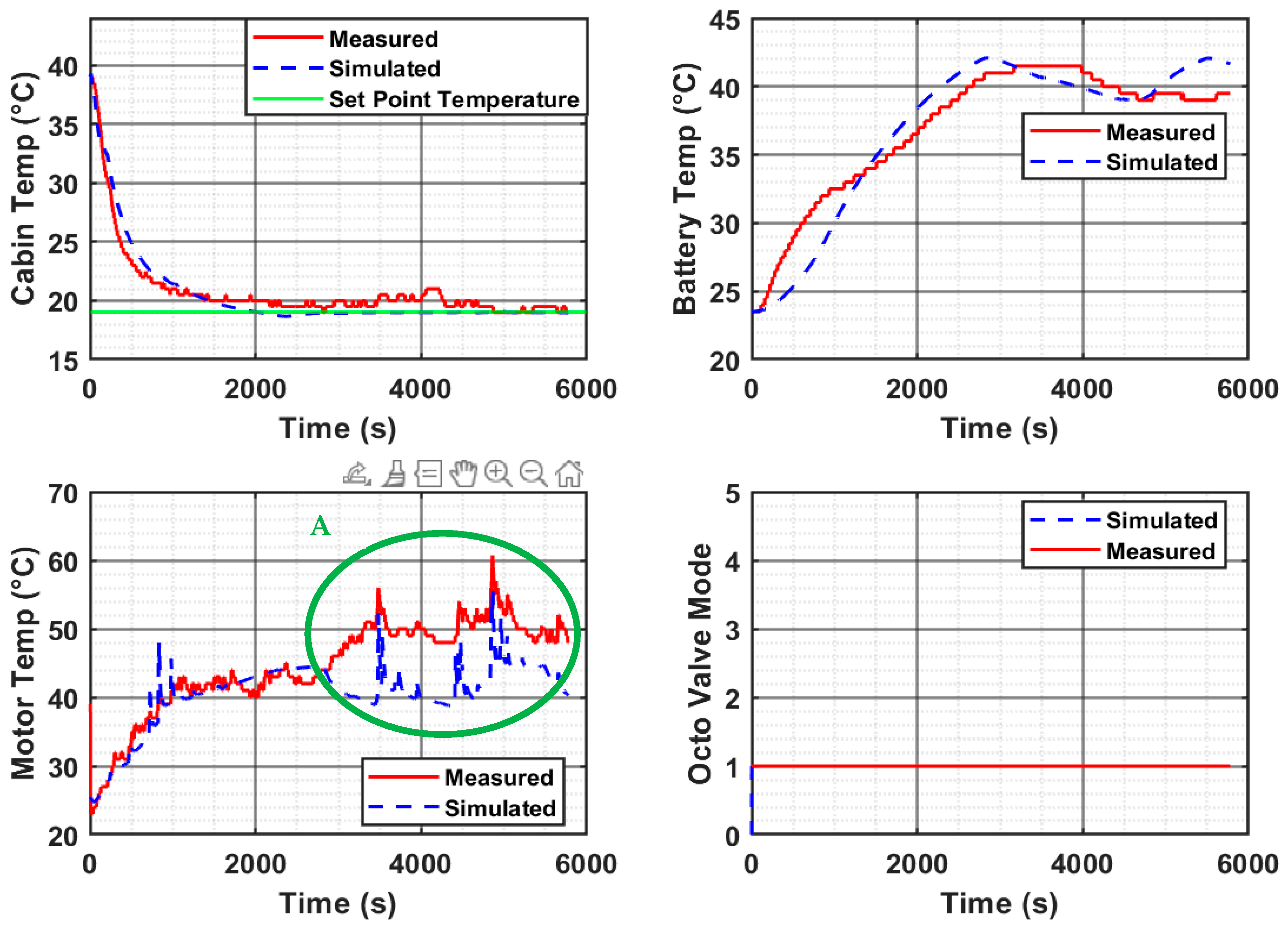
As observed in the thermal data analysis for cabin and powertrain, similar trends were observed in the simulation of Tesla M3 ITMS. The key validation of the model in terms of architecture viability and achieving a similar thermal trend for cabin and powertrain was successful and in good agreement. In
Figure 22, shown below for the cabin and battery temperatures, it can be observed that the cabin was reaching and settling at the set point temperature close to 2200 s, as observed on the vehicle.
A similar control strategy derived from the test data analysis of the vehicle for the Octo-valve mode selection, blower, and radiator fan commands was implemented in the ITMS simulation model. The PID properties, which play a critical role in achieving cabin thermal comfort, were manually fine-tuned to achieve a similar cooling time to that observed on the vehicle under the given ambient and vehicle initial conditions.
The Octo-valve mode (series) observed on the vehicle is followed by the simulation model throughout the drive cycle. As derived from the test data, the evaporator and LCC were active, and the LCC provided the heat to the battery. The battery also receives the heat from the motor as they are looped in series during this mode. The upper limit of the battery temperature as observed from the vehicle thermal data was respecting the upper limit of 42 °C, and it was found that the control strategy also made sure that the radiator would work at max RPM to provide the necessary cooling when the battery reaches this temperature.
The rear motor temperature was within the limits, but deviations were observed from the experimental data, as highlighted in area A, in the motor temperature plot, in
Figure 22. These deviations were primarily due to the assumption of the available heat map of motors from the ETMS layout [
16]. At very high and low speeds, the heat map available in the ETMS layout had less heat dissipated by the motor. These high and low speeds in the drive cycle are exactly at the same time as deviations are observed in the motor temperature plots.
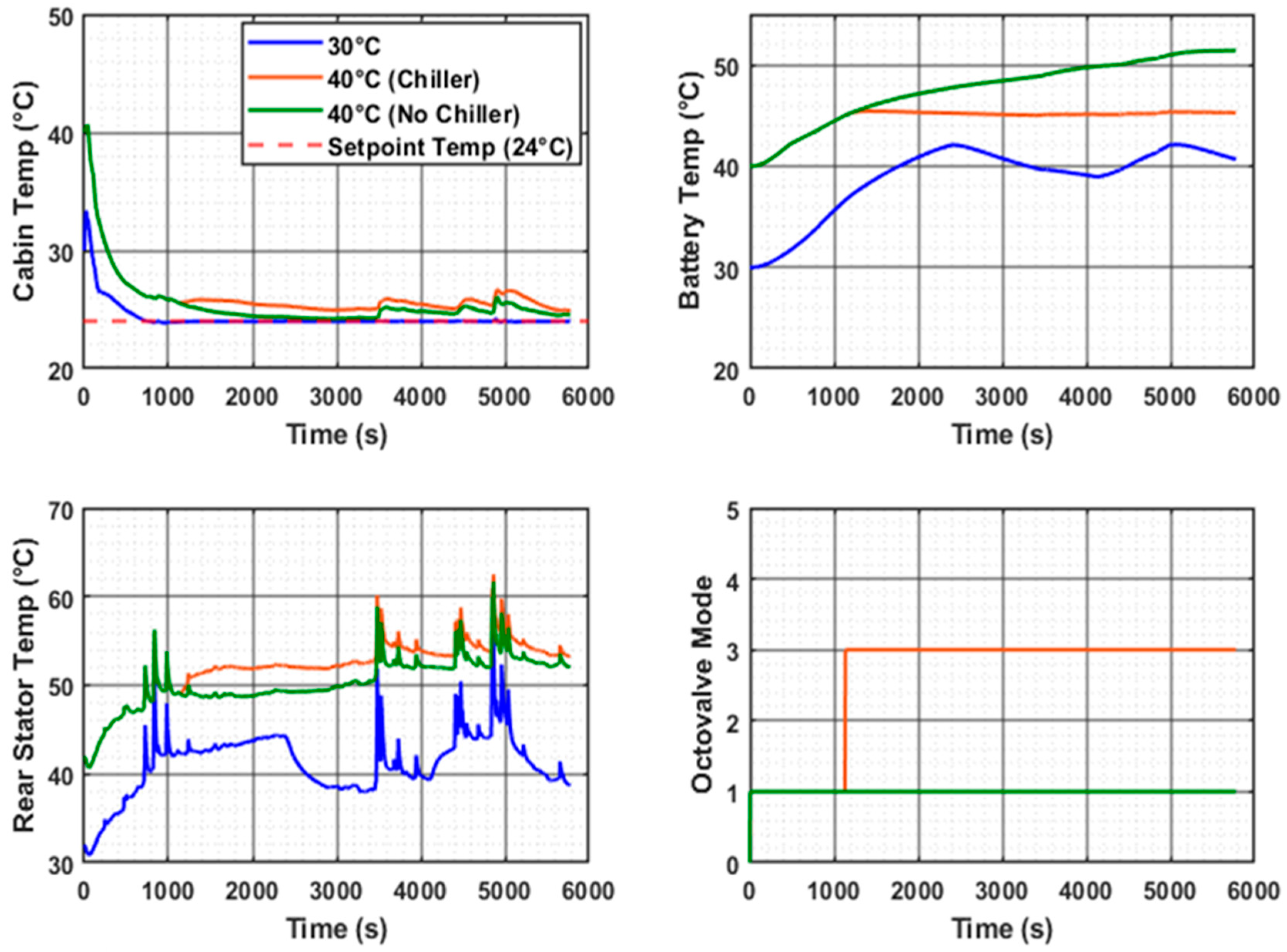
A cabin cooling scenario was studied for the simulation model at two different ambient temperatures of 40 °C and 30 °C, as shown in
Figure 23. Here, the battery is assumed to be soaked in ambient temperature for enough time that the temperature is the same as the ambient environment. For this analysis, the recirculation mode was assumed to be on. These simulations were performed to show the adaptability of the Octo-valve modes of the ITMS model.
When both the cabin and battery are exposed to hot ambient conditions like 40 °C, and assuming that the battery is in thermal equilibrium with the surroundings, i.e., having the same temperature as the ambient air, there is a need for both the cabin and battery to be kept at the required temperatures. This is a hypothetical case to show the architectural benefits of the Octo-valve in keeping the cabin and battery temperature in check.
The control strategy for the ITMS, as derived from the cabin cooling experimental validation, was implemented to study the cabin cooling phenomenon when both the battery and cabin are at a temperature of 30 °C. It was observed that, under extreme conditions, the cabin temperature is brought down to the setpoint temperature of 24 °C. Further, the conditioning time when cabin and ambient temperatures are at 40 °C is close to 3000 s, whereas it was 800 s when these temperatures were at 30 °C.
For the case of battery temperature management, two cases were shown. The first case is without the use of the chiller of the ITMS, and the other case is using the chiller. Without the use of a chiller, the battery temperature increases up to 52 °C. Under hot ambient conditions like 40 °C, this is primarily because the radiator fan is on when battery temperature exceeds 42 °C, and it runs continuously throughout the cycle, so that the battery does not reach very high temperatures. The radiator alone could not control the battery temperature under 45 °C in this case.
In the second case, when the chiller was on, the battery temperature was within 45 °C, as shown in
Figure 23. This benefit of the battery temperature control comes with a slight impact on cabin thermal comfort. This drop in cabin thermal comfort is due to a small amount of refrigerant that is sent to the chiller for cooling the battery. For activating the chiller, the Octo-valve is changed to parallel mode (3). In this mode, the chiller and battery are in one loop, while the LCC and drive train, along with the radiator, are in separate loops.
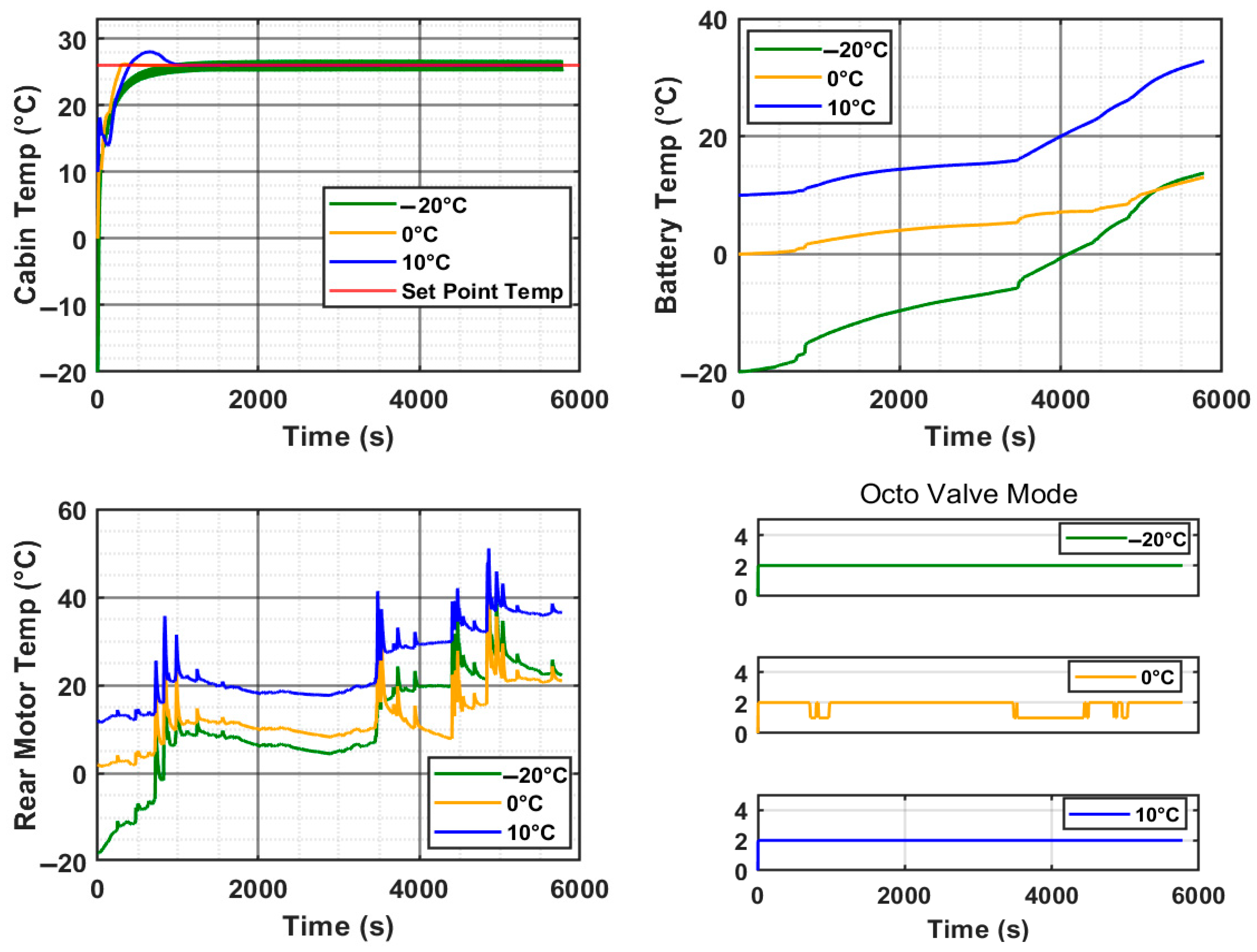
As the favorable ambient conditions, like less than 5 °C, were not available for the heating scenario to evaluate, a theoretical study of the ITMS was performed for the developed model. The comparisons mentioned below are based on the implementation of the control strategies. For the present simulations, thermal equilibrium of the battery and ambient conditions is also assumed. Like the theoretical study for cabin cooling, the recirculation mode was kept on. For the temperature levels of −20 °C, as PTC heater, evaporator, and condenser work in unison. When the Blower air passes through the PTC, it is heated. When the heated cabin air is allowed to pass through the evaporator, its temperature increases, which makes the compressor work at higher power. As stated in [
11], for the present study, for simplicity internal air recirculation duct is not considered, and recirculation of air from the cabin is kept on. For the −20 °C scenario, as shown in
Figure 24, Octo-valve is in mode 2. As the battery temperature is very low and no required thermal energy can be extracted from it, the chiller is inactive in the present case. In the case of 0 °C, the Octo-valve is maintained in mode 2 (radiator bypass), as observed on the vehicle. This bypass is with the help of the shutter and the radiator fan turned off. So, to clearly show the radiator shutter and fan shut off, and their activation modes 1 and 2 were defined earlier in
Figure 13 and
Figure 14. The present simulation shows the radiator fan and radiator shutter being activated when there is a sudden spike observed in battery temperature. For 0 °C temperature consideration, the chiller is active because some energy can now be sourced from the battery as it is heated as the vehicle runs from the motor heat. So, whenever there are sudden spikes in the battery and motor temperatures due to high-speed acceleration events or high-speed cruising, the radiator fan and shutter are activated so that the refrigerant pressure in the chiller is not affected much. In this way, the compressor, which is already working at high power, can work without being affected by these sudden pressure changes in the chiller.
When the ambient temperature is 10 °C, as stated earlier in the implementation of the control strategy, heat from the battery can be sourced. As stated in [
11], it is very difficult to recover energy spent on heating the battery. So, when external heating sources are available, it is best to use this energy for heating the cabin. The chiller is active in this mode to absorb the heat from the battery coolant, and thus improves the COP of the heat pump system. Energy consumption by individual components and the complete ITMS for different ambient temperatures is shown in
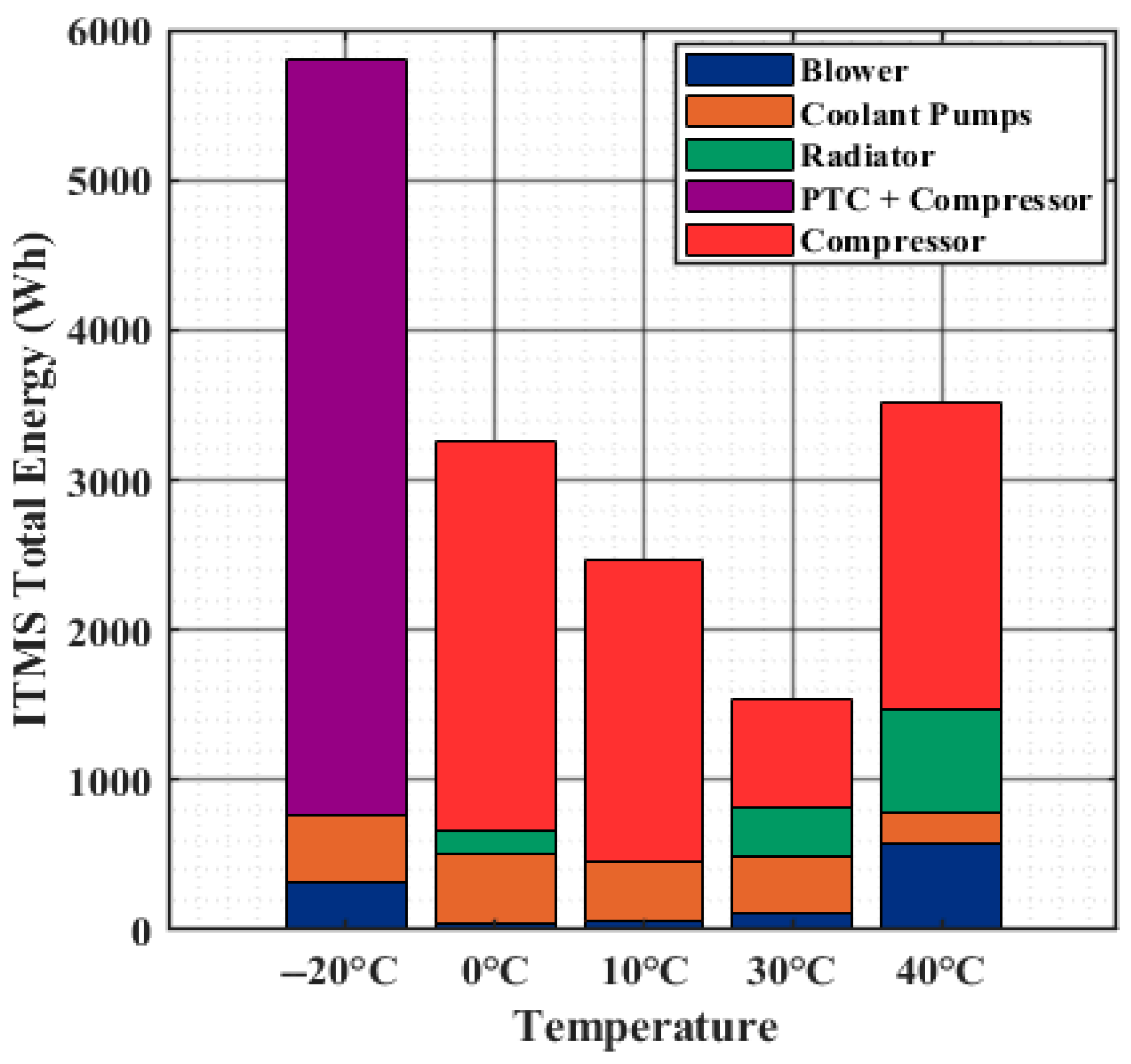
Figure 25.
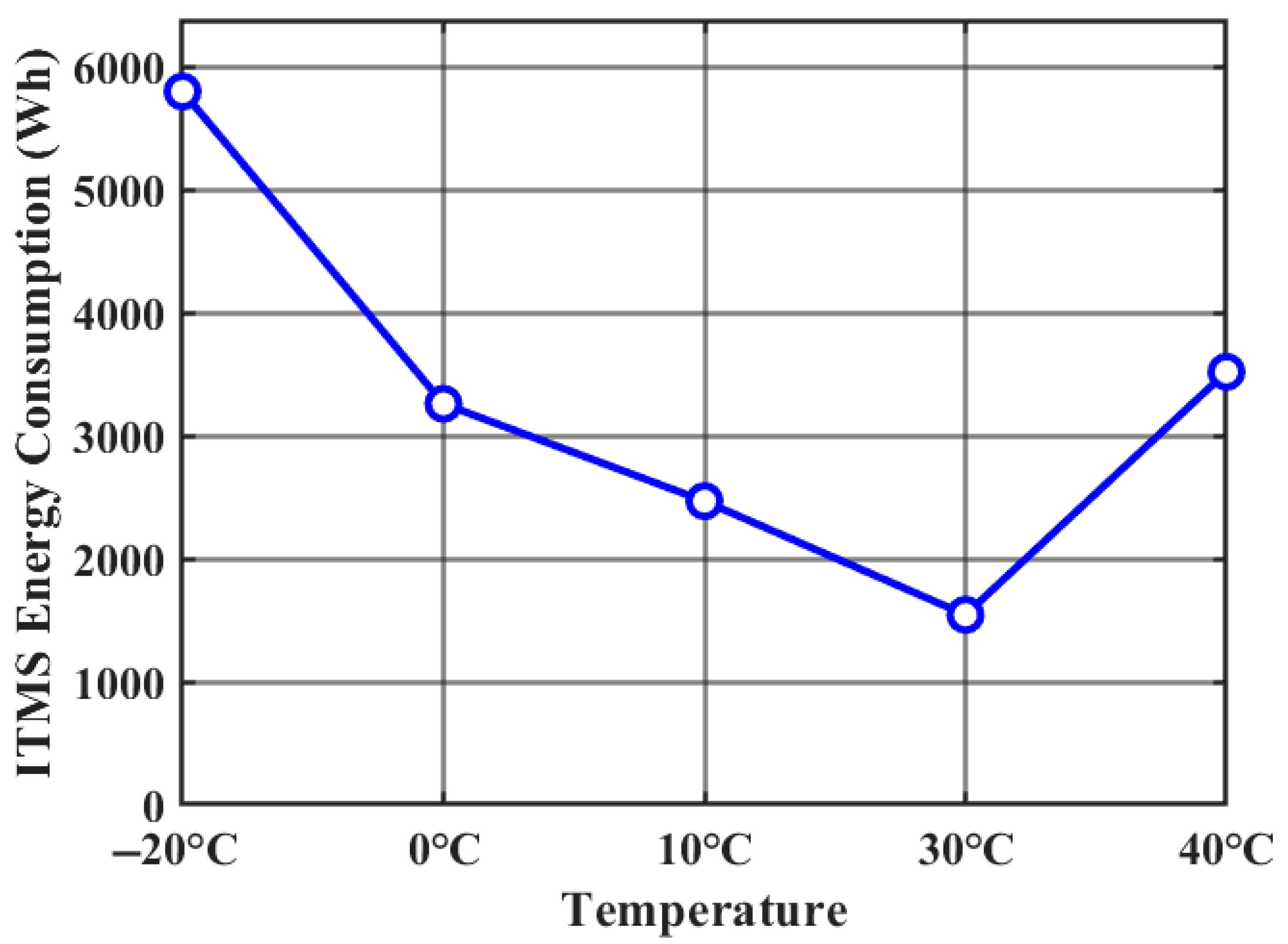
The ITMS energy consumption is shown in
Figure 26; it is very high during extreme low temperatures of −20 °C. This is primarily because, as stated in [
11], both the PTC and compressor work here to effectively heat the cabin. For 0 °C, as the PTC is off in the present case, energy consumption is less by approximately 45%, compared to the former scenario. As mentioned earlier, at this temperature, the compressor works at higher power by having the evaporator and condenser active at the same time, thus enhancing cabin heating. So, with the help of the present architecture to meet the cabin thermal demands at 0 °C, we can refrain from using the PTC.
For an ambient condition of 10 °C, it can be observed that there is no energy consumption of the radiator. This is primarily due to the Octo-valve and the mode selected at this temperature, where the radiator is kept inactive. In this mode, as explained earlier, thermal energy from the battery is used to increase the COP of the heat pump.
For the ambient temperature of 40 °C, it can be observed that due to the high cooling load requirement of the cabin, compressor work is like that of 0 °C. Here, radiators also work at peak RPM for the entire cycle. Due to all these factors, the energy consumption at these ambient conditions is close to 0 °C.
As the Tesla M3 with a heat pump was launched in 2021, there are few literature references relating to heat-pump energy consumption at these extreme temperatures. Therefore, a trend analysis was performed for the ITMS energy consumption observed in the present simulation model of the Tesla M3 (2023), which was like that observed in [
24] for the Tesla M3 (2020) without a heat pump.
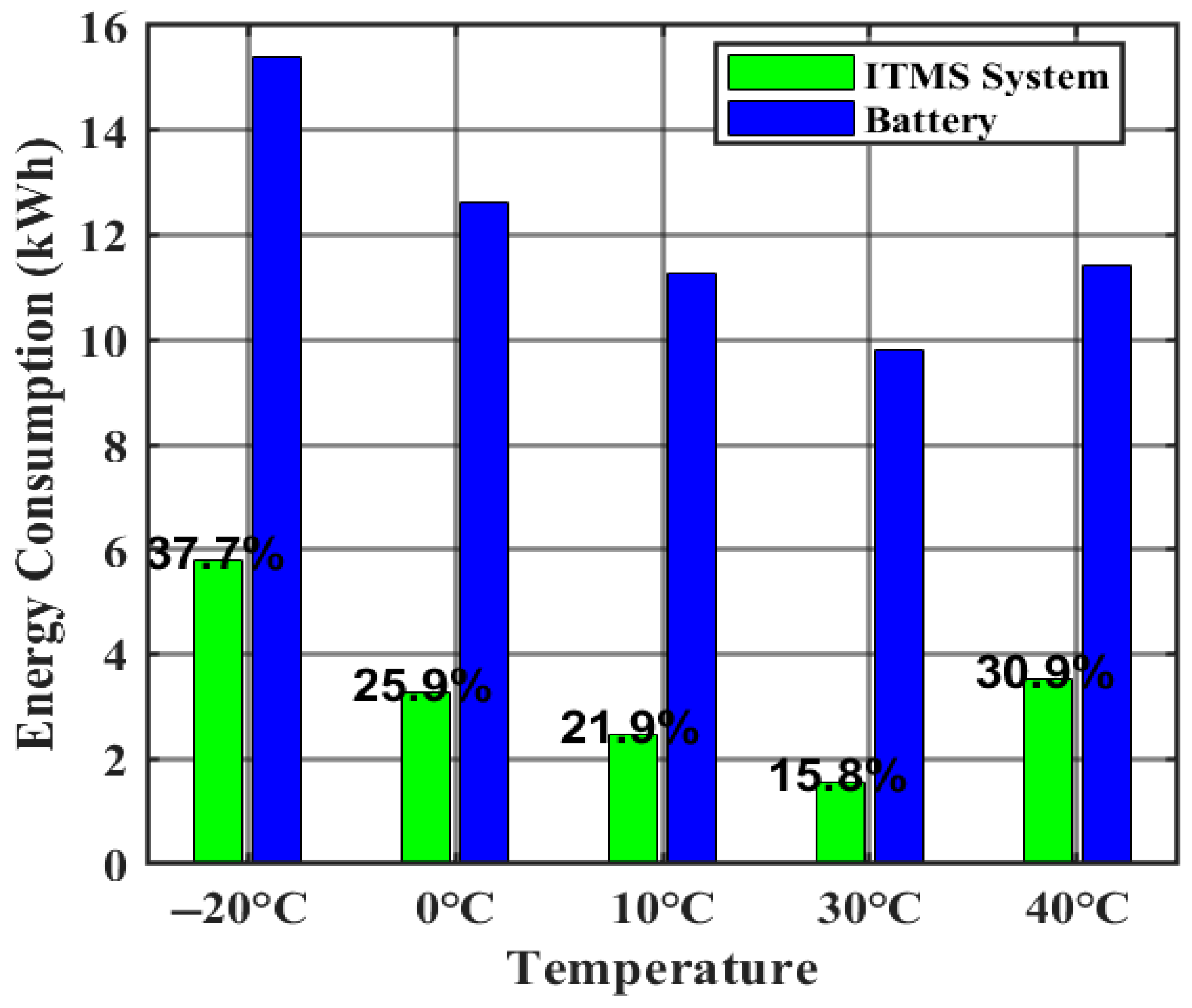
To validate the Tesla M3’s architecture and evaluate the thermal trend behavior of the cabin and powertrain, the energy consumption of the ITMS model as compared to total vehicle energy consumption is shown in
Figure 27. Here, 37.7% of the total energy is used by ITMS at extreme temperatures of −20 °C. HVAC consumption will be more if we consider only PTC, which is a normal case in electric vehicles.
When the ambient temperature is in the range of 30 °C, the energy consumption is quite minimal, which is especially due to the low cooling demand of both the cabin and battery.
7. Conclusions
Experimental validation and parametrization of key ITMS components were carried out based on the cabin cooling tests performed on the test vehicle. In the cooling scenario under ambient conditions of 30 °C, where the cabin temperature was initially 40 °C and the battery was at 23 °C, the thermal behavior of the cabin in the simulation closely matched the trends observed in the measured data once the parametrized components were applied. The battery also exhibited a similar thermal trend to that observed experimentally.
A key observation during the heating scenario, conducted at an ambient temperature of 18 °C, was the occurrence of cabin temperature overshoot, where the cabin temperature rose to approximately 37 °C. This was further confirmed during stationary cabin tests of 15 min duration. The simulation model reproduced this behavior, although the overshoot was less pronounced. Initial analysis indicated that this deviation was likely caused by elevated duct temperatures reaching up to 60 °C, which led to heat transfer toward the cabin as the moist air in the duct sought thermal equilibrium. Another contributing factor may have been the lack of control tuning for this specific ambient condition setup.
Furthermore, the performance of the developed Octo-valve-based ITMS architecture was evaluated across various ambient temperatures (−20 °C, 0 °C, 10 °C, 30 °C, and 40 °C). The energy consumption and thermal response trends of the ITMS at these temperature levels were consistent with patterns reported in the literature. Considering the stated methodology and limitations, the present experimental validation was effective in verifying the ITMS architecture and capturing the thermal trends of the cabin and battery. Although certain approximations may have introduced minor biases, their influence on the overall validation was found to be minimal, confirming the robustness of the developed system.




 ,
,