1. Introduction
Many mechanical engineering objects are rods of variable cross-section that are exposed to various types of heat sources. To ensure the reliable operation of such objects, it is necessary to know the laws of temperature distribution along the length of the rods used and the values of other thermomechanical characteristics, such as elongation, axial force, stress, strain, and displacement.
Due to increased stresses in narrowed areas, a rod with a variable cross-section—with the same length and weight and under the influence of temperature—elongates more than a rod with a constant cross-section [
1,
2,
3,
4]. Therefore, when creating devices that use rod elongation upon heating, it is economically advantageous to use a rod with a variable cross-section, as the desired result can be achieved using a smaller amount of material. Such devices include dilatometric and bimetallic thermometers, thermomechanical sensors, thermal expansion compensators, etc. Nuclear power plant (NPP) tubes can also be considered as a variable cross-section rod exposed to high temperature under the condition that the length-to-diameter ratio is >10 [
5,
6,
7]. Under the same conditions, the pipes of thermal power plants (TPPs) and chimneys can be considered as rods of variable cross-section [
8] with internal heat sources.
A review of published research shows that a sufficient number of studies have been devoted to studying the thermomechanical characteristics of rods using various methods. It is relatively easy to arrive at an analytical decision in the case of a rod with a constant cross-section. Thus, the authors of [
9,
10] considered analytical thermal conductivity solutions for a rod with a constant cross-section and finite length. Heat conduction problems are analyzed when heat flux is supplied to the lateral surface of the rod or when heat exchange with the environment occurs. A power series expansion method is used to solve the same problem [
11]. An analytical solution to the thermal conductivity problem of a thin, non-insulated rod embedded in a heated wall was considered by Eckert and Drake [
12].
Some authors prefer using analytical and numerical methods in parallel. For example, the authors of [
13] utilize a Fourier series analytical solution, while the finite element method was applied as the numerical method. It has been shown that the method of separating variables can be successfully applied in one-dimensional heat transfer problems in a rod [
14].
As expected, various numerical methods can be successfully applied to heat transfer problems in rods with both constant and variable cross-sections. The effective application of variational methods, the finite difference method, and the finite element method in such problems has been demonstrated by the authors of [
14,
15,
16]. For example, the law of temperature distribution along the length of a rod was determined by Arshidinova et al. using a variational solution [
10]. The elongation (when one end of the rod is rigidly fixed and the other is free) and the axial compressive force (in the case of both ends of the rod being clamped) were also calculated. Furthermore, the strain, stress, and displacement fields were determined. In the studies of the authors of [
17,
18], the thermal stress–strain state of a rod with a lateral surface that is completely thermally insulated was numerically investigated. The radius of the rod varies nonlinearly along its length and decreases quadratically along the length of the rod. Heat flow with constant intensity is applied to the left end of the rod, while heat exchange with the environment occurs at the right end. Changes in thermomechanical characteristics depending on changes in heat flow [
17] and environmental temperature [
18] were also studied.
A review of the literature shows that existing sources do not yet provide an analytical solution for thermal conductivity problems in a heat-insulated rod with a quadratic envelope, where heat flux is applied at the left end, and heat exchange with the environment occurs at the right end.
In this study, an analytical solution to this problem is obtained. Thermomechanical properties of the rod, such as elongation, stress, strain, and displacement, are determined. The results of the analytical solution are compared with the finite element method.
2. Problem Formulation
2.1. Differential Equation of Thermal Conductivity
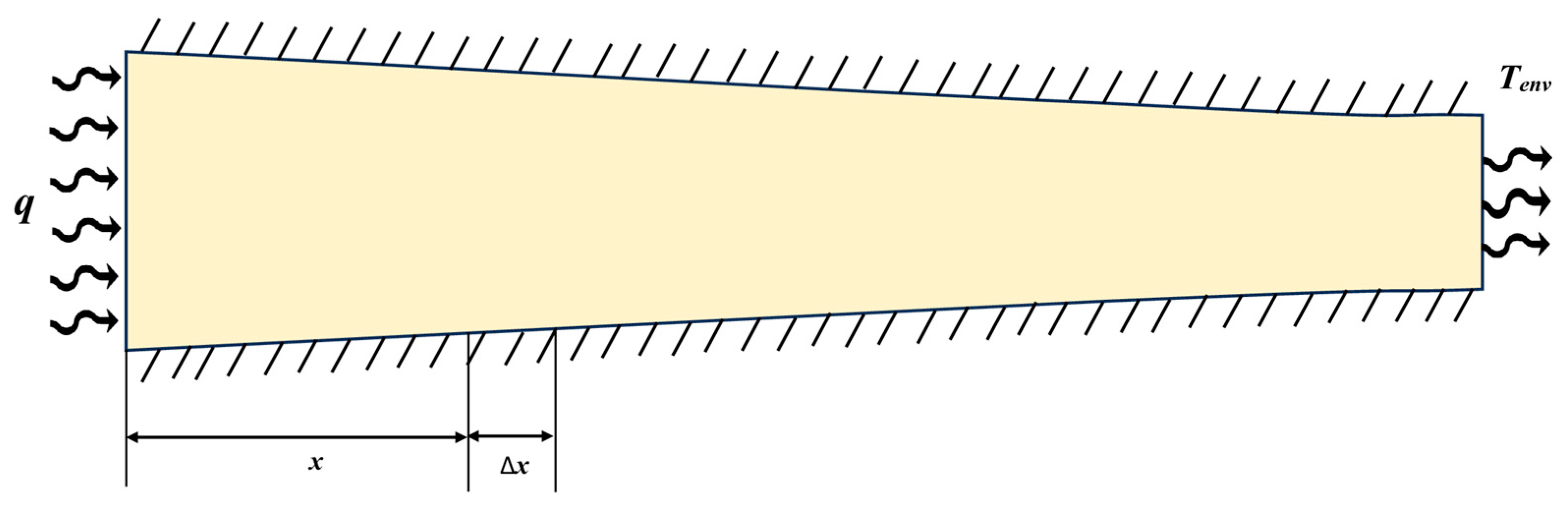
Let us consider a rod with a variable cross-section that is thermally insulated on the sides (the radius changes quadratically along the length of the rod
), the left end of which is under the influence of heat flow, and heat exchange occurs with the environment at the right end—the temperature of which is
Tenv (
Figure 1). It is necessary to determine the thermomechanical characteristics of the rod.
First, we obtain the heat equation for the problem under consideration. To carry this out, we calculate the amount of heat passing through a certain cross-section of the rod—located at a distance
x from the left end of the rod—in time
dτ. According to Fourier’s law, it is equal to the following:
where
F denotes the cross-sectional area of the rod at a distance x from its left end;
During time
, the amount of heat that passes through the section located at a distance
from the left end of the rod will be equal to the following:
Adding and subtracting
to this expression, we obtain
Then, the section of the rod enclosed between the sections located at distances
x and
x + Δ
x from the left end of the rod acquires, over time
dτ, an amount of heat equal to the difference between expressions (1) and (3) due to heat conduction:
On the other hand, the amount of heat that must be supplied to a homogeneous body to increase its temperature by Δ
T is proportional to the volume
V and the density
ρ:
where
c denotes the specific heat capacity of a body.
Equating expressions (4) and (5), we obtain the following:
or
When the process is stationary, this equation takes the following form:
Multiplying both sides of this equation by
, the differential equation for steady-state heat conduction can be written as follows:
2.2. Boundary Conditions
The boundary conditions for our problem are as follows:
3. Analytical Solution of the Problem
3.1. Temperature Distribution
To analytically solve the differential Equation (6) with boundary conditions (7) and (8), we change some variables:
. Then, Equation (6) takes the following form:
Since the cross-sectional radius of the rod changes according to the quadratic equation
ax2 +
bx +
c, the cross-sectional area of the rod changes according to the following formula:
Then, the derivative of the cross-sectional area of the rod with respect to the length of the rod
x is as follows:
Substituting the obtained value of the derivative into Equation (9), we obtain the following differential equation:
or
Integrating this equation, we obtain the following:
From the last integral, we find
or
From here, we determine
y:
Carrying out the reverse substitution of variables (
), we return to variable
T:
Integrating this equation with respect to
x, we obtain the following:
Let us calculate the integral as follows:
Changing some variables, t =
, and taking into account
dt =
dx, we have the following:
Let us consider three cases: D > 0, D = 0, and D < 0.
- 1.
D > 0: Let us denote
d2 =
Then,
We perform a change of variables, setting
t =
d·z and taking into account
dt =
d·dz; thus, we have the following:
Carrying out the reverse change of variables, that is, moving from
t to
x, we have
Taking into account expression (12), the temperature Equation (11) can be rewritten as follows:
By introducing the notation
the temperature can be represented as follows:
Using boundary condition (7) and taking into account expression (10) for
x = 0, we have
From this equation, we find
c1:
Taking into account the second boundary condition (8), we have the following:
From this equation, we obtain
c2:
Substituting the obtained expressions for
and
into Equation (13), we have
That is why the following is the case:
Since
from the boundary condition of the left end of the rod, we have
where
From boundary condition (8) for the right end of the rod, we have
- 3.
D < 0: Let us denote
d = −
> 0. Then,
Let us calculate the integral .
To carry this out, let us consider the two following functions:
The derivatives of these functions are equal to
Moreover, the sum of the derivatives is equal to
The temperature in this case is equal to
The constants of integration
c1 and
c2 are found from boundary conditions (7) and (8). Using boundary condition (7), we have
where
Taking constraint (8) into account, we have the following:
Moreover, we obtain the following:
3.2. Rod Extension
If one or both ends of a rod are free, the rod’s length changes due to temperature changes. As the temperature increases compared to its initial state, the rod elongates. The magnitude of the rod’s elongation, taking into account relationship (13), can be determined using the following expression:
- (1)
For the case when D > 0,
Here, α is the coefficient of thermal expansion, °C−1.
To calculate the integral of the first term, we use the following well-known formula [
19]:
Taking this formula into account, we have
Let us calculate the integral of the second term Δ
L:
Let us make a change of variables:
t =
. Since
dx =
dt, we have
Finally, the expression for the thermal elongation of the rod can be written as follows:
- (2)
For the case of D = 0, we have
- (3)
For the case of D < 0, we have
The first integral is equal to
The second integral is equal to
3.3. Thermal Stress
If both ends of the rod are not able to move in the longitudinal direction, then due to the increase in temperature compared to the initial state, thermal stress arises in the rod, which can be calculated using the following formula:
where
denotes thermal stress;
The constrained thermal strain is determined using the following formula:
where
denotes the coefficient of thermal expansion of the rod’s material.
In Formulas (16) and (17), the index i takes the values 1, 2, and 3 depending on the parameter D: D > 0; D = 0; D < 0.
Thermal stress is determined using Formula (16).
4. Finite Element Method
In this section, the main (resolving) equation of the finite element method (FEM) for modeling temperatures in the rod is obtained via the variational method.
Let us show that the solution of problem (1) under constraints (2) and (3) is equivalent to minimizing the following functional:
Let us apply a small increment to the temperature
, where
η(
x) is some function with a first derivative. Then, the functional
J has the following form:
We take the variation of
J with respect to
ε at point 0. We have
We integrate the first term via the following parts:
Substituting the above into (19), we have
In order for (20) to be identically equal to zero, Equation (1) must be satisfied under constraints (2) and (3).
Next, we divide the rod into m elements of equal length and approximate the temperature in the
i-th element with a quadratic polynomial [
11]:
where
l =
L/m.
Let us define the following:
The number of nodes in this case is equal to n = 2m + 1.
Then, functional (18) has the following form:
The minimization of this functional with respect to the variable
, was carried out using the Python 3.11 programming tool [
20]. The general algorithm for finding the law of temperature distribution along the length of the rod consists of the following steps:
- (1)
Find the derivative of a functional:
This is carried out using the diff() function of the Sympy module [
21]: sympy.diff(J, T[i]),
This results in a system of linear equations of the form
- (2)
We solve the resulting system of equations using the linalg.solve() function of the scipy module: scipy.linalg.solve(A,B). As a result, we obtain the temperature values at the nodal points
- (3)
Substituting the values of into the quadratic temperature approximation function, we obtain the law of temperature distribution along the length of the rod.
5. Results and Discussion
5.1. Thermal Verification
Let us consider a thermally insulated copper rod with a variable cross-section. The rod’s material characteristics and boundary conditions used in the calculations are given in
Table 1 and
Table 2.
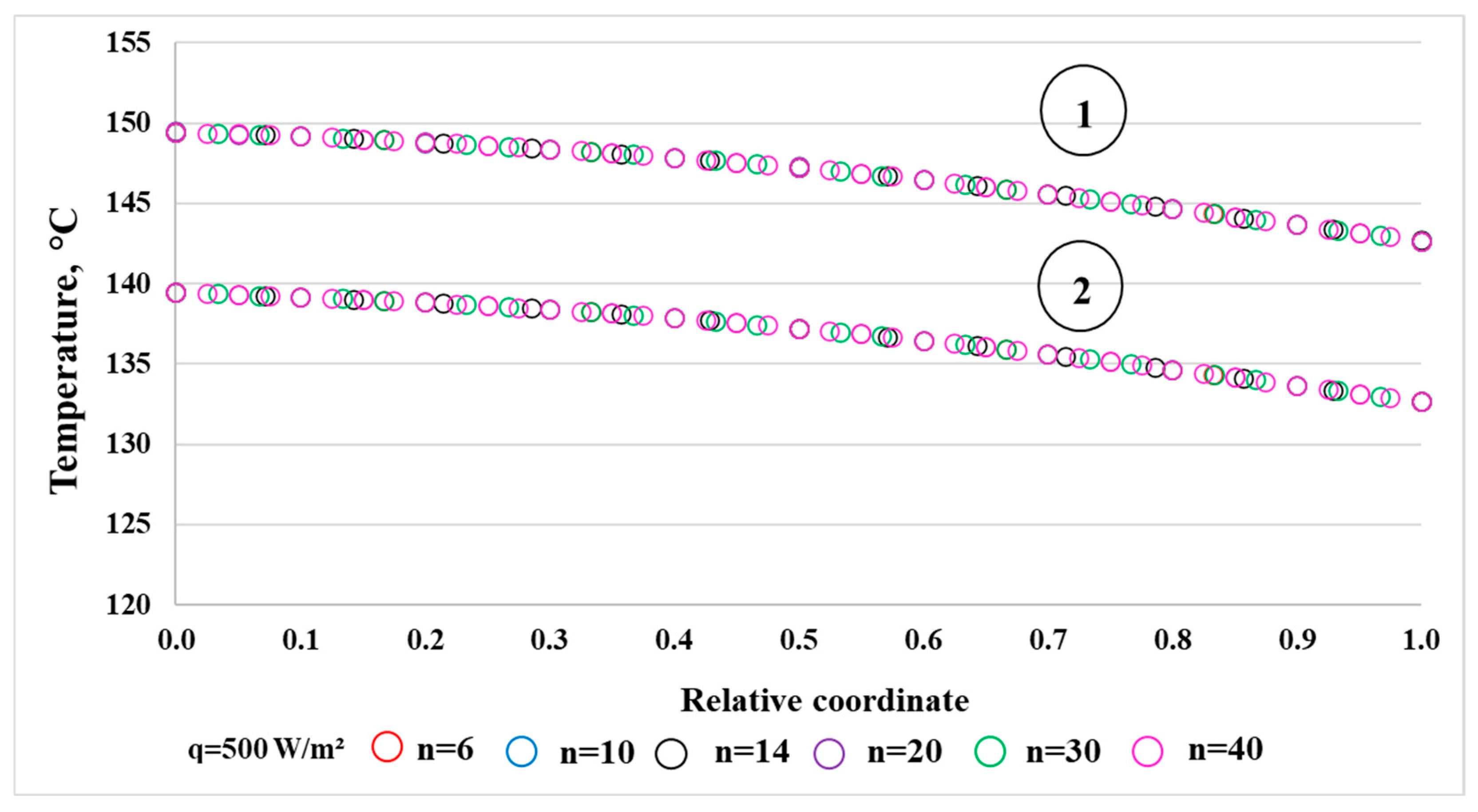
It is well known that the accuracy of calculations using the finite element method also depends on the number of finite elements into which the object under consideration is discretized. To evaluate the accuracy of calculations in our cases, we performed calculations of the temperature distribution in the rod with the following finite element numbers: n = 6, 10, 14, 20, 30, and 40. As
Figure 2 shows, the convergence of the calculations is very high. All subsequent calculations were performed with 30 finite elements, although the use of 6 finite elements ensures high calculation accuracy.
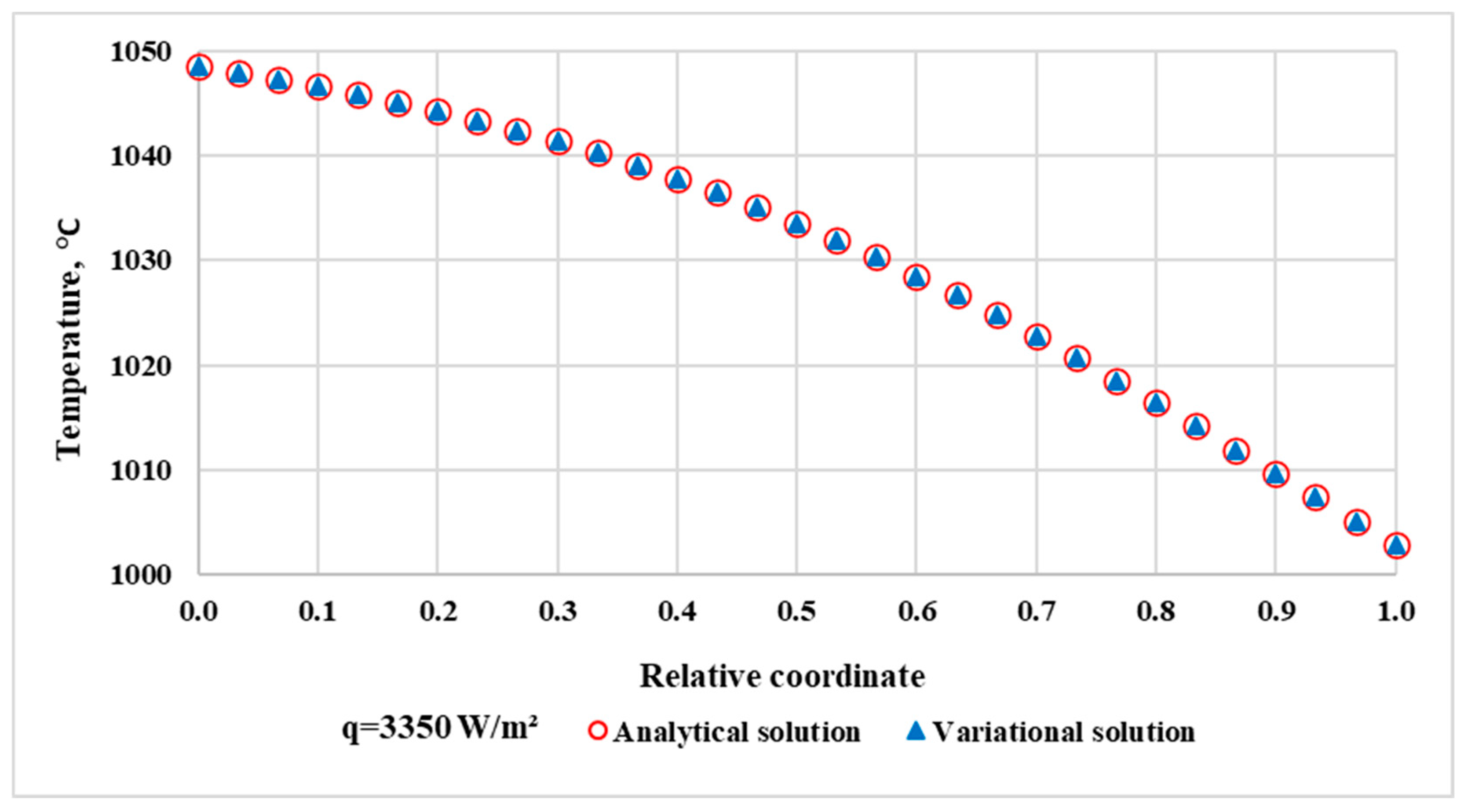
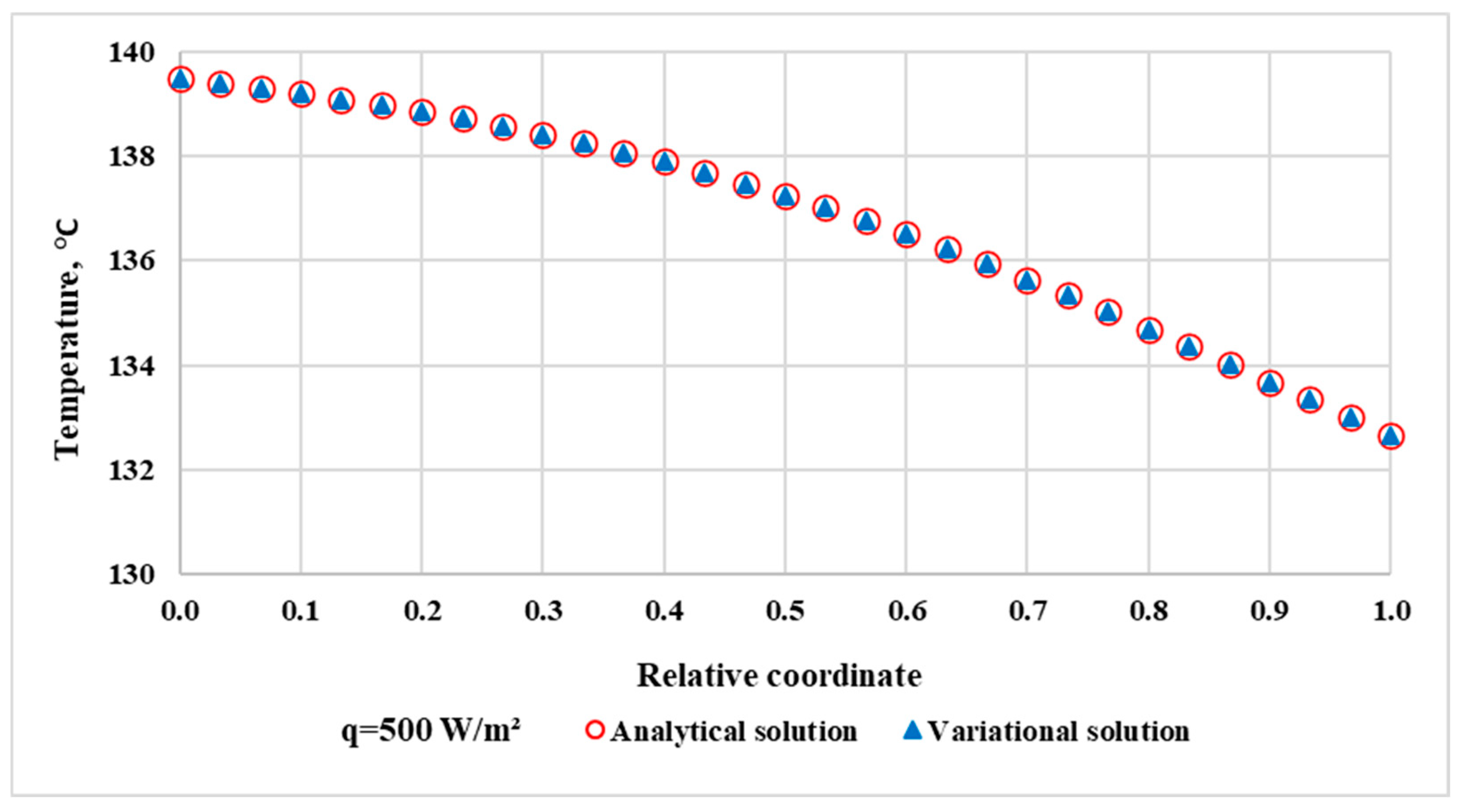
Figure 3 and
Figure 4 show graphs of temperature changes along the rod for two heat flux q values, obtained analytically and via FEM.
As expected, for both high (q = 3350 W/m2) and moderate (q = 500 W/m2) heat flux values, the highest temperatures—equal to 1048.5 °C and 159.4 °C, respectively—occur at the left end of the rod. The temperature decreases monotonically and nonlinearly along the length of the rod. Moreover, the rate of temperature decrease in the first half of the rod is lower than in the second half. Despite the significant difference in heat flux (3350/500 = 6.7), the temperature decrease at the left end of the rod is approximately the same as at the right end (4.6 °C and 6.8 °C, respectively).
These figures also show that the agreement between the temperature values calculated analytically and those obtained using FEM is very high for both high and moderate heat flux values.
5.2. Thermo-Mechanical Response and Parametric Study
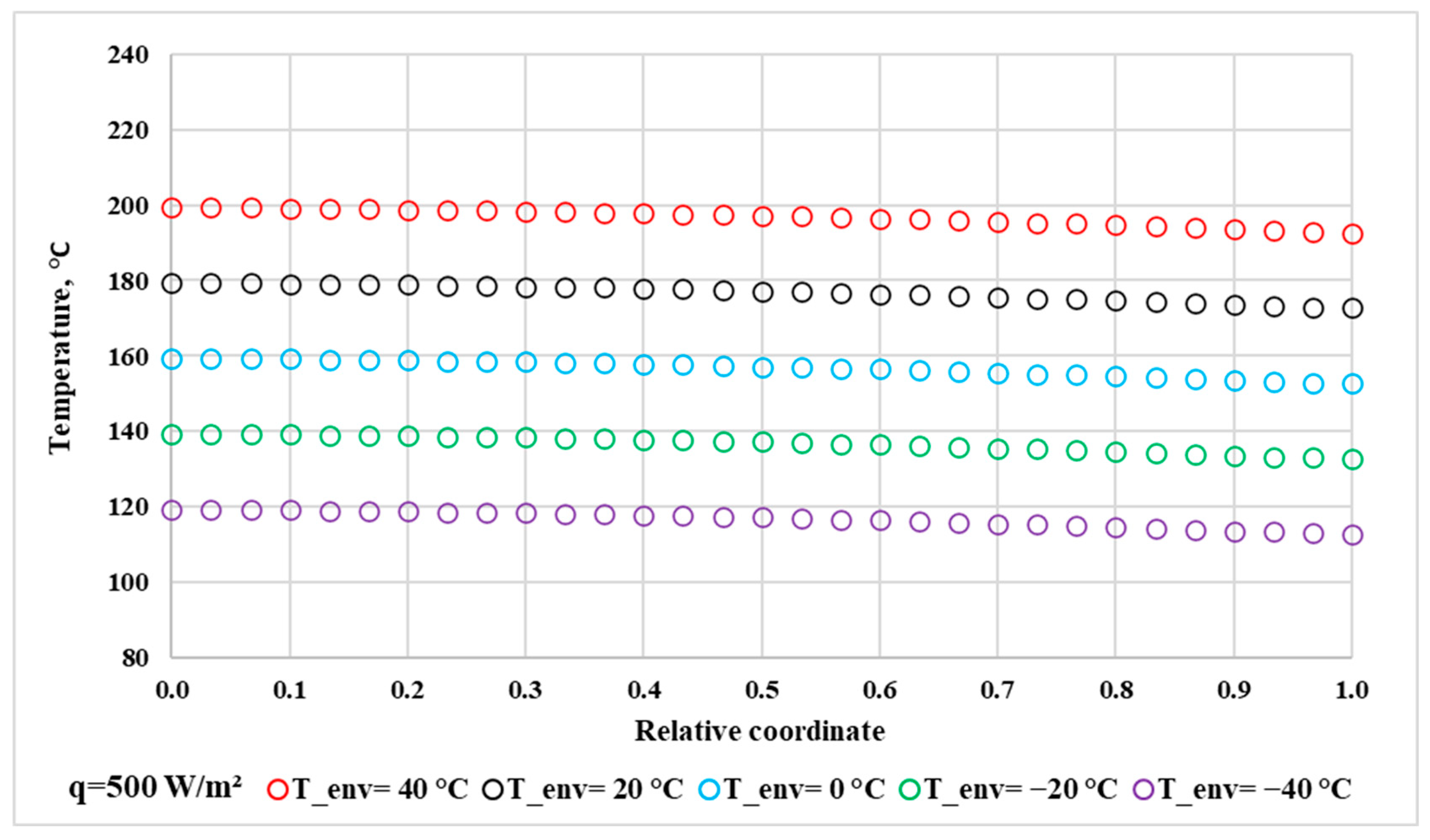
In real-world conditions, the environmental temperature at which the second (right) end of the rod is in contact can vary. Therefore, it is important to assess the influence of environmental temperature on the temperature distribution and other mechanical characteristics within the rod.
In further calculations, the mechanical and thermophysical characteristics of the rod were taken to be the same as in
Table 1 and
Table 2, with the only exception that the heat flow supplied to the left end of the rod was taken to be q = 500 W/m
2, and the environmental temperature values changed from −40 °C to +40 °C in 20 °C increments.
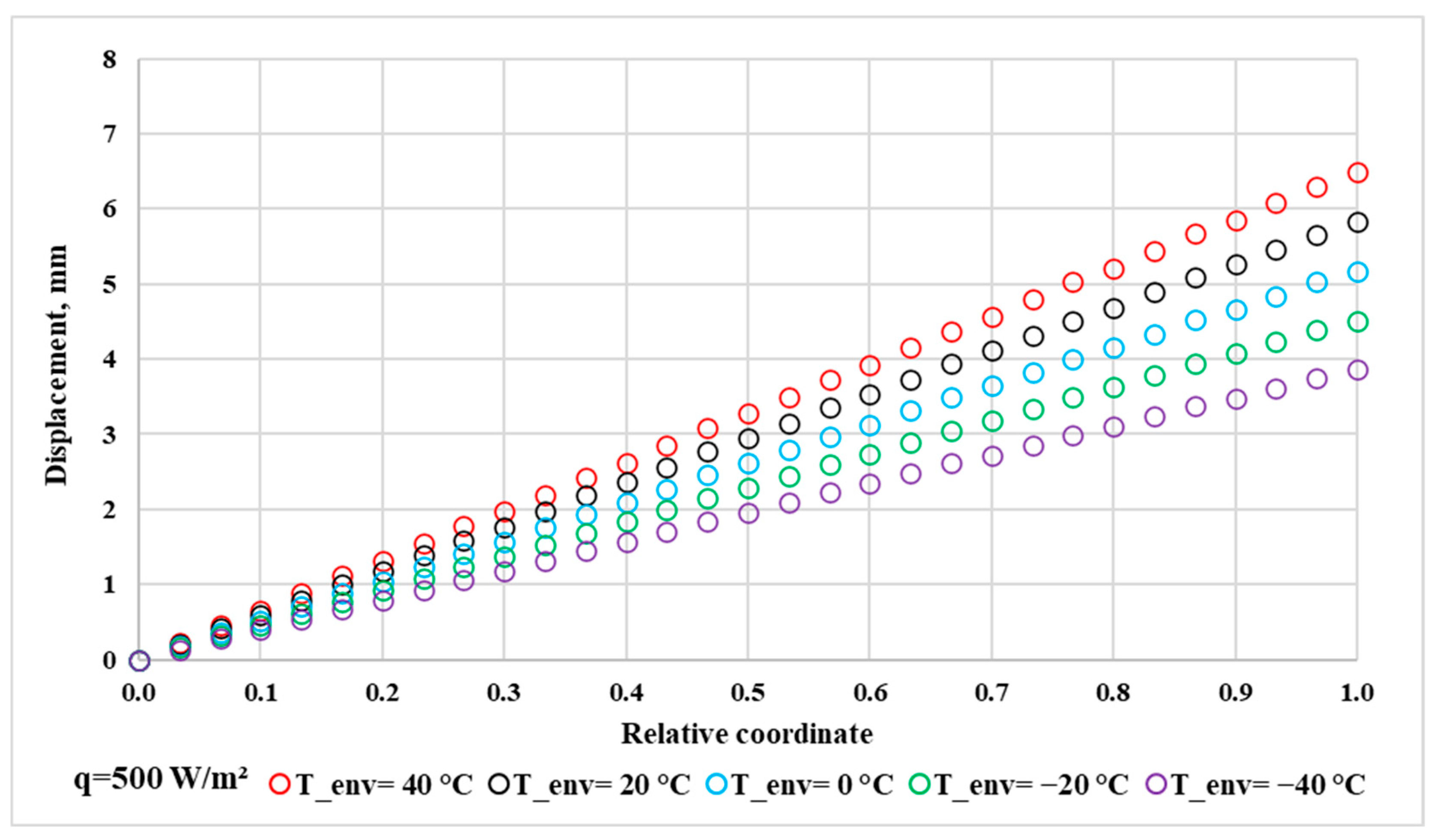
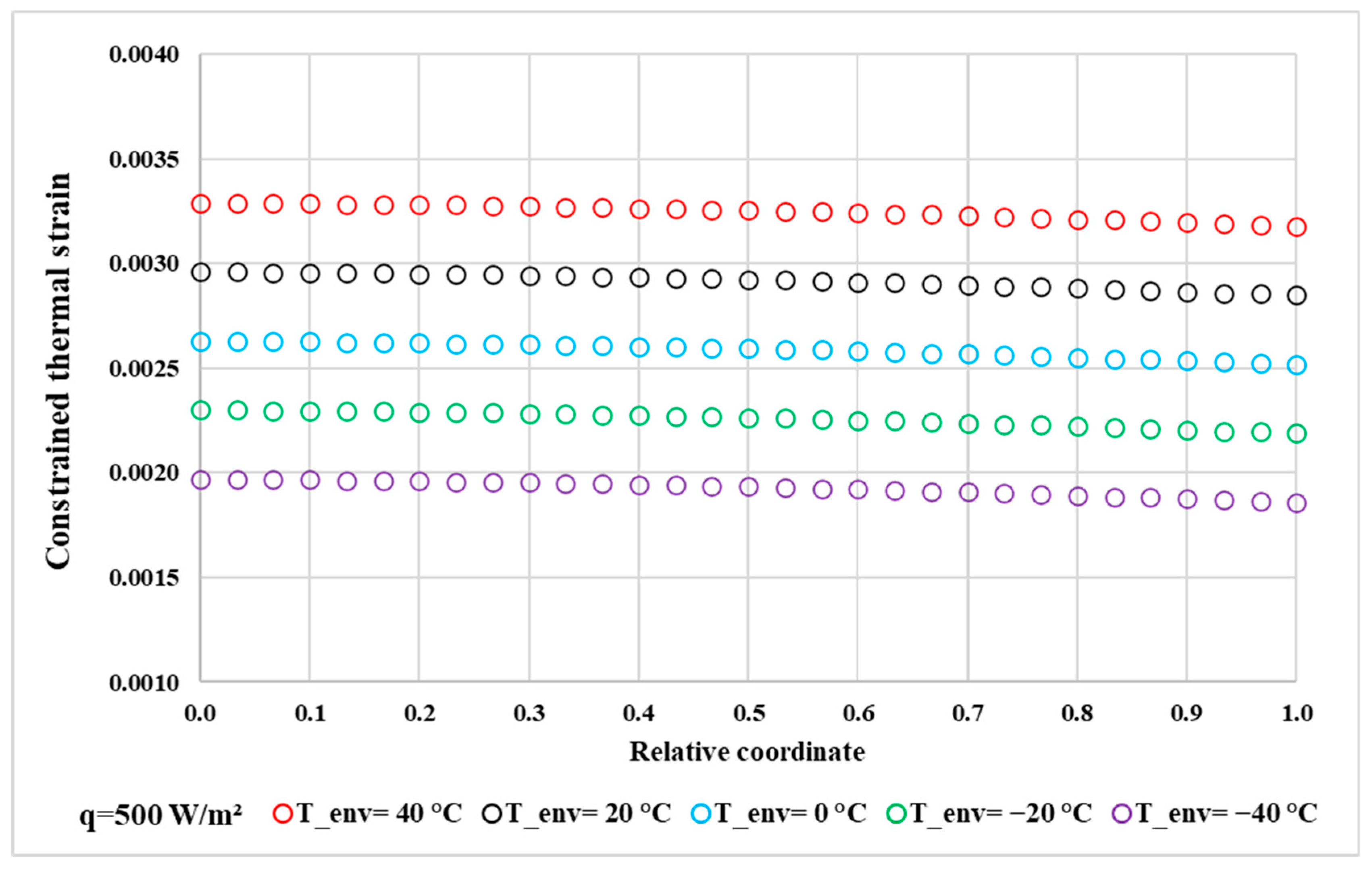
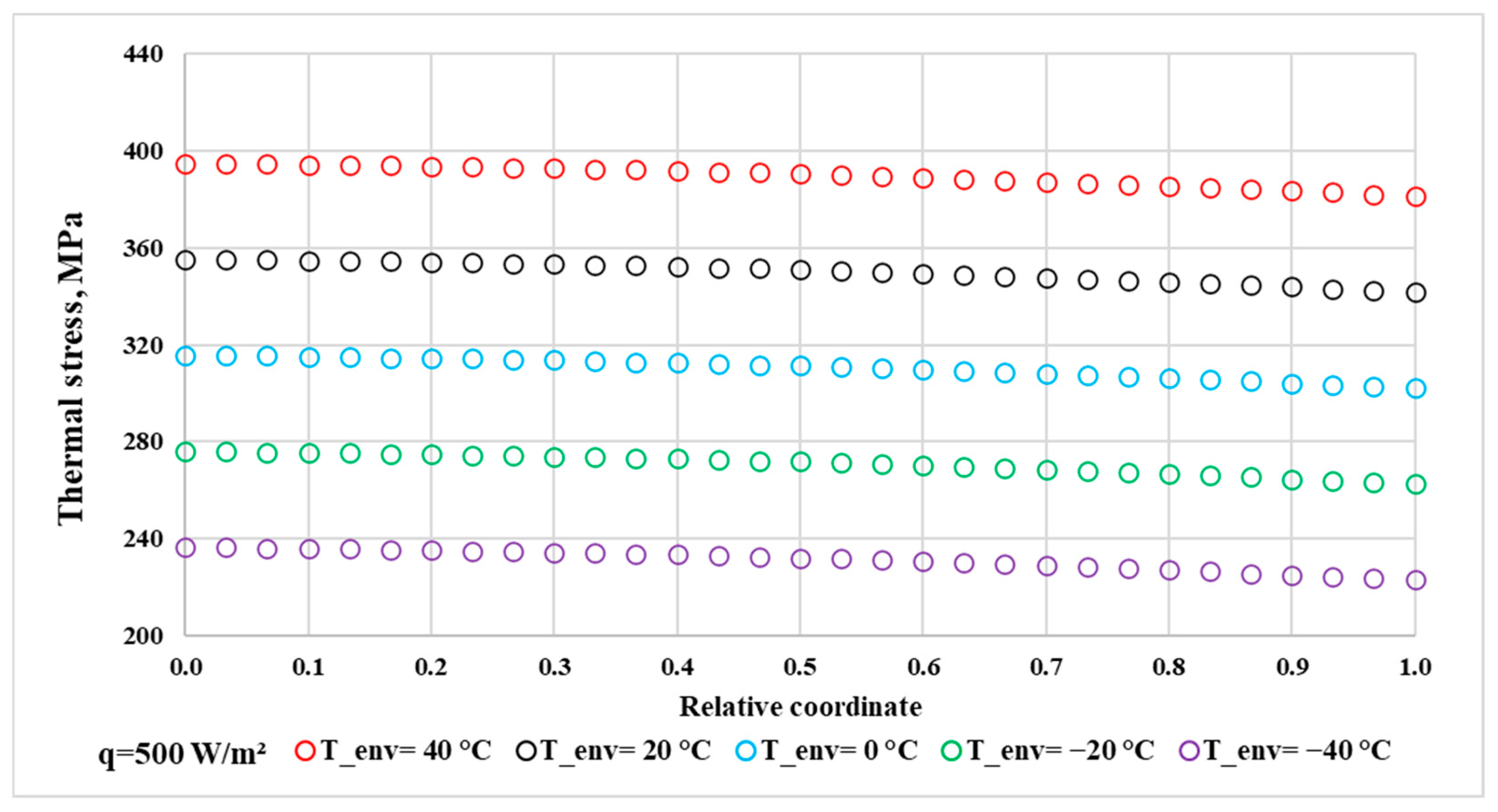
Figure 5,
Figure 6,
Figure 7 and
Figure 8 show the graphs of temperature distribution, displacement values, constrained thermal strain, and thermal stress in the rod for the selected environmental temperature values.
As observed in
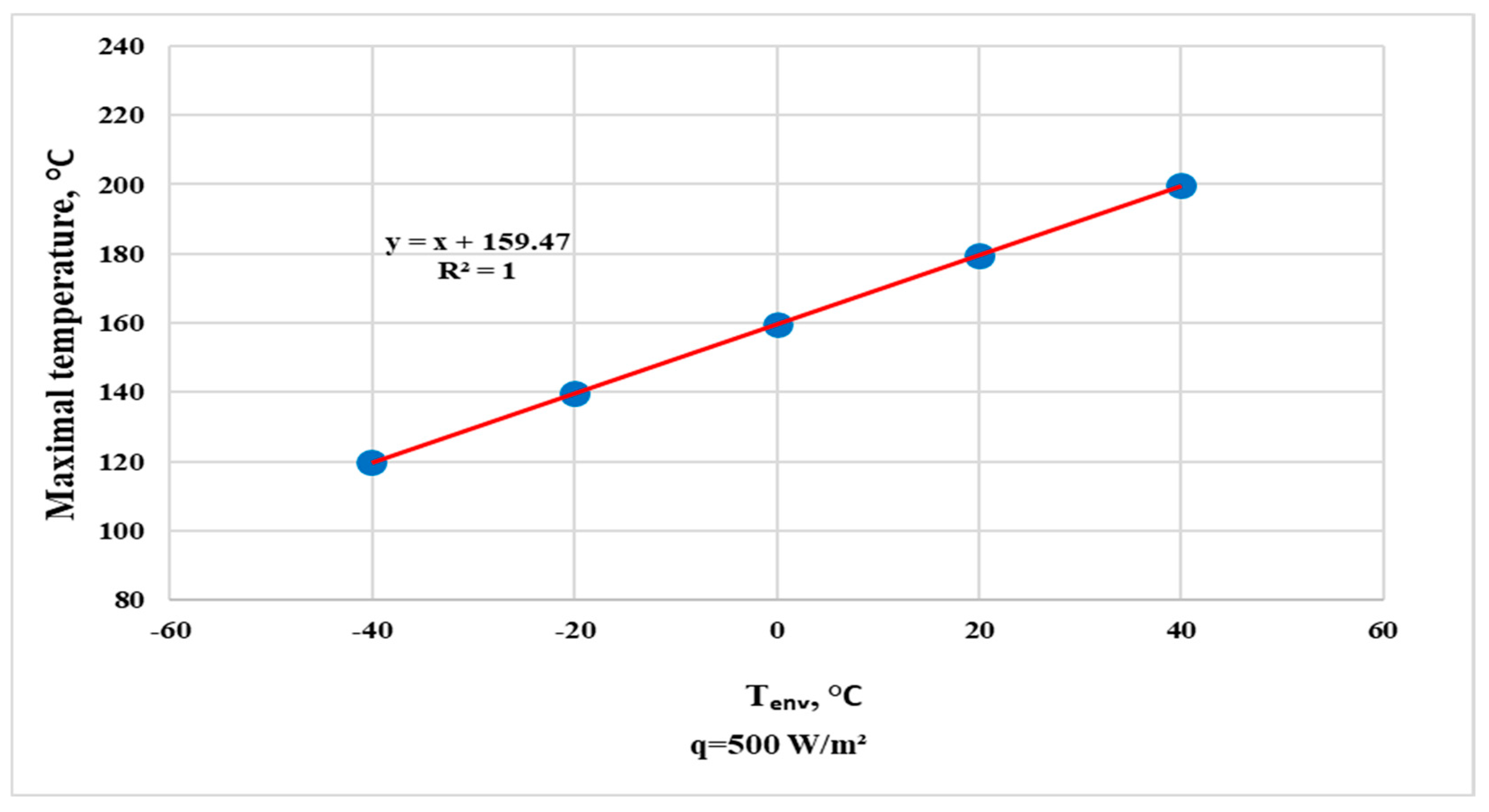
Figure 5, the temperature distributions in the rod at different environmental temperatures are similar. That is, if the temperature distribution at any one environmental temperature is known, then the temperature distribution at other environmental temperature values can be obtained by simply shifting the known temperature distribution in the vertical direction (up or down). It was observed that the maximum temperature in the rod has a functional relationship with the environmental temperature (
Figure 9, R
2 = 1). This relationship is linear, with a slope of 1. From this, it becomes clear that a change (increase or decrease) in the environmental temperature causes a similar change (increase or decrease) in the temperature at the left cross-section of the rod. The graph in
Figure 9 is a function of the shear.
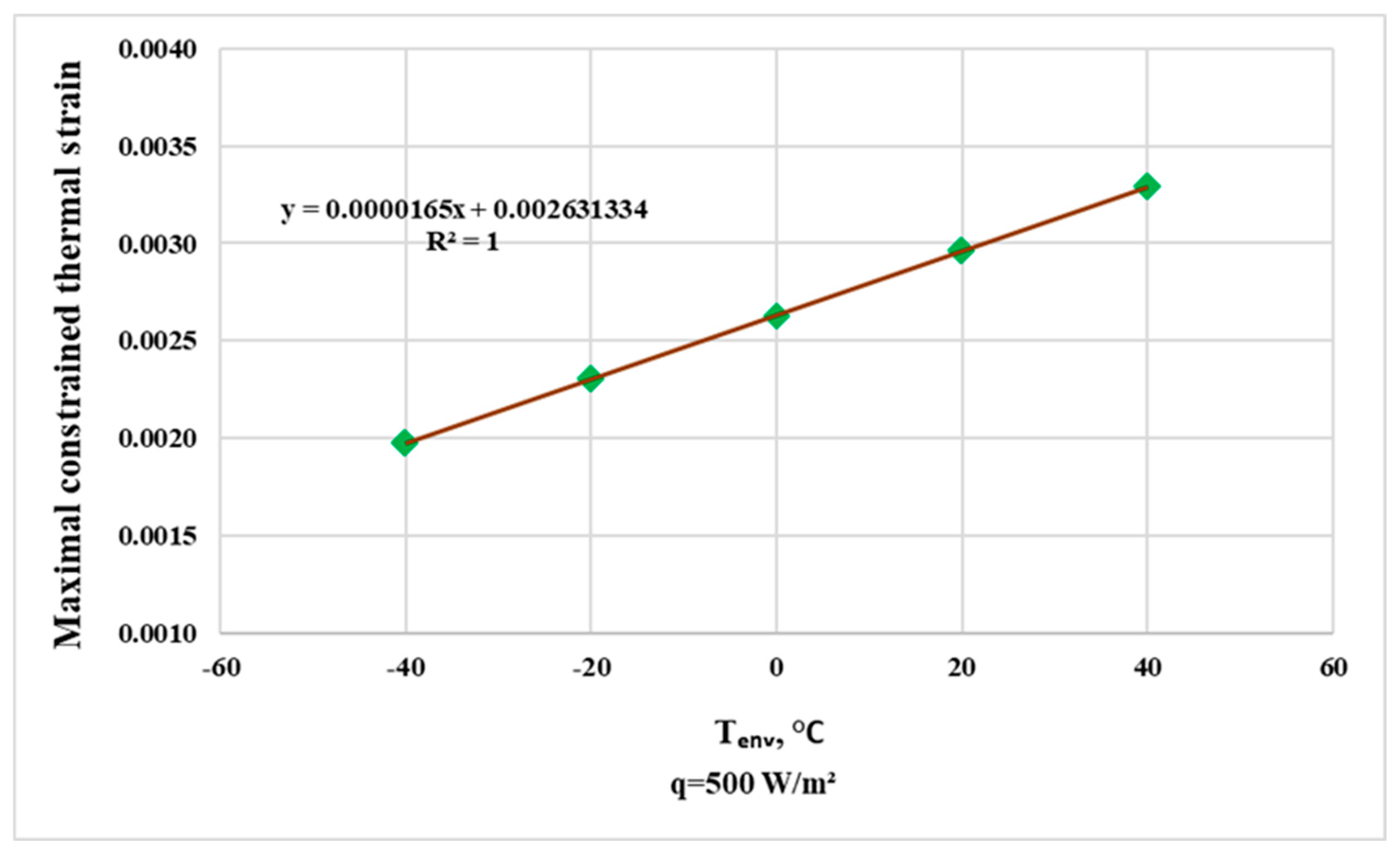
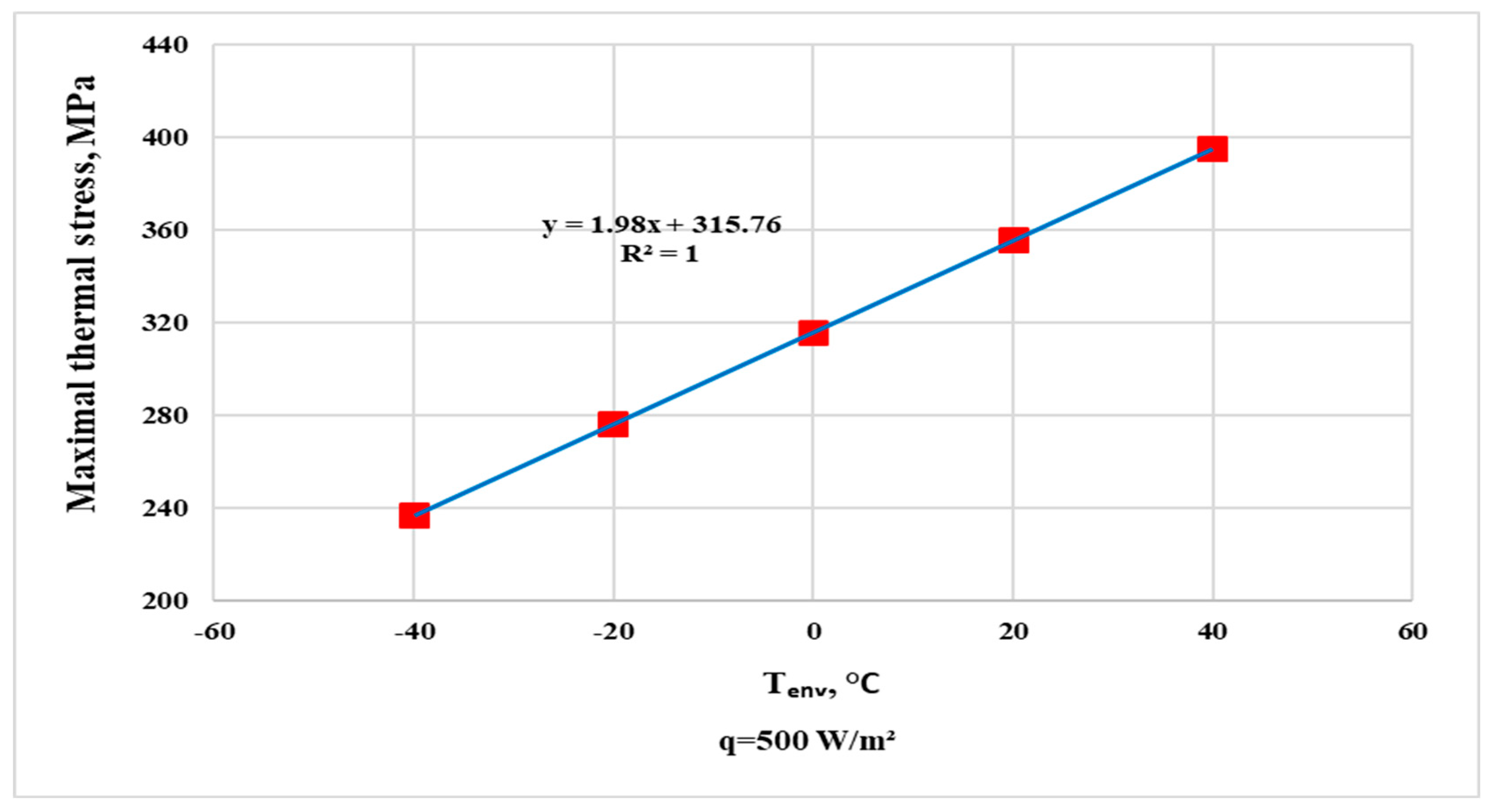
Constrained thermal strain (
Figure 7) and thermal stress (
Figure 8) have similar properties. The shear functions for these strains are shown in
Figure 10 and
Figure 11 respectively.
It was observed that with a change in environmental temperature from −40 °C to +40 °C, the maximum temperature, maximum constrained thermal strain, and maximum stress in the rod increase from 120 °C to 200 °C, from 0.0020 to 0.0033, and from 240 MPa to 400 MPa, respectively.
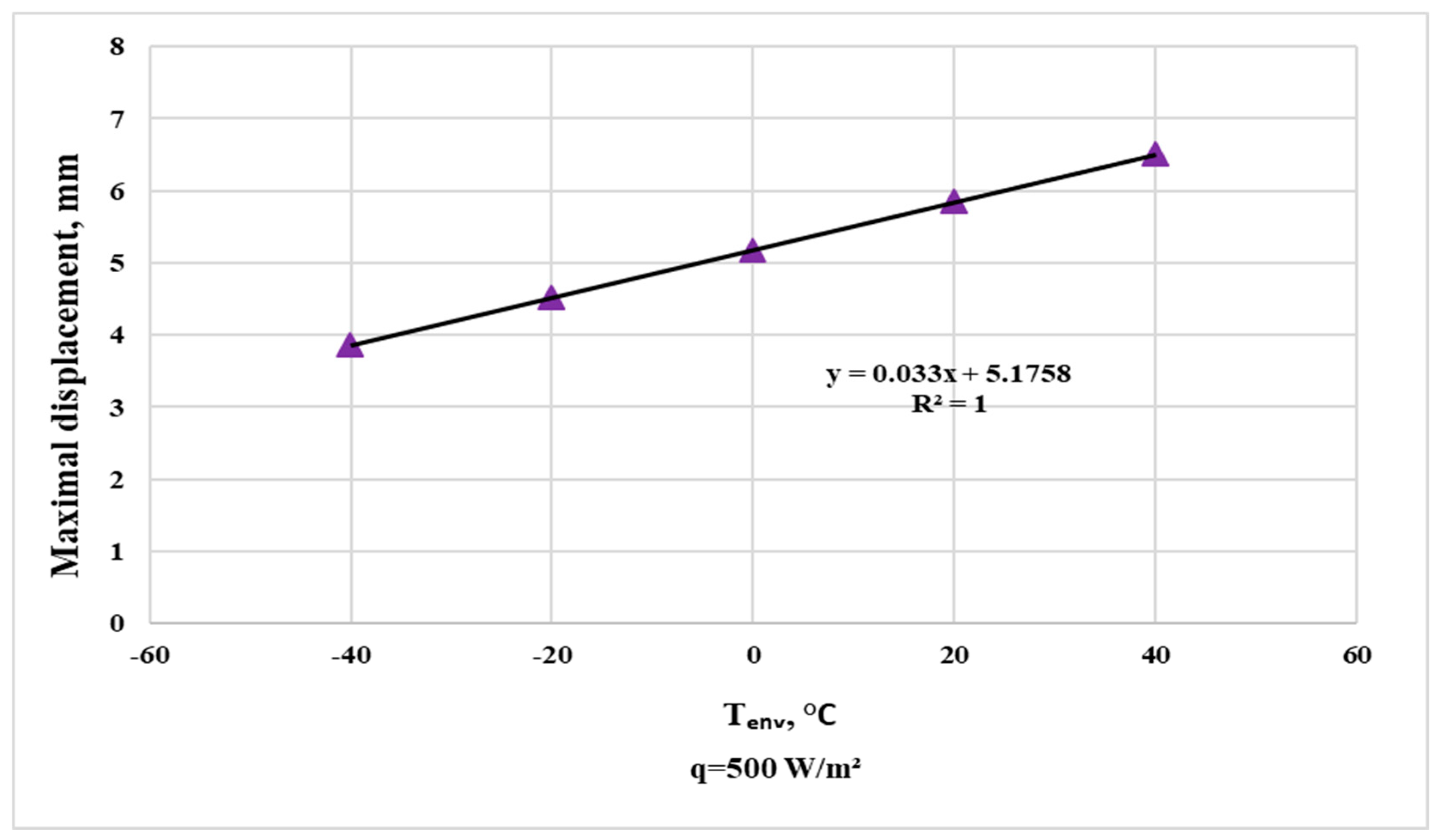
As expected, with an increase in rod temperature (due to increasing environmental temperature), the displacements at the rod points and the rod’s elongation increase linearly. There is also a functional (linear) relationship between the elongation of the rod and the environmental temperature (
Figure 12), which is also a function of the shift in the elongation of the rod at different environmental temperature values (
Figure 6).
Figure 6 and
Figure 12 show that when the environmental temperature increases from −40 °C to +40 °C, the elongation of the rod ranges from 3.8 mm to 6.5 mm.
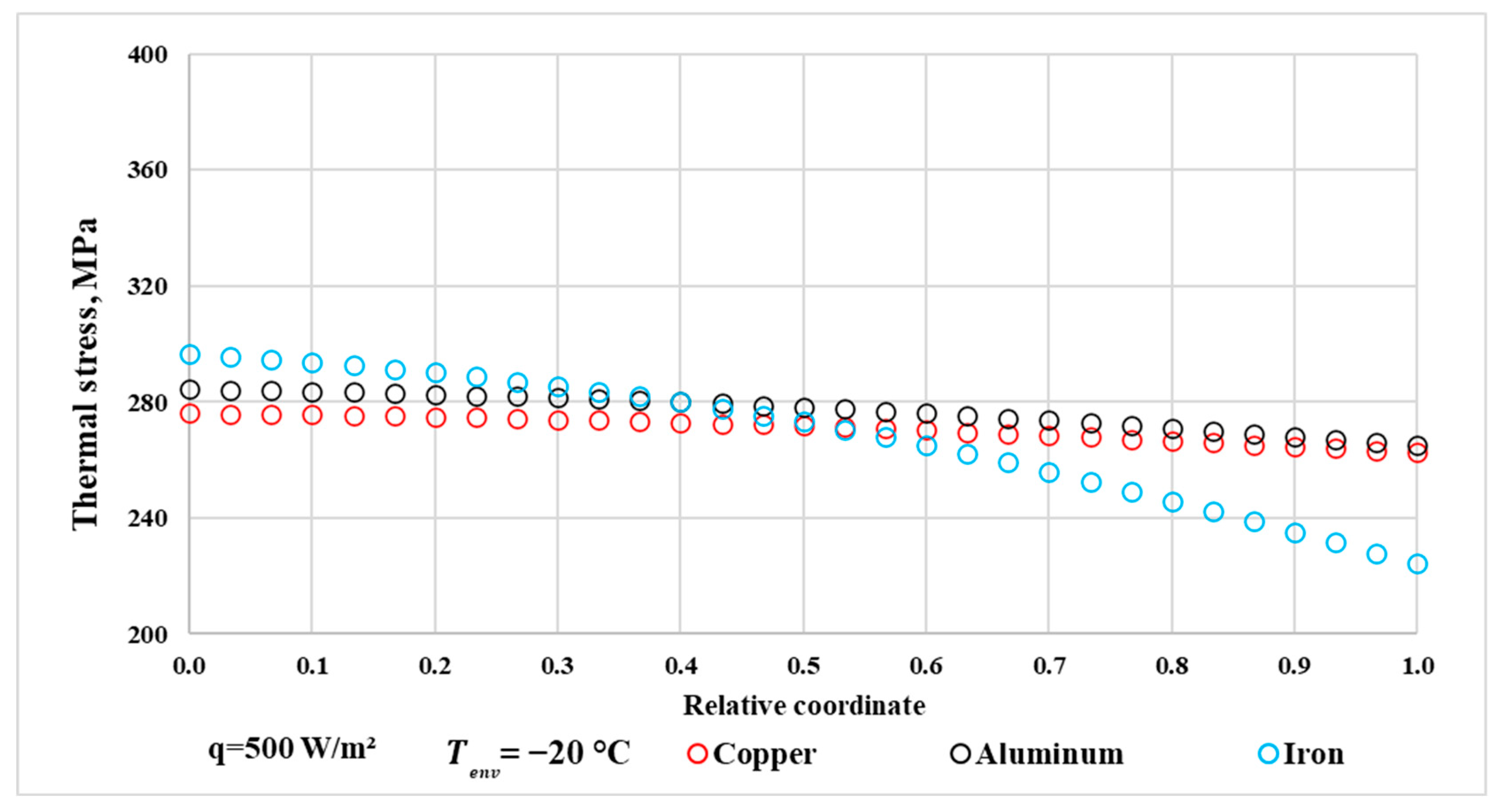
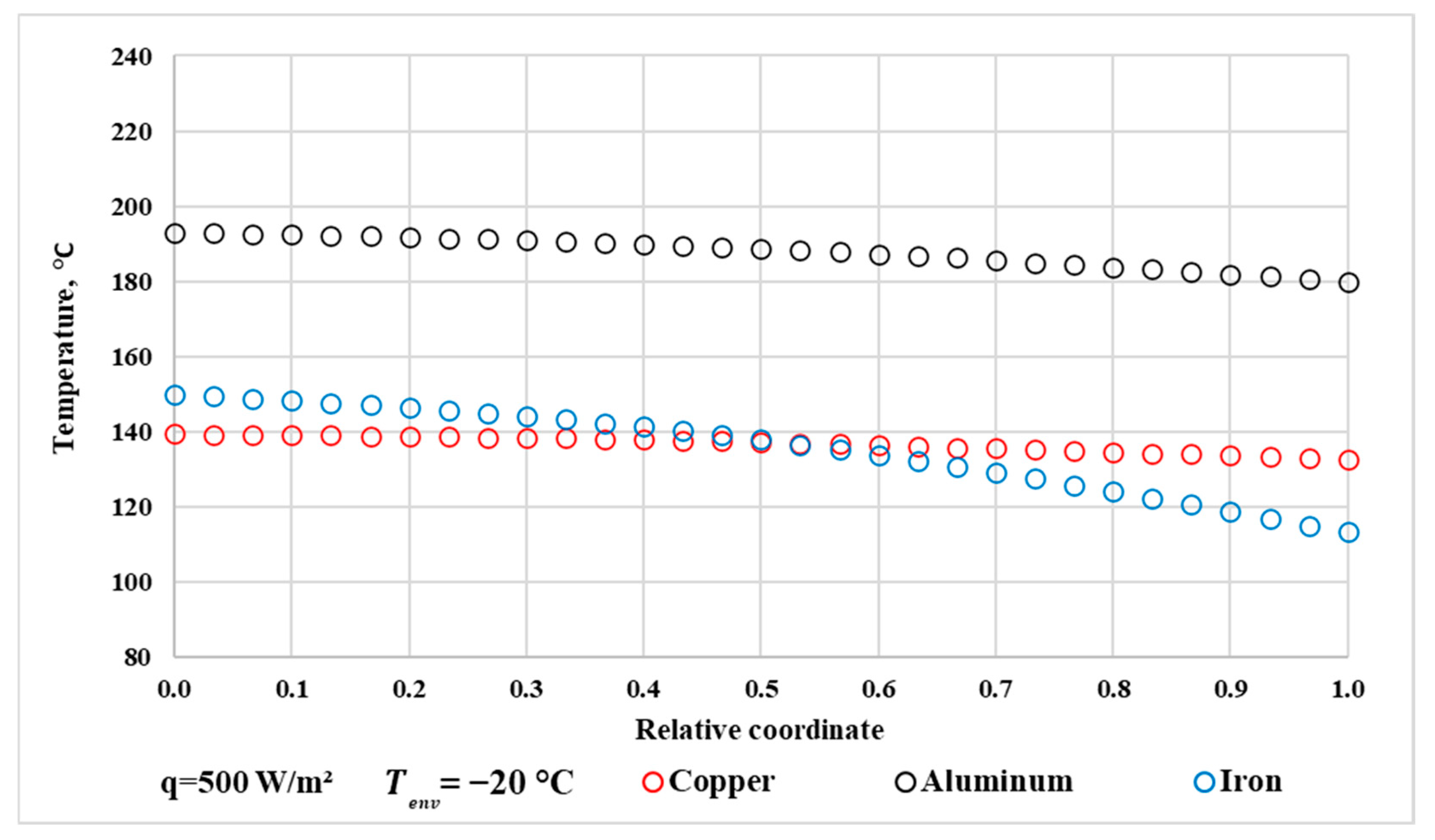
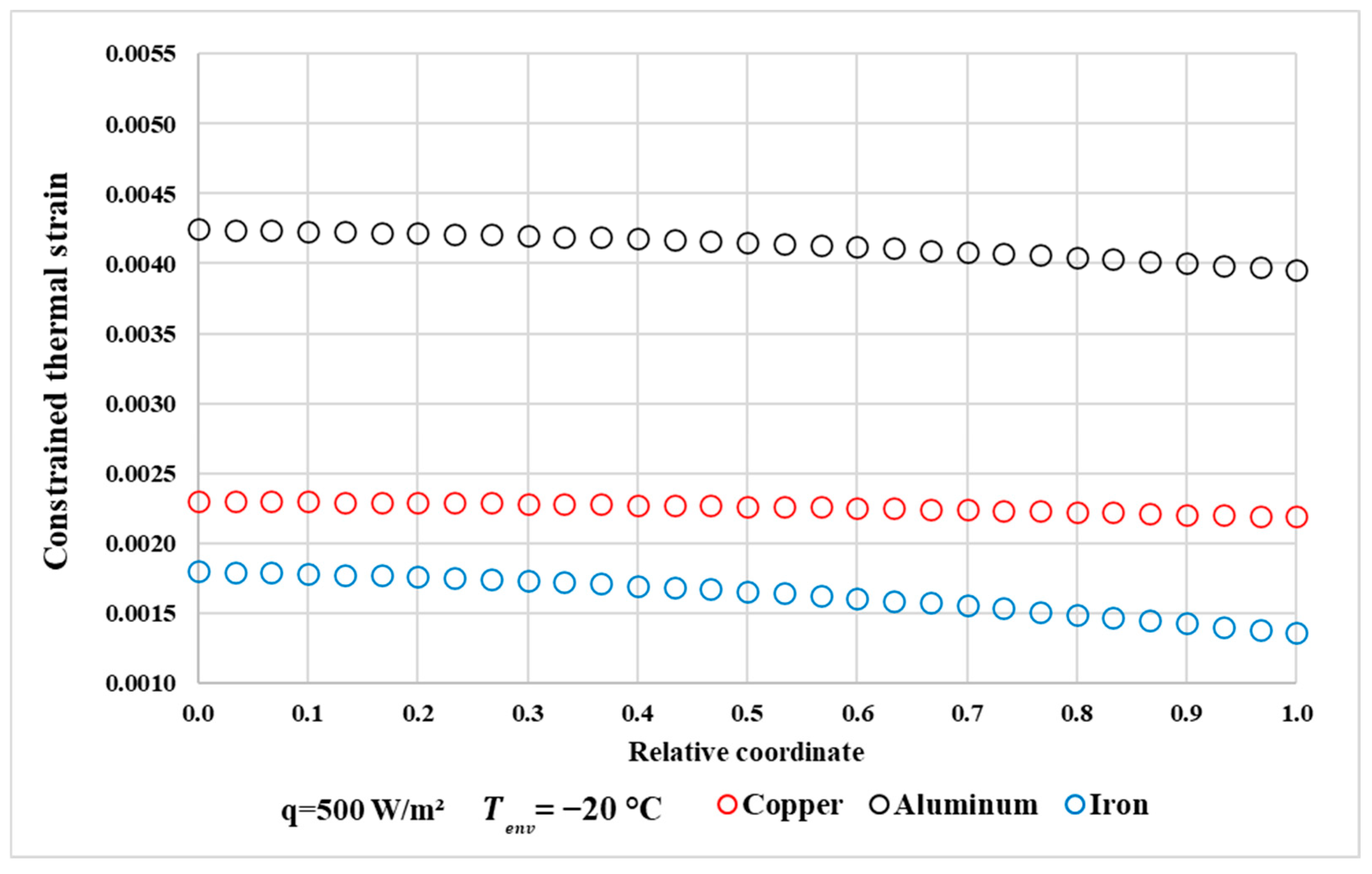
In order to study the influence of material characteristics on the temperature field and mechanical behavior of the rod, temperature distributions (
Figure 13), constrained thermal strains (
Figure 14), and thermal stresses (
Figure 15) were calculated in rods constructed with different materials (copper, aluminum, and iron). The thermophysical characteristic values of rod materials and the parameters of the boundary conditions are given in
Table 3.
As observed, the type of material (its characteristics) greatly influences the temperature distribution and mechanical characteristics of a rod. Despite the fact that the thermal conductivity coefficient of aluminum has an intermediate value (Kxx = 209.3 W/(m∙°C)) compared to iron (Kxx = 74.4 W/(m∙°C)) and copper (Kxx = 400.0 W/(m∙°C)), the temperature value of the aluminum rod is significantly higher. This is explained by the fact that the heat transfer coefficient of aluminum (h = 10 W/(m2∙°C)) is lower than that of iron (h = 15 W/(m2∙°C)) and copper (h = 13.1 W/(m2∙°C)).
The significantly high constrained thermal strain values of the aluminum rod are due to its large thermal expansion coefficient α.
The approximately equal thermal stress in most of the length (approximately 0.7 of the length) of all three rods can be explained by the fact that the elastic modulus of aluminum is almost two times less than that of copper, while the elastic moduli of iron and copper are of approximately the same order of magnitude.
6. Failure Criteria
In order to ensure the safe and reliable operation of structural parts, etc., which are rods with a variable cross-section, the following failure criteria must be taken into account:
where
denotes the value of maximum stress in the rod;
where
denotes the maximum temperature value in the rod, °C;
7. Practical Applications
In the Introduction section of this study, it was stated that many mechanical engineering objects comprise rods with a variable cross-section. It was also noted that rods with variable cross-sections can be used as device components, such as dilatometers, bimetallic thermometers, thermomechanical sensors, thermal expansion compensators, etc.
In geotechnics, the following important problem often arises: It is necessary to construct the pile foundation of a new object in confined conditions (for example, between buildings), which during the spring, summer, and autumn periods can negatively affect the stability of existing neighboring objects. Therefore, this practical process is more reliably carried out in winter. In this case, it is effective to use a device that enables localized thawing of frozen ground to a certain depth. Such a device can be designed in the form of a rod with a variable cross-section, with heat supplied to one end, while the other end, embedded in frozen ground, exchanges heat with the environment (with frozen ground).
8. Conclusions
As the main result of our modeling, an analytical expression was obtained for the temperature distribution in a heat-insulated rod with a variable cross-section, where a constant-intensity heat flow is supplied to the left end, and heat exchange with the environment occurs at the right end. The analytical solution was obtained using the finite element method based on the variational solution.
Using analytical expressions for temperature, we obtained the thermophysical (temperature solution coefficient) and mechanical (elastic modulus) characteristics of the rod material and expressions for the elongation, constrained thermal strain, and thermal stress of the rod.
The agreement between the temperature values obtained using the analytical method and the finite element method for both large (q = 3350 W/m2) and moderate (q = 500 W/m2) heat flux values is very high, which demonstrates the high accuracy of the obtained analytical solution.
The temperature field in the rod is nonlinear and decreases along its length, which is a result of one-sided heating and free heat exchange with the environment at the other end. The temperature distributions in the rod at different environmental temperatures are similar. There is a functional (linear) relationship between the maximum temperatures in the rod and the environmental temperatures. This relationship can serve as a shift function to obtain the temperature distribution in the rod at other environmental temperatures.
The constrained thermal strain and thermal stress in the rod have similar properties, for which the corresponding shear functions are also defined.
When the environmental temperature increases from −40 °C to +40 °C, the maximum temperature, maximum constrained thermal strain, maximum thermal stress, and elongation of the rod increase from 120 °C to 200 °C, from 0.0020 to 0.0033, from 240 MPa to 400 MPa, and from 3.8 mm to 6.5 mm, respectively.
Author Contributions
Conceptualization, A.K.; methodology, A.K., A.T. and B.T.; investigation, A.K., A.T., B.T. and A.M.; writing—original draft preparation, A.K., A.T. and B.T.; writing—review and editing, A.T., B.T. and A.M.; supervision, A.K. Author A.K. passed away prior to the publication of this manuscript. All authors have read and agreed to the published version of the manuscript.
Funding
This study was supported by the Fundamental Research Grant from the Ministry of Science and Higher Education of the Republic of Kazakhstan (Grant Number: BR20280990 (U. Joldasbekov Institute of Mechanics and Engineering)).
Data Availability Statement
The original contributions presented in our study are included in this manuscript; further inquiries can be directed to the corresponding author.
Conflicts of Interest
The authors declare no conflicts of interest.
References
- Timoshenko, S.P. Strength of Materials, Part I, 2nd ed.; Van Nostrand: New York, NY, USA, 1947; 358p. [Google Scholar]
- Feodosiev, V.I. Strength of Materials: Textbook for Universities, 9th ed.; revised; Nauka: Moscow, Russia, 1986; 512p. (In Russian) [Google Scholar]
- Gere, J.M.; Goodno, B.J. Mechanics of Materials, 5th ed.; Brooks/Cole: Pacific Grove, CA, USA, 2001; 922p. [Google Scholar]
- ASME. ASME B31.1 Power Piping Code; The American Society of Mechanical Engineers: New York, NY, USA, 2010. [Google Scholar]
- Blevins, R.D. Flow-Induced Vibration; Van Nostrand Reinhold: New York, NY, USA, 1990; 472p. [Google Scholar]
- Seong, S.H.; Kim, J.T.; Cheon, S.W.; Lee, C.K.; Lee, N.Y.; Hwang, I.S.; Lee, S.J. Vibration analysis for condition monitoring on piping elbow thinning. In Proceedings of the International Symposium on the Future I&C for Nuclear Power Plants (ISOFIC 2005), Tongyeong, Republic of Korea, 1–4 November 2005; KNICS R and D Center: Changwon, Republic of Korea; pp. 372–378. [Google Scholar]
- Kulikov, A.V. Raschet ustoychivosti truboprovodov AES s peremennym secheniem metodom konechnykh elementov [Stability analysis of NPP pipelines with variable cross-section using FEM]. Teploenergetika 2012, 5, 45–52. (In Russian) [Google Scholar]
- Birger, I.A.; Mavlyutov, R.R. Strength of Materials; Nauka: Moscow, Russia, 1986; 554p. (In Russian) [Google Scholar]
- Carslaw, H.S.; Jaeger, J.C. Conduction of Heat in Solids, 2nd ed.; Oxford University Press: Oxford, UK, 1959. [Google Scholar]
- Arshidinova, M.; Tashev, A.; Kudaykulov, A. Developing a method of accounting for the existence of local surface heat exchange in rods of variable cross-section. East.-Eur. J. Enterp. Technol. 2023, 3, 53–64. [Google Scholar] [CrossRef]
- Kanareykin, A. Distribution of the temperature field in the rod, taking into account the correction for heat loss through its side surface. E3S Web Conf. 2023, 376, 01078. [Google Scholar] [CrossRef]
- Eckert, E.R.G.; Drake, R.M. Heat and Mass Transfer; McGraw-Hill: New York, NY, USA, 1959. [Google Scholar]
- Węgrzyn-Skrzypczak, E.; Skrzypczak, T. Analytical and numerical solution of the heat conduction problem in the rod. J. Appl. Math. Comput. Mech. 2017, 16, 79–86. [Google Scholar] [CrossRef][Green Version]
- Eremin, A.V. Study on heat transfer between the rod and the environment under conditions of forced convection. IOP Conf. Ser. Mater. Sci. Eng. 2020, 791, 012008. [Google Scholar] [CrossRef]
- Kudaykulov, A.; Tashev, A.A.; Askarova, A. A computational algorithm and the method of determining the temperature field along the length of the rod of variable cross section. Open Eng. 2018, 8, 170–175. [Google Scholar] [CrossRef]
- Akhmetov, S.; Kudaykulov, A.; Bizhanov, D. Determination of thermally stressed state of rod elements of variable cross section under the impact of a lateral heat flow, heat exchange and surface thermal insulation. E3S Web Conf. 2020, 216, 01073. [Google Scholar] [CrossRef]
- Arshidinova, M.; Kudaykulov, A.; Tashev, A.; Begaliyeva, K. Numerical study of the effect of local heat flow on the thermal stress–strain state of a rod of variable cross-section. In Proceedings of the IFToMM Asian MMS 2024, Almaty, Kazakhstan, 28–30 August 2024; pp. 34–43. [Google Scholar] [CrossRef]
- Arshidinova, M.; Kudaykulov, A.; Tashev, A.; Begaliyeva, K.; Merkibayeva, B. Numerical study of the influence of ambient temperature on the thermo-stress–strain state of a rod with a curvilinear core. In Proceedings of the IFToMM Asian MMS 2024, Almaty, Kazakhstan, 28–30 August 2024; pp. 90–98. [Google Scholar] [CrossRef]
- Dwight, H.B. Tables of Integrals and Other Mathematical Data, 4th ed.; Macmillan: New York, NY, USA, 1961. [Google Scholar]
- Lutz, M. Learning Python, 5th ed.; O’Reilly Media: Sebastopol, CA, USA, 2013; ISBN 978-1-4493-5573-9. [Google Scholar]
- Führer, C.; Verdier, O.; Solem, J.E. Scientific Computing with Python, 2nd ed.; Packt Publishing: Birmingham, UK, 2021; ISBN 978-1-83882-232-3. [Google Scholar]
Figure 1.
Thermally insulated rod with a variable cross-section.
Figure 1.
Thermally insulated rod with a variable cross-section.
Figure 2.
Comparison of temperature distributions for a rod at q = 500 W/m2 obtained via FEM at different FE numbers (n): 1—Tenv = −10 °C; 2—Tenv = −20 °C.
Figure 2.
Comparison of temperature distributions for a rod at q = 500 W/m2 obtained via FEM at different FE numbers (n): 1—Tenv = −10 °C; 2—Tenv = −20 °C.
Figure 3.
Comparison of temperature distributions for a rod at q = 3350 W/m2 obtained via the analytical solution and FEM.
Figure 3.
Comparison of temperature distributions for a rod at q = 3350 W/m2 obtained via the analytical solution and FEM.
Figure 4.
Comparison of temperature distributions for a rod at q = 500 W/m2 obtained via the analytical solution and FEM.
Figure 4.
Comparison of temperature distributions for a rod at q = 500 W/m2 obtained via the analytical solution and FEM.
Figure 5.
Temperature distribution in a rod at q = 500 W/m2 and different environmental temperatures, .
Figure 5.
Temperature distribution in a rod at q = 500 W/m2 and different environmental temperatures, .
Figure 6.
Values of displacement in the rod at q = 500 W/m2 and different environmental temperatures, .
Figure 6.
Values of displacement in the rod at q = 500 W/m2 and different environmental temperatures, .
Figure 7.
Constrained thermal strain in the rod at q = 500 W/m2 and different environmental temperatures, .
Figure 7.
Constrained thermal strain in the rod at q = 500 W/m2 and different environmental temperatures, .
Figure 8.
Thermal stress in the rod at q = 500 W/m2 and different environmental temperatures, .
Figure 8.
Thermal stress in the rod at q = 500 W/m2 and different environmental temperatures, .
Figure 9.
Relationship between the maximum temperature in the rod and the environmental temperature at q = 500 W/m2.
Figure 9.
Relationship between the maximum temperature in the rod and the environmental temperature at q = 500 W/m2.
Figure 10.
Relationship between the maximum constrained thermal strain in the rod and the environmental temperature at q = 500 W/m2.
Figure 10.
Relationship between the maximum constrained thermal strain in the rod and the environmental temperature at q = 500 W/m2.
Figure 11.
Relationship between the maximum thermal stress in the rod and the environmental temperature at q = 500 W/m2.
Figure 11.
Relationship between the maximum thermal stress in the rod and the environmental temperature at q = 500 W/m2.
Figure 12.
Relationship between the maximum displacement in the rod and the environmental temperature at q = 500 W/m2.
Figure 12.
Relationship between the maximum displacement in the rod and the environmental temperature at q = 500 W/m2.
Figure 13.
Temperature distribution in the rod at q = 500 W/m2 and environmental temperature = −20 °C.
Figure 13.
Temperature distribution in the rod at q = 500 W/m2 and environmental temperature = −20 °C.
Figure 14.
Constrained thermal strain in the rod at q = 500 W/m2 and environmental temperature = −20 °C.
Figure 14.
Constrained thermal strain in the rod at q = 500 W/m2 and environmental temperature = −20 °C.
Figure 15.
Thermal stress in the rod at q = 500 W/m2 and environmental temperature = −20 °C.
Figure 15.
Thermal stress in the rod at q = 500 W/m2 and environmental temperature = −20 °C.
Table 1.
Values of geometric characteristics and the modulus of elasticity of the rod material.
Table 1.
Values of geometric characteristics and the modulus of elasticity of the rod material.
| Length of Rod L, m | Radius Change Parameters | Modulus of Elasticity E, MPa |
|---|
| a | b | c |
|---|
| 2.0 | 0.03 | −0.11 | 0.2 | 120,000 |
Table 2.
Values of thermophysical characteristics of the rod material and boundary conditions.
Table 2.
Values of thermophysical characteristics of the rod material and boundary conditions.
| Thermophysical Characteristics of the Rod Material | Boundary Conditions Parameters |
|---|
| Kxx, W/(m·°C) | α, 1/°C | q, W/m2 | h, W/(m2·°C) | , °C |
| 400 | 1.65 × 10⁻⁵ | 3350 | 13.1 | −10 |
| 400 | 1.65 × 10⁻⁵ | 500 | 13.1 | −10 |
Table 3.
Values of the thermophysical characteristics of the rod’s materials and boundary condition parameters.
Table 3.
Values of the thermophysical characteristics of the rod’s materials and boundary condition parameters.
| Material of the Rod | Thermophysical Characteristics of the Rod’s Material | Boundary Condition Parameters |
|---|
| Kxx, W/(m·°C) | α, 1/°C | q, W/m2 | h, W/(m2·°C) | , °C |
|---|
| Aluminum | 209.3 | 2.2 × 10⁻⁵ | 500 | 10.0 | −20 |
| Iron | 74.4 | 1.2 × 10⁻⁵ | 500 | 15.0 | −20 |
| Disclaimer/Publisher’s Note: The statements, opinions and data contained in all publications are solely those of the individual author(s) and contributor(s) and not of MDPI and/or the editor(s). MDPI and/or the editor(s) disclaim responsibility for any injury to people or property resulting from any ideas, methods, instructions or products referred to in the content. |