1. Introduction
Natural convection is the flow caused by nonuniform density in a fluid under the influence of gravity. Natural convection is a fundamental process with application from engineering to geophysics.
Changes in fluid density can be caused by changes in temperature or solute concentration. Under the influence of gravity, density changes cause fluid flow, which also transports heat or solute. Rates of transfer grow until reaching a plateau. This investigation seeks to predict the overall steady-state heat transfer rate from an external, cylindrical, isothermal surface inclined at any angle in a Newtonian fluid.
An “external” surface is one that fluid can flow around freely, especially horizontally. If enclosed, the enclosure must have dimensions much larger than the heated or cooled surface.
Unbounded vertical extent allows the imagining of a hypothetical apparatus to extract as much of the rising fluid’s mechanical energy as possible. This then is a (non-reversible) heat engine driven by the temperature difference between the heated object and the unheated fluid. The analysis in Jaffer [
1] finds that the maximum efficiency, the fraction of the heat energy which can converted into mechanical work, is
, which is 1/2 of the Carnot efficiency limit for reversible heat engines.
From this thermodynamic constraint on heat-engine efficiency, conservation laws, and flow topologies gleaned from streamline photographs, Jaffer [
1] mathematically derives convection heat-transfer upper-bound formulas for vertical and horizontal flat surfaces. Actual convective heat-transfer is less than these upper bounds when fluid flow is (partially) obstructed.
Horizontal downward-facing and vertical surfaces are partially self-obstructing. The Jaffer [
1] treatment of self-obstruction is similar to prior works, but unifies prior work self-obstruction factors into a single exact factor which is more plausible (measurements not significantly exceeding the upper bound) over the full range of Prandtl numbers (the fluid’s momentum diffusivity per thermal diffusivity ratio).
1.1. Characteristic Length
The characteristic length L is the length scale of a physical system. As with a vertical rectangular plate, a vertical cylinder’s characteristic length is its height.
The characteristic length of a level circular cylinder is its diameter d. Generalizing to convex cylinders is the hydraulic diameter, which is 4 times the area-to-perimeter ratio of the cylinder’s cross-section. Note that the diameter and hydraulic diameter are identical for a level circular cylinder.
1.2. Fluid Mechanics
In engineering, convection heat transfer rates are expressed using the average surface conductance with units .
In fluid mechanics, the convective heat transfer rate is represented by the dimensionless average Nusselt number (), where k is the fluid’s thermal conductivity with units , and L is the system’s characteristic length (m).
The Rayleigh number is the impetus for fluid flow due to gravity acting on density differences caused by temperature or solute concentration. A fluid’s Prandtl number is its momentum diffusivity per thermal diffusivity ratio. For mass transfer, the fluid’s Schmidt number is analogous; will be used in formulas.
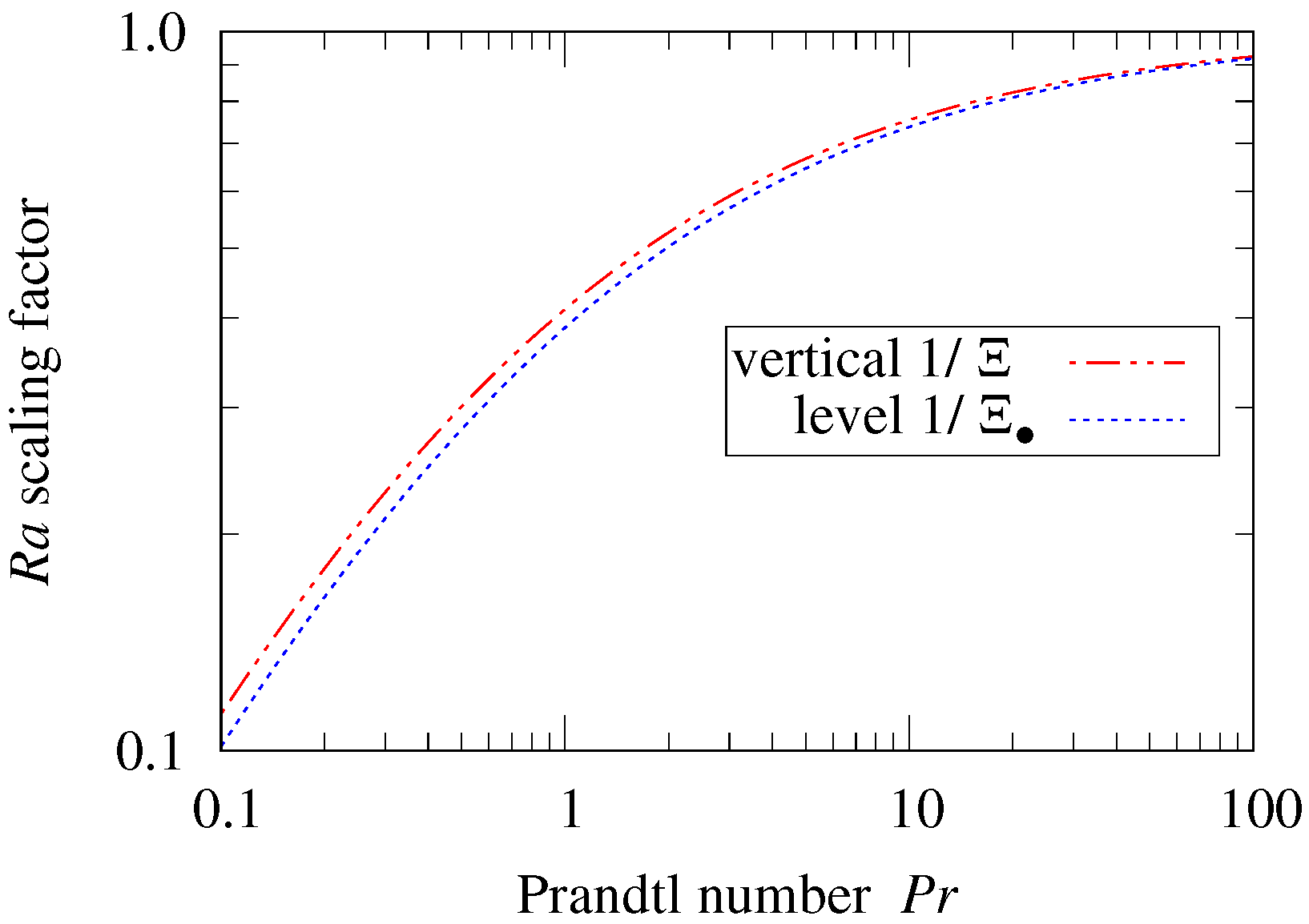
When rising convection-induced fluid flow must pass along or around the object’s surface, is scaled by a “self-obstruction” factor , which depends only on . This applies to both cylinder flow topologies.
The system’s characteristic length L scales , while scales . Variables , , , and are independent of L.
1.3. Flow Topologies
Jaffer [
1] derived a natural convection formula for external flat plates (with convex perimeter) in any orientation from its analyses of horizontal and vertical plates. Similarly, this investigation will derive its formula for an inclined cylinder from its analyses of horizontal and vertical cylinders.
There are two topologies of convective flow from external, convex cylinders.
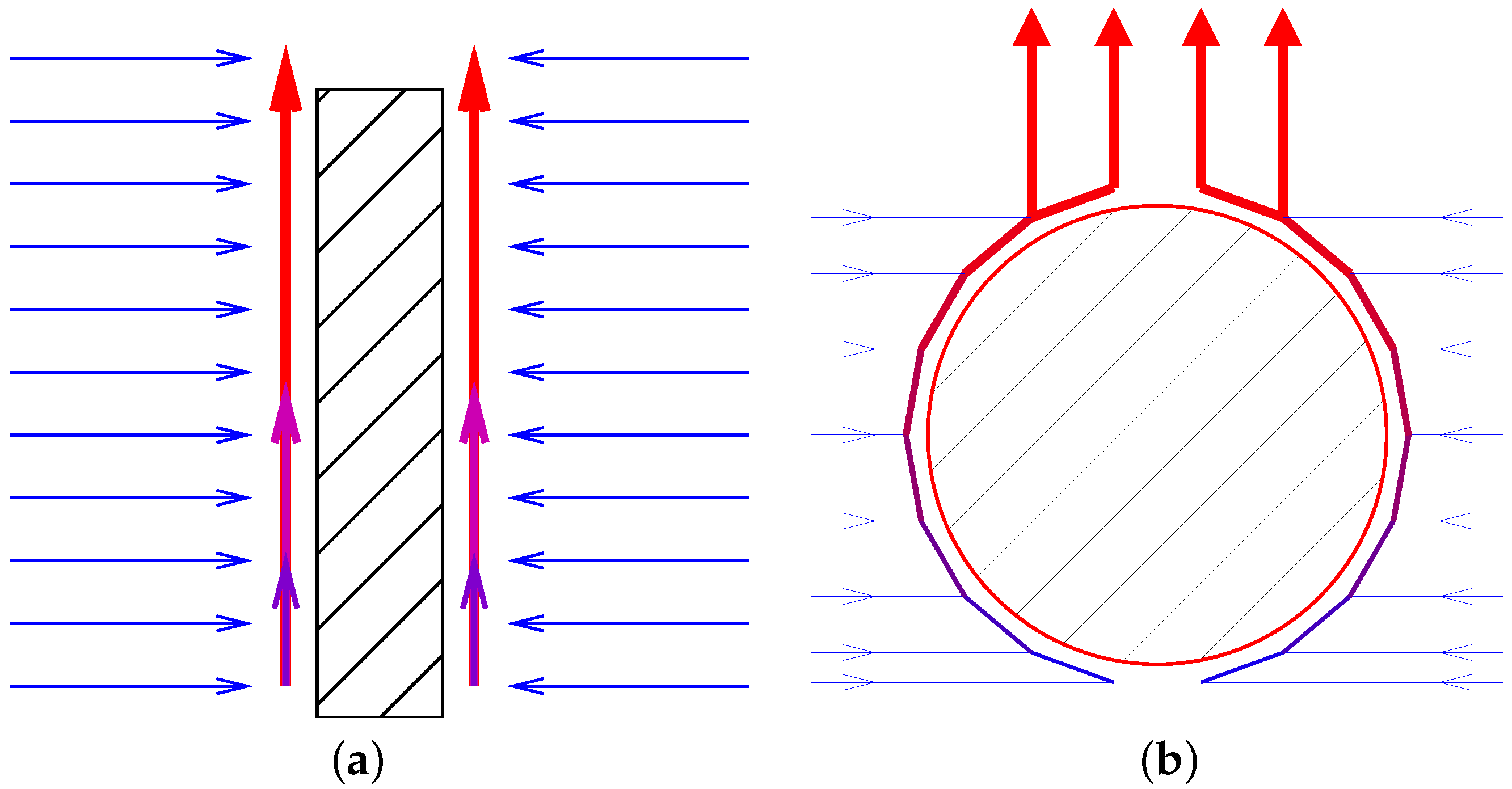
Figure 1 shows the induced fluid flows around heated vertical and horizontal cylindrical surfaces.
An important aspect of both flow topologies is that fluid is pulled horizontally before being heated by the cylinder. Pulling horizontally expends less energy than pulling vertically because the latter does work against the gravitational force. Inadequate horizontal clearance around a cylinder can obstruct flow and reduce convective heat transfer.
There is a symmetry in external natural convection; a cooled cylinder induces downward flow instead of upward flow. The rest of the present work assumes that the cylindrical exterior surface is warmer than the fluid.
1.4. Turbulence
Jaffer [
1] derives the formula for an external flat surface’s total natural convective heat transfer from the thermodynamic constraints on heat-engine efficiency, conservation laws, and flow topology.
Thermodynamic and conservation laws make no distinction between laminar and turbulent flows. What about the fluid flow topology? If the transition to turbulence is far from a heated convex object, then it will not affect heat transfer from the object. Otherwise, the fluid near the object will form a turbulent boundary layer. This turbulent boundary layer will have a viscous sublayer between it and the object. Regarding forced flow-induced boundary layers, Lienhard and Lienhard [
2] (p. 321) state
Because turbulent mixing is ineffective in the sublayer, the sublayer is responsible for a major fraction of the thermal resistance of a turbulent boundary layer.
The boundary layer thickness grows with decreasing forced velocity. Without forced flow, the transition to turbulence will be far from the object, increasing turbulent mixing in the boundary layer and reducing its thermal resistance. This makes the non-turbulent viscous sublayer responsible for most of the thermal resistance. If the distinction between laminar and turbulent natural convection effects heat transfer, its effect will be small.
Prior plate investigations assumed that natural convection heat transfer formulas would differ substantially when the convection was turbulent versus laminar. For their upward-facing plate, Lloyd and Moran [
3] reported that the transition from laminar to turbulent flow occurred at
. The straight line segments they fitted to their data at greater and lesser
were disjoint at
. However, with their fit lines removed, if
represents a discontinuity, then it is one of several, and subsumed within the scatter of their measurements (their data is plotted in Jaffer [
1]).
About their measurements of vertical and downward tilted plates, Fujii and Imura [
4] wrote
Though the boundary layer was not always laminar near the trailing edge for large [] values, no influence of the flow regime on the data shown in [their] Fig. 6 is appreciable.
Churchill and Chu [
5] conclude that one of their equations
...based on the model of Churchill and Usagi [
6] provides a good representation for the mean heat transfer for free convection from an isothermal vertical plate over a complete range of Ra and Pr from 0 to ∞ even though it fails to indicate a discrete transition from laminar to turbulent flow.
Although there are substantial differences between laminar and turbulent fluid flow along plates, a single formula appears to govern both laminar and turbulent natural convective heat transfer in all orientations.
The flow topology from a vertical cylinder is quite similar to that from a vertical plate. The laminar–turbulent differences in flow topology from a level cylinder happen far from the cylinder. Hence, this investigation expects a single formula to govern both laminar and turbulent natural convection from cylinders.
1.5. Combining Transfer Processes
Formula (
1) is an unnamed form for combining functions which appears frequently in heat or mass transfer formulas:
Churchill and Usagi [
6] stated that such formulas are “remarkably successful in correlating rates of transfer for processes which vary uniformly between these limiting cases.” Convection transfers heat (or solute) between the cylinder and the fluid.
1.6. The -Norm
When
and
, taking the
pth root of both sides of Equation (
1) yields a vector-space functional form known as the
-norm, which is notated
:
Norms generalize the notion of distance. Formally, a vector-space norm obeys the triangle inequality , which holds only for . However, is also useful.
When , the processes modeled by and compete and ; the most competitive case is .
The -norm models independent processes; .
When , the processes cooperate and . Cooperation between conduction and flow-induced heat transfer can occur in natural convection systems.
2. Data-Sets and Evaluation
Heat transfer measurements were captured from graphs in the cited works by measuring the distance from each point to its graph’s axes, then scaling to the graph’s units using the “Engauge” software (version 12.1).
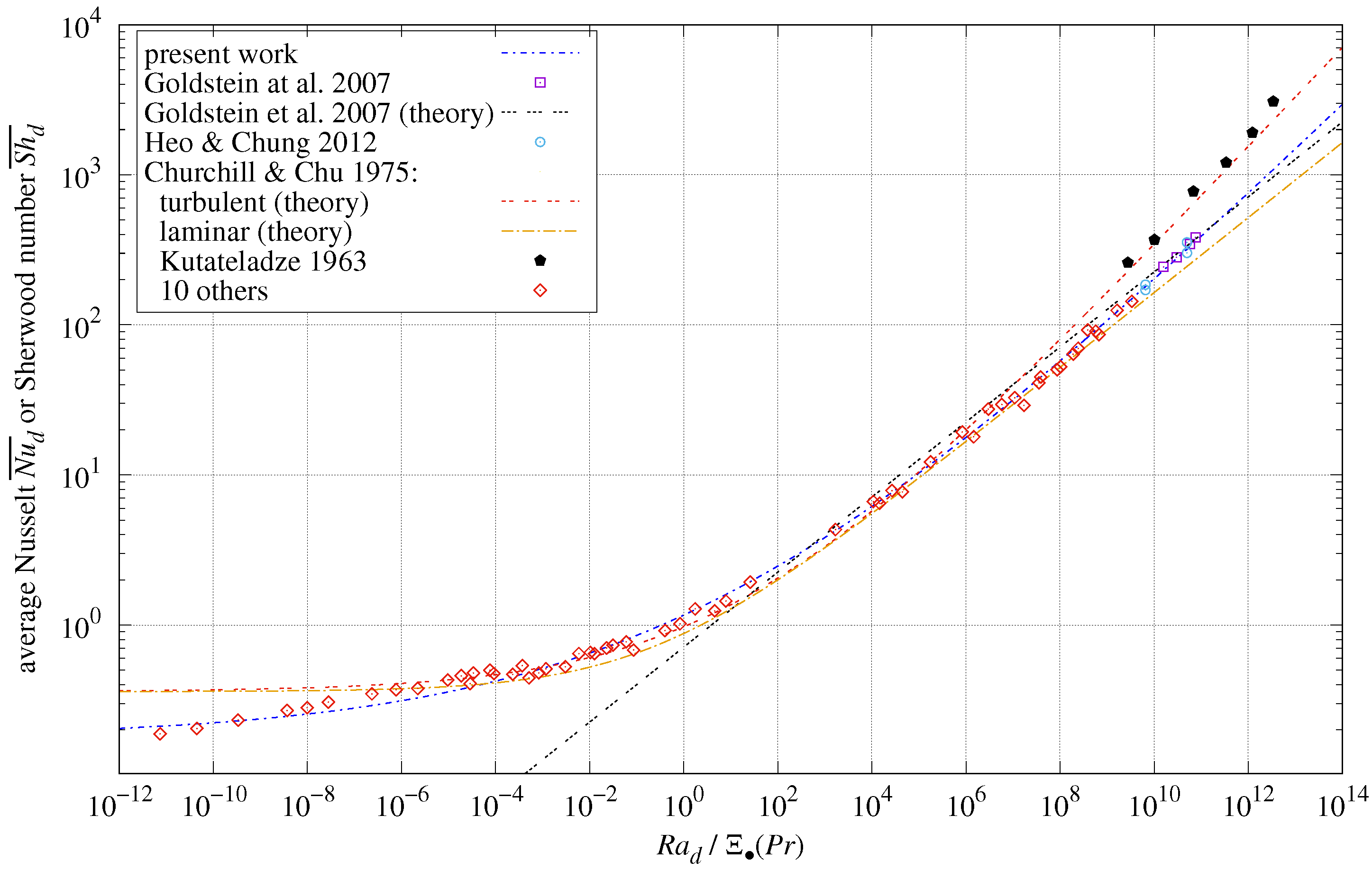
Churchill and Chu [
7] collected level cylinder (angle
) heat and mass transfer measurements from eleven studies spanning more than 23 orders of magnitude of
. The Kutateladze [
8] data-set (with the largest
values) is treated separately in
Table 1.
Al-Arabi and Khamis [
9] measured natural convection heat transfer from a cylinder at six angles. They measured local temperatures along the cylinder, but incorrectly inferred the average heat transfer.
Popiel, Wojtkowiak, and Bober [
10] measured natural convection heat transfer from four vertical cylinders with
. Unfortunately, they tested with the bottom of the cylinder resting directly on a flat platform, which would impede horizontal fluid flow at the bottom. Extra unheated walls were found to significantly affect convective heat transfer in Jaffer [
1].
Goldstein, Khan, and Srinivasan [
11] measured natural convection mass transfer from three cylinders at four inclinations.
Heo and Chung [
12] measured natural convection mass transfer from five cylinders with
at inclinations
.
These data files, used for generating the present work’s graphs and tables, along with digitization details and estimated digitization inaccuracies are collected in
Supplementary Materials.
Table 1.
Cylinder natural convection data-sets.
Table 1.
Cylinder natural convection data-sets.
| Source | Study | | | | | ± | # |
|---|
| Churchill & Chu [7] | Kutateladze [8] | | | | | | 6 |
| Churchill & Chu [7] | all | | | | | | 63 |
| Churchill & Chu [7] | 10 others | | | | | | 57 |
| Source | or | | | | | ± | # |
| Goldstein et al. [11] | | 0.63–2.34 | | | | | 4 |
| Goldstein et al. [11] | | 0.63–2.34 | | | | | 11 |
| Goldstein et al. [11] | | 0.63–2.34 | | | | | 11 |
| Goldstein et al. [11] | | 0.63–2.34 | | | | | 16 |
| Heo & Chung [12] | | 25 | – | | | 0.9% | 13 |
| Heo & Chung [12] | | | – | | | 0.9% | 13 |
| Heo & Chung [12] | | | – | | | 0.9% | 13 |
| Heo & Chung [12] | | 13 | – | | | 0.9% | 9 |
| Heo & Chung [12] | | | – | | | 0.9% | 9 |
| AlArabi & Khamis [9] | | 15.5–104 | | | | | 7 |
| AlArabi & Khamis [9] | | 15.5–104 | | | | | 7 |
| AlArabi & Khamis [9] | | 15.5–104 | | | | | 7 |
| AlArabi & Khamis [9] | | 15.5–104 | | | | | 7 |
| AlArabi & Khamis [9] | | 15.5–104 | | | | | 7 |
| AlArabi & Khamis [9] | | 15.5–104 | | | | | 7 |
2.1. Not Empirical
Empirical theories derive their coefficients from measurements, inheriting the uncertainties from those measurements. Theories developed from first principles derive exact coefficients and exponents mathematically. For example, Incropera, DeWitt, Bergman, and Lavine [
13] (p. 210) give the thermal conductance (units
) of a diameter
d sphere (
) into an unbounded stationary, uniform medium having thermal conductivity
k as
The present theory predicting natural convective heat transfer from a round cylindrical surface derives from first principles; it is not empirical. Each formula is tied to aspects of the cylinder geometry and orientation, fluid, and flow.
2.2. RMS Relative Error
Root-mean-squared (RMS) relative error (RMSRE) provides an objective, quantitative evaluation of theory versus experimental data. It gauges the fit of measurements
to function
, giving each of the
n samples equal weight in Formula (
4). Along with presenting RMSRE, charts in the present work split RMSRE into the bias and scatter components defined in Formula (5). The root-sum-squared of bias and scatter is RMSRE.
5. Inclination
is the angle of a flat surface from vertical; is face-up.
is the angle of a cylinder’s axis from horizontal.
A mass constrained to move along a line inclined at from vertical will experience gravitational force proportional to the projection of the gravity vector onto that line, . Similarly, a mass constrained to move perpendicular to a plate inclined at from vertical will have its force scaled by .
is proportional to gravitational acceleration in the direction of flow; thus plate is scaled by and and get scaled by . Similarly for cylinders, gets scaled by and gets scaled by .
5.1. Natural Convection from an Inclined Plate
For an inclined plate, the formula in Raithby and Hollands [
21] chooses the upward-facing, downward-facing, or vertical flow mode having the maximum convective surface conductance (with each
scaled as described above).
The upward-facing
and downward-facing
do not directly compete with each other, suggesting
However, measurements of inclined plate natural convective heat transfer revealed that, in reality, the
transition is more gradual using the
-norm in Formula (
34):
5.2. Natural Convection from an Inclined Cylinder
Flow along a flat surface is strongly constrained by that surface; competing flows combine with the -norm (). Flows around an inclined cylinder are less constrained but still compete, suggesting a smaller .
However, natural convection flows around a long thin cylinder will be more competitive (
) than from a cylinder where
. This suggests combining
and
with
:
Formula (
35) is suitable for
, but doubles
when
.
should equal
for vertical cylinders and
for level cylinders. It was established earlier that when
, cylinder
is insensitive to orientation; let
be the
surface conductance.
Table 7 shows the desired coefficients for asymptotic values of
and
:
Combining the coefficients from
Table 7, Formula (
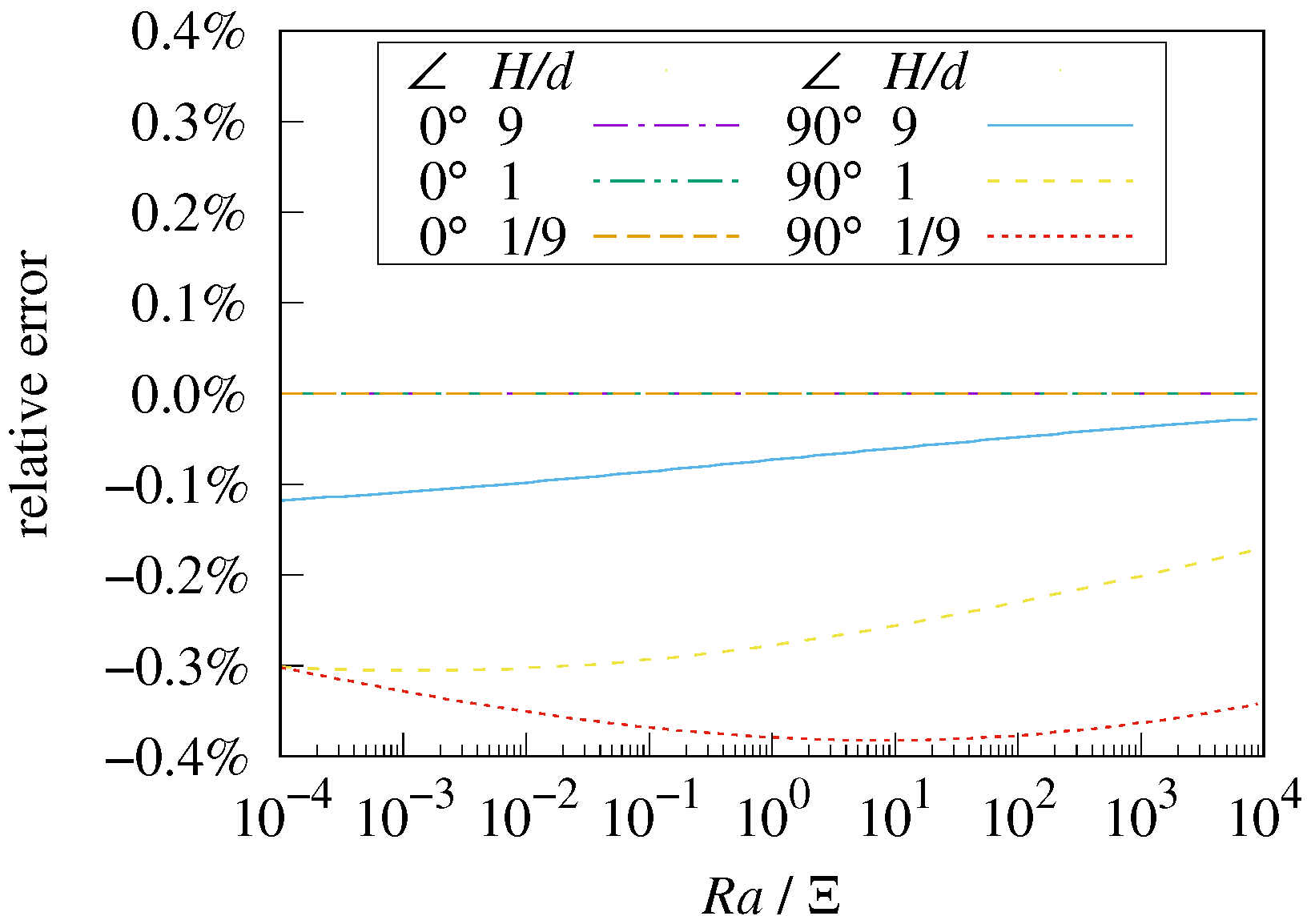
36) satisfies these constraints. Plotted in
Figure 5, its error relative to
Formula (
30) (
) is negligible; its error relative to
Formula (
31) (
) is less than 0.4% when
.
5.3. Heo and Chung
Heo and Chung [
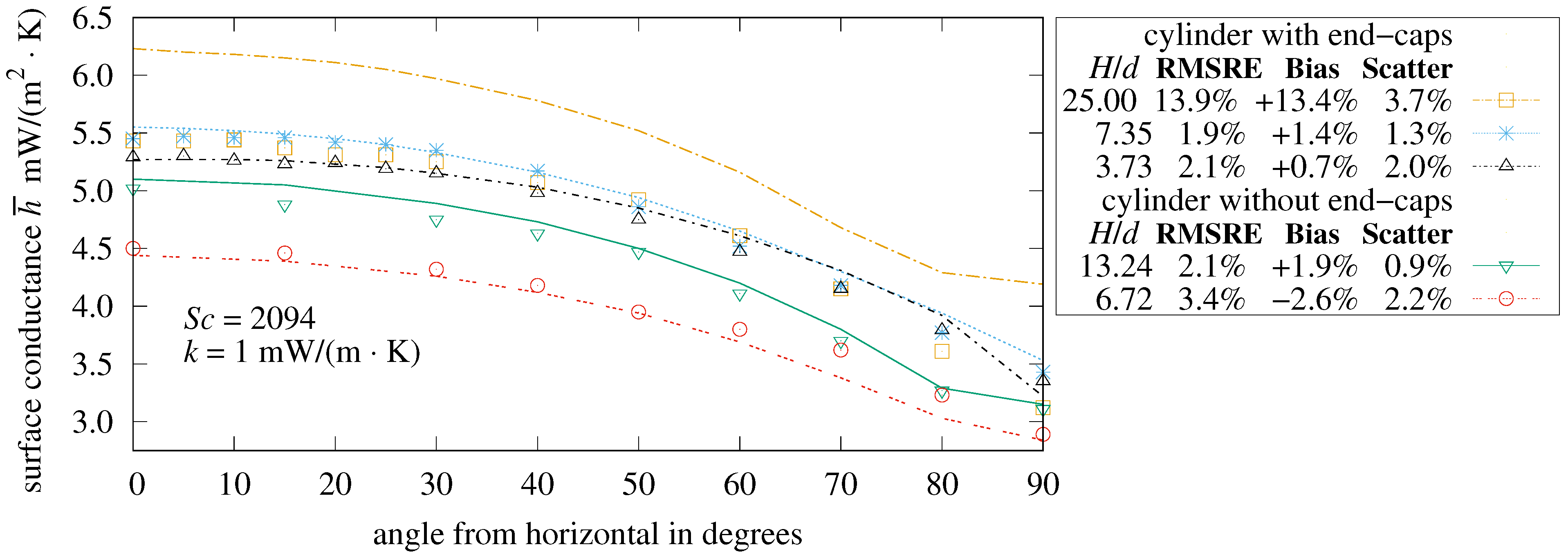
12] measured copper electroplating onto a copper cylinder in a
solution. They measured the mass transfer coefficient
, but reported their results as
and
, which scale with different characteristic lengths. The value of the mass transfer analog of
k was not reported, but for the purposes of comparing theory and measurements,
k is arbitrary if all conversions from
to
use the same
k. A value of
is used in
Figure 6.
To avoid confusion, this section uses cylinder conductance with units W/K instead of .
The cylinder and end-caps have different areas; their heat transfers must combine as conductances (W/K). The top three rows in
Figure 6 were modeled as
For the longer cylinders of the bottom two rows,
should be nearly the same as the shorter cylinders, but the measured
values for
and
are significantly smaller in
Figure 6. Modeling only the cylinder heat transfer but including its end-cap areas yields RMSRE < 3.5%:
Using their reported
, the
in their table differs from the
and
in their figure.
and
are used in the
and
curves in
Figure 6.
The parameters regarding the top row are more troubling. Their table lists for the m cylinder. Using their reported should result in . But their figures specify and for the m cylinder. Given these inconsistencies, the m cylinder is omitted from the present work’s summary statistics.
5.4. Al-Arabi and Khamis
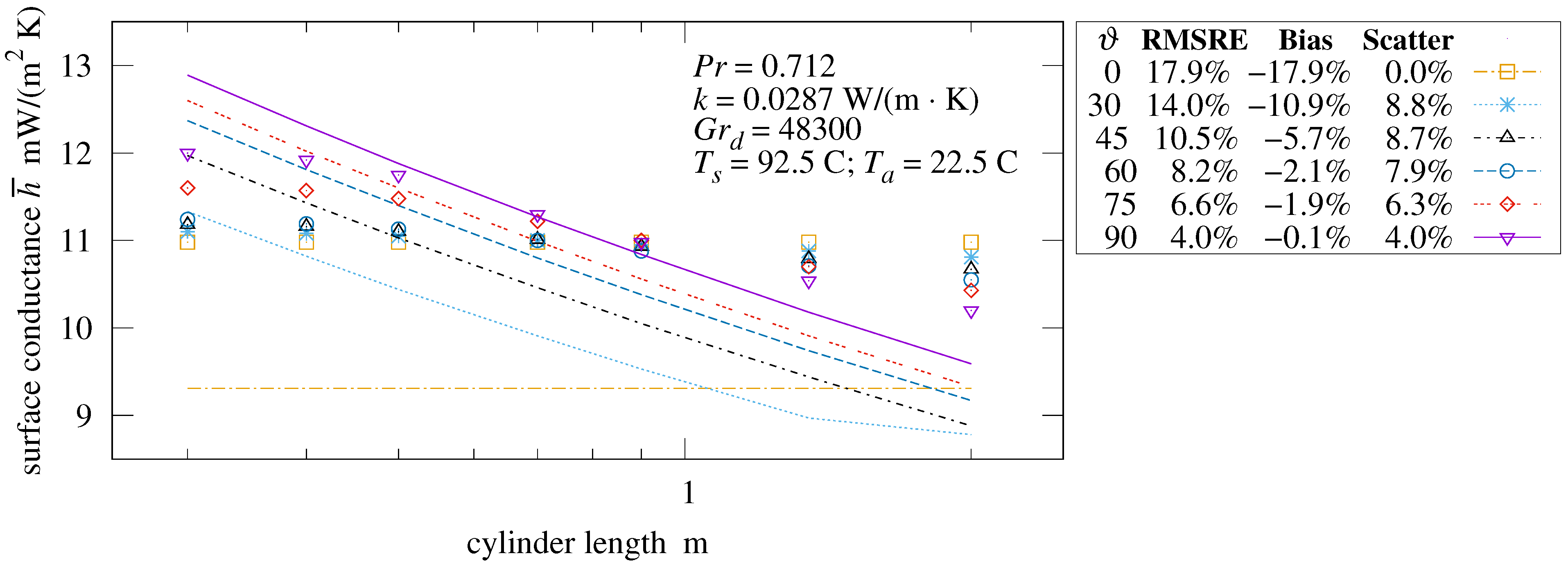
Al-Arabi and Khamis [
9] measured local heat transfer to air from a “nickel-electro-plated” brass cylinder heated by steam.
Text in their figures declares ; however, this is significantly smaller than the value this investigation computes from the average ambient conditions of Cairo, Egypt. The present work uses .
For the average thermal surface conductance they report
values instead of
, indicating that these are local surface conductances, not average. In an earlier paper, Al-Arabi and Salman [
17] report local
and
values, and claim that
and
are “practically the same”. Yet this is clearly contradicted by the second figure of that paper. The only angle for which they are the same is
.
In vertical cylinder natural convection, growth of characteristic length L corresponds to growth in the direction of fluid flow. In such systems the average heat transfer can be inferred by averaging local heat transfers at lengths .
This fails for a horizontal cylinder because its characteristic length is the cylinder’s diameter, not its length.
Figure 7 averages the
values to produce
, and confirms that this averaging works only for the vertical cylinder
. Only the vertical cylinder is included in the present work’s summary statistics.
5.5. Goldstein et al.
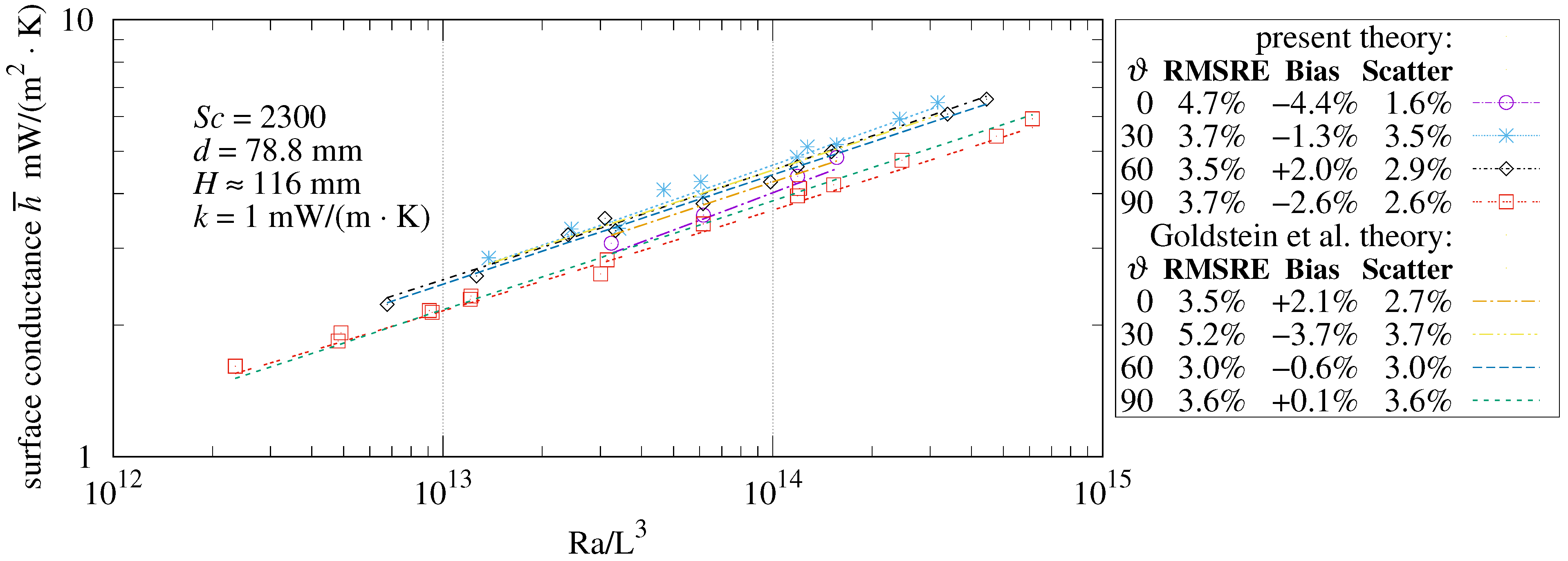
Goldstein et al. [
11] measured copper electroplating onto three cylinders at four angles in a
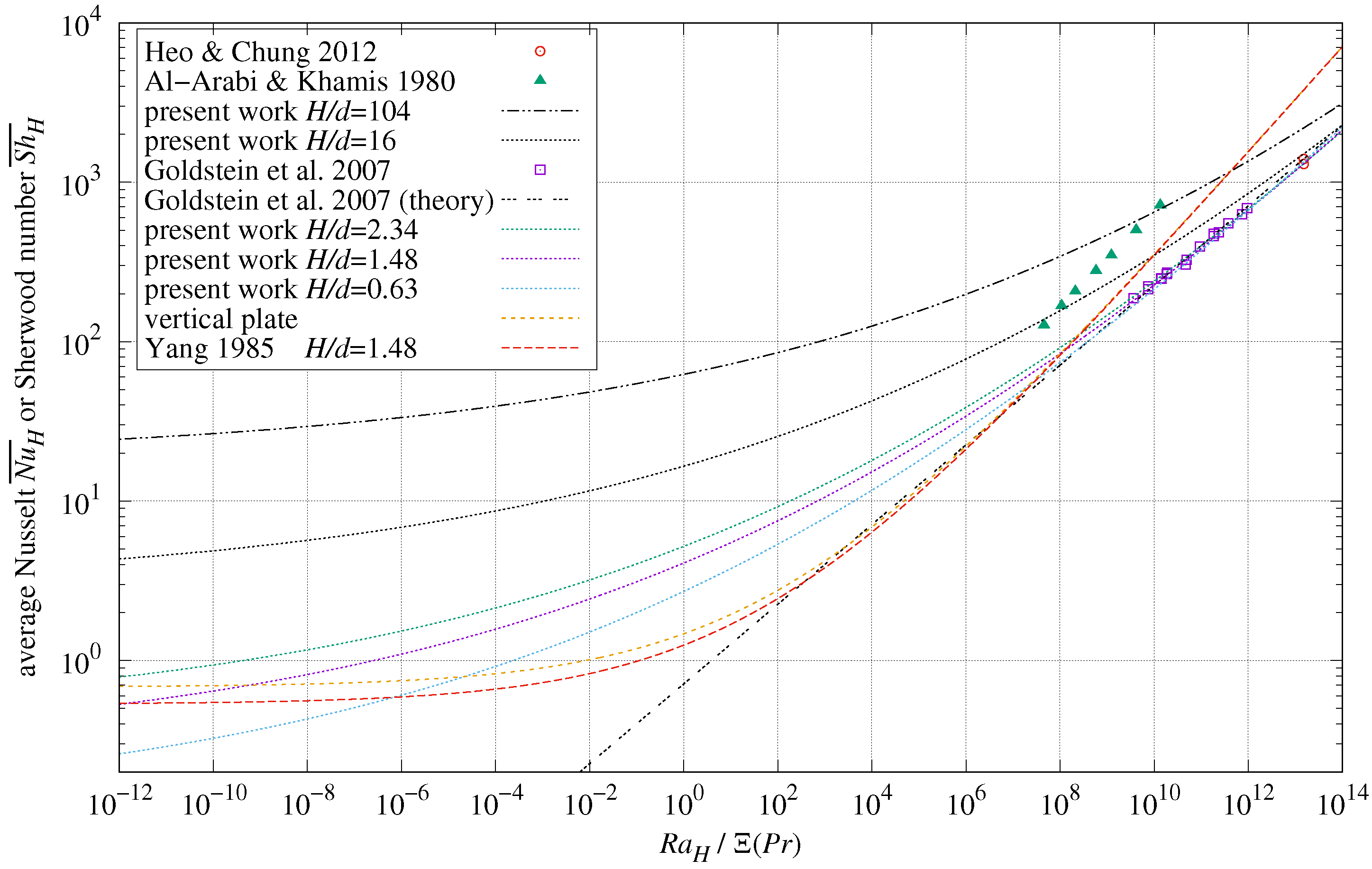
solution. The cylinders were 78.8 mm in diameter and had lengths 49.9 mm, 116.4 mm, and 184.4 mm. They presented measurements without identifying the cylinder used in each trial. The present analysis treats all as having length 116.4 mm, which succeeds because the present work’s
traces in
Figure 4 are converging above
.
The value of the mass transfer analog of
k was not reported, but for the purposes of comparing theory and measurements,
k is arbitrary if all conversions from
to
use the same
k. A value of
is used in
Figure 8.
6. Discussion
Using the thermodynamics-based analysis pioneered by Jaffer [
1], this investigation derived novel Formulas (
30), (
31) and (
36) predicting the natural convective heat transfer from level, vertical, and inclined cylinders, respectively, given length
H, diameter
d, inclination angle
,
, and the fluid’s
and
k, where
.
These formulas enable the direct calculation of cylinder convective heat-transfer estimates at any inclination, avoiding the need for measurements of experimental prototypes or finite-element computations.
End-cap heat-transfer Formulas (
32) were also proposed and tested on two of the Heo and Chung [
12] data-sets, yielding combined RMSRE less than 2.2%.
Table 8 summarizes the present theory’s conformance with 93 inclined cylinder measurements having
at angles
in nine data-sets from three peer-reviewed studies, yielding (data-set) RMSRE values between 1.9% and 4.7%.
On 57 level cylinder measurements from Churchill and Chu [
7] in
Table 9 spanning more than 20 orders of magnitude of
, the present Formula (
30) has 11% RMSRE, a significant improvement from the 21% and 19% RMSRE of prior works’ Formulas (
7) and (
8).
6.1. Laminar and Turbulent Flows
Heo and Chung [
12] claimed that natural convection from four of their five cylinders was turbulent. Goldstein et al. [
11] claimed that most of their data was for laminar natural convection, but that their single correlation was “reasonably accurate” on all their data. If they are correct about the flow modes induced by their cylinders, then the present Formula (
36)
performance in
Table 8 includes both laminar and turbulent natural convection.
in level cylinder Formula (
30) has neither the 1/4 exponent commonly attributed to laminar flow nor the 1/3 exponent attributed to turbulent flow, but an intermediate exponent of
.
6.2. Local Convective Heat Transfer
The technique of calculating average heat transfer by averaging local heat transfers at lengths works only when is constant across the width of a plate or the circumference of the cylinder. For natural convection, this is only when the plate or cylinder is vertical.
Otherwise, each
must be averaged, requiring a two-dimensional local convection model. Lacking such a model, only the vertical cylinder data-set of Al-Arabi and Khamis [
9] is valid.
Thermodynamic constraints can be powerful tools, but apply only to complete systems. While a thermodynamic constraint would be intrinsic to a perfect molecular simulation, such a simulation is impractical. Furthermore, thermodynamic constraints might well not survive the truncation errors of digital computation.
6.3. Short Cylinders
Around a short (
) level cylinder the fluid flow is not restricted to the vertical plane, resulting in larger heat transfers than predicted by Formula (
36). Formula (
36) should work for small
ratios as long as
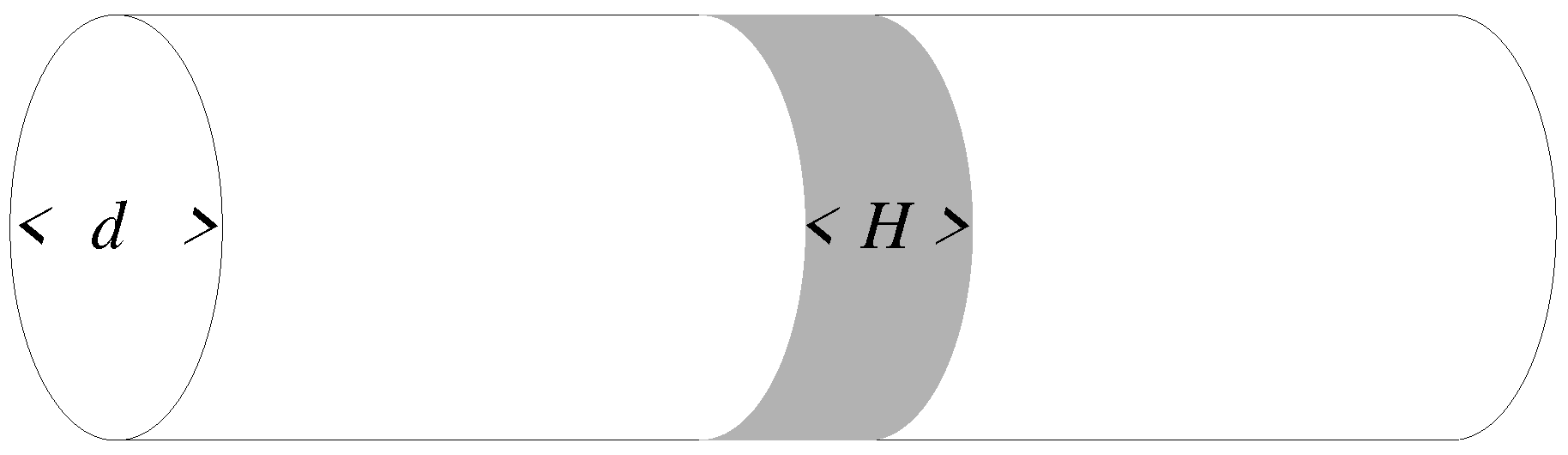
H is the width of a heated band embedded in a longer, insulated cylinder as shown in
Figure 9.
6.4. Non-Circular Cylinders
For a convex cylinder with hydraulic diameter
d, vertical Formula (
31) is expected to predict heat transfer correctly.
For a level convex cylinder,
Table 3’s natural convection parameters
B,
D, and
E need to be reevaluated.
B should be the cross-section’s perimeter length squared divided by its area.
D will be less than
B; for a circular cross-section
. Parameter
E (average bend divided by
rad) can be calculated by the method of Formulas (
24), (
25) and (
26).
If the cross-section lacks bilateral symmetry, then the convection should be calculated separately for each side of the cross-section, split along the line connecting its highest and lowest point of the cross-section.
6.5. Rough Cylinders
Jaffer and Jaffer [
22] made natural convective heat transfer measurements of a 0.305 m square plate with 3 mm root-mean-square height of roughness at angles between
and
. Those measurements matched Formula (
34) with 3% RMSRE, providing evidence that flat surface natural convection is insensitive to roughness which is much smaller than its characteristic length. A similar test conducted with a rough cylinder would ascertain whether the natural convective flows from cylinders are also insensitive.